Shared posts

02 Sep 18:22

Like They Used To

by submission

Author : C. J. Boudreau

The algae were there! In the deep permafrost. Turning up the magnification and refocusing the cam, he could see the nuclei. They were photosynthetic, the rare green color in the frozen soil. Perhaps hundreds of millions of years old. Mars was not dead! Arturo took several samples from the most populated areas. He sealed the case, and climbed back out of the ravine to the rover. He left the case in the car and went back for his remaining tools. He probably shouldn’t have been here alone but his time here was limited and he’d wanted badly to look at this site.

He was climbing out again, awkwardly, with the tools when the side of the ravine collapsed on him. He was lucky he didn’t damage his suit.

The fall back into the ravine stunned him. When he was able to appraise his condition he found himself buried. He tried his com unit and found it wasn’t working. His suit, tough, mostly carbon, told him that it was in otherwise good condition, all its heads up displays green. Most of its controls were voice op. A couple were chin switches in his helmet. A good thing, since he couldn’t move his hands. Just one foot. He ached from some bruises, but was otherwise unhurt. Someone would come looking for him soon and see the car, and his foot. His primary concern was oxygen. If he ran low, he didn’t like to think about it, but there was the Rescue Unit in his suit, Cold sleep. Not hibernation, but freezing.

He hadn’t been there long when the storm came up. Dust storms on Mars can be planet wide and last months. This one didn’t, but it was long enough. Within a few hours he and his rover were deeply buried in red dust. When his oxygen indicator showed a quarter hour left, he initiated the Rescue Unit and icy fluid roared in.

He woke cold and aching in a white room to see a pretty, but reed thin, young blonde woman leaning over him. She said “Don’t try to speak yet, just nod. Are you Doctor Arturo Hartwood?”

He nodded yes. It hurt. She turned to someone outside his field of vision and said excitedly what sounded like “Cee! Yeti Zim! Trooz!” To him, she said “Rest now, we’ll talk later.” Another woman in white, military uniform with a close fitting cap tapped something on his arm and he passed out.

Sometime later he awoke feeling somewhat better. The militaristic nurse came in, smiled at him, said something unintelligible, scanned him with a little handheld instrument and left. Then the blonde woman came in.

“Hello Doctor Hartwood, I am Dr. Enid Veeder. I’m honored to meet you.”

She’d an accent he couldn’t place.

“Hello Doctor. How long will I be here?

“I’m afraid I can’t tell you. We must ask the medics.”

“You’re not a medic?”

“No. I’m a linguist. I’m here because I speak your English.”

” No one here speaks English?”

“Not yours. You are a great celebrity. There is a statue of you in my hometown.”

“A statue to me?”

“Yes Doctor. I’m sorry your rescue took so long. They found your car and samples quickly but they couldn’t find you. Last Sixday, an aqueduct digging crew found you while checking for buried cables. Your discovery – oxygen producing native algae – made terraforming Mars practical. But your suit is amazing. It’s protected you, frozen in the permafrost, for two thousand years. They don’t make them like they used to.”

Discuss the Future: The 365 Tomorrows Forums
The 365 Tomorrows Free Podcast: Voices of Tomorrow
This is your future: Submit your stories to 365 Tomorrows


30 Aug 17:30

Phantom Limb

by submission

Author : Kate Runnels

“There,” said the doctor. “Try it now, agent Sasaki. The neural connection should be hooked in.”

Lia stared down at her cybernetic left arm, recently attached after a case went horribly wrong.

The murderer, after killing her last victim, sliced Lia’s arm, had nearly taken it off. If it hadn’t been for Ming, she’d be dead. It just didn’t feel like her limb, and yet her fingers clenched into a fist when she thought on it.

“Good.” The doctor beamed at her. “It’s responding well.”

Lia reached over with her organic right hand and felt along the seam that joined flesh to synthetic pseudo flesh material.

“That area should join and fuse together in the next few weeks. We’ll watch for any necrosis, but that shouldn’t happen. Things look good.”

Lia nodded at the doctor but her mind felt for the flesh that should be there, thinking it was there.

It wasn’t the same. It would never be the same.

Lia left the doctor’s office and went out onto the streets of Hong Kong, preoccupied- lost in her own thoughts: thoughts on the case; on her arm; on how close she had come to dying. She headed back toward the HK security agency she worked for, by routine alone. But pretty soon, she realized she was being followed. It was like an itch that wouldn’t leave and demanded attention. The person followed her.

Young, teenager, looked to be fully human without prosthetics. She turned into a coffee shop, and glanced over at him as she did so. He eyed her hungrily. No, not her, her arm. New prosthetics went for a premium on the black market.

She got her coffee and when she came out, he wasn’t in sight, but it didn’t take him long to drop on her tail. She kept walking through the streets of Hong Kong, heading in a roundabout way toward her office. She went toward the back of the building, and he came on eagerly, thinking her in his trap.

Around a corner and out of sight, she stopped and waited for him. He raced around, seeing her waiting too late to stop himself. About to run into her, he decided to tackle Lia. She swung her new left arm and it connected with his jaw.

She nimbly stepped out of the way as he hit the pavement, unconscious.

“Everything all right?” asked an Agent who had just stepped out of the building.

“Yeah. But I’ll need help taking him to lock up.”

The agent came over to help and asked, “Why’d he try to jump you?”

Lia raised her left arm. “New arm.”

“That’s right, you got cut up bad. How’s it working out?”

“Seems to be working out just fine.” Lia smiled as they hoisted the young man between them.

Discuss the Future: The 365 Tomorrows Forums
The 365 Tomorrows Free Podcast: Voices of Tomorrow
This is your future: Submit your stories to 365 Tomorrows

17 Aug 20:27

Politicians can only view secret trade pact in special viewing room

by Glyn Moody

The fact that most people have still never heard of the world's biggest trade deal—the Transatlantic Trade and Investment Partnership (TTIP) between the US and Europe—even after two years of negotiations, might suggest that whatever its problems, maintaining secrecy is not one of them. But the European Commission begs to differ: since the end of July, instead of sending up-to-the-minute summaries of its talks with the US to EU politicians, the Commission now requires that national politicians travel all the way to Brussels to a special reading room where the texts can be viewed under tight security. MEPs must also use this same system.

The EC made this rather drastic move in response to confidential TTIP documents appearing on the non-profit investigative news site Correct!v. News of this secret reading room was revealed in a confidential report of an EU meeting that took place on 24 July... which rather embarrassingly was then also leaked to the same site.

The new system is pretty insulting for top politicians, who are not used to being treated likely naughty schoolchildren that require constant adult supervision. Furthermore, considering the wide-ranging implications of TTIP, you'd think that the EC would want to make it easier for European politicians to read the latest documents, so that they know what is being negotiated in their name.

Read 7 remaining paragraphs | Comments

16 Aug 17:46

The Many Things Wrong With the Anti-Encryption Op-Ed in the New York Times

by Jenna McLaughlin

Manhattan District Attorney Cyrus Vance Jr. and his counterparts in Paris, London and Madrid took to the New York Times op-ed page Tuesday morning to pose a flawed argument against default encryption of mobile phones, a service being commercialized and implemented gradually by Apple and Google.

The op-ed misstated the extent of the obstacles to law enforcement, understating the many other ways officials bearing warrants can still collect the information they need or want — even when confronted with an encrypted, password-protected device.

The authors failed to acknowledge the value to normal people of protecting their private data from thieves, hackers and government dragnets.

And they demanded — in the name of the “safety of our communities” — a magical, mathematically impossible scenario in which communications are safeguarded from everyone except law enforcement.

Apple and Google are attempting to provide strong, reliable and user-friendly encrypted systems for their customers. A user who has installed iOS 8 on an iPhone automatically encrypts text messages, photos, contacts, call history and other sensitive data simply by using a passcode.

Android devices also include a system that encrypts downloaded files, application data, and other data with a PIN or passcode. But contrary to what the op-ed stated, that is not the default setting for most Android phones.

It’s true that when law enforcement asks for information that is encrypted with the user’s passcode, Apple and Google cannot actually deliver it. But that’s typically not the whole story.

For one: Apple, for instance, copies a lot of that data onto its own cloud servers during Wi-Fi backups, where the company can in fact access it and turn it over to law enforcement.

Plenty of other data is still available from the phone companies: SMS text messages, phone numbers called and phone calls received, and location information.

And then there’s the ability to break in. Responding to Tuesday’s op-ed, ACLU technologist Christopher Soghoian tweeted: “If law enforcement can’t hack the hundreds of millions of Android phones running out-of-date, vulnerable software, they’re not trying.”

Following the rollout of iOS 8, Lee Reiber, a cell phone forensics expert at AccessData, told Mashable that “As secure as the device can be, there’s always going to be some vulnerability that can be located and exploited.” Reiber said it’s “cat and mouse.”

The authors of the op-ed launched their argument by citing an Evanston murder investigation that they claimed was stymied by law enforcement’s inability to access the data on two phones that were found at the scene.

Unlike the laughably pathetic examples FBI Director James Comey cited in October in his argument against encryption of mobile devices, the Evanston case does actually appear to feature the rare combination of factors in which data on the phone might indeed have helped the investigation.

Ray C. Owens was shot and killed in his car in broad daylight in Evanston, Illinois, in June. Police found two phones near his body. They belonged to Owens — not the killer.

One was an iPhone 6 running on Apple’s iOS 8 operating system, the other a Samsung Galaxy S6 Edge running on Google’s Android operating system. When investigators served search warrants on Apple and Google to unlock the phones, the companies said they were unable to, because both had been password-protected.

According to Commander Joseph Dugan of the Evanston Police Department, investigators were able to obtain records of the calls to and from the phones, but those records did not prove useful. By contrast, interviews with people who knew Owens suggested that he communicated mainly through text messages — the kind that travel as encrypted data — and had made plans to meet someone shortly before he was shot.

The information on his phone was not backed up automatically on Apple’s servers — apparently because he didn’t use Wi-Fi, which backups require.

And the gun recovered two blocks away when a man fleeing police dropped it was not the gun that fired the fatal bullets, Dugan said.

So the Evanston police were stymied. “There doesn’t appear to be anything coming in the near future as far as charging anyone,” Dugan told The Intercept.

But Dugan also wasn’t as quick to lay the blame solely on the encrypted phones. “I don’t know if getting in there, getting the information, would solve the case,” he said, “but it definitely would give us more investigative leads to follow up on.”

The op-ed’s conclusion calls for an “appropriate balance between the marginal benefits of full-disk encryption and the need for local law enforcement to solve and prosecute crimes.”

But experts say there’s either a doorway in or there isn’t. And if there is, lots of other people, including criminals, can use it too.

Caption: Manhattan District Attorney Cyrus Vance Jr. at a 2014 press conference.

The post The Many Things Wrong With the Anti-Encryption Op-Ed in the New York Times appeared first on The Intercept.

16 Aug 17:37

Democrats Continue to Delude Themselves About Obama’s Failed Guantánamo Vow

by Glenn Greenwald

As everyone knows, “closing Guantánamo” was a centerpiece of the 2008 Obama campaign. In the Senate and then in the presidential campaign, Obama repeatedly and eloquently railed against the core, defining evil of Guantánamo: indefinite detention.

On the Senate floor, Obama passionately intoned in 2006: “As a parent, I can also imagine the terror I would feel if one of my family members were rounded up in the middle of the night and sent to Guantánamo without even getting one chance to ask why they were being held and being able to prove their innocence.” During the 2008 campaign, he repeatedly denounced “the Bush Administration’s attempt to create a legal black hole at Guantánamo.”

In the seventh year of Obama’s presidency, Guantánamo notoriously remains open, leaving one of his central vows unfulfilled. That, in turn, means that Democratic partisans have to scrounge around for excuses to justify this failure, to cast blame on someone other than the president, lest his legacy be besmirched. They long ago settled on the claim that blame (as always) lies not with Obama but with Congressional Republicans, who imposed a series of legal restrictions that impeded the camp’s closing.

As I’ve documented many times over the last several years, that excuse, while true as far as it goes, does not remotely prove that Obama sought to fulfill his pledge. That’s because Obama’s plans never included an end to what he himself constantly described as the camp’s defining evil: indefinite detention. To the contrary, he explicitly demanded the right to continue to imprison Guantánamo detainees without charges or trial –– exactly what made Guantánamo so evil in the first place — based on the hideous new phrase “cannot be tried but too dangerous to release.” Obama simply wanted to indefinitely imprison them somewhere else.

In other words, Obama never sought to close Guantánamo in any meaningful sense but rather wanted to relocate it to a less symbolically upsetting location, with its defining injustice fully intact and, worse, institutionalized domestically. In that regard, his Guantánamo shell game was vintage Obama: He wanted to make a pretty, self-flattering symbolic gesture to get credit for “change” (I have closed Guantánamo) while not merely continuing but actually strengthening the abusive power that made it so odious in the first place.

All of this is worth emphasizing because the close-Guantánamo controversy is back in the news as the result of what the Washington Post today, citing anonymous U.S. officials, describes as “an internal disagreement over its most controversial provision — where to house detainees who will be brought to the United States for trial or indefinite detention.” The Post said that “as part of the plan, the administration had considered sending some of the 116 detainees remaining at the prison to either a top-security prison in Illinois or a naval facility in Charleston, S.C.” Most members of Congress who love to parade around as super-tough warriors claim to be petrified about imprisoning Terrorist super-villains in their states, even though one of the few things at which the U.S. still excels is building oppressive penal institutions.

But even Obama’s current Guantánamo plan — like all his previous ones — does not seek to end indefinite detention. It does the opposite: It insists on the right to continue to indefinitely imprison detainees, most of whom have already been kept in a cage for more than a decade with no charges or trial. In that regard, Obama — as has been true since the first day of his presidency — is not seeking to “close Guantánamo” but rather relocate it, as Human Rights Watch’s Ken Roth noted today:

The ACLU also made this point from the moment Obama first unveiled his “move Guantánamo” plan and Democratic partisans pretended it was a “close Guantánamo” plan.

As the ACLU’s Ben Wizner told me in an interview back in 2009, Obama’s Guantánamo plan — long before Congress took any action — was more likely to strengthen the camp’s scheme of indefinite detention than end it, just as Obama did with so many other once-controversial Bush/Cheney War on Terror policies:

It may to serve to enshrine into law the very departures from the law that the Bush administration led us on, and that we all criticized so much. And I’ll elaborate on that. But that’s really my initial reaction to it; that what President Obama was talking about yesterday is making permanent some of the worst features of the Guantanámo regime. He may be shutting down the prison on that camp, but what’s worse is he may be importing some of those legal principles into our own legal system, where they’ll do great harm for a long time.

Obama-excusing Democrats also love to point out that even Democratic Senators such as Russ Feingold and Bernie Sanders voted for legislation blocking Obama’s Guantánamo plan, implying that even the Senate’s most liberal members wanted Gitmo to remain open. But these Obama advocates never mention that those votes were based on their concerns about Obama’s desire to simply relocate the camp to U.S. soil and thus strengthen its core injustice. And all of that is to say nothing of all the limits on closing Guantánamo, which Obama himself (not the Republicans) imposed.

In sum, it’s true that Congress impeded Obama’s Guantánamo plan. But it’s misleading in the extreme to pretend that Obama’s plan was ever about ending the core injustice of that camp. If anything, Obama’s plan would have, and if it succeeds still will, institutionalize and strengthen the Bush/Cheney scheme of indefinite detention: the very same beyond-the-law framework that made them want to open the camp, and made it a symbol of injustice around the world, in the first place.

The post Democrats Continue to Delude Themselves About Obama’s Failed Guantánamo Vow appeared first on The Intercept.

16 Aug 15:28

Bland Monster Jeb Bush “Proud” of His Brother’s Torturing People

by Jon Schwarz

Maybe you’ve seen that Jeb Bush has refused to rule out more torture if he’s elected president. But what’s gone unnoticed — perhaps because Bush is so dreary it’s hard to listen to him without losing consciousness — is he actually said he’s “proud” of his brother’s torture policies.

BUSH: I do think, in general, that torture is not appropriate. It’s not as effective, uh, and the change of policy that my brother did and was then put into executive order form by the president was the proper thing to do. I also would say that right after 9/11, I mean, we were attacked, and, uh, my presid — my brother — and I’m not saying this because I’m a Bush, I’m saying this because I love this country just like everybody in this room — I’m proud of what he did to create a secure environment for our country.

Here are just a few of the things that Jeb Bush is “proud” of:

• The torture of people who were victims of mistaken identity. This included Khalid el-Masri, a German citizen, who was picked up in Macedonia while on vacation and then flown to Afghanistan’s “Salt Pit” black site, where the CIA proudly tortured him. When the CIA realized they had the wrong person, they flew him to Albania and proudly dumped him on the side of the road. The Senate Intelligence Committee’s report on torture made a “conservative calculation” that 22 percent of the CIA detainees were cases of proud, mistaken identity.

• Around 100 U.S. prisoners died during interrogations. A CIA interrogator proudly told a detainee he would never go on trial because “we can never let the world know what I have done to you.”

• The proud tradition of waterboarding, proudly embraced by his brother, was also a favorite torture method of Imperial Japan during World War II, Latin American dictatorships, and Cambodia’s genocidal Khmer Rouge. The U.S. convicted a Japanese officer of war crimes for using it. Many of the torture techniques used by the CIA and the military were proudly modeled on Chinese Communist techniques used during the Korean War to obtain false confessions from American prisoners.

• The CIA proudly subjected at least five prisoners to “rectal rehydration” or “rectal feeding.” According to the Senate report, one prisoner’s lunch of “hummus, pasta with sauce, nuts, and raisins was ‘pureed’ and rectally infused,” thus creating a secure environment for our country.

• An FBI interrogator explained in 2008 that U.S. torture policies had proudly “helped to recruit a new generation of jihadist martyrs” and predicted that “a day of reckoning will come.” Cherif Kouachi, one of the two brothers who killed the staff of Charlie Hebdo, was motivated to become a jihadist by the U.S. torture of prisoners at Abu Ghraib.

Despite all this, it should not go unnoticed that during Bush’s pro-torture remarks he was wearing a very nice, understated tie.

The post Bland Monster Jeb Bush “Proud” of His Brother’s Torturing People appeared first on The Intercept.

16 Aug 04:10

Chelsea Manning having troubles with military brig authorities

by David Kravets

Chelsea Manning, serving a 35-year term for leaking classified military documents to WikiLeaks, is having some run-ins with the authorities at the military brig at Fort Leavenworth in Kansas.

Supporters said Manning is to have an August 18 hearing over having unauthorized books and toothpaste and some minor scrapes with prison guards. The Chelsea Manning Support Network said the woman could be handed solitary confinement because of the infractions:

Chelsea faces this incomprehensibly severe punishment as a result of ridiculously innocuous institutional offenses, including the possession of books and magazines related to politics and LBGTQ issues (which she received openly via the prison mail system), and having a tube of toothpaste that was past its expiration date–deemed “medical mis-use”. The catalyst for this attack on Chelsea seems to have been an incident in the mess hall where she may have brushed, or accidentally knocked, a tiny amount of food off of her table. When aggressively confronted by a guard, she asked to speak to her lawyer.

The reading contraband, the support network said, included "a novel about transgender issues, the book 'Hacker, Hoaxer, Whistleblower, Spy — The Many Faces of Anonymous,' the book 'I am Malala,' an issue of Cosmopolitan magazine containing an interview with Manning and the US Senate report on CIA torture."

Read 2 remaining paragraphs | Comments

16 Aug 04:06

MeFi: Bulldog + box

by mudpuppie
Scientifically minded bulldog seeks to answer the age-old question: "Is it possible to walk around holding a box in front of your face?"

Answer: Not really.

Trigger warning: Filmed in portrait mode.
16 Aug 01:06

Canadian Goose Befriends Pickup Truck

by Don
Bb4

This bizarre wild Canadian goose follows a pickup truck all the way to the Shinning Bank Lake in Alberta, Canada, where it seems to have finally found peace.

15 Aug 19:24

Retro Games Can Still Make You Tons Of Money

by Kevin Wong

Retro Games Can Still Make You Tons Of Money

The retro gaming industry continues to explode.

CNN reported on the secondary market for vintage games, and the dusty, old cartridges sitting in your mom’s attic are increasing in value — sometimes by twice of what they were valued at years ago. Even The Legend of Zelda, a ‘common game’ that sold for a respectable $12 a few years ago, can now fetch a dealer $25. Rarer games and systems can sell for thousands. One such dealer, Giulio Graziani, discussed the changing times.

Graziani, 50, has been in business since 2003, but says the market only recently began to spike. “Five years ago, I could drive through Texas and stop in little towns and buy everything,” he says. “Now they’re selling games out there for more than I do!”

One might think that online stores, such as the Virtual Console, would drive prices down for these games, due to supply-and-demand. But so far, it doesn’t seem to have had an effect upon demand. Perhaps there’s something to be said for permanent, tactile ownership. And when even the most popular classic games aren’t available through the official outlets, the alternatives must feel tempting.

Advertisement

Image Credit: VentureBeat

Kevin is an AP English Language teacher and freelance writer from Queens, NY. His focus is on video games, American pop culture, and Asian American issues. Kevin has also been published in VIBE, Complex, Joystiq, Salon, PopMatters, WhatCulture, and Racialicious. You can email him at kevinjameswong@gmail.com, and follow him on Twitter @kevinjameswong.

This entry passed through the Full-Text RSS service - if this is your content and you're reading it on someone else's site, please read the FAQ at fivefilters.org/content-only/faq.php#publishers.

15 Aug 16:13

University of North Texas mug

by Rob Beschizza
mug

$10. Designs to reconsider. [h/t Karen!]

This entry passed through the Full-Text RSS service - if this is your content and you're reading it on someone else's site, please read the FAQ at fivefilters.org/content-only/faq.php#publishers.

14 Aug 23:37

Finally, Someone Defeats the Candy Bar!

by Ari Spool
8df

That seemingly indestructible Nokia 3310 mobile phone finally gets what it deserves: a good old-fashioned red hot nickel ball application.

14 Aug 19:53

MeFi: The Web We Have to Save.

by advil
Bewarethewumpus

From the comments:

"If you have to put a date on when the Old Web died, July 1, 2013 is as good as any."

The Web We Have to Save. SLhoder: "The rich, diverse, free web that I loved — and spent years in an Iranian jail for — is dying. Why is nobody stopping it?" (h/t mkb, via ...uh... facebook.)
14 Aug 17:05

If you’ve been waiting to play Fallout Shelter on Android, today’s the day you can finally get it.

by Evan Narcisse

If you’ve been waiting to play Fallout Shelter on Android, today’s the day you can finally get it. You can grab it on the Google Play store.


Contact the author at evan@kotaku.com.

This entry passed through the Full-Text RSS service - if this is your content and you're reading it on someone else's site, please read the FAQ at fivefilters.org/content-only/faq.php#publishers.

14 Aug 16:27

Hillary Clinton on the Sanctity of Protecting Classified Information

by Glenn Greenwald

It turns out that at least two of the emails which traversed Hillary Clinton’s personal email account and server were “top secret,” according to the inspector general for the Intelligence Community as reported by McClatchy. To describe that as reckless is an understatement given that, as AP notes, “There is no evidence she used encryption to shield the emails or her personal server from foreign intelligence services or other potentially prying eyes.” The FBI has now taken possession of that server.

When it comes to low-level government employees with no power, the Obama administration has purposely prosecuted them as harshly as possible to the point of vindictiveness: It has notoriously prosecuted more individuals under the Espionage Act of 1917 for improperly handling classified information than all previous administrations combined. 

NSA whistleblower Tom Drake, for instance, faced years in prison, and ultimately had his career destroyed, based on the Obama DOJ’s claims that he “mishandled” classified information (it included information that was not formally classified at the time but was retroactively decreed to be such). Less than two weeks ago, “a Naval reservist was convicted and sentenced for mishandling classified military materials” despite no “evidence he intended to distribute them.” Last year, a Naval officer was convicted of mishandling classified information also in the absence of any intent to distribute it.

In the light of these new Clinton revelations, the very same people who spent years justifying this obsessive assault are now scampering for reasons why a huge exception should be made for the Democratic Party front-runner. Fascinatingly, one of the most vocal defenders of this Obama DOJ record of persecution has been Hillary Clinton herself.

In December 2011, Chelsea Manning’s court-martial was set to begin. None of the documents at issue in that prosecution was “top secret,” unlike the documents found on Hillary Clinton’s server. Nonetheless, the then-secretary of state convened a press conference to denounce Manning and defend the prosecution. This is what she said:

If his case goes to trial and he is convicted, Manning could face life in prison. The government has said it would not seek the death penalty.

Secretary of State Hillary Rodham Clinton called Manning’s alleged actions damaging and unfortunate in remarks to reporters at the State Department on Thursday.

“I think that in an age where so much information is flying through cyberspace, we all have to be aware of the fact that some information which is sensitive, which does affect the security of individuals and relationships, deserves to be protected and we will continue to take necessary steps to do so,” Clinton said.

Manning was convicted and sentenced to 35 years in prison. At the time, the only thing Hillary Clinton had to say about that was to issue a sermon about how classified information “deserves to be protected and we will continue to take necessary steps to do so” because it “affect[s] the security of individuals and relationships.”

That was during the time that she had covertly installed a non-government server and was using it and a personal email account to receive classified and, apparently, even top-secret information. While there’s no evidence she herself placed those documents on the server or sent them herself, it is her use of a personal server and email account that — quite predictably — caused the vulnerability.

It goes without saying that the U.S. government wildly overclassifies almost everything it touches, even the most benign information. As former CIA and NSA Director Michael Hayden said in 2010, “Everything’s secret. I mean, I got an email saying ‘Merry Christmas.’ It carried a top secret NSA classification marking.”

For that reason, almost all of these prosecutions for mishandling classified information have been wildly overzealous, way out of proportion to any harm they caused or could have caused, certainly out of proportion to the actual wrongdoing.

But that’s an argument that Hillary Clinton never uttered in order to object as people’s lives and careers were destroyed and they were hauled off to prison. To the contrary, she more often than not defended it, using rationale that, as it turns out, condemned herself and her own behavior at least as much as those whose persecution she was defending.

The post Hillary Clinton on the Sanctity of Protecting Classified Information appeared first on The Intercept.

14 Aug 16:22

Hunger-Striking Detainee Tests Obama’s Will to Close Guantánamo

by Murtaza Hussain

Since the age of 23, Tariq Ba-Odah has been detained at the U.S. prison facility at Guantánamo Bay. Never charged with a crime, Ba-Odah went on hunger strike eight years ago to protest his indefinite detention, as well as the brutal treatment he is alleged to have suffered at the hands of his captors.

Now a 36-year-old man, Ba-Odah weighs less than 75 pounds. Despite having been cleared for release by a multi-agency review board in 2009, he remains behind bars with his release still a subject of legal wrangling by the Obama administration. In response to his rapidly deteriorating physical condition, his lawyers recently filed a petition for habeas corpus, citing the U.S. government’s legal obligations to free seriously ill prisoners.

Last week, Justice Department lawyers asked for an extension in the deadline to respond to his habeas filing. A New York Times article published at the time cited an interagency conflict between the State Department and Department of Defense as contributing to Ba-Odah’s continued legal predicament. An article published Monday by the Daily Beast, citing anonymous White House sources, purported to explain the nature of this dispute further, suggesting that Defense Secretary Ash Carter is refusing to sign release orders for the 52 Gitmo prisoners who have been cleared for repatriation or resettlement, not wanting to take responsibility for their possible future actions.

Both the Department of Justice and the Department of Defense declined to comment to The Intercept on the specifics of Ba-Odah’s case, while the DoD stated, “We are taking all practicable steps to reduce the detainee population at Guantánamo. … Unfortunately, this process can be slowed unnecessarily by burdensome legislative provisions.”

Omar Farah, a lawyer with the Center for Constitutional Rights, which is representing Ba-Odah, says that the responsibility for his continued incarceration lies with President Obama. “For so long the president has complained that Congress has tied his hands on Guantánamo, but this is a case where he could directly and unilaterally instruct the Department of Justice to not contest Ba-Odah’s habeas petition and he has refused to do it,” Farah says. “We will know how serious Obama is on Friday when the Department of Justice either agrees not to contest Ba-Odah’s case, or fights on Obama’s behalf to hold him at Guantánamo even longer despite his desperate condition.”

The Pentagon Monday said that it was planning to submit a proposal for the closure of Guantánamo for congressional approval, following the August recess. Any such proposal, however, would have to be predicated on rapidly releasing prisoners, like Ba-Odah, who have already been cleared for release. The dispute over Ba-Odah calls into question this plan.

The heart of the dispute in Ba-Odah’s case is believed to be his physical deterioration, which is the result of a hunger strike. Like several other Guantánamo prisoners, Ba-Odah has refused to eat or drink, in protest of his continued indefinite detention. In response, the government has for years subjected him to a force-feeding procedure that it maintains is both healthy and medically appropriate. The government has also fought tenaciously to keep it from public scrutiny.

Last month, a frustrated judge ordered the government to release video footage of the feeding sessions, characterizing repeated government appeals on this issue as “frivolous.”

There is precedent for releasing prisoners in grave medical condition. In 2013, Ibrahim Othman Ibrahim Idris was released from Guantánamo on medical grounds, after the government chose not to oppose a habeas petition by his lawyers that cited his “severe long-term mental illness and physical illness.” However, to do the same in Ba-Odah’s case would amount to an admission by the government that its controversial force-feeding program is ineffective at keeping hunger-striking prisoners in proper physical health. Despite force-feeding Ba-Odah for years, he is wasting away, with doctors stating that his body is cannibalizing its own internal organs for sustenance.

Farah says that on his last visit to see him in July, Ba-Odah was in “disastrous” physical condition, and that continued government contestation of his habeas petition could end up being tantamount to a death sentence. “The government has maintained that it can maintain the health of hunger-striking prisoners by force-feeding them, something that Ba-Odah’s condition clearly disproves,” Farah says. “His case in particular brings to light some of the darkest failings of Guantánamo.”

Caption: U.S. Army Military Police escort a detainee to his cell, Camp X-Ray.

The post Hunger-Striking Detainee Tests Obama’s Will to Close Guantánamo appeared first on The Intercept.

14 Aug 16:17

Jeb Bush, Hosted By Defense Contractor-Backed Group, Calls Iraq War “A Pretty Good Deal”

by Lee Fang

Republican presidential candidate Jeb Bush said today that the U.S.-led invasion of Iraq to topple Saddam Hussein was a “pretty good deal.”

Bush was speaking at an event sponsored by Americans for Peace, Prosperity and Security (APPS), a group formed and backed by a number of people associated with major defense contractors.

Video of Bush’s remark was posted online by an attendee of the event:

According to journalist Alan He, Bush also criticized efforts to reform the National Security Agency’s dragnet metadata surveillance program, telling the audience that it was a “mistake to repeal the metadata provisions of the Patriot Act.”

As The Intercept previously reported, the APPS is advised by Raytheon’s Stephen Hadley, BAE Systems’ Rich Ashooh, former SAIC chief executive Walt Havenstein, among other defense contractors and defense industry lobbyists. APPS was formed earlier this year as a pressure group to “help elect a president who supports American engagement and a strong foreign policy.”

APPS, a 501(c)(3) nonprofit, does not disclose its donor information. The chairman of the group, former House Intelligence Committee Chairman Rep. Mike Rogers, R-Mich., a hawkish politician who has called for greater U.S. military involvement in a number of conflicts around the world, now works for a number of private interests, though he has refused to disclose them.

Costs associated with the war in Iraq, including medical treatment for war veterans, could grow to more than $6 trillion over the next decade, according to a study by the Watson Institute for International Studies at Brown University. The war killed at least 134,000 Iraqi civillians, as well as nearly 8,000 U.S. forces and contractors, according to the study.

The period following 9/11, including the war in Iraq, has been a boon for the defense contracting industry. From 2001 through 2010, the stock prices of major defense firms surged 67 percent as the U.S. increased defense spending to manage the wars in Iraq and Afghanistan, as well new homeland security spending.

The post Jeb Bush, Hosted By Defense Contractor-Backed Group, Calls Iraq War “A Pretty Good Deal” appeared first on The Intercept.

14 Aug 14:17

Comic: Freaks And Beaks

by tycho@penny-arcade.com (Tycho)
New Comic: Freaks And Beaks
14 Aug 04:27

HOW DO YOU KNOW

Bewarethewumpus

Pretty sure that's Chris Pratt.

dinosaur,hilarious,jesus,noah,Raptor

HOW DO YOU KNOW that isn't noah? I don't see a name tag...

Submitted by: DeCoria

Tagged: dinosaur , hilarious , jesus , noah , Raptor
14 Aug 04:25

Anatomy of a Melee Fox

by Brad
Eb0
14 Aug 03:10

Twitch Goes Too Far, Tries To Play Dark Souls

by Mark Serrels

Twitch Goes Too Far, Tries To Play Dark Souls

Twitch famously played through Pokemon. And Metal Gear. But that’s given them false confidence. The hive mind has grown drunk on power.

They think they can beat Dark Souls. They can’t. Surely they can’t. They’ve gone too far this time.

Twitch Goes Too Far, Tries To Play Dark Souls

Advertisement

But holy hell, they’re going to try. Seriously, if they can get past the first boss I’ll be absolutely amazed.

I’ve been watching it for the last 15 minutes or so. They accidentally went into the settings and got lost. That was awkward. Now they’re trying to create a character. His name is ‘otwasd’.

[embedded content]

Okay, it looks like they’ve accidentally chosen the cleric class. Oh dear.

This is unmissable. This is must see TV. Can’t wait to see how it plays out. It’s not possible. They’re struggling with the menu. How in the hell are they gonna beat Ornstein & Smough?


This post originally on Kotaku Australia, where Mark Serrels is the Editor. You can follow him onTwitter if you’re into that sort of thing.

This entry passed through the Full-Text RSS service - if this is your content and you're reading it on someone else's site, please read the FAQ at fivefilters.org/content-only/faq.php#publishers.

13 Aug 14:51

Episode 1235: Recast

Bewarethewumpus

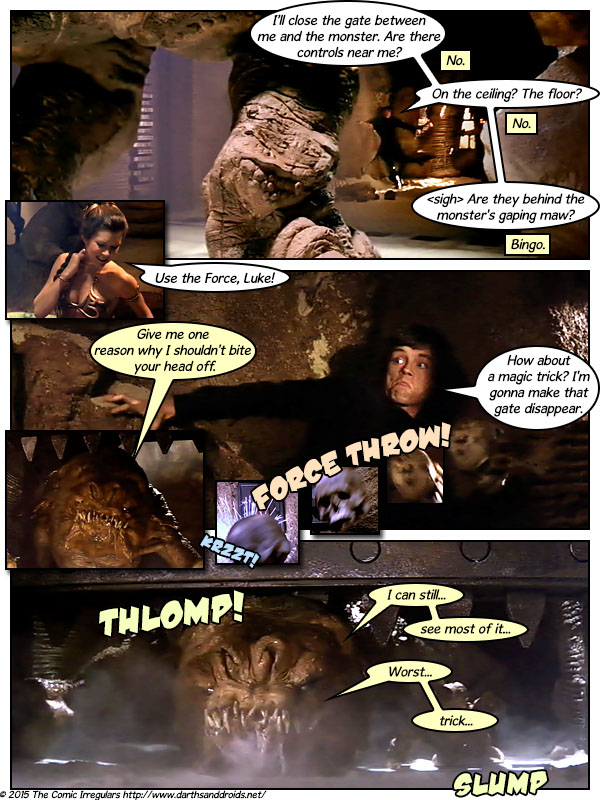
Huh, I always thought it was a rock too.

Episode 1235: Recast

We thought Luke threw a rock, right up to the point where I started getting screengrabs to make this strip. Turns out what he throws at the door control is a skull! Who knew?

See, it's always cool to have skulls around as random dungeon dressing.

12 Aug 22:41

Chelsea Manning threatened with 'indefinite solitary confinement' for expired toothpaste and asking for a lawyer

by Trevor Timm
chelsea

Whistleblower Chelsea Manning, who is currently serving an unjust thirty-five year jail sentence and who has already been tortured under US military supervision, is now being threatened with "indefinite solitary confinement" for alleged infractions that are so minor it's actually hard to believe.

Our friends at Fight to the Future have created a petition where you can sign on to a letter condemning the US Army's treatment of Chelsea.

According to the Army, Chelsea swept food onto the floor in the prison mess hall (unclear if it was an accident or on purpose). Then, when pulled aside about the incident by a corrections officer afterwards, she said, among other things, "I want a lawyer." Afterwards, prison officials found "prohibited" books and magazines in her cell, including the now famous Vanity Fair with Caitlyn Jenner on the cover. She was also charged with having "expired toothpaste" in her possession. For this, she faces "indefinite solitary confinement."

This may sound like an exaggeration, but it's not. Below are the actual charges, word for word, from the Army.

manning_charges51

Solitary confinement, as even Supreme Court Justice Anthony Kennedy recently wrote, is a barbaric punishment that can drive prisoners mad—yet thousands of prisoners are subject to it in the United States per year. As Fight to the Future states, even if these charges against Manning are 100% true, it is no reason to throw a person in solitary confinement for an indefinite period and is a violation of anyone's human rights - whether they are a whistleblower or anyone else.

It should go without saying that the Army should drop these frivolous charges immediately.

We are taking donations to Chelsea Manning's legal fund as she tries to fight her conviction under the Espionage Act. You can donate here.

This entry passed through the Full-Text RSS service - if this is your content and you're reading it on someone else's site, please read the FAQ at fivefilters.org/content-only/faq.php#publishers.

12 Aug 15:38

Oracle security chief to customers: Stop checking our code for vulnerabilities [Updated]

by Sean Gallagher

Oracle's chief security officer is tired of customers performing their own security tests on Oracle software, and she's not going to take it anymore. That was the message of a post she made to her corporate blog on August 10—a post that has since been taken down.

Perhaps thinking that all the security researchers in the world were busy recovering from Black Hat and DEF CON and would be somehow more pliant to her earnest message, Mary Ann Davidson wrote a stern message to customers entitled "No, You Really Can't" (here in Google's Web cache; it's also been reproduced on SecLists.org in the event that Oracle gets Google to remove the cached copy). Her message: stop scanning Oracle's code for vulnerabilities or we will come after you. "I’ve been writing a lot of letters to customers that start with 'hi, howzit, aloha'," Davidson wrote, "but end with 'please comply with your license agreement and stop reverse engineering our code, already.'"

Davidson scolded customers who performed their own security analyses of code, calling it reverse engineering and a violation of Oracle's software licensing. She said, "Even if you want to have reasonable certainty that suppliers take reasonable care in how they build their products—and there is so much more to assurance than running a scanning tool—there are a lot of things a customer can do like, gosh, actually talking to suppliers about their assurance programs or checking certifications for products for which there are Good Housekeeping seals for (or “good code” seals) like Common Criteria certifications or FIPS-140 certifications."

Read 8 remaining paragraphs | Comments

12 Aug 14:55

Japanese Fan Comics Could Die Under New Trade Deal

by Brian Ashcraft

Japanese Fan Comics Could Die Under New Trade Deal

“Doujinshi” (同人誌) is Japanese for fan-created, self-published comics, magazines, and novels. While Japan has strict copyright laws, doujinshi tend to get a free pass and flourish. A new trade agreement could change that forever.

Doujinshi is a proving ground for new artists, who can create a name for themselves through their self-published works and make the leap from amateur to pro. The country’s biggest geek event, Comiket, is centered around doujinshi. Fans line up to buy independently produced parodies of famous manga and starring popular characters.

Copyright holders typically turn a blind eye to doujinshi, knowing it’s where future manga artists often get their start. But under the Trans-Pacific Partnership (TPP), that still might not stop the police from going after doujinshi creators for violating copyright law.

Advertisement

TPP is proposed trade deal with twelve countries possibly participating, including the U.S., Canada, Mexico, Japan, South Korea, Taiwan, the Philippines, Thailand, Australia, and Colombia, among others. China is currently not part of the TPP negotiations.

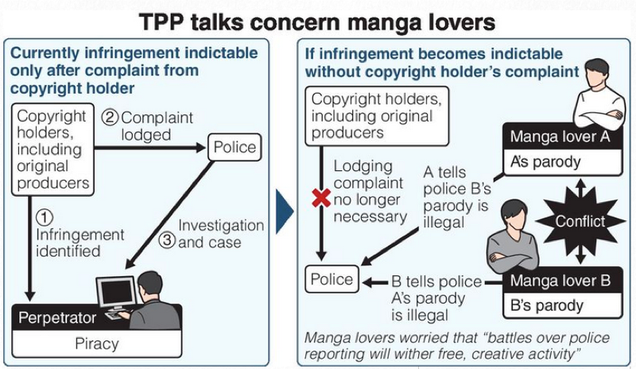
As The Yomiuri Shimbun explains, current Japanese copyright law dictates that violations can only be investigated once the copyright holder files a complaint. No complaint means no investigation.

TPP, however, aims to streamline the process so that the copyright holder does not have to file. A third party can report copyright violations. The reason, The Yomiuri Shimbun notes, is that U.S. companies often experience copyright violations and this TPP provision would combat those.

The rub is that by giving third parties the ability to report copyright violations, fans or rival doujinshi creators could start ratting people out to the authorities. See the below image, via The Yomiuri Shimbun:

Japanese Fan Comics Could Die Under New Trade Deal

According to The Yomiuri Shimbun, a person involved in the TPP negotiations said that the copyright provision will allow for a degree of parody.

“If creators can be prosecuted without complaints from rights holders, it could lead to some kind of snitching battle between fans,” said manga artist Ken Akamatsu, who started out in doujinshi. “Places for people to share their work will also disappear.”

Top photo: Keith Tsuji / Stringer | Getty

To contact the author of this post, write to bashcraftATkotaku.com or find him on Twitter@Brian_Ashcraft.


Kotaku East is your slice of Asian internet culture, bringing you the latest talking points from Japan, Korea, China and beyond. Tune in every morning from 4am to 8am.

This entry passed through the Full-Text RSS service - if this is your content and you're reading it on someone else's site, please read the FAQ at fivefilters.org/content-only/faq.php#publishers.

12 Aug 00:02

US lobbying for TPP to lock up clinical trial data

by Cory Doctorow


Copyright only extends to creative works, not facts, meaning that clinical trial data (and other data sources) are in the public domain as soon as they're published -- unless governments create special "sui generis" rights to scientific research data.

One of the key issues holding up the negotiations over the secretive Trans Pacific Partnership is "data exclusivity" in which the US Trade Rep is demanding that its powerful biologics industry (which produces medicines from living organisms) gets 12 years' worth of exclusive rights to use and publish clinical research data (for comparison, the first sui generis rights to data endured for six months).

This despite the fact that the Obama administration -- for whom the US Trade Rep works -- has been trying to shorten the monopoly over biologics trial data to seven years.

As Glyn Moody writes at Techdirt: "what clinical trials produce is safety data about a drug, which is simply a certain kind of scientific fact concerning a particular complex compound, as unchanging as all its other features. It is not something that depends on the ingenuity of the person measuring it, because it represents intrinsic information about a substance. Granting data exclusivity is thus nothing less than giving a monopoly on knowledge itself, since it forbids any other company from being able to use that newly-established scientific fact."

Eight years of data exclusivity won’t be an appealing option for any of the other TPP countries, with the exception of Japan and Canada, which already allow for eight years. New Zealand’s trade minister recently faced outrage at home over admissions that the cost of medicines may be expected to increase after the agreement. The country’s opposition, also Labor, has declared it won’t support a deal that raises the costs of medicines.

The US stance itself is contradictory as the Obama administration has been trying to reduce the exclusivity period for biologics to seven years, to speed up the availability of cheaper alternatives and save an estimated US$16 billion in the next decade.

It seems clear to everyone except US negotiators – and biopharmaceutical industry lobbyists – that the demand for extending data exclusivity for biologics needs to be dropped if the TPP is to be finalised.

How the battle over biologics helped stall the Trans Pacific Partnership [Deborah Gleeson & Ruth Lopert/The Conversation]

(via Techdirt)

(Image: data.path Ryoji.Ikeda - 4, r2hox, CC-BY-SA)

This entry passed through the Full-Text RSS service - if this is your content and you're reading it on someone else's site, please read the FAQ at fivefilters.org/content-only/faq.php#publishers.

11 Aug 23:59

"I Put on My Robe and Wizard Hat"

by Don
Bewarethewumpus

NSFW, I guess.

924

Need some tips on how to properly cyber? Bloodninja has you covered.

11 Aug 05:28

Larry Lessig considers running for the Democratic presidential nomination

by Cory Doctorow
Bewarethewumpus

I'd vote for him.

He'll be a "referendum candidate": if elected, he'll immediately pass campaign-finance reform, then resign.

Specifically, he'll pass the "Citizen Equality Act," which increases access to voting, shifts to citizen-funded elections, and de-gerrymanders the Congressional districts.

By running as a "referendum candidate" who'll do just one thing, then resign, Lessig is paving the way for Republicans who're disgruntled at electoral corruption (including Tea Party members) to vote Democrat for the purpose of changing, all at once, how government works.

He's soliciting donations, and aiming to raise $1M by Labor Day, or he'll scrap the project and return everyone's money.

The Citizen Equality Act is presented here as a template for three fundamental reforms that must happen if we are to have equal citizens. We are presenting this package now, pointing to the proposed legislative source for each element. If the campaign is launched after Labor Day, then in the fall, we will crowdsource a process to complete the details of this reform, and turn it into proposed legislation by January 1. At this point, you should read the act as embracing at a minimum the reforms included within the source for each element:

Equal Right to Vote
We must have a system that guarantees a meaningfully equal freedom to vote. To achieve that, we must at a minimum enact the Voting Rights Advancement Act of 2015 and the Voter Empowerment Act of 2015. We should as well add automatic registration, and shift election day to a national holiday.

Equal Representation
Equal citizens must have equal representation in Congress. That means, districts must be drawn, and election systems structured, so as to give each citizen as close to equal political influence as possible. FairVote has offered the most comprehensive solution to achieve this equality. At a minimum, the Citizen Equality Act would incorporate their proposed “Ranked Choice Voting Act,” which ends political gerrymandering and creates multi-member districts with ranked choice voting for Congress.

Citizen Funded Elections
A core corruption of our political system is the concentration of funders of political campaigns. That concentration creates extraordinary inequality. The Citizen Equal Act would end that inequality, at a minimum by adopting a campaign funding proposal that is a hybrid between John Sarbanes’ Government by the People Act, and Represent.US’s “American Anti-Corruption Act.” That hybrid would give every voter a voucher to contribute to fund congressional and presidential campaigns; it would provide matching funds for small-dollar contributions to congressional and presidential campaigns. And it would add effective new limits to restrict the revolving door between government service and work as a lobbyist.

Lessig 2016 | Referendum For Citizen Equality

(Thanks, Brian!)

This entry passed through the Full-Text RSS service - if this is your content and you're reading it on someone else's site, please read the FAQ at fivefilters.org/content-only/faq.php#publishers.

11 Aug 00:52

The Mother Of All GTA V Crashes

by Luke Plunkett

The Mother Of All GTA V Crashes

When Hoosker Don’t crashed his bike playing GTA V, he probably figured—as the opening seconds of this video suggest—that he’d just get up and get another vehicle. No big deal. Oh, how wrong he was.

Before too long, the game’s driving AI has...had some problems.

Advertisement

By 1:50 it’s a warzone.

This entry passed through the Full-Text RSS service - if this is your content and you're reading it on someone else's site, please read the FAQ at fivefilters.org/content-only/faq.php#publishers.

10 Aug 19:12

Kansas officials stonewall mathematician investigating voting machine "sabotage"

by Cory Doctorow


Wichita State University's Beth Clarkson (who is also chief statistician of WSU's National Institute for Aviation Research) discovered "odd patterns" in Kansas electoral voting records, so she requested public docs to help her get to the bottom of things -- requests that state officials ignored, dodged, and stalled.

Clarkson's analysis of results from November 2014's election indicated that some machines had been "sabotaged," so she requested the suspect machines' paper-audit tapes (which do not record how each voter voted, merely timestamped votes with associated metadata); the election officials of Sedgwick County told her she'd have to sue them to gain access to them.

The voting machines that Sedgwick County uses have a paper record of the votes, known as Real Time Voting Machine Paper Tapes, which similar machines in Kansas and around the country do not have. Because the software is proprietary, even elections officials can’t examine it and postelection audits can’t be done, according to Pamela Smith, president of Verified Voting Foundation, a nonprofit agency whose mission is to safeguard elections in the digital age.

Clarkson asked Sedgwick County to do a recount in 2013 but the time to file had expired. She then filed an open records request, but officials refused to provide the requested documents. She filed a lawsuit but the judge said the paper records were ballots, even though they didn’t identify the voter, and thus were not subject to the state’s open records law.

Wichita State mathematician says Kansas voting machines need audit [AP/Wichita Eagle]

(Image: Sedgwick County Election Office)

This entry passed through the Full-Text RSS service - if this is your content and you're reading it on someone else's site, please read the FAQ at fivefilters.org/content-only/faq.php#publishers.