Shared posts

15 Jan 00:09

This is also possible in real life too

suppermariobroth:

In Paper Mario: The Origami King, it is possible for Mario to accidentally lock himself in a fridge forever.

If, during the investigation portion of Overlook Tower, Mario opens the doors of the fridge in the restaurant kitchen and jumps inside before the doors close, there will be no way for him to get back out as the door interaction prompt does not appear while Mario is inside.

Note Mario’s silhouette inside the fridge, attempting fruitlessly to escape. The only way to continue playing is to reset the game.

Main Blog | Twitter | Patreon | Source: twitter.com user “Zakubinator3000”

This is also possible in real life too

12 Dec 14:04

Trance _|If the loop is not seamless the mantra is broken. Gif...


Trance _|

If the loop is not seamless the mantra is broken. Gif is meditation.

2 eds at Objkt.

10 Dec 16:16

the fun part is parrots aren't even unique to the Americas and were already known in the old world, but i am NOT complaining. parrotland for life

Roslyn

Parrotland!!!

archive - contact - sexy exciting merchandise - search - about
← previous December 8th, 2023 next

December 8th, 2023: This comic follows up from this one from last week - and thanks to Lee for letting me know about Parrotland! You can read more about the story here.

– Ryan

10 Dec 09:52

Life in the Gaza Strip

by Nathan Yau

The New York Times put together an image of what life is like in Gaza right now: bombing, death, food and water shortage, and limited medical supplies. A 3-D basemap of the Gaza Strip sets the foundation of the story and layers of individual stories and overall destruction display on top.

Tags: Gaza, life, New York Times

04 Dec 23:33

Ten Years Ago

by bookofjoe

Screenshot 2023-11-25 at 10.17.16 AM

See what the internet looked like on November 25, 2013.

Fair warning: there goes the day.

01 Dec 22:38

thedaddycomplex:mathcat345: vaginadude:earhartsease: jaks21:icy...

Roslyn

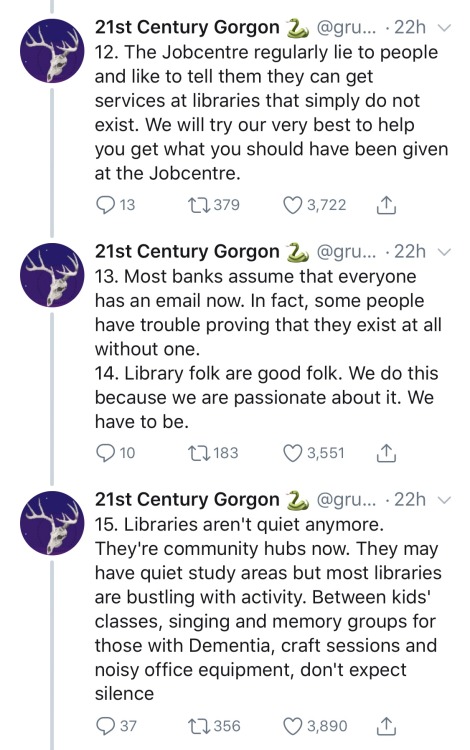
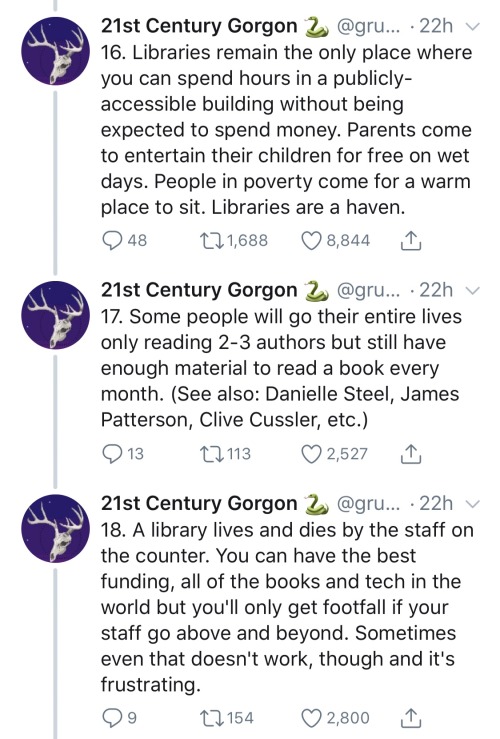
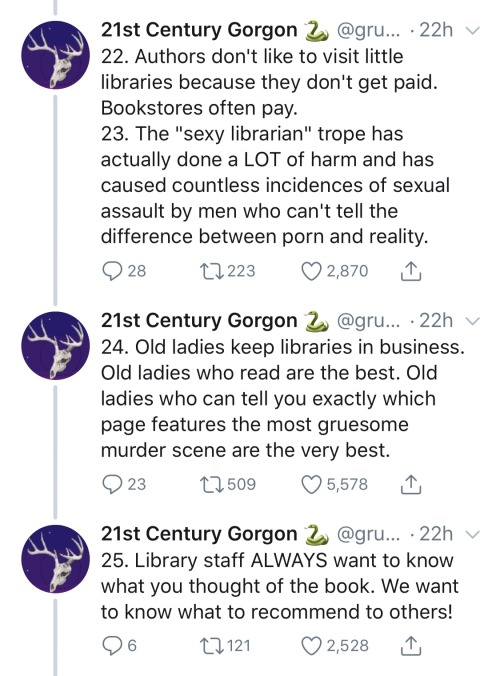
I love my library so, so much


thedaddycomplex:

mathcat345:

vaginadude:

earhartsease:

jaks21:

icycove:

psi1998:

stevviefox:

peneigh-dzredfohl:

Can everyone who reads this PLEASE reblog it?!?!?  Libraries literally saved my life as a child!

Being abused at home, bullied at school and lost in the world, the library and all the books I could escape to the most amazing worlds, kept me alive!

I would walk to the library, and spend all day, from 10 am to 9 pm reading there!! I got special awards for how many books I read, I wrote little blurbs on why i loved the books (probably why I love to BETA and do ARCs) 

PLEASE, PLEASE, PLEASE Just hit the green arrows and the reblog!!!

As a 50 year old woman, the library offers me so much. Digital art pads to borrow, 3D printing, book clubs that are face to face (yeah, the introvert likes face to face because a moderator will stomp on anyone getting snarky)

New books in LARGE PRINT! I’m visually challenged and as much as I love my kindle, The feel of a real book in my hands will always be a beloved feeling!

Our library also has quarterly books sales of almost free books!! For 5$USD we get in a day early and can buy as many as we want. Anyone else has to wait and there is a limit for the first 2 days.

Also many, many libraries have inter library loan(it may be called something different). This means if they don’t have the item you want, they can get it for you. This may include photocopy/pdf of articles. This can also include along with books and DVDs, microfilm/fiche which is also a huge resource. Check around for libraries that are listed as depositories if you want to look at government documents.

Remember that many colleges and universities have open stacks for the public. You will likely have to pay a membership fee but you will get to stuff.

I love the library ☺

The library was one of my favorite places to go as a kid and I still live to go and just. Sit and read. Or do homework. The university I’m at has a massive 8-story one I love to just wonder around in~ Great places

Libraries are amazing places, we need to protect them to ensure their continued existence.

I used to wander about the fiction section in my local library, and choose books with the most interesting titles - I discovered two amazing authors that way

If you feel disconnected from your local community & want to find ways to get involved, seriously consider spending some time at the library. Go to some events! Organize a reading group!

Support your libraries!

Read banned books!

People who don’t learn can be more easily controlled and told what to think!

Echoing @mathcat345, if your school has banned a book, your library will likely have it. Read it. Fuck censorship.

20 Nov 20:48

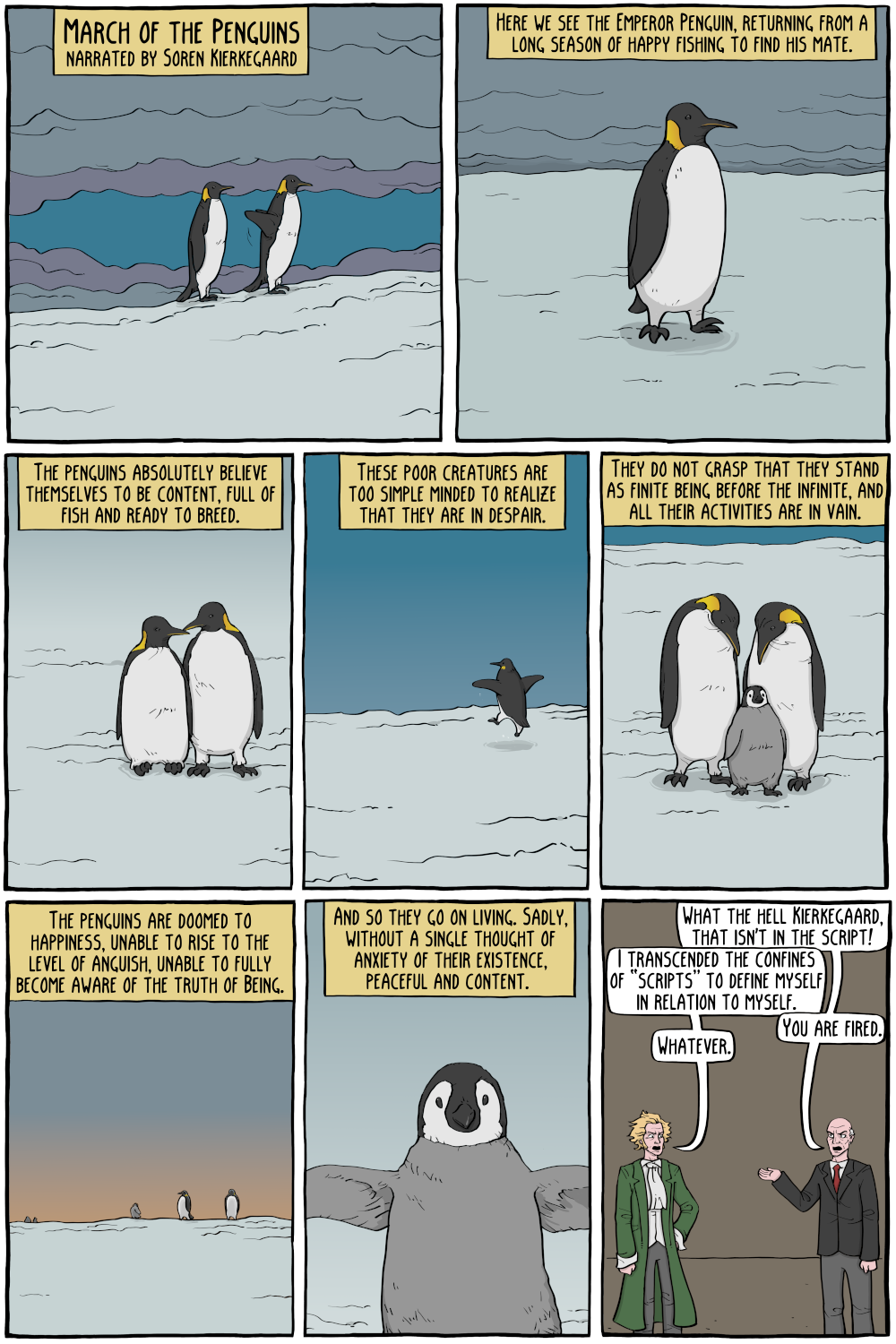
March of the Penguins, Narrated by Soren Kierkegaard

by Corey Mohler
Roslyn

Søren Kirkegaard sounds exactly like Werner Herzog in my mind

PERSON: " "

PERSON: "You are fired."
18 Nov 18:22

“Vague Magazine - November 2023” — Oh boy, I can’t wait to rub my own gromp

Roslyn

Would read

“Vague Magazine - November 2023” — Oh boy, I can’t wait to rub my own gromp

Cover photo by Rolando Brando from Pexels

18 Nov 17:40

Building fair algorithms

by Nathan Yau

Emma Pierson and Kowe Kadoma, for Fred Hutchinson Cancer Center, have a short and free course on Coursera on practical steps for building fair algorithms:

Algorithms increasingly help make high-stakes decisions in healthcare, criminal justice, hiring, and other important areas. This makes it essential that these algorithms be fair, but recent years have shown the many ways algorithms can have biases by age, gender, nationality, race, and other attributes. This course will teach you ten practical principles for designing fair algorithms. It will emphasize real-world relevance via concrete takeaways from case studies of modern algorithms, including those in criminal justice, healthcare, and large language models like ChatGPT. You will come away with an understanding of the basic rules to follow when trying to design fair algorithms, and assess algorithms for fairness.

It’s geared for beginners and no coding is required.

Tags: algorithm, bias, Coursera, Fred Hutchinson Cancer Center

09 Nov 23:07

NASA's On-Demand Streaming Service NASA+ launches today

by bookofjoe
Roslyn

Nice! 🚀

YouTube description:

Introducing NASA's new streaming service, NASA+ — https://nasa.gov/plus — launching November 8, 2023.

More space.

More rockets.

More science.

More missions.

More NASA.

All in one place.

No subscription needed.

NASA+ is ad-free, no cost, and family friendly.

It will feature NASA's Emmy award-winning live coverage and new original video series.

NASA+ will be available on most major platforms via the NASA App on iOS and Android mobile and tablet devices; streaming media players such as, Roku, Apple TV, and Fire TV; and on the web across desktop and mobile devices.

Download the NASA app now to be one of the first to get NASA+ — https://www.nasa.gov/nasaapp

09 Nov 09:16

how to say no to things at work

by Ask a Manager
Roslyn

So handy

06 Nov 17:40

butyoutoldmeiwasfunny:

05 Nov 11:29

(via Ballerina in Containers, On the Edge – By JR in Le Havre,...

05 Nov 11:06

fucker! we wanted to trek those

verdictvelvet:

fucker! we wanted to trek those

28 Sep 20:29

Loneliness, life satisfaction, and time

by Nathan Yau

For The Pudding, Alvin Chang examines loneliness through the lens of individual responses from the American Time Use Survey:

In this story, we’ll go through 24 hours of a typical weekend day in 2021. We know what people did – and who they did it with – because, since 2003, the American Time Use Survey has asked people to track how they use their time.

By the end of the day, we’ll learn that Martin’s isolation isn’t unique. In fact, loneliness has become a far more common experience in the last few decades – and it was supercharged by the pandemic.

The heart of the piece is in the anti-aggregate view of individuals through 24 hours. See each person’s schedule, who they spend time with, and how that changes through the day. Sorting draws patterns. The scrolly clock on the right ticks. And it works on mobile. Chang makes the data immediately relatable.

See it.

Tags: alone, Alvin Chang, The Pudding, time use, well-being

28 Sep 20:28

Two maps with the same scale

by Nathan Yau
Roslyn

So handy!

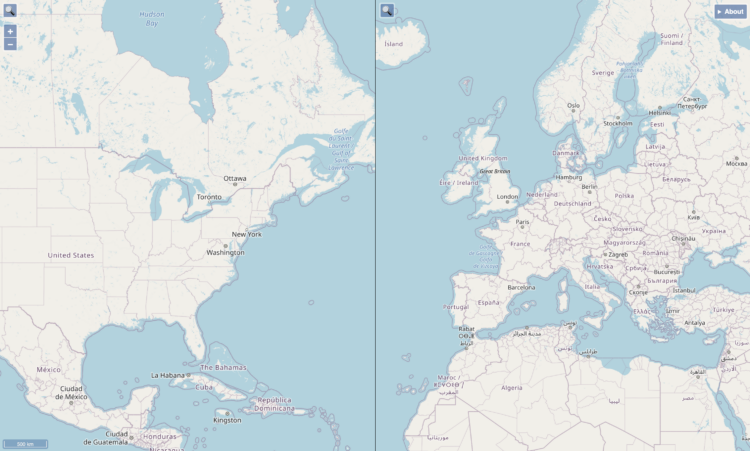
When you compare two areas on a single map, it can be a challenge to compare the actual size of them because of the trade-offs with projecting a three-dimensional space onto a two-dimensional space. Josh Horowitz made a thing that automatically rescales side-by-side maps as you pan and zoom, so that you get a more accurate comparison.

Tags: Josh Horowitz, scale

23 Sep 19:46

737

by Li

737

THROWS WINGFUL OF POPCORN ON THE GROUND

17 Sep 18:04

'Terrible Chair' — Michele Oka Doner

by bookofjoe
Roslyn

This really is a terrible chair

1

From websites: 

The story goes that Miami- and New York-based artist-designer Michele Oka Doner chanced upon a thorny branch one day and got the notion to domesticate its menacing, untamed beauty.

11

"Terrible Chair" is the fulfillment of that ambition.

Oka Doner fashioned real thorn bushes into the shape she desired, then cast the form in gilded bronze.

The end result is less a straightforward, functional piece of furniture than an artifact from a magical fairytale setting.

"Terrible Chair" is imbued with the mystery of a cursed princess's makeshift home in an enchanted forest.

111

Designed and manufactured in 1981

31.5" x 17.5" x 15"

Edition of 1 (one)

1111

14 Aug 17:14

December 19, 1955 — see The Complete Peanuts 1955-1958

Roslyn

Linus knows what’s up

December 19, 1955 — see The Complete Peanuts 1955-1958

13 Aug 13:14

Perseids Pronunciation

Roslyn

Did anyone see it? Sadly it was overcast all night where I am :(

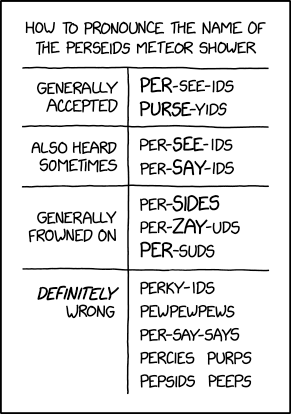
When speaking out loud, you can can call it the 'Perseids meatier shower' and no one will ever know. (If you do get caught somehow, just tell them to Google the 'Kentucky meat shower' and that will distract them while you escape.)
11 Aug 10:31

I need everyone to know that the ship Götheborg, the world’s largest ocean-going wooden sailing…

Roslyn

Utterly amazing

ms-demeanor:

uvradical:

foxgirlsounds:

spandexinspace:

I need everyone to know that the ship Götheborg, the world’s largest ocean-going wooden sailing ship, answered a distress call the other day.

Imagine waiting for the coast guard or whatever to show up and instead a replica of 18th century merchant ship pulls up and tows you to the coast.

pov: you’ve been transported to the 17th century

#in the article it says that the sailboat sailors were concerned because they could not be towed quickly because of the kind of boat#so they asked Götheborg what type of ship they were and warned that they would not be able to go above a certain speed#and götheborg went ’ we are also a sailboat. 50 meters length. no worries :) ’#and the poor sailboat sailors were just like ’ That’s not possible. they have to be messing with us’ and then the ship Rolled Up (via bunjywunjy)

I’m crying. Here’s a photo of a sailor from the Götheborg watching over the little sailboat in tow:

From the story:

We repeatedly emphasized that we were aboard a small 8-meter sailboat, but the response was the same each time: “We are a 50-meter three-masted sailboat, and we offer our assistance in towing you to Paimpol.” We were perplexed by the size difference between our two boats, as we feared being towed by a boat that was too large and at too fast a speed that could damage our boat.

The arrival of the Götheborg on the scene was rapid and surprising, as we did not expect to see a merchant ship from the East India Company of the XVIII century. This moment was very strange, and we wondered if we were dreaming. Where were we? What time period was it? The Götheborg approached very close to us to throw the line and pass a large rope. The mooring went well, and our destinies were linked for very long hours, during which we shared the same radio frequency to communicate with each other.

The crew of the Götheborg showed great professionalism and kindness towards us. They adapted their speed to the size of our boat and the weather conditions. We felt accompanied by very professional sailors. Every hour, the officer on duty of the Götheborg called us to ensure everything was going well.[…]

This adventure, very real, was an incredible experience for us. We were extremely lucky to cross paths with the Götheborg by chance and especially to meet such a caring crew.

Dear commander and crew of the Götheborg, your kindness, and generosity have shown that your ship is much more than just a boat. It embodies the noblest values of the sea, and we are honored to have had the chance to cross your path and benefit from your help.

“Our destinies were linked for very long hours” is just knocking me out.

11 Aug 04:12

734

by Li

734

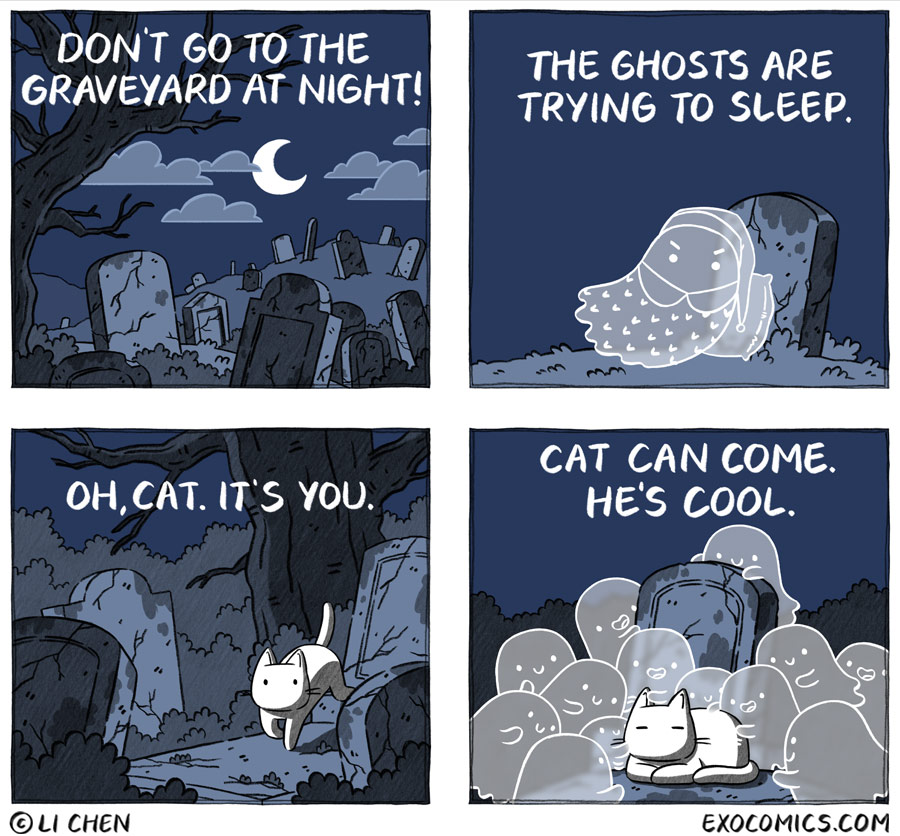
I wish I was as cool as Cat >:(

02 Aug 13:41

December 16, 1955 — see The Complete Peanuts 1955-1958

Roslyn

Thoughts and prayers ❄️

December 16, 1955 — see The Complete Peanuts 1955-1958

31 Jul 15:05

1976 | Thammasat, Bangkok

by S.Za.
Roslyn

Powerful (but graphic) image and a story I had not heard before

The military backed Senate this week blocked a popular progressive candidate from becoming Prime Minister in Thailand. We look back at a particularly troubled year in the Kingdom’s history.

.

Despite its status as a mecca for tourists, Thailand always has an undercurrent of political turmoil, violence, and corruption. The country has always been run by a tight knitted group of bureaucrats, princes, generals, and businessmen, who were reactionary against any slight challenge to their power. As a result, there have been 18 coups and 18 constitutions since 1932 in Thailand, each one staged to thwart the progressive forces from coming to power.

In late 1973, a popular uprising led to the end of the military dictatorship of Field Marshall Thanom. The king invited the chancellor of Thammasat University, a leading jurist, to form an interim government. However, democracy did not take root, and three years later, when Thanom returned from his exile, further student led uprising broke out. Popular refrains still levied against students and activists — of them being communist and anti royalist — were uttered and extremely violent suppression began.

On the night of October 5th 1976, five thousand students were gathered overnight at Thammasat to protest the return of Thanom. At 5:30 AM, a bomb was fired into the Thammasat grounds and shootings began. By 7:30 AM, the campus gates are smashed open, and paramilitary groups and radicalized right-wing protestors stormed the campus. Many died from police gunshots; others were lynched by the crowd, stakes thrust through their dead bodies and women stripped naked with stakes thrust through their breast or sexual organs.

Neal Ulevich, who was covering the protests for AP remembered:

The students had surrendered — a few were able to flee. The paramilitaries made them lie down on the ground. At that point I decided it was nearly over, and to leave before someone demanded my film. I moved to the campus gate. I could see commotion there. I worked my way through it and took a few photos — one, of two policemen escorting a student off campus as he was sucker-punched in the face by a rightist.

Then I saw crowds milling about two trees in Sanam Luang. Among those in the chaos at the gate was an elderly German tourist with an 8mm movie camera, apparently from the Royal Hotel across Sanam Luang. I screamed at him to leave before he was killed. He seemed to be having a good time and ignored me. At the first of the trees, I saw the chair/hanged student. I stayed a moment to see if anyone was looking at me. Then I made a few frames and walked over to the other tree, where another student was hanged. I made a few frames. After that I walked toward the hotel and hailed a taxi. Both hanged students were dead by the time I saw them.

I returned to the AP bureau desperate to have the darkroom tech develop the film and get the first of the prints to PTT [Post and Telephone Office] for radio-photo transmission. I was quite sure all international communications would be shut down or censored within a few hours. At that time, we could not send images from the bureau. Photos had to be printed, captioned and filed like a telegram from PTT. At the bureau I gave Denis Gray a quick summary of what I had seen. He was astonished and began questioning me closely. I told him to hold off until my film was developed and printed. He could see the entire photo record at that point; it spoke louder than words, as photos often do. When the film was developed, I selected the chair image and another, captioned them and dispatched them by messenger to the PTT, hoping to beat any closure of communications. Then I went back to work printing more of my pictures and a few by Mangkorn from earlier in the day. When the messenger returned I asked him if the PTT employees had said anything to suggest censorship. He said no, they just commented on the amazing images. That day we sent — as I recall — about 17 images, 12 of mine and the rest by AP Thai photographers.

The follow-up included images of bodies being burned. All the images cleared before the communications switch was turned off. To put things in perspective, sending 17 images was nearly unheard of, for reasons of effort and cost. But this was clearly a story that deserved to have all available resources thrown at it. We sent those images to Tokyo AP, where they were automatically relayed to New York and London AP. In the evening we began to hear that police had raided Thai newspapers seizing film of the events. Foreign agencies were not visited.

The chaos was used to justify a military coup later that same day. The military would insist that the students fired first – something protesters have always denied. Official figures put the death toll at 46, with 167 wounded and more than 3,000 students arrested. Unoffiically, the death toll was over 100. Nobody was held accountable for the atrocity, and the country’s successive governments have shown that they are still highly sensitive to discussion of it.

The photo above it inspired several Thai theatre productions and movies; and has been used in countless satirical internet memes. The word kao-ee, or ‘chair’ itself became a macabre euphemism in Thailand, a warning about what can happen to those with anti-establishment thoughts. Years later, when Thammasat University Drama Club re-enacted the hanging above (with an effigy which alledgedly stood for the then crown prince, the current king) it was accused of lese majeste and even the newspaper The Bangkok Post which re-printed the re-enactment got embroiled in the controversy.

Ulevich won the Pulitzer and World Press Photo Award for the photo. He recalled the irony.

When I won the Pulitzer, the Bangkok papers noted it on page one. They were very proud that a photographer from Bangkok had won the Pulitzer. They didn’t show the pictures.

.

dumdum-patreon

If you like what I do and what I write, or simply wants me to write more, you can support me via Patreon. I had tremendous fun researching and writing Iconic Photos, and the Patreon is a way for this blog to be self-sustaining.

Proceeds mainly go to buying photography reference books and support me on my research (re: paywalled articles, trips to various archives). In addition to monthly addenda posts on Patreon, readers who subscribe on Patreon might have access to a few blog posts early; chance to request topics or to participate in some polls

Even if Patreon isn’t your thing, you can support by re-sharing, or tweeting about the blog or the specific posts on here. Thanks for your continued support!  Here is the link:

https://www.patreon.com/iconicphotos

11 Jul 23:41

FACEBOOK MEMORIES Sometimes I love it when Facebook shows...


FACEBOOK MEMORIES

Sometimes I love it when Facebook shows me memories - like fun holidays I took with my wife. We have had many adventures after all.

Other times it shows me ex-partners, and I feel a little sting.

But this particular memory, which seems to come up every year, really hits hard.

So many people found this photo funny, because we’d been to a party the night before, and I was clearly ‘SO hungover!!!’

I WAS hungover, but not so much from the alcohol as the fistful of prescription drugs I had swallowed to try to make the noise stop. I didn’t know how much to take or what would happen. I just wanted my head to be quiet.

This photo the next morning is me, hungover (true), but mostly just grappling with the fact that I was still alive, and trying to make sense of what that meant for me.

I think I was 28 at the time. I’m now 39, and I haven’t made another attempt since. A lot has changed. I’m a different person, but I also have a different support network. I have learned how to communicate that I am not OK, and the people I love know what that means.

I feel a lot safer now. I still have times where I just want my brain to be quiet. But I have better ways to get to a place of peace.


24 May 05:12

Bakhmut, Ukraine, once a city of nearly 80,000, has been obliterated by a year of shelling and…

Roslyn

💔

Bakhmut, Ukraine, once a city of nearly 80,000, has been obliterated by a year of shelling and assault from the Russian Armed Forces. An estimated 4,000 people were left in the city as of March, almost every building has been left scorched or reduced to rubble, and craters can be seen in parks and courtyards. Last week, Russia claimed to have captured Bakhmut, while a small outfit of Ukrainian forces remains on the eastern side of the city.

48.594722°, 38.000833°

Drone photo by Tyler Hicks / The New York Times

20 May 04:56

What Is the Correct Plural Form of ‘Octopus’?

by Spencer McDaniel
Roslyn

Octopodes!

It is something of a platitude among native speakers of English to say that our language is a motley one. It is a West Germanic language that has taken in an enormous amount of vocabulary from non-Germanic languages, especially French, Latin, and Ancient Greek. These other languages have systems for the pluralization of nouns that differ from the predominant system in English and, in some cases, users of English have favored pluralizing nouns derived from other languages according to the morphological rules of the word’s language of origin. As a result of this and other factors, pluralizing nouns in English is sometimes a controversial subject.

One of the most controversial of all English nouns to pluralize is octopus, which ultimately derives from the Greek word ὀκτώπους (oktṓpous), which is a compound of the Greek word ὀκτώ (oktṓ), meaning “eight,” and the noun πούς (poús), meaning “foot” or “leg.” English-speakers have tried to pluralize this noun in various ways, with the most popular plural forms being octopuses and octopi. But which plural for this word is the most pedantically correct? In this post, I will delve into the wonderful and exciting world of etymology to answer this question.

Background on nouns in Ancient Greek

In Ancient Greek, every noun has a grammatical gender of masculine, feminine, or neuter. When a person wants to use a noun, they decline it (i.e., change the form) according to number and case. Number indicates whether a noun is singular or plural (or, in some rare cases, dual) and case indicates how the person is using the noun syntactically.

A total of five noun cases exist in Ancient Greek: nominative, genitive, dative, accusative, and vocative. A noun may take a different form in each number and case, with the exception that, for all nouns, the vocative plural is always identical to the nominative plural across all genders and declensions. As a result of this, a single noun in Ancient Greek may have up to five different singular forms and four different plural forms: one form for each of the five different cases, minus the vocative plural.

For our purposes today, we will ignore the genitive, dative, accusative, and vocative cases and focus on the nominative, which the case that a person uses for a noun when it is the subject of a clause.

ὀκτώπους in Ancient Greek

In Ancient Greek, the most common name for the creature that English speakers know today as an octopus was actually πολύπους (polýpous), which is formed from the prefix πολυ- (poly-), which means “many,” plus the word πούς (poús), which means “foot” or “leg.” This is the word that the Greek philosopher Aristotle (lived 384 – 322 BCE) uses for the creature throughout his various treatises on natural philosophy.

The word ὀκτώπους, by contrast, occurs in Greek mainly as a common adjective meaning “eight-legged” and it is not unambiguously attested as a name for the creature that English-speakers call an octopus until quite late.

The earliest attested use of the word ὀκτώπους as an adjective is in a fragment (fr. 80 Shorey) of a lost play by the Athenian comic playwright Kratinos (lived c. 519 – c. 422 BCE), which the medieval Greek scholar Photios (lived c. 810 – 893 CE) preserves through quotation in his own work (p. 326.19). The fragment reads: “ὀκτώπουν ἀνεγείρεις” (“You are stirring up an eight-legged thing!”).

ABOVE: Photograph from Wikimedia Commons showing a Minoan terra-cotta vase dating to around 1500 BCE depicting an octopus, currently held in the Herakleion Archaeological Museum on Krete

Unfortunately, it is not clear whether the “eight-legged thing” that Kratinos references in this fragment is the same creature that twenty-first-century English-speakers know as an octopus, since we have no information about the fragment’s context.

It is possible that the “eight-legged thing” Kratinos references may be a crab, since later Greek writers use forms of the word ὀκτώπους to describe crabs. For instance, the Batrachomyomachia or Battle of the Frogs and the Mice, an anonymous comic mock epic poem in dactylic hexameter that was most likely written in around the late fourth century BCE, uses a plural form of the word in reference to crabs in line 298:

“ὀκτάποδες, δικάρηνοι, ἀχειρέες, οἱ δὲ καλεῦνται καρκίνοι.”

This means, in my own translation:

“They are eight-legged, two-headed, handless, and they are called crabs.”

Similarly, the Roman poet Statyllius Flaccus, who most likely flourished sometime around the beginning of the first century CE, uses the same word as an epithet to describe a crab in the following poem, which is preserved in the Greek Anthology 6.196:

“Ῥαιβοσκελῆ, δίχαλον, ἀμμοδύτορα
ὀπισθοβάμον᾿, ἀτράχηλον, ὀκτάπουν,
νήκταν, τερεμνόνωτον, ὀστρακόχροα,
τῷ Πανὶ τὸν πάγουρον ὁρμιηβόλος,
ἄγρας ἀπαρχάν, ἀντίθησι Κώπασος.”

This means, in my own translation:

“The line-fisher Kopasos dedicates to Pan
as a firstfruit of his catch the crab,
the bandy-legged, two-clawed, sand-diving,
backward-walking, neckless, eight-legged,
solid-backed, hard-skinned swimmer.”

Eventually, by late antiquity, Greek writers had begun to use the word ὀκτάπους (oktápous) to describe the creature that modern English speakers know as an octopus. The Greek medical writer Alexandros of Tralleis (lived c. 525 – c. 605 CE) uses the word with this meaning in his Twelve Books on Medicine 7.1.

ABOVE: Photograph from the Metropolitan Museum of Art website showing a Hellenistic bronze crab dating to between the third and first centuries BCE

Pluralizing ὀκτώπους in Ancient Greek

Now that we’ve examined evidence for the usage of the word ὀκτώπους in Ancient Greek, let’s talk about how one should pluralize it. ὀκτώπους declines as a third-declension masculine noun and the Greek third declension nominative plural ending for masculine and feminine nouns is -ες (-es). Based on this, someone might assume that the plural form of octopus according to Greek declension rules should be octopuses. This, however, would be incorrect.

In Greek, all noun forms other than the nominative singular are formed from the root stem, which is not always predictable from the nominative singular form. Thus, the root stem of ὀκτώπους is actually ὀκτώποδ- (oktṓpod-). To derive the nominative plural form of the noun, we must take this stem and add the third-declension masculine nominative plural ending. This gives us the marvelous, delightful plural form ὀκτώποδες (oktṓpodes).

If, therefore, a person wishes to be pedantically etymologically correct, then the plural form of the word octopus is octopodes. If we apply the standard rules for English pronunciation of Greek words, then this should be pronounced something like /ɔk.ˈtou.pɔ.dɛz/, with the third ⟨o⟩ and the final ⟨e⟩ both being pronounced as short, since they are both short vowels in Greek.

ABOVE: Photograph from Wikimedia Commons showing a singular octopus swimming

Where the incorrect plural form octopi comes from

The Greek diphthong ου (ou) is usually Latinized as a long ⟨ū⟩. Thus, the Greek word πούς (poús), which forms the second component of the word ὀκτώπους, becomes pūs in Latin.

In antiquity, the word ὀκτώπους was rare in Greek and consequently never entered into Latin. In 1758, however, the Swedish naturalist Carl Linnaeus (lived 1707 – 1778) published the tenth edition of his work Systema Naturae or System of Nature, in which he laid out the system of binomial classification for living things. In this work, he coined the word octopus as genus name in New Latin, deriving the name from its Greek roots, possibly unaware that the word had existed in Ancient Greek.

The word octopus swiftly passed from New Latin into scientific English. The Oxford English Dictionary (OED)’s online entry for the word lists its earliest attested use in English as occurring in the journal Philosophical Transactions of the Royal Society of London volume 50, published in 1759, on page 778 in the following quotation: “The Polypus, particularly so called, the Octopus, Preke, or Pour-contrel . . .”

Unfortunately, some confusion about the word’s morphology seems to have arisen quite early. In Latin, second-declension masculine nouns end in -us in the nominative singular and end in in the nominative plural. English speakers have often continued to use the second-declension masculine nominative plural ending for Latin second-declension masculine nouns that we have imported into English. For instance, people often pluralize syllabus as syllabi, cactus as cacti, and so forth.

Despite the fact that octopus does not derive from a Latin second-declension masculine noun, the fact that the word ended in -us made it superficially look as though it did. Consequently, people began trying to pluralize it as a Latin second-declension masculine noun, inventing the plural form octopi. The OED‘s earliest citation for the plural form octopi comes from 1834 in Edward Griffith’s Cuvier’s Animal Kingdom XII. 291, with the quotation: “The octopi also feed on conchyliferous mollusca.”

ABOVE: Photograph showing a diver next to a gigantic octopus

Conclusion

How one pluralizes octopus therefore depends on how much of a pedant one wishes to be. If one does not wish to be a pedant, then the Anglicized plural octopuses is completely acceptable. If, on the other hand, one does wish to be pedant and obnoxiously show off their knowledge of classical morphology, then one can use the plural form octopodes.

I, however, will always regard the plural form octopi as categorically unacceptable because it is not a regular English plural and it is based on an incorrect assumption about the etymology of octopus. I’m not enough of an asshole to correct someone when they use the plural form octopi, but it still grates the gears of my inner pedant a little bit every time I hear it.

ABOVE: The Pedant, early nineteenth-century caricature by Thomas Rowlandson (lived 1757 – 1827), drawn in pencil, ink, and watercolor

The post What Is the Correct Plural Form of ‘Octopus’? appeared first on Tales of Times Forgotten.

20 May 04:51

'New' Music from Daft Punk (Perhaps Their Last Ever)

by bookofjoe

From Kottke:

Earlier this week, the retired electronic duo Daft Punk released The 10th Anniversary Edition of Random Access Memories, their last studio album.

The new album includes 35 minutes of previously unreleased music.

Among the tracks is a demo of "Infinity Repeating" featuring Julian Casablancas and The Voidz, which a recent interview w/ Casablancas on Daft Punk's YouTube channel called "the last Daft Punk song, ever."

The music video for "Infinity Repeating" (above) features a cool evolution-of-humanity animation (with robots!) and is highly re-watchable.

20 May 04:49

Swipe left or right to cut the national debt

by Nathan Yau

Cutting the national debt is a complex process that involves a lot more than personal preferences of an individual. But what if you simplified the task to a bunch of yes-no answers and made it into a Tinder-style swiping game? Szu Yu Chen, Chris Alcantara, and Jeff Stein for The Washington Post put you in charge of the choices.

Tags: debt, game, Washington Post

19 May 13:17

Double Fake

by alex

Double Fake