The Casimir force is a spectacular consequence of the existence of vacuum fluctuations and thus deserves a place in courses on quantum theory. We argue that the scattering approach within a one-dimensional field theory is well suited to a discussion of the Casimir effect. It avoids in a transparent way divergences appearing in the evaluation of the vacuum energy. Furthermore, the scattering approach connects in a natural manner to the standard discussion of one-dimensional scattering problems in a quantum theory course. Finally, it allows for the introduction to students of the methods employed in the current research literature to determine the Casimir force in real-world systems.
Jacopo.bertolotti
Shared posts
26 Jan 15:39
[Perspective] Gender inequality in science
by Andrew M. Penner
Why are women underrepresented in many areas of science, technology, engineering, and mathematics (STEM)? This is a question with no easy answers. In science, as in many areas of life, bias against women exists (1), but researchers disagree on how much bias matters: Some suggest that the effects of bias accumulate over time to shape careers (2), whereas others argue that gender differences in preferences are much more important (3). However, it is likely impossible to disentangle the effects of societal bias and individual preferences, because people's understanding of gender differences shape their preferences (4). Research suggests differences in innate ability are unlikely to play a major role (3), but one route to more equal representation across academic fields might be convincing both women and men that this is true. On page 262 of this issue, Leslie et al. (5) show that how ability is viewed within a field plays a key role in how well women are represented.
Author: Andrew M. Penner
22 Jan 18:09
"Il regista George Lucas, durante una recente intervista rilasciata al sito Cinema Blend, ha rivelato..."
“Il regista George Lucas, durante una recente intervista rilasciata al sito Cinema Blend, ha rivelato che non aveva ceduto solo la sua Lucasfilm alla Disney nel 2012, ma anche alcune delle sue idee dedicate al mondo di Star Wars.
Il suo lavoro però non sembra essere stato utilizzato in nessun modo nella creazione di Star Wars: Episodio VII - Il risveglio della Forza, diretto da J.J. Abrams. George ha infatti spiegato: “Beh, quelle che ho venduto alla Disney insieme al resto… sono giunti a prendere la decisione che non volevano veramente realizzarlo. Quindi hanno creato una propria storia. Non è una di quelle che avevo scritto io in origine”.”
-
Il suo lavoro però non sembra essere stato utilizzato in nessun modo nella creazione di Star Wars: Episodio VII - Il risveglio della Forza, diretto da J.J. Abrams. George ha infatti spiegato: “Beh, quelle che ho venduto alla Disney insieme al resto… sono giunti a prendere la decisione che non volevano veramente realizzarlo. Quindi hanno creato una propria storia. Non è una di quelle che avevo scritto io in origine”.”
-
George Lucas rivela: “La Disney ha scartato le mie idee su Star Wars” - Movieplayer.it
A E I O U Y
(via nipresa)

21 Jan 16:03
Frequency correlations in reflection from random media
by Angelika Knothe Thomas Wellens
Angelika Knothe, Thomas Wellens
We present a theoretical study of frequency correlations of light backscattered from a random scattering medium. This statistical quantity provides insight into the dynamics of multiple scattering processes accessible in theoretical and experimental investigations. For frequency correlations ... [J. Opt. Soc. Am. A 32, 305-313 (2015)]
We present a theoretical study of frequency correlations of light backscattered from a random scattering medium. This statistical quantity provides insight into the dynamics of multiple scattering processes accessible in theoretical and experimental investigations. For frequency correlations ... [J. Opt. Soc. Am. A 32, 305-313 (2015)]
21 Jan 16:01
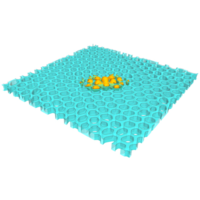
High-Q optical cavities in hyperuniform disordered materials
by Timothy Amoah and Marian Florescu
Author(s): Timothy Amoah and Marian Florescu
Hyperuniform disordered materials are a class of photonic solids with a constrained randomness that have short-range order and long-range statistical isotropy. In these materials, calculations suggest a new type of high-Q localization mechanism in optical cavities, that has no analogue in periodic or quasi-periodic photonic crystals.
[Phys. Rev. B 91, 020201(R)] Published Tue Jan 20, 2015
20 Jan 17:46
 Questo articolo vi arriva gratuitamente e senza pubblicità grazie alla gentile donazione di “luca.lup*” e “darioaia*”. Se vi piace, potete incoraggiarmi a scrivere ancora.
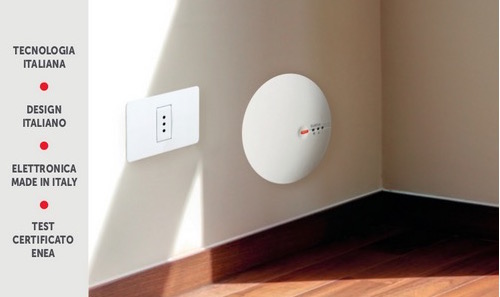
È apparso sul Corriere della Sera il 17 gennaio scorso un articolo che parla di SismAlarm, definito “allarme anti-terremoti”, a firma di Alessandra Dal Monte.
Al prezzo di 99 euro e di un'installazione estremamente semplice, il dispositivo promette un preavviso di una “manciata di secondi prima della scossa distruttiva”, come dice nell'articolo Maurizio Taormina (che è amministratore delegato della Guardian srl, società di San Marino, ma questo il Corriere non lo specifica).
A prima vista il principio di funzionamento sembra sensato: ogni sisma genera solitamente un'onda primaria, che si propaga rapidamente e anticipa l'onda secondaria, che è quella più energetica e distruttiva. Questo è vero. Il Guardian, dicono i suoi creatori, rileva quest'onda primaria e genererebbe un allarme acustico e visivo che può mettere in allerta gli occupanti dell'edificio.
Ma se si fanno due conti in condizioni realistiche emerge un problema molto serio: applicando questo principio di funzionamento, il preavviso possibile, cioè quella “manciata di secondi” di cui parla Taormina citato dal Corriere, ammonta in pratica a un paio di secondi o poco più, come spiega anche Alessandro Amato su Scienza in Rete: un tempo assolutamente insufficiente a compiere qualunque azione concreta per affrontare il sisma in arrivo.
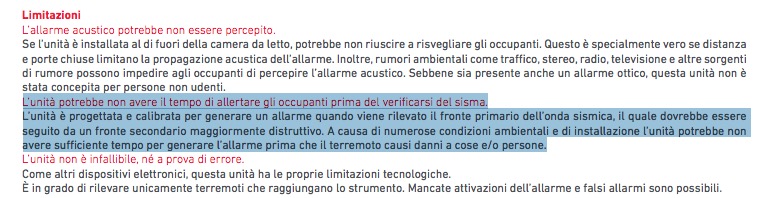
Non a caso il manuale del dispositivo dice chiaramente (screenshot qui sotto) che “L’unità potrebbe non avere il tempo di allertare gli occupanti prima del verificarsi del sisma. L’unità è progettata e calibrata per generare un allarme quando viene rilevato il fronte primario dell’onda sismica, il quale dovrebbe essere seguito da un fronte secondario maggiormente distruttivo. A causa di numerose condizioni ambientali e di installazione l’unità potrebbe non avere sufficiente tempo per generare l’allarme prima che il terremoto causi danni a cose e/o persone.”
Inoltre l'articolo del Corriere segnala che “A dicembre il Dipartimento di Protezione civile ha presentato una segnalazione” (link) “per «pubblicità ingannevole» all'Autorità garante della Concorrenza e del Mercato.” In effetti la segnalazione della Protezione Civile lascia poco spazio ai dubbi (l'evidenziazione è mia):
In sintesi, il prodotto fa esattamente quello che dice di fare, ma quello che fa è inutile all'atto pratico, per cui acquistarlo rischia di essere uno spreco di denaro e di creare una falsa sicurezza che può distrarre da interventi antisismici più concreti ed efficaci.
Fonti aggiuntive: Butac.it.


Antibufala: SismAlarm, “allarme anti-terremoto” sul Corriere della Sera
by Paolo Attivissimo
Questo articolo vi arriva gratuitamente e senza pubblicità grazie alla gentile donazione di “luca.lup*” e “darioaia*”. Se vi piace, potete incoraggiarmi a scrivere ancora.È apparso sul Corriere della Sera il 17 gennaio scorso un articolo che parla di SismAlarm, definito “allarme anti-terremoti”, a firma di Alessandra Dal Monte.
Al prezzo di 99 euro e di un'installazione estremamente semplice, il dispositivo promette un preavviso di una “manciata di secondi prima della scossa distruttiva”, come dice nell'articolo Maurizio Taormina (che è amministratore delegato della Guardian srl, società di San Marino, ma questo il Corriere non lo specifica).
A prima vista il principio di funzionamento sembra sensato: ogni sisma genera solitamente un'onda primaria, che si propaga rapidamente e anticipa l'onda secondaria, che è quella più energetica e distruttiva. Questo è vero. Il Guardian, dicono i suoi creatori, rileva quest'onda primaria e genererebbe un allarme acustico e visivo che può mettere in allerta gli occupanti dell'edificio.
Ma se si fanno due conti in condizioni realistiche emerge un problema molto serio: applicando questo principio di funzionamento, il preavviso possibile, cioè quella “manciata di secondi” di cui parla Taormina citato dal Corriere, ammonta in pratica a un paio di secondi o poco più, come spiega anche Alessandro Amato su Scienza in Rete: un tempo assolutamente insufficiente a compiere qualunque azione concreta per affrontare il sisma in arrivo.
Non a caso il manuale del dispositivo dice chiaramente (screenshot qui sotto) che “L’unità potrebbe non avere il tempo di allertare gli occupanti prima del verificarsi del sisma. L’unità è progettata e calibrata per generare un allarme quando viene rilevato il fronte primario dell’onda sismica, il quale dovrebbe essere seguito da un fronte secondario maggiormente distruttivo. A causa di numerose condizioni ambientali e di installazione l’unità potrebbe non avere sufficiente tempo per generare l’allarme prima che il terremoto causi danni a cose e/o persone.”
Inoltre l'articolo del Corriere segnala che “A dicembre il Dipartimento di Protezione civile ha presentato una segnalazione” (link) “per «pubblicità ingannevole» all'Autorità garante della Concorrenza e del Mercato.” In effetti la segnalazione della Protezione Civile lascia poco spazio ai dubbi (l'evidenziazione è mia):
la pubblicità sembra indurre il consumatore a sentirsi "al sicuro" acquistando il prodotto: i messaggi veicolati sono privi dei necessari riferimenti alle caratteristiche dei forti terremoti che potrebbero colpire l'Italia, in cui il raggio di azione del fenomeno distruttivo è tipicamente limitato, con conseguenti tempistiche di allerta nulle, ovvero di pochi decimi di secondo o pochi secondi, nelle aree epicentrali in cui possono manifestarsi condizioni di pericolo per le persone.
In sintesi, il prodotto fa esattamente quello che dice di fare, ma quello che fa è inutile all'atto pratico, per cui acquistarlo rischia di essere uno spreco di denaro e di creare una falsa sicurezza che può distrarre da interventi antisismici più concreti ed efficaci.
Fonti aggiuntive: Butac.it.
Scritto da Paolo Attivissimo per il blog Il Disinformatico. Ripubblicabile liberamente se viene inclusa questa dicitura (dettagli). Sono ben accette le donazioni Paypal.
Jacopo.bertolotti likes this
19 Jan 19:25
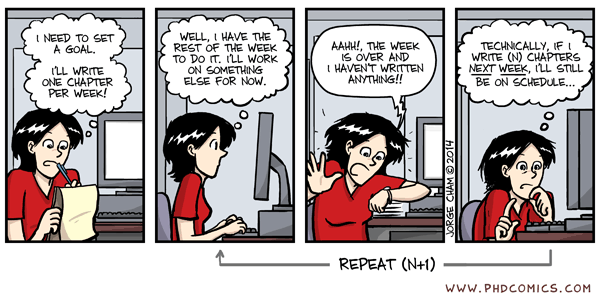
01/19/15 PHD comic: 'On Schedule'
| Piled Higher & Deeper by Jorge Cham |
www.phdcomics.com
|
|
 |
||
|
title:
"On Schedule" - originally published
1/19/2015
For the latest news in PHD Comics, CLICK HERE! |
||
Yao, Jacopo.bertolotti likes this
16 Jan 17:25
 Mi ricredo su ogni intento non belligerante.
Uno ci prova a essere civile... ma guardate cosa scrive la marketing magager del Corriere.
by RRobe
Jacopo.bertolottiBastava dirlo che eravamo su Candid Camera.
15 Jan 14:45
Caro direttore De Bortoli del Corriere della Sera, per rispondere alla sua domanda... IO NON VOGLIO.
by RRobe
De Bortoli, il direttore del Corriere della Sera, si scusa per quanto successo (trovate tutto QUI).
Lo fa dalle pagine del suo quotidiano? No, in una intervista informale a Wired, che trovate QUI.
Si scusa perché ha pubblicato vignette su cui non aveva alcuno diritto in un libro, allegato al suo quotidiano e portato in libreria di varia da Rizzoli-Lizard? No.
Si scusa di non aver avvertito tutti per tempo e ribadisce che gli aventi diritto possono sentire il quotidiano per qualsiasi cosa (traduzione: se volete i soldi per la vignetta, ve li riconosciamo).
Adesso, Signor De Bortoli, io vorrei farle capire una cosa semplice:
io NON VOGLIO soldi da lei. E non voglio nemmeno che lei mi riconosca la proprietà di qualcosa che è già mia.
Io NON VOGLIO essere associato in alcuna maniera al suo libro che trovo orribile sia dal punto di vista tecnico, sia dal punto di vista ideologico.
NON VOGLIO che una mia vignetta, realizzata e diffusa gratuitamente sul web venga commercializzata da una operazione benefica di cui non conosco i dettagli.
NON VOGLIO, soprattutto, che una mia vignetta sia contenuta in un volume che si dice dalla parte di Charlie Hebdo e poi censura le vignette della rivista stessa e degli autori morti nella strage perché non adatte alla linea del giornale.
In poche parole, signor De Bortoli, per rispondere alla mail che lei ha fatto inviare agli autori DOPO l'uscita del volume, chiedendo il loro consenso (mail che, comunque, a me non è mai arrivata): IO NON VOGLIO.
Grazie e cordiali saluti.
Roberto Recchioni
Lo fa dalle pagine del suo quotidiano? No, in una intervista informale a Wired, che trovate QUI.
Si scusa perché ha pubblicato vignette su cui non aveva alcuno diritto in un libro, allegato al suo quotidiano e portato in libreria di varia da Rizzoli-Lizard? No.
Si scusa di non aver avvertito tutti per tempo e ribadisce che gli aventi diritto possono sentire il quotidiano per qualsiasi cosa (traduzione: se volete i soldi per la vignetta, ve li riconosciamo).
Adesso, Signor De Bortoli, io vorrei farle capire una cosa semplice:
io NON VOGLIO soldi da lei. E non voglio nemmeno che lei mi riconosca la proprietà di qualcosa che è già mia.
Io NON VOGLIO essere associato in alcuna maniera al suo libro che trovo orribile sia dal punto di vista tecnico, sia dal punto di vista ideologico.
NON VOGLIO che una mia vignetta, realizzata e diffusa gratuitamente sul web venga commercializzata da una operazione benefica di cui non conosco i dettagli.
NON VOGLIO, soprattutto, che una mia vignetta sia contenuta in un volume che si dice dalla parte di Charlie Hebdo e poi censura le vignette della rivista stessa e degli autori morti nella strage perché non adatte alla linea del giornale.
In poche parole, signor De Bortoli, per rispondere alla mail che lei ha fatto inviare agli autori DOPO l'uscita del volume, chiedendo il loro consenso (mail che, comunque, a me non è mai arrivata): IO NON VOGLIO.
Grazie e cordiali saluti.
Roberto Recchioni
15 Jan 10:14

Experimental evidence of replica symmetry breaking in random lasers
by N. Ghofraniha
Article
Replica symmetry breaking, in which identical systems subject to identical conditions evolve to different end states, has been predicted to occur in many contexts but has yet to be observed experimentally. Ghofraniha et al. report evidence for its occurrence in the pulse-to-pulse variations of a random laser.
Nature Communications doi: 10.1038/ncomms7058
Authors: N. Ghofraniha, I. Viola, F. Di Maria, G. Barbarella, G. Gigli, L. Leuzzi, C. Conti
15 Jan 09:53
Matite in difesa della libertà di stampa... editori che se ne fregano del diritto d'autore.
by RRobe
LETTERA APERTA AL CORRIERE DELLA SERA.

Punto per punto quello che è successo.
- Una manica di estremisti fa una strage nella redazione del settimanale satirico Charlie Hebdo.
- Molti autori di fumetti, satiristi e simili, scossi dall'accaduto, decidono di rispondere al massacro per satira, con la satira stessa. Sul web è tutto un fiorire di vignette e illustrazioni, postate liberamente e spontaneamente sui proprio spazi web: blog, Tumblr, Facebook, Instagram e via dicendo.
- Il Corriere della Sera decide di realizzare un volume a scopo benefico per le vittime della strage di Parigi.
- Per realizzare questo volume, che è arrivato in edicola oggi, quelli del Corriere pescano le vignette dal web e le impaginano alla bene e meglio. Con immagini a bassa definizione.
- Non chiedono alcuna autorizzazione agli autori.
Ora, magari sono strano io ma... se decidi di usare una mia immagine postata sul mio blog, o sulla mia pagina FB, o sul mio Instagram, o su qualsiasi altra piattaforma digitale a me intestata, sarebbe cosa gentile chiedermi il permesso di poterlo fare.
Magari io non ho piacere di collaborare con il tuo gruppo editoriale.
Magari - se voglio fare beneficenza- faccio un bonifico.
Magari non voglio essere associato ad alcuni dei punti di vista espressi da altri autori presenti nel volume.
Magari non ho piacere che il mio lavoro sia presentato in maniera orrenda, con un file a bassa risoluzione.
Magari non voglio che tu ti faccia bello e nobile con la mia roba.
Magari non voglio che una cosa che ho realizzato per uno specifico contesto e su una specifica piattaforma, sia usata da te in un contesto e su una piattaforma del tutto diversa.
Magari non ho piacere che una mia opera, nata da un preciso stato d'animo, sia commercializzata. Nemmeno per fini benefici.
Magari non amo essere scopato a mia insaputa. Almeno mandami dei fiori.
Ora, concludendo, io non ho nulla contro l'iniziativa del Corriere.
Anzi, mi sembra una cosa con un buon fine.
Ma i mezzi per metterla in pratica sono stati osceni.
Mi piacerebbe ricevere una lettera di scuse formali.
Sulle pagine del giornale, quello di carta.
Come di carta è il volume che hanno realizzato.
Che sul web, la parola vola.
Punto per punto quello che è successo.
- Una manica di estremisti fa una strage nella redazione del settimanale satirico Charlie Hebdo.
- Molti autori di fumetti, satiristi e simili, scossi dall'accaduto, decidono di rispondere al massacro per satira, con la satira stessa. Sul web è tutto un fiorire di vignette e illustrazioni, postate liberamente e spontaneamente sui proprio spazi web: blog, Tumblr, Facebook, Instagram e via dicendo.
- Il Corriere della Sera decide di realizzare un volume a scopo benefico per le vittime della strage di Parigi.
- Per realizzare questo volume, che è arrivato in edicola oggi, quelli del Corriere pescano le vignette dal web e le impaginano alla bene e meglio. Con immagini a bassa definizione.
- Non chiedono alcuna autorizzazione agli autori.
Ora, magari sono strano io ma... se decidi di usare una mia immagine postata sul mio blog, o sulla mia pagina FB, o sul mio Instagram, o su qualsiasi altra piattaforma digitale a me intestata, sarebbe cosa gentile chiedermi il permesso di poterlo fare.
Magari io non ho piacere di collaborare con il tuo gruppo editoriale.
Magari - se voglio fare beneficenza- faccio un bonifico.
Magari non voglio essere associato ad alcuni dei punti di vista espressi da altri autori presenti nel volume.
Magari non ho piacere che il mio lavoro sia presentato in maniera orrenda, con un file a bassa risoluzione.
Magari non voglio che tu ti faccia bello e nobile con la mia roba.
Magari non voglio che una cosa che ho realizzato per uno specifico contesto e su una specifica piattaforma, sia usata da te in un contesto e su una piattaforma del tutto diversa.
Magari non ho piacere che una mia opera, nata da un preciso stato d'animo, sia commercializzata. Nemmeno per fini benefici.
Magari non amo essere scopato a mia insaputa. Almeno mandami dei fiori.
Ora, concludendo, io non ho nulla contro l'iniziativa del Corriere.
Anzi, mi sembra una cosa con un buon fine.
Ma i mezzi per metterla in pratica sono stati osceni.
Mi piacerebbe ricevere una lettera di scuse formali.
Sulle pagine del giornale, quello di carta.
Come di carta è il volume che hanno realizzato.
Che sul web, la parola vola.
Jacopo.bertolotti likes this
14 Jan 17:37
Nonlocality and Conflicting Interest Games
by Anna Pappa, Niraj Kumar, Thomas Lawson, Miklos Santha, Shengyu Zhang, Eleni Diamanti, and Iordanis Kerenidis
Author(s): Anna Pappa, Niraj Kumar, Thomas Lawson, Miklos Santha, Shengyu Zhang, Eleni Diamanti, and Iordanis Kerenidis
Quantum nonlocality gives players an advantage in conflicting interest games, as demonstrated by the Battle of the Sexes game implemented with entangled photons.
[Phys. Rev. Lett. 114, 020401] Published Wed Jan 14, 2015
12 Jan 18:16

Published Fri Jan 09, 2015
Focus: Why Language Exceptions Remain the Rule
Interaction among speakers of a language may explain why frequently used verbs tend to remain irregular even as language evolves over generations.
Published Fri Jan 09, 2015
09 Jan 16:50


Lunar Swimming
by xkcd
Lunar Swimming
What if there was a lake on the Moon? What would it be like to swim in it? Presuming that it is sheltered in a regular atmosphere, in some giant dome or something.
Kim Holder
This would be so cool.
In fact, I honestly think it's cool enough that it gives us a pretty good reason to go to the Moon in the first place. At the very least, it's better than the one Kennedy gave.
Floating would feel about the same on the Moon as on Earth, since how high in the water you float depends only on your body's density compared to the water's, not the strength of gravity.
Swimming underwater would also feel pretty similar. The inertia of the water is the main source of drag when swimming, and inertia is a property of matter[1]♬ BILL NYE THE SCIENCE GUY ♬ independent of gravity. The top speed of a submerged swimmer would be about the same on the Moon as here—about 2 meters/second.
Everything else would be different and way cooler. The waves would be bigger, the splash fights more intense, and swimmers would be able to jump out of the water like dolphins.
This[2]Not this one. The other one.[3]The simplest approach, which gives us an approximate answer, is to treat the swimmer as a simple projectile. The formula for the height of a projectile is:
\( \frac{\text{speed}^2}{2\times\text{gravity}} \)
... which tells us that a champion swimmer moving at 2 meters per second (4.5 mph) would only have enough kinetic energy to lift their body about 20 centimeters against gravity.
That's not totally accurate, although it's enough to tell us that dolphin jumps on Earth probably aren't in the cards for us. But to get a more accurate answer (and an equation we can apply to the Moon), we need to account for a few other things.
When a swimmer first breaks the surface, they don't have to lift their full weight; they're partially supported by buoyancy. As more of their body leaves the water, the force of buoyancy decreases, since their body is displacing less water. Since the force of gravity isn't changing, their net weight increases.
You can calculate how much potential energy is required to lift a body vertically through the surface to a certain height, but it's a complicated integral (you integrate the displacement of the submerged portion of their body over the vertical distance they travel) and depends on their body shape. For a human body moving fast enough to jump most of the way out of the water, this effect probably adds about half a torso-length to their final height—and less if they're not able to make it all the way out.
The other effect we have to account for is the fact that a swimmer can continue kicking as they start to leave the water. When a swimmer is submerged and moving at top speed, the drag from the water is equal to the thrust they generate by kicking and ... whatever the gerund form of the verb is for the things your arms do while swimming. My first thought was "stroking," but it's definitely not that.
Anyway, once the jumping swimmer breaks the surface, the drag almost vanishes, but they can keep kicking for a few moments. To figure out how much energy this adds, you can multiply the thrust from kicking by the distance over which they're kicking after breaking the surface, since energy equals force times distance. The distance is most of a body length, or 1 to 1.5 meters. As for the force from kicking, random Google results for a search for lifeguard qualifications suggest that good swimmers might be able to carry 10 lbs over their heads for a short distance, which means they're generating a little more than 10 pounds-force (50+ N) of kicking thrust.
We can combine all these together into a big ol' equation:
\[ \text{Jump height}=\left(\frac{\tfrac{1}{2}\times\text{body mass}\times\left(\text{top speed}\right)^2+\text{kick force}\times\text{torso length}}{\text{Earth gravity}\times\text{body mass}}\right)+\left(\text{buoyancy correction} \right) \] footnote contains some detail on the math behind a dolphin jump. Calculating the height a swimmer can jump out of the water requires taking several different things into account, but the bottom line is that a normal swimmer on the Moon could probably launch themselves a full meter out of the water, and Michael Phelps may well be able to manage 2 or 3.
The numbers get even more exciting when we introduce fins.
Swimmers wearing fins can go substantially faster than regular swimmers without them (although the fastest swimmer wearing flippers will still lose to a runner, even if the runner is also wearing flippers and jumping over hurdles).
Champion finswimmers can go almost 3.2 m/s wearing a monofin, which is fast enough for some pretty impressive jumps—even on Earth. Data on swimfin top speeds and thrusts[4]This paper provides some sample data. suggest that on the Moon, a champion finswimmer could probably launch themselves as high as 4 or 5 meters into the air. In other words, on the Moon, you could conceivably do a high dive in reverse.
But it gets even better. A 2012 paper in PLoS ONE, titled Humans Running in Place on Water at Simulated Reduced Gravity, concluded that while humans can't run on the surface of water on Earth,[5]They actually provide a citation for this statement, which is delightful. they might just barely be able to do so on the Moon. (I highly recommend reading their paper, if only for the hilarious experimental setup illustration on page 2.)
Because of the reduced gravity on the Moon, the water would be launched upward more easily, just like the swimmers. The result would be larger waves and more flying droplets. In technical terms, a pool on the Moon would be more "splashy".[6]The SI unit of splashiness is the splashypant.
To avoid splashing all the water out, you'd want to design the deck so water drains quickly back into the pool. You could just make the rim higher, but then you'd spoil one of the key joys of a pool on the Moon—exiting via Slip 'N Slide:
I 100% support this idea. If we ever build a Moon base, I think we should absolutely build a big swimming pool there. Sure, sending a swimming pool's worth of water (135 horses) to the Moon's surface would be expensive.[7]If you decided to bundle a backyard pool into individual two-liter bottles, and sent them in 3,000 batches of 10 each via the startup Astrobotic, it would cost you $72 billion (according to their website's calculator). But on the other hand, this lunar base is going to have people on it, so you need to send some water anyway.[8]Sending a supply of water and a filter system is probably cheaper than sending a replacement astronaut every 3 or 4 days, although I encourage NASA to run the numbers on that to be sure.
And it's really not impossible. A large backyard swimming pool weighs about as much as four Apollo lunar landers. A next-generation[9](or, heck, previous-generation) heavy-lift rocket, like Boeing's NASA SLS or Elon Musk's SpaceX Falcon Heavy, would be able to deliver a good-sized pool to the Moon in not too many trips.
So maybe the next step, if you really want a swimming pool on the Moon, is to call Elon Musk and ask for a quote.
Margot Foster, Scott Akerman and 12 others like this
09 Jan 13:10
[In Depth] Laser fusion, with a difference
by Daniel Clery
Europe's Laser Mégajoule project blazes its own trail toward nuclear ignition.
Author: Daniel Clery
09 Jan 10:43
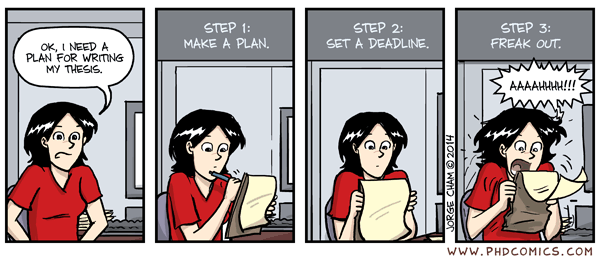
01/07/15 PHD comic: 'Make a plan.'
Jacopo.bertolottifamiliar feeling
| Piled Higher & Deeper by Jorge Cham |
www.phdcomics.com
|
|
 |
||
|
title:
"Make a plan." - originally published
1/7/2015
For the latest news in PHD Comics, CLICK HERE! |
||
08 Jan 23:53

Rave drug holds promise for treating depression fast
by Sara Reardon
Jacopo.bertolottirave parties are somehow useful to society after all
Rave drug holds promise for treating depression fast
Nature 517, 7533 (2015). http://www.nature.com/doifinder/10.1038/517130a
Author: Sara Reardon
Companies and clinicians turn to ketamine to treat mental-health disorder as pipeline of new drugs dries up.
08 Jan 15:16

Grants: Paint me a picture
Jacopo.bertolottiNot really sure why this should help early-career scientists. But it is still a good idea and, as far as I know, it is already implemented in several grant schemes around Europe.
Grants: Paint me a picture
Nature 517, 7533 (2015). doi:10.1038/nj7533-233b
Revised format designed to put research in context.
08 Jan 15:15

Publishing costs: Peer review as a business transaction
by Eleftherios P. Diamandis
Jacopo.bertolotti200$ each time I make a review for a paper? Sounds great!
Publishing costs: Peer review as a business transaction
Nature 517, 7533 (2015). doi:10.1038/517145a
Author: Eleftherios P. Diamandis
I receive 300 requests a year to review research papers. Each takes 3–4 hours to complete, equivalent to roughly 1–2 days per week if I did them all. Should I win 'reviewer of the year' award, however, I suspect my colleagues would see my efforts

07 Jan 13:30
 If you're a PC gamer of a certain age (cough), you've probably lamented that many of the titles you played as a kid are hard to use on modern systems without downloading emulators or waiting for special re-releases. Well, it just got a lot easier to ...
You can play 2,400 classic DOS games in your web browser
by Jon Fingas
If you're a PC gamer of a certain age (cough), you've probably lamented that many of the titles you played as a kid are hard to use on modern systems without downloading emulators or waiting for special re-releases. Well, it just got a lot easier to ...
Roumen.ganeff, manic marauder and one other like this
07 Jan 13:29
Charlie Hebdo, 12 uccisi da gente così codarda da avere paura di una vignetta
by Paolo Attivissimo
Ora milioni di persone in più, in tutto il mondo, sanno cos'è Charlie Hebdo. I vigliacchi hanno già perso.


Scritto da Paolo Attivissimo per il blog Il Disinformatico. Ripubblicabile liberamente se viene inclusa questa dicitura (dettagli). Sono ben accette le donazioni Paypal.
Ettore Del Monte and -1 others like this
07 Jan 10:30
Synopsis: Thinner Stealth Coatings
Antireflective acoustic coatings for hiding submarines and other watercraft could be made much thinner than those in use today.

Published Tue Jan 06, 2015
Published Tue Jan 06, 2015
06 Jan 14:51

Optical focusing deep inside dynamic scattering media with near-infrared time-reversed ultrasonically encoded (TRUE) light
by Yan Liu
Article
Shaping the incident wavefront allows optical focusing deep inside scattering media, but its application in dynamic media is hindered by its low speed. Here, Liu et al . improve the speed by two orders of magnitude and demonstrate in vivo light focusing inside dynamic scattering media.
Nature Communications doi: 10.1038/ncomms6904
Authors: Yan Liu, Puxiang Lai, Cheng Ma, Xiao Xu, Alexander A. Grabar, Lihong V. Wang
06 Jan 10:39
Anomalous Impact in Reaction-Diffusion Financial Models
by I. Mastromatteo, B. Tóth, and J.-P. Bouchaud
Author(s): I. Mastromatteo, B. Tóth, and J.-P. Bouchaud
 Financial markets can behave like critical systems in which small perturbations have an anomalously high impact on trading prices.
[Phys. Rev. Lett. 113, 268701] Published Wed Dec 31, 2014
05 Jan 10:31
Contest Entry: Rejection Letters, 3
by Female Science Professor
Would you want to get a letter like this?
(Too?) Much Information Letter
Dear [applicant name],
We received 154 applications for our advertised position. Of these we selected 32 for a "long list" of applicants and we requested letters of reference for those. You were in this group of 32.
Of those 32, we narrowed the list further to 12 individuals. One or more members of our search committee met with most of these 12 at the Big Conference or at least attended their conference presentation. You were in this group of 12.
Of those 12, we selected 5 to interview. You were not in this group of 5. The selection of the 5 individuals was not based on merit. How could it be? All 12 on the next-to-final short list are highly qualified. In fact the 32 on the long list are highly qualified and probably another dozen or more beyond that.
It might not make you feel better to know that the selection process is nearly random in the end. The struggle is to make that semi-random selection fair (that is, not favoring those we happen to know and like or whose advisors are our friends, trying not to let unconscious bias creep into the process, and so on).
So how did we decide? Is it about that nebulous concept of "fit"? Sort of, but fit can go both ways. The faculty could decide that the best "fit" would be someone who "builds on our strengths" in a certain subfield or "fit" could be defined as needing a person who works on something new and different that would nevertheless somehow "fit" with our vision of exciting future directions. In this search, we interviewed some of each type.
Was there anything in your letters of reference that caused you to be non-selected for an interview? No, there really wasn't anything. All the top candidates had excellent letters of reference.
Was it number of publications? No, it was not. Was it the impact factor of the journals? No. Citation index? Definitely not, you are all too early in your careers for that to be any useful indicator of anything.
In the end, the interview list was selected by the search committee, with input from other faculty and other interested parties, after reading and discussing the application materials, including publications (Perhaps it is useful to mention that the research statement can be quite useful as an indicator of what each applicant's ideas are for future research and teaching.). It is a time-consuming process so even if there is some randomness, it is a thoughtful randomness, if that makes any sense.
Anyway, we interviewed the interviewees and a few stood out and we made an offer to one of them and that person accepted, so our search process has now been completed and we wanted to let you know that.
Sincerely,
The Search Committee Chair, on behalf of the Search Committee
(Too?) Much Information Letter
Dear [applicant name],
We received 154 applications for our advertised position. Of these we selected 32 for a "long list" of applicants and we requested letters of reference for those. You were in this group of 32.
Of those 32, we narrowed the list further to 12 individuals. One or more members of our search committee met with most of these 12 at the Big Conference or at least attended their conference presentation. You were in this group of 12.
Of those 12, we selected 5 to interview. You were not in this group of 5. The selection of the 5 individuals was not based on merit. How could it be? All 12 on the next-to-final short list are highly qualified. In fact the 32 on the long list are highly qualified and probably another dozen or more beyond that.
It might not make you feel better to know that the selection process is nearly random in the end. The struggle is to make that semi-random selection fair (that is, not favoring those we happen to know and like or whose advisors are our friends, trying not to let unconscious bias creep into the process, and so on).
So how did we decide? Is it about that nebulous concept of "fit"? Sort of, but fit can go both ways. The faculty could decide that the best "fit" would be someone who "builds on our strengths" in a certain subfield or "fit" could be defined as needing a person who works on something new and different that would nevertheless somehow "fit" with our vision of exciting future directions. In this search, we interviewed some of each type.
Was there anything in your letters of reference that caused you to be non-selected for an interview? No, there really wasn't anything. All the top candidates had excellent letters of reference.
Was it number of publications? No, it was not. Was it the impact factor of the journals? No. Citation index? Definitely not, you are all too early in your careers for that to be any useful indicator of anything.
In the end, the interview list was selected by the search committee, with input from other faculty and other interested parties, after reading and discussing the application materials, including publications (Perhaps it is useful to mention that the research statement can be quite useful as an indicator of what each applicant's ideas are for future research and teaching.). It is a time-consuming process so even if there is some randomness, it is a thoughtful randomness, if that makes any sense.
Anyway, we interviewed the interviewees and a few stood out and we made an offer to one of them and that person accepted, so our search process has now been completed and we wanted to let you know that.
Sincerely,
The Search Committee Chair, on behalf of the Search Committee
05 Jan 10:23

Ora, se vendere un prodotto preparato in questo modo è pura furbizia commerciale, comprarlo è pura stupidità consumistica.
Dopo queste brevi spiegazioni chi è affezionato all'omeopatia, sa cosa sta comprando (e cosa gli vogliono rifilare) e resta sempre il mio invito per i più testardi: se pensate che in un granulo omeopatico (oltre la 12CH) ci sia qualcosa oltre allo zucchero di cui è composto fatelo analizzare.
Omeopatia: provare per non credere.
by Salvo Di Grazia
Ho parlato tante volte di omeopatia e della sua assoluta inconsistenza scientifica e medica, ma, se non superficialmente, non ho mai raccontato alcuni particolari che credo sia il caso di conoscere per completare l'informazione sul tema.
Sappiamo che la teoria omeopatica, risalente all'ottocento, non è mai stata dimostrata a suo tempo ed è stata anzi smentita con gli anni, quando le leggi della fisica e della chimica hanno soppiantato i "teoremi" medioevali degli albori della medicina, sappiamo anche che l'omeopatia sostiene che diluire continuamente una sostanza, invece di renderla inoffensiva e senza effetti ne aumenterebbe le "capacità" curative e che questa vecchia superstizione, proprio grazie alle scoperte scientifiche venute negli anni, è stata smentita e relegata a memoria storica di una medicina del passato, quando la medicina...non c'era.
Chi segue il blog o chi si è interessato personalmente, saprà già di cosa si parla quando si tratta di omeopatia.
Un prodotto omeopatico diluito più di 12 volte, in linguaggio omeopatico si dice di diluizione superiore alla 12 CH (per "CH" si intende "diluizione centesimale di Hahnemann"), non contiene nessuna traccia del principio attivo iniziale. Il prodotto omeopatico quindi, si può definire, senza possibilità di smentita, semplice "zucchero" (se la "pillola" è fatta di zucchero) o "acqua" (se il prodotto è fatto di acqua). Nessuna persona al mondo potrà smentirlo, è un dato di fatto.
Chi segue il blog o chi si è interessato personalmente, saprà già di cosa si parla quando si tratta di omeopatia.
Un prodotto omeopatico diluito più di 12 volte, in linguaggio omeopatico si dice di diluizione superiore alla 12 CH (per "CH" si intende "diluizione centesimale di Hahnemann"), non contiene nessuna traccia del principio attivo iniziale. Il prodotto omeopatico quindi, si può definire, senza possibilità di smentita, semplice "zucchero" (se la "pillola" è fatta di zucchero) o "acqua" (se il prodotto è fatto di acqua). Nessuna persona al mondo potrà smentirlo, è un dato di fatto.
Un'altra credenza dell'omeopatia sostiene che per curare una malattia bisognerà farlo con una sostanza che in un uomo provoca gli stessi sintomi della malattia. Per fare un esempio: l'insonnia (il cui sintomo è il "restare svegli") si curerebbe con qualcosa che fa restare svegli (per esempio il caffè), il prurito si cura con qualcosa che provoca il prurito, la nausea con un prodotto che provoca nausea e così via e per questo l'inventore dell'omeopatia "ideò" la diluzione: la maggioranza dei prodotti da usare per il suo scopo erano tossici o letali, bisognava quindi renderli inoffensivi. Quale modo migliore se non quello di farli sparire? Così Hahnemann penso di diluirli talmente tanto da farli scomparire, di loro resta solo il "ricordo", una magia oggi insostenibile e giustificabile solo nella sua epoca, quando non si conoscevano nemmeno le basi della scienza.
Ma ecco che a questo proposito c'è un altro particolare che pochi conoscono e che qui ho raccontato solo brevemente: come si fa a capire il prodotto più adatto per ogni persona? Si chiama "proving", è la tecnica che permette di trovare la sostanza omeopatica più adatta per un determinato disturbo.
Come qualcuno saprà l'omeopatia si vanta di "personalizzare" al massimo i suoi trattamenti, non esiste "la cura per tutti i pruriti" ma la cura per "il prurito di quella persona". In teoria l'idea è pure affascinante, ma in pratica questo non succede mai.
Oltre al fatto che i prodotti omeopatici si comprano in farmacia (ed il farmacista non si mette certo a testare per settimane il prodotto sul cliente), oltre al fatto che ogni rimedio dovrebbe essere provato personalmente su ogni paziente e su ogni suo sintomo, è la stessa ipotesi che nasce in maniera davvero curiosa come del resto tutto ciò che caratterizza l'omeopatia, giustificando la definizione di stregoneria, data dai medici inglesi.
Il proving
Il proving è il metodo che consente di "testare" (provare...appunto) un rimedio omeopatico in una persona. In base alle reazioni del soggetto che "testa" il prodotto (ai sintomi che dice di provare dopo aver assunto quel rimedio), l'omeopata saprà per cosa può servire il rimedio omeopatico. Facciamo ancora un esempio.
Se voglio provare la caffeina omeopatica, la somministrerò ad una persona. Questa annoterà in un foglio ciò che prova dopo averla assunta, per esempio ansia, caldo, distrazione, senso di vuoto (esempi a caso).
L'omeopata saprà quindi che la caffeina servirà a curare quei sintomi.
Non credo servano tante parole per spiegare che quei sintomi (le reazioni alla caffeina) sono completamente soggettivi, possono dipendere da tanti fattori e soprattutto, essendo ciò che l'individuo in "proving" assume soltanto zucchero, probabilmente si tratta di reazioni casuali, non dipendenti cioè da quanto assunto (tanto da essere diversi da un individuo all'altro).
L'omeopatia fa "provare" di tutto, qualsiasi sostanza può essere oggetto di "proving" perché qualsiasi sostanza (anche ciò che non è una "sostanza", come l'elettricità o la luce) può diventare un rimedio omeopatico.
Così si assiste a prove sinceramente ridicole quando non assurde.
Questo è uno dei fattori per i quali la possibilità (esistente in qualsiasi professione) che vi siano omeopati "seri" o "meno seri" è campata in aria. Sarebbe come sostenere che esistono astrologi "seri" e "meno seri", se l'intera teoria ed ipotesi su cui si basa un mestiere è una superstizione, un fenomeno paranormale, la serietà è la prima cosa che può essere scartata con sicurezza.
Il proving così riguarderà gli elementi più comuni, la caffeina, appunto o altre come l'arnica o il gelsomino, ma la vera natura dell'omeopatia è forse più chiara quando scopriamo che sono "testabili" e quindi somministrabili elementi che ricordano le pozioni magiche delle streghe d'altri tempi, come l'acqua, l'elettricità, la luce (si espone il soggetto alla luce e si annota ciò che prova, quelli saranno i sintomi curabili con la..."luce omeopatica"), le lacrime, il chiaro di Luna e le note musicali e si arriva a prove irragionevoli quando non rivoltanti, come il sangue di un soggetto con AIDS (naturalmente omeopatico, non c'è nessuna molecola di sangue in quell'intruglio), un preservativo, una zecca, mestruazioni o addirittura un buco nero. Sono talmente assurdi i rimedi omeopatici che, quando descrissi quelli di un prodotto omeopatico in un mio vecchio articolo, intervenne nei commenti l'addetto stampa dell'azienda offeso perché aveva scambiato il mio elenco di "ingredienti" (tra i quali ghiandole di rospo e veleno di serpente, scritto anche sulla confezione) per una "battuta ironica": non riusciva a crederci neanche lui!
Ci siamo?
Il soggetto in "proving" annota tutti i sintomi che prova assumendo il rimedio e consegna tutto all'omeopata che li usa di conseguenza, se una sostanza provoca ansia, l'omeopata lo somministrerà per l'ansia (come ho scritto prima per l'omeopatia la malattia si cura con qualcosa che provoca gli stessi disturbi) se il soggetto prova agitazione il rimedio sarà prescritto per questo disturbo.
Il soggetto in "proving" annota tutti i sintomi che prova assumendo il rimedio e consegna tutto all'omeopata che li usa di conseguenza, se una sostanza provoca ansia, l'omeopata lo somministrerà per l'ansia (come ho scritto prima per l'omeopatia la malattia si cura con qualcosa che provoca gli stessi disturbi) se il soggetto prova agitazione il rimedio sarà prescritto per questo disturbo.
Sappiamo che l'omeopatia è una pratica senza base scientifica, ma conoscendola meglio emergono gli aspetti che la rendono una vera e propria pratica magica, stregonesca.
In ogni caso, a prescindere dalle "stranezze" del proving, sappiamo che di quelle sostanze non assumeremo nulla, è nella stessa natura dell'omeopatia. Perché quindi compiere questi "riti"? Proprio per rendere il gioco magico più "misterioso", più "potente" ed esoterico, pensare che assumiamo i "poteri magici" di una zecca può avere il suo effetto sui soggetti più condizionabili ma nessun timore, non si assumerà nemmeno una molecola di quella zecca, grazie all'estrema diluizione dei rimedi omeopatici la pallina di "medicinale" conterrà solo zucchero, puro.
Era qui che volevo arrivare, le diluizioni.
La più comune è quella di cui si parlava all'inizio, la centesimale di Hahnemann (l'inventore dell'omeopatia) che si indica con la lettera CH (30CH significa trentesima diluizione centesimale di Hahnemann). Ne esistono altre meno diffuse, la DH (diluizione decimale di Hahnemann, ovvero il principio attivo non si diluisce in 100 parti come nella centesimale ma in 10 parti di acqua) e la "korsakoviana" (si indica con K, prende il nome dal suo inventore, il russo Semen Korsakov).
La diluizione korsakoviana, ovvero: ma ci prendete in giro?
Riassumo brevemente la diluzione classica dell'omeopatia (la centesimale Hahnemaniana).
Si parte dal principio attivo. Di questo si prende una goccia e la si versa in un bicchiere con 99 ml. di acqua (avremo quindi una soluzione composta da 99 parti di acqua e una di principio attivo, totale 100 ml., questa è la prima diluizione, 1CH). Si prende una goccia da questo bicchiere e si versa in un secondo bicchiere con 99 ml di acqua (ecco la seconda diluizione, 2CH, 99 parti di acqua ed una parte di principio attivo già diluito la prima volta) e si continua così, una goccia in un bicchiere con 99 ml di acqua e così via. La 12ma volta che compiamo questo gesto il principio attivo sarà sparito, per semplici leggi della chimica e della fisica (vedi numero di Avogadro).
Anche qui spero di essermi spiegato bene.
Anche qui spero di essermi spiegato bene.
Ma gli omeopati non si accontentano di vendere un prodotto nel quale non è contenuto nulla, devono necessariamente esagerare. Così il dott. Korsakov pensò bene di trovare un modo più pittoresco per preparare i rimedi omeopatici.
Ripartiamo dall'inizio e stavolta diluiamo il principio attivo con il metodo "korsakoviano".
Si prende una goccia del principio attivo e si aggiunge a 99 ml. d'acqua, come nel metodo Hahnemaniano. Si svuota quel bicchiere (si svuota, tutto, si butta il contenuto del bicchiere) e si riempie di nuovo di acqua. Si svuota nuovamente e si riempie...si svuota e si riempie ancora di acqua e così via, fino al numero di "svuotamenti" necessari, 10.000 ed anche 100.000. Si chiama "diluizione korsakoviana", indicata con la lettera K (o CK). Importante sottolineare che ad ogni diluizione (di qualsiasi tipo essa sia), il bicchiere "omeopatico" va battuto cento volte sopra un libro (si diceva la Bibbia, ma oggi si usa un libro qualsiasi), alcuni non usano libri ma tappetini di gomma, altri lo fanno con delle macchine, altri manualmente, insomma, come si vuole, tanto non cambia nulla è solo parte del rito magico.
Si prende una goccia del principio attivo e si aggiunge a 99 ml. d'acqua, come nel metodo Hahnemaniano. Si svuota quel bicchiere (si svuota, tutto, si butta il contenuto del bicchiere) e si riempie di nuovo di acqua. Si svuota nuovamente e si riempie...si svuota e si riempie ancora di acqua e così via, fino al numero di "svuotamenti" necessari, 10.000 ed anche 100.000. Si chiama "diluizione korsakoviana", indicata con la lettera K (o CK). Importante sottolineare che ad ogni diluizione (di qualsiasi tipo essa sia), il bicchiere "omeopatico" va battuto cento volte sopra un libro (si diceva la Bibbia, ma oggi si usa un libro qualsiasi), alcuni non usano libri ma tappetini di gomma, altri lo fanno con delle macchine, altri manualmente, insomma, come si vuole, tanto non cambia nulla è solo parte del rito magico.
Dopo tutto questo lavoraccio di bicchieri svuotati otterremo naturalmente un bicchiere finale pieno d'acqua, senza alcun principio attivo, battuto sopra un libro o su qualsiasi altra cosa.
Una goccia di quell'acqua è spruzzata su una pallina di zucchero, l'acqua evapora e le palline di zucchero (normali caramelline da 1 grammo ciascuna) sono confezionate e messe in vendita (al prezzo di circa 1000 euro al chilo).
Una goccia di quell'acqua è spruzzata su una pallina di zucchero, l'acqua evapora e le palline di zucchero (normali caramelline da 1 grammo ciascuna) sono confezionate e messe in vendita (al prezzo di circa 1000 euro al chilo).
Uno dei rimedi omeopatici più noti, l'Oscillococcinum, è preparato così, con un bicchiere svuotato e riempito 200 volte (infatti nella confezione è indicato 200K). Troppo strano per essere vero? Eppure è così. Informarsi per credere, anzi, per non crederci più e così rompere la magia. D'altronde è lo stesso inventore dell'omeopatia a dircelo:
"Talvolta si sente dire che l’omeopatia funziona se ci si crede: questa non è una banalità, è una realtà che indica la modalità d’azione del medicinale omeopatico". Samuel Hahnemann, inventore dell'omeopatia.
Ora, se vendere un prodotto preparato in questo modo è pura furbizia commerciale, comprarlo è pura stupidità consumistica.
Il marketing delle multinazionali omeopatiche è tanto sottile ed abile che riesce a rifilarci il nulla senza che noi ce ne rendiamo conto.
Dopo queste brevi spiegazioni chi è affezionato all'omeopatia, sa cosa sta comprando (e cosa gli vogliono rifilare) e resta sempre il mio invito per i più testardi: se pensate che in un granulo omeopatico (oltre la 12CH) ci sia qualcosa oltre allo zucchero di cui è composto fatelo analizzare.
Conclusione: funziona? No, per la scienza e la logica non può funzionare, lo sappiamo perché conosciamo come funzionano le leggi che governano ciò che ci circonda: una caramella di zucchero può essere piacevole per il palato ma non serve a curare nessuna malattia e gli studi lo hanno confermato ma qualcuno dice "su di me ha avuto effetto".
Bisognerebbe prima di tutto chiedersi come abbia fatto una pallina di solo zucchero ad avere effetto curativo, ma non importa, l'importante è il risultato e soprattutto rendersi conto di aver speso soldi ed aver comprato un prodotto che non contiene nulla, fabbricato svuotando continuamente dei bicchieri d'acqua, battuto su un libro (o su quello che si vuole, a scelta), spruzzato su una caramella e che costa una fortuna.
Ora, se è corretto sostenere che l'omeopatia non funziona dal punto di vista scientifico è obbligatorio sottolineare che dal punto di vista scientifico, dire che funziona, è da stupidi.
Il resto sono chiacchiere, interessanti, affascinanti, ma chiacchiere, non scienza.
Bisognerebbe prima di tutto chiedersi come abbia fatto una pallina di solo zucchero ad avere effetto curativo, ma non importa, l'importante è il risultato e soprattutto rendersi conto di aver speso soldi ed aver comprato un prodotto che non contiene nulla, fabbricato svuotando continuamente dei bicchieri d'acqua, battuto su un libro (o su quello che si vuole, a scelta), spruzzato su una caramella e che costa una fortuna.
Ora, se è corretto sostenere che l'omeopatia non funziona dal punto di vista scientifico è obbligatorio sottolineare che dal punto di vista scientifico, dire che funziona, è da stupidi.
Il resto sono chiacchiere, interessanti, affascinanti, ma chiacchiere, non scienza.
Insomma: "La mente è come un paracadute, non serve se non si apre, ma non tanto da perdere il cervello" (doppia cit. nonsodichi).
Alla prossima.
02 Jan 12:07
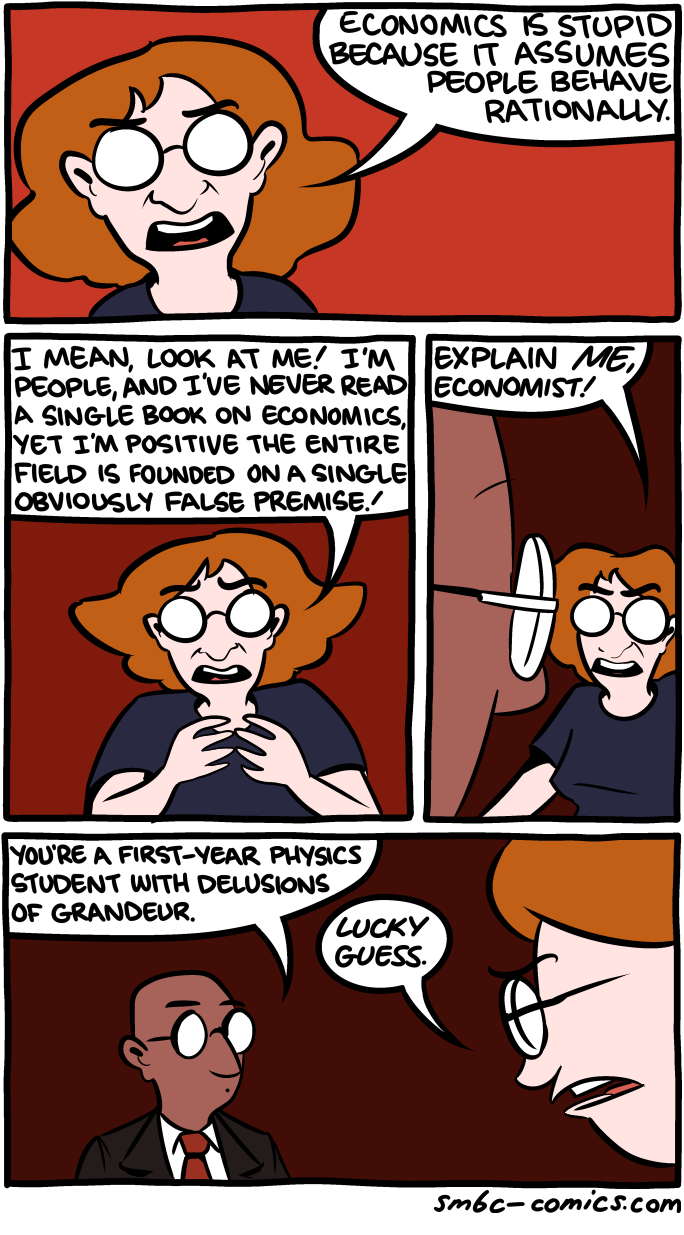
Hey Bostonoids! I'll be delivering a fake theory of economics that'll change the world at this event. This is free and open to the public, so please come say hi!
December 30, 2014
Hey Bostonoids! I'll be delivering a fake theory of economics that'll change the world at this event. This is free and open to the public, so please come say hi!
24 Dec 17:50
 Di come lo spirito del Natale riesca a nascondersi vigliaccamente nelle piccole cose, per poi saltar fuori con attacco vietcongo a tradimento quando meno te l'aspetti, si diceva un anno fa. Oggi hai deciso di fare qualcosa di diverso: parlare di un grande concentrato di sense of wonder guaglionico, di quello che da sempre è catalizzatore di genuini momenti emozione®, natalizi e non. I giocattoli. Cosa c'è di meglio che parlare di giocattoli a Natale? Ecco. Nella tua fattispecie, trattandosi della tua infanzia, giocattoli collocabili cronologicamente tra gli ultimi sgoccioli di anni 70 e gli anni 80. Quelli che seguono NON sono i 30 giocattoli più belli di quel decennio, e neanche necessariamente i tuoi 30 giocattoli preferiti. Sono i primi 30 giocattoli di quel periodo che ti sono venuti in mente, in quanto tutti legati a un qualche ricordo, più o meno carico di potenziale da GME®. Gli auguri alla fine, vamos […]
[continua a leggere...]
30 giocattoli degli anni 80 del cuore (Speciale Lacrime Napulitante Natale)
by Dr.Manhattan
[continua a leggere...]