Shared posts

15 May 23:35

Yatagan Sword Dated: 19th century Culture: Ottoman Measurements:...


Yatagan Sword

  • Dated: 19th century
  • Culture: Ottoman
  • Measurements: overall length 75 cm

The sword features the typical, slightly curved, single-edged blade, this particular one having a double rear groove, blued at the first part, with a round, gold cartouche featuring inscriptions in Arabic on a side, and decorations with inscriptions, in gold, on the other. The gilt copper hilt is decorated with filigree and large cabochon corals and glasses. The walrus ivory grip scales with large ears, while the wooden scabbard comes with leather covering and simple iron mounts.

Source: Copyright © 2014 Czerny’s International Auction House S.R.L.

15 May 23:26

Black Walnuts and Alleopathy...

Picture
I have had a tree in my backyard for years and have watched the green "seeds" grow and fall each year without knowing what the tree was. The squirrels knew as did other wildlife, but I had never identified the tree and discovered the secrets inside this tree.
For me, this is unusual as I am curious about everything and yet missed a great lesson in growing vegetables and flowers. This particular tree is central to a small habitat that I have and use to attract birds and other critters. It has the in-ground birdbath, (See the post on ants swimming), the hummingbird feeder, and the suet feeder for the woodpeckers and other clinging birds. Of course, squirrels also like to try to get to the suet but that is another story. But, it is an area that I have tried to grow several types of flowers including annuals and perennials. But most failed and I was perplexed to say the least. I had some success with Impatiens and Morning Glories but everything else that I tried died fairly quickly. So, I set out to find out why I was having so much difficulty with this area. And, it all started with this tree in the cover photo.
I began by identifying the seed, or in this case the drupe. (The outer fleshy part containing a seed). I determined that the tree was an Eastern Black Walnut and that it has some very interesting chemistry. Black walnut drupes contain Juglone, (Ju Glone) which is 5-hydroxy-1,4-napthoquinone, yellow quinone pigments, and tannin. The juglone is an alleochemical, a biochemically active material that has an influence on the growth of other living organisms including plants, bacteria and fungi, and even people. Alleopathy can be either positive or negative, and in the case of the flowers I was trying to grow, it was having a negative effect. But, we  know that there is what is called "companion gardening" where one plant can be beneficial to another.The area that was not conducive to growth in my case extended from the expanding roots to the drip line of the tree. So, if I had identified the tree sooner I could have saved a lot of time and energy. This is a lesson well-learned.
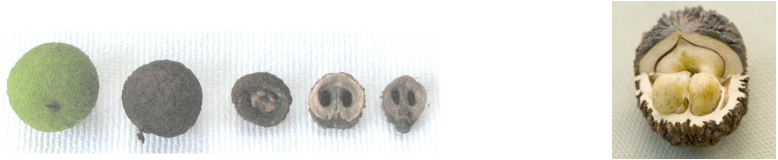
But, that is not the end of the story of black walnuts. The liquid portion of the drupe is brown and stains everything that it comes in contact with and has been used as a dye for centuries. The tannins react with iron and can make a good quill ink. There is a post from the Ohio State University Extension Service on toxicity and some of the plants that will grow with the black walnut tree here. I have also included the following photos of black walnuts in various stages of ripeness as well as the ripe inner edible fruit:


15 May 23:24

Metal Inlays Using A Bit Of Solder

by James Hobson
Bunker.jordan

Might have to etch and inlay some stuff soon!

metal inlay

Looking for a unique way to add a nice metal inlay to finish off your project? [Ben Krasnow] shows us how using a CNC router, a bit of solder, and a lot of sand paper!

It’s actually a pretty simple job — Of course, that’s only if you have a CNC machine. [Ben] started by engraving his inlay using his handy CNC mill, and then sanding off any rough spots. He then filled the engraving with acid flux paste, got out his MAPP gas torch and started dripping solder into the piece. Once everything was covered, he started sanding it, from 60 grit all the way to 600 grit for a nice polished finish. The results speak for themselves.

An easier method of this could also be achieved using plastic and epoxy, instead of brass and solder. One of the biggest problems with the solder is bubbling, which can cause voids which will appear when you are sanding — so you might have to do a second pass with the solder.

[Ben Krasnow] is an interesting character. He’s sought out the perfect cookie, made his own CT scanner at home, explained the various heat treatments of steel — and even installed LEDs into his contact lenses just for kicks!

[Thanks Fabien!]


Filed under: cnc hacks
15 May 23:23

Velogical shrinks the rim drive to "world's lightest" e-bike drive

by C.C. Weiss

The Velogical Velospeeder rear rim motor system

Friction drives like the Rubbee provide a lighter, simpler option for transforming a regular bicycle into an e-bike. Velogical's all-new Velospeeder makes the friction drive even lighter. The compact e-drive solution weighs under 4 lb and allows for seamless switching between e-assist and manual riding. The company claims it's the lightest and smallest bicycle e-drive (soon-to-be) available. .. Continue Reading Velogical shrinks the rim drive to "world's lightest" e-bike drive

Section: Urban Transport

Tags: Bikes, Cycling, Electric Bicycle, Spezialradmesse

Related Articles:
15 May 23:17

Flagship research submersible declared lost at sea

by Anthony Wood
Bunker.jordan

I blame sea monsters.

The loss of the Nereus submersible represents a significant loss to the scientific communi...

One of the scientific community's flagship unmanned research submarines, used for deep-sea exploration, has been declared lost as of 2 pm (New Zealand Standard Time), May 10. It was in use by researchers aboard the scientific research vessel, the Thomas G. .. Continue Reading Flagship research submersible declared lost at sea

Section: Marine

Tags: Remote Control, Submarine, Unmanned, Woods Hole Oceanographic Institution

Related Articles:
15 May 23:14

Hurricanes Are Migrating Closer And Closer To The Earth's Poles

by Ria Misra

Hurricanes Are Migrating Closer And Closer To The Earth's Poles

We may need to revise our ideas of just where we expect hurricanes to land. A new study shows that the location where tropical cyclones hit their most powerful peak is shifting closer to the Earth's poles.

Read more...


15 May 23:13

NASA Chief Charles Bolden has been asked to weigh in on Russia's decision to sever space-science tie

by Robert T. Gonzalez

NASA Chief Charles Bolden has been asked to weigh in on Russia's decision to sever space-science ties with the U.S. "We will need to step back and evaluate the costs and benefits of maintaining" the ISS "without our Russian partners," House Science Committee Chairman Lamar Smith said today in a letter today to Bolden.

Read more...


15 May 22:22

Is Second Life about to die?

by Annalee Newitz

Is Second Life about to die? Wagner James Au wonders about reports of the game world's demise on his blog, while the rest of us wonder where we'll go to act out Gor fantasies when all those Gorean islands are gone. Is it back to IRC?

Read more...


15 May 22:07

BONELUST SCIENCE LESSON - Bone Eating Squirrels

by Jana Miller
Bunker.jordan

Squirrels will gnaw your bones when you die.

Today's Science Lesson: This Is A Well Gnawed On Boar Skull I Wedged Between Two Trees. I Toss Bones In The Woods As Well. Why? For Squirrels & Other Wildlife That Rely On Them For Minerals & Other Nutrients They Can't Get In Their Normal Diet.
The remains of a wild boar skull wedged into a tree on my property that has been very well gnawed out the past 10 years or so.

As a bone collector it is always important to leave some bones for the wild animals. I have tossed out bones around my entire property for them and have spots where I leave piles like in the first photo.

BONELUST SCIENCE LESSON - As a bone collector it is always important to leave some bones for the wild animals. I have tossed out bones around my entire property for them and have spots where I leave piles like in the first photo.

Why do I do this? Most bone collectors have found bones, skulls or even antlers or turtle shells with teeth gnaw marks on them in the outdoors. This is likely caused by squirrels in most cases.

They do this for two reasons: A) As a source of minerals sparse in their normal diet & B) To help keep their teeth from getting too long. Their teeth are always growing & if they get too long it can cause the squirrel to starve or even have the teeth impale them. Eventually resulting in the death of the squirrel. Other animals gnaw on bones for similar reasons as well. Like rabbits. This overgrowth of teeth is called malocclusion.

There was even a giraffe that was photographed recently found gnawing on an impala skull likely for similar reasons.

A Well Gnawed On Wild Boar Or Deer Bone Found In The Woods: Squirrels & Other Animals Eat Them For Nutrients They Can't Get From Their Regular Diet
A well gnawed on deer or wild boar bone.

15 May 22:06

Venture Capital Firm Appoints Machine Intelligence As Board Member

by George Dvorsky

Venture Capital Firm Appoints Machine Intelligence As Board Member

Hong Kong based venture capital firm Deep Knowledge Ventures (DKV) has appointed a machine learning program to its board. Called VITAL, it's an "equal member" that will uncover trends "not immediately obvious to humans" in order to make investment recommendations.

Read more...


15 May 22:05

Jupiter's Great Red Spot Is Shrinking

by Ria Misra

Jupiter's Great Red Spot Is Shrinking

Jupiter's Great Red Spot may need to come up with a new moniker—not only has the spot shrunk down to its smallest measure ever, its shape is changing.

Read more...


15 May 22:05

10 Comics That Can Help You Understand Mental Illness

by Lauren Davis

10 Comics That Can Help You Understand Mental Illness

Comics don't always have the best track record when it comes to portraying mental illness. In superhero stories, mental illness is often associated with violence and villainy. There are, however, other, often personal, comics that can open your eyes to real human experiences with mental disorders.

Read more...


15 May 21:47

A Creationist Schism Is Tearing Apart A Christian College

by Mark Strauss

A Creationist Schism Is Tearing Apart A Christian College

The evolution-creationism debate has returned to Dayton, Tennessee—the site of the Scopes Monkey Trial. Except this time, the venue is not a courtroom but a Christian college, where faculty members have resigned and students have mounted protests. The issue? Whether Adam and Eve were the progenitors of humanity.

Read more...


15 May 21:47

Photo


15 May 21:46

Smart Drugs Could Be Impairing The Brains Of Young People

by George Dvorsky

Smart Drugs Could Be Impairing The Brains Of Young People

It's estimated that over a million students in the U.S. misuse prescription drugs and stimulants to boost their attention span, memory, and alertness. But a new study suggests some of these drugs are detrimental to developing brains, causing long-term impairments to cognitive function.

Read more...


15 May 21:45

Scientists try to teach robots morality

by Dario Borghino
Bunker.jordan

Hmm... the question is, will they eventually decide that humans are immoral enough to be a threat to the Earth's existence, and destroy us?

Researchers are exploring how they might create robots endowed with their own sense of mor...

A group of researchers from Tufts University, Brown University and the Rensselaer Polytechnic Institute are collaborating with the US Navy in a multi-year effort to explore how they might create robots endowed with their own sense of morality. If they are successful, they will create an artificial intelligence able to autonomously assess a difficult situation and then make complex ethical decisions that can override the rigid instructions it was given... Continue Reading Scientists try to teach robots morality

Section: Robotics

Tags: Artificial Intelligence, Brown University, Rensselaer Polytechnic Institute, Research, Robots, Tufts University

Related Articles:
15 May 21:43

Excellent Enhanced Defense Intelligence Cosplay

by Amy Ratcliffe

edi costume

Mass Effect 3′s artificial intelligence EDI (Enhanced Defense Intelligence) has a tricky costume. In a Time of Cosplay spent two months building her version of the outfit, and she made it on a budget of just over $100. Cosplay doesn’t have to be super expensive. Materials included four way metallic spandex, fabric paint, 12 gauge vinyl, a soda bottle, face paint, and a few other odds and ends. Her notes on basic design features are as follows:

The helm is constructed primarily of 2mm craft foam which I then covered in 4 way spandex. It’s a two piece construction, the top pewter portion with the ear covers and visor and then the under structure which is covered in silver. It wasn’t terribly difficult, just a lot of finessing to get all the lines and covers as smooth as possible. It also has a chin strap to hold it as close around my face as possible. The bodysuit is almost completely one piece, the gloves velcro on and the larger vinyl overlays also velcro on but otherwise I’m literally just getting zipped into a bodysuit. I’m really happy with that, everything stayed in place fairly well excepting some of those vinyl overlays which weren’t attached. Covering the cups of the bra in spandex was a total pain but it worked out very well and with the straps of the bra being built into the suit it helped to support all that foam and such that was glued to my chest.

EDI sketches

Read more at In a Time of Cosplay.

15 May 21:42

NEW PRODUCTS – GAKKEN (PART 3) – The Pinhole Planetarium Kit / Edo-Style Clock Kit / AKARI Origami LED Lamp Shade Kit / Desktop Robot Cleaner Kit

by alon shapiro
Bunker.jordan

WANT WANT WANT

NEW PRODUCTS – GAKKEN (PART 3)The Pinhole Planetarium Kit / Edo-Style Clock Kit / AKARI Origami LED Lamp Shade Kit / Desktop Robot Cleaner Kit

Gakken is a Japanese publishing company founded in 1946. In the 1970s, they began selling educational toys, books, magazines, and electronic kits. Their kits are known for their smart design and relative ease of use and have a large cult following both in Japan and the United States.

Check out all of our new Gakken products here!

NewImage

Decorate your walls with 10,000 bright stars with this Pinhole Planetarium Kit from Gakken’s series of Science for Adults kits! The Pinhole Planetarium uses a small light bulb and a micro-perforated dodecahedron to cast the stars, galaxies, and constellations of the northern hemisphere onto your walls. The stellar globe can be set to project the northern hemisphere night sky for any location, date, or time.

The planetarium was designed using records from JAXA, a Japanese space and aviation research institute, and Takayuki Ohira who created the Megastar planetarium, to ensure high accuracy and a comprehensive collection of cosmic bodies. Both kids and adults love seeing their rooms, living rooms, or offices covered in stars and the pin hole planetarium also adds a level of accuracy that makes it interesting and unique.

In stock and shipping now!

NewImage

Experience a favorite feudal Japanese time-piece by building your own beautiful dual-foliot, Edo-period Japanese mechanical clock!

Edo-period Japanese clocks were unique mechanical clocks that adapted Western clock-making techniques to tell traditional Japanese time. This kit from Gakken has two foliots – one for the day hours and one for the night hours. The front and rear foliots switch between 6 AM and 6 PM automatically.

A foliot is part of the Verge escapement of early clocks. Even if you’re not a clock expert or enthusiast, this kit is fairly easy to build and should only take an hour or so.

In stock and shipping now!

Akari

AKARI Origami LED Lamp Shade Kit

Delve into the traditional Japanese art of origami and produce softly lit origami paper. You can make a lampshade using either a square-folded shade or a polygonal shape and then switch between different color lights! Each of the three LED colors can be dimmed individually or set to auto-fade.

The concept and design of the AKARI Origami came about from a collaboration between Japanese artist Hiroyuki Moriwaki and the origami designer Miyuki Kawamura.

In stock and shipping now!

NewImage

Desktop Robot Cleaner Kit

Ever wish you were a member of The Jetsons? While you can’t travel to the year 2062, you can buy your very own desktop robot vacuum cleaner and at least feel like you’ve been transported to a futuristic utopia of tidy tabletops. It changes directions when it bumps into objects and senses any edge so you can leave it alone at your desk, table, or workspace and come back to a nice, clean surface.

In stock and shipping now!

15 May 20:23

Microsoft to sell Xbox One without Kinect, and drop paid-only access to entertainment apps

by Chris Wood

Microsoft will sell a cheaper version of its console that does not include the sensor

Microsoft has announced a turn-around on its policy towards the somewhat controversial Kinect sensor, usually bundled with its next-gen Xbox One console. In what is likely a response to pressure from both consumers and the strong sales of Sony’s competing PlayStation 4 system, the company has today announced that it will sell its latest console without the Kinect sensor, lowering the price of entry to the system... Continue Reading Microsoft to sell Xbox One without Kinect, and drop paid-only access to entertainment apps

Section: Games

Tags: Kinect, Microsoft, Xbox One

Related Articles:
15 May 19:59

Graphene and carbon nanotubes combined to create flexible, wearable supercapacitor

by Colin Jeffrey

The flexible supercapacitor composed of graphene and carbon nanotubes (Photo: Dr.Dingshan ...

An international team of researchers has developed a supercapacitor composed of graphene and carbon nanotubes that is claimed flexible enough to be woven into clothing and potentially powerful enough to offer a real alternative to batteries for use in portable devices. Capable of being charged and discharged in excess of 10,000 cycles, the new supercapacitor also promises to be significantly lighter, faster to charge, and more robust than current battery technology. .. Continue Reading Graphene and carbon nanotubes combined to create flexible, wearable supercapacitor

Section: Electronics

Tags: Fiber, Materials, Portable, Rechargeable, Supercapacitor, Textile, Wearable

Related Articles:
15 May 19:59

Shape-changing implantable transistors grip living tissue

by Lakshmi Sandhana

These implantable shape changing transistors can grip nerves and tissues, changing shape w...

A multinational group of scientists has developed implantable shape-changing transistors that can grip nerves, blood vessels and tissues. According to the researchers, these soft electronic devices can change shape within the body, while still maintaining their electronic properties, allowing them to be used in a variety of applications and treatments... Continue Reading Shape-changing implantable transistors grip living tissue

Section: Science

Tags: Flexible, Implant, Transistor, University of Texas, University of Tokyo

Related Articles:
15 May 18:44

Zero Latency creates a free-roaming wireless multiplayer VR experience

by Richard Moss

Melbourne-based startup Zero Latency built a wireless cooperative virtual reality environm...

"Virtual reality needs its arcade moment," argues Zero Latency co-founder Tim Ruse. The Oculus Rift headset may be making waves around the tech sphere and zeroing in on a takeover of home entertainment, but to really experience immersion, the Melbourne-based startup aims to prove you need to add full-body motion tracking and a big space that players can move around in. No wires, no gamepads, no treadmills... Continue Reading Zero Latency creates a free-roaming wireless multiplayer VR experience

Section: Games

Tags: Oculus Rift, Pozible, Virtual Reality, Wireless, Zero Latency, Zombies

Related Articles:
15 May 18:40

c. 1910-1915: Testing New Yorks fire equipment

by Chris

Testing New Yorks fire equipment Testing New Yorks fire equipment Testing New Yorks fire equipment Testing New Yorks fire equipment Testing New Yorks fire equipment Testing New Yorks fire equipment Testing New Yorks fire equipment Testing New Yorks fire equipment

15 May 18:23

1933: Playing tennis with a woman instead of a ball

by Amanda

Tennis Woman Ball 1

15 May 18:16

Train Ninja Turtles with a Splinter Costume

by Amy Ratcliffe

Splinter Costume

The Teenage Mutant Ninja Turtles wouldn’t be who they are without Splinter; he trains and protects them. The fact that he’s a rat presents a furry cosplay challenge, and Instructables user SpicyPandaCreations handled it with seeming ease. Faux fur isn’t easy to work with it and he used a pile of it, foam, faux leather, and other items to build his Splinter outfit. He constructed the pants, chest, and arms as separate pieces so he didn’t have to wear a giant connected bodysuit. Here’s how he made Splinter’s feet – I’m surprised by how straightforward it is:

Take some foam and make a foot. and several toes. (Pic 1)
Glue foam toes to foot.
Glue cardboard underneath foot.
Duct tape entire foam foot.
Hot Glue the fur onto the entire foot.
Take painted nails and glue them on the toes.
Take leather and glue to the bottom of foot (pic 3)
Put on brown socks prior to sticking your shoe inside fur foot.
Masking tape around the foot to hide your shoe.

Read more at Instructables.

15 May 18:15

May 15th: Fight to Save the Internet

by adafruit

Sti Background Image
May 15th: Fight to Save the Internet.

The drumbeat for real Net Neutrality is getting louder and louder. On May 15th we’re bringing the noise straight to the FCC’s doorstep. Hundreds of thousands of activists are coming out against the FCC’s plan to kill the open Internet.

Our rights to connect and communicate — via universally accessible, open, affordable and fast communications networks and devices — are essential to our individual, economic and political freedoms.

Yet these rights — codified in the First Amendment and the Universal Declaration of Human Rights — are at the mercy of powerful phone, cable and Internet companies and the government agencies they collude with.

The Internet is the foremost battleground for free speech in the 21st century, and protecting our Internet freedom is essential to safeguarding our rights to speak and assemble in private. But the principles embodied in the Declaration of Internet Freedom — freedom of expression, access, openness, innovation and privacy — are under constant attack.   

The attacks are both large and small, but all of them are chipping away at our basic rights.

Phone and cable companies like AT&T, Comcast and Verizon are raising prices, cutting service, blocking applications, censoring speech and violating our privacy. Internet companies — both familiar names and others you’ve never heard of — are compiling profiles of millions of people, selling the data and raking in billions. And federal agencies like the NSA are plying these same companies with requests for the data of millions of users — issuing these demands in secret and in the absence of any real accountability.

Meanwhile, thanks to a lawsuit from Verizon, a court overturned the Federal Communications Commission’s Net Neutrality rules on Jan. 14, 2014 — meaning that our Internet service providers are now free to block or otherwise interfere with online traffic. Policymakers on both sides of the aisle are trying to cut programs that guarantee universal access to communications networks. People around the country are at risk of losing basic connections — connections that, until now, we could take for granted.

We must build a movement to fight for our rights to connect and communicate.

15 May 18:13

3D Designer Spotlight – Michael Curry: 3D Printed Vehicle #3DThursday #3DPrinting

by Matt

Pasted Image 5 15 14 8 55 AM

Michael Curry, aka “Skimbal,” is one of Thingiverse’s / desktop 3D printing’s iconic designers. He swirls together humor/pop culture and his deep passion to learn (and then teach) how machines work — and out of this collision has emerged a wide range of influential and often-cited printable projects such as the Gothic Cathedral Playset and the Turtle Shell Racers.

He has also created a number of 3D printed robot projects to date that we have been unable to resist sharing on the Adafruit blog, from his cute, teenager Minion robots from Maker Faire Kansas City a few years ago to his Dangerball! maker-friendly printable spherical robot last year at World Maker Faire in New York. As long as he keeps creating fantastic project after fantastic project, we don’t see any reason to stop sharing this incredible work.

Pasted Image 5 15 14 9 25 AM

3D Printed Vehicle, by Michael Curry

Over the course of the last few months, after heading back to Kansas City and diving into his self-imposed maker-residency at Hammerspace, he has been hard at work creating one of his dream projects, a project practically no one thought he could pull off — an entirely 3D printed vehicle. This weekend at Maker Faire Bay Area 2014 he will debut the results of this project so far!

To prepare you for this exciting DIY project launch, we wanted to bring together a number of the videos he has been posting about his project in progress, from first system test to a trial drive in the parking lot of Hammerspace!

The project’s tag line: “They said ‘You Wouldn’t Download a Car’! Well now you can!” ;-)

Creating the Rear Differential

Dec 14, 2013: Bench Test of my 3D printed rear differential. Printed on a MakerBot Replicator 2 at Medium settings: 2 shells, 0.2mm layer height, and 10% infill density. The buckets have a combined weight of 70 pounds (30 kilos). At the end the chain slips off sprocket and got twisted, which ended testing for the day. The Differential still works fine.

First Attempt at Rear Suspension

Dec 31, 2013: A test version of the rear suspension of my in-progress 3d printed vehicle. Printed in PLA on two Makerbot Replicators. The parts are all printed at the default medium settings (2 shells, 10% density, .2mm layer height) except for the blue pins, which are printed at 20% density with 4 shells.

2nd Prototype of Suspension

Feb 15, 2014: The second prototype of the Rear Suspension for my 3D Printable Vehicle and the start of the Wheel structures

Further Development of Suspension and Drivetrain


Mar 25, 2014: An update on the development of the suspension and drivetrain, also get a look at what is hopefully the final version of the rear axle.

Test drive!

May 9, 2014: Getting ready for Bay Area Maker Faire 2014 with my 3D Printed giant RC vehicle. Its weighs about 70 pounds and was printed over 5 months on two MakerBot Replicators.

Pasted Image 5 15 14 9 23 AM

Check out the launch of this exciting 3D printed vehicle project at Maker Faire Bay Area this weekend!


649-1
Every Thursday is #3dthursday here at Adafruit! The DIY 3D printing community has passion and dedication for making solid objects from digital models. Recently, we have noticed electronics projects integrated with 3D printed enclosures, brackets, and sculptures, so each Thursday we celebrate and highlight these bold pioneers!

Have you considered building a 3D project around an Arduino or other microcontroller? How about printing a bracket to mount your Raspberry Pi to the back of your HD monitor? And don’t forget the countless LED projects that are possible when you are modeling your projects in 3D!

The Adafruit Learning System has dozens of great tools to get you well on your way to creating incredible works of engineering, interactive art, and design with your 3D printer! We also offer the MakerBot Digitizer in our store. If you’ve made a cool project that combines 3D printing and electronics, be sure to let us know, and we’ll feature it here!

15 May 18:10

Tokyo Man Busted for 3D Printed Weapons

by Site Admin

According to a report on NHK and BBC, Tokyo resident Yoshitomo Imura has been arrested by Japanese police. 

The 27-year old apparently was found in possession of 3D printed “possibly made with the technology”. He’s been charged with concealing two such 3D printed weapons in his Kawasaki home. 

Imura “admitted to using a 3D printer at his home to make the guns, but that he did not think it was illegal.” He had five prints onsite but police determined two of them were capable of firing, thus the charges against two weapons. Imura’s computer also had stored the 3D CAD files for printing the weapon. 

Presumably the design used was the Liberator, made by Defense Distributed, who no longer distribute that design after a government shutdown. 

While this event certainly has made the headlines, we must offer our thoughts. We’re not certain of the legality of weaponry in Japan, but we understand that most types of guns are in fact illegal. Thus, the possession of the two 3D printed guns is likely no different than possessing ANY gun: illegal. 

In this case Imura apparently didn’t realize the weapons were illegal. One could say he probably did, but it is also conceivable that one truly doesn’t realize they are actual weapons. Plastic guns, for most people, would be immediately thought of as toys, wouldn’t they? In any case each jurisdiction should make their policy on 3D printed weapons perfectly clear, otherwise this is probably going to happen again. 

This event is not nearly as silly as the Manchester incident, but is perhaps representative of the confusion generated when a new technology like 3D printing encounters laws and people’s misunderstanding of them. 

Via BBC and NHK

15 May 18:09

MakerBot’s Color-Changing Extruder Patent

by Site Admin
Bunker.jordan

#makerbotpatent #sadness

The buzz today comes from a new MakerBot patent that claims an ability to change filament on the fly - within a single extruder.

USPTO patent application US 20140034214 A1 is titled, “Build material switching”. That’s exactly what is to happen. The MakerBot team seems to have created a simplified method of connecting two different filament feeds to a single extruder. The concept is to slide a platform of two filament feeds alternately across a hot end, as you can see in the diagram above. 

Reading through the lengthy, verbose and vague patent language reveals they are not merely attempting to patent the mechanism in the image, but also much of the activity, including computation of precise filament lengths, evacuation of the hot end during “transitions” and so on. This builds on one of MakerBot’s previous patents that involved evacuation of a hot end for color changing. 

Such a component could enable a 3D printer to print in two colors. We do not believe it is primarily intended to print different materials, however, as that would require the hot end to be constantly changing temperature, complicating filament evacuation and could dramatically slow down printing as seems to happen with many dual-extruder machines of today. 

You must remember a few things: 

  • This is a patent application; it has not yet been approved
  • Just because a patent appears, it doesn’t mean there is even a prototype in a lab, let alone a product
  • There is no certainty whether this approach will practically work

But if it does work. Well. We could expect MakerBot to eventually develop and release a personal 3D printer that includes the magic color-changing extruder. More function with less hardware could mean a lower cost, higher performance option. Or perhaps simply more profitability for MakerBot. 

Via Google Patents

15 May 18:08

MakerBot’s Digital Reconstruction Patent

by Site Admin
Bunker.jordan

This is old, and has been done for a long time... just not in an automated way.

Also, the phrase "patent application from MakerBot" still makes me sad :(

We’ve uncovered a very curious patent application from MakerBot that seems to indicate they’re developing an automated way to reconstruct broken objects. 

The patent application, part of a series of patent applications for various usage scenarios, makes this claim:

A method comprising: providing a broken part having a number of pieces including a first piece and a second piece broken from an integral part; scanning the first piece and the second piece to obtain a first digital model and a second digital model; providing information about the integral part; processing the information, the first digital model, and the second digital model to obtain a third digital model of the integral part prior to becoming broken; and fabricating a duplicate of the integral part from the third model.

What does this mean, exactly? In spite of the near-unintelligible legal wording we believe it could mean this:

You 3D scan the broken pieces of an item; software reconstructs the original object, which can then be 3D printed - replacing the original broken item.

This could be a game-changing new usage scenario for 3D printing, if MakerBot can pull it off. It will require some tricky 3D software to logically assemble broken bits into a new model that closely resembles the original object. 

There will be limits to what’s possible. Imagine an item cracked into so many small pieces that the fragments would become ambiguous: You could not reconstruct the object. This is why we think this process is intended for scenarios involving a small number of broken pieces scenarios only. 

We’re very interested to see if MakerBot follows through on this, because watching the reconstruction process unfold will seem like magic. 

Via Google Patents