
Bunker.jordan
Shared posts
15 May 22:06


Courtly Smallsword Dated: 1780 Culture: French Measurements:...
Courtly Smallsword
- Dated: 1780
- Culture: French
- Measurements: overall length 101 cm
The sword has a blade blued on all sides along the entire length and decorated with gilded lilies. The shape of the blade is triangular, gilded, featuring the French coat of arms of King crown. The grip features horsemen, soldiers and military scenes in relief in iron over frosted gold background. The original grip features a turk’s head and is wrapped in silver wire. The fish skin-covered wooden scabbard comes with finely made fittings. The sword was probably made for the French royal house.
15 May 21:45
Section: Architecture
Tags: House, Small Living
Related Articles:

Couple builds tiny house for US$33k, releases plans
by Stu Robarts

Section: Architecture
Tags: House, Small Living
Related Articles:
- Tiny Leaf House can accommodate a family of four – and it has wheels
- Off-grid Minim House reimagines tiny living
- Mushroom Tiny House: The part-grown portable home
- Could you live in a home the size of a parking space?
- Gizmag talks to the creators of the Tiny Tack House
- Hand-built Pocket Shelter micro home ready to hit the road
Tertiarymatt, firehose likes this
15 May 21:44

The Subtractive Canvases and Street Art of Pejac
by Christopher Jobson


Equally versatile in medium, canvas, and subject matter, Spanish artist Pejac seems comfortable working on the smallest drawing to the largest outdoor mural. While his ideas and motivations are often crystal clear, it is his minimalism and subtractive techniques that make his work truly stand out. His figures are often rendered only in silhouette or fine lines and familiar patterns like bricks or the folds of the human brain are transformed into flocks of birds or the branches of trees.
You can see much more of his work on Facebook and learn a bit more over on Arrested Motion.
rygzengrho, Vitaly Obukhov and 4 others like this
15 May 21:43
Section: Space
Tags: Inflatable, Mars, NASA, Spacecraft
Related Articles:

Inflatable flying saucers could help spacecraft land on Mars
by Lakshmi Sandhana

Section: Space
Tags: Inflatable, Mars, NASA, Spacecraft
Related Articles:
- NASA puts Orion spacecraft's backup parachutes to the test
- How NASA plans to land a 2000 pound rover on Mars
- Phoenix Mars Lander Spacecraft being readied for August launch
- NASA wants public to send haikus to Mars
- MAVEN: NASA's post-Phoenix Mars probe
- NASA announces new rover mission for Mars
Rosalind likes this
15 May 20:02
Section: Laptops
Tags: Android, Archos, Jelly Bean, Netbook, Touchscreen
Related Articles:

Archos launches $170 ArcBook laptop
by Paul Ridden

Section: Laptops
Tags: Android, Archos, Jelly Bean, Netbook, Touchscreen
Related Articles:
- Archos releases 250GB version of 7-inch Archos 70 internet tablet
- Archos unveils G9 series Android tablets with option of 250GB HDD
- Archos updates Windows 7 tablet – The Archos 9
- Archos 7 and 8 to join tablet party
- Archos relaunches Platinum Series tablets
- ARCHOS G9 tablets get release dates and pricing
firehose likes this
15 May 20:02

The Mini Book of Major Events by Evan Lorenzen
by Christopher Jobson


Trying to compress the history of Earth into a single book is an especially daunting task, the difficulty is compounded when the book you’re writing is the size of a nickel and is limited to just a few pages. Oh, and it needs lots of pictures. Lucky for us, illustrator Evan Lorenzen was up to the task and identified a few pivitol moments in history which he turned into this extremely tiny hand-bound book. You can see more of his miniature books over on his Tumblr. (via F*ck Yeah Book Arts)
Christopher Lantz, Rosalind and one other like this
15 May 20:00
Section: Science
Tags: Hydrophobic, Network, Oak Ridge National Laboratory, ORNL, Surfaces, Water
Related Articles:

Water droplet networks could harvest water from fog
by Lakshmi Sandhana

Section: Science
Tags: Hydrophobic, Network, Oak Ridge National Laboratory, ORNL, Surfaces, Water
Related Articles:
- Unique droplet network 3D printer produces synthetic tissues
- Jumping droplets could offer more efficient thermal management
- Dead-eye Droplet: The assassin of garden sprinklers
- Surfing on a wave of sound allows controlled movement of levitating objects
- Oil spill-absorbing material inspired by cactus needles
- Swiss breakthrough could mean rain on demand
15 May 20:00

Tattooed Porcelain Figures by Jessica Harrison
by Christopher Jobson

Courtesy Galerie L.J.

Courtesy Galerie L.J.

Courtesy Arrested Motion

Courtesy Arrested Motion

Courtesy Arrested Motion

Courtesy Arrested Motion

Courtesy Arrested Motion
As part of a new body of sculptural work, artist Jessica Harrison has created a series of delicate porcelain figurines depicting idealized women in ball gowns, with one glaring difference from the collectibles found in your grandmother’s curio: each sculpture is covered neck to wrist in ornate sailor tattoos. This juxtaposition is not unfamiliar territory for Harrison who has created other, much more macabre figures, in the past. The Scotland-based artst recently completed a practice-led PhD funded by the Arts and Humanities Research Council, where she researched the relationship between interior and exterior spaces of the body, an area of study that is directly reflected in her artwork. Via her artist statement:
Harrison proposes a multi-directional and pervasive model of skin as a space in which body and world mingle. Working with this moving space between artist/maker and viewer, she draws on the active body in both making and interpreting sculpture to unravel imaginative touch and proprioceptive sensation in sculptural practice. In this way, Harrison re-describes the body in sculpture through the skin, offering an alternative way of thinking about the body beyond a binary tradition of inside and outside.
The pieces shown above, along with several others, will be on view at Galerie L.J. as part of her first solo show in Paris titled FLASH, beginning May 15, 2014. (via Arrested Motion, I Need a Guide, This Isn’t Happiness)
rygzengrho, Afishman126 and one other like this
15 May 20:00
Section: Wearable Electronics
Tags: Android, Bluetooth, Crowdfunding, Israel, Smartphones, Smartwatch, Watches
Related Articles:

Modillion turns any "dumb" watch into a smartwatch
by David Szondy

Section: Wearable Electronics
Tags: Android, Bluetooth, Crowdfunding, Israel, Smartphones, Smartwatch, Watches
Related Articles:
- Sony shows off NFC-enabled, water-resistant SmartWatch 2
- Magellan Echo smartwatch hits the ground running
- Moto 360: Motorola's first Android smart watch
- LG drip feeds more details on its G Watch
- Adidas gets in on the smartwatch action with the miCoach Smart Run
- Ibis dual-face smartwatch concept revealed at Mobile World Congress
Tertiarymatt likes this
15 May 19:59
Section: Health and Wellbeing
Tags: Addiction, Bluetooth, Kickstarter, Monitor, Rechargeable, Smoking, Tobacco, Tracking
Related Articles:

Quitbit smart lighter tracks how often you spark up
by Nick Lavars

Section: Health and Wellbeing
Tags: Addiction, Bluetooth, Kickstarter, Monitor, Rechargeable, Smoking, Tobacco, Tracking
Related Articles:
- Smokio Smart e-cigarette allows users to monitor their habit via smartphone app
- Harm-reduction gadget helps smokers quit
- Can't find a smoking area? There's an app for that
- SuperSmoker electronic cigarette launched in UK
- Greenbutts cigarette filters sprout flowers when planted
- Digital smoking: indulgence without the side effects?
15 May 18:24
1932: Umbrella “boats” and brooms for “oars”
by Amanda
On a Florida beach, girls using inverted umbrellas as boats and a broom as an oar.

firehose likes this
15 May 18:24
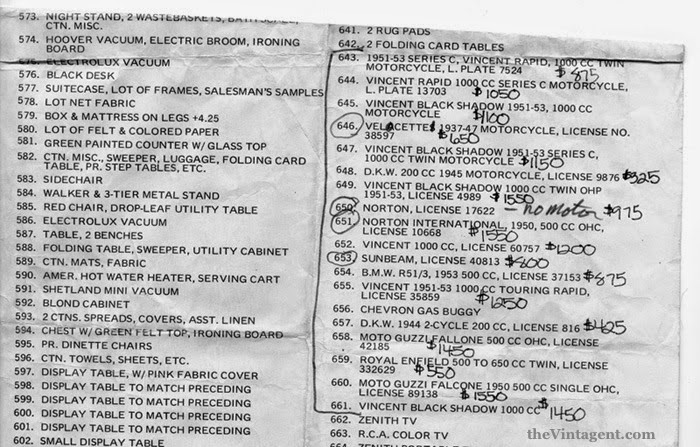
An old friend forwarded a pair of newspaper clippings from a 1978 auction, held by Butterfield+Butterfield auctioneers of San Francisco (now absorbed into Bonhams), of the various contents from the estate of noted Bay Area eccentric 'Crazy' George Disteel. I've written previously about Disteel, but hadn't seen the prices fetched by his motorcycles at the auction -it makes fascinating reading, and sheds light on how the priorities of the motorcycle collector market have shifted in the 35 years.
If I were to ask a savvy classic motorcycle fan today, which was the more valuable, a Vincent Black Shadow, a Norton International, or a Moto Guzzi Falcone? The answer would likely be in that order, that 'of course' a Shadow is among the most coveted of vintage motorcycles, and anyone who's been reading the classic press the past 30 years could explain exactly why - the speed records, the exploits of Marty Dickerson and Rollie Free and George Brown, the Phil Irving connection, all of which seems correct and natural today. But history is a mutually agreed-upon construction (or disagreed upon!), a narrative which suits the needs of the present. And at present, we apparently need the Vincent Black Shadow as top dog, with consequent demand and bidding wars at auction pushing prices over $120k for decent examples.
In 1978, though, collectors felt the three machines - Vincent, Norton, and Guzzi - were of equal value - $1550 - at least in that California auction room. As someone who entered the 'classic bike' scene just a few years later, I concur that in the early '80s, a Moto Guzzi Falcone was a rare exotic in the USA, highly esteemed for the quality of its build and innovative design. Moto Guzzi, the only factory of the 3 still in business at that date (Norton was limping along in limbo, and Vincent gone since 1955) had a far better reputation for the quality of their castings and machine work than either British brand, and Norton OHC singles bathed in the glory of decades of racing success of their racing brother, the Manx. I can confirm that both an Inter and a Falcone were every bit as desirable as a Shadow until the current generation.



1978: WHAT WERE THEY WORTH?
by The Vintagent
 |
| George Disteel late in his life, using 'duct tape' as an eyepatch to help him see despite cataracts |
 |
| The San Francisco Chronicle article of Jan 26, 1978, with a story of George Disteel's estate auction... |
 |
| The Butterfield+Butterfield auction list and results for George Disteel's estate |
 |
| The 1965 Cycle World road test of a Vincent Black Lightning - 'an evil-handling beast' |
Vincent twins had a reputation in the USA for excellent top speed potential, but frightening handling, the legacy of a profoundly negative Cycle World road test of a Black Lightning in their Sept.1965 issue. In fact, the tester said, "The Vincent motorcycle may be fast, but it is an evil-handling beast, with simply awful brakes. It is the most dangerous motorcycle ever to come our way, and we are not sorry in the least that it is no longer being made." Which is a far cry from their current reputation! (By contrast, I've road tested a 1950 Vincent Black Lightning, and found it absolutely fantastic, with excellent handling, and a thrill to ride).
Using an 'inflation calculator', $1550 in 1978 dollars equals around $5800 in 2014, a 275% inflation over 36 years. What would can we expect to pay today for these machines? While I can't account for the condition of Disteel's bikes (they're still around of course, I know of several in the SF Bay Area still), here's what you'll have to pay for really good examples of each machine:
- Bonhams auctioned a 1950 Moto Guzzi Falcone at their Las Vegas 2014 sale, which fetched $36,800.
- H+H sold a 1950 Norton Model 30 International for $33,900 in April 3013 (courtesy theFuelist.com)
35 years later, the Vincent is valued by collectors at 4 times the value of the Norton and Moto Guzzi, a situation which would have puzzled collectors in 1978, who would have pooh-poohed the notion of the flawed Vincent twin having more value than the race-bred Norton and high-quality Moto Guzzi. Food for thought; today's values are exactly that, and not an indication of tomorrow's values...
15 May 18:21
 Every Tuesday is Art Tuesday here at Adafruit! Today we celebrate artists and makers from around the world who are designing innovative and creative works using technology, science, electronics and more. You can start your own career as an artist today with Adafruit’s conductive paints, art-related electronics kits, LEDs, wearables, 3D printers and more! Make your most imaginative designs come to life with our helpful tutorials from the Adafruit Learning System. And don’t forget to check in every Art Tuesday for more artistic inspiration here on the Adafruit Blog!
Drinkable Book combines sanitation manual and water filters #ArtTuesday
by Matt

Drinkable Book combines sanitation manual and water filters, from Dezeen.com:
Launched by communications group DDB New York for charity WaterisLife, the Drinkable Book is a sanitation manual with pages that double as water filters. It was created by researchers from American institutions Carnegie Mellon University and the University of Virginia.
The book’s pages contain unique technology, invented by chemist Dr Theresa Dankovich, which can help decrease the bacteria count of contaminated drinking water by more than 99.9 percent.
New-York-based typographer Brian Gartside was brought on board to help shape the book’s aesthetic.
“At the moment, this is by far the most exciting project I’m working on,” he told Dezeen. “The process of designing the book itself was unlike anything I’ve done before, simply because of all the variables that were beyond our control.”
Historically, WaterisLife faced serious challenges when it came to providing both clean water and useful information about sanitation to communities in need, but The Drinkable Book appears to tackle both issues simultaneously.
Each page gives 60 days of safe drinking water, while an entire book can provide up to four year’s worth.
A single page can be broken into two 4.5 by 4.5-inch filters; the top one is printed with hygiene information in English, while the bottom is translated into the relevant local language. Up to now, they have printed a run of books destined for Kenya, which are written in English and Swahili.
“The end goal would be to produce books/filters for each of the 33 countries that WaterisLife works in, but we had to start somewhere,” Gartside said.


Every Tuesday is Art Tuesday here at Adafruit! Today we celebrate artists and makers from around the world who are designing innovative and creative works using technology, science, electronics and more. You can start your own career as an artist today with Adafruit’s conductive paints, art-related electronics kits, LEDs, wearables, 3D printers and more! Make your most imaginative designs come to life with our helpful tutorials from the Adafruit Learning System. And don’t forget to check in every Art Tuesday for more artistic inspiration here on the Adafruit Blog!
15 May 18:20
Creating Green Arrow’s Bow
by Amy Ratcliffe

Any time a comic book character gets adapted for television or a movie, you can bet the costume is going to change. For The CW’s Arrow, Oliver Queen gets a look that involves more leather but also looks sleeker. RPF user Tvayumat tackled the new ensemble and did a wonderful job making it screen accurate. He didn’t start with the green costume though; instead, he built the bow first. He used a Ragim Matrix Jr. 48 inch bow as the base and says it is a perfect match as far as the overall shape. Here are some notes on how he modified the bow to make it look just right:
I set to work removing the red lacquer finish from the bow riser. It was slow going at first when I was using 60 grit by hand, but after I remembered how rough the finished item was going to look anyway, I switched to a dremel with a sanding barrel attachment. Results were yielded much quicker.
At this point I ordered myself a woodburning pen to burn the mysterious symbols into the bow, and while I was waiting fabricated up some kid, drunk, and con-safe replacement bow limbs out of fiberglass and some epoxy putty.
It was mostly an experiment making flexible things out of fiberglass mat, and it worked out pretty well.
While waiting for things to arrive I experimented with weathering and staining the wood. Several failed experiments using vinegar/steel wool and sanding the riser back down *did* give me some fairly believable wear marks in any case.
After trying a lot of complicated answers, I decided to go for the ultimate shortcut and use Minwax combination wood stain and finish. Since it is an oil based stain, I wanted to do all my burning in advance, lest I immolate my new bow.

Read more at The RPF.
15 May 18:19
Google Glass meets cyberpunk light therapy in this student’s project #WearableWednesday
by Jessica

Fast Co Design has a great story on Drexel University student troy Hudson’s cyberpunk light therapy project.
Do you feel sadder, fatter, or sleepier in fall and winter? You’re not alone. As many as 10 million people in the United States alone suffer from Seasonal Affective Disorder (SAD). A new wearable technology, created by a Drexel University student, may make SAD a thing of the past.
The Light Therapy Glasses, which resemble a pair of cyberpunk goggles, constantly beam simulated sunlight into the periphery of your vision. It tricks your seasonally affected brain into thinking it’s the middle of summer–even in the dead of winter.
Because SAD gets triggered when daylight hours are abbreviated, the best way to treat the disorder is with light therapy, which exposes you to bright light via specially designed light boxes. So your body thinks it’s getting more sunlight than it actually is, and if you use it regularly, it can be up to 80% effective in alleviating your SAD symptoms.

But light therapy has a “profound dropout rate,” says Drexel University product design student Troy Hudson. Why? Because you have to fit a couple of hours of daily light into your busy life. Hudson wanted to find a way to humanize light therapy–to adapt to multiple lifestyles while making its prerequisites less onerous.
Hudson found his solution in wearable technology, and especially in products such as Google Glass. “The idea of projecting light that close to your eyes sounds completely insane, but artificial light needs to hit your retina to simulate the effects of sunlight,” Hudson explains to Co.Design. “For that purpose, glasses are situated perfectly on the face.”
Hudson’s Light Therapy Glasses produce approximately 2,000 lux at the corners of your retina. Because they sit on your face, they provide a consistent angle, distance, and intensity of light, while also being extremely portable. Because the light is always in the periphery of your vision, Hudson says, the Light Therapy Glasses are less blinding than light boxes, which you must stare into for maximum effect. Hudson’s Light Therapy Glasses can even track a user’s progress over time, thanks to a connected Bluetooth app.

 Every Wednesday is Wearable Wednesday here at Adafruit! We’re bringing you the blinkiest, most fashionable, innovative, and useful wearables from around the web and in our own original projects featuring our wearable Arduino-compatible platform, FLORA. Be sure to post up your wearables projects in the forums or send us a link and you might be featured here on Wearable Wednesday!
15 May 18:19
This Hat is Making Eyes at You #WearableWednesday
by Leslie Birch
You may recall that Lucas Morgan made a great EL wire shirt a while back. It looks like this mad tech artist is at it again with a new top hat called “All Seeing Eye”. This is a great example of Adafruit’s NeoPixels — 704 to be exact! Two eyes move around randomly and appear to be staring at passersby. They are almost a bit spooky, like something you would see in a zombie flick (zombies beware!). Actually, Lucas has a love for music fests, so chances are this hat will be on tour.

The project started with a mock-up using the 30 LEDs/meter and then moved off to the 144 LEDs/meter. That’s a lot of bling! One of the issues Lucas faced was finding a hat that was a true cylinder. Apparently most top hats have a slight taper, but he did manage to find a decent one at a costume shop. The next step was aligning the strips, and conveniently there are holes near the LEDs that he was able to pin to help line up the rows. As far as hardware, he used a Tinyduino Microcontroller and a level shifter to convert the power to 5V for the NeoPixels. Not to get all Adafruit here, but the 4 Button Ribbon Cable Input Pad is a really cute way to operate the different animations on the hat. There’s a lot more detail on his blog Enviral Designs, so get ready for some cool pics.

Okay, enough with all the details; you know what’s coming and we’ve got the tutorial all ready for you — the Guggenhat. It’s a hat inspired by the famous Guggenheim Museum with its delightful curves. It will be your own personal billboard, so you can go to your next red carpet event (or graduation) in style. Coil NeoPixels like a pro and have your own original message out there for the world to see.

Every Wednesday is Wearable Wednesday here at Adafruit! We’re bringing you the blinkiest, most fashionable, innovative, and useful wearables from around the web and in our own original projects featuring our wearable Arduino-compatible platform, FLORA. Be sure to post up your wearables projects in the forums or send us a link and you might be featured here on Wearable Wednesday!
firehose likes this
15 May 18:19
Internet Machine
by adafruit
Internet machine is a multi-screen film about the invisible infrastructures of the internet. The film reveals the hidden materiality of our data by exploring some of the machines through which ‘the cloud’ is transmitted, processed and transformed.
15 May 18:19
Solar Dress Charges Phone #WearableWednesday
by Becky Stern

Pauline van Dongen‘s solar dresses on Wired:
A shimmering ocean of solar panels looks cool in photographs, but to wear those panels on your clothes? Sounds pretty uncomfortable. Wearable tech has always been predicated on the fact that little bits of wire, glass and electronics have somehow been made comfortable enough to put on our bodies. But solar technology, despite whatever aesthetic and gadget-charging potential it may have, just hasn’t been that wearable.
Until now. Dutch designer Pauline van Dongen recently released an experimental line of clothes that harnesses the power of the sun to charge small gadgets like your phone. Enabling constant connectedness through your clothes is a feat in and of itself. But even better? You might actually want to wear these things.
Rosalind likes this
15 May 18:17
Wooden Watch with Hidden Display #WearableWednesday
by Leslie Birch
Some of you may have seen a clock project that used a faux wood adhesive paper to pull off an LED display underneath. Well, this watch called Night Vision looks even better with its display shining under some wood veneer according to Gizmodo. Produced by TokyoFlash Japan, the watch comes in different wood finishes, as well as different LED colors.
The most interesting thing about this watch is its hexagonal face, which keeps its geometric design when offering the time. A portion of the outer ring is left open at the appropriate number to represent hour, while the center of the watch offers actual digits with the same fun shape. The watch also has a special mode for evening where you can have the display keep moving. Frank Lloyd Wright probably would have been a fan.

This watch is going to cost you some change, but you may be able to DIY your own version. Start with a laser cutter to get the wood pieces and then work with a thin veneer or faux wood adhesive paper for the face. You’ll probably want to get one of our watch kits like the TIMESQUARE. It might not be a hexagonal display, but it will be a lot quicker to read. Isn’t that part of good design anyway?

Every Wednesday is Wearable Wednesday here at Adafruit! We’re bringing you the blinkiest, most fashionable, innovative, and useful wearables from around the web and in our own original projects featuring our wearable Arduino-compatible platform, FLORA. Be sure to post up your wearables projects in the forums or send us a link and you might be featured here on Wearable Wednesday!
15 May 18:17
All the Details You Need to Make a Boushh Costume
by Amy Ratcliffe

The RPF user Clothears – a.k.a. Alison Naylor – has been trooping as Boushh since 2006. Her costume was even used in the movie Paul. However, she did some more research on the costume used in Return of the Jedi and decided to craft a new version. She set out with the goal of making it as screen accurate as possible. Her and her partner built everything from the tunic to the helmet and discussed construction in great detail over at The RPF. Here’s what she said about the armor piece around the neck:
We moulded the armour from a 50/50 PU rubber and resin with a brown colour pigment. The mould was made to have imperfections in it, as the screen worn armour is very rough. It is very flexible yet holds it’s shape nicely and retains the sharp edges and fiberglass look that we would have lost had we gone with vac formed armour. Once the armour was moulded we trimmed it down and weathered it. Around the collar of the armour I have made the suede/foam padding and finished with the rough black stitching like the original. Also inside the armour is the velcro for attaching the leather tank strap, which runs from the two press studs at the top all the way down and attaches to the velcro inside the armour, we are pretty confident that this is how the original works. There is also velcro inside the front for the chest com link.

Read more and see additional photos at The RPF.
15 May 18:16
Unlock Your Phone with NFC – Ring & Manicure #WearableWednesday
by Becky Stern
Unlock your phone by just picking it up! No more pesky password or gesture PIN, just scan an NFC tag! This week’s project covers creating an NFC ring, putting an NFC tag in your nail polish, modding your Android installation to read tags from the lockscreen, and creating an automation toolchain to unlock the phone when the desired tag is scanned. I earned my Android skill badge on this one, folks!
Unlock Your Phone with NFC – Ring & Manicure – Adafruit Learning System

Every Wednesday is Wearable Wednesday here at Adafruit! We’re bringing you the blinkiest, most fashionable, innovative, and useful wearables from around the web and in our own original projects featuring our wearable Arduino-compatible platform, FLORA. Be sure to post up your wearables projects in the forums or send us a link and you might be featured here on Wearable Wednesday!
Slickarango likes this
15 May 18:16
Mr Snuffy: MakerBot Digital Store Offers Sesame Street Collection for Sale #3DThursday #3DPrinting
by Matt

The MakerBot Digital Store has just announced a licensing deal with Sesame Street. Starting with Mr. Snuffleupagus, this online printed part store offers you a chance to purchase a model of one of your favorite public television memories to run on your desktop 3D printer. It will be interesting to watch this digital marketplace as it begins to launch the licensed designs that have been rumored for some months!
We couldn’t be more excited to announce the childhood classic, Sesame Street, as our first global licensed brand. To celebrate, we’ve added Snuffy to the original, fun, and paintable digital 3D models available on the MakerBot Digital Store. Explore the delightful Sesame Street fun here.
Connecting to Memories
We all remember growing and learning with Sesame Street, but who would have thought you could create one of your favorite characters right at home? Well, today’s the day!
Collect Them All
Mr. Snufflepagus is just the beginning of our Sesame Street offerings. Wait and see who’s next. For now, you can get a jumpstart on this brand-new way of adding to your Sesame Street character collection. You might search high and low for collectibles, but your friends won’t believe where you got this one….


Every Thursday is #3dthursday here at Adafruit! The DIY 3D printing community has passion and dedication for making solid objects from digital models. Recently, we have noticed electronics projects integrated with 3D printed enclosures, brackets, and sculptures, so each Thursday we celebrate and highlight these bold pioneers!
Have you considered building a 3D project around an Arduino or other microcontroller? How about printing a bracket to mount your Raspberry Pi to the back of your HD monitor? And don’t forget the countless LED projects that are possible when you are modeling your projects in 3D!
The Adafruit Learning System has dozens of great tools to get you well on your way to creating incredible works of engineering, interactive art, and design with your 3D printer! We also offer the LulzBot TAZ – Open source 3D Printer and the Printrbot Simple Metal 3D Printer in our store. If you’ve made a cool project that combines 3D printing and electronics, be sure to let us know, and we’ll feature it here!
15 May 18:11
Discov3ry extruder expands your 3D printer to print silicone, clay & icing sugar
Home based 3D printing is currently limited to printing plastics, but Canada-based Structur3d Printing is creating an add-on extruder to enable almost any desktop 3D printer to print a whole new range of paste-like materials.
This article Discov3ry extruder expands your 3D printer to print silicone, clay & icing sugar is first published at 3ders.org.
Rosalind and -1 others like this
15 May 18:09


3D Printed Memes - Lots of Them!
by Site Admin
CGTrader recently ran a contest in which their designers were asked to develop 3D models of notable internet memes. We took a look at the results.
For the uninitiated, an internet meme is an image that provides a platform for funny and often profound statements. They appear so frequently social media they become familiar - but only as 2D images. CGTrader asked their capable users to bring their considerable design skills to transform these flat images into real 3D objects. But did they succeed?
We think so. Check out the image at top of “Good Guy Greg”, as you’ve never seen him before.
These entries were 3D printed, although you’d need to carefully paint them to match the 2D color image, such as this “Obama Approves”.
If you have a color 3D printer, you could produce this “Joseph Ducreux” in full RGB right out of the printer.
Check out the rest at the link below - and you'll find a ton of meme designs available on CGTrader if you take a look around the site.
Via CGTrader
Tertiarymatt, Rosalind likes this
15 May 18:08

Laser cut mechanical Moon Phase Clock
by Guy Blashki
Tracking the lunar orbit with laser cut precision
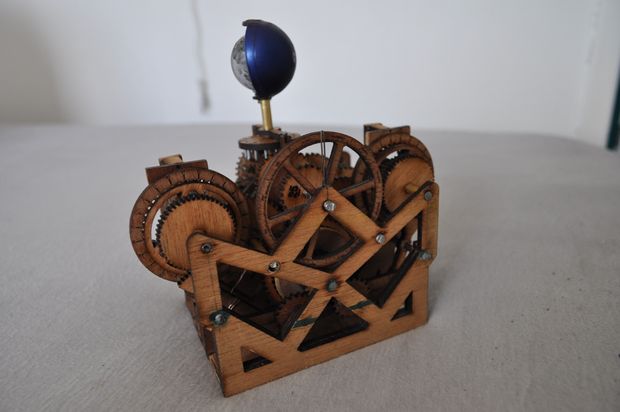
For those who need to know the phases of the moon, there are options way more satisfying than turning to your favourite Internet search engine.
This laser cut marvel was produced by Lukas Christensen as a gift for his brother, a biodynamic farmer who relies on Moon phases to plant and harvest crops.
When investigating exactly what to make, Lukas decided that merely tracking phases of the Moon would be far too easy. To add an extra challenge, he incorporated the function of showing rise and set times of the Moon. And so the Moon Machine began to take form.
Clearly no stranger to working with numbers, Lukas has included a thorough walkthrough of his process on Instructables.
Although an actual video would have been great to see, here is the next best thing – an animation of the mechanism where you can see the hand crank turning away. In real-world use, one turn of the crank is made each day.
Some of the wooden gears broke under the considerable pressure of the assembled machine at the point where forces are translated to the central planetary gear. To get around this, substitute parts were cut from aluminium.
Reflecting on the completed Moon Phase machine, Lukas has identified a number of ways to make it even more accurate should he come to attempt another version.
Learn more about Moon Machine on Instructables.
Posted in Guy Blashki, Inventions, Laser Cut Wood, Laser Cutting by Guy Blashki | Comments are off for this post
15 May 00:05

A Towering Pigeon on an Abandoned Home by ‘Super A’
by Christopher Jobson

I’m really enjoying this giant pigeon painted on an abandoned home by Dutch freelance artist Super A. You can see more of his outdoor work on his website, and read more about him over on City Leaks.
rygzengrho, Christopher Lantz and 3 others like this
13 May 08:15
Section: Space
Tags: Apollo, Astronauts, Auction, History, Joystick, Moon, NASA, RR Auction, Soyuz, Spacecraft
Related Articles:

Apollo 15 joystick among hundreds of air and space memorabilia items up for auction
by David Szondy

Section: Space
Tags: Apollo, Astronauts, Auction, History, Joystick, Moon, NASA, RR Auction, Soyuz, Spacecraft
Related Articles:
- Bonhams auctioning Mercury space suit and other astro-memorabilia
- New NASA pics show Apollo astronauts' footpaths on the moon
- Apollo lunar flags still standing
- Only Apollo camera to make return trip from the Moon to be auctioned
- NASA testing next-gen lunar rover in Arizona
- Fancy your own full-scale lunar module?
Rosalind likes this
13 May 06:34
1904: “The Original “Gangnam Style””
by William
“Two middle-aged Korean gentlemen walking down the street. They wear a traditional Korean costume, echogorie and epajie with eturumagie that is tied with two long ekorume on the upper part of the coat. Their epajie are tied with etaenime at the lower ends of trousers. Both of them have echumonie, that contains money, under their waists. Their hat, called a ehukripe or commonly a ekate is made out of horsehair. Their shoes are ekomusine.
“The sunglasses reflect a modern attire among the upper-class Korean gentry.”

firehose likes this
13 May 06:34
1919: Triple crossing
by Amanda
“Triple Crossing in Richmond, Virginia is believed to be the only place in North America where three Class I railroads cross at different levels at the same spot.
At the lowest (ground) level, the original Richmond and York River Railroad was extended after the American Civil War to connect with the Richmond and Danville Railroad, later part of the Southern Railway System.
The middle level was the main line of the Seaboard Air Line Railroad.
At the top level is a 3-mile long viaduct parallel to the north bank of the James River built by the Chesapeake and Ohio Railway in 1901 to link the former Richmond and Allegheny Railroad with C&O’s Peninsula Subdivision to Newport News and export coal piers.”

firehose, Tertiarymatt and -1 others like this