
Steampunk, which first popped up being used as a word in 1987, finally made its way into the dictionary this week. But just how did it arrive there? It turns out, with a lot of help from the movie Hellboy.

Steampunk, which first popped up being used as a word in 1987, finally made its way into the dictionary this week. But just how did it arrive there? It turns out, with a lot of help from the movie Hellboy.


Handmade Swords - The Behemoth
The sword is entirely handmade, even the pommel is carved out of solid steel.
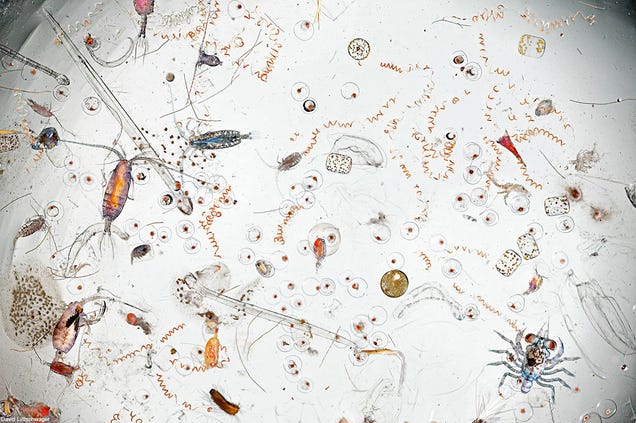
This photo that's been going around purports to show all the little critters found in a single drop of seawater, magnified 25 times. It's a beautiful photo, but there's just one problem: it's not really a single drop of seawater (though it is probably magnified 25 times).


3D Swords - Sword of Ecthelion - Gatekeepers hidden city of Gondolin
deviantART user Horhe Soloma created this recreation of the Sword of Ecthelion using 3dMax2011. Though Tolkien did not describe any inscription on the sword, the artist has added these inscriptions on the blade: "Shine the Light! Run Night!" and "Revenge is coming." You can purchase the 3D model here.
Source: Copyright © 2014 Middle-Earth News | Horhe Soloma | 3D Export

Behold, Hiro Hamada and his robot Baymax from the little-known Marvel series Big Hero 6. That will assuredly change once this Pixar movie comes out on November 7th, but for now, all we have are these few tantalizing pics.

The man responsible for the greatest scifi album of all time is Ziggy Stardust. And the man responsible for that man is of course David Bowie, who explains his creation of his iconic 1970s glam rock character in this 1998 interview with Joe Smith, now animated by PBS's Blank on Blank.


There's a widely held belief that urine, except in cases of kidney or urinary tract infections, is sterile. It's a myth that won't go away — but a recent study linking bacteria to the bladders of healthy women should finally put this tired notion to rest.


The future is here! Geek has the story on these so called “tractor beams” and how they work.
“Tractor beams” are mostly mentioned in reference to starships; the phrase has probably been uttered more by science fiction characters than by everyone else combined. As a result, a new acoustic tractor beam recently unveiled in the journal Physical Review of Letters might not be quite what you’re expecting; since there’s no air between two starships, and thus no possibility of sound, an acoustic tractor beam could never work in space. Still, the breakthrough technology could find dozens of useful applications here on Earth, and pave the way for other, more space-friendly solutions.
The physics at work here is both simple and complex, a dizzying confluence of wave mathematics that ultimately sum to allow the team to create a simple pulling force with sound. Sound, by the way, is simply vibrations in a medium (usually air), and those vibrations manifest as regions of greater or lesser air pressure; the peak of a sound wave diagram corresponds to an area of high pressure, while the trough represents an area of low pressure. These expansions and contractions in a physical medium can do work when they interact with an object — just hold your hand up to a powerful subwoofer to assure yourself of that…
…Now, by shaping the object to be moved so it interacts specifically with the waves doing the moving, this team has managed to move a centimeter-scale object with sound. That’s millions of times larger than the objects we’ve managed to move with light waves, which have never exceeded the nanometer scale. By setting the angle and frequency of vibrations just right, this experiment created a low pressure zone in front of the object, pulling it forward, while simultaneously bouncing waves off the back end to push from the other side. The object used in this experiment was triangular, so the angled back end could transfer up as much kinetic energy forward as possible.
This study used a tank of water for its experiment, rather than of air, largely because water is denser than air and thus allows better propagation of waves. This means their waves will lose less power as they travel and, far more importantly, they will carry more kinetic energy. In theory the technique should work just as well in air, but would result in a great reduction in overall pulling power.
This breakthrough could be of use to a wide array of sectors in research and industry. Moving small objects in a liquid medium could be useful to extremely fine surgical procedures, like small-scale modifications to the cornea. Sending specialized waves through a complex medium should only affect the objects specifically designed to interact with those waves, and as such should not both the rest of, say, your eye. On the other hand, complex environments also have more structures for waves to bounce off, thus making the whole process more difficult.


The Sith Lord Darth Malgus appeared in Star Wars: The Old Republic. He looks a little bit like Darth Vader and Darth Sidious, but he’s his own kind of scary. RPF user Darth Serberus put together a Malgus costume and managed to build it up from a lot of existing parts. He used motorcycle boots and gloves as bases and found a lightsaber from Ultra Saber that only needed a little weathering. It’s impressive. Here’s what he did with the gloves (they only cost $0.99):
A few bits came in so made a bit of progress…Firstly the gloves, I dug out my black leather dye and sorted the grey palms out. Then airbrushed the knuckles to a metallic/ black patina. Gives it a nice ‘used future’ look and stops everything looking too pristine. Then on to the first actual bit of fabrication. I’m just warming up so I’ll start small. With the glove on I cut some card to about the right size and shape to make a template for the hand armour.
With some trimming courtesy of my trusty Dremel and a bit of needle file work I shaped the hand plate armour. When I was happy with the detailing I heated the foamex and set a curve into it so that it sits on the hand comfortably. Finally a few coats of primer filler and a light coat of metallic. The metallic paint is for no other reason than I needed to seal it with a gloss coat anyway and want to use this piece to test some paint finishes on for the rest of the armour.
This video shows off all the details of the costume:
Read more about the build at The RPF.
via Geek Tyrant

Sometimes errors can lead to new discoveries! The New York Times has a piece outlining the latest discovery in materials.
As a research chemist at an IBM laboratory, Jeannette M. Garcia spends her days mixing and heating chemicals in pursuit of stronger and more easily recyclable plastics. Recently she followed a simple formula that required mixing three components in a beaker. Somehow she missed a step, leaving out a chemical. She returned to find her beaker filled with a hard white plastic that had even frozen the stirrer.
Dr. Garcia tried grinding the mystery material, to no avail. Then she took a hammer to the beaker to free it.
That laboratory error has led to the discovery of a new family of materials that are unusually strong and light, exhibit “self-healing” properties and can be easily reformed to make products recyclable.
The materials — two new types of synthetic polymers — could have transportation uses. Because of their recyclability, they also could have an impact on consumer products, as well as on the industrial packaging for microelectronics components…
…The IBM scientists say that this is the first distinctly new family that has been discovered in several decades.
They said they had not yet named the new family, which they have code-named “Titan” and “Hydro.” The materials are not yet ready for commercial use, but the scientists said they had already begun working with several universities on composite applications that could have a significant impact on manufacturing and fabrication in the fields of transportation, aerospace and microelectronics.
The materials are known as thermosets because they are formed using a heating process. Their strength comes from their three-dimensional network of chemical bonds. The polymers have the rigidity of bones, one of the strongest biological materials, and can be made as much as 50 percent stronger by blending them in composite form with materials like carbon nanotubes. They also tend to perform better than other types of polymers under high temperatures.
NASA Goddard put this awesome video up on youtube showing a simulation of a pair of neutron stars colliding and forming a black hole.
This supercomputer simulation shows one of the most violent events in the universe: a pair of neutron stars colliding, merging and forming a black hole. A neutron star is the compressed core left behind when a star born with between eight and 30 times the sun’s mass explodes as a supernova. Neutron stars pack about 1.5 times the mass of the sun — equivalent to about half a million Earths — into a ball just 12 miles (20 km) across.
As the simulation begins, we view an unequally matched pair of neutron stars weighing 1.4 and 1.7 solar masses. They are separated by only about 11 miles, slightly less distance than their own diameters. Redder colors show regions of progressively lower density.
As the stars spiral toward each other, intense tides begin to deform them, possibly cracking their crusts. Neutron stars possess incredible density, but their surfaces are comparatively thin, with densities about a million times greater than gold. Their interiors crush matter to a much greater degree densities rise by 100 million times in their centers. To begin to imagine such mind-boggling densities, consider that a cubic centimeter of neutron star matter outweighs Mount Everest.
By 7 milliseconds, tidal forces overwhelm and shatter the lesser star. Its superdense contents erupt into the system and curl a spiral arm of incredibly hot material. At 13 milliseconds, the more massive star has accumulated too much mass to support it against gravity and collapses, and a new black hole is born. The black hole’s event horizon — its point of no return — is shown by the gray sphere. While most of the matter from both neutron stars will fall into the black hole, some of the less dense, faster moving matter manages to orbit around it, quickly forming a large and rapidly rotating torus. This torus extends for about 124 miles (200 km) and contains the equivalent of 1/5th the mass of our sun. The entire simulation covers only 20 milliseconds.
Scientists think neutron star mergers like this produce short gamma-ray bursts (GRBs). Short GRBs last less than two seconds yet unleash as much energy as all the stars in our galaxy produce over one year.
The rapidly fading afterglow of these explosions presents a challenge to astronomers. A key element in understanding GRBs is getting instruments on large ground-based telescopes to capture afterglows as soon as possible after the burst. The rapid notification and accurate positions provided by NASA’s Swift mission creates a vibrant synergy with ground-based observatories that has led to dramatically improved understanding of GRBs, especially for short bursts.

Steve Wozniak to the FCC: Keep the Internet Free – Technology – The Atlantic.
The early Internet was so accidental, it also was free and open in this sense. The Internet has become as important as anything man has ever created. But those freedoms are being chipped away. Please, I beg you, open your senses to the will of the people to keep the Internet as free as possible. Local ISP’s should provide connection to the Internet but then it should be treated as though you own those wires and can choose what to do with them when and how you want to, as long as you don’t destruct them. I don’t want to feel that whichever content supplier had the best government connections or paid the most money determined what I can watch and for how much. This is the monopolistic approach and not representative of a truly free market in the case of today’s Internet.
[Steve Ward] showed us his Tesla coil project which looks very much like a video game weapon. The hand-crafted masterpiece really packs a punch, able to throw off fat white arcs or a bit less threatening bolts of purple plasma. The video above is noisy and dark, but the look at the electronics in the backpack (holy huge capacitors batman!) and the quick functional demo are both more than worth posting. Unfortunately we didn’t get audio of the gun in action so you’ll have to image those sound effects.
The rig is powered by a 5Ah lithium battery which provides the 60V that gets boosted to 400V. The giant caps already mentioned store about 2k Joules (we love it how [Steve] can’t say that 2,000 Joule figure without beaming with joy). This project is the most advanced version of the prototype we saw a few years ago in Kansas. If you want to see more of what these guys are up to head over to their homepage.


“The third German Antarctic Expedition (1938–1939) was to find an area for a German whaling station, and to scout possible locations for a German naval base. The secret expedition placed Nazi German flags on the sea ice along the coast. Naming the area Neu-Schwabenland after the ship, the expedition established a temporary base.
“Seven photographic survey flights were made by the ship’s two seaplanes. About a dozen 1.2 meter-long aluminum arrows, with steel cones and three upper stabilizer wings embossed with swastikas, were air dropped onto the ice. Altogether they flew over hundreds of thousands of square kilometres and took more than 16,000 aerial photographs.”
“Sometimes we would cover it from Angel’s Peak, take pictures of the mushroom cloud. Sometimes we’d take dancers up to the top of the peak. I’d have one girl, Sally McCloskey, we did a little series that was called Angel’s Dance. And she was a ballet dancer, not a showgirl, and she did an interpretive dance to the mushroom cloud as it came up and we shot a series of pictures and sent it out on the wire and they called it Angel’s Dance. We just did anything we could to make the picture a little bit different because the newspapers would run the mushroom cloud pictures, but they were always hungry for anything that had any kind of a different approach.”
Interview with
Donald E. English
Nevada Test Site Oral History Project
University of Nevada, Las Vegas
Photo 1 courtesy of National Nuclear Security Administration / Nevada Site Office


Robyn Diamond (fb) stunting near San Francisco on her ‘06 636 with a steel half trellis frame, her dog MJ modeling in ther foreground.
Bunker.jordan#cyborgfuture


In an fascinating mix of papercraft, set design, and animation, artist duo Davy and Kristin McGuire bring stories to life inside these exquisitely built paper dioramas. With the aid of digital projection mapping the pair have created several theatrical installations including The Hunter and Psycho which netted the Samuel Beckett Theatre Trust Award and subsequently lead to The Paper Architect. You can see more of their work on their website, and on Vimeo. (via Laughing Squid)


In 2011, gastroenterologist Peter Gibson published the results of a study that provided some of the strongest evidence to date that gluten can cause stomach problems in people without celiac disease. But Gibson has since called the results of his first study into question, with a rigorous followup investigation.