
I love this
WITH ANIMATION YOU CAAAAAAAAAAAAN~!


Art Nouveau in Brussels
1904
6 rue de Lac, Brussels, Belgium
Architect: Ernest de Lune (Belgian,1859-1947)

Here's a collection of rare historical photos from Oak Ridge, Tennessee, a town established by the Army Corps of Engineers in 1942 on an isolated farm. It was a secret location that became one of the most significant sites of the Manhattan Project.


Guardians of the Galaxy is shaping up to be one of the most popular movies of the summer, and I’m especially looking forward to seeing Rocket Raccoon and Groot in action. The latter is an alien who looks like a tree and only says, “I am Groot.” HurleyFx is in the process of building a Groot suit (like a zoot suit but with bark!) for Dragon Con, and it’s shaping up nicely.
He started by casting his legs, torso, and arms with fiberglass bandages and hot gluing the pieces together. He achieved the bark look with expanding foam and a clay sculpt before casting them. He sculpted Groot’s head by hand with a mannequin head for a base and cast it silicone. He also built stilts for the costume so he can match Groot’s height. Here are some of his notes about building the legs:
Groots legs blocked out, now to refine the shapes and then start detailing, busy the next few days so probably back on this the start of next week.
They look quite chunky but along with trying to hide the club feet, the legs will be thinned down some with the refining and they will shrink 10% ish when they are latex + these legs are 4ft + tall,Legs blocked out and trimmed ready for detailing, they stand at 52 inches tall, The latex shrinking should help thin them down again, but if needed I will cut out the odd branch to tailor them more once they are done, better to have them too big to begin, rather than too small.


More photos and WIP information at HurleyFX’s Facebook page.
via Fashionably Geek


Frantopino Small-sword
The sword has a straight blade of triangular section, with hollow faces, wider at the first part, engraved with motto "ne me tirez pas sans Raisons" on a side, “ne me remettez point sans honneur” on the other, both among woven bands.
The beautiful, iron hilt is richly chiselled with mythical figures, deities, spirals and floral motifs on gilt ground. The wooden grip features silver wire binding, bands and a moor’s heads.
Source: Copyright © 2014 Czerny’s International Auction House S.R.L.

A little piece of the sun today… June 7, 2014.


Two-Handed Sword

The folks at the Lansing, Michigan hackerspace built themselves a 40 Watt laser cutter. It’s an awesome machine capable of cutting plywood and acrylic, and is even powered by a RAMPS board, something normally found in 3D printers. They wanted a little more power out of their 40 Watt tube, though, and found pulsing the laser was the best way to do that.
Unlike the fancy Epilog and Full Spectrum Laser machines, the Buildlog.net 2.x laser cutter found in the Lansing Hackerspace didn’t use Pulse-Per-Inch (PPI) control until very recently. When a laser tube is turned on, the output power of the laser is much higher – nearly double the set value – for a few milliseconds. By pulsing the laser in 2-3 ms bursts, it’s possible to have a higher effective output from a laser, and has the nice added benefit of keeping the laser cooler. The only problem, then, is figuring out how to pulse the laser as a function of the distance traveled.
To do this, the laser cutter must accurately know the position of the laser head at all times. This could be done with encoders, which would require a new solution for each controller board. Since laser cutters are usually driven by stepper motors controlled with step and direction signals, a much better solution would be to count these signals coming from the CNC computer before it goes to the RAMPS driver, and turn the laser on and off as it moves around the bed.
A few tests were done using various PPI settings, each one inch long, shown in the pic above. At 200 PPI, the laser creates a continuous line, and at higher PPI settings, the lines are smoother, but get progressively wider. The difference between PPI settings and having the laser constantly on is subtle, but it’s there; it’s not quite the difference between an axe and a scalpel, but it is a bit like the difference between a scalpel and a steak knife.
It’s an impressive build for sure, and something that brings what is essentially a homebrew laser cutter a lot closer to the quality of cutters costing thousands of dollars. Awesome work.


Bunker.jordanI would *love* to do this

Here’s a really clever use for the Oculus Rift — Ecstatic Computation, a virtual reality spirit journey.
[Michael Allison] began his university career as an artist and musician… and somehow down the line, became a Technoshaman. His thesis, presented at ITP 2014, is on computational art, virtual reality, cognitive psychology and his research on various religious, spiritual and scientific methods that try to explain the relationship between our bodies, minds and the universe itself.
Using virtual reality, Ecstatic Computation is a ritual that explores the merging of consciousness and quantum energy in the physio-chemical registration of state within the computer’s memory. The moment when human and computer become one; the moment when thought becomes bit and electrons become ideas.
Sound crazy? Maybe — but check out the video demonstrations after the break. To create this experience he’s using an Oculus Rift, a Microsoft Kinect, a fan, a small keyboard and of course a computer to render it all. During the participant’s journey, [Michael] leads them in flight, passing through a quantum tunnel, merging with quantum energy inside of state registration within the computer’s memory and finally ending by falling into infinity.
All the graphics and effects are generated on the fly using GLSL generation using a robust graphics rendered called Smolder which he wrote himself, which is built on top of Cinder.
And an in-depth explanation of the project and his thesis by [Michael] himself:


Bunker.jordan"How is this a hack?
This is where [Kyledrake] comes in. He sits proudly on the pro net neutrality side of the argument. Rather than simply add more complaints to the ever growing pile, he decided to make a more powerful statement. [Kyledrake] wrote a custom Nginx script that throttles certain users visiting his own web server down to a crawl at 28.8kbps. The catch? His web server only throttles traffic coming from known FCC IP addresses. The desired result is that users browsing his website from FCC networks will experience a slow connection. Nobody else will notice a difference.
Now, [Kyledrake] is a reasonable man. He just wants to ensure that the FCC is paying for their share of [Kyledrake's] bandwidth. Therefore he is offering to put the FCC into their own “fast lane” service for a nominal fee of $1000 per year. He is calling this “The Ferengi Plan“.
[Kyledrake] hopes that more Internet users will start using the script and follow suit. It’s obvious what [Kyledrake] is doing here. He’s trying to show the FCC the downsides of this “fast lane” proposal in a very direct way. It obviously can be abused, but the question is will it be? Will there be protections in place to prevent this abuse? Will those protections actually be enforced?"

Net neutrality is one of those topics we’ve been hearing more and more about in recent years. The basic idea of net neutrality is that all Internet traffic should be treated equally no matter what. It shouldn’t matter if it’s email, web sites, or streaming video. It shouldn’t matter if the traffic is coming from Wikipedia, Netflix, Youtube, etc. It shouldn’t matter which Internet Service Provider you choose. This is the way the Internet has worked since it’s inception. Of course, not everyone agrees that this is how things should stay. We didn’t always have the technology to filter and classify traffic. Now that it’s here, some believe that we should be able to classify internet traffic and treat it differently based on that classification.
It seems like much of the tech savvy community argues that net neutrality is a “given right” of the Internet. They believe that it’s the way the Internet has always been, and always should be. The other side of the argument is generally lobbied by Internet service providers. They argue that ISP’s have the right to classify Internet traffic that flows through their equipment and treat it differently if they so choose. As for everyone else, just about everyone these days relies on the Internet for business, banking, and entertainment but many of those people have no idea how the Internet works, nor do they really care. It’s like the electricity in their home or the engine in their car. As long as it’s working properly that’s all that matters to them. If they can check Facebook on their phone while watching Breaking Bad on Netflix in full HD, why should they care how that stuff gets prioritized? It work’s doesn’t it?
Why is this even a topic for discussion? If the “open Internet” has been working fine since it’s inception, why are we even discussing this now? To understand the problem, it helps to first understand the basic concept of the “Internet backbone”. The Internet is roughly made up of three different tiers of service provider. Consumers purchase their Internet service from a tier 3 provider such as Comcast or Verizon. These tier 3 providers in turn purchase their Internet service from a tier 1 provider such as Level 3. The tier 1 providers are connected to each other and make up the Internet backbone.
While you might pay your ISP $55 per month for a 30Mbps connection, your ISP is “peered” with some tier 1 provider for a much, much faster connection. Their connection has to handle all of the Internet traffic for all of its users at the same time. These peering arrangements vary based on the particular situation, but often times neither company pays the other as long as the traffic getting sent back and forth is roughly equal. If one company was sending much more information than they were receiving, that company would likely pay the other a fee.
Other service companies, such as Netflix, pay an ISP for access to the Internet just like we do as consumers. They would pay a tier 1 or 2 provider for a bigger and more stable connection than your average home user has, though. A company like Netflix would have to purchase their own Internet connection that is fast enough to stream video to all of its users at the same time. The home user just needs a connection fast enough to stream their one video at a time.
The key thing to remember is that everybody pays some kind of ISP for access to this global entity we called “The Internet”. If you pay an ISP, you get online and you can talk to everyone else.

With Internet speeds getting faster and faster all the time, consumers are demanding more and more content. Some ISP’s claim to be struggling to keep up with the demand. A good example of this can be seen with the recent Comcast vs. Netflix battle. Comcast is a major cable television and Internet provider in the United States. For many people, it’s the only realistic option for Internet access in their area. Satellite is too unreliable for them, 4G is not fast enough, etc. It’s also important to note that in the United States, most people only have access to one cable provider in their region. If they decide that cable is the best option for Internet access, they are stuck with whichever provider happens to be in their region. Thus, many people find themselves “stuck” as Comcast customers.
Last year, many Comcast customers noticed a quality reduction in their streaming Netflix video content. This didn’t start happening until just last year. So what changed? Was Comcast slowing down Netflix on purpose? According to Comcast, that was not the case. Comcast has stated that they had a peering arrangement with their ISP, Level 3. Level 3 was sending roughly twice as much traffic into Comcast’s network as Comcast was sending back. Up until recently, the two companies considered this fair and neither was paying the other any fees
Then something changed that somehow caused Netflix to start working slowly on Comcast’s network. Netflix used to use a Content Delivery Network (CDN) service through a company called Akamai. Akamai has distributed centers all over the world that can more easily send the large quantities of data that Netflix users demand. Since Akamai was sending so much data into Comcast’s network, they had their own peering arrangement with Comcast where they paid Comcast a fee to handle the large traffic load. This is a standard Internet practice. The diagram below helps illustrate what this might look like. The wider arrows represent more bandwidth.

This is where things get interesting. Level 3 (Comcast’s ISP) is not only an ISP, but they also offer CDN services that compete with Akamai. Last year, Level 3 won the contract with Netflix to start hosting and distributing Netflix’s content. As a result, Akamai no longer hosts Netflix content and therefore does not have to pay Comcast the same high fees that it used to have to pay. At the same time, the connection that Comcast already had with Level 3 became overloaded with Netflix traffic. Suddenly the reality of the network connection no longer matched the terms of the Comcast/Level 3 peering agreement.

The only way to fix this problem is for Comcast to upgrade their infrastructure to support the new load coming from Level 3. This of course costs a lot of money. Normal industry practice would be for Comcast to change the peering agreement so that Level 3 would now pay a fee to Comcast, which would help support the cost of the new infrastructure changes. This is the equivalent of Comcast charging Akamai. However the two couldn’t come to an agreement, and Level 3 claimed that Comcast was singling out Netflix traffic and was therefore violating principles of Net neutrality.
Netflix eventually got tired of waiting around and purchased new connections directly from Comcast. These network connections give Netflix a direct connection to Comcast customers, bypassing Level 3 all together. In essence, Netflix is now paying Comcast directly to handle their large traffic load.

Shortly after the new direct connections were setup, Comcast customers unsurprisingly noticed a great increase in video quality coming from Netflix. The below graph illustrates how Netflix speed dropped suddenly for Comcast customers around October 2013, and then spiked back up significantly after January 2014 once Netflix purchased direct connections to Comcast.

On the surface, it looks like Comcast is requiring Netflix to pay for faster access to Comcast subscribers. That is the distilled essence of the current net neutrality debate. Should ISP’s be allowed to offer priority access to certain types of traffic, people, or companies? Comcast argues that this is not a net neutrality issue because they are not actively throttling Netflix traffic. In their eyes, Netflix was clogging up the connection and the backbone provider was violating the peering arrangement. They just wanted to work out a new agreement that was reasonable.
One might argue that Comcast customers pay for access to the Internet as a single entity. Therefore, they should be able to stream Netflix all day, every day if that’s how they choose to use their connection. If Comcast offers every single subscriber a 30Mbps connection, shouldn’t their customers be able to use that connection however they see fit? Does it really matter if all the data is flowing in or out?
The other side of the argument is also clear. Peering arrangements were agreed upon and then changed. These arrangements have always worked a certain way, and now it seems as though companies are questioning that practice.
The most recent entry in the net neutrality saga involves what people are calling the “Internet Fast Lane”. This United States’ FCC proposal would allow for broadband ISP’s to offer up faster connections for companies willing to pay more. This is very similar to what is happening with Netflix. On the surface, it sounds like maybe it’s a win-win situation. Companies get to pay more money to have faster access to the customers of various ISPs, and the ISP doesn’t have to continually pay to upgrade their infrastructure to support all this different content.
The downsides are not as obvious to most people. For one, there are ethical issues at play. Comcast is not only an ISP, they are also a cable television provider. They also own NBC Universal, which produces television content. Comcast also is part owner of Hulu, a streaming media service. Clearly Comcast is, to some degree, a competitor of Netflix. So now how does this look? One might think that Comcast took advantage of the situation in order to hurt their competitor. Why should Comcast care if Netflix is slow? This would give more incentive for Netflix customers to purchase cable TV service through Comcast, or use a different Comcast service such as Hulu. There isn’t any clear evidence that this was happening, but you can’t help but wonder. Even if this was not actually an attempt to attack a competitor, what’s stopping other companies from doing exactly that? An “Internet fast lane” may unintentionally permit ISP’s to hurt their competitors in a similar manner.
This also may be bad for competition. This deal with Netflix and Comcast has set a precedence for others to follow suit. Once the Comcast deal went through, Verizon stepped up to the plate and the two companies signed a similar deal. If this trend continues, we may find that only some ISP’s will carry high quality Netflix content whereas others without these special deals will not. The result is that consumers may have to choose their ISP not only based on which has the best quality Internet connection, but also which has the best quality Netflix connection. You can bet that it’s the smaller ISP’s that will suffer, resulting in less competition in a market where competition is already severely lacking. A “fast lane” law may end up supporting this type of Internet.
There’s another way in which the “fast lane” can be bad for competition. A giant company like Netflix might be able to afford to pay for “fast lane” service, but what about a new start-up? Imagine if a new Netflix competitor wanted to start-up but couldn’t afford to pay for all of these fast lane fees to all of the various ISP’s? They might never even get off the ground. Competition is good for the consumer, so we need to make sure the rules foster competition and not hinder it.
This is where [Kyledrake] comes in. He sits proudly on the pro net neutrality side of the argument. Rather than simply add more complaints to the ever growing pile, he decided to make a more powerful statement. [Kyledrake] wrote a custom Nginx script that throttles certain users visiting his own web server down to a crawl at 28.8kbps. The catch? His web server only throttles traffic coming from known FCC IP addresses. The desired result is that users browsing his website from FCC networks will experience a slow connection. Nobody else will notice a difference.
Now, [Kyledrake] is a reasonable man. He just wants to ensure that the FCC is paying for their share of [Kyledrake's] bandwidth. Therefore he is offering to put the FCC into their own “fast lane” service for a nominal fee of $1000 per year. He is calling this “The Ferengi Plan“.
[Kyledrake] hopes that more Internet users will start using the script and follow suit. It’s obvious what [Kyledrake] is doing here. He’s trying to show the FCC the downsides of this “fast lane” proposal in a very direct way. It obviously can be abused, but the question is will it be? Will there be protections in place to prevent this abuse? Will those protections actually be enforced?
We’re curious to hear what Hackaday readers think about this whole net neutrality thing. There are many questions here and not all of them have obvious right and wrong answers. There’s a lot of hypothetical grey areas that muddy the waters. Here are some questions to get everyone thinking.
You also may want to check out the FCC’s comments system. You can leave them a comment in regards to many FCC proposals. Feel free to leave them a comment letting them know how you feel about this issue.


Being the only builder gutsy enough ever to attempt a minifig scaled version of Howl’s moving castle, it’s comes as no surprise to discover that Imagine Rigney was behind this mind-bending recreation of the fall of Cloud Cuckoo Land from The LEGO Movie…

But the diorama just wouldn’t be complete without our heros escaping in the Bat Submarine. So he build that too, naturally. Awesome!

This makes me really wish LEGO would put out more official sets based on that particular region of the LEGO Movie universe. However, if anyone suggests the above creations be submitted as projects to the Lego Ideas site, be warned: I will reach through the screen and slap you!
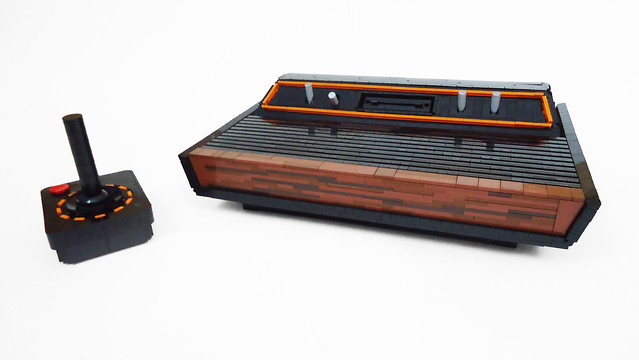
This life-sized model of the Atari 2600 by lego27bricks is as close as it gets to the real thing. Anyone up for playing Pacman or Space Invaders?


Bunker.jordanI have wanted this for so long...


Bunker.jordanI don't like this. #humbug


Brussels-based design and advertising firm TM led by Marc Thomasset, just released the second edition of their wildly popular Inspiration Pad. The ruled notebook plays with the traditional red and blue-lined design of notebooks, turning each spread into a different layout to “inspire people to unleash their own creativity.” The 48-page notebook is printed on sustainable paper and is available here. (via This Isn’t Happiness)
Bunker.jordan"To produce the new material, the team took individual cellulose fibers and broke them down into their component strands or "fibrils." They then separated and re-bound these fibrils in a technique that results in filaments much stronger than the original fiber."
""We have taken out fibrils from natural cellulose fibers, then we have assembled fibrils again into very strong filament," said Fredrik Lundell, one of the researchers. "It is about 10 to 20 microns thick, much like a strand of hair."
The team constructed a "flow-focusing" device (similar to a small-scale extruder) to reassemble the fibrils after they had been mixed with water and sodium chloride. Controlling their reassembly by carefully adjusting the pressure at which they were injected, the researchers were able to produce continuous, consistent strands of fiber from the fibrils."


Bunker.jordanWANT!

DIY Embroidery machine with XY belt and pinion drive via Hackaday
I was thinking about a winter project when the Missus informed me that she fancied an embroidery machine. Although there seemed plenty of options, I got to thinking that perhaps I could adapt her relatively cheap sewing machine. This site helped me to quickly understand the many options that would be available to me.
The main requirement is to control a 2D XY arm that positions the embroidery hoop as required. In addition, the machine also requires control of the sewing machine mains supply, and some means of reliably detecting the needle position.
I came across the V-Slot belt and pinion drive, as published on this site, and set about creating a 2D version using a single gantry plate with drives on opposing sides.The attached sketch-up file shows the final concept, and it is this design that became the prototype.
The type 17 stepper motors use a pinion with 20 teeth driving a 2mm pitch belt (rack). Thus one full revolution gives a displacement of 40mm – this results in a resolution of 0.1mm when used in half step mode. The stepper drives were purchased from EBAY and use the very common L298 driver. I used a 12V supply and pulse width modulation to control the maximum drive current.
The heart of the system is based around a 16F73 PIC Microcontroller that provides the stepper motor control and current regulation. The speed is set at a relatively sluggish 500 steps/s for both axes, avoiding the need for relatively complex acceleration/deceleration profiles. The PIC chip also monitors the mains zero crossing and controls the trigger delay for the TRIAC – used to control power to the sewing machine motor. Both these circuits are opto-isolated to ensure separation from the main supply – this should not be attempted unless you are experienced in the field!
The needle position detection proved quite tricky, but a simple solution using some very fine spring steel gave me the detection required.
Finally, communications to the PIC chip was via serial I/O – using a simple ascii command set running at 38400 Baud.
The high level interaction is provided by an Android tablet (Nexus 7) with code on this developed using Eclipse. Bluetooth connection was provided by adding a widely available Ebay Bluetooth module to the embedded board. I probably spent just as much time with Eclipse as I did on the rest of the project put together. My background is C++ using MS Visual Studio 2010 and it took quite a bit of conversion to get into the Java world!

Remember that awesome Godzilla costume we recently shared? It’s so impressive that we want to share a video of the foam suit in action before it was covered in latex skin and painted.
Sean used polyurethane foam to pull the suit together. After he cut out the patterns he labeled the pieces so he wouldn’t get them mixed up, and from there, it was all about piecing them together – sort of like a puzzle. He had to trim the foam along the way, and he used spray adhesive to make the suit stick together. He also carved details into the hands and feet and cut a ton of smaller pieces of foam for the scales.
Watch how the foam moves in the below video; it’s surprisingly graceful!
See more of the build at the Project: Nautilus Facebook page.
Bunker.jordan#berd
Apropos of nothing, here’s a quick video of a Japanese illustrator who goes by the name Satsuma, working with a Northern white-faced owl perched on his hand. The clip is humourous in and of itself, but it’s especially fascinating to see the stabilization of the bird’s head and eyes while he works. Strangely mesmerizing. (via Tastefully Offensive)
Bunker.jordanSO PRETTY

all photos copyright Michel Denancé


For the last 8 years the Pathe Foundation in Paris has worked with Pritzker-winning architect Renzo Piano to design and construct their new headquarters. Slated for a grand opening this September, photos have emerged that reveal, in the architect’s own words, “an unexpected presence”: a curved bulbous structure that looks like it’s been squeezed into an opening within a historic Parisian city block. “The art of inserting a new building into an historic city block,” says Piano, “means engaging in an open, physical dialogue with the existing city buildings.” In other words, it’s an exercise in reclaiming space.
Hidden mostly behind buildings, the new headquarters, which will promote the Pathe’s heritage in cinematography with office spaces, film archives and a screening room, pokes its head out above the neighbors, looking like a giant armadillo. Walking by, an unsuspecting visitor would have no idea was behind that street-side facade. (via Designboom)