
Bunker.jordan
Shared posts
20 Jun 01:43
Rampage 86619 Trail can utility tool box
by adafruit
Bunker.jordanWANT

Rampage 86619 Trail Can Utility Tool Box. Clever design -
The Rampage Trail Can Utility Tool Box looks like a standard 5-gallon Gerry Can, but is made to store tools and accessories while you’re out on the trail. It comes equipped with a locking lid, a lift-out tool tray, two removable drawers, screw driver storage slots, and has non-slip soft liners. The Trail Can also features heavy duty 14-gauge steel construction and a red powder coated finish for durability.
Josh Allen, Tertiarymatt and 3 others like this
19 Jun 20:10
Filed under: Microcontrollers, tool hacks


The Analog Swiss Army Knife
by Brian Benchoff
Bunker.jordanRad!!

While FPGAs get all the credit for being the hip new thing, they are inherently digital devices. Without a proper ADC and DAC, you won’t be delving into the analog domain with your programmable logic. Maxim has just put out a chip that does just that: an analog swiss army knife with 20 pins that are configurable as analog to digital converter, digital to analog converters, GPIO, or any mix of the above.
The MAX11300 includes twenty IO ports, each capable of becoming an ADC, DAC, or GPIO, with pairs of ports capable of being configured as a logic level translator or an analog switch. The ADCs and DACs are 12-bit, with input and output ranges from -10V to +10V.
As a nice little bonus, the chip is controlled over SPI, making this an interesting device for a small “do anything analog” tool we’re sure will hit Tindie or Seeed Studio before the year is out. Luckily for whoever would create such a device, Maxim has a nice GUI for configuring each of the 20 pins on their chip, Of course Maxim already offers an evaluation kit for the MAX11300. It’s $100 USD and is Windows only.
The MAX11300 is available in either 40-pin TQFN or 48-pin TQFP packages (with the larger, easier to solder TQFP shipping later) for about $5.80 USD in quantity 1000, or $11.37 in quantity one.Video below showing off the MAX11300 reading and writing analog values to a few pins, and a good look at the configuration software.
Filed under: Microcontrollers, tool hacks
Mbanfi, Eyal Cohen and one other like this
19 Jun 20:09
What actually happens when you plug in a USB device?
by adafruit

What actually happens when you plug in a USB device?.
Today I started wondering what actually happens when you plug in a USB device. The little tour below goes from starting the USB subsystem to plugging something in, and I hope it is reasonably accurate. This entry is probably best read with a copy of the Linux kernel handy.
19 Jun 20:08
Lilith from Borderlands 2 Cosplay
by Amy Ratcliffe

Lilith is a NPC who shows up in Borderlands 2. Like most of the characters in that game, she has a memorable design – the kind that attracts the attention of cosplayers. Wind of the Stars put together a Lilith costume and made most of the outfit except for the gun props. She detailed what kind of materials she used for the outfit, and I was interested to read about how much she used dye:
For the pants I used a upholstery vinyl for the chaps with stretch black on the inside to make them formfitting but moveable in. I purchased a pair of jeans second hand, removed the back pockets and dyed them dark grey. Unlike the first Lilith pants, I actually left the chaps and pants separate so that way the chaps didn’t pull down the pants when I kneeled down and such.
The yellow waist wrap is made of yellow stretch knit. I aged it with bleach and dyed it a tan color.
The pink/red undershirt was made for scratch as I felt the time I would spend looking for one to modify I could just make it. I used a white stretch knit to make the shirt. I then dyed it with a variety of pinks, wine, reds, oranges, tans and browns to make it the color you see. I also used some paint in there to get nice and dingy.
The vest was patterned off the old one I made and used the same material. Made the exact same way as the previous one, but this one was just cut up! To prevent the edges from fraying on the one side where it was cut, I used a lighter to melt the edges.
The various arm and hand accessories are made from cotton, pleather, knits and fishnet. Gloves are matte metallic spandex.
She aged the fabric with tan, gray, and black spray paint. She touched up with paint pens and brown fabric dye. She says if the effects look overdone in person, they’ll probably look perfect on camera.
Read more at Wind of the Stars’ blog.
19 Jun 19:59
Analog 3D Printer #3dthursday
by Pedro Ruiz
Bunker.jordanI've wanted to build a 3d printer that's controlled via cams, like a modern version of the Jaquet-Droz "The Writer" automaton. This seems like a step in the right direction :)
Daniel Debruin share his Analog 3D Printer:
more and more products are being fashioned by means of automated processes. not only are these processes more efficient and therefore cheaper, they also ensure that every item meets the same criteria and does not deviate from the norm. however deviations are usually the most interesting. as with humankind and the rest of nature, true beauty lies in its diversity.
I have always had a fascination for production processes but also for natural phenomena. I want to stay true to both these fascinations and so try to find a balance between control and chance in most of my products.

Every Thursday is #3dthursday here at Adafruit! The DIY 3D printing community has passion and dedication for making solid objects from digital models. Recently, we have noticed electronics projects integrated with 3D printed enclosures, brackets, and sculptures, so each Thursday we celebrate and highlight these bold pioneers!
Have you considered building a 3D project around an Arduino or other microcontroller? How about printing a bracket to mount your Raspberry Pi to the back of your HD monitor? And don’t forget the countless LED projects that are possible when you are modeling your projects in 3D!
Bunker.jordan likes this
19 Jun 19:54
awwww-cute: He loves digging holes…and then sitting in them and...

Balint, Tertiarymatt and one other like this
19 Jun 19:52


The Invisibles: Moving Vintage Photos of LGBT Couples in the Early 20th Century
by Maria Popova
Archival images — sometimes poignant, sometimes playful, invariably tender — of gay and lesbian couples privately celebrating their love in an era that denied it.
 Any form of excess can usually be traced to the seed of a basic human longing. Before photography turned into excessive “aesthetic consumerism,” long prior to the narcissistic golden age of the selfie, it was a miraculous medium that granted one simple, fundamental human wish — the desire to be seen and, in the act of seeing, to be understood. Perhaps that is why photography, in its dawning decades, had a particularly poignant role for individuals and groups who were largely invisible to society. It was the role photography played for the LGBT community between the time of the medium’s invention and the first-ever Pride parades as it came to document, and validate by making visible, the love of queer couples — love reserved not only for such famous lovers as Margaret Mead and Ruth Benedict, Virginia Woolf and Vita Sackville-West, Oscar Wilde and Sir Alfred “Bosie” Douglas, and Gertrude Stein and Alice B. Toklas, but also experienced by a great many ordinary men and women alike.
That’s precisely what French screenwriter and director Sébastien Lifshitz explores in The Invisibles: Vintage Portraits of Love and Pride (public library), a remarkable collection of archival photographs — sometimes poignant, sometimes playful, invariably tender — of gay and lesbian couples privately celebrating their love in the early twentieth century. Each couple, Diane Ackerman wrote in her sublime natural history of love, gets to redefine love, and these are some humble and humbling, beautifully human, immeasurably yet quietly courageous redefinitions



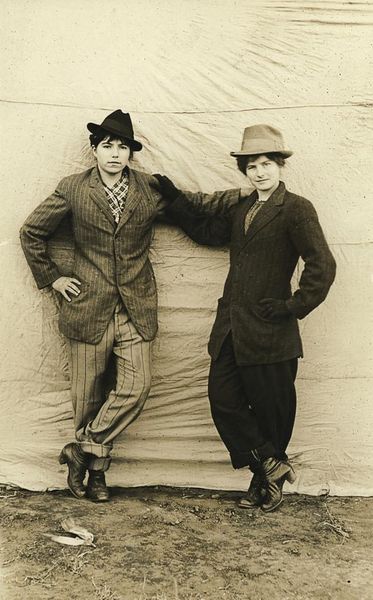

For Lifshitz, the project began somewhat serendipitously: As a longtime collector of vintage amateur photos, he chanced upon a photo album that belonged to two elderly women, “very bourgeois, very ‘old France.’” It didn’t take him long to realize that they were in a lifelong lesbian relationship. He found himself fascinated by such family albums by openly gay couples and was surprised by the freedom and happiness they exhibited in those photos, despite living in eras of extreme social intolerance toward LGBT people. Looking back over the first half of the twentieth century, Lifshitz set out to interview gay women and men born between the two World Wars, seeking to understand what life was like for them — people like the great Edith Windsor, who belongs to that generation and has done for marriage equality more than any other individual in history.



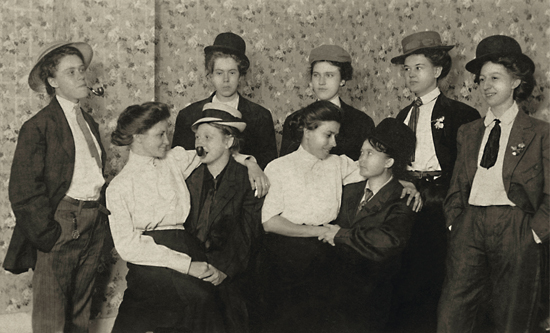
The book is a companion to Lifshitz’s 2012 film, Les Invisibles.

This touching trailer offers a taste:
Complement The Invisibles with history’s most moving LGBT love letters and Edie Windsor on what equality really means.
HT MetaFilter
Donating = Loving
Bringing you (ad-free) Brain Pickings takes hundreds of hours each month. If you find any joy and stimulation here, please consider becoming a Supporting Member with a recurring monthly donation of your choosing, between a cup of tea and a good dinner.
| ♥ $7 / month♥ $3 / month♥ $10 / month♥ $25 / month |

You can also become a one-time patron with a single donation in any amount.
 Brain Pickings has a free weekly newsletter. It comes out on Sundays and offers the week’s best articles. Here’s what to expect. Like? Sign up.
Brain Pickings takes 450+ hours a month to curate and edit across the different platforms, and remains banner-free. If it brings you any joy and inspiration, please consider a modest donation – it lets me know I'm doing something right.

Josh Allen, Tertiarymatt and 3 others like this
19 Jun 19:50
US government launches public library for sharing 3D printable medical data
Bunker.jordanThis is fucking awesome!
3D printed models and virtual surgical planning technologies give surgeons a powerful new tool explore and repair the damage during the most challenging surgeries. Now the National Institutes of Health has launched the NIH 3D Print Exchange
This article US government launches public library for sharing 3D printable medical data is first published at 3ders.org.
Tertiarymatt, Bunker.jordan likes this
19 Jun 19:50
Barack Obama is the first President to be 3D scanned and printed
The first 3D printed presidential portraits created from 3-D scan data were displayed at the first-ever White House Maker Faire on Wednesday. The 3D printed bust and life mask of Obama, will become part of his presidential depictions in the National Portrait Gallery collection.
This article Barack Obama is the first President to be 3D scanned and printed is first published at 3ders.org.
Rosalind likes this
19 Jun 19:49

The Pros and Cons of Proprietary 3D Printing Filament
by Site Admin
Bunker.jordanSure, it may solve a bunch of problems, but a lot of the commercial 3d printers break down almost as often as the personal ones... except it costs more to fix them... *if* you can figure out what's wrong...
Some folks have very strong feelings regarding the use of proprietary filament by some 3D printer manufacturers. Are those feelings warranted?
In the beginning, those with primitive plastic extrusion 3D printers would scramble to find “plastic wire” for their machines from industrial sources. Eventually plastic manufacturers realized there’s a small market for filament specifically designed for personal 3D printers. Filament was plentiful and useable in any 3D printer, so long as the diameter and type of plastic matched.
But then some manufacturers began producing machines that accepted only their own filament, ensured by various hardware mechanisms and proprietary cartridges. Typically the unit price of the filament by weight was substantially higher than “generic” filament, sometimes by several multiples.
The reaction from many was obvious: “it’s a money grab”. Some even boycott machines using this approach. But are there other considerations?
We think so, particularly for consumers. The proprietary filament companies would say:
- The proprietary filament’s physical qualities, such as diameter and variance can be controlled within specific tolerances.
- The plastic’s chemistry can be designed and consistently maintained.
- The filament feed path’s length and friction can be specifically known.
Because the characteristics of the proprietary spool are completely known and always consistent, the manufacturer can then:
- Tune the machine’s printing configuration to precisely match the known filament.
- Design the machine’s extruder to provide optimum performance with the known filament.
One manufacturer, 3D Systems, has adapted their proprietary Cube cartridge to even include part of the extruding mechanism, making things significantly simpler and less failure-prone than fiddling with conventional mechanisms.
So that is the unwritten compact: pay more for a better experience. Or that’s how it’s supposed to go, anyway. It works only if the manufacturer actually does make the experience better. There must be fewer failures, better quality results and an easier to use machine, or it doesn’t make sense.
Bunker.jordan likes this
19 Jun 19:46
Section: Architecture
Tags: Construction, Earthquake, Japan, Resistant, Shipping Container, Structure
Related Articles:

Double storey container site disguises a modern office space
by Bridget Borgobello

Section: Architecture
Tags: Construction, Earthquake, Japan, Resistant, Shipping Container, Structure
Related Articles:
- Studio H:T's off-grid Shipping Container House
- Shanghai farm's shipping container visitor center thinks a little bigger
- WFH House incorporates shipping containers into a modular building system
- Sleeping Around: Shipping containers revamped as relocatable B&B
- Shipping container-based Low Cost House provides home for family of seven
- O+A's temporary shipping container "city"
Rosalind, Bunker.jordan likes this
19 Jun 19:45
Section: Environment
Tags: Electricity, Renewable Energy, Solar Wind Energy Inc, Wind Power, Wind turbine
Related Articles:

Solar Wind Energy's Downdraft Tower generates its own wind all year round
by Darren Quick

Section: Environment
Tags: Electricity, Renewable Energy, Solar Wind Energy Inc, Wind Power, Wind turbine
Related Articles:
- World-first wooden wind turbine starts spinning in Germany
- Invelox wind turbine claims 600% advantage in energy output
- Burj Al-Taqa: self-sufficient skyscraper design
- World’s biggest wind turbine to take a spin in Norway
- Google aims to take wind power to new heights with acquisition of Makani Power
- World's largest Solar Power Tower Plant now on-line
Bunker.jordan likes this
19 Jun 19:45

New Impossibly Tiny Landscapes Painted on Food by Hasan Kale
by Christopher Jobson


From onion peels to kiwi seeds or even bits of chocolate, it seems any canvas is sufficient for Turkish artist Hasan Kale (previously) as long as it meets the requirement of being incredibly tiny. Hasan delights in the challenge of depicting landscapes of his native Istanbul in the most infinitesimal of brush strokes, a feat that requires the use of a magnifying glass to appreciate the details of each piece. While the longevity of each object he paints is questionable, the steadiness of his hand is impressive to witness. See much more over on Facebook. (via Illusion)
rygzengrho, Robson Assis and 3 others like this


19 Jun 09:36
anodetoquality: Evangelion has buckets Evangelion has bowling pins Evangelion has...
Evangelion has buckets
Evangelion has bowling pins
Evangelion has underwear
Evangelion has toasters
Evangelion has wine
Evangelion has soccer balls
Evangelion has electric car charging stations
Evangelion has fake eyelashes
Evangelion eve has its own Schick razor holders
But do they have— they have it!!
EVANGELION CANNED BREAD


firehose, Bunker.jordan likes this


19 Jun 08:27
Section: Around The Home
Tags: Aluminum, Clock, E-Ink, Magnetic
Related Articles:

Twelve24 ClockONE tells the time with E-Ink
by Dave Parrack

Section: Around The Home
Tags: Aluminum, Clock, E-Ink, Magnetic
Related Articles:
- Word clock tells the time in plain English
- Rutledge BookBook case takes the MacBook back in time
- US$230 Handheld Translator speaks 12 languages
- A glimpse at the future of the Human-Computer Interface
- The multi-talented Scruzol screwdriver and drill accessory
- Third generation electric smart car and first generation smart electric bike set to debut
Tertiarymatt, Johnson.aaron.a and 3 others like this
19 Jun 08:26

Photo
Bunker.jordanTV static... Another relic of the era of the busy signal, modem sound, and payphone... soon to be forgotten.
19 Jun 05:41
wrathofthegiraffe: hatewizard: Does anybody actually like miracle whip??????? Yes, but do not...
Does anybody actually like miracle whip???????
Yes, but do not even speak of them. For when you see them, they can see you, and they crawl from the dark places that they dwell, and work their dark magiks upon you.
Rosalind likes this
19 Jun 05:40


Gorgeous Amateur Timelapse of Jupiter Re-enacts Voyager Flyby
by Nancy Atkinson — Universe Today

A group of seven Swedish amateur astronomers have achieved their goal of replicating the Voyager probe's iconic 1979 flyby of Saturn by using images taken with their own ground-based telescopes.
THANKGODYOUREHERE, Tertiarymatt and 3 others like this
19 Jun 05:36


Patta Sword Dated: 18th century Place of Origin: South...
Patta Sword
- Dated: 18th century
- Place of Origin: South India
- Measurements: overall length: 55.5in (1410mm). Blade length: 39.5in (1000mm)
Apparently there are only a handful of this type of Patta swords known to exist, this one being an early 18th century from Tamil Nadu. The wooden gauntlet is carved in the form of a crouching tiger.
The tiger face has a sharp human-like nose, with a long curled moustache and sweeping eyebrows. The mane is well defined and the legs tucked up into the body. The curled tail reaches up the back towards neck.
The underside has a large cut-out, very much in the shape of a Mughal archway, reveals the hand grip. Another thinner slot reveals the fore-arm when the sword is held.
There are also two twisted iron rods which have several iron rings freely attached to them, acting as a jingle when the sword is manoeuvred. There are two deeply carved flowers radiating in full bloom either end of the bars, and in many ways mimic the flowers found in silver on the blade.
The blade is very long at 1m. There;s a panel of very fine silver Koftgari on either side. A large blooming flower with drooping leaves, and a large flower-head can be seen at the base of a floral border joining the two.
Source: Copyright © 2014 Akaal Arms
firehose, Bunker.jordan likes this
19 Jun 05:35

unicorns-happiness-and-death: lieutenantbites: unicorns-happine...
thank mr skeltal
thank mr skeltal
thank mr skeltal
thank mr skeltal
thank mr skeltal
Skeletal*
ITS NOT SKELETAL YOU FUCK READ THE POST. BAD BONES AND NO CALCIUM IS YOUR CURSE FOR 1000 YEARS!!!!!!
Fuck me sideways and up a wall god dammit


19 Jun 04:59
Section: Medical
Tags: Brown University, Diabetes, Glucose, Microfluidic
Related Articles:

Device for detecting glucose levels in saliva comes a step closer
by Ben Coxworth

Section: Medical
Tags: Brown University, Diabetes, Glucose, Microfluidic
Related Articles:
- Biochip that measures glucose in saliva could mean an end to finger-pricking for diabetics
- Glucose Biographer
- Non-invasive way to monitor blood glucose levels using light
- 'Artificial pancreas' could remove multiple daily finger prick tests for children with type 1 diabetes
- Carbon nanotube 'tattoo' to measure blood glucose levels in diabetics
- DexCom’s 7-Day STS Continuous Glucose Monitoring System
19 Jun 04:56
BAM&DICE is now available
by domonoky@googlemail.com (Administrator)
We made it: The first charge of our universal and modular controller is ready. BAM&DICE is now available in our webshop.


The main features we looked for in our development were: simplicity, high performance and superior flexibility. The BAM shield, together with the various DICE-Boards offers a highly flexible interface to implement many different applications. The design is fully Open Source, and our thanks go to the RepRap community, which laid the foundation for this development with the RAMPS board.
With our Indiegogo campaign (see blog entry and campaign) we found some financial support and we want to give our biggest thanks to all our supporters and interested parties which spread our ideas and made pre-orders.
Our hall of fame
Massimo Maimone, Leo Meyer, Alex Wenger, Axel Rössle, Noel Anthony, Valentin Uhrmeister, Hans-Joachim Fingerle, Sebastian Schindler, Leonardo Marques, Vanessa Blass, Marie-Louise Meyer, Peter Häfele, Helge Breitsprecher, Thomas Hartmann, Winold Doege, Annette Fuchs, Mark England, and more anonymous supporters.
Many thanks!
The BAM-Shield
The BAM shield is the interface between an Arduino Mega 1280 or Arduino Mega 2560 and the DICE boards. Five slots allow all combinations of the different available DICE boards. The four layer pcb offers up to about 800W outrageous power for nearly any tinker project. All features known from the RAMPS board, like interface to SD cards or displays, are also supported with the BAM shield.

The DICE-Boards
All DICE boards are compatible with the interface of the BAM shield. Various boards are available, from stepper motor drivers to IO expanders over temperature measurement boards to valve control modules. Please take a look at our webshop or click on the pictures below to get a detailed description.
Stepper motor drivers:
| DICE-STK | DICE-L6470 | DICE-TMC |

|
 |

|
| Stepper motor driver with STK682-010-E |
SPI stepper motor driver with L6470PD |
SPI stepper motor driver with TMC2660 |
Various modules:
| DICE-9555 | DICE-TC | DICE-VN |
 |
 |
|
| Digital IO expander with PCA9555PW |
Temperature measurement with MAX318555 for Thermocouples (Type K) |
Valve-/ Relays controller with VN808CM-E |

With the DICE adapter, every DICE board can be simply tested and used on a breadboard.

The BAM&DICE-STK Kit
The BAM shield together with four DICE-STK modules and an Arduino Mega 1280 or Arduino Mega 2560 offers everything you need to control a 3d printer. Supply voltages of up to 32V and maximum phase currents of 2.85A for stepper drivers offers ample room for big NEMA23 stepper motors and big machines. The fifth DICE slot can be used by any of the other extension boards above.

The future of BAM&DICE
The base concept of the PCI-E slot with it's 36 pins allows many different development possibilities and we hope to explore many of them. We hope to spread this connector and think it would allow some standardization for many different use cases. For this, we offer all schematics, eagle files and BOM lists for all modules under the Open Hardware license CERN OHL V.1.2 free of charge to everyone. For our next development steps we plan to target the Rasberry Pi and the Beagle Board to be able to offer multi functional systems based on linux. Also we plan to extend our program of DICE boards to communication, high-power LEDs, DC motors and many more.
For any questions or ideas, please send us an email to: info@2printbeta.de
firehose, Bunker.jordan likes this
18 Jun 23:42
Eagles vs X-8 FPV wing Skywalker
by adafruit
Eagles vs X-8 FPV wing Skywalker.
Bunker.jordan likes this
18 Jun 21:46


wild-guy: Kelly Rowland texting Nelly via Microsoft Excel and...
Kelly Rowland texting Nelly via Microsoft Excel and then getting annoyed when he doesn’t text back.
firehose and -1 others like this