
A new study of a dozen NASA astronauts has found that exposure to microgravity causes hearts to become more spherical in shape — a change that could lead to serious cardiac problems while in space and back on Earth.

    
|
A new study of a dozen NASA astronauts has found that exposure to microgravity causes hearts to become more spherical in shape — a change that could lead to serious cardiac problems while in space and back on Earth.
|
|

Japan has been ordered by the UN's International Court to stop whaling in the Antarctic after a four-year-long battle over whether the whales were dying for science or for — emphasis on the quotation marks —"science".

|
|
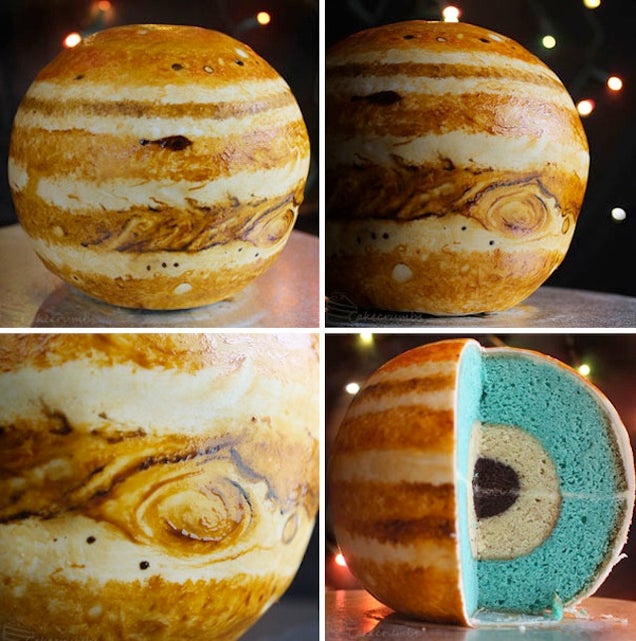
This is possibly the greatest thing I have ever seen, in cake form. It's a scientifically-accurate planet cake, complete with actual inner layers that make a beautiful cutaway diagram just like you used to bake in your geophysics of cooking courses.

|
|
Fun fact: "kerplunking" is an actual scientific term used to describe a certain type of foraging behavior among bottlenose dolphins.

|
|

Bunker.jordanPaging @Rosalind...

Lost Girl's plot thickens. Then it solidifies. It becomes an immobile mass of incomprehensible plot threads crumbling under the weight of their own entropy. This is what the heat death of a TV show looks like. But wait! There's sex!

|
|

The first Space Shuttle didn't reach orbit until 1981, but NASA was working on designs for nearly a dozen years before that. And looking at the progression of these concept drawings, you can see how compromises were made and budgets were cut. Here's the evolution of the Space Shuttle, in pictures.

|
|

Today as part of an April Fool's prank, Google updated Google Maps for iOS and Android to include Pokémon . Let's try to find all of them!

|
|
Neglected murderesses, imaginary elixirs, cryptic objects, and other darkly delightful treats from Gorey’s singular creative chest.
 Edward Gorey is undoubtedly one of the most extraordinary — in every sense of the word — illustrators of the past century. From his quirky children’s books to his naughty treats for grown-ups to his covers for literary classics, he injected his singular blend of darkly delightful weirdness and whimsy into his various masterpieces, created under his many pseudonyms. But Gorey had an especially enchanting soft spot for the old-fashioned charisma of postcards, in addition to the magnificent illustrated envelopes he mailed to his editor. Now comes The Betrayed Confidence Revisited (public library) — an infinitely delightful collection of ten of Gorey’s postcard series, including three never previously published, ranging from the grimly humorous Neglected Murderesses to the cryptic Menaced Objects to the disarmingly adorable Dogear Wryde Interpretive Series to the purposely puzzling Q.R.V. Here’s but a small taste of the enormous delight.
From Dogear Wryde Interpretive Series (“Dogear Wryde” being, as you may have noticed, one of Gorey’s anagrammatic pseudonyms), originally created in 1980:


From Neglected Murderesses, also published in 1980:


From Menaced Objects, released in 1989:


From Q.R.V., Gorey’s final postcard series, created in 1996 and named after a mysterious imaginary elixir that Gorey first introduced in the 1989 miniature book The Universal Solvent:
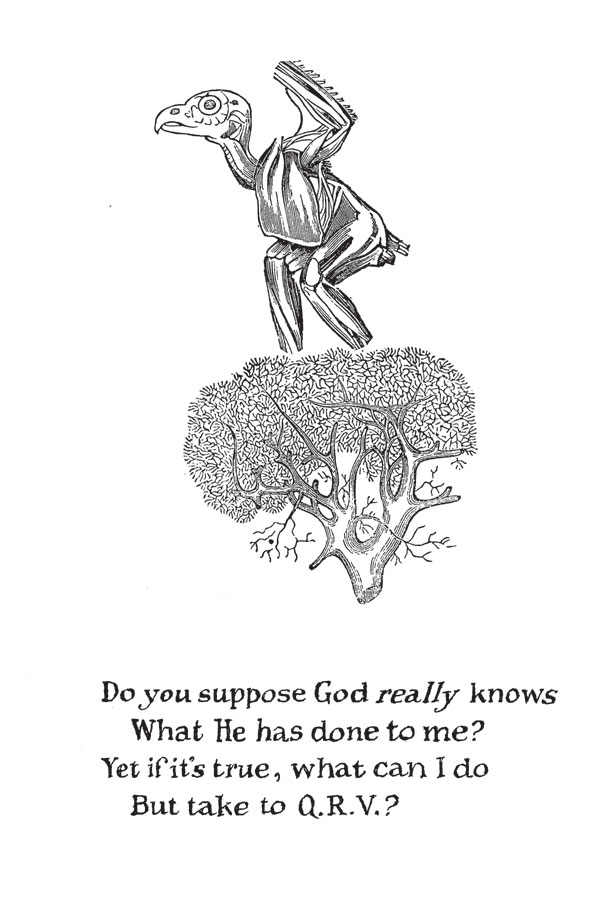


From Alms for Oblivion, part of the Dogear Wryde series:


The Betrayed Confidence Revisited is an absolute treat in its entirety. Complement it with Gorey’s classic scandalous alphabet book, The Gashlycrumb Tinies, and his fantastic vintage illustrations for T.S. Eliot’s cat verses.
Illustrations © The Edward Gorey Charitable Trust courtesy of Pomegranate. All rights reserved.
Donating = Loving
Bringing you (ad-free) Brain Pickings takes hundreds of hours each month. If you find any joy and stimulation here, please consider becoming a Supporting Member with a recurring monthly donation of your choosing, between a cup of tea and a good dinner.
| ♥ $7 / month♥ $3 / month♥ $10 / month♥ $25 / month |

You can also become a one-time patron with a single donation in any amount.

 Brain Pickings has a free weekly newsletter. It comes out on Sundays and offers the week’s best articles. Here’s what to expect. Like? Sign up.
Brain Pickings takes 450+ hours a month to curate and edit across the different platforms, and remains banner-free. If it brings you any joy and inspiration, please consider a modest donation – it lets me know I'm doing something right.

Bunker.jordan... wow
Anti-fascist propaganda cards, circa 1942
This is the third and final part of my BTTF Mr Fusion prop build, using 3D printed parts for the base which was originally made from a Singer Librascope. Check out more finished pictures over on the main project page.
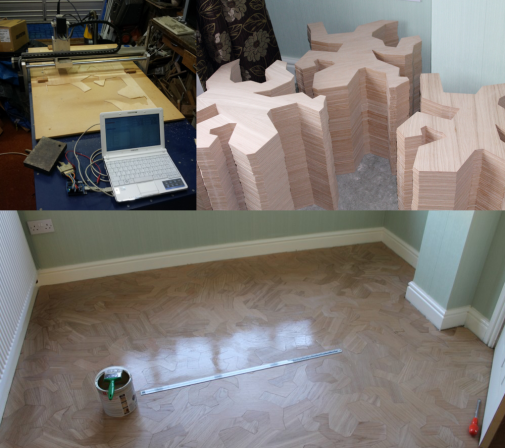
A simple room refinishing project lead [Kris] to his biggest hack yet, a floor inspired by MC Escher’s Reptiles print. Maurits Cornelis Escher is well known for his reality defying artwork. His lifelong passion was tessellation, large planes covered identical interlocking shapes. Triangles, squares, hexagons all 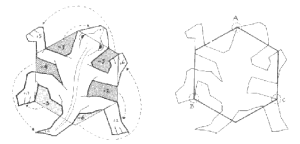 interlock naturally. Escher discovered that if he cut out part of a shape and replaced it on the opposite side, the new shape will still interlock. In Reptiles, Escher created a lizard shape by modifying a hexagon. One side flipped over to become the nose, 4 others to become the feet, and so on. If the cuts are all made perfectly, the final shape would still interlock.
[Kris] was inspired by a photo of a commercial flooring project using small wooden reptiles as the tiles. He wanted to go with larger wooden tiles for his room. He knew his shapes had to be perfect, so he wrote a computer program to split the hexagon perfectly. Armed with art in DXF format, he went looking for a flooring company to help him. The silence was deafening. Even with artwork ready to go, none of the local custom flooring shops would take his job. Undaunted, [Kris] bought an older CNC machine. The machine was designed to be driven from MS-DOS via the parallel port of a Pentium II era PC. [Kris] substituted an Arduino running GRBL. After some GCode generation, he was cutting tiles.
The real fun started when it was time to glue the tiles down. With all the interlocking parts, it’s impossible to just glue one tile and have it in the perfect position for the next. In [Kris'] own words, “You have to do it all in one go”. Thanks to some family support and muscle, the flooring project was a success. Great work, [Kris]!


Phys.org has posted a story on some new photonics research that could allow manufacturers to recycle waste heat and more.
By slowing and absorbing certain wavelengths of light, engineers open new possibilities in solar power, thermal energy recycling and stealth technology.
More efficient photovoltaic cells. Improved radar and stealth technology. A new way to recycle waste heat generated by machines into energy.
All may be possible due to breakthrough photonics research at the University at Buffalo.
The work, published March 28 in the journal Scientific Reports, explores the use of a nanoscale microchip component called a “multilayered waveguide taper array” that improves the chip’s ability to trap and absorb light.
Unlike current chips, the waveguide tapers (the thimble-shaped structures above) slow and ultimately absorb each frequency of light at different places vertically to catch a “rainbow” of wavelengths, or broadband light…
“We previously predicted the multilayered waveguide tapers would more efficiently absorb light, and now we’ve proved it with these experiments,” said lead researcher Qiaoqiang Gan, PhD, UB assistant professor of electrical engineering. “This advancement could prove invaluable for thin-film solar technology, as well as recycling waste thermal energy that is a byproduct of industry and everyday electronic devices such as smartphones and laptops.”
Each multilayered waveguide taper is made of ultrathin layers of metal, semiconductors and/or insulators. The tapers absorb light in metal dielectric layer pairs, the so-called hyperbolic metamaterial. By adjusting the thickness of the layers and other geometric parameters, the tapers can be tuned to different frequencies including visible, near-infrared, mid-infrared, terahertz and microwaves.The structure could lead to advancements in an array of fields…
The multilayered waveguide taper array could help recycle waste heat generated by power plants and other industrial processes, as well as electronic devices such as televisions, smartphones and laptop computers.
“It could be useful as an ultra compact thermal-absorption, collection and liberation device in the mid-infrared spectrum,” said Dengxin Ji, a PhD student in Gan’s lab and first author of the paper.
It could even be used as a stealth, or cloaking, material for airplanes, ships and other vehicles to avoid radar, sonar, infrared and other forms of detection. “The multilayered waveguide tapers can be scaled up to tune the absorption band to a lower frequency domain and absorb microwaves efficiently,” said Haomin Song, another PhD student in Gan’s lab and the paper’s second author.

The X-Men doesn’t have a shortage of blue characters, and cosplayer Reign transformed herself in the Beast. Hank McCoy is smart, witty, and also furry. Reign did a fantastic job bringing the mutant to life with her spot on costume and blue paint. I like her femme approach and that she translated it without making it overly skimpy. It’s more like straightforward crossplay. She shared some in progress pics on her Facebook page, and you can pick up some tips by going through them. For example, she created the buttons on her yellow belt simply by applying stickers. No special riveting tool necessary! See the pics below for some insight:


via Unreality Mag, top photo by JJ Wenzel Images.

16 x 16 Zelda via Waxy.
Hastily cobbled together by Ben Purdy for the Mini-Ludem Dare 50, a 48-hour game jam. The theme was “de-makes” so I have de-made Zelda. Minor updates after the jam ended (couldn’t resist..).
Bunker.jordanFesto seems to be the best at creating pneumatic bio-inspired robotics...

PolicyMic has the story on Festo’s incredible nature inspired robots. You can see more animated gifs over at their site.
German engineering firm Festo is creating a robot army. Sounds scary, right? But there’s no need to fear a “Skynet”-type apocalypse quite yet, because these robots want to do good by making laborious tasks easier in the factories of the future. And they’re using nature as their inspiration.
Festo summarizes the motivation behind their research on their website: “Gripping, moving, controlling and measuring – nature performs all of these tasks instinctively, easily and efficiently. What could be more logical than to examine these natural phenomena and learn from them?”
It makes a lot of sense. Why reinvent the wheel when nature has already spent epochs perfecting the mechanics needed for survival on the Earth? This practice of bio-mimicry is widespread in other fields such as molecular biology, where many drugs are designed by optimizing already existing natural products from microorganisms.
What’s really brilliant about this body of research is that while many of the designs have obvious practical applications, many others have been made in the creative spirit of learning, with some wild results.


Bunker.jordanThis is beautiful...
Fubiz posted about this beautiful sculpture made from “smart flowers” called Lotus Dome.
In the Sainte Marie Madeleine church located in Lille, the Dutch design studio Daan Roosegaarde made a light installation in the shape of a dome with hundreds of lotus metallic lights which respond to the movements of the human body. An interactive and organic sculpture is to discover.


High Voltage Image Making by Phillip Stearns.
A project exploring the use of electrical discharge as a means of creating images in photographic media. High Voltage Image Making is a developing body of work that started with the Retinal Pigment Epithelium and Other Vision Technologies, Real or Otherwise Imagined and has grown to include Polaroid Type 55 @ 15KV. The project explores and extends the expressive capacity of instant photographic film technology beyond its ability to capture images of the world through the application of high voltage and various chemical agents. These treatments approach the film technology as a recording media, capable of creating images from physical, electrical, and chemical transformations. The project takes its cues from artists such as Man Ray (photogram), Pierre Cordier (chemigram), Marco Breuer (scratched expose and developed c-prints), Chris McCaw (sunburned prints) and Hiroshi Sugimoto (static discharges on photopaper).

Though it’s great to be able to work with materials such as Worbla and metal, you can use everyday items to build incredible costumes. This xenomorph from Alien, for example, was built fom a variety of objects Peter Kokis tracked down here and there. He spent 450 hours cobbling bits and pieces together into this super impressive alien. What did he use? Here are some of the Xenomorph’s parts:
12 plungers, 10 knife sharpeners, silicone wine glass drain mats(?), lots of coat hooks, 12 pull handles, 2 Halloween decorations, Army boots, toy sword, knee guards, 10 costume ball masks (for their elongated noses), 2 pr. hockey leg guards, hockey helmet, ski goggle lense, football shoulder pads, baseball pants, 45 velcro straps, shinguards, headband, 48 coiled sneaker laces, athletic cup, teeth from a werewolf mask, bottlecap opener, 2 exercise weights, work gloves, lots of ribbed plastic tubing in various diameters, lots of vitamin bottlecaps, and lots and lots of plastic from trashcan bodies & lids…recurring shapes used throughout his body for a consistent effect.
via Fashionably Geek
“Science is about what is. Engineering is about what CAN be.” A Nerd’s Manifesto by the First Man on the Moon.


I’m not sure what part of this story I enjoy more: the fact that there’s a two-story building somewhere in the world that’s constructed to look like a giant Rolleiflex Camera; that the walk-in camera doubles as a coffee shop and miniature camera museum; or that the entire endeavor is the brainchild of a former helicopter pilot for the South Korean airforce. Located about 60 miles east of Seoul, South Korea, The Dreamy Camera should be high on the list for any coffee or camera enthusiast heading to the area. Check out more photos and info over on their blog. (via Peta Pixel, DIY Photography)

Bunker.jordanAWESOME
For centuries, humans have invented ingenious devices to replace lost limbs. Here we have a gallery of some of the most cutting-edge prosthetics from years past — comparable to today's bionic arms . What's fascinating is that these historic devices weren't just about limb replacement, but also enhancement.

|
|


