Shared posts

02 Apr 22:27

Cat paws in medieval book - again This great image was brought...


Cat paws in medieval book - again

This great image was brought to my attention by the archivist at Balliol College, Oxford (here is the tweet). In a similar case, an image I tweeted some time ago showed a trail of inky cat paws, which was sent to me by @EmirOFilipovic (here is that tweet). The Balliol manuscript again provides evidence of cats walking over books, in this case in a manuscript from the 15th-century. It’s lovely to see that cats walking over books is a universal practice, with currently two medieval cases identified. In the image above the cat appears to merely have had dirt on his feet, not ink. It’s hard to say when this intrusion happened, but it will likely have been before modern times. Cats are, after all, refused entry to library reading rooms.

Pic: Oxford, Balliol College, MS 192 (England, 15th century).

02 Apr 22:01

The Insane History of Rockets at Jet Propulsion Laboratories

by Mika McKinnon on Space, shared by Lauren Davis to io9

Everyone loves a gorgeous rocket launch, but the story of getting from the first sputtering attempts to the modern day marvels is completely unreal. The Jet Propulsion Laboratories took it up a notch, giving mad scientists their epic reputation.

Read more...


01 Apr 23:13

1912: Team Wand Drill

by Amanda

Team Wand Drill 1Team Wand Drill 22Team Wand Drill 12 Team Wand Drill 11 Team Wand Drill 10 Team Wand Drill 9 Team Wand Drill 8 Team Wand Drill 7 Team Wand Drill 6 Team Wand Drill 5 Team Wand Drill 4 Team Wand Drill 3 Team Wand Drill 2 Team Wand Drill 31 Team Wand Drill 30 Team Wand Drill 29 Team Wand Drill 28 Team Wand Drill 27 Team Wand Drill 26 Team Wand Drill 25 Team Wand Drill 24 Team Wand Drill 23 Team Wand Drill 21 Team Wand Drill 19 Team Wand Drill 18 Team Wand Drill 17 Team Wand Drill 16 Team Wand Drill 15 Team Wand Drill 14 Team Wand Drill 13

01 Apr 23:13

1908 - 1921: The Sonora Aero Club

by Amanda

Sonora Aero Club 1

“In the 1960s, a house in Houston caught on fire. In the aftermath, a set of 12 scrapbooks were discovered. They depicted a society, the Sonora Aero Club, that had all but disappeared from history, if it was ever there at all.”

Sonora Aero Club 2 Sonora Aero Club 3 Sonora Aero Club 4 Sonora Aero Club 5 Sonora Aero Club 6 Sonora Aero Club 7 Sonora Aero Club 8

01 Apr 20:34

Using Minecraft to Understand the Speed of Light

by Stella Striegel

YouTube user spumwack explains and demonstrates the speed of light using Minecraft. Don’t blink! You don’t want to miss it. via digg

30 Mar 21:50

Why Is Science Fiction So Fascinated By Black Goo?

by Ria Misra
Bunker.jordan

An interesting question indeed...

Why Is Science Fiction So Fascinated By Black Goo?

Today's Comment of the Day comes from hamnotono who, fresh off the news that Helix has been renewed for a second season , asks what the deal is with science fiction's fascination with black goo?

Read more...


30 Mar 20:51

Behold, A Baby Octopus The Size Of A Pencil Eraser

by Lauren Davis

Behold, A Baby Octopus The Size Of A Pencil Eraser

When it's fully grown, this Caribbean pygmy octopus will be just the size of a silver dollar. As a hatchling, it's dwarfed by a penny.

Read more...


30 Mar 20:33

These Graphs Show Precisely When Your Favorite TV Show Went Downhill

by Lauren Davis

These Graphs Show Precisely When Your Favorite TV Show Went Downhill

When did Heroes jump the shark? At what point did Person of Interest find its footing? The site Graph TV charts out the popular opinion of each episode of each television show.

Read more...


30 Mar 19:19

Seattle's first Passive House "could be heated with a hairdryer"

by Adam Williams

Park Passive House is Seattle's first certified Passive House (Photo: Aaron Leitz)

Well, it could theoretically be heated by a hairdryer, at least. While that attention-grabbing headline needn't be taken too literally (it appears to refer to the equivalent energy required for heating), in Park Passive House, NK Architects has produced an energy-efficient and attractive modern family home. It also happens to be Seattle's first certified Passive House, and so will hopefully provide inspiration for more similarly efficient homes to be built in its wake. .. Continue Reading Seattle's first Passive House "could be heated with a hairdryer"

Section: Architecture

Tags: Energy-efficient, Environmentally-friendly, Home, Passive House, Sustainability

Related Articles:
30 Mar 14:27

June 1933: Charlotte Despard speaking at an anti-fascist rally in Trafalgar Square, London

by Chris
Bunker.jordan

What a badass!

Charlotte

“Charlotte Despard (1844-1939) was an English-born, later Irish-based suffragist, novelist, Sinn Féin activist, vegetarian and anti-vivisection advocate.”

- Wikipedia

Picture taken by James Jarché for the Daily Herald.

30 Mar 14:17

What’s the big deal behind this week’s famous Physics discovery? #SaturdayMorningCartoons

by Rebecca Houlihan

NewImage

What’s the big deal behind this week’s famous Physics discovery? via Jon Kaufman & Jorge Cham

Jon Kaufman (soon to be Dr. Jon Kaufman) is a member of the BICEP2 team that made the discovery described above. As one of the Ph.D. students in the project, Jon spent many months in the South Pole (there is an actual pole), recharging the liquid Helium on the telescope, for which he received a medal. It was his idea to draw this comic.

Read more

29 Mar 19:16

Manga Creator Osamu Tezuka's Newly Discovered Sexy Mouse Art

by Lauren Davis

Manga Creator Osamu Tezuka's Newly Discovered Sexy Mouse Art

The daughter of Osamu Tezuka, legendary creator of Astro Boy, Black Jack, and Buddha, recently discovered some of her father's locked away sketches, including a handful of drawings of a rather voluptuous mouse.

Read more...


29 Mar 19:16

There's A Forest Shaped Like Minnesota In Northern Minnesota

by Lauren Davis

There's A Forest Shaped Like Minnesota In Northern Minnesota

If you search for a certain spot in Lake of the Woods County, Minnesota, on Google Maps, you'll see this curious forest formation. So why is there a Minnesota-shaped forest in Northern Minnesota?

Read more...


29 Mar 12:20

The "Motor" That Allows a Fly to Flap Its Wings 50 Times a Second

by George Dvorsky

The "Motor" That Allows a Fly to Flap Its Wings 50 Times a Second

What you're looking at is a 3D visualization of a fly's thorax in action. The 3D animation, which was put together using data pulled from a particle accelerator, offers a glimpse into the inner workings of one of nature's most complex mechanisms.

Read more...


29 Mar 12:15

1890: The 25 Stages From Courtship to Marriage

by Chris
Bunker.jordan

... wow.

(Slide 11 is missing)

1. The bashful lover makes his first call

1. The bashful lover makes his first call

2. Second call.  Improvement on Call No. 1.

2. Second call. Improvement on Call No. 1.

3. Third call.  Mother wants to know if he is coming

3. Third call. Mother wants to know if he is coming

4. Waiting for him

4. Waiting for him

5. One o'clock in the morning

5. One o’clock in the morning

6. Half-past one in the morning

6. Half-past one in the morning

7. A quarter to two in the morning

7. A quarter to two in the morning

8. The proposal

8. The proposal

9. Showing the engagement ring

9. Showing the engagement ring

10. My wife tomorrow

10. My wife tomorrow

12. Decorating for the wedding

12. Decorating for the wedding

13. The bridesmaids ready for the ceremony

13. The bridesmaids ready for the ceremony

14. The brides ready for the ceremony

14. The brides ready for the ceremony

15. The wedding march

15. The wedding march

16. The wedding

16. The wedding

17. Placing the wedding ring

17. Placing the wedding ring

18. The blessing

18. The blessing

19. The bridegroom's kiss

19. The bridegroom’s kiss

20. The mother's kiss

20. The mother’s kiss

21. The father's congratulations

21. The father’s congratulations

22. The wedding breakfast 23. Alone at last

24. Married and settled

24. Married and settled

25. I just knew it would be a boy

25. I just knew it would be a boy

Via Public Domain Review / Anorak

29 Mar 12:13

X-Men-inspired specs will literally give you a burning stare

by Ben Coxworth
29 Mar 01:56

North Americans are about to experience a "tetrad" of lunar eclipses.

by George Dvorsky

North Americans are about to experience a "tetrad" of lunar eclipses. Starting April 15th, the continent will be witness to a series of four consecutive total lunar eclipses occurring at approximately six month intervals. This is a fairly rare phenomenon as eclipses tend occur about twice each year.

Read more...


29 Mar 01:33

Dyes used to create light-activated antibacterial coating – that also works in the dark

by Ben Coxworth

Samples of the coating, which contains dyes that make bacteria die

Hospital-acquired infections are a major health threat, and have prompted the development of preventative measures incorporating things like blue light and selenium nanoparticles. One of the latest such developments is a light-activated antimicrobial surface coating made from silicone, dye and gold. For some reason, it also works in the absence of light. .. Continue Reading Dyes used to create light-activated antibacterial coating – that also works in the dark

Section: Health and Wellbeing

Tags: Bacteria, Coatings, Microbes, University College London

Related Articles:
29 Mar 01:32

We're So Confused By This Disney/Walking Dead Mashup Art

by Meredith Woerner

We're So Confused By This Disney/Walking Dead Mashup Art

I'm all aboard with reworking every single Disney movie into a post apocalyptic zombie nightmare. But why was it necessary to show much princess skin? That's just not safe — covering up is basic zombie survival 101, guys.

Read more...


29 Mar 01:24

MIT wins prize for $20 robot

by the machinegeek

John Tarbox reports that MIT’s CSAIL team has won first place in the categories of hardware and curriculum for a printable, origami-inspired Segway robot, called SEG, at the “Ultra-Affordable Robot” competition sponsored by the African Robotics Network (AFRON) and the IEEE Robotics and Automaton Society. The robot can be built for about $20. Its made of polyester and moves around on two large wheels and can avoid obstacles. The navigation system design is based on the ATTiny24 MCU, a voltage regulator, two servos and a handful of discrete parts.

For details on the design of the MIT SEG, visit the project web page.

Via the contact form.

29 Mar 00:07

Biologists Have Built An Artificial Chromosome From Scratch

by George Dvorsky

Biologists Have Built An Artificial Chromosome From Scratch

In a breakthrough seven years in the making, an international team of scientists have reconstructed a synthetic and fully functional yeast chromosome. It's a remarkable advance that could eventually lead to custom-built organisms — humans included.

Read more...


28 Mar 22:15

"Mini hearts" on veins could be used to treat circulatory problems

by Ben Coxworth
Bunker.jordan

Science, you crazy!!

The mini heart takes the form of a cuff of cardiac tissue, wrapped around a vein

When someone has chronic venous insufficiency, it means that because of faulty valves in their leg veins, oxygen-poor blood isn't able to be pumped back to their heart. The George Washington University's Dr. Narine Sarvazyan has created a possible solution, however – a beating "mini heart" that's wrapped around the vein, to help push the blood through. .. Continue Reading "Mini hearts" on veins could be used to treat circulatory problems

Section: Medical

Tags: blood vessel, Heart, Stem Cells, The George Washington University

Related Articles:
28 Mar 21:53

How to Criticize with Kindness: Philosopher Daniel Dennett on the Four Steps to Arguing Intelligently

by Maria Popova

“Just how charitable are you supposed to be when criticizing the views of an opponent?”

“In disputes upon moral or scientific points,” Arthur Martine counseled in his magnificent 1866 guide to the art of conversation, “let your aim be to come at truth, not to conquer your opponent. So you never shall be at a loss in losing the argument, and gaining a new discovery.” Of course, this isn’t what happens most of the time when we argue, both online and off, but especially when we deploy the artillery of our righteousness from behind the comfortable shield of the keyboard. That form of “criticism” — which is really a menace of reacting rather than responding — is worthy of Mark Twain’s memorable remark that “the critic’s symbol should be the tumble-bug: he deposits his egg in somebody else’s dung, otherwise he could not hatch it.” But it needn’t be this way — there are ways to be critical while remaining charitable, of aiming not to “conquer” but to “come at truth,” not to be right at all costs but to understand and advance the collective understanding.

Daniel Dennett (b. March 28, 1942), whom artificial intelligence pioneer Marvin Minsky has called “our best current philosopher” and “the next Bertrand Russell,” poses an apt question that probes some of the basic tendencies and dynamics of today’s everyone-is-a-critic culture: “Just how charitable are you supposed to be when criticizing the views of an opponent?”

In Intuition Pumps and Other Tools for Thinking (public library) — the same fantastic volume that gave us Dennett on the dignity and art-science of making mistakes — he offers what he calls “the best antidote [for the] tendency to caricature one’s opponent”: a list of rules formulated decades ago by the legendary social psychologist and game theorist Anatol Rapoport, best-known for originating the famous tit-of-tat strategy of game theory. Dennett synthesizes the steps:

How to compose a successful critical commentary:

  1. You should attempt to re-express your target’s position so clearly, vividly, and fairly that your target says, “Thanks, I wish I’d thought of putting it that way.
  2. You should list any points of agreement (especially if they are not matters of general or widespread agreement).
  3. You should mention anything you have learned from your target.
  4. Only then are you permitted to say so much as a word of rebuttal or criticism.

If only the same code of conduct could be applied to critical commentary online, particularly to the indelible inferno of comments.

But rather than a naively utopian, Pollyannaish approach to debate, Dennett points out this is actually a sound psychological strategy that accomplishes one key thing: It transforms your opponent into a more receptive audience for your criticism or dissent, which in turn helps advance the discussion.

Compare and contrast with Susan Sontag’s three steps to refuting any argument, and treat yourself to Dennett’s wholly excellent Intuition Pumps and Other Tools for Thinking.

Donating = Loving

Bringing you (ad-free) Brain Pickings takes hundreds of hours each month. If you find any joy and stimulation here, please consider becoming a Supporting Member with a recurring monthly donation of your choosing, between a cup of tea and a good dinner.


♥ $7 / month♥ $3 / month♥ $10 / month♥ $25 / month


You can also become a one-time patron with a single donation in any amount.


Brain Pickings has a free weekly newsletter. It comes out on Sundays and offers the week’s best articles. Here’s what to expect. Like? Sign up.

Brain Pickings takes 450+ hours a month to curate and edit across the different platforms, and remains banner-free. If it brings you any joy and inspiration, please consider a modest donation – it lets me know I'm doing something right. Holstee

28 Mar 21:50

1000 WORDS WORTH: BONNEVILLE 1953

by The Vintagent
It's true there's an essay in every photo, but the story's always better when the image is packed with exceptional machinery and good clues to the date..  The 1953 Chevrolet Bel Air convertible in the background was brand new when this shot was taken at the Bonneville Salt Flats, and the Vincent Black Lightning (#9) in the photo is a famous machine which changed configuration dramatically by 1954... so I'm fairly certain we're gazing from the top of a ladder through a magic window onto September 4th, 1953.
Marty Dickerson aboard his Rapide, the 'Blue Bike', at Bonneville
Marty Dickerson is being push-started at the head of the line, on his infamous 'Blue Bike'; he is about to break the magic 150mph barrier for a 'Class C' production machine on one run, while his record average was 147mph...all the more impressive as the rules limited machines to 90 octane pump fuel and an 8:1compression ratio.  Dickerson's record stood from this day in 1953 until 1973, when a Kawasaki Z1 broke it (at 155mph).  Dickerson is being pushed by an SCTA official with a walkie-talkie on his Hawaiian shirt; the SCTA organized the Bonneville events then, and still does with Speed Week.  The flag-man on the far right has already waved green, signaling the all-clear on the track. Bonneville isn't a drag race, as miles of salt are required to build up speed for even the quickest bikes, so there's no histrionic flag-waving at the start. Dickerson's 1948 Series B Touring Rapide was significantly developed by this date, and bears little resemblance to the small-wheeled and heavy-fendered machine he purchased as a lad of 18. He thought the Vincent was ugly when he purchased it, but he wanted the speed it promised, and campaigned his Rapide from 1948 onwards, first making the rounds of the Southwestern states, challenging locals to drag-races while in the employment of Burbank Vincent importer 'Mickey' Martin.  Read all about it here.
Joe Simpson's Lightning in '52
Another shot of Simpson in '52


Next behind Dickerson is the 1949 Vincent Black Lightning of Joe Simpson, the first Lightning imported to the USA.  Simpson was also out for a record that day, and succeeded, averaging , before it evolved into the blown monster you can see today in the Solvang Museum.  Note the interesting black fairing above the front wheel of the Lightning...it almost looks like the hood of a Ford!  If this photo was taken in 1953, Simpson's Lightning is running on methanol, and producing about 90hp @6000rpm, and he recorded 160.69mph, taking the American record away from Rollie Free's 1950 Vincent record of 156.71mph (the only time a Vincent held the World Speed Record was Russell Wright's 184.83mph run in New Zealand in 1955).
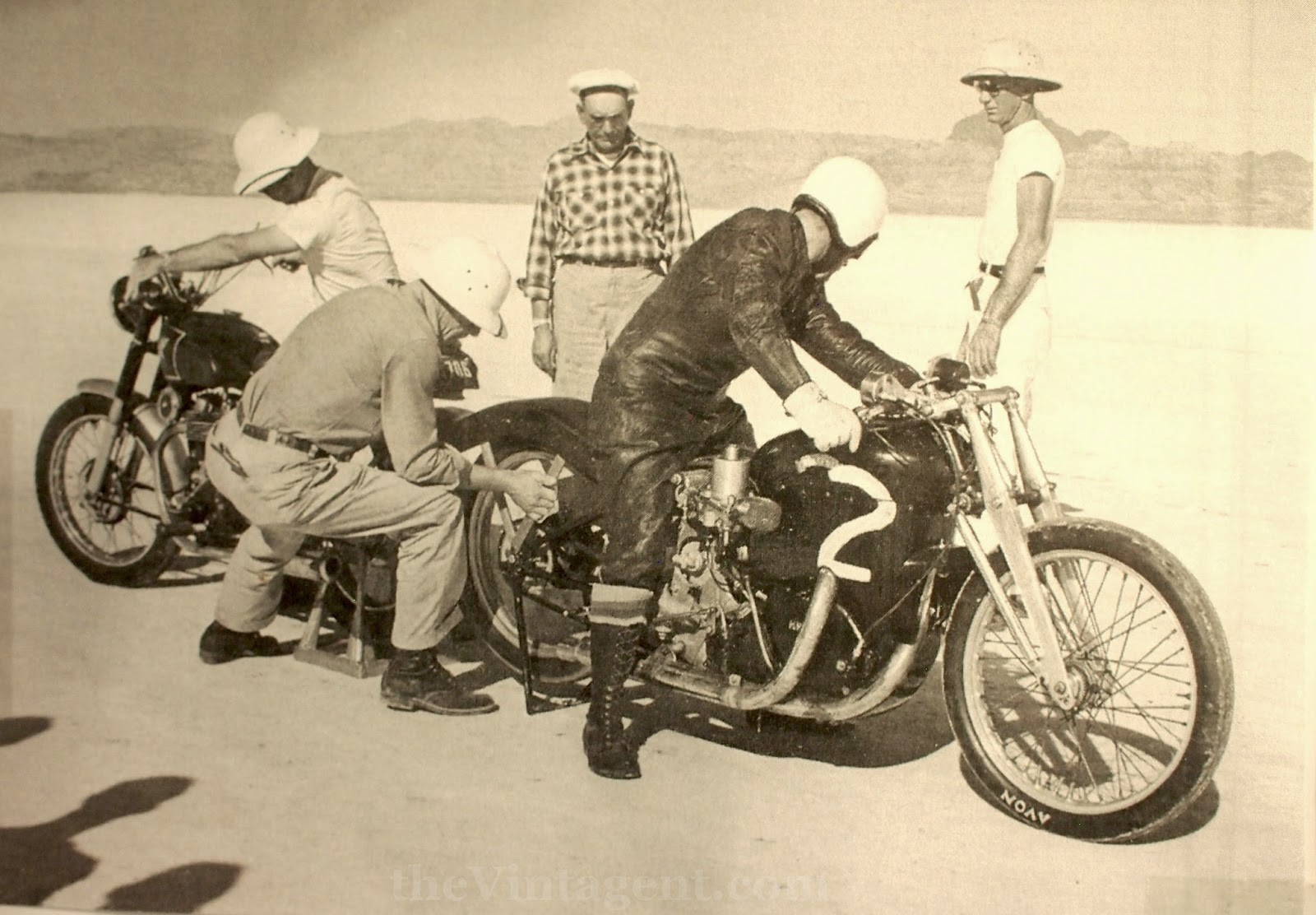
Marty Dickerson wheel-starts the supercharged Lightning with Matchless power, from the looks of it a c. 1952 G9 twin with a single-sided front brake hub.  Rollie Free observes in the plaid shirt, while the owner of the Lightning, Joe Simpson, stands right in the t-shirt
Simpson felt he'd reached the limit of development with a normally aspirated, pushrod motor, and decided to fit a Shorrock supercharger the next year, following the lead of the Reg Dearden Vincent (featured on The Vintagent many years ago), and in fact following the layout of the Dearden machine closely.  By 1955 his blown machine was back at the salt, but nobody would ride it, with an estimated 190mph top speed - only Marty Dickerson was brave enough, and recorded a 177mph average that year, although he saw 196mph on one run with a following wind.  Given the utter lack of safety gear for the riders as seen above, its no wonder at all why riders shied from such speeds...the salt is incredibly abrasive, and nobody had ridden a bike at that sort of speed on the notoriously bumpy and greasy-feeling salt lake surface.
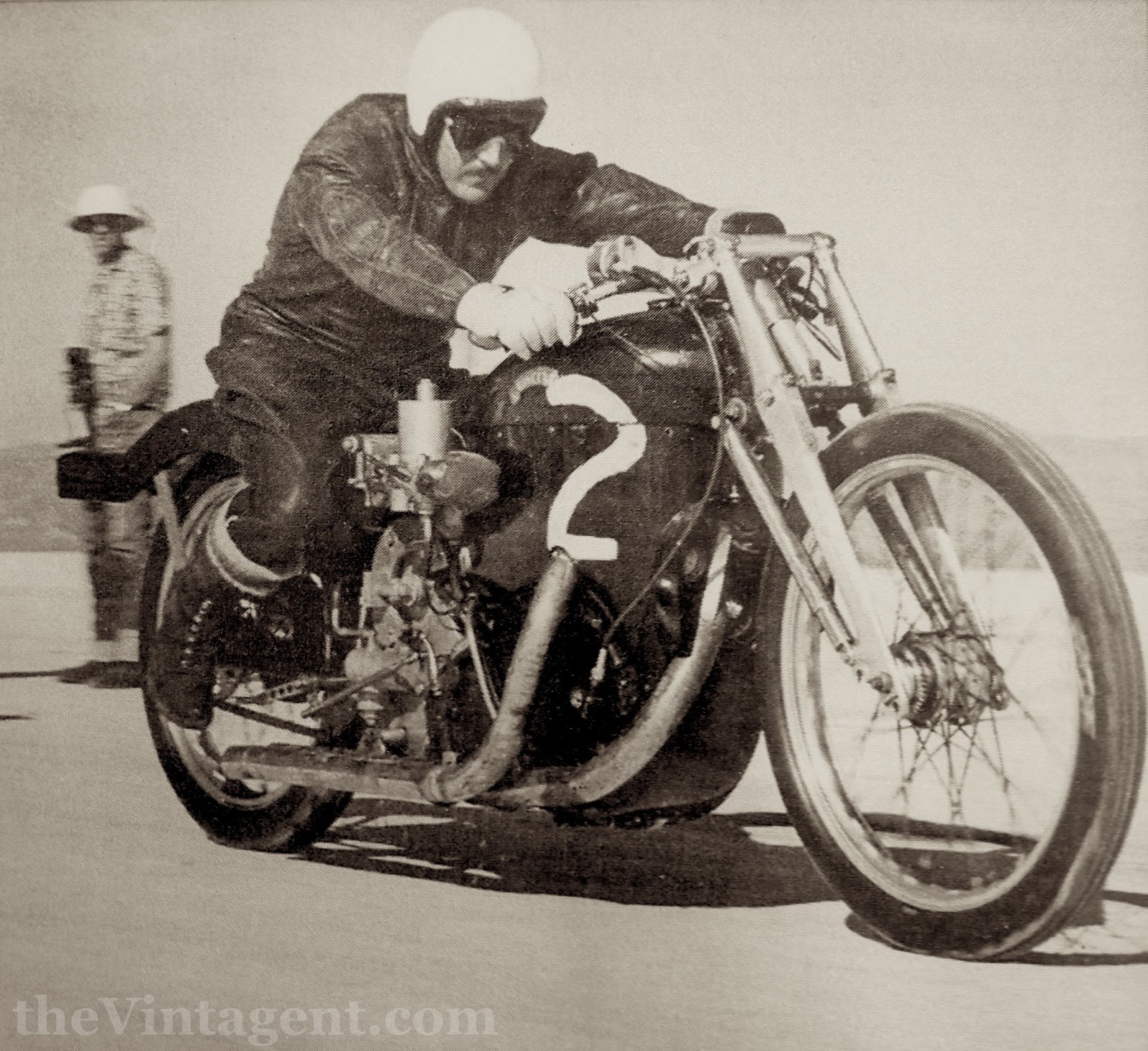
Marty Dickerson aboard the supercharged Lightning ca.1955; he was the only rider brave enough!  Note the protective racing leathers and heavy boots - saving his skin
Simpson had just installed a set of Vincent factory racing cylinder heads with extra-large inlet ports (1 7/16") and matching oversize Amal TT racing carbs, and oversize intake/exhaust valves and exhaust pipe (the same as supplied to Rollie Free), but the bike wouldn't exceed 155mph during his tests.  Marty Dickerson examined the machine and suggested the valves were not sealing properly. Shockingly, the racers had come all the way to Bonneville with few tools, or at least not valve-grinding equipment, and the nearest town (Wendover) had none, so Marty 'made do' with a power drill and a file as an impromptu lathe!  His work was good enough for Simpson to average 160.69mph the next day.  Simpson is one of 3 men who really established the Vincent legend in the USA, and the world, right beside Dickerson and Rollie Free.

The Indian Brave was a product of England!  In 1950, Brockhouse Engineering bought a bankrupt Indian, and began badging its own 250cc sidevalve lightweight as an Indian, while still producing the Chief and vertical twins.  It was built through 1953, when Indian went bankrupt again, and Floyd Clymer bought the name... Here is the Del Branson Brave in Bonneville guise in an Indian ad from 1953.
Between the two big-gun Vincents in the photo sits a pop-gun of a record-breaker; a Brockhouse-built Indian 'Brave' with a 250cc sidevalve engine, which would have struggled to reach the top speed of the Vincents' first gear!  Its rider, Delbert Branson, looks pleased enough to participate in the day, and set a 250cc record in 1952 on a Brockhouse Indian at 80.62mph,  which is pretty fast in Bonneville's thin air (4200' above sea level).  A stock Brave was tested by Cycle magazine that year with a top speed of 68mph, but Branson managed a highest speed of 87mph on one run. The Indian Brave was a product of England; in 1950, Brockhouse Engineering bought the bankrupt Indian company, and badged its own 250cc sidevalve lightweight as an Indian, while still producing the Chief and vertical twins.  The enterprise lasted until 1953, when Indian again went bankrupt, and Floyd Clymer bought the name...carrying on through a succession of hands for decades. 

American Velocette importer Lou Branch placed this ad touting Lloyd Bulmer's accomplishments with his KSS Velo in the Dec.1952 issue of Cycle magazine
Immediately behind the Indian is a 1948 Velocette KSS Mk2 with Dowty air forks, and a dramatically lengthened inlet tract. This is Lloyd Bulmer's Velocette record-breaker, which was featured in plenty of US Velo advertising in the early 50s, as it was the fastest anyone had taken a 350cc Velocette on the USA to date.  In 1952, Bulmer's two-way average was 119.87mph, the fastest 350cc bike that year and an AMA record. In our top photo, Lloyd sits his Velo, with his wife(?) beside him.  The previous year, he'd only managed 106mph on the KSS, but he'd found considerable extra urge in the intervening year, and learned how to 'do the Free' for minimum drag (as seen in the ad above).  In fact, looking at various bikes in our Bonneville photo, 3 are equipped with planks instead of seats for a fully stretched-out riding position, which is now illegal for record-breaking.  As is the total lack of skin protection (ie, racing leathers) and decent boots (most riders are wearing hi-top sneakers or boxing shoes).
 I couldn't find a better photo of the Bonneville Triumph with reversed heads, but they're fairly common in drag/sprint racing.  This machine - Mirage - is pictured in a 1968 Alf Hagon parts catalog
The last motorcycle in our power quintet is a ca. 1952 Triumph Tiger 100 with reversed cylinder heads!  A shield to keep grit out of the carbs is attached to the frame downtube, while a remote fuel float peeks just outside the shield, and the big megaphone exhaust shoots straight out the back.  This is a trick used occasionally in sprint/drag racing, but I'm not familiar with this machine, and my luck in researching this photo ran out with the most 'common' machine in the bunch!  Any info or guesses are welcome. It's interesting to note the total lack of protective clothing, the cool variety of protective eyewear, and the 100% saturation of riders with Cycle magazine t-shirts... this particular run may have been sponsored by Cycle magazine itself, as (at least) four of the 5 motorcycles pictured took the top speed in their class that year.

Somer Hooker who forwarded this photo, adds this about the Lakester cars:


"This is a pretty iconic shot. It reflects on the days when the Salt Flats was casual and not a 'profiling' event.  The coupe on the far right is a 33 or 34 Ford 3 window coupe. It has what is known as a 'lakes chop'. The top was chopped and made to slant back to increase the aerodynamics. They later had to incorporate a rule about how far you could go with this. Note the white 1936 Ford five window coupe has also been chopped in the same manner. The white roadster in the LH side is a modified 1927 Ford roadster. It was a popular body because of its aerodynamics. This one has the engine in the front but quite often, they moved it to the rear and the driver sat in front. Black coupe behind Simpson bike (#9) may be a Chevy? There is a DeSoto grille which was a popular modification. Note the Triumph in lower LH corner has a board on back. This is where the rider would put his body for high speed."
28 Mar 21:28

Discover How The Prometheus Saga Continues In This Free Comic Preview

by Rob Bricken

Discover How The Prometheus Saga Continues In This Free Comic Preview

The first issue of Dark Horse's Prometheus #1 comic isn't due until September 10th of this year, but you can get an exclusive sneak preview right here! It seems a group has sent to LV- 223 to investigate what happened to the crew of the Prometheus, but it's staffed by a much, much smarter group of scientists.

Read more...


28 Mar 21:27

Photo


28 Mar 21:27

Shot-for-Shot Cardboard Recreation of Jurassic Park's Epic T-Rex Chase

by Meredith Woerner

Shot-for-Shot Cardboard Recreation of Jurassic Park's Epic T-Rex Chase

And now, a shot-for-shot remake of the wonderful Tyrannosaurus "we must go faster" car chase from Jurassic Park. Made entirely out of cardboard, toys and twine.

Read more...


28 Mar 21:23

Now you can buy a $60,000 remote-controlled dragon, because why not?

by Dave LeClair
Bunker.jordan

Why... oh, they answered that in the title

The dragon can shoot fire three feet while on the ground

A couple of years ago, a man named Rick Hamel created one of the most insane remote-controlled flying machines you'll ever witness. No, it's not an airplane or helicopter, or anything that mundane. Instead, he created a dragon that actually shoots fire and reaches airborne speeds of up to 70 mph (112.6 km/h). Now, this beast is actually for sale via Hammacher Schlemmer, with a staggering US$60,000 price tag. .. Continue Reading Now you can buy a $60,000 remote-controlled dragon, because why not?

Section: Aircraft

Tags: Dragon, Hammacher Schlemmer, Remote Control

Related Articles:
28 Mar 19:11

How to Get People to Accept Unfairness

by Esther Inglis-Arkell

How to Get People to Accept Unfairness

Say you want to swindle people. You want to force them to take your bad deals, and give you the minimum amount of lip in return. There's an easy way to sway them. And scientists have demonstrated it with a simple game.

Read more...


28 Mar 19:07

This Floating Generator Could One Day Power Your City

by Annalee Newitz

This Floating Generator Could One Day Power Your City

It looks like a UFO, and soon there could be dozens hovering silently over your city. This futuristic wind turbine is designed to take advantage of high winds and deliver huge amounts of power to the ground via thick cables. And it's about to be tested in Alaska.

Read more...