Squirrel Steals Airplane!..(Read...)
Shared posts
27 Feb 01:03
A social worker asks a colleague: "What time is it?
A social worker asks a colleague: "What time is it?"
The other one answers: "Sorry, don't know, I have no watch."
The first one: "Never mind! The main thing is that we talked about it."
The other one answers: "Sorry, don't know, I have no watch."
The first one: "Never mind! The main thing is that we talked about it."


27 Feb 00:40
 Over the past several years, the debate over the efficacy and implementation of the Affordable Care Act has highlighted the deep divides in the U.S. over the need for, and cost of, the entire social welfare net in the U.S.

A Brief History of the Social Welfare Net
by Melissa
 Over the past several years, the debate over the efficacy and implementation of the Affordable Care Act has highlighted the deep divides in the U.S. over the need for, and cost of, the entire social welfare net in the U.S.
All this might have got you wondering about the roots and history of social welfare in its many forms in America. Well, wonder no more:
Federal Employers Liability Act (1908)
At the turn of the 20th century, most industrial workplaces were dangerous. Prior to the passage of the Act (FELA), injured workers had to seek relief in court, proving not only the injury, but that it wasn’t their fault and that they hadn’t assumed the risk of the worksite. As you might expect:
Many families of accident victims had to rely on charity to weather their financial losses . . . [and] the percentages of families receiving nothing ranged from 20.4 % in a New York . . . sample to as high as 60.9 percent among men killed in Illinois before 1911.
Congress enacted FELA in 1908, which provided compensation to injured railroad workers when the railroad was at fault.
Successful, many states chose to model FELA and apply it to other industries, and shortly thereafter, the first workers’ compensation laws were enacted. “By 1930 only Arkansas, Florida, Mississippi, and South Carolina had not yet enacted legislation.”
Mothers’ Pension Movement (1911)
Also at the turn of the 20th century, as many flocked to cities, family life was changing and increasingly, single mothers were isolated (rather than surrounded and supported by extended families). The ad hoc welfare net of orphanages, private charities and other relief did little to alleviate these families’ desperate living conditions.
In response, progressives pushed for local and state governments to take responsibility for these families’ care:
Scoring its first statewide victory in Illinois in 1911, the mothers’ – pension movement swept forty states in less than a decade. No plank of the social-justice platform, with the possible exception of workmen’s compensation, mustered a better legislative record.
Eventually, these state and local initiatives were subsumed by the New Deal’s Aid to Families with Dependent Children (AFDC).
Social Security Retirement (1935), Disability (1956) and SSI (1972) Benefits
The economic meltdown of the 1930s, known as the Great Depression, “wiped out the lifetime savings of seniors, and poverty among the elderly was a growing concern.”
To protect Americans from the “hazards and vicissitudes of life,” in 1935 the Social Security Act was signed into law. Among its many provisions to provide economic assistance were “old age benefits” under Title II, or what “we now think of as Social Security.”
In 1939, the “old age” program was amended to include spouses and children “who relied on the income from a breadwinner.”
In 1956, President Eisenhower expanded the Social Security Act to include disability insurance. Although originally this expansion only covered people aged 50-64, today it includes people of all ages and their dependents.
Supplemental Security Income (SSI) was created in 1972 under President Nixon and was designed to provide “cash assistance to aged, blind and disabled individuals.”
For many years, before the Baby Boomers began retiring, Social Security was taking in more than it was spending, and those excess revenues were placed in a trust fund. In recent years, however, the program has been running a deficit, and if expenditures are made as forecasted, the Social Security trust fund will be depleted by 2033.
Unemployment Insurance (1935)
The Great Depression (1929-1939) devastated the American economy, and within three months of the Crash of 1929:
The Stock Market lost 40% of its value [and] $26 billion of wealth disappeared. . . . . unemployment [eventually] exceeded 25% [and] about 10,000 banks failed . . . . Wages paid to workers declined from $50 billion in 1929 to only $30 billion in 1932.
To deal with these high rates of unemployment, the states began programs that provided workers with unemployment insurance. Wisconsin was the first in 1932, and many soon followed its example. Prior to the inclusion of a UI program in the Social Security Act of 1935, California, Massachusetts, New Hampshire, Utah and Washington had also enacted employment insurance programs.
The 1935 law gave the states a lot of freedom to implement their programs, and “by August 1937, 48 states, Alaska, Hawaii and the District of Columbia had enacted their own Unemployment Insurance laws.”
Aid to Families with Dependent Children (1935)
Built upon the foundation of the mothers’ pensions, the Social Security Act of 1935 also included the AFDC (then ADC) which:
Provided a subsidy to families with fathers who were deceased, absent or unable to work. . . . [and] was viewed as a means of extending help to these families who had the misfortune to lose a breadwinner and who, it was widely believed, should not be forced to rely on the paid work of a mother who belonged at home.
The AFDC remained the primary form of “welfare” assistance in the U.S. until it was replaced with Temporary Assistance for Needy Families in the 1990s.
The National School Lunch Program (1946)
The School Lunch Program was originally seen
As a measure of national security, to safeguard the health and well-being of the Nation’s children and to encourage the domestic consumption of nutritious agricultural commodities and other food.
In 2013, over 5,000,000,000 lunches were served as part of this successful program, and 70.5% of those were free or reduced price.
Food Stamps (1964)
Many localities had developed food stamp programs during the Great Depression as a way to combat hunger and help local farmers, but these were discontinued as the economy improved.
In 1964, as part of President Lyndon Johnson’s “War on Poverty,” a federal food stamp program was implemented to improve “nutrition among low-income households.”
Successful, by 1974, 15 million people were participating in the food stamp program, and as a result of our recent Great Recession, by September 2013, “47 million Americans, one-sixth of the country,” were receiving food stamps.
In February 2014, President Obama signed an $8.7 billion food stamp cut into law, which will cause 850,000 households to love $90 each month in food stamp benefits.
Medicare (1965)
To provide healthcare for America’s seniors, Medicare came about because, as President Lyndon Johnson said:
There has been increasing awareness of the fact that the full value of Social Security would not be realized unless provision were made to deal with the problem of costs of illnesses among our older citizens.
Medicare was expanded in 2006 under President George W. Bush to include coverage for prescription drugs in the program known as Medicare Part D. In 2013, it was estimated that $68 billion was expended on the prescription drug program.
In 2010, Medicare expenditures were:
Estimated to have been $525.0 billion . . . [and are] projected to grow 5.9 percent in 2011, but only 1.7 percent in 2012 .. . .
As of 2012, over 49 million people were benefiting from Medicare.
Medicaid (1965)
From the start, Medicaid was designed to provide health care to low-income persons who would likely otherwise go without.
A partnership between the states and Uncle Sam, the federal government dispersed Medicaid grants to those states that chose to participate in the program, which was not mandatory. Although many states willingly signed on, some held out, including Arizona, which did not begin offering Medicaid benefits until 1982.
The act has been amended many times, modified to include the elderly and disabled (1971), certain AFDC eligible recipients (1984-1985), illegal immigrants with emergency conditions (1986), pregnant women and infants (1986-1988) and low-income children (1990).
In 1997, Medicaid was expanded and empowered the states to provide benefits to children whose families earned up to 200% of poverty under the State Children’s Health Insurance Program (SCHIP).
The Affordable Care Act recently expanded Medicaid’s reach even further to now include those with income below 133% of poverty and certain adults without children.
Women, Infants and Children (1972)
The supplemental nutrition program WIC was designed to address “early age malnutrition [that] was a major cause of developmental problems among low-income children.” Although a pilot program in 1972, it became a permanent fixture in the social welfare net in 1975.
In 2013, nearly 8.7 million women participated in WIC at a cost of $6.5 billion.
Earned Income Tax Credit (1975)
To address what many saw as “welfare’s disincentives to work,” Congress passed the Earned Income Tax Credit that provides tax breaks to low-income workers (who frequently end up paying no income tax).
Although many today complain about the credit, conservative President Ronald Reagan famously described it as “the best anti-poverty, the best pro-family, the best job creation measure to come out of Congress.”
In 2010, 27.5 million low- and moderate- income working families benefitted from the EITC.
Energy Assistance Program (1980)
To address the needs of low-income families who were having trouble heating their homes in the face of increasing energy costs, Congress passed the Low Income Energy Assistance Program (LIHEAP). Although originally only covering heating costs, in 1984, the law was amended to include cooling costs as well.
Funding has declined slightly in recent years as a result of sequestration, dropping from $3.471 billion in 2012 to $3.255 billion in 2013.
Temporary Assistance for Needy Families (1996)
In response to what many had seen as AFDC dependency contributing to generational poverty and disincentives to work, Congress replaced the old “welfare” program with TANF through a law titled the Personal Responsibility and Work Opportunity Reconciliation Act.
TANF made several changes to the welfare system including setting time limits on benefits, requiring recipients to work a certain number of hours, providing incentives to the states to reduce their welfare rolls and incentives to “reduce births to unmarried mothers.”
Called by many “welfare-to-work” and touted as a success, the program, particularly early in its administration, had some critics:
[TANF] eliminated federal assistance for millions of poor mothers [and] one of those . . . facing eviction from her home . . . had to put her kids up at a relative’s house so she could at least keep her “welfare to work” assignment…
In 2011, over 4 million people received benefits under TANF.
Patient Protection and Affordable Care Act (2010)
Hotly debated and highly contested (even after it was passed, the Republican House of Representatives voted 46 times to end it), the Affordable Care Act expanded the nation’s social welfare net by, among other things, eliminating pre-existing conditions, ending lifetime coverage limits, allowing young adults to stay on their parents’ insurance and providing for preventive care.
The law also expanded Medicaid to cover people who earn up to 133% of poverty, and required most others to purchase insurance, although those making up to 400% of poverty may receive cash subsidies.
While the individual mandate to buy insurance is seen as “an overwhelming loss of individual liberty and freedom” by many on the right, in 2012, the U.S. Supreme Court held that the mandate was constitutional.
Other challenges to the Act remain undecided, such as its requirement that employers provide contraception, which opponents of the law call an attack on religious liberty. In December and January, the Supreme Court granted stays allowing certain groups to not comply with the law pending the outcome of existing lawsuits that are set for oral arguments in March 2014.
Another problem with the Act’s implementation is the broken promise “if you like your plan you can keep it,” which turned out to be not entirely true. To add insult to injury, although President Obama repeatedly made this promise during his 2012 campaign, it appears that he knew the statement wasn’t completely true even then.
The President’s deception, however, was put into perspective by The Daily Show’s John Stewart:
So, yes, the president was somewhat dishonest about the promise of his healthcare program, but here’s the weird part, his opponents have been lying like mother*ckers about its effects.
Politicians being politicians on both sides of the coin.
If you liked this article, you might also enjoy:
- The Origin of the Red State/Blue State Dichotomy
- Why the Standard Retirement Age Is Set Where It’s At
- The Checkered History of Slush Funds
- The Origin of the Republican Party
- The Origin of the American Democratic Party
Expand for References
- Adoption of Workers’ Compensation in the United States
- About FELA
- Consensus for Reform: The Mothers’ Pension Movement
- History of Unemployment Insurance in the United States
- History of the Social Safety Net
- National School Lunch Act
- National School Lunch Annual Summary
- President Obama signs $8.7 billion food stamp cut into law
- Social Security History
- Trustees Report Summary
- Why are 47 million Americans on food stamps?
- Affordable Care Act
- An Open Letter from Moore to Gore
- Earned Income Tax Credit
- History of the Earned Income Tax Credit
- History of the Social Welfare Net
- House Has Now Voted 46 Times to Repeal or Dismantle Obamacare
- John Stewart: Obama “Somewhat Dishonest” About Healthcare
- LIHEAP Clearinghouse
- Medicaid: A Timeline
- Medicare Part D
- National Health Expenditure Projections
- Nuns get partial win in U.S. Supreme Court contraception fight
- Obama admin. knew millions could not keep their health insurance
- Obamacare Birth Control Mandate Tramples Religious Liberty
- TANF – Legislative History
- To Your Health
- WIC Program Annual Summary
The post A Brief History of the Social Welfare Net appeared first on Today I Found Out.
27 Feb 00:34

Her Dress Looks Like An Ultrasound Scan
by Admin
Ultrasound scan
Would you wear this dress that looks like an ultrasound scan?
The post Her Dress Looks Like An Ultrasound Scan appeared first on NoWayGirl.
25 Feb 23:47
Look kid, I don't mind you standing there, but your sign has got to go
 |
submitted by -Damien- [link] [100 comments] |
25 Feb 23:46


Guy vs. Girl: 25 Honest Thoughts on the “Tinder” Dating App
by Georgie

I recently had a few friends tell me how much fun they were having on the dating app Tinder. Initially, I had no interest in getting on the app myself, but then I realized that Tinder is basically “Fruit Ninja,” with people for fruit, and a personal lack of sexual attraction to another person for blades!! SOUNDED TOO FUN TO RESIST!
Here’s how it works:
1. You sign up through Facebook and create a simple profile. You can upload up to six pictures from Facebook, and then write a brief profile. The profile can be anything, but most are very short. (I am lazy/ going through a pretty intense “McConaugh-phase,” so I just wrote this quote:
“Aright, aright, aright!” – Matthew McConaughey.
That is my profile. Just that. I know, how am I not married?!)
2. Your age is connected with Facebook, so you can’t lie about it. Sorry, Deborah. Embrace your 40s!
3. You browse other users nearby to your location, and either say “Nope” or “Like” the person.
4. When two people “Like” each other, you’re both alerted that you have a match, and you can start chatting through Tinder’s texting function.
5. The “Fruit Ninja” aspect of it makes this app stupidly addictive.
After I signed up, I was curious as to what the “male experience” of Tinder was, and if it was different from my “female experience” of it. Thus, I had my single male colleague, Morgan, share his honest thoughts on the Tinder experience to compare to my own…
25 Honest Thoughts a Girl Had on Tinder
1. (After 10 minutes.) Okay, so I’m not attracted to anyone and I’ll probably die alone. Tell me something I don’t know.
2. Oooh, I like this one *turns to next photo* Aaaaannd nope.
3. Why can’t people just be honest about what they look like on the first photo? I was told there was going to be transparency? (No I wasn’t.)
4. “Lior” is not a name. I can’t date a Lior. Am I a name-ist? Yes. Because I can’t see myself going steady with a man named “Are” either.
5. I get it, you’re “outdoorsy”
6. I get it, you’re “hilarious”
7. I get it, you’re “probably going to murder me if I ever leave you”
8. OH GOD, SOMEONE I KNOW. What do I do? I’ll “X” them…is that rude? I mean, we’re friendly… but I don’t want to have the awkward, “Sooo… you like me?” talk if I just do the polite thing and say “Yes” to them, even though I don’t want to go out with them. AGH THIS IS THE WORST THING EVER.
9. There are 3 people in this photo. JUST TELL ME WHO YOU ARE.
10. NOOO HE WAS CUTE!!! I was so used to saying “no” for the past 10 minutes, that I might have just “X’d” the love of my liiiiiiife. Or not– I’m over it.
11. This guy says he digs “modern girls.” What…what’s a modern girl?
12. I should probably tell people who message me that I’m only doing this for a blog… But then they might ask about the blog… I’ll just say nothing.
13. Doss is a name, too?!!!!! WHERE ARE ALL THE BRIANS?!
14. Haircuts: They matter. Dear sweet god, they matter.
15. NO MORE HATS.
16. How long have I been doing this? 20 minutes? An hour? I wish I hadn’t finished House of Cards so fast :(
17. The only ones that list their heights are the ones who are happy about their heights.
18. If your picture is sideways you are basically saying, “Hi, I’m lazy!”
19. Profile description: “No, I don’t have instuhh, that’s for vaginas.” – TERRIBLE PERSON.
20. I guess I’m into beards now… Does that make me a woman? Yes.
21. Some beards. Not your beard, Anthony. Your face is an Amish paradise, and I’m… (something about being all out of vacation days).
22. IS THERE NO ONE ELSE?!
23. I don’t have to message people back, right? This is all fake and none of us have real feelings or a desire to make a ‘connection’ with anyone, right?
24. This is Fruit Ninja, but with people whose feelings I anonymously murder instead of fruit.
25. BABE.COM ALERT. It’s a match… awwww yeah. Oh crap, I might have to connect with someone after all :/ DAMMIT.
25 Honest Thoughts a Guy Had on Tinder
1. Nice head shots Ashley, but this isn’t Michael Bay’s casting app. (Actually it probably is.)
2. I probably shouldn’t be doing this on the toilet, but I am going to anyway. Swipe n’ wipe.
3. Oh, you’re not here to “hook up” Katie? So you’re already withholding sex like we’ve been married at least 3 and a half years-ish?
4. I wonder what you’d look like on a Kindle Fire.
5. 8 miles away means I really need to change my proximity settings…
6. You celebrate Halloween a lot. I mean a lot.
7. Two girls one X.
8. The 2009 version of you was pretty hot. Where the 2014 at, though?
9. We both like Subway so our first date is going to be cheap and terrible.
10. I hope you’re the hot one…
11. You’re too old, but so am I. The swipe is right.
12. Please stop Googling Marilyn Monroe quotes and using them for your profile.
13. I know you’re a porn site girl, but it makes me feel good to know you’ll definitely like me, even though it isn’t real. :(
14. That’s a huge scarf… seriously where did you get that huge ass scarf?
15. You shouldn’t have put that very last photo up. :(
16. I like the attention to detail in those double dots over the “e,” Zoë.
17. Your food interests made me hungry.
18. Sometimes I get anxiety hoping you actually don’t like me back. I just can’t take that kind of commitment.
19. Can’t wait to follow you on Instagram, then forget who you are…then randomly “like” one of your sunset pics!
20. HEART, HEART, HEART, HEART, MATCH, EHHHH, BLOCK
21. We have the same name! Is it destiny or is Morgan just a popular unisex name?
22. You were active 3 hours ago, but so was I. We’re both Tinderwhores.
23. Take the sun glasses and ski mask off. TELL ME WHO YOU ARE.
24. Is, “Where did you get that cowboy hat? I’m looking into buying a cowboy hat, myself…” a good opening line?
25. Nope. :(
Conclusion: If you’re a woman, don’t get so used to saying “No” that you accidentally say “No” to the potential love of your life. If you’re a man, don’t ask about the cowboy hat.
Special thanks to Morgan for sharing his honest and deep thoughts about Tinder (ladies, he’s single!) Here’s his bio he just emailed me:

Let us know if you’ve had any funny, cute, or weird experiences from Tinder in the comments!
The post Guy vs. Girl: 25 Honest Thoughts on the “Tinder” Dating App appeared first on POPHANGOVER.
23 Feb 23:47











Some of the top gifs from the askreddit post “If you could sum up your first sexual experience in a SFW gif, what would it be?”
by bspcn
Randy Laue, Tertiarymatt and 2 others like this
23 Feb 23:46
Zelda... In First Person...On The Oculus Rift
by Patricia Hernandez
Maybe changing the perspective on the original Legend of Zelda is a little weird—everything looks so different here—but that's exactly what makes this Oculus Rift version of the game interesting. Its almost like you're playing (or in this case, watching) an entirely new game.
Right now, this version of Zelda is in beta according to Vaecon—and only the overworld and first dungeon are available. The full version of the game drops on March 2014. For now, you can download the beta version of the game for the Oculus Rift here.
And when you're done with that, remember: you can also play Zelda II as a first person shooter, too.
Legend of Zelda BETA on the Oculus Rift [Vaecon]
Related
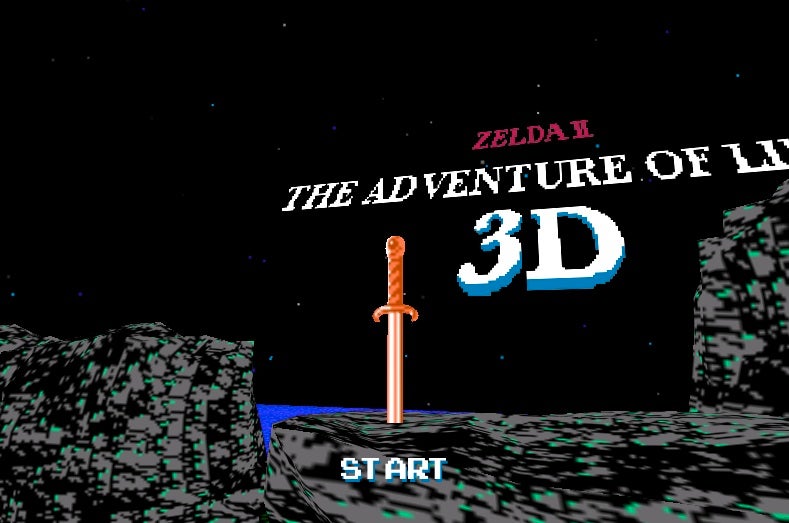
Play Zelda II As A First-Person Shooter
You could keep reading this post. Or you could pop open a new browser window and try playing late-80s Zelda II: The Adventure of Link as a… Read…
This entry passed through the Full-Text RSS service — if this is your content and you're reading it on someone else's site, please read the FAQ at fivefilters.org/content-only/faq.php#publishers.
23 Feb 23:45

Voyager’s Golden Record
by Matt Blitz
Imagine for a moment that it’s 40,000 years in the future in a solar system far, far, away on a planet thriving with intelligent life. Extraterrestrial beings inhabit this place. Perhaps they look like the cuddly ET, the blob, ALF, or maybe even like the dreadlocked beings from Predator; but either way, they are not human. An approaching speck in space catches the beings’ eyes (assuming they have them). Upon sending a craft to retrieve it, they find a probe containing a disk. Using instructions on the disk, they manage to play it. What they are about to hear and see are the sounds and images from an ancient alien civilization – 1977 Earth.
Flashback about 40 millenia to Cornell University in Ithaca, New York, Earth in January, 1977. A brilliant, 43 year old professor named Carl Sagan is the director of the Laboratory of Planetary Studies there.
 In 1975, he had won the Pulitzer Prize for his book “The Dragons of Eden,” a dissertation on the evolution of human intelligence. He helped shape the field of exobiology, the study of the potential for life on other planets. Sagan had also been a key adviser for NASA dating all the way back to it’s earliest days. Working out of the Jet Propulsion Laboratory in Pasadena, California (the same place that Georges Lemaitre spoke with Einstein in 1933 and where Jack Parson launched the first rocket in 1936) as a visiting scientist, he helped design and manage several space exploration missions, including the Mariner 2’s trip to Venus and Viking one & two’s trips to Mars. Also, in the late 1950s, he was involved in a plan the U.S. had to nuke the moon.
So, when Dr. Sagan received a call to come to the JPL once again to help NASA, this wasn’t out of the ordinary. But this wasn’t an ordinary mission.
In August of 1977, NASA planned on launching twin unmanned space probes called Voyager 1 & Voyager 2. The probes’ original mission was to explore and take pictures of the giants of our solar system, Jupiter, Saturn, plus all of their moons. There was also a hope that if the probe’s instruments continued to operate, the probes could do the same with Uranus and Neptune.
Due to “a rare geometric arrangement of the outer planets” that only happens every 175 years, all four planets were positioned perfectly so that a probe launched into space at the proper angle, time, and speed would be able to pass all of them. Pluto was never part of the mission due to it being elsewhere in its orbit and not part of this geometric arrangement. The probes were built to last five years, but there was considerable optimism, that has since proved founded, that they would last many years more.
There was also a possible additional mission- if all went as planned and they were able to carry it out, they would be the first Earth crafts to leave our solar system and become interstellar travelers. This is what NASA wanted Dr. Sagan for. In less than nine months, NASA wanted Dr. Sagan to compile a team and devise a message in case of contact with an extraterrestrial civilization outside of our solar system, a message that needed to convey what life was like on Earth and be relatively easily understood by those who receive it.
Now, the chances of the probes ever being found, detected, or recovered by an extraterrestrial civilization are incredibly small. The probes are the size of a small car which doesn’t even register as a blip in the vastness of the universe. For that matter, the Milky Way itself is barely a blip on that scale. Additionally, the probes wouldn’t even reach another planetary system until around 40,000 years into the future. At that point, Voyager 1 will be nearing Gliese 445 and Voyager 2 will be close to Ross 248. Nevertheless, it was decided such a message should be included, just in case.
The decision was made pretty early on that whatever was sent up there needed to showcase Earth – the sights and sounds of our home planet. It had to be a “cultural Noah’s Ark with a shelf life of hundreds of millions of years.” Now, the question was what sights and sounds exactly?
To answer this question, Dr. Sagan compiled his team. Dr. Frank Drake worked with Sagan on the Pioneer plaque in 1972, which among other things included the location of Earth, mapping it out via pulsars.
Ann Druyan was a friend of Sagan’s (later, his wife) and a young scientific novelist. She was put in charge of music selection. Timothy Ferris (at the time, engaged to Druyan) was a writer for Rolling Stone and would go on to become “the best scientific journalist of his generation.” He helped picked the images that were to be included.
Jon Lomberg had already been Dr. Sagan’s artistic collaborator for several years; his job was to bring color and artistic beauty to what the interstellar beings would see. Finally, there was Linda Sagan, Carl’s wife. She had created the artwork on the Pioneer plaque and was to help produce this project.
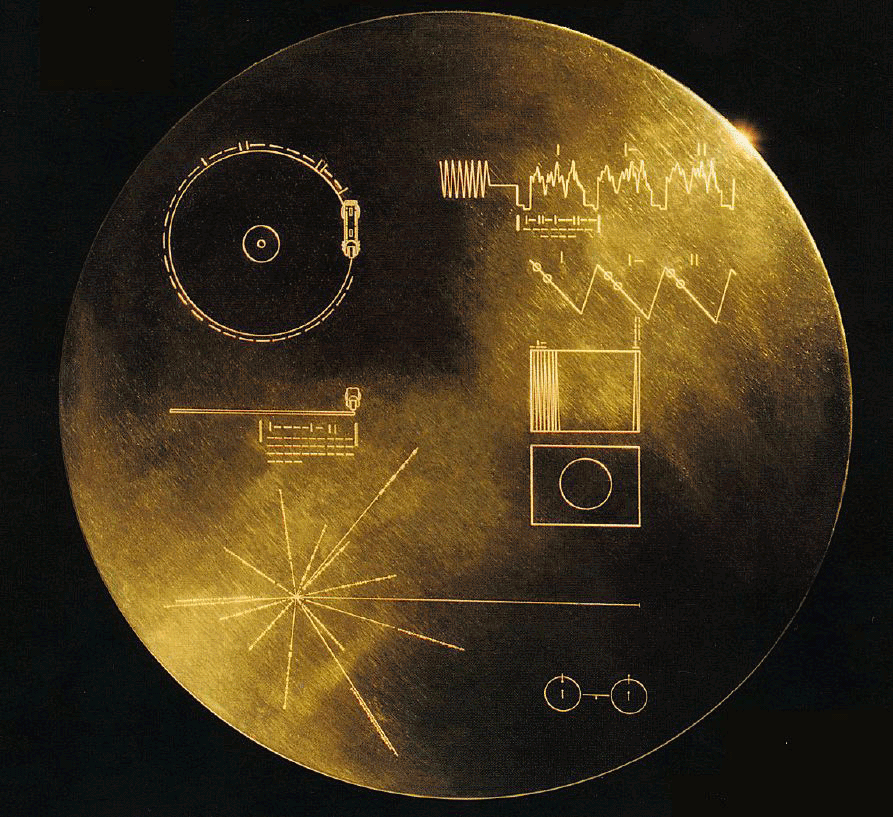
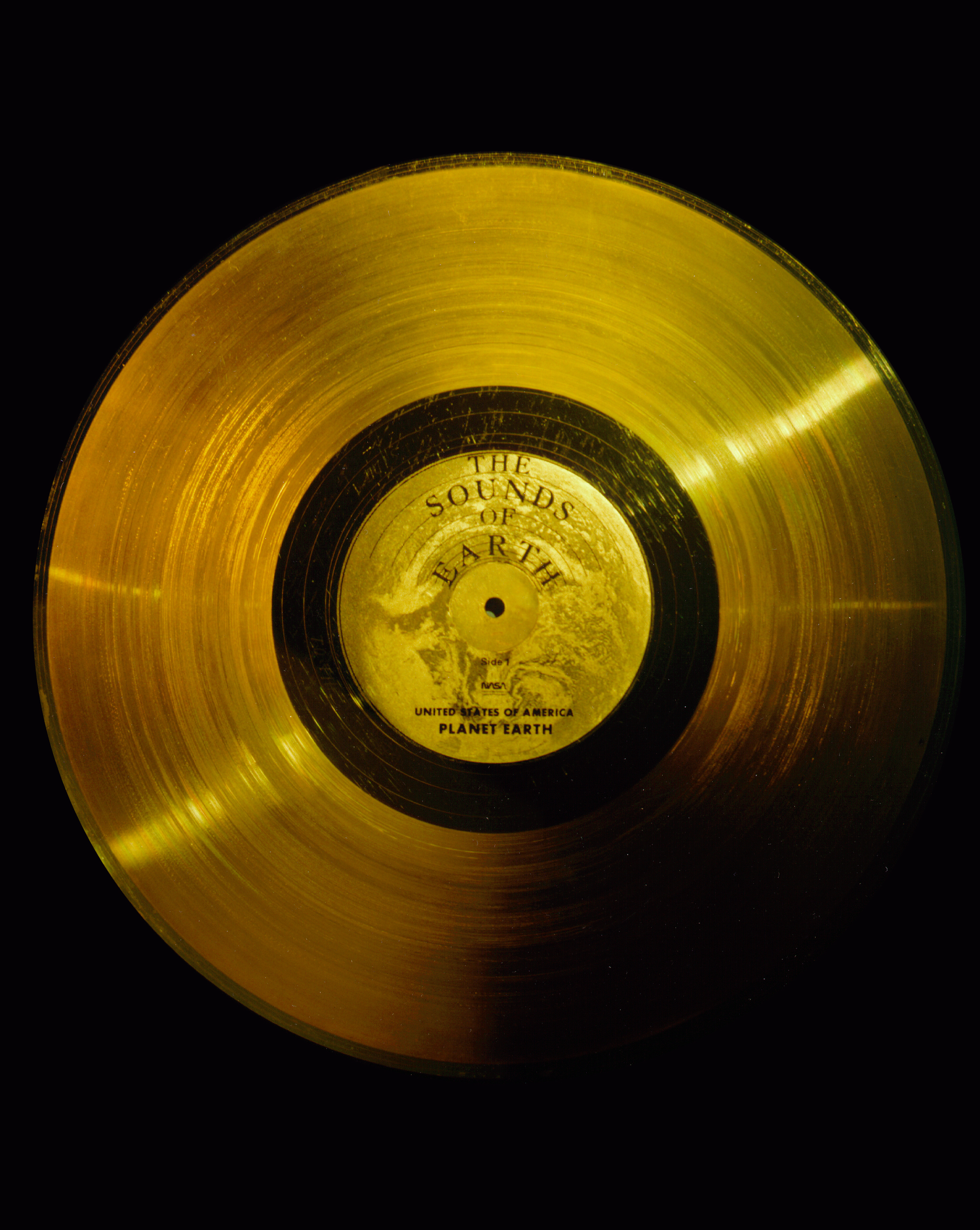
Their first order of business was to figure out how they were going to convey this message. The receptacle for this kind of message had to last for thousands of years and be simple to play. Drake suggested the old-school technology of a phonographic record. It was rather simple to play and as long as the physical record itself was protected, it wouldn’t erode over time. The etchings on a metallic phonographic record could last, according to estimations, for hundreds of millions of years with very little degradation. Additionally, they decided to make it a copper disk coated in gold, further protecting it from magnetic fields and heat, as well as placing it in a protective aluminum jacket.
Coupled with an included needle and cartridge, an alien civilization would be able to play it. They also decided to design it to run at 16 2/3 revolutions per minute, as opposed to the normal 33 1/3 revolutions. This was done so that they could jam as many pictures, music, greetings, and information as they could onto the record. In order to make sure the aliens knew what to do with the disk, needle, and cartridge, symbols were etched in showing how it was to be used. For instance, to make sure they know what speed to rotate the record at, this is etched in binary arithmetic expressed as a factor of the fundamental transition of the hydrogen atom.
In order to demonstrate how the pictures are to be decoded and viewed, the upper right portion of the cover shows the analog signal that is the start of the picture, and in binary how the first three vertical lines are marked. They further show how many vertical lines to a picture. On the face is also a carefully chosen picture of the first picture on the record, for calibration purposes.
Next, and possibly the most arduous task, was to determine what exactly would be on this record. The team wanted the golden record to represent what life was like on Earth; the sights, sounds, and feelings we encounter everyday. After much deliberation, 115 images encoded in analog form (including a picture of DNA, human anatomy, Olympic sprinters, an African hut, and a diagram of vertebrate evolution) and an audio “track list” with greetings, sounds, and music were included.
The audio portion began with “Greetings in 55 languages.” The first greeting, in English, was from then-Secretary General of the United Nations Kurt Waldheim. The rest of the greetings included ones in Sumerian (“may all be well”), Zulu (“We greet you, great ones. We wish you longevity”), Czech (“Dear Friends, we wish you the best.”), and even a “whale greeting.”
The next audio section was known as “sounds of Earth.” They included things like a baby crying, a volcano erupting, birds calling, and a train roaring past. The last audio section was the music, overseen by Ann Druyan. Among the tracks selected for this section was Beethoven’s Fifth Symphony, a Pygmy girls’ initiation song from Zaire, Peruvian panpipes and drums, and “Johnny B. Goode,” by Chuck Berry. Noticeably absent was any song from the Beatles. While the band wanted their hit “Here Comes the Sun” to be included, they didn’t own the rights to their songs. Their publishing company, EMI, did and they did not allow it to happen.
For everything the team included on this golden record, probably the most unique – and telling – inclusion was an EEG brain scan of a young woman, newly in love. That woman turned out to be Ann Druyan. Druyan had planned on going through “a mental itinerary of the ideas and individuals of history whose memory I hoped to perpetuate,” as well as thoughts of her fiancé Tim Ferris while being connected to the EEG. But two days before the recording, something extraordinary happened. She fell in love with Dr. Carl Sagan.
Days before, they had shared a rather intimate phone call where they ruminated about life when they both realized they loved one another. They hadn’t had a single date nor a kiss or even a romantic moment before this, but they decided to marry, despite them both being in other relationships. As described by Druyan herself, “It was a Eureka! moment for both of us—the idea that we could find the perfect match. It was a discovery that has been reaffirmed in countless ways since.”
As for the brain scan, she stated,
Earlier I had asked Carl if those putative extraterrestrials of a billion years from now could conceivably interpret the brain waves of a meditator. ‘Who knows? A billion years is a long, long time,’ was his reply. ‘On the chance that it might be possible why don’t we give it a try?’
Two days after our life-changing phone call, I entered a laboratory at Bellevue Hospital in New York City and was hooked up to a computer that turned all the data from my brain and heart into sound. I had a one-hour mental itinerary of the information I wished to convey. I began by thinking about the history of Earth and the life it sustains.
To the best of my abilities I tried to think something of the history of ideas and human social organization. I thought about the predicament that our civilization finds itself in and about the violence and poverty that make this planet a hell for so many of its inhabitants.
Toward the end I permitted myself a personal statement of what it was like to fall in love.
On August 20, 1977 Voyager 2 lifted off into space. Voyager 1 joined its twin 16 days later. Over the next four years, they explored and took snapshots of Jupiter and Saturn. In 1986, Voyager arrived at Uranus. By 1989, it had passed by Neptune. Voyager 1 officially entered interstellar space on August 25, 2012 and as of February 20, 2014, it was 127.25 AU from Earth. The farthest away of any man-made object.
With perhaps as many as 500 billion galaxies each with billions of stars (for reference the Milky Way has about 300 billion), many of which have planetary objects orbiting them, it seems likely enough we’re not alone in the universe. The Voyager probes will orbit the Milky Way indefinitely, so you never know. One of them might encounter an intelligent alien civilization, maybe even long after humans have gone the way of the Dodo bird.
And if that day does come when a Voyager Golden Record is found, first contact may well be dreadlocked Predator-like extraterrestrials listening to Chuck Berry’s “Johnny B. Good.”
While it’s a long-shot, as Sagan himself noted,
The spacecraft will be encountered and the record played only if there are advanced spacefaring civilizations in interstellar space. But the launching of this bottle into the cosmic ocean says something very hopeful about life on this planet.
(For the full contents of the Golden Records, go here.)
If you liked this article, you might also enjoy:
- The First Man To Walk In Space Almost Got Stuck Out There
- How Do Astronauts Go to the Bathroom in Space?
- When the U.S. Sent Several Hundred Million Needles Into Space
- You Can Survive Being Exposed to the Near Vacuum of Space for About 90 Seconds With No Longterm Damage
- 10 Interesting Space Related Facts
Bonus Facts:
- In order to allow the recipients to view certain images in color, three consecutive images were used in these cases, each representing red, green, and blue. In order for them to determine whether they are calibrating it correctly, a picture of our sun was included. Using the pulsar map to locate it, the aliens should be able to directly compare our sun’s exact color (which isn’t yellow by the way) with the image included.
- As one could imagine, despite the cute love story between Dr. Sagan and Ann Druyan, there were pretty dire consequences due to their secret marriage. They both decided not to reveal it to their partners until the project was completed. But when they eventually did, it led to a eight year legal battle between Carl and Linda, longer than it took the Voyagers to pass by Jupiter.
- The team was able to secure a rather valuable and heartfelt audio message for the probe from US President Jimmy Carter. The message said: “This is a present from a small distant world, a token of our sounds, our science, our images, our music, our thoughts, and our feelings. We are attempting to survive our time so we may live into yours. We hope someday, having solved the problems we face, to join a community of galactic civilizations. This record represents our hope and our determination, and our good will in a vast and awesome universe.”
Expand for References
- What is the Golden Record? – NASA
- Voyager Golden Record – WIkipedia
- Murmurs of Earth
- Voyager, The Love Story – NASA
- Voyager – Interstellar Mission – NASA
- Voyager – FAQ – NASA
- Carl Sagan – Wikipedia
- Carl Sagan – NASA
- Planetary Voyage – NASA
- Project Ozma – WIkipedia
- Ann Druyan – Wikipedia
- Captured by Aliens: The Search for Life and Truth in a Very Large Universe by Joel Achenbach
- Jon Lomberg – Wikipedia
- ScienceCasts: Voyager
- http://voyager.jpl.nasa.gov/spacecraft/music.html
- Voyager Golden Record – Wikipedia
- Golden Record – Greeting Recordings – NASA
The post Voyager’s Golden Record appeared first on Today I Found Out.


23 Feb 05:01


When Founders And Investors Split Over An Acquisition Offer
by Tomio Geron
Editor’s note: Tomio Geron is head of content at startup Exitround. This is part of a series of posts on the tech M&A market. Follow him on Twitter @tomiogeron.
For one founder who recently sold his startup, it was the culmination of a long journey. At the same time, the founder, who spoke to me on the condition of anonymity, had problems during the acquisition process, feeling bullied by a venture investor.
The investor argued against a sale of the startup, and then after agreeing to the sale, proceeded to call the buyer and yell about terms of the deal. The investor also pushed for certain terms that the founder felt were unfair and benefited the investor.
The founder was pleased with the outcome but felt powerless to stop this investor from essentially steamrolling the process.
“They didn’t want to sell because, for them, the deal was too small,” the founder says. “Eventually our investors inserted themselves into the negotiations. They actually screwed things up for us because they demanded more and actually offended the buyers.”
This type of story rarely gets publicly told in Silicon Valley, since founders and investors don’t want to reveal how the sausage is made in negotiations — and more importantly don’t want to criticize each other in public and break Silicon Valley’s unspoken rule of positivity. But because of how venture capital is structured (more on this below), and because of the many startups that will need to sell without being able to raise more funding in the current environment, these types of situations are bound to come up.
Negotiating with a buyer is a challenge for founders in an acquisition. But negotiating with one’s own side — the investors — can be just as difficult, if not more so. These disagreements typically arise when startups get an offer to sell and the founders and venture investors disagree about what to do. These offers, even if relatively small in Silicon Valley terms — say $10 million or $20 million — can be “life-changing” for founders. But for venture investors, particularly with big funds ($300 million, $400 million or even $1 billion), smaller exits are not appealing. To explain why, we need to look at how traditional venture funds are structured.
Fund Economics
VCs typically want a good venture fund to make 3-5x their money. In other words, a fund with $250 million invested would have to return $750 million to $1.25 billion from the fund’s companies that are acquired, IPO, or are otherwise sold off in some form. A 4x return would net about a 2.5x distribution to the fund’s limited partners after fees to the general partners. So VCs depend on massive “home run” exits. For a $250 million fund, VCs would require at least three to four exits of $1 billion or 10 exits of $400 million. (This assumes a VC fund would get 20 percent of the exit price.)
As a result, smaller sub-$100 million exits aren’t that attractive to most large VCs, particularly if they have made a large investment. Many would rather not sell, and instead they roll the dice and hope for a larger outcome. “VCs often look at return on their money as opposed to IRR (as a metric). The fact that they made 4x (return) on $5 million over nine months on a $500 million fund: who cares?” says Villi Iltchev, EVP of corporate development at LifeLock.
To be clear, I’m not saying that all VCs are mistreating startups or behaving badly. I’m not even arguing that the investors’ actions described above are necessarily wrong. (Though it does explain why some founders privately complain about VCs.) And of course, unlike the investor described above, many investors do let their founders make the call on acquisition offers without pressuring them at all.
Aligning Interests
So while many VCs don’t like to talk about it, their immediate economic interests can diverge from their startups, particularly in smaller acquisitions, Iltchev says. “For founders, especially those who are not independently wealthy, their tolerance for risk is usually lower. VCs are in the business of managing risk on a portfolio basis. For founders an exit can be a once in a lifetime chance to change their life for their family. For investors the same transactions may be immaterial.”
This isn’t to say VCs (or founders) are necessarily at fault. The different economic interests are inherently part of the venture model. Other structures may evolve but this is now the dominant model. That certain investors don’t adhere to these fund economics and let founders make their own decisions is a credit to them and their long-term thinking to try to keep founders coming back to them for future investments.
There are also things that venture firms have done to better align interests of founders and investors. Founders Fund created Series FF stock, which gives founders more flexibility to sell shares. And many venture firms now allow founders to take a small percentage of “money off the table” in a secondary transaction to reduce the financial need for founders to sell early.
Different Investors
Of course, not all investors have the same interests. The larger a VC fund, and the more of their money they have invested in a company, the less likely they are to like a smaller exit. Smaller seed investors or micro-VC funds, which are proliferating, don’t need billion-dollar exits to return their funds, so they are happier with smaller exits — what Dave McClure calls a “Moneyball” model. This makes sense, since about 88 percent of tech acquisitions in the last five years with announced prices were less than $100 million, according to Capital IQ. Also, sites like AngelList and FundersClub enable more individuals to invest, and these individuals typically don’t push for massive exits.
Despite the potential conflict of interest I’ve described (i.e. founders want to sell but investors don’t), some venture investors will help negotiate a deal. Particularly for younger, less experienced founders, investors will get actively involved. And some smaller angels or micro-VC investors have less incentive to oppose smaller acquisitions so there can be less of a conflict. For example, seed stage investor Manu Kumar, founder of K9 Ventures, has negotiated acquisitions for a number of his startups.
Psychology
For founders it can be difficult to disagree with an investor on a sale. In particular, first-time founders often feel indebted to investors for taking a chance on them. So to turn around and say, “No we don’t agree with you,” can be hard to do.
Many VCs have rights they can use to try to block an acquisition. But most rarely use them, particularly if a founder makes a good case for a deal as the best possible outcome for a company. VCs do not want to be known as “not founder friendly,” even if they hate a deal and feel it is unfair. But they’ll complain privately. Like the anonymous founder mentioned above, Iltchev has received calls and been yelled at by investors who are unhappy with a deal.
Buyer View
For buyers, of course, it’s complicated when sellers and investors aren’t on the same page. Buyers don’t want to negotiate with multiple parties in the same company. On the other hand, if a VC is calling a buyer, that can mean the founder has already decided to take the deal. “If the investor is calling me to negotiate terms, it is probably because they have already lost the battle with the founder and they are just trying to beat me up,” Iltchev says.
At top Silicon Valley buyers, it is standard to treat investors well, even if they don’t technically have to. For example in an acqui-hire – where a buyer just wants the team but not the product or IP — a buyer could just hire a startup team and not pay the investors anything. But most big Silicon Valley buyers want to stay on good terms with investors — who, after all, send them companies to buy — so they will try to make investors happy by paying back their original investment, if not more. (Non-Silicon Valley buyers do not necessarily play by these rules.)
I will be extremely cautious before ever accepting VC investment again and would only do it on my terms.
Founder Choices
The anonymous founder mentioned above, reflecting on the experience, says, “My advice would be to make sure you have someone who will stick with you not just when things are going well, but during the inevitable struggle that all startups face. It’s fine to have a strong investor who pushes you and fights for what they think is best for the company, but hopefully it’s not just what’s best for them. That said, I will be extremely cautious before ever accepting VC investment again and would only do it on my terms.”
For founders the best way to avoid these problems is to choose the right investor. Vet your investors and have honest conversations before they invest. Ask them what their return profile is and what kind of exit they’re expecting for your company, says Ursheet Parikh, former CEO of StorSimple, which was acquired by Microsoft, and a new partner at Mayfield Fund.
“Some investors may not appreciate you talking to any large companies early because they are concerned that these strategic buyers may either be a distraction or try to buy you early on the cheap,” he says.
That’ll give you an idea of what you are expected to deliver and whether you’re ready to accept that money and the strings attached. And have an honest conversation with the investor about what would happen if you disagreed with him or her on an acquisition offer. The more honest and transparent they are with you the better. Ultimately the more you prepare while choosing your investor, the better position you’ll be in when acquisition offers come in.
Image by Shutterstock
23 Feb 04:59

Wow! He Really Wants Her To Change Her Profile Picture
by Admin
Change your Avi fail
He really wants her to change her profile picture because it’s ugly? Some guys have no manners. Ladies would you change your profile picture for him?
Follow us on Facebook for more funny pictures
The post Wow! He Really Wants Her To Change Her Profile Picture appeared first on NoWayGirl.
23 Feb 02:40

Big Mac Sauce Recipe
by Bobby

The Big Mac from McDonald’s is perhaps one of the most well-known burgers across the country. What makes the Big Mac so special is the secret burger sauce that is used on it. The truth is you can make a sauce that tastes very similar to the sauce used on the Big Mac with just a few simple ingredients, several of which you may already have on hand. This sauce is just a combination of mayonnaise, French dressing, chopped onion, sweet pickle relish, vinegar, sugar, and salt. With this sauce you can make a burger that is much better than a fast-food restaurant could produce. Enjoy.
Big Mac Sauce
Yield: 3/4 Cup
Ingredients:
- ½ cup mayonnaise
- 2 tablespoons French dressing
- 4 teaspoons sweet pickle relish
- 1 tablespoon finely minced white onion
- 1 teaspoon white vinegar
- 1 teaspoon sugar
- 1/8 teaspoon salt
Directions:
- In a small bowl combine mayonnaise, French dressing, pickle relish, minced onion, vinegar, sugar, and salt. Stir well to combine. Cover and refrigerate for several hours to allow the flavors to blend.
- Serve on your favorite homemade burgers.
Adapted from Top Secret Recipes.

![[link]](http://i.imgur.com/wLCI1bQ.png)
18 Feb 06:35
Study: Democrats more likely to think astrology is scientific, less likely to know Earth revolves around the sun
by Allahpundit
D G....but yet the first to call others names

Party of Science.
Via Brendan Nyhan, there’s no better way to celebrate a day of national unity like Washington’s birthday than by sneering at the ignorance of our political opponents. Okay, fine. Relative ignorance. Why the disparity? One possibility is education. Follow the last link and scroll down to Table 7 and you’ll see, as expected, that the […]
18 Feb 06:33

Not all bootleg Pokémon games are terrible
by Jordan Devore
There are so many popular YouTube creators that I just plain cannot connect with as a viewer, try as I might, but JonTron isn't one of them. Oh how he makes me laugh. I'm happy to see him making videos again and this latest one concerning bootleg Pokémon games is a new favorite.
I had heard about Pokémon Vietnamese Crystal and its utterly hilarious translation before, but many of the others were new to me. I'm still chuckling over the intense, out-of-place music in Pocket Monster. And "abomination." What is that thing?!

18 Feb 05:36


70,000 People Are Playing Pokemon Collaboratively – And You Can Watch Live
by Alex Wilhelm
There are things on the Internet that we humans were not built to understand.
Over on Twitch, the largest platform for livestreaming esports and other gaming content, 70,000 people are playing Pokemon in unison and the world is watching. The host cooked up a script that takes game commands from the stream’s chat interface, and feeds them into the game itself. So, people are shouting LEFT, RIGHT, and so forth in some sort of virulent cacophony to control the little Poke hero.
Right.
The Internet is strange, but this is hilarious. You shouldn’t be working, so enjoy:
IMAGE BY FLICKR USER ALIISDAIR UNDER CC BY 2.0 LICENSE (IMAGE HAS BEEN CROPPED)
Mason likes this
18 Feb 01:26


R.I.P. CAPTCHA
by Kate Baggaley
CAPTCHA
Wikimedia Commons
Say good-bye to CAPTCHA, the boxes of warped text that separate humans from bots online. AI company Vicarious claims to have developed an algorithm that can pass the test about 90 percent of the time. What will save us from spam now? These alternatives could come to a site near you.
Two-step verification
Validate your user name with a confirmation code sent to your phone or e-mail.
Games
Solve puzzles, draw shapes, or describe pictures.
Timers
If a form is filled out and submitted faster than is humanly possible, the bot is denied access.
Honeypot
Programming hidden to humans but visible to bots tricks a nefarious algorithm into identifying itself and subsequently blocks it.
Motion
Using a device’s camera, a program analyzes gestures to determine whether you’re flesh and blood.
This article originally appeared in the February 2014 issue of Popular Science.
    
|
Ivegotabikeyoucanride, Spursfan123 likes this
18 Feb 01:26
Kicktaxing: The Crazy Complexity of Paying Tax Correctly On Crowdfunding
by Unknown Lamer
eggboard writes "I thought I knew what I was doing when I budgeted for a Kickstarter campaign. I spent weeks sorting out details, set a number ($48,000) that included expenses, Kickstarter fees, and a margin of error. In the end, we raised over $56,000. But my tax planning nearly put a crimp in cash flow, and could have been real problem. It all worked out, but I've written a detailed guide for people for before and after a campaign to avoid my mistakes." 


Read more of this story at Slashdot.
Alessander, firehose and -1 others like this