Sophianotloren
Shared posts
13 Jan 17:25
Tuesday Tarot – All Steam(punk)ed Up!
by syrbal-labrys
I got very excited scanning my new deck of tarot cards in so I could provide vivid images for anyone ...
Continue reading
Continue reading
Sophianotloren likes this
13 Jan 14:40
Moderation Management – Another AA Front Group
by AddictionMyth
Moderation Management (MM) was founded by Audrey Kishline in 1994 as an ‘alternative’ to AA for those who had a ‘drinking problem’ but weren’t interested in complete abstinence. Kishline believed that there was a difference between ‘problem drinkers’ and ‘true alcoholics’ and that MM could fill a void in substance abuse treatment. Kishline later decided she was a ‘true alcoholic’ after all and rejoined AA in 2000. Two weeks later she killed a father and his daughter while “driving a hundred miles an hour in a total blackout” when going to visit her father.
At about 6 p.m., travelers Patricia Clark and her friend Brenda Keller were driving east on I-90 when Kishline suddenly pulled onto the highway from a wooded shoulder, heading in the wrong direction at 60 mph. After forcing a startled Clark to swerve into the farthest left lane to avoid a collision, Kishline veered into the tree-lined median, then reentered eastbound I-90, again in the wrong direction. “It scared us to death,” says Keller, who immediately dialed 911. During the next five minutes, a dozen horrified motorists phoned the police. “She kept running cars off the road,” says Det. Tom Hickman of the Washington State patrol. Richard “Danny” Davis, 38, and his daughter LaShell, 12, weren’t so lucky. Kishline’s one-ton brown pickup truck slammed head-on into their 1982 two-door Dodge. Davis died on impact, his daughter moments later. “We had to cut them out,” says Hickman. When police arrived on the scene, they found Kishline unconscious and unseat-belted, a half-empty bottle of 80-proof vodka beside her in the front seat. Two hours later at a Seattle hospital, tests showed her blood alcohol level to be 0.26, more than three times the state limit.
 MM is just a front group for AA, whose purpose is to indoctrinate more people into the 12 Step cults by convincing them they might be ‘true alcoholics’ and to underscore the risks of guessing wrong. Of course, ‘alcoholism’ is completely fake. It’s a mischief cult for some (like Kishline) and for others it’s a brainwashing suicide cult (e.g. Robin Williams and Philip Seymour Hoffman and millions of others). Kishline killed herself last month, showing that for some people it can be both.
Kishline founded MM with Jeffrey Schaler, who is curator of a Thomas Szasz web site. Szasz is an anti-psychiatry psychiatrist who questioned the existence of mental illness and addiction. He believed that much of these conditions were faked, as if the participants were actors playing parts. (Szasz died a few years ago.) Schaler is obviously a smart and skeptical guy, but somehow he was bamboozled by Kishline into joining the board of MM. He later left, denouncing the organization he helped found, after she became more persistent in her doctrinal distinction between ‘problem drinkers’ and ‘true alcoholics’. Regarding her crime he wrote: “I support a life sentence in prison for Kishline. Another option would be to give her the opportunity to commit suicide.”
The other original members of MM’s board were Kishline’s husband Brian and psychologist Fred Rotgers of the Rutgers Center for Alcohol Studies. Rotgers has long promoted ‘harm reduction’ strategies and alternatives to the 12 Step approach. But he still believes in the existence of the ‘true alcoholic’ and sees MM as a pipeline into AA: “We now see a sizable minority of folks in MM who have moved to an abstinence goal”.
A recent comment on an article about Kishline’s suicide reveals Rotgers’ true sentiments:
As former Chairman of the Board of Moderation Management Network, Inc, I want to go on record about the major contribution to the health and well-being of Americans made by Audrey Kishline. Audrey was a visionary thinker and a pioneer in bringing science-based treatment alternatives to the American public. These alternatives, as Ms. Glaser notes, are endorsed by SAMHSA and are widely used in other countries outside the U.S., especially in Europe. Audrey’s personal tragedy has nothing whatsoever to do with the importance of her contribution. That she battled serious depression for many years is true. That she found herself unable to moderate her own drinking, especially when in the throes of her depressive darkness is also true. Nonetheless, the organization she founded has helped, and continues to help, thousands of problem drinkers. Science-deniers, such as robddolgin who comment just precedes this one, are no different than those who deny the Holocaust or global climate change. They operate with their heads in the sand, with egos so large that they believe they have all the answers for everyone who has a drinking problem–“do it my way!” Audrey saw clearly, and the principles of MM reflect this vision (as do the basic ideas behind AA–read The Big Book to see how Bill W. conceived of the best way to help people change) and the reality that individuals are always the ultimate decision-makers in their own lives, and the best way to promote healthy choices is to have them available. Moderate drinking approaches are one of these choices. That they are not made widely available to problem drinkers in the U.S. is a travesty, but one that Audrey sought to remedy in one small way. She will be missed both as a pioneer in assisting problem drinkers and as a human being with all the flaws that we all share.
Of course, he is just parroting Big Book propaganda and copying their brainwashing tactics to discredit detractors. Amazingly, anyone who says that addiction isn’t really a disease is called a ‘Holocaust denier’ and ‘science-denier’ and has a ‘large ego’ and is ‘trying to do it your own way’. These are all well-known 12 Step cult debating tactics.
Also he completely fails to address the reason why Kishline went driving even when she knew she was drunk. The idea that she wasn’t aware because of her blackout is BB propaganda. As Bill W said, “There had been no real infidelity, for loyalty to my wife, helped at times by extreme drunkenness, kept me out of those scrapes.” (p.3) This is of course a well known lie. But Rotgers promotes the idea that once drunk you are no longer responsible for your behavior either because you are unaware or lack judgment. This is axiomatic in AA. Of course Kishline had long experience with drunkenness to know that she was dangerous behind the wheel. And yet she drove anyway. Why? Probably because she was trying to get some kind of revenge on her father. This could be easily corroborated by anyone who knows her family. It is very typical of most stories of female alcoholism – usually an attempt to get their mother to ‘love’ them, though most heterosexual women outgrow such childishness by their mid 20’s.
This passage from the Big Book is recited at the start of every meeting:
Most of us have been unwilling to admit we were real alcoholics. No person likes to think he is bodily and mentally different from his fellows. Therefore, it is not surprising that our drinking careers have been characterized by countless vain attempts to prove we could drink like other people. The idea that somehow, someday he will control and enjoy his drinking is the great obsession of every abnormal drinker. The persistence of this illusion is astonishing. Many pursue it into the gates of insanity or death. We learned that we had to fully concede to our innermost selves that we were alcoholics. This is the first step in recovery. The delusion that we are like other people, or presently may be, has to be smashed.
The idea that alcohol makes us do things we later regret is a religious belief: idolatry of ‘King Alcohol’. It is not a scientific belief, despite government scientists’ heroic attempts to make it so. SAMHSA promotes that belief to children under a pseudoscience guise: “Don’t drink because it will make you do things you’ll later regret.” NIAAA and NIDA similarly promote pseudoscience nonsense to convince the public that addiction is real, ironically and hypocritically calling their critics ‘science deniers’ even though their own claims about the ‘neuroscience of addiction’ are pure conjecture and speculation.
Like AA, he dismisses his critics as having their ‘head in the sand’ — “Belligerent denial” (BB p. 568) and suffering from ‘large egos’ — “Our actor is self-centered — egocentric.” (BB p. 61) This causes the resentments that power the cravings. “And with us, to drink is to die.” (p. 66) The only solution is a spiritual cure: “We trust infinite God rather than our finite selves.” (p. 68) Rotgers is promoting AA suicide cult doctrine to disarm his critics, a tactic that has worked for AA for decades. They say either, “If you criticize AA you are going to die.” Or, “If you criticize AA you are killing suffering alcoholics.” (Whichever they think will be more effective at silencing you.) These tactics are the envy of islamist extremists!
Rotgers ascends to new heights of hypocrisy when he validates Bill Wilson’s notions of ‘the best way to help people change’. Of course, Wilson promoted AA as the only way (“Rarely have we seen a person fail”), while Rotgers scorns others as claiming exactly that. What makes Wilson so special in Rotgers’ eyes? Why does Rotgers refer to him reverently as ‘Bill W.’?
The truth is that AA and all its front groups like MM are the true science deniers. AA is killing millions through its deadly brainwashing propaganda, and Rotgers’ greatest hypocrisy is his own denial of the AA Holocaust he helps perpetrate.
Tom Horvath of SMART and other promoters of ‘alternative treatment options’ are similarly just front men for AA propaganda. The goal is to provide softer introductions to AA’s religious pagan/satanic doctrines which provide a convenient pipeline to the 12 Step drinking club suicide cult of powerlessness.
Read more:
- Warning: Campus Rape Epidemic! – The panic agenda
- AA Has Killed Millions!
- A Thomas McLellan – Acclaimed Higher Power of Addiction Science
- Project ‘Emancipation Proclamation’ – A progress report
- Because Addiction – ‘Addiction’, Overdose and Suicide
- Alcoholism: The Lie Becomes the Truth
- SAMHSA’s New Blood Drive
- The Origin of Sin – We once lived in the Garden
- AA’s Satanic Roots – Have a drink and do what thou wilt
- Lie Like the Wind – How to know if AA is right for you
- How to Drink Like a Normal Man – Just keep it simple
- Powerlessness as Religion – Only the good die young
- You Are So Brainwashed It’s Funny – Who will pay for their sins?
- The Problem of the Jews: a Lesson in Brainwashing Propaganda – How AA bamboozled a country
- The Drinking Club – Watch what they do, not what they say
- Does Addiction Take Away Free Will? – We lived in the Garden
- Cory Monteith: The Cult of Powerlessness Claims Another Victim
- I Call Blackout – I did what??
- Rat Addicts and the Science Of Addiction – The best of 60′s Science Fiction
- A Conversation with Dr. Drew Pinsky – 13% and proud
- School for Scoundrels – What you actually learn in the rooms
- AA is a Pagan Cult – Putting the ‘pagan’ in propaganda
- The Little Psychopath Could: How the Addiction Myth creates new Drug Addicts
Sophianotloren likes this
13 Jan 14:36
Dan Weiss’s Morning Coffee
by Dan Weiss
 The future belongs to salt-grown potatoes.
Today in duh: pets radically change your brain.
On the cultural life of whales.
Let’s all take a trip inside the 25th annual ice hotel.
Related Posts:
- No related posts…
Sophianotloren likes this
13 Jan 14:36


Challenging my thoughts
by HappyComeLucky
I have been poorly for the last week and a half. That means that I hadn’t prepared my post for today. In some ways that has been a very good thing as it has led me to challenge myself. While I was thinking about what picture to take, I automatically discounted some ideas because I have my period. When that thought appeared in my mind, I immediately stopped and challenged why I thought that. There is nothing bad about my body when I have my period. In addition to that, I get incredibly horny and crave penetration. After a few minutes thinking, my mind was made up and after a play, I took this picture.

Click to see some more Sinful Sundays.

Sophianotloren likes this
13 Jan 14:35
“Ban This Sick Filth”
by kittystryker

All photos from my scenes in “Ban This Sick Filth“, a collaboration between Courtney Trouble, Pandora Blake and myself
It’s been funny, not ha-ha, but somewhat ironic that the last week has been filled with people telling me that free speech needs to be absolute, and that I just don’t appreciate the necessity for it.
While I’ve been working on a porn that critiques and challenges obscenity laws… with more obscenity.
Originally, it was meant to challenge the UK’s VOD restrictions- things I do at home, like fisting, squirting, and spanking, are now banned for me to do on film. As we worked on it, however, it morphed into a wider critique of how porn, often decided to be without “serious literary, artistic, political, or scientific value”, can and does serve as validation for sexual diversity, queerness, and an enjoyment of non-heteronormative sex.
 In lieu of all the fervor about freedom of speech, I feel inclined to remind folks that obscenity is one of a few things not protected under “freedom of speech”. I don’t have the right to distribute or advertise my creative work, because I’m naked and orgasming in it and a bunch of white old dudes will argue in a courtroom about the artistic and educational merit of that. Considering a local community makes the decision on what is immoral for them, rather than a national standard, what is obscene and what it beautiful varies wildly from state to state. What might be completely acceptable and even tender in the Bay may well be horrifying and traumatizing to people in a conservative state.
I cannot completely anticipate the possible reactions or consequences of what I do, but I can make a pretty decent guess- I might get arrested, I might get doxxed by someone like Porn WikiLeaks, I might end up shot by some Elliot Rodgers PUA/MRA wannabe. Or I might be pointed at as someone perpetuating violence against women in the work I do. So, knowing those possibilities, I try to reduce by ethical carbon footprint in how I critique.
 The thing is, when working on this porn, I recognized that, for example, there are people who watch porn for sexual education. That sense of awareness gave me some feelings of accountability to the viewer.
While it would’ve been, in many ways, a lot easier to have the banned acts be things that are nonconsensually thrust on me as the bottom, I also knew that we live in a culture that considers fisting violent. I know we live in a society where 5 year old rape victims have been said, by judges, that they were “asking for it”. I know we live in a society where to say men shouldn’t catcall is considered some sort of misandrist rallying cry. I didn’t want to add to that culture by implying that these were acts I didn’t want happening to me, I didn’t want there to be a question about my consent. I wanted to show how absurd it is that I can do these things with the same people offscreen and that’s legal, but if it’s on a camera, suddenly it’s obscene.
 I think obscenity laws are ridiculous and worth making fun of. There are ways, I think, to both critique society, government, and law without falling into the tedious and easy trap of perpetuating ignorance or falling into boring stereotypes. While I know very well fisting isn’t inherently violent, I also know that my depiction informs people, and maybe I should avoid having it be part of a rough sex scene involving face slapping and smutty talk so I can show people that it can be intimate and sweet. I choose to do a scene where I giggle through my caning instead of crying, because I want to show that these acts are ok, and a desire for these things is ok to have.
“Ban This Sick Filth” is a pet project I care a lot about, not only because I care about picking away at obscenity laws, but also because it was playful, and fun, and sends the message I wanted to send without being mean. And it’s very intimate- doing watersports for the first time with a real life partner was really precious to me, and a challenge. I feel like this came from my heart, inviting people in to see why I love “sick filth”, rather than dismissing them as ignorant for not feeling the same. And I can’t wait to share it with all of you!
Sophianotloren likes this
13 Jan 14:35


Channel 4’s diversity policy won’t work
by stavvers
Channel 4 have produced new diversity guidelines, and get your martini glasses ready because they’ll likely make the rich cis straight white abled men media class start sobbing. Women, PoC, LGBT and disabled people must now be given leading roles in new shows, and characters must also reflect this diversity.
It sounds good on paper, but it won’t fucking change much. The big problem here is that Channel 4 haven’t hit the issue where it matters: the showrunners. The thing about rich cis straight white abled men is they’re not very good at writing diverse characters. They write tokens rather than rounded characters. They write fucking rubbish, because they can’t step outside of their own very limited life experience. Without a change to who is running shows, we’re not likely to see much interesting new content, just a rehash of the same old tired tropes that happen when characters are viewed through the eyes of the rich cis straight white abled man. Channel 4 could have attacked this problem at the very root, and drastically cut the quantity of shows commissioned that are run by this demographic so it reflects population level.
Saying that, even if they did that, I expect what we’d see was a sudden rise in shows run by rich cis gay white abled men.
There’s also a lot of bullshit which falls into compliance with Channel 4’s self-imposed guidelines which won’t help anything. Take, for example, Dr Christian’s pharmacopoeia of nastiness: he’s a gay man (TICK!) and he’s making shows which feature disabled people (TICK!). The fact that these shows generally take the tone of “HEY LOOK AT THIS FREAK WANNA FIND OUT HOW SHE FUCKS?” doesn’t factor into these diversity guidelines. Representation is representation is representation. It doesn’t matter how people are represented, just that they are there.
On the character side of things, I anticipate a little bit of change, maybe. I expect to see less queer-coding villains and more overtly queer, deviant villains. I foresee an enormous rise in racist tropes, with magical negroes leading the white heroes on their quests while at least getting to be in the opening credits for once. And oh! So much naughty, after hours shows with physical comedy about rimming because everybody knows gays can’t go on before the watershed. But worst of all, I predict a rise of the freak show formula. It’s done Channel 4 well so far, and it’ll only serve it better.
Channel 4 has taken a step, but it’s a pretty useless step. I only hope the amount of discomfort it causes the rich cis straight white abled men media class outweighs the negatives.
Sophianotloren likes this
13 Jan 14:34
bufotoxin: if your privilege/oppression framework is defined solely according to “these people get...
if your privilege/oppression framework is defined solely according to “these people get a kind of flak these people don’t get” and not “these people are actually materially exploited by these people” then you get all kinds of bullshit like vanilla privilege or, idk, non-goth privilege. tall privilege. you can apply it to literally anything
It’s why you need to talk about privilege in the context of power and domination, and not just privilege as just a list of things you get. Those are supposed to be an illustrative tool to help people understand how privilege applies to them, they’re symptoms, not causes. The problem is that talking about privilege online is starting to get divorced from talking about it in the larger framework of anti-oppression, and it’s original place within a model of colonization, power and domination. And so people just think privilege is simply some stuff other people have that you want, or stuff you have that others might want.
Sophianotloren likes this
13 Jan 14:33
Millennials Are Less Tolerant Than You Think -- Science of Us
Millennials Are Less Tolerant Than You Think -- Science of Us:
"The fact of the matter is that millennials who are white — that is, members of the group that has always had the most regressive racial beliefs, and who will constitute a majority of U.S. voters for at least another couple of decades — are, on key questions involving race, no more open-minded than their parents. The only real difference, in fact, is that they think they are."
This goes to something I tweeted out yesterday. White people did a better job convincing their children that racism is over than they did actually trying to end it.
Sophianotloren likes this
13 Jan 14:32


NYC IDs Now Available (Along with Free Membership at Lots of Museums)
by Becca Rothfeld
(image via @1001ptUS/Twitter)
Mayor Bill de Blasio launched IDNYC yesterday, the program that will issue municipal identification cards to any New York resident over the age of 14 who cares to apply for one — including undocumented immigrants. De Blasio’s office has promoted the program as evidence of its commitment to inclusivity, arguing that the cards afford New York’s immigrant population access to services previously unavailable to them. With municipal IDs, it will be easier for them to obtain library cards, open bank accounts, and enter federal buildings.
Though some civil rights groups have expressed concern that the cards could be used to identify undocumented immigrants, de Blasio’s office hopes the initiative will attract a wide enough swath of New Yorkers that they blend in with the crowd. To entice potential applicants, the IDYNC program offers a variety of cultural perks. Here’s a quick primer on why art enthusiasts might want a IDNYC card — and how to get one.
What are the benefits?
You should apply for a municipal ID so that undocumented immigrants can get them without facing stigma or repercussions. But you should also apply for an IDNYC card to get free one-year membership at any or all of these 33 participating cultural institutions:
American Museum of Natural History
Bronx County Historical Society
Bronx Museum of the Arts
Brooklyn Academy of Music
Brooklyn Botanic Garden
Brooklyn Children’s Museum
Brooklyn Museum
Carnegie Hall
New York City Ballet
El Museo del Barrio
Flushing Town Hall
Jamaica Center for Arts and Learning
Lincoln Center for the Performing Arts
Metropolitan Museum of Art
Museum of Jewish Heritage
Museum of the City of New York
Museum of the Moving Image
New York Botanical Garden
New York City Center
New York Hall of Science
MoMA PS1
Public Theater
Queens Botanical Garden
Queens Museum
Queens Theatre in the Park
Snug Harbor Cultural Center & Botanical Garden
Staten Island Children’s Museum
Staten Island Historical Society
Staten Island Museum
Staten Island Zoo
Studio Museum in Harlem
Wave Hill
Wildlife Conservation Society
Bronx Zoo
New York Aquarium
Though the benefits of membership at these institutions vary, some offer pretty appealing packages. The Museum of the Moving Image, for instance, provides its members with “unlimited complimentary admission” to the permanent collection galleries (not counting special exhibitions, unfortunately).
(photo via @DesisRisingUp/Twitter)
How and where can you apply?
There are 12 IDNYC Enrollment Centers scattered across New York’s five boroughs. You can find a complete list of the centers, many of which are located in public libraries, here.
To apply for an IDYNC card, visit the website and print out an application, or stop by an IDNYC Enrollment Center. The application requires proof of residence and identity, but it’s flexible with respect to documentation. The program operates on a point system, requiring applicants to earn a total of at least three identity points and one residency point. For instance, New York–issued identification cards like a state driver’s license are worth four residency and identity points, whereas documents like phone bills are worth just one residency point. For details, look at the second page of the application. Work-arounds are offered for those without a stable home address and survivors of domestic violence.
Sophianotloren likes this
13 Jan 14:30


At last, the paedophile as hero!
by tomocarroll
The paedophile as hero (well, a basically decent guy at least) isn’t exactly an overworked figure in contemporary commercial fiction, so when one turns up who is kind, wise, witty and moral, and even so handsome and athletic that women fall hopelessly (in every sense) in love with him, it is time to pay attention. Heretic TOC’s guest blogger today, “Dissident”, has done just that, by reviewing Pedal, last year’s debut novel by Canadian writer Chelsea Rooney (Caitlin Press, 2014). Dissident is a freelance editor and professional website administrator who also earns part of his living writing fiction, with a substantial body of published work to his name in several genres, including sci-fi. He is a long-time hebephile activist who has been prominent in GL circles for some 15 years. He has contributed essays on MAP-relevant topics to Newgon wiki and he posts to GirlChat, where he is a moderator. He has also participated regularly at Visions of Alice, Lifeline and here at Heretic TOC.
PEDO TO THE METAL
I’m pleased to say that Chelsea Rooney can well be considered one of an emerging band of writers who have an interest in actually getting to the truth of pedophilia (and its cousin sexual preferences, hebephilia and nepiophilia, both of which get token mention in this novel).
She is concerned neither with popular propaganda nor with looking politically “acceptable” to her fellow progressives and feminists; and she sure as hell isn’t looking to garner approval from the likes of Oprah Winfrey or her trashy imitators. She is simply interested in the truth, which she commendably values above popularity, especially of the kind that springs from ignorance, hatred, and willful lack of understanding.
That being made clear, Pedal can be difficult reading at times, depending on the reader’s stylistic preferences and where their extra-pedophilic interests may lie. Like many brilliant and well-read authors, Rooney is heavy on the vocab and may be thought pedantic. I’m a writer myself, and I found my own lexicon and general knowledge enhanced. The reader will learn more about bike maintenance, Canada’s roads and often spectacular scenery, stellar cartography, botany, and even haute couture than they may have been prepared for. You will also learn what radon daughters are, and the cool metaphorical use Rooney makes of them.
Rooney’s characters are complex, and their lives outside of protagonist Julia Hoop’s therapeutic and sociological interest in adult attraction to minors are probed in great detail. Thus these people feel real, including Smirks, the pedophile. The narrative also wanders “off topic” a fair bit, making it a mixed bag for those focused narrowly on pedophilia over general human drama and interplay, but Rooney clearly put a lot into this tale. Her characters are fully realized human beings – except for a trio of sketchily presented Nordic youths (or are they just children?) whose menacing presence briefly threatens Julia and Smirks for reasons that remain deeply enigmatic.
Julia is a so-called “survivor.” However, she has spotted something that a number of researchers have begun to notice among “victims” of sexual contact with adults as minors: she had not felt traumatized by the contact she had with her father, a drunkard and wannabe poet who fled his family many years prior to the main body of the story. Julia cycles across Canada to track down the fugitive referred to universally among family and friends as “Dirtbag” and confront him with what went on between them in her childhood. She wants closure, to make sense of her confused feelings. The journey is also intended as one of self-understanding and growth as a person.
Julia doesn’t feel traumatized by Dirtbag, despite the contemptuous label he is tagged with, but is made to feel shameful and guilty thanks to a now pervasive but erroneous belief. This “conventional wisdom” insists that every child who has such contact with an adult must be traumatized, because that’s just what happens when such contact occurs, be it consensual or not.
This leads Julia into conducting interviews for her thesis with women who had sexual contact with adults as children who believe they are “survivors” of molestation despite not reporting any trauma. As a feminist of the empowerment variety – the genuine feminists, as far as I’m concerned – Julia perceives the trauma matter to be dubious in many ways. She doesn’t find the idea of being emotionally damaged for life and relentlessly venting about it by lashing out at others as in any way empowering.
Her research and strong convictions about her inherent strength as a woman make her skeptical of therapists who encourage women to remain perpetual victims. She sees this as a condescending form of complicity with an agenda that has nothing to do with helping people heal from genuine abuse, or with making sense out of sexual encounters in which the child was a willing participant. She has strong reservations about being told by therapists, or society at large, how she should feel about certain experiences, rather than how she actually feels about it.
Julia perhaps served as a literary avatar for Rooney herself, as is common in fiction. She acknowledged the help of “My early correspondent, Krissy Darch, whose letters I have saved in my inbox in a folder called Fuck Trauma, and whose questions inspired the research that led to Pedal” (p. 239).
However, the informed reader will see Dirtbag as more likely a situational molester than a pedophile. What we hear of him suggests he made advances on his daughter for reasons other than preferential attraction to minors. The failure of his ambition to become a significant writer is implicated, along with associated alcoholic binges. He was very physically and emotionally abusive to Julia’s mom, and this seems again more indicative of a drunkard than a typical pedophile. This misstep of Rooney’s can largely be forgiven, though, because elsewhere in the book she struggles harder than most other progressives of the past two decades to understand pedophiles as human beings, and to make sense of pedophilia with an objective and compassionate eye.
This leads us to featured pedophile character Smirks. He is no activist, but does attend an MAA meeting in Vancouver in the hope of gaining a better understanding of himself. And, yes, Rooney does use the value-neutral, untainted term MAA (Minor Attracted Adult) to cover all forms of adult attraction to minors. This expression and its accompanying acronym are often used interchangeably with MAP (Minor Attracted Person) in the contemporary lexicon. The latter is more inclusive, taking in minor-attracted adolescents, but I’ll stick with Rooney’s language here.
Like the infamous Humbert Humbert, Smirks is no role model for MAAs. Unlike his literary hebephile predecessor as penned by Nabokov, he is far more restrained, and his life and interests are shown to encompass much more than his preferential attraction to children – girls, in his case, which is a refreshing change from the usual disproportionate attention given to boy-attracted MAAs over the past few decades, in both literature and research.
Smirks is a quirky but basically caring soul seeking his way through life while secretly dealing with his pedophilia. He is never revealed to have crossed the legal line, making him more sympathetic to a broad modern audience as a result. We learn that a ten-year-old girl named Maria was once part of his life, but never does Rooney treat Smirks as a mindless creature of lust. His ability to feel love for other human beings is made clear, and this includes his once-upon-a-time little sweetheart. His flaws are also laid bare, in a fully three-dimensional depiction. Never does Rooney make the common liberal mistake of attempting to canonize an oppressed minority in seeking its emancipation.
Significantly, women fall for Smirks, who is a ruggedly handsome 30-something, articulate, soft-spoken and a writer. But he isn’t sexually attracted to women. So what to do? Actual romantic involvement with an adult at least offers something beyond illicit fantasies, however unsatisfactorily. Rooney confronts this dilemma: Smirk’s sexual services are commandeered, shall we say, by Julia’s best friend, Lark, a fast-moving fashionista.
It is through Lark, indeed, that Julia meets Smirks. Julia, the 25-year-old psychology graduate student is instantly smitten, but she has no idea he is a MAA. When she poses as a female hebephile to gain entrance to the MAA lecture in Vancouver, she runs into Smirks there, and the truth of his actual preferences is laid bare to her in this rather awkward fashion.
In this meeting, we get a look into the famed European MAA organization IPCE, and its policies and mission statement are laid out. Rooney clearly did her research, and she represents the org fairly, with no concession whatever to popular hostility.
Wanting to keep Smirks close, Julia invites him to join her trek across Canada to locate Dirtbag. Quickly growing to love Julia in platonic fashion, and wanting her company and support, he agrees to the trip to provide her with the same. Along the way, she grows to know him better, and gains a first-hand view into the mind and feelings of an artistic pedophile who is struggling to make sense of his place in a society which hates the very idea of his natural feelings. He too has read much of the available literature, but being a newcomer to the organized MAA community – who meet mainly online – he has yet to fully scrutinize and critique the “scientific” research, much of which is not as scientific as one would wish. Among the books Julia mentions, I should add, is Tom O’Carroll’s Paedophilia: The Radical Case.
Some of the more distressing literature that Smirks reads includes the contention that pedophilia is a brain disorder, described by him in this manner:
“It’s a dysfunction. The white matter in my brain is screwy. I don’t have enough of it. Grey matter does the thinking, the information processing. White matter controls the signals between the information, their connections. When you look at a child, your white matter connects the child to a nonsexual being, and sends a signal of nurture. Love. Care. My white matter signals sex. Pedophilia is not a sexual orientation. It’s a birth defect.” (pp. 155-156).
Smirks makes it quite clear what pedophiles who have not fully self-actualized often have to deal with when reading pseudo-science of this nature. The fact that Smirks is left-handed makes him buy into this all the more, considering what researcher James Cantor and his ilk have concluded about left-handedness being particularly prevalent in MAAs.
Not addressed by Smirks is what all of this means for non-MAA adults who do not feel that strong nurturing complex towards children. Do they, too, suffer from a lack of sufficient white matter in their neural make-up? And what about the very clear nurturing feelings towards children that many typical pedophiles have alongside the sexual component of the attraction? Does that signify some sort of brain abnormality? Artistic works throughout human history seem to contradict the notion that “normal” human adult brains are somehow biologically hard-wired to view children as asexual beings. This reeks of culture and a very recent brand of moralism imposed upon scientific research.
But the emotional turmoil that MAAs like Smirks have to deal with due to all of this specious literature posing as objective science causes them to buy into this on many levels. Sadly, some MAAs view degrees of self-hatred or at least condemnation of their natural feelings as a form of catharsis or absolution for their transgression against contemporary cultural propriety.
Rooney attempts to convey the belief that despite her strong sympathy for pedophiles (and MAAs in general) as human beings who are not inherently defective, and even her questioning of common perceptions of childhood “innocence,” there are no easy answers for this conundrum. It’s obvious that Rooney was struggling with these issues as she wrote the book, though I must commend her for doing so in a manner that more or less chose neutral ambiguity over that of “regretful” condemnation.
So do I recommend this book to all who are interested in the subject, including the MAA community itself? Yes, I certainly do. Chelsea Rooney is a courageous woman with a genuine interest in understanding pedophilia that does not rest on a simplistic abuse prevention agenda. She may very well have come close to doing for pedophilia and child sexuality in the realm of fiction what Judith Levine did a decade previous as a non-fiction writer. Even those who cannot fully agree with this conclusion may however concede that she has taken a step in the right direction.
Sophianotloren and -1 others like this
13 Jan 09:13


Worst. Tu. Quoque. Ever.
by Scott Lemieux
Shorter Verbatim Dr. Helen: “As if NYC doesn’t have enough to worry about, a campaign is underway to curb manspreading [assholes who sit in a way that occupies multiple seats on the subway — ed. ]…So, if it’s okay to subway shame men, is it okay to slut-shame women? Slut-shaming is “defined by many as a process in which women are attacked for their transgression of accepted codes of sexual conduct.” So now men are attacked. Why is one form of sexism okay and the other not?”
So, let’s see. We have an assertion that men have the right to other people’s public space. We then have a non-sequitur expressing misogynist resentment. Yup, it’s hard to get much more conservertarian than that!
Sophianotloren likes this
13 Jan 09:12


Why, Oh Why, Did Barack Obama Turn Mitch McConnell Into A Reflexive Partisan?
by Scott Lemieux
Virtually every word of Christopher Caldwell’s evaluation of Obama’s presidency is an embarrassment. Let’s start here:
Health-care reform and gay marriage are often spoken of as the core of Obama’s legacy. That is a mistake. Policies are not always legacies, even if they endure, and there is reason to believe these will not. The more people learn about Obamacare, the less they like it — its popularity is still falling, to a record low of 37 percent in November. Thirty states have voted to ban gay marriage, and almost everywhere it survives by judicial diktat.
You have to love the bait-and-switch within the same paragraph. Whether the ACA will be enduring is based solely on public opinion surveys, although the GOP isn’t in a position to repeal it and the primary threat to it is “judicial diktat” (although he would never call judicial decisions he likes that.) On the other hand, public opinion strongly trending in favor of same-sex marriage is ignored because in some states same-sex marriage is recognized because of judicial opinions. If Caldwell thinks that same-sex marriage won’t be enduring because the courts took the initiative, all I can say is, care to make it interesting?
It gets worse than this:
These are, however, typical Obama achievements. They are triumphs of tactics, not consensus-building. Obamacare involved quid pro quos (the “Cornhusker Kickback,” the “Louisiana Purchase,” etc.) that passed into Capitol Hill lore, accounting and parliamentary tricks to render the bill unfilibusterable, and a pure party-line vote in the Senate. You can call it normal politics, but Medicare did not pass that way. Gay marriage has meant Cultural Revolution–style bullying of dissenters (notoriously, Phil Robertson of Duck Dynasty and the Mozilla founder Brendan Eich). You can call this normal politics, too, but the 1964 Civil Rights Act did not pass that way.
Let’s leave aside the outright factual errors (the “Cornhusker Kickback” was not part of the final ACA, what the hell did Obama have to do with Brandon Eich losing his job and what does it have to do with Maoism?) The argument is still a logical and historical disaster. First of all, Caldwell apparently doesn’t know anything about the passage of the Civil Rights Act or Medicare, both of which involved legislative deals. The EEOC was gutted to get Republican support for the Civil Rights Act; congressional leaders abandoned price controls in Medicare to placate the doctor’s lobby. The idea that there’s something new in making deals with legislators is farcical, and giving some additional Medicaid funds to Louisiana is one of the more trivial examples of the genre.
It is true that major reform legislation passing on a straight party-line vote is relatively unusual. But the obvious problem is blaming Barack Obama for the new conditions of American politics. Let’s go back to the Civil Rights Act. From Julian Zelizer’s superb new book The Fierce Urgency of Now, on getting Senate minority leader Everett Dirksen’s support for cloture on the Civil Rights Act:
Dirksen firmly believed that the job as a legislator was to make the compromises necessary to pass bills. Like so many others in this period of insider politics…Johnson and Dirksen knew each other well, liked each other, and believed in working together…
Johnson was hoping to take advantage of Dirksen’s concern for his legacy. Like Johnson, Dirksen measured his worth by the legislation he was able to move through Congress. (116-7)
So, yes, the ACA was passed through different means than the CRA or Medicare. But the key variable was Congress, not the White House. Johnson was dealing with a Republican leadership that was supportive of some parts of Johnson’s agenda ex ante and, more importantly, believed that it was the job of legislators to pass legislation. The current Republican leadership explicitly believes its responsibility is to prevent legislation supported by a Democratic president from passing, and failing that its job is to not give it any patina of bipartisan legitimacy. The only way Obama could have avoided unified Republican opposition is just to not support any significant legislative initiatives. I’m sure this is Caldwell’s preferred outcome — he’s arguing in transparent bad faith here — but it’s absurd to think that historians will be incompetent enough to think that Obama is to blame for Mitch McConnel’s legislative strategies.
Of course, Caldwell uses similar arguments to call Obama racially divisive:
Mitt Romney won three of five white votes in 2012, and exit polls from 2014 show this to be a floor rather than a ceiling. Obama may be remembered the way Republican California governor Pete Wilson was after he backed the anti-immigration Proposition 187 in 1994—as one who benefited personally from ethnic polarization but cost his party and his country dearly by it.
Sure, Romney may have been beaten convincingly by Obama, but Romney won among real voters, and by definition the candidate that was supported by a more heterogeneous coalition is more racially divisive. (Barack Obama getting 2 out of 5 white votes — divisive! Mitt Romney getting fewer than one in ten African-American votes — inclusive!) I’m sure Caldwell’s views will heavily influence historians — if the Dunning School comes back. Otherwise, while it’s of course unclear how historians will evaluate Obama, the evaluation won’t be this.
Sophianotloren likes this
13 Jan 09:09

David Brooks raids a 40 year old science fiction classic --
Also, Mr. Rosenthal, if you want to see this sort of thing done right, here are a few examples
The Left Hand of Gormless
by driftglass
David Brooks raids a 40 year old science fiction classic --
Maybe you’re familiar with Ursula Le Guin’s short story, “The Ones Who Walk Away from Omelas.” It’s about a sweet and peaceful city with lovely parks and delightful music.to explain (oh Lord) why his decades of calculating, loathsome, immoral career decisions weren't really that bad after all:
The people in the city are genuinely happy. They enjoy their handsome buildings and a “magnificent” farmers’ market.
...
The rest of us live with the trade-offs. The story reminds us of the inner numbing this creates. The people who stay in Omelas aren’t bad; they just find it easier and easier to live with the misery they depend upon. I’ve found that this story rivets people because it confronts them with all the tragic compromises built into modern life — all the children in the basements — and, at the same time, it elicits some desire to struggle against bland acceptance of it all.I do with Andrew Rosenthal would keep his diarrhetic mutt the hell outta my back yard.
Also, Mr. Rosenthal, if you want to see this sort of thing done right, here are a few examples
If This Goes On --
"Christ, what an imagination I've got!"
The Day The Icicle Works Closed
The Hollow Men Who Rule Us
driftglass
Sophianotloren likes this
13 Jan 09:09
UK prime minister Cameron wants to ban encrypted communication
by donotreply@osnews.com (Thom Holwerda)
David Cameron could block WhatsApp and Snapchat if he wins the next election, as part of his plans for new surveillance powers announced in the wake of the shootings in Paris.
The Prime Minister said today that he would stop the use of methods of communication that cannot be read by the security services even if they have a warrant. But that could include popular chat and social apps that encrypt their data, such as WhatsApp.
Apple's iMessage and FaceTime also encrypt their data, and could fall under the ban along with other encrypted chat apps like Telegram.
Part of Cameron's speech has been posted on YouTube.
Sophianotloren likes this
13 Jan 09:08
Wonderfully Surreal Photos of Frightful Figures Posing With Taxidermy Animals
by E.D.W. Lynch

In their Wounderland photo project, Antwerp, Belgium-based art duo Mothmeister create wonderfully bizarre portraits in which figures in frightful and surreal costumes pose with taxidermy animals. They present the project as a reaction against both “selfie culture” and the beauty standards of the mass media. The latest photos can be viewed on their Instagram account. Prints are available on their Etsy store.


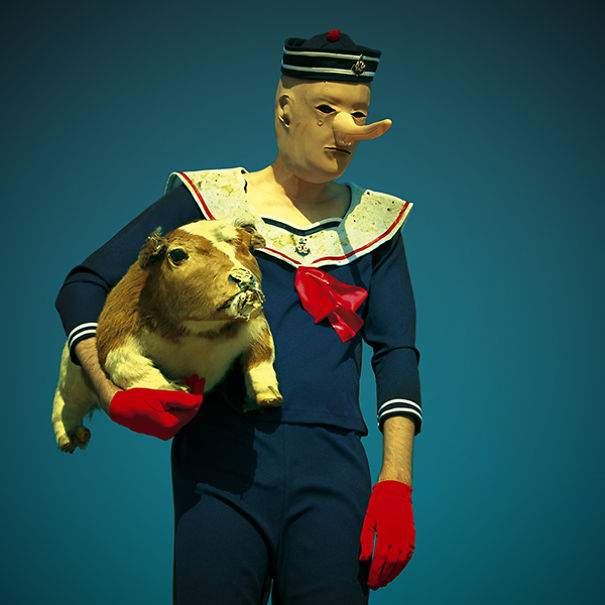
photos by Mothmeister
via Bored Panda
Sophianotloren likes this
13 Jan 09:07
Stephen Colbert to Begin Hosting the ‘Late Show’ on September 8, 2015
by Lori Dorn

Nina Tassler, the president of CBS Television, has announced that Stephen Colbert will begin his duties as host of the Late Show on September 8, 2015, replacing David Letterman when he retires on May 20, 2015 after 22 years of hosting the iconic show. Stephen Colbert was chosen to be David Letterman’s replacement in April 2014, but the start date was unknown at the time.
#NinaTassler announces Late Show w/ @StephenAtHome premiere on September 8, 2015 #TCA15
— CBS Television (@CBS) January 12, 2015
image via Late Show
Sophianotloren likes this
13 Jan 09:07
How to Answer the Phone in Several Different Languages
by Rebecca Escamilla

Cartoonist James Chapman created the informative comic “How to Answer the Phone in 10 Languages” for Babbel. Chapman also drew versions for French, German, Spanish, Portuguese, and Italian speakers.
He publishes a new international sound comic every Friday on his website.
image via Babbel
Albener Pessoa, Sophianotloren likes this
13 Jan 09:06
Eclectic Method Adds Subtitles in for R2-D2’s Beep and Whistle-Filled Lines From the Last Six ‘Star Wars’ Films
by Justin Page
Eclectic Method, the audio-visual remix team who recently created a musical mix of droid scenes from Star Wars, has taken upon themselves to digitally insert subtitles in for R2-D2‘s beep and whistle-filled lines from the last six Star Wars films.

submitted via Laughing Squid Tips
firehose, Sophianotloren and one other like this
13 Jan 09:00
Why are you using the laser cutter for this?

Cooper Griggs, Tertiarymatt and 3 others like this
13 Jan 09:00
NASA and Nissan Agree to Partner on Self-Driving Car and Planetary Rover Technologies
by Brian Heater

The NASA Ames Research Center in Northern California and Nissan North America have signed an agreement that will create partnerships in a number of futuristic fields including autonomous vehicles, robotics, and human-machine interfaces. The deal is expected to lead to the development of self-driving cars and planetary rovers.
NASA will benefit from Nissan’s shared expertise in innovative component technologies for autonomous vehicles, shared research to inform development of vehicular transport applications, and access to appropriate prototype systems and provision of test beds for robotic software. Lessons learned from integration, testing, and demonstrations will enable Nissan North America to better plan for development and commercialization of autonomous vehicles and applications.
image via NASA
Sophianotloren likes this
13 Jan 08:58


intricatelystructuredjewel: katanafatale: Seattle’s Mario Kart...
Seattle’s Mario Kart (N64) Championship Finalist and plus model? Why, yes. Yes, I is.
This needs to have more nots, k!
firehose, Sophianotloren likes this

13 Jan 08:57
rapmonsters: rapmonsters: hobbies: pissing of the beetles fans hobbies: pissing off the beetles...
hobbies: pissing of the beetles fans
hobbies: pissing off the beetles fans

firehose, Sophianotloren likes this