
(tweet via dyldonot)


VeinViewer: an infrared device that detects the location of a patient’s veins and projects them on the skin so doctors and nurses don’t miss. It was developed by the Christie Medical Holdings company. They mainly show surface veins
Stephen King wants Maine's governor to apologize for saying he didn't pay taxesThe governor of Maine has learned the hard way that if you make an author — specifically Stephen King — angry, you'll get scolded in colorful terms on a variety of platforms.The conflict began when Gov. Paul LePage (R) stated in his weekly radio address that King no longer lives in Maine or pays income taxes in the state. This is absolutely untrue, King said. "Governor LePage is full of the stuff that makes the grass grow green," King wrote in a message to Bangor's The Pulse AM 620, which he owns. "Tabby [King's wife] and I pay every cent of our Maine state income taxes, and are glad to do it. We feel, as Governor LePage apparently does not, that much is owed from those to whom much has been given." He also sent an email to the Portland Press Herald, saying that in 2013, he paid approximately $1.4 million in state taxes.On Twitter, King — a Democrat who endorsed LePage's rival in the 2014 election — called the governor out again, saying he "implied that I don't pay my taxes. I do. Every cent. I think he needs to man up and apologize."...

"We will presumably go on the exchange and sign up for health care and we're in the process of transitioning over to do that," Cruz told the Des Moines Register's Jennifer Jacobs.
Adult Wednesday Addams: Wednesday vs. Catcallers [S2, Ep 3]
A playful English bulldog gets his incredibly jowly mouth blown backwards as he tries to catch the air coming from a leaf blower. The whole effect makes the elated canine look like his face has been turned inside out.
![Cadbury Creme Egg season is here again at last. What better way to celebrate the return of one of our all-time favorite seasonal treats than with… an… absolute nightmare of chocolate, fondant and an itty-bitty Chestburster? This awesomely terrifying, yet somehow still tantalizing Weyland-Yutani Chestburster Creme Egg is the work of Ghoulia Childs, who excels at combining horror films with tasty food.We strongly suggest declining this dangerous treat. There are plenty of other Cadbury Eggs out there this time of year and no one wants to see Weyland-Yutani develop a Cadbury Creme Facehugger. Or do we?[via Technabob]](http://40.media.tumblr.com/c8b67c96920bd9b1f8950f53d914c61f/tumblr_nlp8zdbvju1qzfsnio1_500.jpg)
Cadbury Creme Egg season is here again at last. What better way to celebrate the return of one of our all-time favorite seasonal treats than with… an… absolute nightmare of chocolate, fondant and an itty-bitty Chestburster? This awesomely terrifying, yet somehow still tantalizing Weyland-Yutani Chestburster Creme Egg is the work of Ghoulia Childs, who excels at combining horror films with tasty food.
We strongly suggest declining this dangerous treat. There are plenty of other Cadbury Eggs out there this time of year and no one wants to see Weyland-Yutani develop a Cadbury Creme Facehugger. Or do we?
[via Technabob]
 You no longer have to head to Provo if you want Google Fiber in Utah -- Google has revealed that it's bringing its gigabit internet access to the state's capital, Salt Lake City. The company is short on details, but it won't have a ready-made fiber n...
Auckland, New Zealand maintenance engineer Lance Abernathy employed his Ultimaker 2 desktop 3D printer to create what he believes to be world’s smallest working drill. The tiny 3D printed casing houses electrical innards including a hearing aid battery, which powers the minuscule drill bit. Abernathy was inspired to create the tiny tool by childhood stories.
I have always liked small things and have created small items since I was a little kid. I was with my work colleagues and was talking about mythical stories about one country making a twist drill and sending it to another. The other country returned it with a hole through the middle. Things like this easily challenge me and my idea was born.


images via 3DPrint.com


Originally posted 2015-08-21 19:17:23. Republished by Blog Post Promoter
kendall karson throated source: droolingfemme.


The post juelz ventura latin angels appeared first on droolingfemme.

MRAs are trying to free themselves from women by learning how to cook. The results are as pathetic as you can imagine as Amanda Marcotte shows. Of course these people can’t press a button on a microwave without ranting against evil women. Amanda provides some helpful kitchen tips for these guys:
Frozen Burritos Of Online Dating
Buy a pack of frozen burritos. Take a couple, unwrap them and put them in the microwave for 3 minutes. While you are waiting, message someone 20 years younger on OK Cupid, telling her she’s beautiful and you want to worship the ground she walks on. When she doesn’t reply before your microwave beeps, get angry. Who does this bitch think she is? Send another message explaining to her that she’s an ungrateful cunt and she really shouldn’t be on this service if she’s not going to reply immediately when you put yourself out there like that.
Rotate your burritos and put on another 2 minutes. Return to find that she has not replied yet. Get absolutely furious. Drop your pants and start jerking off until your cock is nice and hard. Pull out your iPhone and take a picture of it, to show her what she is missing. Send it to her. Ignore your microwave beeping, because you are too busy scrolling through her pictures of her laughing with friends and convincing yourself she’s just playing a game with you. Suddenly she messages back. “Jesus, dude, WTF,” it reads. Pen a 4 page manifesto explaining how women like her are the ruin of the world and they will be sorry one day when they’re alone with cats and frozen burritos. Send. Wait a few more minutes. She blocks you.
Eat your burritos, now cold, while drinking a Bud Light. Watch some porn, and laugh at all those women who are sorry now that you’ve found an alternative to dating them.


Plaster reproductions of European sculpture at the Brooklyn Museum, shown in an archive photograph shared by the museum for Museum Week’s Secrets day (via Tumblr)
What are museums hiding in their pasts and inside their collection storage vaults? Some of those secrets (or just lesser-known facts) are being shared by institutions around the world this Museum Week through the hashtag #secretsmw. The social media collaboration is one of seven themed days for Museum Week, which is organized by Twitter and the French Ministry of Culture and Communication. Sure, it’s another handy way to leverage all that museum social media time into some visitor engagement, but many of the museums are sharing some tantalizing tidbits, from secret passageways to hidden art. Here are some highlights.
The Brooklyn Museum shared the beautiful archive image above on Tumblr and Instagram, showing casts of European sculptures, once a popular exhibition practice for American museums, a pre-internet way of sharing global collections, if you will. However, as Jessica Palmieri in the office of the chief curator explains, the casts later fell out of favor: “Rumor has it, they were put to rest beneath our parking lot.”
The National Museum of American History also revealed some of its more curious past with a photograph of staff members in colorful corn costumes for “a faux scholarly conference on corn.” The Smithsonian may be undervalued for its corn resources; check out this pre-Photoshop exaggeration of some cobs from an Iowa county fair in the 1910s in the museum’s collection.

(screenshot by the author via Twitter)
Several museums disclosed their secret passageways or hidden compartments, such as the Grant Museum in London, which highlighted this tiny door to which they’ve never had the key, or the Morgan Library in New York, which revealed a secret bookshelf hidden behind another bookshelf, stating that it’s allegedly where Pierpont Morgan “kept some of his *most private* reading materials.” Below are a couple more hidden doors from the Royal Institution and British Museum in London.
#DidYouKnow there is a secret door in the Enlightenment Gallery (Room 1)? #secretsMW #MuseumWeek pic.twitter.com/szioLA4pDS
— British Museum (@britishmuseum) March 23, 2015
Other museums divulged some unobserved architectural features. The National Portrait Gallery in London has beehives on its roof and even sells the honey in its shops. And visitors to the Imperial War Museum in London may have noticed these concrete covered circles on its steps, which were actually used to deliver coal when the building was the old Bedlam Asylum. In an off-limits space you can still see the metalwork from below.

(screenshot by the author via Twitter)
The Guggenheim Museum in New York has a far more distinguished feature, also obscured by concrete. The great rotunda wall holds behind it a large ceramic tile mural titled “Alicia” (1965-67) by Joan Miró and Josep Llorens Artigas.

(screenshot by the author via Twitter)
The best of these museum facts are details that prompt you to look closer, such as the American Museum of Natural History in New York pointing out that in the Okapi diorama is a North American impostor, placed there in the foreground as a prank by artist George Frederick Mason. The Smithsonian Institution’s National Museum of Natural History in Washington, DC, on the other hand, asked viewers to be active in environmental awareness by noting that its North Atlantic Right Whale model is based on a real whale named Phoenix, which has been tracked in the oceans since 1987.

(screenshot by the author via Twitter)
Also in DC, the US National Archives pointed out that Abraham Lincoln lurks secretly in their Founding Fathers mural. Can you spot his angled nose floating in the clouds?

(screenshot by the author via Twitter)
Other museums unveiled some of their darker corners, like the Royal Academy of Arts in London, which shared that one of the flayed corpse casts used by its students was made by three artists who wanted to prove the usual way of depicting the crucifixion of Jesus was anatomically wrong. The Walker Art Center in Minneapolis revealed that it has human remains buried on its grounds: a skeleton gifted to Kiki Smith by David Wojnarowicz, interred by artist Kris Martin in 2009. Meanwhile, the Victoria and Albert Museum in London revealed this about its garden:

(screenshot by the author via Twitter)
On a brighter note, the Walker Art Center also shared this great Vine chronicling some of the emblems that have adorned its shipping crates for every traveling exhibition since 1993. There’s an explanation of some on the museum’s blog, including one that reads “Crates are easy” for 1993’s In the Spirit of Fluxus, referencing artist Ben Vautier’s “Art is easy.”
Museums are continuing to Tweet away their secrets, which you can track through the hashtag #SecretsMW. Museum Week continues through March 29.
P.S. A little piece of English-language usage that has struck me a couple of times lately and made me think "Lynne might be interested in that", is that people in shops and cafes now invariably say "are you paying by cash", whereas they would have said "are you paying cash" until recently. The ubiquity of card (and, soon, phone) payments is doubtless to blame, but I was interested by the addition of the pointless "by" because it seems characteristic of US-English (where you "beat on" someone, instead of beating them; "meet with", instead of simply meeting, etc.). Any thoughts?This historian is English, as you might be able to tell. But he's married to an American so I'm not about to let him off lightly for this (AmE) rookie mistake (=beginner's error).
You notice more prepositions in AmE because they're new info where you weren't expecting it. But BrE has an awful lot of prepositions where AmE doesn't--e.g. in expressions of time (on Tuesday), with certain verbs (protest at the decision), etc. I submit, as attachment, data to indicate that this is one not an Americanism. :)

You can pay by cash, cheque, bank draft, or laser card.Laser card? They have cards with lasers in Ireland? Let me in!!**


Window display of uniforms in Moscow, 1990 (all images © 2015 David Hlynsky and courtesy Thames & Hudson unless otherwise noted)
“In a cityscape largely without commercial seduction, the banality of the shop windows underscored a real cultural difference between East and West,” photographer David Hlynsky writes in his introduction to Window-Shopping Through the Iron Curtain. The new book out this month from Thames & Hudson includes more than 100 shots of window displays taken between 1986 and 1990 in Communist Europe.
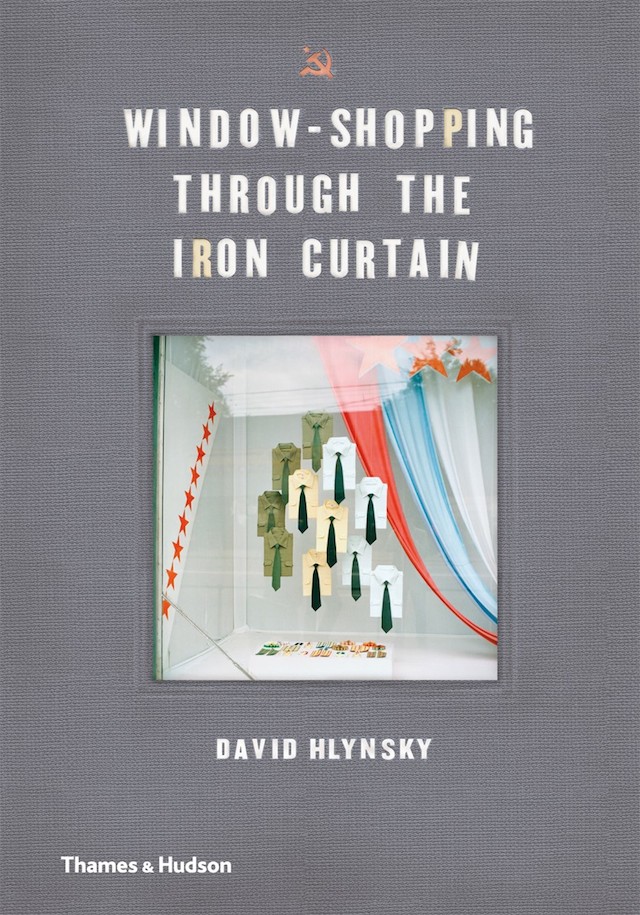
Cover of ‘Window-Shopping Through the Iron Curtain’ (click to enlarge)
The American-born, Toronto-based Hlynsky took about 8,000 photographs in East Germany, Moscow, Hungary, Czechoslovakia, Yugoslavia, Poland, and Bulgaria, concentrating on details of everyday life. This included the rather somber store windows, where a simple abstract ham hints at a butcher, or a pair of shoes dwarfed by a giant vase of flowers suggests more footwear indoors. A trio of bread loaves before a lace curtain has a restrained domesticity without being quite clear about what is sold. Nowhere are prices advertised.
With his Hasselblad camera, Hlynsky focused on the subdued commercial life in the Communist countries, where people needed and wanted to buy things but the Capitalist fervor of shopping in the West and its aggressive displays were absent. There are creative touches in the shop windows, like pajamas seemingly posed in-flight in Budapest, or simple wooden chairs and folded napkins at a table for a Yugoslavian restaurant. All of the displays are from the end of the Cold War, leading up to and right after the fall of the Berlin Wall, when the Iron Curtain was already crumbling to outside influences. The muted colors and sometimes bleak displays are reminders of the often limited availability of products in these countries at the time, but also are calm captures of the daily lives of an era of isolation that was already opening.

Pages from ‘Window-Shopping Through the Iron Curtain’ (photo of the book by the author for Hyperallergic)

Krakow, Poland, 1989

Bulgaria, 1989

Krakow, Poland, 1989

Moscow, 1990

Moscow, 1990

Pages from ‘Window-Shopping Through the Iron Curtain’ (photograph of the book by the author for Hyperallergic)

Moscow, 1990

Budapest, 1989

Yugoslavia 1989

Krakow, Poland, 1988

Moscow, 1990

Moscow, 1990

Yugoslavia, 1989

Prague, 1988
Window-Shopping Through the Iron Curtain by David Hlynsky is available from Thames & Hudson.

The ridiculous attempt to put the Olympics in Boston in 2024 is dying on the vine. Hosting the Olympics is a terrible idea for any city. For a old, cramped, expensive city like Boston with no room to grow and huge traffic problems, it’s pretty much the worst idea imaginable.

"Let me be clear: Americans have freedom of religion - not freedom from religion." - Republican Congressman Sam Johnson of Texas.
"There would be less cancer, less disease, and aids and diabetes in this country if people would simply pray. God blesses the righteous with good health and curses the immoral with sickness," Republican Senator Rafael 'Ted' Cruz, CPAC 2015.So, of course Republicans feel perfectly justified trying to force religion down the throats of all Americans yet again! And they will use the Awesome Power of Government to ensure that you adopt religion.
"I don’t believe in an America where the separation of Church and state is absolute. The idea that the Church can have no influence and no involvement in the operation of the state is absolutely antithetical to the objectives and vision of our country. This is the First Amendment. The First Amendment says the free exercise of religion." 2016 Republican Wannabe Rick Santorum's interpretation of the 1st Amendment is, of course, the direct opposite of it's stated mandate.Republicans always try to downplay the conservative religious bigots who form the core of their party. But, while Republicans have thought they were using the religious loons to gain power, over the last 35 years, the Conservative Fanatics have become convinced the Party belongs to them.

 facebook
 reddit


The post jada stevens sheena shaw school appeared first on droolingfemme.
 For the aspiring DJs and living room producers, there's now a way to craft your drum machine chops with nothing more than your favorite web browser. An HTML5-driven site lets you choose between iconic instruments like Roland's TR-808 and TR-909, alon...
 MDMA is widely used both on and off festival grounds. But the drug is quietly making a comeback as a therapeutic aid. Last week, the DEA approved a clinical trial that will use a combination of the psychedelic drug and psychotherapy to treat anxiety ...

Why
This is demonstrating why you absolutely do not pour water on a grease fire.
holy shit


Dom’Up Treehouse
Dom’Up is an innovative treehouse that draws inspiration from tree camping and traditional treehouse structure.
Dutch arboriculturist Bruno de Grunne and architect Nicolas d’Ursel from Trees and People invented this new suspension style cabin. The innovative treehouse draws inspiration from tree camping and traditional treehouse structures. The end result is a tree shelter that’s reported easy to install and leaves no trace or impact on its surrounding environment and trees.
