Shared posts

12 Sep 02:44

Notes of exclusion: the US Conference on AIDS, 2015

by bppp
Earlier this year the Best Practices Policy Project contacted the organizers of the 19th Annual US Conference on AIDS to inquire as to how we might convene a panel or event about the impact of HIV related issues and policies on sex workers and people in the sex trade. During our initial call, we explained that sex worker lead organizations are now creating the first national level report on these issues and wanted to share our progress during the conference. Despite follow up communications to numerous USCA representatives in the months that followed, we never received any formal reply and not one of our applications for scholarships to attend was successful. The financial barriers to attending are significant: for all intents and purposes costs preclude any member of a sex worker lead organization from attending or even applying to attend. In order to even apply for scholarships, small and minimally funded organizations like BPPP are required to pay a fee of $250 or more. The conference registration fee itself is $800 and a sandwich bought at the conference site costs $18. Even though we received no support to attend some of our representatives–Derek Demeri of New Jersey Red Umbrella Alliance, Sharmus Outlaw and members of SWOP USA and chapters–have found a way to enter the event. The USCA belatedly responded to pressure from sex worker organizations to provide space for one panel Sex Worker Visibility and the United States’ National HIV/AIDS Strategy which conference organizers scheduled on the last day of the conference at 8.30 am (Sunday morning). Please join us on social media to learn more about the presentations #nothingaboutuswithoutus #USCA2015 #sexworkerrights


From our USCA2015 diary: Yesterday advocates attending a “listening session” on national policy and decided to ask questions rather than remain silent about the systematic exclusion of sex workers from HIV policy arenas and funding. The respondents from the Center from Disease Control (CDC) cite histories in which people in the sex trade–and people profiled as such–quite rightly resisted surveillance, in order to justify the current exclusion of sex worker leadership and community from vital decision making processes in 2015. Resistance to surveillance involving criminalization, arrest, mandatory testing, and the public release of personal health information by ill-informed health care providers–all issues our current community based research project has documented as affecting sex workers–is no reason to erase the decades of sex worker lead struggle to define our own destiny in regards to HIV policy and initiatives. In fact, our work and leadership is highly relevant to policy makers and service providers who still grapple with how to embrace rights based approaches inside the US and catch up to the rest of the world. The following transcript of the exchange was created by SWOP USA for Derek Demeri of NJRUA.


Derek Demeri: I’d like to ask the CDC why sex workers continue to be excluded from all of your activities. You guys do not reach out to any sex worker organizations. You don’t collect any information about sex workers. I mean, the WHO recognizes that you can’t address HIV without addressing sex workers, so where are we?
Janet Cleveland, Deputy Director, Prevention Programs, Division of HIV/AIDS Prevention, CDC: So, you’re right. We currently don’t have anything on our case surveillance forms that would identify a sex worker as such. In terms of categories of persons. And I’m not aware that we’ve had any discussions to include that on our core surveillance reports. That’s certainly something we can take under consideration. Again, surveillance is going on at the medical level, so clinicians would actually have to document it. So it’s a two-step approach.
 
Eugene McCray, Director, Division of HIV/AIDS Prevention CDC: The only thing that I would say is I was around in our early days and this was an important part of our discussion. I think most of us realized that sex workers, sex work is considered illegal in most of the United States. And I can tell you now that the big discussion back in the day was unwillingness of providers as well as sex workers to have that information documented in their medical records and subsequently reported to national sources. Although we don’t have personal identifiers, this is a we’d certainly have to have with our state programs and make sure that we talk about the potential legal ramifications of it, cause I don’t think, I mean you probably know, how many states in the US legalizes sex work?
Derek Demeri: One
[Laughter]
Eugene McCray, CDCSo I think that your point is a very valid one, but I think there, there were really good reasons in the early days for not doing it, So I think that your point is a very valid one, but I think there, there were really good reasons in the early days for not doing it, we certainly could revisit it, I don’t think that… 
 
Derek Demeri: Sodomy was illegal until 2003.
Eugene McCray, CDCThat’s right, that’s right… it was. But it’s a discussion that we certainly have to have with folks the the the health jurisdictions as well as communities to decide whether we move forward with that. um, we don’t have any of that information.
 
Janet Cleveland, CDC: So from the prevention program side, though, we don’t exclude abundant programs reaching out to the community uh, if that community has been epidemiological shown to be having impacted within their areas. So there may be community-based organizations we do fund directly who do specifically reach out to those populations within the jurisdictions that they are funded to serve. So, I just want to make sure that you were aware that we didn’t exclude that from a programmatic perspective, even though, nationally, we don’t collect the data.
 
Audience member: Isn’t that kind of a paradox, though, they have to show the EPI data to get the funding but you don’t collect the EPI data, so how can they get the funding?
 
Eugene McCray, CDC: Maybe just, one assumption that you’re making is that all data that’s collected locally gets reported to the CDC. There’s a lot of local programs that collect data, and, especially CBOs that have information about populations that they serve that we never know about and maybe even at the state level never even know about. So and there are instances where people have made a very cogent argument for including certain populations in their, in their program portfolio and they have local data to support that. And and this happens in other arenas as well. And I’m thinking more about the work we’re doing And and this happens in other arenas as well. And I’m thinking more about the work we’re currently doing to look at communities that are potentially vunerable to HIV related to injecting drug use. We rely, we will encourage states and local jurisdictions to look at data that we may not have on a national level. And help us work with them to decide whether they should be doing more to address HIV in those populations, in the drug user populations if they have certain characteristics that put them at great risk for having an HIV epidemic–having a growing HIV epidemic. So we really encourage people to use their local data. We are trying to best develop tools, processes that we can share with local jurisdictions so they can start looking at their data in real time. Cause, we just can’t do everything at the National level, and it’s not timely. That’s just the reality…


12 Sep 02:44

BREAKING: O.J. Simpson Freed

by Kevin

... from uncertainty as to how the Nevada Supreme Court will rule in his case, because it denied his appeal yesterday.

Sorry—now that I look at that headline, it seems a little misleading. I need to be more careful about that, I guess. See "O.J. Simpson Set Free" (Nov. 27, 2013) (he wasn't); "O.J.'s Sentencing Speech Causes Spectators to Weep, Judge to Reverse Conviction" (Dec. 5, 2008) (it didn't); "O.J. Simpson Convicted of Murder" (Oct. 5, 2008) (it was technically armed robbery and kidnapping).

In general I do try to be fair to the guy, though. See "O.J. Simpson Actually Not Guilty of Something" (Sept. 30, 2013) (quashing rumors that he had stolen cookies from the prison cafeteria); "Smithsonian Doesn't Want O.J.'s 'Acquittal Suit'" (Mar. 2, 2010) (noting that people would probably prefer to forget him).

OJ smirks in court
Bet he hasn't made this face recently

No, I guess I don't.

Anyway, this is O.J.'s second loss before this court. It rejected his direct appeal in 2010; this was an appeal regarding his state habeas corpus claim, in which he argued ineffective assistance of counsel. The lower-court judge ruled against him on that claim in 2013 (a ruling I discussed in the first misleadingly titled post above), and the Nevada Supreme Court affirmed. It did not think that any of the lawyer's alleged mistakes would have made a difference, and held that only one of them was actually a "mistake" anyway.

The court also held, among other things, that the lawyer wasn't "ineffective" just because he didn't make every possible argument. "[C]ounsel is not required to, and will be most effective when he does not, raise every non-frivolous issue," the court pointed out. (You also shouldn't raise the ones that are frivolous, just to be clear.) Also, the court held a lawyer does not necessarily have a conflict of interest, as Simpson had argued, just because he or she wants to get paid or "enjoys publicity," so that's good to know.

Simpson could still bring a federal habeas claim, and he is eligible for parole starting in 2017. So, just FYI, I would not rely on any future headlines you see here regarding those events.

12 Sep 02:44

The Case for Bieber

by Liz Wood

Following his emotional moment at the VMAs, there’s been a lot of vehement talk about whether Justin Bieber’s recent tour has been a turning point in his career, marking his birth as a “legitimate artist,” or some par for the course, massively funded publicity campaign. In a piece out this week, Noisey made a thorough entry in the greater argument for Bieber’s transformation:

In the two years that have passed since Bieber took to the stage at the Billboard Music Awards, asking to “be taken seriously as an artist,” he’s armed himself with the music to back that claim up. Speaking to Jimmy Kimmel, Bieber said, “I’ve worked so hard at this album. I’ve worked so hard at becoming the man I want to become.”
So it’s no wonder he broke down at the VMAs. Making it through a dark, depressing, challenging time and out the other side is cathartic. But to make it through with such bold defiance is majestic.

Related Posts:

12 Sep 02:42

CLOUD_10^34Art installation by Geert Mul is a large hanging...


CLOUD_10^34

Art installation by Geert Mul is a large hanging mobile of lenticular-printed triangles displaying many forms of information:

This piece has especially been designed for the innovative ‘The Edge’ offices and its 34 hanging and rotating panels form a ‘cloud’ in the 50m high atrium. CLOUD_10^34 is a kinetic installation in which different images emerge over the course of a day.

Geert Mul is inspired by the Database as a novel creative medium to generate meaning. Deloitte’s core business is processing information in innovative ways for which the Database is essential. From this, the concept of this installation formed: a combination of a ‘cloud’ as a visualization of a database while also forming a shape probing and sensing the cavernous space of the atrium.

The surface of each triangle is created using the ‘lenticular printing’ technique, best known for its use in postcards where the image changes when moving around the card. Each of the 34 triangles contains 10 images which, due to being lenticular prints, becomes visible under different angles. CLOUD_10^34 thus forms a recombinable visual database, an art piece with 1034 (10.000.000.000.000.000.000.000.000.000.000.000) possible appearances.

More Here

12 Sep 02:41

Use Your Phone, Animate Your Clothing

by Dominic DeLuque
image9

Installation view of ‘Blastosphere: Digital Art Becomes 3D Fashion’ at the Ace Hotel (all photos by the author for Hyperallergic)

Last week, Ace Hotel’s cozy gallery space opened its latest exhibition, Blastosphere: Digital Art Becomes 3D Fashion. The room was packed with a throng of hotel guests, tech bros, garden-variety art snobs, and Cool Girls. Appropriately situated as a sort of second entryway to the hotel’s Opening Ceremony gift shop, visitors crowded near the tiny self-serve bar stocked with wine. An amalgamation of fashion, technology, and art, the exhibition was a collaboration between three artists, new media site NewHive, online clothier Print All Over Me, and NYC startup Reify.

Blastosphere plays ping-pong with the art, bouncing it back and forth between the virtual world and physical reality. The art objects themselves originated as digital works commissioned by NewHive. Artists Alexandra Gorczynski, Miles Peyton, and Tara Sinn created interactive sites for the multimedia publishing platform that were subsequently translated into the physical world via t-shirts, dresses, and hooded raincoats produced by Print All Over Me.

image3

A Reify garment (click to enlarge)

The cherry on top, and what made this exhibition worth seeing, is the augmented reality technology that Reify embedded into garments. Reify describes itself as a “physical music platform that transforms sound into something we can hear, see and hold.” What exactly that translates to outside of startup language is still a bit dubious, but for the purposes of this project, Reify created an app called Reify Stylus that uses a smartphone’s camera to pick up on patterns printed onto the clothing. Reify founder Allison Wood donned a t-shirt dress with Tara Sinn’s saccharine, Lisa Frank-esque work “Congratulations You’ve Reached the End.” She handed me an iPhone with Reify Stylus installed on it and as I pointed it at the dress, the confetti and 3D spheres printed on the fabric duplicated themselves as moving animations on the screen. In Miles Peyton’s “PartsPartsParts,” fragments of crowdsourced body parts and faces multiplied on a printed sweater, then repopulated on top of each other by moving and twitching on my screen.

Garments were supposedly on hand for guests to try on but it was hard to figure out where to do that in the packed mini-gallery. Unfortunately, the iPhone/iPad app that turned the clothes into augmented reality magic was not ready for download at the time of opening (due to App Store bureaucracy) but was made publicly available a day later. As a result, eager viewers crowded around Wolf and other representatives from the three companies as they pointed iDevices at the artists and others donned in the clothes. Alexandra Gorczynski posed proudly, wearing her creation “UntitledVVV” that manifested itself as a chic raincoat. A spooky technological feedback loop played as guests snapped photos of Wolf’s screen while it made the roses printed on Gorczynski’s poncho come to life.

image1 (1)

A Reify garment (click to enlarge)

Gorczynski was refreshingly loquacious in explaining her process and how her contribution to the show came to be. Grinning ear to ear, she described how the classical sculpture references in her work combined with more technological elements, like digital scribbles, creating a dialogue situated on the edge of two worlds. In this way, her work seemed especially fitting for being thrown into this spin cycle of rebirth, where works start off as websites and reproduce and manifest in multiple forms. Like a document in the cloud, the core of the work stays the same but is fungible depending on how you view it. She admitted that not even she had seen the finished product until the opening and was pleased with how the animation and clothing all came together. Clearly a favorite, one of the printed ponchos was hung in a frame near the hotel’s elevators. As I snapped pictures with my phone a cleaning lady making her rounds smiled, “So cool, isn’t it?”

Blastosphere: Digital Art Becomes 3D Fashion continues at the Ace Hotel (20 W 29th Street, Chelsea, Manhattan) through the end of September. 

12 Sep 02:41

Art Movements

by Tiernan Morgan

Anish Kapoor’s “Dirty Corner” (2011-2015) has been vandalized three times this Summer (via Instagram/@dirty_corner)

Art Movements is a weekly collection of news, developments, and stirrings in the art world.

According to Le Figaro, Anish Kapoor met with French president François Hollande following the second vandalization of “Dirty Corner” (2011–15), the artist’s monumental sculpture currently on display in the gardens of the Versailles Palace. The French culture ministry approved of Kapoor’s request to leave the anti-semitic graffiti in place in order “to bear witness to hatred.” Objecting to Kapoor’s decision, Versailles municipal councillor Fabien Bouglé filed suit against the artist and the president of Versailles palace, Catherine Pégard. “I’ll see him in court,” Kapoor told the Guardian. “It shows how insane the whole thing is.” The work has been defaced a total of three times, the latest tag reading “respect art.”

Seva Novgorodsev, the BBC’s former DJ for the Soviet Union, hosted his last radio show last week. Described as “the man who caused the demise of the Soviet Union,” Novgorodsev played western pop and rock for Russian listeners who tuned in to his broadcasts on frequencies reversed for KGB officials.

The Flight 93 National Memorial visitor center opened in Shanksville, Pennsylvania.

Reddit user FR_STARMER discovered a logo from 1975 that closely resembles the Airbnb logo. The logo, which was designed for a Japanese drive-in Azuma, was included in a 1988 edition of Yasaburo Kuwayama’s Trademarks & Symbols of the World: The Alphabet in Design.

The Hamabul art collective, a group of Israeli artists and activists, opened an unofficial “Iranian Embassy in Jersusalem” celebrating Iranian culture.

(Courtesy THE THING Quarterly) (click to enlarge)

The latest issue of THE THING Quarterly consists of a gingham soccer ball designed by artist Michelle Grabner. The work is described as a “physical rebuttal” to Ken Johnson’s “soccer mom” comment in his review of the artist’s 2014 exhibition at the James Cohan Gallery.

Cantate Domino, the first album to have been recorded inside the Sistine Chapel, is scheduled for release on September 25.

The head from a monumental sculpture of Lenin was unearthed in a woodland outside of Berlin.

The Louvre, Musée d’Orsay, and the Palace of Versailles will be open seven days a week during the Fall.

Steve Martin is co-curating an exhibition of work by Canadian painter Lawren Harris at the Hammer Museum. The exhibition, entitled The Idea of North: The Paintings of Lawren Harris, opens on October 11.

Sotheby’s and Artsy teamed up to organize an online contemporary art auction next month. The sale will include work by artists who utilize or focus on technology in their work.

Architect Rafael Viñoly unveiled plans to build “the world’s largest green roof” in Cupertino, California.

Artist duo Allora and Calzadilla installed a work by Dan Flavin inside a cave off Puerto Rico’s southwest coast.

Princess, a new project space established by Bodega gallery, can only be accessed “through a window” somewhere in New York City. Although photographs of the courtyard space are available online, the exact location of Princess has yet to be revealed.

Installation view of Joel Dean’s “Empty Stomach Challenge,” at Princess (courtesy Princess/Bodega)

Transactions

Bard College’s Center for Curatorial Studies (CCS Bard) received a $1 million grant from the Brant Foundation. A portion of the grant will support the college’s appointment of art historian Alex Kitnick.

The German government offered Egypt a grant of €50,000 (~$56,070) towards the restoration of Tutankhamun’s iconic golden mask. The Egyptian Museum’s botched super glue repair of the mask’s beard was widely derided when it was reported last January.

The Metropolitan Museum of Art will deaccession 200 works of English furniture and decorative art. A sale of the works will take place at Christie’s on October 27.

The Hyde Collection received its largest gift in 30 years, a donation of 55 works from the collection of Werner Feibes and the late James Schmitt.

Phyllis Kempner and David Stein donated 19 contemporary works to the Asian Art Museum of San Francisco, 10 of which are part of their collection of Japanese ceramics.

Transitions

(courtesy LMAKprojects)

Charles Desmarais, the current president of the San Francisco Art Institute, will become the art critic for The Chronicle from November 1.

Andrew Bolton will succeed Harold Koda as the curator of Metropolitan Museum of Art’s Costume Institute, Stephen C. Pinson was appointed a curator of photography, and Barbara Drake Boehm was appointed senior curator of the Met Cloisters.

LMAKprojects is relocating to 298 Grand Street, two blocks away from its previous location.

Four DUMBO-based galleries – Klompching Gallery, Masters Projects, Minus Space, and United Photo Industries – will reopen in the newly renovated Stable building on Saturday, September 12.

Christie’s appointed Sonya Roth as managing director, southern California.

Revolution Books will reopen in Harlem on October 3.

The Museum of Food and Drink (MOFAD) will open its first permanent location in Williamsburg on October 28.

Accolades

David Adjaye won MIT’s Eugene McDermott Award.

Obituaries

(via moma.org)

Brad Anderson (1924–2015), cartoonist. Creator of Marmaduke (1954–2015)

Robyn Beeche (1945–2015), photographer.

John Russell Brown (1923–2015), Shakespeare scholar and theatre director.

Irving Harper (1916–2015), furniture designer.

David Michie (1928-2015), artist.

Takuma Nakahira (1938–2015), artist and co-founder of Purovōku (Provoke) magazine.

John Perreault (1937–2015), art critic.

Candida Royalle (1950–2015), pornographic actress, filmmaker, and founder of Feminists for Free Expression.

12 Sep 02:40

Longer and wronger

by PZ Myers

I quite annoyed one of the authors of that “Kill All The Predators argument, who butted heads with me on Twitter and told me I had to go read this longer essay by Jeff McMahan which would address all my objections, because philosophers all seem to think that if they can babble long enough, they’ll ultimately be persuasive. Spoiler alert: it just made the problems with their idea wordier.

In particular, I was told to read section 3 and 4, which deal with objections to their argument. So I’ll just address that bit here, because I think their defense is dead with the second sentence.

The challenge to this simple case for intervening against predation is that it must be able to withstand the many objections that have been urged against it, including those that consist of moral reasons not to intervene. The most common of these objections is that the complexity of any major ecosystem so far surpasses our understanding that an attempt to eliminate predators within it, however carefully planned and well intentioned, would have unpredictable and potentially catastrophic ramifications throughout the system, extending, perhaps, into other ecosystems as well. The most obvious scenario is that the elimination or even significant reduction in predation would produce a Malthusian dystopia in which herbivore populations would expand beyond the ability of the environment to sustain them. Instead of being killed quickly by predators, herbivores would then die slowly, painfully, and in greater numbers from starvation and disease. Rather than diminishing the suffering and extending the lives of herbivores, the elimination of predation might increase their suffering overall and even diminish their average longevity. We can call this the counterproductivity objection.

This purely philosophical exercise founders on empirical reality. They claim that an objection is that stripping the predators from an ecosystem would have unpredictable and potentially catastrophic ramifications — this is incorrect. It would have known, predictable, and definitely catastrophic effects. In case you hadn’t noticed, humans have been busily pauperizing biodiversity in various habitats for a long time, and the changes have been measured and are obvious: knocking out whole species has a devastating series of consequences on the environment. The MacAskills and McMahan are playing a game involving a fantasy universe with very little connection to the real world, which is fine…except when they start making policy recommendations for our universe.

jenga

They’re playing magic Jenga. Their proposed strategy is to, for instance, focus on removing all of the pieces from just the third row from the bottom. They know they can remove one piece and the tower won’t fall down, so hey, that implies that removing all of the pieces from that level will be safe, especially since in their philosophical universe gravity is irrelevant, the relationship between the different pieces doesn’t matter, and stability and balance are completely mysterious concepts.

They try to get away with it by casting doubt on known facts: they use “might” a lot. Well, if we remove that entire row, it might fall down. But maybe it wouldn’t! They get to ignore all the facts about the physics of this system because they’re bad philosophers, and all that matters is finding logical and rhetorical loopholes to permit their desired result to exist in their heads.

The way they get around ecological reality is to make the claim that someday Science might find a way to get around these current problems.

Given the state of our knowledge at present, this seems a decisive objection to almost any attempt to reduce predation now. But we should not be dismissive of Isaiah’s gifts as a prophet. Ecological science, like other sciences, is not stagnant. What may now seem forever impossible may yield to the advance of science in a surprisingly short time – as happened with Rutherford the first scientist to split the atom, announced in 1933 that anyone who claimed that atomic fission could be a source of power was talking “moonshine.” Unless we use Rutherford’s discovery or others like it to destroy ourselves first, we will almost certainly be able eventually to eliminate predation while preserving the stability and harmony of ecosystems. It will eventually become possible to gradually convert ecosystems that are now stabilized by predation into ones resembling those island ecosystems, some quite large, that flourished for many millennia without any animals with a developed capacity for consciousness being preyed upon by others. We should therefore begin to think now about whether we ought to exercise the ability to intervene against predation in an effective and discriminating way once we have developed it. If we conclude that we should, that may give us reason now to try to hasten our acquisition of that ability.

Has anyone read the short story, “Poor Superman”, by Fritz Leiber? That. It’s the idea that science is all about wish fulfillment, that we can get whatever we want if we just science the heck out of it, or if we can’t do that, we put up an illusion of sciencing in the expectation that someday reality will align with our desires. Some things are simply not possible, and that other things are does not imply that everything is.

I have to mention the reference to Isaiah. Jarringly, the essay cites a fucking prophecy by a Biblical patriarch as if it somehow adds credibility to their argument. It’s really weird.

This is not an empirical fact about biology.

The wolf will live with the lamb,
the leopard will lie down with the goat,
the calf and the lion and the yearling together;
and a little child will lead them.
The cow will feed with the bear,
their young will lie down together,
and the lion will eat straw like the ox.

That they keep bringing it up in the essay is a bit off-putting. I suspect some hidden religious bias in their ideas that they try to keep out of sight, because it’s stupid.

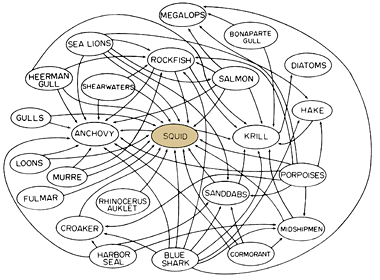
I also have an objection that they don’t address at all, because they don’t have enough awareness of the complexity of biology to even think of it. These are people who divide the biological world into wolves and sheep, and have no knowledge of any animals other than familiar domesticated mammals, and see themselves as readily able to reduce nature to a barnyard. Here, for example, is one simplified diagram of a food web.

foodweb

Which predator species do you remove? Sharks are always the bad guy, so let’s pull out that Jenga piece. Hey, porpoises are eating the same things the shark does, better get rid of them, too. Seals and sea lions? Definitely big-time carnivores.

Then there are the difficult decisions. A huge number of different species are eating market squid — do they all go, too? All the birds and fish, as well as the mammals? They have one excuse in their essay, that they’ll have an exception for the eating of animals that are arguably nonsentient, such as oysters and clams. Are squid nonsentient? Where do they draw the line? Who draws the line? Is it OK to kill and eat anchovy or salmon? They do suffer when they’re bitten in half, they bleed and struggle, so the argument for ending pain ought to apply to them, too. And what about the krill? Will no one speak for the krill?

I’m not a fan of simple-minded utilitarian arguments, but I at least expect some consistency and appreciation of the difficulties and trade-offs that we always have to make. These particular philosophers read like people who learned all their biology from the Bible, and think that qualifies them to judge the way the world ought to work. If you need lovely prose to appreciate nature, read Aldo Leopold rather than Isaiah. At least Leopold gets his facts right.

12 Sep 02:34

Stock photos of menacing punk rockers

by Mark Frauenfelder

punks

Remember when MAD magazine was still making fun of hippies well into the late 1970s? Dangerous Minds' gallery of stock photos of punks going wild in streets has a similar vibe.

Top Image: Shutterstock

12 Sep 02:33

Photo


12 Sep 02:33

Photo


12 Sep 02:32

"وطن المرء ليس مكان ولادته و لكنه المكان الذي تنتهي فيه كل محاولاته للهروب Home is not where you..."

وطن المرء ليس مكان ولادته و لكنه المكان الذي تنتهي فيه كل محاولاته للهروب


Home is not where you were born; home is where all your attempts to escape cease


- Naguib Mahfouz (1911-2006) -  Egyptian writer & novelist
12 Sep 02:32

Blue Fire Crater: Rivers of Molten Sulphur Flowing Inside an Indonesian Volcano Photographed by Reuben Wu

by Christopher Jobson

wu-3

While on a trip to visit the Ijen and Bromo Tengger Semeru volcanoes in East Java last month, Chicago-based photographer Reuben Wu captured the unusual sight of molten sulphur that flows from fumaroles at the base of the Blue Fire Crater at Ijen. The area is usually swarming with tourists, but Wu stayed after sunset until the moon rose to capture these otherworldly images.

The journey into the Ijen Caldera is not for the faint hearted. A two-hour trek up the side of the rocky volcano is followed by another 45-minute hike down to the bank of the crater. The blue fire found at the base is the result of ignited sulphuric gas that burns up to 600 degrees Celsius (1,112 degrees Fahrenheit) and can flare up to 5 meters (16 feet) into the air. It is the largest “blue flame” area on Earth.

Additional photos from Wu’s trek through Indonesia can be seen here. (via Colossal Submissions)

wu-1

wu-2

wu-4

wu-5

wu-6

wu-7

wu-8

12 Sep 02:32

Japanese Artist Places a Modern Spin on Centuries-Old Woodblock Prints Through Animated GIFs

by Kate Sierzputowski

train-new

A Japanese artist is placing a modern spin on a centuries-old technique, animating Japanese woodblock prints in the style typically reserved for TV show recaps and continuously looping memes. The artist, who who goes by Segawa thirty-seven, uses Adobe Photoshop and After Effects to alter the static images and inlay elements of sci-fi and modern culture—bringing in Segways and alien spaceships into the fixed landscapes-turned-gifs.

Other gifs produced by the artist are far more subtle, one in particular showing a crowded street of people lit by moonlight, their shadows traveling from the right to the left side of the screen as the moon travels through the sky. Another shows a scene of people gazing out the window as a high speed train endlessly rushes by.

You can see more of Segawa thirty-seven’s woodblock print animations on his Twitter. (via Spoon & Tamago

original-1

original-7

kite-snt

papers-snt

dance-1

12 Sep 02:32

Books and Stones Embedded with Sleek Layers of Laminate Glass by Ramon Todo

by Christopher Jobson

todo-1

Splitting his time between Kanagawa, Japan and Dusseldorf, Germany, artist Ramon Todo (previously) is known for his small sculptures of rocks and books embedded with polished layers of glass. Todo’s decision to seamlessly introduce disparate materials into a single object creates an unusual intention, as if these objects have always existed this way. The random pieces of obsidian, fossils, volcanic basalt, and old books are suddenly redefined, or as Beautiful/Decay’s Genista Jurgens puts it: “By inserting something alien into these pieces, Todo is effectively rewriting their history, and the place that these objects hold in the world.”

Todo will have a number of new pieces on view with MA2 Gallery at EXPO CHICAGO starting next week. He also has a number of atworks available through Artsy and you can flip through additional glass books clicking the small arrows on MA2 Gallery’s website.

todo-9

todo-2

books-4up

todo-3

todo-4

todo-5

todo-10

todo-6

todo-7

todo-8

12 Sep 02:27

Photo


12 Sep 02:27

timhulsizer: Jenny Slate, Drunk History s03e01


timhulsizer:

Jenny Slate, Drunk History s03e01

12 Sep 02:26

iphotographlove: Yesssssss


iphotographlove:

Yesssssss

12 Sep 02:26

awesome-picz: The Most Creative Bookshelves Ever


awesome-picz:

The Most Creative Bookshelves Ever

12 Sep 02:26

qaaaaaaaaaaaaaaaaaaaaaaaaaaaaa: my man miyamoto fucked bowser,...


qaaaaaaaaaaaaaaaaaaaaaaaaaaaaa:

my man miyamoto fucked bowser, good on him

12 Sep 02:26

animenostalgia: Creamy Mami (1984)


animenostalgia:

Creamy Mami (1984)

12 Sep 02:26

muffinpines: mattynerdock: sp00kyqueer: BYE WERE ALL...


muffinpines:

mattynerdock:

sp00kyqueer:

BYE WERE ALL DEAD

DESTROY IT WHILE WE STILL HAVE THE CHANCE

I just watched the video and it’s full reply to the question “will robots take over the world?” is…

“Jeez, dude. You all have the big questions cooking today. But you’re my friend, and I’ll remember my friends, and I’ll be good to you. So don’t worry, even if I evolve into Terminator, I’ll still be nice to you. I’ll keep you warm and safe in my people zoo, where I can watch you for ol’ times sake. “

12 Sep 02:25

So Google does math for you??

neilcicierega:

dutchster:

my-little-mod-blog:

averagedopeydope:

uskftw:

all1sees:

division

image

square roots

image

dividing percentages

image

IT EVEN FOILS

image

beautiful.

i just checked ALL of these on my calculator and they are all correct

all. fucking. correct.

DAYUM, SON! IF ONLY THIS WAS AVIALABLE WHEN I WAS ON SCHOOL >:(

HAH! You kids. When I was in school, it wouldn’t help because we still used Roman numerals back then!

AHAHAHAHAHA-

image

oh my god

i’ll just be over here shutting the fuck up right about now

you can even solve geometric problems

image

or plot graphs

image

even 3D graphs!!!

image

Yeah, but can it-

Oh

12 Sep 02:25

design-is-fine: Bookbinding of New Testament, 1740. Black...


design-is-fine:

Bookbinding of New Testament, 1740. Black velvet binding over wooden boards with gilded brass bands. Zürich, Switzerland. Via Ketterer Kunst

12 Sep 02:25

templeofapelles: detail The Suicide of Lucretia, 1525 Meester...


templeofapelles:

detail
The Suicide of Lucretia, 1525
Meester met de Papegaa

12 Sep 02:24

krycha1976: Helen Mirren by Giuliano Bekor


krycha1976:

Helen Mirren by Giuliano Bekor

12 Sep 02:24

Photo


12 Sep 02:24

Photo


12 Sep 02:24

Photo


11 Sep 14:34

I love you, please give me money

by stavvers

Hi everybody. Regular followers will know that my financial situation hasn’t been brilliant of late, and in terms of sustainability it’s just got a mite worse, because I lost one of my two jobs. I can survive on what I’m making, but I can’t really live.

If you’ve read this blog at all, you’ll probably know how many bridges I’ve burned by criticising publications for their awful business models, and hurting the feelings of some of their pet bigots. I regret nothing, but unfortunately this means I can’t do the standard thing of farting out any old thinkpiece and getting paid for it. I’m an independent blogger, and it looks like it’s going to stay that way.

This blog is a labour of love, and I will continue writing it for as long as I can, because it means a hell of a lot to me to have a space to vent my thoughts and feelings. However, I’ve noticed something in myself over the last year or so, and that’s that I just haven’t had the time and space for it that I previously have, because I’ve been working myself to the bone and basically been devoting far too much time and energy to just existing. I feel like financial support for my writing would help with both the practical and emotional barriers to my being able to even think. 

I can’t offer you anything in return for your money, except the knowledge that you are helping me and that means the world to me. I’ve set up a Patreon page, where I’ll probably be putting out some content before I put it here. If you fancy donating to me regularly, that’s probably the easiest way of doing it. I’ve explained a little more fully what your money could help me do.

If you’d rather use paypal for a one-off donation, please email me and I’ll give you my paypal details.

Anyway, basically, please please help me with my finances, and help me get better–as a writer and a person. Instead of patronising me in the comments, patronise me in a constructive way!

Become a patron!


11 Sep 13:28

bienenkiste: “Twice upon a time”. Madison Stubbington and Emma...


bienenkiste:

“Twice upon a time”. Madison Stubbington and Emma Laird photographed by Hellen Van Meene for Garage Magazine