Shared posts

15 Oct 23:52

Halloween costumes by the neural net GPT-2

Sarah

ghost in a packet of potato chips!

sentient stone, skunk in a moose costume, eight ball of wrath

In my opinion, one of the best applications of neural networks is for generating Halloween costumes. Thanks to a dataset of over 7,100 costumes crowdsourced from readers of this blog, I’ve been able to generate Halloween costumes with progressively more powerful neural networks. In 2017, I used char-rnn, which learned to generate costumes starting from no knowledge of English (Statue of Pizza, the Fail Witch, Spartan Gandalf, and Professor Panda were some of its inventions). In 2018, I used textgen-rnn, also training from scratch, and teamed up with the New York Times to illustrate the costumes (some of my favorites were Sexy Wizard and Ruth Bader Hat Guy).

Now, as of 2019, there are much more powerful text-generating neural nets around. One of these is GPT-2, trained by OpenAI on a huge dataset of text from the internet. Using the connections it’s gleaned from this huge general dataset, GPT-2 can generate recognizable (if often weird) lists, mushrooms, British snacks, crochet patterns, and even a to-do list for a horrible goose.

So, I trained the 355-M size of GPT-2 (the largest I can currently finetune for free via Max Woolf’s collab notebook)

GPT-2 is good at costumes. Many of its inventions could easily have come from the training data. In fact, the neural net did tend to memorize the training data and repeat it back to me - technically this is what I asked for when I asked it to predict the training data. (The neural net is trying to give me exactly what I ask for, which isn’t necessarily exactly what I want.) I was using a handy script to filter out duplicates (thanks to John Tebbutt), and even so I had to check several of these to make sure they weren’t near copies of the training data. My previous Halloween costume generators would not have been smart enough to come up with things like “jackalope” or “Carl Sagan”, but GPT-2 has seen these words used online in similar contexts to things that ARE in the training data, and it makes the connection.


vampire rock, gothy giraffe, battle worm

Gothy Terminator
jackalope
vampire cat
Eye of Sauron
incognito llama
space cow
Vampire Rock
Scooby Gadget
a raised eyebrow
Battle worm
Mastodon
Swamp girl
Carl Sagan
A space squirrel
walking carpet
Frizzle the witch
Cleopatra on vacation
gothy giraffe
Sexy Lego Batman skeleton

Oh yes, the sexy characters. The neural net definitely picked that up from the training data, and innovated admirably, bringing in words that it knew from the internet (barnacle, groundhog, and bunsen burner were not in the list of Halloween costumes), and adding a sexy twist. This is impressive (if somewhat horrifying) work. None of these were in its training data, but I wouldn’t be surprised if some of them exist.


sexy hummingbird, sexy flying dutchman, sexy barnacle

Burlesque Horse
Sexy Bulldog
Sexy Egg
Sexy Parsley
Sexy Barnacle
Sexy Walrus
sexy locust
Sexy Titmouse
Sexy Hummingbird
Sweet Potato Burlesque
Sexy Groundhog
Sexy bitcoin
Sexy DNA
Sexy Rubber Duck
Sexy Bunsen burner
Butt-Monks
Sexy gingerbread man
Sexy Flying Dutchman
Sexy Chimneywatcher
Sexy Flames Of War
Sexy English Tea Party

And the neural net was pretty good at designing identifiable characters, even if they are a bit on the weird side.


gingerbread man guinea pig, ghost in a packet of potato chips, cozy coconut

A spangled Auroch manatee
M. Bison the Clown Prince of Darkness
Gingerbread Man guinea pig
Skin Fairy
sentient stone
fast food bald eagle
Fairy root vegetable
Ghost in a packet of potato chips
cozy coconut
Kelpie the mage
Crochet monster
Walrus rider
Star skunk
Slytherin AI priest
A skunk in a moose suit
Semi-molten Kool Aid Man
Time Lord Power Ranger
The Power Dinosaur
Space Oystermonger
Deadly Snow Monkey
An evil cupcake
basic plumber’s equine
Spooky mother hen
The Bozo the Destroyer
Eight Ball of Wrath
Ursula, Queen of the Fart Science
A poker player in possession of an onion

There are hints, though, that this is the work of an AI rather than the work of someone who understands what costumes are and how they work. These, for example, take somewhat ordinary costume concepts and then make them unnecessarily difficult.

Batman on egg
Vampire in hot tub
A Hidden Jesus Statue
Zombie ice cream cone
penguin as a Newt
A wizard encased in a icicle
Zombie fisherman on a quest
Computer generated horse(?)
telephone that accepts up to 4 numbers
Third Eye Blind Photographed By Dorothy
Zombie fisherman w/ lady diegrove tied around foot

And the following costumes are clearly the product of a glitchy AI:


pajamas made of wood and spiders, world's nicest fart, list of leg parts

Meat Belt
Eyeballed Balloon Men
Green beans in bun
10,000 Hands
Favorite Caterpillar
The Oatmeal Tree
102 SNOWBALLS in a basket
Pie and Jell-O
List of leg parts
world´s nicest fart
Pineapple wrapped sasquatch
Is it a Snake, a Watermelon, or a Bush?
Putting Turtles on Decor
Fish tank ‘n chair
ROBO-ACCIDENT
pajamas made of wood and spiders
Ssssssssssexy SSSssssssstinky Ssssssssssssexy ssssssssssssssssexy
setup 9 × 11 party trick
Smagma Monster
Commentary couldn’t be heard over the squawking of clocks
Poltergeist might be entertaining, but he’s harder to read in Hungarian
Cereal Implanting Device
blueberry sipping fizzy pop with eyes of ice
blueberry sipping fizzy pop with fake blood on it
A sarcastic, racist noble using progressively tinier body parts as a human shield

Bonus content! The above costumes are all from temperature 1.2; I also tried a higher temperature setting, but the generated costumes were at an expert level of chaos (I would like to see someone attempt to go as “hypnopotamus embroidered death”) Enter your email here to get them!

You can order my book You Look Like a Thing and I Love You! It’s out November 5 2019.

Amazon - Barnes & Noble - Indiebound - Tattered Cover - Powell’s


04 Oct 03:42

Pickle Plant

by swissmiss
Sarah

eeee i need one!

I am completely in love with this somewhat silly looking Pickle Plant. I bought one a few weeks ago and it’s thriving. I am delighted. Also, I had no idea you can buy plants on Etsy!

26 Sep 00:47

WeWork is everything wrong with capitalism today

Sarah

can't wait to get fucked again by the economy

Adam Neumann's exit is just the beginning of bad times ahead.
20 Sep 00:21

The Care and Feeding of the Uffington White Horse Through More Than 100 Generations

by Jason Kottke
Sarah

Sometimes humans are smart and good.

The Uffington White Horse is a prehistoric monument that’s been around since the late Bronze Age, some 3000 years ago. Situated on a hill in the South of England and measuring 360 feet long, the horse is made of deep trenches filled with white chalk and is easily visible in the satellite view on Google Maps.

Uffington White Horse

So cool. Here’s the truly amazing thing though: the horse requires regular maintenance or erosion and grass growing over the chalk will obscure the figure. Which means that the inhabitants of this area have continuously cleaned and maintained the horse — through changes in religion, king, climate, and empire — for 30 centuries.

It’s chalking day, a cleaning ritual that has happened here regularly for three millennia. Hammers, buckets of chalk and kneepads are handed out and everyone is allocated an area. The chalkers kneel and smash the chalk to a paste, whitening the stony pathways in the grass inch by inch. “It’s the world’s largest coloring between the lines,” says George Buce, one of the participants.

Chalking or “scouring” the horse was already an ancient custom when antiquarian Francis Wise wrote about it in 1736. “The ceremony of scouring the Horse, from time immemorial, has been solemnized by a numerous concourse of people from all the villages roundabout,” he wrote.

In the past, thousands of people would come for the scouring, holding a fair in the circle of a prehistoric fort nearby. These days it’s a quieter event. The only sounds are the wind, distant birdsong and the thumping of hammers on the chalk that can be felt through the feet.

The maintenance may have actually been the point of the horse:

From the start the horse would have required regular upkeep to stay visible. It might seem strange that the horse’s creators chose such an unstable form for their monument, but archaeologists believe this could have been intentional. A chalk hill figure requires a social group to maintain it, and it could be that today’s cleaning is an echo of an early ritual gathering that was part of the horse’s original function.

A group from the Long Now Foundation recently went to help out with the chalking of the horse and the trip report touches on the importance of upkeep to the infrastructure that our society depends on:

Though it requires considerably less resources to maintain, and is more symbolic than functional, the Uffington White Horse nonetheless offers a lesson in maintaining the infrastructure of cities today. “As humans, we are historically biased against maintenance,” Smith said in her Long Now lecture. “And yet that is exactly what infrastructure needs.”

When infrastructure becomes symbolic to a built environment, it is more likely to be maintained. Smith gave the example of San Francisco’s Golden Gate Bridge to illustrate this point. Much like the White Horse, the Golden Gate Bridge undergoes a willing and regular form of maintenance. “Somewhere between five to ten thousand gallons of paint a year, and thirty painters, are dedicated to keeping the Golden Gate Bridge golden,” Smith said.

(via @veganstraightedge)

Tags: art
15 Sep 23:55

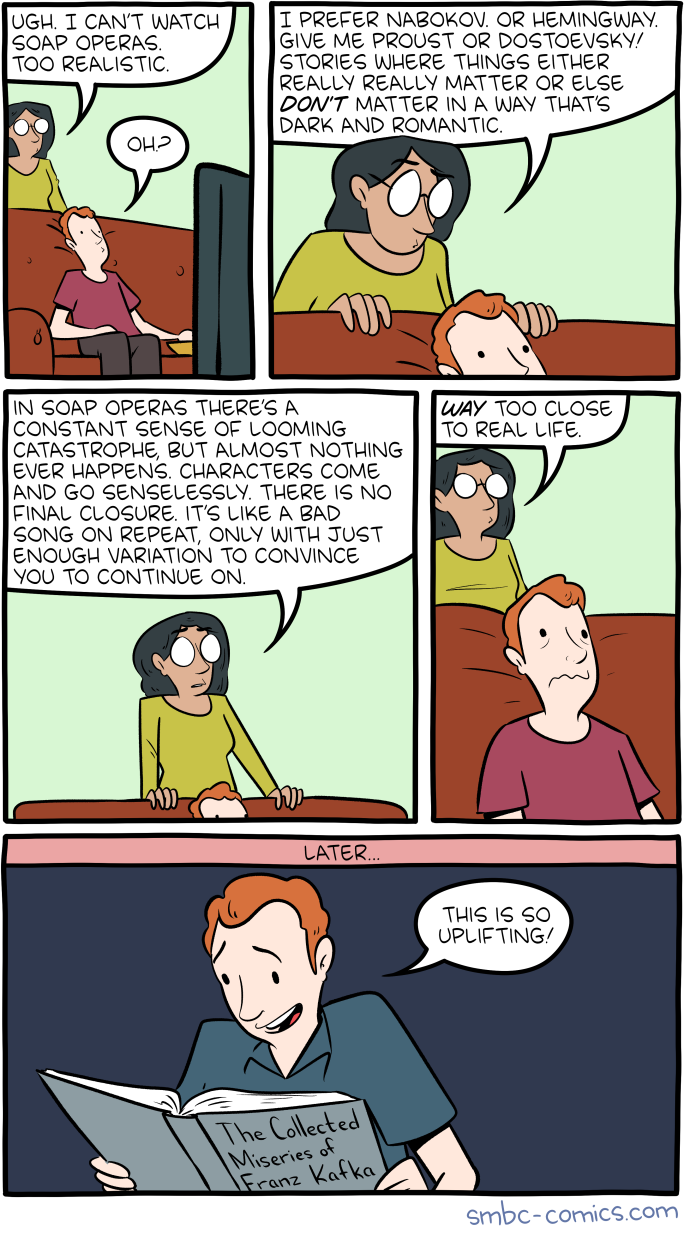
Saturday Morning Breakfast Cereal - Soap Opera

by tech@thehiveworks.com
Sarah

oh no


Click here to go see the bonus panel!

Hovertext:
Sorry for the slow update. I use Viasat internet, so I'm currently updating from the parking lot of a Starbucks.


Today's News:
10 Sep 01:15

The Surprising Grace & Power of a Slow Motion Pigeon Take-off

by Jason Kottke
Sarah

I've had tomatoes, cucumbers, and gin for dinner so this is amazing.

In this slow motion video clip from a BBC program called Secrets of Bones, you can see how a pigeon takes off so quickly. Pigeons can accelerate from 0 to 60 mph in about 2 seconds, straight up from the ground. A look at its skeleton reveals short, thick bones, an absolute necessity for an animal generating that much power in such a short time. (via the kid should see this, back from its summer hiatus)

Tags: birds   slow motion   video
09 Sep 23:14

What will the 2000s fashion revival really look like?

Sarah

i wish we had universal health care so i could be a picker

Early 21st century fashion was more than just trucker caps and bedazzled thongs — it’s something we can learn from.
09 Sep 23:06

Councilor wants to rip mask off protesters

by adamg
Sarah

time to bring back clown makeup

City Councilor Tim McCarthy (Hyde Park, Roslindale, Mattapan) wants to ban mask wearing on public roads.

The ire of the soon to be former councilor is aimed at left-wing protesters. McCarthy's request for a hearing would specifically call for barring "the wearing of a mask, hood or other device to conceal any portion of the face to conceal the identity of the wearer upon or within Public Property in Boston."

McCarthy says the final draft of any proposal would specifically exempt kids wearing face-concealing masks on Halloween, clowns and mascots such as Wally the Green Monster.

The council will consider McCarthy's proposal for a hearing on the matter at its regular Wednesday meeting. The proposal would then be sent to "the appropriate committee" for consideration, which in this case likely means the Committee on Public Safety, which McCarthy will chair at least until his term ends Dec. 31. The council's meeting begins at noon in its fifth-floor chambers in City Hall.

Separately, at-large Councilor Althea Garrison has filed a resolution asking her fellow councilors to pledge their "unwavering" support not just to Boston Police, but to the Boston Police Patrolmen's Association - the police union.

In his proposal, McCarthy angrily denounces protesters from out of town who, he says, came to Boston on Aug. 31 not to protest racists, homophobes and just all around Nazis but to conceal themselves as they ran riot through the streets of Boston: "They were here to cause violence [and] they were here to attack Boston police officers, attack the city of Boston itself."

McCarthy says nine of them were charged with assaulting a police officer; his proposed measure does not mention the majority of the protesters arrested will have their charges dropped by the Suffolk County District Attorney's office, now that a Supreme Judicial Court justice has ruled judges cannot tell a DA whom to prosecute, and DA Rachael Rollins has said she feels these protesters had their First Amendment rights violated.

Wally photo source.

28 Aug 14:32

Unearthly Iceland

by Jason Kottke
Sarah

I wanna go baaaack

If you need to convince yourself to go to Iceland, this short film by Vadim Sherbakov should do the trick for you. Just stunningly beautiful landscape masterfully shot.

Islandia — is a Latin name for Iceland and relative to the old language since this film portraits primordial and rough nature of Iceland. For the short duration of the film, you will be transported to a place that easily could be a million years ago. From unbelievable landscapes and vast valleys to painting-like terrain and majestic waterfalls and lakes - this film shows the unparalleled beauty of Iceland and its unearthly glory.

Watching the film, I wondered what Iceland would have looked like back when it had trees — probably even more amazing. (via colossal)

Tags: Iceland   Vadim Sherbakov   video
27 Aug 23:07

Kai, 21“I’m wearing a thrifted blazer I cut up, a tank...


Kai, 21

“I’m wearing a thrifted blazer I cut up, a tank top, a pair of Comme des Garcons Homme Plus pants, and Margiela shoes. I take a lot of inspiration from fashion students in Japan. I try to focus on silhouette and wearing my clothes in new ways.”

Aug 23, 2019 ∙ Tribeca
24 Aug 16:01

Man roams Boston, Cambridge in search of signs made by one California company

by adamg
Sarah

Another thing to keep an eye out for--I love it!

Atlas Obscura follows Dave Hebb, a "commercial archaeologist," on a quest to find local small-business signs made by a single manufacturer, signs you've probably never paid any attention to but the style of which you'll instantly recognize.

23 Aug 22:21

Orange Line tracks catch on fire - right under an Orange Line train

by adamg
Sarah

I would like to note the bananas made it home safely after 2 hours navigating the shuttle buses

You can guess how these Orange Line riders at Community College are feeling while waiting for a shuttle bus. Photo by Spiffs Queer Adventures.

The MBTA has to reset its "It's been __ days since last T disaster" signs now that a track fire erupted under a train at the Malden/Medford line shortly after 3 p.m., forcing its passengers to evacuate on the tracks and shutting down the entire line from Community College to Oak Grove just as rush hour was about to start.

Kim Vanderbeck has videos and a running description of her sudden status as an Orange Line refugee:

Raise your hand if you’ve ever been on the @MBTA when it caught on fire and had to walk the tracks in Malden and climb through a hole they cut in the fence.

Liz Double-U reports overhearing an urgent message from an MBTA bus dispatcher while riding a 93 bus in Charlestown:

Heard call for all operators pulling out to please advise and redirect for emergency shuttle service...

The T is tweeting that shuttle buses are on the way but at 4:05 p.m., FrettyDavis reported:

Not one shuttle bus at Sullivan Station. But lots of angry people.

Three minutes later, Spiffs Queer Adventures reported from Community College:

Community College
Community College

Easily over 100 people and have only seen one shuttle bus in about a half hour. So glad we’re paying so much for this garbage service.

Kyle is also among the hordes at Community College:

Community College

There is not a single MBTA employee at community college. We are getting directions from a homeless man to where the shuttles are

The fire also halted service on the neighboring Haverhill Line.

Trisha F. watched the evacuees coming off the tracks:

Orange Line evacuees

She reports:

It's called Jerry's Gate in Medford off Medford Street. It's behind a mini mall. It' where the train stopped and the passengers evacuated.

Corey, one of the people caught waiting for a shuttle bus, sighs:

The salt in the wound is I brought home some killer potato salad from work that’s gonna get gross in this heat. @MBTA you bastards owe me some potato salad, dammit!

Snoe replies:

I have a backpack full of over ripe bananas from the office that I am taking home to make muffins. I'm sure everyone on this shuttle bus is real happy with the smell...

Mister Jon joins the food mopers:

I have 4 pints of Ben & Jerry's ice cream...

Civil_War_MBTA sums it up:

Mother,

It has gone from bad to worse. I believe this is the last time I will write to you. The track fires on the #orangeline has left all of us trapped in the city. There is no escape. There is no hope. I will send you my monthly pass as there are no refunds.

22 Aug 01:19

All the world’s a stage, especially when you have no job prospects

Believe it or not, life as a travelling theater actor making $225 a week performing Shakespeare for high school students isn’t all it’s cracked up to be.
17 Aug 12:48

DIY Glam PVC Pipe Walls

by Kelli Kehler
Sarah

wow!

It wouldn’t be a proper final month of Design*Sponge (I’m not crying, you’re crying!) if we didn’t leave you with one more knock-your-socks-off DIY project. Today I’m thrilled to be sharing the work of one of my favorite collaborators over the years, producer/photographer/podcaster Caroline Lee. You’ll remember Caroline from the fantastic Atwater Village home she shares with photographer husband Jayden, and Light Lab, the vibrant and refreshing multi-purpose studio space the couple shares with author/stylist/blogger, Anne Sage. Caroline and Anne have teamed up multiple times to turn out effervescent spaces, including Caroline’s sister Margaret’s studio (with a superb painted checkered ceiling!).

When the time came to design the studio room of their A-frame home in Palm Springs, CA, Caroline and Jayden knew they wanted to bring big impact while maintaining a neutral, relaxing vibe at the same time. Since the A-frame will eventually be a place where workshops and gatherings are held, much thought went into both the aesthetic and functionality of the room. Caroline tapped Anne once again to help tackle the space — along with a team of handy friends — and pull off this stunning DIY PVC Pipe Wall studio. I’m handing it over to Caroline to take us through the design process and her steps for pulling off a PVC Pipe Wall look in your own home. Take it away, Caroline! —Kelli

—-

This room is the final space we designed at the A-frame, and it is our favorite! We call it the studio. It’s a space separate to the main house, and the vision was a space where relaxing and talking could happen, where people could sleep on the built-in beds if the house’s beds were full, and when workshops start happening at the house, this room can be a space where focused work can happen (think trauma-therapy type work, reiki, massage, etc.). It really depends on what type of workshop is happening, but I love that there’s a private space for quiet, intentional work to happen.

Anne and I got to work brainstorming and Pinning like fiends, trying to come up with something perfect to create here. We were super drawn to the built-in beds of Spain, Morocco and Greece, so that was the first step.

Anne created the design schematic, and then our dear friend Jonathan Gudino whipped together the bed bases (below) in a day’s work. He makes things look effortless.

Now, we had this perfect blank canvas, lots of dreams, and lots of questions. I had seen a lot of rad dowel walls in Australia, and, because Australia wins at all things interior design, of course they have a ready-made dowel paneling product you can buy. I searched high and low in the States — it doesn’t exist yet. (Mark my words, this will be made in the US in two years. We’re about two years behind … always.) I even got a quote from a few timber fabricators here who could make the paneling for me, but the quotes were all $8-10k, and, I’m gonna be honest, the pool at the A-frame drained every last dollar we had in our bank accounts. Oops.

Enter: The Home Depot, and my dear friend Ken (AKA the husband + co-conspirator of my other dear friend, Erin of Design for Mankind.) Ken makes everything. Like, builds entire homes everything — by himself.  So I texted him a few photos of the dowel lewk I was trying to create, and he replied with something like, “Oh… that’s easy! If it were me, I’d use PVC, and I’d glue the PVC to boards to make panels, and then I’d screw them into the drywall.”

He made it sound so easy.

I said, “How long do you think it’ll take to do this to one room?”

“About a full week’s work,” he said. My brother, Robert, and I got to work.

I’ve broken down the process into general steps below, and I highly recommend you find someone to cut/slice the PVC pipes in half (lengthwise) for you. If you give this project a try, let us know how it turns out! And please feel free to DM me on Instagram or comment below if you have any questions — I’ll do my best to help. Good luck! —Caroline

Photography by Jayden Lee of Echo and Earl / @echoandearl

08 Aug 13:23

Custom-Made Felt Cat Hats

by swissmiss
Sarah

Andy! Make some! Just...uh...out of wool.

Japanese couple Ryo and Hiromo Yamazaki create custom-made hats for their three cats out of the animals’ own shedded fur. I find this quite amusing.

08 Aug 00:52

The end times are here, and I am at Target

Sarah

for real

On the strange experience of living through the only accurate doomsday prediction.
07 Aug 10:58

A long strange trip. A fear submitted by Rafael to Deep Dark...

01 Aug 22:53

Longtime Davis Square Pub Will Survive Planned Redevelopment of Its Home

by Terrence B. Doyle
Sarah

Andy! Sligo's!

The exterior of the Burren in Somerville’s Davis Square, painted black with bright red doors and window frames The Burren isn’t going anywhere | Terrence B. Doyle/Eater

The Burren doesn’t expect to be affected by the building’s sale to Scape, a student housing developer, but other businesses might not be as lucky

A British student housing developer called Scape recently bought the building that houses several businesses on Somerville’s Elm Street in Davis Square, including the Burren. The development firm paid nearly $10 million for the building and signed a 99-year ground lease with the City of Somerville.

This is terrifying news at first blush — the Burren is among Greater Boston’s most beloved Irish pubs, and no one wants to see it go. All seems well, though: It expects to survive.

“I’m glad to say the Burren is not affected,” owner Tommy McCarthy told Boston Magazine. “Long live the Burren.”

The Boston Business Journal confirmed McCarthy’s assertion, reporting that Scape CEO Andrew Flynn had reached an agreement with the Burren to keep the bar open.

Meanwhile, another longstanding Irish pub on the block, Sligo Pub, posted a message to its Facebook page stating that “it does appear that the Sligo Pub is going to be directly affected by these changes.” Open for over 30 years, Sligo thanked its patrons and the community for the support and expressed a hope to “make the best of [the] time” that it has left while its future remains “uncertain.”

Sligo also bid its fans to speak up by sending feedback to Somerville and show up to the Planning Board meeting in August.

It’s not clear at the moment what the proposed development will mean for the other businesses in the building, including Jae’s Cafe, When Pigs Fly bakery (which recently moved from another part of Davis Square), McKinnon’s Meat Market, Caramel French Patisserie, Kung Fu Tea, and Martsa on Elm.

Scape currently operates student housing complexes in England, Ireland, and Australia. The company builds student housing units and offers them to undergraduate and graduate students at below-market rate, operating independently of any college or university. Scape has also proposed a 15-story building on Boylston Street in Fenway, but that project has been met with a fair amount of pushback from the Boston Planning & Development Agency.

This story will be updated as more information becomes available. For now, head to Davis Square and drink tons of Guinness and eat bangers and mash and celebrate the fact that the Burren doesn’t appear to be going anywhere anytime soon — but pay attention to its neighbors, too, whose futures are less certain.

Student Housing Developer Buys Davis Square Building that Houses The Burren [BG]
Contrary to Sudden Panic, the Burren in Somerville is Not Closing [BM]
Scape Grows Local Presence with $10M Buy in Somerville’s Davis Square [BBJ]
Here’s What a British Dorm Builder Is Planning for Boston [BG]
British Firm’s Plans to Build Private Dorms in Boston Hit a Snag [BG]

01 Aug 01:58

Ursula K. Le Guin documentary on PBS

by Patrick Tanguay
Sarah

Friday plans set!

If you’re in the US, most PBS stations will be showing the documentary Worlds of Ursula K. Le Guin on August 2nd, so that’s your Friday night sorted.

Features interviews with the author, her family and friends, and the generation of sci-fi and fantasy writers she influenced, like Margaret Atwood, Neil Gaiman, and Michael Chabon, as well as gorgeous animations illustrating her work as she reads.

One comment I noted when she passed in 2018:

One of the many, many things Le Guin gave us was a subtle one: that the “science” in science fiction could also be the social sciences, and that, indeed, without it, no science fiction could be entirely complete.
Catherynne Valente on Twitter

And this great thread by Jeet Heer, including:

Le Guin was part of a great shift in science fiction, often called New Wave, which had many dimensions (literary, countercultural, feminist) but was also a move from xenophobia to xenophilia.

I loved this from her Rant About “Technology” which, sadly, seems to have gone offline when that site was redesigned.

Technology is the active human interface with the material world.

… But the word is consistently misused to mean only the enormously complex and specialised technologies of the past few decades, supported by massive exploitation both of natural and human resources.

And of course this great acceptance speech when she received the National Book Foundation’s Medal for Distinguished Contribution to American Letters.

(Via Eliot Peper / Neil Gaiman.)

Tags: documentaries   Ursula K. Le Guin
29 Jul 23:10

In East Sussex, A Family’s Old Victorian Breathes New Life

by Sofia Tuovinen
Sarah

love the wall color with the white trim!

In East Sussex, A Family's Old Victorian Breathes New Life | Design*Sponge

In East Sussex, A Family's Old Victorian Breathes New Life | Design*Sponge “Once you’ve experienced an old property — despite its numerous problems like damp, failing walls — it’s hard to imagine yourself living anywhere else,” Poonam Sharma says. For the past 10 years, she and her partner Paul have lived in a Victorian villa in Hove, East Sussex in the UK. Although the couple still has ongoing house projects, they have transformed their home drastically over the last decade, highlighting period details while adding personal touches to each space. When Poonam and Paul’s son Zachary was born five years ago, Poonam left the corporate world of HR to focus on family. About a year ago, she wanted to try something new and started her blog, Modern Luxe, where she shares her home’s renovation along with completed makeovers.

When Poonam and Paul first moved in, they started off with painting their house in neutral colors. They wanted to live in and experience each space before deciding on colors and moods. “We talked about dark colors and as we’ve got really high ceilings we can get away [with] it, without losing the sense of space. “Initially Paul wasn’t convinced, so whilst he was away on a business trip, I painted the living room in Farrow & Ball ‘Railings.’ [Paul] didn’t speak to me for a couple of hours when he got back, but he loves it now and was more than happy for us to go dark in the bedroom too!” Poonam shares. Today, the family’s home includes various hues that continue beautifully from one space to the next, making the rooms feel both unique and connected at the same time. “Each of the rooms flows into each other, bringing a sense of unity, which we love,” Poonam explains.

Although Poonam and Paul now feel like they have a house they can proudly call home, they are still working on changes that will ultimately allow them to spend more quality time together as a family. Poonam has plans to change some things here and there, starting with the living room. She explains, “When we first bought the house, we didn’t have Zachary. But now [the house] needs to function as a family space. And I think on the whole it does, but there are a few rooms like the living room that look great but just don’t feel quite right as a family space. So that’s the next room on my hit list.” Scroll down to see how Poonam and Paul have created a home they love. For updates to the living room and the rest of the family’s home, there’s Poonam’s Instagram. —Sofia

Photography by Molly Seybold / Cathy Pyle 

Image above: Adding shutters was one of the first things that Poonam did when she and Paul moved in. “Whilst they enhance all the original features, it also gives our house a modern feel, which is one of the reasons we love them,” Poonam says. 

27 Jul 04:19

Lord send the asteroid

by Austin Kleon

Cartoonist Lucy Bellwood made me this pin, based on something I like to tweet on bad days. Turns out last night we had a near hit! Asteroid 2019 OK (what a hilarious name) missed us by 45,000 miles. Oh well. There’ll be another one.

24 Jul 01:11

Journos 16

Sarah

I feel very seen with all the cats and plants

8426eec7f0e1a93dcc3576045e9ed963e278f0ae

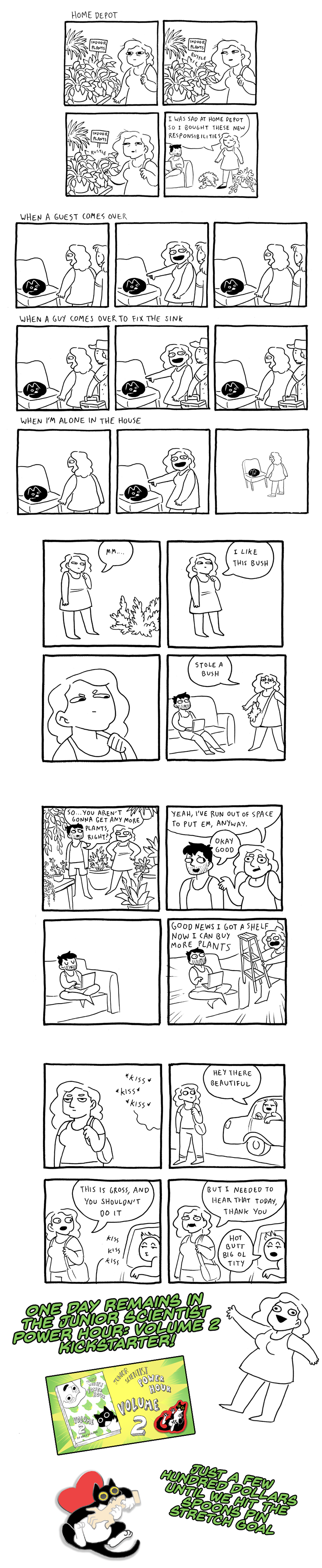
IT'S THE LAST DAY! The Kickstarter ends tomorrow around noon, so if you've been holding off, now is the time to pledge to get this big beautiful hardcover (plus all the other good stuff that comes with it.)

I've just implemented a last day sale for all the remaining original page tiers-- all the hourly comics day strips as well as Bigfeet are now only $200 each, and The Door In The Kitchen (all 37 pages!) has been lowered to $1000!

There's also a new $200 tier where you can request all the original pages from the comic of your choice, so long as it's not already spoken for. Just shoot me a message on Kickstarter or wherever is most convenient (twitter, email (abbyhoward.art@gmail.com), etc) and let me know which comic you're interested in owning!

And I hope all of you have a lovely day, you're the best, and I love you

22 Jul 23:55

One man, eight years, nearly 20,000 cat videos, and not a single viral hit

Sarah

"Taking care of cats leads to your own happiness"

How an animal lover’s hobby of recording himself feeding stray cats exemplifies the glory of the anonymous web.
18 Jul 23:22

Highlights from In the Garden of Beasts by Erik Larson

by Jason Kottke

You may know of Erik Larson from his excellent book on the 1893 World’s Fair, The Devil in the White City. Larson’s In the Garden of Beasts: Love, Terror, and an American Family in Hitler’s Berlin was published in 2011 and tells the story of William Dodd, America’s first ambassador to Nazi Germany, roughly from the time of his appointment in 1933 to the events of the Night of the Long Knives, the July 1934 purge that consolidated Adolf Hitler’s power.

Reading it, I couldn’t help but notice several parallels between what was happening in 1933 & 1934 as Hitler worked to establish an authoritarian government in Germany and some of the actions of our current government and its President here in the US. If you think that sort of statement is hyperbolic, I urge you to read on and remember that there was a time when Nazi Germany and its rulers seemed to its citizenry and to the world to be, sure, a little extreme in their methods, fiery in their rhetoric, and engaged in some small actions against certain groups of people, but ultimately harmless…until they weren’t and then it was too late to do anything.

Here’s everything I highlighted on my Kindle presented with some light commentary…much of it speaks for itself and the parallels are obvious. I apologize (slightly) for the length, but this book provided a very interesting look at the Nazi regime before they became the world’s canonical example of evil.

Page 19 (The practiced good cop/bad cop of the tyrant.):

And Hitler himself had begun to seem like a more temperate actor than might have been predicted given the violence that had swept Germany earlier in the year. On May 10, 1933, the Nazi Party burned unwelcome books — Einstein, Freud, the brothers Mann, and many others — in great pyres throughout Germany, but seven days later Hitler declared himself committed to peace and went so far as to pledge complete disarmament if other countries followed suit. The world swooned with relief.

Page 28 (There is much in the book about anti-Semitic attitudes in the US in the 1930s and the indifference to what was happening to the Jews in Germany.):

But Roosevelt understood that the political costs of any public condemnation of Nazi persecution or any obvious effort to ease the entry of Jews into America were likely to be immense, because American political discourse had framed the Jewish problem as an immigration problem. Germany’s persecution of Jews raised the specter of a vast influx of Jewish refugees at a time when America was reeling from the Depression. The isolationists added another dimension to the debate by insisting, as did Hitler’s government, that Nazi oppression of Germany’s Jews was a domestic German affair and thus none of America’s business.

Page 29 (After reading the book, I couldn’t help but think that if Japan had not bombed Pearl Harbor in late 1941, the US might not have entered the war against Germany and may have gone down an isolationist path that led towards fascism.):

Indeed, anti-immigration sentiment in America would remain strong into 1938, when a Fortune poll reported that some two-thirds of those surveyed favored keeping refugees out of the country.

Page 38:

When the conversation turned to Germany’s persecution of Jews, Colonel House urged Dodd to do all he could “to ameliorate Jewish sufferings” but added a caveat: “the Jews should not be allowed to dominate economic or intellectual life in Berlin as they have done for a long time. “In this, Colonel House expressed a sentiment pervasive in America, that Germany’s Jews were at least partly responsible for their own troubles.

Page 40 (This is in reference to Dodd’s daughter Martha, who was 24 when he was named ambassador and accompanied him to Berlin.):

She knew little of international politics and by her own admission did not appreciate the gravity of what was occurring in Germany. She saw Hitler as “a clown who looked like Charlie Chaplin.” Like many others in America at this time and elsewhere in the world, she could not imagine him lasting very long or being taken seriously.

Page 41:

In this she reflected the attitude of a surprising proportion of other Americans, as captured in the 1930s by practitioners of the then-emerging art of public-opinion polling. One poll found that 41 percent of those contacted believed Jews had “too much power in the United States”; another found that one-fifth wanted to “drive Jews out of the United States.” (A poll taken decades in the future, in 2009, would find that the total of Americans who believed Jews had too much power had shrunk to 13 percent.)

Page 54 (The “if it’s not happening to me, it must not be happening” response to injustice.):

When Martha left her hotel she witnessed no violence, saw no one cowering in fear, felt no oppression. The city was a delight.

Page 56 (Read more about Coordination):

Beneath the surface, however, Germany had undergone a rapid and sweeping revolution that reached deep into the fabric of daily life. It had occurred quietly and largely out of easy view. At its core was a government campaign called Gleichschaltung — meaning “Coordination” — to bring citizens, government ministries, universities, and cultural and social institutions in line with National Socialist beliefs and attitudes.

Page 56 (This paragraph, and the one that follows below, about “self-coordination” was one of the most chilling I read…I had to put the book down for a bit after this.):

“Coordination” occurred with astonishing speed, even in sectors of life not directly targeted by specific laws, as Germans willingly placed themselves under the sway of Nazi rule, a phenomenon that became known as Selbstgleichschaltung, or “self-coordination.” Change came to Germany so quickly and across such a wide front that German citizens who left the country for business or travel returned to find everything around them altered, as if they were characters in a horror movie who come back to find that people who once were their friends, clients, patients, and customers have become different in ways hard to discern.

Page 57:

The Gestapo’s reputation for omniscience and malevolence arose from a confluence of two phenomena: first, a political climate in which merely criticizing the government could get one arrested, and second, the existence of a populace eager not just to step in line and become coordinated but also to use Nazi sensitivities to satisfy individual needs and salve jealousies. One study of Nazi records found that of a sample of 213 denunciations, 37 percent arose not from heartfelt political belief but from private conflicts, with the trigger often breathtakingly trivial. In October 1933, for example, the clerk at a grocery store turned in a cranky customer who had stubbornly insisted on receiving three pfennigs in change. The clerk accused her of failure to pay taxes. Germans denounced one another with such gusto that senior Nazi officials urged the populace to be more discriminating as to what circumstances might justify a report to the police. Hitler himself acknowledged, in a remark to his minister of justice, “we are living at present in a sea of denunciations and human meanness.”

Page 58:

“Hardly anyone thought that the threats against the Jews were meant seriously,” wrote Carl Zuckmayer, a Jewish writer. “Even many Jews considered the savage anti-Semitic rantings of the Nazis merely a propaganda device, a line the Nazis would drop as soon as they won governmental power and were entrusted with public responsibilities.” Although a song popular among Storm Troopers bore the title “When Jewish Blood Spurts from My Knife,” by the time of the Dodds’ arrival violence against Jews had begun to wane. Incidents were sporadic, isolated. “It was easy to be reassured,” wrote historian John Dippel in a study of why many Jews decided to stay in Germany. “On the surface, much of daily life remained as it had been before Hitler came to power. Nazi attacks on the Jews were like summer thunderstorms that came and went quickly, leaving an eerie calm.”

Page 66 (LOL, a “moderate nationalist regime”):

Neurath saw himself as a sobering force in the government and believed he could help control Hitler and his party. As one peer put it, “He was trying to train the Nazis and turn them into really serviceable partners in a moderate nationalist regime.”

Page 68:

It was a problem Messersmith had noticed time and again. Those who lived in Germany and who paid attention understood that something fundamental had changed and that a darkness had settled over the landscape. Visitors failed to see it.

Page 81:

Dodd reinterated his commitment to objectivity and understanding in an August 12 letter to Roosevelt, in which he wrote that while he did not approve of Germany’s treatment of Jews or Hitler’s drive to restore the country’s military power, “fundamentally, I believe a people has a right to govern itself and that other peoples must exercise patience even when cruelties and injustices are done. Give men a chance to try their schemes.”

Page 84 (Yeah, where did all those nice houses come from?):

The Dodds found many properties to choose from, though at first they failed to ask themselves why so many grand old mansions were available for lease so fully and luxuriously furnished, with ornate tables and chairs, gleaming pianos, and rare vases, maps, and books still in place.

Page 85 (Dodd’s Jewish landlord, who lived in the attic, rented his house to Dodd at a significant discount to gain protection from state persecution of Jews.):

Panofsky was sufficiently wealthy that he did not need the income from the lease, but he had seen enough since Hitler’s appointment as chancellor to know that no Jew, no matter how prominent, was safe from Nazi persecution. He offered 27a to the new ambassador with the express intention of gaining for himself and his mother an enhanced level of physical protection, calculating that surely even the Storm Troopers would not risk the international outcry likely to arise from an attack on the house shared by the American ambassador.

Page 94 (Nazi forces would often beat people who failed to “Heil Hitler!”, even non-Germans. This order did not stop the beatings.):

The next day, Saturday, August 19, a senior government official notified Vice Consul Raymond Geist that an order had been issued to the SA and SS stating that foreigners were not expected to give or return the Hitler salute.

Page 97:

She too had been shaken by the episode, but she did not let it tarnish her overall view of the country and the revival of spirit caused by the Nazi revolution. “I tried in a self-conscious way to justify the action of the Nazis, to insist that we should not condemn without knowing the whole story.”

Page 105:

Messersmith met with Dodd and asked whether the time had come for the State Department to issue a definitive warning against travel in Germany. Such a warning, both men knew, would have a devastating effect on Nazi prestige. Dodd favored restraint. From the perspective of his role as ambassador, he found these attacks more nuisance than dire emergency and in fact tried whenever possible to limit press attention.

Page 108:

Göring too seemed a relatively benign character, at least as compared with Hitler. Sigrid Schultz found him the most tolerable of the senior Nazis because at least “you felt you could be in the same room with the man,” whereas Hitler, she said, “kind of turned my stomach.” One of the American embassy’s officers, John C. White, said years later, “I was always rather favorably impressed by Göring. … If any Nazi was likeable, I suppose he came nearest to it.”

Page 115:

Martha’s love life took a dark turn when she was introduced to Rudolf Diels, the young chief of the Gestapo. He moved with ease and confidence, yet unlike Putzi Hanfstaengl, who invaded a room, he entered unobtrusively, seeping in like a malevolent fog.

Page 117:

Yet under Diels the Gestapo played a complex role. In the weeks following Hitler’s appointment as chancellor, Diels’s Gestapo acted as a curb against a wave of violence by the SA, during which Storm Troopers dragged thousands of victims to their makeshift prisons. Diels led raids to close them and found prisoners in appalling conditions, beaten and garishly bruised, limbs broken, near starvation, “like a mass of inanimate clay,” he wrote, “absurd puppets with lifeless eyes, burning with fever, their bodies sagging.”

Page 118:

During a gathering of foreign correspondents at Putzi Hanfstaengl’s home, Diels told the reporters, “The value of the SA and the SS, seen from my viewpoint of inspector-general responsible for the suppression of subversive tendencies and activities, lies in the fact that they spread terror. That is a wholesome thing.”

Page 130 (“When someone shows you who they are, believe them the first time.” -Maya Angelou):

Dodd said, “You cannot expect world opinion of your conduct to moderate so long as eminent leaders like Hitler and Goebbels announce from platforms, as in Nuremberg, that all Jews must be wiped off the earth.”

Page 134 (“A kind of daily suspense” is definitely a tool in the political toolbox today. The news media practices this as well.):

Klemperer detected a certain “hysteria of language” in the new flood of decrees, alarms, and intimidation — “This perpetual threatening with the death penalty!” — and in strange, inexplicable episodes of paranoid excess, like the recent nationwide search. In all this Klemperer saw a deliberate effort to generate a kind of daily suspense, “copied from American cinema and thrillers,” that helped keep people in line. He also gauged it to be a manifestation of insecurity among those in power.

Page 135:

Persecution of Jews continued in ever more subtle and wide-ranging form as the process of Gleichschaltung advanced. In September the government established the Reich Chamber of Culture, under the control of Goebbels, to bring musicians, actors, painters, writers, reporters, and filmmakers into ideological and, especially, racial alignment. In early October the government enacted the Editorial Law, which banned Jews from employment by newspapers and publishers and was to take effect on January 1, 1934. No realm was too petty: The Ministry of Posts ruled that henceforth when trying to spell a word over the telephone a caller could no longer say “D as in David,” because “David” was a Jewish name. The caller had to use “Dora.” “Samuel” became “Siegfried.” And so forth.

Page 136 (George Messersmith was the head of the US Consulate in Germany from 1930 to 1934 and was one of the few people at the time who properly diagnosed the Nazi threat. In a 1933 letter to the US State Department, he called Hitler and his cronies “psychopathic cases” that would “ordinarily be receiving treatment somewhere”.):

Messersmith proposed that one solution might be “forcible intervention from the outside.” But he warned that such an action would have to come soon. “If there were intervention by other powers now, probably about half of the population would still look upon it as deliverance,” he wrote. “If it is delayed too long, such intervention might meet a practically united Germany.” One fact was certain, Messersmith believed: Germany now posed a real and grave threat to the world. He called it “the sore spot which may disturb our peace for years to come.”

Page 148 (On a speech Dodd gave in Berlin in October 1933 in front of an audience that included Joseph Goebbels.):

He gave the talk the innocuous title “Economic Nationalism.” By citing the rise and fall of Caesar and episodes from French, English, and U.S. history, Dodd sought to warn of the dangers “of arbitrary and minority” government without ever actually mentioning contemporary Germany. It was not the kind of thing a traditional diplomat might have undertaken, but Dodd saw it as simply fulfilling Roosevelt’s original mandate.

Page 149 (The reaction to Dodd’s speech):

“When the thing was over about every German present showed and expressed a kind of approval which revealed the thought: ‘You have said what all of us have been denied the right to say.’” An official of the Deutsche Bank called to express his own agreement. He told Dodd, “Silent, but anxious Germany, above all the business and University Germany, is entirely with you and most thankful that you are here and can say what we can not say.”

Page 154 (Hanfstaengl, a confidant of Hitler, tried to set up Hitler with Martha Dodd as a moderating influence.):

Putzi Hanfstaengl knew of Martha’s various romantic relationships, but by the fall of 1933 he had begun to imagine for her a new partner. Having come to feel that Hitler would be a much more reasonable leader if only he fell in love, Hanfstaengl appointed himself matchmaker.

Page 154 (Shocker that Hitler was controlling and abusive when it came to women.):

Hitler liked women, but more as stage decoration than as sources of intimacy and love. There had been talk of numerous liaisons, typically with women much younger than he — in one case a sixteen-year-old named Maria Reiter. One woman, Eva Braun, was twenty-three years his junior and had been an intermittent companion since 1929. So far, however, Hitler’s only all-consuming affair had been with his young niece, Geli Raubal. She was found shot to death in Hitler’s apartment, his revolver nearby. The most likely explanation was suicide, her means of escaping Hitler’s jealous and oppressive affection — his “clammy possessiveness, “as historian Ian Kershaw put it.

Page 157 (The banality of evil…):

Apart from his mustache and his eyes, the features of his face were indistinct and unimpressive, as if begun in clay but never fired. Recalling his first impression of Hitler, Hanfstaengl wrote, “Hitler looked like a suburban hairdresser on his day off.”

Page 159 (On Dodd’s meeting with Hitler):

Though the session had been difficult and strange, Dodd nonetheless left the chancellery feeling convinced that Hitler was sincere about wanting peace.

Page 159:

“We must keep in mind, I believe, that when Hitler says anything he for the moment convinces himself that it is true. He is basically sincere; but he is at the same time a fanatic.”

Page 161 (Martha Dodd met Hitler once briefly):

At this vantage, she wrote, the mustache “didn’t seem as ridiculous as it appeared in pictures — in fact, I scarcely noticed it.” What she did notice were his eyes. She had heard elsewhere that there was something piercing and intense about his gaze, and now, immediately, she understood. “Hitler’s eyes,” she wrote, “were startling and unforgettable — they seemed pale blue in color, were intense, unwavering, hypnotic.”

Page 165 (I didn’t highlight this, but at several points in the book, officials from the US and other countries acknowledged that they also had a “Jewish problem”, i.e. the Jews had too much power, money, and influence.):

Dodd believed that one artifact of past excess — “another curious hangover,” he told Phillips — was that his embassy had too many personnel, in particular, too many who were Jewish. “We have six or eight members of the ‘chosen race’ here who serve in most useful but conspicuous positions,” he wrote. Several were his best workers, he acknowledged, but he feared that their presence on his staff impaired the embassy’s relationship with Hitler’s government and thus impeded the day-to-day operation of the embassy.

Page 186 (Again with the belief that you can control an irrational & psychopathic nationalist.):

Papen was a protege of President Hindenburg, who affectionately called him Franzchen, or Little Franz. With Hindenburg in his camp, Papen and fellow intriguers had imagined they could control Hitler. “I have Hindenburg’s confidence,” Papen once crowed. “Within two months we will have pushed Hitler so far into a corner that he’ll squeak.” It was possibly the greatest miscalculation of the twentieth century. As historian John Wheeler-Bennett put it, “Not until they had riveted the fetters upon their own wrists did they realize who indeed was captive and who captor.”

Page 189 (Relevant to this are Hannah Arendt’s thoughts on lies. See also Donald Trump’s “fanciful thinking” about 9/11 and his continuing condemnation of the Central Park Five.):

An odd kind of fanciful thinking seemed to have bedazzled Germany, to the highest levels of government. Earlier in the year, for example, Göring had claimed with utter sobriety that three hundred German Americans had been murdered in front of Independence Hall in Philadelphia at the start of the past world war.

Page 213 (Subtle oppression is still oppression and sets the stage for the later acceptance of overt & violent oppression.):

But Schweitzer understood this was in large part an illusion. Overt violence against Jews did appear to have receded, but a more subtle oppression had settled in its place. “What our friend had failed to see from outward appearances is the tragedy that is befalling daily the job holders who are gradually losing their positions,” Schweitzer wrote. He gave the example of Berlin’s department stores, typically owned and staffed by Jews. “While on the one hand one can observe a Jewish department store crowded as usual with non-Jews and Jews alike, one can observe in the very next department store the total absence of a single Jewish employee.”

Page 223 (Even rumors are enough to change behavior when dealing with an authoritarian regime.):

A common story had begun to circulate: One man telephones another and in the course of their conversation happens to ask, “How is Uncle Adolf?” Soon afterward the secret police appear at his door and insist that he prove that he really does have an Uncle Adolf and that the question was not in fact a coded reference to Hitler. Germans grew reluctant to stay in communal ski lodges, fearing they might talk in their sleep. They postponed surgeries because of the lip-loosening effects of anesthetic.

Page 225:

You lingered at street corners a beat or two longer to see if the faces you saw at the last corner had now turned up at this one. In the most casual of circumstances you spoke carefully and paid attention to those around you in a way you never had before. Berliners came to practice what became known as “the German glance” — der deutsche Blick — a quick look in all directions when encountering a friend or acquaintance on the street.

Page 226:

An American professor who was a friend of the Dodds, Peter Olden, wrote to Dodd on January 30, 1934, to tell him he had received a message from his brother-in-law in Germany in which the man described a code he planned to use in all further correspondence. The word “rain,” in any context, would mean he had been placed in a concentration camp. The word “snow” would mean he was being tortured. “It seems absolutely unbelievable,” Olden told Dodd. “If you think that this is really something in the nature of a bad joke, I wonder if you could mention so in a letter to me.”

Page 229 (Hitler had been saying this shit since the 1920s and no one took him seriously.):

First Hitler spoke of broader matters. Germany, he declared, needed more room in which to expand, “more living space for our surplus population. “And Germany, he said, must be ready to take it. “The Western powers will never yield this vital space to us, “Hitler said.”That is why a series of decisive blows may become necessary - first in the West, and then in the East.”

Page 241 (A reminder that the US was also treating millions of people as second-class citizens at this time.):

After studying the resolution, Judge Moore concluded that it could only put Roosevelt “in an embarrassing position.” Moore explained: “If he declined to comply with the request, he would be subjected to considerable criticism. On the other hand, if he complied with it he would not only incur the resentment of the German Government, but might be involved in a very acrimonious discussion with that Government which conceivably might, for example, ask him to explain why the negroes of this country do not fully enjoy the right of suffrage; why the lynching of negroes in Senator Tydings’ State and other States is not prevented or severely punished; and how the anti-Semitic feeling in the United States, which unfortunately seems to be growing, is not checked.”

Page 265:

He reached into his pocket, and pulled out a small bag of candy fruit drops. Lutschbonbons. Bella had loved them as a child.” Have one,” Hanfstaengl said. “They are made especially for the Führer.” She chose one. Just before she popped it into her mouth she saw that it was embossed with a swastika. Even fruit drops had been “coordinated.”

Page 270 (Wow, “inner emigration”.):

In the months following Hitler’s ascension to chancellor, the German writers who were not outright Nazis had quickly divided into two camps — those who believed it was immoral to remain in Germany and those who felt the best strategy was to stay put, recede as much as possible from the world, and wait for the collapse of the Hitler regime. The latter approach became known as “inner emigration,” and was the path Fallada had chosen.

Page 273:

Even so, Fallada made more and more concessions, eventually allowing Goebbels to script the ending of his next novel, Iron Gustav, which depicted the hardships of life during the past world war. Fallada saw this as a prudent concession. “I do not like grand gestures,” he wrote; “being slaughtered before the tyrant’s throne, senselessly, to the benefit of no one and to the detriment of my children, that is not my way.” He recognized, however, that his various capitulations took a toll on his writing. He wrote to his mother that he was not satisfied with his work. “I cannot act as I want to — if I want to stay alive. And so a fool gives less than he has.” Other writers, in exile, watched with disdain as Fallada and his fellow inner emigrants surrendered to government tastes and demands. Thomas Mann, who lived abroad throughout the Hitler years, later wrote their epitaph: “It may be superstitious belief, but in my eyes, any books which could be printed at all in Germany between 1933 and 1945 are worse than worthless and not objects one wishes to touch. A stench of blood and shame attaches to them. They should all be pulped.”

Page 279 (Nazi leaders had already begun using their power to amass opulent wealth.):

“Ladies and gentlemen,” Göring said, “in a few minutes you will witness a unique display of nature at work.” He gestured toward an iron cage. “In this cage is a powerful male bison, an animal almost unheard of on the Continent. … He will meet here, before your very eyes, the female of his species. Please be quiet and don’t be afraid.” Göring’s keepers opened the cage. “Ivan the Terrible,” Göring commanded, “I order you to leave the cage.” The bull did not move. Göring repeated his command. Once again the bull ignored him. The keepers now attempted to prod Ivan into action. The photographers readied themselves for the lustful charge certain to ensue. Britain’s Ambassador Phipps wrote in his diary that the bull emerged from the cage “with the utmost reluctance, and, after eyeing the cows somewhat sadly, tried to return to it.” Phipps also described the affair in a later memorandum to London that became famous within the British foreign office as “the bison dispatch.”

Page 282:

The next day Phipps wrote about Göring’s open house in his diary. “The whole proceedings were so strange as at times to convey a feeling of unreality,” he wrote, but the episode had provided him a valuable if unsettling insight into the nature of Nazi rule. “The chief impression was that of the most pathetic naivete of General Göring, who showed us his toys like a big, fat, spoilt child: his primeval woods, his bison and birds, his shooting-box and lake and bathing beach, his blond ‘private secretary,’ his wife’s mausoleum and swans and sarsen stones. … And then I remembered there were other toys, less innocent though winged, and these might some day be launched on their murderous mission in the same childlike spirit and with the same childlike glee.”

Page 306 (during the aforementioned Night of the Long Knives purge):

In Munich, Hitler read through a list of the prisoners and marked an “X” next to six names. He ordered all six shot immediately. An SS squad did so, telling the men just before firing, “You have been condemned to death by the Führer! Heil Hitler.” The ever-obliging Rudolf Hess offered to shoot Röhm himself, but Hitler did not yet order his death. For the moment, even he found the idea of killing a longtime friend to be abhorrent.

Page 321 (in the aftermath of the purge):

As the weekend progressed, the Dodds learned that a new phrase was making the rounds in Berlin, to be deployed upon encountering a friend or acquaintance on the street, ideally with a sardonic lift of one eyebrow: “Lebst du noch?” Which meant, “Are you still among the living?”

Page 328:

Throughout that first year in Germany, Dodd had been struck again and again by the strange indifference to atrocity that had settled over the nation, the willingness of the populace and of the moderate elements in the government to accept each new oppressive decree, each new act of violence, without protest. It was as if he had entered the dark forest of a fairy tale where all the rules of right and wrong were upended.

Page 333:

Hitler’s purge would become known as “The Night of the Long Knives” and in time would be considered one of the most important episodes in his ascent, the first act in the great tragedy of appeasement. Initially, however, its significance was lost. No government recalled its ambassador or filed a protest; the populace did not rise in revulsion.

Page 334 (Hitler cracked down on the Storm Troopers because their leadership was against him, but their doing of bad deeds were soon replaced by the SS.):

The controlled press, not surprisingly, praised Hitler for his decisive behavior, and among the public his popularity soared. So weary had Germans become of the Storm Troopers’ intrusions in their lives that the purge seemed like a godsend. An intelligence report from the exiled Social Democrats found that many Germans were “extolling Hitler for his ruthless determination” and that many in the working class “have also become enslaved to the uncritical deification of Hitler.”

Page 336 (on the good treatment of horses in Germany):

“At a time when hundreds of men have been put to death without trial or any sort of evidence of guilt, and when the population literally trembles with fear, animals have rights guaranteed them which men and women cannot think of expecting.”

Page 340 (Dodd eventually came to see the danger of Nazi Germany):

He became one of the few voices in U.S. government to warn of the true ambitions of Hitler and the dangers of America’s isolationist stance. He told Secretary Hull in a letter dated August 30, 1934, “With Germany united as it has never before been, there is feverish arming and drilling of 1,500,000 men, all of whom are taught every day to believe that continental Europe must be subordinated to them.” He added, “I think we must abandon our so-called isolation.” He wrote to the army chief of staff, Douglas MacArthur, “In my judgment, the German authorities are preparing for a great continental struggle. There is ample evidence. It is only a question of time.”

Page 351:

Dodd’s sorrow and loneliness took a toll on his already fragile health, but still he pressed on and gave lectures around the country, in Texas, Kansas, Wisconsin, Illinois, Maryland, and Ohio, always reprising the same themes — that Hitler and Nazism posed a great risk to the world, that a European war was inevitable, and that once war began the United States would find it impossible to remain aloof. One lecture drew an audience of seven thousand people. In a June 10, 1938, speech in Boston, at the Harvard Club — that den of privilege — Dodd talked of Hitler’s hatred of Jews and warned that his true intent was “to kill them all.”

Dodd died in February 1940. He lived long enough to witness the start of Hitler’s war on Europe but not long enough to see America’s isolationist come to an end or Hitler’s attempt to kill all the Jews.

Tags: Adolf Hitler   books   Erik Larson   In the Garden of Beasts   Nazis   politics   William Dodd
12 Jul 00:07

Calli, 28“I’m wearing my favorite Docs, a thrifted top and...

Sarah

forever


Calli, 28

“I’m wearing my favorite Docs, a thrifted top and skirt, the leather jacket was bought with my employee discount at work and the military fez hat is from South African company Simon and Mary. My current style is heavily influenced by the intersection of what I like and can afford. I make a lot of my own clothing as a result. I like to think of my style as a sort of dapper, militant, dark, priestess.”

May 11, 2019 ∙ Industry City
10 Jul 13:49

The Korean Invention of the Printing Press, Almost 200 Years Before Gutenberg

by Jason Kottke
Sarah

whelp!

Jikji

M. Sophia Newman writing for Literary Hub: So, Gutenberg Didn’t Actually Invent the Printing Press.

It is important to recognize what this means. The innovation that Johannes Gutenberg is said to have created was small metal pieces with raised backwards letters, arranged in a frame, coated with ink, and pressed to a piece of paper, which allowed books to be printed more quickly. But Choe Yun-ui did that — and he did it 150 years before Gutenberg was even born.

This piece is also a good reminder that the spread of technology (and culture) depends on more than just how useful it is.

However, Korea’s printed books did not spread at a rapid pace, as Gutenberg’s books would 200 years later. Notably, Korea was under invasion, which hampered their ability to disseminate their innovation. In addition, Korean writing, then based closely on Chinese, used a large number of different characters, which made creating the metal pieces and assembling them into pages a slow process. Most importantly, Goryeo rulers intended most of its printing projects for the use of the nobility alone.

The image at the top of the post is of Jikji, the oldest existing book printed with movable metal type, made in 1377.

Tags: books   Choe Yun-ui   Johannes Gutenberg   M. Sophia Newman
04 Jul 03:48

A Visit To Guo Pei’s Alternate Universe

by S. Elizabeth
Sarah

SIGN ME UP

I’d like to think that in the alternate universe referenced in Guo Pei’s mythical Fall Winter 2019 collection, one may step out for a coffee clad in a ballgown of marionette theatre manipulated by a coolly bespectacled simian puppet master, with barely a flickering glance from the barista as they take a name for your latte. A world where one might greet their postman wearing an ensemble showcasing the snowy bleeding heart of a tangled winter forest or renew one’s driver’s license attired in a veritable marigold altar to one’s self–and no one would give you a second look.

An alternate universe where “extra” is de rigueur and an astonishing profusion of embellishments, flourishes, and frills, and 30-plus wardrobe changes is barely enough to get by in a day. Granted, it would be really challenging to keep up with the fashionable and their fantastic extremes in this parallel reality…but holy ruching and ruffles–wouldn’t that be a fantastic place to visit?

See below for some of our favorite looks from this collection and find the entirety of Guo Pei’s Alternate Reality over at Vogue today;  for some extra extras, take a peek at this thread, in which twitter user @vandroidhelsing provides the most marvelous commentary for the show.
[h/t Annie!]


28 Jun 13:07

On the Street…Paris

by The Sartorialist
Sarah

Look. I'm all one for ugly pants. But those are some ugly ass pants.

61919Ver6B7666IG

25 Jun 22:32

Who’s Coming? A New Free Toolkit for Respectful Audience Surveying

by noreply@blogger.com (Nina Simon)
Sarah

paths i wish i could take

Michaela Clark-Nagaoka surveying visitors at a MAH event.
Note: this is cross-posted on OF/BY/FOR ALL, where you can find more tools and stories for building more inclusive organizations. 

If you want to involve new people at your organization, you need to know who is coming - and who isn’t. Today, OF/BY/FOR ALL is introducing a new free resource - a guide to creating and implementing demographic audience surveys that are accurate, respectful, and useful.

I remember the first time I understood how powerful it was to have demographic data about our participants. At the time, I was leading the Santa Cruz Museum of Art & History. We were three years into a dramatic transformation to welcome new people in new ways. For my first three years, we got a sense of who was and wasn’t involved based on observation and gut instinct. We tried things. We checked out the crowd. We noticed if people were younger or older, more or less racially diverse.

But after three years of ad hoc observation, we were hungry for hard data. We realized our gut instincts could only take us so far. There was a lot we couldn’t see - like economic class and sexual orientation. And there was a lot we were assuming - about race, gender, and age. We decided to make a commitment to collecting better data about who was and wasn’t coming.

We discovered that was not an easy thing to do. We talked to colleagues in other institutions who were struggling with the same questions. No one had a playbook of answers. We ended up working with two sets of consultants, funded by two different foundations, for over a year. Those expert researchers taught us how to conduct truly random surveys, how to train our team, how to ask sensitive questions in a respectful manner, and how to analyze the results. The outcome was a simple, powerful protocol... but our process in getting there was anything but simple.

That’s why we decided, as part of our first year of work with OF/BY/FOR ALL, to demystify audience surveying with The Who’s Coming toolkit. We’ve teamed up with Slover Linett Audience Research - with generous support from the James and John L. Knight Foundation - to write this toolkit. We wrote it for people like us: busy professionals who want to do a better job capturing and analyzing demographic audience data. In this toolkit, you’ll find step-by-step tools to help you write a survey, share it with a truly random slice of your audience, and analyze the results. You don’t need funding or a consultant to get started collecting data. You can do it yourself, with your staff and volunteers - and this toolkit.

In my experience, collecting good demographic data can help you smash stereotypes. It can help you make smarter strategic decisions and better programs. As one small example, in our very first round of data collection at the MAH, we learned that the audience coming to monthly free First Friday events was wealthier, whiter, and older than the audience for ticketed Third Friday festivals. This finding fundamentally shifted our perception of who attends paid and free programs. It made us ask why, dig deeper, and understand a lot more about what makes a program welcoming to whom.

The Who’s Coming toolkit has two parts. The first section tackles HOW to design and implement random audience surveys. The second section tackles WHAT to ask. While both parts are rooted in practitioner and expert experience, the WHAT will keep evolving as our collective understanding of identity changes. We wrote this toolkit from a US-centered perspective, and we know some of the demographic terms might be different in other countries. If you have questions or suggestions to make the toolkit more inclusive, please let us know.

Until then, I hope you’ll read it, share it, and most of all, USE IT. You are free to download, share, excerpt, and use this toolkit however you want. And if you do use it, we’d love to hear how it goes for you and what you learn. What gets measured gets done. When you measure demographic data, it accelerates your ability to make positive, inclusive change.
23 Jun 23:39

Saturday Morning Breakfast Cereal - Teleporter

by tech@thehiveworks.com
Sarah

it me


Click here to go see the bonus panel!

Hovertext:
It's not a particularly good plant, but it's still better than you.


Today's News: