Shared posts

15 Feb 04:58

SalviaParma Ham“We are an art and design duo working under...


Salvia
Parma Ham

“We are an art and design duo working under the alias Nullo. Our work investigates posthuman digital tribalism, agender avatars, and the feedback loop that affects every-day experience. We are in New York to host our goth party Wraith. Salvia is wearing boots by Demonia and a custom-made ba by Riri Fukuju. Ham wears a coat by Ann Demeulemeester and shoes by Gareth Pugh.”

Nov 29, 2019 ∙ Lower East Side
14 Feb 02:12

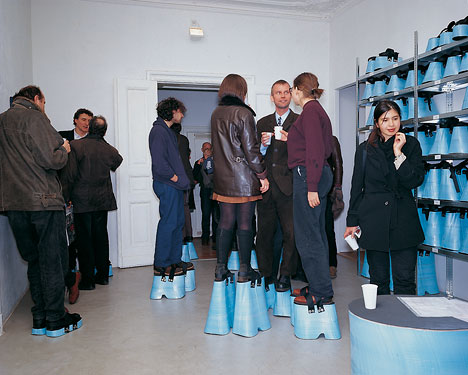
Same Height Party

by swissmiss
Sarah

Like how when I first met everyone they thought I ws 5'10" because of my boots

As a tall woman, the idea of attending a party where everyone is the same height, is incredibly fascinating. What a cool experiment!

10 Feb 03:38

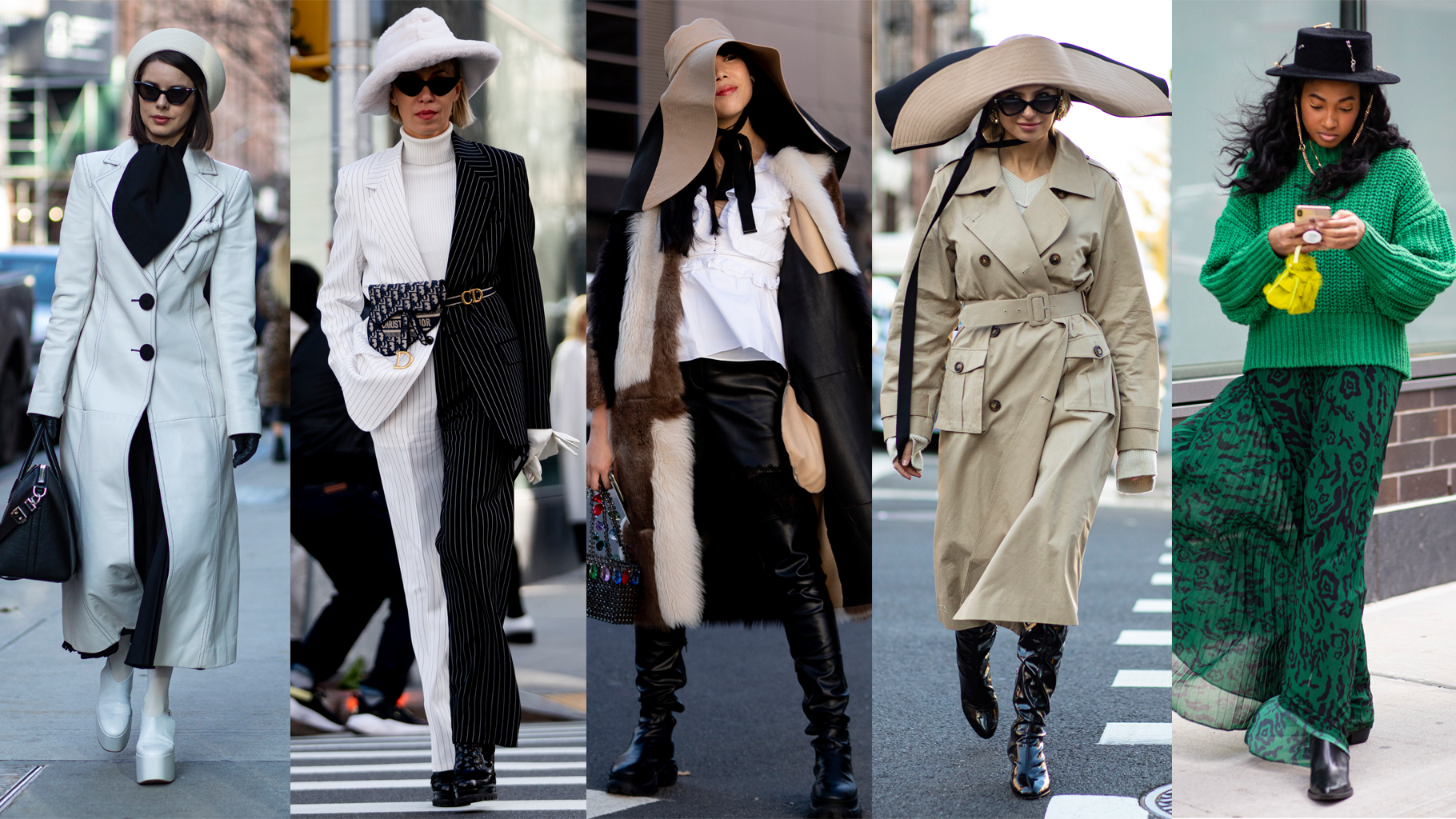
Showgoers Wore Statement Hats on Day 2 of New York Fashion Week

by Fashionista
Sarah

yes, no, no, ???, yes

The New York Fashion Week schedule may seem lighter and snoozier than usual, but the street style crowd has kept the sartorial energy up by continuing to wear conversation-starting outfits. On day two, showgoers moved about the city in their best statement hats: boater hats, berets, extra ...

Continue reading

09 Feb 13:55

The culture of fashion: Georgia O’Keeffe’s wardrobe for sale

by Disneyrollergirl
Sarah

I'm not a huge fan of O'Keefe's work, but I admire her as a person and her style was amazing!

Georgia O'Keeffe - Todd Webb

I have tons of Georgia O’Keeeffe pictures on my Pinterest board as research for a project. Her personal style was just fantastic – those shirts! The hats! The kimonos! The hair!

Sotheby’s
has a sale of a number of her personal artefacts coming up, including dresses, jewellery, coats and a fabulous velvet hood. What’s remarkable to me is that apparently some of these pieces were hand-sewn by Georgia O’Keeffe herself. The workmanship shown in Vogue’s detail images is beautiful (look at the black and white pleated crepe dress) and even though I guess many people sewed their own clothes back in the day, it seems novel to me in today’s everything-automated age.

A particularly notable item up for auction is a silver ‘OK’ pin. It’s a copy that O’Keeffe had made of the gold pin given to her by sculptor Alexander Calder. When O’Keeffe ‘s hair went white, she decided to have the silver dupe made as a more flattering option. Also in the sale is O’Keeffe’s recipe box (Estimate $6,000–8,000 – remember the O’Keeffe recipe book?). Read more on Sotheby’s and Vogue.

Georgia O'Keeffe OK brooch
Georgia O'Keeffe by Todd Webb
Georgia O'Keeffe
Georgia O'Keeffe wardrobe

Georgia O'Keefe by Bruce Weber

WORDS: Disneyrollergirl
IMAGES: Todd Webb; to come; Todd Webb; to come; Laura Gilpin, 1953, Georgia O’Keeffe Museum, Santa Fe, N.M; Bruce Weber
NOTE: Most images are digitally enhanced. Some posts use affiliate links* and PR samples. Please read my privacy and cookies policy here

CLICK HERE to get Disneyrollergirl blog posts straight to your inbox once a week
CLICK HERE to buy my book The New Garconne: How to be a Modern Gentlewoman

07 Feb 20:35

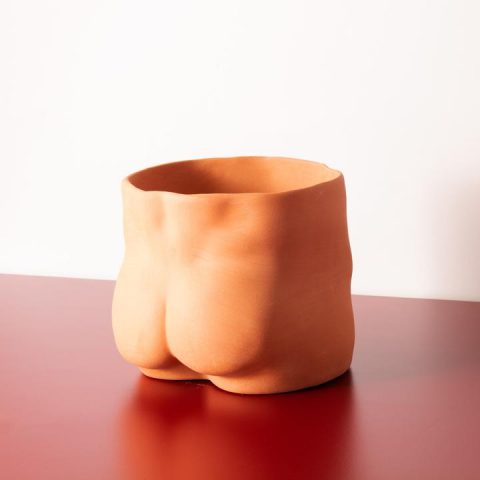
Nude Bottom Planter

by swissmiss
Sarah

heehee

This nude bottom planter by group partner made me smile.

07 Feb 20:24

Chinatown restaurant business collapsing as diners stay away due to coronavirus fears

by adamg
Sarah

Let's get dumplings!

WBUR reports, notes something similar happened during the SARS scare in 2003 - at least until Mayor Tom Menino went on a walking tour of the neighborhood and didn't get SARS - that Chinatown is no more at risk from the new coronavirus strain than anywhere else and that you're far, far more likely to get the flu, which can also be fatal.

01 Feb 02:03

Andy, 21“I’m wearing black UGG boots, black and white Nike Air...


Andy, 21

“I’m wearing black UGG boots, black and white Nike Air oversized fleece crew neck with a black pleated Zara skirt and Levi’s crossbody bag. My current everyday style is inspired by filling the gap in between androgyny and streetwear within modern day culture.”

Nov 2, 2019 ∙ Clinton Hill
25 Jan 14:05

Here's Your First Look at the New Elizabeth and James for Kohl's

by Ana Colón
Sarah

wait what

Last spring, Kohl's continued to ramp up its fashion offerings by announcing a series of new partnerships. One of the most conversation-starting was its deal to be the new exclusive carrier for Elizabeth and James, the contemporary lifestyle brand founded by Mary-Kate and Ashley Olsen in ...

Continue reading

23 Jan 02:02

Dancing Twigs

by Jason Kottke

Dancing Twigs

Artist Chris Kenny uses bits of twig from tree branches to make these interesting found art pieces that exploit the human tendency for pareidolia, including the one above of twigs in motion. (via @nicholsonbaker8)

Tags: art   Chris Kenny   dance   trees
14 Jan 16:18

“Queer” as in… what, exactly?

Sarah

"Queer is imagined as a kind of political practice of “anti-normativity,” of striving against the norm and the oppressive structures that inscribe it as such."

The spaces we invoke by using the term don’t always do justice to our imaginations.
10 Jan 03:28

Working in the restaurant industry will haunt your dreams

Sarah

cool maybe i'll always have retail dreams

Why people still have nightmares about 10-table sections even years after they quit serving.
08 Jan 00:18

Tamás Király: Hungary’s King of Fashion

by Doris Domoszlai-Lantner and Petra Egri
Photograph by Almási J. Csaba, 1990. Courtesy Ludwig Múzeum.

Few Hungarian designers have made a name for themselves on the international stage. Ready to-wear brands Nanushka and Sugarbird, and demi-couture Abodi are a few of the contemporary brands that have recently captured the attention of the fashion industry. Long before this contingent, Tamás Király (1952-2013) broke through the barriers imposed by the socialist system to present politically-informed collections in both Hungary and abroad. The neo avant-garde Király was not a fashion designer in the traditional sense of the term. He created what he called ‘clothing sculptures,’ which he often made out of mundane, ephemeral materials and objects such as fishing rope and kitchen supplies. As such, his garments and accessories skirted the line between the everyday and the fanciful. He sold his collections at New Art Studio, a collaborative underground boutique that he ran with his fellow designer friends. Due to his affinity for unusual designs and those who consumed them, Király referred to himself as an ‘anti-fashion fashion designer,’ a term that the Hungarian press, starting with the general-interest magazine Új Tükör (New Mirror), readily adopted.1

Király’s created his exaggerated, fantastical designs in defiance of with what was considered ‘socialist good taste,’ standing up to established conventions of both the regime and the ready-to-wear industry.2 Although the majority of his pieces were not explicitly political, he did occasionally take the opportunity to present garments and imagery that were controversial.

In 1987, the red star, a symbol of communist military might, was transformed by Király into a multi-dimensional dress with massive points radiating off the wearer’s body.3 In 1989, Király boldly photographed a model wearing a hat that he built as a small-scale replica of the dome of the Hungarian Parliament Building — complete with the infamous red star on top — right across the Danube with its inspiration in plain sight.4 Dressed in a hodgepodge of various different layers and prints, the model and her hat were an eyesore next to the otherwise scenic landscape, effectively transmitting his views of the regime in a coy, playful manner.

In 1988, Király presented an extraordinary collection at the historic Dressater fashion show in West Berlin. With a rallying cry of ‘dressed to thrill’ as the show’s central theme, Vivienne Westwood may have been the show’s celebrity guest, but Király held a special honour: he was the only designer from all of the countries behind the Iron Curtain in attendance. The show received great accolades not just for its talented roster of designers, but also for its location: it took place at an abandoned train station. Comprised of forty eccentric pieces, Király’s collection looked right at home in its surroundings as models eagerly strutted down a makeshift catwalk, a steel-plate hanging in train station, in pyramid-, ball- and disc-shaped garments. The daring red and black colours and exaggerated shapes evoked the masterful work of the avant garde Russian Constructivists and Oskar Schlemmer’s Triadic Ballet.5

Király’s participation in Dressater was entirely dependent on the state — international travel was restricted, yet the Kádár regime permitted him to travel to West Germany, an enemy country, to take part in this event. As Király could have easily defected and besmirched the Hungarian People’s Republic’s name, this authorisation was a calculated action designed to show that it was actually a permissive country where self-expression, art, and fashion flourished. During the late socialist period, Király was also fortunate enough to have belonged to a unique social strata of citizens who were tolerated — not persecuted nor promoted — by the regime. Taking advantage of his special status, Király foreshadowingly called the collection ‘Open Doors,’ a subtle jab at the socialist regime and its impending dissolution. The following year, during which the regime collapsed during what became known as the ‘Fall of Nations,’ his work was featured in the West’s preeminent fashion and culture magazine, i-D.6

Like most designers, Király also presented his work in the format that is most common within the fashion industry: catwalk shows. His experimental fashion performances, however, transcended the borders of traditional shows and are part of a unique era of fashion history to which other visionary designers such as Thierry Mugler and Alexander McQueen belong. From as early as 1981 up until 2002, Király periodically appropriated Váci Street, the area of Budapest known for its fashionable, upscale boutiques, to serve as his catwalk during his ‘fashion walks.’7 The 1997 ‘Schwaa 3C 273’ collection (named after the first quasar ever to be identified), was an example of what he referred to as ‘fashion performances’ for which he built specific sets and integrated contemporary dance.8 He also collaborated with performance groups to present what he called ‘fashion theater,’ a medium through which he used dress as a narrative storytelling technique. His most famous production was with the Baltazar Theater, a professional troupe of intellectually disabled actors, with whom he staged Baltazár Éjjeli Álom (Baltazar Night’s Dream). Made of all white and cream-coloured textiles and objects, the costumes reflected the phantasmagoric atmosphere of the Shakespearean play it interpreted: A Midsummer Night’s Dream.

In the years leading up to his headline-grabbing alleged murder in 2013, Király frequently showed his work at the Petőfi Csarnok (hall), the famous Sziget music festival on Margaret Island, and the Elle magazine-sponsored Fashion Weeks in Budapest. The year 2011 was very successful for Király. In May, he showed one of his most sculptural collections at the Fashion Deluxe runway show in the famous New York Palace (then known as Boscolo) in Budapest. Silver, gold, and bright red garments with boldly cut out and vividly three-dimensional details seemed to take on a life of their own as the models danced and vogued their way down the catwalk. A few days later, an interview with Király, interspersed with footage of the show, was released on Divatikon, one of Hungary’s most successful fashion blogs and YouTube channel.9

Later that year, a short made-for-television documentary on Király aired on ‘Propaganda,’ a show on the Hungarian public-access TV2 channel. The documentary, ‘Abszolút,’ available in its entirety on YouTube, took a very light-handed approach to Király’s craft.10 The host’s bias against Király was evident as he repeatedly alluded to the designer’s alleged insanity, and implied that he was sloppy and unprofessional. The documentary undoubtedly had a negative effect on the general Hungarian public’s opinion of Király. His death, a mere year and a half after the documentary aired, was overshadowed by the very rumors that it had fuelled and helped perpetuate. Half-naked and with a silk sash supposedly around his neck, Király was found dead in his own apartment after what various media outlets called a night of rough, sado-masochistic romp with a male sex worker. In the socially conservative country that is Hungary, both the police and the press focused on the potentially shameful, reputation-ruining aspects of his death instead of the incredible legacy he left behind.

In 2014, the opening of an exhibition at tranzit.hu, an art gallery and think tank, changed the public discourse around Király. Curated by Gyula Muskovics and Andrea Soós, the exhibition, Nyitott kapuk: Király Tamás ‘80s (Open Doors: Király Tamás ‘80s) sought to unravel the layers of meaning within Király’s work during the years leading up to the dissolution of the socialist regime.11 As an astute reference to the creative output that Király expended during this tumultuous period, the exhibition was named after the collection he showed at Dressater. Comprised of a selection of garments, photographs and primary documents from the designer’s personal archive, the exhibition was praised by art historian Endre Lehel Paksi for effectively fulfilling the action implied in its name: opening Király’s body of work to constructive analysis and scholarship.12 The exhibition’s accompanying book, Király Tamás ’80s, was published by Tranzit in 2017.

Most recently, the Ludwig Museum in Budapest mounted their own aptly-titled exhibition, Király Tamás: Out of the Box. Curated by art historian Katalin Timár, Out of the Box was designed to allude ‘…to the visual athmosphere [sic] so typical to Király’s shows… to evoke the multifaceted and interdisciplinary approach that render Király’s activity [sic] so unique in the Hungarian visual arts scene.’13 The exhibition featured extant garments and accessories from several of his collections and productions, including Baltazár Night’s Dream, and his last ever catwalk show in 2013, during which he showed his ‘Red Collection’ of sculptural pieces that he painstakingly cut and formed with a pair of nail scissors. Although Out of the Box was criticised for its lack of adequate signage and labels, it built upon the tranzit.hu effort by providing the first large-scale retrospective of his consummate career.14

Renewed and increased public interest into Király’s history has also laid the groundwork for an upcoming feature-length documentary by London-based filmmaker, and Royal College of Art alumni Noémi Varga. Having participated in several major development incubators, including the Sheffield Doc/Fest EDN Market Mentors program in 2017, Varga has obtained unparalleled access to Király’s archives and its previously camera-shy caretaker, his son Ilias. Through her film, Varga seeks to tell the sensitive story of Király’s life as an artist, demonstrating his devotion and passion to his craft, rather than the  potential profitability of the wider fashion industry.15

The thirtieth anniversary of the 1989 regime change has brought renewed attention to the burgeoning arts and culture of the late socialist era. Tamás Király, one of the most prolific Hungarian artists of the socialist and post-socialist periods, has certainly benefitted from the increased attention towards his work, including that which occurred posthumously. What remains to be seen, however, is if and how Király’s legacy will continue to be shaped.


Doris Domoszlai-Lantner is a New York-based historian and archivist specialising in dress and fashion. Petra Egri is a PhD candidate in philosophy at the University of Pécs, Hungary.


  1. Katalin Bogyai, ‘Divatellenes divattervező’ (‘The anti-fashion fashion designer’), Új Tükör, January 29, 1989 

  2. Ildikó Simonovics and Tibor Valuch, eds., Öltöztessük fel az országot: Divat és öltözködés a szocializmusban, (Argumentum Press: Budapest, Hungary, 2009), p.65-95 

  3. Gyula Muskovics and Andrea Soós, Király Tamás ’80s, (Budapest: Tranzit Kiadó, 2017), p.11 

  4. Ibid, p.64 

  5. Gyula Muskovics, ‘Against Interpretation. On the performance art of El Kazovsky and Tamás Király,’ Artportal, March 27, 2019, https://artportal.hu/magazin/against-interpretation-on-the-performance-art-of-el-kazovsky-and-tamas-kiraly/ 

  6. C.D., ‘Fashion Hungary,’ i-D, issue 71 (1989), p.83 

  7. Katalin Timár, ‘Király Tamás: Out of the Box’ (exhibition brochure), Ludwig Museum, https://www.ludwigmuseum.hu/system/files/page/attachments/2019-08/ludwig_kiralyt_kiall_vezeto_kis_pdf.pdf 

  8. Ibid, p.15 

  9. ‘Király Tamás divattervező a Fashion Deluxe 2011-en,’  Divatikon, May 29 2011, https://www.youtube.com/watch?v=xGCsHUx5kk0 

  10. ‘Király Tamás: Abszolút,’ Propaganda, December 11 2011, https://www.youtube.com/watch?v=dyDQkgo5jHY 

  11. “Nyitott kapuk: Király Tamás ’80s,” tranzit.hu, http://hu.tranzit.org/hu/esemeny/0/2014-10-10/nyitott-kapuk-kiraly-tamas-80s 

  12. Endre Lehel Paski, ‘Csillagködszerű ábra. Király Tamás a tranzit.hu-ban,’ Artportal, November 19, 2014, https://artportal.hu/magazin/csillagkodszeru-abra-kiraly-tamas-a-tranzit-hu-ban/ 

  13. Katalin Timár,  ‘Király Tamás: Out of the Box’ (exhibition brochure), Ludwig Museum, https://www.ludwigmuseum.hu/system/files/page/attachments/2019-08/ludwig_kiralyt_kiall_vezeto_kis_pdf.pdf 

  14. See exhibition critiques by Kata Benedek, ‘A divattervező és kult-figura munkáit mutatja be a Ludwig Múzeum. Kérdőjelek. Elszalasztott lehetőség.,’ Artportal, August 20 2019, https://artportal.hu/magazin/kiraly-tamas-retrograd/, and Petra Egri, ‘Megjegyzések a Ludwig Múzeum Király Tamás. Out of the box című kiállításához,’ Artmagazin, September 2 2019, http://artmagazin.hu/artmagazin_hirek/megjegyzesek_a_ludwig_muzeum_kiraly_tamas._out_of_the_box_cimu_kiallitasahoz.4655.html?pageid=119 

  15. ‘Inkubátor Hét: Varga Noémi Pályakezdő filmrendezők bemutatása,’ November 16 2016, Filmhu, https://magyar.film.hu/filmhu/magazin/inkubator-het-varga-noemi.html 

07 Jan 01:24

Mous Lamrabat

by swissmiss

Loving these photographs by Mous Lamrabat.

05 Jan 02:09

Saturday Morning Breakfast Cereal - Coffee

by tech@thehiveworks.com
Sarah

dammit


Click here to go see the bonus panel!

Hovertext:
I need to do a book of just comics that end with God laughing.


Today's News:
21 Dec 14:24

The Year in Making Clothes

by Naomi Skwarna

What were we obsessed with, invested in and plagued by in 2019? Hazlitt’s writers reflect on the issues, big and small.

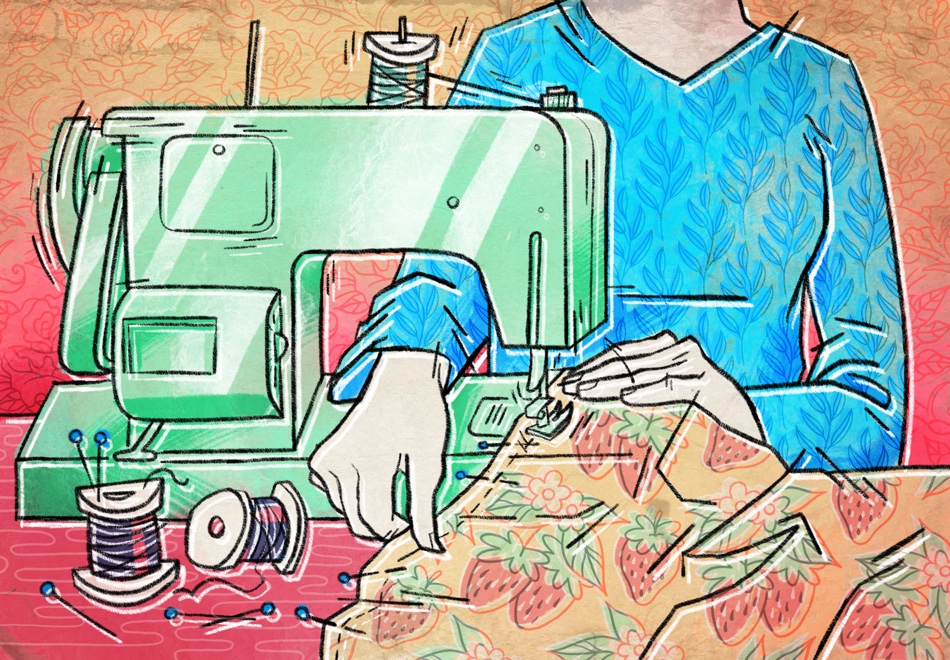
“Sylvia Plath loved to sew,” began my therapist’s email, some weeks after I attended our appointment wearing a freshly completed Wiksten Haori. She was referring to a New Yorker story by Dan Chiasson about Plath’s last letters, published in a new volume that includes correspondence either suppressed or ignored in previous edits of Plath’s work. I skimmed the article, which was full of the misdeeds and mysteries related to Plath’s short life; the posthumous tailoring of her output to protect the reputations of her surviving family, most notably, her husband Ted Hughes.

But I read with deep interest of Plath’s “new & exciting” sewing hobby, which I too had fallen hard for. “Plath had none of the leisure for contemplation that we associate with male writers,” writes Chiasson. “Her muses were economy, thrift, and the clock.” One day, “cowlike and cabbagey” after Frieda’s birth, Plath went downtown and “bought three 2-yard lengths of material” and a Simplicity sewing pattern.

It’s, well, funny to receive an email from a steward of one’s mental health pointing out the hobby of a poet associated quite closely with her suicide. But it articulates something about Plath that I’ve long struggled to reconcile in my own understanding of depression—namely the ease with which a chronic condition can feel like the thing one is, rather than a quality through which, at a given time, one might pass. As a person prone to variable periods of anxiety and depression, it reminded me that Plath had access to joy and optimism, perhaps even deepened by her knowledge of despair. Plath, despite the mental distress she presented so brutally in The Bell Jar, still found pleasure in buying fabric and sewing patterns and making dresses for her daughter. Sylvia Plath loved to sew. I also love to sew.

Based on little more than a wish to make my own ridiculously wide pants, I learned to sew at age 14 from a jocular nicotine chimney named Don. A towering ginger with red plastic glasses that dangled from a cord around his neck, I attended Don’s teen sewing class every Thursday, where I was often the only student, and usually stayed for the adult class that directly followed. When I try to remember what I learned in that class, I think it was mostly how fun it was to be with Don, who didn’t so much teach sewing as do our sewing for us. He helped me buy my first (and only) sewing machine: an unbreakable Janome RX18S that’s gone hard for twenty years, never more than in 2019. The light bulb hasn’t even burned out.

I stopped sewing for a very long time, doing it mostly when pants required shortening. Then, last winter, I found myself in a mentally deranging period of work-related stress. Riven with anxiety, I drifted into the Toronto fabric stores I had first discovered as a Modrobes-horny kid: King Textiles, with its sign-tossing sentry bellowing FaBrIc SaLe! at the corner of Queen and Spadina, as he has since the beginning of time. Affordable Textiles, which it is, and World Sew Centre, where they would check whether a fabric was cotton by setting a scrap of it on fire. Fabric stores are subject to an uncommon entropy. Somehow, twenty years later, they all look, smell, and sound the same. These stores, due to the dampening factor of all the fabric bolts, have an uncanny lack of acoustics. Someone talking to you from six feet away will appear to be on mute, lip-synching to nothing. That kind of quiet is healing.

My first item of clothing sewn and completed this year was a stretch velvet t-shirt that a friend of mine had requested. It took me a month to make it, a very simple garment, ultimately overworked and clumsily finished. But when it was, I felt the clearest form of happiness I’d experienced in years. As 2019 began, I was full of ideas, revived curiosity, absolutely hectic with interest in YouTube pleating demos and vintage Issey Miyake sewing patterns on Etsy. I hung a pegboard to organize my growing collection of tools; acquired a self-healing cutting mat and a rotary knife and a tailor’s ham and a seam gauge and a point turner and a blind hem foot—accessories that grew from the projects that I was teaching myself to do. I repeated the brand names aloud for their absolute non-descriptness: Dritz. Olfa. Brother. Singer. I bought a heavy Black & Decker iron that has seared the flesh of my inner arms with its point multiple times, causing a minor airshow of little pink triangles that I dab with Lucas’ Papaw Ointment. One piece of advice to any sewer: get a good steaming iron. The heavier, the better.

The passionate assumption of a hobby led, in my case, to spending money on things that I convinced myself I needed. As spring approached, I worried that my desire to sew and sew and sew was producing waste I could not defend, even with my happiness. So I took a break from the peaceful glut of the Queen West fabric stores and began thrifting old quilts and bed linens; learned to dye them with synthetic and eventually natural pigments—indigo, osage, madder, goldenrod. Adding iron to most, if not all natural dyes will darken the shade, a process known as saddening.

As stories like Natalie Kitroeff’s investigation into Fashion Nova’s laissez-faire exploitation of their workers, or Uniqlo’s refusal to pay $5.5 million in wages to workers after the sudden closure of an Indonesian factory emerge, the ethics of fast fashion continue to shape how we evaluate the clothes we choose to wear. I can’t say that I started my obsession with sewing this way, but seeing how long it takes me to make a pair of shorts produces a visceral understanding of just how undercompensated most overseas—and in the case of Fashion Nova, domestic—garment workers are.

Very often as I am writing something, I will rise from my keyboard, moving to the corner in the back of my apartment where my sewing machine, my new overlock machine, my shears and bobbins and French curves are all in a state of readiness. Within minutes my iron is hissing and I am cutting out a shirt or a dress. Sewing is slow but steady. Its products grow from the fibrously small into something that you can button up or down. I will just as quickly rise from my sewing machine and walk back to my computer to type something that entered my brain while hemming a sleeve. It becomes appealing to look at a Word doc as something tactile and slow growing. Distracted by the certainty of a garment, my mind is free to write without the smothering observations of ego. And so I type it quickly, before I can decide that it sucks. I feel most at peace while traveling between one machine and the other, because I know I will have something exact to do when I arrive at either.

In university, I did an interview with the playwright and mathematician John Mighton. In that conversation, he told me that he taught himself to write by taking apart the poems of Sylvia Plath. I have nothing new to add about Plath, the writer. I admire Ariel and The Bell Jar and thinking too much about her life as I mostly know it makes me sad. But thinking about Sylvia Plath, the seamstress, makes me happy—because I know how happy sewing makes me. Something soft to lay her hands on. That Mighton found her poems to be worthy garments to learn from is apt, although any and all writers can be treated the same. Isn’t that how we all teach ourselves to write? Take it apart; see how to hide or show the seams as the one you love did.

In the past year, my sewing has improved vastly, to the point that I now know how much of an amateur I still am. I have made jackets and coats and skirts and pants and curtains and dresses and a baby-sized version of Bjork’s swan dress. I’ve gotten faster and better, and then smug, and made mistakes that require hours of fixing that sometimes can’t be fixed. If my mood is low, the task of threading a needle is a momentary sideline from a feeling that might otherwise darken me completely, iron in the dye bath. Sometimes that is enough, and mostly, as this new decade approaches, I find peace in enough.

As described in her letters, Plath’s goal was to publish enough poetry to buy her own sewing machine. “I am awfully proud of making clothes for little Frieda,” she wrote in her letters, which prompted more poetry, writes Chiasson. “She wrote the poems that allowed her to buy the machine, which, in turn, shows up in a poem.”

Is this love then, this red material
Issuing from the steel needle that flies so blindingly?
It will make little dresses and coats,

It will cover a dynasty.

20 Dec 22:02

The Year in Clouds 2019

by Jason Kottke
Sarah

some beautiful clouds

Clouds 2019

Clouds 2019

The NY Times shares a selection of cloud photos taken by members of the Cloud Appreciation Society. The photos above are by Rod Jones & Jeanette Brown.

Clouds, their manifesto says, are not signs of negativity and gloom, but rather “nature’s poetry” and “the most egalitarian of her displays.”

If you follow me on Instagram, you know that I’m a bit of a cloud nerd myself (e.g. see my Sun & Clouds Story). My favorite cloud pic I took last year (and perhaps even of all time) is this shot of some cumulonimbus mammatus clouds at sunset after a thunderstorm.

Clouds 2019

That was a surreally beautiful evening and I felt lucky to have witnessed it. (thx, michelle)

Tags: clouds   photography
19 Dec 13:53

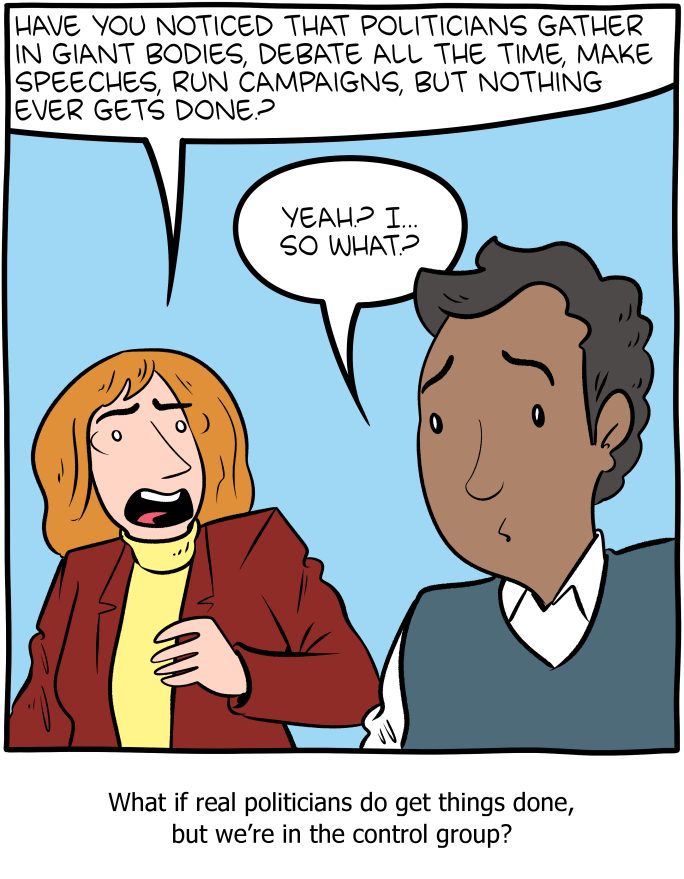
Saturday Morning Breakfast Cereal - Politics

by tech@thehiveworks.com
Sarah

oh no


Click here to go see the bonus panel!

Hovertext:
Well, I picked a weird day to post this.


Today's News:
11 Dec 23:58

The Embroidered Memory of the Berlin Wall

by Jason Kottke

Diane Meyer Berlin

Diane Meyer Berlin

For her series called Berlin, artist Diane Meyer embroiders the Berlin Wall back into modern-day scenes of the once-divided German city. Meyer hand-sews the thread right onto the photographs.

In many images, the embroidered sections represent the exact scale and location of the former Wall offering a pixelated view of what lies behind. In this way, the embroidery appears as a translucent trace in the landscape of something that no longer exists but is a weight on history and memory.

(via colossal)

Tags: art   Berlin   Berlin Wall   Diane Meyer   photography
11 Dec 01:04

The “Harbinger Customers” Who Buy Unpopular Products & Back Losing Politicians

by Jason Kottke
Sarah

whoa

Colgate Foods

This paper, about the curious phenomenon of “harbinger customers” and “harbinger zip codes”, is really interesting. These harbinger customers tend to buy unpopular products like Crystal Pepsi or Colgate Kitchen Entrees and support losing political candidates.

First, the findings document the existence of “harbinger zip codes.” If households in these zip codes adopt a new product, this is a signal that the new product will fail. Second, a series of comparisons reveal that households in harbinger zip codes make other decisions that differ from other households. The first comparison identifies harbinger zip codes using purchases from one retailer and then evaluates purchases at a different retailer. Households in harbinger zip codes purchase products from the second retailer that other households are less likely to purchase. The analysis next compares donations to congressional election candidates; households in harbinger zip codes donate to different candidates than households in neighboring zip codes, and they donate to candidates who are less likely to win. House prices in harbinger zip codes also increase at slower rates than in neighboring zip codes.

It’s fascinating that these people’s preferences persist across all sorts of categories — it’s like they’re generally out of sync with the rest of society.

Perhaps the most surprising aspect of the harbinger customer effect is that the signal extends across CPG categories. Customers who purchase new oral care products that flop also tend to purchase new haircare products that flop. Anderson et al. (2015) interpret their findings as evidence that customers who have unusual preferences in one product category also tend to have unusual preferences in other categories. In other words, the customers who liked Diet Crystal Pepsi also tended to like Colgate Kitchen Entrees (which also flopped).

(via bb)

Tags: politics
07 Dec 19:33

Roslindale getting two thrift stores; one replaces a smoke shop, the other's a transplant from Allston

by adamg
Sarah

RIP

The new Treasures on Washington Street.

Treasures, a thrift and antique shop, opened today at 4266 Washington St. in Roslindale Square, in the space where the Boston Smoke Shop used to be.

Meanwhile, workers today were converting the space where the Grossman's bargain outlet used to be at 630 American Legion Highway into space for Urban Renewals, which will be moving there from its current location on Brighton Avenue in Allston - which Dustin J.S. Watson reports closed for good yesterday.

No more yellow Grossman's:

New home of Urban Renewals

The strip mall the store will be in already has a number of dollar and discount shops.

The move, however, is disappointing some of its Allston customers, who really have no easy way to get to the new location. Driving from Allston to that stretch of Roslindale (OK, almost anywhere in Roslindale) can take awhile and while it's theoretically possible to get from Allston to there by public transit, the bus that runs down American Legion Highway only runs once every 45 minutes or so even at rush hour, and not at all on Sundays.

The two stores join Roslindale's existing thrift shop - the Home for Little Wanderers Thrift Shop of Boston on Corinth Street in Roslindale Square.

27 Nov 21:32

415 Hours of East German Home Movies from 1947-1990

by Jason Kottke
Sarah

saving this so I can look for Trabants

Open Memory Box

Open Memory Box houses what they say is the largest digitized collection of home movies from East Germany. The 415 hours of footage was filmed between 1947 and 1990 by 149 different families, who captured scenes of what it was like behind the Iron Curtain. Here’s one of the few videos they’ve posted to YouTube (the rest are presented on the site with a custom video player):

Some interesting searches are Trabant, sports, Berlin, China, and Brandenburg Gate. Light NSFW warning…East Germans went about in the nude more often than one might have guessed. Also, a lot of the footage has a huge watermark over it, which can make it difficult to focus on the actual subject matter.

Tags: Cold War   East Germany   video
25 Nov 18:55

Quote of the day: Garance Dore on influencer culture

by Disneyrollergirl
Sarah

I wasn't ever a huge Garance fan, but I do feel this piece. The fashion scene just isn't interesting anymore--it's just people wanting to turn themselves into brands. Boring

Garance Dore

“For a few seasons, I had been seated with all the new influencers on the front row, which was, to be honest, a quite dreadful experience. As individuals, everyone on the front row was so nice. But the fight for power was exhausting, empty and ridiculous. I had also run out of stories to tell. But I wanted to be a good girl, so I pushed, pushed and pushed. And then, the day before the Chloé show, in my bedroom surrounded by designer clothes, I broke down. I started crying, and I couldn’t stop. I had tried to talk to friends about these feelings that I’d been having for years. All I would hear back in response was, “You have a dream life, don’t let it go.”

Garance Dore, CNN

Not everyone is going to love Garcance Dore’s fashion industry takedown, but as a first-gen blogger I can relate to her story on CNN. (Bryanboy on the other hand is less sympathetic.)

WORDS: Disneyrollergirl / Navaz Batliwalla
IMAGE: Garance Dore
NOTE: Some posts use affiliate links and PR samples. Please read my privacy and cookies policy here

CLICK HERE to get Disneyrollergirl blog posts straight to your inbox once a week
CLICK HERE to buy my book The New Garconne: How to be a Modern Gentlewoman

23 Nov 13:10

'I Thought the World Needed to See Prince's Pages': An Interview with Dan Piepenbring

by Chantal Braganza

There’s a series of selfies in the middle of The Beautiful Ones (Spiegel & Grau), a book that began as Prince’s memoir, that has more than once brought me to tears. Nineteen at the time, Prince takes photos of himself in a red pullover and denim micro cutoff shorts, with matching red leggings layered underneath them. His expression suggests someone who is testing out how they want to be seen.

“I took this picture of the heater and I, in the bathroom window. mirror. (soRRy) (Sorry!)” reads the back of one. They present a slightly unsure version of Prince, unlike anything I’ve ever read or seen about him, I first think, until the last shot. He gazes through the camera with one eye, at the mirror—his audience—with the other, his left hip hiked up and right hand fanned out, fingers adjusting the lens. A fake hand creeps out of the crotch of his shorts. Hilarious, tender, an unexpected gut punch. Prince had always known who he was, even when he was searching.

Dan Piepenbring was supposed to help the American music icon tell a story that included these versions of himself by collaborating with him on his memoir. A 29-year-old online editor at The Paris Review who had never written a book at the time, being chosen for the job seemed extremely unlikely—and extremely like something Prince, a longtime hero of Piepenbring’s, would do. But only three months and barely thirty pages into their work together, Prince died from an accidental fentanyl overdose, revealing a largely concealed opioid addiction and cutting the project short.

This means that The Beautiful Ones could not be a memoir, and should not be read as one. There is Piepenbring’s story of meeting and working with Prince, and such stories are a genre of Prince lit unto themselves. There are the pages Prince himself wrote, which reveal that many of the stories he told about himself through his art weren’t fiction. And then there is the archive: reproductions of photographs, drawings, original song lyrics, even equipment rental receipts found in Paisley Park after Prince’s death. 

I spoke to Piepenbring about how one takes those three threads and turns them into a book. 

Chantal Braganza: This book exists through two almost-didn’ts: the sheer improbability of being chosen to co-write Prince’s story, and his death, after he’d written only 28 pages of material. How do you press on after a start like that?

Dan Piepenbring: It was tough, and not the natural thing to assume would happen. After he died, and I had his pages in my possession, I thought the world needed to see them. I was biased on that count, having had this amazing experience with him. And of course, a lot of skepticism greeted that. Because it’s not an unfinished memoir; it’s a barely-started memoir. And I think for almost anyone that would be disqualifying.

But because it was Prince, and because he was so shrouded in mystery, and because he had done the writing himself—and it was in a quiet, deliberately domestic way so revealing of him—I think that there was a much greater chance of us to carry on.

Prince commanded complete control over his output. This book is transparent about how it came to be, but what do you imagine Prince would have thought about the decision to continue without his input?

I can’t put any words in his mouth and I wouldn’t want to. I know that those pages he wrote, he was very proud of. He read them to friends, and he would talk about my conversations with him to others who were close to him at that time. So, I felt comfortable putting them out. Especially because so much of what we talked about involving his parents did come from his desire to correct the record about them, and to correct this mystery-ing of Purple Rain as autobiography.

I hope he’d be happy with the book. I’d never want to come outright and declare that he’d be happy with it—that’d be wrong. For all I know there’d be parts of it he didn’t want out. Parts of it he’d be dismayed by. There’s no saying.

The rest of the book is derived from material you were able to review from his estate. What kind of an archivist was Prince?  

One of the reasons my editor and publisher and I thought there would likely not be a book is that we expected him to have kept very little. He was someone that, for the majority of his life, would say that he had no interest in exploring his past. He would always say that his favourite album was the one that was about to come out. We were shocked to find not only that he had kept some reminders of his past, but that he seems to have been a very conscious documentarian of his own life. 

But then, when you think about The Vault, this fabled storage area for all of his music, maybe it wasn’t so surprising. I feel like, with Prince, there was always a cancelling-out. Anything you were surprised by you could step back from and look at another way, and find made sense.

What’s it like to edit his writing?

It was great, because he’s a great writer! You can really see, like in the economy of his lyrics, a songwriter’s talent for elision. It really came through in his prose. And best of all, his sense of humour was in such abundance there. And I think that sense of mischief he ascribed to his mother is everywhere in his prose. 

After he died, I didn’t want to change anything. To do that without having him to sign off on changes would be wrong. But he was receptive to the few criticisms I offered. They boiled down to one thing: I felt he would do well to slow down and expand some of these themes that he had very carefully dredged up from his past. They felt raw to me. Even though he had given them the comic treatment I could tell there was more he remembered that hadn’t gotten to the page yet, and if he had gone back to that well he would be able to draw up so much more.

People talk about a writer’s voice. Not so much about an editor’s. What was yours in the making of this book?

I wanted to tell the story as plainly and as openly as I could, because I felt that if I did anything less people would wonder what had given me the authority to do this book. In addition to serving as a final profile of Prince, the introduction had to make a case for the book existing at all and project the final vision of the unfinished book that would exist in parallel with the thing you’re actually holding.

I knew I wanted to avoid any sort of obituary-style critical writing. That I wanted to avoid the feel of something summative or interpretive. That I just wanted the events to speak for themselves. 

Did you ever think much about the idea of meeting one’s heroes before doing this?  

I’ve been approached by movie producers about turning our introduction into a film. Which, I think, would be terrible. I don’t want to do that. The one I always reach for in comparison is The End of the Tour.

In college, around the same time I was listening to a lot of Prince, I was also reading a lot of David Foster Wallace. Which is probably the most expectable thing that someone like me can say, but it’s true. But other than that, I hadn’t really given it much thought, because of the sheer unlikeliness of it. It really is a fantasy construct. Usually, when you see it on TV or movies, it’s this imagined thing. It was dramatized once in Prince’s case. He had gone on this episode of New Girl with Zooey Deschanel. And he was responsible, if memory serves, for resolving this conflict between two lovers and getting them to declare their love for one another.

Yes! I’ve seen the episode…a few times.

Yes! It’s great. He’s said that music is healing, and this is the perfect example of that. My experience was much less scripted and doesn’t have the five-act frame of a sitcom episode, it really wasn’t all that different, in terms of the sheer surprise of it and the fact that it worked out very well. Everyone says that the line about meeting your heroes is that you shouldn’t do it. That they’re going to disappoint you. And it wasn’t true in my case. 

It could have been. He was known as a fickle man and he may have decided he didn’t want to do the book, or that he didn’t want to do it with me. There’s a number of things that could have gone wrong. But even had it never come to fruition, his presence really was inspiring. I still struggle, through all the interviews I’ve had to do for this book, with how to articulate it. But it was so ineffable in a way. He was so devoted to making you feel at ease and giving you a sense of accomplishment that even someone with confidence would not have necessarily had. It seemed like he was using his stature for the best possible good.

12 Nov 13:36

Must Read: Instagram's Decision to Hide 'Likes' Is Good for Influencers, Brands Are Beginning to Phase out Leather

by Rania Bolton
Sarah

Sharing primarily for that dumb tiny bag

These are the stories making headlines in fashion on Monday.  Instagram's decision to hide 'likes' is good for influencersInstagram is implementing a new policy that would remove likes from being displayed publicly, though the user would still be able to see the number of likes generated by ...

Continue reading

11 Nov 23:08

Saturday Morning Breakfast Cereal - Coffee

by tech@thehiveworks.com


Click here to go see the bonus panel!

Hovertext:
This is how he has learned to love his commute.


Today's News:
11 Nov 23:05

Where to Eat Burritos in and Around Boston

by Terrence B. Doyle
Sarah

Sharing so I can remember to go to Cha Cha Cha in Everett next time I want a burrito

Corn, black beans, and red pepper pieces spill out of burrito on a dark wood surface. A red pepper and cilantro sit in the background. Amelia’s Taqueria burrito | Amelia’s Taqueria/Official Site

Sorry: Chipotle didn’t make the cut

Anecdotally, Bostonians often complain about the city’s dearth of good Mexican and Tex-Mex food. While it might not be a destination for Mexican food like Los Angeles or San Francisco or El Paso or, you know, Mexico, Boston’s definitely got some good spots for burritos (Bostonians just might not be looking hard enough.)

From tiny little carts hawking lunchtime burritos inside train depots to mom-and-pop-neighborhood-joint-cum-local-taqueria-juggernauts, there are plenty of spots in and around the city to snack on a tasty burrito. Here are 18 of the best places to do so in Greater Boston.

This map was originally published on November 30, 2017; it is updated periodically, and the date of the most recent update appears above.

01 Nov 16:58

A list of stories set in a future now past

by Austin Kleon


Good morning. We can now add Blade Runner to the list of stories set in a future that is now past.

24 Oct 22:29

Finishing Rita’s Quilt

by Jason Kottke
Sarah

I love this so much. I have a box of perfect quilt squares a mother of one of my mom's former co-workers gave her

Shannon Downey regularly goes to estate sales to buy unfinished embroidery projects and then completes them — “there’s no way that soul is resting with an unfinished project left behind”. At a recent sale, she found a quilting project begun by a woman named Rita who had recently died at the age of 99.

Ritas Quilt

Downey doesn’t quilt but wanted to finish the project, so she asked her Instagram followers for help. Hundreds of people volunteered. Read about the progress of the project so far here on Twitter or keep up with it on Instagram at #ritasquilt. (via @nhannahjones)

Tags: Shannon Downey
21 Oct 16:48

Out of Town News to become a place to sit in Adirondack chairs or something

by adamg
Sarah

attn Andy

Cambridge Day reports Cambridge is giving at least temporary control of the soon to be emptied Harvard Square newsstand to a group that promises a series of pop-up events to make the space a "community living room," at least until something more permanent is slotted into the kiosk. Adirondack chairs are part of the short-term plans.

18 Oct 23:01

Copley Place Barneys to close after all

by adamg
Sarah

Wonder if we're going to get 2008-9 level of good TJ Maxx finds from this (RIP Filene's Basement)

WABC in New York reports that Barneys New York now plans to shut all of its stores as it sinks further into bankruptcy. The Back Bay store had initially been one of the outlets that would stay open. The news means we'll never see the planned Freds at Barneys restaurant, let alone the Bettys at Barneys womens' accessories shop or the Mr. Slate at Barneys quarry-supplies depot.

Latest Barneys bankruptcy filing, which lists the Boston location under "closing stores" (11.4M PDF).