Shared posts

15 Jan 13:56

A Supercut of Sterling Archer’s Best One-Liners

by Justin Page

UPROXX Video has created a great seven-minute supercut video of Sterling Archer’s best one-liners. The season five premiere of Archer aired on FX Monday, January 13th, 2014.

As we close in on the Archer Season 5 premiere, it only seems fitting to pivot our coverage from what will be happening this season to why we fell in love with the show to begin with. And nothing says that like a supercut of all the awesome things Sterling Archer has said through four seasons of being the world’s premiere womanizing alcoholic super spy.

14 Jan 18:53

Why is everyone disappointed by Google buying Nest?

by Nilay Patel

Google's bombshell $3.2B acquisition of connected-home company Nest Labs makes simple sense on paper: Nest CEO Tony Fadell says he'll gain the ability to scale his business without worrying about cash or infrastructure, while Google gets a company at the leading edge of the difficult smart-home market and a team skilled in building well-designed products that combine hardware, software, and services. (And how: before Nest, Fadell and co-founder Matt Rogers led the iPod and iPhone teams at Apple.) It's a win-win, and Nest's investors sound ecstatic. "It's a fantastic return," Lightspeed Venture Partners' Peter Nieh told The Wall Street Journal.

But outside of the players directly involved in the deal, there was a second, more visceral reaction: disappointment. Nest was the first in a new wave of hardware startups built by engineers and executives eager to apply their experience building smartphones to new markets — a mission captured perfectly by Fadell's irrepressible upstart spirit in interviews and appearances. But by selling Nest seems to have undercut the optimism those companies represented, and perhaps not coincidentally, underlined a growing distrust of Google itself — a distrust shared by regular consumers, tech investors, and privacy advocates alike.

I *really* don’t get why Google acquiring Nest makes sense for either Google, Nest, or any of either customers or investors in any way.

— Thijs van der Vossen (@thijs) January 14, 2014

Although Fadell says Nest will remain mostly independent, with its own identity, team, and even offices intact, it will most certainly become a part of Google. "It's somewhere between YouTube and Motorola," Fadell said yesterday, describing two of the search giant's more famous acquisitions. Motorola has remained almost completely independent, "firewalled" away from Google's Android team, while YouTube has become more and more integrated over time — with a recent outpouring of anger when its comment system was tied to the niche Google+ social network.

Now Nest can just raise the temperature of people's homes until they join Google+.

— David Strauss (@DavidStrauss) January 14, 2014

So what will happen to Nest? Fadell called any speculation "totally premature" yesterday, but that hasn't stopped customers from worrying — and most seem to think Google will "ruin" Nest in a variety of ways, with Google+ integration standing in for a host of potential sins. Others worry that Nest will fall victim to the ongoing platform war against Apple, although Fadell says the company will continue to support iOS.

@davidhfe Spite is not illegal.

— John Gruber (@gruber) January 14, 2014

Still others wondered, perhaps a bit facetiously, if Nest would become yet another in a long line of companies acquired by Google in a flurry of hype only to disappear years later.

If Google's honest about not peeking at Nest user data, that means it's gonna shut it down and stripmine the tech for new google gadgets.

— Rob Beschizza (@Beschizza) January 14, 2014

Bummed to hear about Nest. I liked their products and assume they will eventually be shuttered like everything else Google buys.

— justin severson (@_js) January 13, 2014

Viewed at a distance, the reaction is similar to Avis buying Zipcar: the fear that a slower, less innovative giant will kill the spirit and pace of a beloved startup. The difference, of course, is that Google is itself one of the richest and most innovative companies in the world. That it carries even the whiff of a lumbering giant is odd — especially since for tech investors, the Nest deal smacks of coldly efficient dominance.

Consumers aren't the only ones feeling some angst over Google's purchase of Nest. Yesterday's news caused a big question to boil up among Silicon Valley venture capitalists. How do you play the game when Google is one of the biggest investors in tech and also one of the biggest buyers of tech startups? "The purchase of Nest was a big win for us, of course," said one of the company's investors, who asked to remain anonymous. "But at the same time you have to wonder, could this company have been 10 times bigger had it continued to go things on its own?"

can Google Ventures be trusted to keep its founder interests separate from its backers?

Entrepreneurs face a similar pickle. Google has said that its venture arm is completely independent from core business, but that always seemed like wishful thinking, and yesterday's purchase will only strengthen the perception that taking an investment from Google Ventures ties a startup closely to Google itself. "It sends some really mixed signals," said another Nest investor. An entrepreneur might look at this and see the upside: an investment from Google Ventures means an acquisition by Google is more likely down the road. But for the truly ambitious entrepreneurs who want to take on tech titans like Google and Facebook the question now is, can Google Ventures be trusted to keep its founder interests separate from its backers?

There is no way Google is going to be able to resist doing something with the data collected from Nest thermostats/smoke+CO detectors

— Brian Klug (@nerdtalker) January 13, 2014

The question of trust is perhaps most important of all. Fadell once described the Nest thermostat to me as nothing more than an on / off switch with a lot of nuance — nuance gained by collecting huge amounts of data about your living patterns and energy needs. Adding that data to Google's formidable collection of information about nearly everyone who uses the internet struck immediate fears with privacy advocates and a growing base of skeptics who contend Google's ad-supported business model creates an anti-privacy culture.

Watch what happens when Google aggregates your online data tied to a location to what is going on physically in your home via Nest.

— Randy Picker (@randypicker) January 13, 2014

And the timing wasn't great for the counterargument: hours before the Nest announcement, Google clarified that a controversial plan to let Google+ users easily email nearly anyone on Gmail would be more private for "high-profile" users. It's another in a long string of confusing messages about privacy from Google, and the Nest team did little to alleviate the concerns.

give Google the chance to acquire more data, and it usually will

Co-founder Matt Rogers wrote that the company "takes privacy seriously," and that its privacy policy limits the use of customer data to "providing and improving Nest's products and services." But those services could arguably be improved by integration with other Google products, and the implications are unclear — give Google the chance to acquire more data, and it usually will. Fadell wouldn't rule out future changes yesterday. "At this point, there are no changes to our terms of service, and that's it. That's all I can say."

It’s a shame Apple didn’t buy Nest. I feel much more comfortable when the business model is built around selling hardware. Not the data.

— Moshen (@paranoidroid) January 13, 2014

It's a strange set of affairs: an innovative young company led by some of the best engineers and executives in the business being acquired and validated by one of the great American businesses of the past 20 years should be a slam dunk of good PR. Instead, there's a chorus of concern — some sincere, some contrived, but all of it grounded in fear of an unchecked Google.

Additional reporting by Ben Popper
13 Jan 14:34

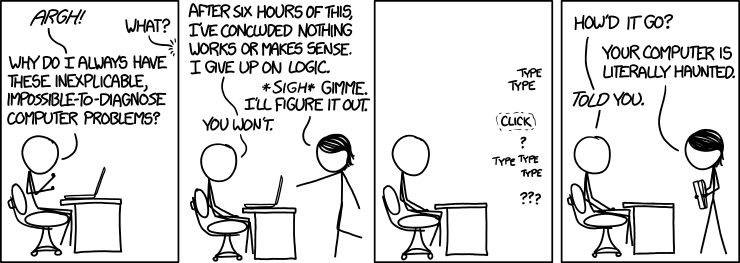
Inexplicable

'It has a ghost in it. Take it back.' 'No.'
09 Jan 06:09

American Silent Library with Jimmy Fallon

by Chauncey Plantains
Here's an American version of the popular Japanese game show Silent Library.
08 Jan 18:58

Photos

I hate when people take photos of their meal instead of eating it, because there's nothing I love more than the sound of other people chewing.
07 Jan 16:31

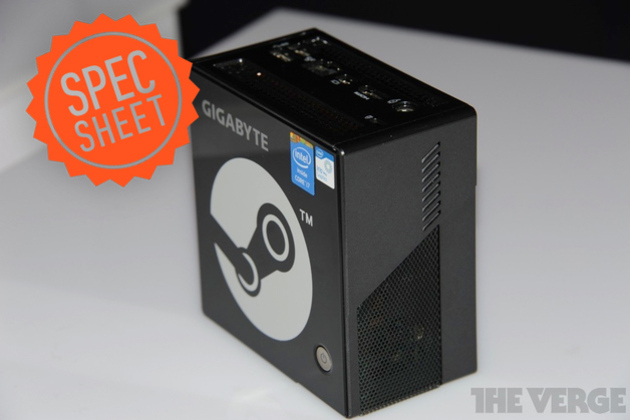
Spec Sheet: the highs and lows of the first 13 Steam Machines

by Jacob Kastrenakes

Valve's Steam Machines are reinventing the game console by transforming daunting PCs into friendly boxes for the living room. But rather than make the machines all by itself, Valve has turned to hardware partners to create a whole lineup of them, from basic consoles priced like an Xbox all the way up to towers that just barely veil their gaming PC roots.

Yesterday we got a peek at what 13 of the very first of those Steam Machines will look like. Their prices range from $499 all the way up to $6,000, putting Valve's goal of a diverse ecosystem on the right track. But there's still the question of what that will get you. We're taking a look across the broad spectrum of Steam Machines to see if there's a legitimate alternative to the Xbox and PlayStation, and what you'll get for buying something that costs well over twice their price.


Lc
Click any of the images in this article for all available specs on the Steam Machines.

There's plenty of power to be had even at $499

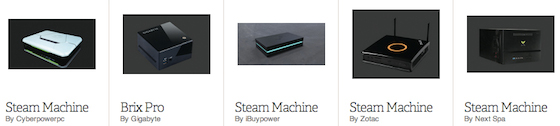
Most of Valve's hardware partners are making lower-cost machines that are designed to compete with Microsoft's and Sony's game consoles on price. That includes machines from CyberPowerPC, iBuyPower, Next Spa, Zotac, and likely Gigabyte as well. In general, those machines include Intel Core i5 processors, 8GB of RAM, and a mid-range, desktop-class GPU like Nvidia's GeForce GTX 760. None of the manufacturers have fully detailed their specs yet, but from what they've shown, the machines' internals appear to be on par with — if not slightly better than — the graphical power we've come to expect from the latest generation of game consoles.

Buying a sub-$500 Steam Machine will still be a bit more complicated than picking up an Xbox or a PlayStation, though. While you can easily buy a box that's ready to go from a manufacturer, you'll have to choose which manufacturer's hardware you want. That's particularly tricky in many situations, as they each make different tradeoffs to get their prices so low.

One tradeoff is in how these machines focus their power: most machines at this price range use a fairly capable discrete graphics card, while others choose to eschew that and place their money in a faster CPU with a built-in graphics solution. Those integrated graphics have gotten surprisingly powerful in recent years, but they're rarely a match for a standalone card. Choosing discrete graphics may be the safe solution, but gamers who want to buy in at this level will have to make a choice between those philosophies.

Mr

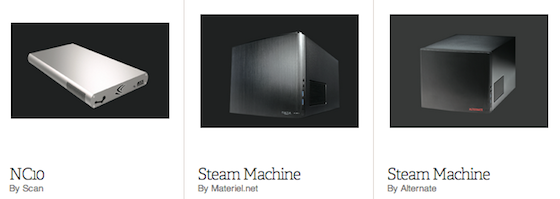
Stepping up to just above $1,000, there are even more decisions to be made. While all of these machines should be able to run modern games at 1080p, you'll have to select between different form factors and different components within them. Steam Machines from Material.net and Alternate paint the picture clearly: they come in nearly identical bodies, yet they offer different internals. It's not immediately obvious how much better Alternate's $1,399 Steam Machine will be than Materiel.net's $1,098 machine either, and you'll probably want to decide how much their different components will do for you before spending more or less money than you should.

Options open up at $1,000 and above

The $1,000 range also sees differences in form factor. While those two machines are industrial-style cubes that'll likely take up some real space on your desk, Scan's NC10 uses mobile components to create a sleek and low-lying option. Mobile components usually don't perform as well as comparably priced desktop components, which may give buyers looking at the NC10 pause. But once again, the choice isn't so simple. As we've seen multiple times, the NC10's GPU, the GeForce GTX 765M, isn't just capable — it's downright powerful for its class.

He

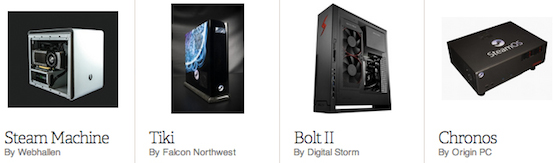
As boutique gaming PCs tend to, Steam Machines get vastly more complicated as their prices rise toward $2,000 and beyond. These are imposing machines reaching toward the heights of performance, and with SteamOS installed, they could end up giving enthusiast gamers who were never quite ready to dive into PCs a way to start playing on a high-end machine. At this point, you aren't just choosing between components anymore — you're choosing between elaborate options like ventilation systems that keep the machine running quiet and custom finishes on the case too.

What will a $2,000 Steam Machine do with all of its power?

Of course, you could just build your own gaming PC and probably save good money in the process, but when you're looking for a premium machine, price isn't always the first priority. These high-end boxes from Falcon Northwest, Digital Storm, Webhallen, and Origin PC could also be the perfect match for a high-end living room setup. If you're looking to pump out content in 4K, you'll want a machine like this to do it.

But whether you'll actually want to dedicate so much power to a Steam Machine is another question. There aren't any games on SteamOS that are demanding enough to really take advantage of this level of performance just yet. Valve is certainly confident that they'll come, but it's a gamble that could be worth waiting on.

Even with their limited game library and unproven OS, Steam Machines are already looking enticing. By taking after their Windows-gaming counterparts, manufacturers have been able to quickly turn around great-looking machines and offer plenty of options. But while there was never much doubt that manufacturers could find existing PC gamers to look over their higher-end machines, we now know that some manufactures think more casual gamers could be interested in their hardware too — and that low-cost hardware might just cut it for SteamOS gaming.

06 Jan 15:08

The pill that might give you perfect pitch by altering your brain

by Rich McCormick

Takao Hensch, professor of molecular and cellular biology at Harvard University, believes that absolute pitch — the ability to identify or sing a specific note without any reference points — is a learned ability, normally only acquirable by humans in a "critical period" early in our lives. In the past, Hensch and other scientists believed, if we missed the window and hadn't gained the ability to pick out or produce a note at will by the time we were around seven years old, we wouldn't ever be able to master the skill as adults.

But a new study co-authored by Hensch claims that a drug gives humans the ability to learn perfect pitch, long after that critical period has closed. Hensch says that when applied to a group of test subjects, valproate — a mood stabilizer more commonly used to treat epilepsy — returned the brain's plasticity to a "juvenile state," allowing it to learn skills it should be too old for.


Until now there have been "no known reports of adults acquiring absolute pitch"

Research had previously shown that adult mice given histone-deacetylase inhibiting drugs (HDAC inhibitors) could "establish perceptual preferences that are otherwise impossible to acquire after youth." To test whether this connection also existed in humans, Valproate, another HDAC inhibitor, was given to a group of healthy young men with no musical training. The men were then asked to perform a set of exercises for two weeks with the aim of improving their pitch while another control group was asked to perform the same exercises, but given a placebo.

The drug could be used to help learn languages

According to the study, those subjects given valproate learned to identify pitch "significantly better than those taking the placebo." Hensch calls the results remarkable, telling NPR that until now there had been "no known reports of adults acquiring absolute pitch." The implications of the study aren't limited to learning how to sing beautifully: by altering brain plasticity, users of valproate could conceivably learn other skills normally picked up during the early critical period. Hensch picks out language learning as an obvious area of application for the drug.

But he also cautions against its widespread use before the neuroscience behind it is understood. "Critical periods," the professor says, "have evolved for a reason." By reopening the critical period, Hensch says we may run the risk of erasing the identities we've shaped by the way we were raised, accidentally replacing important portions of our personalities.

06 Jan 09:01

Siri's a little jealous of Scarlett Johansson in 'Her'

by Bryan Bishop

Siri used to deliver some rather opinionated takes on sci-fi movies, and while those have largely been left behind it turns out the digital assistant has some strong feelings when it comes to Spike Jonze's recent film Her. The movie tells the story of a man who falls in love with an operating system named Samantha (Scarlett Johansson), but as BuzzFeed first noticed, asking Siri if she is Samantha results in a terse "no. You know that it's just a movie right?" Different phrasings result in Siri taking shots at how Her "gives artificial intelligence a bad name" and how she "doesn't spend much time with fictional characters." We were quite fond of Her when we reviewed it last year, and it will be opening wide on January 10th — but in the meantime, it's pretty clear how Siri feels.

Sirisnark_560

06 Jan 08:20

Major Lazer and Snoop Lion Pokébattle in a pixel art music video

by Aaron Souppouris

Snoop Lion's crossover to reggae-pop with Reincarnated may have met with mixed reviews, but perhaps one thing everyone can agree on is his gaming-inspired music video for "Get Away" is a triumph. The video pulls you into a pixel art world inhabited by Snoop and Major Lazer, the track's producer. After battling for Pokémon supremacy, the duo team up to battle a pair of malevolent speakers in a side-scrolling shooter, all to the sound of one of Major Lazer's pumping bass lines.


31 Dec 04:15

Chromebooks overtake Android tablets and Macs in US business sales

by Jon Fingas

Estimated US retail computer sales

Chrome OS is at last gaining some momentum -- among US businesses and schools, anyway. The NPD Group reports that Chromebooks represented 9.6 percent of all computing devices sold through American commercial channels in 2013, or enough to surpass the market share of Android tablets, Windows tablets and MacBooks. Google's rise put the squeeze on traditional computers, which dropped from 77.8 percent of the commercial space in 2012 to 63.7 percent this year. NPD researchers don't believe that the PC is going away, but they note that the most successful companies diversified their gadget lineups. Samsung's combo of Android and Chromebooks helped it jump to 10 percent share of commercial sales in 2013, while PC-focused builders like HP took a bruising; it's clear that one-trick ponies won't thrive in the workplace for much longer.

NPD's top personal computing brands in 2013

Filed under: Laptops, Tablets, Mobile, Apple, Samsung, Microsoft, Google

Comments

Via: Electronista

Source: NPD Group

29 Dec 08:08

Tumblr | 61e.jpg

61e.jpg
26 Dec 10:30

LG's HomeChat will let you command its latest smart appliances via SMS

by Steve Dent
Yousef Alnafjan

This is so creepy

LG really, really wants you to have a good chat with your washer/dryer and robotic vacuum cleaner. It just announced you'll soon be able to use the Line messaging app and a new service called HomeChat to give natural language commands to its 2014 Smart Appliance lineup. If you tell the system "I'm going on vacation," for instance, it'll put your refrigerator into power-savings mode and program the robotic vacuum cleaner. The app will also update you as to what's in the fridge, show a history of your robotic vacuum's cleaning trips and recommend recipes via the smart oven, to name a few other features. LG also announced NFC tagging and smart diagnoses for its upcoming smart appliance lineup, a scheme that'll help you avoid unnecessary repair visits, download new washing machine cycles and more. All of this will arrive in the flesh at CES 2014, but if you're interested, maybe avoid seeing Maximum Overdrive in the meantime.

Filed under: Internet, Software, LG

Comments

Source: LG

26 Dec 10:29

Photo


25 Dec 05:10

This is what Miiverse was made for ⊟ When they’re...

by ericisawesome


This is what Miiverse was made for ⊟

When they’re not breaking your heart, random Miiverse messages are always great for a laugh. Credit to DaCo for the pic.

BUY Super Mario 3D World, upcoming releases
24 Dec 08:46

wannyy: This was actually uploaded to PornHub. That’s how good...


wannyy:

This was actually uploaded to PornHub. That’s how good it was. Just saying.

23 Dec 07:02

Hot mod: Cyanogen raises another $23 million to become the next big version of Android

by Casey Newton

The effort to turn CyanogenMod into the next big mobile operating system just got a big new vote of confidence. The company announced today that it has raised an additional $23 million, led by Andreessen Horowitz, to add staff and improve its distribution around the world. The series B round, which comes on top of $7 million that the company closed in April, shows that investors are betting the world is clamoring for a different take on Android. “Mobile has really just begun,” says Kirt McMaster, Cyanogen’s CEO. “Apple, Google, and Samsung have not won. Although it seems like they’ve won, it’s still early days.”


There’s some data to back up the big talk: CyanogenMod now has 11 million active users, up from 8 million in September, and that counts only those who have elected to share data with the company. The true number of CyanogenMod users is already in the tens of millions, says Andreessen partner Peter Levine — and that’s despite some significant distribution challenges. One guide for installing CyanogenMod on your Android smartphone lists 23 steps; the company released a one-click installer this fall, but was forced to remove the companion app from the Google Play store after Google said it violated the store’s terms of service. Licensing issues also mean that a freshly installed Cyanogen ROM doesn’t come with Google apps or the Play Store — users typically have to search online forums for links to those apps and install them via PC. These are all significant hurdles to mainstream adoption.

Cyanogen now has 11 million monthly active users

So where’s all the growth coming from? Initially, Cyanogen’s custom ROM found favor with hobbyists in the United States and abroad who preferred it to the often bloated versions of Android promulgated by carriers. The ROM strips Android down to a near-stock version while customizing it with a new camera app, secure messaging, and access to thousands of themes. It has also proven a godsend to owners of older devices who are abandoned by their carriers.

But Cyanogen has also found favor with Chinese smartphone manufacturers. Xiaomi’s MiUI operating system is based on Cyanogen, for example, and Oppo’s N1 is shipping with CyanogenMod preinstalled. Emerging markets have begun to embrace it as well, particularly in India, where merchants are flashing used smartphones with the latest version of Cyanogen and reselling the devices. And it has begun to announce its first device partnerships, where Cyanogen is preinstalled on the phone.

The task now is to make Cyanogen more appealing to the mainstream. “We have to figure out a way to cross the chasm and get into the mass market,” McMaster says. “For that to happen, we have to do some things that are different.” Late next year, Cyanogen plans to unveil a new consumer brand. Among other things, it will be easier to say than “cyanogen.” The company is also working on what McMaster calls “signature experiences” — features no other operating system can offer. (The company won’t say what it’s working on, but the offerings will include “some things that scream out, like, ‘Fuck yeah,’ that’s really awesome,’” McMaster says.)

An installer that personalizes your phone

And while some see the Cyanogen installer as a hurdle to adoption, McMaster sees it as a potential benefit. The installer can evolve into software that personalizes your phone the moment it updates your firmware, so that when it restarts your device will be populated with custom wallpaper and apps you are likely to enjoy. But McMaster is likely understating the challenge: replacing a phone’s firmware can be difficult and risky. The reason Google wanted the Cyanogen installer app out of the Play Store is that installing it can void the warranty of many smartphones — something most mainstream users would rather not risk.

Now McMaster will begin rapidly expanding his team of 20, which is split between Seattle and Palo Alto. He plans to hire between 40 and 50 people over the next nine months — “enough to start doing some real damage,” he says." He says he is also confident that the one-click installer will return to the Google Play store; he has been in contact with Google to begin discussions.

And if investors are worried about the company’s relationships with Google, they’re not showing it: previous Cyanogen investors including Benchmark Capital and Redpoint Ventures also invested in this round, as did Chinese tech giant Tencent. In a blog post accompanying the announcement, Levine likens Cyanogen to Linux Red Hat or Windows — operating systems that thrived by being independent of hardware. “Software is eating the world, Android is eating mobile, and we think Cyanogen only just finished their appetizer and is moving onto the entree,” he says. But Red Hat may be a telling example — consumers’ appetite for it never matched its makers’ ambitions, and it ultimately pivoted into an enterprise offering. If Cyanogen doesn’t become easier to use, that entrée may prove to be out of reach.

19 Dec 11:31

pazzojinn: princessrosalina: this makes me so...


pazzojinn:

princessrosalina:

this makes me so uncomfortable

It’s so wrong, yet it feels so right.

19 Dec 09:51

'Pulp Fiction' and 24 other classics added to US film archive

by Vlad Savov
Yousef Alnafjan

"I hid this uncomfortable hunk of metal up my ass for two years... And now, little man, I give the watch to you."

The US Library of Congress has today revealed its 2013 selection of 25 movies it will be adding to the country's National Film Archive in recognition of their "great cultural, historic or aesthetic significance." The highlight of that bunch is Quentin Tarantino's Pulp Fiction, an expletive- and violence-laden tale of interconnecting storylines and dark humor that never aspired to be as great as it turned out to be. The director's initial intent was to create a pastiche of film noir and the comic books he grew up reading, but in the process of remixing the old he came up with a resoundingly fresh and visceral experience. Evidently, it's resonated with serious and sober critics just as much as it has with audiences over the years.

Michael Moore, another unlikely candidate for Congressional recognition, also figures on this year's list with his first ever documentary, 1989's Roger & Me. More predictable choices include 1964's Mary Poppins, 1966's Who's Afraid of Virginia Woolf, and The Magnificent Seven, a 1960 western remake of the Japanese classic Seven Samurai.

16 Dec 19:02

joshbyard: Google’s Machine Learning Algorithms Outpacing...


joshbyard:

Google’s Machine Learning Algorithms Outpacing Engineers’ Ability to Understand How they Work

“Google no longer understands how its “deep learning” decision-making computer systems have made themselves so good at recognizing things in photos.

What stunned [Google Software Engineer] Quoc V. Le is that the software has learned to pick out features in things like paper shredders that people can’t easily spot – you’ve seen one shredder, you’ve seen them all, practically. But not so for Google’s monster.

Many of Quoc’s pals had trouble identifying paper shredders when he showed them pictures of the machines, he said. The computer system has a greater success rate, and he isn’t quite sure how he could write a program to do this.

Google researchers can no longer explain exactly how the system has learned to spot certain objects, because the programming appears to think independently from its creators, and its complex cognitive processes are inscrutable. "

(via The Register ht algopop)

16 Dec 07:25

cutbu: read more comics


cutbu:

read more comics

16 Dec 01:35

'House of Cards' season 2 trailer: the butchery begins

by Aaron Souppouris
Yousef Alnafjan

TOR finally adds a "Send To" button. Rejoice!

After last week announcing House of Cards season two will premiere February 14th 2014, Netflix has released a full trailer hinting at the story arcs for the new season. The trailer comes just hours after the political thriller was nominated for four Golden Globes.


14 Dec 06:07

You won’t believe what these 8 heartthrobs from the ’90s are...

by ericisawesome


You won’t believe what these 8 heartthrobs from the ’90s are playing ⊟

You know you’re a ’90s kid if you can name all these shows, right. All my TRUE millennials know what I’m talking about with that Parker Lewis Can’t Lose jam. Shout outs to all the TGIF peeps out there with crushes on JTT, Ian Ziering, and Estelle Getty.

Most of these shots are courtesy of TV on Television, with a couple grabbed from 90210 Stupid and liniboy6969.

YOUR REACTION? OMG/WTF/LOL/OLD/FAIL/THAT’S SO LIZARD

BUY Game Boy games, upcoming releases, our holiday gift guide
11 Dec 13:07

Plex on the Chromecast! It’s Official.

by elan

Do you remember where you were when Google announced the Chromecast?

I do. I was in our online chatroom hanging with the Plex crew when the news broke. We realized immediately that the diminutive little dongle and Plex would be a match made in heaven. We simply couldn’t imagine an easier (or cheaper) way to fling your media onto every big screen in the house. The entire team ran off to buy Chromecasts immediately, and soon we were shipping extras to our colleagues who didn’t manage to buy them before online stores ran out.

I’m happy to tell you that over the last few months, we’ve been working closely with Google to bring Plex to the Chromecast. It’s an honor for us to be among the first handful of apps on the device, and it’s been great working with Google – we’ve never met a smarter or more energetic group of people to work with.

One of the most interesting aspects of adding Chromecast support to Plex was integrating it with our existing support for remote players and remote control. We wanted to make sure that the user experience across Plex players, AirPlay devices (from iOS), and Chromecast devices was both seamless and rich, and we took the opportunity to greatly enhance our own remote control support in the process. You’ll notice a much better experience when flinging media or remote controlling all our players, including Plex Home Theater, the Roku, Windows 8, iOS, Android, and of course our web player.

The Chromecast platform itself is super cool; the device runs the Chrome browser, and each “application” is essentially a web page that the controller apps talk to. This is a really flexible model, as it allows for arbitrary sorts of applications on the big screen (one of Google’s examples is a Tic-tac-toe game).

We’re excited to be launching today with support for Chromecast on iOS, Android, and on the web! We have support for video, and we’ll be releasing support for casting photos and music very shortly. Note that for an initial period, the Chromecast feature is only available to our beloved PlexPass users, who get exclusive access to many new features.

Make sure you have the latest media server installed, and go have fun with your Chromecast! And if you use Android, make sure you have the latest Plex for PlexPass release or download it from our forums.

 
Screenshot 2013 12 06 23 34 01 2013 12 06+22 40 06

 2013 12 06 at 9 59 PM

Did you know Barkley is a huge fan of the Chromecast? Well, now you do. And he’s picky about his consumer electronics, too.

 Image

The post Plex on the Chromecast! It’s Official. appeared first on Plex Blog.

09 Dec 06:32

Quadrocopter drone recovers from failures without skipping a beat (video)

by Jon Fingas

ETH Zurich's failproof quadrocopter drone

Quadrocopter drones are capable of some incredible acrobatics, but they seldom handle failure all that gracefully. ETH Zurich's Mark Mueller is tackling this problem through a new failsafe algorithm that gives these flying robots a better chance of survival. As you'll see in a video demo after the break, the software automatically compensates for rotor failures, bringing a drone back to its original position before giving the owner an opportunity to land the craft. Mueller's routine works even when there's just one propeller left, and it could eventually avoid dangerous objects on the way down. While there's no mention of when the algorithm will reach copters outside of the lab, there's a patent on the way -- we'd expect it to reach production drones at some point in the future.

Filed under: Robots

Comments

Via: Gizmodo Australia

Source: Flying Machine Arena, Robohub

05 Dec 17:40

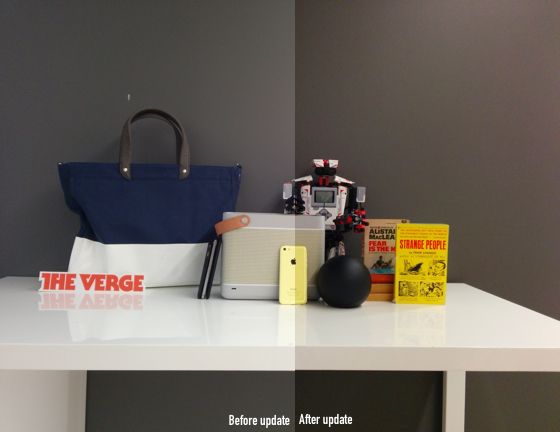
Fixing the Nexus 5: with a new version of Android, Google tackles the camera

by David Pierce

Only a few years ago, Dave Burke remembers, cellphone users were just happy to have a camera at all. But expectations have changed. "If you have a smartphone, people want it to take pictures like a DSLR. Even in one year the quality bar and expectation bar has gone up higher and higher. Internally, ours have too. I think we can do better, and we are."

As he says this, Burke, Google's Director of Engineering for Android, is walking through all the changes Google has made to the Nexus 5's camera in the five weeks since the phone hit the market. The fruits of the Android team's efforts is Android 4.4.1, the update rolling out over the next few days that is designed to fix the buggy, inconsistent camera on what is otherwise one of the best Android phones on the market.

Fixing autofocus fixes a number of other problems, too

The changes break down in five categories, Burke says, autofocus first among them. Mixing speed and image quality requires a fragile balance, particularly in low light, and Android 4.4 skewed too far toward image quality. "There’s a tendency to say, 'oh, we have this cool thing that stabilizes, so lets make the shutter time longer, reduce the gain even longer, and get better shots.'" But while the Nexus 5's optical image stabilization allowed it to get better-than-average shots in low light, in good lighting it just made for frustratingly slow shooting speeds. By speeding up the framerate and increasing how quickly the camera can read its surroundings and fire a picture, Burke and his team improved the autofocus, the exposure, and the white balance. "You fix the motion blur," he says, "and make everything faster."

Img_20131204_095806-560

Speed is a theme for the update, and the Nexus 5's camera really does feel faster across the board. The app launches a full second quicker than it did before the update, meaning you'll miss many fewer shots than before. There's also a new progress indicator in HDR+ mode, which makes the process, longer by necessity, feel a lot more straightforward. It's the first of what Burke says will be a series of interface changes, as Google tries to make Android cameras a little more controllable and obvious. Right now, nearly every setting is buried under layers of menus, and Burke says Google is working on undoing that.

In only five weeks, Google massively upgraded the Nexus 5's camera

But even now, after just five weeks of work, the Nexus 5's camera has been massively improved. We've only had a day with the software, but the changes are clear. Before, there were shots you simply couldn't get — I learned to not even try with fast-moving subjects, especially in low light, but now a picture of the New York City skyline out the window of a taxi is crisp and in focus, even if it's not quite as sharp as on an iPhone 5S. The Nexus 5 just inspires confidence in a way it never did before. It doesn't take six tries to get a picture in focus, because the camera doesn't re-focus again as soon as you hit the shutter. It just fires, and far more often than not gets a crisp, clear photo.

Tablecompare

Photos are a little more contrasted, too, with slightly more vibrant colors. Burke says this was an intentional change, that "we just wanted to make photos pop a little more." The effect occasionally goes too far, with reds and oranges exploding off the screen, but for the most pictures look lively and accurate.

There's more work to do, both in performance and in software

There's still plenty of work to be done, of course. The camera app desperately needs a one-touch way to focus and capture an image, for one thing: moving your hand from focusing to firing doesn't cause blur the way it used to, but it still means you'll miss quick-moving subjects. Photos can still come out looking over-processed, and focusing in low light still takes a while. Burke says his team is working on "tuning the edge cases," too, making sure the camera can function properly in strangely lit situations.

With Android 4.4.1 on board, however, the Nexus 5's camera stops being a dealbreaker — it's not the best smartphone camera, but it's a camera you can use confidently and expectantly knowing that it will almost always deliver. It may not take the perfect shot yet, but rarely offers anything but a completely usable one. Burke says it's only going to get better, though he admits there's a lot to do. "Cameras can be pretty complicated," he says.

04 Dec 16:38

Starred Items!

We’re excited to announce that starred items are now live in The Old Reader.  This has been one of the most requested features and something we’ve felt belongs in the application for a long time.  Hotkey (f) and API support are also available.  Starred items will automatically be sent to pocket for users that have it activated.

As most of you know, our focus over the past few months was to increase performance and stability of The Old Reader.  We’ve made tremendous strides and can now focus on adding functionality and making this tool a long-term sustainable platform built for the Open Web.  The best is yet to come.

Thanks for using The Old Reader!

(www.catgifs.org/2013/09/07/cat-surprised-cat-animated-gif/)

04 Dec 08:45

I Don't Own a TV

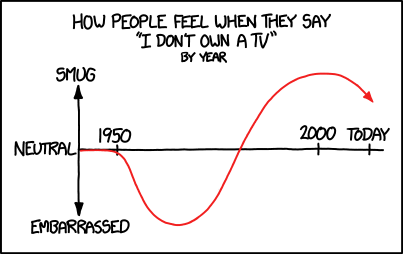
Theory: Smugness is proportional to the negative second derivative of TV ownership rate with respect to time.
04 Dec 07:14

Comic #124- Signatories

by Tyler Rhodes

03 Dec 09:17

Nvidia Shield update lets you stream PC games to your TV in 1080p

by Andrew Webster
Yousef Alnafjan

Nvidia easily justified my purchase with their excellent support.

When Nvidia released the October software update for its Shield handheld, it said that the ability to stream PC games at 1080p and 60 frames per second was coming — and now it's finally here. The handheld's December update brings the ability to stream 1080p, 60 fps PC games to your television using the device's console mode and an ethernet connection; previously the Shield could stream PC games smoothly at 720p. And a number of big titles already officially support the feature — you can play new releases like Assassin's Creed IV: Black Flag and Battlefield 4, as well as slightly older titles like Bioshock Infinite and Borderlands 2, while Nvidia says that more officially supported games will be added weekly. If you have the necessary equipment, it's a solid addition to a rapidly improving device, and great news for those who picked up a Shield for cheap on Black Friday.

S_pzkn2d40pvch8v4a8pjo5h05c0hyesiqpprt9m-ai

03 Dec 05:31

Nvidia could give Shield the power of a gaming PC with Grid streaming technology

by Sean Hollister

About a year and a half ago, the excitement around cloud gaming all but disappeared. Sony bought GaikaiOnLive collapsed, and Nvidia's GeForce Grid partners failed to materialize in the United States. The idea was that you could give any old smartphone or tablet limitless gaming power by actually running the games on server farms, then stream them like a YouTube video. It seemed like an idea ahead of its time, but it actually worked — and now, Nvidia appears to be testing the waters of cloud gaming once more.

Today, the company launched an extremely limited beta of Nvidia Grid, a new cloud gaming service exclusively for the Shield. It only works if you live close enough to the company's single data center in San Jose, California. It requires a good internet connection and a fancy wireless router. It's just a test, to be sure.

But if you have all the necessary components in place, you might be surprised at just how well Grid works.


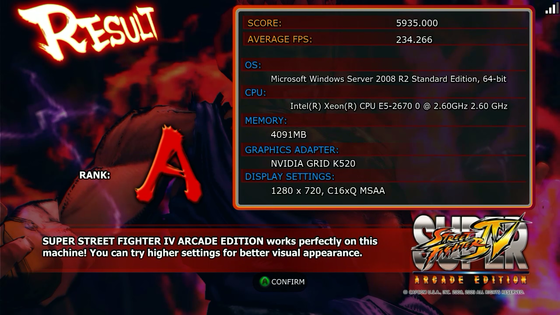
We've used both OnLive and Gaikai, and as of today Grid easily trumps both. Despite running at the same 720p resolution, the images are clearer, without nearly as much artifacting, and the controls are more responsive. Games look better and are more playable than any cloud gaming system we've tried before — which is to say that they're actually playable — and they look worlds better than any Android game that the Shield can play with its own Tegra chip. While audio still isn't perfect — the report of a gun lags behind your trigger pull — the lag of the shot itself is barely perceptible. Overall, it looks and feels about as good as playing games on a console.

Of course, the issues with cloud gaming in the past have had less to do with how well it works and a lot more to do with how well it scales: how close people need to be to your data centers, and how many data centers and server racks you need to give lots and lots of users a satisfactory experience. Ten miles from Nvidia headquarters and with what appears to be an entire miniature supercomputer at our disposal, things unsurprisingly look great.

20131202-15315756--screenshot_2013-12-02-12-20-29

But sadly, Nvidia couldn't tell us if the company even plans to turn Grid into a product, or under what circumstances Nvidia would consider the test a success. Product manager Andrew Fear tells us that the company just wanted to see how Grid might perform with a couple thousand users, merely wanted to see if the Shield would be a good device for cloud gaming. "We felt like Shield was a smaller device, with a smaller set of users that we could control," he explains.

"We want to run it for a period of time, test it, learn from it, see if it helps us improve our hardware and software and figure out what to do after that."

"Literally, this is just our trial," says Fear. "We have nothing to announce."

A lot of trouble for a tiny test

Still, it seems like Nvidia's gone to quite a bit of trouble for what Fear claims is just a test. The company's already asking for users to tell the company where it should expand the beta next, and even has a dedicated webpage where users can watch the service roll out — if it ever does. The company's customer support site has been fleshed out with over 30 different articles to help users understand how things work, and the company already has eight games available to play during the beta period, including Street Fighter x Tekken, The Witcher 2, and Red Faction: Armageddon. The company says it plans to add more.

If you do qualify for the extremely limited beta, Fear says you should be able to play through the eight games for free. Though you can only play for two hours at a time, Fear says the trial will last at least three months and the company has no plans to delete your save games during that period. And if you aren't close enough to San Jose, you can always stream games to the Shield the way Nvidia originally intended: by hooking up your own beefy gaming PC.