Bitcoin appears to meet the definition of an energy-backed currency proposed by the famed American inventor during the interbellum period.
Bitcoin appears to meet the definition of an energy-backed currency proposed by the famed American inventor during the interbellum period.
Editor note: Japan had two different military programs working on developing an atomic bomb. The movie reviewed here only discusses one of the programs. Japan’s attempt to develop nuclear weapons was much more successful than imagined, click here and read What If Japan Had the Atomic Bomb First? For more details.
Review by Kaori Shoji
“Gift of Fire (Japanese original title: Taiyo no Ko)” proffers an unsettling view from an old and familiar window. Directed by Hiroshi Kurosaki, the gist of this story set in the summer of 1945, is this: just weeks before Japan’s surrender in WWII, a team of graduate students at Kyoto University were hard at work on the creation of a nuclear bomb. While this piece of information may not be news to many western historians, the majority of the Japanese are bound to feel baffled. For generations, the Japanese were conditioned – by our elders, by the media, by the education system and history itself, to feel that we were the victims of a war that very few in the populace ever wanted to fight. And now a Japanese movie is saying we could have been the perpetrators of the world’s first nuclear bomb attack? That’s an incredibly heavy load to process, and still more to confront.

After all, Japan had banked the struggle of the postwar years and the rapid growth era that followed it, on Hiroshima and Nagasaki. The horrors that happened on August 6th, 1945 in Hiroshima and then, a mere 72 hours later in Nagasaki, were recounted through generations and revived in the media more times than anyone could count. It was a legacy of suffering, a collective mantle of unspeakable sadness under which the Japanese toiled and labored for decades to come.
At the same time, the two bombs exonerated the Japanese from having to explain and face up to wartime atrocities – the crimes committed in Korea, China, Singapore and pretty much the entire Asian Pacific Rim. Call it the a-bomb card, pulled out when the Koreans or Chinese got noisy about acknowledgement and reparations for war crimes. And whenever the Japanese people protested against the econo-centric measures of the government that irredeemably polluted oceans and mountains and quashed the livelihoods of millions of traditional workers. For seventy plus years, the a-bomb card served Japanese politicians, their politics and the national conscience. We suffered enough, now leave us alone.
But “Gift of Fire” says it may be about time to turn in that card.

The Kyoto University lab was under close scrutiny by the Imperial Army and the scientists were pressed for results. If and when they succeeded in splitting the atom, the plan was to drop the bomb on San Francisco. The students were plagued by doubts and filled with anxiety, and who can blame them. Nightly air raids, frequent power outages and utter lack of resources prevented their experiments from moving forward when all the while, they were listening to American news on a hand-crafted short wave radio. The Americans were closing in on the Japanese Imperial Army though the propaganda reports from the frontlines said otherwise. “Should we even be doing this, in the comfort of a laboratory? Shouldn’t we be fighting and giving our lives to this country?” says one anguished student, who eventually quits the project to enlist in the Imperial Army.
The truth was, the Kyoto University team lacked everything to build anything, let alone a weapon of mass destruction. Still, they forge on, fueled by a blind hope that an atomic bomb will change the course of the war or even end it. Besides, says Professor Arakatsu, the helmer of the project: “if we don’t build it the Americans will. And if the Americans don’t get there first the Soviets will. Why do you think this war started in the first place? It’s because the world is in a race to procure energy resources. Whoever gets control of the energy, gains control over the world.”
By saying that, Arakatsu has shifted the concept of war from ideology and nationalism to science and technology. Fittingly, “Gift of Fire” is mostly devoid of sentiment and righteousness, preferring instead to sanctify the scientist and all that he stands for. In Arakatsu’s laboratory, scientific advancement is a religion, and the god at the altar is Albert Einstein. The highest prayer of course, is E=mc2. The film marks the first time a Japanese film has addressed the atomic bomb from a scientific standpoint, and bringing in an American voice to the proceedings. Kurosaki persuaded Peter Stormare to appear in a voice-only role that defends, honors and ultimately glorifies the scientific mission.
Perhaps that voice belongs to Shu (Yuya Yagira) who is the most committed member in Arakatsu’s lab. Shu is responsible for procuring the much-needed uranium for their experiments, and turns to a local potter for his meager supply. The potter used to make beautiful things, but now he only makes funeral urns. “A lot of people dying,” says the potter matter-of-factly to Shu, pointing to the rows and rows of small white urns turned out in his kiln that day. Shu can only nod, bow and make his exit with the uranium powder stashed in his rucksack. Shu knows that Japan will hurtle toward a terrible defeat unless they can build the bomb before the Americans. At the same time he knows their chances of making that happen are practically zilch. Yet the thought of giving up never crosses his mind. A stubborn work-ethic and an obsessive regard for science dictates Shu’s actions and his MO, like the rest of his team, is to ‘ganbaru (do the best they can)’ until they drop.
Director/writer Hiroshi Kurosaki is a seasoned television director, best known for his work on the NHK morning drama series “Hiyokko, (2017)” which means ‘youngster.’ Kurosaki has a flair for portraying youth and innocence under duress. “Hiyokko” was set in the post war years, with a young female protagonist (Kasumi Arimura) searching for her missing father in Tokyo. Arimura teams up with Kurosaki again for “Gift of Fire” as she plays Setsu, who is Shu’s possible love interest. Setsu, perhaps as a nod to our times, is not the typical docile young woman of wartime Japan. In one scene she lectures Shu and his brother Hiroyuki (played by the late Haruma Miura who committed suicide last summer. The film marks his final screen appearance) about their tunnel vision, exhorting them to look beyond the war and envision a future without violence. In the post-screening press conference Kurosaki said: “I wanted to portray what a young woman must have felt in the final days before the surrender. She’s young and has an intense desire to live and experience life, but death is always there.”
“Gift of Fire” is not without redemption. What permeates the otherwise dark and spartan narrative is the sheer innocence of the characters, especially Shu and Hiroyuki. In their separate ways, the brothers seek closure to a war that had come to define their identifites – Shu by creating the atomic bomb, and Hiroyuki by flying a plane right into an American warship. Defeat may be imminent but neither of them are about to surrender peacefully. “They made mistakes, they’re not heroes,” said Kurosaki. “They are ordinary young men, blundering on and doing the best they can.” Sadly that’s never enough to right a ship gone horribly awry.
END
This is important:
Monsignor Jeffrey Burrill was general secretary of the US Conference of Catholic Bishops (USCCB), effectively the highest-ranking priest in the US who is not a bishop, before records of Grindr usage obtained from data brokers was correlated with his apartment, place of work, vacation home, family members’ addresses, and more.
[…]
The data that resulted in Burrill’s ouster was reportedly obtained through legal means. Mobile carriers sold — and still sell — location data to brokers who aggregate it and sell it to a range of buyers, including advertisers, law enforcement, roadside services, and even bounty hunters. Carriers were caught in 2018 selling real-time location data to brokers, drawing the ire of Congress. But after carriers issued public mea culpas and promises to reform the practice, investigations have revealed that phone location data is still popping up in places it shouldn’t. This year, T-Mobile even broadened its offerings, selling customers’ web and app usage data to third parties unless people opt out.
The publication that revealed Burrill’s private app usage, The Pillar, a newsletter covering the Catholic Church, did not say exactly where or how it obtained Burrill’s data. But it did say how it de-anonymized aggregated data to correlate Grindr app usage with a device that appears to be Burrill’s phone.
The Pillar says it obtained 24 months’ worth of “commercially available records of app signal data” covering portions of 2018, 2019, and 2020, which included records of Grindr usage and locations where the app was used. The publication zeroed in on addresses where Burrill was known to frequent and singled out a device identifier that appeared at those locations. Key locations included Burrill’s office at the USCCB, his USCCB-owned residence, and USCCB meetings and events in other cities where he was in attendance. The analysis also looked at other locations farther afield, including his family lake house, his family members’ residences, and an apartment in his Wisconsin hometown where he reportedly has lived.
Location data is not anonymous. It cannot be made anonymous. I hope stories like these will teach people that.
De kans om de ware te vinden via een datingsite of -app is klein. Bovendien zijn de platforms soms duur en zijn ze lang niet altijd duidelijk over wat ze precies kosten. Dat blijkt uit onderzoek van de Consumentenbond.
Jongeren worden de dupe als er na corona nog steeds veel thuisgewerkt wordt. Tot die conclusie komt Kilian Wawoe, onderzoeker aan de Vrije Universiteit, na onderzoek onder duizenden mensen. Hij schreef er een boek over dat vandaag aan minister Hoekstra wordt aangeboden.
In de coronacrisis zijn we geleid door een relatief kleine groep mensen, zegt Wawoe. Mensen van eind 40 die een koophuis hebben, een eigen werkkamer en voldoende kennis en een netwerk om op terug te vallen. "Het gevaar bestaat dat deze groep het zo gaat inrichten dat het voor henzelf prettig is. De kwetsbare groep betaalt dan de rekening."
Die kwetsbare groep bestaat uit jongeren tussen de 20 en 30 jaar die net zijn begonnen met hun loopbaan. "Die groep is niet alleen op zoek naar contact, maar ook naar kennis, omdat ze nog niet zo vaardig zijn in hun vak. Als je dan thuiszit, hoe kun je dan een vak leren?"
Thuiswerken belemmert de communicatie en dat is vooral voor jongeren een probleem, zag Wawoe. "Jongeren communiceren anders dan veertigers. Waar ouderen het prettiger vinden om te bellen, doen twintigers dat bijna nooit." Het gevolg is dat jongere medewerkers een grote barrière voelen om vragen te stellen aan collega's die niet op kantoor zijn.
Wawoe ziet ook de voordelen van thuiswerken, zoals de afname van de drukte in het verkeer en vooral de files. Maar hij vindt ook dat met jongeren rekening moet worden gehouden. Dat levert volgens hem op de lange termijn niet alleen gelukkigere medewerkers op, maar leidt er ook toe dat jonge mensen sneller hun vak leren.
D66 en GroenLinks werken aan een wetsvoorstel dat erin voorziet dat een werkgever thuiswerken niet kan weigeren, tenzij er een goede reden voor is. Daar is Wawoe op tegen. "Wat je dan krijgt, is dat de groep die het zelf prettig vindt, gaat thuiszitten. Werk is een teamsport, je moet niet alleen denken: wat werkt prettig voor mij. Als de overheid zegt dat iedereen het zelf mag weten, dan gaat het natuurlijk niet goed."

As the COVID-19 pandemic scales down in the United States, debates around the origins of the virus — and speculations that it came from a lab in China, not an animal — rumbled back to life. And they’re diverting attention to the wrong places. Focusing on where the virus came from is a distraction from the rest of the urgent work governments and health agencies around the world need to do in order to end this pandemic and prepare for the next one. We don’t need a consensus on the origins of COVID-19 in order to take steps to strengthen global public health.
That doesn’t mean finding out where the coronavirus came from isn’t important. It’s one of the pieces of information that could give us tools to prevent a similar situation from...

As some of you know already, my Mum died last October after a long battle with advanced cancer. This is a transcript of the eulogy I gave at her funeral in November of last year.
I've been putting off publishing it, in fact, I've put off doing writing of any sort, but now's the time. And you never know, it may help someone else deal with what they're going through with someone they know who has died. After all, we all go through bereavement at some time or other.
+++++++++++++++++++
How lovely to see so many of you here in person and online this afternoon and I thank you all for being here. I'm touched that my Mum meant so much to you.
Hello, my name is Helen and I’m Marie Keegan’s youngest daughter. It’s not an easy job to write a eulogy for one’s own mother, but here goes.
I’ll be honest with you, it’s hard for me to believe Mum’s gone which sounds a bit odd, after all, she was 94 years old and suffering from advanced cancer. Yet she seemed so strong and ever-present.
When speaking to Mum’s friends and relatives, many lovely things were said about her - ‘such a livewire’ ‘so thoughtful’ ‘bright and sparkly’ ‘never any different’ ‘beautifully turned out’ ‘great sense of humour’ ‘strong and determined’ ‘an amazing woman’ ‘formidable’ ‘the best looking girl to come out of Tyldesley’ ‘witty and charming’ ‘easy and interesting to talk to’ ‘elegant’ ‘a great hostess’ ‘a smile to light up a room’ ‘approachable’ ‘interested in others’. Mum was all these things and more. She may have been small in size but she certainly wasn’t small in personality or impact.
Mum came from humble beginnings in Tyldesley in what is now Greater Manchester. She met my father at the age of 15 - my father a coal miner and my Mum working in the coal board office. 10 years later, and after a long engagement, they married and set sail for India where my father had been appointed as manager for a coal mine in the North East India coal fields.
That was an adventure and a half! Their new life in India was a million miles away from post-war life in a Lancashire mining village. Mum loved it, not least having two children, Martin and Jane, but also the friends she made, the trips to Calcutta and their active social life! But after 15 years, it was time to return and start a new life in England.
But all did not go according to plan. Mum was surprised to find that she was expecting me, and speaking to her sister, Betty, confided in her that she really didn’t know what on earth she was going to do with a new baby at her age. My Auntie Betty said, well, it’ll be wonderful. She can look after you when you’re old. Quite the prophecy, Aunty Betty. Mum only shared this memory with me a few months ago. And to be honest, it was a surprise to us both that I should end up being Mum’s full-time carer. Neither of us knew that I had it in me to do it. But what I never told Mum, but now wish I had, was that it was a privilege to be able to do it.
Mum was very well travelled and enjoyed holidays near and far - whether that was a day trip somewhere or a short break with me in Cheltenham or Hereford, long summers spent in the Isle of Man and Ireland, winter months spent in mainland Spain, Majorca and Portugal or trips further afield to South Africa and Florida. Most of these trips involved a lot of walking - coastal paths, hill climbs, tramping through fields and half overgrown footpaths. Mum and I spent a lot of time together on our feet and as we'd walk, we'd chat and admire the views and Mum would tell me what all the different flowers and plants were that we passed along the way. Mum's knowledge of plants was really impressive.
Mum was always very smartly dressed, well turned out with perfect make-up, pink lipstick and a spritz of lovely perfume. She always had great taste and great interest in clothes and shoes and she enjoyed shopping. When I was a little girl, Mum would drag me around the shops, and I'd end up sitting on the floor in the dressing room at Russell and Dorrell in Worcester whilst she tried on what seemed like an endless array of clothes asking me what I thought of them. And then afterwards treating me to a toasted teacake in the cafe there. This trend continued well into Mum's old age with regular trips to House of Fraser and the local TK Maxx. Mum always loved a good sweater! I hope some of her excellent taste and style has rubbed off on me.
One thing that did rub off on me was Mum's penchant for bargain hunting. I seem to have Mum's knack for spotting a yellow sticker in the food aisle in Marks & Spencer or a sale rail in the fashion department at 50 paces.
And where do you wear all your nice clothes? Why, at a party. And there were lots of those in Mum’s life. Mum loved to dance the night away starting in her younger years in Lancashire, to glamorous parties at The Grand Hotel in Calcutta in her thirties, to corporate dos at The Dorchester in London or a Riverboat Shuffle in Worcester in later years. And when there weren’t dinners or dances to go to, there were dinners and parties at home and Mum was a great hostess. I remember there were many late nights when the grown-ups would be listening to the likes of Shirley Bassey, Frank Sinatra, and Barbra Streisand. And sometimes I'd have to come downstairs to ask them to turn it down as I couldn't sleep!
But it wasn’t all socialising and glamour. Mum was also very down to earth, practical and gave her time to others. She volunteered in charity shops in Worcester and in the Isle of Man and also helped out at school and parish fundraising events. She did the flowers at Church with her friend Noreen. She looked after her neighbour Herta when she became terminally ill and became her carer. She befriended one of the Mums at my primary school who was having a lot of trouble with her husband and took her under her wing to help her sort herself out. Even in her 90s, Mum would pick up a bit of shopping for her friend who was younger than her but clearly didn’t have her stamina. Not forgetting how much she loved to spend time with all her family too.
Mum also liked to keep up to date with current affairs - be that the news kind or the kind that happens on TV in Coronation Street or Last Tango in Halifax. Until Mum’s sight failed her, she would read the Telegraph most days and always did the crosswords - both the quick and the cryptic. I can still only manage a few cryptic clues before giving up. But not Mum. She even completed the Telegraph cryptic Crossword a few days before she died. If I tell you nothing else about Mum, she would want you to know that she was still doing the cryptic crossword right up until the very end.
Spending all this time with Mum over these last few years has taught me much about life and love, just by being with her, listening to her and observing how she lived. The easy way which Mum could talk to anyone and how she treated everyone the same, whether you’re a corporate bigwig or a part-time waitress in a cafe, is an example to all of us. The way Mum could make and keep friends anywhere and everywhere and have a genuine interest in their lives. Mum could find out someone’s life story within a short time of meeting them - that's a skill I don’t have but I’m working on it. Mum’s gratitude at the smallest thing and the way she was touched by small kindnesses is something we could all learn from. And Mum’s memory! She could remember small details about people - their lives, conversations they’d had, time spent together, birthdays and anniversaries. Even right up to the end. Incredible.
Mum’s faith was also important to her and we spent time praying together every day. And I can’t help but admire Mum’s strength and fortitude. She used to say that old age isn’t for the fainthearted. She’s not wrong.
But what I learned most of all from Mum, especially in these last few months, is about love. After my father died, I remember telling a close friend that although it was very sad that he’d died, and I missed him terribly, it had allowed me to get to know and to fall in love with my Mum all over again. And I’ve enjoyed seven and a half years of that and I wouldn’t swap that for the world.
My goodness, she was one of a kind, that Marie Keegan. I know everyone says that about their Mum, but I really mean it. Her love of life and love of living was extraordinary. She was so sad when she realised she wasn’t going to make it to 100 and there would be no telegram from the Queen. She really wanted to just keep going. But by her own admission, what a life she had led. Full of joy and laughter and filled with love given and received.
Daughter, sister, wife, mum, Grandmother, Great grandmother, auntie, cousin, neighbour and friend. Mum loved us - her friends and family - and will continue to be loved and remembered with great affection by all of us.
Marie is joining those who have gone before her including my father, Terry, her sister Betty, and her brother in law Tommy. I imagine they are having a great party up there - Sinatra on the record player, my Dad pouring the drinks, Uncle Tommy telling the jokes and Mum and Aunty Betty dancing the night away, but this time no-one is telling them to turn the music down.
Oh, I have an awful lot to live up to, Mum. You’re a hard act to follow, all right, but I’m going to do my very best.
As you used to say to me every night before you went to bed, and as I say to you now, Mum, ‘thank you, thank you, goodnight and God Bless’.
Analyzing cryptocurrency data, a research group has estimated a lower-bound on 2020 ransomware revenue: $350 million, four times more than in 2019.
Based on the company’s data, among last year’s top earners, there were groups like Ryuk, Maze (now-defunct), Doppelpaymer, Netwalker (disrupted by authorities), Conti, and REvil (aka Sodinokibi).
Ransomware is now an established worldwide business.
Slashdot thread.

Enlarge (credit: Getty Images)
High-performance computer networks, some belonging to the world’s most prominent organizations, are under attack by a newly discovered backdoor that gives hackers the ability to remotely execute commands of their choice, researchers said on Tuesday.
Kobalos, as researchers from security firm Eset have named the malware, is a backdoor that runs on Linux, FreeBSD, and Solaris, and code artifacts suggest it may have once run on AIX and the ancient Windows 3.11 and Windows 95 platforms. The backdoor was released into the wild no later than 2019, and the group behind it was active throughout last year.
While the Kobalos design is complex, its functionalities are limited and almost entirely related to covert backdoor access. Once fully deployed, the malware gives access to the file system of the compromised system and enables access to a remote terminal that gives the attackers the ability to run arbitrary commands.
Read 10 remaining paragraphs | Comments
Maxim BangeFinally

Enlarge (credit: Lobanovgo | Getty Images)
In 2010, British designer Harry Brignull coined a handy new term for an everyday annoyance: dark patterns, meaning digital interfaces that subtly manipulate people. It became a term of art used by privacy campaigners and researchers. Now, more than a decade later, the coinage is gaining new, legal, heft.
Dark patterns come in many forms and can trick a person out of time or money or into forfeiting personal data. A common example is the digital obstacle course that springs up when you try to nix an online account or subscription, such as for streaming TV, asking you repeatedly if you really want to cancel. A 2019 Princeton survey of dark patterns in e-commerce listed 15 types of dark patterns, including hurdles to canceling subscriptions and countdown timers to rush consumers into hasty decisions.
Read 9 remaining paragraphs | Comments
This tumultuous year, two things really helped me get through it: my colleagues at Automattic and the community of WordPress.
At the end of the year I usually deliver a speech to the WP community we call the State of the Word, that celebrates what we accomplished the previous year and shines a light on what we could focus on in the coming year. There’s always a great energy in the room and I love mixing with the audience before and after the talk. This year we did it online, which meant we could produce the talk a little more, and we made extra time for the Q&A afterward with answers not just from me but folks across the community.
One thing I’ll call out WordPress 5.6 had an all women and non-binary release squad of over 50 people, a first for WordPress and probably any large open source project. Also the market share of WordPress grew more in 2020 than it has in any year since it started being tracked!
If you’re curious about what’s next for WordPress, check it out:
Earlier this year, I announced that I had joined Inrupt, the company commercializing Tim Berners-Lee’s Solid specification:
The idea behind Solid is both simple and extraordinarily powerful. Your data lives in a pod that is controlled by you. Data generated by your things — your computer, your phone, your IoT whatever — is written to your pod. You authorize granular access to that pod to whoever you want for whatever reason you want. Your data is no longer in a bazillion places on the Internet, controlled by you-have-no-idea-who. It’s yours. If you want your insurance company to have access to your fitness data, you grant it through your pod. If you want your friends to have access to your vacation photos, you grant it through your pod. If you want your thermostat to share data with your air conditioner, you give both of them access through your pod.
This week, Inrupt announced the availability of the commercial-grade Enterprise Solid Server, along with a small but impressive list of initial customers of the product and the specification (like the UK National Health Service). This is a significant step forward to realizing Tim’s vision:
The technologies we’re releasing today are a component of a much-needed course correction for the web. It’s exciting to see organizations using Solid to improve the lives of everyday people — through better healthcare, more efficient government services and much more.
These first major deployments of the technology will kick off the network effect necessary to ensure the benefits of Solid will be appreciated on a massive scale. Once users have a Solid Pod, the data there can be extended, linked, and repurposed in valuable new ways. And Solid’s growing community of developers can be rest assured that their apps will benefit from the widespread adoption of reliable Solid Pods, already populated with valuable data that users are empowered to share.
“Social skills are like any other kind of ability in that they require practice.” Smith writes in the latest edition of her newsletter, Inside Your Head. “And by this point in the pandemic, starved of normal, everyday social interactions — running into an acquaintance on the street, sharing an elevator with a co-worker, or making small talk with a barista — most of us are pretty rusty.”
We’ve already gotten kind of awkward. But over the next few months, with even fewer chances to practice being social in person, we’re all about to get super awkward.
For many years, Apple’s Mac has had a solid run in customers buying computers from Apple. In the last year, Apple has continued to sell over 5 million units per quarter. On the other hand, Windows PC sales dominated pretty much the rest of the market. In the last quarter, according to Gartner, Lenovo sold 18,310 million units, HP sold 15.446 units, and Dell sold 10.827 million PCs. Thanks to demand during the pandemic, Apple sold 5.513 million Macs in Q3, up 7.3% over the same quarter in 2019.
While the Mac has never been a major threat to the big PC makers to date, they still watch Apple closely, especially for any innovations Apple may add to the Mac that might impact the market and, ultimately, their future designs.
But when Apple announced that they have moved on from Intel’s CPU’s to their own, the PC makers have become even more interested in Apple being a potential threat to their PC dominancy.
The biggest reason is that Apple now controls its processor destiny as well as its cost, to a degree. Conservative estimates for a Core i7 processor from Intel cost as much as $80-$90+ per chip. That, along with Apple’s premium pricing model, always kept the Macs well over the same laptop’s price from computers in the Windows camp using the same processor.
For Windows laptop makers, their sweet spot for most of their profits come from making laptops in the $599-$899 range. While they all make Chromebooks priced mostly under $400, margins are slim to none. That is why most of them try to pack as much technology as possible into their laptops in their sweet spot range and market them aggressively. Of course, they all sell even more expensive laptops, but most of the profits and volume come from products in the $599-$899 range.
Apple recently announced a MacBook Air with 256 gigs of storage for $899, the only MacBook to even touch the high end of the Windows PC maker’s sweet spot. But this uses a low-end Intel Core i3 processor and has only eight gigs of memory. Dell sells at Latitude 3510 laptop with an Intel Core i7 processor and 500 gigs of storage for $899.
Apple has invested a great deal in their processor design. Their new A14 Bionic chip is expected to be on some of their laptops, perhaps before the end of the year. Apple has most likely already amortized some of the costs of their designs and using their processors, and they no longer pay the Intel tax.
This shift from Intel to Apple’s homegrown processor has some Windows laptop vendors more worried about Apple potentially threatening their core laptop business. The two price points they are the most worried about, should Apple decide to be more aggressive, is in the range of $799-$899 and using their most powerful A14 Bionic processor. Note this article from Ben Bajarin analyzing how a lower cost Mac entry point could dramatically increase the Macs PC market share.
There is a sense that should Apple offer a Mac in this power and price range; it could pressure their bottom lines. Apple has a great marketing machine, and they are showing more marketing focus on the Mac these days.
Suppose they make a lower cost/higher performance Mac that broaches on prime Windows laptop territory. In that case, it can impact all of the traditional Windows laptop vendors.
This issue is causing some of the PC forecasters to struggle with 2021 forecasts. Apple has not said when we would get our first Mac’s with an Apple homegrown processor, although there are rumors that Apple might hold another event in November to launch the first models.
A more likely scenario is that they launch A14 laptops in early Q1 and market them aggressively. If so, Apple could increase its Mac’s unit sales and potentially decrease some Windows PC sales in the near future.
I have had many discussion’s with Windows Laptop vendors over the years about Apple. These talks were always about Apple, not threatening their overall market position, especially in corporate markets.
Only in the last three months, since Apple announced they were leaving Intel and moving to their own silicon, have I heard a potential concern about Apple making a bid for what is their sweet spot.
Without knowing what Apple will bring to market with its chips and its pricing, it is hard to forecast Apple’s Mac growth at this time. However, their competition is rightly concerned about an Apple move in its direction and will be watching Apple closer than in the past.

Computing was labeled a 'science' and placed almost immediately within the domain of science, technology, engineering and mathematics (STEM), but perhaps that was a mistake. Perhaps, as we are learning recently, there's much more to computing than the technical aspect - things like law, ethics, and power relations. Minimally, argues Randy Connolly, it needs to embrace other disciplines' insights, include some social sciences courses in the computing science curriculum, and hire faculty from multiple disciplines (hiring a few philosophers couldn't hurt either, ahem). "Computing also needs as an academic discipline... to move to the edge and to participate in the rich academic biodiversity that happens where computing interacts with other disciplines."
Web: [Direct Link] [This Post]Maxim BangeThank you for sharing!
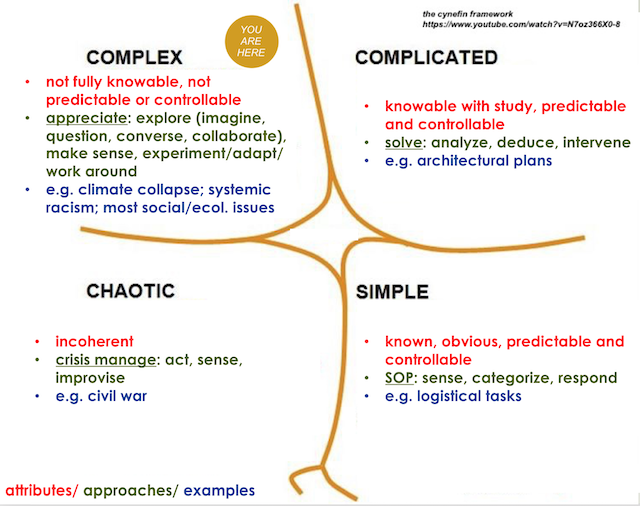
I coined Pollard’s Law of Complexity nearly 20 years ago, to try to sum up what I thought was the most important practical learning from my years of study of complexity theory. Here’s how I worded it:
POLLARD’S LAW OF COMPLEXITY
Things are the way they are for a reason. To change something, it helps to know that reason. If that reason is complex (and it usually is), success at truly understanding and changing it is unlikely, and developing workarounds and adapting to it is probably a better strategy. Complex systems evolve to self-sustain and resist reform until they finally collapse.
To the extent we’re talking about changes to human social systems (including political, economic/financial, educational and health care systems), this law is further subject to Pollard’s other law:
POLLARD’S LAW OF HUMAN BEHAVIOUR
Humans seem to have evolved to do what they must (the personal, unavoidable imperatives of the moment), then do what’s easy, and then do what’s fun. There is never time left for things that are seen as merely important. As a result, social, political and economic change happens only when the old generation dies and a new generation with different entrained beliefs and imperatives fills the power vacuum. Despite this, we have evolved to be a collaborative and caring species, and we are all doing our best — in fact we cannot do otherwise.
Over the years, these hypotheses that I’ve pretentiously called laws, have been subject to two main criticisms. The first is that they devalue and demoralize true change initiatives, and overlook laudable successes in movements for change. While I applaud these apparent advances, both John Gray’s Straw Dogs and Ronald Wright’s A Short History of Progress make, I think, a very strong argument that such ‘advances’ merely corrected obvious and untenable aberrations in the Human Experiment, and also that such advances are tenuous, offset throughout history by equally giant steps backwards, and often subject to revocation when times get tough or violent. I apologize if I come across as a defeatist or doomer, but from my study of history and prehistory, that seems to be the way things work.
More recently I’ve been challenged on the Law of Complexity on the grounds that its wording seems to be validating or supporting “the way things are”. When I say “things are the way they are for a reason”, I’m not passing a moral judgement; I’m not saying it’s a “good” reason.
In a recent discussion with Stuart Ramsing, something he said made we wonder if I was missing something. He said “We shouldn’t put too much trust in the assumption that just because something currently exists, that it necessarily makes sense.”
Things that currently are “the way things are” but which at least today don’t make sense, might, for example, include:
So suppose we were to differentiate, in the Law of Complexity, between (a) things that are the “way they are” as a result of having emerged for an obvious and understandable reason and (b) things that are the “way they are” by accident or coercive imposition, or which are now anachronistic. And if it’s one of the latter, is it likely to have the same positive (reinforcing) feedback loops keeping it entrenched that more naturally emergent aspects of the way things are, do?
An example of a “naturally emergent” “way things are” might be our current addiction to fossil fuels, which is sustained by several positive (reinforcing) feedback loops. We observe for example that when improvements are made in auto fuel efficiency, drivers of those more efficient vehicles tend to drive farther than they would have in gas guzzlers, reinforcing the seemingly insatiable appetite for fossil fuels and defeating the promising intervention of fuel-saving innovations or standards.
We can “make sense” of this entrenchment and addiction (though we might wish it were otherwise) by studying and understanding driving and buying behaviours and propensities. The consequences of this self-reinforcing system are highly undesirable, and possibly disastrous, but we can understand why the system is so hard to change. It will cease to be a problem when our socioeconomic system permanently collapses in a few decades, but in the meantime we are unlikely to be able to significantly change it. Rather than beating our head against the wall pointlessly, we might be better to focus our energies on other change initiatives. (I can hear objections that we might solve this by just banning fossil-fuel-powered vehicles, but I could describe a whole series of reinforcing feedback loops that explain why we haven’t already done so.) Simple “solutions” to complex predicaments are almost invariably flawed by failure to understand why things are “the way they are”.
So let’s look at our civilization’s systemic racism and xenophobia as an example of something that is “the way things are”, but which on the surface doesn’t make sense. It’s too easy and too simplistic to argue that this exists solely because of greed or pathology (though that may in part be true).
Just this week, Tom Cotton, an overtly racist US senator who’s running unopposed for re-election in November, declared that slavery was a “necessary evil” and announced plans to prohibit an anti-slavery program called the 1619 Project from being taught to schoolchildren. He’s the same guy who authored the NYT editorial calling for sending in the military to quell the BLM protests (it seems he’s now got his wish). How can this attitude still prevail to the point the Democrats couldn’t even be bothered to run a candidate against him, four centuries after the start of the slavery he doesn’t want American schoolkids to even know about?
A survey of millennials in 2017 suggested that, unlike African Americans, Asian Americans, and Latinx Americans, half of white millennials did not think Trump was a racist, and a similar number thought BLM protestors were “not very different” from white nationalists (this was shortly after the Charlottesville shooting and car attack by white extremists). Even more white millennials thought the confederate flag was a source of pride, and opposed removing confederate statues. And this was across the US, not just in the south. So if a Tom Cotton Jr were to run for office a generation from now, he’d probably be a shoo-in too, especially as every generation tends to get more conservative as they get older (the boomers who stopped the Vietnam War are now the most conservative and hawkish voters in the US).
Like their parents and grandparents, millennials get their political views from their peers and their parents. Although they are more likely to grow up in communities with more BIPOC neighbours and classmates than previous generations, this survey suggests white millennials are not mixing with and sharing political thoughts with BIPOC millennials. As long as that continues, systemic racism is likely to continue unabated. No matter that much of it may be unconscious.
Four centuries this has been going on. And still it is entrenched. It seems we’re not going to change it with wars, with laws, with education, or with information. If we want to end systemic racism we have to smash the system that produces it — the police system, the prison system, the military system, and the patriarchal political/corporatist system with its “old boys” network. The alternatives are just to adapt to it and work around it (for another four centuries?), or to just wait until it collapses due to its dysfunction and unsustainability (which will happen soon, but for many, understandably, not soon enough).
Is this systemic racism and xenophobia across generations, which really makes no sense, “the way it is” for a reason? And if so, what is that reason? And, since it makes no sense, is it more readily changeable than existing problems and abominations that we can at least understand the rationale for?
I think there might be some clues in the ease with which laws that discriminated against LGBT+ persons have been overturned. There was no reason for them; they never made sense. Just about all of us know someone who has suffered from these arbitrary laws. So why did this happen so easily so quickly (so far; there could of course be backsliding, and that fight is far from over) when after four centuries racism still seems intractable?
Ibram X Kendi argued back in 2017 that systemic racism remains because racists see racism and the oppression of Blacks as being in their self-interest:
Protesting against racist power and succeeding can never be mistaken for seizing power. Any effective solution to eradicating American racism must involve Americans committed to anti-racist policies seizing and maintaining power over institutions, neighbourhoods, counties, states, nations – the world. It makes no sense to sit back and put the future in the hands of people committed to racist policies, or people who sail with the wind of self-interest. An anti-racist America can only be guaranteed if principled anti-racists are in power, and then anti-racist policies become the law of the land, and then anti-racist ideas become the common sense of the people, and then the anti-racist common sense of the people holds those anti-racist leaders and policies accountable.
This makes sense. You could put the word “capitalist” in place of “racist” and it would equally make sense (that’s not to in any way equate struggles against racism with struggles against capitalism). And yet there seemingly was no similar need for a seizing of power in order to radically and quickly change prevailing attitudes against homosexuality. Is that because the LGBT+ community is seen as less of a threat to the self-interest of the rest of society than the BIPOC community? If so, how can racism be so prevalent and so extreme even in cities like Dubuque, Iowa that are 97% white? Where exactly is the threat to them?
Perhaps it’s all about fear. I’ve argued before that anger is usually a mask for fear, and fear is endemic in our modern society, likely rooted in a mix of trauma and reactivity stirred up by fear-mongers through the enormous power of the media, both mainstream and social. They can make us fear things we normally wouldn’t even know about (like “murder hornets”). It’s profitable. It’s effective. It’s “the way things are”. Most of us now probably vote out of fear of the person or party we vote against, rather than for anyone. Trump (from NYC!) and other fear-mongers have found it pathetically easy to prey on the fears that many in small towns, and even some in suburbs, have of the “big city”, by simply wildly exaggerating its dangers.
If fear is what underlies racism, what is it that racists are afraid of? They are, perhaps, afraid of people who aren’t “like” them, people who are strangers to them and whose beliefs and motivations they don’t understand. They may be afraid of what seems to be out of control, or out of their control. They’re afraid of failure, and even the admission of failure. And they’re afraid of loss, and of not having enough, in our collapsing civilization of created scarcity.
Like most fears, these fears don’t make much sense, particularly in as far as they underlie racism, yet they are “the way things are”. Are they still subject to Pollard’s Depressing Law of Complexity?
I would reluctantly suggest they are. On a small scale we can combat and overcome fears by helping people see that these fears are unwarranted. All kinds of issues have been resolved by amazing representative assemblies of people who initially largely feared and hated each other, but who, through familiarity, came to appreciate and support each other’s positions. But these kinds of initiatives simply don’t scale. We can’t systematically make people unafraid, especially when the media are busy stirring up new fears and anxieties. While the humanist ideal that if we just got to know each other better and see each other’s circumstances we’d soon all be on the same page, may be completely valid, it is just an ideal, and one that is completely impractical in a world of 7.8B struggling and damaged people.
And while the humanists’ solution is hopelessly idealistic, Ibram’s seizing-of-power solution, which is equally valid in theory, is equally unlikely in practice. It may happen in a few places on a small scale (the toppling of racism-glorifying statues and the prohibition of flags and other symbols that promote hate, for example), but in a complex society of millions or billions, there are just too many reinforcing feedback loops sustaining the status quo to fundamentally change it.
A guaranteed annual income for all is a terrific, necessary, affordable idea, but, even if it were to happen, it wouldn’t solve the global intractable problems of racism and xenophobia, which are arguably getting worse each year rather than better as the stresses of civilizational collapse deepen. That’s no reason not to strive for a guaranteed annual income (and free decent universal health care and education, and a bunch of other no-brainer initiatives that could make the world a safer, saner place to live). But we should be sanguine about what we expect these things to accomplish.
This is what I mean in Pollard’s Law of Complexity when I talk about adaptations and workarounds to “the way things are”, instead of hoping to fundamentally change them.
That is not of course to excuse or defend racism or xenophobia, which are outrageous, insidious and tragic. It’s simply to say that even though they don’t make sense, they are intractable parts of entrenched global systems that are the way they are for a reason — not a good reason, but a reason.
So as we work to make things better at scales and in ways that are achievable, we can perhaps take solace in the knowledge that as our global civilization’s collapse accelerates, everything is going to change, in ways we cannot imagine. And then, things that were “the way things were”, whether for reasons sensible or senseless, will cease to be so, and we’ll have the chance to start again, and maybe, next time, come together to make things not only “the way they are” but the way they could be, for all of us remaining.
Chrome plans to start blocking resource-heavy ads that drain a lot of battery in August, Google announced today on its Chromium blog (via VentureBeat). Chrome will block ads that mine cryptocurrency, are badly programmed, or are unoptimized for network usage.
We have recently discovered that a fraction of a percent of ads consume a disproportionate share of device resources, such as battery and network data, without the user knowing about it. These ads (such as those that mine cryptocurrency, are poorly programmed, or are unoptimized for network usage) can drain battery life, saturate already strained networks, and cost money.
In order to save our users’ batteries and data plans, and provide them with a good experience on the web, Chrome will limit the resources a display ad can use before the user interacts with the ad. When an ad reaches its limit, the ad’s frame will navigate to an error page, informing the user that the ad has used too many resources.
Chrome plans to limit the resources that an ad can use before the user interacts with the ad, and when that limit is hit, the ad’s frame will redirect to an error page to let the user know that the ad has eaten up too many resources.
Google says that it extensively measured the ads in Chrome, targeting the most “egregious” ads that use more CPU or bandwidth than 99.9 percent of all detected ads for that resource.
Chrome will have thresholds that allow for 4MB of network data or 15 seconds of CPU usage in any 30 second period, or 60 seconds of total CPU usage before an ad is blocked. Just 0.3 percent of ads exceed this threshold, but today, account for 27 percent of network data used by ads and 28 percent of all ad CPU usage.
Google will experiment with the changes for the next several months with the intention of releasing the feature on Chrome stable towards the end of August.Tag: Chrome
This article, “Chrome to Block Battery-Sucking Ads in August Update” first appeared on MacRumors.com
Discuss this article in our forums
The post Chrome to Block Battery-Sucking Ads in August Update appeared first on AIVAnet.
This study shows that most people don't change their passwords after a breach, and if they do they change it to a weaker password.
Abstract: To protect against misuse of passwords compromised in a breach, consumers should promptly change affected passwords and any similar passwords on other accounts. Ideally, affected companies should strongly encourage this behavior and have mechanisms in place to mitigate harm. In order to make recommendations to companies about how to help their users perform these and other security-enhancing actions after breaches, we must first have some understanding of the current effectiveness of companies' post-breach practices. To study the effectiveness of password-related breach notifications and practices enforced after a breach, we examine -- based on real-world password data from 249 participants -- whether and how constructively participants changed their passwords after a breach announcement.
Of the 249 participants, 63 had accounts on breached domains;only 33% of the 63 changed their passwords and only 13% (of 63)did so within three months of the announcement. New passwords were on average 1.3× stronger than old passwords (when comparing log10-transformed strength), though most were weaker or of equal strength. Concerningly, new passwords were overall more similar to participants' other passwords, and participants rarely changed passwords on other sites even when these were the same or similar to their password on the breached domain.Our results highlight the need for more rigorous password-changing requirements following a breach and more effective breach notifications that deliver comprehensive advice.
News article.
EDITED TO ADD (6/2): Another news aricle. Slashdot thread.
I love this post by Ben at The Overflow.
“After interviewing several developers, a pattern started to become clear: great developers share a lot. This takes different forms for different people but is very often a blog. “So what?” you might say, you would expect successful people—“thought leaders”—to use their position and platform to share their own ideas and projects. But the interesting thing is that for many top developers, their sharing mindset came before their success, and was the direct cause of it, not the result of it.”
Ben shares two powerful thoughts:
1) The most successful people give more than they take.
2) Sharing makes you stronger.
If you’re looking for two emotive messages to encourage more contributions from top members; I’d try these.
Maxim BangeXS4ALL is fine
Cloudflare launched Is BGP safe yet recently that provides Internet users with a test to find out whether their Internet Service Provider (ISP) has implemented a certification system to make BGP safer to use.
All it takes is to open the website and click on the "test your ISP" button to run a quick test that determines whether the ISP has implemented the certification system RPKI.
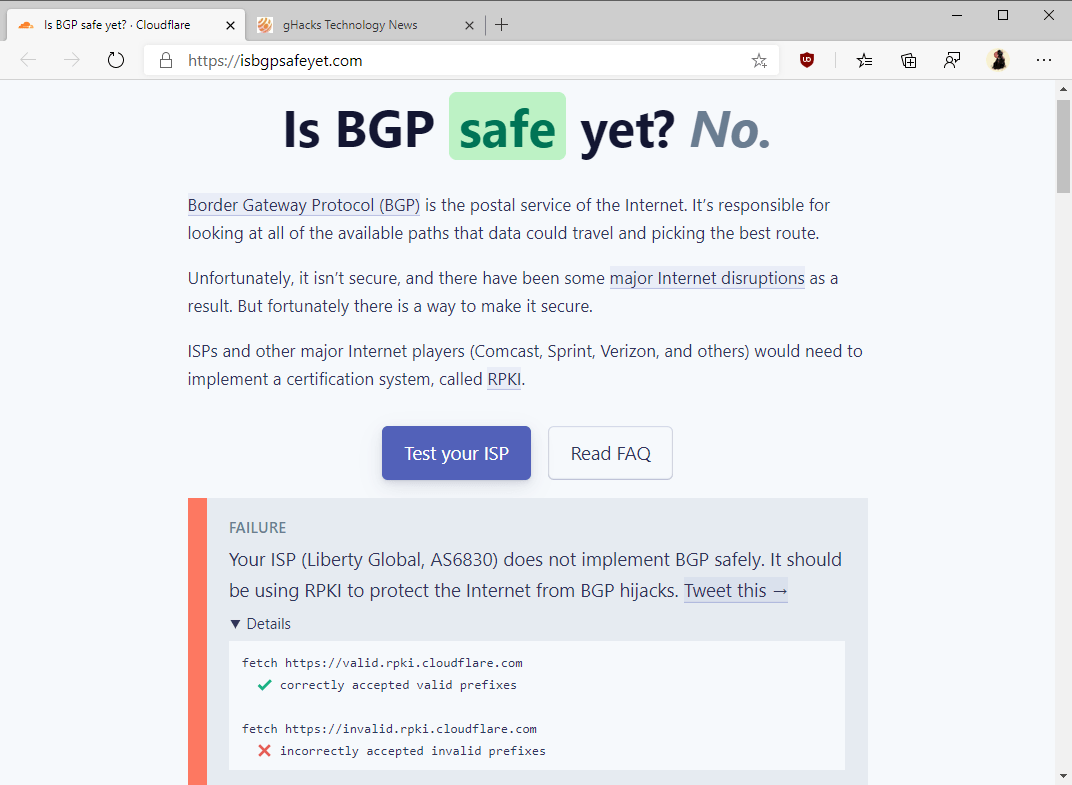
Border Gateway Protocol (BGP) is a core Internet protocol that is used to determine the route that data takes on the Internet. One of the issues associated with the protocol is that the possibility of hijacking exists. A basic example would be that traffic from a user in the United States would go through servers in Asia to access the New York Times website.
While that is usually caused by server misconfigurations, it is sometimes used on purpose to redirect traffic for malicious or privacy-invading purposes, e.g. to record data.
Cloudflare's test checks if the ISP has implemented Resource Public Key Infrastructure (RPKI) by announcing a legitimate route and making sure the route is invalid. If the site is loaded, the invalid route was accepted by the ISP which in turn means that the ISP has not implemented RPKI.
Only a few ISPs, transite or cloud companies have implemented the security feature already. Cloudflare lists Telia and NTT on the test page, and several more, e.g. Amazon, AT&T or Cogent, that have started the implementation or implemented it partially already.
Internet users cannot really do much about it other than share the results of the test on Twitter (implemented on the test site) or elsewhere. An email, letter, or message to the ISP in question might also help get the ball rolling. Those who use different ISPs, e.g. one for the Internet connection at home and another for mobile, may find that one provider supports the safer standard already while another does not.
Now You: Has your ISP implemented RPKI already?
Thank you for being a Ghacks reader. The post Find out if your ISP implements BGP safely appeared first on gHacks Technology News.

There’s been a lot written in the press recently about video conferencing app Zoom. From claiming that it is malware to more detailed analysis of its security, or lack or security in most cases. The app has seen a large increase in use over the past weeks as the worldwide coronavirus pandemic has forced many to work from home. VentureBeat reported early in April that daily active users rose from 10 million to more than 200 million in just three months.
Many news outlets have reported on Zoom’s security failings. With the Guardian going as far to say that the software was ‘malware’. The article describes issues such as Zoom-bombing, where hackers interrupt online meetings. And it goes on to say that despite Zoom’s initial claims, end-to-end encryption is not used to secure calls, so that they can only be decrypted by participating users.
MacOS has been particularly affected by Zoom’s security woes. Ex NSA hacker Patrick Wardle revealed two zero-days at the end of March. The first can be used by a local attacker to get access to the root account in MacOS. The second involves code injection to get access to the microphone and webcam without alerting the user.
But while Zoom is currently in the spotlight, this isn’t the first time the app has come under scrutiny. Last year, Zoom was found to be silently installing a hidden webserver on MacOS so users could be added to calls without their permission. And at the end of March, Zoom plugged a well-publicized problem in its iOS app that was sending analytics data to Facebook.
The University of Toronto’s Citizen Lab has posted a more detailed look at how Zoom calls are secured. While Zoom doesn’t employ end-to-end encryption, it does encrypt data in transit. Zoom’s documentation claims that it uses Transport Layer Security (TLS) version 1.2. But Citizen Lab was unable to confirm that. Furthermore, Zoom apparently uses its own encryption method in a modified version of the Real-Time Transport Protocol (RTP), which is used for streaming audio and video.

A single AES-128 key is used by all call participants to encrypt and decrypt video and audio streams. But the mode of operation is Electronic Codebook (ECB), which leaves patterns in the input, potentially allowing an attacker to obtain the contents of a call, albeit in poor quality.
The AES-128 key used for a call can be used to decrypt Zoom packets if they are intercepted. The keys are likely generated by Zoom servers, and sometimes delivered to call participants, using servers located in China. Regardless of where call participants are located. Although Citizen Lab did also find 68 servers located in the U.S. that appear to run the same software as the servers in China.
While Zoom is registered in the U.S., Citizen Lab says that it appears to own three companies in China that employee around 700 people to develop the software. That could leave users vulnerable if the Chinese government demanded the companies hand over encryption keys stored on servers in China.
Hackers have been able to ‘Zoom-bomb’ meetings because the software allows participants to join using a simple URL containing a string of 9 to 10 numbers that can be easily guessed or generated. Citizen Lab also found an issue in the Waiting Room feature. Waiting Rooms are virtual spaces where participants wait until the host starts the meeting. Details of the vulnerability have not been released to give Zoom a chance to address the problem.

As Citizen Lab points out, if you are using the platform to conduct meetings that might normally happen in a public space, then you might consider Zoom’s lax security to be a non-issue. If you do decide to use Zoom, you should avoid the Waiting Rooms feature and enable passwords for your meetings to help prevent Zoom-bombing.
If you need a platform with security that can reasonably provide strong privacy and confidentiality, then Zoom is not the solution for you. At least as it stands in its current form. Microsoft Teams doesn’t use end-to-end encryption either. But it was designed with security baked in from the get-go. And a lot depends on how much you trust Microsoft, or other solution provider, with the keys used to encrypt and decrypt communications.
You can find an overview of security and compliance in Teams on Microsoft’s website here. And you can see Zoom’s response to Citizen Lab’s research here.
With the need to interact with Office 365 in so many of our environments, this newsletter is dedicated to sharing detailed knowledge from some of the top Office 365 experts in the world. Delivered once a month to your inbox.
Petri.com may use your contact information to provide updates, offers and resources that may be of interest to you. You can unsubscribe at any time. To learn more about how we manage your data, you can read our Privacy Policy and Terms of Service.
!Already a Petri.com member? Login here for 1-click registration.
The post How Secure is Video Conferencing App Zoom? appeared first on Petri.