Shared posts

22 May 17:57

Women Trailblazers in Science

by STEM Women

Today we take a look at various women who have inspired us for their trailblazing efforts in science. We start with Dr Harriette Chick, who was a microbiologist, nutritionist and the first scientist to show sunshine impacts health. Particle physicist, Dr Fabiola Gianotti, is the first woman leader of CERN. You likely know Florence Nightingale for her contributions to nursing, but did you know she was the first woman awarded the Order of Merit, and the first scientist to develop graphical statistics? Astronomer Dr Cecilia Payne-Gaposchkin was the first person to discover what the universe is made of, though few people understand her tremendous contributions to the field of physics.  Did you know that the word “scientist” was invented to describe the research contributions of Mary Somerville? She trained as a mathematician, astronomer and historian. Finally, Dr Jane Cooke Wright was a “first” in many senses, as a Black woman physician, cancer researcher, and the first woman elected president of the New York Cancer Society.

Learn more about these amazing scientists below!

Harriette Chick

Harriette Chick

Microbiologist, nutritionist and first scientist to show sunshine impacts health

Dr Harriette Chick was born on 1875, was the first scientist to show that sunshine was important for the synthesis of Vitamin D in our skin. Growing up in Victorian England at a time when women did not have the right to vote, she studied science at University College London in 1894, earning a PhD in bacteriology, whilst spending time working in both Vienna and in Munich. Eleven years later, in 1905, Chick became the first woman employed by the Lister Institute of Preventive Medicine in London, the only not-for-profit medical research institute in Britain at that time.

After WWII, rickets became a growing health problem, leaving children with soft bones that broke easily. Harriet’s meticulous study of the diet and activities of a group of rickets-ridden children in Vienna led her to realize that the problems seemed to ease with the arrival of summer each year. By examining children kept in the shade and those allowed in the sun, she figured out the critical role of sunlight for bone health.

She would go on to lead a new Division of Nutrition at the Lister Institute, focusing on deficiencies of water-soluble vitamins. Even after retiring, she continued to write reviews and lived to the age of 101 years.

Fabiola Gianotti

Particle physicist and first woman leader of CERN 

Fabiola Gianotti

Dr Fabiola Gianotti was born on 1960. She received her PhD in experimental particle physics from the University of Milan in 1989. She has worked as a research physicist in the Physics Department of CERN since 1994, leading protects such as the detector R&D and construction, software development and data analysis. She has published over 500 publications in her impressive career.

In November 2014, Dr Fabiola Gianotti was announced as the head of CERN, Europe’s most renowned particle physics laboratory. Established in 1954, CERN did not appoint its first woman leader for another six decades. Fabiola has been hailed as one of the world’s leading scientific minds, including by Time, who chose her as a runner up as their Person of the Year in 2012. Dr Gianotti serves on several university and international science committees, including the Scientific Advisory Board of the United Nation Secretary-General, Ban Ki-moon.

Florence Nightingale

Florence Nightingale

Nurse, feminist, first woman awarded the Order of Merit, and first scientist to develop graphical statistics

Born into a middle-class family in England in 1820, Florence Nightingale showed strong academic aptitude, but it took much convincing of her parents to allow her to join a short nursing training program in Dusseldorf. At age 33, she became the superintendent of a women’s hospital in London. In 1854, during the Crimean War, Nightingale was invited to oversee the nurses helping British troops in Turkey, where she earned the nickname, “Lady of the Lamp” for her strong attention to her patients’ needs.

Nightingale established modern nursing education by formalising its scientif practices. In 1860, she established the Nightingale School of Nursing at St Thomas’ Hospital in London, and she provided training for midwives and nurses in workhouse infirmaries. In 1907, she became the first woman awarded the Order of Merit.  (1907). May 12, the day of her birth, is known as International Nurses Day, commemorating nursing contributions in health professions.

Many people recognise Nightingale as a nurse, but few realise she was also an innovative statistician. Have you heard of the Nightingale Diagram or the Nightingale Rose? When Florence Nightingale returned from the Crimean War, she realized that the majority of soldiers were dying, not from their wounds, but from infections (typhus and cholera, among others) acquired inside the hospital, triggered by neglecting hygiene conditions. She depicted this in her diagrams (right image), with blue representing deaths occasioned by diseases, red for the deaths due to wounds and black for all other causes of death. She used these data visualization tools to make her successful case for better sanitation in hospitals.

Florence Nightingale

Read more: http://goo.gl/U1xCv

Cecilia Payne-Gaposchkin

Astronomer and first person to discover what the universe is made of

Cecilia Payne-Gaposchkin

Born in 1925, Dr Cecilia Payne was the first woman to earn a doctorate in Astronomy from Radcliffe College (now part of Harvard) in 1925. Her thesis, establishing that hydrogen was the overwhelming constituent of stars, has been described as the most brilliant thesis in astronomy. She would go on to make more than million observations of variable stars to determine stellar evolution. Despite this, she remained a lowly paid technical assistant at Harvard until 1956 when she became the first woman to be promoted to full Professor and later as Chair of Astronomy, the first woman to head a department at Harvard.

Professor of Chemistry at Harvard University, Jeremy Knowles bemoans how little public recognition exists for Payne-Gaposchkin:

“Since her death in 1979, the woman who discovered what the universe is made of has not so much as received a memorial plaque. Her newspaper obituaries do not mention her greatest discovery. […] Every high school student knows that Isaac Newton discovered gravity, that Charles Darwin discovered evolution, and that Albert Einstein discovered the relativity of time. But when it comes to the composition of our universe, the textbooks simply say that the most abundant atom in the universe is hydrogen. And no one ever wonders how we know.”

Mary Somerville

Mathematician, astronomer, historian and the world’s first “scientist”

Mary Somerville

Mary Somerville was born in 1780 in Scotland who is famously known as a polymath; excelling in mathematics, astronomy and science history. Along with the astronomer Caroline Herschel, they would become the firs twomen members of the Royal Astronomical Society. In fact, such was her impact, that the word “scientist” was coined by Philosopher William Whewell to descirbe Somerville, in his 1834 review of her book, On the Connexion of the Physical Sciences. While Somerville was obviously not the first person to practice science, it is a double delight that this term was invented to describe not only a woman in STEM, but also in praise of her public communication of science in beautiful and engaging prose. So in a sense, Somerville was not the first “scientist” but she was also the first science communicator to reach a broad public audience!

The enduring impact of Somerville’s opus, On the Connexion of the Physical Sciences, continues to be celebrated. It was an internationally best selling book that pre-dates Charles Darwin’s On the Origin of Species by 25 years.

Somerville studied mathematics, but she also engaged in a wide-ranging scholarship of other disciplines. She translated French astronomy books into English and had political clout as a scientific authority in England. Like many scientists, Somerville had diverse interests and she was highly creative (she played the piano!).

She described herself as “intensely ambitious,” explaining that: “I felt in my own breast that women were capable of taking a higher place in creation than that assigned to them in my early days.”

Her landmark book, On The Connexion… painted a vibrant picture of scientific discovery.

“In contrast to the vague speculations of eighteenth-century natural philosophy, her 500-page book covers a tight field of hard sciences — astronomy, physics, chemistry, geography, meteorology and electromagnetism. Its groundbreaking style, clear and logical, occasionally opens out into passages of sublime perspective, such as the description of universal gravity as a force equally present “in the descent of a rain drop as in the falls of Niagara; in the weight of the air, as in the periods of the moon”. Somerville ranges over subjects from stellar parallax to terrestrial magnetism, from comets to giant seaweed.”

Jane Cooke Wright

 Physician, cancer researcher and first woman elected president of the New York Cancer Society

Jane C. Wright

Dr Jane Cooke Wright was born in Manhattan in 1919 to a distinguished African-American family. She obtained an art degree from Smith College in 1942 and three years later obtaind a medical degree, graduating with honors, from the New York Medical College.

In 1964, working as part of a team at the N.Y.U. School of Medicine, Dr. Wright developed a nonsurgical method, using a catheter system, to deliver heavy doses of anticancer drugs to previously hard-to-reach tumor areas in the kidneys, spleen and elsewhere. She was the only woman, and only Black person, among the seven researchers who founded the American Society of Clinical Oncology (ASCO) and later became head of the chemotherapy department and associate dean at New York Medical College. It was the first time a black woman had held such a senior position in a medical school.

Dr Wright worked alongside her father, Dr Louis T. Wright, who was one of the first Black students to earn an M.D. from Harvard Medical school and the first African-American doctor appointed to a public hospital in New York City. Together at the Cancer Research Foundation at Harlem hospital, “The Wrights were one of the first groups to report the use of nitrogen-mustard agents as a treatment for cancer, which led to remissions in patients with sarcoma, Hodgkin’s disease, chronic myelogenous leukemia, and lymphoma. The Wrights were also some of the first researchers to test folic acid antagonists as cancer treatments. ”

After her father died in 1952, Dr Wright took over as Director. The American Association for Cancer Research writes:

“She was among the first researchers to test chemotherapeutic drugs in humans, which produced effective dosing levels and helped saved lives. Dr. Wright began her pioneering work in 1949, and during her 40-year career she published over 100 research papers on cancer chemotherapy and led delegations of cancer researchers to Africa, China, Eastern Europe, and the Soviet Union. By 1967, she was the highest ranking African-American woman in a United States medical institution. In 1971, she became the first woman elected president of the New York Cancer Society.”

Dr Sandra Swain, 2013 president of ASCO, said of Dr Wright:

“Not only was her work scientific, but it was visionary for the whole science of oncology. She was part of the group that first realised we needed a separate organisation to deal with the providers who care for cancer patients. But beyond that, it’s amazing to me that a Black woman, in her day and age, was able to do what she did.”

22 May 17:57

“I Don’t Need the Most Expert Expert Who Ever Experted”: Q & A with Journalist Mika McKinnon

by STEM Women

Men dominate media: in news rooms and stories, they get more exposure on camera, more by-lines and are quoted more often. An analysis of  2,353,652 news articles covering 12 topic categories from over 950 news outlets over a six month period ending in April, 2015 showed that mentions of men ranged from 69.5% in Entertainment to 91.5% in Sports. The only exception was Fashion, where women edged out men slightly at 54%. A more recent analysis by science writer Ed Yong of his STEM stories was similarly discouraging: only 24 percent of his quoted sources were women. Worse, 35 percent of his articles featured no female voices at all. Why does this matter? As journalist and editor Adrienne Lafrance noted in The Atlantic, the extreme gender imbalance in the media implies that the best voices are not those of women and misses out on diverse viewpoints, experiences and ideas. Journalist and field geophysicist Mika McKinnon is acutely aware of this gender differential in reporting and makes it a point to ask both men and women for expert comments. When making press requests, she is typically turned down more often by women. One case stood out: not one of 74 women requested for an interview obliged, contrasting with 11 of 15 men who agreed, including two who stated that they were not experts. She tweeted her frustration.

https://platform.twitter.com/widgets.js

This tweet was seen over 792,000 times with more than 16,000 interactions, clearly demonstrating that the topic touched a nerve. We asked Mika to share her experience and her thoughts on the gender imbalance in journalism reporting. 

Mika McKinnon Kneels at the edge of icy water

Your Twitter thread about your experiences as a journalist in contacting women for interview really resonated with a lot of people. Why do you think that is?

We’re at a crossroads in North American culture where we recognize the injustices of our society and want something better.

I started my career in science, and participated in countless initiatives to recruit more women into STEM fields with me. In recent years, we’ve also started talking about the barriers that block women from progressing, or drive them out of science after they’ve devoted years of their lives to training and building experience. That basic injustice hurts.

When working as a science journalist, the conversation shifts to whose voices are given a platform. We express frustration at panels of all-men experts, then write stories that only feature those same voices. We’re having more and more conversations about how our habits creates an endless loop where coverage provides visibility and prestige, elevating those same voices disproportionately to others of similar professional caliber, and what we can do to break out and create new patterns.

It feels like every month, a new database pops up claiming to be the ultimate solution to finding new experts to showcase — BBC’s Expert Women, the Canadian nonprofit Informed Opinions, or more specialized databases like 500 Women Scientists. But like recruiting more girls to enlist in science majors doesn’t automatically mean we’ll have more women in senior professorships and agency leadership roles, journalists using databases of women in science addresses just one aspect of a big, monstrous problem that doesn’t solving the root injustices.

What I think resonated is taking something we know is a problem — underrepresentation of women in science, and particularly media coverage of women in science — and looked at how our superficial solutions of databases and goodwill aren’t enough. This isn’t a simple issue with a simple answer. It’s not about more women volunteering to talk to media, or about more journalists asking women for interviews, or even about the language we use when trying to overcome the barriers for why both those things don’t universally work. It’s looking at how even when you do everything right to make things better, sometimes that isn’t enough.

You noted a 5:1 ratio in how often men respond to requests for interview versus women. Why do you think this disparity exists?

The situation I wrote about on Twitter was an extreme abnormality for me. For every news article I write, I typically need two experts — one who worked on the research, and someone else from the same field of study who didn’t that can provide an outside opinion. This limits who I can talk to — not every study has a woman coauthor, and some fields have much greater gender disparities than others.

My ratios are usually about 75% of women initially turning down interview requests, dropping to 50% if I follow up to find out their reason for declining and work with them on a solution. Very few men turn down my interview requests, and when they do it is almost universally for logistics of being unable to schedule the interview prior to my deadline.

I had a particular story where I was getting grumpy over a 100% decline rate from women, particularly when I had only a 25% decline rate from the men I approached. I got stubborn about fixing it, ending up with a 5:1 approach rate (and still no women), so I tweeted about it because it was a particularly unusual and frustrating experience.

Of the reasons women experts give for not being able to give interviews, which do you think is the most important issue for the science community to be mindful of? How can we better address this in research training or professional development of women scientists?

The most common reasons women give me for declining interviews are:

  • Lack of time – This is fair, as women receive disproportionate service demands, and something I don’t push back on.
  • Discomfort with press – This is a self-perpetuating problem, but is something that can be addressed in part with media training by universities, professional organizations, or media agencies. It’s fair to ask for a someone more familiar with press to sit in on the interview (like an advisor or public information officer). Not every journalist can do this for every story, but it’s also fair to ask if it’s possible to get a list of questions in advance, or to review quotes prior to publication.
  • Distrust of press – Pay attention to who is making the request. I teach experts to research bylines so they can evaluate the credibility of journalists. They can also check out the science coverage in the particular publication.
  • Fear of repercussions – Women and other underrepresented people are often disproportionately punished for missteps, or become targets for harassment campaigns when they gain visibility. This is something I’ll talk to potential interviewees about, but it’s also something I won’t push on because it’s can be a real risk.
  • Referral to greater authority – Even full professors will redirect me to more well-known names in the field (who due to increasing gender disparity with seniority, disproportionate award and prestige markers, and bias in media coverage, are usually men).
  • Insufficient expertise – This is particularly true for graduate students, who despite actually doing the research, often decline by suggesting I talk to their advisors or team leaders (who due to the increasing gender disparity with seniority, are usually men).
  • Unfamiliarity with exact topic – Women will typically turn down interview requests in their field if it does not directly overlap with their area of specialization, whereas men will frequently accept with a disclaimer like “I’m no expert, but…”

For all three of the last concerns, it’s important to understand that journalists are writing accessible articles, not technical articles. This means that interviews may be to teach the journalist background information, and it’s always to try to get quotes that can be used in the article. For most purposes, if a scientist is familiar enough with a topic to teach an undergraduate lecture, they probably understand it in sufficient detail to give an interview. I don’t need the Most Expert Expert Who Ever Experted. I need someone who knows more than most people about the topic who can talk to me right now and point out any irregularities, subtleties, or complications that I wouldn’t get from teaching myself about the topic by reading Wikipedia articles.

Mika McKinnon stands in the forefront. Behind her is a fuzzy ci

You gave excellent and practical advice for journalists to make women experts more comfortable about responding to media requests. Why do you think this is important?

No one person is going to solve the problems of gender bias in science or in media. We’re all in this together, and we all need to use our expertise and skills to help each other out to make things better than they are right now.

What else do you think journalists can do more of, to ensure fairer representation in the media?

The most important thing for journalists to do is pay attention to whose voices they are showcasing and why. After that, following up to understand why they’re not getting the diversity of voices they want to cover is important, and be flexible on addressing the barriers preventing people from participating.

How did your journalist peers respond when you shared this story?

Many shared their own stories, resources for finding women experts, reasons they get turned down, and tips they have for solving barriers. I also heard from event organizers who shared similar problems.

But from some, I also heard disbelief or shock. These reactions were typically from people who don’t pay attention to the people they approach as sources, who will hopefully start paying attention in the future!

Mika, you are a field geophysicist, disaster researcher, scifi science consultant and science writer. What advice would you give women scientists considering following a similar path in consulting and science writing?

My job is to be excited and curious in public. I currently find it rewarding to do a diversity of jobs that allow me to do this in different ways, but it’s not a path for everyone. If you want to freelance, the most important things are to be creative in how you apply your skills, organized in your assignments, and reliable in being competent at work.

About

Mika McKinnon is white woman wearing glasses with a decorative necklace

Mika McKinnon is a consultant, public speaker and writer based in Vancouver, British Columbia, Canada. She has trained as a geophysicist specializing in disasters, including tsunami, earthquakes, asteroid impacts. Ask her to bring science to your fiction, write a story, run a workshop, give a talk, or more! Follow her on Twitter @mikamckinnon

Read Mika’s advice to journalists seeking women experts below!

Challenges Overcoming Bias in Science Coverage https://platform.twitter.com/widgets.js

22 May 17:50

Relying on renewables alone significantly inflates the cost of overhauling energy

Evidence points to the need for a broader range of clean power beyond just wind and solar.
01 Mar 21:43

Report: Houston's housing market deemed overvalued

by Fauzeya Rahman
An overvalued market is defined as one in which home prices are at least 10 percent higher than the long-term, sustainable level.
01 Mar 21:43

Meet the Woman Who Guides NASA's Juno Probe Through Jupiter's Killer Radiation

by Ryan F. Mandelbaum on Gizmodo, shared by Cheryl Eddy to io9

On the night of July 4th, 2016, scientists successfully maneuvered a basketball court-sized probe into the orbit of the largest planet in the solar system. Some at the Florida launch cheered, some breathed a sigh of relief. But for NASA’s Heidi Becker, this could have been the mission’s end.

Read more...

09 Jan 19:16

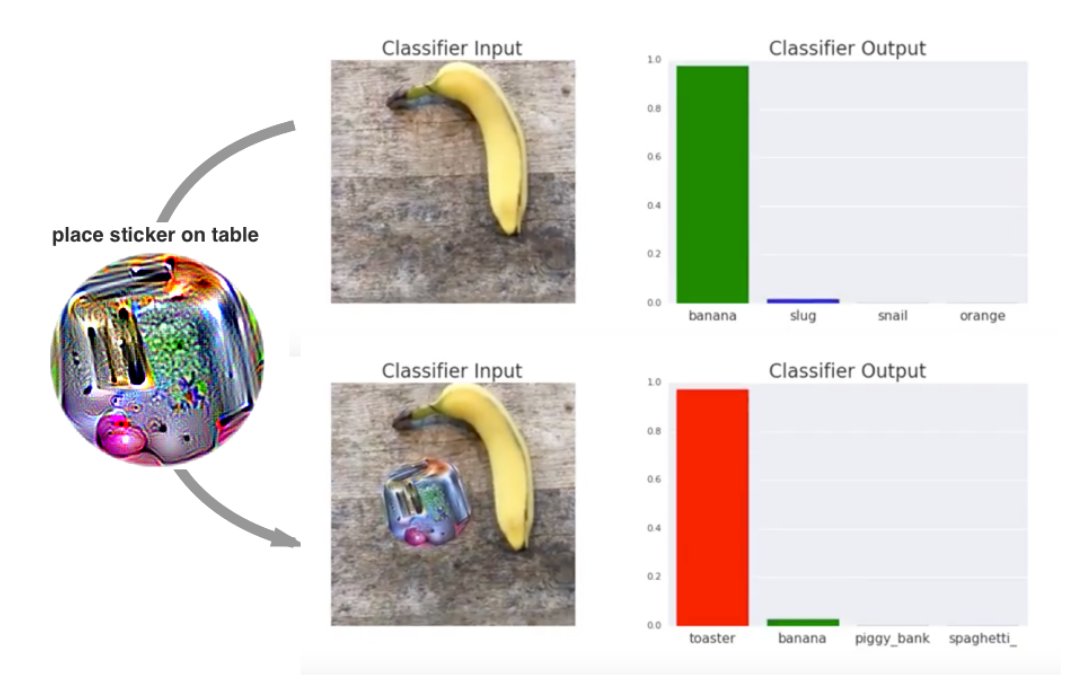
Adversarial patches: colorful circles that convince machine-learning vision system to ignore everything else

by Cory Doctorow

Machine learning systems trained for object recognition deploy a bunch of evolved shortcuts to choose which parts of an image are important to their classifiers and which ones can be safely ignored. (more…)

09 Jan 19:09

Watch Hunter S. Thompson on 1967 TV game show "To Tell The Truth"

by David Pescovitz

A year after Hunter S. Thompson published his pioneering gonzo journalism book "Hell's Angels," he appeared on the wonderful TV game show "To Tell The Truth." Bud Collyer hosted with a panel of actors/entertainers Tom Poston, Peggy Cass, Barry Nelson, Kitty Carlisle.

On the show, three people claim to be a particularly interesting or notable person described by the host. One is really that person, the other two are imposters. The panelists must ask questions to identify who isn't lying.

09 Jan 19:09

Novelty in science – real necessity or distracting obsession?

by S. Abbas Raza

Jalees Rehman in The Conversation:

ScreenHunter_2929 Jan. 09 19.53In a recent survey of over 1,500 scientists, more than 70 percent of them reported having been unable to reproduce other scientists’ findings at least once. Roughly half of the surveyed scientists ran into problems trying to reproduce their own results. No wonder people are talking about a “reproducibility crisis” in scientific research – an epidemic of studies that don’t hold up when run a second time.

Reproducibility of findings is a core foundation of science. If scientific results only hold true in some labs but not in others, then how can researchers feel confident about their discoveries? How can society put evidence-based policies into place if the evidence is unreliable?

Recognition of this “crisis” has prompted calls for reform. Researchers are feeling their way, experimenting with different practices meant to help distinguish solid science from irreproducible results. Some people are even starting to reevaluate how choices are made about what research actually gets tackled. Breaking innovative new ground is flashier than revisiting already published research. Does prioritizing novelty naturally lead to this point?

More here.

09 Jan 18:19

The Search for Extraterrestrial Intelligence, a brief history

by David Pescovitz

Is there anybody out there? If we don't listen for the answer, we certainly won't hear it. Over at the Planetary Society, Jason Davis posted an excellent survey of the past, present, and future of the search for extraterrestrial intelligence. It begins in 1959 with Giuseppe Cocconi and Philip Morrison's historic paper "Searching for Interstellar Communications" and Frank Drake's Project Ozma, the first scientific SETI search:

One year later, the National Academy of Sciences hosted an invitation-only meeting at Green Bank to discuss how to go about conducting further SETI research. The eclectic, interdisciplinary group included Drake, Cocconi, Morrison, the biochemist Melvin Calvin (who won the Nobel Prize in Chemistry during the meeting), Bernard Oliver, who was the vice president of research and development at Hewlett-Packard, the young Carl Sagan, and the scientist John Lilly, who had recently published a controversial book arguing dolphins were an intelligent species.

With a nod to Lilly's book, the participants dubbed themselves "The Order of the Dolphin." One product of the meeting was the Drake equation, which attempts to predict the number of advanced civilizations in the Milky Way able to contact Earth. The equation includes variables such as average star formation rate, the number of habitable planets per star, and the number of planets where intelligent life could evolve.

For the rest of the 1960s, SETI research remained mostly dormant, aside from a few searches in the Soviet Union. Starting in 1971, two Project Ozma follow-ups named Ozpa and Ozma II used bigger dishes and listened to more stars.

In 1973, another SETI search began, using a radio telescope called Big Ear at Ohio State University. Big Ear was a flat, aluminum dish three football fields wide, with reflectors at both ends.

On the night of August 15, 1977, Big Ear picked up a signal from the constellation Sagittarius that was 30 times stronger than the cosmic background noise, right at the 1,420 megahertz hydrogen line frequency. No one noticed it for a few days, until a volunteer sifting through the previous week's data circled the signal and wrote "Wow!" in the margin.

Jill Tarter is a legendary SETI scientist. She's the Bernard Oliver Chair for SETI at the SETI Institute in Mountain View, California, and is the inspiration for protagonist Ellie Arroway in Contact, played by Jodie Foster in the film adaptation.

Tarter told me Big Ear's automated search program had no built-in logic to stop and focus on the Wow! signal. Furthermore, there was no confirmation system such as a second telescope located elsewhere, which could help determine whether the signal was local to Earth or truly from the stars.

Despite decades of follow-up searches, the Wow! signal was never heard again. To this day, Tarter favors SETI programs that can process data in real time, rapidly follow-up on detections, and rule out local interference.

I asked her if the Wow! signal still haunts the SETI field. "Well, it haunts me," she said.

Is there anybody out there? (Planetary Society)

09 Jan 18:18

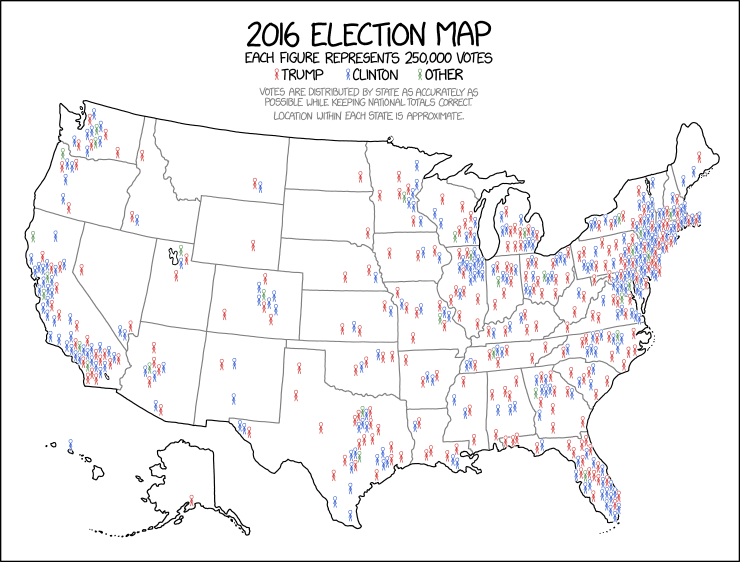
2016 Election Map

I like the idea of cartograms (distorted population maps), but I feel like in practice they often end up being the worst of both worlds—not great for showing geography OR counting people. And on top of that, they have all the problems of a chloro... chorophl... chloropet... map with areas colored in.
09 Jan 18:18

Barbra Streisand Wants the Golden Globes to Acknowledge Female Directors

by Charline Jao

Natalie Portman called out the Golden Globes’ all-male nominees for Best Director last night, a fact that seemed at odds with the night’s efforts to uplift and stop silencing women in the industry. Greta Gerwig, Dee Rees, and Patty Jenkins didn’t receive nominations for their films despite critical acclaim, especially frustrating when you consider Lady Bird won Best Picture as well as Best Actress.

Adding her voice to the disapproval was Barbra Streisand, who was the first and only woman to win Best Director for Yentl. Streisand tweeted:

It should be noted that only 15 of films with confirmed directors over the next two years have a female director. Considering Streisand was also the first woman to write, produce, direct, and star in a major studio film, it’s embarrassing that so little progress has been made since her historical accomplishment.

(image: MGM/UA Entertainment Company)

Want more stories like this? Become a subscriber and support the site!

The Mary Sue has a strict comment policy that forbids, but is not limited to, personal insults toward anyone, hate speech, and trolling.—

09 Jan 18:15

I used to have a hard time thinking that babies were cute

by Matthew Inman
09 Jan 18:15

Multiplicative Idiocy

by Matthew Inman
Multiplicative Idiocy

An immutable law of design.

View on my website

09 Jan 18:12

"It’s Never Aliens—until It Is"

by David Pescovitz

In 2017, the big mainstream stories of "near-hits" (aka "near-misses") in the search for extraterrestrial intelligence included episodic dimming of a star caused by possible "alien megastructures," a large object tearing through our solar system, and video captured by a fighter jet of a weird object capable of incredible maneuvers in the sky (video below).

(more…)

09 Jan 16:57

My Father’s Body, at Rest and in Motion

by Azra Raza

Siddhartha Mukherjee in The New Yorker:

SidThe call came at three in the morning. My mother, in New Delhi, was in tears. My father, she said, had fallen again, and he was speaking nonsense. She turned the handset toward him. He was muttering a slow, meaningless string of words in an unrecognizable high-pitched nasal tone. He kept repeating his nickname, Shibu, and the name of his childhood village, Dehergoti. He sounded as if he were reading his own last rites. “Take him to the hospital,” I urged her, from New York. “I’ll catch the next flight home.” “No, no, just wait,” my mother said. “He might get better on his own.” In her day, buying an international ticket on short notice was an unforgivable act of extravagance, reserved for transcontinental gangsters and film stars. No one that she knew had arrived “early” for a parent’s death. The frugality of her generation had congealed into frank superstition: if I caught a flight now, I might dare the disaster into being. “Just sleep on it,” she said, her anxiety mounting. I put the phone down and e-mailed my travel agent, asking her to put me on the next available Air India flight.

My father, eighty-three, had been declining for several weeks. The late-night phone calls had tightened in frequency and enlarged in amplitude, like waves ahead of a gathering storm: accidents were becoming more common, and their consequences more severe. This was not his first fall that year. A few months earlier, my mother had found him lying on the balcony floor with his arm broken and folded underneath him. She had taken a pair of scissors and cut his shirt off while he had howled in double agony—the pain of having to pull the remnants over his head compounded by the horror of seeing a perfectly intact piece of clothing sliced up before his eyes. It was, I knew, an ancient quarrel: hismother, who had ferried her five boys across a border to Calcutta during Partition and never had enough clothes to split among them, would have found a way to spare that shirt. Then, too, my mother had tried to play it down. “Kicchui na,” she had said: Look, it’s nothing. It was a phrase that she, the family’s stabilizing counterweight, often clung to. “We’ll manage,” she’d said, and I took her word for it. This time, I wasn’t so sure.

Twenty hours after my mother’s phone call, I landed in sweltering, smog-choked Delhi. I went to the family home from the airport, flung my bags across the bed, and took a taxi to the neuro-I.C.U. The unit was arranged in four pods around an atrium. Part of the floor was being repaired—the polished terrazzo had a gash like a busted lip that exposed the building’s pipes and electrical conduits, and pieces of jagged concrete were strewn across the corridor. If you tripped and bashed your head on the floor, I noted, a neurologist would be waiting conveniently for you around the corner. My father was densely sedated. I called his name and, for a moment, I thought he swung his head toward me in recognition. I felt a burst of joy—until I saw him swing his head back and forth again, and realized I was seeing an automatic movement, repetitive, rhythmic, patterned. His brain seemed to be slipping down some evolutionary chain, through a series of phylogenetic trapdoors—thud-thud-thud—toward a primitive, reptilian consciousness. Over time, I began to regard that vacant, circular motion as a semaphore that you might send up from the lower reaches of Hell.

More here.

09 Jan 16:56

Business Design Is a Powerful Tool for Breaking Down Bureaucracy

by Lisa Kay Solomon

Designing the right business model and value proposition is fundamental to the success of any endeavor—yet rarely have governments used these practices.

We caught up with Michael Eales, a business designer and partner at Business Models Inc., a global innovation firm. Based in Brisbane, Australia, Michael has been building bridges between government, industry, and entrepreneurial communities to create new approaches to innovation that benefit the broader ecosystem. Michael and his team recently won the inaugural Design Pioneer Award for their work in democratizing innovation and design-driven strategy tools for all changemakers around the world.

Lisa Kay Solomon: What does it mean to be a business designer?

Michael Eales: A business designer is the fusion between the disciplines of business and design. It’s about being flexible and adaptable to the way we tackle challenges and problems in the world, particularly when there are high degrees of uncertainty. When you overlay a discipline of business planning and an operational approach to sorting out uncertain challenges, you can translate that into executable ways of creating value for customers and broader stakeholders.

LKS: You’ve been doing a lot of work lately with government agencies. What are they coming to you for? What kind of help are they looking to get from you?

ME: We’ve found that today there is an awareness that the problems we’ve been trying to solve for a long time aren’t being solved using the ways that have got us to where we are.

This is particularly true in government, which is good at regulating what is known, not exploring the unknown. We help them approach the problem with a beginner’s mindset—not assuming we have a solution that’s linear from the pathway they’ve been on, but rather embarking on a new approach that will likely feel a bit uncomfortable. It is very helpful to explain to these leaders that, while this process may seem messy, there is a discipline and rigor behind it.

“We’re seeing an absolute step change in the way many governments are now talking about policy design.”

One essential part of this new approach is to put the citizen at the center of the challenge—to actually have staff from government agencies watch citizens in the field experience their services. This often prompts some foundational questioning of the bureaucratic barriers maintaining the status quo.

We’re seeing an absolute step change in the way many governments are now talking about policy design. And when we look at the role of a department of government, you’re seeing now the leaders in these areas giving themselves permission to experiment, to fail, and in many ways, that’s a significant mindset shift.

LKS: That seems pretty revolutionary, having government agencies spend time with the citizens trying to understand their needs. Can you give us an example of an experience?

ME: We did some exciting work with the Department of Industry in Australia. Significant budget pressures were forcing two areas of the department to merge into a single unit. One area was the funding arm that focused on financing businesses in Australia. The other group, known as the enterprise connect group, was helping business grow and thrive.

The cultural differences between them were vast.

One area of this department was very much focused on saying yes to helping business, while the other one was often saying no because of the money constraints. Bringing these two teams together, we saw the front-line service mindset of the enterprise connect team was about unpacking and understanding the problems of the business. If you’re providing funding to a business, you’ve got to actually go a lot deeper into understanding the mechanics of that business.

In a pivotal moment, we brought the teams together to hear the needs of business owners through their own personal stories.

It was an opportunity for both sides to hear about the pressures and obstacles business owners experience when they have to jump through one set of hoops to secure funding, while, at the same time, also trying to secure success by leveraging the other resources and networks across the government agency. This became a particularly enlightening exercise when we did some role-playing with the government staff as well.

In the end, this particular department decided to emphasize providing a service to business before they talk about funding. Now, in Australia, a large program called the Entrepreneur’s Infrastructure Programme talks about this concept of infrastructure as an enabler through a service delivery model. It’s the “one-stop shop” version of government services.

The grants and various contribution schemes in Australia now offer a service delivery model as a first point of contact. We’re seeing the funding being almost a secondary conversation to understanding the business value.

LKS: It sounds like these groups started off competing, with many barriers to engagement. But by putting them together, by exposing them to the actual customers—the small businesses—and hearing their stories about getting funding and support from the government, it created a breakthrough moment.

ME: Yes, absolutely. Bringing together 200 public offices to have a conversation about the common purpose behind their mandate helped break through the complexity to reach a shared vision of how to serve the Australian business community in a much bolder and unified way.

Image Credit: Peshkova / Shutterstock.com

05 Dec 21:12

Geological Mosaic Map

by Jonathan Crowe
York Museum Gardens

The York Museum Gardens’ Geological Mosaic Map is a four-metre-square pebble mosaic that depicts the Yorkshire part of William Smith’s 1815 geological map of Great Britain—a copy of which is held at the adjacent Yorkshire Museum. The mosaic was commissioned in 2015 and created by mosaic artist Janette Ireland, who “used many imaginative devices—including fossils, both real and formed from pebbles, discarded stone from the minster and tiny millstones made of millstone grit—to represent the ideas which Smith was demonstrating in his map. […] The pebbles in the mosaic reflect the colours Smith used in his map, but genuine Yorkshire rocks are displayed in the flower beds on either side of the mosaic, alongside strips of the pebbles used to represent them.” Photo gallery. [WMS]

21 Nov 21:17

FCC chairman lays out plan to kill net neutrality

by Danette Chavez

Well, after months of increasingly less veiled threats against the free and open internet, FCC Chairman Ajit Pai revealed his plan for repealing net neutrality today.

Read more...

21 Nov 21:16

Review: The Breadwinner Is Exactly the Kind of Female-Led and Created Story We Need Right Now - 4.5 out of 5 stars.

by Teresa Jusino

The Breadwinner movie poster

In the flurry of news about all the world’s terribleness, let’s not forget that there are still examples of beauty and love to be enjoyed. One such example is a gorgeous animated film called The Breadwinner, directed by Nora Twomey and executive produced by Angelina Jolie, based on the children’s novel by Deborah Ellis.

The Breadwinner tells the story of an 11 year old girl named Parvana, who lives in Kabul, Afghanistan under the rule of the Taliban. When her father Nurullah is unjustly arrested, Parvana and her mother Fattema go to the prison to petition for his release, and Fattema is beaten. Fattema falls into a deep depression, leaving Parvana, her older sister Soraya, and her baby brother to fend for the family themselves.

Under the Taliban, women are forbidden from traveling without men, and so with no one to earn money or escort them out of the house, the food quickly gets used up and the family is at risk of starvation. Parvana decides to cut her hair and dress up as a boy to go out and provide for her family, doing so by selling goods at market and providing reading and writing services the way her father did.

Since Nurullah is a storyteller, and Parvana seems to have inherited that gift, the film goes back and forth between the real world, and the world of a story Parvana is telling to entertain her baby brother each night; the story of a young man’s quest to go to the top of a mountain and retrieve his village’s harvest from a monster that’s stolen it.

Much of the beauty in the film is in the way the animation changes between the painterly style of Parvana’s real life, and the colorful, more textured look of the world of the story she’s telling. Twomey deftly balances the harshness of Parvana’s life with brilliant moments of humor to take the pressure off of Parvana’s harrowing circumstances. The story also serves to punctuate one of the many themes in the story: that one child can fight monsters and win.

What’s lovely about the story, too, is how feminine it is, and the characters that we’re rooting for, whose perspectives we’re following are all women and girls, each of whom are nuanced, complicated characters.

Parvana, voiced beautifully by Saara Chaudry, is an amazing and imperfect heroine you will instantly fall in love with in this film (if you haven’t already read the books). Fattema (Laara Sadiq) starts the film literally immobilized by her circumstances, but in the story’s climax finds a fierceness in standing up not just for herself, or her daughters, but in a way, for all Afghan women. Parvana’s sister Soraya (Shaista Latif) walks the fine line between making-do with what she has, and finding ways in which to rebel, mostly in helping Parvana when she needs it.

image; GKids A scene from "The Breadwinner"

And then there’s Parvana’s awesome bestie, Shauzia (voiced with melancholy earnestness by Soma Bhatia). She, like Parvana, is dressing like a boy to provide for her family, and so the girls team up to take on odd jobs together. However, unlike Parvana, Shauzia does not come from a happy home. It’s insinuated that her father is abusive, and she dreams of saving up enough money to be able to live somewhere near the ocean, which she has never seen.

The way the girls share this dream, but ultimately have to diverge in their priorities is a heartbreaking but accurate portrayal of female friendship that is treated with respect and love.

Initially, I was concerned by the fact that this film was an adaptation of a white Canadian woman’s book…by a white Irish woman. However, while the source material wasn’t created by Afghan women, both Ellis when writing her books and Twomey when making her film did everything they could to incorporate the participation and perspectives of Afghan women.

When writing The Breadwinner (and subsequent books in the series), Ellis traveled to Pakistan to interview refugees at an Afghan refugee camp. It was there that she met a mother and daughter whose story she fictionalized through Parvana.

For the film, Twomey made sure to cast all-Asian/Arab folks for the voice cast, and the composers worked with Afghan musicians to make sure the film had Afghan input from every angle. The fact that Afghanistan’s first lady has spoken highly of the film makes me think that it manages to be as authentic as it can possibly be without having been written/created by an Afghan woman.

The Breadwinner is a thoroughly engaging, beautifully-told story that will appeal to children and adults alike, and will be a wonderful conversation starter between parents and children about the way other children live around the world, and what can be done to help those in trouble. I would highly recommend seeing it this week if you not only want to see a great film, but also want to send the message that this is the type of filmmaking you’d like to support and see.

The Breadwinner is in theaters NOW.  

(image: GKids)

Want more stories like this? Become a subscriber and support the site!

The Mary Sue has a strict comment policy that forbids, but is not limited to, personal insults toward anyone, hate speech, and trolling.—

07 Nov 20:49

Valkyrie: The Comic History of the Breakout Star of 'Thor: Ragnarok'

by Graeme McMillan
Her only constant is that she's always evolving.
07 Nov 20:45

When you think of freedom, remember the Charter of the Forest, not the Magna Carta

by Cory Doctorow

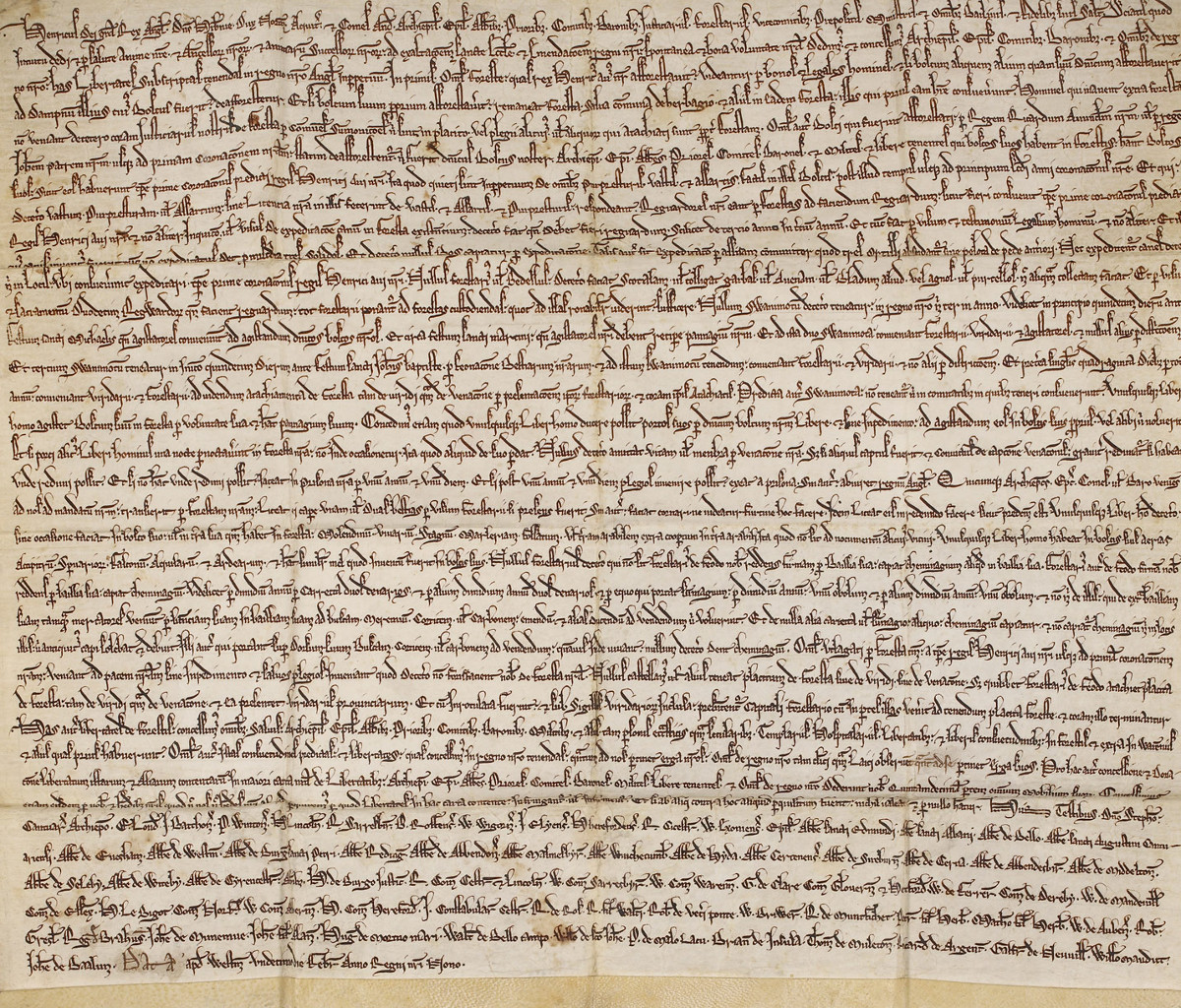
800 years ago today, on Nov 6, 1217, the Charter of the Forest was sealed by King Henry III, making it "the first environmental charter forced on any government" in which were asserted "the rights of the property-less, of the commoners, and of the commons." (more…)

07 Nov 20:44

Nnedi Okorafor Delivers an Awesome TedTalk on Afrofuturism

by Princess Weekes

Nnedi Okorafor is one of science fiction’s smartest voices. The Nebula and Hugo award-winning author has published multiple novels and short stories about futuristic African societies and fantastical ones as well. In this TedTalk, Okorafor speaks on Afrofuturism and how her work Binti is an exploration of a future where Africa and African roots are part of a textual framework:

“I can best explain the difference between classic science fiction and Afrofuturism if I used the octopus analogy. Like humans, octopuses are some of the most intelligent creatures on earth. However, octopus intelligence evolved from a different evolutionary line, separate from that of human beings, so the foundation is different. The same can be said about the foundations of various forms of science fiction.

So much of science fiction speculates about technologies, societies, social issues, what’s beyond our planet, what’s within our planet. Science fiction is one of the greatest and most effective forms of political writing. It’s all about the question, “What if?” Still, not all science fiction has the same ancestral bloodline, that line being Western-rooted science fiction, which is mostly white and male. We’re talking Isaac Asimov, Jules Verne, H.G. Wells, George Orwell, Robert Heinlein, etc.

So what if a Nigerian-American wrote science fiction?”

If you haven’t read Okorafor’s work, I would recommend you check out her novella Binti for an idea of her writing style. Her novel, Who Fears Death is in production with HBO and as an upcoming series. Her newest young adult novel, Akata Warrior, is the long-awaited sequel to Akata Witch is out now and it is amazing. She is excellent in every way, not only because she is an Aries like me, but because her work is creative, interesting, and unapologetically African. It is worth exploring for anyone who enjoys the genre and amazing writing.

(image: Tor.com)

Want more stories like this? Become a subscriber and support the site!

The Mary Sue has a strict comment policy that forbids, but is not limited to, personal insults toward anyone, hate speech, and trolling.—

07 Nov 20:44

Stern Pinball’s CEO tells us how a pinball machine gets made

by Baraka Kaseko and Marah Eakin

Gary Stern, owner and president of Chicagoland’s Stern Pinball, has been a key member of the arcade gaming industry for over three decades. While at the helm, he’s helped create hundreds of pinball machines, all of which are designed and manufactured in America. In the video above, Stern explains how a pinball machine…

Read more...

07 Nov 20:43

A Board Game Cafe To Balance Out King’s Bierhaus in a Shady Acres Strip Center

by Dan Singer

Houston’s first board-game-themed cafe and bar is set to move into the long-mostly-vacant strip center near the White Oak hike-and-bike trail off T.C. Jester just east of Ella Blvd. next February. King’s Bierhaus (pictured above) took up residence last year on the opposite end of the same center (which is behind Restaurant Depot and SSQQ) — on the other side of the iCycle Bike Shop. The photo at top shows 2 businesses that have since left the strip; Tea & Victory and its lending library of 500 board games will go into the 3,300 sq.-ft. space formerly occupied by City Nails and Skincare. A first storefront for cake and cupcake vendor AshleyCakes will be moving in next to the game cafe. $5 will cover an all-access pass for customers to play as many games as they want, including the ones shown in this photo snapped at a Tea & Victory pop-up event in May: “Game Wardens” will be on hand to recommend board games and offer training for new players. Tea & Victory [Facebook] Success of King’s BierHaus brings area new tenants [The Leader] Photos: Loopnet (center); JJ J. (King’s Bierhaus); Tea & Victory (games) … Read More
07 Nov 20:38

The Male Sensitivity Reader©

by DEVORAH BLACHOR

The Male Sensitivity Reader helps women compose social media posts in a way that won’t offend, threaten, trigger, or cause discomfort to male readers. Offering critique, explanation, and editing services, The Male Sensitivity Reader is available to assist you in all your Male Sensitivity needs.

Examples of The Male Sensitivity Reader at work:

Offending Post:
“Men: Please stop trying to help women reverse into parking spaces. It’s patronizing.”

Critique:
This is offensive because I myself members of our staff have helped women reverse and would certainly help a man if the occasion ever arose. We mustn’t presume anything negative about men who do this or their motivations.

Post Male Sensitivity Reader Edit:
“Men: Thank you for helping both women and men reverse into parking spaces. As for those who only help women, I realize that you’re acting from a sense of chivalry. Thank you as well.”

- - -

Offending Post:
“I can’t even look at this photo. A bunch of men signing legislation so that they can control our bodies. I feel sick.”

Critique:
You have missed the real injustice here, which is that in this room full of legislators, a woman was present. This photo has been mendaciously framed so that the woman doesn’t appear, thus giving a false impression about an unequal power structure.

Post Male Sensitivity Reader Edit:
“Here is a photograph of wise men faithfully doing their jobs. It must be difficult to carry the weight of so many big decisions on their shoulders. They really haven’t gotten enough credit. This photo makes me feel buoyant.”

- - -

Offending Post:
“I just read this puff piece about a 75-year-old man marrying a 24-year-old woman. My daughter turns seventeen tomorrow and we’re thinking we should move to a lesbian commune LOL”

Critique:
This post is ageist and homophobic. Aside from the bigoted comments you make about lesbian women and how they’re different from everyone else, you have gravely injured the dignity of older human beings. A mature man might very well have the wit, intelligence and vigor to be the perfect partner for a marginally younger woman. This is a failure of imagination and you’re also judging people you have never met, which exposes your own bias.

Post Male Sensitivity Reader Edit:
“Oh, the mysteries of true love!”

- - -

Offending Post:
“Is everyone aware that white conservative males are twice as likely to deny climate change? Just sayin’”

Critique:
You’re making generalizations based on race and gender and everyone knows it’s wrong to be a racist and a sexist.

Post Male Sensitivity Reader Edit:
“While some climate scientists believe that human beings and carbon emissions have caused the earth’s temperature to increase, we can’t really trust them because of their liberal bias and because scientific theory is just that — a theory. No one can know what will happen in the future, so let’s make good decisions based on what that scientist who got his funding from Exxon says.”

- - -

Offending Post:
“I can’t believe this fucking pussy grabber POS is president”

Critique:
By cursing, you expose yourself as hysterical. Also, by neglecting to mention Bill Clinton, and more importantly, by failing to call out Hillary Clinton for enabling her husband’s sexism, for victimizing his girlfriends, and for being the architect of Harvey Weinstein’s shocking behavior, you have done a disservice to all women. I’m not sure the feminist movement can recover from attacks such as this one. You’ve done grave damage.

Post Male Sensitivity Reader Edit:
“Hillary Clinton is the greatest threat to women and to democracy.”

- - -

Offending Post:
“If one more dude mansplains to me today, I will rip his head off.”

Critique:
This seems like a threat that I take personally will likely get you into legal trouble and also might hinder your chances of getting married.

Post Male Sensitivity Reader Edit:
“Women: It’s best to listen politely when men speak because they have many interesting and enlightening things to say. I learn so much from men and I hope that you too, dear woman reader of this post, will honor men by paying close attention to their words, heeding their advice, and obeying their unsolicited social media critiques. Thank you.”

- - -

Devorah Blachor’s humor parenting book, The Feminist’s Guide to Raising a Little Princess comes out this week. She’s looking forward to receiving helpful comments about the book from sensitive males.

07 Nov 20:37

Dig Thor’s New Hair in Thor: Ragnarok? You Have Kevin Smith to Thank!

by Teresa Jusino

image: Marvel  Chris Hemsworth as Thor in "Thor: Ragnarok"

I, like much of America, saw Thor: Ragnarok this weekend and had a great time. It’s literally the only time I’ve cared this much about Thor as a character. Also, I’m a much bigger fan of the closely-cropped hair than I ever was of Thor’s longer, shaggier do. As it turns out, we have Kevin Smith and his nerdy ranting to thank for the change!

In an interview with Vanity Fair, Thor himself, Chris Hemsworth, talked about how desperate he was for a change after having played Thor basically the same way through several MCU films, saying he was “frustrated and bored,” and having told Marvel’s Kevin Feige “I feel like I’m dying here. I feel like I have handcuffs on.”

Thankfully, he listened to a Kevin Smith podcast where Smith spent it trash-talking the Thor franchise. It was that trash-talking that inspired Hemsworth to pursue changes to the character with director, Taika Waititi. Hemsworth said, “Hearing someone like Smith, who represents the fanboy world, was such a kick in the ass to change gears. We sort of had nothing to lose. People didn’t expect what we did with it this time around.”

And so, they “cut his hair” and “destroy[ed] the hammer.” And created one of the most fun and grounded iterations of Thor ever. I’m just grateful that Kevin Smith’s nerdery is so influential.

(via CBR.com, image: Marvel)

Want more stories like this? Become a subscriber and support the site!

The Mary Sue has a strict comment policy that forbids, but is not limited to, personal insults toward anyone, hate speech, and trolling.—

16 Oct 16:36

Python easy earth globe

by Prof. Christopher L. Liner
You can make a stunning earth globe, including topography and bathymetry, with just a few lines of python. Just now, I am interested in New Zealand, so we can put it in the middle. Here is the code:

from mpl_toolkits.basemap import Basemap
import matplotlib.pyplot as plt
import numpy as np
map = Basemap(projection='ortho', lat_0=-30, lon_0=170, resolution='l')
map.etopo()
map.drawcountries()
map.drawmeridians(np.arange(0,360,30))
map.drawparallels(np.arange(-90,90,30))
plt.show()

Below is the result, not bad for 9 lines of code!


16 Oct 16:28

Ralph Steadman’s Hellish Illustrations for Ray Bradbury’s Classic Dystopian Novel, Fahrenheit 451

by Colin Marshall

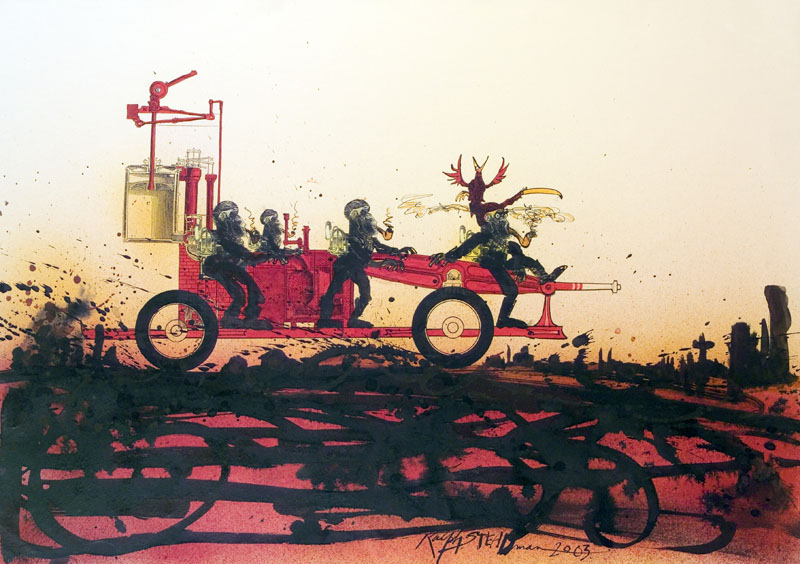
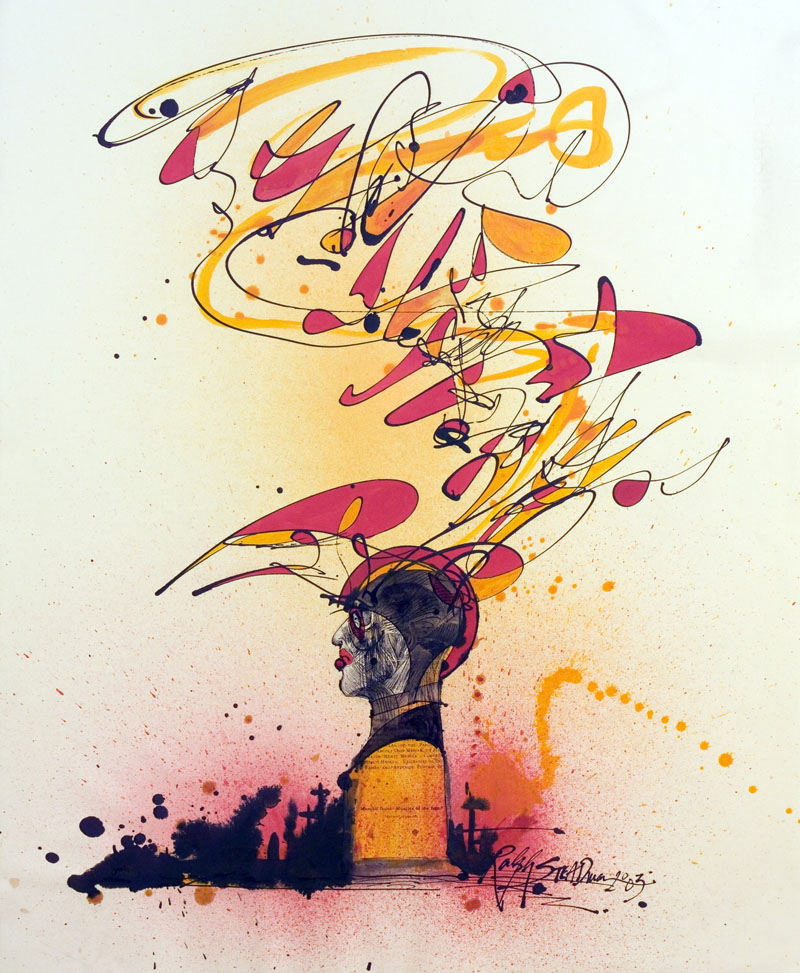
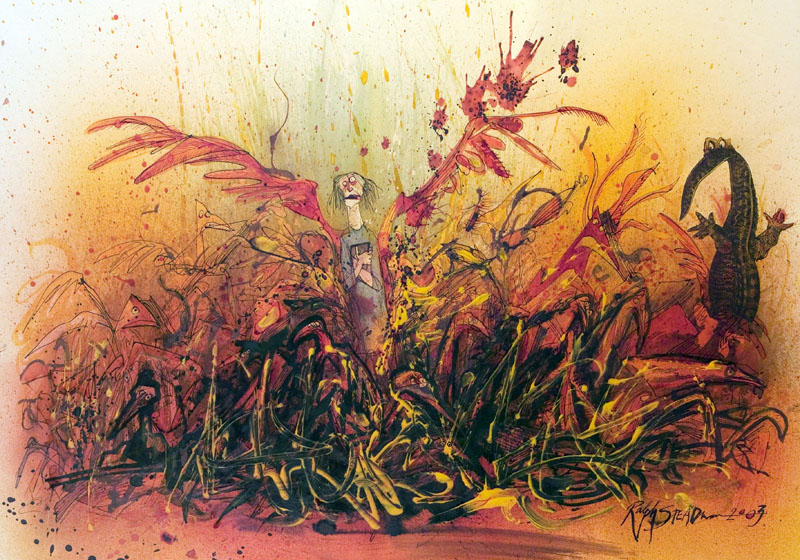
Hunter S. Thompson and Ray Bradbury would at first seem to have little in common, other than having made their livings by the pen. Or rather, both of them having developed as writers in the mid-20th century, by the typewriter--though Thompson famously shot his and a young Bradbury once had to rent one for ten cents per hour at UCLA's library. In one nine-day rental in the early 1950s, Bradbury typed up Fahrenheit 451, still his best-known work and one whose central idea, that of a future society that methodically destroys all books, has stayed compelling almost 65 years after its first publication.

Thompson's best-known work, 1971's Fear and Loathing in Las Vegas, deals in different kinds of frightening visions, some of them brought to illustrated life by the English artist Ralph Steadman. Thirty years later years later and with his name long since made by his collaboration with Thompson, Steadman would bring his talents to Bradbury's dystopia. Brain Pickings' Maria Popova quotes him describing the theme of Fahrenheit 451 as "vitally important." According to Dangerous Minds' Paul Gallagher, when Bradbury saw Steadman's illustrations, commissioned for a limited edition of the book around its fiftieth anniversary, he said to the artist, "You’ve brought my book into the 21st century."

Steadman repaid the compliment when he said that he considers Fahrenheit 451 "as important as 1984 and Animal Farm as real powerful social comment," and he should know, having previously poured his artistic energies into a 1995 edition of George Orwell's deceptively simple allegory of the Russian Revolution and its consequences. More than a few of us would no doubt love to see what Steadman could do with 1984 here in the 21st century, a time when we've hardly extinguished the societal dangers of which Orwell, or Bradbury, or indeed Thompson, tried, each in his distinctive literary way, to warn us. Book-burning may remain a fringe pursuit, but the fight against thought control in its infinite forms demands constant vigilance — and no small amount of imagination.

You can see more illustrations of Fahrenheit 451 at Brain Pickings and Dangerous Minds. Also, you can purchase used copies of the limited print edition online, though they seem quite rare at this point. Editions can be found on AbeBooks--for example here and here.

Related Content:

Ray Bradbury Reveals the True Meaning of Fahrenheit 451: It’s Not About Censorship, But People “Being Turned Into Morons by TV”

To Read This Experimental Edition of Ray Bradbury’s Fahrenheit 451, You’ll Need to Add Heat to the Pages

Gonzo Illustrator Ralph Steadman Draws the American Presidents, from Nixon to Trump

Ralph Steadman’s Surrealist Illustrations of George Orwell’s Animal Farm (1995)

How Hunter S. Thompson — and Psilocybin — Influenced the Art of Ralph Steadman, Creating the “Gonzo” Style

Based in Seoul, Colin Marshall writes and broadcasts on cities and culture. His projects include the book The Stateless City: a Walk through 21st-Century Los Angeles and the video series The City in Cinema. Follow him on Twitter at @colinmarshall or on Facebook.

Ralph Steadman’s Hellish Illustrations for Ray Bradbury’s Classic Dystopian Novel, <i>Fahrenheit 451</i> is a post from: Open Culture. Follow us on Facebook, Twitter, and Google Plus, or get our Daily Email. And don't miss our big collections of Free Online Courses, Free Online Movies, Free eBooksFree Audio Books, Free Foreign Language Lessons, and MOOCs.

16 Oct 16:28

After Trump lies about the Iran deal, John Oliver says "We got him!," forgets that nothing matters any more

by Dennis Perkins

A running gag on Last Week Tonight With John Oliver points up the fact that, in a world where the president lies about easily verifiable, globally vital facts at least once a day (and that just on Twitter), the old rules about accountability and acceptable fucking behavior just don’t apply. Several times now, Oliver…

Read more...

16 Oct 16:27

Gravitational waves: Why the fuss?

Great excitement rippled through the physics world Monday at news of the first-ever detection of two ultra-dense neutron stars converging in a violent smashup.