Shared posts

16 Oct 16:35

Organizing spreadsheets

by Matt Hall

A couple of weeks ago I alluded to ill-formed spreadsheets in my post Murphy's Law for Excel. Spreadsheets are clearly indispensable, and are definitely great for storing data and checking CSV files. But some spreadsheets need to die a horrible death. I'm talking about spreadsheets that look like this (click here for the entire sheet):

Bad_spreadsheet_3.png

This spreadsheet has several problems. Among them:

  • The position of a piece of data changes how I interpret it. E.g. a blank row means 'new sheet' or 'new well'.
  • The cells contain a mixture of information (e.g. 'Site' and the actual data) and appear in varying units.
  • Some information is encoded by styles (e.g. using red to denote a mineral species). If you store your sheet as a CSV (which you should), this information will be lost.
  • Columns are hidden, there are footnotes, it's just a bit gross.

Using this spreadsheet to make plots, or reading it with software, with be a horrible experience. I will probably swear at my computer, suffer a repetitive strain injury, and go home early with a headache, cursing the muppet that made the spreadsheet in the first place. (Admittedly, I am the muppet that made this spreadsheet in this case, but I promise I did not invent these pathologies. I have seen them all.)

Let's make the world a better place

Consider making separate sheets for the following:

  • Raw data. This is important. See below.
  • Computed columns. There may be good reasons to keep these with the data.
  • Charts.
  • 'Tabulated' data, like my bad spreadsheet above, with tables meant for summarization or printing.
  • Some metadata, either in the file properties or a separate sheet. Explain the purpose of the dataset, any major sources, important assumptions, and your contact details.
  • A rich description of each column, with its caveats and assumptions.

The all-important data sheet has its own special requirements. Here's my guide for a pain-free experience:

  • No computed fields or plots in the data sheet.
  • No hidden columns.
  • No semantic meaning in formatting (e.g. highlighting cells or bolding values).
  • Headers in the first row, only data in all the other rows.
  • The column headers should contain only a unique name and [units], e.g. Depth [m], Porosity [v/v].
  • Only one type of data per column: text OR numbers, discrete categories OR continuous scalars.
  • No units in numeric data cells, only quantities. Record depth as 500, not 500 m.
  • Avoid keys or abbreviations: use Sandstone, Limestone, Shale, not Ss, Ls, Sh.
  • Zero means zero, empty cell means no data.
  • Only one unit per column. (You only use SI units right?)
  • Attribution! Include a citation or citations for every record.
  • If you have two distinct types or sources of data, e.g. grain size from sieve analysis and grain size from photomicrographs, then use two different columns.
  • Personally, I like the data sheet to be the first sheet in the file, but maybe that's just me.
  • Check that it turns into a valid CSV so you can use this awesome format.

      After all that, here's what we have (click here for the entire sheet):

    The same data as the first image, but improved. The long strings in columns 3 and 4 are troublesome, but we can tolerate them. Click to enlarge.

    The same data as the first image, but improved. The long strings in columns 3 and 4 are troublesome, but we can tolerate them. Click to enlarge.

    Maybe the 'clean' analysis-friendly sheet looks boring to you, but to me it looks awesome. Above all, it's easy to use for SCIENCE! And I won't have to go home with a headache.


    The data in this post came from this Cretaceous shale dataset [XLS file] from the government of Manitoba. Their spreadsheet is pretty good and only breaks a couple of my golden rules. Here's my version with the broken and fixed spreadsheets shown here. Let me know if you spot something else that should be fixed!

    16 Oct 16:34

    A History of Canada in Ten Maps

    by Jonathan Crowe

    The odd thing about A History of Canada in Ten Maps, the new book by Adam Shoalts out today from Allen Lane, is that it’s almost entirely uncontaminated by maps. It’s not just because the electronic review copy I received (via Netgalley) contained no images of the maps being referred to in the text: I expect that will be rectified in the published version; if nothing else I was able to find an online version of each map (a gallery follows below). It’s that in the text itself the maps are quite literally an afterthought.

    It turns out that A History of Canada in Ten Maps isn’t really a book about maps, or mapmaking, but exploration. For Shoalts, the maps are the evidentiary traces of the stories he really wants to tell. In nine of the ten cases, those are stories of Canada’s exploration; in the tenth, a key battle of the War of 1812. Combined, those stories form a mosaic tale of nation-building, one that supports the kind of national mythmaking that the previous government in Canada was particularly fond of.

    Each story, from the Vikings’ earliest explorations of North America, through the journeys of the inland explorers of the fur trade to the Franklin expedition, is engagingly told. Shoalts does know how to spin a tale. Drawing on contemporary accounts, explorers’ journals and letters, he recounts fairly traditional narratives of the various expeditions that are nonetheless vivid and bracing: we feel the starvation, the privation, the threat, the cold. But from an historiographical perspective this book neither breaks new ground nor adds anything to our understanding. In terms of method it’s a bit of a throwback: it centres significant historical figures who are hardly unknown to Canadians: Champlain, Radisson, Hearne, Mackenzie, Thompson and so forth. It could have been published a half-century ago without raising any eyebrows.

    Readers expecting something about maps will be disappointed. Despite the title, this is not the Canadian version of Jerry Brotton’s History of the World in Twelve Maps. In most chapters the maps get only the briefest of mentions, sometimes less than a paragraph; and sometimes their connection to the enterprise being described is somewhat tenuous or after the fact. As a narrative conceit, shaping the history of the exploration of Canada around a set of maps is not a bad one, but Shoalts fails to meet the expectations he himself has raised. In the end, I think he ended up being led by his primary sources, telling the stories they wanted to tell rather than the story his own structure demanded.

    A History of Canada in Ten Maps is available in hardcover in Canada and as an ebook in both Canada and the United States (Kindle, iBooks).

    (Image sources: 1, 2, 3, 4, 5, 6, 7, 8, 9, 10)

    16 Oct 16:29

    Mapping: In Praise Of The Triangle

    by noreply@blogger.com (Suvrat Kher)
    Jerry Brotton in his book A History Of The World In 12 Maps writes about France's National Map Project. Begun around the 1670's upon the establishment of the Academie de Sciences and the Paris Observatory and headed by the astronomer Cassini I, it first attempted to create an accurate geodetic survey of France using the latest surveying instruments. At the heart of the survey was the calculation of distances and directions using the method of triangulation. Latitude was calculated using a quadrant that measured the altitude of celestial bodies. Then, using a measuring stick, a baseline of a known length was established. A third point on the landscape was sighted. The angles between the three control points were measured. Using trigonometric tables the lengths of the remaining two sides of the triangle could be calculated.

    I liked this passage:

    In 1744 the survey was finally completed. Its geometers had completed an extraordinary 800 principal triangles and nineteen base lines. Cassini III had always envisaged printing regional maps as they were produced, and by 1744 the map was published in eighteen sheets. Its new map of France, on an approximately small scale of 1: 1,800,000, shows the country represented as a network of triangles, with virtually no expression of the land's physical contours,and with large areas such as the Pyrenees, the Jura and the Alps left blank. It was a geometrical skeleton,a series of points,lines and triangles following coasts, valleys and plains in connecting key locations from which observations were carried out. Over it all lay the triangle, the new immutable symbol of rational, verifiable scientific method. On Cassini III's map the triangle almost takes on its own physical reality, a sign of the triumph of the immutable laws of geometry and mathematics over the vast, messy chaos of the terrestrial world. The Babylonians and the Greeks had revered the circle, the Chinese celebrated the square, the French now showed that it was the application of the triangle that would ultimately conquer the earth.

    Cassini III was the grandson of Giovanni Domenico Cassini (Cassini I). The directorship of the Paris Observatory remained in the Cassini family over four generations.

    This surveying method was quickly adopted and adapted by others. The Ordnance Survey began mapping the British Isles using this method in the late 1700's.  William Lambton took the Ordnance Survey's acquired expertise and began the Great Trigonometrical Survey of India in the year 1800, a feat that took nearly 50 years to complete. John Keay's book The Great Arc details that mammoth effort.

    16 Oct 16:29

    The Bay Of Bengal Once Touched Sikkim

    by noreply@blogger.com (Suvrat Kher)
    See this satellite imagery of the Himalaya.  The Indian State of Sikkim occupies the region just east of Darjeeling.


    The Siwaliks (green arrows) appear as a forested linear band forming the southernmost hilly terrain of the Himalaya. The hills abut against broad alluvial plains. Rivers traversing the Himalaya carrying enormous sediment load encounter a gentler gradient upon exiting the hilly terrain. A loss of stream power results in sediment being dumped in the channel, so much so, that rivers get chocked on their own sediment. As a result, channels split and bifurcate forming a braided river system. These rivers  also suddenly change course, abandoning their channel and carving out new ones. Such course changes may occur during floods or by tilting of the land by structural movements.  Over time, the deposits of these ever changing rivers coalesce to form cone shape aprons of sediments known as alluvial fans. These rivers like the Kosi and the Tista, which flow transverse to the mountain range, meet an axial river like the Ganga and the Brahmaputra flowing parallel to the mountain front. The axial river flows into the Bay of Bengal.

    The Siwalik hills were once these type of alluvial fans.  Just as today, during Miocene and Pliocene times, sediment was being deposited in front of the rising Himalayan mountains. Beginning about half a million years ago or so, these ancient alluvial fans were crumpled up and uplifted to form the Siwalik ranges. Active alluvial fan formation shifted southwards to its present locus. This process continues. In a few million years, the present day alluvial fans deposited by rivers like the Kosi and the Teesta will be deformed into a newer mountain range south of the Siwaliks. The Himalaya are growing southwards.

    How do we know that the Siwaliks were once alluvial fans? Geologists rely on analogy, comparing the Siwalik sediments with what is accumulating in the present day alluvial fans. They find a striking similarity. Siwaliks are made up of alternations of coarse gravel layers and finer sand and silt layers with characteristic bed orientations and structures like cross beds and rippled sand. The gravel layers are inferred to be the river channel deposits while the finer sand and silt layers are the river bank, levee and floodplain deposits. An important finding made throughout the length of the Siwalik ranges has been the paleo-current directions preserved in the rocks.  Geologists have measured the orientation of bedding and ripple marks and found out that rivers were flowing south and south east i.e. perpendicular to the mountain chain. There is no evidence of an axial river like the Ganga in these Siwalik sediments. The thinking is that such an axial river must have flowed much to the south of the region of deposition of Siwalik sediments.

    And what about evidence of a delta? Where did these Miocene and Pliocene rivers meet the sea? The logical geographic place to look for a coast would be towards the east. And in fact, that evidence has come from the Siwalik sediments of West Bengal and Sikkim. In a really interesting paper published recently in Current Science, Suchana Taral, Nandini Kar and Tapan Chakraborty describe sedimentary structures and marine trace fossils from Middle Siwalik sediments exposed along the Gish River and its tributaries in the Tista Valley. Siwalik rocks in the central and western part of the Himalaya show current structures that indicate south flowing rivers. In this easterly location however, the sediments show evidence of being deposited in a wave influenced environment. Sedimentary structures like wave ripple laminations and hummocky-swaley stratification indicate deposition in wave dominated marine bay.  Paleo-current indicators like ripple marks preserved on sandstone surfaces show a south as well as north directed current. This suggests an environment influenced by tides and north directed waves. Associated sediments show indicators of different delta environments like distributary channels, delta mouth bar and delta flood plain deposits.

    Apart from current direction indicators, the sediments contain plant fossils indicative of mangrove vegetation and brackish water environments. They also contain trace fossils i.e. impressions and burrows made by creatures moving and disturbing the sediment surface. Cylindrichnus, Chondrites, Rosselia, Taenidium, Skolithos, Planolites are some of trace fossils reported in this study. The assemblage of trace fossils is similar to those reported from marine settings.

    All this suggests that during the time of deposition of these Middle Siwalik sediments in Late Miocene-Pliocene times, about 5-10 million years ago, a branch of the Bay of Bengal had invaded as far north as present day Sikkim. Rivers carrying sediment from the Himalaya were debouching them in a delta and a shallow marine bay. The Sikkim Middle Siwalik strata are ancient deformed delta and marine deposits.  

    A paleo-geographic reconstruction of this eastern part of these Siwalik depositional environments in shown below.


     Source: Suchana Taral, Nandini Kar and Tapan Chakraborty 2017

    The  upper graphic shows the reconstructed delta and marine depositional environment. The lower graphic shows the regional paleo-geography. The pin shows the environmental location of the study area. The yellow rose diagram shows the paleocurrent directions measured in the Siwalik sediments.

    Interestingly, some earlier work by geologists has shown that in Late Miocene times the Brahmaputra was flowing along a much more easterly route towards the Bay of Bengal. They used sand thickness and sand/shale ratios from wells drilled in the delta and found lobate sand bodies, which they inferred were brought in by a large river flowing from a ENE source. Their interpretation is shown in the graphic to the left (Uddin A. and Lundberg N. 1998). At the time the Shillong Plateau did not exist. The river flowed into the Bay of Bengal from the Upper Assam valley and through the Sylhet depression in to the Bengal Basin. The uplift of the Shillong Plateau in Pleistocene times forced the Brahmaputra to turn west and wrap itself around the newly emerging uplands.

    Since Pliocene times, the tremendous amount of sediment being delivered by Himalayan rivers, coupled with Pleistocene sea level fall, has caused a retreat of this arm of the Bay of Bengal southwards.

    In the satellite image below, based on the location of the Sikkim Siwalik deposits and other work on the Bengal Basin paleogeography, I have drawn in brown the coastline as it would have existed 5-10 million years ago. The ancient drainage systems are shown in blue. South directed arrows shows the extent of the growth of the Bengal/Bangladesh alluvial plains and delta and the retreat of the sea since then to its present location.


    Pretty amazing finding.

    29 Aug 19:29

    ABC News anchor reports on Houston flood survivors stealing food, directly to police

    by Sean O'Neal

    The situation in Houston remains dire, as dams begin overflowing with rains that have already wrought catastrophic damage and swept away thousands of homes, leaving the city’s residents trapped with limited recourse for shelter and no hope for evacuation. Fortunately, a brave journalist like ABC World News Tonight

    Read more...

    29 Aug 19:28

    All these Harvey hoaxes are another reminder of how hard it is to fight fake news

    by Cale Guthrie Weissman

    You may have heard that there was a shark swimming around in a flooded highway in Houston. Well, that’s wrong, but it went viral anyway thanks to a hoax tweet. Similarly, an airport in Houston is not underwater, despite false pictures showing planes under water. And Obama is not on the ground in Houston feeding meals to … Continue reading “All these Harvey hoaxes are another reminder of how hard it is to fight fake news”

    You may have heard that there was a shark swimming around in a flooded highway in Houston. Well, that’s wrong, but it went viral anyway thanks to a hoax tweet. Similarly, an airport in Houston is not underwater, despite false pictures showing planes under water. And Obama is not on the ground in Houston feeding meals to evacuees, despite false reports.

    Read Full Story

    29 Aug 19:28

    You're gonna like the Heckuva Job

    by jeffrey
    It's gonna be the best, biggest, most beautiful Heckuva Job. You're gonna love it. Believe me. But later.
    President Donald Trump said Harvey's destruction and flooding was a disaster "of epic proportions" as he visited Corpus Christi, Texas, on Tuesday (Aug. 29).

    "This was of epic proportions. No one has ever seen anything like this," the president said as he received a briefing from Texas state and local officials.

    Trump also said his administration wants to handle the recovery "better than ever before."

    "We want to be looked at in five years, in 10 years from now as this is the way to do it," Trump said speaking to reporters. Addressing Texas Gov. Greg Abbott, Trump said now is not the time to say congratulations.

    "We won't say congratulations. We don't wanna do that," the president said, "we'll congratulate each other when it's all finished."
    We  want to say Heckuva Job. We can't wait to say Heckuva Job. But we'll wait until it will be less infuriating. 
    29 Aug 18:53

    Levee South of Houston Breached, Residents Told to "Get Out Now"

    The catastrophic flooding from Tropical Storm Harvey isn't over yet. On Tuesday morning there was a breach in one of the levees in Brazoria County, located just south of Houston. Brazoria County officials responded to the failure in the Columbia Lakes levee by bluntly urging anyone still in the area...
    29 Aug 18:37

    Twitter Shamed This Millionaire Televangelist Into Opening His Megachurch as Shelter From Hurricane Harvey

    by Vivian Kane

    Embed from Getty Images

    Pastor Joel Osteen runs the Lakewood megachurch in Houston, Texas. The church, being as mega as it is, used to be an indoor sports arena and is capable of holding nearly 17,000 people. Now, I know what you’re thinking! This is exactly what the people of Houston need right now, as they suffer the biggest flood ever to hit their city and thousands have been evacuated, with many more still waiting for help. What better combination than a man who has dedicated his life to doing the work laid forth by his god, and an obvious shelter for so many in need? Obviously, Osteen is going to do everything he can for the community that reportedly donates tens of millions of dollars a year (not to mention those $55 million Osteen’s own book sales). That would be the only Christian thing to do, right?

    No, of course that’s not what Osteen did. He sent thoughts & prayers.

    If you’re one of the 30,000 people expected to need shelter in Houston, though, don’t worry. Osteen may not be helping, but he promises “God’s got this.”

    Unfortunately, that tweet didn’t do much to alleviate the need or suffering of his parishioners and other Texans. Nor did it lessen the anger they’re feeling toward Osteen, who cancelled church services and claimed he couldn’t open his doors because of flooding.

    https://twitter.com/cmclymer/status/902204084597469184

    https://twitter.com/cmclymer/status/902315827042689024

    He later said he would open the church after all other shelters were full.

    Not surprisingly, this non-statement did little to win people over.

    https://twitter.com/cmclymer/status/902341182663032832

    https://twitter.com/bkerogers/status/902247522357440512

    Apparently, all it took for Osteen to finally open Lakewood’s door to those in need was total commitment to the values he’s dedicated his life to preaching a day of public Twitter shaming.

    If you’re looking for ways to be more helpful than Joel Osteen, here are some organizations that can use donations and other forms of aid.

    (image: YouTube/Joel Osteen, Twitter)

    Want more stories like this? Become a subscriber and support the site!

    The Mary Sue has a strict comment policy that forbids, but is not limited to, personal insults toward anyone, hate speech, and trolling.—

    29 Aug 17:15

    Flooding update: Levee at Columbia Lakes breached; Addicks overflows

    by Olivia Pulsinelli
    The levee at Columbia Lakes has been breached, Brazoria County tweeted Tuesday morning. Nearby residents were urged to “get out now,” according to the tweet. Information about the Columbia Lakes evacuation on the county’s website says shelters are available in Clute, Angleton, Manvel and Alvin. The Columbia Lakes area is near the town of West Columbia, less than 20 miles northwest of Lake Jackson and about 60 miles from Houston. It’s essentially bordered by the Brazos River. This is the…
    29 Aug 17:15

    Brazos River Expected to Reach Record Highs in Fort Bend County

    Parts of Fort Bend County remain under mandatory evacuation as the Brazos River is projected to crest at 57.5 feet by 9 p.m. Tuesday, nearly four feet above its current level, according to the National Weather Service. That would break a 2016 record high. Already, more than 50,000 residents are...
    29 Aug 17:15

    Here’s a Map of the West Houston Neighborhoods Behind the Addicks and Barker Reservoirs Threatened by Overflow

    by Swamplot

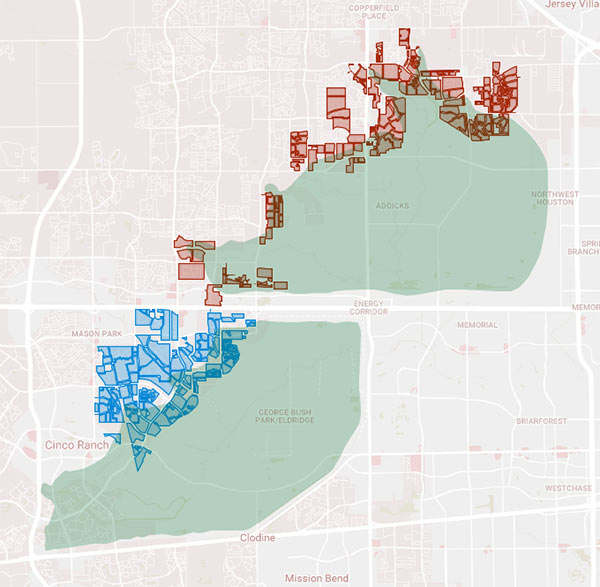
    The map above outlines the actual locations of neighborhoods designated by officials yesterday as being at risk from flooding over the back sides of Houston’s dual Buffalo Bayou reservoirs — in advance of actual spillovers, which began last night and continued this morning. The map was put together by Chronicle data reporter John D. Harden, using information from the Harris County Flood Control District. Zoom in and you can identify specific streets and neighborhoods on the upstream side of Addicks (in red) and Barker (in blue) reservoirs. Names of the affected neighborhoods are listed on the map’s fly-out panel, available by clicking on the icon at the top left corner of the map. Click on the icon at the top right corner to enlarge the map if you need to. To lessen the risk of flooding to these areas, officials have been releasing water out the other end, through the Addicks and Barker dams into Buffalo Bayou — possibly (depending on bayou water levels) endangering neighborhoods and structures downstream. A weary Houston likely to endure catastrophic flooding through Wednesday [Houston Chronicle] Officials fear rising rivers, failing levees [Houston Chronicle] Map: Houston Chronicle … Read More
    22 Aug 15:21

    The People Behind Game of Thrones Admit This Week's Rescue Timeline Didn't Quite Work

    by Germain Lussier

    The most recent episode of Game of Thrones, “Beyond the Wall,” was one of the most divisive in recent memory. Much of that was because of the highly questionable timeline linking the group in the North with Daenerys, who was much further South.

    Read more...

    22 Aug 15:21

    Microsoft and Halliburton collaborate to digitally transform oil and gas industry

    Microsoft and Halliburton has announced plans to enter into a strategic alliance to drive digital transformation across the oil and gas industry.
    22 Aug 15:21

    Rose Petroleum gets approvals for Paradox Basin Seismic Survey

    Rose, the AIM quoted natural resources business, announced that it has now received all necessary final approvals for its 3D seismic survey on its oil and gas exploration acreage in the Paradox Basin, Utah (the Paradox Acreage) and the permitting process for the proposed survey is now complete.
    03 Aug 19:24

    40 years ago today, RadioShack gave us the TRS-80

    by Harry McCracken

    If you pressed me to name the most important year in the history of personal technology, I might come up with 1977. That’s the year that three groundbreakingly consumery personal computers were released. There was Apple’s Apple II and Commodore’s Pet 2001. And on August 3, 1977, RadioShack (née Radio Shack) unveiled its TRS-80 during a press conference at the Warwick Hotel in New York.

    I cheerfully admit to having a bias in favor of the TRS-80, which I started using when my father brought one home in 1978. Even in its heyday, it had a reputation for being clunky snd unglamorous. But it outsold the sexier (and pricier) Apple II for years and was marketed in thousands of the Shack’s retail outlets at a time when Apple products were still available primarily in weird little mom-and-pop computer stores. To me, that makes it the most mainstream of the early PCs.

    I had a lot more to say about the machine for a piece I wrote to mark its 35th anniversary in 2012. And here (via RadioShackCatalogs.com) is some imagery from the cover of the first TRS-80 catalog, back when anyone selling computers had to start by explaining what they could do.

    1977 RadioShack catalog image

    01 Aug 22:30

    Your Patriotism Isn’t Love, It’s Blindness

    by Abraham A. Joven


    Like most American tales, this one begins with baseball. The unusual sight of an entirely left-handed battery on an otherwise empty diamond; father catching son. A splitter—fast and cutting—fools the father as the bottom drops out of its trajectory and right onto his toe, causing a small amount of blood to pool under the nail. After some hobbling and a few muttered curse words in Tagalog, he turns to the son and apologetically calls it a day.

    “That was a good pitch, anak,” he says. “But, to save my body, we better head back.”

    I think about my father often. I think about days like that at the park, or when he pulled me out of bed to catch Kirk Gibson hit that home run in ’88. I was fresh from the Philippines, having only immigrated a few months prior with my mother and sister—my brother, only an infant then, would follow shortly, to finally unite our family in our small slice of South Los Angeles. My father was our gateway to America. I think about how he came here first, learned aspects of the culture (sports especially), and worked to pass them on to us. I think about how he worked the graveyard shift, got laid-off, then was rehired but only for jobs out of state—away from our home in Los Angeles. I think about how that crushing loneliness would have defeated me, and how he never complained about it to any of us. I think often of how he loved us.

    I also think about his many demons: alcoholism and gambling among them. I think about the cigarette smoke still curling in the air as my mother, sister, brother, and I frantically combed an empty apartment for personal effects before he returned, drunk and angry. I think about how the nobility in being separated from family to provide for them is tempered by his absence in our lives. How he was unable to fully articulate his sense of care. And how that care, often, felt prickly and uncertain. This, too, is how he loved us.

    Reflecting on the state of America for people of color, I think about that love; I think about loving the oppressor.

    Patriotism in America has long been marked by a vein of blind and unceasing fealty to the country. A strange corruption of unconditional love, this strain would have citizens follow its leadership and laws to all ends without question or regard. Never mind that the founders of this country used as a guiding principle that this nation was, is, and implicitly always will be, an imperfect union. Nor that this nation was founded on a set of contradictions: laws and documents codifying into legal practice centuries of race-based oppression, exclusion, and discrimination all bleed into our modern world. As a Filipino-American, I cannot explain the plight against my immigrant community without acknowledging the Chinese Exclusion Act, the Alien Land Law, the internment of Japanese-Americans, and anti-miscegenation laws. There is a direct thread linking this nation’s abysmal history on race and its oblique deflections regarding critiques on it, to the continued proliferation of white supremacist activity today. Love of country, for people of color, has always meant acknowledging the sins of America.

    The myth of this nation is rooted in benign stories of discovery and adventure. Of pious journeys set on noble ideals. There is no lasting grapple with the tensions in our history. That the beauty of California’s missions along El Camino Real also ravaged local indigenous communities with disease, while exploiting the bodies of the newly converted by forcing them into labor. That those missions are gilded in the blood and sweat of that cheap labor force,  maintained through brutal forms of punishment, rarely registers. Our pilgrims to the east were hardly more noble, as religious refugees persecuted their own in the Salem witch trials, an early example of North American misogyny. From a Constitution that enumerated African-Americans as less than human, to an extermination campaign by government under a seemingly benign sense of duty to gentrify “savages,” tragedy and devastation were a part of your American Dream, unless you were white and male.

    Love of country, some argue. With their boots firmly planted in my chest as I struggle to protest. No, that is not love, but blindness.

    The blindness that these patriots would will on to others—a malady not random and loaded with cruelty—is what I’d come to know as patriotism. It presents itself in arguments of a post-racial America under President Barack Obama. Or in the whitewashing of Japanese internment as an act of mercy and protection for those stripped of their possessions, liberty, and, ultimately, humanity. It is in the lack of engagement over the meaning of Southern states fighting more vehemently for the retention of monuments on behalf of Confederate soldiers than in the civil rights protections of people of color in their own communities.

    The ultimate hope of this blindness is not only to avoid the discomfiting feelings of guilt or complicity, but to obtain absolution without penance. To be made innocent without justice. This trick—this falsehood—only serves those desiring to avoid an internal reckoning.

    And for a nation laboring under the stresses of its contradictions, it is not love that marks the silence or obstruction to the remedies proposed over history. It is not love that caused Confederate secession or the ambush of the Freedom Riders. It is not love that refused the huddled masses on the MS St. Louis. It is not love that suggests my humanity is tied to my passport.

    Love, you see, looks unflinchingly into the morass and calls on hope. It does not disavow the wreckage or avoid it. True love is a wise change agent that leans on the better angels without naivety.

    If patriotism is love, then, maybe the point is to reclaim the narrow definition of that love from those that would have us believe that thin, flimsy version they peddle. Theirs is the kind of love that would allow this nation to continue its dark path of hypocrisy, proclaiming to be a light set on a hill, while cloaking many of its citizens in shadow. No, let our generation be the last that accepts this imposter as love and, instead, turn a steely eye inward at the illnesses plaguing us today: racism, ableism, xenophobia, misogyny, transphobia, homophobia, and Islamaphobia. For in order to move forward, we must first acknowledge where we’ve been. And where we’ve been as a nation—as a people—is steeped in violence, exploitation, and inequality.

    Love is restorative. Love is healing. Love carries with it a real hope of reconciliation. But love does not exist exclusively apart from these tensions. The love that I have for my father is complex and messy. I’ve long circled how I might reconcile a love for the person that worked his hands raw to provide for me, and who was often quick with encouragement, with the memory of my twenty-one-year-old-self demanding he never return home. The icy silence of the car ride taking him to the airport is as vivid as the memory of that day at the park.

    It is a similar reflection of love for this problematic nation that I’ve come to know. As an expecting father myself, I’ve seen my work imbued with new urgency and purpose: I am raising my voice to prepare this world for the arrival of my precious joy. This world, undoubtedly, will not be ready for their ebullient spirit. Their brown skin and Asiatic features will mark them as foreign to many, despite their being as American as, well, apple pie. Birthed in this nation, they will still be made to feel as The Other and my heart has broken over and over for the past few months with that knowledge. It is one thing to strain against the yoke of inequality myself. It is another to feel complicit in burdening my child with that same yoke.

    But love is nothing if not hopeful. And hopeful love has long animated the movements that grind against the further cementing of the untiring machine of inequality that is America. This hopeful love filled Fredrick Douglass and protected Harriet Tubman. This hopeful love moved Rosa Parks, Larry Itliong, Cesar Chavez, and Dorothy Day to hold this nation to the truths it proclaims are self-evident. This hopeful love has not had a linear trajectory, but it has always aimed for the zenith that is Justice.

    It is that love, then, that has allowed people of color to resist by simply existing. In the communities left for dead due to the suburban/segregated housing boom: the Comptons, the Detroits, the Bronxs, the Hawthornes. Little acts of rebellion emerge every day and black and brown people thrive. Singing a posada is rebellion. Wearing a Barong Tagalog is rebellion. Attaining a university education is rebellion. Love is tenacious, and our communities are emblematic of that enduring fight.

    It honors our spirit to continually push back against the factions that peddle a false love—that seek to inoculate the masses with their blindness. It is an act of love to work to remove the veil and loosen the bonds of hate and iniquity that have bound our nation from before its founding. Let us march on and not go weary in our search for justice. This is an act of fealty, worthy of patriots.

    ***

    Rumpus original art by Eva Azenaro Acero.

    Related Posts:

    01 Aug 22:30

    How Princess Leia Changed My Life

    by Meg Cabot

    Every time I go on tour for a new Princess Diaries book, I get asked the same question (especially on local morning news casts):

    “Shouldn’t we be raising our daughters to be strong, independent women? Aren’t princesses bad role models?”

    I’m not tired of this question at all though, because every time it’s asked, I get to talk about my favorite fictional character: Princess Leia Organa.

    I was ten when I met her.

    There was just something about the way that gritty, smart-mouthed, dirty-dressed princess exploded onto the big screen, blasting her laser pistol and complaining about the incompetence of her rescue that really got to me.

    And if I’m honest, I know what it was: Even before we knew Darth Vader was her dad (and let’s face it, even George Lucas didn’t know at that point that Darth Vader was Princess Leia’s dad), he was treating her really unfairly. She was on a diplomatic mission for God’s sake (ha, okay, not really), but he not only threw her in a cell and tortured her (I was never really sure what happened in that cell until I read Alan Dean Foster’s excellent Splinter of the Mind’s Eye, and learned about post-traumatic stress for the first time), he blew up her HOME PLANET.

    But it didn’t matter, because later, she got revenge.

    As soon as the movie was over, I went out and spent all of my allowance on Star Wars action figures.

    I had only one friend, however, who was interested in Star Wars, and she wouldn’t play with my action figures unless I’d let her be Princess Leia. I had to voice all the other characters, including Luke, Han, Darth Vader, Obi Wan Kenobi, C3PO, R2D2, Chewie, and Grand Moff Tarkin.

    This was exhausting. I had to stay up nights, hand-writing new Star Wars plots for us to act out the next day, crafting every other character’s part but Princess Leia’s (which my friend would then act out, often—to me—unsatisfactorily).

    But it was through this friend’s insistence on playing the only female action figure in the Star Wars universe at that time (Aunt Beru, about whom I write in the forthcoming Star Wars: From a Certain Point of View, had only a custom action figure that I could not then afford) that I honed my ear for dialogue.

    And very soon I became more interested in writing the plots for our Star Wars action figures than I did in playing them. In fact, I felt that my plots were so good that it was my duty to send them to George Lucas so that he could use them for his next movie (I was ten).

    When I asked my mother to look up his address in Hollywood, however, she broke the news that Mr. Lucas had his own scriptwriters, and that what I was doing was called copyright infringement (neither of us had heard of fan fiction at the time. In 1977, the Internet did not yet exist).

    Fearing that I’d hear from Lucasfilm’s lawyers any day, I removed all references of “the Force” from my stories, turned Princess Leia into a talented aspiring rebel pilot named “Litta,” and then, even later, into a high school student named Princess Mia Thermopolis and her younger half-sister, Olivia.

    I get that there’s still a lot of people who believe that little girls go through a “princess stage” because of the nice clothes or elevated social status or the idea that they want to be rescued. But the truth is, there’ve been stories about princesses in every culture throughout the history of the world, and in every one of those stories, those princesses have something normal little girls completely lack:

    Power.

    And in every one of those stories, those princesses get that power taken from them.

    But in the end, they get that power back—something that almost never happens to us normal girls—and, more importantly, they get justice.  Whether they marry for love, destroy their enemy’s Death Star, or simply find out they’re heir to a throne, for once, girls get to be the ones in charge.

    And that’s why princesses are good role models.

    Editor’s note: Meg Cabot kindly shared some of her early Star Wars fan fiction with us, which we’ve included below. Enjoy.

    (featured image: Lucasfilm)

    Want more stories like this? Become a subscriber and support the site!

    The Mary Sue has a strict comment policy that forbids, but is not limited to, personal insults toward anyone, hate speech, and trolling.—

    01 Aug 22:28

    Thank You for Calling the Philosophy Helpline

    by SAHAJ SANKARAN

    Welcome to the Philosophy helpline. If you’re looking to write a college paper, or hope to impress your date, or see life as a featureless void empty of all hope, or our most common answer, ‘all of the above,’ you’ve come to the right place…

    For Descartes, please press (1,0,0). You have pressed it, therefore you will be connected to him. But who is it that is really doing the pressing? Is it possible to press the act of pressing itself? All that is certain is that you exist, that I exist, and that your call may be recorded for quality assurance purposes.

    For Camus, press 2. Or maybe 3. I’m not sure. Press both. I don’t know why’d you try, though, very likely neither will work. Do you feel it in your heart, the aching despair of human impotence? Do you dream of that moment you get past the automated message and finally reach a genuine human who might know something about your support ticket? Do you feel that fantasy slipping away as the hour hand creeps further round the clock? Good. Perhaps you have learned something. Have a cigarette.

    You could press 4 to reach Hume, but we’re not sure it’ll be of any help at all. Just judging by the last five guys, you’re better off using a Magic 8-Ball and pig entrails.

    There is a procedure to reach Kafka. We know it; we’re just not telling you. There is a long queue, but don’t let that worry you, because people are randomly bumped to the front according to a set of rules we’re also not telling you. Even when you get to the front, it does you no good, because the man on the other hand knows as little as you do, but won’t admit it for a while. Also, he’s just turned into a giant insect, and mandibles are proving quite unsuited to grasping his headset.

    To reach Marx, press any button; no button is more important than any other. Disclaimer: Since we work on the basis of need, not ability, don’t be alarmed if you’re instead connected to Wladislaw, who really needed this job and knows a great deal about underground interpretive dance. Unfortunately, that fascinating conversation won’t be very long, since everyone gets equal conversation time and Wladislaw is proving pretty popular with the urban lot.

    We’re afraid Plato isn’t in right now. He was on his way over from the Piraeus market when he ran into Dionysus, son of Anaximenes, who took the opportunity to rapidly pivot the conversation from the rising price of fish to the moral imperative of the call-center employees to strive ever to deliver maximum satisfaction. He might be a while.

    We regret to inform you that Socrates no longer works here; he’s been let go for excessive insubordination and constantly mumbling questions to himself. Ordinarily, these would be tolerated, but when combined with his BO, the office voted to axe him.

    Reaching J.S. Mill is a little difficult right now; Bentham and Singer convinced him that his utility from answering your call might not be as much as the utility they’d heard was hiding at the bottom of the beer glasses at the Flanagan Arms.

    Our apologies, but the Proudhon line has been permanently disconnected. Last time someone got through to ask for advice, a Molotov cocktail was hurled through their front window, accompanied by a note reading ‘Take a hint.’

    That concludes the helpline options. Press 0 to be connected to the Buddha, who will send you back to the beginning to hear the options again.

    01 Aug 22:28

    Newswire: Paul Oakenfold’s life becomes comic art in this Wonderful World Of Perfecto exclusive

    by Oliver Sava

    Record producer and DJ Paul Oakenfold played an integral part in the rise of club culture, and to celebrate the 30th anniversary of the trip to Ibiza that kicked his career into high gear, Oakenfold is crafting a new graphic novel with Z2 Comics and a team of exciting indie comics artists. November’s The Wonderful World Of Perfecto: With Paul Oakenfold And Friends pairs artists like Tyler Boss, Chris Hunt, Ian McGinty, and Koren Shadmi with Oakenfold to recount different periods of his life, from his two-year residency at Cream nightclub to that time he drank absinthe with Hunter S. Thompson and his tour with U2. It’s the the latest title in Z2’s new initiative pairing graphic novels with original music, giving readers a soundtrack that informs the material on the page.

    “We think bringing together music and graphic novels can be the secret sauce of Z2 ...

    01 Aug 22:27

    Murphy's Law for Excel

    by Matt Hall

    Where would scientists and engineers be without Excel? Far, far behind where they are now, I reckon. Whether it's a quick calculation, or making charts for a thesis, or building elaborate numerical models, Microsoft Excel is there for you. And it has been there for 32 years, since Douglas Klunder — now a lawyer at ACLU — gave it to us (well, some of us: the first version was Mac only!).

    We can speculate about reasons for its popularity:

    • It's relatively easy to use, and most people started long enough ago that they don't have to think too hard about it.
    • You have access to it, and you know that your collaborators (boss, colleagues, future self) have access to it.
    • It's flexible enough that it can do almost anything.
    Figure 1 from 'Predicting bed thickness with cepstral decomposition'.

    Figure 1 from 'Predicting bed thickness with cepstral decomposition'.

    For instance, all the computation and graphics for my two 2006 articles on signal processing were done in Excel (plus the FFT add-on). I've seen reservoir simulators, complete with elaborate user interfaces, in Excel. An infinity of business-critical documents are stored in Excel (I just filled out a vendor registration form for a gigantic multinational in an Excel spreadsheet). John Nelson at ESRI made a heatmap in Excel. You can even play Pac Man.

    Maybe it's gone too far:


    So what's wrong with Excel?

    Nothing is wrong with it, but it's not the best tool for every number-crunching task. Why?

    • Excel files are just that — files. Sometimes you want to do analysis across datasets, and a pool of data (a database) becomes more useful. And sometimes you wish nine different people didn't have nine different versions of your spreadsheet, each emailing their version to nine other people...
    • The charts are rather clunky and static. They don't do well with large datasets, or in data you'd like to filter or slice dynamically.
    • In large datasets, scrolling around a spreadsheet gets old pretty quickly.
    • The tool is so flexible that people get carried away with pretty tables, annotating their sheets in ways that make the printed page look nice, but analysis impossible.

    What are the alternatives?

    Excel is a wonder-tool, but it's not the only tool. There are alternatives, and you should at least know about them.

    For everyday spreadsheeting needs, I now use Google Sheets. Collaboration is built-in. Being able to view and edit a sheet at the same time as someone else is a must-have (probably Office 365 does this now too, so if you're stuck with Excel I urge you to check). Version control — another thing I'm not sure I can live without — is built in. For real nerds, there's even a complete API. I also really like the native 'webbiness' of Google Docs, for example being able to use web API calls natively, for example getting the current CAD–USD exchange rate with GoogleFinance("CURRENCY:CADUSD").

    If it's graphical analysis you want, try Tableau or Spotfire. I'm especially looking at you, reservoir engineers — you are seriously missing out if you're stuck in Excel, especially if you have a lot of columns of different types (time series, categories and continuous variables for example). The good news is that the fastest way to get data into Spotfire is... Excel. So it's easy to get started.

    If you're gathering information from people, like registering the financial details of vendors for instance, then a web form is your best bet. You can set one up in Google Forms in minutes, and there are lots of similar services. If you want to use your own servers, no problem: any dev worth their wages can throw one together in a few hours.

    If you're doing geoscience in Excel, like my 2006 self — filtering logs, or generating synthetics, or computing spectrums — your mind will be blown by spending a few hours learning a programming language. Your first day in Python (or Julia or Octave or R) will change your quantitative life forever.

    Excel is great at some things, but for most things, there's a better way. Take some time to explore them the next time you have some slack in your schedule.

    References

    Hall, M (2006). Resolution and uncertainty in spectral decomposition. First Break 24, December 2006, p 43–47.

    Hall, M (2006). Predicting stratigraphy with cepstral decomposition. The Leading Edge 25 (2, Special Issue on Spectral Decomposition). doi:10.1190/1.2172313


    UPDATE

    As a follow-up example, I couldn't resist sharing this recent story about an artist that draws anime characters in Excel.

    01 Aug 22:26

    The Medieval Fantasy City Generator

    by Jonathan Crowe

    It’s like Uncharted Atlas, but for cities: the Medieval Fantasy City Generator is a web application that “generates a random medieval city layout of a requested size. The generation method is rather arbitrary, the goal is to produce a nice looking map, not an accurate model of a city.” As was the case with Uncharted Atlas, the effect is accidentally damning: if an algorithm can create a fantasy setting indistinguishable from a human-made product, what does that say about the human-made product? [Ada Palmer]

    Previously: Uncharted Atlas.

    01 Aug 22:25

    Understanding the Language of Female Breakups

    by Hayley Krischer

    I met my best friend Olivia (not her real name) during my time in an overseas program in Tel Aviv. We were inseparable. I got her through drunken nights, talked endlessly about her boyfriend—who wasn’t really her boyfriend and who wasn’t all that interested in her. We cooked together, smoked hash together. We, as one friend commented, “Gelled into one person.”

    Six months later, when the program was over, I lived in Manhattan with my mother and Olivia lived on Long Island with her family, and our friendship continued. Her not-so-much-of a boyfriend was gone and it had become her turn to talk me through a slow breakup with an awful boyfriend, who had not only told me that I was a terrible writer but also that he had decided to see other people.

    I also need to mention to you that this boyfriend was extremely good-looking. He was like Jon Hamm in that episode of 30 Rock where people just wanted to do things for him (like buy his groceries or pick up his mail) because he was so good-looking. Before iPhone selfies, this boyfriend filled up disposable cameras with pictures of himself; he was that good-looking. Olivia was also enamored with him and was equally, I believe, enamored with my initial indifference towards him.

    Olivia decided that he and I were the most adorable couple and that we would live in an apartment together in Harlem and maybe one day have babies. I only dated this guy while in an overseas program for three months and Olivia already had a plan for us. I’m also telling you this, because I think my friendship with Olivia had something to do with, or at least was intertwined with, me sleeping with him.

    Back in the States, after the good-looking guy and I broke up, Olivia and I talked every day. That’s what you do when you’re twenty-one years old, freshly dumped, quitting a two-pack-a-day habit, and having an existential crisis about the morality of Israeli politics.

    I’d start my morning by calling Olivia, talking over coffee like we did as roommates in Tel Aviv. Until one day Olivia said to me over the phone: “We don’t have to speak every day, you know.”

    I pretended like it was a good idea. “Of course we don’t have to talk every day,” I said, laughing it off because in her eyes, I was the more level-headed one. The calmer, cooler one. The one who snagged—albeit briefly—the extremely good-looking guy. We hung up and I cried the whole night because I wanted to talk to her everyday about my small, crumbling world—and I missed her.

    After her comment, I shut down. No more guys. No more new friendships. No sex for two years. I found a therapist in Greenwich Village who taught me about patterns and boundaries. I stuck to my best friends from high school, traveling out of Manhattan by bus every weekend, sitting late night with girlfriends at a flashy diner on the highway, drowning my sorrows in disco fries.

    After years of trying to understand it, I came up with this: In Tel Aviv, Olivia saw me as a together girl, someone who was secure and confident. I had a hot boyfriend. I was impulsive. I was that awful Don Henley song: I never looked back.

    But now, back in New York, I was the insecure one. Confused about my future. Anxious without my cigarettes. Eating every piece of bread in front of me. Living with my mother on the family-friendly Upper West Side of Manhattan where everybody seemed to be walking a baby stroller, and feeling no connection to the downtown campus of NYU where I had just transferred. I was a lonely, tearful mess. I felt used by Olivia. Maybe my breakups were exhausting to her. Maybe I was too needy. All of it was possible. I over thought every moment of that friendship and was tormented by it for years.

    *

    The most painful friendship stories are breakup stories, or as Stanford University linguist Deborah Tannen, coined them “friendship cutoffs.” Tannen, who spoke to eighty women and girls, ages nine to ninety-seven, for her new book, You’re the Only One I Can Tell: Inside the Language of Women’s Friendships, has been talking to women about their relationships for years. Her other books explore the inner world of female relationships, with titles like You Were Always Mom’s Favorite: Sisters in Conversation Throughout Their Lives and You’re Wearing THAT?: Understanding Mothers and Daughters in Conversation.

    In her research, Tannen found that friendship cutoffs were the most agonizing relational break for women—leaving them wondering what you did to cause your abandonment for years after the friendship is over. “When someone you’ve been close to, who has been part of your life, suddenly refuses to see you or speak to you,” Tannen writes, “her departure leaves a hole in your life and your heart.

    Tannen had her own cutoff story with a best friend from high school named Susan. One day, Susan decided to stop speaking to Tannen. No explanation—Susan just refused to have anything to do with her. Tannen never stopped thinking about the abrupt breakup; fifty-four years later and she’s not only writing about the experience, but admits that scrutinizing why Susan cut her off was a reason for writing and researching the book. Through a mutual friend, Tannen contacted Susan and found the answer: Susan’s older brother decided Tannen had been bad influence. He had demanded Susan stop being friends with her. “Looking back, [Susan] said, she thinks he was just jealous,” Tannen wrote. “And it broke her heart at the same time that it broke mine.”

    There’s only one chapter in the book dedicated to friendship cutoffs, yet most of the book leads up to that unfortunate and inevitable moment in a woman’s life. Chapters focus on the linguistics of female friendships, such as “troubles talk” (digging deep into a problem with other women), conversational style (which can lead to missed signals, miscommunication, and most damagingly, misjudgement about others’ intentions), and interrupting. Women, Tannen observed in her research, tend to interrupt each other more than men because we see it as “latching on to each other’s sentences” rather than an intrusion of conversation. All of these linguistic dissections fold back into examining why a friendship ends or persists.

    The answer, it seems, depends on Tannen’s concept of “troubles talk.” If you’ve ever read a pop psychology book—think Men Are from Mars, Women Are from Venus—you’ll learn men generally want to “fix” a problem which is the opposite of troubles talk. But Tannen argues that it’s not that women don’t want to fix a problem—but first we need details, an investigation.

    Digging deep, Tannen writes, is a crucial piece to women’s conversations: And what did you say? What did she say? And why do you think she said that? And how did that make you feel? This careful exploration sends a meta-message of caring. If you don’t explore the problem (or if in my case, your friend says, “We don’t have to talk every day”), you’re telling your friend that you essentially don’t care what she has to say.

    And look, most friends at a certain point don’t care what their girlfriend has to say, but this shouldn’t stop troubles talk. You still have to listen. It’s a conversational ritual, Tannen writes, even if a friend’s problems aren’t all that easy to sympathize with. This is simply what we do. When we don’t, it can lead to a breakdown in conversational style, or missed communication opportunities, or some kind of fracture.

    Lately, I’ve heard so many stories about friendship cutoffs—new friends who’ve stopped talking or old friendships disintegrating—that I wonder if women can recover from friendship cutoffs at all. “I never spoke to her again,” was the most common ending of friendship breakup, Tannen says, which should be baffling to all of us. Women will drag out a damaging relationship with a man for years, tolerating all sorts of horrible behavior. But if a woman hurts you, it seems practically impossible for the friendship to recover.

    One the most famous of friendship breakups—one that I’m continually fascinated by, maybe because they seemed to show true love for each other so publicly—was between Winona Ryder and Gwyneth Paltrow. In 1997, Ryder and Paltrow were best friends. They shared an apartment together. Paltrow dated Ben Affleck and then introduced Ryder to Matt Damon. (Granted, Matt Damon was no Johnny Depp, but he was intelligent and stable and that seemed appealing at the time.) With their pixie cuts and midi skirts, prancing around Hollywood, they felt like alterna-girls who were too cute to ignore. Yet, by 1999, after Paltrow won the Best Actress Oscar for Shakespeare in Love, the once-inseparable pals were over. The good old days where Paltrow and Ryder giggled in the fashion show front row, smoking cigarettes, were gone. Their thin arms intertwined as they escaped the paparazzi glare no longer.

    Rumors about the demise of their friendship centered on a salacious piece of gossip that Paltrow stole the Shakespeare in Love script from Ryder’s coffee table. After 1999, the story and the friendship wasn’t discussed by either woman until ten years later, in 2009, when Paltrow dropped an explosive blind item in her Goop newsletter. “I had a frenemy who, as it turned out, was pretty hell-bent on taking me down,” she wrote. “This person really did what they could to hurt me. I was deeply upset, I was angry, I was all of those things you feel when you find out that someone you thought you liked was venomous and dangerous.”

    But the real giveaway was when she admitted: “Something unfortunate and humiliating had happened to this person. And my reaction was deep relief and… happiness.” At that point it seemed Paltrow was practically pointing the finger at Winona Ryder and her infamous shoplifting incident. The Internet went bonkers.

    Elaine Liu of Lainey Gossip offered some insight into the feud at the time; Liu explained that the role had probably been Paltrow’s all along. (Apparently, Paltrow had a long-standing relationship with Harvey Weinstein, who produced Shakespeare in Love, and the movie had been on the table for a while.) Yet, the stolen screenplay story seemed so believable because it tethered two popular concepts about the women: Paltrow’s drive for perfection (the uncoupling, the easy cookbooks, the body) and Winona’s propensity to be a bit of a mess (the breakups, the depression, the shoplifting).

    Maybe one day, the gossip gods will deliver an account of what actually happened between the women, but for now, all we have are Paltrow’s carefully chosen words: “venomous” and “dangerous.” When those words aren’t being used to describe a deadly carpet viper, they bring insight to Paltrow’s side of the story. It was clearly a painful time for her—she admits this as much in the article. But the fact that Paltrow dug up the story for use in her very successful website and lifestyle brand, tells us, in a way, what Tannen has detailed, which is that this was a friendship cut off and Paltrow never really got over it. Of course, Paltrow could have dredged up the story for page views purposes, but I’m going stick with the never-got-over-it theory. I’m guessing that the two women, like many of us who have experienced a friendship cutoff, didn’t talk about it. That one day they were talking and the next day, they simply were not.

    *

    Science tells us that this isn’t a typical response for a woman—to shut out a friend. In 2000, a study out of UCLA found that women respond to stress differently than men. Instead of choosing between “fight or flight”—which has always been the conventional wisdom around our reaction to stressful situations—women “tend and befriend.” In other words, women don’t just run when there’s stress—we run in a straight line to our friends.

    This research, Tannen explains, is why problems with friends can be more distressing for women than it is for men. It’s more than just a shitty feeling to have a crisis with a friend; it goes against our nature and our chemical makeup. Maybe this is why a gay girlfriend once told me, “Lesbians never break up. We just don’t want to hurt each other.” She continued, “It’s always, ‘Are you okay? Are you sure you’re okay? No, are you okay?'” It’s also probably the reason why women who say they don’t trust other women or who announce, “Women will only stab you in the back,” (as I saw once in a post on Facebook after the Women’s March) are so adamant about their belief. They’re writhing in pain from whatever happened to them—with another woman. How can they go back to that well if what was in the well is the source of their anguish?

    This position, that your friends are who you run to in distress, is a position that the entertainment world has understood for a long time. Thelma and Louise didn’t drive off that cliff separately. They drove off it together, with glee and with power. There’s no Romy without Michelle. No Edina without Patsy. No Ilana without Abbi. You think Sally Fields cried by herself after her daughter died in Steel Magnolias? Of course not. Over and over again we are told that a female friendship is a relationship that takes precedence over everything else in your life—over your kids, over your lover, over your spouse—and if we don’t have that relationship then we are lost. We’re goners. We’re flying in the wind on our own posting angry messages on Facebook about how women can’t be trusted because they’re all fake bitches.

    But recently, some more realistic dynamics outside of the perfectly supportive and harmonious female relationship have been explored in the pop culture realm. In Frances Ha, Noah Baumbach’s 2013 film, lead character Frances, played by Greta Gerwig (who also co-wrote the film) describes her relationship with her best friend Sophie like this: “We’re exactly the same person but with different hair.” Except here’s the thing—they’re no longer the same person and they’re not really friends anymore. (And who says it’s so great to be exactly like someone else, anyway? Isn’t that what twins hate about being a twin—that they have no individuality?) The film is unusual because it explores the unraveling of a female friendship, and how without that friendship, Frances is able to evolve into her own person.

    In the last season of Girls, half of the women are no longer speaking to each other. In a bathroom scene where all four characters are gathered together, Shoshanna, the most optimistic character at the start of the series, has morphed into a jaded surgeon, dissecting the reality about her friendships with these women. It’s over. There’s no saving it. She tells them that no, they can’t hang out together anymore, and then after a deep breath, gives the friendship a time of death. “I think we should all just agree to call it,” she says. “Okay?” No one disagrees.

    In 2015, Diana Gettinger took the idea of a friendship cutoff to the next level with her web series “Ex-Best.” Gettinger told Vogue that she made a card for writer Monica Hewes, her real life friend who also plays her ex-friend on the show that read: “If we’re still talking at the end of this, just know that I really love you and I’m really excited to be on this journey.” I felt glad to read this only because it means that Gettinger not only understands the friendship breakup, but that a friendship is messy—that there are risks involved and in taking on a role about the demise of a friendship could risk their own real-life friendship. I can’t help but focus on this part of her statement, “If we’re still talking,” because, after all, talking is the key word here. It makes me root for them—though I have to tell you, anytime real life friends or lovers decide to film a breakup story (see Angelina Jolie and Brad Pitt in By the Sea, for example), you are running a high risk of demise. Too many lights shine in all of the wrong places. There are too many scars and words that shouldn’t have been said. It’s like couples therapy; sometimes you should opt not to go.

    The pain of a lost friendship is familiar to all of us because we’ve all been through it. I’ve left out many other friendship cutoffs since my breakup with Olivia. And you know what? There were plenty of them prior to her as well. It doesn’t make me a serial friendship-ender—some of my friends have been in my life since kindergarten—it just means that it’s incredibly common for women of all ages.

    Look at Paltrow and Ryder. After their cutoff, Paltrow went on to have another public breakup with Madonna. (Side note: Can you even imagine being friends with Madonna? It must involve being, first, completely enamored of her, and then next, having to listen to her talk about herself nonstop for the rest of your life.) Paltrow’s next best friend, according to Paltrow herself, was Beyoncé. Paltrow made sure to name-drop that friendship over and over and over, but they haven’t been photographed together for years. I’m just saying.

    Female friendship, however necessary it is in our lives, and for all the joy it brings us, for all its love and support and kindness and generosity, can be a real mindfuck when it ends.

    *

    About two years ago, I had an odd interaction with a friend of Olivia’s. It was a party in Los Angeles. I hadn’t seen the woman in a long time, around twenty years; our only connection had been Olivia.

    “I have to tell you something,” she said, pulling me aside to talk. “Olivia felt really hurt, devastated, by the end of your friendship. She never knew why you stopped being friends.”

    “How could she not know why we stopped being friends?” I said, shocked. “Olivia said to me, ‘We don’t have to speak every day.’ Then she never called me again.”

    But was this really what happened? Olivia put the breaks on the intensity of our friendship, but wasn’t I was the one who pulled the “you are dead to me” card? Wasn’t I the one who decided that the friendship was over because she wasn’t interested in a daily rundown of my “troubles talk?” Didn’t I determine that once the extremely good-looking guy was over me, Olivia followed in his path? Is it possible that Olivia tried to contact me after that conversation? Maybe there was a phone call. Maybe there was a voicemail. And maybe I chose not to call her back.

    I flipped through the friendship cutoff chapter in Tannen’s book to see what she had to say about this. And there it was, a declaration that seemed to vindicate Olivia and suddenly, implicate me: “Women who told me they had been cut off always said they’d been devastated… and almost always said they didn’t know why they had been cut off,” Tannen wrote. “But women who told me they had cut off a friend could always tell me why.”

    I knew exactly when the friendship ended.

    Olivia, so I was told, did not.

    For so many years, I held on to this friendship cutoff story as a turning point in my life. Olivia was the quintessential heartless friend. The kind of girl who unloads you. In the middle of a breakdown! I was the victim—wasn’t I? I was most definitely the victim of a callous comment. But when I looked back on it, it seemed that I was the one who cut her out.

    Friendship, like romantic love, wrote Tannen (with inspiration from philosopher Kahlil Gibran’s The Prophet) is “for your growth” but also “for your pruning.” Olivia, it appears to have been, in Tannen’s words, “for my pruning.” And the loss of that friendship created some space, or growth, as Tannen would say, to stay in touch with two other women—Sara and Beth—from the overseas program. Sara and Beth both became therapists and, in short, wanted only to analyze and overanalyze and then reanalyze every single element of our lives. They’re two of the most thoughtful, empathetic, and caring people I know. In the twenty-five years I’ve been friends with both women, they’ve never once told me to call less.

    We don’t get to absolve ourselves from the lingering pain of female friendships. We don’t get to remove ourselves from it because it is who we are; it’s how we’re built. While I might never forget my friendship with Olivia—honestly, there were lovely times, and even after all those years, I still remember them fondly—the friendship, sadly, has become defined by our last conversation. You don’t have to call me every day.

    I wish I had talked to her about it. I wish I had been able to strike up the courage and put my wounded pride aside and say to her, “That’s really hurtful. It blows me away how hurtful that is.” As Tannen hammers home in You’re the Only One I Can Tell, talk is the glue that holds women’s relationship together. The communication is all we have. It’s through language—even prickly, awkward language—that we can more deeply understand each other and make our friendships stronger. (Or learn that we need to let them go.) If talk is the glue that holds the relationship together, then without it, all we have left is the silence.

    ***

    Image credits: feature image, image 1, image 2, image 3, image 4.

    Related Posts:

    01 Aug 22:08

    Coming up in The Bullish Society: You’re The Boss- Getting Clear on What’s Important and What’s Not

    by Jenny Palkowitsh

    Meet our August Experts-in-Residence Kara and Stephanie. They'll be helping us define what's important and how to clarify what we want.

    Each month in The Bullish Society, we welcome a new expert (or in this case experts) in residence to share wisdom and help our members boost their careers and lives. This month we have an extra special treat — the founders of  wolf & heron and future BullCon17 speakers Kara Davidson and Stephanie Judd will be joining us to help clarify what’s important and what’s not.

    Here’s a quick Q&A with the two of them to get an idea of what to expect this month.

    Hi Stephanie and Kara! We’re so excited for your residency this August. Can you tell us a bit about yourselves?

    S: Thanks for having us! Kara and I are co-founders of wolf & heron, where we create experiences to empower leaders at all levels. I’ve always been fascinated by leadership and what makes leaders effective. In the past several years I’ve been playing with my own leadership, my definition of it, and the impact I want to make in the world, and was so psyched when Kara and I decided to launch our business with leadership as a core pillar of our work. I’m in the process of finishing up my coaching certification with CTI and Kara and I are incorporating leadership coaching into our work as well. As for my personal life, I finally moved to Colorado last year with my now-husband, and I’m loving the outdoorsy life we have here. Sunshine and mountains make me happy without fail.

    K: We’re so happy to be here and connecting with you all! I’m a recent upstate New Yorker. My Mom’s one of 13 (yes, very big family) and much of the extended family is around here so I’ve had a gentle pull to the area my whole life. A couple years ago, that pull got stronger and that lined up with an increasing desire for WorkLife freedom. I wanted to not just be my own boss, but to feel like my work was personally meaningful and built on my strengths, dreams, preferences and gifts. The best part was finding that Stephanie was in a place where our partnership made this amazing sense for both of us. It’s our secret sauce, even though we operate virtually almost all the time. Together, at wolf & heron, we do our part to live our own dreams and create personal and professional development experiences that build the confidence, increase the influence and enhance the impact of all the badasses we come across.

    What would you say is the main thing that holds people back from being the boss of their lives?

    S: My personal purpose statement is all about courage. I think courage is core to what makes the difference in how big we choose to live our lives, and how much ownership we take. In my coaching, I don’t know how many times I’ve seen people not go for that promotion, or wait to ask for that raise, or not call someone back, or not take that leap into entrepreneurship because they lack the courage to stand up for what they believe in, or the confidence to know that they matter and what they want matters. For folks that don’t yet have tons of experience or are trying something new, it’s only the courageous ones that take the step forward and own their lives. One of the most powerful things we can do as individuals to be the boss of our lives is to know ourselves – what matters to us, what we care about – and it takes a lot of courage to be honest with ourselves about what those things are. I have one client who went to business school and got herself a fancy consulting job because she thought that was what she wanted and what mattered – but in our work together, she has come to realize that none of that was really important to her after all. Now she’s launching a greeting card business! Once you know what matters to you – what you care about, what you’re good at, what you won’t tolerate, etc. – you can have the courage to make the decisions that will move you along the path toward owning your life.

    K: I find that sometimes people put too much pressure on themselves, on this one opportunity or this one decision, when really, in all likelihood, they’ve probably already shown themselves capable to be capable of the opportunity or eliminated most of the bad options. All you really need is to give things a try, move yourself forward via baby steps. And an authentic understanding of yourself and your goals will help you do those things, and yes, become the boss of your life.

    Can you tell us more about your residency this month? What have you got in store for us?

    S: In order to lead from where you are, you need to know who you are. So this month, we’ll be working with everyone to help them explore what’s important to them. What do you value at work? What do you value in terms of how you spend your time? How do you prioritize all the different important things in your life? What is balance for you?

    K: We’ll share how you can use that understanding of yourself and what you value to bolster your confidence, give you courage, and help you make decisions and show up as a consistent leader with a point of view and a brand that’s authentically you. So, it’s lots of personal reflection, mixed in with some creative brainstorming, topped off with action planning sprinkles of joy.


    The Bullish Society is currently offering a 10 day free trial for new members! Join today to learn more about how to be the boss of your own life.

    Stephanie and Kara will be joining us this year as Bullish Conference speakers! Their August residency is only a sneak peak into their kickass BullCon workshop, so get your tickets and join us in DC for Own Your Future.

    25 Jul 17:39

    Fear and loathing in oil & gas

    by Evan Bianco

    Sometimes you have to swallow your fear. This is one of those times.

    The proliferation of 3D seismic in the 1980s was a major step forward for the petroleum industry. However, it took more than a decade for the 3D seismic method to become popular. During that decade, seismic equipment continued to evolve, particularly with the advent of telemetry recording systems that needed for doing 3D surveys offshore.

    Things were never the same again. New businesses sprouted up to support it, and established service companies and tech companies exploded size and in order to keep up with the demand and all the new work.

    Not so coincidently, another major shift happened in the late 1980s and early 1990s with the industry-wide shift to Sun workstations in order to cope with the crunching and rendering the overwhelming influx of all these digits. UNIX workstations with hilariously large cathode-ray tube monitors became commonplace. This industry helped make Sun and many other IT companies very wealthy, and once again everything was good. At least until Sun's picnic was trampled on by Linux workstations in the early 2000s, but that's another story...

    I think the advent of 3D seismic is one of many examples of the upstream oil and gas industry thriving on technological change. 3D seismic changed everything, facilitating progress in the full sense of the word and we never looked back. As an early career geoscientist, I don't know what the world was like before 3D seismic, but I have interpreted 2D data and I know it's an awful experience — even on a computer.

    Debilitating skepticism?

    Today, in 2017, we find ourselves in the middle of the next major transformation. Like 3D seismic before it, machine learning will alter yesterday's landscape beyond all recognition. We've been through all of this before, but this time, for some reason it feels different. Many people are cautious, unconvinced about whether this next thing will live up to the hype. Other people are vibrating with excitement viewing the whole thing with rose-coloured glasses. Still others truly believe that it will fail — assertively rejecting hopes and over-excited claims that yes, artificial intelligence will catapult us into a better world, a world beyond our wildest dreams.

    A little skepticism is healthy, but I meet a lot of people who are so skeptical about this next period of change that they are ignoring it. It feels to me like an unfair level of dismissal, a too-rigid stance. And it has left me rather perplexed: Why is there so much resistance and denial this time around? Why the apprehension?

    I'll wager the reason it is different this time because this change is happening to us, in spite of us, whether we like it or not. We're not in the driving seat. Most of us aren't even in the passenger seat. Unlike seismic technology and UNIX|Linux workstations, our sector has had little to do with this revolution. We haven't been pushing for it, instead, it is dragging us along with it. Worse, it's happening fast; even the people who are trying to keep up with it can barely hold on. 

    We need you

    This is the opportunity of a lifetime. It's happening. High time to crank up the excitement, get involved, be a part of it. I for one want you to be part of it. Come along with us. We need you, whether you like it or not. 


    This post was provoked by a conversation on LinkedIn.

    25 Jul 16:39

    Wisconsin Company Will Let Employees Use Microchip Implants To Buy Snacks, Open Doors

    by BeauHD
    A Wisconsin company called Three Square Market will soon offer employees implantable chips to open doors, buy snacks, log in to computers, and use office equipment like copy machines. The chips use near field communication (NFC) technology and will be implanted between the thumb and forefinger of participating employees. According to The Verge, around 50 people are supposedly getting the optional implants. From the report: NFC chips are already used in a couple of workplaces in Europe; The Los Angeles Times reported on startup workspace Epicenter's chip program earlier this year. In the US, installing them is also a form of simple biohacking. They're essentially an extension of the chips you'd find in contactless smart cards or microchipped pets: passive devices that store very small amounts of information. A Swedish rail company also lets people use implants as a substitute for fare cards. 32M CEO Todd Westby is clearly trying to head off misunderstandings and paranoia by saying that they contain "no GPS tracking at all" -- because again, it's comparable to an office keycard here.

    Share on Google+

    Read more of this story at Slashdot.

    25 Jul 16:38

    H.R. Giger’s Tarot Cards: The Swiss Artist, Famous for His Design Work on Alien, Takes a Journey into the Occult

    by Colin Marshall

    The first tarot cards appeared in Europe in the mid-fifteenth century, and those who used them used to play simple card games. But as the art of the tarot deck developed to incorporate a host of historical, philosophical, and astronomical symbols, their imagery took on more weight, and a couple hundred years later the cards had become popular instruments of divination. From the late eighteenth century on, one could obtain tarot decks specifically designed for occult purposes, and their artistic variety has only expanded in the 250 or so years since. In the 1990s, the imaginative world of tarot collided with an equally rich set of visions: those of H.R. Giger.

    Giger, a Swiss artist who first gained worldwide fame and influence with his design work on Ridley Scott's Alien (up to and including the terrifying alien itself), united the biological and the mechanical in a distinctive and disturbing fashion.

    After seeing Giger's art in his first book of paintings Necronomicon, a Swiss occultist by the name of Akron understood its potential as tarot imagery. The collection's title picture, Akron writes, showed a "fascinating monster" called Baphomet, "the symbol of the connection between the rational and irrational world," the same function performed by the occult tarot deck itself.

    When Akron approached Giger proposing to collaborate on a deck, according to i09's Lauren Davis, "Giger felt that he didn't have the time to create new works that would do the deck justice. So he selected 22 of his existing, previously unpublished pieces" for the cards' faces. In a later interview, "Giger says that he never studied Tarot cards and in fact, had no interest in having his fortune told with them. (Giger claimed he was too superstitious, though he describes Akron's descriptions of the individual cards as 'sometimes crazy, but funny — but not probably very serious.')" His "mix of occult iconography, demonic organisms, and his trademark biomechanical aesthetic make for apt, if unusually dark Tarot illustrations."

    You can see more of Giger and Akron's tarot deck, available in both English and German, at i09 and Dangerous Minds. Or better yet, pick up your own deck of cards. While browsing, do keep in mind two things: first, that Giger's visions, even those selected to represent age-old tarot arcana, can certainly get NSFW. Second, even though the artist specialized in nightmarish imagery (hence his popularity on the grimmer side of science fiction) we should resist interpreting them too literally as representations of the future. After all, the cards, as a much more lighthearted production once joked, are vague and mysterious.

    via io9

    Related Content:

    The Tarot Card Deck Designed by Salvador Dalí

    Twin Peaks Tarot Cards Now Available as 78-Card Deck

    Alejandro Jodorowsky Explains How Tarot Cards Can Give You Creative Inspiration

    The 14-Hour Epic Film, Dune, That Alejandro Jodorowsky, Pink Floyd, Salvador Dalí, Moebius, Orson Welles & Mick Jagger Never Made

    Based in Seoul, Colin Marshall writes and broadcasts on cities and culture. He’s at work on the book The Stateless City: a Walk through 21st-Century Los Angeles, the video series The City in Cinema, the crowdfunded journalism project Where Is the City of the Future?, and the Los Angeles Review of Books’ Korea Blog. Follow him on Twitter at @colinmarshall or on Facebook.

    H.R. Giger’s Tarot Cards: The Swiss Artist, Famous for His Design Work on Alien, Takes a Journey into the Occult is a post from: Open Culture. Follow us on Facebook, Twitter, and Google Plus, or get our Daily Email. And don't miss our big collections of Free Online Courses, Free Online Movies, Free eBooksFree Audio Books, Free Foreign Language Lessons, and MOOCs.

    25 Jul 16:37

    Hear the 150 Greatest Albums by Women: NPR Creates a New Canon of Albums That Puts Women at the Center of Music History

    by Josh Jones

    What is it with all the trendpieces on great women artists, writers, directors, singers, etc.? What, indeed. To ask the question is to acknowledge the premise of such pieces. Why should they need to be written at all if women in these fields received fair representation elsewhere? That lists and articles can be written in the hundreds puts the lie to phony claims that "great" women do not exist in every field in numbers. This is especially true in the 20th century, when hard-won political gains opened cultural doors unimaginable to many previous generations. But those gains did not fundamentally alter how cultural histories have been written.

    Music critic Anne Powers and Lincoln Center program director Jill Sternheimer recently considered this problem, one which, Powers writes at NPR, persists even in the ways “music history’s being recorded and revised in the digital age.”

    They wondered, "why... was the importance of women so often recognized as a trend instead of a source of lasting impact? We came to a conclusion that, in 2017, will likely strike no one as a surprise: that the general history of popular music is told through the great works of men, and that without a serious revision of the canon, women will always remain on the margins.”

    This is a truth reinforced in many different ways: by the shelves weighed down with books about Jimi Hendrix and Nirvana, while only one or two about Aretha Franklin or Patti Smith sit nearby; by the radio playlists that still only feature women once or twice every hour.

    This isn’t a problem of “representation”—the term we so often hear applied to casting decisions and awards shows. Powers isn’t making a case for diversity in hiring, but for accuracy in writing the historical record. To that end, Powers and Lincoln Center, together with “nearly 50 women who play a role in NPR… compiled and voted” on a list: "Turning the Tables: The 150 Greatest Albums by Women.” You can hear nearly all of those albums in our Spotify playlist below. Calling the list “an intervention, a remedy, a correction,” Powers writes, “These albums were released between 1964, the year The Beatles invaded America… and 2016, when Beyoncé arguably ushered in a new period with her ‘visual album’ Lemonade.”

    The point is to offer a view of popular music history with women's work at the center. The list does not represent an "alternate history." It stands for music history, touching upon every significant trend, social issue, set of sonic innovations, and new avenue for self-expression that popular music has intersected in the past fifty years.

    Against the argument for “affirmative action”—or simply rewriting old “great album” lists to include more women—Powers argues, “once a canon is formed, it gains an aura of immutability.” Plenty of lists include female artists. Almost none of them include women in the top spots, suggesting that “the paradigms that define greatness remain masculine at their core.” Tokenism, no matter how well-intentioned, does not make for “a shift in perspective beyond the simple mandate to adjust the numbers.”

    Ava Duvernay has made a similar argument against mandated “diversity” in Hollywood as a mollifying tactic that maintains status quo power relationships. “The fact that the mainstream starts to gaze at this space doesn’t make it a moment,” she tells Hollywood Reporter, “it makes it a moment for them.” As Powers writes of the way Joni Mitchell was often treated by the rock establishment, "the female musician is a dream, a surprise and a disruptor. She can claim the center of attention, but her rightful point of origin, and the place to which she returns, is a margin."

    Instead of marginal inclusion in existing cliques, Powers argues for a cultural shift, a “new canon,” that isn’t hedged with the usual standards that often exclude women on arbitrary purist grounds. Keeping “wide parameters,” the contributors “left room for acknowledged rock-era classics as well as pop hits dismissed by others as fluff.” That disclaimer aside, there’s precious little “fluff” on this list—meaning it’s hard to find albums here that wouldn’t qualify for “greatest” status on more narrowly-defined genre lists. It is a list, that is to say, of 150 great albums, written, recorded, and released over the course of fifty plus years, by some of the most talented writers, players, and musicians in modern music history.

    "Lists have their limitations," Powers admits, "They reflect biases and whispered compromises." She and her contributors offer this one "as the beginning of a new conversation" rather than an authoritative statement. At such depth and breadth, however, "Turning the Tables" makes room for nearly every possible genre, from all over the world. Read the full list of 150 albums, with commentary, here. A few of the 150 albums, including Lemonade, Bikini Kill's Yeah Yeah Yeah, Joan Jett's I Love Rock 'n' Roll, Joanna Newsome's Ys, and Laurie Anderson's Big Science aren't on Spotify, so didn't make our playlist above. The top ten albums on the list are:

    1. Joni Mitchell, Blue (Reprise, 1971)
    2. Lauryn Hill, The Miseducation of Lauryn Hill (Ruffhouse/Columbia, 1998)
    3. Nina Simone, I Put a Spell on You (Philips, 1956)
    4. Aretha Franklin, I Never Loved a Man the Way I Loved You (Atlantic, 1967)
    5. Missy Eliot, Supa Dupa Fly (The Goldmine/Elekra, 1997)
    6. Beyoncé, Lemonade (Parkwood/Columbia 2016)
    7. Patti Smith, Horses (Arista, 1975)
    8. Janis Joplin, Pearl (Columbia, 1971)
    9. Amy Winehouse, Back to Black (Island, 2006)
    10. Carole King, Tapestry (Ode, 1971)

    Related Content:

    Hear Seven Hours of Women Making Electronic Music (1938-2014)

    1200 Years of Women Composers: A Free 78-Hour Music Playlist That Takes You From Medieval Times to Now

    Women of Jazz: Stream a Playlist of 91 Recordings by Great Female Jazz Musicians

    Josh Jones is a writer and musician based in Durham, NC. Follow him at @jdmagness

    Hear the 150 Greatest Albums by Women: NPR Creates a New Canon of Albums That Puts Women at the Center of Music History is a post from: Open Culture. Follow us on Facebook, Twitter, and Google Plus, or get our Daily Email. And don't miss our big collections of Free Online Courses, Free Online Movies, Free eBooksFree Audio Books, Free Foreign Language Lessons, and MOOCs.

    25 Jul 16:34

    Mexico City Is Killing Parking Spaces. Pay Attention, America

    by Aarian Marshall
    One of the world’s most trafficky cities gets a parking overhaul.
    25 Jul 16:32

    When Will AI Be Better Than Humans at Everything? 352 AI Experts Answer

    by Edd Gent

    Predictions of when machines will make us obsolete seem to come either from AI evangelists or doom-mongers with little practical experience of the field. Now though, researchers have carried out the largest-ever survey of machine learning experts on the subject.

    The advent of AI that can outperform humans at various tasks will have a dramatic impact on society, so forecasting when particular skills or jobs will be automated could be invaluable for policymakers.

    But the field is so fiendishly complex and has so many specialized sub-disciplines that there are very few people in a position to forecast when these breakthroughs will come. So instead, researchers at the Oxford University’s Future of Humanity Institute decided to crowdsource the problem.

    They contacted 1,634 researchers who published papers at the 2015 NIPS and ICML conferences—the two leading machine learning conferences—and asked them to complete a survey on the topic, with 352 researchers responding.

    “The aggregate forecast was that there is a 50 percent chance that ‘unaided machines can accomplish every task better and more cheaply than human workers’ within 45 years.”

    When all the researchers’ answers were combined, the aggregate forecast was that there is a 50 percent chance that “unaided machines can accomplish every task better and more cheaply than human workers” within 45 years, and a 10 percent chance of it occurring within nine years.

    Interestingly, there was a large discrepancy between the predictions of Asian respondents, who expect this to occur in 30 years, and North Americans, who expect it to take 74 years.

    And when the question was worded slightly differently to gauge when all human labor would be automated rather than just when it could be, the aggregate forecast was a 50 percent chance in 122 years from now and a 10 percent chance within 20 years.

    The survey also asked for predictions for when a few specific activities would be taken over by machines such as: translating languages (by 2024), writing high-school essays (by 2026), driving a truck (by 2027), working in retail (by 2031), writing a bestselling book (by 2049), and working as a surgeon (by 2053).

    However, the usefulness of specific predictions like this is exemplified by the fact that back in 2015 the researchers predicted it would take until 2027 for an AI to beat a human at the board game Go. Google DeepMind’s Alpha Go beat a top-ranked professional the following year and the world’s number one this year.

    “Perhaps more interesting are some of the broader findings of the survey, such as a perception that progress in machine learning is accelerating.”

    Perhaps more interesting are some of the broader findings of the survey, such as a perception that progress in machine learning is accelerating. More than two-thirds of respondents said progress was faster in the second half of their career and only 10 percent said progress was faster in the first half.

    There was little support for one of the mainstays of AI evangelism, though. The “intelligence explosion”  is the idea that once AI reach human-level intelligence, including in developing AI, their ability to operate in parallel and at far greater speeds than humans will lead to rapid growth in their capabilities.

    When asked how likely it was that AI would perform vastly better than humans in all tasks two years after machines overtook human capabilities the median probability was just 10 percent. When asked whether there would be explosive global technological improvement after two years the median probability was 20 percent.

    “The vast majority of respondents thought machines outperforming humans would have a positive impact on humanity.”

    Unsurprisingly, the vast majority of respondents thought machines outperforming humans would have a positive impact on humanity. But 48 percent also said there should be more research aimed at minimizing the risks of AI.

    While the results of the survey are informative, it’s important to remember that machine learning researchers are inherently enthusiastic about the technology. That means they’re liable to overestimate the speed of progress, while simultaneously underestimating the potential negative implications.

    They are also probably not really qualified to judge how technological advances will interact with things like politics, economics, and human psychology. Just because a machine can do something doesn’t necessarily mean it will. There are many other factors involved in determining whether AI will be widely adopted than just technological readiness.

    Nevertheless, the perspective of those on the bleeding edge of AI research is an important one. While they may have blind spots, they’re certainly better positioned to pass judgment than many of the commentators weighing in on the debate. Let’s just hope their optimism is well-founded.

    Image Credit: Stock Media provided by maniaks3D / Pond5