Shared posts

29 Feb 16:30

Bidding on Security

by Jane Bailey

Let's talk about Javascript.

Like just about every modern language, Javascript is based on C-syntax. That means when you look at a piece of Javascript, it should look pretty familiar: braces to denote block scope, semicolons to terminate lines, square brackets for arrays and dot notation for objects. The usual stuff.

Javascript, however, is a scripting language. Like most scripting languages, it's weakly typed. Extremely weakly typed. Thanks to late-night Comedy Central, the Javascript community has come up with two words to replace the usual concept of true and false: truthy and falsy. A non-empty string is truthy, while an empty one is falsey. A defined variable is truthy, while an undefined variable is falsey. Pretty straightforward stuff. You can check for yourself; pressing F12 should provide you with a Console (or, as Rubyists would call it, a REPL) where you can follow along.

But that's not all. Not only can you evaluate anything as a boolean, you can evaluate any expression as any type at all with a few handy tricks. Pop quiz: What is the value of [] as an integer?

...wat?
...no seriously... wat?
E_NOTVALID
NaN
Segfault
0
Submit

That's right, dear readers, it's 0. You see, [] is truthy, and true is 1, so therefore-- no, sorry, wrong proof. [] is empty, and empty arrays are vaguely similar to the empty string, and the empty string has a length of 0, therefore, [] == 0, and +[] === 0 (because the unary plus forces it to be interpreted as an integer). Now, since [] is truthy, you can convert it to false by negating it: ![]. And you can convert it to true by double-negating it: !![]. True is equal to 1, therefore, +!![] === 1. With 0 and 1, you now have Binary, the beginnings of a programming language.

But maybe you want to dream big. Maybe you want the number 42. Well, that's easy enough. (+!![])+(+!![]) gets you two, so naturally, (+!![])+(+!![])+(+!![])+(+!![]) gets you four. And, thus it follows that ((+!![])+(+!![])+(+!![])+(+!![])+[])+((+!![])+(+!![])+[]) gets you 42. Simple mathematics at this point.

Still with me? Good. Let's talk about JsF**k.

JsF**k is an esoteric programming language that runs on any Javascript interpreter using only six symbols: (, ), [, ], +, and !. We've trivially shown how you can get any number you want. But how can you get letters? Well, that's easy. In the case of Objects, Javascript does what you may have expected: casting {} to an integer gets you NaN. As you may have noticed in my previous case study, adding +[] forces anything to be interpreted as a string, so +{}+[] results in the string "NaN", and (+{}+[])[+!![]] results in the string "a". How to get b? The string representation of an object, which just happens to be "[Object object]" (as though Javascript had types). So b is represented as ({}+[])[+!![]+(+!![])], and c is ({}+[])[+!![]+(+!![])+(+!![])+(+!![])+(+!![])] (JsF**k is hardly a succinct language).

From the values true,false,undefined,NaN, and [Object object], we obtain the letters "a", "b", "c", "d", "e", "f", "i", "j", "l", "n", "N", "o", "O", "r", "s", "t", and "u". This is enough to put togther the string "1e1000", which, when parsed as a number and cast back to a string, overflows into the string "Infinity", giving us "y" and "I". The string "1e100" isn't quite enough to overflow, but parses back into the almost-identical string "1e+100", which gives us "+" in our toolbox as a string.

We're almost there, but not quite. The next few tricks depend on the script running in a browser. In the browser, we have access to the precious window global object, complete with the "unescape" function which would take any hex sequence and turn it into a character. But how to get unescape without a "p"? From "http", of course, obtained via Function("return location")() and sliced up. Granted, if this is being served via the file prefix, we won't get our precious p, but who does that anyway, right? We can now call escape("[") to get a %, and we're in business. Any character, encoded with our base six characters.

Let's talk about Ebay.

Ebay thought they were secure, you see. They thought they'd done everything right. Sure, their regex only matched alphanumeric characters inside script tags, but really, who writes javascript without using letters or numbers? How much harm could possibly be done? Nobody in their right mind would, say, create an anonymous array, call methods using associate array syntax and a long string of braces that somehow evaulates to the name of the method, and replace one of them with a call to "eval" that then evaluates arbitrary strings, right?

Have you ever discovered a fun exploit like this one? Submit your stories!

[Advertisement] Universal Package Manager - ProGet easily integrates with your favorite Continuous Integration and Build Tools, acting as the central hub to all your essential components. Learn more today!
26 Feb 17:52

Annotating The Letter Disney's CEO Sent To Disney Employees Asking Them To Fund Disney's Sketchy Lobbying Activities

by Mike Masnick
Here's quite a scoop from Joe Mullin over at Ars Technica. Apparently, Disney is getting a bit desperate on the whole TPP thing. The company, which has been having a rough go of things because of the next generation not giving a shit about ESPN, decided to take things up a notch. CEO Bob Iger apparently emailed Disney employees asking them to contribute to DisneyPAC, specifically to help Disney pay for lobbyists to push the TPP across the finish line. They even made it so easy that employees can donate directly from their payroll. Here's the letter, with some commentary (how can I resist?):
As we head into the election year of 2016, the electorate faces significant decisions about the direction of our Nation's future. Besides choosing a new president, we will once again be electing new senators and representatives. These decisions will have a profound impact on the lives of all Americans. The election will also impact issues that affect our company. As such, we will continue to work with our representatives in Congress to ensure that they understand our perspective on critical issues like trade, intellectual property, tax, and travel policies. I write to urge you to consider supporting the Company's efforts through a contribution to DisneyPAC. A well funded DisneyPAC is an important tool in our efforts to maintain our positive profile in Washington.
We're a big giant company, and as such, we've stopped innovating. So we need to keep friends in Washington to protect us from innovation and competition. Please consider taking your hard earned money and giving it to us so we can keep doing that kind of thing.
In the past year, we successfully advocated the Company's position on a number of issues that have a significant impact on our business. We played a major role in ensuring that the "Trade Promotion Authority" legislation set high standards for intellectual property (IP) provisions in our trade negotiations, and we helped get that bill through Congress. We used that language in TPA to advocate successfully for a strong IP chapter in the Trans-Pacific Partnership (TPP) trade negotiations. We also pushed for provisions to promote digital trade and to reduce barriers in media and entertainment sectors. TPP will establish a strong baseline of protection for intellectual property while breaking down trade barriers in the Asia Pacific region. In both TPA and TPP we had to overcome significant efforts to weaken respect for IP, pushed not only by foreign governments but also from within our own Congress and the Administration.
Have you heard about the TPP? It was negotiated in backrooms by special interests -- but good news -- we're one of the big special interests! So we helped craft it and it's got all sorts of goodies for us. Not the public, of course. Or even you workers. But it's really awesome for Disney bosses.
The fight on these issues is far from over. Last year we spent significant time and effort engaged in a series of government reviews of the state of copyright law in the digital environment.
By the way, did we mention that 18 years ago we successfully extended copyright 20 years to keep Mickey Mouse from reaching the public domain, and we have two years left to do it again. Think of the Mouse, Disney employees. Think of the mouse!
We also continued to defend our right to be compensated for carriage of our programming by cable and satellite carriers as well as by emerging "over-the-top" services. With the support of the US Government we achieved a win in the Supreme Court against Aereo—an Internet service claiming the right to retransmit our broadcast signals without paying copyright or retransmission consent fees. With respect to tax issues, Congress extended certain provisions that provide favorable tax treatment for film and television production in the US. It also extended this treatment to live theatrical productions. Last year we also worked closely with the Administration on important veterans employment issues—an issue of critical importance for the men and women who defend our country and an area in which our company is proud to play a leadership role.
Yes, thanks to our efforts, we were able to destroy innovative technologies that consumers really liked! And now we're losing customers who are ditching cable. But rather than help us innovate, please contribute more money so that we can shut down other new innovations. Because we're Disney and thwarting innovation is just what we do these days.
In the coming year, we expect Congress and the Administration to be active on copyright regime issues, efforts to enact legislation to approve and implement the Trans-Pacific Partnership trade agreement, tax reform, and more proposals to weaken retransmission consent, to name a few.
Can you believe those numbskulls in Washington? We already did this once and suddenly they're back again, talking about the public interest and consumer rights and all that crap again. Please help us put an end to it.
On the trade front, we will also look to build on our achievements in other negotiations this year. 2016 should see significant activity in negotiations between the US and China over a Bilateral Investment Treaty (BIT), continued negotiations with the European Union over the proposed Transatlantic Trade and Investment Partnership agreement, the 50-country Trade in Services Agreement negotiations, and efforts by the US Government to raise IP standards and break down trade barriers through a variety of means.
We successfully got awesome anti-public / pro-Disney language into the TPP and now we can do it again in other trade deals. Go team! Help us lock up culture even more! And pretend it's about "free trade."
In 2016, Congress will further discuss various tax reform proposals. While comprehensive reform is unlikely, activity in the coming year will lay the foundation for what many expect to be a genuine opportunity for reform in early 2017. We have been active educating Members of Congress on the importance of lowering the corporate tax rate to be competitive with the rest of the world. The US has one of the highest marginal and effective tax rates among developed countries, creating a significant competitive impediment to companies headquartered in the US.
Because, yes, we know that you, dear Disney employee, are quite concerned about the tax rates of giant conglomerates like Disney. Please give us money to help us get a tax break! We may give you a free ticket to Disneyland in exchange. But no free music or movies. That's bad.
Congress will continue to be very active on intellectual property issues... After three years of hearings and testimony from 100 witnesses, we now expect the House Judiciary Committee to turn to legislating. We expect significant attention on legislation to modernize the Copyright Office, a small agency that can have an enormous impact on our interests.
Did you hear about the newly nominated Librarian of Congress? We hear she actually cares about the public and open access, and that's bad and must be stopped. At the very least, let's rip the Copyright Office out from under her and put it in the hands of people who understand us better. And by "understand" I mean, will soon accept jobs from us when they "transition" out of government work.
And the Copyright Office has launched several proceedings involving possible changes to laws governing the accountability of online services and the laws protecting technologies used to secure distribution of digital content. These discussions obviously have significant implications for a business like ours that is dependent on copyright policy in the face of ongoing change in technology and the marketplace.
Did I mention our successful efforts in killing innovation? This is the next part of our plan. Like the internet? Fuck you. We're Disney and we're going to fuck it up. With your money, hopefully!

We will also need to continue our work to fend off growing and concerted efforts to weaken our ability to freely negotiate the distribution of our broadcast and cable programming. Last year, the FCC teed up several rule makings that could have a significant adverse affect on retransmission consent and how we package and sell our media networks. As the debate becomes much more heated, we will need to remain vigilant.
Did you notice how odd it was that the FCC suddenly seemed to be caring about consumers again? We can't have that. We CANNOT have that. Please help us destroy the FCC. Sure your cable bills will be higher, and the internet will suck, but we're Disney. We've got a mouse.
With all of the challenges we will face this year, it is important that our PAC be strong. We, therefore, respectfully suggest that you consider making a contribution of [REDACTED]. You may give more or less than the suggested amount (although no contribution can exceed $5000 in any year) and any contribution will be appreciated. As always, 100% of your contribution is used in direct support of candidates and political entities that uphold policies and principles that are consistent with the best interests of our company. DisneyPAC contributes equally to Democrats and Republicans each calendar year. For your convenience, DisneyPAC has implemented a payroll deduction system, through which your contributions to the PAC will be deducted from your weekly paycheck. If you prefer, you may instead make a one-time personal contribution to the PAC. Your contribution is important to all of us, but I want to emphasize that all contributions are voluntary and have no impact on your job status, performance review, compensation, or employment. Any amount given or the decision not to give will not advantage or disadvantage you. You have the right to refuse to contribute without reprisal. Your help is truly appreciated.
We'll take money straight from your paycheck and put it to work making corporate Disney's life better. Not yours. Do that with whatever money you have left.

Permalink | Comments | Email This Story


26 Feb 01:27

Google Threatens 9to5Google Over Trademark, Rescinds Threat, Leaves Everyone Frightened

by Timothy Geigner

If you correct for company size, Google is generally pretty decent on intellectual property matters. But, hey, I guess no corporation is perfect. The company whose motto is "don't be evil" is, of course, very big. And they certainly have a very big legal team. I think it might be time for that legal team to get a quick primer on the wider culture at Google and do a quick review on the company motto, because those lawyers apparently suddenly decided that a news site, called 9to5Google, was suddenly violating Google's trademark after a scant five full years in operation.

The threat device Google decided to employ in this case was the news site's use of Google's Doubleclick/Ad Exchange network, which the site claims is a decent profit center for 9to5Google. There had apparently been occasional blips of the network not working in the past, all of which had been quickly resolved. Not the case this time, however.

But this time was different. We have learned that Google's Public Policy Team has decided that, after 5 years of publishing under the 9to5Google name, we have been violating their trademark. Sure we're on Google+, News, Apps, Ads and just about everything else Google as 9to5Google but I guess something changed.

We are a news site dedicated to covering Google, not trying to masquerade as Google, so we're appealing this decision (and if you know anyone at Google please have them run this up the ladder). But there is a big chance we'll have to change our name. Obviously we'll do a redirect so you can enter 9to5google.com in your browser and shouldn't have to update your bookmarks feeds or Twitter or anything.
The post notes that there was never any real hostility between them and Google in the past, so it seems pretty clear this was the legal team suddenly becoming aware of something that was not and had never been a problem in the past, and then making it a problem for whatever reason. It seems clear that the news site had never attempted to pass itself off as a wing of Google and it's difficult to think of another name for a news site that specifically covers Google that wouldn't include Google's name.

Fortunately, it appears the Google Gods changed their minds.
Update: A Google rep now tells us: Our Policy Team has taken another look at this and decided to reinstate ad serving to your site. No further action is needed. Please reach out if you still have any issues with ads on your site.

So we're back..for now – but obviously we're exposed and it might make sense to make a change anyway. Stay tuned.
And that's where the harm and the tad bit of evil comes in: just the threat of exposure of a trademark issue between a massive company like Google and a small news site is likely going to result in the news site changing its name, even as the company walks back the threat. I can completely understand how this happens, but I can also understand the chill that must still be working its way down the spines of the folks running 9to5Google. And that sucks.

Permalink | Comments | Email This Story


25 Feb 18:16

Alternate Titles: Apple Now Looking To Close The Backdoor The FBI Discovered

by Mike Masnick
Yesterday the NY Times put out a story claiming that Apple Is Said to Be Working on an iPhone Even It Can't Hack, with the underlying thrust being that this is a response to the big DOJ case against it, in which the court has ordered Apple to undermine key security features, which would then enable the FBI to brute force the (almost certainly weak) passcode used by Syed Farook on his work iPhone. But, here's the thing: prior to that order and its details coming to light, many people were under the impression that the existing iPhones were ones that it "couldn't hack." After all, it was offering full disk encryption tied to the device where it didn't hold the key.

And thus, a key reality of this debate is that Apple already had a bit of a backdoor in its devices: it could update the code on the device, without it wiping the key, and that updated operating system could, theoretically, remove key security protections that made the iPhone's security workable. It's just that the FBI found the backdoor.

So, really, it appears that what Apple is doing is what a few of us asked about as the details became clear: why can't Apple build a phone that works the way many people assumed it worked prior to this court order: and not allow for such a software update to work without first being approved by the end user.

So, really, this is just Apple closing the backdoor that the FBI revealed. Nice work, FBI, for disclosing this vulnerability.

Of course, as this so-called "arms race" continues, the surveillance state apologists are coming out of the woodwork to insist that the law must stop what the technology allows:
“We are in for an arms race unless and until Congress decides to clarify who has what obligations in situations like this,” said Benjamin Wittes, a senior fellow at the Brookings Institution.
Or, Congress can leave things as they are, and Apple and others can continue to better protect the security of all of us. That seems like a good idea.

Permalink | Comments | Email This Story


24 Feb 23:16

The Census Bureau Is Going Digital In 2020

by Laura Bliss
Image AP Photo/National Archives and Records Administration
Tabulators in Washington record the information from the more than 120,000 enumerators who gathered data for the 1940 U.S. Census. (AP Photo/National Archives and Records Administration)

The U.S. Census Bureau is on track to go digital in its 2020 survey, the Pew Research Center reports. The agency is aiming to get 55 percent of American households to respond to the next decennial census digitally, using personal computers or mobile devices. (Neighborhoods with low internet usage rates and elderly populations will still receive paper surveys through the mail, as will people who don’t respond online.)

Excepting a handful of households in 2000, the 2020 census would be the first in which Americans haven’t had to fill out a paper survey, assuming all goes to plan. It’s a huge cost-saving move, as the more citizens who respond on their own, the fewer enumerators the bureau has to send door-to-door. There will also be far fewer employees compiling the mailing list: Rather than send employees to all 11 million census blocks in the country to gather addresses (as in the past), the bureau plans to cover just 25 percent of those blocks using on-the-ground employees, and the rest using aerial imagery and GIS data. Between cutting labor, printing, and mailing costs, the agency expects to save $5.2 billion compared to the 2010 census.

The advance could also put the bureau back on track with its historic position at the cutting edge of data processing. After all, this is the agency that has been helping advance information technology since 1890, when it leased a fleet of “tabulating machines” to turn cardboard punch-cards printed with survey responses into machine-readable data. Not only did they radically accelerate census processing, but within a few years the devices were being used by department stores, electric and gas utilities, drug manufacturers, oil companies and railroads. Their inventor, Herman Hollerith, went on to found the Tabulating Machine Company, which eventually became IBM.

The inventor of the revolutionary tabulating machine also founded the company that became IBM.

Versions of Hollerith’s machines (eventually electronic ones) dominated the landscape of data processing until the 1950s and the arrival of early computers. Which the Census Bureau was also all about: In 1950, the agency first processed the census with a gigantic electronic computer—the first ever commissioned for civilian purposes—which tabulated twice as fast as the old machines. For the following census, the Bureau switched to an optical device that “read” census results on microfilm and transferred the data to magnetic tape, which was then fed to computers—a technology not unlike to the optical scanners the agency has used since 2000.

But concerns about fraud, delays, and glitches have caused the bureau to shy from going online over the past several decades. In that sense, it has fallen from the fore of data science. While moving online isn’t exactly on par with inventing a precursor to the computer, the bureau’s plans for 2020 could include software and IT infrastructure that advances data processing once more.

Or not. 2020 is still four years away, and whatever technology the bureau is developing now could be nearing obsolescence by the time it hits “send” on millions of digital surveys. But as the rest of the world moves online, it’s time for the once-revolutionary agency to keep up—and hopefully, push technology a small step further.

24 Feb 23:14

President Obama Nominates New Librarian Of Congress Who Supports Open Access, Fights Against Surveillance

by Mike Masnick
So here's a pleasant surprise. President Obama has nominated Carla Hayden as the new Librarian of Congress, and at a first glance, she looks perfect for the job. The job is super important for a whole variety of reasons, including that the Librarian of Congress controls the Copyright Office (more on that in a bit...). The former Librarian of Congress, James Billington, was really bad. He apparently was mostly focused on hobnobbing with rich people in fancy places around the globe than doing anything useful. A report by the Government Accountability Office found a massive leadership vacuum with Billington when it came to technology issues, noting that he basically ignored technology entirely. When Billington announced he was retiring, the Washington Post reported that employees were absolutely elated:
The reaction inside the library was almost gleeful, as one employee joked that some workers were thinking of organizing a conga line down Pennsylvania Avenue. Another said it felt like someone opened a window.

“There is a general sense of relief, hope and renewal, all rolled into one feeling,” said one staffer who spoke on the condition of anonymity for fear of reprisal. “Like a great weight has been lifted from our shoulders.”

Maureen Moore, who retired in 2005 but volunteers at the library, said she and her friends were thrilled.

“It’s a great day for the library. The man has had 27 years to do good things, and he hasn’t,” she said.
That line is great: The man has had 27 years to do good things, and he hasn't. But, right after that, that same Maureen Moore noted what many people feared: what if the replacement was worse and didn't actually understand the key issues of the day: "But the ecstasy is tempered by worry that Obama will appoint someone else who isn’t a librarian, someone who doesn’t have management experience or another megalomaniac."

There had been a lot of speculation about who might be nominated, but it seemed tough to find people with the right qualifications. Someone who actually was a librarian, who had real management experience with a large organization and someone who actually understood the issues.

And at a first glance, Hayden seems perfect. For a while now, she's been CEO of the Enoch Pratt Free Library in Balitmore, and by all accounts has done an amazing job modernizing that system. It's also good to see that the President's announcement directly calls out her support of open access to information:
Her understanding of the pivotal role that emerging technologies play in libraries will be essential in leading the Library of Congress as it continues to modernize its infrastructure and promote open access and full participation in today's digital world.
The video that comes with the announcement also focuses quite a bit on free and open access to information and the role of the Library of Congress in encouraging that:

Today, I'm nominating Dr. Carla Hayden to be our 14th Librarian of Congress. Michelle and I have known Carla since her days working at the Chicago Public Library, and her dedication to learning and education is unparalleled. More recently, she's been hard at work revitalizing Baltimore’s struggling library system as the CEO of Enoch Pratt Free Library. Last year, during the unrest in Baltimore, Dr. Hayden kept the doors of the Pratt open as a beacon for the community. Her understanding of the pivotal role that emerging technologies play in libraries will be essential in leading the Library of Congress as it continues to modernize its infrastructure and promote open access and full participation in today's digital world. Finally, Dr. Hayden will be the first woman and the first African-American to hold this position in its 214 year history – both of which are long overdue.I hope you'll take a couple minutes to watch this video and meet Carla for yourself. I have no doubt she'll make a fantastic Librarian of Congress.

Posted by President Obama on Wednesday, February 24, 2016
Beyond that, Hayden was one of the leading voices speaking out against surveillance. As President of the American Library Association at the time when the PATRIOT Act was being debated, she was vocal in opposition, especially to Section 215, which was used to create the phone metadata program that Ed Snowden revealed. What many people forget is that it was the librarians who were most vocal about Section 215 when it was first proposed, as many people thought it would be used to demand things like library records to see what was being checked out -- and librarians are big supporters of privacy.

She's also spoken out for years about the value of free access to information. Here's a 2003 profile of Hayden in Ms. Magazine (where she was named Woman of the Year) in which she notes:
“Libraries are a cornerstone of democracy—where information is free and equally available to everyone. People tend to take that for granted,” says Hayden. “And they don’t realize what is at stake when that is put at risk.”
From that same profile:
Hayden’s stance against the PATRIOT Act is part and parcel of her vision of the library as an integral element of democracy. “We serve the underserved,” Hayden says. “When libraries fight against the PATRIOT Act, or against [mandatory Internet filters], we’re fighting for the public. Most of the people who use public libraries don’t have the opportunity to buy books at a bookstore or on Amazon.com. What the library does is protect the rights of all people to fully and freely access information and to pursue knowledge, without fear of repercussion.”
Of course, the best recommendation may be the fear already coming out of the RIAA, who put out a fairly ridiculous statement in response:
“It is worth noting that the Library of Congress and the U.S. Copyright Office have been mutually respectful of each other’s areas of expertise. We would hope that the new Librarian would continue to demonstrate that respect for the Copyright Office’s expertise in copyright policy and recommendations to Congress.”
In other words "don't mess with the Copyright Office." Of course, what this really is about is the current and ongoing fight over what to do to "modernize" the Copyright Office. There's a big push from the MPAA and the RIAA to move the Copyright Office out of the Library of Congress and either merge it into the US Patent and Trademark Office, or make it a stand alone agency. That's all part of the decades-long whitewashing of the history of copyright, to pretend that it's not about benefiting the public with more access to information, but rather about protecting a particular industry. That fight will only take on more prominence as a result of this nomination.

Of course, there's also the question of whether or not the Senate will approve the nomination. Obviously, there are different stakes involved, but everyone lately has been talking about whether or not the Senate will even hold hearings on President Obama's expected Supreme Court nomination. And the (totally bullshit) argument against it is "well, this is an election year, and we should let the public decide who the President will be, and then let that President choose a nominee." That's silly for a whole bunch of reasons, and without the SCOTUS backdrop no one would think twice about considering the LOC nominee. However, given all the statements being made, I could see some in the Senate argue that they can't consider any nominees for anything, just to appear to remain consistent.

And, of course, some are actually wondering if her vocal opposition to the PATRIOT Act will somehow get in the way of her appointment. I guess that's possible, but if so, it would be crazy, because she was absolutely right, and Congress itself has now updated Section 215 after Ed Snowden revealed how it was being abused.

Either way, this appears to be a fantastic nomination and I hope it does go smoothly, and that it leads to not just a modernized Library of Congress, but a modernized Copyright Office as well --and by that I mean one that doesn't just focus on doing the bidding of a few legacy industry players, but actually on serving the public interest.

Permalink | Comments | Email This Story


24 Feb 22:59

House Speaker Paul Ryan Demands TPP Be Renegotiated; Neglects To Mention It Was His Bill That Makes That Impossible

by Mike Masnick
House Speaker Paul Ryan is apparently none too pleased about the Trans Pacific Partnership (TPP) agreement. We're not very pleased with it either and think large sections of it should be dumped -- but for very different reasons than Ryan I imagine. Ryan is saying that there aren't enough votes in the House to ratify the TPP, while suggesting that the USTR has to go back and renegotiate the deal in an interview he gave on Fox News:
When asked where TPP stands now, Ryan said, “Right now I don’t see the votes there for TPP, because I think the administration negotiated an agreement that has some problems in it, has some flaws in it, and they’re going to have to figure those out and work those out if they want to get the votes to pass it through Congress, which I just don’t see the votes there right now.”

Ryan said TPP is not dead, “but right now they have a lot of work to do. If we brought it to the floor today, it wouldn’t pass.”
And then when the host, Maria Baritoromo challenges him on this, pointing out that if they don't have the votes now, how will they have the votes later, he raises a bunch of issues (including intellectual property -- which probably means he wants those provisions to be even worse and more ridiculous than they are now) and basically says the USTR needs to go back to the negotiating table:
I won’t go into all the details, but cross-border data flows, dairy, there are biologics, intellectual property rights protections. I can go into all the details if you’d like, but the point I’m trying to make is I don’t see the votes for this agreement now. That’s why I think they need to go back and work on this agreement.
Go back and work on this agreement? Oh really? Now, this is the same Paul Ryan who (as he mentions in the interview) was the driving force behind the so-called fast track or "Trade Promotion Authority." Though Ryan totally misrepresents what that means. He claims that the TPA gave the USTR "the ability to go negotiate trade agreements." That's hilariously not true. After all, the USTR has been negotiating the TPP for more than half a decade at this point, and only got Trade Promotion Authority in June. All Trade Promotion Authority REALLY does is ties Congress's hands so that it can no longer ask the USTR to go back and renegotiate sections, because the whole point of the TPA is that it limits Congressional authority to a simple yes or no vote -- rather than allowing it to actually debate and challenge specific aspects of the agreement.

And, of course, back when that push was on, Ryan was all over the place, insisting that Congress needed to pass Trade Promotion Authority to make sure that the USTR would follow Congress's instructions on the deal and to make sure everyone knew that the US government "spoke with one voice." Here's what Paul Ryan was saying a few months ago:
TPA shows our trading partners that the U.S. government speaks with one voice, putting our country in the strongest negotiating position possible, and it lets these countries know that we are open for business. Additionally, TPA gives us the opportunity to write the rules of any deal before entering into a trade agreement, and it mandates that no provision of any trade agreement can conflict with existing American laws, make changes to our immigration policy, impose new environmental regulations on our economy, infringe on our 2nd Amendment rights, or undermine the sovereignty of the American people in any way. Completing any major trade agreement without TPA undermines the constitutional role of Congress over trade, and TPA would ensure that Congress is an equal partner in the negotiations.
Of course, almost none of that is accurate. All TPA did was take away Congress's "constitutional role" in trade, by giving it over to the executive branch. I still find it hilarious that Congressional Republicans, who claim to so hate executive power wielded by President Obama, were so eager to give up their own powers to enter into trade agreements, and to hand that power entirely over to the executive branch, with a mere up or down vote.

So now it seems particularly ridiculous for Speaker Ryan, of all people, to be claiming that we need to go back and renegotiate the deal. We can't do that -- and the reason we can't do that is because of Ryan's own Trade Promotion Authority effort, which he insisted was necessary so that the final deal would reflect the wishes of Congress.

In another push for Trade Promotion Authority, Paul Ryan said the following:
With so much at stake, if the House rejects TPA, it will announce to the world that America is unreliable. But if the House approves TPA, it will underscore America’s commitment to a successful negotiation and reassert America’s leading role in world affairs. After years of indecision, no puffed-up posture can enhance America’s stature. Only concrete actions can rebuild U.S. credibility. And number one on the to-do list is establishing TPA.
The whole basis of TPA was that once the USTR concluded a deal, Congress couldn't nitpick it. That was Ryan's entire argument. And now that the deal is done... he wants to nitpick it?

Permalink | Comments | Email This Story


24 Feb 22:52

This Supermarket Stocks Its Shelves With Expired Food

by Amy X. Wang
Image WeFood/Facebook
WeFood/Facebook

Walk into WeFood, a new supermarket in Copenhagen, and you’ll find prices up to 50 percent lower than any other grocery store in the city. The only catch? The food is past its official expiration date or has damaged packaging that would’ve caused it to be thrown away at a regular store.

WeFood, which threw open its doors on February 22, is Denmark’s first-ever surplus food supermarket, aiming to cut down on the massive amounts of food wasted every day—700,000 metric tons in Denmark, and 1.3 billion metric tons around the world.


Related Story

For a Week, I Scavanged All My Meals From Dumpsters

Here’s what I learned about food waste after sorting through scraps in London.


The supermarket hopes to draw both environmentally conscious shoppers and low-income individuals with limited budgets, according to Folkekirkens Nodhjaelp, the local non-profit that set up the project over the past year. Already praising the effort—which took a fair amount of legislative wrangling to set up—is Danish food minister Eva Kjer Hansen, who called the amount of food wasted each year “ridiculous.”

Denmark as a whole has been doing a good job of cleaning up its act. The country throws away 25 percent less food than it did five years ago and many of its supermarkets sell food that is near its expiration date at reduced prices. Elsewhere in Europe, France has banned supermarkets from throwing away unsold food and is asking restaurants to provide take-out containers.

None of this means the global fight to reduce food waste is anything close to over. In the US, people are tossing out 50 percent more food these days than they did in 1990, for instance. Looking to inspirational projects like WeFood might help other countries get their priorities in order.

This post originally appeared on Quartz, an Atlantic partner site.

More from Quartz:

What’s So Bad About Mandatory Workplace Socializing?

The Complete Guide to Faking Your Own Business-Class Upgrade

Asking My Boss for a Demotion Was the Best Career Choice I Ever Made

24 Feb 22:38

A Better Way to Turn Poop Into Energy

by Tanvi Misra
Image Virginia Tech University
Virginia Tech University

Yes, poop is smelly and gross, but it’s also a solid source of energy. In India, for example, cow dung has been used for decades to light up villages, heat homes, and cook. It’s such a popular source of fuel that cow-poop cakes started selling online.

All that stuff we flush down our human toilets also contains a lot of usable energy. A new study published in Scientific Reports uncovers key insights about the process by which bacteria turn refuse into electricity, which can help maximize the amount of energy derived from sewage.

“Tracing the bacteria gave us a major piece of the puzzle to start generating electricity in a sustainable way,” Xueyang Feng, an assistant professor of biological systems engineering at Virginia Tech, said in a press release. “This is a step toward the growing trend to make wastewater treatment centers self-sustaining in the energy they use.”

There’s a couple ways to harness energy from poop-filled sewage. Cities like Albany and Chicago, for example, do it through the process of anaerobic digestion. They get the bacteria in sewage to break down the organic matter in the absence of oxygen, generating a combustable “biogas” which can be burned as fuel.

A different process, which is still in a developmental stages, gets those little microbes to convert poop directly to electricity using “microbial fuel cells.” Here’s how Scientific American explains this newer process:

Millions of tiny microbes infest the water that carries the detritus of human life and society. Some of them steadily break down the organic material in waste streams and produce electrons in the process. By harvesting these electrons, scientists have created microbial fuel cells.

These bacteria use various components of organic materials in different ways during the breakdown process. Feng and Virginia Tech colleague Jason He analyzed the metabolic process of a type of bacteria in wastewater and found that these bacteria used a compound called “lactate” as food, while they used another one called “formate” to generate electrons. When both these compounds, or “substrates,” were clumped together, a lot more electricity was generated than if the bacteria worked on either one of them separately.  

“Actual waste water contains a variety of organic compounds and many different types of bacteria,” the study coauthor He tells CityLab via email. “There may be similar ‘synergistic effects’ on bio-electricity generation among unknown substrates contained in wastewater.”

Mixing sewage rich in “synergistic” substrates may be one way to yield higher amount of power for the same amount of poop-filled water, his colleague Feng suggests. But there’s some way to go before how this scientific development can be used to make the poop-to-power process more efficient.

Check out this cute animated video explaining Feng and He’s development:

19 Feb 17:38

Of Course Copenhagen Is Giving Bicycles Traffic-Light Priority

by Eric Jaffe
Image Gunnar Bothner-By / Flickr
Gunnar Bothner-By / Flickr

The best urban cycling system in the world is about to get a little better.

Long home to a highly advanced bike network, Copenhagen will reportedly replace 380 traffic signals with intelligent lights that will prioritize the flow of buses and bicycles over cars at intersections. The sophisticated signals are expected to cut travel times for transit riders by 5 and 20 percent, and for cyclists by 10 percent. Copenhagenize sees the move as the latest effort in a larger paradigm shift away from car-first transport policy:

The City now wants to make the baseline question "how will it affect the travel times for bicycles?" If it has a negative effect on bicycle traffic and travel times, the idea will be viewed as less positive. Car traffic will be sent farther down the hierarchy in this new paradigm.

Alex Davies of Wired reports that the new intelligent signal system will involve buses communicating their position, passenger load, and schedule delay to the lights ahead of time. The light network would then extend a green anywhere from eight to 30 seconds, no doubt to avoid bunching and make up for lost time. Davies writes that a pilot of 10 smart signals in Copenhagen’s Valby area “found that buses saved up to two minutes during rush hour.”

The reason cyclists in Copenhagen don’t stand to save even more time with the new system is that many signal corridors in the Denmark capital are already timed for bicycle “green waves”—a series of lights synchronized so riders don’t hit a red if they maintain a certain speed. For cyclists going at least 20 km an hour (12 mph) through Nørrebrogade, Østerbrogade, and Amagerbrograde, for instance, everything’s coming up green. Of course a green wave can be phased for any travel mode, but Copenhagen wants bikes ahead of the pack.

A few American cities have experimented with green waves for bikes. San Francisco has timed steady flows for riders going roughly 15 mph on a number of streets throughout the city, and Chicago piloted waves at 12 mph last summer. Broader pushes for transit-signal priority—typically considered part of a package of advanced bus enhancements, along with all-door boarding and dedicated lanes—have been harder to come by in the U.S., but every new example of success can only help the cause.

19 Feb 03:19

How to Ride the D.C. Streetcar

by Eric Jaffe

The District of Columbia’s Department of Transportation has released a fun video on how to ride the D.C. Streetcar in advance of its announced launch date a decade ago later this month. Close your eyes and listen to the upbeat score and you might actually forgive the years and years and years of delay, the poorly conceived design that mixes trolleys with automobile traffic, and the millions of taxpayer dollars spent on economic development for an H Street NE corridor that was thriving on its own.

The video’s hero is a young man eager to learn the ropes before a date with a streetcar obsessive. He’s trained by a lovely trolley instructor whose patience, energy, and general transit wisdom makes you wonder how he doesn’t realize she’s the one I really loved all along. Then again, this is a young man who can’t figure out how to ride a streetcar on his own. So—let’s trolley!

1. Put on exercise clothing

Our hero’s lessons begin with him gearing up in exercise clothes and sweatbands and workout music. It’s a good idea to get in shape ahead of time, because whenever the streetcar slows to a crawl in traffic, or collides with a vehicle, or gets stalled by a driver trying to park at the curb, he’ll realize it may well be quicker to walk to his destination.

2. Pick a destination along a straight two-mile line

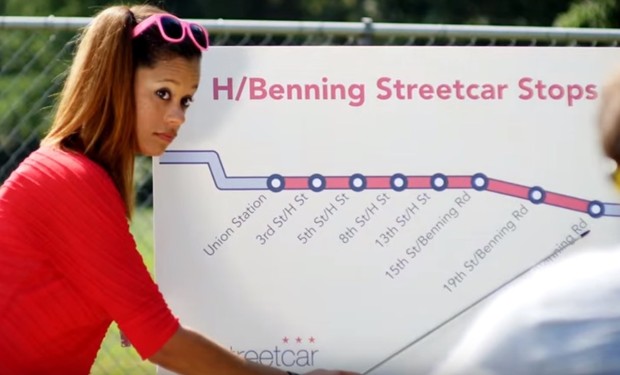
The D.C. Streetcar is supposed to run for about two miles, from Union Station down H Street NE before turning slightly onto Benning Road. Make sure to pick a destination somewhere along this basically straight line or else it might make more sense to take a bike, cab, or bus. Unless, of course, you’ve already started walking.

3. Stand away from the curb

The D.C. Streetcar will be so quiet that you’ll forget how not to wander mindlessly into the middle of the street (which, again, is still carrying loud moving traffic). Excellent tip from DDOT: remember not to forget that.

4. Take your bike on board with you

In the highly unlikely event the streetcar isn't packed with passengers, you’ll have plenty of room to stow your bike on board. That might be an easier option for many cyclists than detouring over to the bike lanes on G or I streets—the suggestion offered by DDOT, now that riding a bicycle on H Street is less safe.

5. Park inside the white lines to avoid blocking the streetcar

It’s unclear how this is an instruction for riding the streetcar, but in case you choose to get out mid-ride and drive to your destination, DDOT would like to remind you to park within the lines near the curb, lest you block the streetcar (as well as all the other traffic that shares a lane with the streetcar). For an example of how to be a success both in streetcar-adjacent parking and in life, take a cue from the above Mercedes SUV.

6. Ride for free—at first

Riding the streetcar will be free during an introductory period. That's a kind gesture by the city. Just don't tell your streetcar-obsessed date you didn't pay her fare!

7. Don’t bother leaving a question or comment on the video’s YouTube page

DDOT disabled them. Now that’s good planning.

All video stills via DDOT

19 Feb 03:16

tbt


tbt

19 Feb 03:11

February 18, 2016

17 Feb 14:20

The Striking Rich-Poor Life-Expectancy Gap, in 1 Chart

by Tanvi Misra
Image AP Photo/Lynne Sladky
A man walks by the Camillus Health Concern in Miami, a clinic that provides medical care to the homeless and low-income, in 2009. (AP Photo/Lynne Sladky)

The gap in life spans between the rich and the poor has been widening for a while, but the speed with which it has worsened has severe consequences for economic inequality in the U.S., a new analysis by the Brookings Institution finds.

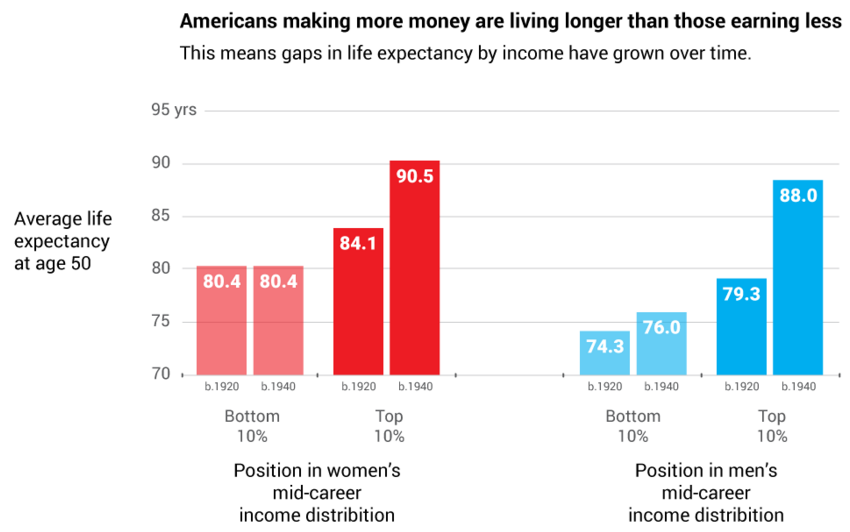
Researchers analyzed Social Security data and other government records for thousands of men and women born between the years 1910 and 1950. They found that, for a man born in 1920, the average life expectancy at age 50 if he was in the top 10 percent of the income spectrum was 79 years. In other words, if this man made it to 50, he could expect to stick around for another 29 years. But the life expectancy at 50 of a man in the lowest 10 percent of income was just 74 years—five years less than the wealthier peer from his age cohort.

This rich-poor gap in life expectancy at 50 sharply increased to 12 years if the men were born in 1940 (below, right). For women, this gap widened from four to 10 years between 1920 and 1940 (below, left). Simply put, over time, the rich saw much bigger jumps forward in their life expectancy, while the poor saw little to no improvements:

Brookings

The Brookings researchers don’t yet fully understand the reasons behind this disturbing trend. Sabrina Tavernise suggests in The New York Times that afflictions that disproportionately affect low-income Americans, such as smoking and drug addiction, may play roles, though that doesn’t explain why better and more accessible health care over time hasn’t closed the life expectancy gap. Here’s Tavernise quoting a public health expert:

At the heart of the disparity, said Elizabeth H. Bradley, a professor of public health at Yale, are economic and social inequities, “and those are things that high-tech medicine cannot fix.”

The life-expectancy gap also feeds the very economic inequities it stems from, by weakening the ability of the Social Security program to redistribute wealth. Low-income Americans, with limited lifetime earnings and savings, benefit greatly from Social Security once they’ve aged out of the labor force. But if they’re dying at younger ages, they won’t accrue as much in benefits over time relative to their longer-living, wealthier counterparts.

The disparity in longevity compounds the effect of another harmful trend: low-income Americans tend to claim benefits before they reach full retirement age, meaning their monthly payouts are smaller to begin with compared to more well-off Americans. Here’s how the researchers sum it up:  

The growing gap in life expectancy between low- and high-income workers means that high-wage workers will collect pensions for progressively longer periods, even as low-wage workers see little improvement in life expectancy. That gap, when taken together with the rise in average retirement ages since the early 1990s, means the gap between lifetime benefits received by poor and less educated workers and the benefits received by high-income and well educated workers is widening in favor of the higher income workers.

17 Feb 14:18

Math of crime and terrorism

by Nathan Yau

Numberphile, from the Mathematical Sciences Research Institute, is one my new favorite YouTube channels. In this episode, Hannah Fry talks crime, data, and the Poisson distribution.

[Thanks, Mike]

Tags: crime, Hannah Fry, Numberphile

17 Feb 14:10

Stargazing

Some of you may be thinking, 'But wait, isn't the brightest star in our sky the Sun?' I think that's a great question and you should totally ask it. On the infinite tree of possible conversations spread out before us, I think that's definitely the most promising branch.
16 Feb 22:10

All Your Favorite British TV Shows, Mapped

by Eillie Anzilotti
Image Courtesy of Tim Ritz
Courtesy of Tim Ritz

Fawlty Towers is set in Torquay. The Office, in Slough; Downton Abbey in North Yorkshire.

If you’re a British TV enthusiast, you’d know the name of the town where your favorite show is set. But could you pick it out on a map?

Unlikely.

While settling in to an episode of Foyle’s War, designer Tim Ritz’s wife asked him to show her where, exactly, Hastings was. He drew a map of the U.K. on a sticky note, with a dot on the East Sussex village.

But he didn’t stop there. He added a dot for Downton Abbey, and another in Derbyshire for Pride & Prejudice, and ended up with the first draft for what would become The Great British Television Map.

“All of our friends and families have been getting into British TV more and more over the years,” he tells CityLab. But as an American, he realized that Americans’ (as he puts it) notoriously “feeble grasp on international geography” might be getting in the way of completely understanding the shows.

Wall art can be informative, too. (Courtesy of Tim Ritz)

The Great British Television Map (h/t: The Great British Bake Off) attempts to remedy that. Though by no means comprehensive, Ritz’s design presents a geography of the U.K.’s airwaves. In plotting the locations, Ritz says he took a cue from vintage London Underground maps. Color-coded dots correspond to the original broadcast network.

“Layer upon layer of cultural understandings underpin the television we watch,” Ritz says. When American viewers watch American TV, he adds, they inherently understand references to everything from snack brands to the history of certain places.” But foreign viewers may not, and likewise, “British geography is one of those layers of reference in British TV” that may elude American viewers, Ritz says.

In compiling the map, Ritz says he expected more shows to follow the Downton Abbey strategy of setting the show in one location (Yorkshire, in northern England) and filming it in another (Highclere Castle, in West Berkshire, where it’s sunnier). But he was surprised to find that most shows were filmed on or close to their intended settings. London, unsurprisingly, was the most daunting to account for—Ritz’s map accommodates it in a large inset, and “even then it was bursting at the seams to contain all the series in there,” he says.

Since launching the map, Ritz has gotten some comments (and a few outright complaints) about missing shows, but he’s taking them in stride. He’s looking into overhauling the design to accommodate more programs in an updated edition, and he’s considering taking on continental Europe and North America, as well.

Map, $34 at Society6.

16 Feb 14:10

Introducing the Scariest Skateboarding Film of 2016

by John Metcalfe

You’ll know right away if you want to finish “SKATE NEAR DEATH,” one title that actually deserves its SCARY ALL-CAPS. Skater Roma Alimov rolls right up to the lip of a subway platform with a train oncoming and … well, let’s just say the conductor was not happy that day.

Set to a hammering piano score that would delight Alfred Hitchcock, this footage isn’t for the faint of heart. The camera follows Alimov as he executes one coffin-defying move after another—sliding on one freakin’ wheel on a building ledge, hopping on a wall above a busy highway, getting shot at by what looks like a security guard (though that last one is probably fake).

Needless to say, he falls and loses his board more than once. But if the Reaper wants to claim the soul of this Russian skater, it’ll have to wait for the sequel. Here’s a trailer with more bruising outtakes:

Roma Alimov - SKATE NEAR DEATH (trailer) from SALTY pictures on Vimeo.

H/t Thrasher Magazine

16 Feb 14:02

How To Make Popcorn in the Microwave — Cooking Lessons from The Kitchn

by Emma Christensen

Microwave popcorn has changed my snacking habits forever. No, I'm not talking about the plastic-wrapped packages of microwave popcorn from the store — although I will thank them for the inspiration. I'm talking about a more DIY version using a scoop of kernels and a plain brown paper lunch bag. It's so easy and fast that it has now become the only way I make popcorn.

READ MORE »

16 Feb 13:58

Why There Is Always a Comfy Spot for My Pets in the Kitchen — Pets in the Kitchen

by Anjali Prasertong

As an introvert, I don't always love having other people in the kitchen with me, but I always love having my pets in the kitchen while I cook. Some people find the idea of an animal in the kitchen unsanitary — all that fur! Those dirty paws! — but having to give the counters an extra wipe-down is worth it for the presence of the quietest, least judgmental, silliest, and most useless sous chefs a gal could ask for.

READ MORE »

11 Feb 17:29

An Oregon Mountain Casts an Upside-Down Shadow in the Sky

by John Metcalfe
Image Lisa Nelson/NWS
Lisa Nelson/NWS

A gargantuan funnel of gray pouring from the top of Mount Hood—did Oregon’s iconic peak just blow its top?

Nooope. (Although one day it could, being a volcano that erupted periodically through the 1800s.) What people saw Wednesday was instead a huge, inverted shadow, cast upon a fiery sky by the rising sun.

Locals describe the scene as “stunning” and “Monet-like” on the Facebook page of Portland’s National Weather Service, which shared the above photo taken by Lisa Nelson. Meteorologist Scott Sistek has more great images at KOMO-TV, showing the shadow stretching like a blue stalactite over cold waters or pointing beam-like to the side as if it were a reverse-spotlight.

This is at least the second time in 2016 the mountain has made a floating penumbra over Oregon. Here are similar views from February 3:

11 Feb 02:54

This comic goes out to the anonymous reader who messaged me on...


This comic goes out to the anonymous reader who messaged me on Monday. Hope it helps.

11 Feb 02:53

Rent Vincent Van Gogh's 'Bedroom in Arles' for $10 a Night

by Tanvi Misra
Image Airbnb
Screenshot of Airbnb listing of Van Gogh's Bedroom. (Airbnb)

It’s a small space with wooden floor. On one side, a narrow bed with red covers stands solemnly. On the other, a small toilet table is parked beneath a wall mirror, mounted with a basin among other objects. It’s flanked on either side by a chair. The room has one window and an odd assortment of paintings mounted on its walls.

This room doesn’t seem like much, but Vincent van Gogh’s “Bedroom in Arles” is arguably the most famous room in art history. And now a replica of it in Chicago’s River North is up for rent as per this listing on Airbnb. The cost? Just $10 per night, charged “for no other reason than that I need to buy paint,” writes the Airbnb host, purportedly van Gogh himself. Here’s how the space is described in the listing:

This room will make you feel like you're living in a painting. It's decorated in a Post-Impressionist style, reminiscent of Southern France and times gone by. Its furniture, bright colors, and artwork will give you the experience of a lifetime.

In actuality, this replica was created and listed on Airbnb by the Art Institute of Chicago to promote their upcoming exhibit titled “Van Gogh’s Bedrooms,” which will feature all three versions of the iconic room, among his other work, letters, illustrations, and personal belongings. Here’s the institute with a little history on the paintings of the room Van Gogh lived in for a brief period of time:

Van Gogh painted his first Bedroom just after moving into his beloved “Yellow House” in Arles, France, in 1888. He was so enamored with the work, now in the collection of the Van Gogh Museum in Amsterdam, that after water damage threatened its stability, he became determined to preserve the composition by painting a second version while at an asylum in Saint-Rémy in 1889. Identical in scale and yet distinct from the original, that second work is now one of the icons of the Art Institute’s permanent collection. Van Gogh created a smaller third version, now at the Musée d’Orsay in Paris, as a gift for his mother and sister a few weeks after making the second. While the three paintings at first appear almost identical, when examined closely, each reveals distinct and unique details.

Unfortunately, van Gogh didn’t live very long in the yellow house before he cut off a chunk of his left ear. He admitted himself into an asylum shortly following that famous incident, writes Julia Felsenthal in Vogue about van Gogh’s life in that bedroom. Here’s Felsenthal quoting Gloria Groom, the curator of the exhibit at the Art Institute of Chicago:

“It’s a sad story, but we’re trying to make it human,” says Groom. “There’s such a sensationalized story around Van Gogh. It’s always the struggling artist, the artist with emotional issues, the artist who kills himself. What I think comes out is that he really was a person. We wanted to show that universal quality: Everyone wants a room of their own.”

And now it’s possible to experience what it feels like to spend a night in his.

Check out some of the images of the replica featured on the Airbnb listing below, including a side-by-side comparison of the painting and the replica. All images are courtesy of the Art Institute of Chicago. “Van Gogh’s Bedrooms” runs through May 10.

10 Feb 15:25

Eighth Harry Potter Story, Harry Potter and the Cursed Child, Also Coming in Book Form - It's all happening!

by Dan Van Winkle

If you were worried you’d miss out on the magic of the new Harry Potter sequel because it’s coming to the stage rather than page or screen, fear not! The play’s script is coming in book form for those of us unable to get to the Palace Theatre in London, England to see it for ourselves!

Better yet, it’s coming at the end of July this year, which is the same month the play opens, so we there won’t even really be an agonizing wait (in addition to the wait for July to arrive, that is). In case you haven’t been keeping up, we’re pretty excited about the casting decisions, and here’s the official summary:

It was always difficult being Harry Potter and it isn’t much easier now that he is an overworked employee of the Ministry of Magic, a husband and father of three school-age children.

While Harry grapples with a past that refuses to stay where it belongs, his youngest son Albus must struggle with the weight of a family legacy he never wanted. As past and present fuse ominously, both father and son learn the uncomfortable truth: sometimes, darkness comes from unexpected places.

A book of the play’s script isn’t quite another Harry Potter novel, but really, who cares? We won’t have to live vicariously through those actually able to attend the play in person after all!

—Please make note of The Mary Sue’s general comment policy.—

Do you follow The Mary Sue on Twitter, Facebook, Tumblr, Pinterest, & Google +?

10 Feb 15:24

Cluster Fudge - Ep. 125

image image image image image
09 Feb 23:47

Coming Soon to France: Hundreds of Miles of Solar-Powered Roads

by Julian Spector
Image Colas / Joachim Bertrand
Colas / Joachim Bertrand

Sooner or later the lamps glowing softly over the Champs-Élysées could be powered by the road itself.

France plans to install 1,000 kilometers of solar panel roadways in the next five years, Global Construction Review reports. That’s an ambitious goal, but not at all out of reach, because the technology is ready to go: the 7-millimeter-thick photovoltaic panel called Wattway, produced by French transportation infrastructure firm Colas. These panels can glue onto existing road surfaces to draw power from the sun, while providing enough grip for cars and trucks to drive over them. Colas says one kilometer is enough to power public lighting for a city of 5,000 people and 20 square meters of Wattway can power a single French home.

This project joins a growing trend in urban innovation. A couple in Idaho raised more than $2 million to develop their own version of smart, solar panel road surfaces (their panels incorporate programmable LED lights and heating elements for melting snow). The Dutch SolaRoad project in Krommenie, which is actually a solar-paneled bike path, generated more electricity than expected in its pilot phase. The U.K., taking the inverse approach, is looking into roads that can transmit electricity to charge electric cars on the move.

The French effort offers a possible advantage over other approaches: It can be installed easily on top of existing roads, sidestepping the costly need to build new ones. And even though this technology probably won’t produce electricity more cheaply than conventional solar, it is a more efficient use of land.

France’s investment in this improvement will show the world how it works at a larger scale than previous endeavors, and how the wear and tear of real-world driving affects the panels. If the road underneath a Wattway installation needs repairs, will the panels need to be torn up? With several different versions of a similar technology now working their way into use, sustainably minded cities stand to benefit from the friendly competition driving down costs and differentiating the strengths and weaknesses of each approach. Who needs a Sun King when you can have Sun Roads?

(Colas / Joachim Bertrand)

04 Feb 23:57

Mapping Countries By Connecting Postal Codes

by Tanvi Misra

The Zone Improvement Plan, or ZIP code system as we know it today, was robustly rolled out in 1963 with the purpose of modernizing the mail-sorting process. But this updated postal zoning system ended up doing a lot more. ZIP codes have led to fine-grained information about American neighborhoods, including how rich, poor, and unequal they are, who lives there, and how the place is changing. Here’s how the U.S.P.S. Inspector General put it in a 2013 report called “The Untold Story of the ZIP Code”:

Today, the ZIP Code is much more than a tool for moving mail efficiently, and its positive spillover effects are enormously beneficial to society.

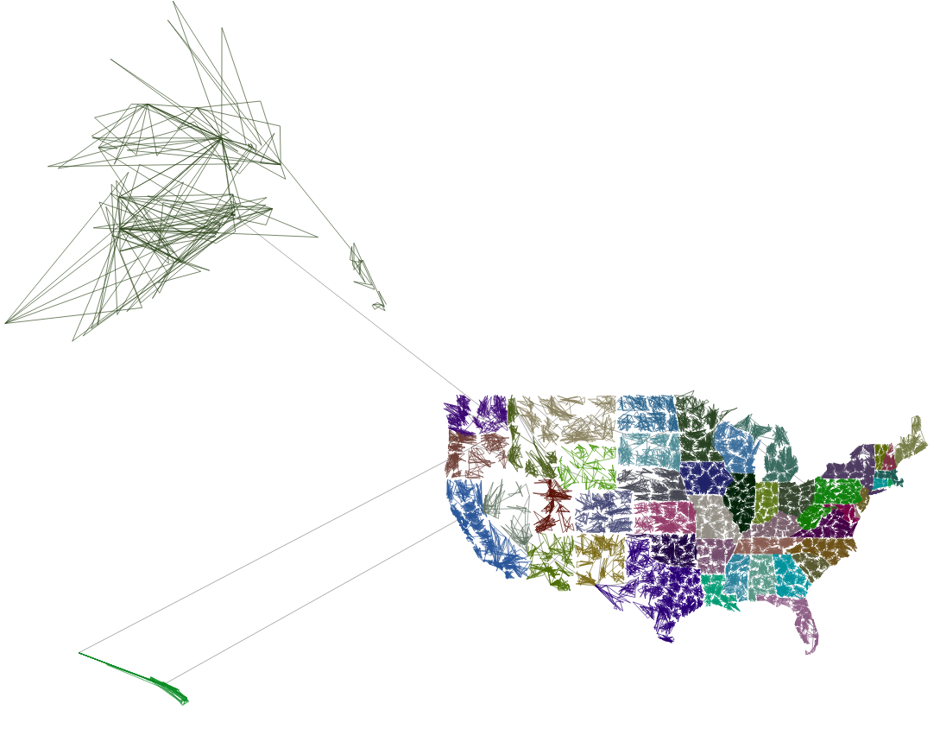
But data viz expert Robert Kosara wanted to go beyond individual ZIP code. He wondered if examining how they were spread out would reveal interesting patterns. To satisfy his curiosity, he created this interactive “Scribble Map” by connecting each dot representing each U.S. ZIP code in ascending order. Here’s what Kosara tells CityLab is the key takeaway from his visualization, via email:

Perhaps the main thing is to appreciate the structure in ZIP codes. Most people probably never think about where they come from or why there are certain numbers in certain places. But they're all planned and structured, and surprisingly interesting to look at.

He’s right. The U.S. map of connected codes is a jagged web, dense in some places and scant in others—loosely mirroring the concentration of people in the country. Here’s Kosara, who runs the data visualization blog eagereyes.com, in a blog post explaining how his viz builds on a postal code dot map created by Ben Fry:

The patterns and density distribution are readily apparent, and can in fact be seen much better than when only the dots are drawn. The scribbling quality of the lines (looks like somebody was bored while talking on the phone) lead to the clever name for the map.

To add some clarity to the monochromatic ZIP code map, Kosara colored the geometrical tumbleweed in each state with a different hue. The resulting map reveals how manmade boundaries (like state lines) and natural topography (like rivers and mountain ranges) affect ZIP code distribution and density:

Kosara’s interactive version of these maps lets you zoom in really close on the tangle of lines connecting these numbers. It also includes Hawaii and Alaska. Here’s a screenshot of a zoomed out version of the U.S. map:

And here are some of the northeastern states up close:

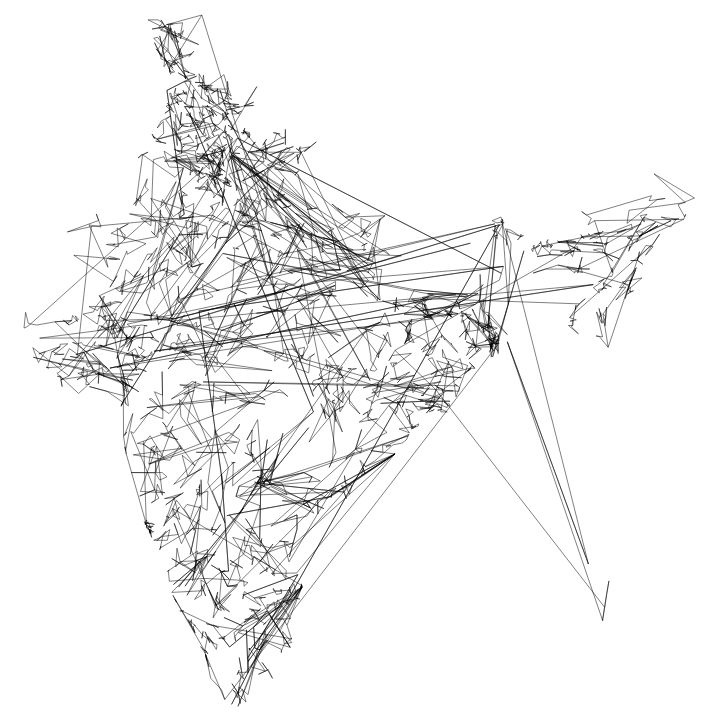
Kosara’s maps aren’t restricted to the U.S.—some feature postal codes from countries around of the world. Below are some of the ones that look like they were created when a polygraph machine went awry. Check out the rest here.

India

Japan

Germany

Iceland

04 Feb 23:51

Why a Christian University’s Freshman Fitbit Requirement Is a Bad Idea

by Claire Landsbaum
Technology That Helps

In the world of wearable fitness trackers, Fitbit is king. The company was valued at $4.1 billion last summer when it first became available to public investors, and a study conducted shortly thereafter concluded that Fitbit owns 68 percent of the fitness-band market — if you owned a...More »

02 Feb 15:08

An Itsy, Plastic Version of Your City, Block by Block

by Aarian Marshall
Image microscape
microscape

Have you ever dreamed of being the King Kong of your metropolis, bounding from skyscraper to apartment buildings to historic district? Yeah? You’re the perfect candidate for Microscapes.

These hyper-detailed, 1:5000 scale models of the metropolis of your choice are printed in 3-D from non-toxic white plastic. (The creators, the firms TO+WN DESIGN and AJSNY, insist you can even eat off them, though who wants to pick quinoa from the weensy spaces between buildings?)

(Microscape)

The creators say they use completely up-to-date data to print their models, so each 6-inch, “half-mile” square tile can include buildings still under construction. The company also offers “landmark” tiles, which feature cities’ most notable sites.

(Microscape)

Microscapes’s first printing is only of Manhattan, but the company says it intends to print cities all over the country and world. For a cool $25,000, you can currently purchase all of New York City in mini, plastic form. Why buy a New York apartment when you can get the entire isle of Manhattan for a fraction of the cost?  

(Microscape)

Plastic city tiles, $65 to $275 pre-order at Kickstarter.  

H/t Curbed

01 Feb 21:32

A New Book Retrospectively Diagnoses Famous People With Mental Disorders

by Tanya Basu
Andy Warhol

Andy Warhol loved to shop and collect. What he really didn’t like, on the other hand, was throwing any of it away. In a recent interview with NPR, science journalist Claudia Kalb discusses Warhol’s predilections along with the behaviors of other celebrities, collected in the new book Andy...More »