Shared posts

05 May 16:32

What Not Dying Looks Like

It’s always odd to hear people say RSS is dead. The fact is, RSS is easily the most successful stealth, insurgent technology on the web. It is pervasive and is the engine for much of the Internet.

Apple uses it to syndicate computer updates. Your podcast subscriptions rely on RSS. Every Wordpress blog is RSS enabled and every major news site is broadcasting via RSS. They’re all syndicated. They all have an RSS feed. It’s the background hum of the Internet.

There are millions of feeds out there, continually connecting users to their favorite content. Just about everything online except Facebook and Twitter is available via RSS.

Even more importantly, RSS has proven to be resilient and durable regardless of what corporate interests want to do with it. Netscape invented the underlying code in the late 90’s, and then took away all documentation and support in 2001 after AOL bought them out. But even that didn’t slow the dissemination. 

And then last year, the biggest player on the Internet took its ball and went home when Google killed its Reader. Despite the fact that Google retired the most popular RSS application on the Net, it did not affect RSS in any appreciable way. All of those feeds are still available and users are still getting their content delivered exactly as they want it. What greater proof is there of the resiliency of RSS?

In fact, what might have seemed like a disaster at first is perhaps the best thing that could happen to the technology. Remember, RSS is a technology and a service; it is not a product. AOL thought they could squash this great idea, but a community of developers took the idea and ran. Then Google thought they could abandon the technology and assumed everyone would gravitate to their social networks instead.

In fact, any number of companies can go out of business, but nobody can stop anybody from publishing and reading RSS feeds. 

However, just because a technology is widely available does not guarantee success. What makes RSS truly powerful is that users still have the control. The beauty of the system is it that no one can force you to be tracked and no one can force you to watch ads. There are no security issues I am aware of and no one ever has to know what feeds you subscribe to. This may be the last area of the Internet that you can still say things like this.

Google Reader was a monopolist product built on an anti-monopolist technology. Now that they’re gone, RSS is once again anyone’s game. You’re going to see a lot more innovation and new stuff for RSS. I never know if its supposed to be a blessing or a curse to live in interesting times. But I have to believe this RSS is entering maybe the most interesting time in its long history.

02 May 18:20

Court Tells Ex-Wife Of Husband Who Killed Himself To Use Copyright To Delete Anything He Ever Wrote Online

by Mike Masnick
Last week, we wrote about the unfortunate situation, in which it appeared that a lawyer representing Dina Mackney was claiming copyright on her ex-husband's suicide note (in which he says many unkind things about his ex-wife) and demanding the content be removed. Since then, we've found a lot more of the details of what happened, and discovered a lot of additional content that Mackney's lawyer has been able to remove from the internet with the help of a judge -- who not only gave the ex-wife full control over her ex-husband's "intangible assets" but further directed her to seek to delete all sorts of content from the internet. Now, I should note up front a few things: there may be reasonable claims from the lawyer concerning the privacy of the children (and possibly others) involved. Furthermore, having read through way too many details in this case, it should be noted that Chris Mackney does not come off as the most credible narrator of his own situation. This certainly makes the situation difficult on a variety of levels. That said, it is still immensely troubling to think about the kind of precedent this sets, and how it clearly sets up copyright as a tool for censorship, not just of a suicide note, but of all sorts of online activity. Furthermore, we've been careful in the documents that we're posting to leave out things that are more private in nature (which go beyond some of the claims in the suicide note), instead focusing solely on the legal issues here.

It appears that, back in March, a judge put Dina Mackney in charge of Chris Mackney's estate. Given the rancorous divorce proceedings and the eventual suicide, this doesn't seem even remotely appropriate. Then, around the same time, a judge in a Virginia court basically issued a court order telling Dina Mackney to go ahead and seek to use those powers to basically censor a whole bunch of what Chris Mackney had to say online.
ORDERED AND DECREED that Petitioner shall have the legal authority to take any reasonable action necessary to access, remove and destroy any web postings, to require that websites be taken down and/or otherwise dispose of intangible property including but not limited to information that the deceased has posted online on any website or social media account including, but not limited to material located at the following domain names:
After that is a long list of domain names, including various blogs that have discussed the Chris Mackney story, but also a broad swath of other sites, including all of Google (specifically calling out Google Docs and Google Drive -- where Mackney had posted many documents, including news articles that he believed supported his position), Facebook (where Mackney had originally posted his intent to commit suicide), Scribd, Reddit, Wikipedia and many more. Some of the links include sites where Mackney had previously commented on blog stories or other discussion groups.

The order goes on to basically tell Dina Mackney that she can seek to delete all evidence of her husband existing online at all:
... and to wind down and remove any website posts or other online activity by the decedent at such time and in such direction as the Administrator may deem appropriate, it being the intent that this Order shall apply to any online activity by the decedent during his lifetime.
Again, even while being conscious of the legitimate privacy concerns raised by the situation, this is immensely troubling on multiple levels. First, the idea here is clearly to use copyright as a tool to delete Chris Mackney's online existence entirely. And, indeed, while the lawyer raises other arguments (including privacy and defamation), the letters (and I've seen about half a dozen at this point) all lead with the copyright claim, citing the DMCA's notice-and-takedown provisions. Here's one example.

Second, while some of the reposted content may raise certain issues, the content that Mackney himself posted to various sites clearly is not infringing. When he posted it to those sites, he almost certainly granted those sites a perpetual license to post that content. To after-the-fact claim copyright on it is bizarre and ridiculous. For much of the other content, Mackney himself clearly was granting an implicit license for the content to be shared (and sometimes shared widely). There may be legitimate reasons why that content should not be shared, but copyright infringement is clearly not one of those -- and that's what it's being used for here, not just for the content that may legitimately go too far from a privacy standpoint, but for everything Chris Mackney has ever posted online.

It's difficult to see how that's appropriate in any situation, even if we were dealing with a loving widow after decades of a happy marriage, let alone the opposing partner in a bitter divorce battle (no matter whose arguments in the divorce made more sense). The situation here is certainly messy, but using copyright to basically try to delete Chris Mackney's entire online presence appears to be a massive overreach of copyright law.

Permalink | Comments | Email This Story


02 May 15:31

Toronto Asked To Ban Dangerous Dr. Seuss Book For Promoting Violence

by Timothy Geigner

When we discuss book bans, we typically discuss them in terms of being revolted by the myopic viewpoint of those doing the banning. For instance, Tim Cushing recently wrote about one book that was banned, despite being an award-winning novel, for including some fairly mild language dealing with sexuality and masturbation. In that case, some parents went to the police to keep teenagers from passing out the books anyway, as if some kind of school book ban had the force of law. That was, obviously, quite a silly situation.

But we shouldn't let this taint all book-banning activities. After all, some books are truly dangerous. Take the tome of violence-advocacy recently targeted for banishment by the Toronto library system, for instance, and see if you can't find it in your heart to admit that some books are too dangerous to be allowed.

Librarians at the Toronto Public Library were asked to remove copies of Dr. Seuss’ 1963 children's book "Hop on Pop” from the establishment’s collection because it allegedly promotes violence. A document detailing the seven books the library has been asked to remove over the past year was posted online on Monday.

The book “encourages children to use violence against their fathers,” according to the complaint.
Now, I know what you're thinking: "But, Tim, it's a harmless rhyming children's book. It isn't promoting violence!" Well, you're not fooling anyone. It seems pretty clear to me that this book, written by some guy named Dr. Seuss (probably a terrorist), is being actively promoted as a way to quite literally stomp out fathers. Think of the children.....that will never be born because other children are stomping on men's two-bits at the behest of some 1960's love-child Dr. of death! This will not stand!
The Materials Review Committee pointed out that the book is “humorous,” “well-loved” and that it has “appeared on many ‘Best of’ children’s book lists.” The MRC also pointed out that the children in the Pulitzer Prize-winning author’s book are actually told not to hop on pop.
Nobody's buying it, MRC. These are probably the same people that told us there were WMDs in Iraq and that 9/11 wasn't just a false-flag operation orchestrated by a zombie Hitler that's kept in an underground bunker beneath the Grand Canyon. You can't fool us. A tiny fraction of people in Toronto want this book banned, damn it.
Despite the complaint, the library opted to retain the book in the children's collection.
Does government overreach know no bounds? We say "don't tread on me," and they house this book that literally tells children (except it doesn't) to tread on their fathers? Canadians, write your Congressmen (or whatever it is you call them up there). Something must be done.

Permalink | Comments | Email This Story


02 May 15:20

May 01, 2014


02 May 15:18

Coke's Arcade Machine Accepts Plastic Bottles Instead of Quarters

by Andrew Liszewski

Coke's Arcade Machine Accepts Plastic Bottles Instead of Quarters

Sometimes all that's needed to encourage people to recycle is a little incentive. That's why pop cans and beer bottles have deposits, and why Coca-Cola built an arcade machine that runs on empty plastic soda bottles instead of quarters.

Read more...


29 Apr 19:26

Report: Android Silver to replace Nexus program next year

by Quentyn Kennemer

SilverBars-SilverCoins-Background

Even more rumors are coming out corroborating early reports that Google is looking to do away with the Nexus line. Originally, they were thought to be doing that with Google Play Experience devices, but the Android Silver train seems to be gaining more steam.

So what is Android Silver? It’s a new device initiative Google will be launching to help bring premium handsets with pure, unadulterated versions of Android to carrier and retail store fronts. There are a few different components to this that make it a bit different up against the existing Nexus and Google Play Edition lines:

  • Android Silver handsets can either be existing versions of OEM smartphones or smartphones made specifically for Android Silver.
  • Android Silver handsets’ software will have little to no OEM or carrier customization.
  • OEMs who offer Android Silver handsets will commit to timely updates.
  • Google will put up the marketing dollars for carriers and retailers to promote the handsets alongside their usual offerings.

Basically, it sounds like it’s going to be the Nexus program we’ve always wanted — affordable, available, and with Google actually trying to sell these things at high volume instead of just catering to developers and enthusiasts.

Other staples of the existing Nexus program — such as great hardware at very affordable rates — might or might not carry over. That story has yet to be told, and we likely won’t have a clear answer on it all until everything’s official. All of it is looking to go down next year if rumors are accurate, with Google said to be putting up more than $1 billion to get OEMs and carriers on board.

[via The Information]

29 Apr 19:25

CISPA Take 3: Feinstein & Chambliss Draft Another Cybersecurity Bill, Designed To Wipe Out Your Privacy

by Tim Cushing

Washington DC: where no bad idea ever truly dies. CISPA, the infamous "cybersecurity" bill that has twice failed to cross the President's desk is back again. This is the Senate's attempt at a cybersecurity bill, so it doesn't sport the same gaudy initials (those belong to the House), but it's still the same set of terrible ideas.

The Senate's previous attempts to write its own cybersecurity bill were supposedly prompted by privacy concerns, something the House version treated as wholly irrelevant to securing our nation from cyberattacks. This new bill may decide privacy is the only thing irrelevant to national security, seeing as it's been crafted by Dianne Feinstein and Saxby Chambliss, both largely supportive of the NSA's (recently exposed) activities.

The new bill sports the following title: Cybersecurity Information Sharing Act of 2014. CISPA without the "p," apparently. Out with the "protection" (which was nominal) and in with the oversharing of cyberthreat information.

The bill, like others before it, grants broad immunity to participating companies, stripping away one of the few reasons these entities might stick up for their customers (and their data) and consider plugging the security hole before turning that info over to both the military, national security agencies and, well, any number of government agencies or competitors. The text of the bill leaves that almost completely unspecified.

The new, 39-page draft bill, written by Sen. Dianne Feinstein (D-Calif.), chairman of the intelligence committee, and Sen. Saxby Chambliss (Ga.), the ranking Republican, states that no lawsuit may be brought against a company for sharing threat data with “any other entity or the federal government” to prevent, investigate or mitigate a cyberattack.
This immunity screws up incentives and encourages questionable behavior, as it to be expected when accountability is removed.

There's a small nod to privacy in the bill, but it carries with it some potential weasel words that could completely undermine the protection.
An entity sharing cyber threat indicators pursuant to this Act shall, prior to such sharing, remove any information contained within such indicators that is known to be personal information of or identifying a United States person, not directly related to a cybersecurity threat in order to ensure that such information is protected from unauthorized disclosure to any other entity or the Federal Government.
Considering what the NSA and others have deemed "relevant" to their counterterrorism efforts, lots of personal data could easily be construed as being "directly related" to a potential cybersecurity threat.

Other protections are equally as malleable. Law enforcement agencies are allowed to avail themselves of cyberthreat information, but only if given written consent from the entity(ies) involved. But that "only" isn't actually a limitation. The paragraph immediately following the "written consent" stipulation creates the same sort of loophole that agencies like the FBI have abused to the point of surreality in the past.
If the need for immediate use prevents obtaining written consent, such consent may be provided orally with subsequent documentation of the consent.
IN CASE OF EMERGENCY, BREAK PROTECTIONS.

Giving law enforcement or indeed any agency this sort of manual override undercuts anything stipulated previously. This encourages a culture of asking forgiveness, rather than permission. Grab the data and justify it post facto. That's no protection at all, especially when granted immunity gives companies absolutely no reason to push back on these oral requests.

This may only be the draft version, and there will be several changes made before it goes up for a vote, but this groundwork is far from heartening. It appears as though no one involved has learned anything from CISPA's two troubled trips through the House, not to mention the new concerns prompted by leaked NSA documents.

Further gestures in the direction of civil liberties and privacy protections are made later in the bill (under a heading "Privacy and Civil Liberties" no less), but those protections are roughly identical to existing policies governing the NSA's (and FBI's) mass collection of American metadata -- oversight and minimization, both of which have been subverted by these agencies.

The bill also consolidates more power within the DHS, creating an "all roads lead to the DHS" method of managing cyberthreat information. If there's one entity which has proven time and time again to be both a) mostly useless and b) prone to abusive behavior, it's the DHS. And yet, the bill calls for the agency to be the central cyberthreat repository.
IN GENERAL.—Not later than 90 days after the date of the enactment of this Act, the Secretary of Homeland Security, in coordination with the heads of the appropriate Federal entities, shall develop and implement a capability and process within the Department of Homeland Security that—

(A) shall accept from any entity in real time cyber threat indicators and countermeasures in an electronic format, pursuant to this section;

(B) shall, upon submittal of the certification under paragraph (2) that such capability and process fully and effectively operates as described in such paragraph, be the process by which the Federal Government receives cyberthreat indicators and countermeasures in an electronic format that are shared by an entity with the Federal Government…
Unfortunately, as terrible as the DHS is at determining threats and sharing information, there's probably no way to route around it. The post-9/11 agency is now the government's national security clearinghouse, and everything flows to it, even if it's usually the agency least likely to make productive use of the information. While cyberthreats pile up, DHS agents will be chasing down people taking pictures of public structures.

Believe it or not, this bill putting DHS as the central authority is actually one half-step better than the likely alternative, which is making NSA the central player. For many years now, there's actually been something of a turf war between DHS and NSA over who gets to control the (increasingly massive) cybersecurity budget. And a bill that designates DHS as the "winner" of that turf battle at least gives it a slight preference over the NSA -- though, unfortunately, this bill would let DHS share info with NSA freely, which is yet another problem.

CISPA may have seemed at least half-dead, but Feinstein and Chambliss are breathing life into its lumbering carcass. You would think the last several months, combined with CISPA's earlier struggles, would have resulted in a better cybersecurity bill. Instead, it actually seems worse.
“This is definitely a step back,” said Gabe Rottman, legislative counsel and policy adviser for the American Civil Liberties Union, who was shown a copy of the draft. “The problem is the definitions of what can be shared and who it can be shared with are too broad. In this draft, companies can share data with the military and the NSA. Given the past revelations, I think it’s important to keep this information in civilian hands.”
And that's just one of several problems. Combine the bill's wording with the administration's tacit approval of the NSA's exploit stockpile and you've got something that will generate millions of dollars worth of budget line items while doing very little to make anyone -- even the government itself -- any safer.

Permalink | Comments | Email This Story


29 Apr 19:21

Breaking: Lucasfilm Officially Announces Star Wars: Episode VII Actors With Cast Photo

by Jill Pantozzi

From StarWars.com: “Actors John Boyega, Daisy Ridley, Adam Driver, Oscar Isaac, Andy Serkis, Domhnall Gleeson, and Max von Sydow will join the original stars of the saga, Harrison Ford, Carrie Fisher, Mark Hamill, Anthony Daniels, Peter Mayhew, and Kenny Baker in the new film.” Read on for a quote from director J.J. Abrams and the official release date.

“We are so excited to finally share the cast of Star Wars: Episode VII. It is both thrilling and surreal to watch the beloved original cast and these brilliant new performers come together to bring this world to life, once again,” said Abrams. “We start shooting in a couple of weeks, and everyone is doing their best to make the fans proud.”

Just earlier today we posted a story about the original cast being spotted in London, it’s nice Lucasfilm finally decided to put everything out all at once and officially. The film will hit theaters December 18, 2015.

Are you following The Mary Sue on Twitter, Facebook, Tumblr, Pinterest, & Google +?

29 Apr 16:34

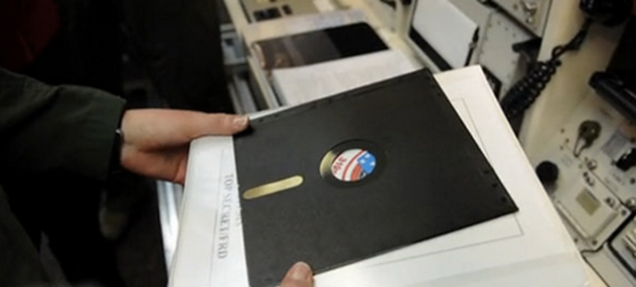
60 Minutes shocked to find 8-inch floppies drive nuclear deterrent

by Sean Gallagher
CBS News

In a report that aired on April 27, CBS 60 Minutes correspondent Leslie Stahl expressed surprise that part of the computer system responsible for controlling the launch of the Minuteman III intercontinental ballistic missiles relied on data loaded from 8-inch floppy disks. Most of the young officers stationed at the launch control center had never seen a floppy disk before they became "missileers."

An Air Force officer showed Stahl one of the disks, marked “Top Secret,” which is used with the computer that handles what was once called the Strategic Air Command Digital Network (SACDIN), a communication system that delivers launch commands to US missile forces. Beyond the floppies, a majority of the systems in the Wyoming US Air Force launch control center (LCC) Stahl visited dated back to the 1960s and 1970s, offering the Air Force’s missile forces an added level of cyber security, ICBM forces commander Major General Jack Weinstein told 60 Minutes.

“A few years ago we did a complete analysis of our entire network,” Weinstein said. “Cyber engineers found out that the system is extremely safe and extremely secure in the way it's developed.”

Read 1 remaining paragraphs | Comments

29 Apr 16:32

SC Republican: Women to Blame for 95% of Divorces

by Ed Brayton

Det Bowers is one of half a dozen far-right Tea Party types running in the Republican primary challenging Sen. Lindsay Graham of South Carolina. He delivered a sermon at a church in that state recently in which he claimed that women are responsible for 95% of all divorces because they love their children more than their husband.

“I find that in about 95 percent of broken marriages, though the husband’s the one that ran out on his wife, the wife loves her children more than she does her husband,” Bowers said. “That is an abominable idolatry.”

He then directed his comments, his voice rising, to the women in his congregation, which he led from 2000 to 2012.

“Do you hear me, ladies?” Bowers said. “It is an abominable idolatry to love your children more than you love your husband, and it will ruin your marriage. And yet you blame it on him because he ran off with some other woman! He did run off with some other woman, and you packed his bags. All of his emotional bags, you packed for him. Is that true in every case? No, but it’s true in the vast preponderance of them.”

He described “abominable idolatry” as “unlawful worship” as he continued lecturing women.

“You just ran him off,” Bowers said. “You paid more attention to your children than you did to him. ‘Oh, he doesn’t need me?’ He needs you more than they do. He chose you, they didn’t. An abominable idolatry.”

Must be part of that Republican outreach program to women that is working so well.

29 Apr 16:32

Censorious Parent Calls Cops On Teen Giving Away Books In A Local Park

by Tim Cushing

Here's where moral panic meets police state... and fortunately, in this case, one of the two involved parties actually showed some common sense.

Here's the short version:

A teenager giving away free books at a book giveaway event at a local park has the cops called on her by a local citizen.

After about an hour of Kissel passing out books to teenagers, Meridian police showed up. They said they had been called out by someone concerned about teenagers picking up a copy of the book without having a parent's permission.
Not sure why that's a police matter rather than, say, a parental matter, but that's the way these things go. If anything, the parent involved probably picked up the "let law enforcement handle everything" attitude from educators, who seem to have relinquished the duties of the principal's office to armed law enforcement officers.

To their credit, the police arrived, checked everything out, and left.

So, why would a parent find giving away a book to be a police matter? Well, that's the longer story.
Junior Mountain View High school student Brady Kissel showed up at Kleiner park in Meridian to pass out the book parents are complaining about. The Absolutely True Diary of a Part-Time Indian by Sherman Alexie. Some parents believe the book is not appropriate for 10th graders. Others who showed up said they had no problem with their teenager reading it.

The book was taken off the Meridian School Districts reading list and is under review. It is still on the shelves in school libraries.

Some Meridian parents objected to the sexual content in the book. Others say the book is anti-Christian. Some readers say they've seen worse.
Parents have tried to ban Alexie's book because of some very dangerous words that should apparently never be viewed by 10th graders. According to the student passing out the book, the "sexual content" of the book is almost wholly contained within the following sentence.
Kissel says, "There's a paragraph right here where it has some sexual content. But if you look at it it's a paragraph this big in a 230 page book." That page reads 'If God hadn't wanted us to masturbate, then God wouldn't have given us thumbs."
It's a good thing the citizen stepped up, or 10th graders might know what masturbation is. It wasn't just one citizen, however. It was several. Meridian, Idaho's school board voted 2-1 to ban the book, which was apparently all the justification needed to send cops after a teen giving away copies of the forbidden novel. One local idiot offered his opinion as to why the book just needed to go away.
[A]n adult named Lonnie Stiles complained that the Alexie novel contains language “we do not speak in our home.”
Ah. I see. So "not in your home" should mean "not in any home." Stiles is listed as an adult in this article but his behavior (along with a number of Meridian's citizens) sounds dangerously childish. If Stiles doesn't want his kid to read this "offensive" book, he should do all he can to prevent his, and only his, children from doing so. What he shouldn't do is allow his personal squeamishness towards certain words and subject matter to become school policy.

So, once again, it's the kids who are acting more mature than the adults. Somehow, they feel that banning the book would make it less likely to end up in teenagers' hands, an idea that is clearly refuted by the whole of teenage existence since human life began.

Kissel's decision to hand out 350 copies of a banned book was a statement against this small-minded board decision. 350 students signed a petition asking for a reversal, which was ignored. In response, these students were provided with their own copy, showing just how easy it is to route around censorship. As noted earlier, the book has only vanished from the school's library. It's still available at the public library, so all the outrage expended was entirely useless -- like it almost always is.

But this one went a bit further, with a parent apparently believing that the cops are there to enforce stupid school policies outside of school and uphold his or her "not on my bookshelf" morality. Ridiculous.


Permalink | Comments | Email This Story


29 Apr 15:57

US Judge Says Prosecutors Can Use A Warrant To Go Fishing For Information Held Overseas

by Mike Masnick
We've had some discussion concerning the NSA and its defenders arguing that the 4th Amendment doesn't apply outside of the US, but it seems they also believe that the US jurisdiction applies basically anywhere when they want it to. While we recently wrote about magistrate judges pushing back on overly broad requests for information, that clearly is not absolute. Magistrate judge James Francis recently ruled that Microsoft needs to turn over data held on servers in Dublin, even though a US warrant isn't supposed to apply outside the US. Microsoft, quite reasonably, sees this as a problem:
"A U.S. prosecutor cannot obtain a U.S. warrant to search someone's home located in another country, just as another country's prosecutor cannot obtain a court order in her home country to conduct a search in the United States," the company said. "We think the same rules should apply in the online world, but the government disagrees."
As does the judge. The judge's own explanation is basically that he's pretending the warrant is not a warrant, but a subpoena.
Francis agreed that this is true for "traditional" search warrants but not warrants seeking digital content, which are governed by a federal law called the Stored Communications Act.

A search warrant for email information, he said, is a "hybrid" order: obtained like a search warrant but executed like a subpoena for documents. Longstanding U.S. law holds that the recipient of a subpoena must provide the information sought, no matter where it is held, he said.
If the Stored Communications Act sounds familiar, that's because it's a part of ECPA, the horribly outdated law that we've been discussing for years concerning its need for reform. If this ruling stands (and Microsoft is already challenging it), it'll be just one more thing that ECPA reform needs to tackle.

Permalink | Comments | Email This Story


29 Apr 15:46

What Does It Say About The US Press That The Toughest Interview Keith Alexander Has Is From A Comedian?

by Mike Masnick
Last night was the debut of comedian John Oliver's new show on HBO called Last Week Tonight. Oliver, of course, is well known from his years on The Daily Show (though, if you're not familiar with it, you should also listen to his podcast, The Bugle). On his first show, Oliver was able to get former NSA boss Keith Alexander, who retired about a month ago. The resulting ten minute interview is well worth watching, not just because it's pretty damn funny, but because it's one of the few times a journalist has actually asked Alexander direct tough questions about the NSA -- and it's not even from a journalist: Seriously, compare that interview to the one Alexander gave to 60 Minutes, a show that used to be associated with asking the tough questions of people in power.

Alexander kicks off this new interview claiming that Americans don't understand that they're not the target of the NSA, and Oliver immediately shoots back:
Oliver: No, the target is not the American people, but it seems that too often you miss the target and hit the person next to them going 'Whoa, him!'

Alexander: You see, we're not just out there gathering information, listening to their phone calls, or collecting their emails. But, that's the first thing that people jump to.

Oliver: But you are out there doing that. You're just saying that you're not then reading them. You are gathering that data.
Alexander responds with the usual NSA talking points about "we just collect metadata" and again, Oliver immediately hits back:
Oliver: That's not nothing. That's significant information. Otherwise, you wouldn't want it.
Oliver also pushes back on the whole "needle and haystack" argument, by pointing out that people's "concerns" are that the NSA is also collecting "the whole farm, and the county and the state, and now you've got photos of the farmer's wife in the shower as well." Later on, after a series of funny exchanges, including Oliver being shocked that Keith Alexander has never heard of Pinterest (where Oliver suggests all the worst people in the world gather), Oliver asks:
Oliver: In your mind, has the NSA ever done something illegal.

Alexander: In my time, no. Not that I know of. You know, one of the most impressive things that I've seen in my career was people who made a mistake, that could be a huge mistake, stepping up to say 'I made a mistake.' And in every case, to my knowledge, everyone but 12 individuals stepped forward at the time they made those mistakes.

Oliver: Right, but you can't say 'everyone... except for 12.' That's like saying 'I've never killed anyone... apart from those three people I have buried under my patio at home.'

Alexander: The key issue I was trying to make was, in every case, we reported. In some cases, those who made a mistake, but were still caught.
Alexander is being incredibly dishonest here, not surprisingly. The NSA's own internal audit highlighted that the NSA abused its power to spy on Americans thousands of times each year. The NSA's Inspector General's report noted a track record of flagrant abuse which led to the program almost getting shut down. As for those "12 individuals," Alexander is simply wrong. As we detailed, most of those 12 actually self-reported the details but often did so years later (in one case seven years later).

So Alexander is flat out lying in saying that there were 12 non-self-reported cases that got caught. In fact, it's pretty clear that if most of those 12 had chosen to keep their abuses secret, we'd have never known about them. Which should lead to the obvious question: how many people within the NSA abused the powers to spy on people, didn't self-report, and therefore were never caught. It's incredible for him to basically be arguing that everyone who abused the system was caught, when the details show they actually failed to discover most of the intentional abuses until someone admitted to them much later.

And we won't even get into the fact that a court and the federal government's Privacy and Civil Liberties Oversight Board (PCLOB) have both found the entire program to be illegal and unconstitutional.

Either way, those are only a few examples, but the pushback against Alexander still seems much greater from Oliver than any journalist so far, and that says something (not good) about the state of journalism today.

Permalink | Comments | Email This Story


29 Apr 15:29

The latest chapter for the self-driving car: mastering city street driving

by Emily Wood
Jaywalking pedestrians. Cars lurching out of hidden driveways. Double-parked delivery trucks blocking your lane and your view. At a busy time of day, a typical city street can leave even experienced drivers sweaty-palmed and irritable. We all dream of a world in which city centers are freed of congestion from cars circling for parking (PDF) and have fewer intersections made dangerous by distracted drivers. That’s why over the last year we’ve shifted the focus of the Google self-driving car project onto mastering city street driving.
Since our last update, we’ve logged thousands of miles on the streets of our hometown of Mountain View, Calif. A mile of city driving is much more complex than a mile of freeway driving, with hundreds of different objects moving according to different rules of the road in a small area. We’ve improved our software so it can detect hundreds of distinct objects simultaneously—pedestrians, buses, a stop sign held up by a crossing guard, or a cyclist making gestures that indicate a possible turn. A self-driving vehicle can pay attention to all of these things in a way that a human physically can’t—and it never gets tired or distracted.

Here’s a video showing how our vehicle navigates some common scenarios near the Googleplex:

As it turns out, what looks chaotic and random on a city street to the human eye is actually fairly predictable to a computer. As we’ve encountered thousands of different situations, we’ve built software models of what to expect, from the likely (a car stopping at a red light) to the unlikely (blowing through it). We still have lots of problems to solve, including teaching the car to drive more streets in Mountain View before we tackle another town, but thousands of situations on city streets that would have stumped us two years ago can now be navigated autonomously.

Our vehicles have now logged nearly 700,000 autonomous miles, and with every passing mile we’re growing more optimistic that we’re heading toward an achievable goal—a vehicle that operates fully without human intervention.

Posted by Chris Urmson, Director, Self-Driving Car Project
28 Apr 12:46

Driver Finds Himself Surrounded By Cops With Guns Out After Automatic License Plate Reader Misreads His Plate

by Tim Cushing

Automatic license plate readers can scan plates at a rate of one per second. Nationwide, several hundred million plate/location records have been captured and stored by a variety of contractors. Mathematics alone says mistakes will be made. Except when mistakes are made with ALPRs, they tend to put citizens on the bad side of men with guns.

According to the Prairie Village Post, earlier this month lawyer Mark Molner was driving through a Kansas City suburb on his way home from his wife’s sonogram. All of a sudden, his BMW was blocked in front by a police car as another officer on a motorcycle pulled up behind him. (His pregnant wife witnessed the incident from a nearby parked car.)

According to what Molner told the Post, one of the officers then approached his car with his gun out.

“He did not point it at me, but it was definitely out of the holster,” Molner told the Post. “I am guessing that he saw the shock and horror on my face, and realized that I was unlikely to make (more of) a scene.”
The mistake prompting this guns-drawn approach of Molner's video could have been made by anybody. The ALPR read a "7" as a "2" and returned a hit for a stolen vehicle. The hit also returned info for a stolen Oldsmobile, which clearly wasn't what Molner was driving. But that could mean the plates were on the wrong vehicle, which is also an indication of Something Not Quite Right.

The PD's statement on the incident is fairly sensible and measured.
“The officer has discretion on whether or not to unholster his weapon depending on the severity of the crime. In this case he did not point it at the driver, rather kept it down to his side because he thought the vehicle could possibly be stolen. If he was 100 percent sure it was stolen, then he would have conducted a felony car stop which means both officers would have been pointing guns at him while they gave him commands to exit the vehicle.”
That makes sense, but there's still a chance this situation could have been averted. Molner's plate triggered the hit several miles before he was pulled over as pursuing police were unable to verify the plate due to traffic density. But it appears the officers made a last-minute decision to perform the unverified stop shortly before Molner would have driven out of the PD's jurisdiction. The stop occurred on the city/state boundary between Kansas and Missouri.

This lack of verification is what bothers Molner.
“I’m armchair quarterbacking the police, which is not a good position to be in,” Molner told the Post. “But before you unholster your gun, you might want to confirm that you’ve got the people you’re looking for.”
So, when the plate reader kicked back a bad hit, the cops did attempt to verify the plate, but it looks very much like they overrode procedural safeguards in order to prevent possibly losing a collar.

As these plate readers become more common, the number of erroneous readings will increase. If the verification safeguards are followed, problems will be minimal. But if anyone's in a hurry... or the vehicle description is too vague... or it's night... or someone's had a bad/slow day... or if the end of the month is approaching and the definitely-not-a-quota hasn't been met… bad things will happen to good people.

Placing too much faith in an automated system can have terrible consequences. Molner came out of this without extra holes, electricity or bruises. Others may not be so lucky.


Permalink | Comments | Email This Story


25 Apr 23:15

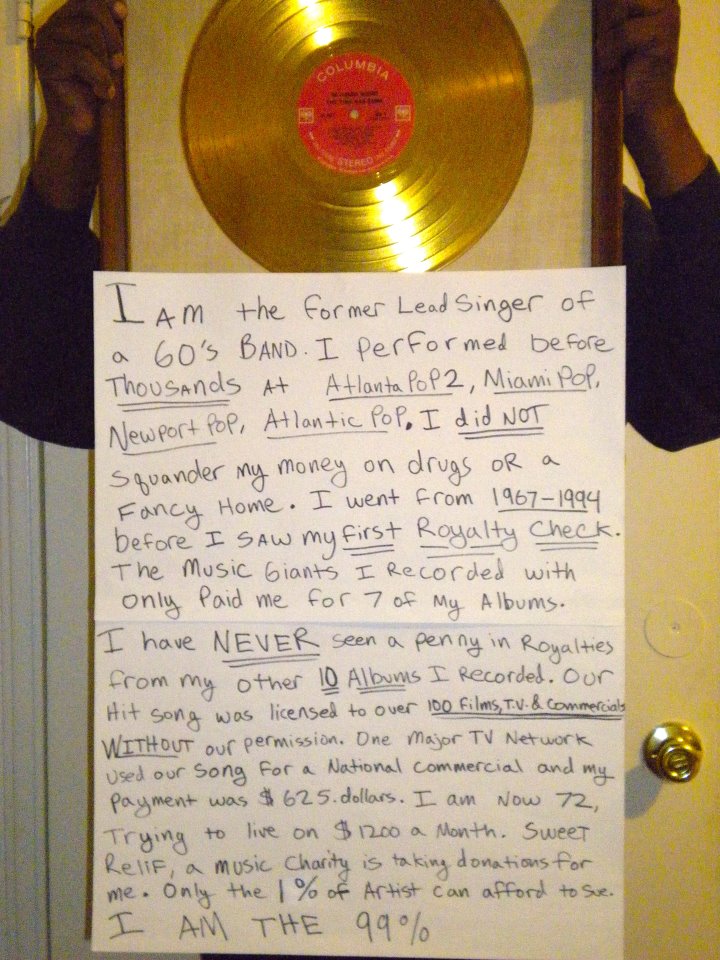
RIAA Claims That It Is 'Standing Up For' Older Musicians That It Actually Left To Rot

by Mike Masnick
The RIAA is not exactly known for its positive treatment of musicians. If you're at all familiar with the art of RIAA accounting, you'd know about how they structure deals to totally screw over musicians, doing everything possible to make sure they never get paid a dime. Yes, many are given advances, but those advances are "loans" on terrible terms in which the labels add on every possible expense that needs to be "paid back" before you ever see another dime. Very few musicians ever "recoup" -- even after the labels have made back many times what they actually gave the artists. For the most succinct example of how the labels make out like bandits, profiting mightily while still telling artists they haven't recouped, here's Tim Quirk, who a few years back explained how it worked with his band, Too Much Joy (TMJ):
A word here about that unrecouped balance, for those uninitiated in the complex mechanics of major label accounting. While our royalty statement shows Too Much Joy in the red with Warner Bros. (now by only $395,214.71 after that $62.47 digital windfall), this doesn't mean Warner "lost" nearly $400,000 on the band. That's how much they spent on us, and we don't see any royalty checks until it's paid back, but it doesn't get paid back out of the full price of every album sold. It gets paid back out of the band's share of every album sold, which is roughly 10% of the retail price. So, using round numbers to make the math as easy as possible to understand, let's say Warner Bros. spent something like $450,000 total on TMJ. If Warner sold 15,000 copies of each of the three TMJ records they released at a wholesale price of $10 each, they would have earned back the $450,000. But if those records were retailing for $15, TMJ would have only paid back $67,500, and our statement would show an unrecouped balance of $382,500.
In other words, musicians don't get paid anything in most cases, while the labels can earn a tidy profit for years and years, still insisting the band hasn't recouped. It's why a band can sell a million albums and still owe $500,000.

I bring this up, because of the latest ridiculousness from the RIAA, claiming that it "stands behind" artists who aren't making enough money. We've already written about the latest lawsuit against Pandora, in which the RIAA/Soundexchange are saying that Pandora isn't paying pre-1972 artists (despite the fact that the RIAA itself refuses any attempt to put those recordings under federal copyright law, which would mandate compulsory licenses). We've also covered the ridiculousness of the RIAA releasing bizarre statements from artists like Steve Cropper, pretending that programmers still get paid for code they wrote in 1962.

But now it's reached truly ridiculous levels. musicFirst, a lobbying group put together by SoundExchange and the RIAA (potentially violating some laws), has put out an astoundingly ridiculous blog post, in which it discusses these lawsuits over pre-1972 sound recordings, by arguing that it is standing up for pre-1972 artists and not letting them "fade away" (a weak reference to a Buddy Holly song).
What a shady move. Fans will go to record stores to pay for this timeless music, but billion dollar corporations won’t pay a dime. And these services sell those same fans stations like the “60s on 6” and the “Buddy Holly station” yet refuse to give one dime of subscribers’ payments to the artists that made the music on those stations.

No matter what the outcome is in courts of law, Sirius XM and Pandora will pay a hefty price in the court of public opinion and in Congress. We love and respect our pre-72 artists and we will stand up for them. We will not let them fade away.
Oh really? You won't let those artists fade away? Then I assume you'll be going back and paying all of those artists you screwed over for decades, right? Let's start with Lester Chambers, for example, who got some attention a couple years ago, for how the RIAA totally fucked him over and let him fade away: Of course, it wasn't the RIAA, SoundExchange or musicFirst who helped him out. It was the internet, led by Reddit founder Alexis Ohanian, who helped Chambers raise over $60,000 on Kickstarter for a fantastic new album (it really is great, if you haven't yet heard it) -- and that money went to Chambers, not to a label who then refused to pay royalties. Or how about all of those artists who are seeking to take back their copyrights thanks to the copyright termination clause, which the RIAA is fighting tooth and nail against -- the same copyright termination clause that the RIAA's number two guy tried to secretly delete from copyright for musicians, while he was a Congressional staffer (months before taking his $500,000 salary at the RIAA, where he's remained until today).

So, whether or not Pandora and Sirius XM are right or wrong in how they handle the streaming royalties on pre-1972 works, the idea that the RIAA is somehow out there "protecting" older artists and not letting them fade away is a sick joke.

Permalink | Comments | Email This Story


25 Apr 23:12

April 25, 2014


18 Apr 15:04

Free Foldable Fruit Printables — Apartment Therapy

by The Kitchn
Pin it button

From Apartment Therapy → Free Foldable Fruit Printables

READ MORE »

18 Apr 14:37

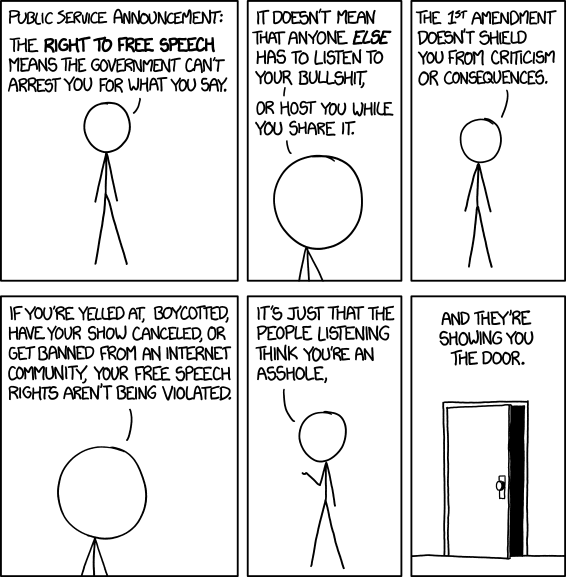
Free Speech

I can't remember where I heard this, but someone once said that defending a position by citing free speech is sort of the ultimate concession; you're saying that the most compelling thing you can say for your position is that it's not literally illegal to express.
18 Apr 14:30

April 12, 2014


09 Apr 13:14

DC Judge Smacks Down Government For Vague iPhone Search Warrant

by Tim Cushing

Trying to pin down DC Magistrate Judge John Facciola is tricky. Early in March, he issued an order denying a government warrant for an email search, stating the following:

[T]he government continues to submit overly broad warrants and makes no effort to balance the law enforcement interests against the obvious expectation of privacy e-mail account holders have in their communications.
So far, so good, as far as upholding the Fourth Amendment goes. Then later in the month, Facciola appeared to switch sides, rejecting a warrant application for a cell phone search because, as he saw it, there was no need for the police to obtain one. This determination was based on the warrant application's description of the phone as being "abandoned" by the suspect, when in all reality, it may have just been dropped inadvertently. This strange order put the police in the strange position of being forbidden to obtain a warrant, something that could potentially jeopardize the prosecution's case if another judge later determines a warrant was, in fact, needed before performing the search of the phone.

That backwards step has now been followed by another step forward in terms of the Fourth Amendment. Facciola has again smacked down a government warrant request for being too broad and too unconcerned with potential privacy implications.
Although Attachment B provides a sufficiently particularized list of the data that the government will search for and seize, the Forensic Analysis section fails to provide this Court with the same level of detail as to the methodologies to be used to conduct the search. Specifically, the government fails to articulate how it will limit the possibility that data outside the scope of the warrant will be searched. For the reasons stated below, the government’s Application for a search and seizure warrant will, therefore, be denied.
Specifically, Facciola finds this warrant approved from others he has blocked in the past, but the government still seems hesitant to explain exactly how it plans to limit its search to just pertinent data and documents.
The Court also requires a search protocol for a separate Fourth Amendment reason—to particularly describe the place to be searched. In a broad manner, describing the iPhone and its specific IMEI number certainly describes the “place to be searched” in a particular manner. But an electronic search is not that simple. An iPhone 4 has either 16 GB or 32 GB of flash memory, 10 which could allow storage of up to around two million text documents. Obviously no one—especially not a college student—would fill an iPhone with text documents, but it is inconceivable that the government would go file by file to determine whether each one is within the scope of the warrant. Instead, as the government has explained in extremely general terms, it will use some sort of “computer-assisted scans” to determine where to look because those scans will determine which parts will be exposed “to human inspection in order to determine whether it is evidence described by the warrant.”
Facciola notes that the fact that so much can be stored similarly increases the chance of abuse. All he's asking for is for the government to be more specific in its description of how it will minimize accessing data not related to the case at hand, and all the government has provided so far is vagaries like "computer-assisted scan" and "keyword searches."
It tells the Court nothing about what will actually happen and does not provide a means of searching so that this Court is assured that it is the type of particularized search that the Fourth Amendment demands. What the government has submitted is no better than the vague explanation in In re Search of Odys Loox that it will “image each device, search them, and keep all files.”
If Facciola sounds irritable, it's probably because this is the third time he's sent the government back to work on this particular warrant request. And this is the third time he's had to make this statement, one which still seems to elude the agency making the request.
Until the government actually explains how the search will proceed, and thus how the government intends to limit its search of data outside the scope of the warrant, this warrant cannot be issued.
So, it appears Facciola's fighting for citizens' Fourth Amendment rights against a government that seems unwilling or unable to narrow the scope of its electronic searches. Of course, this protection seemingly only extends to citizens whose phones have been properly seized as evidence, rather than dropped/abandoned and claimed by pursuing law enforcement agents. If it's the latter, Facciola appears to believe it's an imposition on law enforcement to demand a warrant. Still, two out of three (in just this month alone) is a pretty good batting average for Americans' rights, something that tends to be subverted very easily by expansive judicial readings of the Third Party Doctrine.

Permalink | Comments | Email This Story


09 Apr 13:13

FOIA Exemption B(5) Means Never Having To Let A Redaction Opportunity Slip By

by Tim Cushing

We've seen our share of redacted pages here at Techdirt, covering everything from NSA rules violations to GPS tracking to transcripts of court proceedings. Redaction is a way of life for the government, making a mockery of both the Freedom of Information Act AND this administration's claim that the White House is the most transparent place on earth.

This last claim in particular is ridiculous. The Redacted blog (run by members of George Washington University's research library) has published the following chart, which shows exactly how much sunlight isn't making its way to requested government documents thanks to its favorite FOIA exemption, b(5).


This exemption theoretically covers only the following:
inter-agency or intra-agency memorandums or letters which would not be available by law to a party other than an agency in litigation with the agency
In reality, it covers all of the following, according to Redacted's research.
The Department of Justice’s use of b(5) to censor dozens of pages of a candid history of Nazi-hunting (and Nazi-protecting) by the U.S. government to such a self-defeating extent that former officials leaked the entire document to the New York Times, instead of fulfilling a Freedom of Information request.

The CIA, supported by the Department of Justice, is currently using the b(5) exemption to keep secret its history of the 1961 Bay of Pigs Invasion, arguing that it’s release “could confuse the public.”

Muckrock’s Shawn Muscrave has reported that The Federal Elections Commission attempted to argue that it’s own guidance on when to apply b(5) is itself exempt from release under b(5) –even though it had already been posted on the FEC’s website.
Also included? Henry Kissinger's notes on telephone conversations, which were withheld for seven years under this exemption. DOJ legal counsel opinions, which by law must be released if the stated suggestions have been officially adopted. The State Dept. even argued that this exemption applied to Presidential Policy Directive addressing the Department's need to be more transparent about its aid plans.

This is the next FOIA battleground, according to Redacted. The expansive reading of this exemption has lead to the government adopting this as the go-to redaction, applied haphazardly to withhold information from the public. The b is for "broad," or as Redacted puts it, "withhold it because you want to."

The blog points to one of the most ridiculous redactions in a sea of misuse -- the withholding of a State Department employee's hand-scrawled "commentary" on a proposed bill to designate Pakistan as a state sponsor of terrorism.


Sure enough, b(5) was cited when redacting the opinion ("What a bunch of crap!"), meaning that this penned commentary somehow was an inter/intra-agency "memorandum or letter" not meant for the public's eye. The fact that it was neither and was written on a copy of a publicly available piece of legislation didn't stop the agency from redacting it. Two years later, it was finally forced by the court to uncover the rogue commentary.

"Because you feel like it" sums it up completely. Someone hoped to head off a microscopic bit of embarrassment by abusing the FOIA exemptions and somehow we're expected to believe other b(5) redactions are done with a sense of purpose and restraint.

Permalink | Comments | Email This Story


09 Apr 13:11

A New Animated Web Series About Copying And Copyright

by Mike Masnick
A group of filmmakers has decided to put together an interesting new animated web series called "Copy-Me" all about copying and copyright -- and more specifically about culture and sharing, and why that's important (while also debunking some of the usual myths about copyright). Among the things they've claimed the series will cover are:
  • The importance of the public domain.
  • Artists making money without restricting access to their work.
  • A bit of copyright history.
  • The paradox of originality.
  • The state of the Internet today
  • The impact of copyright on every single part of society today.
While they're just getting started, it looks like it will be quite interesting. They've also put together an IndieGogo campaign for folks interested in supporting this project. Here's the intro video the filmmakers have made about the campaign, explaining a bit more of why they're doing this and what they hope to accomplish: While there have been various other cool projects trying to discuss these issues, from Kirby Ferguson's Everything is a Remix to Nina Paley's Copying is Not Theft, the more the merrier in getting past the myths of copyright that a certain industry has been pushing for decades.

Permalink | Comments | Email This Story


08 Apr 14:35

Progress: An Honest Criminal Turns Himself In After Learning He's Wanted Via Vanity Google Search

by Timothy Geigner

You know, we talk a great deal at Techdirt about dumb criminals and how often they are nabbed by the intersection of their own stupidity and technology. It is, frankly, enough to make you wonder about the future of our species, watching these would-be criminal masterminds fumble about social media, YouTube, and the like. I remember the days when criminals had a certain sense of honor. Sure, they did wrong, but they had a certain something to them.

Well, perhaps that breed of criminal isn't dead yet, judging by Christopher Viatafa, the Palo Alto man who did a vanity Google search for his own name, saw that he was a wanted man, and promptly turned himself in.

Google Christopher Viatafa and with no digging at all you'll find he's wanted by San Leandro police. That's exactly what the 27-year-old Palo Alto man discovered this month. The first result of his search led to the Northern California's Most Wanted website, where his picture appeared along with the charges he's facing, authorities said Friday. Accused of doing wrong, authorities said Viatafa then did what was right: He turned himself in to police.
In a world filled with criminals who brazenly use technology to act like jackasses, this is apparently what passes for a breath of fresh air. Viatafa appears to be no saint, having allegedly peeled off a couple of caps after an argument at a party (no injuries/deaths reported), but at least he went to face his charges after finding out just how badly the state wanted him.

So fear not for our future, because some bad guys who shoot guns will apparently use the internet to turn themselves in. Or something. Actually, I'm not sure any of this is really making me feel much better.

Permalink | Comments | Email This Story


08 Apr 02:56

5 Year Old Hacks Xbox Live; Thankfully DOJ Apparently Uninterested In Prosecuting Cute Kid Under CFAA

by Mike Masnick
There have been a bunch of stories going around about how 5-year-old Kristoffer Von Hassel figured out a way to hack the Xbox Live password system. Kristoffer's parents noticed that their son was logging into his father's account and playing games he wasn't supposed to be playing. They asked him how he was doing it and he showed them:
Just after Christmas, Kristoffer's parents noticed he was logging into his father's Xbox Live account and playing games he wasn't supposed to be.

“I got nervous. I thought he was going to find out,” said Kristoffer.

In video shot soon after, his father, Robert Davies, is heard asking Kristoffer how he was doing it.

A suddenly excited Kristoffer showed Dad that when he typed in a wrong password for his father’s account, it clicked to a password verification screen. By typing in space keys, then hitting enter, Kristoffer was able to get in through a back door.
Kristoffer's father, Robert Davies, works in computer security (which, frankly, makes me a little skeptical that Kristoffer really made this discovery), and submitted the bug to Microsoft, who not only quickly fixed it, but also listed Kristoffer on their March "acknowledgements" for security researchers who helped them find bugs and vulnerabilities. Of course, the flip side to this story is how we've seen the CFAA used in the past to go after people discovering similar flaws. Compare the story of Kristoffer to the story of Andrew "weev" Auernheimer. Kristoffer clearly exceeded authorized access to the Xbox Live system in order to obtain something of value (perhaps he gets off because the "something" is not worth more than $5,000, but still...). Of course, weev is an obnoxious internet troll, and Kristoffer is a cute 5-year-old. I guess that's what's meant by "prosecutorial discretion."

Permalink | Comments | Email This Story


08 Apr 02:51

US, Apparently With No Sense Of Irony, Preaching 'Openness' And 'Transparency' To Chinese

by Mike Masnick
Defense Secretary Chuck Hagel is heading to Beijing to talk with the Chinese government, and the message he's bringing to the Chinese is that (a) Americans don't do irony and (b) we're a bunch of lying hypocrites. I'm sure that will go over well. You may recall the recent revelations that the NSA (which is a part of the defense department) had hacked into Huawei -- a company that the US keeps insisting is likely used by the Chinese government to spy on people... even though it has no evidence at all to support that.

In what may be the most unintentionally hilarious article in the NY Times you'll read in a while, it discusses how Hagel and the US government are preaching openness, transparency and candor when it comes to state-level cyberattacks, sharing information on what the US is doing, and hoping that the Chinese will reciprocate. In fact, the Obama administration recently held a briefing for the Chinese government in which they discussed the US's "doctrine" for defending against cyberattacks:
The idea was to allay Chinese concerns about plans to more than triple the number of American cyberwarriors to 6,000 by the end of 2016, a force that will include new teams the Pentagon plans to deploy to each military combatant command around the world. But the hope was to prompt the Chinese to give Washington a similar briefing about the many People’s Liberation Army units that are believed to be behind the escalating attacks on American corporations and government networks.

So far, the Chinese have not reciprocated — a point Mr. Hagel plans to make in a speech at the P.L.A.’s National Defense University on Tuesday.
Note, of course, that they only discussed how the US defends against attacks, not their offensive capabilities, such as hacking into Huawei or introducing destructive malware like Stuxnet. Even so, Hagel's mantra seems to be that "transparency" is suddenly a good thing.
In Beijing, the defense secretary “is going to stress to the Chinese that we in the military are going to be as transparent as possible,” said Rear Adm. John Kirby, the Pentagon press secretary, “and we want the same openness and transparency and restraint from them.”
Of course, that's quite a different message from a year ago. As you may recall, just as the first Snowden documents were being released to the public, President Obama was scolding China for its cyberattacks. But, as the NY Times article notes:
“We clearly don’t occupy the moral high ground that we once thought we did,” said one senior administration official.
You think?

And, yet, it seems that making these hilarious claims of "openness" and "transparency" from an administration famous for its unprecedented secrecy has been drilled into Hagel's head for this trip to Beijing. Discussing a different issue -- an escalating dispute between China and Japan over some uninhabited islands -- Hagel again made a statement that reads like pure hypocrisy:
"The more transparent and open governments can be with each other, the better for everyone. That avoids miscalculation, misinterpretation, misunderstanding, and hopefully that lowers the risks of conflict."
While that statement is likely true, it seems fairly rich for the US to be out there preaching that message, while being one of the least transparent, least open US administrations ever. Last year, we wrote about how the Snowden and Manning stories basically stripped the US of its ability to hypocritically browbeat other countries, because those other countries had little to pushback on. As we noted, the way out of that was to stop being hypocritical and to actually practice openness and transparency. While, perhaps, you could argue that sharing a few details of our "cyberdefense" capabilities qualifies, that's a pretty hard sell. The US government still seems to hope that its own hypocrisies will be ignored while it preaches principles it comes nowhere close to living up to.

Permalink | Comments | Email This Story


08 Apr 02:48

Mike Rogers Still Pushing His 'Snowden Is A Russian Spy' Delusion, Citing Every Single 'Counterintelligence Official' In Support

by Tim Cushing

Mike Rogers is still intent on proving Ed Snowden is a Russian spy. Apparently, Rogers' plan is to make the same assertions over and over again without providing any evidence beyond hearsay and conjecture (always from unnamed, unspecified intelligence community members).

His latest foray into his own particular conspiracy theory occurred during an interview with Michael Crowley at TIME. Crowley asks him to explain the assertions he's made about Ed Snowden, particularly the statement that he's under the influence of Russian intelligence (FSB). Crowley points out Rogers has offered no evidence to back up these claims. Rogers responds… by again offering no evidence.

The NSA contractor is definitely under the influence of Russian officials. We know that he was in China, Hong Kong anyway, and in Russia today. We have seen patterns and activities that lead us to believe that some or all of that information is being worked through by those intelligence services and putting the U.S. at risk.
There's your "evidence." Snowden was in Hong Kong and now, Russia. Case closed. As for the "patterns and activities," Rogers offers nothing definite, other than foreign intelligence services are "working through" the documents, which could really mean nothing more than they're reading the papers.

If the NSA still doesn't know what's been taken, it's rather hard for any "counterintelligence official" to claim moves are being made because of yet undisclosed documents. If Rogers' assertion is true (and there's no reason to believe it is), it means the intelligence community is engaging in the same sort of conspiratorial speculation that he is. Needless to say, this would be perhaps the least productive use of the agency's resources.

You'll notice (as Crowley did) that Rogers won't even say Snowden's name at this point (referring to him only as a "NSA contractor"). Here's his excuse:
I think people have wrongly given him some elevated status, and he has some kind of an underground rock-star status. He’s a traitor who puts our soldiers lives at risk.
If anyone's turning Snowden into a larger-than-life figure, it's those, like Rogers, who are attempting to portray him as backstabbing traitor who ran to the welcoming arms of foreign intelligence agencies.

Rogers goes from bad to worse to incomprehensible within the space of a few questions. He says Snowden's living arrangements are far too cozy with Russian intelligence. At first, Snowden's only "about a mile away" from FSB's headquarters, then he's "been in custody" and finally, he's living in an FSB "joint facility." Crowley questions this and Rogers backpedals.
No, no, not a joint facility. He’s housed very near an FSB facility. Makes it convenient for everybody.
Hmm.

Then there's this: Rogers' ultimate proof that he's not a crazy person with a headful of conspiracy theories.
And remember we have other classified ways as well. That’s why no counterintelligence official does not believe that today he’s under the influence.
Really? Then why have no other counterintelligence officials stepped up to make this claim? Do they really think this potential bombshell is best deployed by a rah-go-team-surveillance blowhard like Mike Rogers, a legislator who has done his very best to play the part of subservient flack catcher for the surveillance state? Wouldn't the single, most damning bit of evidence that Snowden is everything his detractors claim he is (traitor, spy) have already been exposed? Presumably these unnamed counterintelligence officials are no fan of Snowden's actions. If so, why are they sitting on this and letting someone like Rogers proactively destroy any potential credibility?

There's only one answer: it's completely untrue. Rogers may be able to find a number of yes-men who nod sagely while he spews baseless claims, but there's no way that number includes counterintelligence officials. Even if some of them suspect Snowden might be working in conjunction with Russia's FSB, they've wisely decided not to make that public before they've gathered enough evidence to support the claim. Rogers, on the other hand, has decided his gut instinct, informed by his irrational hatred of this "NSA contractor," is all the evidence that's really needed.

Permalink | Comments | Email This Story


08 Apr 02:39

Former CIA, NSA Boss Says Senator Feinstein Is Too Emotional To Judge CIA Torture Fairly

by Mike Masnick
We've written about former NSA and CIA boss Michael Hayden plenty of times around here, and the guy is practically a caricature of what you'd expect him to be. He defends the intelligence community at all costs, and is quick with baseless insults to anyone who disagrees with him, and also (laughably) seems ill-prepared to be a fortune teller. We've also written about California Senator, and head of the Senate Intelligence Committee, Dianne Feinstein, many times as well -- often watching her make similarly ridiculous claims in defense of the intelligence committee. However, as we've seen over the last few months, the one place where she seems to draw the line is with the CIA and its torture program. Feinstein, normally a staunch defender of the intelligence community, has been battling the CIA over the release of the $40 million, 6,300 page report that shows that the CIA's torture program (which she still refuses to call "torture") went way beyond what was authorized, produced no useful intelligence and resulted in the CIA lying to Congress about the program.

Since the two are normally in lock-step on various issues, it's interesting to see what happens when they differ. On Fox News over the weekend, Chris Wallace asked Hayden about the report, and Hayden pretty explicitly tossed out the ridiculous misogynistic argument that Feinstein was, effectively, too emotional to judge whether the report should be released. While he didn't make that claim exactly, he came about as close as possible to saying it without saying it:

WALLACE: But the report says that more prisoners were abused than we had previously known and that the enhanced interrogation produced little intelligence of significance.

HAYDEN: Yes. I read an article by David Ignatius earlier this week. And he said --

WALLACE: He's a columnist for The Washington Post.

HAYDEN: Right. He said that Senator Feinstein wanted a report so scathing that it would ensure that an un-American brutal program of detention interrogation would never again be considered or permitted.

Now, that sentence, that motivation for the report, Chris, may show deep emotional feeling on part of the senator. But I don't think it leads you to an objective report.

WALLACE: I mean, forgive me, because you and I both know Senator Feinstein. I have the highest regard for her. You're saying you think she was emotional in these conclusions?

HAYDEN: What I'm saying is -- first of all, Chris, you're asking me about a report. I have no idea of its content. No one responsible for that report has spoken a word of this to me, to George Tenet, to Porter Goss, to anyone else that is involved in these events. But it's very hard for me to make a judgment.

Of course, as Amy Davidson at the New Yorker notes, while the Ignatius report does suggest this as potential motivation for Feinstein, it's actually taking a Feinstein quote completely out of context. Rather than it being the motivating factor in creating the report, it was actually Feinstein's response to reading the completed report and arguing that its key findings should be made public. That is, rather than being emotionally motivated to create the report (as Hayden falsely claims), Feinstein realized that the report was so damning that it needed to be made public to stop future CIA torture and abuse.

And, really, can anyone explain what's wrong with suggesting that preventing an "un-American, brutal" torture program from happening again would be a beneficial result? Is Hayden honestly arguing that the US should continue with un-American torture efforts?

Either way, the choice of words by Hayden is deliberate and obnoxious. He's suggesting that a female Senator might be too emotionally driven and fragile to understand the "realities" of war, where people like him -- people who apparently sold out their morals long ago -- make important decisions like when and how to violate the Geneva conventions, torture people and to then lie to Congress about it. Call me crazy, but when it comes to stopping a "brutal" and "un-American" program of torturing people in violation of international law, a little emotion might be a good thing.

Permalink | Comments | Email This Story


08 Apr 02:34

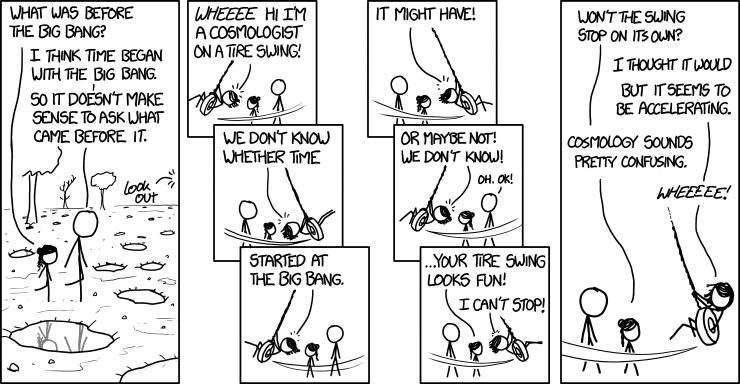
Cosmologist on a Tire Swing

No matter how fast I swing, I can never travel outside this loop! Maybe space outside it doesn't exist! But I bet it does. This tire came from somewhere.
08 Apr 02:33

One big reason we lack Internet competition: Starting an ISP is really hard

by Jon Brodkin
Aurich Lawson / Thinkstock

There are probably many reasons that US households have so few choices for Internet service, but not least among them is the fact that starting a new ISP is really difficult, and expensive to boot.

Millions of Americans would gladly switch from their DSL or cable Internet service to fiber, which in many cities delivers speeds of 1Gbps. That's 250 times faster than the 4Mbps download bandwidth that qualifies as "broadband" under the Federal Communications Commission definition. As of Dec. 2012, 29 percent of US households lived in census tracts with one or zero providers offering fixed Internet service of at least 6Mbps, according to FCC data. While the other 71 percent of census tracts had at least two providers offering 6Mbps, they may not offer that speed to all households in each area, the FCC said. Cable and DSL dominate nationally, with fiber-to-the-premises accounting for only 6.7 million out of 92.6 million fixed connections of at least 200Kbps.

Seems like a huge market opportunity, right? But actually starting a new Internet service is no simple task.

Read 47 remaining paragraphs | Comments