Shared posts

29 Jun 20:01

How Television Won the Internet

The Opinion Pages | Op-Ed Contributor

How Television Won the Internet

By MICHAEL WOLFF

Inside
    Supported By

    RUPERT MURDOCH recently appointed his son James chief executive of 21st Century Fox, prompting the obvious question: How can a guy whose main credential is a silver spoon compete with Silicon Valley’s meritocratic coders and entrepreneurs?

    I suggested that disconnect in a testy interview with James several years ago, when he was running his father’s satellite broadcasting company, BSkyB. “You must be incredibly stupid,” he said with trademark Murdoch dismissiveness. “Look around you, man. It’s television!”

    Supremely confident that the Murdochs were old-media toast, I looked around, and it was in fact perplexing that BSkyB had, despite the Internet, become a colossus — one of the biggest businesses in Europe.

    Another most counterintuitive fact: No matter the skyrocket valuations of digital companies, and the hype and press — much of it coming from digital media itself — people still spent more time watching television than they did on the Internet, and more time on the Internet was spent watching television. Indeed, the period since my conversation with Mr. Murdoch — a period in which almost everyone in media has uttered the words “digital is the future” — has been one of the biggest growth periods in the history of television.

    Online-media revolutionaries once figured they could eat TV’s lunch by stealing TV’s business model — more free content, more advertising. Online media is now drowning in free. Google and Facebook, the universal aggregators, control the traffic stream and effectively set advertising rates. Their phenomenal traffic growth has glutted the ad market, forcing down rates. Digital publishers, from The Guardian to BuzzFeed, can stay ahead only by chasing more traffic — not loyal readers, but millions of passing eyeballs, so fleeting that advertisers naturally pay less and less for them.

    Meanwhile, the television industry has been steadily weaning itself off advertising — like an addict in recovery, starting a new life built on fees from cable providers and all those monthly credit-card debits from consumers. Today, half of broadcast and cable’s income is non-advertising based. And since adult household members pay the cable bills, TV content has to be grown-up content: “The Sopranos,” “Mad Men,” “Breaking Bad,” “The Wire,” “The Good Wife.”

    Looking for irony? Television, once maniacally driven by Nielsen ratings, has gone upscale as online media becomes an absurd traffic game. TV figured out how to monetize stature and influence. Nobody knows how many people saw “House of Cards,” and nobody cares. Mass-market TV upgraded to class, while digital media — listicles, saccharine viral videos — chased lowbrow mass.

    So how did this tired, postwar technology seize back the crown? With old-fashioned businessmen in charge. When YouTube threatened to become a TV piracy site, television, led by Viacom’s 84-year-old Sumner Redstone, dragged Google, YouTube’s owner, into a painful spiral of litigation. A throwback like Mr. Redstone turned YouTube from pirater to licenser. He made Google his customer.

    Television, not digital media, is mastering the model of the future: Make ’em pay. And the corollary: Make a product that they’ll pay for. BuzzFeed has only its traffic to sell — and can only sell it once. Television shows can be sold again and again, with streaming now a third leg to broadcast and cable, offering a vast new market for licensing and syndication. Television is colonizing the Internet.

    Continue reading the main story

    Recent Comments

    Carolyn Egeli

    Not me..I won't pay. I cancelled my t.v. with delight! Especially as there is little worth while to watch! I can do without it. I like being...

    Nathaniel

    Next we just need to instate civilocity and put the person leading the country on tv the entire time anybody ever leads our country.

    Larry Greenfield

    I think the author makes a semantic argument, not a commercial one. I also think he might see things differently once Apple TV's new...

    • See All Comments
    • Write a comment

    Streaming video is now not only the hottest media draw — 78 percent of United States Internet bandwidth — but, defying the trend, many of its creators are getting paid. Netflix bills itself as a disrupter of television — except that it is television, paying Hollywood and the TV industry almost $2 billion a year in licensing and programming fees.

    Continue reading the main story 58 Comments

    The latest pseudo-crisis is the flight from the box — cord-cutting — but more people than ever are consuming television, and paying for it as they please on whatever screen. Well-produced, highly structured narrative video entertainment is so profitable that everybody in digital media — frustrated by tumbling ad rates and rising traffic demands — wants to be streaming premium video (i.e., television). Yahoo just cut its first big sports deal. Mark Zuckerberg of Facebook says that his company’s future is video. Just last week, BuzzFeed and the Huffington Post announced their new TV plans.

    The fundamental recipe for media success, in other words, is the same as it used to be: a premium product that people pay attention to and pay money for. Credit cards, not eyeballs.

    In 2014, Rupert Murdoch, at his son James’s urging, made a bid to buy Time Warner, quite clearly the opening shot in a battle that now involves all the major content owners, the cable Goliaths and the digital platforms — a struggle for primacy in the video industry. It’s not the digital revolution. James Murdoch is right. Look around you man, it’s the television revolution!
    29 Jun 04:27

    It’s Time to Legalize Polygamy

    Welcome to the exciting new world of the slippery slope. With the Supreme Court’s landmark ruling this Friday legalizing same sex marriage in all 50 states, social liberalism has achieved one of its central goals. A right seemingly unthinkable two decades ago has now been broadly applied to a whole new class of citizens. Following on the rejection of interracial marriage bans in the 20th Century, the Supreme Court decision clearly shows that marriage should be a broadly applicable right—one that forces the government to recognize, as Friday’s decision said, a private couple’s “love, fidelity, devotion, sacrifice and family.”

    The question presents itself: Where does the next advance come? The answer is going to make nearly everyone uncomfortable: Now that we’ve defined that love and devotion and family isn’t driven by gender alone, why should it be limited to just two individuals? The most natural advance next for marriage lies in legalized polygamy—yet many of the same people who pressed for marriage equality for gay couples oppose it.

    This is not an abstract issue. In Chief Justice John Roberts’ dissenting opinion, he remarks, “It is striking how much of the majority’s reasoning would apply with equal force to the claim of a fundamental right to plural marriage.” As is often the case with critics of polygamy, he neglects to mention why this is a fate to be feared. Polygamy today stands as a taboo just as strong as same-sex marriage was several decades ago—it’s effectively only discussed as outdated jokes about Utah and Mormons, who banned the practice over 120 years ago.

    Yet the moral reasoning behind society’s rejection of polygamy remains just as uncomfortable and legally weak as same-sex marriage opposition was until recently.

    That’s one reason why progressives who reject the case for legal polygamy often don’t really appear to have their hearts in it. They seem uncomfortable voicing their objections, clearly unused to being in the position of rejecting the appeals of those who would codify non-traditional relationships in law. They are, without exception, accepting of the right of consenting adults to engage in whatever sexual and romantic relationships they choose, but oppose the formal, legal recognition of those relationships. They’re trapped, I suspect, in prior opposition that they voiced from a standpoint of political pragmatism in order to advance the cause of gay marriage.

    In doing so, they do real harm to real people. Marriage is not just a formal codification of informal relationships. It’s also a defensive system designed to protect the interests of people whose material, economic and emotional security depends on the marriage in question. If my liberal friends recognize the legitimacy of free people who choose to form romantic partnerships with multiple partners, how can they deny them the right to the legal protections marriage affords?

    Polyamory is a fact. People are living in group relationships today. The question is not whether they will continue on in those relationships. The question is whether we will grant to them the same basic recognition we grant to other adults: that love makes marriage, and that the right to marry is exactly that, a right.

    Why the opposition, from those who have no interest in preserving “traditional marriage” or forbidding polyamorous relationships? I think the answer has to do with political momentum, with a kind of ad hoc-rejection of polygamy as necessary political concession. And in time, I think it will change.

    The marriage equality movement has been both the best and worst thing that could happen for legally sanctioned polygamy. The best, because that movement has required a sustained and effective assault on “traditional marriage” arguments that reflected no particular point of view other than that marriage should stay the same because it’s always been the same. In particular, the notion that procreation and child-rearing are the natural justification for marriage has been dealt a terminal injury. We don’t, after all, ban marriage for those who can’t conceive, or annul marriages that don’t result in children, or make couples pinkie swear that they’ll have kids not too long after they get married. We have insisted instead that the institution exists to enshrine in law a special kind of long-term commitment, and to extend certain essential logistical and legal benefits to those who make that commitment. And rightly so.

    But the marriage equality movement has been curiously hostile to polygamy, and for a particularly unsatisfying reason: short-term political need. Many conservative opponents of marriage equality have made the slippery slope argument, insisting that same-sex marriages would lead inevitably to further redefinition of what marriage is and means. See, for example, Rick Santorum’s infamous “man on dog” comments, in which he equated the desire of two adult men or women to be married with bestiality. Polygamy has frequently been a part of these slippery slope arguments. Typical of such arguments, the reasons why marriage between more than two partners would be destructive were taken as a given. Many proponents of marriage equality, I’m sorry to say, went along with this evidence-free indictment of polygamous matrimony. They choose to side-step the issue by insisting that gay marriage wouldn’t lead to polygamy. That legally sanctioned polygamy was a fate worth fearing went without saying.

    To be clear: our lack of legal recognition of group marriages is not the fault of the marriage equality movement. Rather, it’s that the tactics of that movement have made getting to serious discussions of legalized polygamy harder. I say that while recognizing the unprecedented and necessary success of those tactics. I understand the political pragmatism in wanting to hold the line—to not be perceived to be slipping down the slope. To advocate for polygamy during the marriage equality fight may have seemed to confirm the socially conservative narrative, that gay marriage augured a wholesale collapse in traditional values. But times have changed; while work remains to be done, the immediate danger to marriage equality has passed. In 2005, a denial of the right to group marriage stemming from political pragmatism made at least some sense. In 2015, after this ruling, it no longer does.

    While important legal and practical questions remain unresolved, with the Supreme Court’s ruling and broad public support, marriage equality is here to stay. Soon, it will be time to turn the attention of social liberalism to the next horizon. Given that many of us have argued, to great effect, that deference to tradition is not a legitimate reason to restrict marriage rights to groups that want them, the next step seems clear. We should turn our efforts towards the legal recognition of marriages between more than two partners. It’s time to legalize polygamy.

    ***

    Conventional arguments against polygamy fall apart with even a little examination. Appeals to traditional marriage, and the notion that child rearing is the only legitimate justification of legal marriage, have now, I hope, been exposed and discarded by all progressive people. What’s left is a series of jerry-rigged arguments that reflect no coherent moral vision of what marriage is for, and which frequently function as criticisms of traditional marriage as well.

    Fredrik deBoer is a writer and academic. He lives in Indiana. 


    Many argue that polygamous marriages are typically sites of abuse, inequality in power and coercion. Some refer to sociological research showing a host of ills that are associated with polygamous family structures. These claims are both true and beside the point. Yes, it’s true that many polygamous marriages come from patriarchal systems, typically employing a “hub and spokes” model where one husband has several wives who are not married to each other. These marriages are often of the husband-as-boss variety, and we have good reason to suspect that such models have higher rates of abuse, both physical and emotional, and coercion. But this is a classic case of blaming a social problem on its trappings rather than on its actual origins.

    After all, traditional marriages often foster abuse. Traditional marriages are frequently patriarchal. Traditional marriages often feature ugly gender and power dynamics. Indeed, many would argue that marriage’s origins stem from a desire to formalize patriarchal structures within the family in the first place. We’ve pursued marriage equality at the same time as we’ve pursued more equitable, more feminist heterosexual marriages, out of a conviction that the franchise is worth improving, worth saving. If we’re going to ban marriages because some are sites of sexism and abuse, then we’d have to start with the old fashioned one-husband-and-one-wife model. If polygamy tends to be found within religious traditions that seem alien or regressive to the rest of us, that is a function of the very illegality that should be done away with. Legalize group marriage and you will find its connection with abuse disappears.

    Another common argument, and another unsatisfying one, is logistical. In this telling, polygamous marriages would strain the infrastructure of our legal systems of marriage, as they are not designed to handle marriage between more than two people. In particular, the claim is frequently made that the division of property upon divorce or death would be too complicated for polygamous marriages. I find this argument eerily reminiscent of similar efforts to dismiss same-sex marriage on practical grounds. (The forms say husband and wife! What do you want us to do, print new forms?) Logistics, it should go without saying, are insufficient reason to deny human beings human rights.

    If current legal structures and precedents aren’t conducive to group marriage, then they will be built in time. The comparison to traditional marriage is again instructive. We have, after all, many decades of case law and legal organization dedicated to marriage, and yet divorce and family courts feature some of the most bitterly contested cases imaginable. Complication and dispute are byproducts of human relationships and human commitment. We could, as a civil society, create a legal expectation that those engaging in a group marriage create binding documents and contracts that clearly delineate questions of inheritance, alimony, and the like. Prenups are already a thing.

    Most dispiriting, and least convincing, are those arguments that simply reconstitute the slippery slope arguments that have been used for so long against same sex marriage. “If we allow group marriage,” the thinking seems to go, “why wouldn’t marriage with animals or children come next?” The difference is, of course, consent. In recent years, a progressive and enlightened movement has worked to insist that consent is the measure of all things in sexual and romantic practice: as long as all involved in any particular sexual or romantic relationship are consenting adults, everything is permissible; if any individual does not give free and informed consent, no sexual or romantic engagement can be condoned.

    This bedrock principle of mutually-informed consent explains exactly why we must permit polygamy and must oppose bestiality and child marriage. Animals are incapable of voicing consent; children are incapable of understanding what it means to consent. In contrast, consenting adults who all knowingly and willfully decide to enter into a joint marriage contract, free of coercion, should be permitted to do so, according to basic principles of personal liberty. The preeminence of the principle of consent is a just and pragmatic way to approach adult relationships in a world of multivariate and complex human desires.

    Progressives have always flattered themselves that time is on their side, that their preferences are in keeping with the arc of history. In the fight for marriage equality, this claim has made again and again. Many have challenged our politicians and our people to ask themselves whether they can imagine a future in which opposition to marriage equality is seen as a principled stance. I think it’s time to turn the question back on them: given what you know about the advancement of human rights, are you sure your opposition to group marriage won’t sound as anachronistic as opposition to gay marriage sounds to you now? And since we have insisted that there is no legitimate way to oppose gay marriage and respect gay love, how can you oppose group marriage and respect group love?   

    I suspect that many progressives would recognize, would pushed in this way, that the case against polygamy is incredibly flimsy, almost entirely lacking in rational basis and animated by purely irrational fears and prejudice. What we’re left with is an unsatisfying patchwork of unconvincing arguments and bad ideas, ones embraced for short-term convenience at long-term cost. We must insist that rights cannot be dismissed out of short-term interests of logistics and political pragmatism. The course then, is clear: to look beyond political convenience and conservative intransigence, and begin to make the case for extending legal marriage rights to more loving and committed adults. It’s time.

    Fredrik deBoer is a writer and academic. He lives in Indiana. 

    27 Jun 00:50

    The Antonin Scalia “Sick Burn” Generator

    Joel Thrasymachus Dahl

    “One would think that Joel Dahl's arrogance is a black-robed cocktail. Never mind.”

    Like us on Facebook for more great Slate stories! X Follow us on Twitter for more great Slate stories! X

    Find out how the Supreme Court justice would insult you.

    128229808AW008_Supreme_Cour

    Alex Wong / Getty Images

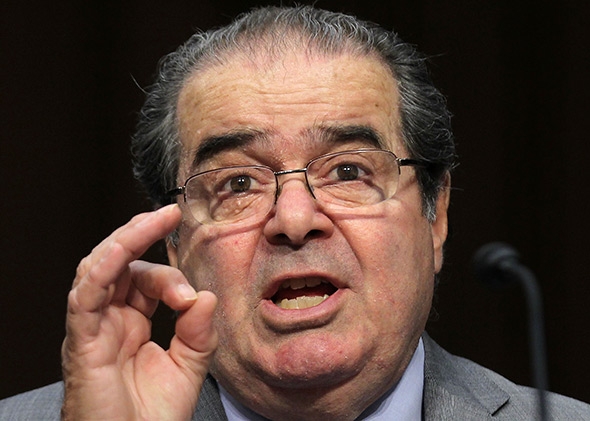
    When it comes to penning baroquely articulated vitriol, Justice Antonin Scalia may rival William Shakespeare. His dissent on Obamacare brought us “pure applesauce” and “jiggery-pokery.” On Friday, he offered “mummeries” and “judicial Putsch.” In fact, his lexicon of argle-bargle insults is nearly bottomless. So what would your Scalia burn be? Find out with our generator.

    Get Your Scalia Burn

    All insults are taken from Scalia’s writing, though some have been lightly edited for grammar. 

    26 Jun 22:26

    Chicago lawyer angered by woman’s distractingly large breasts

    Published time: May 26, 2011 16:29
    Edited time: May 26, 2011 20:44
    Image from gossipjackal.com

    Image from gossipjackal.com

    A lawyer in Chicago is being lambasted with accusations of sexism after he filed a motion with the court complaining about the distracting bust size of a ‘large breasted woman’ sitting at the opposing council’s table in court.

    Attorney Thomas Gooch is representing Rolling Meadows car dealership in a small claims case and is outraged by the distraction at the opposing table. He feels his opposing council’s paralegal is too distracting for the jury to pay attention to actual court proceedings.

    He alleged that the opposing legal team placed her in full view of the jury for the specific purpose of drawing “the attention of the jury away from the relevant proceedings” and has requested Cook County Circuit Judge Anita Rivkin-Carothers order her to sit in the gallery with the rest of the spectators, reported AP.

    Gooch claims the woman, although she is a paralegal, has no legal experience and no right to be at the opposition table.

    Opposing attorney Dmitry N. Feofanov is representing a couple who is suing Rolling Meadows over a car they purchased under warranty and when the vehicle broke the company allegedly refused to pay.

    Feofanov, speaking to Jesebel.com, said the motion regarding his paralegal, Daniella Atencia, was completely without merit. He said in the motion Gooch cites no laws and makes no legal argument for why his paralegal can be dismissed or discriminated against because of her body.

    Gooch, speaking to the Chicago Sun-Times, explained that while he likes "large breasts," he believed that Atencia should dress more appropriately for court as a paralegal. His motion and further comments have brought down a firestorm from legal and feminist experts.

    "Why does she have to provide you with evidence of legal training? Isn't sitting there silently what most counsel do during a trial? Based on this motion, I'm thinking you are the one who should need to provide some kind of proof of legal knowledge," Elie Mystal wrote for Above the Law, directing the comments at Gooch.

    Jezebel.com referred to the motion as one of the "strangest – and possibly most sexist – legal endeavors" they had ever come across.

    26 Jun 22:04

    FREEDOM

    In our great country the United States, we can legally do a lot of things when we turn the age of eighteen, such as adopt a child, smoke, join the military, vote, or even be a stripper.

    26 Jun 20:06

    Scott Walker calls for Constitutional amendment to stop gay marriage

    Joel Thrasymachus Dahl

    And, here come the troglodytes.

    Hilary's campaign is popping champaign corks as they contemplate their counterparts in the Bush camp trying to figure out how to still win the Republican nomination without moving so far to the right as to sink themselves in the general.

    Wisconsin Gov. Scott Walker, seizing the moment after the Supreme Court’s landmark ruling legalizing same-sex marriage, called Friday for a Constitutional amendment defining marriage as being between one man and one woman.

    Walker’s call came shortly after the high court ruled 5-4 that same-sex couples could marry across the country, overturning a number of state same-sex marriage bans.

    Story Continued Below

    The ruling was “a grave mistake,” the Republican governor said, touting his support for amending his state’s constitution “to protect the institution of marriage from exactly this type of judicial activism.” Walker signaled he’d like that to happen nationally as well.

    “As a result of this decision, the only alternative left for the American people is to support an amendment to the U.S. Constitution to reaffirm the ability of the states to continue to define marriage,” Walker said.

    Walker’s statement put him directly at odds with one potential 2016 rival, South Carolina Sen. Lindsey Graham, who said he didn’t support pursuing a constitutional amendment.

    “[G]iven the quickly changing tide of public opinion on this issue, I do not believe that any attempt to amend the U.S. Constitution could possibly gain the support of three-fourths of the states or a supermajority in the U.S. Congress,” Graham said in his statement. “Rather than pursuing a divisive effort that would be doomed to fail, I am committing myself to ensuring the protection of religious liberties of all Americans.”

    Other 2016 candidates have not specifically said whether they would back such an amendment, which would face steep odds on Capitol Hill.

    26 Jun 20:05

    Supreme Court Allows Nationwide Health Care Subsidies

    Joel Thrasymachus Dahl

    No need for the TOR for everyone to learn this, as we all have internet access.

    Sharing to say, following up on a comment of mine on TOR a few months back, that my crazy dad called it again. Right down to which justices voted which way. I seriously don't know how he does this.

    We'll see -- probably on Monday -- whether his more outlandish claim of a coming 8-1 (Thomas dissenting) or possibly even 9-0 upholding gay marriage bears out.

    If it does, I'm going to conclude that my dad has a time machine.

    Supreme Court Allows Nationwide Health Care Subsidies

    By ADAM LIPTAK

    Inside
      Supported By
      Photo
      Demonstrators expressed support for the Affordable Care Act outside of the Supreme Court on Thursday. Credit Doug Mills/The New York Times

      WASHINGTON — The Supreme Court ruled on Thursday that President Obama’s health care law allows the government to provide nationwide tax subsidies to help poor and middle-class people buy health insurance, a sweeping vindication that endorsed the larger purpose of Mr. Obama’s signature legislative achievement.

      The 6-to-3 ruling means that it is all but certain that the Affordable Care Act will survive after Mr. Obama leaves office in 2017, and will give it a greater chance of becoming an enduring part of America’s social safety net.

      For the second time in three years, the law survived an encounter with the Supreme Court. But the court’s tone was different this time. The first decision, in 2012, was fractured and grudging, while Thursday’s ruling was more assertive.

      “Congress passed the Affordable Care Act to improve health insurance markets, not to destroy them,” Chief Justice John G. Roberts Jr. wrote for the majority.

      The court’s three most conservative members — Justices Antonin Scalia, Clarence Thomas and Samuel A. Alito Jr. — dissented. Justice Scalia called the majority’s reasoning “quite absurd.”

      News Clips By Associated Press Play Video 11:09 Full Remarks: Obama on Health Care Ruling
      skip ad
      Continue reading the main story Video

      Full Remarks: Obama on Health Care Ruling

      President Obama spoke on Thursday about the Supreme Court’s decision allowing nationwide tax subsidies to help poor and middle-class people buy health insurance.

      By Associated Press on Publish Date June 25, 2015. Photo by Stephen Crowley/The New York Times.

      “The court’s decision reflects the philosophy that judges should endure whatever interpretive distortions it takes in order to correct a supposed flaw in the statutory machinery,” he wrote.

      “It is up to Congress to design its laws with care,” he added, “and it is up to the people to hold them to account if they fail to carry out that responsibility.”

      Justice Scalia announced his dissent from the bench, a sign of bitter disagreement. His summary was laced with notes of incredulity and sarcasm, which sometimes drawing amused murmurs in the courtroom as he described the “interpretive somersaults” he said the majority had performed to reach the decision.

      Continue reading the main story
      Health Care Subsidies
      The court decided in King v. Burwell that tax subsidies are being provided lawfully in three dozen states that have decided not to run the marketplaces for insurance coverage. Full analysis »
      6-3 Decided June 25
      MAJORITY
      DISSENT
      Sotomayor
      Kagan
      Ginsburg
      Breyer
      Kennedy
      Roberts
      Scalia
      Alito
      Thomas

      “We really should start calling this law Scotus-care,” Justice Scalia said, to laughter from the audience.

      The case concerned a central part of the Affordable Care Act that created marketplaces, known as exchanges, to allow people who lack insurance to shop for individual health plans. Some states set up their own exchanges, but about three dozen allowed the federal government to step in to run them. Across the nation, about 85 percent of customers using the exchanges qualify for subsidies to help pay for coverage, based on their income.

      The question in the case, King v. Burwell, No. 14-114, was what to make of a phrase in the law that seems to say the subsidies are available only to people buying insurance on “an exchange established by the state.”

      Continue reading the main story
      OPEN Interactive Feature

      Interactive Feature: What to Take Away from the Supreme Court Decision on Health Care

      Chief Justice Roberts wrote that the words must be understood as part of a larger statutory plan. “In this instance,” he wrote, “the context and structure of the act compel us to depart from what would otherwise be the most natural reading of the pertinent statutory phrase.”

      Continue reading the main story

      Recent Comments

      AR

      So were Scalia, Alito, and Thomas making plans to march into a local DC area hospital and gleefully evict from their hospital beds those...

      Barry

      The world is ambiguous. The only person who lives in an unambiguous world is Justice Scalia. Lucky for him. Justices who only believe in...

      galtsgulch

      Does this mean we won't finally get to see the GOP health plan they had promised to roll out if the ACA was shot down by the Supreme...

      • See All Comments
      • Write a comment

      “Congress passed the Affordable Care Act to improve health insurance markets, not to destroy them,” he added. “If at all possible, we must interpret the act in a way that is consistent with the former, and avoids the latter.”

      Four plaintiffs, all from Virginia, sued the Obama administration, saying the phrase meant that the law forbids the federal government to provide subsidies in states that do not have their own exchanges. Congress made the distinction, they said, to encourage states to create their own exchanges.

      Continue reading the main story

      Latest Updates

      The Times is following the reaction to the Supreme Court’s decision.

      The plaintiffs challenged an Internal Revenue Service regulation that said subsidies were allowed whether the exchange was run by a state or by the federal government. They said the regulation was at odds with the Affordable Care Act.

      Lawyers for the administration said the balance of the law demonstrated that Congress could not have intended to limit the subsidies. The disputed phrase, noticed by almost no one until long after the law was enacted, was a curious way to encourage states to establish exchanges, they said. And a legal victory for the plaintiffs, the lawyers said, would affect more than six million people and create havoc in the insurance markets.

      In July, the United States Court of Appeals for the Fourth Circuit, in Richmond, Va., ruled against the challengers.

      Judge Roger L. Gregory, writing for a three-judge panel of the court, said the contested phrase was “ambiguous and subject to multiple interpretations.” That meant, he said, that the I.R.S. interpretation was entitled to deference.

      25 Jun 20:47

      Spielberg Thinks You Should Read More

      by Angela

      1-45

      by Fiona Wheeler

      Joseph McBride writes in his screenwriting manual Writing in Pictures,

      The fragmentation of the TV-watching experience, the influence of the Internet and YouTube, and the effect of our amped-up video culture on feature filmmaking have resulted in a modern style relying more on moment-to-moment sensation than on the traditional pleasures of coherent storytelling.

      Culture is turning away from books in favor of the visual media in recent decades, the related decline in reading skills also have had damaging effect on our storytelling skills.

      Steven Spielberg was speaking in an interview about the Golden Age of films from the 70s and early 80s, considered by many the greatest period of American cinema. The interviewer asked why it was that great films like those aren’t being written any more. Spielberg replied,

      They read the great words of great minds… In our romance with technology and our excitement at exploring all the possibilities… I think we’ve partially lost something we now have to reclaim… for only a generation of readers will spawn a generation of writers.

      Is that right? Are screenwriters who have dropped classic reading from their “to do” lists to blame?

      [Read Steven Spielberg’s Curriculum, the 200 films Spielberg thinks every filmmaker should watch.]

      How The Blockbuster Began Its Reign

      The Paramount case of 1948, during those paranoid post-War times, saw the enforced separation of production, distribution and exhibition. A single company could no longer make movies secure in the knowledge that each new title would be passed along and shown (by the various branches of the parent company) to a ready-made domestic and international audience.

      Budgets were tightened, studios became more cautious. A film now had to rely on the pulling power of great stories and well-known actors. Actors, that is, who increased and maintained their screen appeal by their savvy choice of well-written, complex characters.

      films

      To write such multi-faceted characters, studios sought to hire well-known authors. Writing critically-acclaimed novels has never exactly paid well, so it is was that many great writers and playwrights of the day, with their vast reserves of cultural and literary knowledge, turned to screenplays. Being well-read became the screenwriter norm.

      The rise the French New Wave and its knock-on impact on American culture meant that by the 70s in America the film director “auteur” was dictator. But, as any historian will tell you, no dictatorship lasts forever. A series of mega hits saw studios giving directors as much rope as they wanted, and inevitable massive losses resulted.

      During this dictatorship of the directors, the studios had been working behind the scenes to repeal the “divorcement” decree of 1948. In 1985 they were successful. Finally, global conglomerates were once again allowed to make, distribute, and exhibit their own product (movies). Plus, they could exclusively use songs from music labels they owned, as well as license, manufacture and sell movie-related merchandise in their various food and retail outlets.

      Knowing they stood to make so much in value-added income, studios could once again afford to bankroll the blockbusters. Suddenly story and nuanced, complex characters weren’t important anymore. Special effects and related technologies were where the investment dollars were funneled.

      But that doesn’t explain why we, the screenwriters, stopped reading.

      The Modern Screenwriter

      Societal shifts and the rise of the literary savant (first-time novelists whose self-style rebel image was built upon their refusal to read the classics, or any written works) meant that for the first time writing became an accessible, and acceptable, dream for not just the cultural elite, but everyone. And what’s more accessible than film and TV? Thousands, tens of thousands, who were intimidated by the very idea of great literature, felt comfortable sitting down to write their very own screenplay or teleplay.

      Then came the next tsunami: the digital revolution. Almost overnight the prohibitive cost of making a (celluloid) feature film disappeared. To the non-professional, unaware that a film production is a myriad of perfectly balanced moving cogs, writing a feature seemed even more possible than ever before.

      Does it matter that filmmakers with no formal training in writing, directing or cinematography are making features?

      Some would argue that that’s exactly what the French have been doing all along.

      What works for one nationality, doesn’t necessarily work for another. Firstly, 80 percent of French box office is for American, not European, films. Secondly, the French are educated in an entirely different way than Americans. Philosophy and the culture of knowledge are fundamental to the French way of being.

      great_expectations__still_life_painting_of_classic_other_still_life__still_life__b58516de417623cc8117ea7485779f65

      If you grow up in Paris, you live only a train ride from the place where the first ever declaration of Human Rights was penned. From there you can stroll down to the Seine River and gaze across at Notre Dame, which was saved from crumbling to ruins because an author, Victor Hugo, wrote a novel set there. When a French director says they read “no more than most” and have no great focus on literature, culture or ideas, it’s relative.

      So what are American writers, and those who wish to write for American producers/studios to do?

      Read, Watch, Experience, Enjoy

      Julian Hoxter, author of the screenwriting manual Write What You Don’t Know says, “Engage with culture, politics and the world… your characters don’t live in a vacuum and, if you want to make them come alive, neither should you.”

      We all agree that a screenplay is the blueprint of a film. For an architect to be judged knowledgeable enough to create a blueprint for a building, they must first study other great structures and understand why it is those landmarks have withstood the tests of time. I agree with Spielberg: only a generation of great readers will spawn a generation of great writers.

      So read. Read the newspaper. Read classic novels. Read pulp fiction. Read your friend’s scripts. Read produced scripts. And watch and experience and revel and enjoy, as well. Surround yourself with art and knowledge, and your craft is sure to benefit.

      25 Jun 19:39

      California assembly approves vaccine bill

      by By Julia Horowitz The Associated Press

      SACRAMENTO >> California's Assembly on Thursday approved a hotly contested bill requiring that nearly all public schoolchildren be vaccinated, clearing one of its last major legislative obstacles before the measure heads to the desk of Gov. Jerry Brown.

      The bill aims to increase immunization rates after a measles outbreak linked to Disneyland in December sickened over 100 people in the U.

      25 Jun 19:38

      KING, DAVID, ET AL. v. BURWELL, SEC. OF H&HS, ET AL.. Decided 06/25/2015

      25 Jun 18:23

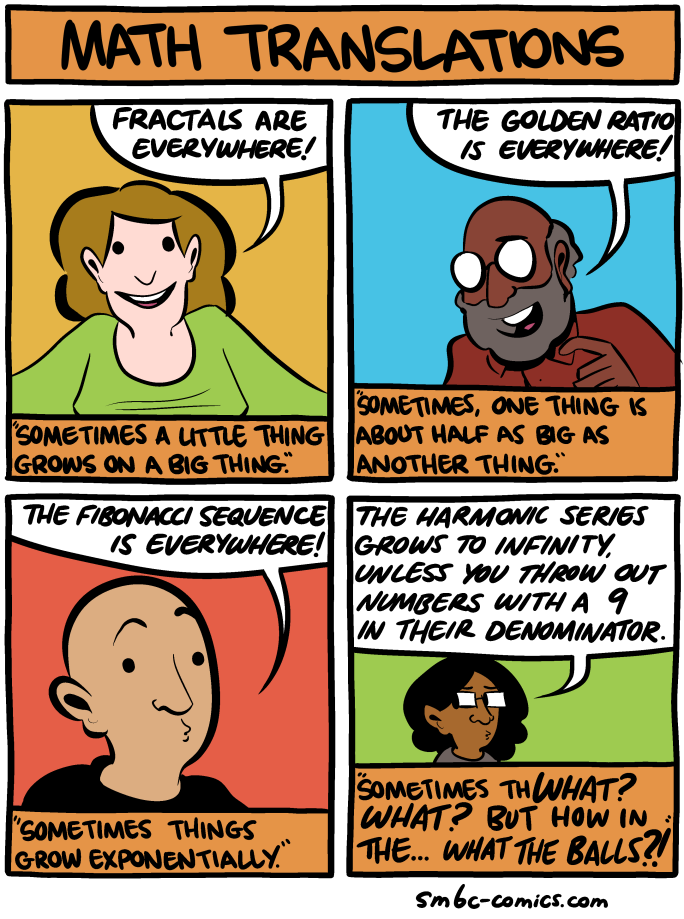
      Saturday Morning Breakfast Cereal - Math Translations

      by admin@smbc-comics.com
      Joel Thrasymachus Dahl

      My wife and my best friend are both high school math teachers. They both just emphatically endorsed the "what the balls?" of the fourth panel.

      Hovertext: Also, that's not EXACTLY a circle.


      New comic!
      Today's News:

      Come onnnn hatemail. Come onnnnn hatemail. 

      25 Jun 17:58

      Plane called off Lake Fire because of drone in area

      by Ryan Hagen

      SAN BERNARDINO MOUNTAINS >> At least one airplane was temporarily called off of fighting the Lake Fire on Wednesday because a drone entered the temporary flight restriction area, according to the U.S. Forest Service.

      "When there's a drone there, it's a safety issue," said Forest Service spokeswoman Melody Lardner.

      24 Jun 20:20

      Anesthesiologist trashes sedated patient — and it ends up costing her

      Sitting in his surgical gown inside a large medical suite in Reston, Va., a Vienna man prepared for his colonoscopy by pressing record on his smartphone, to capture the instructions his doctor would give him after the procedure.

      But as soon as he pressed play on his way home, he was shocked out of his anesthesia-induced stupor: He found that he had recorded the entire examination and that the surgical team had mocked and insulted him as soon as he drifted off to sleep.

      In addition to their vicious commentary, the doctors discussed avoiding the man after the colonoscopy, instructing an assistant to lie to him, and then placed a false diagnosis on his chart.

      “After five minutes of talking to you in pre-op,” the anesthesiologist told the sedated patient, “I wanted to punch you in the face and man you up a little bit,” she was recorded saying.

      When a medical assistant noted the man had a rash, the anesthesiologist warned her not to touch it, saying she might get “some syphilis on your arm or something,” then added, “It’s probably tuberculosis in the penis, so you’ll be all right.”

      Tiffany M. Ingham (Maj. Dale Greer/Kentucky Air National Guard)

      [Listen to clips of doctors trashing the patient]

      When the assistant noted that the man reported getting queasy when watching a needle placed in his arm, the anesthesiologist remarked on the recording, “Well, why are you looking then, retard?”

      There was much more. So the man sued the two doctors and their practices for defamation and medical malpractice and, last week, after a three-day trial, a Fairfax County jury ordered the anesthesiologist and her practice to pay him $500,000.

      The plaintiff, identified in court papers only as “D.B.,” wanted to maintain his anonymity and did not want to comment about the case, said his attorneys, Mikhael Charnoff and Scott Perry.

      The anesthesiologist, Tiffany M. Ingham, 42, could not be reached for comment, and her attorney, D. Lee Rutland, did not return messages seeking comment. Ingham worked out of the Aisthesis anesthesia practice in Bethesda, Md., which the jury ruled should pay $50,000 of the $200,000 in punitive damages it awarded. Officials there did not return a call seeking comment. Ingham no longer works there, an Aisthesis employee said, and state licensing records indicate that she has moved to Florida. An anesthesiology practice in Tavares, Fla., said she no longer worked there. Calls to a number believed to be Ingham’s were not returned, and there was not an answering machine or voicemail at that number.

      [Opinion: Nurses make fun of their dying patients. And that’s okay.]

      On the opening day of the trial last week, the gastroenterologist who performed the colonoscopy, Soloman Shah, 48, was dismissed from the case. Court documents state Shah also made some insulting remarks — “As long as it’s not Ebola, you’re okay,” Shah was recorded saying during the rash discussion — and did not discourage Ingham from her comments or actions, which included writing on the man’s chart that he had hemorrhoids, when he did not.

      Neither Shah, who did not return a message left at his office, nor the lawyers on either side would comment.

      The lawyers also would not discuss whether Ingham or Shah faced disciplinary action from the Virginia Board of Medicine. No actions are listed against either on the board’s Web site.

      The jury awarded the man $100,000 for defamation — $50,000 each for the comments about the man having syphilis and tuberculosis — and $200,000 for medical malpractice, as well as the $200,000 in punitive damages. Though the remarks by Ingham and Shah perhaps did not leave the operating room in Reston, experts in libel and slander said defamation does not have to be widely published, merely said by one party to another and understood by the second party to be fact, when it is not.

      “I’ve never heard of a case like this,” said Lee Berlik, a Reston lawyer who specializes in defamation law. He said comments between doctors typically would be privileged, but the Vienna man claimed his recording showed that there was at least one and as many as three other people in the room during the procedure and that they were discussing matters beyond the scope of the colonoscopy.

      “Usually, all [legal] publication requires is publication to someone other than the plaintiff,” Berlik said. “If one of the doctors said to someone else in the room that this guy had syphilis and tuberculosis and that person believed it, that could be a claim. Then it’s up to the jury to decide: Were the statements literal assertions of fact? The jury apparently was just so offended at this unprofessional behavior that they’re going to give the plaintiff a win. That’s what happens in the real world.”

      One of the jurors, Farid Khairzada, said that “there was not much defense, because everything was on tape.” He said that the man’s attorneys asked for $1.75 million and that the $500,000 award was a compromise between one juror who thought the man deserved nothing and at least one who thought he deserved more.

      “We finally came to a conclusion,” Khairzada said, “that we have to give him something, just to make sure that this doesn’t happen again.”

      The colonoscopy took place in Shah’s surgical suite on April 18, 2013, according to the man’s lawsuit. While being prepped for the procedure, the man apparently told Ingham that he had passed out previously while having blood drawn and that he was taking medication for a mild rash on his genitals.

      Because he was going to be fully anesthetized, the man decided to turn on his cellphone’s audio recorder before the procedure so it would capture the doctor’s post-operation instructions, the suit states. But the man’s phone, in his pants, was placed beneath him under the operating table and inadvertently recorded the audio of the entire procedure, court records show. The doctors’ attorneys argued that the recording was illegal, but the man’s attorneys noted that Virginia is a “one-party consent” state, meaning that only one person involved in a conversation need agree to the recording.

      The recording captured Ingham mocking the amount of anesthetic needed to sedate the man, the lawsuit states, and Shah then commented that another doctor they both knew “would eat him for lunch.”

      The discussion soon turned to the rash on the man’s penis, followed by the comments implying that the man had syphilis or tuberculosis. The doctors then discussed “misleading and avoiding” the man after he awoke, and Shah reportedly told an assistant to convince the man that he had spoken with Shah and “you just don’t remember it.” Ingham suggested Shah receive an urgent “fake page” and said, “I’ve done the fake page before,” the complaint states. “Round and round we go. Wheel of annoying patients we go. Where it’ll land, nobody knows,” Ingham reportedly said.

      Ingham then mocked the man for attending Mary Washington College, once an all-women’s school, and wondered aloud whether her patient was gay, the suit states. Then the anesthesiologist said, “I’m going to mark ‘hemorrhoids’ even though we don’t see them and probably won’t,” and did write a diagnosis of hemorrhoids on the man’s chart, which the lawsuit said was a falsification of medical records.

      After declaring the patient a “big wimp,” Ingham reportedly said: “People are into their medical problems. They need to have medical problems.”

      Shah replied, “I call it the Northern Virginia syndrome,” according to the suit.

      The doctors argued that the Vienna man did not suffer any physical injury or miss any days of work. The man’s complaint said that he was “verbally brutalized” and suffered anxiety, embarrassment and loss of sleep for several months.

      “These types of conversations,” testified Kathryn E. McGoldrick, former president of the Academy of Anesthesiology, “are not only offensive but frankly stupid, because we can never be certain that our patients are asleep and wouldn’t have recall.”

      22 Jun 23:31

      Study: Polluted swimming holes in Santa Monica Mountains may pose public health risk

      by Dana Bartholomew
      Joel Thrasymachus Dahl

      A shame. These are both really awesome swimming holes.

      CALABASAS >> As temperatures neared the century mark across Los Angeles last week, hordes of bathers bypassed crowded beaches to splash into cool mountain swimming holes.

      But the swimmers who leaped into fresh-water ponds across the Santa Monica Mountains said they weren't aware the ponds and creeks may contain enough fecal matter to potentially make them sick, according to a newly released study.

      22 Jun 19:43

      Saturday Morning Breakfast Cereal - Oh no.

      by admin@smbc-comics.com
      Joel Thrasymachus Dahl

      Wonder if this is meant as a parody of this CH cartoon: https://calvy.files.wordpress.com/2010/08/dead-bird.jpg ?

      Watterson wrote in the Tenth Anniversary Collection that he drew that one as a poignant cartoon after finding a dead bird on his doorstep after it flew into his screen door storm window. The first panel is a sketch of that bird.

      Hovertext: It's so nice how all cute life forms are immortal!


      New comic!
      Today's News:
      22 Jun 14:32

      Building a craft beer buzz: LA Beer Week 7 starts Saturday

      by Nick Green
      Joel Thrasymachus Dahl

      Nic, this is across from your office.

      Bigger and better than ever, LA Beer Week 7 -- a celebration of the county's rapidly expanding craft beer industry -- kicks off Saturday at Exposition Park with an expanded opening day festival boasting more than 75 breweries and 200 brews.

      Traditionally held in the fall, the seventh edition moves to the start of summer for the first time to avoid a conflict with other large craft beer gatherings.

      22 Jun 11:46

      How Y’all, Youse and You Guys Talk

      Joel Thrasymachus Dahl

      My map: http://nyti.ms/1GLkBhG

      Really odd. I lived in New Jersey for 18 years, New Hampshire for 6, and California for 7-going-on-8.

      I've only ever vacationed in Maine. I've never lived in Boston. New Hampshire for 6 years, yes, but I'm not sure Hanover counts, even though it's north of the Mason-Boston line that divides "really Boston" from "real hampsha."

      What does the way you speak say about where you’re from? Answer all the questions below to see your personal dialect map.

      About This Quiz

      Most of the questions used in this quiz are based on those in the Harvard Dialect Survey, a linguistics project begun in 2002 by Bert Vaux and Scott Golder. The original questions and results for that survey can be found on Dr. Vaux's current website.

      The data for the quiz and maps shown here come from over 350,000 survey responses collected from August to October 2013 by Josh Katz, a graphics editor for the New York Times who developed this quiz. The colors on the large heat map correspond to the probability that a randomly selected person in that location would respond to a randomly selected survey question the same way that you did. The three smaller maps show which answer most contributed to those cities being named the most (or least) similar to you.

      21 Jun 13:04

      As Stress Drives Off Drone Operators, Air Force Must Cut Flights

      U.S.

      As Stress Drives Off Drone Operators, Air Force Must Cut Flights

      By CHRISTOPHER DREW and DAVE PHILIPPS

      Inside
        Supported By
        Photo
        Trevor Tasin with three of his sons: John, 11; Ben, 13; and Dominic, 2. Mr. Tasin, a pilot who retired as a major in 2014 after flying Predator drones and training new pilots. Credit Ilana Panich-Linsman for The New York Times

        CREECH AIR FORCE BASE, Nev. — After a decade of waging long-distance war through their video screens, America’s drone operators are burning out, and the Air Force is being forced to cut back on the flights even as military and intelligence officials are demanding more of them over intensifying combat zones in Iraq, Syria and Yemen.

        The Air Force plans to trim the flights by the armed surveillance drones to 60 a day by October from a recent peak of 65 as it deals with the first serious exodus of the crew members who helped usher in the era of war by remote control.

        Air Force officials said that this year they would lose more drone pilots, who are worn down by the unique stresses of their work, than they can train.

        “We’re at an inflection point right now,” said Col. James Cluff, the commander of the Air Force’s 432nd Wing, which runs the drone operations from this desert outpost about 45 miles northwest of Las Vegas.

        The cut in flights is an abrupt shift for the Air Force. Drone missions increased tenfold in the past decade, relentlessly pushing the operators in an effort to meet the insatiable demand for streaming video of insurgent activities in Iraq, Afghanistan and other war zones, including Somalia, Libya and now Syria.

        Photo
        A Predator drone on a training flight from Creech Air Force Base, Nev., in 2009. Credit Ethan Miller/Getty Images

        The reduction could also create problems for the C.I.A., which has used Air Force pilots to conduct drone missile attacks on terrorism suspects in Pakistan and Yemen, government officials said. And the slowdown comes just as military advances by the Islamic State have placed a new premium on aerial surveillance and counterattacks.

        Some top Pentagon officials had hoped to continue increasing the number of daily drone flights to more than 70. But Defense Secretary Ashton B. Carter recently signed off on the cuts after it became apparent that the system was at the breaking point, Air Force officials said.

        The biggest problem is that a significant number of the 1,200 pilots are completing their obligation to the Air Force and are opting to leave. In a recent interview, Colonel Cluff said that many feel “undermanned and overworked,” sapped by alternating day and night shifts with little chance for academic breaks or promotion.

        At the same time, a training program is producing only about half of the new pilots that the service needs because the Air Force had to reassign instructors to the flight line to expand the number of flights over the past few years.

        Colonel Cluff said top Pentagon officials thought last year that the Air Force could safely reduce the number of daily flights as military operations in Afghanistan wound down. But, he said, “the world situation changed,” with the rapid emergence of the Islamic State, and the demand for the drones shot up again.

        Officials say that since August, Predator and Reaper drones have conducted 3,300 sorties and 875 missile and bomb strikes in Iraq against the Islamic State.

        What had seemed to be a benefit of the job, the novel way that the crews could fly Predator and Reaper drones via satellite links while living safely in the United States with their families, has created new types of stresses as they constantly shift back and forth between war and family activities and become, in effect, perpetually deployed.

        “Having our folks make that mental shift every day, driving into the gate and thinking, ‘All right, I’ve got my war face on, and I’m going to the fight,’ and then driving out of the gate and stopping at Walmart to pick up a carton of milk or going to the soccer game on the way home — and the fact that you can’t talk about most of what you do at home — all those stressors together are what is putting pressure on the family, putting pressure on the airman,” Colonel Cluff said.

        While most of the pilots and camera operators feel comfortable killing insurgents who are threatening American troops, interviews with about 100 pilots and sensor operators for an internal study that has not yet been released, he added, found that the fear of occasionally causing civilian casualties was another major cause of stress, even more than seeing the gory aftermath of the missile strikes in general.

        A Defense Department study in 2013, the first of its kind, found that drone pilots had experienced mental health problems like depression, anxiety and post-traumatic stress disorder at the same rate as pilots of manned aircraft who were deployed to Iraq or Afghanistan.

        Trevor Tasin, a pilot who retired as a major in 2014 after flying Predator drones and training new pilots, called the work “brutal, 24 hours a day, 365 days a year.”

        Continue reading the main story

        Recent Comments

        L

        Maybe drone operators should be chosen from within the prison system, where the military could probably identify sociopaths who can kill...

        Gary Durst

        The stress angle? Everyone has their stressors. Traffic, bills, angry insurgents trying to kidnap or kill you...I think the stress here...

        Bullnuke

        After a career of working 12 - 14 hour days 7-days a week in a 120deg F work space operating a nuclear propulsion plant on 7 to 9 month...

        • See All Comments

        The exodus from the drone program might be caused in part by the lure of the private sector, Mr. Tasin said, noting that military drone operators can earn four times their salary working for private defense contractors. In January, in an attempt to retain drone operators, the Air Force doubled incentive pay to $18,000 per year.

        Another former pilot, Bruce Black, was part of a team that watched Abu Musab al-Zarqawi, the founder of Al Qaeda in Iraq, for 600 hours before he was killed by a bomb from a manned aircraft.

        “After something like that, you come home and have to make all the little choices about the kids’ clothes or if I parked in the right place,” said Mr. Black, who retired as a lieutenant colonel in 2013. “And after making life and death decisions all day, it doesn’t matter. It’s hard to care.”

        Colonel Cluff said the idea behind the reduction in flights was “to come back a little bit off of 65 to allow some breathing room” to replenish the pool of instructors and recruits.

        The Air Force also has tried to ease the stress by creating a human performance team, led by a psychologist and including doctors and chaplains who have been granted top-secret clearances so they can meet with pilots and camera operators anywhere in the facility if they are troubled.

        Continue reading the main story Write A Comment

        Colonel Cluff invited a number of reporters to the Creech base on Tuesday to discuss some of these issues. It was the first time in several years that the Air Force had allowed reporters onto the base, which has been considered the heart of the drone operations since 2005.

        The colonel said the stress on the operators belied a complaint by some critics that flying drones was like playing a video game or that pressing the missile fire button 7,000 miles from the battlefield made it psychologically easier for them to kill. He also said that the retention difficulties underscore that while the planes themselves are unmanned, they need hundreds of pilots, sensor operators, intelligence analysts and launch and recovery specialists in foreign countries to operate.

        Some of the crews still fly their missions in air-conditioned trailers here, while other cockpit setups have been created in new mission center buildings. Anti-drone protesters are periodically arrested as they try to block pilots from entering the base, where signs using the drone wing’s nickname say, “Home of the Hunters.”

        Correction: June 16, 2015
        An earlier version of this article misspelled the surname of the pilot who retired as a major in 2014 after flying Predator drones and training pilots. He is Trevor Tasin, not Tazin.

        Christopher Drew reported from Creech Air Force Base, and Dave Philipps from New York. Mark Mazzetti and Eric Schmitt contributed reporting from Washington.

        20 Jun 20:07

        Osama bin Laden’s son asked the U.S. government for his father’s death certificate. The U.S. said no.

        An undated file photo shows al-Qaeda mastermind Osama bin Laden. (EPA/STR)

        According to a recently leaked document, the son of al-Qaeda mastermind Osama bin Laden, Abdullah bin Laden, sent a letter to the U.S. Embassy in Saudi Arabia to ask for his father's death certificate.

        In response, the embassy wrote to Abdullah to inform him that there was no death certificate issued for the older bin Laden.

        The letter went on to suggest other ways that the al-Qaeda leader's death could be officially confirmed.

        The remarkable exchange has come to light thanks to the latest release from WikiLeaks, the controversial secret sharing organization helmed by Julian Assange. On Friday, the organization released what it said was the first part of more than a half-million cables and other documents from the Saudi Foreign Ministry, which it had dubbed "The Saudi Cables."

        The U.S. Embassy's response to Abdallah was included within the release. It is dated Sept. 9, 2011, approximately four months after bin Laden was killed by U.S. forces during a raid on his hideout in Pakistan. U.S. officials have said that bin Laden was later buried at sea. Requests to publish photographs of bin Laden's body or his burial have been denied and any photographs taken are suspected to have been destroyed.

        In the letter to Abdullah bin Laden, Glen Keiser, a consul general at the U.S. Embassy in Riyadh, explains that the lack of a death certificate for bin Laden is "consistent with regular practice for individuals killed in the course of military operations."

        Keiser goes on to suggest that the criminal case against Osama bin Laden had effectively been dropped due to his death since June 2011, and describes a process for requesting the order of "nolle prosequi" (which literally means "unwilling to pursue") from the court, which could act as proof of death.

        It's unclear why Abdullah bin Laden had requested the death certificate.

        In 2012, the Department of Defense responded to an Associated Press Freedom of Information Act request and said that it was unable to find a death certificate for bin Laden.

        You can see the full letter below:


        More on WorldViews

        The bin Laden library the U.S. government doesn’t want you to see: The porn stash.

        Chomsky, Woodward and 9/11 conspiracy theories: Bin Laden’s English-language bookshelf

        The Saudi king gave a prize to an Islamic scholar who says 9/11 was an ‘inside job’

        18 Jun 23:28

        "Possibly the best filmed example of game theory in action ever."

        skip to main | skip to sidebar
        Metafilter points to this showdown on "Golden Balls":

        Posted by Ann Althouse at 9:57 AM
        Tags: games, Metafilter

        24 comments:

        Lyle said...

        Guy on the right played well.

        4/22/12, 10:14 AM
        bagoh20 said...

        There really is no strategy. You either trust the other guy or you don't. No matter what strategy you think is being used, it still comes down to that.

        But, I think the strategy here was if the bald guy did take all the money, then he would feel obligated to give the other guy the same deal he was offered. Thus two bites at the apple.

        4/22/12, 10:28 AM
        Rabel said...

        Speaking od Brits and balls, this review section from Amazon.uk has been going around the nets.

        Pardon if it has already been linked.

        Bollocks

        4/22/12, 10:31 AM
        EDH said...

        While ostensibly demonstrating how both players can "win" the prisoner's dilemma, it didn't.

        Apart from the lack of ability to coordinate in the true prisoner dilemma situation, there's no way to split the benefits after one prisoner testifies against the other.

        Instead, Nic demonstrated the potential benefit in game theory of being the "the first throw the steering wheel out the car window" in order to gain control of the road.

        The interesting insight from Game Theory is that a player that can credibly demonstrate that he lacks control and hence cannot swerve will win the game. For example, one driver might ostentatiously throw his steering wheel out the window. Onlookers may think that he is insane, but the demonstration forces the other driver to rethink his strategic choices. The sane player can dismiss the possibility that the crazy player will choose the chicken strategy. Having seen the crazy player’s steering wheel fly out the window, the sane player knows that he can no longer win the game or even play to a draw. He must concede. The sane player must be the chicken. Of course, the same logic holds of one player can credibly demonstrate that he delusional enough to believe that nothing bad can happen even if there is a collision. In a game of chicken, the crazy player has the advantage.

        Nic didn't completely eliminate his ability to choose "split", obviously, nor could he. But by stating his unequivocal intention to chose the self-interested "steal", he removed any pretense of good-faith coordination within the game itself. That left Abraham with only two choices: (1) loose or (2) trust. Nic had diminished the potential benefit of Abraham's third option: deception. Nic's altruistic deception benefited both by curtailing Abraham's expected benefit of self-interested deception.

        Aside, while the host alluded to there being no way to enforce Nic's promise to split the prize afterward (perhaps because the game show's rule prohibit it?), otherwise I can't think of a Statute of Frauds or other legal defense from making the oral agreement enforceable.

        4/22/12, 10:50 AM
        rhhardin said...

        It's a coordination problem.

        If R says he'll steal and then share, the only shot L has is to split.

        If R steals, L gets half _probably_.

        If R splits, L gets half.

        If L steals, he's been promised that he'll get nothing.

        So L's only option is split.

        4/22/12, 10:53 AM
        Patrick said...

        Classic Prisoner's Dilemma, except for money instead of avoiding prison time, which is why it works. I think the strategy here was to freeze out your opponent's choices. That's why Nick moved so quickly to announce to Ibrahim his intent. The optimal solution is that both players act in their self-interest, but since you can't do that outside of your opponent's choices, that means split. But to announce "I'm going to choose split" is to invite a loss. So you do what Nick did, hoping that your opponent will select split, and you do too. It puts you in control of your opponent.
        The interesting thing is how sincere a liar Nick is. He has a future in politics!

        4/22/12, 10:54 AM
        Harsh Pencil said...

        Every time a man is on first base and the pitcher and catcher must decide whether to pitch out is a filmed example of game theory in action.

        And the theory does great. It predicts randomization on both sides.

        4/22/12, 10:55 AM
        Chip S. said...

        It's not a Prisoner's Dilemma. Neither is "Chicken", btw.

        In a PD, "share" is strictly dominated by "steal". In this game, "share" is only weakly dominated; if your opponent chooses "steal" your payoff is zero no matter what you do.

        That's why even an uncertain chance of a post-game side payment can influence the outcome.

        Cleverly done.

        4/22/12, 11:01 AM
        Zach said...

        For a single round game between strangers, stealing is a degenerate strategy -- it's no worse than even regardless of the opponent. The only way you can change your expected payoff is to change your opponent's strategy -- here, by credibly committing to stealing, and offering a side deal.

        Of course, once you've made that commitment, it's a zero cost strategy to break your promise and choose split instead. That way, you ensure that the disaster scenario is averted, and your opponent might even choose to split out of generosity in your new worst case scenario (split/steal, with all money going to your opponent).

        4/22/12, 11:06 AM
        EDH said...

        Chip S
        Neither is "Chicken", btw.

        Funny, tasted like Chicken.

        Admittedly, wasn't pure "Chicken", more like a Chicken Nugget. One reason I dubbed it "'the first [to] throw the steering wheel out the car window' in order to gain control of the road".

        But how do you explain Nic's strategy of throwing away the option to coordinate within the game as having nothing to do with him using a "Chicken" strategy in way to overcome the Prisoner's Dilemma, as both are loosely applied to the predicament of this game show?

        4/22/12, 11:28 AM
        David said...

        You mean we have to watch one thing for six minutes?
        Holy attention span, Althouse, will this be on the exam?

        4/22/12, 11:46 AM
        William said...

        Rational self interest doesn't motivate a lot of human behavior. See World War I.

        4/22/12, 11:58 AM
        Chip S. said...

        EDH--As Nic played it, there is no apparent difference b/w his strategy and the strategy of announcing that he's going to choose "share" (b/c he chooses the 50/50 split). However, his strategy opens up more possible outcomes, b/c IF he's credible then he's turned the game into a single-round noncooperative bargaining game, in which he offers his opponent some token amount and keeps the rest.

        What this game best illustrates, IMO, is the importance of the actual full rationality of the players. Among purely rational players, Nic's strategy is as good as his opponent's degree of belief that he'll carry it out. (And since he's only vulnerable if he deviates from it, his announcement has a high degree of credibility. The fact that he didn't follow through is part of this clip's viewer appeal.)

        But in reality it is wise to consider your opponent's emotions. If Nic's opponent didn't believe that he'd share afterwards, then his payoff-indifference between "share" and "steal" could easily have been trumped by feelings of anger and resentment. So if Nic had enraged his opponent enough, this strategy wouldn't have worked.

        4/22/12, 12:07 PM
        Chip S. said...

        EDH--Upon further thought I can see the merit in your "steering wheel" analogy, due to the high degree of credibiity of Nic's announcement in this case. My objection was based on the fact that Nic wasn't allowed to show what action he chose--and showing the removed steering wheel is critical to the whole "chicken solution".

        And, after all, he didn't really throw away his steering wheel at all....

        4/22/12, 12:16 PM
        EDH said...

        As Nic played it, there is no apparent difference b/w his strategy and the strategy of announcing that he's going to choose "share" (b/c he chooses the 50/50 split).

        The difference I see is seeking an agreement within the game to "share" would increase the expected return to Abraham of following the share-deception strategy.

        However, his strategy opens up more possible outcomes, b/c IF he's credible then he's turned the game into a single-round noncooperative bargaining game, in which he offers his opponent some token amount and keeps the rest.

        Hmmm. Doesn't it reduce the possible outcomes (see bold text below)?

        Friend or Foe?

        Friend or Foe? is a game show that aired from 2002 to 2005 on the Game Show Network in the United States. It is an example of the prisoner's dilemma game tested by real people, but in an artificial setting. On the game show, three pairs of people compete. As each pair is eliminated, it plays a game similar to the prisoner's dilemma to determine how the winnings are split. If they both cooperate (Friend), they share the winnings 50–50. If one cooperates and the other defects (Foe), the defector gets all the winnings and the cooperator gets nothing. If both defect, both leave with nothing. Notice that the payoff matrix is slightly different from the standard one given above, as the payouts for the "both defect" and the "cooperate while the opponent defects" cases are identical. This makes the "both defect" case a weak equilibrium, compared with being a strict equilibrium in the standard prisoner's dilemma. If you know your opponent is going to vote Foe, then your choice does not affect your winnings. In a certain sense, Friend or Foe has a payoff model between prisoner's dilemma and the game of Chicken.

        This payoff matrix has also been used on the British television programmes Trust Me, Shafted, The Bank Job and Golden Balls. The latter show has been analyzed by a team of economists. See: Split or Steal? Cooperative Behavior When the Stakes are Large.

        Split or Steal? Cooperative Behavior When the Stakes are Large

        Abstract:
        We examine cooperative behavior when large sums of money are at stake, using data from the TV game show “Golden Balls.” At the end of each episode, contestants play a variant on the classic Prisoner’s Dilemma for large and widely ranging stakes averaging over $20,000. Cooperation is surprisingly high for amounts that would normally be considered consequential but look tiny in their current context, what we call a “big peanuts” phenomenon. Utilizing the prior interaction among contestants, we find evidence that people have reciprocal preferences. Surprisingly, there is little support for conditional cooperation in our sample. That is, players do not seem to be more likely to cooperate if their opponent might be expected to cooperate. Further, we replicate earlier findings that males are less cooperative than females, but this gender effect reverses for older contestants because men become increasingly cooperative as their age increases.

        4/22/12, 12:43 PM
        Dante said...

        To the guy on the left, I would say "I like your method, I will chose the 'steal' ball."

        I have to admit, I was surprised twice by the guy on the right. He either:

        a) Did not care that much about the money and winning
        b) Is quite confident in his ability to read people, and was willing to prove it on the air.

        He strikes me as more interested in the game, so I think he did care about winning but is also quite confident in his ability to read people.

        Well worth a watch!

        4/22/12, 12:43 PM
        Chip S. said...

        This makes the "both defect" case a weak equilibrium, compared with being a strict equilibrium in the standard prisoner's dilemma.

        Um, that's what I said in my first comment.

        4/22/12, 12:50 PM
        bagoh20 said...

        It does not matter what any player says, because the same set of possibilities are always in play, regardless. Just because he said he would steal does not mean that you can trust that he would, nor can you trust his promise to share it later. And in return, the guy on the right had no way to predict how the other guy will respond to his offer.

        Consequently, the guy on the right changed nothing with his offer. They were both decent guys, and unless they knew each other, that was simple luck for them both.

        4/22/12, 2:06 PM
        Chip S. said...

        Can announcements matter when they don't affect payoffs? That's the question behind the concept of cheap talk, which is totally useless in a game with a dominant-strategy equilibrium like the prisoner's dilemma, but not necessarily irrelevant when there are multiple equilibria, as in this case.

        What's odd about this clip being labeled the best filmed example of game theory in action ever is that, in the game without side payments, there are three Nash equilibria--and none of them is the actual outcome of this game.

        So either the clip provides some evidence against the usefulness of game theory, or else it's an illustration of how cheap talk can matter. The mystery to me is that Nic probably would have been more credible if he'd promised the other guy a much worse deal than 50/50. The guy is better off accepting a promise of, say, 10 pounds rather than getting zero (which is what he gets if they both "steal"), and Nic is more likely to actually follow through on a promise to pay 10 pounds rather than 6,000 or so. But any expected side-payment greater than zero is sufficient to induce Nic's opponent to choose "share" if he doesn't get pissed off enough to choose irrationally. Caveat: Strictly speaking, there's nothing in the payoff structure as defined by this game to give that result. It would be necessary to assign Nic a negative payoff from reneging on a very low-cost promise. But the main point is that it doesn't take very much faith that Nic will follow through at all to induce this outcome.

        So I agree that it's ultimately about the individuals' personalities.

        4/22/12, 2:53 PM
        Tyrone Slothrop said...

        The only Prisoner's Dilemma I'm familiar with is how to keep your pants up after they take away your belt.

        4/22/12, 5:06 PM
        EDH said...

        Tyrone Slothrop said...
        The only Prisoner's Dilemma I'm familiar with is how to keep your pants up after they take away your belt.

        "Ben, nice to meet you."

        4/22/12, 5:44 PM
        Matthew Sablan said...

        That was awesome.

        4/22/12, 8:03 PM
        Synova said...

        Ah, I see. The guy said he *absolutely* would choose steal, so that there was no motivation for the other guy to chose steal hoping he'd chose split. It was the best way to have control over both balls.

        Not fool-proof, but still the closest to control over both that was possible.

        4/23/12, 5:13 PM
        Methadras said...

        The advantage was with the fat guy. He initially said he was going to steal and that he would give his word to split the sum if the other guy chose split. He now has a 66% chance to win at that point because not only did he psychology psyche out the other guy, but he pushed the advantage towards him. The fact that he chose split is irrelevant since the stated outcome was the same. They split. 33% chance fat guy loses because bald guy was willing to sabotage the game and have them walk away with nothing, but the real lure is the advantage to walk away with something, rather than nothing and the psychological advantage that fat guy put on bald guy assured that he would get money regardless. Very interesting insight into human intuition however.

        4/23/12, 11:45 PM

        Post a Comment

        Subscribe to: Post Comments (Atom)

        Support this blog by shopping:

        Support this blog directly:


        Follow by Email

        Subscribe To Althouse

        Posts
        Comments
        Comments

        Blog Archive

        18 Jun 22:33

        UC teaching faculty members not to criticize race-based affirmative action, call America ‘melting pot,’ and more

        One of the latest things in universities, including at University of California (where I teach) is condemning “microaggressions,” supposed “brief, subtle verbal or non-verbal exchanges that send denigrating messages to the recipient because of his or her group membership (such as race, gender, age or socio-economic status).” Such microaggressions, the argument goes, can lead to a “hostile learning environment,” which UC — and the federal government — views as legally actionable. This is stuff you could get disciplined or fired for, especially if you aren’t a tenured faculty member.

        But of course this concept is now being used to suppress not just, say, personal insults or discrimination in hiring or grading, but also ideas that the UC wants to exclude from university classrooms. Here, from the UC Office of the President, Academic and Personnel Programs department’s site (promoted, for instance, here, here, and here), are some of what the UC wants to see stamped out, in classrooms and presumably elsewhere as well:

        Tool: Recognizing Microaggressions and the Messages They Send

        Microaggressions are the everyday verbal, nonverbal, and environmental slights, snubs, or insults, whether intentional or unintentional, that communicate hostile, derogatory, or negative messages to target persons based solely upon their marginalized group membership (from Diversity in the Classroom, UCLA Diversity & Faculty Development, 2014). The first step in addressing microaggressions is to recognize when a microaggression has occurred and what message it may be sending. The context of the relationship and situation is critical. Below are common themes to which microaggressions attach….

        [Theme:] Color Blindness[:] Statements that indicate that a White person does not want to or need to acknowledge race.

        [Microaggression Examples:] “There is only one race, the human race.”
        “America is a melting pot.”
        “I don’t believe in race.” …

        [Theme:] Denial of Individual Racism/Sexism/Heterosexism[:] A statement made when bias is denied….

        [Microaggression Examples:] … To a person of color: “Are you sure you were being followed in the store? I can’t believe it.” …

        [Theme:] Myth of Meritocracy[:] Statements which assert that race or gender does not play a role in
        life successes, for example in issues like faculty demographics.

        [Microaggression Examples:] “I believe the most qualified person should get the job.”
        “Of course he’ll get tenure, even though he hasn’t published much — he’s Black!”
        “Men and women have equal opportunities for achievement.”
        “Gender plays no part in who we hire.”
        “America is the land of opportunity.”
        “Everyone can succeed in this society, if they work hard enough.”
        “Affirmative action is racist.”

        Well, I’m happy to say that I’m just going to keep on microaggressing. I like to think that I’m generally polite, so I won’t express these views rudely. And I try not to inject my own irrelevant opinions into classes I teach, so there are many situations in which I won’t bring up these views simply because it’s not my job to express my views in those contexts. But the document that I quote isn’t about keeping classes on-topic or preventing presonal insults — it’s about suppressing particular viewpoints. And what’s tenure for, if not to resist these attempts to stop the expression of unpopular views?

        But I’m afraid that many faculty members who aren’t yet tenured, many adjuncts and lecturers who aren’t on the tenure ladder, many staff members, and likely even many students — and perhaps even quite a few tenured faculty members as well — will get the message that certain viewpoints are best not expressed when you’re working for UC, whether in the classroom, in casual discussions, in scholarship, in op-eds, on blogs, or elsewhere. (Remember that when talk turns to speech that supposedly creates a “hostile learning environment,” speech off campus or among supposed friends can easily be condemned as creating such an environment, once others on campus learn about it.) A serious blow to academic freedom and to freedom of discourse more generally, courtesy of the University of California administration.

        UPDATE: Fox News reports this response by a UC Office of the President spokeswoman:

        “Given the diverse backgrounds of our students, faculty and staff, UC offered these seminars to make people aware of how their words or actions may be interpreted when used in certain contexts. Deans and department heads were invited, but not required, to attend the seminars,” University of California Office of the President spokeswoman Shelly Meron told FoxNews.com.

        She added that the university had not banned the words when it labeled them as examples of micro-aggressions and insisted that the university system is “committed to upholding, encouraging and preserving academic freedom and the free flow of ideas.”

        So let’s see if I understand it. “Microaggressions” are defined as “send[ing] denigrating messages” based (in relevant part) on race. Unsurprisingly, they are labeled as potentially leading to “hostile learning environments,” which the university and the federal government views as legally actionable. The university as an employer is telling its employees, including many employees who don’t have tenure, that expressing certain views is a “microaggression.”

        But then the university insists that it’s “preserving academic freedom and the free flow of ideas.” Because, you know, lecturers, adjuncts, not-yet-tenured faculty members, and so on, will read this and say, “sure, I can express my ideas condemning affirmative action, and be labeled by UC as engaging in ‘microaggressions’ — of course UC isn’t going to retaliate against me for that.” Doesn’t seem to reflect how actual employees behave in the face of such statements from the employer’s Office of the President, Academic and Personnel Programs department.

        FURTHER UPDATE: Here is a more recent statement from the UC Office of the President media relations people:

        To suggest that the University of California is censoring classroom discussions on our campuses is wrong and irresponsible. No such censorship exists. UC is committed to upholding, encouraging, and preserving academic freedom and the free flow of ideas throughout the University. As such, the media characterization of voluntary seminars for UC deans and department heads about campus climate issues — similar to seminars at university campuses throughout the country — is inaccurate.

        Contrary to what has been reported, no one at the University of California is prohibited from making statements such as “America is a melting pot,” “America is the land of opportunity,” or any other such statement. Given the diverse backgrounds of our students, faculty and staff, UC offered these seminars to make people aware of how their words or actions may be interpreted when used in certain contexts. Deans and department heads were invited, but not required, to attend the seminars.

        Let’s just say that I’m unpersuaded. Note that another paper endorsed by the UC Office of the President defines microaggressions as “one form of systemic everyday racism.” So the UC says microaggressions are a form of racism; communicate hostile, derogatory, or negative messages to target persons based solely upon their marginalized group membership; and can help create a hostile environment. And it says that expressing certain views is a form of racial microaggression. (By the way, UC Berkeley says this not just to administrators but also to “faculty or graduate student instructor[s].”) UC also often talks about how important campus climate is and how important diversity is, and indeed makes “contributions to diversity and equal opportunity,” such as “research … that highlights inequalities,” as a factor “in the evaluation of the candidate’s qualifications” when it comes to hiring, promotion, and appraisal.

        But apparently instructors — including untenured ones — are somehow expected to feel uncensored, and free to express their ideas, including ones UC has labeled racist, aggressive, and hostile. Really?

        16 Jun 22:45

        Verbatim: The D.N.C.’s Tongue-in-Cheek Welcome to Donald Trump

        Verbatim: The D.N.C.’s Tongue-in-Cheek Welcome to Donald Trump

        12:31 pm ET
        First Draft

        Today, Donald Trump became the second major Republican candidate to announce for president in two days. He adds some much-needed seriousness that has previously been lacking from the G.O.P. field, and we look forward hearing more about his ideas for the nation.”

        — A statement sent out to reporters from the Democratic National Committee, welcoming Donald Trump to the 2016 presidential race, with just the slightest hint of sarcasm.

        16 Jun 17:50

        Buried in Jeb Bush Website, a ‘Die Hard’ Surprise

        Buried in Jeb Bush Website, a ‘Die Hard’ Surprise

        6:28 pm ET
        Jeremy Bowers

        For an hour or so this afternoon, buried in the source code of Jeb Bush’s website were several paragraphs summarizing the plot of the “Die Hard” movie franchise.

        Besides spoiling the “Die Hard” movies for people who haven’t seen them, the inclusion of the scripting files — something of a joke among the campaign’s programmers — does nothing to compromise the function of Mr. Bush’s website.

        But source code of candidate websites has been an interesting place to browse so far this cycle.

        The source code of Hillary Rodham Clinton’s site features an ASCII-art version of her campaign logo, and the page source for Rand Paul’s site includes a pitch to join the campaign’s tech team.

        (Hiding messages in a site’s HTML files isn’t an uncommon practice. Even the Times includes a recruiting message in the source code of many of its pages.)

        So, when browsing campaign websites, don’t forget to look under the hood. You just might find something that surprises you.

        Follow the New York Times Politics and Washington on Facebook and Twitter, and sign up for the First Draft politics newsletter.

        15 Jun 18:39

        What it's like to own a Tesla Model S - A cartoonist's review of his magical space car

        by Matthew Inman
        Joel Thrasymachus Dahl

        Nic, as an owner of one now, do you agree with this?

        What it's like to own a Tesla Model S - A cartoonist's review of his magical space car

        I wrote a comic about my Tesla Model S.

        View
        15 Jun 14:57

        Exclusive: Arnold Schwarzenegger voices Waze as the Terminator

        Arnold Schwarzenegger in a scene from the 1984 motion picture "The Terminator."(Photo: MGM HOME ENTERTAINMENT)

        Starting Monday, drivers around the world could soon be directed by a familiar Austrian-accented voice telling them, "I'm a Terminator Cyberdyne Systems Model 101 and you're coming with me."

        It's Arnold Schwarzenegger, the actor and former California governor, who is lending his persona as the famed Terminator from the movie franchise to the community-based traffic and navigation app Waze, a unit of Google.

        The actor and former California governor becomes the Terminator when telling motorists how to find their way around town Video provided by Waze/Paramount

        Snagging a star like Schwarzenegger, even if he's using the Waze gig to promote his next movie, Teminator Genesis, opening July 1, has become a popular method for navigation apps to try to stand out from each other.

        Waze has tried it before, luring Terry Crews of TV's Brooklyn Nine Nine to entice drivers to the app. Waze is a free app that earns revenue from advertising.

        To land Schwarzenegger, Waze formed a partnership with Paramount Studios that could give it a leg up in the battle against competitors like Google Maps and Navigon. Waze has skyrocketed in growth from 15 million users in 2012 to its current 50 million.

        To Schwarzenegger, being the voice of a phone navigation app is tinged with irony.

        In 1984, when we did (the first) Terminator, we talked about the world being run by machines. It was science fiction then," Schwarzenegger, 67, tells USA TODAY. "Now you have machines telling you where to drive."

        USA TODAY

        Arnold goes old school 'Terminator'

        Schwarzenegger required a one-hour recording session to provide the automated prompts for Waze -- everything from routine commands such as "turn left" to Ah-nuld-isms such as "Hasta la vista, Baby" at the end of the journey. The Terminator feature will last through mid-July.

        "It is an added entertainment. Where I come in, I'm bringing the Arnold twist," says Schwarzenegger. "Even in the recording studio, people were laughing at every single line when I put the Arnold spin on it."

        Schwarzenegger say he's a fan of the app. He will be programming his Waze to Terminator mode.

        "Of course I'm going to use my voice," says Schwarzenegger. "That's a must. When I get into the car and a passenger sits there and all of a sudden you punch up the app and there's me talking. Then they will go, 'What the hell is going on in this car?' It's funny."

        Arnold Schwarzenegger uses the Waze app. Governor's ring is not a problem. (Photo: Arnold Schwarzenegger)

        For Schwarzenegger, the voice gig is sweet redemption after being told early in his career he could not be a leading man because of his thick accent.

        "Here we are 40 years later and my accent is a big asset. It's what people enjoy," says Schwarzenegger. "When I dreamt of a career, I had no idea that one day I would be telling 50 million drivers (where) to drive."

        "Only in America," he adds with a laugh.

        USA TODAY

        Schwarzenegger works up emotion in 'The Last Stand'

        Arnold Schwarzenegger takes the wheel for Waze. (Photo: Courtesy of Arnold Schwarzenegger)

        15 Jun 14:53

        Saturday Morning Breakfast Cereal - Exact Science

        by admin@smbc-comics.com
        Joel Thrasymachus Dahl

        People (such as me) who write screenplays are just people who want to experience actual montage sequences for the hard bits of life.

        Hovertext: ...we think.


        New comic!
        Today's News:

        In case you missed it, the new little kids' books (which are suuuuper limited) are on sale now! 

        12 Jun 00:27

        Fueled by Bullsh*t | Presented by Toyota Mirai

        Joel Thrasymachus Dahl

        Oh my god. I WANT ONE!!!

        Nic, tell Joanna's Tesla to eat its heart out.

        Hydrogen is almost everywhere. It's in water, grass, and yes, even bullsh*t. But can it fuel a car? Discover more at http://www.Toyota.com/FBE SUBSCRIBE: htt...
        10 Jun 19:11

        The Martian

        I have never seen a work of fiction so perfectly capture the out-of-nowhere shock of discovering that you've just bricked something important because you didn't pay enough attention to a loose wire.
        09 Jun 23:20

        LightSail Spacecraft Sends Back a Selfie Showing Its Sail Stretched Out

        Science

        LightSail Spacecraft Sends Back a Selfie Showing Its Sail Stretched Out

        By KENNETH CHANG

        Inside
          Supported By
          Photo
          LightSail took this picture of its solar sail, confirming success for the mission. Credit The Planetary Society

          Like everything else with the LightSail spacecraft, the picture did not come easily.

          LightSail, an ambitious privately financed project to demonstrate using the force of sunlight for propulsion, has had a bumpy life in orbit since it launched last month. Particles of light reflect off an expansive sail of shiny Mylar, providing momentum, and the hope is that this could be an effective way to push future space probes through the solar system without fuel.

          But twice during the mission, LightSail dropped completely out of touch and then later revived. On Sunday, it received the command to extend four 13-foot booms and the sail, which spans nearly 345 square feet.

          LightSail ignored it.

          On the next orbit, the command was sent again, and this time, the spacecraft’s tiny electric motor started whirring. Data including the 134,200 turns of the motor and the slowing of the spacecraft’s spin indicated that the sail was out.

          “The deployment was perfect, better than anyone expected,” said William Sanford Nye, the chief executive of the Planetary Society, who is better known as Bill Nye the Science Guy.

          But seeing is believing — or worth a thousand telemetry readings.

          On Monday morning, the spacecraft sent out a couple of pictures it had taken. But something went wrong, and no one could figure out how to turn the bits of data into pictures. Later, the team downloaded the pictures again, and this time they could see part of the sail.

          Emily Lakdawalla, the senior editor of the Planetary Society, the nonprofit organization running the LightSail project, unscrambled the pieces to produce an incomplete picture that nonetheless shows the sail stretched out.

          Photo
          The Planetary Society's LightSail sent back this picture of itself, partially garbled, on Monday. Credit Emily Lakdawalla/The Planetary Society

          On Tuesday, the full image was finally downloaded. “Then we got the big beautiful shot,” Mr. Nye said. “We’re feeling pretty good.”

          By design, the booms were not fully extended, because of uncertainties of how much they would expand in the warmth of sunlight. After a few more photographs, the engineers will push them out a little more. “The potential problem is the booms might buckle,” Mr. Nye said.

          Within days, LightSail will fall out of orbit, because the drag of the sail through the upper atmosphere is greater than the propulsive force of sunshine. Next year, a second LightSail is to be launched to a higher orbit to demonstrate controlled solar sailing.

          08 Jun 23:19

          Private Ryan Needs To Be Saved Again in Ridley Scott's 'The Martian' Trailer

          martian-trailer-1.jpg

          In his follow-up to Interstellar, Matt Damon is once again a lonely male seeking extraterrestrial rescue in Ridley Scott's The Martian. Based on the Andy Weir's bestselling novel of the same name, the film is sort of Apollo 13 meets Cast Away, or Mission to Mars meets Home Alone, for those unfamiliar with Tom Hanks crises. Damon stars at Mark Watley, a crew member on a manned Mars mission that gets abruptly aborted due to storms on the planet's surface. It's like when Matt and Ben somberly drove back to Boston after Disney World ended up having rain all week, but with one key difference--this time, Damon is left for dead and abandoned. The Martian tells the concurrent tales of him trying to survive, his loyal crewmates trying to stage an impromptu rescue mission, and the ground team desperately working to figure out--should the worst occur--whether they could maybe replace Damon with Jeremy Renner. Jessica Chastain, Kate Mara, Jeff Daniels, Chiwetel Ejiofor, Sebastian Stan, Donald Glover, Michael Peña, and an extremely concerned-looking Kristen Wiig co-star. Here's the trailer:

          In space... no one can hear the legend of Bagger Vance.