A page from “A Rape on Campus,” published in the December 2014 issue of Rolling Stone. (Reuters)
At Slate, Emily Yoffe digs into the one of the poster cases for the anti-campus rape advocacy film “The Hunting Ground” and finds some devastating flaws in how the movie portrays what happened.
[Kamilah] Willingham’s story is not an illustration of a sexual predator allowed to run loose by self-interested administrators. The record shows that what happened that night was precisely the kind of spontaneous, drunken encounter that administrators who deal with campus sexual assault accusations say is typical. (The filmmakers, who favor David Lisak’s poorly substantiated position that our college campuses are rife with serial rapists, reject the suggestion that such encounters are the source of many sexual assault allegations.) Nor is Willingham’s story an example of official indifference. Harvard did not ignore her complaints; the school thoroughly investigated them. And because of her allegations, the law school education of her alleged assailant has been halted for the past four years.
I’ll let you read Yoffe’s article to understand why the allegations against the man don’t hold up.
But this all raises an important question. I think the activists on this issue are mistaken when they say that we’re in the midst of a campus rape crisis. The data just don’t support the notion. And the studies that do have some serious flaws. The results produced by this debate are also troubling: Colleges and universities are essentially pulling an end-around the criminal justice system, adjudicating sexual assault cases on their own, on terms more favorable to the accusing party. The punishment isn’t as severe, but it can still be pretty devastating for the wrongly accused. And the guilty aren’t put away to protect society, but merely banished from campus to protect the students who pay tuition.
That said, there’s obviously no doubt that campus rape happens. The nature of the crime makes it extraordinarily difficult to assess its frequency. From the studies I’ve seen, it seems safe to say that it isn’t nearly as frequent as the one-in-five figure often raised by activists, but it happens often enough that there are likely thousands of assaults on campus every year. It’s also easy to sympathize with frustrations over how difficult rape can be to prove, especially those assaults that don’t produce any physical injury. And because rape can be so hard to prove, there’s no doubt that there are thousands of cases in which a rape actually occurred and for which the perpetrator was never disciplined, criminally, administratively or any other way.
So here’s my question: Given that there are so many legitimate incidents to choose from, why have so many high-profile cases ultimately fallen apart?
If you were to ask an average person today to name a prominent story about rape on college campuses, odds are pretty good that among the top four or five replies would be the Duke lacrosse case, the Rolling Stone cover story about Jackie and the University of Virginia, Columbia University “mattress girl” Emma Sulkowicz and one of the stories from “The Hunting Ground.” Yet in all of these stories, either the accusations were later shown to be a complete fabrication or at least serious questions were raised about them.
Each time a new high-profile story falls apart, a larger portion of the public becomes less likely to believe the next one. (It would be nice to think that we’d evaluate these stories on their own merits. But that isn’t how we tend to process contentious issues.) The anti-campus rape activists often claim that false accusations of sexual assault are practically nonexistent. (“Anti-campus rape activists” is a necessary but admittedly clumsy term. Every sane person is obviously opposed to campus rape. And even among activists who have made campus rape their issue, there is dissent and disagreement about strategy, priorities and reform.) But that so many of the accusations that they themselves have chosen as emblems of the cause have been proved false or debatable suggests that they’re either wrong about the frequency of false accusations or that the movement itself has had some extraordinarily bad luck.
Calculating the frequency of false rape accusations is even more difficult than studying the frequency of rape. Consequently, the researchers and activists who have tried have put this figure all over the map, from a fraction of a percent to as high as 40 percent. My own hunch is that they’re much more common than “almost never,” which activists claim, but nowhere nearly as common as their apparent occurrence in these high-profile cases. So why do anti-campus rape activists keep shooting themselves in the foot? Something else must be at play.
One possibility is that the nascent anti-campus rape movement isn’t as seasoned as the activist groups to whom we’ve become accustomed. We’re used to groups like the American Civil Liberties Union (or if you’re familiar with it, the Institute for Justice, a libertarian law firm) who are incredibly meticulous about vetting their poster cases. This is an unfortunate reality of successful activism: You must be very careful when choosing your victims. But there’s a big difference between always picking good cases and this uncanny record of picking bad ones. So this explanation isn’t quite satisfying.
A second explanation could just be that the cases that fell apart are the ones we remember — or, we remember them because they fell apart. There may be some truth to this. Exoneration stories certainly capture the public’s attention. But the Duke lacrosse case and the Rolling Stone story were huge national news well before skeptics began poking holes in the accusers’ stories. In fact, the earliest skeptics in these cases faced quite a bit of scorn and derision. In the case of Sulkowicz, the consensus is still probably in her favor, although the story looks much different now than when it was first reported. In the “Hunting Ground” story, Yoffe just posted her investigation today, so this explanation clearly doesn’t apply.
Last July 8, Sabrina Rubin Erdely, a writer for Rolling Stone, telephoned Emily Renda, a rape survivor working on sexual assault issues as a staff member at the University of Virginia. Erdely said she was searching for a single, emblematic college rape case that would show “what it’s like to be on campus now … where not only is rape so prevalent but also that there’s this pervasive culture of sexual harassment/rape culture,” according to Erdely’s notes of the conversation.
In other words, there’s a strong desire to find the “emblematic” case, one that checks off all the right boxes — a sympathetic victim, a privileged attacker, an indifferent administration, and so on. Real life doesn’t usually produce such clean-cut cases. So there may be an urge to bend stories to make them more sympathetic, more universal and more likely to generate outrage. Probably more to the point, this desire to seek out the perfect poster case may also make activists and their sympathizers in the press more credulous and less willing to ask questions when a story that appears to fit the bill does come along, as Jackie’s story did. For activists and sympathetic journalists alike, there’s a strong incentive to want to see a promising story (i.e. “promising”in terms of its potential to generate change) in the most favorable light, and with that, a proclivity to overlook the red flags.
Another possibility merges these two points: The alleged victims most eager to generate publicity for their stories may be the those most likely to say what activists or journalists in search of a good story want to hear. This means the stories most likely to be heard are those most in need of skepticism — and those least likely to get it. That’s a conflation of incentives that’s almost guaranteed to produce bad results.
This is obviously a very sensitive topic — but this point in particular is a delicate one, so let me be clear. This isn’t an argument that college students (and anti-rape activists in particular) never get raped. Nor is it an argument that accusations should never be believed. Nor is it an argument that rape victims should be ashamed to come forward. It’s only to say that generally speaking, an alleged victim eager to generate publicity about what happened to her may require more verification than an alleged victim who is reluctant to come forward. All else being equal, reluctant witnesses are more persuasive than eager ones. (Of course, all else is rarely equal.)
Finally, it may be that activists deliberately seek out and champion the ambiguous cases to demonstrate their commitment to the cause. This is pretty common among ideologues. (I see it often among my fellow libertarians.) You show your bona fides by taking a hard line even on those issues, incidents and scenarios that scream out for subtlety. You see this in some of the reform proposals put forth by anti-campus rape activists, such as laws requiring explicit consent before each progression of sexual activity or in staking out absurd positions such as “drunk sex is always rape.” This one seems to have been a contributing factor in the Columbia and “Hunting Ground” stories, which became accepted demonstrations of acquaintance rape despite their ambiguity. (Only recently, a Salon headline referred to Sulkowicz as a “rape survivor,” despite the fact that her alleged assailant had been cleared by a school inquiry, was never criminally charged and denies the accusation.) But it couldn’t have been a factor in the Rolling Stone and Duke lacrosse stories — there was nothing ambiguous about what was alleged in those cases.
As I wrote above, I have some real disagreements with the means with which the anti-campus rape movement wants to achieve its goals. I don’t think colleges are equipped to handle what are at heart criminal trials — nor should we ask them to take on that responsibility. But I certainly share the movement’s goals, as does any decent human being — we all want to minimize the incidence of rape, and we all want rapists to be brought to justice. The good news is that despite what you may have been led to believe, on the first objective, we’re seeing incredible progress.
But the “believe every accuser” approach to this issue is proving to be destructive to both goals. It’s obviously destructive to the men who have been wrongly accused and whose reputations and lives have been ruined. But it’s also destructive to actual victims of sexual assault. Every high-profile story that crumbles under scrutiny reinforces the perception that false accusations are common. And that only makes it more difficult to hold the real assailants accountable.
I know a hot trend when I see one and I hate to hop aboard too late. So here goes:
I’m announcing my candidacy for the Republican presidential nomination.
Sure, I have severely limited name recognition in the hinterlands and, come to think of it, in most urban, suburban and exurban areas as well. But that isn’t stopping Lindsey Graham.
True, I have questionable hair (what’s left of it). But that’s not going to deter Donald Trump.
My weight has been known to fluctuate, but that connects me to Mike Huckabee, Chris Christie and Jeb Bush, whose Paleo regimen has worked slimming wonders. Forget his position on immigration and check out those new cheekbones! Memo to self: Out with the rigatoni, in with the rib-eye.
My legs aren’t as sturdy as Rand Paul’s. The only way I’d manage a marathon filibuster is if the Senate allowed a Barcalounger and microwave popcorn. But I don’t share his unsettling habit of berating female journalists. I just beg the ones I know to retweet me.
And I have cool eyeglasses that make me look a whole lot smarter than I really am. I’ll fit right in with Rick Perry.
Like Marco Rubio, I have an inspiring immigrant story. My forebears arrived penniless on these shores.
Unfortunately, their country of origin was Italy, which people no longer associate with struggle. They associate it with Prada and prosciutto. One of these is central to my life.
Skeptics will focus on the pesky gaps in my résumé. I’ve never won election to any political office.
But neither has Trump, Ben Carson or Carly Fiorina, and her batting average, zero for one, is worse than mine, which is zero for zero. I’m undefeated.
I made the requisite trip to Israel, but it was ages ago and I stupidly neglected to alert the media, tote along a publicist, pose for photographs at the Western Wall and sup with Bibi. You live and you learn.
I haven’t published a book with a title like “On My Honor” (Perry), “Rising to the Challenge” (Fiorina), “Tough Choices” (Fiorina again), “Unintimidated” (Scott Walker), “American Dreams” (Rubio), “American Patriots” (Rick Santorum), “Leadership and Crisis” (Bobby Jindal) or “Unbroken” (oops, wrong genre).
My memoir, “Born Round,” doesn’t belong. But perhaps I can reissue it as “The Hunger for Greatness” or “Fire in the Belly,” if the latter doesn’t sound too much like I just ate bad Thai.
Clearly I need a “super PAC” and a benefactor willing to float me, I don’t know, $10 million? Possibly $15 million? Do I hear $20 million?
I’ll go to the highest bidder, and if it’s for a sufficiently handsome sum, I could last until the Florida primary and charge a Coconut Grove hotel suite and dinner in South Beach to the campaign.
Excellent and very funny column. I wanted to make a funny comment, but there are 232 comments already posted, and all the good jokes are...
Montreal Moe
I am reminded of the biblical story of Jacob and Esau where Esau trades his birthright for a bowl of potage. In 1980 America traded its...
DB
Frank Bruni is the perfect candidate for either party. He is a true advocate of the Hypocratic (not hypocritic) Oath - "First, do no harm"
See All Comments
Write a comment
I used to think that faintness on voters’ radar was an impediment to running. Hardly. In a recent Quinnipiac poll, 69 percent of respondents said that they didn’t know enough about Fiorina to have any opinion of her, 60 percent said the same about Carson, and 56 percent said that about Graham, even though he’s been in Congress for two decades and had himself surgically conjoined with John McCain.
I used to think that a groundswell of support mattered. Not at all. Last I checked, Jindal and George Pataki were both polling below 1.5 percent. That must have them losing to the margin of error.
I used to think that a shot at victory was the point. Ha! There are spoils aplenty on the path to defeat.
I’ll get to ride around in an Escalade with my very own Huma. Minions will buff my Facebook page. “Morning Joe” will beckon, and I hear that you leave the set with a commemorative mug.
I could even come out of this with my own show, provided that I’m not picky about the network, hour, format or guests. And with the right kind of stump speech and pandering, I could emerge as a deity to one micro-constituency or another and have a guaranteed place at podiums forevermore.
If I don’t make the cut for the Fox News debate in August, I’ll just watch it in a nearby pub with Pataki and Graham. Fun! We’ll do shots of Wild Turkey whenever Walker mentions unions, Huckabee invokes God or Ted Cruz praises Ted Cruz.
I haven’t mentioned a platform. What’s the point? Christie was for the Common Core before he was against it. The Walker who ran for re-election in the Wisconsin governor’s race and the one wooing Iowans are second cousins at best.
Every candidate turns to mush. So I, in a blow for integrity, will start out that way.
My wife is a vegetarian, so this would be the usual carnivores consuming herbivores scenario.
According to several Middle East newspapers, the Mufti of Saudi Arabia, Sheikh Abdul Aziz Al-Sheikh has created a sensation after he issued a new fatwa which permits a man to eat his wife in the event that he is afflicted with a severe hunger and fear of starving. He can now, according to Sharia, Islamic law, eat parts of her body, or eat the flesh so that his hunger is satisfied.
The Mufti of Saudi Arabia said that this is evidence of the sacrifice of women and obedience to her husband and her desire to become one with his body.
This fatwa created a sensation on the social networks and in particular on Twitter, in which the Saudis are active users. Many have expressed shock over this fatwa, calling it cannibalism.
The Mufti also issued a fatwa a few weeks ago which said that marriage of minors under the age of 15 years is permissible, stressing that so far intentions to discuss the issue do not exist.
The Grand Mufti of Saudi Arabia is the head of Sharia Law, and the fatwas he issues are to be followed by Muslims around the world.
Comments at Speisa are unmoderated. We do believe in free speech, but posts using foul language, as well as abusive, hateful, libelous and genocidal posts, will be deleted if seen. However, if a comment remains on the site, it in no way constitutes an endorsement by Speisa of the sentiments contained therein.
New and expecting parents in the United States, read this and weep.
As you cobble together your annual leave (if you have any) and sick leave (if you are entitled to it) to spend a few weeks with your newborn baby, over in Sweden the government wants to give dads a third month of parental leave.
While I don't generally agree with Douthat's politics, I think his point about social conservatives having generally better predictive ability than they're given credit for to be fairly anecdotally compelling.
Today the Supreme Court heard oral arguments on whether there exists a constitutional right to same-sex marriage, with a conclusion that (notwithstanding some chin-stroking from Anthony Kennedy this morning) seems more or less foregone. Among my fellow journalists and commentators, there’s little remaining debate at all, in part because there’s almost nobody left to have one, and in part because the winning side’s theory of the case (that opposition equals bigotry) precludes sustained engagement with the few remaining non-converts to its cause. On this issue, social conservatives have basically experienced the old “first they ignore you, then they laugh at you, then they fight you, then you win” process in reverse, and we’re somewhere between the “laugh at you” and the “ignore you” stages — though it remains to be seen whether “then they fine you and tax you and try to shut you down” will be the actual final step.
For a good example of the laughter, I recommend this piece by MSNBC’s Irin Carmon, running under the title “The Wildest Arguments Against Marriage Equality,” which quotes from some of various briefs filed on behalf of the traditional definition of wedlock. Some of the arguments she cites really are strange, implausible, prejudiced or dumb; a few of them are attached to predictions too specific or sweeping to be credible. What’s striking to me, though, is how many are just variants on a claim that social conservatives have been making for years and years and years, which I think can be usefully summarized as follows: What a society believes and teaches about the link between sex, marriage and procreation has major implications for how, when and whether people couple, marry and raise children, which in turn has implications for every other societal arrangement as well.
I’m not sure if most liberals, or most same-sex marriage supporters, would call this broad claim “wild” per se. The eye-rolling only really enters in when social conservatives get specific about how they think it cashes out — with lower marriage rates, more unstable families, more children born out of wedlock, more commodification of reproduction, fewer children born overall, etc. the further we move away from the idea of marriage as something essentially linked to conjugality, sexual difference, and procreation. Eye-rolling isn’t the only response, of course: There is a lot of honest left-right disagreement about whether some of these trends are necessarily troubling at all, or whether they involve trade-offs (for the sake of female equality, in particular) that are just morally necessary to make. But both among those (like Carmon, I think) who believe changing family structures might be a net positive in the end and among those inclined to think that the decline of the two-parent family is regrettable and even tragic, there’s a shared dismissal-with-prejudice (or, again, with laughter) of the strong link that social conservatives assert exists between the model of marriage that a society instantiates and how people actually behave.
Which is understandable, since the modern liberal mind is trained to ask for spreadsheet-ready projections and clearly defined harms, and the links that social conservatives think exist aren’t amenable to that kind of precise measurement or definition. How do you run a regression analysis on a culture’s marital iconography? How do you trace the downstream influence of a change in that iconography on future generations’ values and ideas and choices? How do you measure highly-diffuse potential harms from some cultural shift, let alone compare them to the concrete benefits being delivered by the proposed alteration? How do you quantify, assess and predict the influence of a public philosophy of marriage — whatever that even means — on manners and morals and behavior? Especially when there are so many confounding socioeconomic variables involved — enough of them, in fact, to enable left and right to argue endlessly about whether something as nebulous as “culture” really shapes marriage and family at all, or whether everything is just economics all the way down.
These are just the intellectual biases of our age, no better whined at than withstood. And in the case of same-sex marriage, where the debate played out the way it did in part because ideas about sex and marriage had already changed so much for straight people, the demand that skeptics identify clear harms arguably has a stronger-than-usual logic: Since most serious social conservatives concede that same-sex marriage follows from premises about wedlock that our society has already partially adopted, it’s reasonable to ask why this change alone should be resisted, and why we should expect it to have any meaningful negative effects on heterosexual life beyond what earlier changes already ushered in. And the answer might be that we shouldn’t. As I’ve suggested before, the march of same-sex marriage could be both a natural legal completion of the sexual revolution and an accelerant of its cultural consequences. However, it’s also possible that it’s just a capstone on a new sexual/marital order that’s now relatively predictable in its social consequences, and so we shouldn’t expect much in the way of follow-on effects.
But with all that being said, there is something strange, even deeply strange, about a discussion of social and legal change in which it’s never acknowledged that for all the hard-to-quantify elements in their vision, social conservatives do have a pretty decent predictive track record, including in many cases where their fears were dismissed as wild and apocalyptic, their projections as sky-is-falling nonsense, their theories of how society and human nature works as evidence-free fantasies.
It’s not that social conservatives are always right about where American society is going. As you would expect, they often err on the side of pessimism: The “Slouching Toward Gomorrah” fears that informed some right-wing arguments in my youth, for instance, were partially falsified by subsequent declines in crime, abortion rates and teen pregnancy, and it’s easy enough to reach back into the history books to find moral panics that turned out to be just that. And there are plenty of slippery-slope arguments, even when vindicated, that don’t necessarily prove anything on the merits: The fact that Antonin Scalia’s dissent in Lawrence v. Texas was basically correct about that ruling’s implication, for instance, is a point that same-sex marriage’s supporters have actively (and understandably) embraced in the recent years.
But there’s still a broad track record that’s worth considering. In the late 1960s and early ’70s, the pro-choice side of the abortion debate frequently predicted that legal abortion would reduce single parenthood and make marriages more stable, while the pro-life side made the allegedly-counterintuitive claim that it would have roughly the opposite effect; overall, it’s fair to say that post-Roe trends were considerably kinder to Roe’s critics than to the “every child a wanted child” conceit. Conservatives (and not only conservatives) also made various “dystopian” predictions about eugenics and the commodification of human life as reproductive science advanced in the ’70s, while many liberals argued that these fears were overblown; today, from “selective reduction” to the culling of Down’s Syndrome fetuses to worldwide trends in sex-selective abortion, from our fertility industry’s “embryo glut” to the global market in paid surrogacy, the dystopian predictions are basically just the status quo. No-fault divorce was pitched as an escape hatch for the miserable and desperate that wouldn’t affect the average marriage, but of course divorce turned out to have social-contagion effects as well. Religious fears that population control would turn coercive and tyrannical were scoffed at and then vindicated. Dan Quayle was laughed at until the data suggested that basically he had it right. The fairly-ancient conservative premise that social permissiveness is better for the rich than for the poor persistently bemuses the left; it also persistently describes reality. And if you dropped some of the documentation from today’s college rape crisis through a wormhole into the 1960s-era debates over shifting to coed living arrangements on campuses, I’m pretty sure that even many of the conservatives in that era would assume that someone was pranking them, that even in their worst fears it couldn’t possibly end up like this.
More broadly, over the last few decades social conservatives have frequently offered “both/and” cultural analyses that liberals have found strange or incredible — arguing (as noted above) that a sexually-permissive society can easily end up with a high abortion rate and a high out-of-wedlock birthrate; or that permissive societies can end up with more births to single parents and fewer births (not only fewer than replacement, but fewer than women actually desire) overall; or that expressive individualism could lead to fewer marriages and greater unhappiness for people who do get hitched. Social liberals, on the other hand, have tended to take a view of human nature that’s a little more positivist and consumerist, in which the assumption is that some kind of “perfectly-liberated decision making” is possible and that such liberation leads to optimal outcomes overall. Hence that 1970s-era assumption that unrestricted abortion would be good for children’s family situations, hence the persistent assumption that marriages must be happier when there’s more sexual experimentation beforehand, etc.
I’m not going to tell you that either side has a monopoly on the truth; human nature is much too complicated for that. But I will say, again, that if you look at the post-1960s trend data — whether it’s on family structure and social capital, fertility and marriage rates, patterns of sexual behavior and their links to flourishing relationships, or just trends in marital contentment and personal happiness more generally — the basic social conservative analysis has turned out to have more predictive power than my rigorously empirical liberal friends are inclined to admit.
All this may tell us exactly nothing about the implications of same-sex marriage. History rarely repeats itself exactly, and a worldview can be prophetic on several points and all wrong on another. Moreover, the conservatives (and conservative-friendly liberals) who might agree with some of the above but also think that same-sex marriage is itself basically bourgeois, not revolutionary, may be vindicated in a way that the people who made a “conservative case for abortion” (a half-forgotten but substantial bunch) in the 1970s mostly were not. Religious conservatives have reasons to be doubtful on this point, but the future is unwritten, and we see through a glass darkly in interpreting what this particular change will ultimately mean.
But while we wait for its official ratification, the likely victors should just remember that what’s “wild,” whether in analysis or in prophecy, is not necessarily wrong.
The San Andreas Fault can’t open into a giant chasm. And Dr. Lucy Jones will tell you why.
On Friday, a magnitude 3.8 earthquake struck an area of mountainous desert near Indio, California, 125 miles east of downtown Los Angeles. Such a quake isn’t unusual for the area. But the epicenter initially seemed awfully close to the infamous San Andreas Fault, which cuts through the vicinity.
While there are plenty of other fault lines in Southern California that could deliver a significant, highly disruptive and damaging seismic event to the highly populated region, this southernmost section of the San Andreas Fault in particular is always worrisome.
So to anyone interested in earthquakes, new seismic activity near Indio and the Salton Sea can spark immediate interest with one looming question in mind: Does it signal anything for the San Andreas and the possibility that the dreaded Big One for Southern California could be soon on the horizon?
Following Friday’s quake near Indio, U.S. Geological Survey seismologist Lucy Jones, one of the most highly visible earthquake experts in the region who also serves as a science adviser for seismic safety for Los Angeles Mayor Eric Garcetti—took to Twitter, as she often does, to provide some informed observations of the event: “Tonight's M3.8 well east of San Andreas, on north-striking fault.”
Similarly, on May 20, a magnitude 4.0 earthquake near the Salton Sea prompted a question for Jones from a Twitter user: “Any concerns with 4.0 or 4.1 quake at Salton Sea given its proximity to the San Andreas?
Jones’ reply: “Tonight's M4.0 is 23 km south of San Andreas. All CA foreshocks have been within 10km of mainshock so no extra concern.”
A translation for those unfamiliar with Southern California seismology: Relax, the those smaller quakes don’t necessarily portend something more immediately menacing for the San Andreas Fault.
With earthquakes, Jones provides a critically important public information service: She provides sobering, informed assessments of seismic risks and realities and, perhaps more importantly for the world of social media, dispels myths and misinformation that may be circulating online.
And it’s certainly been an interesting week or so for the looming threat of destructive earthquakes in California.
First off, the highly anticipated movie “San Andreas,” which features the dramatic destruction of Los Angeles and San Francisco in a series of catastrophic San Andreas earthquake events, was released and was the top-grossing film this weekend.
Last week, Jones livetweeted the movie’s Hollywood premiere, leveraging all the attention on the disaster blockbuster as a teachable event regarding earthquake science in California.
Jones also reviewed the movie for The Hollywood Reporter, again, laying out earthquake facts against the over-the-top plot line:
Nobody should confuse San Andreas with Seismology 101. Hollywood usually exaggerates for effect, and this movie is no exception; both the magnitude of the shaking and the damage displayed are exaggerated beyond reality. Magnitude 9 earthquakes only occur on “subduction zones,” places where tectonic plates collide, pushing one plate under another and deforming the sea floor to create tsunamis. It has been millions of years since there was an active subduction zone under Los Angeles or San Francisco. The modern day San Andreas Fault maxes out at about magnitude 8.3, and, being mostly on land, will never produce a big tsunami.
The level of destruction portrayed in the movie is over-the-top, collapsing high rises with heedless abandon. The gaping chasm we see rupturing the San Andreas in central California belongs to the realm of the completely impossible. If the fault could open up like that, there would be no friction — and without friction there would be no earthquake.
Jones’ take on that: “Anyone who believes that the gravitational pull of Venus has more impact than that of the moon isn't listening to science.”
That predicted earthquake didn’t happen.
Jones has been with the U.S. Geological Survey since 1983 and is also a visiting research associate at the Seismological Laboratory at Caltech. In her role advising Garcetti on earthquake resiliency, Jones is technically independent of Los Angeles City Hall.
Both the USGS and the Mayor’s Office feel it’s important that I do not work for the city. The price of getting me for free is that I’m governed by my scientific integrity, not by political decisions. That gives citizens the confidence that this is based on factual information.
It’s cool that the Mayor’s Office wanted to try and deal with the real issues. I can give them a very long list—longer than anyone can deal with—of things that can go wrong in a big earthquake. They’re trying to grapple with ones that have the biggest consequences, recognizing that the financial demands will need to be traded off with the other needs of the city.
Jones has highlighted the vulnerability of aqueducts that provide water to Los Angeles, which could be severed by the San Andreas Fault during a large earthquake.
"We're the first city that's really bet its life on outside water," Jones said in December, according to the Los Angeles Times. "We have to cross the faults. There's no way to not go over the fault."
In May, Jones applauded the Los Angeles City Council for passing legislation requiring higher seismic standards for cellphone towers so communications can continue following an earthquake.
"Here we said, we want more than life safety, we want cell towers that will continue to function after the earthquake, because our society needs cellular communication," Jones said, according to KABC-TV.
Last month, Jones was recognized as a Samuel J. Heyman Service to America Medals finalist for citizen services—the “Sammies” recognize federal workers “whose work makes our country better, healthier and stronger.”
For all her work to get Southern California prepared for the next seismic disaster and providing scientific expertise in the public policy arena, Jones certainly is a deserving honoree.
“Her objective is not just to deliver science, but to explain to decision-makers and policymakers how they can better handle natural disasters and, in particular, earthquakes,” said Rob Graves, a USGS seismologist, according to Jones’ Sammies finalist profile. “She is not doing science for the sake of science, but actually getting the information into broader use where it will benefit society.”
Michael Grass is Executive Editor of Government Executive's Route Fifty.
The Homoerotic got an idea for a 2.0 tool. It was flat and sharp on the edges and could be used for a variety of things. 1.5 million years ago tools were like a smart phone today
Every tautology in The Wire, in chronological order. If there's one I missed, leave me a comment! Check out Paul Allen Anderson's paper on this topic, "The G...
Whoever has the job of writing these descriptions at Netflix must often really enjoy doing their job, without even trying to be funny.
While researching the history of a little-known empire, anthropologist Hess Greene comes across an ancient dagger that is shortly used to murder him. When he wakes up unharmed, Greene discovers that he's developed an acute appetite for human blood.
BOISE, Idaho >> A 1988 Nobel Prize put up for auction by a retired experimental physicist has sold for $765,002.
The online auction went into overtime Thursday evening until a final bid went unchallenged for half an hour. Nate D. Sanders Auctions spokesman Sam Heller says the final amount is the fourth-highest ever paid among the 10 Nobel Prizes that have been sold at auction.
At 57 pounds, the desk in question is light enough for two students to carry and move around the classroom. At $35 per student, it's affordable enough for many school districts to buy in bulk. And oh yes, tests have shown it can survive a crushing weight of 1,000 kilograms (2,200 pounds) or more.
In other words, this desk can withstand an earthquake — and potentially save students' lives in the process
Building an earthquake-resistant desk was the brainstorm of Arthur Brutter, who came up with the idea in 2010 for his senior project at Bezalel Academy of Arts and Design in Jerusalem. After graduation, he continued to work on the desk with his professor of industrial design, Ido Bruno.
The reasoning behind the desk's usefulness goes like this. The general advice for students in the event of an earthquake is to duck under their desks. But if the furniture isn't sturdy, "duck and cover" won't necessarily help, Bruno points out.
From the start, "we were thinking how this could help in a country with problematic buildings — that is, one- or two-story buildings that were not built to hold out in an earthquake," Bruno says. Such structures are especially prevalent in older cities and across less wealthy countries along earthquake rifts and fault lines, such as Jordan, Turkey, India and Nepal. Indeed, an estimated 5,000 schools were destroyed in Nepal's back-to-back earthquakes.
The desk is made of wood and steel tubes. So how can it absorb up to a ton of impact, as tested by the engineering department of Italy's University of Padua in 2012? The steel creates a framework that can absorb and spread the impact, Bruno says.
Now it may be used in an actual earthquake zone.
About two months ago, Bruno met Brian Tucker, the founder and president of GeoHazards International, a nonprofit that helps developing countries prepare for natural disasters. Bruno, Brutter and Tucker are working on a proposal to bring the desk to schools in earthquake-prone Bhutan. Part of the plan would include training workers to manufacture the desk there — which could help the economy.
Other earthquake-resistant desks are already on the market. But they tend to be reinforced with thick steel plates, making them too heavy for students to carry. And they often carry a hefty price tag to match.
By contrast, Bruno says what he and Brutter designed is more affordable for poor countries or municipalities, especially when you compare it to other earthquake solutions, such as building a new school or strengthening the existing structure. "That would cost anywhere from seven to 14 times as much as buying the tables," Bruno says.
Not everyone is enthusiastic about the desk. "The idea of stronger desks to protect students in earthquake-prone areas is no substitute for assuring that school buildings themselves will not collapse," says Marla Petal, a senior adviser for disaster risk reduction for Save the Children. "The only effective way to ensure the safety of children is to build or retrofit school buildings to well-established standards of earthquake safety."
In principle, Brian Tucker of GeoHazards agrees with Petal: "The long term solution is to build or retrofit schools in accordance with modern building codes," he writes in an email. But the desk, he explains, is a cost-effective alternative for the short term.
According to Tucker's estimates, it would cost approximately $1,500 per student to build an earthquake-resistant school, as opposed to approximately $35 per student for each desk (with each $70 desk accommodating two students). From his point of view, "the 'earthquake-strong' desks gives cash-strapped policy makers and international development agencies more options to choose from."
Even in earthquake-safe buildings, objects often fall from above, Bruno adds. This desk could protect students and reduce or prevent injury.
But even a simple desk isn't easy to produce. To become reality, the proposal will require coordination among many different sectors, Bruno says, including Bhutan's Ministry of Education, potential manufacturers in Bhutan, the nonprofit GeoHazards, the Israeli company that owns the license to the desk and perhaps additional funders to support the project. Meanwhile, Bhutan is expected to have a large earthquake in the next few years.
"“She’s not a paranoid person, I don’t think, but she wants some paranoid people around her,” said one former aide, who spoke on the condition of anonymity because of Clinton’s distaste for those who speak to reporters when not authorized to do so."
For those who worry that Hillary Rodham Clinton’s 2016 presidential campaign would be a repeat of the chaotic operation she ran eight years ago, her advisers have often pointed to her time in between at the State Department — which by comparison was an archetype of crisp managerial efficiency.
But a trove of newly released e-mails suggests that one tendency of Clinton’s persisted — an inability to separate her longtime loyalties from the business at hand.
The e-mails from her private account reveal that she passed along no fewer than 25 memos from friend and political ally Sidney Blumenthal, who had business interests in Libya, but no diplomatic expertise there.
Moreover, she did it after the White House had blocked her from hiring Blumenthal at the State Department. The president’s team considered him untrustworthy and prone to starting wild rumors.
Each week seems to bring more distracting news for Hillary Clinton's presidential campaign, from previously undisclosed payments to the Clinton Foundation to the e-mails she wrote about the 2012 attack in Benghazi, Libya. What does it all mean this time? The Fix's Chris Cillizza explains. (Tom LeGro/The Washington Post)
Hers has never been a world that lends itself to an organizational chart. In addition to those who work for her, she maintains a vast network of political allies.
That is not a bad thing, in itself. Nor is Clinton the first public official to rely on a kitchen cabinet of advisers, defenders and loyalists.
But as her earlier presidential campaign showed, the environment that she creates is one where lines of authority and decision-making can be undermined by second-guessers and meddlers.
Her back-channel communication with Blumenthal has come to the attention of the House Select Committee on Benghazi. It has subpoenaed Blumenthal to testify in its politically charged investigation of the September 2012 attack in Libya where U.S. ambassador J. Christopher Stevens and three other American officials were killed.
In the memos, Blumenthal — who was identified to lower-level State Department officials only as “HRC friend” — said the information was “intel,” gathered from sources he described in breathless terms as “an extremely sensitive source” or “an extremely well-placed individual.”
In many cases, it was met with skepticism by government officials who were experts in the region.
One official who received some of the missives said “the secret source” was known to be close to the secretary, and “seemed to have some knowledge” of North Africa “but not much.”
The State Department has released nearly 900 pages of e-mails on Libya and the Benghazi attacks sent from the private e-mail of Hillary Rodham Clinton when she was secretary of state. (AP)
The official described reading the Blumenthal e-mails carefully to ensure that Clinton was not “taking as fact” reports that were largely political gossip.
In addition to the memos regarding Libya, Blumenthal also sent Clinton e-mails regarding the situation in Egypt, another problem area for U.S. policy, officials said.
Asked by reporters about the e-mails, which were first reported by the New York Times, Clinton noted that she has “many, many old friends,” and added: “When you’re in the public eye, when you’re in an official position, I think you do have to work to ensure that you’re not caught in a bubble. I hear from a certain small group of people and I’m going to continue to talk to my old friends, whoever they are.”
The Clinton campaign tried to put distance between the former secretary of state and the unreliable advisories that she had passed along.
“Sid provided unsolicited thoughts and suggestions to the Secretary on a variety of topics. He was not a U.S. government employee nor asked by the Secretary to do so,” said her spokesman, Brian Fallon.
Blumenthal also played down the significance of his extensive private communication with the secretary of state.
“From time to time, as a private citizen and friend, I provided Secretary Clinton with material on a variety of topics that I thought she might find interesting or helpful,” he said in a statement issued by his lawyer’s office. “The reports I sent her came from sources I considered reliable.”
Yet Blumenthal fits a pattern of allies whom Clinton has long been drawn to — one who shares her view that she is surrounded by enemies and dark conspiracies.
“She’s not a paranoid person, I don’t think, but she wants some paranoid people around her,” said one former aide, who spoke on the condition of anonymity because of Clinton’s distaste for those who speak to reporters when they are not authorized to do so.
Another former high-ranking staffer said that Clinton prizes “a combination of loyalty, blind devotion, willingness to stand up and fight for her — somebody who doesn’t back down from a fight on her behalf and who doesn’t flinch.”
On that score, Blumenthal had more than proven himself over the years. Indeed, one of the reasons that the White House objected to putting him at the State Department was that many there believed he had spread toxic rumors about Obama during the lengthy primary battle with Clinton in 2008.
Hillary Clinton believes in the value of such tactics, and of the people who are willing to employ them. After her husband was defeated in his bid for reelection as Arkansas governor in 1980, she went to work on a plan for him to win back the office.
One of her first moves was to recruit Dick Morris, a political consultant who worked mostly for Republicans and had a reputation for hardball tactics.
A friend recalls being surprised when she told him about hiring Morris. He asked why she had turned to someone that many in the field considered unsavory.
Morris “sees the underside of things,” Clinton told her friend, according to his recollection.
In an interview, Morris remembered it pretty much the same way. “The main reason that she liked me was that I did do a lot of negative advertising, and viewed politics as a combatant. She was the same way,” he said.
When Bill Clinton’s presidency was on the rocks after the midterm elections of 1994, the first lady played a key role in bringing Morris back again. She had made no secret of her belief that her husband’s White House advisers were too defeatist for what could be a difficult reelection fight, one aide recalled.
So surreptitious was the move that Bill Clinton’s own aides did not know of it at first; phone messages from Morris were left under the code name “Charlie.”
“The president had engaged him to run a covert operation against his own White House--a commander’s coup against the colonels. The two of them plotted in secret — at night, on the phone, by fax,” former aide George Stephanopoulos wrote in his memoir.
Hillary Clinton’s 2008 presidential operation was similarly dysfunctional. Veterans of that campaign recall that there were too many advisers elbowing each other on important decisions, and no one empowered to tell them no.
Her 2016 organization has been built with those mistakes in mind. Relatively few who were involved in 2008 remain; in their place is a new generation of data-driven operatives, few of whom have long or deep ties to the candidate herself.
Her new campaign chairman John Podesta was picked in part for his willingness to act as an enforcer.
“With Podesta in charge,” said a longtime Clinton friend, “it’s a new game in the sense that Podesta’s big skill is the ability to tell people to go to hell.”
In other words, they are building a different kind of Clinton campaign. The question is whether the candidate can be a different kind of Clinton.
A man of countless affairs, Mad Men’s Don Draper (Jon Hamm) finally shares his tips on how to pick up women with steps like: be silent, be vague, have a great name, look fantastic and, most importantly, be Don Draper. [Season 34, 2008]
Somebody, somewhere, decided it was a good idea to make this movie.
In a twisted sort of way, they were right.
Enjoying a relaxed and romantic lakeside holiday, a gang of college students suddenly find themselves hunted by a pack of murderous un-dead beavers. Taking refuge in their rustic cabin, the terrified co-eds must fight tooth-and-claw to survive.
Nic, have you seen this? I haven't. I'm intrigued.
Transplanted to small-town America, this modern-day take on William Shakespeare's intricate play revolves around biker-gang leader Cymbeline and his second wife, who schemes to have her son wed Cymbeline's daughter to get her out of the picture.
A wife bonus, I was told, might be hammered out in a pre-nup or post-nup, and distributed on the basis of not only how well her husband’s fund had done but her own performance — how well she managed the home budget, whether the kids got into a “good” school — the same way their husbands were rewarded at investment banks.
WHEN our family moved from the West Village to the Upper East Side in 2004, seeking proximity to Central Park, my in-laws and a good public school, I thought it unlikely that the neighborhood would hold any big surprises. For many years I had immersed myself — through interviews, reviews of the anthropological literature and participant-observation — in the lives of women from the Amazon basin to sororities at a Big Ten school. I thought I knew from foreign.
Then I met the women I came to call the Glam SAHMs, for glamorous stay-at-home-moms, of my new habitat. My culture shock was immediate and comprehensive. In a country where women now outpace men in college completion, continue to increase their participation in the labor force and make gains toward equal pay, it was a shock to discover that the most elite stratum of all is a glittering, moneyed backwater.
A social researcher works where she lands and resists the notion that any group is inherently more or less worthy of study than another. I stuck to the facts. The women I met, mainly at playgrounds, play groups and the nursery schools where I took my sons, were mostly 30-somethings with advanced degrees from prestigious universities and business schools. They were married to rich, powerful men, many of whom ran hedge or private equity funds; they often had three or four children under the age of 10; they lived west of Lexington Avenue, north of 63rd Street and south of 94th Street; and they did not work outside the home.
Instead they toiled in what the sociologist Sharon Hays calls “intensive mothering,” exhaustively enriching their children’s lives by virtually every measure, then advocating for them anxiously and sometimes ruthlessly in the linked high-stakes games of social jockeying and school admissions.
Their self-care was no less zealous or competitive. No ponytails or mom jeans here: they exercised themselves to a razor’s edge, wore expensive and exquisite outfits to school drop-off and looked a decade younger than they were. Many ran their homes (plural) like C.E.O.s.
It didn’t take long for me to realize that my background in anthropology might help me figure it all out, and that this elite tribe and its practices made for a fascinating story.
I was never undercover; I told the women I spent time with that I was writing a book about being a mother on the Upper East Side, and many of them were eager to share their perspectives on what one described as “our in many ways very weird world.”
It was easy for me to fall into the belief, as I lived and lunched and mothered with more than 100 of them for the better part of six years, that all these wealthy, competent and beautiful women, many with irony, intelligence and a sense of humor about their tribalism (“We are freaks for Flywheel,” one told me, referring to the indoor cycling gym), were powerful as well. But as my inner anthropologist quickly realized, there was the undeniable fact of their cloistering from men. There were alcohol-fueled girls’ nights out, and women-only luncheons and trunk shows and “shopping for a cause” events. There were mommy coffees, and women-only dinners in lavish homes. There were even some girlfriend-only flyaway parties on private planes, where everyone packed and wore outfits the same color.
“It’s easier and more fun,” the women insisted when I asked about the sex segregation that defined their lives.
“We prefer it,” the men told me at a dinner party where husbands and wives sat at entirely different tables in entirely different rooms.
Sex segregation, I was told, was a “choice.” But like “choosing” not to work, or a Dogon woman in Mali’s “choosing” to go into a menstrual hut, it struck me as a state of affairs possibly giving clue to some deeper, meaningful reality while masquerading, like a reveler at the Save Venice ball the women attended every spring, as a simple preference.
And then there were the wife bonuses.
I was thunderstruck when I heard mention of a “bonus” over coffee. Later I overheard someone who didn’t work say she would buy a table at an event once her bonus was set. A woman with a business degree but no job mentioned waiting for her “year-end” to shop for clothing. Further probing revealed that the annual wife bonus was not an uncommon practice in this tribe.
A wife bonus, I was told, might be hammered out in a pre-nup or post-nup, and distributed on the basis of not only how well her husband’s fund had done but her own performance — how well she managed the home budget, whether the kids got into a “good” school — the same way their husbands were rewarded at investment banks. In turn these bonuses were a ticket to a modicum of financial independence and participation in a social sphere where you don’t just go to lunch, you buy a $10,000 table at the benefit luncheon a friend is hosting.
This is nothing new, either as a social phenomenon, as anthropological research, or journalism. Tom Wolfe wrote sharply about this in...
Helvetico
What's the big surprise here? Marriage is first and foremost an economic transaction. The author's premise that true equality can be...
hilde45
As James Carville put it, "It's the economy, stupid." As Marx/Engels put it, "The bourgeois sees his wife a mere instrument of production....
See All Comments
Write a comment
Women who didn’t get them joked about possible sexual performance metrics. Women who received them usually retreated, demurring when pressed to discuss it further, proof to an anthropologist that a topic is taboo, culturally loaded and dense with meaning.
But what exactly did the wife bonus mean? It made sense only in the context of the rigidly gendered social lives of the women I studied. The worldwide ethnographic data is clear: The more stratified and hierarchical the society, and the more sex segregated, the lower the status of women.
Financially successful men in Manhattan sit on major boards — of hospitals, universities and high-profile diseases, boards whose members must raise or give $150,000 and more. The wives I observed are usually on lesser boards, women’s committees and museums in the outer boroughs with annual expectations of $5,000 or $10,000. Husbands are trustees of prestigious private schools, where they accrue the cultural capital that comes with being able to vouch for others in the admissions game; their wives are “class moms,” the unremunerated social and communications hub for all the other mothers.
WHILE their husbands make millions, the privileged women with kids who I met tend to give away the skills they honed in graduate school and their professions — organizing galas, editing newsletters, running the library and bake sales — free of charge. A woman’s participation in Mommynomics is a way to be helpful, even indispensable. It is also an act of extravagance, a brag: “I used to work, I can, but I don’t need to.”
Anthropology teaches us to take the long and comparative view of situations that may seem obvious. Among primates, Homo sapiens practice the most intensive food and resource sharing, and females may depend entirely on males for shelter and sustenance. Female birds and chimps never stop searching out food to provide for themselves and their young. Whether they are Hadza women who spend almost as much time as men foraging for food, Agta women of the Philippines participating in the hunt or !Kung women of southern Africa foraging for the tubers and roots that can tide a band over when there is no meat from a hunt, women who contribute to the group or family’s well-being are empowered relative to those in societies where women do not. As in the Kalahari Desert and rain forest, resources are the bottom line on the Upper East Side. If you don’t bring home tubers and roots, your power is diminished in your marriage. And in the world.
Rich, powerful men may speak the language of partnership in the absence of true economic parity in a marriage, and act like true partners, and many do. But under this arrangement women are still dependent on their men — a husband may simply ignore his commitment to an abstract idea at any time. He may give you a bonus, or not. Access to your husband’s money might feel good. But it can’t buy you the power you get by being the one who earns, hunts or gathers it.
The wives of the masters of the universe, I learned, are a lot like mistresses — dependent and comparatively disempowered. Just sensing the disequilibrium, the abyss that separates her version of power from her man’s, might keep a thinking woman up at night.
A writer and social researcher in New York and the author of the forthcoming memoir “Primates of Park Avenue.”
A version of this op-ed appears in print on May 17, 2015, on page SR1 of the New York edition with the headline: Poor Little Rich Women. Order Reprints| Today's Paper|Subscribe
It’s just the thing is, sex is one of the easiest things to bring up, rap about, talk about. So many variables to it. So many people have sex. It’s a huge thing. Brings life.
CHICAGO — HOW can we reduce the enormous populations of our country’s local jails?
Last month, Mayor Bill de Blasio of New York unveiled a plan to decrease the population of the Rikers Island jail complex by reducing the backlog of cases in state courts. About 85 percent of those at Rikers haven’t been convicted of any offense; they’re just awaiting trial, sometimes for as long as hundreds of days.
Mayor de Blasio’s plan is a positive step. Yet it ignores a deeper question: Why are so many people — particularly poor people of color — in jail awaiting trial in the first place?
Usually, it is because they cannot afford bail. According to a 2011 report by the city’s Independent Budget Office, 79 percent of pretrial detainees were sent to Rikers because they couldn’t post bail right away.
This is a national problem. Across the United States, most of the people incarcerated in local jails have not been convicted of a crime but are awaiting trial. And most of those are waiting in jail not because of any specific risk they have been deemed to pose, but because they can’t pay their bail.
In other words, we are locking people up for being poor. This is unjust. We should abolish monetary bail outright.
Some will argue that bail is necessary to prevent flight before trial, but there is no good basis for that assumption. For one thing, people considered to pose an unacceptable risk of flight (or violence) are not granted bail in the first place. (Though the procedures for determining who poses a risk themselves ought to be viewed with skepticism, especially since conceptions of risk are often shaped, tacitly or otherwise, by racist assumptions.)
There is also evidence that bail is not necessary to ensure that people show up for trial. In Washington, D.C., a city that makes virtually no use of monetary bail, the vast majority of arrestees who are released pretrial do return to court, and rates of additional crime before trial are low.
In addition to being unjust and unnecessary, pretrial incarceration can have harmful consequences. Not only do those who are in jail before trial suffer the trauma of confinement, but in comparison with their bailed-out counterparts, they are also more likely to be convicted at trial. As documented in a 2010 Human Rights Watch report, the legal system is substantially tougher to navigate from behind bars. People in jail face more pressure to accept plea bargains — often, ones that aren’t to their advantage — than do those confronting their charges from home.
Those who spend even a few days in jail can lose their jobs or housing during that time. Single parents can lose custody of their children. By exacerbating the effects of poverty, and by placing people in often traumatizing circumstances, pretrial incarceration may actually lead to more crime.
Outrageous, and we have the gaul to criticize other Countries for human rights violations.The case against pre trial incaceration is...
rico
Cut off this stream of revenue for the city, maybe NYC can afford it the rest of us need to fleece the poor for every penny.
See All Comments
Write a comment
Bail also raises issues of racial injustice. A number of studies have shown that black defendants are assigned higher bail amounts than their white counterparts. This discrepancy is compounded by the fact that black people disproportionately live in poverty and thus unduly face challenges in paying bail.
Other burdens of bail also fall harder on people of color. For instance, black mothers face a particularly serious risk of losing custody of their children while incarcerated, because they are excessively targeted by child protective services.
Jails disproportionately confine mentally ill people, too — rates of mental illness are four to six times higher in jail than outside — and people with mental health problems often live in economic circumstances that make it difficult to afford bail. A study released in February by the Vera Institute of Justice found that one-third of jailed people with mental illness were unemployed before being arrested.
Finally, monetary bail is at odds with the legal ideal of the presumption of innocence. If we want to grant people this presumption, we must not punish them before their trials.
There is no getting around it: We are incarcerating people for being poor, at great cost to actual human lives. We have to stop.
A view from Smuggler Mountain. (Nan Palmero/Flickr.com/nanpalmero)
There’s something in the air on Aspen’s Smuggler Mountain.
It’s dog poop. The smell of dog poop.
People like to bring their dogs to Smuggler and their dogs like to poop, which is fine. Poop happens. But what’s not happening is the scooping of said-poop.
Here are the details from the Aspen Times, which has been at the forefront of this poop mountain coverage: Last month volunteers scooped up 100 pounds — yes 100 pounds – of dog poop from a mountain trail. Now rangers have had to mark off another 50 or so piles with pink flags.
Pitkin County Open Space and Trails senior ranger John Armstrong told the Aspen Times it’s “deja poo,” which is an excellent pun for a sad occasion. Back in March, he told the newspaper that the problem is especially bad this year:
“It has been disgusting this year,” [Armstrong] said Monday after marking a field of dog feces with hot-pink flags. “It seems like we’ve regressed back five or six years.”
Armstrong said officials have been actively working with users to lessen the problem for about eight years. This year, the most egregious offense, he said, has been users who put their dog’s poop in a plastic bag but leave the bag behind for someone else to dispose of it.
“I don’t know who they figure is going to pick it up, but there’s not a poop fairy,” Armstrong said. “We don’t have slaves that go behind people and clean up after them.”
That “poop fairy” idea gave rise to this public service campaign:
Look, owning a dog and living around other humans implies some pretty basic responsibilities, foremost among them the picking up of poop. Sorry that it’s kind of gross, but this is what you’ve signed up to do.
And you can bring upon legal troubles for not cleaning up after your pooch. The citation runs about $100. In 2012, a woman faced a 30-minute trial for accusations that she didn’t scoop her dog’s poop on Smuggler Mountain (a judge dismissed the charge).
Dog poop causes a lot of trouble in neighborhoods across the country. In 2011, a jury exonerated a Virginia dogwalker for not cleaning up dog poop after a day-long trial that involved a lot of in-depth discussions about poop and accusations from neighbors.
Smuggler Mountain rangers may have to do something similar. But first, they’re considering a rule forcing dog owners to use leashes during the first half-mile of the trail, where most of the offenders do their business.
[This story has been updated to reflect a correction later made by the Aspen Times that volunteers picked up 100 pounds of dog poop, not 600.]


 Continue reading the main story




 TV Funhouse: Christmastime for the Jews
 Night School Musical
 Annuale
 Bedelia: The Birthday Party
 Mark Wahlberg Talks to Animals
 TV Funhouse: Journey to the Disney Vault
 Louis C.K. Monologue
 Wood PSAs
 This Is How I Talk
 Forgotten TV Gems: Whoops! I Married a Lesbian
 The Shoemaker & the Elves
 Weekend Update: Tom Brady
 Jon Hamm's John Ham
 Vincent Price's Halloween Special
 SNL Digital Short: Shy Ronnie - Ronnie and Clyde
 Hamm & Bublé

AdChoices


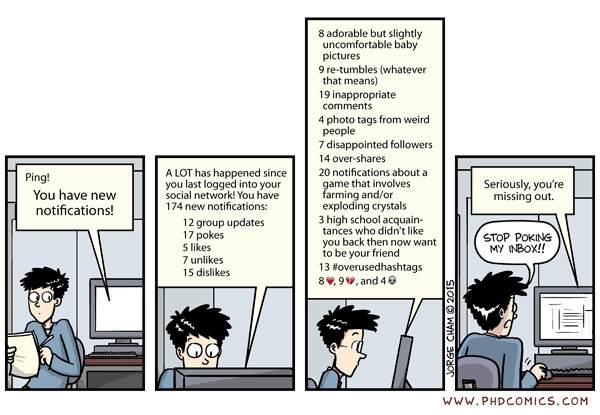



 A view from Smuggler Mountain. (Nan Palmero/Flickr.com/nanpalmero)
