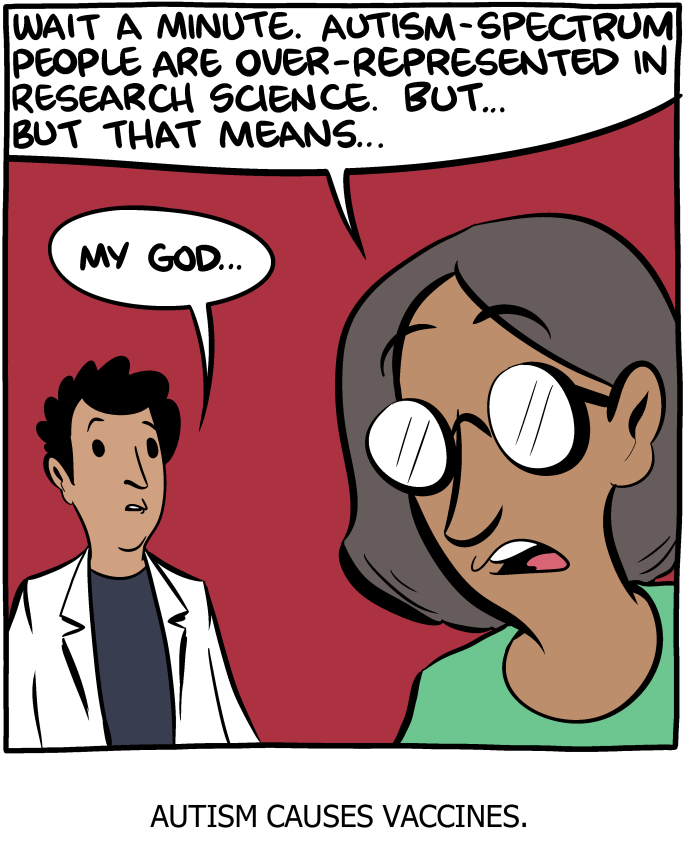
Hovertext: I await your hatemail, pertussis enthusiasts!
New comic!
Today's News:
With apologies to people who saw my earlier version of this on twitter.
Hovertext: I await your hatemail, pertussis enthusiasts!
With apologies to people who saw my earlier version of this on twitter.
Joel Thrasymachus Dahlhttps://drive.google.com/file/d/0B5GJoi7_z0StTjJjUGZhZV9aSzQ/view?usp=sharing
http://nyti.ms/1LiKABQ

Gov. Chris Christie of New Jersey endorsed Donald J. Trump on Friday, a major turn in a wild race and one that gives the New York businessman a major boost as he heads into the pivotal Super Tuesday contests.
Mr. Christie was a candidate himself until he came in sixth place in New Hampshire’s primary. Seeing his political career facing an abrupt conclusion at the end of a second term as governor following his faded presidential campaign, he was said to be deeply angry with Senator Marco Rubio, according to three people with direct knowledge of his thinking. He blames Mr. Rubio’s “super PAC” for halting his momentum in New Hampshire in December with a string of slash-and-burn ads.
The endorsement came a day after Mr. Rubio, in a withering debate performance, turned his guns on Mr. Trump for the first time, and followed up this morning, calling Mr. Trump a “con artist.”
Mr. Trump welcomed the endorsement with warm praise for the New Jersey governor.
“He’s been my friend for many years, he’s been a spectacular governor,” said Mr. Trump, standing with Mr. Christie at a press conference in Fort Worth, Texas, for the endorsement.
“I am proud to be here to endorse Donald Trump,” said Mr. Christie, noting they have been friends for a decade.
Mr. Trump “will do exactly what needs to be done to make America a leader around the world again,” said Mr. Christie.
But his backing of Mr. Trump comes after weeks of him saying that it was time for the “entertainment” portion of the race to end, and as he had said that the type of executive leadership that a governor has is important.
Find out what you need to know about the 2016 presidential race today, and get politics news updates via Facebook, Twitter and the First Draft newsletter.
Let’s get right to the point: Donald Trump had a great night, easily winning the Nevada GOP caucuses on Tuesday. The 46 percent of the vote he received is by far the highest share won by Trump, or any other Republican, in any state so far. Marco Rubio placed a distant second, with 24 percent of the vote, and Ted Cruz finished in third with 21 percent.
If South Carolina, which Trump won Saturday, provided some bits of good news for Trump skeptics — Trump faded over the course of the week and finished with less of the vote than he had in New Hampshire — his victory in Nevada was much more emphatic. Trump proved he could win in a relatively low-turnout environment,21 suggesting that his lack of a traditional “ground game” may not be that harmful to him.
The result underscores that preventing Trump from winning the nomination is likely to require both that anti-Trump Republicans coalesce around an alternative and that they adopt a much more aggressive strategy in probing Trump for signs of weakness. On the first point, anti-Trump Republicans have made some progress: Rubio, who narrowly finished second in both South Carolina and Nevada, has received a cavalcade of endorsements in recent days as Republican “party elites” have increasingly rallied around him as the top alternative to Trump.
But there are not yet many signs of a concerted effort to attack Trump. Instead, reports from Politico and other news organizations suggest that potential conservative donors are largely sitting on the sidelines. Remarkably little advertising money has been spent against Trump so far, especially given his position in the race. Rubio has also conspicuously avoided attacking Trump.
Here are a few other stray thoughts about the Nevada result — written early in the morning from New York and not, unfortunately, the New York-New York Hotel and Casino:
Lastly, we should keep in mind that this was just one state. Trump won 46 percent of the vote, blasting through his 33 percent (or thereabouts) ceiling, right? Not totally. It’s been clear for a while that Nevada Republicans loved Trump. As far back as October, polls have had Trump beating his national averages in Nevada. Meanwhile, Morning Consult polls, which have had Trump averaging 36 percent nationally over the course of the Republican primary, had Trump at 48 percent in Nevada. Believe it or not, states are not all the same! Recent polls have shown Trump getting anywhere from 50 percent of the Republican vote in Massachusetts to 18 percent in Utah. It’s certainly possible that Trump uses his momentum from Nevada to propel himself to even greater heights. But sometimes what’s billed as “momentum” is really just demographic and cultural variance among different states.

Joel Thrasymachus Dahlhttp://nyti.ms/1QbrH42
non-screwy formatting: https://drive.google.com/file/d/0B5GJoi7_z0StMkJoX08yRTFXY3M/view?usp=sharing
By ADAM LIPTAK FEB. 22, 2016

Advertisement
WASHINGTON — Justice Antonin Scalia loved opera, but he also had a soft spot for Bob Dylan.
In a 2010 dissent, for instance, he chastised the majority for refusing to answer key questions in a case about sexually explicit text messages because technology was evolving so fast.
“The-times-they-are-a-changin’ is a feeble excuse for disregard of duty,” he wrote.
Justice Scalia was in good company. Mr. Dylan has long been the most cited songwriter in judicial opinions, said Alex B. Long, a law professor at the University of Tennessee and the author of a 2012 study, “The Freewheelin’ Judiciary: A Bob Dylan Anthology,” published in the Fordham Urban Law Journal.
It was a 2008 dissent from Chief Justice John G. Roberts Jr. that really opened the floodgates, Professor Long said. “Judges’ inclination to go to Dylan has actually increased in the past few years, probably as a result of Roberts’s dissent in that case,” he said.
Dylan citations are booming in other fields as well. A study last year found 213 references to his lyrics in medical papers. (One was called “Nitric Oxide and Inflammation: The Answer Is Blowing in the Wind.”)
But a few Dylan fans frowned when they read the chief justice’s 2008 dissent. His quotation, from “Like a Rolling Stone,” was not a faithful reflection of what Mr. Dylan had sung. Though the justices occasionally correct their opinions long after they are first issued, the quotation has remained unchanged and incomplete.
Almost eight years later, Chief Justice Roberts this month finally broke his public silence on the matter during an interview at a law school in Boston, explaining why and how he had chosen to quote the lyric. In the process, he illuminated the special role Mr. Dylan plays in American jurisprudence.
The 2008 case concerned standing — the requirement that parties have a direct, personal stake in a litigation. The chief justice argued that the plaintiffs in the case before him, who were collection agencies for pay-phone companies, lacked standing.
His analysis was tightly reasoned and characteristically lucid. Then he put the Dylan lyric in a spot usually reserved for a citation to legal precedent: “‘When you got nothing, you got nothing to lose.’ Bob Dylan, Like a Rolling Stone, on Highway 61 Revisited (Columbia Records 1965).”
What Mr. Dylan actually sings, of course, is, “When you ain’t got nothing, you got nothing to lose.”
In the interview on Feb. 3, Dean John F. O’Brien of New England Law, Boston, probed the matter, starting with a general question. “What was your objective in quoting Bob Dylan?”
Chief Justice Roberts, a little defensively, said there was a place for a bit of levity and license in legal writing. “An intelligent layperson appreciates Bob Dylan’s poetry, if not his music,” he said. “It was, after all, in a dissent, so you have a little bit more leeway there.”
“Bob Dylan captured the whole notion behind standing,” he added. “In that case, the party didn’t have anything at stake in the case and had nothing to lose, and the case should have been thrown out on that basis.”
Advertisement
Advertisement
“I know Bob Dylan would have agreed with that,” Chief Justice Roberts said, to laughter.
Then Professor O’Brien asked about the missing word.
“That is as performed,” Chief Justice Roberts responded. “The liner notes show that it doesn’t have the ‘ain’t’ in it.”
It is true that Mr. Dylan’s own website reproduces the lyric as Chief Justice Roberts had. (The liner notes on the “Highway 61 Revisited” album sleeve, though, did not set out the lyrics. The back cover was instead devoted to an extended surrealistic poem from Mr. Dylan that seemed aimed at confounding the intelligent layperson.)
Why did Chief Justice Roberts use the published version? “I’m a bit of a textualist,” he said, to laughter.
Professor O’Brien, who seemed to think the song as sung was the superior source, had a quick retort. “If not an originalist,” he said.
There is a reason Mr. Dylan is so popular among judges, Professor Long said: His lyrics are pithy, memorable and pointed.
“They’re great lines on their own,” he said, “and they’re also really useful to convey to the legal concept they’re trying to get across.”
The most cited Dylan lyric, he said, came from “Subterranean Homesick Blues.” When judges want to reject expert testimony about an obvious point, say, they are apt to remind readers that “you don’t need a weatherman to know which way the wind blows.”
Mr. Dylan will not maintain his exalted stature forever.
“The Beatles and Springsteen are still up there,” Professor Long said. “Billy Joel is making his move. As the bench gets a little bit younger, you see guys like Billy Joel pop in there.”
The youngest member of the Supreme Court, Justice Elena Kagan, 55, has already moved on to the music of the 1980s.
In a 2013 case concerning signs on trucks, Justice Kagan gave a hypothetical example of one: “How am I driving? Call 213–867–5309.”
That was a reference to “867-5309/Jenny,” Tommy Tutone’s indelible 1981 hit, which reached No. 4 on the Billboard Hot 100 chart and will still get people of a certain age onto the dance floor at college reunions.
Still, it will be hard to displace Mr. Dylan. The day after the Supreme Court established a constitutional right to same-sex marriage last year, Justice Scalia sang a song to Justice Ruth Bader Ginsburg.
It was that same Dylan favorite: “The Times They Are a-Changin’.”
Joel Thrasymachus DahlNon-screwy formatting: https://drive.google.com/file/d/0B5GJoi7_z0StRFFXVHdYbG5pc00/view?usp=sharing
Paywall: http://nyti.ms/1o9aPQZ

David Brooks FEB. 12, 2016
Advertisement
American capitalism has always been distinct from continental European capitalism. We’ve had more entrepreneurial creativity but less security. Our system has favored higher living standards for consumers while theirs has favored stability for employees and producers.
For the past several decades, the United States has had a bipartisan consensus that we should stick to our style of capitalism and our style of welfare state. There has always been a broad consensus that a continent-size nation like ours had to be diverse and decentralized, with a vibrant charitable sector and a great variety of spending patterns and lifestyles.
American values have always been biased toward individualism, achievement and flexibility — nurturing disruptive dynamos like Bell Labs, Walmart, Whole Foods, Google and Apple — and less toward dirigisme, order and economic equality.
It’s amazing that a large part of the millennial generation has rejected this consensus. In supporting Bernie Sanders they are not just supporting a guy who is mad at Wall Street. They are supporting a guy who fundamentally wants to reshape the American economic system, and thus reshape American culture and values. As he told ABC’s George Stephanopoulos, he wants to make us more like northern Europe.
According to The Wall Street Journal, Sanders would add $18 trillion to the federal budget over the next 10 years. Currently, total government spending is about 36 percent of G.D.P. Under Sanders it would rise to about 47.5 percent of G.D.P., putting us comfortably in the European range.

First, Sanders would centralize power in Washington. If you radically increase the amount of money going to the Washington establishment, as Sanders would, you’re giving that establishment greater resources to control American life.
Second, Sanders would weaken the ability of members of the middle class to make choices about their own lives. He would raise taxes on the rich, but there is only so much money you can squeeze out of such a small group of people. European welfare states generally rely on a highly regressive value-added/sales tax — usually around 20 to 25 percent.
Middle classes across Europe bear a much higher tax load than the American middle class. As Austan Goolsbee, a former economic adviser to President Obama, has noted, you really can’t have a Swedish-style welfare state without a broad high tax burden. That means less spending power for most Americans, and fewer resources to choose one’s own lifestyle.
Third, Sanders would change the incentive structure for the country’s most successful people. He proposes raising the top tax rate to 52 percent. As Josh Barro noted in The Times, when you add in state, local and other taxes, top earners would be paying a combined tax rate over 73 percent. In high-tax locales like New York City and California, it would be even more.
It’s possible that entrepreneurs, company founders and others would pay these rates without changing their behavior, but I wouldn’t count on it. When you make risk-taking less rewarding, you get fewer risk-takers, which is exactly what you see across the Atlantic. When you raise taxes that high, the Elon Musks of the world find other places to build their companies.
Advertisement
Advertisement
Fourth, Sanders would Europeanize American public universities. It sounds great to make college free. In fact, it’s a hugely expensive program that would mostly benefit the already affluent.
Continue reading the main storyAccording to His Lordship Brooks it's amazing that the millennial generation has rejected a system that has left them, and many others I...
"The changes in the health care system would be along the same lines. Sanders would create a centralized and streamlined system. His...
Why look to some European countries? Just look to your north at Canada. To my mind we have a system that encapsulates the European Social...
It would create, as in Germany, a legion of eternal students who have little incentive to leave school because the costs are so low. It would give Washington officials greater control over state universities, determining what sort of faculty they could hire and what sort of programs they could run. It would threaten hundreds of private colleges, which could no longer compete against the completely subsidized state system. It would reduce the pressures universities now feel to reform themselves because it would cushion them with federal largess. Slowly, American universities would look more like their European counterparts. They’d be less good.
Every weekday, get thought-provoking commentary from Op-Ed columnists, The Times editorial board and contributing writers from around the world.
The changes in the health care system would be along the same lines. Sanders would create a centralized and streamlined system. His approach would also, as in Europe, reduce the rate of medical progress, increase the rationing of care, increase the wait times for patients, induce many doctors to retire and centralize decision-making. He might reduce health care costs by $6 trillion over the next decade, but his proposal to do this gives new meaning to the word vagueness.
There’s nothing wrong with living in northern Europe. I’ve lived there myself. It’s just not the homeland we’ve always known. Bernie Sanders’s America is starkly different from Alexander Hamilton’s or Alexis de Tocqueville’s America or even Bill Clinton’s and Barack Obama’s America.
It’s amazing that so many young people want to mimic a continent that has been sluggish for decades. It’s amazing that so many look to the future and want a country that would be a lot less vibrant.
Joel Thrasymachus Dahl"I have predicted that the New Hampshire’s primary will be rigged to give Rubio a strong second-place finish. This blog has enough visibility to make the riggers nervous about being too obvious. That’s why I did it."
Thank you, Scott Adams. You are truly an American hero, and not just covering your ass.
As you watch pundits discuss the presidential elections, you might be wondering who is right, who is wrong, who is wise, and who is dumb. To that end, I put together the the following “high ground” chart.

As I have said in prior posts, I don’t believe our brains evolved to give us truth. Our brains evolved to create little movies in which we get to be the stars. And we can view our movies through many filters with no preference for which filter is the “right” one.
For example, Ted Cruz and Richard Dawkins believe totally different things about reality and yet both can use an ATM, shop at a store, and procreate. So your filter on reality need not be related to any actual underlying reality in order to keep you alive. It just has to NOT kill you.
There are many filters that explain the past. Even conspiracy theories fit the past. But filters are not equal when it comes to predicting the future. I’ll explain each filter.
Social Filter
At the bottom of the chart we have what I call a Social Filter. That involves two or more people lying to each other in ways that society expects them to lie. For example, you might see pundits and frustrated voters complaining that the candidates are not talking about the issues, or that one side is lying, or one side has an impractical plan. At the same time, you know that ALL the candidates are lying, ALL have impractical plans, and you wouldn’t understand the details of the issues if you heard them. This is the dumbest and least predictive filter, but the one you see most often because of social necessity. We all want to be the ones looking at the important facts while others are being silly. But at the same time we know that the facts never determine political races. This filter produces nothing but frustration and bad predictions.
Last night I watched a panel discussion on CNN in which they discussed Donald Trump calling Ted Cruz a “pussy” (indirectly). The social liars on the panel all pretended they were shocked and appalled by the language. PJ O’Rourke said his 15-year old daughter was in attendance, suggesting that teens do not hear such language every hour of every day. It was absurd and awkward social lying. But they had to do it.
Candidate/Pundit Filter
One level up from the Social Filter is where the pundits and candidates try to live. This group takes the “high ground” and understands that all candidates are lying during a campaign. In this situation, say pundits and candidates, you need to look at character, track record, and flip-flopping. An entire news industry depends on this filter. But it isn’t rational. In the rational world, people learn from failures. In the pundit/candidate world, failures mean you are a loser. In the real world, people change their views when confronted with new information or better thinking. In the pundit world, that is flip-flopping, and a sign of bad character. The Candidate/Pundit Filter is completely useless for decision-making or predicting. It exists only for entertainment. If the news had to cover facts, there would be nothing to talk about except boring policy differences.
Aspirational/Imaginary Reason Filter
The next level up is the Aspirational/Imaginary Reason filter. This filter is imaginary in the sense that we think we are at that level all the time, or we think we can get to it. But reason is not something our brains evolved to handle. What we have instead is an illusion of reason. And that illusion extends to science. Your hard science looks like junk science to me, and vice versa. The scientific method only works until humans get involved and start misinterpreting the results.
Here I must add a Social Lie to protect myself:
— start of social lie —
Science is the best way to understand our reality. The scientific method is the best tool we have for predicting the future. I love science more than you do. If I could have sex with science, I would do it. So don’t tell me you love science more than I do. Science is the best!
— end of social lie —
Do you believe in climate change science? How about the existence of a gender pay gap? The people on both sides are certain the science is with them. So science fails when it takes the leap from the laboratory to the human brain. In the end, we see what we want to see.
Moist Robot Filter
At the top level, we have the Moist Robot filter. This is the subject of my book, and the basis for my Trump predictions that have been accurate except for one rigged election in Iowa. (And I should have seen that coming.)
Under the Moist Robot filter, persuasion is everything, and free will is an illusion. Reason is an illusion too. Under this way of thinking, anything that CAN be corrupted already is. The stock market, national elections, all rigged. Because it is possible. We can’t know the extent of the rigging, but the odds of rigging in those environment are 100%.
—
I might be on CNN tomorrow (Wednesday) between 4-5 PM EST. These things tend to change at the last minute.
—
I have predicted that the New Hampshire’s primary will be rigged to give Rubio a strong second-place finish. This blog has enough visibility to make the riggers nervous about being too obvious. That’s why I did it.
If you don’t think rigged voting machines are a real thing, this video will make your jaw drop.
—
Metro ExpressLanes are not living up to their name.
Since miles of pay lanes were created as an experiment three years ago, too many solo drivers are riding the converted car-pool lanes on segments of the 110 and 10 freeways, causing speeds to drop to levels that could result in federal highway funds being withheld.
Joel Thrasymachus DahlNic, you get 1/1 for predictive accuracy. I figure claiming that Christie was Trump's puppet for the "linguistic kill shot" is close enough to your prediction to give it to you.

If your firewall is being uncooperative, see the image on Twitter here.
If you have a life, and you missed the GOP debate on Saturday night, let me give you the highlights.
Trump: Trump acted controlled and more presidential to counter the idea that he’s a loose cannon. That strategy looked effective to me. And as Trump often does, he produced one irresistible piece of news candy by suggesting he was in favor of some sort of unspecified torture. It was classic Trump. He likes to focus attention on anchors that are easy to discuss, easy to understand, and have a visual component. Who is toughest on terrorism, you wonder? Probably the pro-torture candidate. That’s what your irrational mind tells you.
Trump slipped-in one good line about Cruz stealing Carson’s vote to win Iowa. Had Trump said more on that topic, it would have been whiney. But a jokey reminder was just right.
Cruz: Cruz did nothing to help or hurt himself. He seemed unimportant this debate.
Christie: Christie had his best debate night, especially his Linguistic Kill Shot about Rubio being a robot who can’t stop repeating canned modules of policy. Rubio responded by repeating canned modules of policy. People noticed.
Christie’s kill shot was a fresh field and it fit what we have been thinking about Rubio but never put into words. It also throws Rubio off his game because it will force him to adjust. Now the press and the public are looking for his robotic repetition.
The funny part is that all candidates repeat their memorized modules all the time. But something about Rubio’s game makes the robot accusation fit him better than it would the rest of the field. I think people see Rubio as a manufactured candidate designed by the GOP establishment.
Chris Christie turned Rubio’s “electability” into “He’s a robot programmed by the elites.” That is some Master Persuader genius right there. And that means one of two things. Either…
1. Christie figured out Trump’s Linguistic Kill Shot designs and launched one of his own, perfectly engineered, as Trump would.
or
2. The Linguistic Kill Shot came from Trump. It has his fingerprints all over it.
There is a non-zero chance that the Christie kill shot was designed by the Trump campaign. Trump was on his best behavior at the debate, as a strategy, but Trump needed to put a cap in Rubio’s ass to slow his rise. Trump and Christie seemed a bit chummy last night. How hard would it be for the Trump campaign to pass along that kill shot?
In the 2D world, all of the candidates are flinging random insults and some of them stick. In the 3D world, you don’t see well-engineered Linguistic Kill Shots emerge from someone who doesn’t normally use them.
I see Trump’s fingerprints.
This is a good time to remind you that the Master Persuader Series is for entertainment only. I don’t like any of the candidates’ stated positions. Luckily, they don’t mean most of what they say.
—
If you think Robots Read News is too wordy, you should see my book. That thing is full of words.
This weekend, 2.5 miles of the 101 Freeway will be closed in what authorities are calling the "Slow Jam," as it may cause more traffic than usual for Angelenos.
Starting at 10 p.m. Friday, the 101 will be closed from the 10/101 split to the 5/10/101 interchange, according to L.A. Mayor Eric Garcetti's office.
On Thursday, the mayor rolled out a new public service announcement in the form of an actual slow jam along with students from Roosevelt High School.
So here are the details:
Access to the 101 from the 60 will also be closed, but alternate routes are available along I-5 and I-710 to connect with I-10.

A press release from the Mayor's Office suggests Boyle Heights and downtown L.A. residents plan ahead for their weekend travels, using detours along other highways.
The closure comes as L.A. bids adieu to the 6th Street Bridge. Contractors have 40 hours to demolish the city landmark, according to Caltrans spokeswoman Lauren Wonder.
Compared to 2012's "Carmageddon," the potential for traffic jams is not as severe, Wonder said.
“This is not as busy as the 405 in terms of traffic volume, and 101 does have some parallel routes where people can get around,” she said.
Wonder said Caltrans is working in tandem with the city of L.A. to close roads, and she even predicted that by Super Bowl Sunday, roads could already possibly be up and running.
“If all goes well, there’s always the possibility that we could open the freeway earlier than 2 p.m.,” Wonder said.
Planning ahead can keep you out of the traffic, but if you do end up getting stuck, listen to our "Slow Jamz" playlist to keep your vibes chill on the freeway.
This story has been updated.
Catch up each morning with KPCC's Short List newsletter.
Joel Thrasymachus Dahl"The Master Persuader filter can’t predict stolen elections. But it did sniff out the fraud after the fact."
LOL!
I got a lot of scorn this week for declaring Iowa a rigged election based on the vote totals alone, and no real evidence. Strangers on the Internet called me pathetic, desperate, and a few other words.
There is no evidence that the vote count was rigged, although opportunity and human nature pretty much guarantee it. But it probably doesn’t matter because Cruz’s dirty tricks thwarted Trump’s win, and that was the main objective of the establishment. So now we have the odd possibility that the GOP was planning to fix the vote count but didn’t need to do so because Cruz did it for them. I have no evidence for that idea. I just think it is likely, given the existence of motive, opportunity, and a huge upside gain. In those situations, corruption is universal.
Here’s Karl Rove explaining how the Cruz’ campaign stole the election.
While there is no direct evidence that the GOP establishment rigged the vote, they did crown as their winner the candidate who has acknowledged and apologized for his campaign’s dirty tricks. If Karl Rove’s math is right, that cheating probably made a difference. Crowning a cheater as your party’s winner is different from doing the cheating yourself, I suppose. But not by much. The establishment wanted to slow down Trump, and they got their wish.
The Master Persuader filter can’t predict stolen elections. But it did sniff out the fraud after the fact.
Joel Thrasymachus DahlThis is even more wacky and childish than I expected his first post-Trump's-ass-handed-to-him post to be.
My predictions about the Iowa caucus were wrong! I am fallible after all. Time to eat some crow, as we say in America. Let me at it!
Nom-nom-nom. Gulp. Mmmmm… That’s good crow.
This is one of those situations in which having no sense of embarrassment comes in handy. I look forward to your brutal mocking in the comments.
On the Democratic side, Clinton won a close contest, as the polls predicted she would. High turnout probably helped Sanders a bit, as expected.
But on the Republican side, we see two big surprises. Cruz and Rubio both outperformed expectations, at a cost to Trump who barely placed second.
According to the “gold standard” of Iowa polls (Ann Selzer), the order should have been this way:
That particular poll has been right almost every time in the past. So what went wrong?
You will see lots of explanations today for why the polls in Iowa were roughly accurate on the Democratic side and yet far off on the Republican side. For example:
I might be missing a few reasons. But the point is that you don’t need to do any woo-woo third-dimension analysis to see lots of reasons my prediction went wrong. There are plenty of ordinary explanations.
But just for fun, let’s visit the third dimension and see how things look. And remember, the Master Persuader filter is just for entertainment.
As I was watching the final tally on the Republican side, I noticed that the result coincidentally matched what I would expect from a rigged election.
I’m not saying the election was rigged. I have no evidence of such a thing, and I’m sure the good people of Iowa are honest and competent.
But just for fun, watch me build my case for a rigged election.
If you had the power to rig the vote in Iowa – either to hurt Trump, or help Rubio – what election result would do the best job?
A Rubio first-place win would raise too many questions. Even a second-place finish would raise questions. But how about a strong third? Yes, that’s the ticket. You would engineer the vote so Rubio got the strongest possible third-place showing without overtaking Trump. And that is exactly how the vote tally went.
As a hypothetical vote-rigger, you don’t care too much about Cruz winning Iowa because he will have trouble in New Hampshire where Rubio will get another shot at surprising.
I’m not saying the vote in Iowa was rigged. I’m just saying the result is exactly the same as what one would expect from a well-engineered and rigged election. But that could be a coincidence.
Now consider motive and opportunity. Lots of people in both of the major parties want to stop Trump. And the GOP establishment is probably betting on Rubio as their best hope. Suspects are everywhere.
As for opportunity, the Iowa caucus system was designed and implemented by humans. Wherever you have humans, you have problems. Hedge funds are crooks, priests are molesting kids, and that sort of thing.
As I have said in prior blog posts, the stock market is definitely rigged. I say that with certainty simply because it is possible, the risk of detection is low, and the gains are enormous. Whenever you see that combination, crime is guaranteed.
The Iowa caucus might be an exception to the universal law of human awfulness. We can hope that is the case. But keep in mind that it would only take one player to rig the result.
Now consider that a healthy percentage of the American public believes Donald Trump is literally a Hitler-in-waiting. If an American patriot in Iowa had a chance to take down Hitler and save billions of lives, I hope he or she took the shot. That’s what I expect of my fellow-citizens.
As a thought experiment, put yourself in the shoes of an Iowan who has the opportunity to rig the Republican caucus vote. You alone might have the power to stop Trump-Hitler. If you don’t, the next Holocaust is on you.
What do you do?
As an American and a patriot, I hope you rigged the election to save us all from Hitler. If you didn’t take the shot when you had it, why not? If I were in that situation – and I believed in my heart that I could stop Hitler – I would feel obligated to do it. How could you feel otherwise?
And if I were a GOP establishment person who just wanted to keep the military-industrial machine intact, I would have that motive as well.
I’m not saying the Republican caucus in Iowa was rigged. All I’m saying is that the result looks exactly like it was rigged, and the people who had the opportunity had the best motive in the history of all motives. You might say they had the mother of all motives and a few aunts of motives as well.
As I was having these thoughts last night, some folks on Twitter mentioned that Republicans were using a new Microsoft app to tally results. Apparently that system was a bit buggy. Microsoft provided the system for free.
Oh, and Microsoft is Rubio’s biggest donor.
As for my predicting ability, remember that I “Trumped” this prediction by giving myself a way to win no matter how the vote turned out. I said that Iowa is a squirrelly process, so the Master Persuader filter would not be the best at predicting this outcome. In other words, if the rest of my predictions are right – and the only one I get wrong is squirrelly Iowa – it validates the filter as opposed to debunking it.
That’s a Trump trick. Losing is winning if you set it up right from the start.
Again, I’m not saying the Iowa caucus results were rigged on the Republican side. I don’t have proof of that, or anything close to proof. The Master Persuader filter is just for fun.
All I’m saying is that according to the Master Persuader filter, the second-best explanation for the outcome in Iowa is that the Republican caucus vote was rigged.
The first-best explanation is that Iowa is fundamentally unpredictable and I’m in cognitive dissonance. If you are a Trump supporter, you might be there with me. The funny part is that we have no way of knowing.
Joel Thrasymachus DahlNic, since Adams "keeps freaking [you] out" lately, are you going to ditch the MyFitnessPal app?
I add this data point to the “Everything you knew about diet is wrong” part of your brain.
Counting calories is worthless. The science is messy, everyone is different, and – here’s the interesting part – cooking your food makes the calories more available. That’s one of the reasons I rarely eat cooked food unless I am at a restaurant. At home I eat uncooked things whenever I can.
In my book, I talk about experimenting with your own body to create systems in which you replace willpower with knowledge. This is one example of how to do that. Now you know that given a choice between two foods of equal flavor, the raw one is probably the smart choice for weight loss.
The obvious caveat is that diet science was all wrong in the past, so we have to be skeptical about new findings too. That’s why I recommend isolating specific diet changes and letting them play out in your body before you try another thing.
Dieting is hard if you stop eating everything that is bad for you all at the same time. Packaged foods are engineered (literally) to create addiction. That’s why the diet system I use involves targeting one suboptimal eating habit at a time until the addiction for that one item is gone. As long as you can have anything else you want, it isn’t that challenging to deal with one type of food withdrawal. After about three months, move on to the next.
For example, I stopped a 12-can-per-day Diet Coke habit a few years ago. It was hard to fight the addiction for about two weeks. But after a few months I couldn’t remember why I ever thought it was a good idea to pour a chemistry experiment into my mouth. Once the addiction was gone, my brain stopped seeing Diet Coke as a beverage. Now I see it as a thing for removing rust. I mean that literally.
You shouldn’t listen to cartoonists when it comes to your health. The only point I want to leave you with is that it is usually a good idea to replace willpower with knowledge when you have the option. And it is also a good idea to isolate diet changes and deal with them one-at-a-time. That way you never have too much of a willpower demand and you can isolate how each change affects your body and your mind.
Joel Thrasymachus DahlNon-screwy formatting version:
https://drive.google.com/file/d/0B5GJoi7_z0StMjN1S3M2aFJ0SVE/view?usp=sharing

Advertisement
Writing six decades after the election of 1896 brought the retired Ohio governor William McKinley to the White House, the political scientist V. O. Key Jr. identified the Democratic defeat as “so demoralizing and so thorough that the party could make little headway in regrouping its forces until 1916.” The scale of this Republican success — a moment that ushered in a period of Republican Party ascendance that lasted until the election of Franklin Roosevelt in 1932 — draws the attention of the prominent political strategist Karl Rove, who also views McKinley’s victory over the charismatic William Jennings Bryan as pivotal. Rove is in awe, rightly so, of McKinley’s political achievement, and his richly detailed, moment-by-moment account in “The Triumph of William McKinley” brings to life the drama of an electoral contest whose outcome seemed uncertain to the candidate and his handlers until the end.
But there is more to this book than simply recounting the details of what was arguably the country’s first modern presidential campaign. For Rove, 1896 matters for the strategic and substantive guidance it provides, especially to his cherished Republican Party. McKinley, he shows, brilliantly organized a campaign based on clear policy ideas. Offering optimism at a time of economic crisis, he broadened the party’s appeal and extended its coalition, in part by rejecting anti-Catholic prejudice while preaching national unity. As a result, “the Republican Party was no longer a shrinking and beleaguered organization composed of white Anglo-Saxon Protestants in the North and Southern blacks being systematically stripped of their right to vote.”
With the strategic counsel of Mark Hanna and Charles Dawes, his leading advisers, McKinley advanced a platform for the protection of industry with high tariffs and for the defense of a gold-backed dollar against the free-trade, silver currency platform of Bryan and the Democrats. Rather than exhaust himself as Bryan did, by frantic barnstorming and lengthy speechmaking, McKinley ran a campaign that was “almost industrial in scale.” Some 750,000 persons, organized in handpicked clusters of occupational, ethnic and regional blocs, were brought to McKinley’s front porch in Canton, Ohio. There, the candidate offered concise, tightly crafted speeches tailored to each specific group. These, in turn, were spread to larger audiences both by the publicity provided by the relatively new mass press and by an unprecedented public relations effort.
Advertisement
Sign up to receive a preview of each Sunday’s Book Review, delivered to your inbox every Friday.
McKinley’s campaign had a huge financial advantage. Bryan raised just $300,000; McKinley, close to $4 million. This great sum allowed it to produce a vast array of campaign literature, some 250 million pieces in all, and to target voters in swing states, some of whom got at least one mailing each week. Rove hails the way “McKinley and his managers placed a premium on organization, applying business methods to politics, particularly to the tasks of persuasion and mobilization.”
Advertisement
“The Triumph of William McKinley” briskly chronicles its subject’s career before the presidential effort, opening with a report of McKinley’s Civil War heroism and abolitionist sentiments. Though we learn a bit about his private life, his policy commitments and his early ups and downs in politics, the story really begins with the nomination struggle between McKinley and the House speaker Thomas Reed. This account, along with Rove’s colorful description of Bryan’s “Cross of Gold” speech, which stampeded the Democratic Party convention, might well be read with profit by today’s floundering aspirants.
The book culminates with McKinley’s triumphant campaign. Most Republicans have long left protectionism behind, and silver is a forgotten populist cause. For Rove, 1896 “still matters,” as the subtitle insists, not because of these issues but for the way the Republican Party framed its economic policies to secure the dominion of business based on consent.
This, for Rove, was that party’s key task, then and now. That it could be achieved in tandem with religious toleration, respect for black Republicans and the defense of a threshold level of labor rights wins Rove’s approval. This is, at the same time, a quiet lament that the professed compassionate conservatism of George W. Bush, Rove’s own presidential candidate in the 2000 election, has given way among modern Republicans to a more extreme devotion to markets, frequently coupled with bigotry. Above all, Rove wishes to recover the McKinley model of an assertively organized and electorally inclusive party.
But the significance of Rove’s book outruns this ambition. For it implicitly raises questions about the causes of electoral success and the rhythms of partisanship. V. O. Key’s 1955 essay was called “A Theory of Critical Elections.” It placed 1896 within the small number of sharp and lasting electoral realignments in American history. In writing about the McKinley triumph Key, like Rove, stressed that the contest “did not form a new division in which partisan lines became more nearly congruent with lines separating classes, religions or other such social groups.” Rather, it produced a broad coalition that, despite internal tensions, drew in new supporters.
While Rove sees this success as the result of a felicitous combination of a fine candidate, strategic intelligence, ample money, smart issues and a campaign of extraordinary size and scope, Key’s analysis is contextual. It starts with the Panic of 1893, which drove unemployment over 10 percent for a half-decade, and ushered in a period marked by failing banks, railroads going into receivership and often violent coal and rail strikes. A year after the panic, a Republican landslide reduced the number of Democrats in the House of Representatives to just 93, after a loss of well over 100 seats. McKinley’s victory built on all this.
Key cautions that “some of the misinterpretations of the election of 1896 flow from a focus on that election in isolation.” For him, the historical situation counted for more than electoral strategy. The same point has been made by the contemporary presidential scholar Stephen Skowronek, who has argued that elections and administrations should be placed in “political time.”
Advertisement
Joel Thrasymachus DahlAccurate.
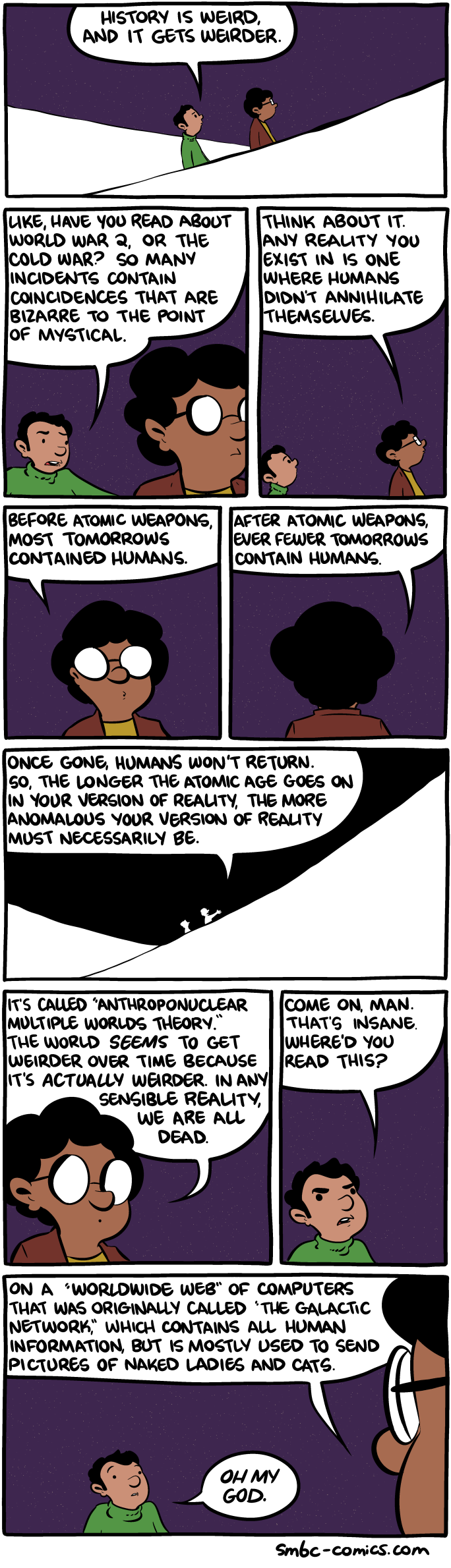
Hovertext: Thank you for browsing this funnybook on the Galactic Network.
If you want to come to BAHFest London's Evolution show, you must buy online tonight by midnight! There will be no tickets at the door!
Joel Thrasymachus DahlThis is very well done.
Not sure that matters at all, but still: well done ad.
If you, like us here at FiveThirtyEight, were initially skeptical of Donald Trump’s chances of winning the GOP nomination in part because you assumed that the Republican Party would go out of its way to stop him, then you’ll find the following pretty remarkable. According to Tim Alberta of the National Review, there are currently no negative television ads running against Trump in Iowa, New Hampshire or South Carolina.
There are a lot of reasons for this — including, paradoxically, both resignation to the idea of Trump as the nominee, and conversely, a belief that Trump’s support in national polls won’t translate into winning margins in Iowa and other early voting states. But there’s another dimension to the problem too. It should have been perfectly obvious, but it became clearer to me after spending the past week in Iowa: The campaigns competing against Trump are acting in their own narrow best interests, and not necessarily in the best interest of the Republican Party.
If you look at the race through the lens of the national media, it’s easy to focus solely on Trump, and to a lesser extent Ted Cruz and Marco Rubio. But in Iowa, there are a lot of other Republican campaigns too. Some, like Ben Carson’s, are relatively visible in the form of billboards and advertisements. Others, like Rick Santorum’s, you really have to go looking for. All of these campaigns still have boots on the ground. However implausible their candidate’s chances might be, it’s the job of their staffers to keep working for their candidate until the bitter end.
So unless the Republican National Committee itself were to buy airtime to run negative ads against Trump, the question is which individual candidates might benefit from doing so. This answer is more complicated than you might think.
The most important part of the calculation is that if Trump doesn’t win Iowa, Cruz very probably will instead. In fact, if Trump slumps during the final two weeks of the campaign, Cruz could win resoundingly in Iowa, since polls suggest that he’s the second choice of many Trump voters.
So what would the other candidates rather have: an overwhelming Cruz win in Iowa or a close finish between Cruz and Trump?
Rubio, for example, might prefer a close finish. For one thing, if Cruz and Trump almost evenly split their vote, there’s an outside chance that Rubio could win Iowa himself with something like the 25 percent of the vote Mitt Romney got in 2012.24 Furthermore, a big Cruz win in Iowa, coupled with a big Trump loss, might be enough for Cruz to surge to the top of New Hampshire polls and win there too.
What about Chris Christie? Christie’s tough-guy persona might seem perfect for taking on Trump, especially during a debate. But Christie, like Rubio, has largely avoided confronting Trump. That too could reflect a strategic calculation. To win the nomination, Christie will first need a good performance in New Hampshire. Then he’ll hope to survive until the latter half of the nomination process, when lots of delegate-rich (and often winner-take-all or winner-take-most) blue and purple states vote. He’s playing a long game, in other words, and he might not mind some Trump-induced chaos in the short run if it prevents Cruz or some other candidate from slingshotting to victory.
Obviously, the calculations that Rubio and Christie are making may be wrong. Jeb Bush and John Kasich, whose situations are not all that different than Christie’s or Rubio’s, have chosen to attack Trump instead. Furthermore, the more Trump becomes a threat to win the nomination himself, instead of being a bumper that other candidates try to ricochet against, the more urgent it becomes to attack him.
That may be what Cruz’s campaign has figured out. After months of buddying up to Trump, Cruz is now shifting into attack mode. While Cruz might prefer a cordial victory over Trump in Iowa, maintaining a favorable image with Trump supporters so as to convert them into his camp later on, Trump remains too much of a threat too late in the race for Cruz to feel assured of that now.
It might seem ironic that the establishment could soon be counting on Cruz to save itself from Trump. (Cue the scene from “Jurassic World” when T. Rex is summoned out of its cage to battle Indominus Rex to the death.) But if you consider the problem from the standpoint of the individual campaigns, and not “the party” as a whole, it makes a lot more sense.
Check out our live coverage of the Democratic debate.

Two new mountain lion cubs have been discovered in the Santa Monica Mountains.
P–46 and P–47, a female and a male, have been implanted with tracking devices like their mother, P–19, after their den was discovered in a remote area in the western end of the range, according to the National Park Service.
Biologists have been monitoring the local puma population closely since 2002. The animals are penned into a narrow habitat by freeways and other man-made obstacles, which has led to dangerous in-breeding. Scientists hope to learn how they survive in a heavily urbanized environment.
“We continue to see successful reproduction, which indicates that the quality of the natural habitat is high for such a relatively urbanized area,” Jeff Sikich, a biologist for Santa Monica Mountains National Recreation Area, said in a prepared statement.
P–19 had two previous litters after in-breeding with her father, P–12. Biologists are currently testing the cubs’ DNA to identify whether it’s the same father or perhaps P–45, a recently discovered adult male.
Sikich said this new batch of kittens faces many challenges, “from evading other mountain lions, to crossing freeways, to dealing with exposure to rat poison.”
Several mountain lions in the area have been harmed or killed after exposure to rat poison. Puma P–22 contracted mange, and biologists suspected it was caused by an exposure to the poison. He has since recovered. P–34 was found dead in Pt. Mugu State Park after being exposed to a variety of rat poisons.
With contributions by Brian Frank
Catch up each morning with KPCC's Short List newsletter.
What if all of the sun's output of visible light were bundled up into a laser-like beam that had a diameter of around 1m once it reaches Earth?
—Max Schäfer
Here's the situation Max is describing:

If you were standing in the path of the beam, you would obviously die pretty quickly. You wouldn't really die of anything, in the traditional sense. You would just stop being biology and start being physics.
When the beam of light hit the atmosphere, it would heat a pocket of air to millions of degrees[1]Fahrenheit, Celsius, Rankine, or Kelvin—it doesn't really matter. in a fraction of a second. That air would turn to plasma and start dumping its heat as a flood of x-rays in all directions. Those x-rays would heat up the air around them, which would turn to plasma itself and start emitting infrared light. It would be like a hydrogen bomb going off, only much more violent.

This radiation would vaporize everything in sight, turn the surrounding atmosphere to plasma, and start stripping away the Earth's surface.
But let's imagine you were standing on the far side of the Earth. You're still definitely not going to make it—things don't turn out well for the Earth in this scenario—but what, exactly, would you die from?
The Earth is big enough to protect people on the other side—at least for a little bit—from Max's sunbeam, and the seismic waves from the destruction would take a while to propogate through the planet. But the Earth isn't a perfect shield. Those wouldn't be what killed you.
Instead, you would die from twilight.

The sky is dark at night[citation needed] because the Sun is on the other side of the Earth.[citation needed] But the night sky isn't always completely dark. There's a glow in the sky before sunrise and after sunset because, even with the Sun hidden, some of the light is bent around the surface by the atmosphere.
If the sunbeam hit the Earth, x-rays, thermal radiation, and everything in between would flood into the atmosphere, so we need to learn a little about how different kinds of light interact with air.
Normal light interacts with the atmosphere through Rayleigh scattering. You may have heard of Rayleigh scattering as the answer to "why is the sky blue." This is sort of true, but honestly, a better answer to this question might be "because air is blue." Sure, it appears blue for a bunch of physics reasons, but everything appears the color it is for a bunch of physics reasons.[2]When you ask, "Why is the statue of liberty green?" the answer is something like, "The outside of the statue is copper, so it used to be copper-colored. Over time, a layer of copper carbonate formed (through oxidation), and copper carbonate is green." You don't say "The statue is green because of frequency-specific absorption and scattering by surface molecules."
When air heats up, the electrons are stripped away from their atoms, turning it to plasma. The ongoing flood of radiation from the beam has to pass through this plasma, so we need to know how transparent plasma is to different kinds of light. At this point, I'd like to mention the 1964 paper Opacity Calculations: Past and Future, by Harris L. Mayer, which contains the single best opening paragraph to a physics paper I've ever seen:
Initial steps for this symposium began a few billion years ago. As soon as the stars were formed, opacities became one of the basic subjects determining the structure of the physical world in which we live. And more recently with the development of nuclear weapons operating at temperatures of stellar interiors, opacities become as well one of the basic subjects determining the processes by which we may all die.
Compared to air, the plasma is relatively transparent to x-rays. The x-rays would pass through the plasma, heating it through effects called Compton scattering and pair production, but would be stopped quickly when they reached the non-plasma air outside the bubble. However, the steady flow of x-rays from the growing pocket of superhot air closer to the beam would turn a steadily-growing bubble of air to plasma. The fresh plasma at the edge of the bubble would give off infrared radiation, which would head out toward the horizon (along with the infrared already on the way), heating whatever it finds there.

This bubble of heat and light would wrap around the Earth, heating the air and land as it went. As the air heated up, the scattering and emission from the plasma would cause the effects to propogate farther and farther around the horizon. Furthermore, the atmosphere around the beam's contact point would be blasted into space, where it would reflect the light back down around the horizon.
Exactly how quickly the radiation makes it around the Earth depends on many details of atmospheric scattering, but if the Moon happened to be half-full at the time, it might not even matter.
When Max's device kicked in, the Moon would go out, since the sunlight illuminating it would be captured and funneled into a beam. Slightly after the beam made contact with the atmosphere, the quarter moon would blink out.

When the beam from Max's device hit the Earth's atmosphere, the light from the contact point would illuminate the Moon. Depending on the Moon's position and where you were on the Earth, this reflected moonlight alone could be enough to burn you to death ...

... just as the twilight wrapped around the planet, bringing on one final sunrise.[3]Here's an image which is great for annoying a few specific groups of people:

There's one thing that might prevent the Earth's total destruction. Can Max's mechanism actually track a target? If not, the Earth could be saved by its own orbital motion. If the beam was restricted to aiming at a fixed point in the sky, it would only take the Earth about three minutes to move out of the way. Everyone on the surface would still be cooked, and much of the atmosphere and surface would be lost, but the bulk of the Earth's mass would probably remain as a charred husk.
The Sun's death ray would continue out into space. Years later, if it reached another planetary system, it would be too spread out to vaporize anything outright, but it would likely be bright enough to heat up the surfaces of the planets.

Max's scenario may have doomed Earth, but if it's any consolation, we wouldn't necessarily die alone.
Joel Thrasymachus DahlIs this a joke?

Joel Thrasymachus DahlNo woman, no cry.
Transcript in progress
Watch next...
Rives: If I controlled the Internet
arrowShare this idea
Watch LaterLater
DownloadDownload
RateRate
Share via FacebookEmbed
Share
More
Your impact
Share this talk and
track your influence!
Suspicious emails: unclaimed insurance bonds, diamond-encrusted safe deposit boxes, close friends marooned in a foreign country. They pop up in our inboxes, and standard procedure is to delete on sight. But what happens when you reply? Follow along as writer and comedian James Veitch narrates a hilarious, months-long exchange with a spammer who offered to cut him in on a hot deal.

Comedian and writer
Similar topics
This talk was presented at an official TED conference, and was featured by our editors on the home page.
Enthusiastically agree? Respectfully beg to differ? Have your say here.
2000 characters remaining
Sort comments by Newest Upvotes
There are currently no comments for this talk.
Have you ever closed your eyes and fantasized, just for a second, what it is those rugged men in Ammon Bundy's militia do when the lights turn low and the occupiers gather to stay warm by the soft glow of the fire?
No? OK, maybe a little bit? It's all right, you're not alone.
See also: 'Y'all Qaeda': People aren't taking the armed militia in Oregon too seriously
Aspiring erotic-fiction writers are imagining steamy scenes between militia members and sharing their fan fiction under the hashtag #bundyeroticfanfic.
Here, one man presses another into a rack of "Birds of Oregon" books as the steam strands of their jerky-scented breath dance in the moonlight. There, only the sound of Carhartt pants un-zippering pierces the night's silence.
The hashtag appears to have been created on Tuesday by Colin Meloy, frontman of the Portland-based rock band The Decemberists, days after a group of armed men took over a remote outpost in the Oregon wilderness to protest the federal government's ownership of state lands.
This is the spark that lit the flame:
"They huddled together for warmth. The cold of Ammon's Ruger 22 against Brian's naked thigh sent a thrill up his spine." #bundyeroticfanfic
— colin meloy (@colinmeloy) January 6, 2016
Responses to his call for submissions showed fans of Meloy — and erotic fan fiction — just what was possible.
@colinmeloy Ammon ran a hand through Ryan's hair, then eased him down, whispering "I grant you unlimited grazing rights." #bundyeroticfanfic
— Eric Heidle (@Ericheidle) January 7, 2016
Soon it began to take off, and by early Thursday morning it was a trending topic on Twitter.
"Feeling pretty proud of my country tonight. #BundyEroticFanFic is trending," Meloy tweeted. We reached out to his management for comment on what he thinks about all this success, and we'll add to the story once we hear back.
For now, we'll say this: these tweets are perfect.
They're part criticism of the occupying militia's goals, part Brokeback Mountain sexual liberation, painting scenes of weather-hardened ranchers finding romance in the most unexpected places.
#bundyeroticfanfic
Ammon hesitated. “Isn’t this against the laws of nature?”
“Laws?” panted Dwight, “We make our own laws, Ammon."
— Remittance Girl (@remittancegirl) January 7, 2016
As Cletus gazed longingly at Ammon's naked body, he finally understood the real fight for grazing rights. #BundyEroticFanFic
— Catherine (@deja1422) January 7, 2016
Some tweets criticize the things the Bundy militia have publicly done, such as this one, which pokes fun at the group's widely teased request for snacks.
#bundyeroticfanfic The small improvised washtub was filled with two things: Cletus... and Cheetos. "C'mon, Ammon," he purred. "Snack time."
— Skip Mendler (@smendler) January 7, 2016
Others are simply jokes about guns — the militia has been toting their rifles and sidearms.
Ammon exercised his right to Jed's bare arms, stroking his fingers lightly down until he reached Jed's loaded weapon. #bundyeroticfanfic
— Laura Packard (@lpackard) January 7, 2016
"Did you bring condoms?" Jed whispered. "Not to worry, we're protected by the 1st and 2nd Amendment" Ammon replied. #bundyeroticfanfic
— J Julian Christopher (@JulianChristo) January 7, 2016
"But they'll hear us," Ammon whispered breathlessly. "No, they will not," Jason replied, "I'm using a silencer." #bundyeroticfanfic #fb
— Max Reddick (@MaxReddick) January 7, 2016
A few are just puns about the militia members' choices in fashion.
Ammon slid his hand inside LaVoy's flannel shirt. 'You set fire to the open range land of my soul,' he whispered." #bundyeroticfanfic
— Brian Young (@BrianYoung) January 7, 2016
"I want you to take me like Obama takes our freedoms," Jed whispered.
The sound of a Carhartt zipper was his only reply. #bundyeroticfanfic
— Liandre (@canunderum) January 7, 2016
We firmly recommend you take a glance through the top tweets under the hashtag on Twitter. You won't be disappointed.
Have something to add to this story? Share it in the comments.
Joel Thrasymachus DahlAre the Trump theories spilling over into the main cartoon?






 04:07
Under 6 minutes
04:07
Under 6 minutes
 17:04
17:04
 18:18
18:18
 05:25
Under 6 minutes
05:25
Under 6 minutes
 12:25
12:25
 13:57
13:57
