Shared posts

04 Jan 20:24

Obama as Literary Critic

Joel Thrasymachus Dahl

This is remarkably better than you can expect from your average undergrad.

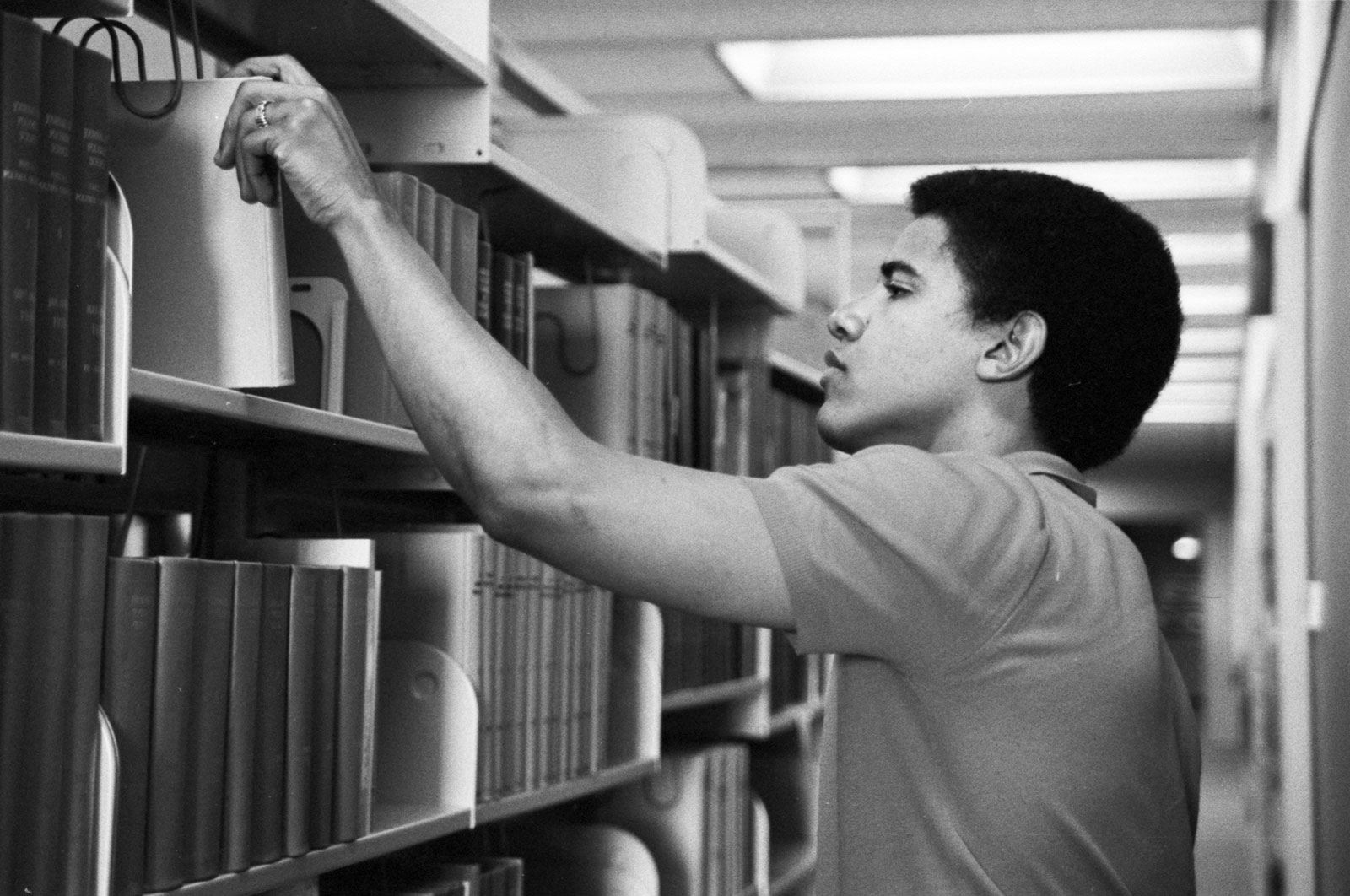
Barack Obama at Occidental College, 1981
Thomas Grauman/CorbisBarack Obama at Occidental College, 1981

Recently, while writing an essay on T. S. Eliot for The New York Review, I read or reread the work of many earlier critics, and was impressed most by two of them. One was Frank Kermode, who was ninety when he wrote, in 2010, one of his greatest essays, “Eliot and the Shudder,” a breathtakingly wide-ranging and sharply-focused piece about Eliot’s unique response to the common experience of shuddering. The other was a twenty-two-year-old college senior named Barack Obama, who wrote about Eliot in a letter to his girlfriend, Alexandra McNear, when she had been assigned to write a paper on The Waste Land for a college course.

Obama’s letter appeared in a biography by David Maraniss, Barack Obama: The Story, published in 2012, and prompted dozens of comments, some praising, some condescending. What struck me on rereading it was that, hasty and elliptical as it was, it exemplified literary criticism—like Frank Kermode’s—at its best, and showed why it might be worth doing. It also pointed toward something unsettling about its author’s later career.

This is what the young Obama wrote to his friend, divided into paragraphs for easier reading on screen:

I haven’t read “The Waste Land” for a year, and I never did bother to check all the footnotes. But I will hazard these statements—Eliot contains the same ecstatic vision which runs from Münzer to Yeats. However, he retains a grounding in the social reality/order of his time.

Facing what he perceives as a choice between ecstatic chaos and lifeless mechanistic order, he accedes to maintaining a separation of asexual purity and brutal sexual reality. And he wears a stoical face before this. Read his essay on Tradition and the Individual Talent, as well as Four Quartets, when he’s less concerned with depicting moribund Europe, to catch a sense of what I speak.

Remember how I said there’s a certain kind of conservatism which I respect more than bourgeois liberalism—Eliot is of this type. Of course, the dichotomy he maintains is reactionary, but it’s due to a deep fatalism, not ignorance. (Counter him with Yeats or Pound, who, arising from the same milieu, opted to support Hitler and Mussolini.)

And this fatalism is born out of the relation between fertility and death, which I touched on in my last letter—life feeds on itself. A fatalism I share with the western tradition at times. You seem surprised at Eliot’s irreconcilable ambivalence; don’t you share this ambivalence yourself, Alex?

Obama begins with a strikingly suggestive insight into Eliot’s literary and religious tradition and his special relation to it: Eliot is one of a line of Protestant visionary and apocalyptic writers from Thomas Münzer (or Müntzer) in the sixteenth century to Yeats in the twentieth, but distinguishes himself by finding his apocalypse in the actual world, not in a visionary one. Obama then describes Eliot’s double impulse toward, on one hand, a visionary realm of “ecstatic chaos” together with “asexual purity,” and, on the other, the “lifeless mechanistic order” and “brutal sexual reality” of everyday existence. And he recognizes that Eliot accepts this double impulse as a tragic fate that he can never transcend or escape.

Obama sees that Eliot’s conservatism differs from that of fascist sympathizers who want to impose a new political hierarchy on real-world disorder. Eliot’s conservatism is instead a tragic, fatalistic vision of a world that cannot be reformed in the way that liberalism hopes to reform it; it is a fallen world that can never repair itself, but needs to be redeemed. Behind this insight into Eliot’s conservatism is Obama’s sense that the goal of partisan politics is not the success of one or another party or program, but the means by which private morality can be put into action in the public sphere. So the liberal Obama can respect the conservative Eliot, because both seek what are ultimately moral, not political, ends.

Eliot’s fatalism, which Obama shares “with the western tradition at times,” had its source, Obama continues, in Eliot’s sense that life requires death. The living fertility hoped for in The Waste Land must seek its own death in order that new life may arise; the seed must die. This is the point of the “Death by Water” section in The Waste Land and the lines in Four Quartets where the wedding dance leads inevitably to “dung and death.” And the fatalistic cycle of “birth, and copulation, and death” (Eliot’s words in Sweeney Agonistes) always contrasts with the undying perfection that The Waste Land glimpses briefly in “the heart of light, the silence.”

Obama asks his friend, “You seem surprised at Eliot’s irreconcilable ambivalence; don’t you share this ambivalence yourself, Alex?” Instead of isolating Eliot in some social, ethnic, or sexual category, instead of hearing in him the voice of political or ideological error, Obama finds a deep ambivalence that might be felt by anyone, just as Kermode sees Eliot’s “shudder” as a special case of something felt by everyone. And instead of making an assertion to his friend about her own ambivalence, Obama asks her a rhetorical question, because no one can be certain about someone else’s inner life, though sympathy makes it possible to guess. Having first placed Eliot in his historical and literary context, then having pointed to what is unique in him, Obama ends by showing how he speaks to any individual reader who pauses to listen. This is what the finest literary criticism has always done.

Like everyone, I imagine, who was moved and hopeful after the 2008 elections, I have mixed feelings about Barack Obama’s presidency, and I doubt that “a fatalism I share with the western tradition” is desirable in a practical politician. To be fatalistic is to believe that nothing can be fixed, that the best anyone can do about the miseries of the world is to talk about them, eloquently, while hoping for the world to be redeemed.

03 Jan 23:58

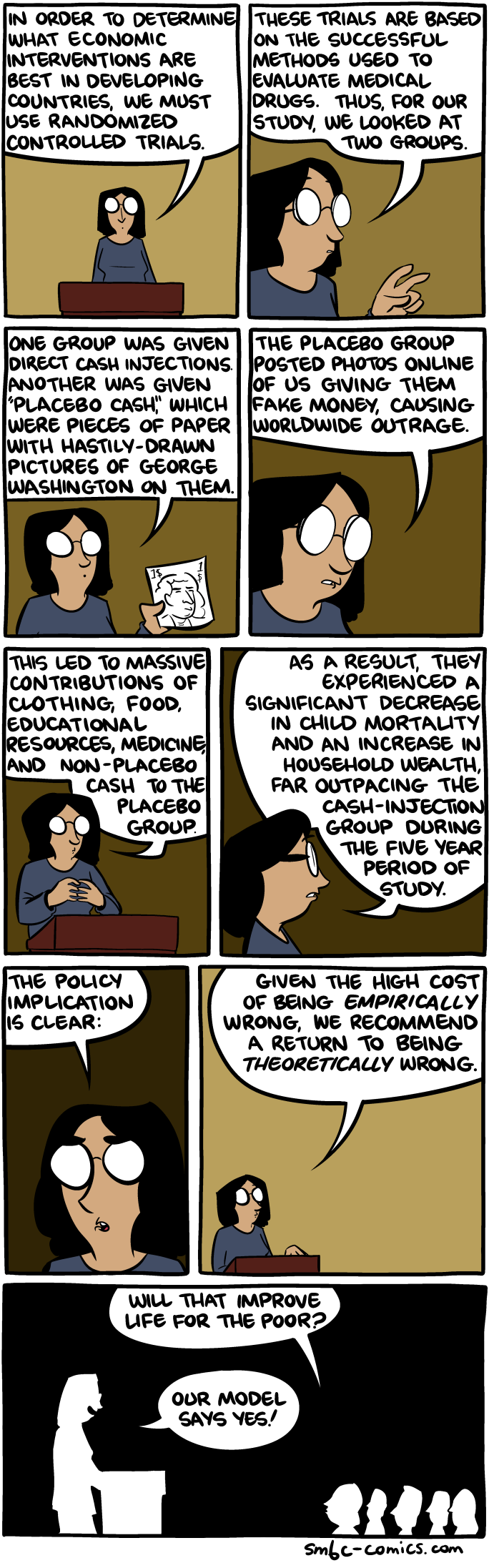
Saturday Morning Breakfast Cereal - Empirical Economics

by admin@smbc-comics.com

Hovertext: BAM. I have cornered the market for comics aimed at skeptical developmental macroeconomists.


New comic!
Today's News:
03 Jan 14:33

Driven to Kill

Hkg741386
Look both ways: Pedestrians wait for the light to change in central Beijing on Sept. 18, 2007.

Photo by Teh Eng Koon/AFP/Getty Images

In April a BMW racing through a fruit market in Foshan in China’s Guangdong province knocked down a 2-year-old girl and rolled over her head. As the girl’s grandmother shouted, “Stop! You’ve hit a child!” the BMW’s driver paused, then switched into reverse and backed up over the girl. The woman at the wheel drove forward once more, crushing the girl for a third time. When she finally got out from the BMW, the unlicensed driver immediately offered the horrified family a deal: “Don’t say that I was driving the car,” she said. “Say it was my husband. We can give you money.”

It seems like a crazy urban legend: In China, drivers who have injured pedestrians will sometimes then try to kill them. And yet not only is it true, it’s fairly common; security cameras have regularly captured drivers driving back and forth on top of victims to make sure that they are dead. The Chinese language even has an adage for the phenomenon: “It is better to hit to kill than to hit and injure.”

This 2008 television report features security camera footage of a dusty white Passat reversing at high speed and smashing into a 64-year-old grandmother. The Passat’s back wheels bounce up over her head and body. The driver, Zhao Xiao Cheng, stops the car for a moment then hits the gas, causing his front wheels to roll over the woman. Then Zhao shifts into drive, wheels grinding the woman into the pavement. Zhao is not done. Twice more he shifts back and forth between drive and reverse, each time thudding over the grandmother’s body. He then speeds away from her corpse.

Incredibly, Zhao was found not guilty of intentional homicide. Accepting Zhao’s claim that he thought he was driving over a trash bag, the court of Taizhou in Zhejiang province sentenced him to just three years in prison for “negligence.” Zhao’s case was unusual only in that it was caught on video. As the television anchor noted, “You can see online an endless stream of stories talking about cases similar to this one.”

“Double-hit cases” have been around for decades. I first heard of the “hit-to-kill” phenomenon in Taiwan in the mid-1990s when I was working there as an English teacher. A fellow teacher would drive us to classes. After one near-miss of a motorcyclist, he said, “If I hit someone, I’ll hit him again and make sure he’s dead.” Enjoying my shock, he explained that in Taiwan, if you cripple a man, you pay for the injured person’s care for a lifetime. But if you kill the person, you “only have to pay once, like a burial fee.” He insisted he was serious—and that this was common.

Most people agree that the hit-to-kill phenomenon stems at least in part from perverse laws on victim compensation. In China the compensation for killing a victim in a traffic accident is relatively small—amounts typically range from $30,000 to $50,000—and once payment is made, the matter is over. By contrast, paying for lifetime care for a disabled survivor can run into the millions. The Chinese press recently described how one disabled man received about $400,000 for the first 23 years of his care. Drivers who decide to hit-and-kill do so because killing is far more economical. Indeed, Zhao Xiao Cheng—the man caught on a security camera video driving over a grandmother five times—ended up paying only about $70,000 in compensation.

Security cameras have regularly captured drivers driving back and forth on top of victims to make sure that they are dead.

In 2010 in Xinyi, video captured a wealthy young man reversing his BMW X6 out of a parking spot. He hits a 3-year-old boy, knocking the child to the ground and rolling over his skull. The driver then shifts his BMW into drive and crushes the child again. Remarkably, the driver then gets out of the BMW, puts the vehicle in reverse, and guides it with his hand as he walks the vehicle backward over the boy’s crumpled body. The man’s foot is so close to the toddler’s head that, if alive, the boy could have reached out and touched him. The driver then puts the BMW in drive again, running over the boy one last time as he drives away.

Here too, the driver was charged only with accidentally causing a person’s death. (He claimed to have confused the boy with a cardboard box or trash bag.) Police rejected charges of murder and even of fleeing the scene of the crime, ignoring the fact that the driver ran over the boy’s head as he sped away.

These drivers are willing to kill not only because it is cheaper, but also because they expect to escape murder charges. In the days before video cameras became widespread, it was rare to have evidence that a driver hit the victim twice. Even in today’s age of cellphone cameras, drivers seem confident that they can either bribe local officials or hire a lawyer to evade murder charges.

Perhaps the most horrific of these hit-to-kill cases are the ones in which the initial collision didn’t injure the victim seriously, and yet the driver came back and killed the victim anyway. In Sichuan province, an enormous, dirt-encrusted truck knocked down a 2-year-old boy. The toddler was only dazed by the initial blow, and immediately climbed to his feet. Eyewitnesses said that the boy went to fetch his umbrella, which had been thrown across the street by the impact, when the truck reversed and crushed him, this time killing him.

Despite the eyewitness testimony, the county chief of police declared that the truck had never reversed, never hit the boy a second time, and that the wheels never rolled over the child.  Meanwhile, one outraged website posted photographs appearing to show the child’s body under the truck’s front wheel.

In each of these cases, despite video and photographs showing that the driver hit the victim a second, and often even a third, fourth, and fifth time, the drivers ended up paying the same or less in compensation and jail time than they would have if they had merely injured the victim.

With so many hit-to-kill drivers escaping serious punishment, the Chinese public has sometimes taken matters into its own hands. In 2013 a crowd in Zhengzhou in Henan province beat a wealthy driver who killed a 6-year-old after allegedly running him over twice. (A television report claims the crowd had acted on “false rumors.” However, at least five witnesses assert on camera that the man had run over the child a second time.)

Of course, not every hit-to-kill driver escapes serious punishment. A man named Yao Jiaxin who in 2010 hit a bicyclist in Xian and returned to make sure she was dead—even stabbing the injured woman with a knife—was convicted and executed. In 2014 a driver named Zhang Qingda who had hit an elderly man in Jiayu Pass in Gansu province with his pickup truck and circled around to crush the man again was sentenced to 15 years in prison.

Both China and Taiwan have passed laws attempting to eradicate hit-to-kill cases. Taiwan’s legislature reformed Article 6 of its Civil Code, which had long restricted the ability to bring civil lawsuits on behalf of others (such as a person killed in a traffic accident). Meanwhile, China’s legislature has emphasized that multiple-hit cases should be treated as murders. Yet even when a driver hits a victim multiple times, it can be hard to prove intent and causation—at least to the satisfaction of China’s courts. Judges, police, and media often seem to accept rather unbelievable claims that the drivers hit the victims multiple times accidentally, or that the drivers confused the victims with inanimate objects.

Hit-to-kill cases continue, and hit-to-kill drivers regularly escape serious punishment. In January a woman was caught on video repeatedly driving over an old man who had slipped in the snow.  In April a school bus driver in Shuangcheng was accused of driving over a 5-year-old girl again and again. In May a security camera filmed a truck driver running over a young boy four times; the driver claimed that he had never noticed the child.

And last month the unlicensed woman who had killed the 2-year-old in the fruit market with her BMW—and then offered to bribe the family—was brought to court. She claimed the killing was an accident. Prosecutors accepted her assertion, and recommended that the court reduce her sentence to two to four years in prison.

This light sentence would still be more of a punishment than many drivers have received for similar crimes. But it probably won’t be enough to keep the next driver from putting his car in reverse and hitting the gas.

02 Jan 19:12

Guesstimate: a spreadsheet for adding up uncertainties

by Cory Doctorow

1--p3AcItKP2t2gms3N3-VFA

Guesstimate is a new free/open source project from Ozzie Gooen: unlike normal spreadsheets, its cells accept confidence intervals, and it outputs models based on 5,000 Monte Carlo simulations. (more…)

02 Jan 15:38

In ‘Star Wars,’ Was the Death Star Too Big to Fail?

In ‘Star Wars,’ Was the Death Star Too Big to Fail?

Gray Matter

By ZACHARY FEINSTEIN JAN. 1, 2016

Inside
    Photo
    Credit Oscar Bolton Green

    AT the end of “Star Wars: Episode VI — Return of the Jedi,” the heroic Rebel Alliance defeats the evil Galactic Empire, destroying the second Death Star, the empire’s central space station (and superweapon). Audiences typically respond to the destruction of the Death Star with triumphant cheers.

    31 Dec 16:06

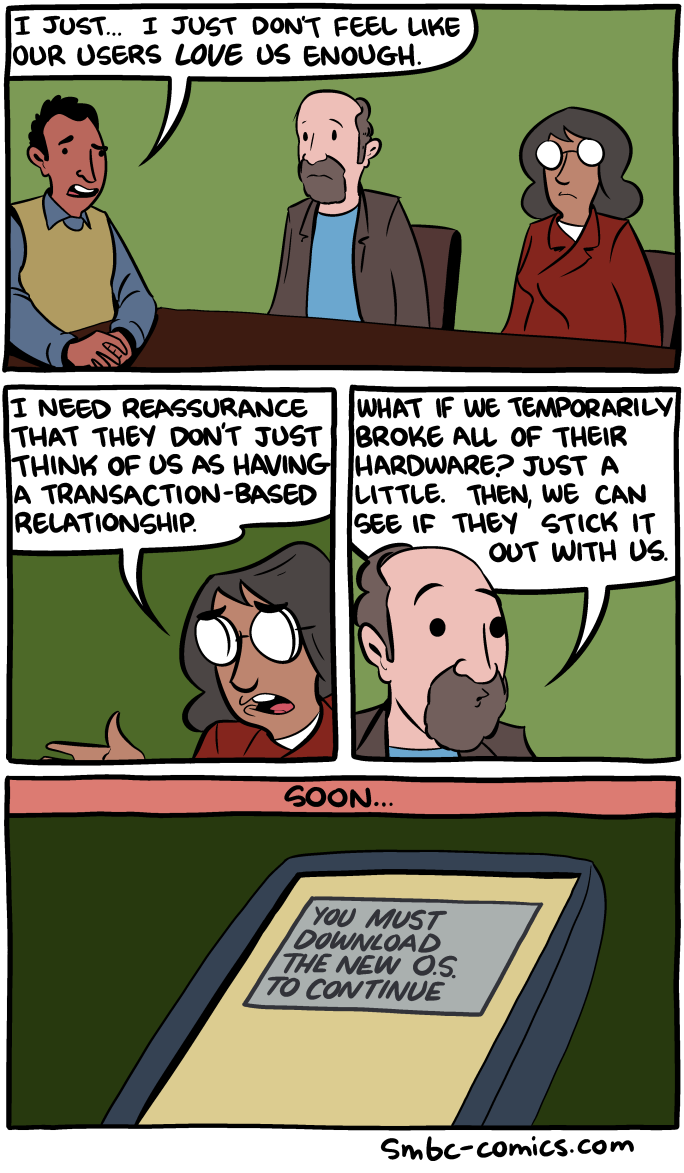
    Saturday Morning Breakfast Cereal - Users

    by admin@smbc-comics.com

    Hovertext: Update 9.1.2.001.241 has been a test of your loyalty.


    New comic!
    Today's News:

     We've already sold about a quarter of all discounted tickets to both London BAHFests! These'll probably sell out quick once the new year starts, so buy soon to lock in a spot!

    24 Dec 16:48

    Toy Type and Parent-Infant Communication

    Importance  The early language environment of a child influences language outcome, which in turn affects reading and academic success. It is unknown which types of everyday activities promote the best language environment for children.

    Objective  To investigate whether the type of toy used during play is associated with the parent-infant communicative interaction.

    Design, Setting, and Participants  Controlled experiment in a natural environment of parent-infant communication during play with 3 different toy sets. Participant recruitment and data collection were conducted between February 1, 2013, and June 30, 2014. The volunteer sample included 26 parent-infant (aged 10-16 months) dyads.

    Exposures  Fifteen-minute in-home parent-infant play sessions with electronic toys, traditional toys, and books.

    Main Outcomes and Measures  Numbers of adult words, child vocalizations, conversational turns, parent verbal responses to child utterances, and words produced by parents in 3 different semantic categories (content-specific words) per minute during play sessions.

    Results  Among the 26 parent-infant dyads, toy type was associated with all outcome measures. During play with electronic toys, there were fewer adult words (mean, 39.62; 95% CI, 33.36-45.65), fewer conversational turns (mean, 1.64; 95% CI, 1.12-2.19), fewer parental responses (mean, 1.31; 95% CI, 0.87-1.77), and fewer productions of content-specific words (mean, 1.89; 95% CI, 1.49-2.35) than during play with traditional toys or books. Children vocalized less during play with electronic toys (mean per minute, 2.9; 95% CI, 2.16-3.69) than during play with books (mean per minute, 3.91; 95% CI, 3.09-4.68). Parents produced fewer words during play with traditional toys (mean per minute, 55.56; 95% CI, 46.49-64.17) than during play with books (mean per minute, 66.89; 95% CI, 59.93-74.19) and use of content-specific words was lower during play with traditional toys (mean per minute, 4.09; 95% CI, 3.26-4.99) than during play with books (mean per minute, 6.96; 95% CI, 6.07-7.97).

    Conclusions and Relevance  Play with electronic toys is associated with decreased quantity and quality of language input compared with play with books or traditional toys. To promote early language development, play with electronic toys should be discouraged. Traditional toys may be a valuable alternative for parent-infant play time if book reading is not a preferred activity.

    21 Dec 17:47

    A Medieval Antidote to ISIS

    A Medieval Antidote to ISIS

    Photo
    Credit Spencer Charles

    ISTANBUL — THE recent massacres in Paris and San Bernardino, Calif., demonstrated, once again, the so-called Islamic State’s ability to win over disaffected Muslims. Using a mixture of textual literalism and self-righteous certainty, the extremist group is able to persuade young men and women from Pakistan to Belgium to pledge allegiance to it and commit violence in its name.

    This is why the Islamic State’s religious ideology needs to be taken seriously. While it’s wrong to claim that the group’s thinking represents mainstream Islam, as Islamophobes so often do, it’s also wrong to pretend that the Islamic State has “nothing to do with Islam,” as many Islamophobia-wary Muslims like to say. Indeed, jihadist leaders are steeped in Islamic thought and teachings, even if they use their knowledge to perverse and brutal ends.

    A good place to start understanding the Islamic State’s doctrine is by reading Dabiq, the digital English-language magazine that the group puts out every month. One of the most striking pieces I have seen in it was an 18-page article in March titled “Irja’: The Most Dangerous Bid’ah,” or heresy.

    Unless you have some knowledge of medieval Islamic theology you probably have no idea what irja means. The word translates literally as “postponing.” It was a theological principle put forward by some Muslim scholars during the very first century of Islam. At the time, the Muslim world was going through a major civil war, as proto-Sunnis and proto-Shiites fought for power, and a third group called Khawarij (dissenters) were excommunicating and slaughtering both sides. In the face of this bloody chaos, the proponents of irja said that the burning question of who is a true Muslim should be “postponed” until the afterlife. Even a Muslim who abandoned all religious practice and committed many sins, they reasoned, could not be denounced as an “apostate.” Faith was a matter of the heart, something only God — not other human beings — could evaluate.

    The scholars who put this forward became known as “murjia,” the upholders of irja, or, simply, “postponers.” The theology that they outlined could have been the basis for a tolerant, noncoercive, pluralistic Islam — an Islamic liberalism. Unfortunately, they did not have enough influence on the Muslim world. The school of thought disappeared quickly, only to go down in Sunni orthodoxy’s memory as one of the early “heretical sects.” The murjia left a mark on the more lenient side of Sunni Islam, represented by Hanafi-Maturidism, most popular in the Balkans, Turkey and Central Asia, but today there is virtually no Muslim group that identifies itself as murjia. The word irja is seldom heard in discussions of Islamic theology.

    So why is the Islamic State so alarmed about this old “heresy”? The answer to this question can be found in the Dabiq article itself, where the authors accuse other Islamist rebel groups in Syria of irja. “These factions did not rule by the Shariah despite their control of ‘liberated’ territory,” the Islamic State writers note loathingly. In other words, they did not kill “apostates,” implement corporal punishment, or force women to cover themselves head to toe.

    The groups that the Islamic State accuses of irja — many of them conservative Islamists — would probably not readily accept the label. In their religious texts, too, irja probably appears as heresy. But we should recognize that by “postponing” the imposition of religion and the punishment of sinners, they are engaged in de facto irja. Not out of principle perhaps, but out of pragmatism.

    Continue reading the ...
    20 Dec 13:02

    Saturday Morning Breakfast Cereal - Quantum Mechanics is Weird

    by admin@smbc-comics.com

    Hovertext: And lo, The Lord spake, saying, Let the fundamental equations contain an imaginary component.


    New comic!
    Today's News:

    Wooh! The "Both Shows" for London tickets sold about 10% on day one :) Please buy soon if you want the discount!

    18 Dec 21:58

    An Honest Performance Of "Baby It's Cold Outside"

    Joel Thrasymachus Dahl

    Worth the click-through.

    'Tis the season to take a closer look at questionable Christmas song lyrics. And of... more »
    'Tis the season to take a closer look at questionable Christmas song lyrics. And of all the classic holiday tunes, the “Baby It’s Cold Outside” duet is definitely the creepiest. « less
    Published December 16, 2015 44k views More Info »
    18 Dec 15:00

    Putin says Trump is ‘absolute leader’ in U.S. presidential race

    Joel Thrasymachus Dahl

    “He’s a very lively man, talented without doubt,” Putin said according to the Interfax news service after the three-hour news conference. He added that Trump is the “absolute leader in the presidential race.”

    “He’s saying he wants to go to another level of relations, closer, deeper relations with Russia,” Putin continued. “How can we not welcome that? Of course we welcome that.”

    MOSCOW —Russian President Vladimir Putin during a wide-ranging news conference on Thursday found a moment to offer a strong endorsement for Republican frontrunner Donald Trump, calling the billionaire presidential candidate the “absolute leader in the presidential race.”

    Putin consecrated the budding international bromance between the two men as he commented on the U.S. race for the White House, saying that Russia would work with “whomever the American voters choose,” but expressed special praise for Trump.

    Trump in October had said he would “get along very well” with Putin and applauded the Russian leader for his intervention against the Islamic State in Syria, but until Thursday, his praise had gone unreciprocated.

    “He’s a very lively man, talented without doubt,” Putin said when journalists approached him after the news conference and asked about Trump. “He’s saying he wants to go to another level of relations — closer, deeper relations with Russia. How can we not welcome that? Of course we welcome that.”

    It was a moment of levity during a more than three-hour press conference that touched on Russia’s battered economy, Russia’s intervention in Syria, tense relations with Turkey over the downing of a Russian warplane, and the smoldering conflict in Ukraine.

    Republican presidential frontrunner Donald Trump has said a lot of nice things about Russian president Vladimir Putin. Putin finally responded on Dec. 17. (Gillian Brockell/The Washington Post)

    [Full GOP debate transcript]

    During the news conference, Putin denied once again that regular Russian forces were in Ukraine, where pro-Moscow rebels began clashes with the Western-backed government in 2014. But Putin hinted that Russian military advisers or security forces were active in that country, an involvement that he and senior Russian officials have sharply denied in the past.

    “We never said that we did not have people there who are dealing with certain issues,” Putin said of southeastern Ukraine, the base for the Russian-backed separatists. “But there are no regular Russian troops there. Feel the difference!”

    Putin’s statement came after a Ukrainian journalist “passed on a hello from Captain Erofeyev and Sergeant Alexandrov,” two alleged Russian servicemen captured by Ukrainian government forces. Russia has said they quit the army before going to Ukraine.

    [[Putin and Kerry talk Syria]

    The format of the yearly news conference is a spectacle in itself: Nearly 1,400 journalists jostle on national television for the opportunity to ask Putin a question.

    Putin answers in monologues that can stretch as long as 10 minutes, making it difficult for reporters to follow up.

    Asked about Russia’s intervention in the civil war in Syria, Putin said Russian forces would remain there at least until a democratic process is launched.

    “There is a plan,” Putin said. “In its key aspects, it coincides with the American plan: working on the constitution, preparing elections in Syria and the recognition of their results. But for now we are going to launch strikes and support the Syrian army in its offensive.”

    But the United States and Russia differ sharply over Syrian President Bashar al-Assad. Washington and its allies insist that Assad has no role in Syria’s political future. Russia and Iran, however, are key backers of Assad and will likely resist any outcome that lessens their influence in Syria.

    [Putin defends Syrian intervention]

    Russia began airstrikes to back Assad in September, but recently Russian analysts and government officials have expressed frustration with the slow speed of the offensive and ineffectiveness of the Syrian troops.

    In a closed-door meeting before parliament on Wednesday, Russian Defense Minister Sergei Shoigu declined to put a time limit on the intervention but said that Russia “can’t count on a quick conclusion to the operation,” the RIA Novosti state news agency reported.

    A day earlier, Putin met with Secretary of State John F. Kerry, striking an agreement to hold talks Friday in New York on a political settlement that may then be formalized in a United Nations resolution.

    Putin largely reiterated Russia’s anger over the downing of one of its warplanes by Turkish jets last month.

    [The ‘amazing’ Mr. Putin ]

    “Life has shown that it is difficult for us, practically impossible, to come to terms with the incumbent Turkish administration,” Putin said. “Even when and where we say that we agree, they stab us in the side or in the back, for absolutely unclear reasons.”

    He also said that someone in the Turkish government may have ordered the attack on the Russian plane in an effort to please the United States, or as he put It, to “lick the Americans in a particular place.”

    Putin also addressed Russia’s economy, which has been hit with high inflation and plunged against the dollar and euro as the price of oil has fallen drastically in recent months. While the dollar was worth 35 rubles two years ago, it now trades at more than 70 rubles.

    Putin said that he was satisfied with the leadership of Russia’s government and the Central Bank, which steeply hiked interest rates to prevent inflation, despite the pain that the move has dealt to businesses and borrowers. He said he wanted to lower interest rates but that this would happen only when Russia could do so “in a natural way.”

    [Putin plays Kremlin host for Assad]

    Putin predicted that Russia would have 0.7 percent growth in 2016, 1.9 percent growth in 2017 and 2.4 percent growth in 2018. But he made those predictions with oil trading at $50 a barrel. Brent crude was trading at just over $37 a barrel on Thursday.

    In a personal moment, Putin was asked about the identity of his daughters, after a series of investigations in the Russian press revealed that a woman named Katerina Tikhonova had attained a prominent position overseeing millions of dollars in investment at a high-tech business incubator at Moscow State University.

    “They don’t engage in business, and they don’t engage in politics,” Putin said, declining to say whether Tikhonova was his daughter. “They are never going to get involved in that.”

    Read more:

    Watch: A bouquet of roses kicked off Ukraine’s most bizarre parliament brawl ever

    Russian truckers threaten crippling Moscow traffic jam in rare protest

    Russia targets soccer players, Ottoman classes and turkey part from Turkey

    Today's coverage from Post correspondents around the world

    17 Dec 01:01

    It's a new day in America.

    It's a new day in America. Vote for Frank Underwood in 2016.
    16 Dec 12:59

    December 16, 2015

    15 Dec 21:07

    Autocorrect hates you

    by Matthew Inman
    Joel Thrasymachus Dahl

    I usually feel bad about finding The Oatmeal funny, because it mostly just substitutes vulgarity for humor (kinda like my own sense of humor).

    But this one is pretty damned funny.

    12 Dec 00:20

    Iliza Shlesinger - Girls At The Bar (Stand up Comedy)

    Joel Thrasymachus Dahl

    Shared for the Apocalypse Now bit.

    09 Dec 23:54

    Look, up in the sky, at Army missile launch that can be seen across Southwest

    by By SUSAN MONTOYA BRYAN Associated Press

    ALBUQUERQUE, N.M. -- An early morning missile test over a remote part of New Mexico is expected to produce a contrail that will be visible across the Southwest on Thursday, and authorities says they're preparing for a flood of phone calls and emails from curious onlookers.

    The unarmed Juno target missile will be launched between 5:30 and 6:30 a.

    09 Dec 18:52

    My Offer to Stop Donald Trump

    Joel Thrasymachus Dahl

    This is hilarious trolling. I bet if he'd set a more attainable limit, someone would actually run a successful crowdfunding campaign to take up the offer.

    It's almost as good as the CAH "give us five bucks for nothing" campaign.

    As regular readers know, I have been writing about the persuasive skills of Donald Trump. You might also know I’m a certified hypnotist and I’ve been studying the field of persuasion for decades. And you might also know I predicted back in August that Trump would use those persuasion skills (which are unprecedented) to dominate the field.

    Other than me, who else predicted in August that Trump would be leading the Republican polls in December? Keep in mind that I showed my work all the way. I updated my prediction in October to a Trump landslide in the general election. My predictions are based on his skills, not his policies.

    Now let’s say you think I was right – or partly right – about Trump’s skills. You observe him using his persuasive skills and you believe he has more power than the media understands. Let’s say you believe that maybe those skills are the biggest part of his success. Or maybe you think the immigration issue is the main reason Trump is popular with some, but you still think Trump’s persuasive skills are part of the story. Either way works for today’s purpose.

    Now let’s say you’re scared to death of a Trump presidency. In your mind, it could be the biggest disaster in the history of civilization. You imagine nukes flying, discrimination everywhere, and the general unraveling of polite society.

    So I thought I would offer you some Trump insurance today. For $1 billion dollars, I will use my own persuasive skills to prevent Trump from becoming president. 

    For fun, let’s say this is all done through a crowdfunding site (if they can handle that dollar amount) so my failure would mean I don’t get paid. I only get paid if Trump does NOT make it all the way to president.

    Confusing, isn’t it? That’s the fun. Let me spell it out in simpler terms.

    The proposition is that the public can pledge any amount of money to a crowdfunding site to activate my persuasion skills to stop Donald Trump. Each person might only pledge $10, so no big risk involved. If Trump loses in the general election, I get the full $1 billion for my efforts, EVEN IF YOU THINK MY EFFORTS MADE NO DIFFERENCE. That last part is important because the public would not see my fingerprints on anything. The press would report that people simply tired of Trump’s act, or maybe some future gaffe would be credited with his downfall. But that would not necessarily be the real story. Then, as now, the public and the media see Trump as a 2D player. I see him as a 3D player who manages your emotions, not your sense of reason. If I do the same, my technique will be as invisible as Trump’s.

    If I fail, and Trump wins, the payout would not be triggered, and I get nothing. And if the crowdfunding pledges never reach the full $1 billion, I would do nothing at all but continue to report on Trump as I have been doing, as objectively as I can. 

    Think about it. For ten dollars you could buy some Trump insurance. There are no guarantees in life, but if you truly fear him, and hate him, ten bucks isn’t much of a risk. And who knows? Maybe I can stop him. You don’t really know. Frankly, neither do I. There are no guarantees in life. I’d put the odds of my success at around 60%. 

    Now ask yourself how anyone else could stop him. Are you confident Hillary Clinton has what it takes? Remember, Trump hasn’t even focused on her yet.

    This is a thought experiment, so I don’t expect any of this to materialize. And I wouldn’t want to wrestle with the moral implications of actually going through with it. Also, as I often say, I’m not smart enough to know who would do the best job as president. They all look qualified to me. 

    That said, I think my deal structure is solid. If you are afraid of a Trump presidency, do you see any problem with my offer?

    09 Dec 18:42

    December 09, 2015

    08 Dec 18:45

    California newest airport terminal extends to Mexico

    The U.S.-Mexico border is one of the world's most fortified international divides. Starting Wednesday, it will also be one of the world's only boundaries with an airport straddling two countries.

    An investor group that includes Chicago billionaire Sam Zell built a sleek terminal in San Diego with a bridge that crosses a razor-wire border fence to Tijuana's decades-old airport. Passengers pay $18 to walk a 390-foot overpass to Tijuana International Airport, a springboard to about 30 Mexican destinations.

    The terminal is targeting the estimated 60 percent of Tijuana airport passengers who cross into the United States, about 2.6 million travelers last year. Now, they drive about 15 minutes to a congested land crossing, where they sometimes wait several hours to enter San Diego by car or on foot. The airport bridge is a five-minute walk to a U.S. border inspector.

    "It seems so much easier, so liberating," said Daniela Calderon, who flies from Tijuana four times a year to visit family in the central Mexican city of Morelia and has a friend drive her across the border from Riverside, California.

    The only other cross-border airport known to industry experts is in the European Union — between Basel, Switzerland, and France's Upper Rhine region — but it carries none of the political freight of San Diego and Tijuana. Mexicans who ran across the border illegally overwhelmed the Border Patrol until the mid-1990s, when new fences and additional agents heralded a massive surge in U.S. enforcement on the 1,954-mile line with Mexico.

    Cross Border Xpress, one of the largest privately-operated U.S. air terminals, wouldn't have happened if Tijuana didn't build its airport a few steps from the international line in the 1950s or if it wasn't surrounded by undeveloped land in a barren, industrial part of San Diego.

    "It's an amazing accident of geography," said Stanis Smith of Stantec Inc., the terminal's architect. "It could never happen again."

    The terminal is one of the last works by the late Ricardo Legorreta, whose bold colors helped bring Mexican modernism to a world stage and attracted a strong following in the American Southwest. The stone exterior mixes purple stucco and red limestone that takes on a deep, inky hue when it rains. Stone gardens sprout agave and other desert plants.

    Passengers enter a courtyard with a reflecting pool to an airy building with ticket counters and kiosks. High, white ceilings have large orange circles of recessed lighting. Sparse decorative touches are onyx, including high-hanging black slabs near ticket counters and white spheres atop the escalators.

    Aesthetics are more dated in the Tijuana airport but passenger flow is the same. Ticketed passengers must carry luggage across a bridge with frosted glass windows to border inspectors in the receiving country and a wall in the middle to separate the two directions.

    The idea isn't new — San Diego leaders proposed an airport with a runway on each side of the border in the early 1990s to replace the city's constrained Lindbergh Field — but it didn't gain traction until a Mexican couple invested in 2005 in a company that runs airports in Tijuana and 11 other Mexican cities.

    Carlos Laviada, whose mother-in-law lived in San Diego, had experienced the hassles of crossing the border after flying to Tijuana for decades. The view of San Diego from Tijuana's control tower convinced him he had to act before the vacant land was developed.

    "Oh, my God, it's right here," he recalls saying.

    Laviada said Grupo Aeroportuario del Pacifico SAB's board deemed it too risky but allowed him, his wife and another company director to invest privately. Zell and another Mexican investor joined them.

    The privately-held consortium, Otay-Tijuana Venture LLC, doesn't release financial projections but expects to make money on a duty-free shop, rental car companies, restaurants and other concessions. The $120 million terminal occupies less than half their 55-acre parcel, and the city of San Diego has approved a 340-room hotel, shopping center and gas station.

    Parking costs $10 a day, which is competitive with lots near land crossings and Tijuana's airport.

    The terminal fee will go largely to pay U.S. border inspector salaries, one of the nation's few privately-funded ports of entry.

    Laviada, echoing views of airport officials on both sides of the border, doesn't consider Tijuana a threat to San Diego's airport because they share few routes. Both are primarily domestic airports, and Tijuana has shown no sign of expanding international destinations beyond Shanghai and Oakland, California.

    Cross Border Xpress officials say they hope to capture half of Tijuana passengers bound for the U.S., which sounds realistic to nervous Tijuana airport taxi drivers who charge $13 for a ride to a land crossing. Nearly all cars in the Tijuana airport garage have California plates.

    Passengers joke that they spend more time crossing the border than they do on the plane.

    "No more driving around so much," Maria de Jesus Gonzalez said after arriving in Tijuana from a family visit to Guadalajara and waiting for her son to drive from Southern California. "This will be much more direct."

    08 Dec 18:34

    Petition Seeks To Ban Donald Trump From U.K. Over Hate Speech

    Could Donald Trump get banned from Britain? 

    An online petition calls on U.K. Home Secretary Theresa May to bar the Republican presidential frontrunner from entering the country for allegedly violating the nation's hate-speech laws. 

    If it receives 100,000 signatures, the petition could be taken up for debate in the House of Commons, according to The Independent. 

    The petition launched by Scottish resident and longtime Trump critic Suzanne Kelly blasts Trump for "unrepentant hate speech and unacceptable behavior" that "foments racial, religious and nationalistic intolerance which should not be welcome in the U.K."

    It reads in part: 

    “The UK has banned entry to many individuals for hate speech. This same principle should apply to Donald J Trump. We cannot see how the United Kingdom can condone his entry to the country when many people have been barred for less. 

    If the United Kingdom is to continue applying the ‘unacceptable behavior’ criteria to those who wish to enter its borders, it must be fairly applied to the rich as well as poor, and the weak as well as powerful.”

    The petition is not currently available for additional signatures. MSNBC reports that it's being reviewed by Parliament's petitions committee. A message online says it will be back after the review, if it meets standards

    Such a ban would not be without precedent. Earlier this year, rapper Tyler the Creator was barred from entering the country for a string of tour dates due to some of his lyrics. Anti-Islam activist Pamela Geller was also banned in 2013.

    "The Home Secretary will seek to exclude an individual if she considers that his or her presence in the U.K. is not conducive to the public good," a spokesman told HuffPost U.K. at the time. "We condemn all those whose behaviors and views run counter to our shared values and will not stand for extremism in any form."

    The Trump petition may be about more than just the Republican frontrunner's Islamophobic rhetoric; Kelly was one of the voices in opposition to the real estate tycoon's controversial golf course just outside Aberdeen.  

    Kelly has also launched a petition calling on Robert Gordon University in Aberdeen to revoke an honorary degree bestowed on Trump in 2010 -- a move so controversial at the time that a former principal of the university angrily returned his own honorary degree.

    "Mr. Trump is simply not a suitable person to be given an honorary degree and he should not be held up as an example of how to conduct business," David Kennedy, principal of Robert Gordon University from 1987 to 1997, told the BBC.

    "I can think of no better way to express my anger at the decision to honor Mr. Trump than to return my own honorary doctorate to the university," Kennedy said. "I would not want to hold the award after Mr. Trump has received his." 

    (h/t Raw Story)

    Also on HuffPost

    Muslims React To Trump's Islamophobic Comments

    08 Dec 00:46

    California condoms-in-porn opponents fined for illegal foreign campaign donations

    by By JULIET WILLIAMS Associated Press

    SACRAMENTO -- California's campaign finance watchdog is issuing its first fine against a campaign for accepting illegal foreign donations.

    The Fair Political Practices Commission levied $61,000 in fines against opponents of a 2012 Los Angeles ballot measure to require actors in pornography films to wear condoms during sex scenes.

    08 Dec 00:45

    Largely Muslim campaign raises $75,000 for San Bernardino shooting victims

    by Brenda Gazzar

    A largely Muslim campaign has raised about $75,000 so far for the victims of Wednesday's terror attack at the Inland Regional Center in San Bernardino, an organizer said.

    A network of local, regional and national organizations -- most of which are Muslim or Muslim-led -- plans to raise a total of $100,000 for the immediate and short-term needs of victims and their families, which could include funeral expenses, medical expenses, rent and mortgage payments, said Dr.

    07 Dec 19:52

    Born again American

    Joel Thrasymachus Dahl

    This might actually be true. Consistent with fervor of the convert that I've seen in a few naturalized citizens whom I know.

    A person who is not born in the United States but eventually becomes a citizen of the United States is a born again American.

    07 Dec 19:30

    Paul Ryan Brings Sharply Different Leadership Style to House

    Joel Thrasymachus Dahl

    I wonder how much of this is a genuine change in style, and how much is Honeymoon period + he's still forming his inner circle.

    If this fellatio piece can be trusted, this would be a good set of developments.

    Paul Ryan Brings Sharply Different Leadership Style to House

    By JENNIFER STEINHAUER

    Inside
      Photo
      Speaker Paul D. Ryan at a news conference at the Capitol on Tuesday. House colleagues say his leadership style contrasts sharply with that of his predecessor, John A. Boehner. Credit Zach Gibson/The New York Times

      WASHINGTON — On a recent Saturday afternoon, Paul D. Ryan texted Representative Tom Cole of Oklahoma. Mr. Ryan, the new House speaker, was attending a University of Oklahoma football game and wondered where the Sooner-adoring Mr. Cole might be sitting.

      From Our Advertisers

      04 Dec 21:11

      TV Cameras Tear Through Shooters’ House At Invitation Of Landlord As Anchors, Analysts Watch In Horror

      by Lisa de Moraes
      Looking like an episode of Storage Wars – or a typical real estate open house in Santa Monica – TV news reporters with cameras this morning stormed the apartment rented by the San Bernardino shooters, at the invitation of the landlord. MSNBC and CNN were among the outlets broadcasting jaw-dropping footage of passports, Social Security cards, driver’s licenses, personal photos and other articles left behind as their reporters rummaged through the Redlands space. Also in…
      01 Dec 22:15

      UnitedHealth Report Stirs Alarm About Obamacare Exchanges

      Joel Thrasymachus Dahl

      Apparently Rubio was the major sponsor of the legislation that's screwing CMS on this.

      By Rebecca Adams, CQ Roll Call

      November 19, 2015 -- Health policy analysts and lobbyists were split on Thursday over whether the announcement by the nation's largest insurer that it may withdraw from health law insurance marketplaces in 2017 signals broader problems with the viability of the exchanges.

      UnitedHealth Group lowered its expectations for earnings on Thursday, blaming higher-than-expected medical claims from the approximately 550,000 people it covers through the marketplaces created by the 2010 overhaul. Some patients enroll to receive medical care and drop coverage later, company officials said.

      "In recent weeks, growth expectations for individual exchange participation have tempered industrywide, co-operatives have failed, and market data has signaled higher risks and more difficulties while our own claims experience has deteriorated," said Stephen J. Hemsley, chief executive officer of UnitedHealth Group, in a statement.

      While United is not a dominant insurer in the marketplaces, lobbyists warned that other health plans face similar risks. Insurance companies are eyeing 2017 as a pivotal year because two financial protections that have limited insurers' losses will be expiring.

      Administration officials already announced last month that one of those programs, the so-called risk corridors system, would not operate as intended. The program limits profits and losses for insurers offering coverage in the marketplaces. Lawmakers designed it to shift money from insurers with gains above a certain threshold to those with deficits beyond a certain cap.

      Congressional Republicans had passed legislation in the fiscal 2015 spending package (PL 113-235) that blocked the Obama administration from tapping other federal funds to fund the program. In October, the Centers for Medicare and Medicaid Services (CMS) announced a $2.5 billion shortfall in the program and a subsequent 87 percent reduction in expected payments to insurers with losses.

      As a result, many nonprofit co-op plans have failed and some other insurers are struggling. America's Health Insurance Plans spokeswoman Clare Krusing said the shortfall is causing some other plans to re-evaluate whether they will be able to keep offering coverage.

      "We've been very clear with the Administration about the serious challenges facing consumers and health plans in this Exchange market," said AHIP president and CEO Marilyn Tavenner in a statement. "When health plans cannot rely on the government to meet its obligations, individuals and families are harmed as a result.

      Tavenner, who until February was the administrator of CMS, said that "nearly 800,000 Americans have faced coverage disruptions as a result of the significant and unexpected shortfall." That includes people who are losing coverage because they were enrolled in either a co-op plan or other type of insurance plan that will not be continued.

      Health and Human Services Secretary Sylvia Mathews Burwell has said she expects that about 10 million people will have enrolled and paid their premiums in the state and federal exchanges by the end of 2016, about half of previous Congressional Budget Office estimates and less than one million more people than in late 2015.

      Tough Environment

      The administration insisted that the marketplace remains stable.

      "The Health Insurance Marketplace is entering its third year and continues to grow, giving millions of Americans access to quality affordable insurance," said CMS spokesman Aaron Albright. "Tens of thousands more Americans turn to the Health Insurance Marketplace for health coverage and even more return to the Marketplace for another year. In fact, about 9 out of 10 returning consumers will be able to choose from 3 or more insurers for 2016 coverage."

      However, insurers are operating in an environment in which health care costs are rising at a faster clip than a couple of years ago and enrollment in the marketplaces has not been as robust as some plans predicted.

      "The market dynamics mean that the administration is going to have to figure out what they can do to create more stability," said Dan Mendelson, the president of the Avalere consulting firm and a former Clinton administration health budget official.

      The threat to withdraw by United, which is already reducing publicity about its marketplace plans, adds pressure on the administration.

      CMS officials potentially could tweak other protections for insurers, such as a permanent program that bases insurance payments in part based on the health of the people enrolled. The administration also may be able to give insurers more discretion in the design of their benefits.

      The best way to ensure the sustainability of the marketplaces would be for Congress to assist the administration in revising the law, much as lawmakers did for several years after Medicare cuts in the 1997 Balanced Budget Act (PL 105-33) struck home health agencies and other providers too deeply. "But when half of Congress is gunning for the law, that's just not going to happen," said Mendelson in an interview.

      "One company doesn't tank the program but if they don't do something to stabilize the market, it's going to shrink and become more of a subsidized, specialized low-income program and that was not the intent of the law," he said. "The goal was to have a robust private insurance market for individuals in the U.S."

      01 Dec 22:08

      The Unlikely Governor

      Joel Thrasymachus Dahl

      Somebody just linked this to me and said "this is Hilary's running mate."

      Thoughts? I've never heard of the dude before.

      Pennsylvania Gov. Tom Wolf ’71 gets a kick out of talking about the roads not taken—such as the academic life for which he had once so assiduously prepared. 

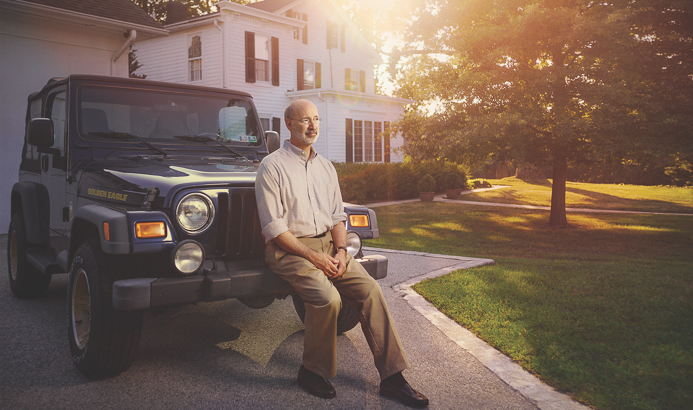
      His calling card was his 1981 doctoral dissertation on the U.S. House of Representatives in the late 19th and early 20th centuries. It was honored by the American Political Science Association as the best of the year, and Wolf isn’t shy about saying so: He showed off that tome in one of his famous campaign ads, which highlighted his navy-blue Jeep, two adoring daughters, business experience, low-key persona and small-town roots. The $15-million ad campaign, into which he poured $10 million of his own, propelled Wolf from 2 percent in the polls to a 2014 landslide Democratic primary victory over several better-known opponents. The November 2014 general election, against an unpopular Republican incumbent, Tom Corbett, turned out to be a cakewalk. “It wasn’t miraculous,” Wolf says of his rapid political ascent. “I just told my story.” 

      But it could all so easily have gone a different way.

      “So it was New Year’s Eve,” the new governor recalls in an April interview in Harrisburg’s ornate capitol building, “and I was at my parents’ place and the phone rang and my mother says, ‘It’s Harvard.’ ” He drops his voice to convey the combination of reverence and incredulity with which she would have imparted that information.

      “So I pick up the phone,” Wolf continues, “[and] this professor says, ‘We’ve heard a lot of good things about your dissertation. We’d like you to come up and interview for a tenure-track job.’

      “I said, ‘Thank you, but I’m not in a position to accept.’

      “So he says, ‘Well, Harvard’s a good school.’ ” (It’s hard to imagine the professor actually saying that, but never mind—Wolf is clearly savoring the anecdote.)

      “I said, ‘I know, but I’ve made other commitments.’

      “So he says, ‘Where will you be teaching?’

      “I said, ‘I’m not going to be teaching.’

      “He said, ‘Doing research then?’

      “I said, ‘No, I’m not doing research.’

      “He said, ‘What are you going to do?’

      “I said, ‘I’m going to be managing a True Value hardware store in Manchester, Pennsylvania.’ ”

      It’s a great story, and a characteristic one, too, in its blend of pride and wry self-deprecation: One can imagine both the Harvard professor’s bafflement and Wolf’s own quirky satisfaction in dashing expectations.

      There was method to the apparent madness, even if Wolf (who, with his beard and wire-rims, resembles a professor) hadn’t yet envisioned a political career. The hardware store was owned at the time by the Wolf Organization, his family’s building-products distributorship, and managing it was part of his apprenticeship. So, too, was an earlier, even more unlikely stint as a forklift operator, later ballyhooed in those same campaign ads.

      In 1986 Wolf would partner with two cousins and buy the company from the older generation, as per family tradition. (“They didn’t actually understand the meaning of the word ‘inheritance,’ ” he quips.) Twenty years later he would sell all but 11 percent of his interest in the company for about $20 million. Pennsylvania Gov. Edward G. Rendell, whose campaign he had supported generously, would name him state secretary of revenue, and Wolf would start planning a gubernatorial run.

      Despite his unassuming air, Wolf is both “confident in his own judgment and able to establish rapport with an opponent.”

      Wolf says that managing that hardware store is the hardest job he’s ever had. Until, one is tempted to suggest, this current gig. Wolf, who turns 67 in November, said in April that he was having “more fun than anybody should” as governor. In mid-August, still ensnared in thorny, sometimes acrimonious negotiations with Republican legislators over a state budget impasse, he insisted that his enjoyment of the job hadn’t abated. “It’s still true,” he says. “I’m really having a ball.”

      By then Wolf had slammed the GOP budget as “a sham,” “a disgrace” and “an insult” and had bemoaned the “continued intransigence” of Pennsylvania House Speaker Mike Turzai, a Republican. Turzai had called Wolf’s criticism “petty and childish.” After a deadlocked summer, there were signs that both sides were actually grappling with the issues, from increased public education funding (Wolf’s priority) to pension reform and the restructuring of the state’s antiquated liquor monopoly (both high on the GOP wish list).

      In mid-September Wolf tried to remove those stumbling blocks with “historic” compromise proposals—then held an angry press conference denouncing GOP negotiators for giving him nothing in return. “We have wasted three months,” he said. “This is beyond pathetic.…This is ridiculous.” On September 24 Jennifer Kocher, a spokeswoman for Senate Majority Leader Jake Corman, a Republican, predicted that the two sides were “weeks away from any type of agreement.” 

      Christopher Borick, professor of political science and director of the Muhlenberg College Institute of Public Opinion, says the governor has performed “fairly admirably” and “shown that he’s interested in compromise.” He adds: “I think he appears at times to be a little frustrated with the nature of the process.”

      “Frustration is part of any job,” Wolf says philosophically. “If you want to be a spectator, that’s how you avoid feeling frustration. But if you want to do something in any field, you’re going to feel frustration sometimes.”

      “If he has made a mistake,” says Charles Gerow, a Pennsylvania Republican media strategist, “it was in believing that the voters gave him some sort of mandate last fall rather than that he beat a man who was politically unpopular at the time—and failing to understand that the voters did give a mandate to the general assembly all across Pennsylvania in record numbers.”

      The GOP handily controls both houses of the general assembly, making Wolf’s administration a case study in the perils of divided government in an era of extreme political polarization. In Illinois Bruce Rauner ’78 (see “Meanwhile, In Illinois”) faces comparable obstacles as a freshman Republican governor battling an overwhelmingly Democratic state legislature. There is another parallel: Both men have been highly successful businessmen but came to office as relative political neophytes, in situations that would test even the most practiced politicians. 

      Confronting each state are economic problems familiar across the country: a structural deficit, a wobbling and expensive public pension system, a burdensome property tax structure, cities and school districts perennially strapped for funds. In Pennsylvania throw into the mix an unpopular state liquor monopoly, a byproduct of Prohibition that is also a source of state jobs and revenues. Republicans support privatization; the governor’s latest proposal involves leasing the system to a private manager, while making liquor easier to buy and protecting state jobs.

      As in nearly every state, and in contrast to the federal government, Pennsylvania and Illinois are legally required to pass a balanced annual budget. As of late September the two were the only states in the country that had not yet managed that feat. To some extent that is not surprising: Reaching agreement requires traversing the chasm, at once predictable and seemingly impassible, between the Republican reluctance to increase taxes and the Democratic focus on providing for social needs. 

      Wolf’s $33.8-billion budget, unveiled in March, included $1 billion in new money for education, with the greatest boosts going to needy school districts such as Philadelphia. It also dramatically reconfigured the state’s tax structure, calling for lower corporate and local property taxes, higher sales and income taxes, and a 5-percent severance tax on the state’s thriving, if controversial, natural-gas industry. (Anti-fracking activists picket Wolf regularly.) Newspaper headlines called the plan “bold.” Republican legislators signaled their opposition. “He did, by his own admission, bite off an awful lot,” says Gerow. “Whether or not he can chew it is another question altogether.”

      Wolf made clear early on that he was prepared to miss the June 30 deadline. On deadline day the governor issued a rare full veto, the state’s first in nearly 40 years, of a $30.2-billion Republican budget devoid of tax hikes, saying it relied on “smoke and mirrors” and included insufficient education funding. Gerow describes the full veto—rather than a line-item veto approach—as “a Pyrrhic victory at best [that] cost [Wolf] the high moral ground.” The biggest surprise, he says, has been just how “stubborn and recalcitrant” the new governor has turned out to be. “He’s doubled down every time there’s been a choke point in negotiations [and ] has dug in his heels at every turn,” the Republican strategist says.
      Tom Wolf Pennsylvania Governor

      The sprawling Wolf homestead—a white frame house with black shutters, a colonnaded portico overlooking a railroad track and a lawn bursting with daffodils—is surely the most elegant residence in Mount Wolf (population 1,393). 

      The borough was founded, and the house built, by Wolf’s great-great-grandfather, George H. Wolf. The future governor grew up here, in heavily Republican York County, and later bought his childhood home from his parents, who now live nearby. “It’s an old farmhouse,” Wolf says, “but a town grew up around it. It’s surrounded by an old lumberyard, a furniture factory and a box factory.”

      The house is filled with books and family portraits. A detached structure next to it has been converted into an art studio for Wolf’s wife, Frances, whose often-surrealistic paintings have been widely exhibited. The celebrated Jeep sits out front, and a state trooper keeps a wary eye on the property. Instead of moving into the governor’s mansion, about half an hour away, Wolf—who donates his government salary to the United Way—sleeps here most nights and commutes to Harrisburg. He and his wife also own an apartment in Philadelphia, where they can be spotted enjoying ice cream on a park bench. 

      Mary Toomey, a retired music teacher in Mount Wolf, has known the governor since he was a child. As a 10-year-old he sang his lone solo in her church choir “very well,” she says—and at a campaign kickoff party she hosted he joked about not having been invited to solo again. 

      At 86, Toomey, who appeared in a campaign ad, is an unabashed Tom-and-Frances enthusiast whose home is filled with Wolf photographs, clippings and campaign and inaugural memorabilia. She recalls his early compassion for the underdog: “When he played with these kids in Mount Wolf and there was one kid standing off to the side who was not involved in whatever the game was, he’d walk over to them and he’d say, ‘Aren’t you going to help us? We need you.’ He wanted to get everyone involved.” After Wolf became governor, Toomey called him one evening about an absent neighbor’s barking dog. Wolf volunteered to take the animal in for the night.

      Wolf attended the Hill School, a private boarding school in Pottstown, Pennsylvania, before matriculating at Dartmouth. He whizzed through college, spending, he says, only two football seasons there. He has vicariously enjoyed the more leisurely Dartmouth careers of his two daughters, Sarah ’04 and Kate ’06, he says. 

      Thanks to Advanced Placement credits, Wolf says he entered Dartmouth with the equivalent of sophomore standing. He participated in the Navy’s ROTC program but left school after freshman year to join the Peace Corps. “I was looking for something significant to do even when I was 19 years old,” Wolf says. His Peace Corps stint, more than two years in rural India, immersed him deeply in the agriculture of rice production. 

      On his return, he lived off campus, took summer school courses and majored in government. “I think what Dartmouth gave me was the same thing the Peace Corps gave me—a sense of efficacy, that you do things, you don’t sit around and wait for someone else to do things for you,” he says. 

      Through the 1972 George McGovern presidential campaign, Wolf got to know Kate Stith ’73 and her husband, Jeffrey L. Pressman, a government professor at the College. “We worked in the trenches together,” says Stith, a former Dartmouth trustee and the Lafayette S. Foster Professor of Law at Yale Law School. Pressman became Wolf’s mentor at Dartmouth and then at the Massachusetts Institute of Technology, where Wolf wrote his doctoral dissertation. 

      David Shribman ’76, executive editor of the Pittsburgh Post-Gazette and also a former Dartmouth trustee, says that Pressman exerted an unusual intellectual allure. “Like so many of our era and outlook, Gov. Wolf as a young man was drawn into the magical circle of Jeffrey Pressman,” recalls Shribman, who also studied under him.

      That circle was broken when Pressman, just 33, died by suicide. Stith says that he had been depressed and had a family history of suicide. (Both Dartmouth and MIT have since created prizes in Pressman’s honor.) 

      Wolf, who had been Pressman’s teaching assistant at MIT, took over his mentor’s classes. “Jeff thought the world of him,” Stith recalls. Wolf spoke at the memorial service and stayed close to Stith; he later named one of his daughters for her. When Stith moved to Washington, D.C., for a job, she says, he “told me there was no need to hire a moving company; he’d take care of it. A few days later he and some friends showed up with a U-Haul truck.

      “He always reminded me a little bit of Tom Sawyer—friendly, with an easy smile, easygoing,” she says. “I’ve never seen him lose his temper,” an observation seconded by others. (Wolf says that he has been known to give people “the hairy eyeball” when upset.)

      Nelson Kasfir, an emeritus professor of government at Dartmouth, met Wolf in 1974 during a sabbatical at the University of London, where Wolf was earning his master’s. “He had this quality of being self-deprecating—an ‘aw, shucks’ kind of personality,” Kasfir recalls—so much so that Frances, who also met Wolf at the University of London, told an interviewer that she hadn’t at first realized he was proposing marriage.

      Despite his unassuming air, Wolf is both “confident in his own judgment and able to establish rapport with an opponent,” says Kasfir. “He wouldn’t be stiff and he wouldn’t be off-putting—I think that’s a strength of his.”

      Wolf is not a charismatic public speaker, a deficiency he is quick to note. But one-on-one he can indeed be charming, and that quality is on display during his legislative drop-ins, an unconventional practice he inaugurated soon after taking office.

      At periodic intervals Wolf strides around the capitol building, popping in unannounced on selected legislators for a few minutes of casual conversation. The contrast with his Republican predecessor, Corbett, considered remote even by members of his own party, could not be more striking. Wolf also has aimed for more public accessibility, crisscrossing the state to build support for his proposals and holding “town halls” on Twitter and Facebook.

      On the day of my visit the governor targeted several Republicans for impromptu schmoozing on subjects that included the political philosophy of John Locke, accountability in education, Seamus Heaney’s translation of the Old English epic Beowulf, Wilt Chamberlain’s storied basketball career at Philadelphia’s Overbrook High School and Robert Caro’s Pulitzer Prize-winning study of New York city planner Robert Moses, The Power Broker.

      “In American democracy we’re all basically disciples of Locke. So the question really is what level of constraints do you put on overall behavior so we can optimize our individual freedom?”

      “It’s unheard of, from my understanding,” says freshman Rep. Aaron Kaufer of the governor’s frequent visits to his office. “I give him a lot of credit.”

      Wolf describes Kaufer as a “thoughtful Republican” and “a John Locke scholar.” Kaufer duly shows off his first edition of John Locke’s complete works, printed in 1714 and “bought as a present for myself after the election.”

      “He’s actually a John Locke practitioner,” Wolf adds.

      “I try to,” says Kaufer. “Free contract is actually the big thing to me—how democracy is supposed to be implemented in today’s environment.”

      “It actually is a philosophical conversation between Republicans and Democrats,” says Wolf, launching into an enthusiastic, professorial explanation of the state of nature and the social contract. “In American democracy we’re all basically disciples of Locke. So the question really is what level of constraints do you put on overall behavior so we can optimize our individual freedom?”

      His aides have to drag him away to the next meeting.

      In August I asked Wolf whether all those drop-ins had had any political value. “I wasn’t trying to bamboozle anybody by getting to know them,” he responds. “I was trying to say that when we disagree, I want you to have a face that you can attach to the person you’re disagreeing with, and I want a face attached to the person I’m disagreeing with. So I wasn’t trying to change anybody’s mind.” Given the persistent ideological divide, he may not have. But it is true that informal meetings are a Wolf signature. Dave Confer, general counsel at WOLF (whose corporate parent is the Wolf Organization), says that his former boss used to visit the company’s lumberyards and warehouses to chat with workers about their concerns. “He had a very common touch,” Confer recalls. “At his core Tom really never thought that he was better than anyone else.”

      Confer, who also has served as chairman and secretary of the company, praises Wolf as “visionary” and “rock solid in his integrity”—someone who “would tell you first and foremost you ought to do the right thing.”

      In his initial two-decade stint as CEO and president Wolf expanded the business—from annual sales of $70 million in five states to $385 million in 13 states, according to his campaign biography. 

      He also immersed himself in philanthropic and civic enterprises, as he had always intended. “I remember walking through Copley Square in Boston, where the Boston Public Library was, with my wife,” Wolf says, explaining why he decided to forsake academia and return home. “And I said, ‘You know, if I really write a lot of books and articles and do a good job at MIT, maybe someday I can be on the board of the Boston Public Library.’ And then I said, ‘Wait a minute—if I go back to York, I can probably be the chair of the local public library within a couple of months.’ ”

      He did far more. He ticks off the list: “I was chairman of the chamber of commerce, the United Way, the York County Community Foundation, the York College board of trustees, the York-Lancaster Heritage Region, WTIF—the PBS station,” not to mention president of a group called Better York. 

      In 2006 Wolf engineered the sale of the Wolf Organization to Boston leveraged-buyout firm Weston Presidio Fund V and a handful of employees—a prelude, he says, to his retirement. Around that time, as he tells it, Gov. Rendell “came to my house and said, ‘Would you like to do something in my administration?’ ’’ At first, Wolf says, he demurred. Then, after a couple of days of vacation, “I realized I wasn’t ready for retirement, so I came back and said, ‘What do you have in mind?’ ” (Rendell told Philadelphia magazine that Wolf had approached him first.) 

      In 2008 Wolf resigned as revenue secretary and picked a campaign team. He was planning to make his gubernatorial candidacy official immediately following President Barack Obama’s 2009 inaugural festivities. Wolf was still in Washington, D.C., when, he says, “I got a call saying the company was tanking and the bank was about to pull the plug.”

      Confer, who organized that fateful conference call, says that the housing recession, not failed leadership or debt from the buyout deal, was to blame. He wasn’t expecting rescue, he says, but felt an obligation to inform Wolf, whose minority stake in the company was in a blind trust.

      Wolf, in turn, felt his choice was clear: He abandoned his electoral hopes—he thought for good—in favor of trying to save the company. “I grew up with those folks,” he says. “That’s what you do. I think anybody would have done that.” 

      It was a risky decision, financially as well as politically. “Everything I’d taken out I put back in,” Wolf says, and he convinced his two former partners and even the buyout firm to pony up additional funds. Confer says that the management team also contributed.

      In another dramatic move, Wolf says he decided around 2010 “to change the business model,” from distributing other people’s products to manufacturing WOLF-branded cabinetry and other building supplies. Confer says he was enthusiastic, but “a lot of people were not on board with this, including very senior management people in the company.”

      And the transition wasn’t easy. “I don’t ever want to go through 2011 again in my life,” Wolf says. “But by the end of the year it was working, and by 2012 we had turned the corner and by the time I left in 2013 things were going very well,” so much so that WOLF now bills itself as the country’s largest manufacturer of kitchen and bathroom cabinets.

      That turnaround became a linchpin of Wolf’s 2014 campaign, an essential credential when he decided, once again, to stage a seemingly quixotic run for governor.

      In June another twist in the saga finally ended the company’s history of family ownership: Quad-C, a Charlottesville, Virginia, investment group, acquired control of the Wolf Organization for an undisclosed sum. Wolf, whose assets had once again been placed in a blind trust, was not involved in the deal.

      Across from the Kensington Health Sciences Academy, an L-shaped building of stone and aqua tile, sits a massive fenced lot garlanded with refuse. In this blighted row-house neighborhood, in one of the country’s poorest congressional districts, flowering fruit trees clash incongruously with trash-strewn pavements. Traverse a few labyrinthine streets toward the highway and the shimmering postmodernist skyscrapers of Center City Philadelphia loom into view—like Oz suddenly visible from Kansas.

      This specialized high school—which partners with community organizations, offers technical training in medical and dental fields and encourages college aspirations—is trying to transcend its surroundings. “What we’ve decided to do is simply raise the bar,” says principal James Williams. “We eliminate excuses and we work twice as hard.” The school’s corridors and classrooms are immaculate and orderly. Students wear uniforms: gray shirts with the school logo and black pants or skirts. 

      On this gloomy, drizzly April morning Wolf arrives in his own uniform of navy pinstripe suit and navy-and-white polka-dot tie. The stop is part of his ongoing “Schools that Teach” tour, his continued push for education investment. On hand are Philadelphia school superintendent William R. Hite Jr., tall and affable even as his district remains in perpetual crisis and cutback mode, and Mayor Michael Nutter, fuming at the lack of support for his proposed property-tax hike for the city. “You can’t say that you’re for kids, but not for paying for their education—that is bogus,” Nutter tells reporters, while praising the governor for seeking $159 million in additional aid for Philadelphia schools.

      Beside the mayor, Wolf is a decidedly cool presence, a master of the soft sell. To a class discussing the Orphan Train, he touts the value of reading. And when Angela Iovine, an English teacher, explains that students writing essays are taught that they must support their arguments, he flashes his trademark wry humor.

      “What?” quips the governor. “Not in politics.”

      As of late September Wolf is still fighting hard for his priorities, using the state’s recent credit downgrades as ammunition. Although he says he is trying to minimize disruption, he notes that county human services agencies and nonprofits are feeling the pinch of delayed state funding. He has nevertheless promised to veto the Republicans’ “stopgap” funding measures—which he calls “a poke in the eye” and “hypocrisy”—until an agreement appears within reach.

      “There is some temporary inconvenience,” he says. “If I were to cave, there’ll be some very long-term inconvenience.” The question, as he frames it, is, “Are you willing to tough it out and have a little bit of a fight in the hopes of getting a better Pennsylvania in the long run?” Showing a glint of steel, he is settling in for a siege.    

      Julia M. Klein, a contributing editor at Columbia Journalism Review, was formerly a political reporter for The Philadelphia Inquirer. Her work has appeared in The Wall Street Journal, The New York Times, The Washington Post and Mother Jones.       
      01 Dec 19:43

      Impatient Lady Driving Her Jaguar On the Grass Turns Out to Be Queen Elizabeth

      Queen 3

      The UK’s Mirror published a series of photographs depicting a senior driver in a ,Jaguar X-Type Estate wheeling off in the grass to get around a young couple walking a baby in a stroller. That driver turns out to be Queen Elizabeth II, the only Briton allowed to drive without a license.

      The incident took place on the Long Walk at Windsor Great Park. Aside from the park’s rangers, Queen Elizabeth II is the only person allowed to drive on the Long Walk.

      Queen 2

      According to the Mirror, “Scarlett Vincent and Toby Core were strolling through Windsor Great Park with their son Teddy when the monarch drove her Jaguar X-Type estate onto the grass verge to get around them.

      The shocked couple pointed at the regal driver, only for her to wave and smile as she drove past.

      Miss Vincent, 23, a housewife, said that she and Mr Core, 30, a company director, were left in fits of laughter when they realised they had been overtaken by the Queen.”

      Queen 1The Queen of England has a long motoring history. For most of her official engagements, she’s driven in the official State Limousine, a 2002 Bentley presented to her at her Golden Jubilee in 2002. The engine is a modified Bentley Arnage V-8, twin turbocharged to produce 400hp. Like “The Beast,” the President of the United States’ limousine, the Bentley State Limousine is longer, taller and heavily modified from stock, with armor in the doors and windows, and an oxygen system in case of a gas attack.

      Queen Bentley State LimousineThe Queen is also fond of a Land Rover Defender in her fleet, which she uses to drive around Sandringham Estate in Norfolk, England.

      The Queen counts approximately 30 Land Rovers since her first — a 1953 Series 1 —  including State Review cars, parade cars, and a 2002 Range Rover Sport she traded for a Range Rover Landaulet in 2015.

      During World War II, then 18-year-old Princess Elizabeth joined the Women’s Auxiliary Territorial Service during World War II, the only female member of the royal family to have entered the armed forces. She trained in London as a mechanic and military truck driver.

      01 Dec 19:37

      Anti-vax mom changes her tune as all 7 of her children come down with whooping cough

      Joel Thrasymachus Dahl

      #schadenfreude

      Canadian mother Tara Hills discusses why she changed her anti-vaccination stance, and her experience with her seven children's whooping cough. (Jhaan Elker/The Washington Post)

      In the ongoing skirmishes between public health officials and vaccine skeptics, I'm scoring this one for the pro-immunization forces. A Canadian woman who had declined to have her children immunized against pertussis, better known as whooping cough, has changed her position now that all seven of her children have come down with the disease.

      Yes, Tara Hills was stuck in isolation at her Ottawa home for more than a week with her sick children and her regrets about refusing to vaccinate them against the highly contagious respiratory disease. Whooping cough, a bacterial infection, causes violent, uncontrollable coughing and is best known for the telltale sound victims make as they try to draw breath. Occasionally, it can be fatal, especially in infants less than a year old, according to the Centers for Disease Control and Prevention.

      The Hills kids completed a course of antibiotics and were released from isolation Tuesday.

      "I set out to prove that we were right," Hills said in an interview with the Washington Post, "and in the process found out how wrong we were."

      [Adults are skipping their vaccines too]

      Vaccination rates in Canada, like those in United States, have waned in some communities, mostly as a result of increased skepticism about the dangers of immunization that have spread on the Internet despite overwhelming scientific evidence that vaccines are safe and effective. A debunked 1998 study linked the measles vaccine to autism. Both Canada and the U.S. have suffered large outbreaks of whooping cough and measles in recent years.

      [Everything you need to know about the measles]

      In an April 8 post she wrote for the blog TheScientificParent.org, Hills offered many of the most common reasons for skepticism about vaccines. She and her husband had partially immunized their first three children, but decided against any vaccines for the next four.

      "We stopped because we were scared and didn’t know who to trust," she wrote. "Was the medical community just paid off puppets of a Big Pharma-Government-Media conspiracy? Were these vaccines even necessary in this day and age? Were we unwittingly doing greater harm than help to our beloved children? So much smoke must mean a fire, so we defaulted to the ‘do nothing and hope nothing bad happens’ position."

      But when a small measles outbreak hit nearby, Hills was terrified. "I looked again at the science and evidence for community immunity and found myself gripped with a very real sense of personal and social responsibility before God and man. The time had come to make a more fully informed decision than we did 6 years ago. I sat down with our family doctor and we put together a catch-up vaccination schedule for our children," she wrote.

      [Whooping cough sweeps through California]

      But before that could happen, all her children came down with whooping cough. A vaccine for the disease has existed in Canada for 70 years.

      "Right now my family is living the consequences of misinformation and fear," Hills wrote. "I understand that families in our community may be mad at us for putting their kids at risk. I want them to know that we tried our best to protect our kids when we were afraid of vaccination and we are doing our best now, for everyone’s sake, by getting them up to date."

      The only silver lining about learning the hard way is the knowledge that minds can be changed on this subject, she said.

      "People like me who were hesitant, who were confused, who froze, we can be reached if people use the right approach," she told the Post.

      Read more:

      The myth of sugar-free drinks, candy: Study shows they can wreak havoc on teeth, too

      Cutting sugar from kids’ diets appears to have a beneficial effect in just 10 days

      Take that, Martin Shkreli: Rival companies announce $1 alternative to $750 Daraprim pill

      01 Dec 18:40

      Catalina aims to avoid more water rationing with desalination plant

      Catalina Island is set to add a new desalination plant that the local government hopes will delay more cutbacks to the island's water use as California's drought continues. Since August 2014, Catalina Island has had to reduce its water usage by 25 percent.

      The new desalination plant has been built through a partnership between Los Angeles County, the city of Avalon and Southern California Edison. Edison began constructing the desalination plant in June as another water source for the island that would help reduce the need for more water rationing.  

      "The ultimate goal [of the new desalination plant] is to not enter the next stage of rationing, which would require a 50 percent reduction across the board," Ron Hite, Southern California Edison district manager for Catalina Island, told KPCC. 

      The new desalination plant cost $3 million, according to Edison. The Avalon City Council voted to provide $500,000 in funding.

      The desalination plant is set to be up and running by Dec. 7. Hite said that all that is left is to secure a drinking water permit from the state.

      The new desalination plant is the island's second. Hite said that he hopes the island can get by until the rainy season comes with the help of the new plant. He said that he hopes storms will refill the island's aquifers so that people can go back to relying on the island's groundwater system. According to Edison, groundwater is the island's main water source.  

      The new desalination plant "really supplements the groundwater system in a way that did not require lengthy permitting processes," Hite said. 

      While there have been problems, there has been an overall 40 percent reduction in water use by island residents, Hite said, and during a time when tourism increased. The 40 percent reduction has also helped delay the need to add more mandatory reductions.

      Catch up each morning with KPCC's Short List newsletter.