Shared posts
Everything Is Broken
In depth: Lost and found: great bits of tech we thought were lost forever

IT techs have a saying: you can never have too many hats, gloves, socks, or backups.
Sage advice, given that a couple of erroneous letters on a command line can wipe out hundreds of thousands of man-hours of work.
Things often work out in the end, though, so we've found some of the best examples of long-lost bits of tech that came through in the end.
Forgotten Bitcoins
Bitcoin was invented back in 2009, and for the first few years of its existence, it remained the preserve of drug dealers and the kind of people who frequent IRC. As a result, a couple thousand Bitcoins were only worth a few pounds, and people thought nothing of chucking away a hard drive with a sizeable wallet on it.
Fast forward a few years, though, and one Bitcoin is worth hundreds of pounds. Meaning those who chucked away their digital wallets were now missing sizeable amounts of money.
Who'd throw away even a few pounds of Bitcoins, you ask? Well a Mr James Howells did. He tossed a hard drive into the rubbish, complete with the only access to 7,500 Bitcoins, now worth a cool few million in cold, hard cash.

As any sane person would do, Howells spent a few months scouring the landfill thought to contain the hard drive, and even tried an Indiegogo campaign to help find the elusive treasure, but it all ultimately came to nought.
On a much larger scale, Mt Gox, the home of the world's biggest crypto currency exchange managed to misplace a couple of Bitcoins, worth between £300-700 each depending on the day of the week.
Luckily it found 200,000 of missing coins a, hidden in old-format wallets that had simply been forgotten about. Imagine finding £50 million down the back of the sofa!
Unfortunately that is only a fraction of Mt Gox's missing Bitcoins, thought to be around 850,000 with an estimated value of $450 million.
The World's Worst Game
In 1982, the long-awaited video-game spinoff of E.T. was launched by Atari. As is often the case with game spinoffs from Hollywood, the game bombed, being labeled "the worst game ever" (which, in fairness, wasn't such a big deal back in 1982).

Out of shame, Atari filled a landfill in New Mexico, since they couldn't even discount-bin the games. Roughly 750,000 copies were dumped and poured with concrete, where Atari presumably hoped no one would ever find them.
Twenty years later, Microsoft had different thoughts, and, with a film crew on hand, dug up Atari's skeletons for a documentary being made for the budding Xbox video series, tentatively titled Atari: Game Over. I imagine that unlike wine, E.T. didn't improve with age.
How Not to Use Linux
Anyone who's ever suffered an unexpected Blue Screen of Death knows what it's like to lose a fully formed project - but Pixar's misfortune takes first place.
During the making of Toy Story 2 a mystery person entered the fateful code '/bin/rm -r -f *'. Thanks to the efficiency of Linux, this made all of the project files of Toy Story 2 (hundreds of thousands of hours of rendering, art, and lighting) disappear in the virtual bin, never to be seen again.
YouTube : https://www.youtube.com/watch?v=EL_g0tyaIeETo make things worse, the backups turned out to be useless. The developers had to resort to cobbling together a backup off individual users' machines; combined with a version someone had taken home to work on.
In the end, it took a week of all-nighters, comparing every frame and asset by eye to see if they were good, to be re-written. The team did get everything re-assembled, just in time for the Pixar high-ups to decide the film needed a re-write. Sometimes, luck just doesn't go your way.
NASA, McDonalds, and the Lost Moon Photos
Littered among the hangers and wind tunnels of NASA's Ames Research Centre is an old McDonalds building. Inside, there's a bunch of computers happily whirring away.
It's the home of the Lunar Orbiter Image Recovery Project, a team that's trying to restore a bunch of images from analogue tapes, taken by the lunar orbiters back in the '60s. Their recoveries so far include priceless shots like the first photo of a moonrise.

Back when they were taken, the only way to get the images off the tape was from projection screens onto paper. It's a crude method, and even blown up to a huge scale the final product was horribly grainy.
The 'McMoon' team have been working since 2007 to get high-quality digital versions. You'd think that copying images from one medium to another wouldn't be hard, but they've had to basically rebuild a bunch of 1960s tape drives just to be able to start. It's a challenging, if ultimately worthwhile, project.
Cash (Or Priceless Dr Who Episodes) In The Attic
At least NASA hung onto the moon photos, however. Back in the early days of Dr.Who, the BBC didn't see the point in hanging onto already-broadcast episodes. With limited storage space, they decided to junk hundreds of Who episodes from the 60s and 70s to make space for newer stuff.
The practice wasn't unique – series like The Avengers and Dad's Army also didn't get stored. Film was expensive, and the actors' union opposed recording (without copies, actors often had to be re-hired to reprise roles if the broadcaster wanted to re-show an episode).

Despite the official copies going down the landfill, most of the missing episodes have been recovered, thanks to Dr Who fans painstakingly recording clips, or foreign broadcast operations with slightly better bookkeeping than the Beeb.
Most recently, nine lost episodes were re-discovered in Nigeria, at a relay station where film canisters had been gathering dust for decades. Don't get your hopes up, though, there's still a whopping 97 episodes outstanding.

Human 'suspended animation' trials to start this month
 The researchers behind it don't want to call it suspended animation, but it's the most conventional way to explain it. The world's first humans trials will start at the UPMC Presbyterian Hospital in Pittsburgh, with 10 patients whose injuries would...
Cineplex Charging $3 Extra For The Good Seats
Hotel Files $75K Suit Against Anonymous Reviewer
What Does It Take To Make Meat From Stem Cells?

Made with some breadcrumbs, egg, and 20,000 lab-grown cow muscle cells, the world's first lab-grown burger made its debut last year. It was a proof of concept, evidence that you can make meat in lab. The technology is too difficult and expensive to show up grocery stores any time soon. In the future, however, proponents hope so-called cultured meat will get cheaper. If it does, making beef from stem cells could be an environmentally friendly alternative to, you know, killing animals for food. Raising cattle takes up a lot of arable land and water and creates greenhouse gas emissions. Engineers working on in vitro meat hope their creations will be less harmful on the environment. But will they ever get there?
One new paper, published yesterday in the journal Trends in Biotechnology, aimed to find out. It outlined a new method for growing ground beef in a lab, different from both the technique used in last year's burger and the 3-D printing that other researchers have proposed. It also crunches some numbers on how much this animal-free beef would cost. Growing meat in lab is resource-intense and expensive, it turns out. One of the biggest costs? Feeding the little beasties.
Like the techniques that made last year's burger, bioengineer Johannes Tramper's proposed method starts with a small number of stem cells taken from an animal. After that, however, they go into a big, cylindrical bioreactor, like the ones used in the pharmaceutical industry today. In contrast, the burger was grown from small pieces in dishes in lab and made just a few burgers. So Tramper's idea brings meat-growing to a bigger scale. So far, so good.

One bioreactor could make 25,600 kilograms (56,400 pounds) of meat a year, Tramper, a professor at Wageningen University in the Netherlands, calculates. His numbers take into account how big cells are, how fast cells reproduce, and how many batches a bioreactor processes in a year. Assuming a person eats 10 kilos of meat a year—enough for 968 burgers—one bioreactor could feed 2,560 people.
How much would it cost to grow a kilo of this stuff? About 391 euros ($534), Tramper calculates. That's how much it takes to buy growth medium, the liquidy stuff that cells must grow on. After all, cells are living things. They have to eat, too. In fact, although one of the benefits of lab-grown meat is that it's not supposed to harm any animals, for now, growth medium requires animal products to make.
Research could lower the cost of growth medium to 8 euros a kilo, or about $5 a pound, Tramper thinks. That's still not competitive with cow-grown ground beef. Plus, it doesn't take into account other costs of running a bioreactor, such as hiring three or four well-trained people.
"Competition with normal meat is still a challenge," says Cor van der Weele, a Wageningen University bioethicist who worked with Tramper on the new paper. "We are not especially optimistic about that, in the short term."
In the future, perhaps conventional meat will rise in price, van der Weele says. That will help close the gap between in vitro and in vivo.
Both van der Weele and Tramper think it's important to study cultured meat to try to bring down its price, but that it's not a guaranteed solution to the problems of world's appetite for animals. "It's not certain that this is going to succeed," van der Weele says. "We do believe it is necessary to develop alternatives."
"Cultured meat is one such alternative, but [so are] textured vegetable protein or even whole insects," Tramper wrote to Popular Science in an email.
Beyond price, there's one comparison many have missed, says a Texas-based science communicator who goes by the name Dr. Ricky. Dr. Ricky, who prefers to go by his pseudonym, has written and given public talks about the drawbacks of cultured meat. It's not clear yet that cultured meat is—or will be—more environmentally friendly than meat cut from cows. Dr. Ricky doesn't think it will be.
"We're talking about feeding cells, running the bioreactor, sterilizing the area, the facilities we need to do all that," he says. "This form of biology factory is hilariously inefficient, relative to the input."
Without numbers like those Tramper calculated for the price of lab meat, Popular Science can't say whether Dr. Ricky is right. While many scientists have calculated the environmental footprint of beef, no one has done that for stem cell burgers. Updated May 22, 2014: Reader Jay pointed out there is at least one analysis of the environmental footprint of cultured meat. Know of any others? Let us know and we'll write about farmed vs. cultured meat footprints soon.

A Wake-Up Call For Coffee Addicts

1) Coffeepots can be "smart"
There’s the barista at the corner coffee bar who knows your order and always has it ready. Then there’s the Mr. Coffee Smart Coffeemaker ($150; available fall), which does the same thing in your own kitchen. The pot connects to an app over Wi-Fi, so you can control the brewing schedule, check water and grounds levels, and turn the machine off and on from anywhere.
2) Most Americans don’t drink that much
The average Swede drinks four cups of coffee every day. That’s 1,460 cups a year, about twice as much as the average American.
3) Caffeine levels fluctuate a lot
Below, dots plot drinks’ caffeine content, and lines show overall range, according to the Journal of Analytical Toxicology.

This article originally appeared in the June 2014 issue of Popular Science.

Duncan Jones: Filming on Warcraft is now complete
 Though it won't hit theaters until March of 2016, director (and David Bowie progeny) Duncan Jones has announced that filming on the World of Warcraft movie adaptation is now complete.
"Final day on Warcraft now officially... wrapped!! Off to bed for...
Though it won't hit theaters until March of 2016, director (and David Bowie progeny) Duncan Jones has announced that filming on the World of Warcraft movie adaptation is now complete.
"Final day on Warcraft now officially... wrapped!! Off to bed for...
Meet THE NIGHT SHIFT: Jill Flint, Eoin Macken and J.R. Lemon Hilariously Preview Their New NBC Medical Series
Read More
A forgotten Belgian genius dreamed up the internet over 100 years ago
 Though we're pretty sure that time travelers don't exist, people were working on hypertext -- used by web browsers to retrieve connected information -- long before computers. It even predates the ideas of a certain Vannevar Bush, the man generally...
The real-life hacking behind Watch Dogs' virtual world
 It starts out simply. One day, you're scrolling through the Naval Criminal Investigative Service database, identifying a perp's body when an alert flashes red on your monitor. "INTRUSION DETECTED," it screams. You're getting hacked and there's only...
FBI considers hiring stoned hackers


Land a role in the new Star Wars movie just for donating to UNICEF
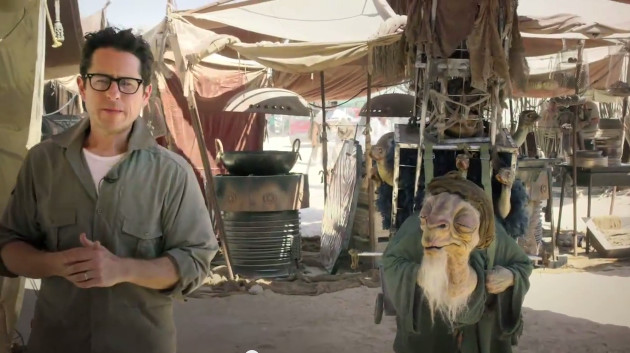 Admittedly, we're pretty stoked about the next instalment in the Star Wars saga -- specifically seeing the old cast back in action. J.J. Abrams announced the Star Wars: Force for Change initiative from Episode VII's set in Abu Dhabi this morning....



97 arrested in worldwide Blackshades cybercrime crackdown

Over 1,100 storage devices seized

Morning Static: GAME OF THRONES, THE COMEBACK, THE GOOD WIFE & More!
Read More
Microsoft announces its biggest tablet yet, the 12-inch Surface Pro 3; starts at $799
 When Microsoft invited us to a "small gathering" here in New York City, we thought that meant a smaller-screened Surface Mini was in order. Instead, the company just announced a larger Surface, the 12-inch Surface Pro 3. Like the previous Surface...
Watch 'Game of Thrones' mysteries explained (or disproved) with science
 Sure, works of fiction are hardly subject to the rules of science, but the folks behind It's OK To Be Smart set out to explain many of the enigmas surrounding Game of Thrones. In the PBS digital short that awaits after the break, topics like the...
Reinvented Father's Day Gifts For Extraordinary Dads

Every great dad deserves a great Father's Day gift. Trouble is, he's been around the block longer than you have--and isn't easily surprised. But if your dad is a Popular Science fan, as we suspect he is (why else would you be reading this?), then you've come to the right place. Here are some of the coolest, quirkiest, and nerdiest products we've seen cross our desks in the past year.

Russian Bluster Aside, What Will Become Of The ISS?

Russian deputy prime minister Dmitry Rogozin announced on May 13 that his country will end cooperation on the International Space Station after 2020. The comments spurred gloomy headlines: “Russia's retaliation could doom Space Station,” wrote one science news outlet, while NBC News ran with “Russia Makes Plans to Kill Space Station in 2020.”
What many accounts have missed is that the station's fate past 2020 has never been assured. The ISS, first launched in 1998, is nearing the end of its functional life, with many parts of the station's structure deteriorating after enduring decades of extreme heat and cold.
Left in orbit, it could turn into dangerous space junk. So the plan has long been to destroy the ISS by means of a controlled re-entry into the Earth's atmosphere and a crash into the ocean.
In 2010, the international station management team began advocating an extension of the International Space Station's operations from 2020 to 2028, a year that would coincide with the 30th anniversary of the launch and connection of its initial two sections, Russia's Zarya and the U.S.A's Unity. Earlier this year, the Obama administration approved an extension to 2024. It's unclear how either plan will fare, technologically or financially, if the Putin government makes good on its latest statements.
(This 2013 report from CBS News is well worth reading for its account of the challenges of keeping the International Space Station orbiting and operating safely into the next decade, as well as the station's engineering and multiple sections, which include two laboratories: Japan's Kibo lab, and the European Space Agency's Columbus lab.)
This isn't the first time Russia has loudly proclaimed a 2020 expiration date for the ISS. In 2011 a Roskosmos official said much the same, prompting Discovery News to write, "Space Station to Be Sunk After 2020." That may account for NASA's thus-far stoic response that the agency has not been formally notified of an end to American-Russian cooperation on the ISS.
But the current chill in Russia-U.S. relations, caused by the crisis in Ukraine, is what's spurring some of Rogozin's recent bluster, as evidenced by his tweet last week in response to new U.S. sanctions against Russia:
Проанализировав санкции против нашего космопрома, предлагаю США доставлять своих астронавтов на МКС с помощью батута
@Rogozin April 29, 2014
(Translation: "Having reviewed the sanctions against our space program, I suggest the U.S.A. deliver its astronauts to the ISS with the help of a trampoline.")
This rhetoric doesn't suprise James Oberg, author of the book "Red Star in Orbit: The Inside Story of Soviet Failures and Triumphs in Space," and noted space historian.
Rogozin is trying to revive the fading Russian space industry, says Oberg, which may also account for why a proposal to put Russian colonies on the moon by 2050 recently saw light in the pages of the newspaper Komsomolskaya Pravda. But in mentioning 2020 rather than next week, next month, or next year, says Oberg, the deputy prime minister is effectively admitting “that they need us as much as we need them.”
The U.S. is relying on Russia for transporting astronauts to and from the ISS for several years, and Russia's space station modules currently provide propulsion for the structure. But on board the station itself, Oberg says, Russia's sections and crew rely upon American-made and operated equipment for electricity and communications. Further, Russia's effort to to complete and launch its own science section is "years behind schedule," says Oberg, so it must rely upon the labs contributed by other nations.
No matter what happens with Russian space policy, Oberg is excited for the next decade of space science, which he believes will be shifting from a “CERN model” of multiple nations contributing to and collaborating at one research facility, to “the Antarctica model” of many smaller stations forming and ending cooperative efforts as the science requires.
If Russia does exit the ISS soon after 2020, he says, it will happen at about the same time that new "human-rated" spacecraft like SpaceX's Dragon come into use, and end Russia's current lock on crew transportation.
“The Ukraine crisis has not diverted the station's evolution into a new path,” Oberg says. “It may have put into sharper focus the different paths the station could follow, but that was happening anyway."
Click here to see more of Popular Science's coverage of the International Space Station.

The NSA is recording all cellphone calls in the Bahamas
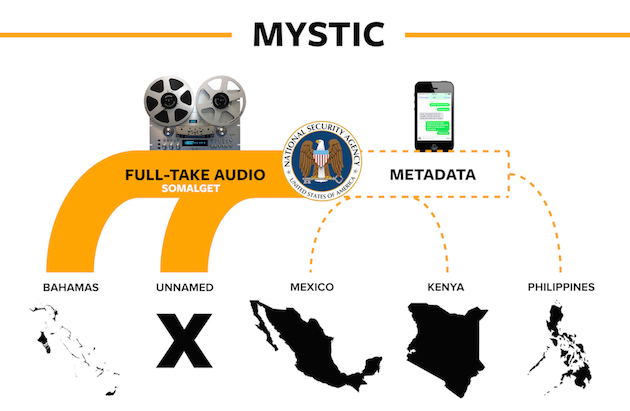 You might want to be careful of what you say over the phone the next time you visit the Bahamas. According to The Intercept, NSA documents leaked by Edward Snowden reveal that the security agency is not just listening to all mobile calls made to,...
'World's first' braille mobile phone goes on sale in the UK
 Touchscreens may have kicked-off a mobile computing revolution, but they didn't do much for the visually impaired. OwnFone, which launched a customizable mobile phone for kids and the elderly back in 2012, is now offering its stripped-down handset...
The Human Equation Theater Experience - Coming In 2015, Pre-Registration Starts Today
A Serious Talk

Here’s more quality parenting.
Product launch

by @m_uysl
What is the MERS virus, and is it going to kill us all?
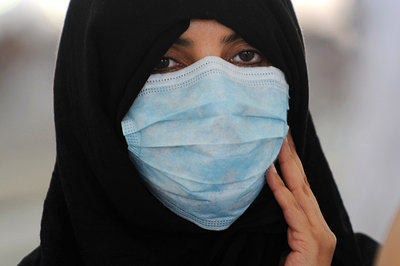
A mysterious illness known as MERS might turn into the next global pandemic. Or it may fizzle out. For now, public health experts are keeping a close eye on the situation — but they haven't declared an emergency yet.
MERS has already killed 173 people across nineteen countries
Middle East respiratory syndrome, or MERS, was first discovered in 2012 and has a surprisingly high death rate. There have already been 572 confirmed cases and 173 deaths across 19 countries. The majority of the illness has been concentrated in Saudi Arabia.
This week, a second case of the viral disease was identified in the United States, shortly after the first was found earlier this month. (Both were health-care workers who had recently been in Saudi Arabia.) The discovery came after a sudden jump in cases in Saudi Arabia this spring.
The origins and characteristics of MERS are still quite enigmatic. The virus might fade away into oblivion or mutate into a monster. Here's a rundown of what we know so far:
What is MERS?
First off, MERS is not MRSA — the antibiotic-resistant bacteria that's somewhat common in US hospitals.
MERS — or Middle East respiratory syndrome — was first identified in Saudi Arabia in 2012. It's caused by a virus called MERS-CoV. Patients with MERS end up with symptoms like coughing, fever, and shortness of breath.
Although MERS doesn't appear to be exceptionally contagious, public-health experts have been tracking it closely because the disease has such a high death rate. So far, about one-third of the people with confirmed cases have died. The majority of MERS has been in Saudi Arabia, although it's spread to 18 other countries, including two recent cases in the US.
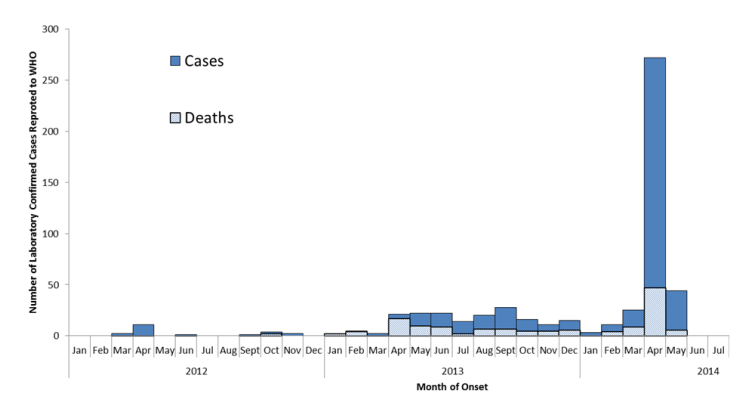
There was a sudden spike in MERS cases this spring. WHO
How bad is the situation?
The World Health Organization (WHO) is watching the disease closely and has convened an emergency committee on the threat, which has met five times since July, 2013.
But, so far, the WHO has yet to declare a global health emergency (Public Health Emergency of International Concern) — the way it did for swine flu and polio in recent years. (Declaring such an emergency would allow the organization to make recommendations such as travel or trade restrictions or that people feeling ill delay any international trips.)
So what does it mean? It means that MERS could conceivably get really, really bad. But it's not really, really bad yet.
Where is MERS?
More than a dozen countries have confirmed cases so far, including the US. However, most of those people originally caught the virus in Saudi Arabia. (Also, many of those countries don't have anyone who's sick anymore. Oftentimes it's an isolated event. That person then gets better and never infected anyone else.) This map shows where people have been picking up the illness:
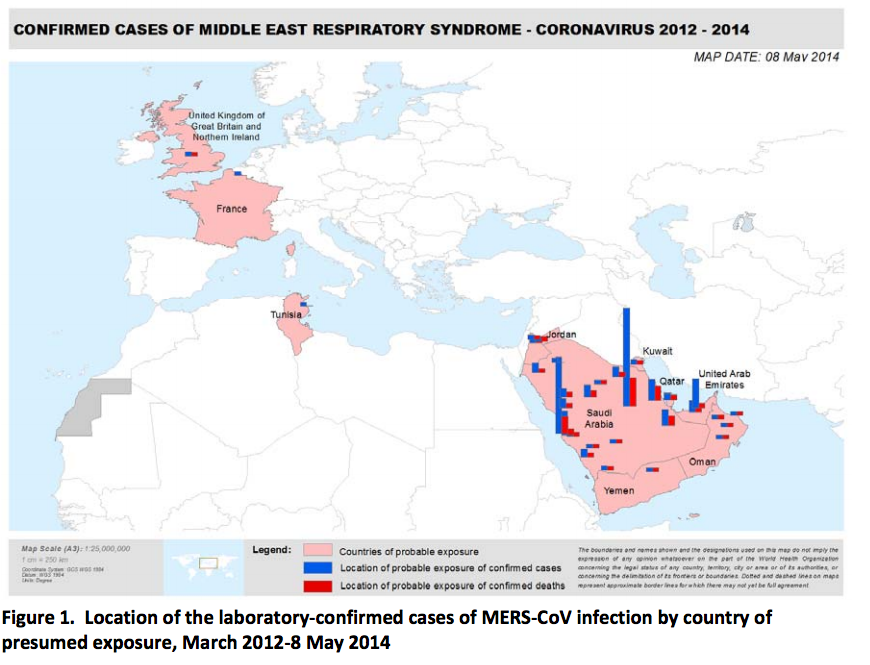
The majority of people with MERS caught it in Saudi Arabia. WHO
Where did MERS come from?

Dromedary camel. UIG via Getty Images.
No one is quite sure. So far, evidence of the MERS-CoV virus has been found in bats and dromedary camels (the one-hump kind). It's unclear if the virus actually makes these animals sick, although they could still transmit it either way.
There are millions of camels in the Middle East, where they're used for meat, milk, and racing. It's possible that MERS has been jumping from camels to livestock workers or to people who have eaten raw camel milk or meat. But even that's unclear. Although some MERS cases have appeared in people who work with camels, many others haven't.
Am I going to get MERS?
Right now, the risk is pretty low. But that could conceivably change if the virus mutates.
MERS currently seems to have a pretty low transmission rate — lower than both the flu and SARS. Casual contact — like being on the same plane flight — doesn't seem to be enough to spread the disease. Most documented cases are of people who have been living with or caring for someone with MERS — and those are the only people that the Centers for Disease Control and Prevention says are at risk. (Many cases in Saudi Arabia are spreading within hospitals.)
MERS currently has a fairly low transmission rate
Here's a picture of how hard it is to spread: after the first confirmed case of MERS in the United States, public-health officials tracked down and tested more than 500 people whom that patient had come in contact with. None of them have turned up positive.
That's why the CDC says that the two cases of MERS in the United States currently "represent a very low risk to the general public in this country." The agency doesn't even recommend that anyone change their travel plans — even if they're going to Saudi Arabia. However, it does recommend that travelers to the Arabian Peninsula take general precautions like washing your hands and avoiding people who are sick.
There is one catch, however: viruses can — and do — mutate. The MERS virus is mutating much less slowly than, say, the flu virus, but you never know what a random mutation might bring.
If I get MERS, will I die?
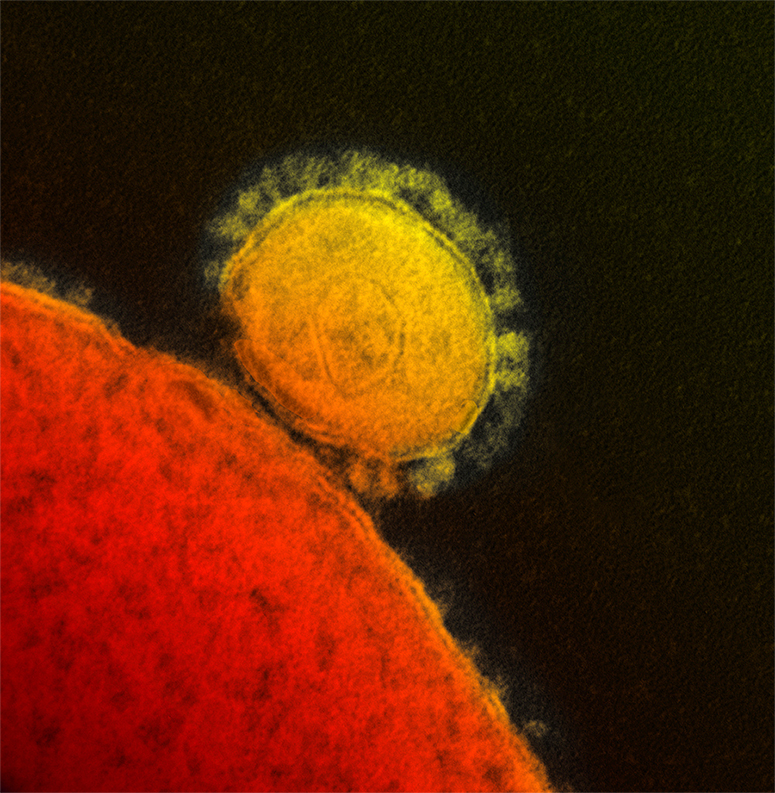
MERS coronavirus. National Institute of Allergy and Infectious Diseases (NIAID)
Calculating an actual death rate for MERS is currently impossible because there isn't enough surveillance to know exactly how many people have been infected with MERS.
The World Health Organization reports at least 572 confirmed cases of MERS, about a third of which have been fatal. (The official death rate for SARS was about 10 percent, which gives you an idea of why experts are concerned about MERS.)
However, there could be many people with MERS and mild symptoms who never appear at a hospital, never get screened, and never get diagnosed. As surveillance increases and more doctors know to test for MERS, the apparent death rate might go down. (In fact, this may already be happening.)
To sum up: these numbers don't mean that an individual person's actual chance of dying is one in three. No one knows what that actual number is.
What happened to the people with MERS in the US? Did they die?
As of May 15, one has been released from the hospital and is fully recovered. The other is in the hospital and doing well.
What's the treatment for MERS?
There's currently no treatment specifically for MERS and no vaccine for it, either. If people do create a vaccine, there's a good chance they will give it to camels (just like they currently vaccinate poultry for bird flu).
Why are there all of these terrible viruses lately?
Experts point to several possible reasons that could all be contributing to the rise. As the human population grows, we've been physically expanding into other animals' territories. This proximity could be increasing viruses jumping from animals to people.
What's more, once a virus is around people, increased air travel gives it a better chance to spread across the globe.
Also, public health officials have been making a bigger effort to track these kinds of viruses lately (especially after the SARS outbreak in 2002–2003) — so part of the increase may be that they're discovering more about what is out there.
Further Reading:
For a view of MERS at the front lines in Saudi Arabia, check out this recent Q&A with virologist Christian Drosten.
From Laurie Garret writing in Foreign Policy, a different perspective inside Saudi Arabia.
For the patenting of the MERS virus, try this news review in ScienceInsider and this piece by law professor David Fidler in Foreign Affairs.
For how to wrangle a feisty, ornery camel to test it for MERS, scroll down to the bottom of this New York Times story.
Latest Snowden leak reveals the NSA intercepted and bugged Cisco routers
 As promised, the release of Glenn Greenwald's new book, No Place to Hide, has brought plenty more Snowden leaks, and one document is particularly mind-blowing. The photo above shows an NSA team intercepting and bugging a Cisco router before it's sent...
Air Force Prepares to Dismantle HAARP
Don't worry, the Pentagon's got a plan to deal with a zombie apocalypse
 What would happen if the plot of The Walking Dead, or any other TV show with "Dead" in the title, came true? It turns out that the Department of Defense already has a plan for that, in a folder marked CONOP 8888 Counter-Zombie Defense. The document...
The Top Patent-Holders In The U.S. [Infographic]

This article originally appeared in the May 2014 issue of Popular Science.
