Read more of this story at Slashdot.

Corvus.coraxmight want to check your macs duders-
"Unfortunately, the researchers didn't mention how the malware spreads, but they shared that it is unpacked into the /Library/Application Support/JavaW directory, poses as the application com.JavaW, and sets itself to autostart."
Read more of this story at Slashdot.
Corvus.coraxI scoff at the minimum volume listed- as if hop content were a constant by volume!
Perhaps also a reason to experiment with hop teas brewed with my homegrown harvest?
Read more of this story at Slashdot.

Corvus.coraxI can't say I appreciate all of the author's religious/biblical undertones and using the word "magically" to describe the jump to multi-cellular life, but Musk is certainly fascinating.

‘Fuck Earth!’ Elon Musk said to me, laughing. ‘Who cares about Earth?’ We were sitting in his cubicle, in the front corner of a large open-plan office at SpaceX headquarters in Los Angeles. It was a sunny afternoon, a Thursday, one of three designated weekdays Musk spends at SpaceX. Musk was laughing because he was […]
The post Exodus appeared first on Aeon Magazine.
Corvus.coraxwas thinking this would be a good reason to read the book, but maybe I want to be surprised at the movie...
Boyz? shall we plan to venture out for this one?

Corvus.corax#skipmarsgototitan
Read more of this story at Slashdot.

Corvus.coraxI am not surprised. I deleted my user account a few months ago (even though i never uploaded any music) when they sent an email with lots of ominous sounding legalese in it. My legal status as a simple streaming user was somewhat ambiguous so i got out. It's been hard to stay away however.
Read more of this story at Slashdot.

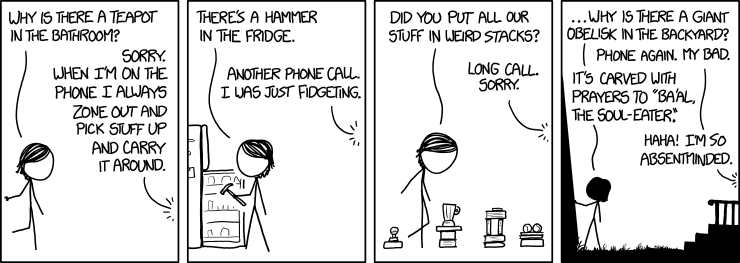
Corvus.coraxwhile i don't build prayer obelisks, I definitely move things around the house when working from home and making calls (partly because I always get up for calls per a healthy living tactic)
Corvus.coraxThis is one story that's begging for an artist's rendition, so click on this link for the source article and get a somewhat satisfying one:
http://motherboard.vice.com/read/astronomers-found-a-unique-star-system-40-years-after-it-was-first-theorized
The universe is so spectacular, as are the intelligent beings who can theorize something like a TZO in 1970 and find a real one in 2014.
Read more of this story at Slashdot.

Corvus.coraxsilos on hwy 55 in mpls anyone?

Photo by roaming-the-planet

Photo by roaming-the-planet


Photos by roaming-the-planet


First a Boeing 747, and now an industrial complex on a Vancover island; it seems no canvas is too large for Brazilian graffiti artists Os Gemeos who were invited to the Vancouver Biennale to turn six multi-story silos on Granville Island into their trademark ‘Giants.’ The murals on the 70-foot towers are now the largest paintings ever attempted by the pair, an astounding feat considering Os Gemeos completely donated a month of their time to create the non-profit art project. An Indiegogo fundraising campaign to recoup costs associated with painting the silos has been extremely successful. You can see more over on Arrested Motion.
Corvus.coraxI half expected to see a picture of my great grandfather Hans in one of these pictures- he was a sailor on an U-Boat in WW1. Makes it seem rather recent.

World War I was shaped by the new vehicles developed during the four years of conflict. A century after the start of the war, we’re looking back at the most remarkable vehicles—the planes, cars, tanks, ships, and zeppelins—it helped bring about. For British merchant vessels operating during World War I, few things were so terrifying […]
The post How WWI’s U-Boats Launched the Age of Unrestricted Warfare appeared first on WIRED.

Corvus.coraxgreat book. when can we discuss it Lev?
“The Woman Who Lost Her Soul,” an epic about America’s unbridled military ambitions, has won this year’s Dayton Literary Peace Prize for fiction. In their announcement of the $10,000 award this morning, the judges said that novelist Bob Shacochis “creates an intricate portrait of the catastrophic events that have led to an endless cycle of vengeance and war between cultures.”
Read full article >>
Corvus.coraxCan't say I've ever seen this before:
"Warning! The following article is from The Great Soviet Encyclopedia (1979). It might be outdated or ideologically biased."
Click the link to see what I mean.
[I was trying to find a pronunciation guide for the word epizoochory]
the transport of the seeds or fruits of plants on the surface of animal bodies (hairs, feathers, paws). In the course of plant evolution, the following adaptations have been developed to ensure epizoochory: mucus secreted by cells of the seed coat (flax, plantain, many crucifers), sticky glandular hairs on fruits (twinflower, nightshade), holdfasts and thorns on fruits (alfalfa, hound’s-tongue), calyxes (marigold, Labiatae), and lemmas (Tragus).
Corvus.coraxseamless indeed- looks like he painted them.
also nice reference to Philip K. Dick and Blade Runner


About 3 months ago photographer Dan Tobin Smith set up a website to ask the public to donate kipple: junk that was lying around their house. “It’s time to free yourself of the pointless or unused objects in your life,” read the plea. “Give them a purpose as part of Dan Tobin Smith’s installation for the London Design Festival 2014.”
Sure enough, the donations began coming in and in no time at all Smith had enough junk on his hands to create a sprawling installation that filled an entire floor and mezzanine, “carpeting 200-square-metres with a dense, precise, chromatically-themed arrangement of thousands of objects.” The objects are so carefully placed that gradients seem to blend together seamlessly.
The fictional word Kipple was coined by science fiction writer Philip K Dick. Kipple appears in his 1968 novel “Do Androids Dream of Electric Sheep” (the film adaptation was Blade Runner) and is used to describe useless, pointless stuff that humans accumulate. It served as the inspiration for Smith’s installation “The First Law of Kipple,” which was part of London Design Festival this month. (via Creative Review)
Corvus.coraxreminds me a bit of the donny darko soundtrack
From the wsj piece: "The result is a score composed of lilting, haunting synths interspersed with doleful piano melodies and accentuated by the orchestral arrangements."
http://online.wsj.com/articles/david-fincher-turns-to-trent-reznor-and-atticus-ross-for-gone-girl-soundtrack-1409845014

Corvus.coraxlolita is on my shelf right now.
would not recommend madam bovary

"I love reading, but there's just no time!"
Chances are good you've heard this excuse or maybe even used it. It's not a bad excuse, either: reading does take time, and sometimes, it takes lots of it. Unlike Twitter and Facebook, literature worth reading doesn't offer quaint tl;dr summaries. It may be time to implement a strategy to help you get to those books you've been putting off for the past 17 years.
It might be good to start by planning out your reading by the length of time it will take you to finish a book. A nifty infographic from Personal Creations can help here. The website calculated the hours it takes for an average reader — which they define as reading 300 words per minute — to finish 64 of the world's most popular books
Shakespeare's All's Well That Ends Well will take you just under two hours, which is about the length of a romcom you might watch on Netflix. The Great Gatsby and A Wrinkle in Time will both take you less than three hours. Some books, like Jonathan Swift's Gulliver's Travels, will require a slightly longer commitment (six hours), and some, like Gone With the Wind, will require almost an entire day to read.
Here's the infographic to help you plan your literary schedule. Happy reading!

How long to read books (Personal Creations)
(H/t Shortlist)
Corvus.coraxHell yes: "There are no Skrillex-style bass drops, no trap beats, no Sam Smith guest spots."
listening now on grooveshark- and digging it.
I'm really effing tired of skrillex bass drops.


Read more of this story at Slashdot.

Corvus.coraxradiohead news autoshare

Corvus.coraxweirdly the reader bookmarklet posted the transcript of the video. Watch for the unusual transition to the interview, and for colbert's customary awkward interview style.
(CHEERS AND APPLAUSE)>> STEPHEN: WELCOME BACK,
EVERYBODY!
MY GUEST TONIGHT IS AN ACCLAIMEDFILMMAKER WHO GOT HIS START WITH
MONTY PYTHON'S FLYING CIRCUS,AND NOW HE DOES SOMETHING
COMPLETELY DIFFERENT.
PLEASE WELCOME TERRY GILLIAM!
♪♪(CHEERS AND APPLAUSE)
>> STEPHEN: I'M A HUGE FAN!
I LOVE YOU, STEVE CARELL!
>> OH, OH, AHHH!
>> HOW DO WE LOOK?
(LAUGHTER)♪♪
(LAUGHTER)♪♪
(LAUGHTER)♪♪
>> WHOO!
(CHEERS AND APPLAUSE)WHOO!
(CHEERS AND APPLAUSE)>> STEPHEN: TERRY!
HEY!
THANKS FOR COMING ON!
>> THANK YOU!
>> STEPHEN: THANK YOU FORBEING HERE TONIGHT AND WEARING
WHAT I ASSUME IS YOUR FORMALBATHROBE.
>> MM-HMM.
YES.
>> STEPHEN: TERRY, GOOD TO SEEYOU.
>> IT'S GOOD TO BE IN THE TEMPLEOF COLBERT.
>> STEPHEN: THANK YOU SO MUCH.
I'LL TAKE THE EXTRA T.
I'M SAVING THEM AND SENDING THEMOFF TO THE FRENCH COUNTRIES
THAT NEED THEM. IN YOUR MOVIESLIKE "BRAZIL" AND "12 MONKEYS"
AND IN THIS ONE CALLED "THE ZERO
THEOREM," THE FUTURE IS NOT THEHAPPIEST PLACE IN THE WORLD.
WHY DO YOU SEE THE FUTURE ASBLEAK?
MAYBE THINGS ALL WORK OUT IN THEFUTURE.
>> HAVE YOU WATCHED THE FILM?
>> STEPHEN: I SAW 40 SECONDSOF IT.
>> THAT'S ENOUGH.
EXACTLY.
IT'S WHAT I SUSPECTED ALL ALONG.
I HAVE BEEN BROUGHT HERE, AND ASYOU SEE THE WORKS, THE OEUVRE
>> STEPHEN: I DON'T SPEAKSPANISH
IT'S THE WAY THE FRENCHPRONOUNCE "COLBERT."
SO I THOUGHT YOU'D BE FAMILIARWITH THAT.
>> STEPHEN: WHY DON'T WE SHOWTHE AUDIENCE A LITTLE BIT OF IT.
>> IF YOU WISH
>> STEPHEN: I DON'T PARTICULARLY(LAUGHTER)
THANK GOD THERE'S INTELLIGENTPEOPLE IN THIS AUDIENCE
THAT WANT TO KNOW THE TRUTH
>> LET'S SEE A LITTLE BIT
IT'S THE "THE ZERO THEOREM."
>> THANK YOU.
♪♪(INDISCERNIBLE TALKING)
♪♪(INDISCERNIBLE TALKING)
♪♪(INDISCERNIBLE TALKING)
>> STEPHEN: WILL I BE SAD WHEN
I LEAVE THE MOVIE?
>> YOU WILL.
BUT YOU WILL LAUGH BEFORE YOU'RESAD.
YOU WILL GO THROUGH ALL THEEMOTIONS LIFE CAN GIVE US.
>> STEPHEN: WILL I BE ASADDER, BUT WISER MAN?
>> WIDER, SADDER, BUT WHEN YOUREFLECT ON IT LATER, YOU WILL
REALIZE YOU SAW TRUTH ANDYOU'RE A MAN WHO BELIEVES IN
TRUTH.
>> STEPHEN: I BELIEVE IN MYTRUTH (LAUGHTER)
MY TRUTH IS IS THE TRUTH THAT IWISH TO BE TRUE, NOT WHAT
THE FACTS SUPPORT.
I DON'T WANT TO BE SADDER ANDWISER, I WANT TO BE HAPPIER AND
DUMBER.
>> NOW YOU UNDERSTAND WHY IHAVE RENOUNCED MY AMERICAN
CITIZENSHIP.
>> STEPHEN: BECAUSE YOU DON'TWANT TO BE A HAPPY IDIOT?
>> YES!
I THINK YOU PUT IT BEAUTIFULLY(LAUGHTER)
I DON'T NEED TO SAYANYTHING. (APPLAUSE)
>> STEPHEN: I NOTICED A THEME.IN BRAZIL, IT WAS
BIG GOVERNMENT.
>> YES.
>> STEPHEN: YOU SEEM MOREAFRAID OR THREATENED BY
CORPORATIONS.
>> I THINK WE OUGHT TO.
I THINK YOU MIGHT EVEN AGREEWITH ME ON SOME OF THIS.
>> STEPHEN: PROBABLY NOT.
>> STEPHEN, STEPHEN...
>> STEPHEN: TELL THE PEOPLEWATCHING THIS GREAT VIACOM
PROGRAM WHY CORPORATIONS ARE BADRIGHT NOW.
(LAUGHTER)>> I THINK WE'VE GOT TO REACH
ACROSS THIS GAP THAT'SSEPARATING US.
LET'S HOLD HANDS AND THINKTOGETHER.
>> STEPHEN: OKAY.
>> CORPORATIONS -->> STEPHEN: CORPORATIONS, YES,
THEY'RE PEOPLE.
>> THEY MAKE US HAPPY.
>> STEPHEN: THEY DO BECAUSETHEY PROVIDE THINGS LIKE THIS.
THIS BEAUTIFUL THING.
>> EXACTLY.
>> STEPHEN: THIS IS ABEAUTIFUL THING OF THE FUTURE.
OH, OKAY.
YES, THAT OLD THING!
(APPLAUSE)(LAUGHTER)
YOU'VE GOT TO GET YOURSELF A NEWGIRL!
>> THIS ONE DOESN'T HAVE THEUNSIGHTLY BULGE IN THE TROUSERS.
IT'S THE OLD ONE.
>> STEPHEN: OH REALLY?
BUT THIS ONE MAKES ME LOOK HAPPYTO SEE YOU.
(LAUGHTER)IN THE MOVIE, CHRIS OWNS --
>> HE OWNS NOTHING.
HE'S A MAN WHO WORKS FOR ACORPORATION.
HE'S INCREDIBLY SKILLED AT THECOMPUTER ACTIVITY.
>> STEPHEN: I THOUGHT HE WASPLAYING TWO PIANOS AT ONCE.
>> HE CAN DO THAT AS WELL.
HE'S AN ACTOR, A CHARACTER ANDBRILLIANT PIANIST IN PRIVATE
LIFE.
BUT WE'RE NOT TALKING ABOUTTHAT.
WE'RE TALKING ABOUT THE MOVIE.
HE'S A COMPUTER GENIUS AND HEHAS A TASK OF SOLVING THE ZERO
THEOREM TO PROVE EVERYTHING ISMEANINGLESS.
ALL IS NOTHING.
>> STEPHEN: MAYBE NOTHING ISALL.
>> GLASS HALF FULL, HALF EMPTY.
>> STEPHEN: MAYBE HALF FULL.
MAYBE FULL OF URINE AND YOUWOULDN'T WANT TO DRINK IT
(LAUGHTER)>> YES.
BUT THAT'S HIS TASK.
THE PROBLEM IS HE'S ANTISOCIAL.
HE'S NOT A SOCIAL NETWORKER.
HE TRIES TO DISCONNECT FROM THATAND WORK AT HOME LIKE SO MANY OF
US DREAM OF.
>> STEPHEN: IS THIS AUTOBIOGRAPHICAL?
DO YOU LIKE PEOPLE, TERRY?
>> WHAT I LIKE TO CALL IS POSTOR PRE-POST AUTO BIOGRAPHICAL.
PRE-POST-AUTO BIOGRAPHICAL.
IS THAT ON THE ASPERGER'S SCALE?
(LAUGHTER)>> THERE YOU GO.
AS A DIRECTOR, I HAVE TOIDENTIFY WITH MY MAIN CHARACTER.
OTHER WISE, HOW CAN YOU ANSWERTHE QUESTIONS.
DURING THE MOVIE, WE LAUGHED ALOT AND MADE JOKES.
IN THE END, I FOUND I HAD BECOMETHE CHARACTER CHRISTOPH PLAYED
SO BRILLIANTLY IN THE FILM.
I LOVE MY COMPUTER.
MY WIFE HAS BEGUN TO QUESTION MYSEXUALITY.
>> STEPHEN: THAT OUTFITDOESN'T HELP.
(LAUGHTER)>> HER OSHKOSH DUNGAREES, WE
BALANCE.
I THINK IT'S GOOD FOR MEN TODISCOVER THEIR FEMININITY AND
WOMEN TO DISCOVER THEIRMASCULINITY. THERE'S NOTHING
WRONG WITH IT IF YOU'RECONFIDENT.
>> STEPHEN: AS LONG AS YOUHAVE A SAFE WORD.
PUMPKIN PATCH, TERRY.
PUMPKIN PATCH.
>> I DON'T WANT TO PUSH YOUHERE.
>> STEPHEN: YOU'RE NOT PUSHINGME AT ALL., I'M UNPUSHABLE.
MY CHI IS SO STRONG I CAN'T BEPUSHED.
>> THE POINT IS WILL YOU AND CANYOU BE COMFORTABLE WEARING
WOMEN'S CLOTHING?
>> STEPHEN: TERRY, I WISH IHAD TIME TO SHOW YOU.
I'M VERY COMFORTABLE WEARINGWOMEN'S CLOTHING.
>> 811, TRIBECA GRAND HOTEL.TALK TO YOU LATER
(LAUGHTER)>> STEPHEN: TERRY GILLIAM,
"THE ZERO THEOREM" OPENSTOMORROW!
WE'LL BE RIGHT BACK!
Corvus.coraxah explanations!
this is something I tell kids who visit my work when we're touring the solar array. they all know einstein and are surprised to learn he got the nobel for describing the photoelectric effect.
Albert Einstein never won a Nobel prize for the theory of relativity—in fact, it was only through long, political jockeying within the Nobel committee that he won the prize at all. Instead, when he was given the 1921 Nobel Prize in Physics (in 1922, after a long bout of internal Nobel hand-wringing), he received it primarily for his explanation of the photoelectric effect. Extraordinarily enough, he came up with both his relativity theory, and the photoelectric effect in the same year: 1905.
At the turn of the century, physicists already knew that, in some circumstances, exposing certain materials to light could create an electric current. An American named Charles Fritts had even created a working solar cell from selenium more than two decades before, in the early 1880s.
But observing that light can create electricity is not the same as understanding why light can create electricity. That was baffling.
It was understood, at that point, that light worked as a wave. But if that was true, it didn't make any sense that light could create an electric current: A wave of light just wouldn't have enough energy to cause materials like selenium to shoot off electrons as fast as they did when exposed to light.
In 1905, Einstein was 26 and producing physics papers that would change the way we think about the world for decades to come. He wasn't quite the wild-haired celebrity yet:
But in a paper published in March 1905, Einstein suggested that, perhaps, light wasn't a wave. Phenomena like the photoelectric effect, he wrote,
are more readily understood if one assumes that the energy of light is discontinuously distributed in space. In accordance with the assumption to be considered here, the energy of a light ray spreading out from a point source is not continuously distributed over an increasing space but consists of a finite number of energy quanta which are localized at points in space, which move without dividing, and which can only be produced and absorbed as complete units.
In other words, light could create electricity if it behaved, sometimes, like a particle rather than a wave. (This should sound familiar to anyone who remembers physics class.)
Only one section of the paper covered the photoelectric effect, but it outlined how a light particle might deliver enough energy, all at once, to knock an electron off an atom and create an electric current. This, it turned out, was easier to show experimentally than some of the other ideas Einstein had outlined. Within a decade Robert Millikan had verified, experimentally, the equation that Einstein had used to describe the photoelectric effect.
The idea that Einstein described in 1905—that won the Nobel Prize a decade and half later—is what makes today's solar panels work at all. But it wasn't until 1954—almost 50 years later—that anyone was able to make a solar cell that created enough current to actually run electrical equipment. Just as there's a gap between observing something and knowing how it works, there's a gap between knowing how something works and being able to do anything useful with it.
This article was originally published at http://www.theatlantic.com/technology/archive/2014/09/einstein-didnt-win-a-nobel-for-relativity-he-won-it-for-this/380451/

Corvus.coraxtake that, Yelp
Read more of this story at Slashdot.

Corvus.corax" trying to understand what happens in the brains of people who see the face of Jesus in a piece of toast."
", for carefully documenting that when dogs defecate and urinate, they prefer to align their body axis with Earth's north-south geomagnetic field lines.
(look at the list of authors on that one- 12!
"for measuring the relative pain people suffer while looking at an ugly painting, rather than a pretty painting, while being shot [in the hand] by a powerful laser beam."
Truly advancing human frontiers of knowledge
Read more of this story at Slashdot.

Corvus.coraxmore minnesota haters over at Vox.
"...agreeing to take in a baby — only to learn that baby is an orangutan. Presumably, this happened all the time in late-1800s Minnesota"

The TV series Little House on the Prairie turned 40 this year. Some might date its debut to the airing of its pilot (a made-for-TV movie) in March of 1974, but the first regular airing of the show, which would run nine seasons, came on Sept. 11, 1974. The show was a massive hit for NBC, at a time when the network was in need of hits; even by the time it was canceled, it had yet to fall out of the Nielsen top 30. Based on Laura Ingalls Wilder's novels, it was one part coming-of-age series, one part small-town show, and one part Western in the vein of something like Gunsmoke.
It was also, particularly as it got older, completely bugnuts.
The books Little House was based on weren't terribly easy to adapt for television at the time — particularly since its protagonists, the Ingalls, were always moving around. The series took a few incidents and ideas from Wilder's writing, but for the most part, it started constructing its own world more indebted to ‘70s and ‘80s TV drama than anything else.
And it loved melodrama. Loved it. It never missed an opportunity to tell a story that involved as much weeping and misery as it could muster. And as it got older, that love of melodrama combined with the general lack of stories any TV show faces in its old age — and the show just completely lost its mind.
Here are nine episodes of Little House that will remind you what a whacked-out masterpiece this could be, and display just how frequently TV shows used to run out of plotlines about three seasons in.
Were there crazy episodes on this show prior to the season five premiere? Sure. But this two-parter — in which the vast majority of the show's characters just up and move to a new town, because why not? — is where things started to spin off their axis. Yeah, pioneers would occasionally follow the gossip of those they had once known to new towns. But rarely did they do so in what amounted to late '70s caravan road trips. Even odder: everybody would be back in the show's more familiar setting of Walnut Grove, Minnesota, within a few episodes.
Episodes where the characters took incredibly unrealistic road trips, like they were the Brady Bunch or something, were surprisingly common. In this one, Laura helps a dying boy fulfill his wish of seeing the ocean by hopping a train. Along the way, she receives some help from William Randolph Hearst.
Another thing that was always happening on this show: the circus coming to town. In this one, Nels Oleson goes to the circus, only to find out the morbidly obese sister he's always been ashamed of is its fat lady. It has a reasonably sweet conclusion (and plays into the show's general calls for tolerance), but it's hard to imagine what writers' room discussion possibly led to this storyline.
Little House did a surprising number of horror-themed episodes, particularly ones where somebody dresses up like a monster, as though they were a cut-rate Scooby Doo villain. But this one — which involves young Albert dreaming he's somehow confused for an Indian — takes the cake, both for sheer oddity of its existence and utter lack of racial sensitivity.
This is the one that seems have left psychological scars on most Little House fans. The series' star Michael Landon had long written and directed many of its episodes, and it's evident he wanted this one to be a serious discussion of sexual assault. But by putting the rapist in a creepy mime mask and masking his identity, Landon inadvertently created a Little House slasher movie homage.
Little House was both obsessed with the Judeo-Christian notion of God and with orphans. Ma and Pa Ingalls took in more and more of them over the years, as their girls aged out of being cute, telegenic children. In this one, a young boy who's been living with the Ingalls is accidentally shot in a bank robbery, and then Pa takes him out into the woods to place him on an altar and demand God heal him. Even weirder: this was Landon's last episode on the series as a regular.
There's a boy who's been imprisoned in a cage and is brought to Walnut Grove by a peddler selling magical elixirs? Sure. That sounds like two full episodes of this show.
One of the last episodes ever to air, this one features Mr. Edwards, gregarious pal of the Ingalls clan, agreeing to take in a baby — only to learn that baby is an orangutan. Presumably, this happened all the time in late-1800s Minnesota. Or someone on the writing staff had just seen Every Which Way But Loose.
The greatest thing Little House ever did was end its run with a two-hour, made-for-TV movie (the last of a handful of specials produced after the show's cancellation) that concluded with the residents of Walnut Grove blowing up their town with dynamite, rather than let an unscrupulous developer get hold of their homes and buildings. Because now, presumably, he can't build anything else on the land? It seems they didn't really think this one through. (And NBC didn't either, actually airing this special second to last in the series run.)
Much has been gained from TV shows having shorter runs — on both a season and series level — but we've also lost the days when those shows just needed to fill out their episode orders with any old thing they could think of. And, look, that's great and all, but isn't a little part of you sad we'll never get an episode of Mad Men where Don Draper has to care for an orangutan?
Corvus.coraxsuch an intriguing world this dark web.

Evolution’s popularity has been driven not only by a more secure and professional operation than its competitors, but also by a more amoral approach to the cryptomarket than the strict libertarian ethos the Silk Road preached.
The post The Dark Web Gets Darker With Rise of the ‘Evolution’ Drug Market appeared first on WIRED.

Corvus.coraxi'm impressed by this. the guy on the les paul with the bluesy solo was a nice touch.
Give it Up is a new track released yesterday by Israeli musician and composer Kutiman. The song was created entirely using vocal and instrument tracks lifted from 23 different YouTube videos of mostly amateur musicians, credited here. If you liked this, you’ll be happy to learn this is just the first track off his upcoming album Thru You Too which the artist says will be comprised entirely of unrelated YouTube videos.
In other composing-music-with-videos news, Andrew Huang created a version of the 80s hit 99 Red Balloons… using only red balloons. Included here for your listening pleasure.
(via Adam Savage)
Corvus.coraxnice twist on the classic
This slick commercial for Japanese high-speed optical internet service au Hikari has a pretty novel take on the Rube Goldberg Machine. Each sequence in the device is powered (or otherwise set in motion) by a single beam of light sent through magnifying glasses and mirrors to burn strings, pop balloons, and melt bits of ice. Even if you’re Rube Goldberg’d out lately, this is worth a watch. (via The Kid Should See This)
Corvus.coraxDigging Lerche's latest, and I love the first listen feature on NPR. Stream it today at work and enjoy his whimsical melodies.
The wife and I saw a show at the Fitz last winter that included him and he was definitely the highlight (with Polica's Channy a close second).
For more than a decade, Norwegian-born singer-songwriter Sondre Lerche has made pop music his primary weapon in a full-frontal charm offensive. A slyly charismatic presence, he sings with an air of playful whimsy — it's no mistake that he was cast to write and perform the songs in the lightly melancholy 2007 romantic comedy Dan In Real Life — even when his subject matter veers into love's sordid underbelly and aftermath.
An expert, jazz-trained guitarist and renowned stage-banterer, Lerche can tiptoe right up to the line separating amiability from preciousness, but he's long since perfected the art of staying on the correct side. Plus, as fizzy and friendly as he can sound, his songs spit acid when necessary. On Please, his seventh studio album, the kiss-off song "Lucifer" hits unusually hard — as hard as the menacing funk into which the similarly misanthropic "Bad Law" ultimately descends.
Lerche gets sweeter — and certainly more bittersweet — in "Lucky Guy" and elsewhere, even as he sings, "I'm no sentimentalist" (in "Sentimentalist"). But Please finds Lerche sharpening his edges throughout: This is, after all, his dreaded divorce album, inspired by his own recent experiences. The singer hurls blame fairly evenly, and omnidirectionally, in many of these 10 songs. But, more importantly, his personal losses and failings come re-purposed in an album that's loose, feisty, energetic, and fully recharged — the work of a guy who understands that tearing down doesn't do much good if you don't bother building something better.
Corvus.coraxcreepy. the french gun gif was the most startling.
Starting this month Verizon FiOS customers can get upload speeds every bit as fast as their download speeds. Since that means faster, easier sharing of high-res illustrations, designs, and photos, FiOS is sponsoring a series of posts on Colossal to help us commission and share these super hi-res animated GIFs from some of the most amazing artists we could find.


Art director and designer Kevin Weir uses historical black and white photographs forgotten to time as the basis for his quirky—and slightly disturbing—animated GIFs. His path to online GIF superstardom began when he was in high school. He tells us that “my parents’ boss bought me a copy of Photoshop and I decided I wanted to be some kind of designer.” Having mastered the software, he found himself five years later “making black and white GIFs as a way to occupy myself during the downtime of an internship I had during grad school.” He shared the images on his Tumblr, Flux Machine where they quickly went viral.
Weir makes use of photographs he finds in the Library of Congress online archive, and is deeply drawn to what he calls “unknowable places and persons,” images with little connection to present day that he can use as blank canvas for his weird ideas. Perhaps it’s the nature of his imagination, or maybe a result of the medium’s limited frames of animation to communicate anything too serious, but despite the creepiness factor, it’s hard to not to smile at the absurdity of his ideas.
Weir is now an art director at Droga5 in NYC, he also also animates music videos and sassy birds.


Corvus.coraxthinking about litter art for a work program series


For the past few months Portuguese artist Bordalo II (previously) has been stalking the streets of Lisbon looking for heaps of trash. Using mounds of discarded plastic sheeting, old tires, shingles, and tangles of electrical cable, he carefully repositions everything before spray painting it to resemble animals and insects. You can see more from the ongoing series on Facebook.
Read more of this story at Slashdot.