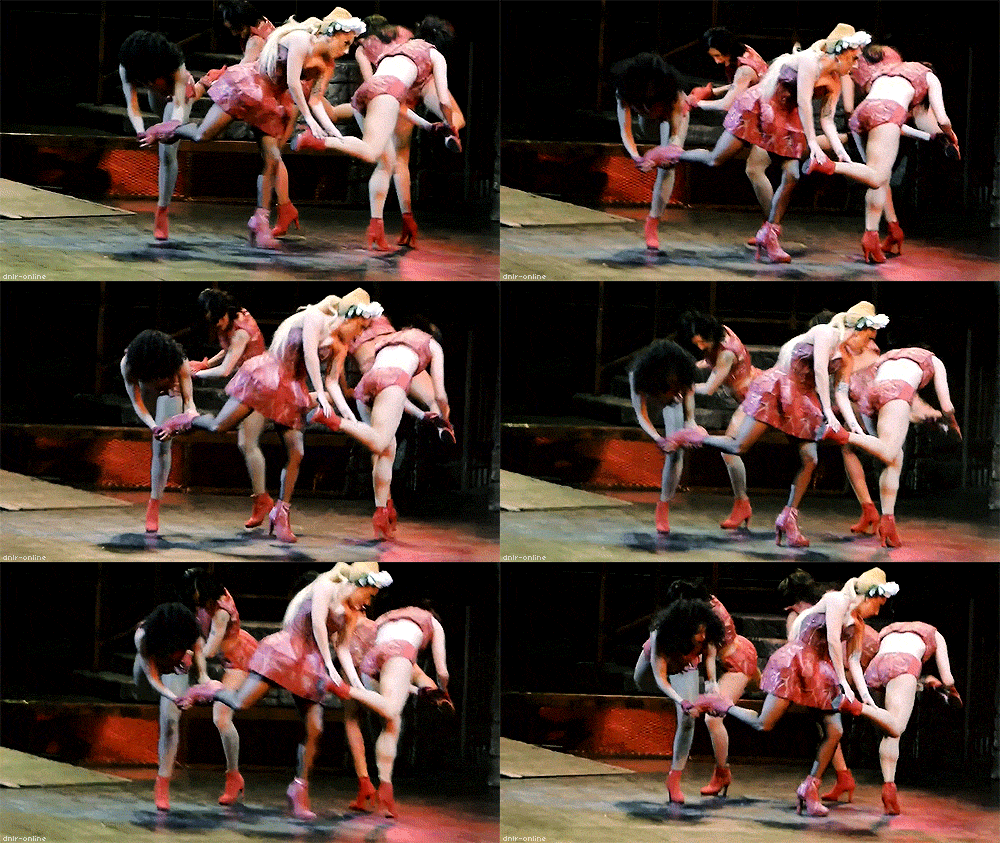
Highlights from South Africa Fashion Week 2013
Day 3
Designer: Skorzch
ah-mah-gaaaahd
Highlights from South Africa Fashion Week 2013
Day 3
Designer: Skorzch
ah-mah-gaaaahd
Johan PalmeMore good hating on dating.
 |
| A coffin falls to the ground as Royal Ulster Constabulary officers fire plastic bullets at funerals of IRA Volunteers Paddy Deery and Eddie McSheffrey, Derry City, 2 November 1987 |
 |
| Police try and push through mourners at same funeral: |
 |
| Mourner injured in police baton charge in Derry '87. |
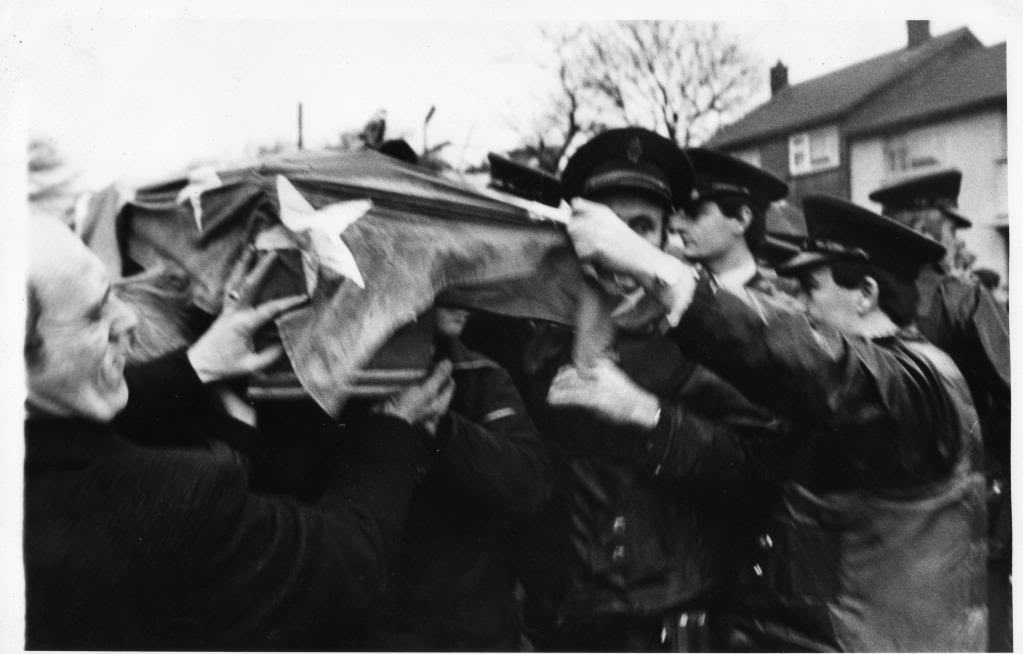 |
| Police try to seize flag from coffin at 1983 funeral of Joe Cravan of the Irish National Liberation Army |
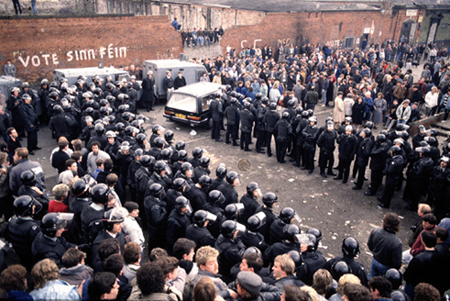 |
| Police at the Belfast funderal of Larry Marley in 1987, delayed for three days as a result of police intimidation. |
 |
| Anderson Town News, 12 April 2013 |
An extremely well attended talk by Hugo Teso, a security consultant at n.runs AG in Germany, about the completely realistic scenario of plane hijacking via a simple Android app has galvanized the crowd attending the Hack In The Box Conference in Amsterdam today.
By taking advantage of two new technologies for the discovery, information gathering and exploitation phases of the attack, and by creating an exploit framework (SIMON) and an Android app (PlaneSploit) that delivers attack messages to the airplanes’ Flight Management Systems (computer unit control display unit), he demonstrated the terrifying ability to take complete control of aircrafts by making virtual planes “dance to his tune.”
”Ever since the Walkman, ordinary people have had the ability to soundtrack their lives. You can play familiar music to reinforce or change your mood, music that either fits the tone and speed of your situation or is purposefully set against it. Earbud listeners can seek solace in this private musical headspace, an environment of their own making.
Now imagine this, what if your personal soundtrack could change dynamically? What if technology existed that took into account weather, time of day, and your exact location and activity? When you breach the threshold of your door, one song crossfades into another. When you bump into an acquaintance on the street, the volume pitches down to allow for easy conversation. When you approach the entrance to your place of work you hear the theme song that you assigned to that location. A dynamic personal soundtrack would take the traditional playlist to a whole new level.
With augmented reality, the potential for context-aware playlisting exists, and game developers and sound artists are already working on projects that push these ideas forward. Although AR is a term mostly tied to visual alteration, experiments focusing on audio have been expanding the palette of possibilities for the technology.

Ed Key and David Kanaga’s video game, Proteus, and sound artist Halsey Burgund’s installation, Scapes, are two recent examples of projects that use the infrastructure or AR audio to house new methods of exploration that reflect on the player’s/participant’s own involvement in the work.
“The ideal is to have every object making music."
Proteus is a video game that simulates an AR audio world. Everything and everywhere in Proteus is musical, and exploring the retro-styled 3D island, triggering sounds is the game’s primary mechanic. If you approach a frog, it will hop away with a two-note chime. Reach a mountain summit and serene strings will neutralize the noise of lower altitudes. Synthesizer tones cascade as leaves fall from 8-bit branches. David Kanaga, the composer of Proteus, said of the game’s musicality, “The ideal is to have every object making music. Every object is singing. And you can interact with it. You can feel the presence of the objects.” In Proteus, musical discovery and physical exploration are tied together like never before.
Games have been piping in location-sensitive music for decades, but in Proteus, this system of player-driven music composition is more than just background noise, it is the game. There’s no clear “goal” to Proteus at its outset; you’re simply plopped onto a procedurally generated island to do as you will. Controls are limited to walk, look, and sit. In this free-roam setting, the exotic sounds of the island and its wildlife provoke curiosity and drawn you in further.
Proteus’ functionally tight, interactive soundscape is an impressive feat, artistically and technically, but what about applying those same ideas to real world tech? An IRL Proteus system would require a sophisticated hybrid of geo-locative and image recognition instruments, a technophile fantasy that is, at best, in development in a secret Google lab. While we await sci-fi’s magic headgear of the future, artists and designers have taken to smartphones as a logical platform for AR.
Enter musician Halsey Burgund. Burgund developed a smartphone-based participatory audio platform called Roundware that allows users to record sound and assign it to their GPS coordinates. When Roundware listeners wander in reach of an audio clip’s location, they will hear it, along with any other samples in range. In his Scapes installation at DeCordova Sculpture Park, Burgund composed several generative pieces of ambient music for specific placement around the park. “As participants walk around the sculpture park, the individual path they follow creates their own personal version of the Scapes audio experience. The music is directly influenced by the landscape and is composed using custom algorithms which constantly generate new music; there are no repeated loops,” Burgund explains on his website.
Then, at some point while wandering among the sculptures, voices can be heard as well. You see, park visitors were able to download the Roundware app on their phone and contribute their own audio to the installation. Participants added 850 recordings to Scapes over a 6-month span. Some were descriptions of what they saw, others were meditations on the art, and still others were reflective of the Scapes project itself.
In a video documenting Scapes, Burgund ducks under a domed sculpture and the sound of rain emanates from his phone. Perhaps the audio posits a subtle commentary on the sculpture’s physical presence, both formally and from an earlier, soggier point in time. The person who originally recorded the audio may have just been trying to stay dry during a storm, but the audio remnant provides content for further insight into the sculpture than did not exist without it.
"The music is directly influenced by the landscape and is composed using custom algorithms which constantly generate new music; there are no repeated loops."
While Proteus is very much concerned with living in the now, Burgund is “trying to connect people to what is around them, past, present, and future.” Playthroughs of Proteus are ephemeral; there’s no way to record music in-game, leaving you to enjoy it in the moment. Proteus is about letting go while Scapes is about writing clues for the next person to consider.
When discussing technology, it’s easy to get wrapped up in the specifics of how systems work and lose sight of whether the latest development is being used for anything worthwhile. Games like Proteus present an idealist vision of where AR could lead while sound artists like Halsey Burgund apply those ideas to the real world within the constraints of current tech. However, what’s more important is that both present interactive artistic visions that outshine their techie novelty.
Your iTunes Genius playlist should be rightly concerned.
Proteus gif via Matt Glanville.
Johan PalmeWOW! What's happening to groovy soca? This is amazingly good.
Bunji Garlin - Differentology
It’s kinda nice Major Lazer helped this song gain even more attention by remixing it - even though the remix is quite horrible. Here’s the original again with a short unofficial video.
In 1903, the motto “Deeds not Words” was adopted by Emmeline Pankhurst as the slogan of the new Women’s Social and Political Union. This aimed above all to secure women the vote, but it marked a deliberate departure in the methods to be used. Over fifty years of peaceful campaigning had brought no change to women’s rights in this respect; drastic action was, Emmeline decided, now called for. The “deeds” encouraged by the WSPU, such as stone-throwing, arson, window-breaking, and parliamentary deputations, would all be widely reported over the ensuing years. In the collective memory, it was however not deeds but words — and one word, suffragette, in particular — which came to epitomise this period and its aims.

The (UK) National Archives Catalogue Reference: AR 1/528
Suffragette neatly evokes the conflicted history of this time. If some women (and men) campaigned for the female right to vote, others campaigned against it. Even among those who supported female suffrage, there could be marked divides. First used, according to the Oxford English Dictionary, in the Daily Mail in 1906, suffragette was not only new but a deliberate (and deliberately negative) coinage, intended to divide the suffragists, whose campaigns remained peaceful, from those who, as Pankhurst urged, should henceforth adopt more ‘militant’ methods. Suffragette, as a compound of suffrage (“The casting of a vote, voting; the exercise of a right to vote,” as the Oxford English Dictionary would confirm) plus the suffix -ette, was by no means complimentary. On one hand, -ette was a diminutive and was often seen as trivialising in intent, as well as distinctly patronizing; a lecturette (first used in 1867) was “a short lecture,” a meteorette “a small shooting star.” Both were very different from their non-diminutive counterparts.
-Ette had moreover another meaning which had become familiar in recent years. This, as in leatherette, first used in 1880 and cashmerette, used in 1886, signalled the idea of imperfect imitation, as well as inauthenticity. As a result, just as leatherette was a fake version of leather, so too, by implication, were the suffragettes ‘fake’ — and profoundly improper — versions of the suffragists. Densely polysemous, -ette was also starting to emerge as a specifically female suffix, a use which can be seen in forms such as poetette. Defined as “A young or minor poet; (sometimes esp.) a young female poet” in the Oxford English Dictionary, this already indicates the transitions at work, as the diminutive shades into the specifically female — a semantic development which was undoubtedly aided by the prominence of suffragette itself. Here too, notions of true and false, norm and other, intervene. ‘True’ women, as anti-suffrage writers regularly stressed, would never engage in militant activities of this kind. “Woman—or suffragette?” the writer Marie Corelli demanded in 1907. One could not, at least in anti-suffrage rhetoric of this kind, be both.
Trying to control meaning, as Samuel Johnson long ago affirmed in his Dictionary of 1755, is, however, rather like trying “to lash the wind.” One might feel better, but little result will be achieved. Suffragette, in fact, offers a precise illustration of Johnson’s point. Intended as a term of derision, it was nevertheless swiftly appropriated by the suffragettes themselves. Rather than a mark of stigmatization, it became a positive badge of identity — of shared aims and aspirations. A magazine was launched, named The Suffragette (copies of which were often left at sites of militant activity). In 1911, Sylvia Pankhurst published a history of the campaign so far. She called it The Suffragette: the History of the Women’s Militant Suffrage Movement, 1905-1910. Even the pronunciation could be hijacked for positive ends. Writing in the Observer in 1906, Lady Hugh Bell stressed the genuine appropriacy of the word. The dismissive -ette could, she argued, be converted into -gette, conveying not powerlessness but the “jet of enthusiasm” which united action for the vote across the land. It was also “feminine enough,” she noted — “a fine flowing word.” The Pankhursts suggested another version by which -gette was to be pronounced ‘get’ — succinctly indicating the suffragettes’ determination to ‘get the vote’ on equal terms with men.
Whether dictionaries can ever capture this complexity of meaning is an interesting question. “A female supporter of the cause of women’s political enfranchisement, esp. one of a violent or ‘militant’ type,” wrote Charles Onions, defining this word in the Oxford English Dictionary in 1915. A single pronunciation appears in the accompanying transcription. One suspects that, had the Pankhursts been asked to define this word, it would have been very different. As the opening of Pankhurst’s The Suffragette extolled: “the adventurous and resourceful daring of the young suffragettes who, by climbing up on roofs, by sliding down through skylights, by hiding under platforms, constantly succeeded in asking their endless questions, has never been excelled.” “Instantly the crowd roared, “Votes for Women!”—”Three cheers for the Suffragettes!”” Emmeline Pankhurst’s 1914 My Own Story records, here describing events in 1907. Words, then as now, can mean different things to different people. Point of view can influence the act of meaning, in dictionaries as well as outside them. Were the suffragettes brave, or foolhardy? Courageous or ‘violent’? Women or suffragettes — or, of course, both?
Lynda Mugglestone is Professor of History of English at the University of Oxford and Fellow and Tutor in English at Pembroke College. She edited the newly revised and updated Oxford History of English. She is the author of Dictionaries: A Very Short Introduction and Talking Proper: The Rise of Accent as Social Symbol. She is the editor of Johnson’s Pendulum (with Freya Johnston) and Lexicography and the OED: Pioneers in the Untrodden Forest. She has contributed to The Oxford History of English Lexicography and The Oxford Handbook of the Victorian Novel.
Subscribe to the OUPblog via email or RSS.
Subscribe to only lexicography and language articles on the OUPblog via email or RSS.
The post Woman – or Suffragette? appeared first on OUPblog.
Johan PalmeThis is somewhat hillarious.
The moment I buy my fake Facebook girlfriend, she leaves a post on my wall. It reads: “I just remembered that thing you said… hiarious. lol ;)” Great. Now everyone thinks I’ve fallen for a woman who can’t spell and says “lol” a lot. This is a disaster. My reputation might take years to recover. What if she misuses an apostrophe in her next post? Or has ever said the word “nom” out loud? I’ll be ruined.
Worse still, my girlfriend – my actual, real-life, flesh-and-blood girlfriend with whom I live – isn’t a fan of my new fake girlfriend at all. Whenever my Facebook girlfriend posts anything, my real-life girlfriend narrows her eyes and reads it back to me in a withering voice. Yesterday, while I was looking up a recipe on my phone, she yelled, “Are you texting your new girlfriend? You are, aren’t you?” and then fell silent for three-quarters of an hour. This whole situation was a mistake.
Why did I buy a fake Facebook girlfriend? Curiosity, mainly. Name me one red-blooded man who wouldn’t want to validate his neediness by paying a stranger of undetermined gender to send him hollow, misspelt platitudes on the internet. You can’t, can you?
”As most readers of Edible Geography will know, smell makes up to ninety percent of what we perceive as flavour, primarily through a process known as retronasal olfaction, in which odour molecules travel from the mouth to the nose via the throat as we eat.
In other words, we use our noses to smell food after it’s inside us, as well as before. But, in a fascinating snippet of news based on a presentation given yesterday at the American Chemical Society’s annual meeting by German food chemist Dr. Peter Schieberle, it seems that our noses may not be not alone in that ability, and that other cells in our bodies are able to “smell” food too.
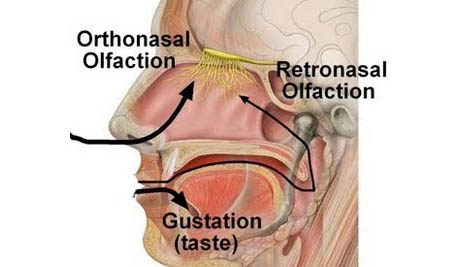
IMAGE: Retronasal olfaction illustrated, via this excellent explanation.
Dr. Schieberle’s research is focused on what he calls “sensomics” — identifying and analysing the individual compounds that, in combination, create the flavour of different foods. At the 2011 ACS meeting, for example, Schieberle reported on research showing that, of the more than 600 odour or taste compounds his team had found in chocolate, only twenty-five are “key”; together, they create a chocolate flavour that is indistinguishable from the real, more complex, thing.

IMAGE: Chocolate photographed by André Karwat, via Wikipedia.
But what of the other 575 odour and taste compounds in chocolate, if only twenty-five of them interact with nasal receptors and are experienced as flavour? Do they have any sensory impact, perhaps post-ingestion? In his presentation at this year’s conference, Schieberle explained that he and his colleagues have spent the past couple of years investigating this question, in order to discover “the fate of aroma compounds in the human body.”
Describing one experiment, Schieberle told ACS attendees that when he put “an attractant odorant compound” — some small volatile amides from chocolate — “on one side of a partitioned multi-well chamber, and blood cells on the other side,” the blood cells actually moved toward the odour through chemotaxis. Finally, Schieberle summarised:
Our team recently discovered that blood cells — not only cells in the nose — have odorant receptors. In the nose, these so-called receptors sense substances called odorants and translate them into an aroma that we interpret as pleasing or not pleasing in the brain. But surprisingly, there is growing evidence that also the heart, the lungs and many other non-olfactory organs have these receptors.
This discovery of non-nasal odorant receptors is seeming supported, Discovery News points out, by a 2006 paper in which biotechnologist Ester Feldmesser and colleagues found what they called “widespread expression of olfactory receptor genes” in tissues outside the nose, including the prostate, brain, and colon.
But, as Schieberle went on to ask, does the presence of odorant receptors, and even evidence of their response to particular aromatic molecules, mean that blood cells actually perceive flavour in some way?
Once a food is eaten, its components move from the stomach into the bloodstream. But does this mean that, for instance, the heart ‘smells’ the steak you just ate? We don’t know the answer to that question. [...] But we would like to find out.

IMAGE: Blood cells photographed in a scanning electron microscope by Bruce Wetzel and Harry Schaefer, National Cancer Institute, via Wikipedia.
Moving from science into speculation, it’s tempting to wonder about the possibility of hematogastronomy. For example, just as yoga gurus might learn to consciously experience and control the normally unconscious mechanics of breathing, could gourmets tune into flavour as a whole-body experience — one that starts in the mouth, but spreads throughout the body postprandially?
If so, just as Schieberle already uses his findings on nose-brain flavour perception to optimise chocolate, tweaking fermentation and roasting processes to raise or lower levels of different odour molecules into even more delicious combinations, could chefs or chemists one day spend as much time creating foods that are attractive to our blood cells as to our noses? What is gourmet for blood?
Johan Palme" Today, the mammoth steppe has vanished. So if bioengineers managed to produce pseudo-mammoths, they’d likely have no place to go."
Thousands of years after the last woolly mammoth died, some bioengineers dream of resurrecting the species. When I first heard their arguments, these folks struck me as the modern, high-tech version of snake-oil salesmen. The product they’re promoting is not what they lead people to believe it is, and it won’t do what people like to imagine it will.
Mammoths and mastodons once roamed throughout the Americas, as well as much of Europe and Asia. There were several species, but the best-known is the woolly mammoth, a creature of the far north. Well-preserved carcasses have been discovered melting out of the permafrost in Siberia and the Yukon. There’s been a lot of talk of ‘cloning’ a mammoth by using DNA recovered from bodies preserved in permafrost.

However, the genetic material in even the best-preserved mammoth specimens has been broken to bits, devoured by cold-adapted bacteria and shattered by thousands of years of freezing and thawing. No mammoth sperm cell holding intact DNA—a prerequisite for cloning—has ever been found. Using bits of ancient mammoth DNA, and referring to the genome of living elephants, researchers have pieced together much of the coding genome of the woolly mammoth—the segments that direct the building of proteins. But the vast majority of the genome, whose functions are little understood, remains unmapped.
Still, it’s now theoretically possible to create a pseudo-mammoth. This could be done by taking the genome of an Asian elephant, the closest living relative of the woolly mammoth, and splicing some sequences of mammoth DNA into it. This hybrid DNA could be inserted into an elephant sperm cell, which could then be used to artificially inseminate a female elephant. If the embryo developed and was carried to term, a mammoth-like animal would be born. This is a big ‘if’, because elephant reproduction is slow and complex. Even in efforts to clone living animals, there are often multiple abortions before a live infant is born. And those babies often don’t live long.
“We’d propose to make a hybrid elephant with the best features of modern elephants and of mammoths,” George Church said at a recent TEDx conference on De-Extinction. A genomics pioneer based at Harvard, Church is a master of genetic manipulation. His motivation for trying to raise the mammoth is obscure. When I spoke with him a couple of years back, he told me, “You can be very fussy and insist on getting the genome exactly right. Or you can go for something that has the main visible characteristics: the hair, the size, the tusk shape.” So, like many who imagine mammoths once again roaming the far north, Church was hung up on appearances.
Experiments using ancient mammoth DNA sequences have shown that these cold-adapted elephants had a different form of the blood protein hemoglobin compared to their modern cousins. Mammoth hemoglobin, which picks up oxygen in the lungs and offloads it in the tissues, was designed to release oxygen under cold conditions, a feat that modern elephant hemoglobin can’t perform. So a gene for cold-adapted hemoglobin is now on Church’s list of characteristics to splice into a mammothified elephant. But how many other subtle factors made the mammoth what it was? To believe that human technology can fabricate an animal that will fill the lost niche of the mammoth takes a lot of blind faith—or hubris.

Mammoths lived in cold, dry prairies, an Ice Age habitat that Palaeoecologists call the mammoth steppe, and that once covered great swathes of the planet. Today, the mammoth steppe has vanished. So if bioengineers managed to produce pseudo-mammoths, they’d likely have no place to go. With a lot of luck, they might help to create their own habitat. Ecologist Sergei Zimov is running a long-term experiment in northeastern Siberia which he calls Pleistocene Park. His goal is to bring large herbivores into the soggy tundra in the hope that their grazing will transform the landscape back into the productive grassland that existed in the days of the mammoth. Large herbivores can shape their own habitats, a phenomenon that’s been observed in African savannas as well as in the Arctic. Zimov has seen some signs of success with horses and muskoxen. But whether mammoth-like animals could survive there is unknowable.
While some dream of raising the mammoth, living elephants are under siege. Poaching has reached a new peak; 62 percent of forest elephants in Central Africa were killed for their ivory over the last decade. (It’s worth noting that mammoth tusks were considerably larger: meaning a bigger pay-off of ivory for every animal killed). Elephants often die in clashes with subsistence farmers in Africa and Asia. They need large stretches of habitat to survive, and land unoccupied by humans is becoming a rare and precious resource.
Even bringing back species that were deliberately wiped out in much of North America within the last century remains controversial. The reintroduced gray wolf population in Yellowstone National Park is by many measures a great success: the animals thrived, and have helped to restore an array of other creatures, from beaver to songbirds. Still, as the wolf population has expanded beyond the park’s boundaries, they’ve been met with outrage and gunshots. Yellowstone’s bison, the last free-roaming herd in the United States, gets the same reaction when the animals migrate out of the park in winters of heavy snow.
Conservation efforts for these living megafauna are chronically under-funded. So it’s hard to take the notion of raising a pseudo-mammoth, or any other long-extinct species, as a serious conservation move. The mammoth has been a favorite for resurrection, not because the idea is practical, but because the lost creature has such a strong hold on our imaginations.
Still, it’s probably not fair to compare all advocates of this idea to snake-oil salesmen. After watching a number of speakers at the TEDx De-Extinction conference passionately describe their dreams of raising not only the mammoth, but the thylacine and the passenger pigeon, I think many of these people are sincere. They believe they can raise dead species, and set them free to function in the wild. But they’re so focused on this vision that they seem disconnected from the reality of here and now.
Sharon Levy is a freelance science writer who specializes in making natural resource and conservation issues accessible for a broad audience. She is the author of Once and Future Giants, a book that introduces the idea that Ice Age megafauna extinctions hold important lessons for modern conservation. She lives in Humboldt County, California.
Subscribe to the OUPblog via email or RSS.
Subscribe to only science and medicine articles on the OUPblog via email or RSS.
Image credits: Smithsonian Woolly Mammoth. Photo by Kevin Burkett. Creative Commons License via Wikimedia Commons; Woolly Mammoth. Photo by Flying Puffin. Creative Commons License via Wikimedia Commons.
The post Can we raise woolly mammoths from their Pleistocene graves? appeared first on OUPblog.

Twerking among Black women has recently emerged as a threat—to the “politics of respectability” that associate proficiency in art forms dismissed as “low class”/”ghetto”/”ratchet” with moral turpitude and intellectual degeneracy; to the notion that Black women (both cis and transgender) and gay men adept at dances that focus attention on the torso merit contempt instead of praise; to the belief that if a person (especially young and Black and/or Latino/a) provokes desire, whether purposefully or unwittingly, they/s/he deserves violent exposure to the worst of contemporary “rape culture,” from internet trolling to physical abuse; to the the idea that historically Black innovations (such as AAVE and queer men’s and trans women’s ballroom voguing) exist merely to be decontextualized, commodified, and jokingly imitated, rather than commemorated as collectively affirmed vectors of value and ongoing modes of resistance.
In the online exchanges concerning Black women’s twerking and the subsequent appropriation(s) of it by white performers, some have questioned the extent of its linkages to older African-derived dances. Others know far more about the topic from first-hand experience and have more to offer in terms of analysis. I would like to expand the discussion slightly to draw a few more connections across the African Diaspora—between African-American dances as currently performed and Caribbean movement traditions—than those I have seen elsewhere. For instance, I would propose comparison not only with the “limin,’” “wainin,’” or “winin’” of Jamaica and Trinidad, but also with Cuban dance styles that share with certain West and Central African forms an emphasis on the buttocks as punctuation marks for the narrative told by the legs of the dancer. Rumba guaguancó, with its characteristic thrusting vacunao, is a textbook example.
Another complex of dances that would reward consideration alongside twerking are of Haitian origin (and with which I am unfortunately less familiar, so I apologize in advance for any inaccuracies). For example, the lwa, or spirits, of the Gede clan enjoy dancing the hip-swiveling banda, and seeing it executed for them. Gage Averill relates,
The Gedes (including Bawon Samdi/Papa Gede, Grann Brijit, Gede Nibo, Bawon Lakwa, and others) are spirits who guard the secrets of death and the cemetery and also have a special relationship to crossroads. The dance of the Gedes is the highly sexual banda, with its accentuated rolling of the pelvis, and the Gedes have a privileged position from which to interject humor and sexuality into all of their interactions.
Yvonne Daniel disputes the interpretive focus on sex, arguing that banda communicates the need for “keeping life vital,” but not the importance of banda in ritual practice. While banda performance may also turn explicitly oppositional, as when the Gedes demand resources or rights from the powers-that-be, it is difficult to think of a celebration of survival among people of African descent that would not be—in multiple senses—political.
Similar movements are not confined to ceremonies explicitly centered on the lwa. As in the footage seen above, filmed by Maya Deren between 1947 and 1951, participants in the Lenten (usually Easter Week) festival called Rara visually cite banda and have developed genres of performance that strategically use the hips and hindquarters as tools of expression. The poses struck by these majò jon or ”baton jugglers,” convincingly traced to Kongo precedents, complement the bodily attitudes assumed by the ”queens” of Rara bands. Elizabeth McAlister observes,
A quality Rara queens seem to share with their hip-hop counterparts is their irreverence toward the dominant culture’s moral stance, which would seek to repress their sexuality as women. Rara queens, as well as rappers and other women artists in Black Atlantic performance traditions, fashion and perform a publicity that projects images of female sexual freedom and economic control.
She continues:
One common feature of many forms is the celebration of the African female behind. Future scholarship might well look into the possibility that the “bottom-heavy” hip-rotating dances like gouyad, whinin’, and “doin’ da butt” “had one meaning in African culture and came to be integrated into bodily performances of opposition in the American setting.”
At the end of this passage, McAlister quotes Judith Bettelheim’s 1990 paper, “Deconstructing the Mythologies: From Priestess to ‘Red Hot Mama’ in African and African American/Caribbean Performances.” This title hints at the work still to be done in order for twerking to be understood more widely as part of a larger family of Diasporic dances, and for its mastery to be appreciated as a unique recombination of skill, knowledge, and kinship.
Johan PalmeKlick thru for images that apparently don't go through with RSS.
When the aesthetic of a decade comes back in fashion again all the other disciplines imbibe with it. As the 90s officially becomes classified as vintage it is eagerly being consumed by the generation who grew up in that decade.
VHS, and all its imperfections, seem to be interesting to video creatives and web designers more than ever, and of course for those young people who have become used to high resolution images even for everyday personal pictures.
Lately, rock bands and creative directors are more inspired by homemade video of the last days of the analogue era. Pixelated images, improper camera movements, acid colours, the amateur attitude; wrong becomes right and breaking the rules of beauty is the way to follow.
C’N'C – Costume National featured the French blogger Jeanne Damas in last year’s technicolour-blipped spring campaign, and they are not alone on this trend. Up-and-coming Spanish fashion designer María Escoté is a fan of this aesthetic and her whole website is a good example of it. Victoria Beckham’s new section on her website, called Look, responds to this dishevelled and spontaneous movement too showing its popularity in the mainstream as well as the underground. However, the gifs used add a certain Tumblr-looking modern technology touch.
In music videos we have new examples every day. From garage-punk such as Fidlar or The Men to more electro Meneo, whose video – above – is the perfect partner for the 8bit track.

This is what happens when you stack hundreds of photos of the same sky on top of each other. (via SciencePorn - pic.twitter.com/vzRYZsf8fG)
HEIMDALL, OPEN THE BIFROST
Social conservatives, in general, believe that we were better off when sex necessarily led to babies and babies necessarily led to lifelong marriage. None of them deny believing this, they just rarely (these days) put it in such stark terms, because that’s not a very popular position. Especially among a large portion of modern women, for whom it reads suspiciously like serfdom.
The only way that belief is relevant to gay marriage is that gay marriage supposed the modern notion that marriage is a thing two people who love each other do. One assumption underlying nearly all social conservative marriage arguments is that marriage is something fertile youngsters must be coerced into for the good of society as a whole. If you strip away the anti-gay moral revulsion the movement is truly more concerned with reversing the gains of feminism than the gains of LGBT rights. That’s going to be a much harder sell, though.
”BRYMO - Omoge Campus (OFFICIAL VIDEO)
Such a simple video, but I love the concept.
This music video is beyond adorable. Watch it all the way through to see why I say that. I love how the video didnt take a predictable route for the song. I love Brymo. He has immense talent. He will be around for a long time.
I want to marry his voice.

"Numerous Japanese teens, it seems, are uploading photos of themselves doing the Kamehameha attack from popular manga and anime series Dragon Ball," writes Kotaku's Japan-based correspondent Brian Ashcraft. There's a photo gallery and it's awesome. Brian had an earlier post at Kotaku about the broader trend in Japan of young women staging photos with manga-style martial arts. Below, one such image found on 2ch, Japan's largest bulletin board, with the heading, "Schoolgirls Nowadays lol".
(Thanks, Brian Lam!)


 |
 |
As the First of April nears you may be planning the perfect joke, hoax, or act of revenge. If so—and if you’re looking for inspiration—may we recommend some of British history’s finest hoaxers, courtesy of the Oxford Dictionary of National Biography. So this year, how about …
1. Going shopping. In 1809 Theodore Hook performed a spectacular act of revenge by ordering enormous quantities of coal, musical instruments, upholstery, linen, and jewellery for delivery in unison to the same address in Berners Street, London. The lord mayor of London, governor of the Bank of England, and the duke of Gloucester were also tricked into making an appearance at the victim’s door. The Berners Street hoax took Hook, and two accomplices, six weeks to plan. This was before internet shopping. Think what you could do.
2. Doing-it-yourself. Follow the example of Frances Griffiths and Elsie Wright and cut out your own imitation fairies and gnomes. Next take some photos of them at the bottom of the garden, and bring them to the attention of a devotee of the paranormal, such as Arthur Conan Doyle. With his backing the ‘Cottingley fairies’ became a worldwide sensation and continued to convince (some) until 1983 when Griffiths and Wright admitted their hoax. As Elsie remarked: ‘I’m old now and I don’t want to die and leave my grandchildren thinking that they had a loony grandmother.’
3. Being a bit more ambitious. For this one you’ll need a Royal Navy battleship, a few false beards, and Virginia Woolf. Masterminded by the professional practical joker Horace De Vere Cole, the party (including a youthful Woolf) tricked their way onto HMS Dreadnought and toured the ship while masquerading as the Abyssinian royal family. Here’s the proof.
4. Making use of your balding friends. To imitate this one, another of De Vere Cole’s, you’ll need to block book some theatre tickets (must be in the stalls) and then carefully arrange your balding associates, having first consulted a book of rude words. Read the biography for more—and don’t forget to cross your Ts and dot your Is.
5. Making a career of it. Hoaxes that last a day are really for beginners. Instead let Archibald Stansfield Belaney be your inspiration. Though born at 32 St James’s Road, Hastings, Sussex, Belaney passed himself off as Grey Owl—a native American whose deception was only uncovered after his death. If you think big, the rewards can be great. In 1937 Grey Owl was invited to give a lecture at Buckingham Palace; AND he was played by Pierce Brosnan in the film version of his unusual life.
6. Not discarding those fragments of orang-utan. In 1912 Charles Dawson and Arthur Woodward caused a sensation by announcing the discovery of the ‘missing link’ in human evolution—uncovered in a gravel pit not too far from Grey Owl’s boyhood home. The body, dated to 4 million BC, became known as Piltdown Man, and was for several decades widely regarded as the oldest fossil human found in Europe. Then, in the 1950s, came new scientific techniques and the revelation that Piltdown Man was simply an odd assembly of stained bones and the jaw of a young orang-utan. By then Dawson and Woodward were dead—and the who and why remain unanswered.
7. If can’t get hold of an orang-utan, rabbits will do. This was the experience of Mary Toft, the so-called ‘Rabbit woman of Godalming’, in 1726. It’s quite a story, though not for the faint hearted.
8. Going bump in the night. Rattle your plumbing in a convincing way, and who knows who’ll come by to investigate. This is what Elizabeth Parsons did in 1762 and she met Samuel Johnson and the duke of York! Like Grey Owl, her deception was commemorated in art, with a poem, play and an engraving by William Hogarth.
9. Breathing in. Staying with the eighteenth-century, we come to John Montagu, second earl of Montagu, who’s thought to have been behind the ‘bottle conjuror’ hoax, as performed to a packed Haymarket theatre, London, in 1749. The trick saw a full-size man squeeze himself into a wine bottle. If this were not enough, ‘during his stay in the bottle any person may handle it, and see plainly that it does not exceed a common tavern bottle’ (General Advertiser, 16 Jan. 1749).
10. Not promising violence, especially against foreigners. Be careful, not all April Fool’s day tricks go to plan, and the fooled can turn nasty—as the seventeenth-century actor Thomas Jevon can testify.
As well as reading their entries, you can also listen to the stories of the Cottingley fairies, Piltdown Man, and Elizabeth Parsons (the ‘Cock Lane ghost’) in the Oxford DNB’s 175-strong biography podcast.
Philip Carter is Publication Editor of the Oxford Dictionary of National Biography.
The Oxford Dictionary of National Biography is the national record of men and women who have shaped British history and culture, worldwide, from the Romans to the 21st century. In addition to 58,500 life stories, the ODNB offers a free, twice monthly biography podcast with over 175 life stories now available. You can also sign up for Life of the Day, a topical biography delivered to your inbox, or follow @odnb on Twitter for people in the news. The Oxford DNB is freely available via public libraries across the UK. Libraries offer ‘remote access’ allowing members to log-on to the complete dictionary, for free, from home (or any other computer) twenty-four hours a day.
Subscribe to the OUPblog via email or RSS.
Subscribe to only British history articles on the OUPblog via email or RSS.
The post This April fools’ day, learn from the experts appeared first on OUPblog.
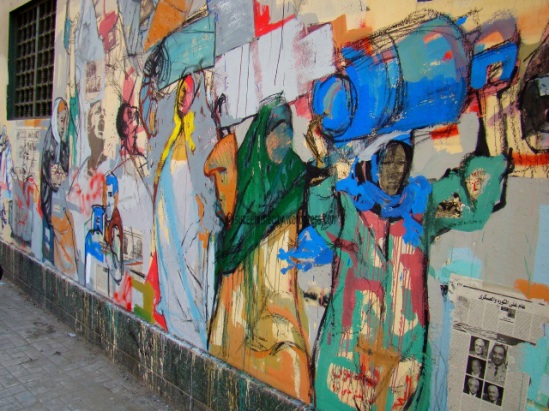
Hanaa El Degham, mural on the wall of the Lycée Français, Cairo. Copyright suzeeinthecity.wordpress.com.
Mickey Mouse is pulling apart a bomb: inside is the torso of George W. Bush, and they’re both looking perfectly happy about the whole thing. Soraya Morayef is taking a photo of the wall where these figures are painted, on a busy street in downtown Cairo, when a man walks up to her and asks her what the picture means.
‘I think that’s Mickey Mouse,’ I say helpfully.
‘Yes but what does it mean? And who is that man next to him?’
He’s bald with a graying walrus moustache, probably in his mid-forties, his full cheeks sweating as he fans at his pin-striped pink shirt.
‘I’m not quite sure,’ I say politely, wishing I could go back to my camera, but he appears adamant for an answer. ‘Maybe it’s a president? It could be George Bush.’
‘Yes but what is George Bush doing with Mickey Mouse? I like this picture, I walk past it every day, but I wish there’d be some writing explaining it so that I could understand.’
She is stuck between the wall and the man, who tells her he was in Tahrir Square (a stone’s throw away from where they are standing) every day of the uprisings, “one of the shabab of the revolution…”. Eventually, after he has given her his number, he leaves, and she recommences her task, cataloguing the street art in Cairo, a city in which graffiti has flourished since 2011, but where the wall may have been white-washed the next morning.
Morayef is a journalist and writer based in Cairo. Since June 2011 she has been blogging at suzeeinthecity.wordpress.com, where she posts images of street art, with captions and analysis. The same urgent questions — of graffiti and gender, intimidation and interpretation — resurface in a recent post, ‘Women in Graffiti: A Tribute to the Women of Egypt’, on the participation of women in making graffiti on the walls of Egyptian streets.

Sit El Banat, stencil tribute to the women who were beaten, dragged and stamped on by military forces in December 2011. Copyright suzeeinthecity.wordpress.com
The artists mentioned include Aya Tarek (“one of the pioneers of graffiti in Egypt”), Hend Kheera (“the first Egyptian graffiti artist to be profiled by Rolling Stone”), Bahia Shebab (an artist and art historian behind the project, A thousand times no), Mira Shihadeh, Laila Magued (more of her work here), the Nooneswa collective, and Hanna El Degham, whose work on the wall of the Lycee Morayef describes as “one of the most astounding street artworks I have seen in Egypt.” The article also includes images of the tributes — by artists Alaa Awad, Keizer, Zeft and Amr Nazeer, X4SprayCans and Ammar Abo Bakr — to Egyptian women, their role in the protests, works made in outrage at the men who have harrassed and attacked them.
The world has been fascinated by the explosion of graffiti in Egypt, and the walls have become signifiers for revolutionary desires, and the street a place where art makes demands of its public, everyday. The precariousness of this art makes Morayef’s catalogue of images necessary, and it has become the visual archive of an emancipatory politics, expressions of hope for a country in which women are not violated everyday.
The beginning of the project
“The project happened organically,” Morayef says, “I found it impossible to post images without context. I did it once and ended up having to explain it, it became an article. It wasn’t originally a project but a personal hobby of mine. I started taking photographs every day in April, May 2011, in the neighbourhood I lived in, where there was a faculty of fine arts.”
This was Zamalek, “where the art students were, so it made sense this should be the hunting ground. There was always new graffiti popping up and disappearing. I wasn’t aware of other people doing it, other citizen journalists. I thought, ‘ok, I’m the only one doing this. It was for my personal archive, I put it on Facebook and a friend said ‘can I share your album’. I said ‘I’ll put it on a blog and you can share it with your friends.’”
“Then I noticed graffiti appearing in different neighbourhoods. With every post it went from being fun to being an obssession. At some point it felt like a responsibility, but not in a negative sense. I started getting feedback from street artists. I would start to credit the photographs to the separate artists, the artists would start to contact me because they recognised I enjoyed what I was doing, that there was no ulterior motive to my job.”
“What was really great about the process was social media. These artists were uploading or tweeting. By following the top Twitter accounts I would find out about work I hadn’t heard of. All the artists have Twitter accounts, Facebook, so it was easy to access them without invading their privacy.”
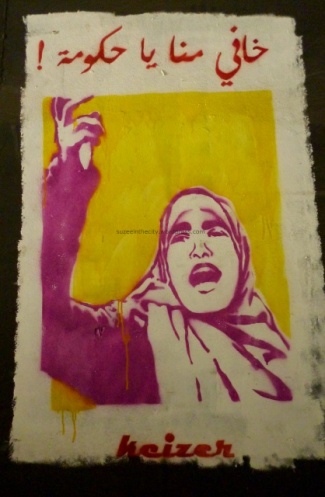
Keizer, Fear Me, Government! Copyright suzeeinthecity.wordpress.com
“It reached the point where I could recognise the street, the aesthetic of the artist and figure it out. Ganzeer [who she interviews here] created this interactive Google map, this blog, where he enabled artists to upload images, and their location, so people like me could upload and tag them to the artist. But the artists I follow and I am aware of, I think they are the tip of the iceberg. They are twenty percent of the graffiti crowd.”
“You have activists who use graffiti, artists who use graffiti for a certain phase then stop because it became too trendy, artists who join because it is trendy … it’s hard to keep track … artists who sign their work, others who have no interest. These people, some of them I would only come across because I would drive by or walk by. In one or two cases they would reach out and say this does belong to me but I don’t want anyone to know.”
Sad Panda
“I was included in this crowd, giving me access to their personal lives and their information. Someone like Sad Panda, who has created this anonymous persona for the media so no one knows his real name. I wrote a blog about when he welcomed me to his house. He introduced himself as a friend of the artist. So I walk in and I have no idea who this kid is, cutting up a stencil of a panda, then meeting his mum, watching him as he works, that was a privilege.”
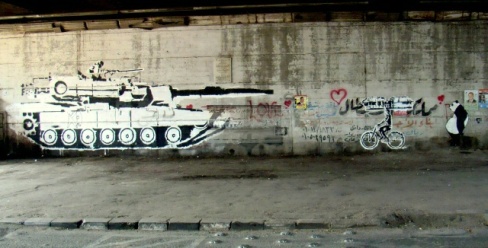
Ganzeer’s tank versus bike (with Sad Panda in melancholy pursuit), under the October 6th Bridge. Copyright suzeeinthecity.wordpress.com.
The origins of graffiti
“The general view is that it [graffiti] started with the revolution. I completely disagree with this. I’ve seen graffiti for as long as I remember liking it. Graffiti on school walls, on mosque walls, whether it’s patriotic or, like, I love my school. There’s an argument that the Muslim Brotherhood started using graffiti, usually in the impoverished neighbourhoods. There’s an argument that it started in Alexandria, and many of the artists who are known as the pioneers of graffiti, were working there as early as 2003/4.”
“One of the images I took [of a fresh work of graffiti next to an older piece] when I posted it on Twitter someone I knew messaged me and said ‘I took a photo of the graffiti next to it in 2005!’ So there’s been a change in attention, attention and participation. And a sudden focus on the international media.”
“It started from an urgent need [during the uprisings] we had no internet, no phone-line. We were cut off from the media, there was no one there … As the intention increased, there was the glamorisation of people in the revolution, especiall the youthful ones, many artists felt the need to participate. And there was suddenly an audience, for something which [before] would have been received negatively.”
The gender of graffiti artists
“The gender is still predominantly male. I have noticed – in the collective, the Mona Lisa Brigade, who are using graffiti for social initiatives – they have thirty percent members who are female. Apart from the female artists I mentioned on my blog there are perhaps a handful more.”
The Mickey Mouse encounter (read about the episode here)

Keizer, Mickey Mouse. Copyright suzeeinthecity.wordpress.com.
“Two years on I have a different perspective on it. It is a good example in Egypt [of the reaction to graffiti], when you are dealing with forty percent of the population being illiterate. It’s an environment to create art that would explain [itself] or be easily interpreted. The man’s conversation was a good example of – and I’m generalising – how we prefer to be told what it is rather than figuring it out.”
“We’ve lived under a dictatorship for so long, and it’s not only Mubarak, but Sadat and Nasser. We haven’t had a free space to come up with our own ideas. We are used to voting yes to everthing, so with every singly referendum people have voted yes. Because we just don’t understand saying no to our leaders.”
“When street artists make work which says no to military leaders, these are the works which are responded to most negatively. It was really interesting, you would have people getting really vocal: ‘you can criticise our leaders but the army is a red line.’ We couldn’t handle seeing our leaders, our heroes, our pharaos, criticised.
“That particular artist [Keizer – who she interviews here] was making graffiti which was really Western-influenced. I personally felt – and what I saw – was a certain confusion behind the messages. I think he received some flak from his peers. [The man on the street] would not recognise why George Bush is holding Mickey Mouse by the paw.”
“When you are dealing with traumatic events there is so much to work with. Why would you mystify the man on the street? The artist has since said that he is using Western graffiti to attack the elites, and that’s his theory. But he has since moved to making graffiti with Arabic language and Egyptian symbols. I have noticed a shift.”
Violence against women
“One artist [Zeft] made a stencil of Nefertiti with a gas mask. He distributed it via social media and said you can reuse this. It appeared on the Facebook page of Op Anti-Sexual Harassment, and you can see it in photographs of protests a few weeks back. This image appeared in Washington, Berlin and Gaza.”

Zeft, Nefertiti mask. Copyright Ahmed Hayman.
“This was an example of one artist showing solidarity with women’s rights and rape. It became a symbol for social awareness campaigns. That’s a great success, but you are still dealing with a small segment of society. These artists, most of them are liberals, most of them are with the revolution. But the fact that women’s rights have been advocated by artists show that there has been a significant shift in awareness.”
The defacement of walls
“There was the Ganzeer tank versus bike grafiti, some of it was defaced. The artists are on the street, during the protest, sometimes the paint during the protest. I interviewed one artist during the protest: he was very upset, he said ‘this is the only thing I can do.’ So [working like this] is taking an artist from a sense of helplessness to a sense of responsibility.”
“This is the same thing the artists, Ammar Abo Bakr and Alaa Awad, who made the painting of the martyrs said. The guy and his friend made a mural on the AUC wall. They each spent two thousand Egyptian pounds, they said this is our way of paying them back. But it was so powerful and popular that alumni and members of the faculty circulated this petition asking the administration to stop the university from allowing government officials to paint over it. The artists came back and did a second paint.”
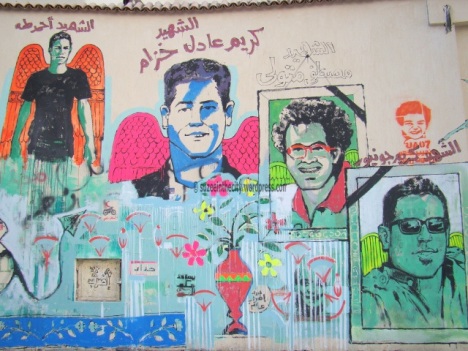
Painting of the Martyrs at AUC, Port Said. Copyright suzeeinthecity.wordpress.com.
“Then the government workers arrived. The baladiya – they are the bottom of the food chain, assigned to clean up – went down in the middle of the night. They actually had a line of soldiers protecting them as they cleaned off the graffiti. The reaction of the public was so heavy. You had street artists going on TV – who had previously avoided the media – who became very vocal in their criticism of the government. To the point that the prime minister had to release a statement.”
“I’m going to go ahead and say this was probably the most important moment in the history of graffiti. You had the prime minister, the second most important man in Egypt, having to apologise to a group of graffiti artists, who have been repeatedly criminalised.”
Soraya Morayef is currently pursuing a Master’s degree at Kings College London, as well as working with the Museum of Contemporary Art in Los Angeles on a series of videos documenting the graffiti scene in Cairo, Beirut, Libya and Palestine.


The Swedish Language Council has nuked a word from its list of new terms for 2012 at Google’s request, according to a report from The Local. As of Tuesday, the council has removed the word ogooglebar (ungoogleable) from its list of new words for the year after Google objected to its definition.
Each year, the Swedish Language Council selects a handful of new words to highlight with the goal of advancing and cultivating the Swedish Language. In December, one of the words selected was ogooglebar, meaning a thing or person that does not produce relevant results when typed into a search engine.
Google took exception to the broad inclusion of “search engines” in the definition, and wanted the word to be defined only as things or people unsearchable on Google specifically. Rather than quibble with Google over the definition or bend to its request, the council removed the term from its list, while noting that this didn’t necessarily mean it would be removed from the language itself.
The Swedish Language Council was first established in 1944, and according to The Local, this is the first time it has removed a word from its annual list.
”
Guest Post by Benjamin Lebrave
This morning I started my week reading the following on the New York Times’ website: “Digital music, responsible for the improvement in the industry’s brighter overall outlook, has failed to catch on across much of Africa.” To be more accurate, the first words I read were “Serraval, France”, the location of the writer. Ironically, Serraval’s city hall website starts with the following: “Today, children use the internet much like our generation played marbles.” Well it seems that despite Serraval’s noted efforts to encourage the use of the internet, Eric Pfanner, the great mind behind this piece of in-depth NYT journalism, may have lost his marbles.
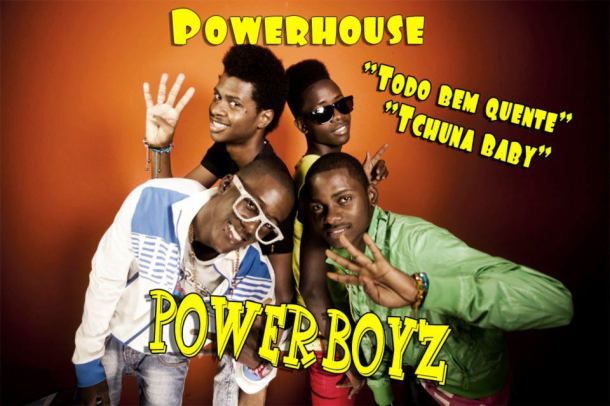
Just for comedic effect, let’s continue fact checking for a minute. Pfanner talks about high profile moves, then mentions three artists to back up the significance of the claim: Power Boyz from Angola, DJ Vetkuk from South Africa, and W4 from Nigeria (not even a facebook page for him, all I found was this). Now don’t get me wrong, I LOVE Tchuna Baby, and wish that song were a global hit. But it’s not, and Power Boyz are at best a second tier band. Same goes for W4 or DJ Vetkuk, who may also be talented, but for the sake of this article, are completely irrelevant. No mention of D’Banj, P-Square, or any other proper pan-African heavy hitters.
Maybe they don’t chop money in Serraval…
No mention of Spinlet either, a Nigerian company backed by serious investment money for over a year now. While it is clear Pfanner is green about digital music in Africa, he did however do his homework among Western players attempting to jump on the African bandwagon. But that’s exactly the problem: he relies on PR information obtained from corporations, who rely on consulting firms to do their market research. And those firms rely on information obtained from offices in London, Paris, or at best Johannesburg. Even when they do have some kind of ground office, it is exactly that: an office.
If you want to understand how digital music is evolving in Africa, you first have to step out of the office, and go where digital music lives: in the devices of teenagers. You have to witness how music listening and consuming habits have changed. You have to see how hits blow up strictly from bluetooth swapping. You have to go to concerts, and watch crowds chant in unison to songs which never play on the radio or on TV.
To think that the number of paid downloads is a testimony to the advancement of digital music in Africa is like looking at champagne sales as an indicator of overall growth in Africa. When people live on a buck or two a day, it is slightly unlikely they will spend a buck on a song. But that does not mean they are not living and breathing digital music. That does not mean digital music does not make or break artists, who then go on to get endorsement deals, and a properly lucrative career. Digital is not only the cornerstone of how music lives in Africa today, it is also fundamental in the business of music.
The problem with this New York Times article is nothing new: the general consensus about reporting in Africa seems to be: nobody knows, nobody cares, so let’s just put the smallest amount of effort into it. Let’s rely on the same reporter who writes about Moscato wine and French tax schemes, he’s smart enough, he’ll get it right. And even if he doesn’t, who cares?
Well the irony in this case is: specifically because digital media (and music) is exploding in Africa, a lot of us notice, and a lot of us care.
I have to add one last bit: the main reason for Pfanner’s article is Samsung and Universal’s launch of The Kleek, a music service aimed at African markets. Pfanner tells us digital music is non-existent in Africa, and tells us Universal is jumping in. So that would make Universal a bold, courageous pioneer. Now THAT is good humor.
* Ghana-based Benjamin Lebrave runs Akwaaba Music, a platform promoting and distributing urban and electronic music from all over Africa. He also reports about musical discoveries for Fader magazine and This Is Africa.


Johan PalmeSHAREBROS! I crave more, much more, obscure easter music. Any tips? (Click through for a Spotify playlist of 65-ish decent tracks I've found so far.)
I’ve been trying to put together a properly huge easter playlist, containing music from all over the world, both secular and religious. I have to say it’s kind of difficult, especially with the constraint of only including music that actually alludes to easter per se. The easter atmosphere is considerably more multifaceted than the Christmas one, and the music varies endelssly in mood, which I guess is why so few have chosen to work with the theme. Why don’t pop musicians release easter albums? Heck, besides specifically liturgical ones for use in church, how many actual complete easter albums are there at all? I have only found one classical work, Foerster’s fourth symphony, which isn’t even on here. Novelty singles, balkan brass, samba, lebanese chanting, russian schmaltz, jesus freak electro-rock, gospel, Vivaldi, whatever though, are definitely possible to find.
Johan PalmeShared for the name and the model in look 24 as much as anything.