Shared posts

10 Jan 13:03

A Pirate’s Life for Me, Part 1: Don’t Copy That Floppy!

by Jimmy Maher

Piracy

February 3, 1976

An Open Letter to Hobbyists

To me, the most critical thing in the hobby market right now is the lack of good software courses, books, and software itself. Without good software and an owner who understands programming, a hobby computer is wasted. Will quality software be written for the hobby market?

Almost a year ago, Paul Allen and myself, expecting the hobby market to expand, hired Monte Davidoff and developed Altair BASIC. Though the initial work took only two months, the three of us have spent most of the last year documenting, improving, and adding features to BASIC. Now we have 4 K, 8 K, Extended, ROM, and Disk BASIC. The value of the computer time we have used exceeds $40,000.

The feedback we have gotten from the hundreds of people who say they are using BASIC has all been positive. Two surprising things are apparent, however: 1) most of these “users” never bought BASIC (less than 10 percent of all Altair owners have bought BASIC), and 2) the amount of royalties we have received from sales to hobbyists makes the time spent on Altair BASIC worth less than $2 per hour.

Why is this? As the majority of hobbyists must be aware, most of you steal your software. Hardware must be paid for, but software is something to share. Who cares if the people who worked on it get paid?

Is this fair? One thing you don’t do by stealing software is get back at MITS for some problem you may have had. MITS doesn’t make money selling software. The royalty paid to us, the manual, the tape, and the overhead make it a break-even operation. One thing you do do is prevent good software from being written. Who can afford to do professional work for nothing? What hobbyist can put three man-years into programming, finding all the bugs, documenting his product, and distribute for free? The fact is, no one besides us has invested a lot of money in hobbyist software. We have written 6800 BASIC, and are writing 8080 APL and 6800 APL, but there is very little incentive to make this software available to hobbyists. Most directly, the thing you do is theft.

What about the guys who resell Altair BASIC, aren’t they making money on hobbyist software? Yes, but those who have been reported to us may lose in the end. They are the ones who give hobbyists a bad name, and should be kicked out of any club meeting they show up at.

I would appreciate letters from anyone who wants to pay up, or has a suggestion or comment. Just write me. Nothing would please me more than being able to hire ten programmers and deluge the hobby market with good software.

Bill Gates
General Partner, Micro-Soft

The “open letter” above, written by a 20-year-old Bill Gates, was printed in early 1976 in a number of the publications that served the nascent PC industry, centered at the time on the MITS Altair kit computer. Some of the soldering-iron-wielding visionaries who read it were enraged, a few supportive. Most, however, were merely confused. Sharing, of software the same as all other sorts of information, was simply what they did, the rock upon which their little hacker community was founded. For many the letter marked the first time they had ever confronted the notion of a program being owned by a single entity.

The PC industry was barely a year old, but already its age of innocence was passing. Bill Gates, the man who brought knowledge of the good and evil of copyright to this hacking Eden, was, plenty would soon be arguing, perfectly suited to play the role of the serpent. The change in thinking he set in motion with this open letter of his would soon prove more significant than even his own company’s outsized influence on the industry. From 1976 right up to the present day — and doubtless for many years to come — the PC industry and all of its many offshoots have been tying themselves into knots over the question of copyright, of where the ethical and legal rights of digital-content creators and users begin and end.

Both sides of the debate as it rages today could stand to glance back at copyright as it was once understood. Those who claim that modern copyright law merely applies an eternal principle to a new medium should note that, on the contrary, our notions of copyright have changed in some very fundamental ways in recent decades. And those who see laws like the Digital Millennium Copyright Act as well-nigh fascistic overreaching might do well to remember that even in the pre-DMCA days one could be prosecuted for merely photocopying the pages of a book. At the first conference on “software protection” in Britain in 1981, the first speaker opened with an old joke about an Englishman who asks an Irishman how to get to County Derry. “If I wanted to get to County Derry,” replies the Irishman, “I wouldn’t start from here.” The decades after Bill Gates fired the opening salvo of the digital-copyright wars would be marked by the law’s struggle to get to there from here — from the analog, materialist culture of creation that was to the digital, virtual culture that must now be.

When thinking about any big, overarching concept like that of copyright, it’s often helpful to return to first principles, to think about what the words or phrases themselves literally mean. In those literal meanings we can usually find the meaning of the concept as its originators understood it. Just as, say, “science fiction” once literally meant fiction about science, “copyright” once meant simply the right to copy. As enshrined in the American Copyright Right Act of 1909, the latest iteration at the time that Bill Gates wrote his open letter of the original Act of 1790, only the author had the right “to print, reprint, publish, copy, and vend the copyrighted work.” The original sin that must come before any printing, reprinting, publishing, or vending by someone who wasn’t the author must be the simple act of copying itself, which was in and of itself illegal. If you purchased a book at your local bookstore and copied its contents — whether on a photocopier, on a typewriter, or freehand on paper — you had already committed an actionable legal offense, even if your purpose in doing so was simply to have a “backup” copy for your own personal use. In the materialist world of arts and letters that held sway prior to the digital revolution, this approach to copyright as a literal right to copy made perfect sense.

Many of the conflicts and controversies that have plagued the idea of copyright in the years since have stemmed from the fact that a right to copy is a prerequisite to making any use at all of digital content. Thus rights-holders have needed to make the act of unauthorized distribution, not that of unauthorized copying, the original sin of the infringer. Much of the story of recent copyright legislation has been the story of how that shift was made.

On this blog, we’ve heretofore largely avoided that long, fraught societal debate and negotiation, but the specter of copyright and its violation in the form of software piracy loomed too large over the games industry of the 1980s to neglect it any more. This, then, is the story of what Gates’s letter wrought for the people who were making the games, the people who were playing them, and, in due time, an underground culture which dedicated itself to defying the legal system and keeping games — all games — available for free.
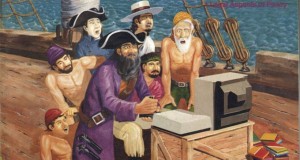
Pirates

The first programmer ever to attach a notice of copyright to her program, and thus quite likely the first programmer ever to conceive of her program as a potentially marketable creative work, was Betty Holberton, one of the original programmers of the ENIAC, by some definitions the world’s first true computer. In 1951, she was proud enough of a sorting program she had written to attach her name to a copyright notice included therein. It wasn’t until 1964, however, that a programmer made the next step of attempting to actually secure registration through the Copyright Office. That year a Columbia University law student and MIT electrical-engineering graduate named John F. Banzhaff III applied for the registration of two programs he’d written to aid his studies: one to help with the indexing of old court cases and one to compute automobile braking distances. His request was at first rejected, but he put his legal training in progress to good use to lobby for reconsideration. At last a Copyright Office functionary decided that “we could, under the law, make the registration.” The whole transaction was novel enough that the New York Times printed a rather bemused sidebar about it.

Despite Banzhaff’s success, few followed his lead in using copyright as a means of protecting their investment in software. IBM and the other companies who made the big-iron systems that kept the books for corporate America saw their programs not so much as independent entities as components of an entire ecosystem which included both hardware and software. They offered the whole enchilada to their customers as a leased package, complete with lengthy, heavily restrictive licensing agreements that can be seen as the forefathers to all the legalese we click through so impatiently today every time we install a new piece of software. If those contracts, many of which had never been tested in court, should fail, there were always patents, of which IBM in particular had quite a massive portfolio covering most of their systems’ operations.

Meanwhile the smaller systems with their scruffier, more independent-minded hacker culture were so immersed in the ethos of sharing ideas and code alike that copyright was a veritable foreign concept to them. Anyway, what would be the point of copyright really? Nothing like commercial software as we know it today existed prior to the mid-1970s. You either got your software along with your hardware from a big vendor like IBM, you wrote it yourself, or you pulled it off the hacker grapevine. You certainly didn’t walk into a store and buy it.

It was probably a good thing that the copyrighting of software felt a little pointless because, Banzhaff’s success with the Copyright Office aside, it wasn’t at all clear that the current copyright law could even be applied to much or all software due to two serious concerns.

The first was the stipulation, stated in the text of the 1909 Act, that copyright applied only to the “writings of an author.” The body of amendments and case law that followed had determined that “writings” encompassed not just traditional literary works but also such creative miscellany as musical compositions and recordings, statues, films, photographs, scientific models, and maps. Multifarious as they were, these forms all had one trait in common: they could all be easily “read” by a human being with the right knowledge or training. Program source code should also qualify under this standard.

But the proprietary software that was most likely to need the protection afforded by copyright wasn’t always distributed as source code. The sequences of ones and zeroes that made up binary code could be read only slowly and laboriously — anything but “easily” — by even the most talented hackers. One might be tempted to make a comparison to film, which like computer programs did require a technological intermediary to be “read” by people but which clearly was covered by copyright thanks to a 1912 amendment to the Act of 1909. Yet the comparison broke down in the question of just what it was that the author was really seeking to copyright. In the case of a film, that was the presentation layer, if you will, the actual imagery being projected onto the screen. In the case of something like Bill Gate’s BASIC, it was the code that generated what appeared on the screen. A comparison with recorded music broke down similarly. Yes, with computer displays so primitive as to make it difficult to distinguish one program from another, it was the code that mattered to companies like the young “Micro-Soft” — and, indeed, that would remain the main if not the exclusive nexus of their attention for many years to come.

The best hope for dodging the requirement of human readability lay in the fact that the copyright to an original work also reserved to its author the exclusive right “to translate the copyrighted work into other languages or dialects, or to make any other version thereof.” Without too much tortured thinking, one could imagine a compiler as “translating” source code into another version, a derivative work — albeit one not human-readable — also covered by the copyright to the original source. Unfortunately, case law seemed to point against such an interpretation. In 1908, the Supreme Court had decided in the case of White-Smith Music Publishing v. Apollo that a player-piano roll, which one might see as analogous to binary code, was not eligible for the same copyright protection as the sheet-music “source code” that had produced it.

And that was if anything the easier legal question. The other concerned the fundamental idea of copyright itself as it was still understood by the law in 1976 — that of it constituting a literal “right to copy.” The thing was, a program was copied every single time it was run — copied from disk or tape or, in the case of Altair BASIC, a spool of punched paper into the memory of the computer. This act would seem to be according to the established law clearly illegal, just as much so as buying a book and photocopying its pages. Thus every legitimate purchaser of Altair BASIC who chose to actually use it immediately became a pirate.

Now, this loophole was at some level fairly ridiculous, sounding more like a gotcha! for a raging pedant than a serious argument for those of good faith. Yet, ridiculous as it was, it was also extremely dangerous. How could a company like Microsoft claim the right to ask people to ignore this part of the law, but not these other parts? A slippery-slope scenario could be all too easily imagined. Even worse, as long as it existed, as long as a law hadn’t been written to explicitly close it, the loophole remained as a legal land mine for any company contemplating the ultimate remedy against piracy, that of hauling the pirates into court; a clever defendant could point to it and collapse the whole concept of copyright as applicable to software at a stroke.

Piracy

Even as Bill Gates was drafting his letter, Congress was in the process of overhauling American copyright law for the first time in well over half a century. Yet the end result directly answered few of the burgeoning software industry’s concerns. In addition to dramatically extending the term of copyright protection from a maximum of 56 years to “the lifetime of the author plus 50 years,” the Copyright Act of 1976, which actually went into effect on January 1, 1978, further broadened the applicability of copyright to “original works of authorship fixed in any tangible medium of expression, now known or later developed, from which they can be perceived, reproduced, or otherwise communicated, either directly or with the aid of a machine or device.” While the Act still failed to cite software among its many examples of same, it seemed more clear than ever that source code at least ought to fit this definition of a copyright-eligible work, while the door for binary code now also seemed, at worst, to have been opened considerably wider. But an unresolved question still remained in the form of the negative legal precedent of White Smith v. Apollo. And the copying that was a necessary part of actually running a computer program remained unaddressed as well.

The software industry therefore started working on solving the problem through technical rather than legal means. Here Bill Gates’s Microsoft was once again at the fore. When Microsoft shipped their version of Will Crowther and Don Wood’s perennial Adventure for the TRS-80 in 1979, they included on the disk one of the first instances of physical copy protection, on the theory that if buyers couldn’t copy the disk in the first place they wouldn’t be tempted to share the game with their friends. Ironically, Microsoft’s own ethical if not legal right to sell Crowther and Wood’s game was far from clear, a classic example of the moral murkiness that always seems to surround issues of piracy and intellectual property in the digital age as soon as you drill beneath the surface.

Only in 1980, with the PC industry beginning to enter the public consciousness as a much-needed American economic-success story and Apple, whose origins in a suburban garage were already becoming the stuff of legend, gearing up for the first big silicon IPO, did Congress at last directly address the question of copyright as it applied to software. The Computer Software Copyright Act of 1980 created an exception in the case of software to the idea of copyright as fundamentally constituting an author’s exclusive right to copy. Henceforward, said the Act, “it is not an infringement for the owner of a copy of a computer program to make or authorize the making of another copy” if such a copy is “an essential step in the utilization of the computer program” — thus securing the owner’s right to actually run the software she purchased — or is “for archival purposes only” — thus securing the owner’s right to make backup copies of her purchase. Making the act of distribution rather than the act of copying itself the original sin of software piracy represented a huge development in the evolution of copyright law that went as unremarked by the Act’s own drafters as it remains today. The law’s oft-tardy, clunky, and controversial negotiation with the brave new world of digital content begins here, in a modest little change that even most Congresspeople barely even noticed.

That same year, the question of whether the presentation layer of a program can be afforded copyright protection in its own right was settled in the affirmative in a landmark court case involving Midway, a producer of standup-arcade games, and Dirkschneider, a cloner of same. Atari in particular immediately started applying that precedent with gusto to squash the practice of cloning their standup-arcade and home-console games on computers.

All told, it had been a pretty good year for those on the side of strong software-copyright protection. But still hanging out there at its end, unresolved and dangerous and with case-law precedent still seemingly against it, was the question of copyright protection for binary code.
Piracy

For a long time the question continued to go unresolved, even as IBM entered the PC fray and the software industry went from being a curiosity to one of the biggest stories in the world of business, with names like WordStar and VisiCorp — and, yes, Microsoft — now on every stockbroker and venture capitalist’s lips. But then in 1982 along came a company called Franklin Computer which wished to produce a clone of the Apple II. By far the most difficult part of such a task must be the the production of a ROM-based operating system that performed exactly like Apple’s own; the slightest deviation would mean that a subset of the Apple II’s huge software library must fail to work on Franklin’s model. Franklin responded to the challenge through the simple expedient of copying Apple’s ROM verbatim, whereupon Apple responded to Franklin’s solution by suing them in federal court. Franklin didn’t even try to deny that they’d copied Apple’s own ROM — but, they claimed, they were within their rights to have done so. At the root of their complicated defense was the old claim that copyright could not be applied to binary code. The industry held its collective breath; the moment they had half wished for and half dreaded for so long was here. At last the long-standing question was about to be settled in court.

Things didn’t go so well at first. The district court refused an injunction by Apple to force Franklin to take their machines off the market, and then ruled for Franklin in open court, accepting their argument that binary code could not by its nature be subject to copyright — exactly the result the industry had feared. But Apple appealed, and finally, on August 30, 1983, the Third Circuit Court of Appeals ruled that Franklin had indeed violated Apple’s copyright, at the same time definitively settling in the affirmative the question of whether binary code could be copyrighted. Citing the 1976 Act’s stipulation that copyright could also be applied to works readable only “with the aid of a machine or device,” the Court stated that “it is clear from the language of the 1976 Act and its legislative history that it was intended to obliterate distinctions engendered by White-Smith.” Franklin was forced to withdraw their machine from the market until they had written for it a unique ROM of its own. The question of the copyright eligibility of binary code would never be seriously challenged again.

Relatively little remembered today, Apple v. Franklin was, in terms of its impact on the industry at large, easily one of the most significant court cases with which Apple has ever been involved. It had taken more than seven years to get from Bill Gates’s open letter to this point, but the American software industry could at last feel entirely free to zealously guard their intellectual property and sue offenders, with both law and precedent on their side. The rest of the Western world gradually followed the American legal system’s lead. In 1985, for instance, the British Parliament passed the Copyright (Computer Software) Amendment Act, securing once and for all the same strong copyright protection for companies selling their software on British soil.
Piracy

Yet, even with the legalities finally settled, it made little sense to attempt to prosecute most software pirates. Civil or criminal court cases involving software piracy, both in the United States and outside it, remained a relative rarity, reserved for large-scale bootlegging rings and blatant corporate violators like Franklin. Game publishers in particular, a small fraction of the software industry as a whole, lacked the time, money, and energy to legally pursue on any serious scale the mostly teenage pirates who passed games among themselves in school lunch rooms and via the BBS networks. While the threat of legal action always made a good rhetorical tool — “It could happen to you!” — game publishers, following the lead of Microsoft Adventure, came to rely on technical rather than legal remedies to minimize the damage. Their methods encompassed various sorts of manual-look-up schemes — photocopying was still fairly expensive in the 1980s — as well as code wheels, hardware dongles, and bizarre Rube Goldberg contraptions like the British Lenslok. But the bedrock for most publishers remained the protection they applied to the disk or tape itself to make it physically impossible to copy. Virtually all publishers understood that their protection schemes, whatever form they took, were bound to be broken. One hope was that the protection would hold up for at least a little while under the onslaught of the hardcore crackers; another was that it would be enough in and of itself to deter the more casual pirates. The former hope was usually forlorn, while the latter stood on moderately firmer ground.

Meanwhile the larger debate about the rights of software buyers and sellers that had been touched off by Bill Gates’s letter was far from over. Indeed, it continued to rage more violently than ever at users group meetings, in computer stores, and in the magazines, pitting the software industry against a substantial percentage of their theoretical customer base. In 1983 a new Apple II magazine called Hardcore Computist chose to begin publishing information on copy-protection schemes and how to crack many of the most popular games. The response from the software industry was a shitstorm that forced the magazine off of computer-store racks and drove it underground. As a largely subscription-only publication, the editors chose to double down on their stance that a right of users to make backup copies of their expensive software ought to be as fundamental as the right of publishers not to have their programs given away for free. Hardcore Computist quickly became a go-to source for Apple II crackers, both those wanting simply to make the personal backups the law so plainly allowed and those with more nefarious agendas.

That magazine was, however, very much the exception. The others, knowing who buttered their bread, duly toed the industry hard line against any and all forms of copying, with very few exceptions. To do otherwise risked becoming a pariah like Hardcore Computist, cut off from the advertisements, early review copies, and insider scoops on which they depended. Few editors dared to push back in more than the most tepid ways against the industry’s stance. The articles they published on the subject usually weren’t all that different in tone or content from Bill Gates’s original entry in the genre, complete with questionable data (“Industry estimates claim that between four and ten illegally copied programs are circulating for every one sold.”); dire predictions for the future (“Software piracy, which was the casual crime of the 1980s, could actually threaten the survival of the software industry in the 1990s.”); conflations of piracy with shoplifting (“It seems that the same person who would never dream of walking out of a K-mart with a stolen watch hidden in his jacket doesn’t think twice about stealing software.”); fear-mongering (“Those who dip into the questionable waters of pirated software risk virus infection each time their disk drive whirs.”); and a little good old-fashioned name-calling (“Those computerists who copy software are the lowest form of animal life on the planet.”). A more candid debate was allowed to rage only in the letters sections, where the pirates, usually in response to a hand-wringing anti-piracy editorial or feature article, got a chance to state their side of the case.

The core of their argument, one which carried with it a certain practical if not always a legal or moral force, was that games were ridiculously overpriced, and that most of them were terrible to boot. Both assertions were largely correct. The price you pay today per man-hour of game-developer effort is almost invariably well over one if not two orders of magnitude less than it was in the 1980s even without adjusting for inflation. This reality applies almost equally to the good games of yore, the games I’ve praised here, as the bad. Even the typical Infocom game gave you about a novella’s worth of text, various “you can’t do that!” messages included, in return for $30 to $50 in 1980s money. The nostalgic stories of the old days that abound in places like the Get Lamp documentary claim that players routinely got 50 or 100 hours out of such thin gruel, but it’s honestly hard for me to imagine how. And, again, those are the good games. Many others were all but unplayable, insoluble, or missing vital clues due to the fact that most publishers’ testing methodology consisted of “let the developers play it for a few days if there’s time, otherwise just put it in a box and ship it.” Games routinely shipped with flaws serious enough almost to smack of outright fraud, flaws that not even the most mercenary publisher of today would dare allow to go unaddressed. And the magazines, in thrall as they were to the publishers for advertising dollars, were hardly a reliable means of sorting the wheat from all that chaff. The economics of gaming being so hopelessly out of whack, many pirates claimed that they copied games only to test them out and see if they were really worth the money, that they then bought those few that they did indeed judge worthy. Assuming they were telling the complete truth — admittedly a doubtful proposition — this seems to me quite a reasonable response to the situation.

Which is not to say that game publishers were deliberately shafting their customers. Staying in business carries plenty of fixed costs, and requires much larger profit margins when selling 50,000 copies of a successful game rather than 5 million or more. Everyone was doing the best they could, but everyone was feeling their way through, without any precedents to guide them. It was hard for a gamer, eager to play all the latest games highlighted in the magazines, to take too seriously the moral hectoring of the editors of same who were themselves drowning in free review copies.

Underlying the whole debate, conducted though it often was in such strident fashion on both sides, was an uneasy settlement. Publishers recognized that their software was going to be copied and traded, but, through physical copy protection and other means, hoped to keep it to a manageable level. Meanwhile users settled into whatever approach best seemed to balance ethics and practicalities: set up a collective with a few friends to buy a pool of games and trade them with each other; buy every third Infocom game and pirate the others from the BBS network; buy a game if and only if you wound up spending more than a few hours with the pirated version; etc.

But of course there were also the hardcore pirates, the people who wanted to have every game released, who tied their self-worth to the number of “hot warez” in their collection. For them the act of collecting games, not that of playing them, was the real draw. Many would say that the greatest game of all was the one played between the crackers, the elite members of the piracy “scene” who knew how to break copy protection, and the publishers, who were constantly dreaming up nastier and trickier schemes to protect their disks. The scene’s shadowy existence was barely hinted at by the bright, wholesome magazines chronicling the overground of computing. But, existing in a zone between the casual pirates who traded games with their friends and the big for-profit bootlegging rings, the scene was responsible for virtually all of the cracks that gradually trickled down to even many of the least-connected gamers, making it the root of all the evils of piracy in the view of the publishers. And yet, decentralized and anonymous as it was, it was impossible for them to stamp out. Described by historian Anders Carlsson as nothing less than “the first digital global subculture,” the scene was, among other things, a cesspool of adolescent nihilism, teenage posturing, and crude social Darwinism, teeming with racism, sexism, and homophobia. It was, in other words, much like many other gatherings of unsupervised teenage boys. Nevertheless, it’s thanks only to the efforts of the scene’s crackers that many of the games I write about still exist at all for an historian like me to study — one more ironic aspect of an intellectual-property debate that’s never quite as ethically clear as either side would have it. We’ll look more closely at this mysterious scene, at where it came from and what it meant to 1980s gaming, next time.

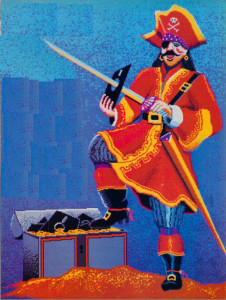
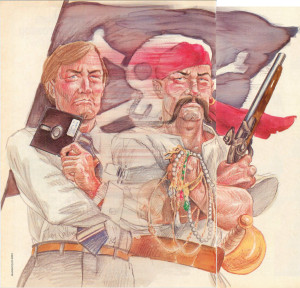
(Sources: ACM Computing Surveys of March 1975; New York Times of May 8 1964; Byte of September 1976, January 1977, May 1981, September 1981, October 1981, December 1981, January 1982, and May 1982; PC Magazine of October 1982 and November 1982; Computer World of December 5 1983; 80 Microcomputing of November 1982, February 1983 and April 1983; Ahoy! of August 1985, November 1985, and March 1986; Color Computer Magazine of August 1983, November 1983, January 1984, and July 1984; Commodore Magazine of April 1989; Commodore Power Play of August/September 1985; Games Machine of September 1988; Transactor 5.3 and 5.5; Computer Gaming World of September/October 1982; Acorn User of September 1984; Amazing Computing of September 1987; A.N.A.L.O.G. of January 1984; Computer and Video Games of April 1984, May 1984, and June 1984; Creative Computing of November 1984; Electronic Games of January 1985; Enter of April 1984; Hardcore Computist #2; New Zealand Bits and Bytes of September 1982; Popular Computing Weekly of June 7 1984; Sinclair User of September 1984 and November 1984; The Rainbow of March 1984; Your Spectrum of December 1983/January 1984; Zzap! of June 1987. Also the book From Pac-Man to Pop Music, including “Chip Music: Low-Tech Data Music Sharing” by Anders Carlsson. The pictures are all drawn from the magazines’ various anti-piracy articles, which always seem to bring out the fanciful best in their artists. Really, aren’t they great?)


Comments
08 Jan 14:09

A Pirate’s Life for Me, Part 2: The Scene

by Jimmy Maher

Fair warning: This article contains a couple of images that qualify as Not Safe For Work. Scroll further with caution!

Disks

The scene, the underground, whatever name you attach to it, there will never be anything like it again. There was a certain degree of innocence about it all, even though the activities were largely illegal. No one really understood that because most of us were still living at home trying to get through primary school! We had no larger world view to place the activities in context, no moral compass to tell us it was wrong. It was just fun, and that’s all we cared about!

— A scener named “Fantasy”

There is no historical instant to label as the beginning of the so-called “scene,” the loose international association of hackers, crackers, phreakers, and traders who dedicated themselves to making every computer game available for free within hours of its release, regardless of where in the world that initial release took place. The scene’s story rather begins with thousands of individual stories taking place in thousands of places, in the playgrounds and computer stores and bedrooms where young people first began to casually trade their latest software purchases among themselves. Someone who had a friend in the next town over, where the pool of games being passed around might be very different, could become a big fish in his own small pond by visiting said friend for a little inter-city trading. Gradually a larger distribution network was formed that offered immense rewards in status for the best-connected traders. It didn’t take long for some of these teenage kingpins to start editing their initials into the games, just so everyone at their school would be sure to know from whose largess they were benefiting. And so it began, driven, as it always would be, by the eternal adolescent need for acceptance and validation as much as it was by the very new technologies of home computers and the games they played.

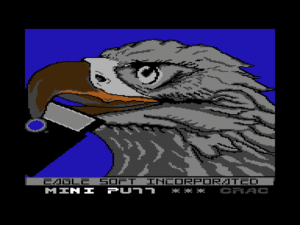
If we insist on identifying a more concrete point of origin for the scene, we could do worse than the birth of Eagle Soft Incorporated, the oldest of the big cracking groups whose bewildering, ever-changing allegiances and wars would come to dominate life in the scene. In 1982, three Canadians named Dan, Jason, and Jim decided to band together under the Eagle Soft banner, chosen from a literal banner of an eagle that Dan happened to have hanging above his bed. With copy protection now becoming more common on games and other software, Jim, a citizen of Singapore studying in Canada, became one of the the world’s first recognized crackers through his work de-protecting early Commodore 64 games. Then another, even better cracker from the United States named Mitch joined the group. In a matter of months he took it over, as the original Canadian trio all lost interest and got on with their lives in one way or another. Unlike Mitch, who remained an almost unique exception by simply going by his first name, the new members he recruited all adopted online handles, the perfect complement to a social milieu that would come to represent for its participants an alternate, fantastic existence divorced from all the trials and tribulations of high school.

Eagle Soft

Eagle Soft dominated the Commodore 64 cracking scene in North America throughout the 64’s glory years there, thanks not only to their technical chops but also to a network of contacts inside magazines and stores that often resulted in an Eagle Soft crack of a game hitting the scene before an honest buyer could walk into a store and purchase it. The earliest Eagle Soft cracks went entirely unclaimed. Later the group started to edit in their initials (“ESI”) wherever they could find a place — for instance, as a replacement for the usual “loading…” message. Soon, however, the Eagle Soft eagle, one of the most iconic images of the cracking scene as a whole, made its first appearance. It became the centerpiece of the custom-programmed introductions that Eagle Soft took to including in the games they cracked. Such “cracktros” were soon a staple of the emerging scene, a place for the various groups to brag about their accomplishments, greet their friends and flame their enemies, and, teenage boys being teenage boys, quote their favorite rock lyrics (Eagle Soft always had a particular obsession with Rush).

Pirated games cracked by North American groups like Eagle Soft were first released almost exclusively via modem, through a fast-growing underground network of BBS systems. Telecommunications in those days was almost unbelievably primitive. Almost all of the boards were single-user systems, a single Commodore 64 or similar computer attached to a single phone line. Because only one person could be online uploading or downloading at any one time, the boards’ time was precious. A scener was expected to justify his use of a system’s time by uploading new “warez” as well as downloading; many boards had a credit system that might award two “download credits” for every block uploaded. Like everything else about the scene, the boards themselves were ranked according to a hierarchy running from “lame” to “eleet”; the better the board’s ranking, the more connected were its users and the more recent the games hosted there. Games trickled down through the hierarchy, from the “0-dayz” boards to the “3-dayz” to the “5-dayz” to all the others, to be eventually traded in gymnasiums and lunch rooms via the sneaker net by those kids so lame they didn’t even own modems. Primitive though it was, the system was surprisingly efficient. A hot new game could easily be available nationwide on the most eleet boards within 24 hours of its arrival on store shelves — if not before it was actually released, thanks to the scene’s contacts inside publishers and magazines. Within a week or two after that one could expect to find it on even the lamest boards.

In those days, there were few affordable legal ways to call between telephone area codes without incurring minute-by-minute long-distance charges, an expense very few parents of teenagers were willing to tolerate. Thus the grease that lubricated the distribution of pirated games was “phreaking,” the illegal practice of making long-distance calls for free. The PC industry had always had connections to this shady art; Steve Wozniak and Steve Jobs famously first bonded over a “blue box” used to generate the whistling tones that could be used to fool the analog phone systems of the early 1970s, and one of the first pieces of third-party hardware made available for the original Apple II was a similar device. In the 1980s, the scene made phreaking more popular than ever. By now the old analog switches that were vulnerable to blue boxes were on their way out, but the new phenomenon of long-distance calling cards was on the way in. These allowed customers to take their long-distance services with them when they traveled; they needed only dial a local access number, then input the code on their card followed by the long-distance number they were actually wanting to call. In the beginning, many of the calling-card codes consisted of only five digits, meaning that for a company with just 5000 calling-card customers fully one possibility in twenty would be a valid number. Sceners developed programs to brute-force the numbers; these could be set up overnight to try combination after combination until a valid one turned up. Once they were found, the phreaker could either reserve the codes for his own use or trade them on the boards for download credits or other considerations. Most would last a few weeks, until the victim got her first bill for hundreds or thousands of dollars.

Because they were so essential to the workings of the scene, long-distance codes (“codez”) and other means of phreaking were if anything even more sought-after than the games themselves, the fastest way for a new arrival to earn cred and rise through the class hierarchy. Unfortunately, phreaking was also by far the most common if not the only way for a scener to get himself into real legal trouble. The last legal questions surrounding the copyright eligibility of software had been settled by the time the scene came into its own, but enforcement still remained at best problematic. Very few district attorneys saw much profit in hauling teenagers into criminal court for trading computer games, and the game publishers themselves, players in a niche industry as they were, had neither the clout to influence the district attorneys nor the financial wherewithal to pursue civil cases. The case of the big phone companies, however, was another matter entirely. The few police investigations and prosecutions that resulted from the American scene’s activities virtually all revolved not around the software piracy that was the perpetrators’ real raison d’être, but rather around the offense of phone phreaking, or even more dangerous practices like credit-card fraud; desperate for more and better hardware to improve their boards and thus improve their standing, some sceners took to using stolen credit-card numbers to order equipment to convenient nearby vacant houses.

That said, even police involvement of this stripe was uncommon, and often exaggerated within the scene itself. Sceners, being almost universally at that rebel-without-a-cause phase of life, relished the idea of being daring outlaws out of all proportion to the reality of the risk. While the so-called “leet speek” that already characterized the scene by the mid-1980s — replacing “software” with “warez,” “hacker” with “haxxor,” “elite” with “eleet” — was allegedly developed to circumvent electronic law-enforcement filters that might be tracking their activities, one senses that such constructions were more important as typical adolescent markers of inclusion and exclusion.

In 1985 or so a new species of game began to trickle into the American Commodore 64 scene. These new arrivals went unmentioned in the magazines’ review sections and were never spotted on store shelves. And they had a different feel about them as well. Typical American commercial software at the time tended to be fairly high-concept stuff, with lots of earnest simulations, strategy games, and adventure games. The new games, though, unabashedly emphasized fast action and fast graphics over depth. Many already came equipped with cracktros of their own, but these also were different in character from the norm, with audiovisual production values that often smoked even those of the impressive action games to which they were attached. And, while the boasting, greeting, and warring being done by the groups behind these new cracktros wasn’t all that different from what American sceners were used to, it was all being carried on by groups no one had ever heard of before, and often in distinctly broken English that was apt to suddenly lapse into spasms of incomprehensible German or Dutch. The American scene had finally met the European.

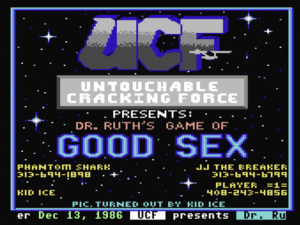
A typical Commodore 64 cracktro. Something tells me most sceners greeted this game with particular interest...

A typical Commodore 64 cracktro. Something tells me most sceners greeted this game with particular interest…

The fast-action sensibilities of these new games were right in line with the American scene’s own, ironically much more so than the games commonly made in their own country. They quickly became great favorites, among the most sought-after warez of all. Certain groups became import/export specialists, establishing trading alliances with the groups across the pond. Particularly in the beginning, their trading was often done via the mail. Later, sceners began to practice the risky art of international phreaking. Europeans learned that they could make good use of the calling cards issued by American phone companies to their customers traveling abroad; there followed a booming codez-for-warez trade between the United States and Europe.

The European versions of machines like the Commodore 64 and Amiga were slightly different than the American, with their video signal and internal timings made to conform to the European PAL television standard rather than the American NTSC. This was enough to break certain games that really pushed the hardware, or to make them flicker or run slightly too quickly or too slowly. Some sceners therefore became specialists in PAL or NTSC “fixing,” the art of adapting games to run correctly under the alternate standard. This was far from trivial work — a marker of the fact that, much as the scene may look at times like little more than boys acting out, the best of those boys had real technical chops.

If it’s surprising that the two scenes should have developed so similarly in what was initially all but complete isolation from one another, well, one can only presume that nerdy yet rebellious teenagers really don’t vary all that fundamentally from country to country. More surprising is that the scene took root so strongly in Europe in the face of barriers that must have seemed almost unbelievably confounding to their American counterparts. One was the simple barrier of language. Very few European sceners had English as their native language; computer-mad Britain was, somewhat oddly, never all that huge in the scene, which was biggest in West Germany, the Netherlands, and Scandinavia. Yet they adopted English, the language they all learned to at least some extent in school and also that of most of the pop culture they consumed, as their lingua franca. The European scene’s diction is indescribable but immediately identifiable to anyone who’s spent any time around it, a mixture of stiff, grammatically suspect schoolboy constructions, leet speek, and phrases copied and pasted out of movies and music, with a heaping dose of profanity layered on top to make it all go down easy.

Another barrier facing European sceners was the cost of telecommunications. European telephone systems, unlike their American counterparts, generally still charged even local calls by the minute in the scene’s formative years, and prior to the influx of all those American codez there were few ways to safely phreak one’s way around this situation. Thus trading by post rather than BBS dominated in Europe for some years. Just as American sceners happily cheated the phone companies, European sceners did the same to the postal systems. Stamps were covered with a thin layer of glue or hairspray, which could be peeled away when packages arrived at their destination, taking with it the postal service’s mark showing the stamps had been used. Another possibility was to attend one of the “copyparties” that started sprouting up in Europe by about 1986. At most of them, you needed only turn up, equipped with a computer, dozens of blank disks, and dozens of games of your own for trading, to get in one the action.

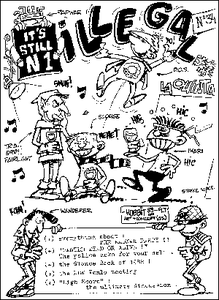
An issue of Illegal, one of the scene's newsletters.

An issue of Illegal, one of the scene’s newsletters.

The specter of law enforcement, usually more a theoretical than an actual threat in North America, was a more serious concern in Europe. Plenty of mail swappers had uncomfortable run-ins with the local postal authorities that resulted in hefty fines and very unhappy parents, and in more extreme cases jail terms for international smuggling and/or mail fraud. One French scener by the name of Maximillian, a major trader in the codez used for international phreaking, was tracked down by Interpol and sentenced to several years in prison. The European police also generally took the crime of software piracy more seriously than their American counterparts. The West German and Norwegian police went so far as to institute special task forces to concentrate on the software-piracy problem, although games were seldom if ever their main focus. Still, for sceners in those countries and others the proverbial policeman’s knock on the front door, while not exactly commonplace, was hardly entirely unknown either. The police would arrive armed with search warrants and the full force of the law to ransack the scener’s bedroom while shocked parents looked on in horror.

As if the legitimate authorities weren’t scary enough, then as now the copyright wars attracted a fair number of shady dealers on the side of ostensible law and order. One German lawyer, Günther Freiherr von Gravenreuth, made the war against software piracy a dodgy sort of personal crusade, going so far as to send entrapping letters to suspected sceners in the persona of “Tanja,” a 16-year-old girl looking for new games; whatever else you can say about him, Gravenreuth certainly did know how to capture a teenage boy’s interest. If they replied, the targets could expect to be threatened with a lawsuit, along with a helpful settlement offer for many thousands of marks. (Gravenreuth was himself found in 2004 to be one of the masterminds of an international for-profit software piracy ring that dwarfed in scale and sophistication anything the scene could have imagined.)

Despite all these pressures, the scene not only survived in Europe but thrived, and for far longer than its American equivalent. Much of the reason for the European scene’s comparative longevity had to do with the rise and fall of the computing platforms that both American and European sceners favored. While virtually all viable platforms had their share of cracking groups, the core of the scene always identified most closely with Commodore’s machines, first the 64 and later the Amiga. When the former began to slowly fade and the latter to rise in the late 1980s, European sceners made a natural, gradual migration. Because the Amiga never quite took off in North America as it did in Europe, however, the American scene largely faded away with the 64. Between 1988 and 1990, most of the prominent American groups and crackers disbanded or retired, leaving the scene as a whole a largely European phenomenon, where it would continue to grow for another half-decade. Indeed, it still survives, in a shrunken and more subdued form with little continuing interest in software piracy, right to the present day. So dominant did its identity as a European phenomenon become that today the very fact that a scene ever existed at all in North America is all but forgotten by many.

But how did one get involved in the scene in the first place? In the hope that one individual’s story might take the place of a lot of dull generalities, let me tell you how it happened for “Weasel,” a German scener.

Our hero’s first computer, bought for him by his parents in 1985, was a Commodore 128 that he used in 64 mode all the time because the 128 didn’t have much in the way of games. He started out trading only with his schoolyard chums. But as his mania for collecting grew, his network of contacts grew to match: “People were coming to me now to get the latest games. I had them all!”

He found fascinating the cracktros that came attached to many of the games he was now trading, created by groups with names like the Dynamic Duo, 1001 Crew, Triad, German Cracking Service, and Federation Against Copyright. As the cracktros grew more elaborate almost by the month, he found himself spending more time admiring them and reading their “scrolltexts” than he did playing the games. “One day I want to be one of those guys as well,” he thought, “being part of a group and doing lots of cracks for all the people inside and outside of that so-called ‘scene.'” With that goal in mind, he started learning to program, first in BASIC, then in machine language, following a course in one of the magazines. He used his new knowledge to tinker with the cracktros and the games themselves, changing this and that to see what would happen. And, because every aspiring scener needed a handle, he started to call himself “Wiesel,” from a car advertisement he had stuck to his bedroom door: “Schneller als ein Wiesel!”

One day he took his skateboard to a popular local hill, at the top of which he noticed a rather incongruous stack of floppy disks amid the jumble of backpacks and bags left lying around by the boarders. When he saw the owner of the disks pick them up, he screwed up his courage to walk over and start a conversation. The owner was a fellow who called himself Havok, a music specialist with a cracking group called Frontline. Havok invited him to the next Frontline meeting, to take place in a Burger King in just a few days. Wiesel accepted in a daze, feeling “I must be dreaming.”

At the meeting, he was given an original of a game called Ikari Warriors, whose copy protection was known to be fairly strenuous. His assignment was to crack the game and bring it to the next weekly meeting, thereby to prove himself worthy — or unworthy — of membership.

So I went home and inserted the disk into my computer to have a look at the game. What I first saw looked like a never-be-able-to-crack-that game. So I almost gave up at the beginning, when I noticed the game loading with a track-sector fastloader. I had never seen anything like that before. But I never stopped thinking about a way to get into that damn program. I recalled everything I had already learned about machine language, and tried to find out as much as I could about the loading routine, the protection, the game itself, and how it worked. Finally I found a way to access the game, and after a while I had a working memory backup saved on my disk.

When Wiesel proudly returned to Frontline with crack in hand, they pronounced his work good enough and offered him official membership. There was only one condition: he needed to change his handle from the German “Wiesel” to the English “Weasel,” to “give it an international touch.” Thanks to his boldness, initiative, and technical chops, he was a real participant in the scene at last. He spent the remainder of his teenage years bouncing from group to group — Frontline, Matrix, Crazy, Crest, Enigma, Red Sector, Legend, Avantgarde, Fantastic Four Cracking Group — in the extended soap opera of shifting allegiances and relationships that was the life of a prominent scener. As with so much in life, the hardest part had proved to be just getting through the door.

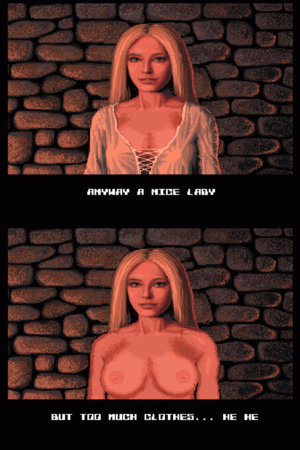
Cracktros and demos often repurposed — read, stole — graphics and sound from games. The love scene from Defender of the Crown was a great favorite, for obvious reasons.

And once through the door, what was life like then as a real scener? Well, the scene was first and foremost a rough place, dominated as it was by teenage boys with angsty streaks a mile wide. Prominent sceners could be as young as age 13, and most tended to scale back their involvement or drop out entirely before entering their twenties, as jobs and university and girlfriends proved harder and harder to forgo for the all-consuming obligations of being a big wheel in the scene. Sceners mention in interviews already feeling “old” and out of step with the Lord of the Flies politics of the scene as young as age 17.

There were some exceptions to the demographic rule. Eagle Soft, for example, numbered two actual girls within their ranks (Ladyhawk and Scorpio), who served as their artists, drawing their famous eagle among other pictures. Perhaps the most amusing exception of all is that of Derbyshire Ram, an English country gentleman who retired in his fifties, took up the Commodore 64 as a hobby, and became a major trader and member of several big groups. While Derbyshire Ram was by all reports a gentle soul and an all-around good egg, others among the sprinkling of adults who chose to spend so much time hanging out with all these teenage boys may have had more disturbing motivations; one, known as Music Man, was reportedly jailed for child molestation.

But, exceptions aside, we can guess that at least 90 percent of active sceners during the 1980s were boys between the ages of 13 and 19. The reality that the members of this international criminal conspiracy almost all had parents hectoring them to do their homework and spend more time away from their computer could lead to some hilarious juxtapositions. Mitch of Eagle Soft, for instance, who was for years the most respected cracker in North America, worshiped by legions of disciples within the scene, tells of hiding in bed under the covers with his brother and a portable Commodore 64 playing Maniac Mansion into the night. Really, how many international criminal masterminds have a bed time?

It seems safe to say that many of these kids were the sort who don’t have the easiest time of it in high school. Sadly, instead of creating a gentler teenage society, most embraced the “shit roles downhill” theory of social policy with relish, choosing victims below them in the scene’s pecking order to harass mercilessly. Most of their flames and diatribes will sound very familiar to anyone who’s ever been unwise enough to read YouTube comments. We’ve already encountered one or two of the scene’s cruder productions in passing in earlier articles, like the text adventure Mad Party Fucker, with its tagline “The object of this game is to fuck as many women as you can without getting bufu’ed by fags (contracting AIDS).” Tolerance wasn’t any higher than grammar on the scene’s list of virtues.

Things could get particularly vicious when one of the periodic “warz” broke out between rival groups. If the groups were of sufficient stature, the conflict could quickly become a global one, with every other group force to align themselves with one side or the other. The largest, most sustained, and most brutal of all the wars was probably the one sparked off in 1987 between Eagle Soft and their only real rival for dominance of the North American scene, a group called Untouchable Cracking Force. Again, some of the techniques used by the combatants will ring sadly familiar to anyone aware of some of the Internet harassment that goes on today. Sceners set up war dialers to call their enemies’ homes, endlessly, with a screeching modem on the other end for anyone who picked up; taped their enemies’ conversations, then sent out edited snippets to place them in a bad light (anything that could somehow be construed to imply that they were gay was particular gold); ordered massive quantities of pizza to their houses; sent them mail-order packages full of useless computer equipment, ordered cash-on-delivery.

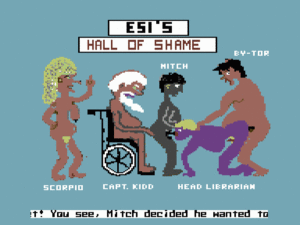
Scene from a "war" between Eagle Soft and a rival group. Make no mistake: the scene could be an ugly, ugly place.

A scene from a war between Eagle Soft and Untouchable Cracking Force. Believe it or not, this is actually one of the less offensive images of its type.

A journalist who infiltrated the scene and published a newspaper article about the goings-on — one of its few appearances in the overground media — allegedly suffered even worse indignities at their hands. According to By-Tor, a former member of Eagle Soft:

I remember it caused GREAT disruption in the scene and many major groups got together and we harassed him for 2 weeks straight, (I wish I would remember the groups names involved) his credit cards were given out, were charged up for computer equipment that went to a lot of people in the scene. His MCI cards were phreaked and loaded up with charges. He had to change his phone number 3 times during this time and cancel credit cards as there were people in groups that were great hackers and had inside info to finding out his new phone numbers and credit card numbers. Taught him a lesson he never forgot, that he was forced to write a 2nd story apologizing to all of us for lying to us and writing his story explaining the workings of the ELITE SCENE. We put him through HELL. :)

This doesn’t truly convey in written words what truly went on but that is the main story. It was GREAT!

The worst transgression, considered beyond the pale by even most warring sceners but occasionally practiced nevertheless, was to make an anonymous call to the police (the “pigs”) to out a fellow scener as a phreaker and/or pirate. There were also scattered reports of physical confrontations, particularly at the copyparties in Europe, involving fists, baseball bats, pepper spray, or in one alarming case an allegedly live hand grenade.

Lest we judge all of this too harshly, we should remember that, driven by hormones, frustrations, and most of all peer pressure, almost all of us did and said things as adolescents that we aren’t particularly proud of. Betwixt and between the orgasms of ugliness real friendships were formed. The old sceners have for the most part long since gone on to productive lives and careers, often using the skills they learned cracking games and writing cracktros in those formative years. With the exception of only a few like our friend By-Tor who still remembers the scene’s worst antics as so “great,” most remember the scene fondly when thinking back, but naturally prefer to focus on its more positive aspects if they haven’t managed to forget the worst ugliness entirely. The collision between nostalgia and reality can be a little off-putting when they are, say, confronted with an actual newsletter to which they contributed, as happened with the fellow who once went by the handle of “Punk Executioner.”

The thing that struck me when re-reading this 20 year old text was the level of aggression and gorilla chest thumping. Clearly I owe a lot of apologies. This was more apparent after I penetrated deep into my garage and dug out the old C64. Re-reading some of the scroll texts and Reason 4 Treason articles made me cringe. It appears I took aim at any dork, nerd, drop-out, non-music listener, anti-graffiti, pro-establishment, unfashionable person out there. I’m not sure why, perhaps it was because I occasionally copped a bit of flak myself for being a ‘computer head’ at school. Being a Dungeons & Dragons geek and using a brief-case as a school bag didn’t do me any favours either.

The scene’s saving grace, assuming we’re willing to grant it one, must be that its was an ethos not just of nihilism but also, almost paradoxically, of creation and even artistic excellence. Cracking games wasn’t easy, particularly as time went on and the publishers’ protection schemes grew more and more sophisticated. The best crackers brought a real flair to the job, not just finding a way to copy the disk but also adding cheat modes, conveniences, and new features. See for instance the crack by a group called Nostalgia of Access Software’s Leader Board golf simulation, which combined the core game with the course add-on pack and a simple menu to switch between them, simplifying a rather laborious process of rebooting and switching disks that annoyed many a legitimate purchaser.

And, increasingly over time, cracking was just one of the things that sceners did, and eventually not even the most important. In addition to horrid pornographic text adventures like Mad Party Fucker, sceners produced newsletters on paper and disks, in the case of the latter often with astonishingly good production values if not prose; home-grown utilities to produce graphics and, especially, music (the best of the scene’s so-called “sound trackers” on the Amiga were as good as any commercial music package); reams of art and countless hours of music, some of which wouldn’t sound particularly out of place on a modern dance floor, created with the aid of said utilities; and of course cracktros, which by the end of the 1980s had begun to morph into standalone demos, little showcases of multimedia art of sometimes stunning sophistication and ambition. In an odd but satisfying turnaround, software piracy became the afterthought of a vibrant and creative, if still very much underground, association of digital artists. Latter-day Amiga crackers even took to adding messages to their scrolltexts saying, hey, if you like this game you really ought to buy it — perhaps because by this point many current and former sceners were working in the games industry, snapped up for their audiovisual-programming chops by the very publishers who had once tried so hard to stamp them out. As copyparties turned into “demoparties” and the cracking scene turned into the “demoscene” in Europe in the early 1990s, it also became, relatively speaking, a gentler place, with an idealistic artistic ethos all its own. We’ll drop in on the scene again in a future article, to give you a chance to appreciate with me that unique community and some of its creations and to marvel with me how far it came in such a short time.

To be sure, the crackers and pirates who came before the demo coders were a less idealistic lot, motivated as they were by their teenage lusts for acceptance and for free games, but all their feverish cracking and trading all those years ago has had one supreme benefit. In cracking the games, they made it possible to archive and preserve them, something the companies that published them never spared a moment’s thought for. The sceners didn’t either, of course; they were hardly working for posterity when spreading their “0-day warez” around the world. Nevertheless, I’m hugely in their debt, as is everyone who cares about the history of gaming. The vast majority of the games you’ll find on the various disk-image archives today are the cracked versions, complete with their cracktros chronicling all the most recent wars and alliances, an ephemeral tempest in a teapot preserved forever. That, too, is another marker of our new digital way of living, toward which the scene, the first international digital subculture, pointed the way.

Next time we’ll wrap up this little series with a practical look at the mechanisms of copy protection itself: how it worked and how the scene’s crackers learned to defeat it.

(Sceners have done a very good job of archiving most of the artifacts of the 1980s and 1990s, although most of their own attempts at writing about their history quickly devolve into breathless but bewildering accounts of scene politics — “And then this group was formed, and went to war with this group, but this other group switched sides…,” etc. There’s a lot of that in Freax by Tamás Polgár, the only book I know of about the scene, but it’s nevertheless an essential resource for anyone hoping to really understand it. Otherwise this article is largely drawn from online scene sites. See Scenery, Heikki Orsila’s archive of scener interviews, Hall of Fame, the Illegal newsletter archives, and Recollection. Also see the chapter “The Scene” in my own The Future Was Here.)


Comments
08 Jan 11:13

#1188; Off to a Good Start

by David Malki

I’ll check in with you at your funeral to see how it’s going

07 Jan 15:58

Guns And States

by Scott Alexander

[Epistemic status: I think I probably wrung the right conclusions out of this evidence, but this isn’t the only line of evidence bearing on the broader gun control issue and all I can say is what it’s consistent with. Content warning for discussion of suicide, murder, and race]

I.

From a Vox article on America’s Gun Problem, Explained: “On Wednesday, it happened again: There was a mass shooting — this time, in San Bernardino, California. And once again on Sunday, President Barack Obama called for measures that make it harder for would-be shooters to buy deadly firearms.”

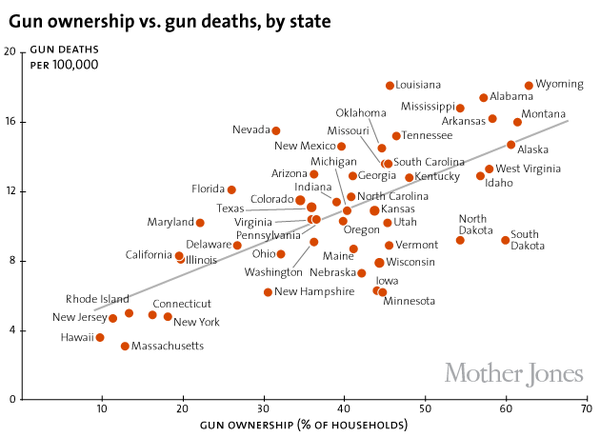
Then it goes on to say that “more guns mean more gun deaths, period. The research on this is overwhelmingly clear. No matter how you look at the data, more guns mean more gun deaths.” It cites the following chart:

…then uses the graph as a lead in to talk about active shooter situations, gun-homicide relationships, and outrage over gun massacres.

Did you notice that the axis of this graph says “gun deaths”, and that this is a totally different thing from gun murders?

(this isn’t an isolated incident: Vox does the same thing here and here)

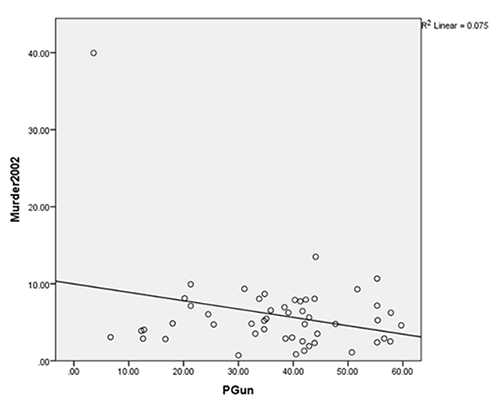
Gun deaths are a combined measure of gun homicides and gun suicides. Here is a graph of guns vs. gun homicides:

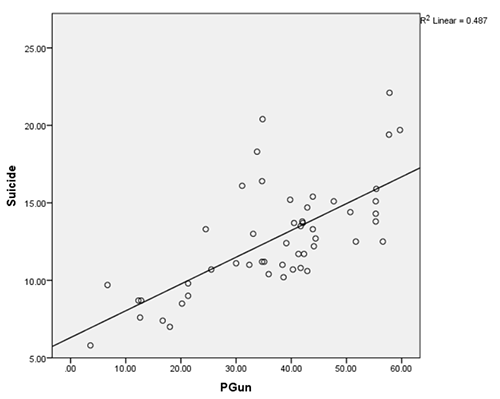
And here is a graph of guns vs. gun suicides:

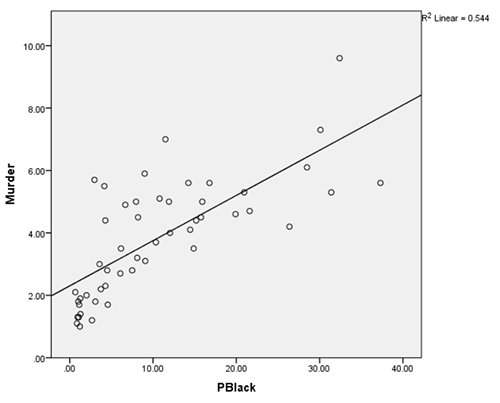
The relationship between gun ownership and homicide is weak (and appears negative), the relationship between gun ownership and suicide is strong and positive. The entire effect Vox highlights in their graph is due to gun suicides, but they are using it to imply conclusions about gun homicides. This is why you shouldn’t make a category combining two unlike things.

II.

I am not the first person to notice this. The Washington Examiner makes the same criticism of Vox’s statistics that I do. And Robert VerBruggen of National Review does the same analysis decomposing gun deaths into suicides and homicides, and like me finds no correlation with homicides.

German Lopez of Vox responds here. He argues that VerBruggen can’t just do a raw uncontrolled correlation of state gun ownership with state murder rates without adjusting for confounders. This is true, although given that Vox has done this time and time again for months on end and all VerBruggen is doing is correctly pointing out a flaw in their methods, it feels kind of like an isolated demand for rigor.

So let’s look at the more-carefully-controlled studies. Lopez suggests the ones at the Harvard Injury Control Research Center, which has done several statistical analyses of gun violence. They list two such analyses comparing gun ownership versus homicide rates across US states: Miller Azrael & Hemenway (2002), and Miller Azrael & Hemenway (2007).

(does it count as nominative determinism when someone named Azrael goes into homicide research?)
We start with MA&H 2002. This study does indeed conclude that higher gun ownership rates are correlated with higher murder rates after adjusting for confounders. But suspiciously, it in fact finds that higher gun ownership rates are correlated with higher murder rates even before adjusting for confounders, something that we already found wasn’t true! Furthermore, even after adjusting for confounders it finds in several age categories that higher gun ownership rates are correlated with higher non-gun homicide rates (eg the rates at which people are murdered by knives or crowbars or whatever) at p Behavioral Risk Factor Surveillance System Survey – and the FS/S measure fails. When I repeat all of their analyses with their own FS/S measure, I get all of their same positive correlations, including the ones with non-gun homicides. When I repeat it with the real gun ownership data, all of these positive correlations disappear. When I look at exactly why this happens, it’s because FS/S is much more biased towards Southern states than actual gun ownership is. Real gun ownership correlates very modestly – 0.25 – with 538’s ranking of the Southern-ness of states. FS/S correlates at a fantastically high 0.62. For some reason, suicidal Southerners are much more likely to kill themselves with guns than suicidal people from the rest of the States, even when you control for whether they have a gun or not. That means that MA&H 2002 thought it was measuring gun ownership, but was actually measuring Southern-ness. This is why they found higher homicide rates, including higher rates of non-gun homicide.

So we move on to MA&H 2007. This study was published after the CDC’s risk survey, so they have access to the same superior gun ownership numbers I used to pick apart their last study. They also have wised up to the fact that Southern-ness is important, and they include a dummy variable for it in their calculations. They also control for non-gun crime rate, Gini coefficient, income, and alcohol use. They do not control for urbanization level or race, but when I re-analyze their data including these factors doesn’t change anything, likely because they are already baked in to the crime rate.

They find that even after controlling for all of this stuff, there is still a significant correlation between gun ownership level and gun homicide rate. Further, this time they are using good statistics, and there is not a significant correlation between gun ownership and non-gun-homicide rate. Further, there is a correlation between gun ownership and total homicide rate, suggesting that the gun-gun-homicide correlation was not just an artifact of people switching from inferior weapons to guns while still committing the same number of murders. Further, this is robust to a lot of different decisions about what to control or not to control, and what to include or not to include.

I repeated all of their analyses using two different sources of gun ownership data, a couple different sources of homicide and crime rate data, and a bunch of different plausible and implausible confounders – thanks a lot to Tumblr user su3su2u1 for walking me through some of the harder analyses. I was able to replicate their results. Pro-gun researcher John Lott had many complaints about this study, including that it was insensitive to including DC and that it was based entirely on the questionable choice of controlling for robbery rate – but I was unable to replicate his concerns and found that the guns-homicide correlation remained even after DC was included and even when I chose a group of confounders not including robbery rate. I was unable to use their methodology to replicate the effect in places where it shouldn’t replicate (I tried to convince it to tell me tractors caused homicide, since I was suspicious that it was just picking up an urban/rural thing, but it very appropriately refused to fall for it). Overall I am about as sure of this study as I have ever been of any social science study, ie somewhat.

This study doesn’t prove causation; while one interpretation is that guns cause homicide, another is that homicide causes guns – for example, by making people feel unsafe so they buy guns to protect themselves. However, I doubt the reverse causation aspect in this case. The study controlled for robbery rate; ie it was looking at whether guns predicted homicides above and beyond those that could be expected given the level of non-homicide crime. My guess is that people feeling unsafe is based more on the general crime rate than on the homicide rate per se, which would make it hard for the homicide rate to cause increased gun ownership independently of the crime rate.

If guns are in fact correlated with more homicide, how come me and VerBruggen found the opposite in our simpler scatterplot analysis? This is complicated, but I think the biggest part of the answer is the urban/rural divide. Rural people have more guns. Murder rates are higher in urban areas. Race also plays a part: whites have more guns, but black areas have higher murder rates. Finally, the North and West seem to have more guns, but murder rates are highest in the South (which is what produced the bogus effect on the last study). All of these differences are large enough to cancel out the gun/no-gun difference and make the raw scatterplot look like nothing. This study didn’t address all those things directly, but its decision to control for non-gun crime rate and poverty took care of them nevertheless. As the old saying goes, guns don’t kill people; guns controlled for robbery rate, alcoholism, income, a dummy variable for Southernness, and a combined measure of social deprivation kill people.

If this is all true, how come I spent so much time yelling at that first study with worse data? Because I worry that if people only see the good studies, they’ll get complacent. Vox posted these two studies as proof that there was a state-level gun-murder correlation. The first one was deeply flawed, but the second one turned out to be okay. Do you think Vox realized this? Do you think they would have written that article any differently in a world where both studies were flawed? As long as you trust every scientific paper you see – let alone every scientific paper you see on your side in a highly politicized field – even when you’re right it will often just be by luck.

III.

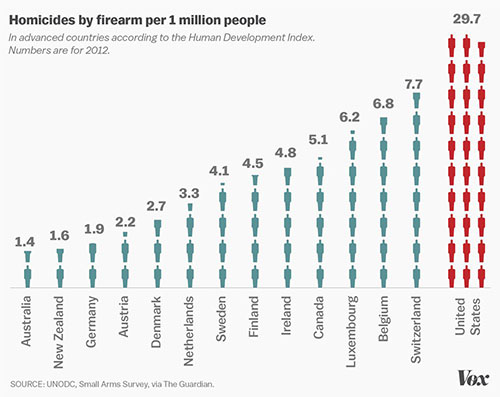
Vox also voxsplains to us about America’s unusually high gun homicide rate.

Having presented this graph, they say that “To understand why that is, there’s another important statistic: The US has by far the highest number of privately owned guns in the world.”

Even granting, as we saw above, that gun ownership does indeed increase homicide rates, this is not the most important factor in explaining America’s higher homicide rate, or even close to the most important factor. Let me give a few arguments for why this must be the case:

1. The United States’ homicide rate of 3.8 is clearly higher than that of eg France (1.0), Germany (0.8), Australia (1.1), or Canada (1.4). However, as per the FBI, only 11,208 of our 16,121 murders were committed with firearms, eg 69%. By my calculations, that means our nonfirearm murder rate is 1.2. In other words, our non-firearm homicide rate alone is higher than France, Germany, and Australia’s total homicide rate. Nor does this mean that if we banned all guns we would go down to 1.2 – there is likely a substitution effect where some murderers are intent on murdering and would prefer to use convenient firearms but will switch to other methods if they have to. 1.2 should be considered an absolute lower bound. And it is still higher than the countries we want to compare ourselves to.

2. There are many US states that combine very high firearm ownership with very low murder rates. The highest gun-ownership state in the nation is Wyoming, where 59.7% of households have a gun (really!). But Wyoming has a murder rate of only 1.4 – the same as right across the border in more gun-controlled Canada, and only about a third of that of the nation as a whole. It seems likely that the same factors giving Canada a low murder rate give Wyoming a low murder rate, and that the factors differentiating the rest of America from Wyoming are the same factors that differentiate the rest of America from Canada (and Germany, and France…). But this does not include lower gun ownership.

3. There are many US states that combine very low firearm ownership with very high murder rates. The highest murder rate in the country is that of Washington, DC, which has a murder rate of 21.8, more than twenty times that of most European countries. But DC also has the strictest gun bans and the lowest gun ownership rate in the country, with gun ownership numbers less than in many European states! It seems likely that the factors making DC so deadly are part of the story of why America as a whole is so deadly, but these cannot include high gun ownership.

If not gun ownership, what is the factor making America so much more deadly than Europe and other First World countries? The traditional answer I always heard to this question was that America had a “culture of violence”. I always hated this answer, because it seemed so vague and meaningless as to be untestable by design. If the NRA waves their hands and says “eh, culture of violence”, how are you going to tell them they’re wrong?

But we can work with this if we assume the culture of violence (or, if you want to be official about it, “honor culture”) is more common in some populations and areas than others. Some of the groups most frequently talked about during these lines are Southerners and various nonwhite minorities. This provides a testable theory: if we compare American non-Southern whites to European countries mostly made up of non-Southern whites, we’ll find similar murder rates. But first, some scatter plots:

This is murder rate by state, correlated with perceived Southernness of that state as per 538’s poll. I’ve removed DC as an outlier on all of the following.

And this is murder rate by state correlated with percent black population:

This would seem to support the “culture of violence” theory.

Can we adjust for this and see what the murder rate is for non-Southern whites? Sort of. The Economist gives a white-only murder rate of 2.5 (this is based on white victims, whereas we probably want white perpetrators, but the vast majority of murders are within-race so it doesn’t make much difference). And Audacious Epigone has put together a collection of white murder rates by state. I can’t find anything on non-Southern white murder rates per se, but one hack would be to take the white murder rate in non-Southern states and assume there aren’t any Southerners there.

Our main confounder will be urbanization. Western Europe is about 80% urban, so let’s look at states at a similar level. The four northern states that are closest to 80% urban are Colorado, Oregon, Washington, and Connecticut. I’m throwing out Colorado because it has a large Latino population who can’t be statistically differentiated from whites. That leaves, Washington (2.4), Connecticut (2.0), and Oregon (2.0). So possibly adjusting out Southerners brings us down from 2.5 (all whites) to 2.1 or so (non-Southern whites)? Again, compare to Germany at 0.8, Canada at 1.4, and America at 3.8.

There’s one more factor that needs to be considered:

This is a plot of the gun death rate vs. the robbery rate. There’s a strong correlation (r = 0.78). Robbery is heavily correlated with percent black, percent Southern, and urbanization, so it’s probably coming from the same place. Nevertheless, it seems to correlate with murder better than any of them alone, maybe because it’s combining all three measures together. I was able to make a linear model using those three measures that correlated at r = 0.79 with murder, about the same amount that robbery does. I should also mention that robbery correlates negatively with gun ownership at r = – 0.52, but this disappeared when controlled for urbanization.

So my very tentative conclusion is that although the US murder rate is much higher than that of other First World countries, this is partly due to the existence of various cultural factors not present in those other nations. When we adjust those away, America’s murder rate falls from 3.8 to 2.1. Which is still higher than Germany’s 0.8 or Canada’s 1.4.

Is that extra due to guns?

IV.

According to MA&H 2007, each absolute percentage point in gun ownership was related to a 2.2 relative percentage point difference in homicide. This part of the study was beyond my ability to check, and I’m not sure why they switched from absolute to relative percents there, but suppose we take it seriously.

America has a gun ownership rate of 32%, so if we somehow decreased that to zero, we would naively expect about a 70% decrease in homicides. Unfortunately, only 67% of American homicides involve guns, so we’re back to pretending that eliminating guns will not only have zero substitution effect but also magically prevent non-gun homicides. This shows the dangers of extrapolating a figure determined by small local differences all the way to the edge of the graph (I’M TALKING TO YOU, RAY KURZWEIL).

Maybe we can be more modest? Canada has a gun ownership rate of aboot 26%, so…

…wait a second. I thought we’ve been told that the US has a gun ownership rate seven zillion times that of any other country in the world, and that is why we are so completely unique in our level of gun crime? And now they’re telling us that Canada has 26% compared to our 32%? What?

Don’t trust me too much here, because I’ve never seen anyone else analyze this and it seems like the sort of thing there should be loads of analyses of if it’s true, but I think the difference is between percent of households with guns vs. guns per capita. US and Canada don’t differ very much in percent of households with guns, but America has about four times as many guns per capita. Why? I have no idea, but the obvious implication is that Canadians mostly stop at one gun, whereas Americans with guns buy lots and lots of them. In retrospect this makes sense; I am looking at gun enthusiast bulletin boards, and they’re advising other gun enthusiasts that six guns is really the bare minimum it’s possible to get by with (see also “How many guns can you have before it’s okay to call your collection an ‘arsenal’?”, which I have to admit is not a question that I as a boring coastal liberal have ever considered). So if the guy asking that question decides he needs 100 guns before he gets his arsenal merit badge, that’s a lot more guns per capita without increasing percent household gun ownership. This should actually be another argument that guns are not a major factor in differentiating US vs. Canadian murder rates, since unless you’re going on a mass shooting (WHICH IS REALLY RARE) you wouldn’t expect more murders from any gun in a household beyond the first. That means that the small difference between US and Canadian household percent gun ownership rates (32% vs. 26%) would have to drive the large difference between US and Canadian murder rates (1.4 vs. 3.8), which just isn’t believable.

…okay, sorry, where were we? Canada has a gun ownership rate of about 26%, so if America were to get its gun ownership as low as Canada, that would be -6 absolute percentage points = a 13% relative decrease in murder rate = the murder rate going from 3.8 to 3.3 = a 0.5 point decrease in the murder rate. That’s pretty close to the difference between our 2.1 US-sans-culture-of-violence estimate and the 1.4 Canadian rate – so maybe beyond the cultures of violence, the rest of the US/Canada difference really is due to guns?

(I’m not sure whether I should be subtracting 13% from 2.1 rather than 3.8 here)

In Germany, 9% of households own firearms (wait, really? European gun control is less strict than I thought!) Using MA&H’s equation, we predict that if the US had the same gun ownership rate as Germany, its murder rate would drop 50%, eg from 3.8 to 1.9. Adjust out the culture of violence, and we’re actually pretty close to real Germany’s murder rate of 0.8.

How much would gun control actually cut US gun ownership? That obviously depends on the gun control, but a lot of people talk about Australia’s gun buyback program as a model to be emulated. These people say it decreased gun ownership from 7% of people to 5% of people (why is this number so much lower than Canada and Germany? I think because it’s people rather than households – if a gun owner is married to a non-gun-owner, they count as one gun-owner and one non-owner, as opposed to a single gun-owning household. The Australian household number seems to be 19% or so). So the gun buyback program in Australia decreased gun ownership by (relative) 30% or so. If a similar program decreased gun ownership in America by (relative) 30%, it would decrease it by (absolute) 10% and decrease the homicide rate by (absolute) 22%. Since there are about 13000 homicides in the US per year, that would save about 3000 lives – or avert about one 9/11 worth of deaths per year.

(note that our murder rate would still be 3.0, compared to Germany’s 0.8 and Canada’s 1.4. Seriously, I’m telling you, the murder rate difference is not primarily driven by guns!)

Is that worth it? That obviously depends on how much you like being able to have guns. But let me try to put this number into perspective in a couple of different ways:

Last time anyone checked, which was 1995, about 618,000 people died young (ie before age 65) in the US per year. Suppose that the vast majority of homicides are of people below 65. That means that instituting gun control would decrease the number of premature deaths to about 615,000 – in other words, by about half a percentage point. I’m having to borrow this data from the UK, but if it carries over, the average person my age (early 30s) has a 1/1850 chance of death each year. Gun control would decrease that to about 1/1860. I’m very very unsure about the exact numbers, but it seems like the magnitude is very low.

On the other hand, lives are very valuable. In fact, the statistical value of a human life in the First World – ie the value that groups use to decide whether various life-saving interventions are worth it or not – is $7.4 million. That means that gun control would “save” $22 billion dollars a year. Americans buy about 20 million guns per year (really)! If we were to tax guns to cover the “externality” of gun homicides preventable by Australia-level gun control, we would have to slap a $1000 tax on each gun sold. While I have no doubt that some people, probably including our arsenal collector above, would be willing to pay that, my guess is that most people would not. This suggests that most people probably do not enjoy guns enough to justify keeping them around despite their costs.

Or if all gun enthusiasts wanted to band together for some grand Coasian bargain to buy off the potential victims of gun violence, each would have to contribute $220/year to the group effort – not totally impossible, but also not something I can really see happening.

This is very, very, very, very very tentative, but based on this line of reasoning alone, without looking into the experimental studies or anything else, it appears that Australia-style gun control would probably be worth it, if it were possible.

(I didn’t price in the advantages of guns in terms of preventing state tyranny and protecing freedom, which might be worth subsidizing, but my guess is that if 32% gun ownership is enough to maintain freedom, 22% gun ownership is as well)

V.

In summary, with my personal confidence levels:

1. Scatterplots showing raw correlations between gun ownership and “gun deaths” are entirely driven by suicide, and therefore dishonest to use to prove that guns cause murder (~100% confidence)

2. But if you adjust for all relevant confounders, there is a positive correlation between gun ownership and homicide rates (~90% confidence). This relationship is likely causal (~66% confidence).

3. The majority of the difference between America’s murder rate and that of other First World countries is not because of easier access to guns in America (~90% confidence).

4. But some of it is due to easier access to guns. This is probably about 0.5 murders/100K/year.

5. An Australian-style gun control program that worked and had no side effects would probably prevent about 2,000 murders in the US. It would also prevent a much larger number of suicides. I am otherwise ignoring suicides in this piece because discussing them would make me too angry.

6. Probably the amount of lost gun-related enjoyment an Australian-style gun control program would cause do not outweigh the benefits.

7. This is not really enough analysis to make me have a strong opinion about gun control, since this just looks at the correlational evidence and doesn’t really investigate the experimental evidence. Contrary to what everyone always tells you, experimental evidence doesn’t always trump correlational – there are cases where each has its strengths – but it wouldn’t be responsible to have a real opinion on this until I look into that too. Nevertheless, these data are at least highly consistent with Australia-style gun control being a good idea for the US.

If you want to look into this more, here is a CSV version of all the relevant data.

06 Jan 21:55

A ‘progressive alliance’ needs a lot more than wishful thinking to happen

by Nick

PAFBExploding onto the scene with all the impact of a sodden paper bag landing in a puddle, someone has launched Progressive Alliance UK, seeking “to build a broad alliance of progressives from across the centre and left of British politics to end Conservative rule”. The aim is to somehow bring together everyone vaguely nice progressive into one big electoral alliance that will enable the Tories to be defeated at the next election and allow for everyone to receive their very own unicorn.

I mock, but the idea does appear to be driven mostly by wishful thinking, imagining that ‘progressives’ will be able to overcome their differences thanks to a call for pragmatism and sweep to victory over the Tories. That there doesn’t seem to be much of a desire for pragmatism and co-operation from many of the supposed progressives right now isn’t acknowledged, with an assumption that all everyone needs to do is realise that this is is the only way to beat the Tories and come together to achieve it.

Trying to bring together the British centre-left/left/progressive/anti-Tory (delete as preferred) forces into one electoral alliance isn’t anything new, of course. The Liberal-Labour split has been lamented almost continually by some in the century or more since it happened. Realigning British politics to either unite the ‘progressive’ parties or creating a new party to achieve the same aim has been the dream of many politicians, though with at best limited success. Indeed, as I’ve written about somewhat extensively, the most successful anti-Tory alliance was perhaps the informal one of Blair and Ashdown in the 90s, rather than any formal arrangement.

This flags up what the problem would be for any ‘Progressive Alliance’ now. Blair and Ashdown not only got on well personally, they were close politically, which made working together a much easier prospect, even if they couldn’t persuade their parties to go for a formal alliance. Trying to put together any sort of alliance now would require Tim Farron and Jeremy Corbyn to suddenly discover a lot of common ground that doesn’t seem too evident in Farron’s latest call to Labour members to come and join the Liberal Democrats. And if you thought the problems of getting two parties into an electoral alliance were too easy to resolve, then the Progressive Alliance have a great challenge for you, as you’ll need to find a way to bring in the Greens and the SNP as well (poor Plaid Cymru don’t get a mention). I’m not quite sure who’s going to bridge that massive gap, if it even can be bridged, but it’ll take more than hopeful words on the internet to manage it.

06 Jan 14:25

Alex & Richard's Doctor Who 52: 07 Black Orchid

by Millennium Dome

Previously…


After some snowmen for Christmas, why not a party with food and dancing for New Years’…

Introducing…


The fifth Doctor’s full house. The TARDIS is quite full during the show’s nineteenth season, with no fewer than four companions aboard in the form of the Doctor, Adric, Nyssa and Tegan. Three of whom are aliens and one an Australian. The TARDIS hasn’t had a crew of four since Seasons One and Two, when Ian and Barbara, the Doctor and Susan followed by Vicki made a cosy family unit of sensible parents with teenager and wacky grandpa. The dynamic for the fifth Doctor – more, big brother left in charge of unruly kids – is really quite different. No wonder the abiding expression of Doctor Five is exasperation.


Ten Reasons To Watch "Black Orchid " (warning: spoilers)


  1. It’s a holiday – we often get the impression that the Doctor and his fellow travellers rocket from one peril to another with barely a chance to catch their breath. Indeed, I’ve even made a joke of the Second Doctor’s apparent “afternoon of fun” consisting of “The Evil of the Daleks”, “The Tomb of the Cybermen”, “The Abominable Snowmen” and “The Ice Warriors” with no gaps in between stories. So it’s nice that we get to see what TARDIS travel is like – or at least what we think it ought to be like – most of the time: turning up places and enjoying all that the local times and spaces have to offer. At least until the murders start.

  2. The cricket – so, the fifth Doctor has been dressed as an Edwardian cricketer since his regeneration, and suddenly he gets a chance to show off that it’s not a put-on. Just like could-have-been-a-professional Matt Smith as the eleventh Doctor playing football in “The Lodger”, Peter Davison is actually rather good at this, and genuinely clean bowls and hits for six his way through a rapid montage. Well, rapid-ish. In fact, most of episode one is actually a gentlemanly chunk of leisurely sports coverage, leavened by watching Adric and Nyssa – standing in for the Doctor Who fans, clearly – with baffled expressions on their faces. Tegan – that resident Australian, remember – gets to add a touch of character by being just as cricket-crazy as the Doc.


  3. The costumes – producer John Nathan-Turner had put the show’s leads in much more easily identifiable costumes, almost uniforms (literally in Tegan’s purple airhostess garb), so this is a charming opportunity to see them in mufti. Nyssa and Ann’s matching purple butterflies are the highlight, with their jewelled halter; while Tegan carries off the Twenties flapper look with aplomb. Charmingly, Adric transfers his gold star for mathematical excellence to the collar of his own dress shirt. The Doctor picks the sinister harlequin suit because otherwise how can the villain look suitably menacing when the cliffhanger comes? Oh all right, probably because it’s the nearest to his beige cricket whites.


  4. The food – and we get to see them eat as well. Specifically, Adric. People say that he eats so much because he’s Alzarian with a faster metabolism, but honestly he’s a teenage boy, have you seen how much we can eat at that age? This is about as much of the story as Adric gets – being scolded by the girls for getting seconds! – along with generally being confused by all the strange cricket terms and cocktails, but there’s also a lovely moment where he’s delighted at the realisation that Nyssa can Charleston. It really is all very convivial.


  5. The dancing – yes, the Charleston is the featured “period” dance. Nyssa appears to have picked it up almost instantly from Tegan who “learned it for a play”. Tegan – being token human at the moment – is always full of weirdly unexpected bits of knowledge when we need to know something from Earth’s history (real or imagined): like the way that she suddenly comes out with knowing Sir George Cranleigh, the famous botanist and explorer who brought the black orchid back from the regions of the Orinoco. That might be important later(!)

    Is this a clue?


  6. It’s a hoot – ostensibly this is the “Nyssa” story of Season Nineteen: both because Sarah Sutton is given a bigger role due to the unexplained appearance of Nyssa’s doppelgänger, Ann Talbot ingénue fiancée to the man passing himself off as Lord Cranleigh (Michael Cochrane – yes, Redvers Fenn-Cooper again); but also because it’s a formal, courtly story in a period setting (like Traken is faux-Shakespeare world).

    …And this comes between the emotion and psycho-drama “Tegan” story of “Kinda” and the boys’ own adventure “Adric” story of “Earthshock”…

    However, there’s a lovely little side-story of Tegan charming Sir Robert, the chief constable. He’s an older man clearly flattered by the attention she pays to him. For extra Agatha Christie detail, Sir Robert is played by the redoubtable Moray Watson who was Colonel Bantry in the first of the BBC’s famous Miss Marple adaptations.


  7. It’s a genuine historical – (by which we mean entirely made up history) for the first time since Jamie joined the Second Doctor in “The Highlanders” and for the last time in the series so far we have a story set in the past with no “science fiction” elements (i.e. monsters) at all. It works perfectly well without them, and really the series should – at least occasionally – make or use of the fact that the social mores of the past could be as alien and dangerous as any Zygon gambit.
    Look - real history. Ish.


  8. It’s a delightfully unexpected afternoon – Lady Cranleigh (Barbara Murray) turns out to be a complete bitch. Faced with the possibility of social embarrassment if she admits that her elder son is not so much dead as off his chump, she prefers to drop the Doctor in it by making him look increasingly crazy himself.
    This never happened(!)

    She’s hardly naïve enough to believe her own excuse that “no harm will come to him; he’s innocent”, especially since she’s taken active steps to undermine his alibi. Of course, the entire story hinges on this attitude of: “I’m very posh so you have to believe what I say”. That’s probably why the Doctor ends up trying his “I couldn’t be the murderer – I’m a Time Lord” line. Obviously it gets him nowhere, but he is trying to out-posh everyone else. (Though if anyone actually knew any other Time Lords – the Master, the Monk, the Rani, Borusa, Rassilon and the rest – that would probably see him convicted even faster!) However, the Doctor’s waspish put down to Lady Cranleigh as he is led away is a perfect moment of the fifth Doctor’s character – his politely-expressed vast irritation that since he stopped being Tom Baker the Universe seems to have stopped behaving like it owes him one.

    The Unexpected Lady Cranleigh

  9. It’s all a rather massive coincidence – the story only kicks off because Lord Cranleigh’s chauffeur is expecting a substitute for the cricket match who prefers to be known only as the Doctor, the genuine ringer having missed his train. And that’s before we get to Nyssa and Ann being dead ringers too. It all smacks of being highly contrived, yet appears to pass off as “just one of those things” that happen when you travel about in time. Though really, it’s more like the Seventh Doctor trying to fix a holiday for his earlier self to make up for that thing he does in “Cold Fusion”. There’s even a steam engine for him to enjoy! (Though wouldn’t Cranleigh’s End have been a funnier name for the railway station than Cranleigh Halt, all things considered?!)

  10. Strike Me Pink – it isn’t really true that the Doctor gets off by just shuffling the entire constabulary into the TARDIS… but it can look that way. Of course, by claiming that he has a Time Machine (when challenged about his identity), he’s made everything else that he says – about secret passages, and finding a second body, and an Indian with a lip… from Brazil… where the nuts come from (manic expression and trembling lip)… all being the reason he’s only just come downstairs so cannot be the killer – sound ridiculous. Demonstrating that the TARDIS is real, helps to establish he’s not lying, at least not about that – Sir Robert does remind him (quite sensibly) that there’s still a murder to account for. Fortunately, though, the younger Cranleigh has confessed all to Ann, and so they’re going to come clean to the authorities. Which is what really clears the Doctor’s name.

    With the police summoned back to Cranleigh Hall, the Doctor promises to get them there faster by TARDIS. However, given his abject inability to control his Time Machine during this season – we’ve spent most of the last five stories trying and spectacularly failing to get Tegan back to Heathrow – you have to suspect that there are months of hilarious adventures with Terileptils and Androgums for the Chief Constable in Time and Space between departure and arriving back at the Hall. Don’t think Big Finish haven’t thought about this!

    This will work out just fine...


What Else Should I Tell You About "Black Orchid "?


Don’t listen to the DVD commentary. Peter Davison, and especially when egged on by Janet Fielding, will often give a bitchy commentary on the goings-on. But it’s usually a funny bitchy. This one, it appears, that the cast had a really horrid time making it. Thanks to the miracle of video-cassette (on which this was recorded) you cannot really tell that it’s absolutely bucketing down in the scenes outside on the terrace. So Davison and crew all hate it. Which is a shame, because it’s actually rather good.

If you need one, my score:


7/10.
Episode one is a total charm; episode two goes off the rails completely, but the downbeat ending gives it a sense of dignity.

If You Like "Black Orchid", Why Not Try…


"The Robots of Death>/em>" – the costumes! The courtly manners! The mystery! The insane killer who likes dressing up! The clues are all there.

"The Unicorn and the Wasp" – all the period charm and whimsy, and for added Agatha Christie detailing… yer actual Agatha Christie. The explanations make about as much sense too. Christopher Benjamin and Felicity Kendal are worth the money on their own.

Meanwhile on the other side…


tba ;-)

Next Time…


From the upper crust of Agatha Christie-land to the Alpha Class of the Year Five Billion (and a bit); another mystery and another villain driven crazy by their looks. And some evil cat nuns.
06 Jan 10:42

Kirby, Konsidered

by evanier

The current issue of Art in America magazine contains an article on Jack Kirby entitled, "Genius in a Box." The piece was written by Alexi Worth and an intro paragraph says…

A legend among comics fans, Jack Kirby was the gifted, overworked illustrator who made Marvel Comics possible. Two recent exhibitions reveal his artwork as an inventive "side-channel" within pictorial modernism.

I agree with all that and appreciate this appreciation of Kirby but I have a few small quibbles, one being Worth's doubt that Jack anticipated his own immortality as an artist. He's wrong. Jack, in a surprisingly non-egotistical way, talked often of how his work would outlive him…as would the work of other great comic creators. He absolutely expected it to be reprinted in editions with deluxe printing and to be exhibited in galleries.

Also, there is the assertion that Jack's new books for DC in the early seventies "flopped." They were canceled prematurely by a company that was crumbling from all corners at the time and had to be rebuilt, almost from the ground up, a few years later. New management looked at the sales figures for the books Worth says "flopped" and promptly revived and reprinted them…and they continue to reprint them over and over and to reuse the characters and concepts introduced in them. I would save the word "flop" for something that went away and was never seen again.

hulkposters01

And I guess I oughta take issue with what Worth writes about a Hulk poster that Kirby drew and which was then redrawn somewhat by Herb Trimpe…

As his friend and biographer Mark Evanier tells it, "someone at Marvel" evidently decided that Kirby’s Hulk poster was too eccentric. Another artist, Herb Trimpe, was assigned to lightly deKirbify the poster, giving the Hulk ordinary knuckles and fingernails, normal feet and recognizable pectorals.

That's not what his friend and biographer Mark Evanier said. What I said in my first book on Jack was…

…someone at Marvel decided that the proposed line [of posters] had too much Kirby in it and ordered that four of Jack's posters be replaced by the work of other artists…[they] liked the design of Jack's Hulk poster. They just felt it should be illustrated by Herb Trimpe, who was then the artist on the Hulk comic. Trimpe was told to trace Kirby's drawing, which he did, effectively just re-inking it and altering the head as per his version of the character.

I never said it was deemed too eccentric, nor was Trimpe told to change the knuckles, fingernails, etc. The alterations were almost all of the character's head and any other changes were just Trimpe doing things the way Trimpe did. Worth also deduces that the exaggerated pose related somehow to the one 3-D comic Jack had drawn more than a decade earlier — which of course it didn't. Jack's super-hero work was always filled with that kind of extreme pose, dating back to before he first drew Captain America.

I cringed at Worth's description of Kirby as a "hack" — but then I always cringe at that word, especially when applied to someone of earnest intent who was giving his employer way more than he had to in order to get the paycheck in question. It's a word that in 50-some-odd years of reading comic book reviews and essays, I have seen applied in a myriad of ways ranging from a compliment for sheer productivity to a synonym for "knowing producer of crap." I'm sure Worth wasn't using the latter definition but to Jack, during a period of his career when detractors were calling him "Jack the Hack," it was the supreme insult, condemning not only the work but the integrity of its maker.

Also: The article identifies Fantastic Four #76 as coming out in 1975. Perhaps a reprint of the story in it did but the original publication was in 1968. And I think that's about all that bothered me: Not all that much and not at all the central thesis.

captainamerica01

I hope I'm not being too negative about a piece that I am quite glad was published where it was published. Jack's work deserves recognition from all quarters and I'm glad Worth talked about it as sequential art. Too often, people approach Jack as an illustrator and liken his individual pages and panels to works of art meant to be complete in themselves. Jack was an illustrator and yet again, he wasn't. To get the "big picture" (to use a term he used often), you have to view him as a storyteller if not a writer.

That was the only way Jack viewed his work: Not whether he'd done a good drawing but whether he'd done the right drawing. To him, if it conveyed what he wanted the panel to convey, it was a good drawing. When I spoke at the wonderful, recent exhibit of Jack's work out at Cal State Northridge, I tried to make the point that to fully appreciate and comprehend his work, you have to consider the art in the context of its intention.

Which doesn't mean you can't hang Jack in galleries and discuss him in the same breath as guys who unquestionably belong there. It just means that in addition to looking at panels or pages, you ought to read the comic. I hope pieces like Worth's will prompt more people to do both those things.

The post Kirby, Konsidered appeared first on News From ME.

05 Jan 14:10

Electoral pacts won’t bring electoral reform

by Nick

proprIn ‘all of this has happened before and will happen again’ (British politics edition) we’ve already got people suggesting – apparently seriously – that the way to get a better electoral system is through an electoral pact. It’s one of those ideas that sounds good when you first come up with it, but then falls apart if given any sort of serious analysis, and time spent trying to make it happen is time that could be used much more productively doing just about any other form of campaigning for electoral reform. Trying to put together an electoral pact would require huge amounts of politics as we understand it to go missing, and in the unlikely event such a pact was formed, why would anyone vote for it?

First, agreeing any sort of electoral pact for electoral reform is going to require the agreement of multiple parties with wildly different policies. Even putting aside that just about the only point of agreement between the parties in the pact would be ‘we want electoral reform’, there’s little agreement even amongst committed reformers about what non-FPTP system is best for the UK. The Pro-PR Pact website has one of the most handwaving dismissals of this problem I’ve read:

Which system of proportional representation should the Pact back?

The Electoral Reform Society and the Liberal Democrats support the introduction of the single transferable vote for general elections.

However, as it would be crucial to have Labour in the pact, it might be decided to agree on the system that that party prefers if it demands an alternative choice.

Because I’m sure no one in the Lib Dems, Greens, UKIP, SNP, Plaid Cymru or any of the other parties involved in this pact would have any objection to having the one policy of it dictated by Labour Party fiat, would they?

The proposal is for a pact on a scale not seen in British politics for nearly a hundred years and unlike any National Government or Coalition Coupon election would be formed by an opposition over a single policy that’s not of high interest to most voters. Consider the problems the SDP=Liberal Alliance faced in agreeing the details of policy and who would be standing where, and that was between two parties in broad(ish) agreement. Now imagine that you’re the person who has to tell a Labour candidate they have to stand down in favour of UKIP because of the PR pact.

But, for the purposes of argument, let’s suppose all these and many other problems are somehow overcome and the 2020 election comes around with a clear choice in most constituencies between a Conservative and the local pro-PR candidate. You’re a keen electoral reform campaigner, eager to get your pro-PR candidate elected, even if they are a member of a party you despise. You go out to campaign for them, knock on someone’s door and give them your spiel about how electoral reform is important.

“That’s great.” They reply. “I think we need a new voting system, and I support that. Now, what are you going to do about the local hospital?”

What’s your reply?

Is it “Well, I’d like to do X, but the candidate I’m campaigning for wants to do the exact opposite of that and some of the people they’d be elected with would have completely different views.”? Or maybe “we’re not going to do anything because we believe changing the voting system is more important than any other issue.”? Or perhaps a “ask me that again in six months time when I come back to campaign against the person I just got elected in our first PR election, which we’ve managed to pass through Parliament (including the Lords) remarkably quickly and there’ve been no crises that have required a political response from the Government in that time.”?

Electoral reform is an important issue, but not in the minds of the voters. Any pact for electoral reform would be giving the voters nothing to vote for on what they think are the most important issues. Unless you’ve got evidence (and that’s evidence, not wishful thinking) of how electoral reform is going to be the most salient concern for voters in 2020 any pro-PR pact is going to go down to the same ignominious defeat experienced by every other single issue party in British politics. If you want electoral reform, then you have to campaign for it like any other policy and get a Government elected that wants to achieve it along with other policies, not believe that you can get every other political dispute to willingly suspend itself to allow you to get your favoured policy through.

05 Jan 14:10

Canada: why electoral reform will be hard to win

by Nick

Coming soon to a Canadian billboard

Coming soon to a Canadian billboard

In one of last year’s few political highlights, Justin Trudeau led the Liberal Party to victory in Canada’s general election, and one of their manifesto pledges was to change Canada’s electoral system from first past the post.

The Liberals won a majority of the seats in Canada’s Parliament, and reforming the electoral system is also backed by the New Democratic and Green parties, meaning that a substantial majority of the electorate backed parties that want change. So, that’s an electoral majority, a Parliamentary majority and a clear manifesto pledge all backing change.

As you might expect, that’s not enough for the Conservatives, who are now insisting that there needs to be a referendum as well, or they’ll use their strength in the (unelected) Senate to block any change. This fits in with how the Conservatives ran the country in the Harper era, when all controversial decisions went to national referendums… oh no, they didn’t do that, did they?

Just as happened here in Britain a few years ago, the vested interests whose chance of power would be most threatened by electoral reform are getting ready to do whatever it takes to stop it from happening. Those of you who miss reading ill-informed columnists spouting badly-argued talking points about why a country doesn’t need electoral reform will enjoy the Canadian press right now. This article manages to hit almost all the bases of objection from ‘there are more important things to worry about’ through a reference to a misunderstood Arrow’s Theorem and right to ‘it’s all too complicated for people to understand’. (Anyone Danish reading this might be somewhat surprised to learn that they don’t know how their electoral system works) It does a great job of undermining its own arguments with this line:

As flawed as our system is, it has its virtues. The greatest one is clarity. Any party that wins a majority has the chance to fully implement its agenda, for better or for worse.

Which is exactly what the Canadian Liberals are doing. It is a strange situation when a government comes to power with a commitment to change the system that delivered it a majority, but that (amongst other things, which they’re also doing because Governments can multi-task) is what they were elected to do. The Canadian campaign against electoral reform is only just beginning to pick itself up and organise its arguments, so it’s not quite at the ridiculous hyperbole of ‘electoral reform kills babies and soldiers’ yet, but it’s going to come. Even when a Government is elected with an overwhelming argument for change, those that fear it will do all they can to stop it, and I hope Trudeau and his government have the strength to see them off.

05 Jan 14:00

[sci/bio] Whoa: water wrinkles not from absorption

(h/t Metafilter)

From The Best Facts I Learned from Books in 2015 by Kathryn Schulz:
Why do your fingers and toes turn all pruney after soaking in water? I’d assumed that the answer was osmosis, until I came across the real explanation in Cynthia Barnett’s “Rain.” Since the nineteen-thirties, Barnett writes, researchers have known that people with nerve damage in their arms don’t develop water wrinkles in their fingers; subsequent scientists discovered that the wrinkling process is triggered by the autonomic nervous system. More recently, the neurobiologist Mark Changizi has argued that the wrinkles are an adaptation that helped our barefoot (and barehanded) ancestors negotiate their environment during extended rainy periods; on wet surfaces, hands and feet, like tires, grip better when they’re ridged.
04 Jan 21:51

things that are not as good as they sound (PART 1??)

archive - contact - sexy exciting merchandise - search - about
← previous January 4th, 2016 next

January 4th, 2016: I had the idea for this comic on Boxing Day, AS YOU MAY WELL HAVE GUESSED.

– Ryan

04 Jan 18:06

InterVarsity takes a firehose to Pentecost in a rush to quench the spirit

by Fred Clark

Roll Thunder: Well done, Wheaton students,” I wrote back in early December, because I saw a sign of something that had me excited and hopeful.

I hadn’t forgotten about the pattern, but I was hoping that maybe, for once, this time, it might be different. Maybe this bit of genuine good news from a white evangelical institution might, just this once, be allowed to stand. Maybe the gatekeepers were too busy elsewhere to punish this outbreak of virtue.

But that was silly of me. The pattern held. Of course it did. It always does. The Powers That Be in white evangelicalism quickly reasserted their control as Wheaton’s administrators struck back, hard — suspending a tenured professor as a first step toward her termination, and as an effective warning to all of the school’s students and faculty that talk of justice, mercy and such weightier matters would not be tolerated in their community.

So I kept that in mind when I first heard murmurs on Twitter that InterVarsity Christian Fellowship was expressing support for #BlackLivesMatter at their massive Urbana student missions conference. That was encouraging news. InterVarsity has been putting out some pretty good stuff lately about multicultural ministry and diversity, but all in the Nerfed, baby-stepps version of the “racial reconciliation” model. If this respected, mainstream white evangelical group was now going beyond that to a wholehearted endorsement of #BlackLivesMatter, that would be big news.

But after seeing the p;d pattern reinforced and repeated so vigorously just last month, I remained cautious in my optimism.

Then I watched a video of Michelle Higgins’ powerful, remarkable sermon — delivered from the main stage as a main event at Urbana.

Click here to view the embedded video.

That’s extraordinary. I never imagined that I would see a sermon like that preached in a mainstream white evangelical forum like Urbana. Higgins did not mince words or soft-pedal the truth. Her prophetic words on that stage, for that audience, seemed to be, as Tobin Grant described it, “a watershed moment in American evangelicalism.”

I watched that sermon. Twice. Seeing such a “watershed moment” unfolding, I chided myself for being overly cynical.

But then I remembered the pattern. It never allows you to forget about it for long.

And it didn’t take long, at all, for the pattern to reappear and reassert itself. It didn’t take long for me to realize, yet again, that whenever I worry that I’m being overly cynical about white evangelicalism, I’m probably still not being cynical enough.

Michelle Higgins stood in the pulpit at Urbana and said that white evangelicalism was committing spiritual adultery with the false god of white supremacy. She called on white evangelical Christians to repent and be born again — to tear down that false idol and get busy where God is busy, in the movement for justice.

Screenshot 2016-01-04 at 8.11.29 AMBut that’s not what InterVarsity is now saying happened there at Urbana. If you go to InterVarsity’s website, you’ll see that the backpedaling, qualifying and retracting of this prophetic moment has already begun in earnest.

Tobin Grant’s Religion News Service report on Higgins’s sermon is headlined “InterVarsity’s unabashed support for #BlackLivesMatter may be its boldest move yet.” But within days InterVarsity’s leaders were insisting there was absolutely nothing bold or unabashed about it. They’re furiously distancing themselves from #BlackLivesMatter, only mentioning it in the context of an official statement offered as an extremely abashed explanation of “Why InterVarsity chose to address #BlackLivesMatter.”

“Endorsed” changed to “addressed” in the course of a single weekend.

And IV’s official statement apologizing for even “addressing” the movement is a repugnant, sinful mess. It’s a textbook example of quenching the spirit by changing the subject to — what else? — “orthodox doctrine,” the authority of the Bible, and abortion.

I’ll have much more to say about that statement later, but for now just note what’s probably it’s most essential salient feature: It was written for white people — and only for white people.

Every paragraph, every line, every sentence, every word was written based on the assumption that the reader is a white Christian. More specifically, it was written based on the assumption that every possible and imaginable reader of this statement would be a white Christian who fears black people.

OK, then.

04 Jan 14:55

Edging in: the biggest science news of 2015

by Scott

For years, I was forced to endure life with my nose up against the glass of the Annual Edge Question.  What are you optimistic about?  Ooh! ooh! Call on me!  I’m optimistic about someday being able to prove my pessimistic beliefs (like P≠NP).  How is the Internet changing the way you think?  Ooh, ooh! I know! Google and MathOverflow are saving me from having to think at all!  So then why are they only asking Steven Pinker, Freeman Dyson, Richard Dawkins, David Deutsch, some random other people like that?

But all that has changed.  This year, I was invited to participate in Edge for the first time.  So, OK, here’s the question:

What do you consider the most interesting recent [scientific] news?  What makes it important?

My response is here.  I wasn’t in love with the question, because of what I saw as an inherent ambiguity in it: the news that’s most interesting to me, that I have a comparative advantage in talking about, and that people probably want to hear me talk about (e.g., progress in quantum computing), is not necessarily what I’d regard as the most important in any objective sense (e.g., climate change).  So, I decided to write my answer precisely about my internal tension in what I should consider most interesting: should it be the recent progress by John Martinis and others toward building a quantum computer?  Or should it be the melting glaciers, or something else that I’m confident will affect the future of the world?  Or possibly the mainstream attention now being paid to the AI-risk movement?  But if I really want to nerd out, then why not Babai’s graph isomorphism algorithm?  Or if I actually want to be honest about what excited me, then why not the superquadratic separations between classical and quantum query complexities for a total Boolean function, by Ambainis et al. and my student Shalev Ben-David?  On the other hand, how can I justify even caring about such things while the glaciers are melting?

So, yeah, my response tries to meditate on all those things.  My original title was “How nerdy do you want it?,” but John Brockman of Edge had me change it to something blander (“How widely should we draw the circle?”), and made a bunch of other changes from my usual style.  Initially I chafed at having an editor for what basically amounted to a blog post; on the other hand, I’m sure I would’ve gotten in trouble much less often on this blog had I had someone to filter my words for me.

Anyway, of course I wasn’t the only person to write about the climate crisis.  Robert Trivers, Laurence Smith, and Milford Wolpoff all wrote about it as well (Trivers most chillingly and concisely), while Max Tegmark wrote about the mainstreaming of AI risk.  John Naughton even wrote about Babai’s graph isomorphism breakthrough (though he seems unaware that the existing GI algorithms were already extremely fast in practice, and therefore makes misleading claims about the new algorithm’s practical applications).  Unsurprisingly, no one else wrote about breakthroughs in quantum query complexity: you’ll need to go to my essay for that!  A bit more surprisingly, no one besides me wrote about progress in quantum computing at all (if we don’t count the loophole-free Bell test).

Anyway, on reflection, 2015 actually was a pretty awesome year for science, no matter how nerdy you want it or how widely you draw the circle.  Here are other advances that I easily could’ve written about but didn’t:

I’ve now read all (more or less) of this year’s Edge responses.  Even though some of the respondents pushed personal hobbyhorses like I’d feared, I was impressed by how easy it was to discern themes: advances that kept cropping up in one answer after another and that one might therefore guess are actually important (or at least, are currently perceived to be important).

Probably at the top of the list was a new gene-editing technique called CRISPR: Randolph Neese, Paul Dolan, Eric Topol, Mark Pagel, and Stuart Firestein among others all wrote about this, and about its implications for creating designer humans.

Also widely-discussed was the discovery that most psychology studies fail to replicate (I’d long assumed as much, but apparently this was big news in psychology!): Nicholas Humphrey, Stephen Kosslyn, Jonathan Schooler, Ellen Winner, Judith Rich Harris, and Philip Tetlock all wrote about that.

Then there was the Pluto flyby, which Juan Enriquez, Roger Highfield, and Nicholas Christakis all wrote about.  (As Christakis, Master of Silliman College at Yale, was so recently a victim of a social-justice mob, I found it moving how he simply ignored those baying for his head and turned his attention heavenward in his Edge answer.)

Then there was progress in deep learning, including Google’s Deep Dream (those images of dogs in nebulae that filled your Facebook wall) and DeepMind (the program that taught itself how to play dozens of classic video games).  Steve Omohundro, Andy Clark, Jamshed Bharucha, Kevin Kelly, David Dalrymple, and Alexander Wissner-Gross all wrote about different aspects of this story.

And recent progress in SETI, which Yuri Milner (who’s given $100 million for it) and Mario Livio wrote about.

Unsurprisingly, a bunch of high-energy physicists wrote about high-energy physics at the LHC: how the Higgs boson was found (still news?), how nothing other than the Higgs boson was found (the biggest news?), but how there’s now the slightest hint of a new particle at 750 GeV.  See Lee Smolin, Garrett Lisi, Sean Carroll, and Sarah Demers.

Finally, way out on the Pareto frontier of importance and disgustingness was the recently-discovered therapeutic value of transplanting one person’s poop into another person’s intestines, which Joichi Ito, Pamela Rosenkranz, and Alan Alda all wrote about (it also, predictably, featured in a recent South Park episode).

Without further ado, here are 27 other answers that struck me in one way or another:

  • Steven Pinker on happy happy things are getting better (and we can measure it)
  • Freeman Dyson on the Dragonfly astronomical observatory
  • Jonathan Haidt on how prejudice against people of differing political opinions was discovered to have surpassed racial, gender, and religious prejudice
  • S. Abbas Raza on Piketty’s r>g
  • Rebecca Newberger Goldstein, thoughtful as usual, on the recent study that said it’s too simple to say female participation is lower in STEM fields—rather, female participation is lower in all and only those fields, STEM or non-STEM, whose participants believe (rightly or wrongly) that “genius” is required rather than just conscientious effort
  • Bill Joy on recent advances on reducing CO2 emissions
  • Paul Steinhardt on recent observations saying that, not only were the previous “B-modes from inflation” just galactic dust, but there are no real B-modes to within the current detection limits, and this poses a problem for inflation (I hadn’t heard about this last part)
  • Aubrey de Grey on new antibiotics that are grown in the soil rather than in lab cultures
  • John Tooby on the evolutionary rationale for germline engineering
  • W. Tecumseh Fitch on the coming reality of the “Jurassic Park program” (bringing back extinct species through DNA splicing—though probably not dinosaurs, whose DNA is too degraded)
  • Keith Devlin on the new prospect of using massive datasets (from MOOCs, for example) to actually figure out how students learn
  • Richard Muller on how air pollution in China has become one of the world’s worst problems (imagine every child in Beijing being force-fed two packs of cigarettes per day)
  • Ara Norenzayan on the demographic trends in religious belief
  • James Croak on amazing advances in battery technology (which were news to me)
  • Buddhini Samarasinghe on (among other things) the power of aspirin to possibly prevent cancer
  • Todd Sacktor on a new treatment for Parkinson’s
  • Charles Seife on the imminent availability of data about pretty much everything in our lives
  • Susan Blackmore on “that dress” and what it revealed about the human visual system
  • Brian Keating on experiments that should soon tell us the neutrinos’ masses (again, I hadn’t heard about these)
  • Michael McCullough on something called “reproductive religiosity theory,” which posits that the central purpose of religions is to enforce social norms around mating and reproduction (for what it’s worth, I’d always regarded that as obvious; it’s even expounded in the last chapter of Quantum Computing Since Democritus)
  • Greg Cochran on the origin of Europeans
  • David Buss on the “mating crisis among educated women”
  • Ed Regis on how high-fat diets are better (except, isn’t this the principle behind Atkins, and isn’t this pretty old news by now?)
  • Melanie Swan on blockchain-based cryptography, such as Bitcoin (though it wasn’t entirely clear to me what point Swan was making about it)
  • Paul Davies on LIGO getting ready to detect its first gravitational waves
  • Samuel Arbesman on how weather prediction has gotten steadily better (rendering our culture’s jokes about the perpetually-wrong weatherman outdated, with hardly anyone noticing)
  • Alison Gopnik on how the ubiquity of touchscreen devices like the iPad means that toddlers can now master computers, and this is something genuinely new under the sun (I can testify from personal experience that she’s onto something)

Then there were three answers for which the “progress” being celebrated, seemed to me to be progress racing faster into WrongVille:

  • Frank Tipler on how one can conclude a priori that there must be a Big Crunch to our future (and hence, the arena for Tiplerian theology) in order to prevent the black hole information paradox from arising, all recent cosmological evidence to the contrary be damned.
  • Ross Anderson on an exciting conference whose participants aim to replace quantum mechanics with local realistic theories.  (Anderson, in particular, is totally wrong that you can get Bell inequality violation from “a combination of local action and global correlation,” unless the global correlation goes as far as a ‘t-Hooft-like superdeterministic conspiracy.)
  • Gordon Kane on how the big news is that the LHC should soon see superparticles.  (This would actually be fine except that Kane omits the crucial context, that he’s been predicting superparticles just around the corner again and again for the past twenty years and they’ve never shown up)

Finally, two responses by old friends that amused me.  The science-fiction writer Rudy Rucker just became aware of the discovery of the dark energy back in 1998, and considers that to be exciting scientific news (yes, Rudy, so it was!).  And Michael Vassar —the Kevin Bacon or Paul Erdös of the rationalist world, the guy who everyone‘s connected to somehow—writes something about a global breakdown of economic rationality, $20 bills on the sidewalk getting ignored, that I had trouble understanding (though the fault is probably mine).

03 Jan 18:27

A world-building puzzler

by Charlie Stross

I get mail. And sometimes I want to share it with you. Especially when it's email like this one, from Jacques Mattheij:

Question for you: One HN thread caused me to wonder about this: What would a technological society look like that somehow managed to side-step the written word? Would such a thing even be possible? If not why not?

Just to keep you awake at night :)

This question caught my attention like a snagged fingernail, and it's still pulling at me: here's my first cut at an answer. I'm taking the no-writing parameter seriously as a limiting condition: what level of technological society can emerge in conditions which preclude writing—for example, if it's forbidden for religious reasons? I'm going to treat this as holy writ for purposes of this thought-experiment: rules-lawyering around the no-writing rule in the comments will be treated as Derailing and deleted, with one special sort-of-exception which I'll explain near the end because it opens up a bunch of interesting consequences.

My rule of thumb answer is: it wouldn't be possible for human beings to develop a technological civilization—at least anything beyond roughly 17th century levels of energy utilization and mid-19th century levels of agriculture—without some form of record-keeping technology. And without writing they might never get that.

The reason is memory capacity. Yes, we can memorize lengthy texts when assisted by verse metrics as a form of mnemonic—the Iliad and the Odyssey, the Koran—but the format is error-prone, transcription is at least as time consuming as copying a mediaeval illuminated manuscript, and the "books" are high maintenance (they need food, clothing, and shelter). I don't know how many books one human being can memorize, but even if the number runs as high as two digits (which I think would require a very rare level of memory) you're then faced with the problem of what to do if one of your books gets cancer or dies of old age. So not only is copying more expensive than in a mediaeval monastery's scriptorum, but the substrate onto which "books" can be copied is extremely expensive (because we're coming at this from a pre-industrial situation where agriculture is labour-intensive because there's no copious supply of cheap energy). To put it in perspective, if one "book" can memorize five texts, then those five texts represent an entire productive human lifespan's worth of opportunity costs.

We know you can get to high-level neolithic culture (including agriculture and settlements) without writing, because our ancestors did so. I'm guessing that by using a monastery system for libraries, you could maintain stores of expertise equal to a couple of hundred (maybe as many as a thousand) "books". But studying them would require a scholar to travel to wherever the nearest current copy of a "text" lives and listen to (and memorize bits of) their recitation. Carrying on an actual academic dialog between two or more texts would be ... interesting, but likely slow, and the cost of creating a new text would be enormous (human lifespan-equivalents).

And then we run into mathematics. Assuming they figure out binary, integer arithmetic on fingers and toes gets you a long way for basic counting, multiplication, and optionally subtraction and division. But I'm not sure how they'd explore reals, let alone algebra or calculus, in a notation-free environment. I imagine tally sticks might work if our sophonts have opposable thumbs, but then we're cheating and getting into writing systems by the back door.

We might have specialist memory folks whose job is to act as temporary stores for working human calculators, but again, that's going to be a rare skill ("Quick! Memorize these six thirty digit binary numbers! Now repeat the fourth and sixth back to me!").

So I see the natural sciences stalling out around the point where they'd be getting to Newton/Liebnitz, and as for literature, oh dear. (Hey, I'd be out of one job but into another as an itinerant storyteller, with just one story to call my own, endlessly elaborating on it. I'd go nuts!)

Law and arbitration is going to be problematic. The Mediaeval Icelandic parliament is said to have started each session with a recitation of the legal code; any law that no sitting legislator could remember was deemed to have passed beyond the sunset. This is thus shown to work, after a fashion, for non-literate societies up to a mediaeval level. However, reliance on memory means that a case-law system simply can't develop, except in the sketchiest of ways. (On the third hand, though, one might expect the accounts of witnesses in such a memory-based society to be more detailed, if not more accurate, than what we've become used to.)

Economics is going to be even worse. Pace Graeber, money may have originated as a tally mechanism inside temple grain stores: you can't eat gold, so it serves as a persistent token representing so many sheaves of wheat or ewes or whatever that the temple has received on your behalf. Money represents a debt. But without hard records outside of someone's head, how do we agree on exchanges of fair value? There are possible work-arounds, such as using an impartial third party as an arbiter, or using gift-giving rather than purchase-buying, but they probably don't scale well.

As for engineering, I think they'd have to rely on models and finger-in-the-sand sketches. You can get quite a long way with that; I live on the top floor of an apartment building where about 80% of the builders would have been illiterate when they constructed it. (Admittedly without electricity, plumbing, or central heating at the time of construction, circa 1829.) You might get low-pressure walking beam steam engines, but I don't think you'd be able to build high pressure steam engines (and thereby prime movers) without being able to mess around with the ideal gas law and do heat transfer calculations—it's too dangerous (the failure mode is an explosion and your research notes are mortal), and if you build in conservative margins of error on stuff like the boiler wall thickness you'll end up with it weighing too much to be useful.

The lack of steam traction means agricultural productivity will remain geared against human and animal labour: by our standards, it's very labour-intensive indeed. I don't see the lack of writing as precluding the development of things like threshing machines—and in related industries, the Spinning Jenny and the weaving loom—but lack of motive power and recording technology may prevent more complex derivatives (such as the Jacquard card-controlled loom). Clothing is going to stay expensive for a long time here. In general devices which have hidden dependencies on high pressure engineering aren't going to be readily available: I'm guessing the sewing machine, developed in the mid-19th century, would in principle be possible but mass production of standardized steel needles and precision components would make them inaccessible.

... This is as far as the discussion got in email, before my wife came in and made a key observation: sound recording tech is something you can do entirely mechanically. Think in terms of hand-cranked wax cylinder recorder or dictaphone: such a device is functionally equivalent to writing, albeit bulky, slow to absorb (spoken narrative is about a third to half the speed of reading), and still requiring transcription costs. Wax cylinders won't last forever, but they're easy enough to re-record by someone memorizing the "text" in five minute segments and reciting from memory. And if wax isn't good enough, there were early forms of plastic (casein polymerized with formaldehyde?) that date to the early-19th century and don't require advanced chemistry which might do as a shellac alternative in mass use, if indeed shellac itself isn't available.

So, if we permit audio recording as a possibility (but not writing as such) we then have the derivative question: can a civilization develop to wax cylinder reorders in the absence of writing? (Note that this technology is not trivial: it depends on reduction gearing, probably an escapement mechanism, and some degree of precision engineering. It also almost certainly depends on your being able to deliver division of labour which is itself a question of economics and resource allocation which, under conditions of expensive information storage, is problematic.) And, if that isn't a leap too far, how much further can you bootstrap your technological civilization if you can do some audio reording? And what will such an a-literate climax society look like?

02 Jan 21:17

#1187; It was A Long Time Ago

by David Malki

Han and Chewie played themselves in THE FORCE AWAKENS like Jerry Lawler played himself in MAN ON THE MOON

02 Jan 16:19

The Rule of Slaw

by evanier

I have not eaten at a Chick-Fil-A since the firm's anti-gay stance became known and people began interpreting its sales chart as a referendum on Gay Marriage. In my case, I haven't been not dining there because of that. It's because the only Chick-Fil-A where I venture is at the corner of Hollywood Boulevard and Highland Avenue.

I usually drive through there on my way to or from meeting someone for lunch or dinner so I don't need to stop off en route and grab a sandwich. And if I did, that intersection is such a nightmare — and the Chick-Fil-A parking lot and drive-thru line always look so crowded — that I'd decide to go elsewhere.

If and when I'm hungry some day and near an accessible Chick-Fil-A, I'll consider the close-by alternatives and decide how I feel about contributing to the profits of a company that took the position it did. I'll probably remember that despite a surge in sales when the chain became a symbol of opposition to Gay Marriage, Chick-Fil-A backed off its position and either ceased or drastically cut its support of such causes. And then if there isn't a Five Guys across the street, I'll probably patronize Chick-Fil-A.

I'm thinking of them more favorably today because I just learned that they've done a truly wonderful, decent thing. They've decided to drop cole slaw from their menu. This kind of thing must be encouraged.

chickfilacoleslaw01

True, they're doing it to make room on their menu for other items I can't eat like kale and broccolini but my anti-slaw stance has never been about the fact that someone offers food that I find repulsive or to which I am allergic. Way more than half the foods in this world are on that list. My campaign against cole slaw has always been about how hard it is to not get it on your dish, oozing into the chow you actually want to eat when you're in a restaurant; how they so often ignore the phrase "No cole slaw, please" or interpret it to mean "Extra cole slaw, please!"

Actually, this post is to announce that as the first (and maybe last) of my New Year's Resolutions, I've decided to stop picking on cole slaw. It seems to really upset some people that I don't like some food that they do. I think a couple of folks who've written me on this topic have a genuine concern that the guy who puts words in the mouth of Groo the Wanderer has the power to get cole slaw banned.

Of greater import is that I'm starting to get really weary of folks on the Internet who hate certain TV shows or comic books or fashions the way you'd hate someone who murdered a beloved housepet. I'll write some posts in the weeks to come about this…but I see so many people getting hysterical because there are movies out that they don't like or that someone likes recording artists they find ghastly.

I can understand being angry because there are folks out there who love Donald Trump. If Donald Trump gets elected or even if the mindset of some of his supporters catches on, it could cause some changes in this country that some of us think would harm lives. I don't understand getting enraged because Jimmy Fallon is successful or because Dancing With the Stars is still on.

I don't care for Dancing With the Stars but I find it quite easy to avoid…unlike, say, cole slaw. Of the two, I find cole slaw the more entertaining but I'm no longer going to crusade against either. At least until someone tries to make either or both mandatory.

The post The Rule of Slaw appeared first on News From ME.

01 Jan 21:47

Liberal Democrats will compromise and do want national power

by Jonathan Calder


Miranda Green has an article in the Guardian looking at the prospects for Labour and the Liberal Democrats in the coming year.

I was struck by this passage:
For the Lib Dems, polling day was cruel: not only a massacre of MPs, but a rebuke to the very idea of power-sharing. Coalition had blunted the party’s identity and destroyed at a stroke its appeal to anti-establishment protest voters. 
Tim Farron, never a minister, has chosen “a fresh start” as his new backdrop: while careful not to disown the Clegg era, he is more at home with the Liberal tradition of dissent than the necessary compromises of government. 
Activists in both opposition parties have dug out dog-eared copies of the old scripts: the one (Labour) rehearsing traditional scenes of internal feuding, the other (Lib Dem) doggedly clawing back council seats and denouncing Westminster as a distraction from local campaigning.
There are two questionable assumptions here: that Liberal Democrat members do not grasp the necessity for compromise in politics and that there is a conflict between local campaigning and winning power nationally, with those members' hearts being in the former.

First, compromise. For the 1983 general election the Liberal Party agreed to form an alliance with the SDP, standing down its candidates in half the constituencies.

A few years later the Liberals voted to merge with the SDP to form a new party that its leader hoped would be known as the Democrats. The SDP voted the same way, with a larger minority against.

And after the 2010 general election the Lib Dem members voted to join a governing coalition with almost no one against.

When I wrote my post saying we should "accept David Cameron's offer in some form" I thought a) I was being terribly daring and b) that we would go in for some variety of confidence and supply arrangement.

But it turned out that I was being timid and, for better or worse, the membership was keen to endorse Nick Clegg's wish for a full coalition. No sign of an unwillingness to compromise there.

On the contrary, at least in those Alliance years of the 1980s compromise had an almost mystical attraction for Liberals. Many gave the impression of believing that, if only we compromised on enough things, we were bound to win power.

Looking back, this may have been a generational difference. Many of the older Liberal activists I met had been brought into the party by Jo Grimond and were tired after years of campaigning. Not surprisingly, they welcomed the short cut to power that the Alliance appeared to offer.

Me? I was young enough to have energy in those days and stupid enough to find ideological purity appealing.

Second, national power and local campaigning. That enthusiasm for coalition in 2010 does not suggest any ambivalence about taking power nationally.

Nor is there any necessary opposition between the local and national. What was remarkable in the early years of the Lib Dems, particularly under the influence of Chris Rennard, was the way that local success was afterwards turned into victories in Westminster elections.

Besides, local campaigning is also about power - there was as a time recently when the Lib Dems ran many large cities across the country. If some party members became disenchanted with Nick Clegg it was in part because they felt he had lost them that power.

Nor was the party a stranger to power before Nick came along. We were in government at Holyrood before he was even elected to the European parliament.

The great problem with the Liberal Democrats is not the two discussed above: it is (and I suspect Miranda would agree with me here) is that we have failed to establish a clear identity in the public mind.
Featured on Liberal Democrat Voice
But this post has gone on long enough and I will write about that another day.

Later. Miranda has kindly replied:
@lordbonkers I don't disagree with any of your blog. My preoccupation in this piece is more with what voters want and how they judge LDs
— Miranda Green (@greenmiranda) January 1, 2016
01 Jan 21:42

Run, Franklin, run.

by Fred Clark

Evangelist Franklin Graham quits the Republican Party over Planned Parenthood funding.”

Evangelist Franklin Graham has announced he is abandoning the Republican Party in disgust over the move by the GOP-led Congress last week to pass a budget that Graham said was “wasteful” and provided funding for Planned Parenthood, which he compared to the Nazis.

Graham has previously said he has no faith in any political party, but his apparent renunciation of his Republican affiliation is an indication of anger on the right and the strong interest many disaffected evangelicals have shown in populist outsiders like Donald Trump.

Graham himself has expressed admiration for Trump, the surprise frontrunner in the Republican presidential field, and has voiced support for some of Trump’s more controversial positions — such as his call to ban Muslims from the U.S. — which have drawn condemnation from more mainstream evangelical leaders.

Franklin H.P. Graham is now a former Republican, although it’s hard to say what, if anything, that actually means. He’s still a yooge fan of the current GOP frontrunner, Donald Trump, and he’ll continue to support — and to vote for — Trump and any of the competing Trumpism-without-Trump candidates (Sen. Ted Cruz, Ben Carson, etc.).

Mainly, it seems, Graham’s complaint seems focused on Congress, and particularly on Mitch McConnell and Paul Ryan — neither of whom will be on the ballot in Graham’s home state of North Carolina, where “ex-Republican” Graham will still be voting, for all Republicans, next November.

But maybe this goes further than that. Maybe Franklin Graham has decided that the Republican Party is too far gone — too compromised by its support for baby-part-selling baby-killers, by its flirtation with “amnesty for illegals,” by its reluctance to declare a clash of civilizations, by its failure to pass a constitutional amendment banning the gay lifestyle,  by Jade Helm and Agenda 21 and all the other things Graham says he’s so very angry and disappointed about.

And so maybe he has something bigger in mind in planning this:

In denouncing the Republican Party this week, Graham made a pitch for the prayer rallies he will hold in every state next year, starting in Iowa in January shortly before the crucial first presidential primary.

The rallies, as Graham says, aim to “challenge Christians to live out their faith at home, in public and at the ballot box.”

It may be that Franklin Graham sees these prayer rallies as laying the groundwork for his own campaign, challenging the Republicans from the right as an independent candidate.

Franklin

The good news according to Franklin Graham.

If so, all I can say is this: Run, Franklin, run!

Could you really do it? Could you, Franklin Graham, run a successful third-party campaign for the presidency. Well, just look at all the tens of thousands of “likes” your rants have been getting on Facebook. Or just ask your tight circle of yes-men advisers if you’re the right man for the job.

Sure, some of the old hands there at the Billy Graham Evangelistic Association have been concerned with the far-right, explicitly political direction you’ve been taking that organization. Those old friends of your father have been disappointed in you. Nothing you do seems to win their approval. What better way to prove all of them wrong? This is your chance, at last, to show them — and to show the old man himself — that they’ve all been wrong about you, that you can not only live up to your father’s legacy, but surpass it.

You can do this, Franklin Graham. You can run for president.

And once you win, you’ll be out from under the shadow. You won’t just be Franklin Graham, son of the famous evangelist. You’ll be President Graham, and your father will be described in reference to you. He’ll become a “retired evangelist best-known as the father of the popular firebrand president.”

You’re the independent candidate that people like you have been waiting for. It’s your time. Run.

01 Jan 20:52

‘Ed Dobson loved homosexuals’

by Fred Clark

Here’s the Religion News Service report, by Adelle Banks: “Ed Dobson, retired pastor and onetime Moral Majority leader, dies at 65.”

Ed Dobson, a onetime architect of the religious right who later spent a year “living like Jesus,” died Saturday (Dec. 26).

Dobson, the retired pastor of the prominent Calvary Church in Grand Rapids, Mich., suffered for more than 15 years from Lou Gehrig’s disease, or amyotrophic lateral sclerosis. He was 65.

… Dobson served as one of the lieutenants of the Moral Majority in the late 1970s and early 1980s, helping Ronald Reagan defeat President Jimmy Carter in the 1980 election.

A graduate of Bob Jones University and the University of Virginia, Dobson worked at Liberty University in Lynchburg, Va., for 15 years and had served as an aide to Jerry Falwell.

But here’s something else you should know about Ed Dobson that I haven’t seen discussed in the obituaries: Dobson was also one of the first white evangelical pastors to respond admirably to the AIDS crisis of the 1980s. That response reflects something Dobson said about his book, The Year of Living Like Jesus: “The way of Jesus is very hard. … If you take his teaching seriously, it will mess you up.”

Ed Dobson

Ed Dobson

As the AIDS crisis arose, and even while his former mentors, people like Jerry Falwell, were gleefully pronouncing it to be God’s righteous judgment on homosexuals, Ed Dobson believed that he and his church needed to do … something. But he didn’t know what, or how. So he went to the only people he could find who were doing anything meaningful at that point. He went to ACT UP.

Yes, that ACT UP – the AIDS Coalition to Unleash Power famous for confrontational demonstrations and radical action. They were initially wary, but once they were convinced Dobson was sincere, they suggested ways that he and his church — his politically conservative, fundamentalist church — could help people suffering from AIDS.

Dobson took those suggestions to his white evangelical mega-church congregation, where they didn’t go over well with everyone. The tipping point in winning over the congregation came, the story goes, when one member objected that helping AIDS victims would harm the reputation of the church and its pastor. “People are going to say Ed Dobson loves homosexuals,” he said.

And the pastor replied that he hoped they would. “If I die and someone stands up at my funeral and says nothing but, ‘Ed Dobson loved homosexuals,’ I would feel proud.”

Those won’t be the only words spoken at Dobson’s funeral, but they’re part of the legacy of his long ministry and his strange and complicated story.


01 Jan 16:41

#61 Dinah the Aspie Dinosaur and the Mysterious Ticking Noise

by Dinah

Mysterious Ticking Noise.png


Tagged: sensory
01 Jan 16:17

Introducing Unsong

by Scott Alexander

I.

In retrospect, there had been omens and portents.

(“We are now approaching lunar sunrise,” said William Anders, “and for all the people back on Earth, the crew of Apollo 8 has a message that we would like to send to you.”)

Rivers flowed uphill. A new star was seen in the night sky. A butchered pig was found to have the word “OMEN” written on its liver in clearly visible letters.

(“In the beginning, God created the heaven and the earth. And the earth was without form, and void; and darkness was upon the face of the deep.”)

Lightning struck in clear weather. Toads fell from the clouds. All ten thousand lakes in Minnesota turned to blood; scientists blamed “phytoplankton”.

(“And the Spirit of God moved upon the face of the waters. And God said, Let there be light: and there was light. And God saw the light, that it was good: and God divided the light from the darkness.”)

A majestic golden eagle flew onto the Vatican balcony as Pope Paul VI was saying Mass. The bird gingerly removed the Pontiff’s glasses with its beak, then poked out his left eye before flying away with an awful shriek.

(“And God called the light Day,” said Jim Lovell, “and the darkness He called Night. And the evening and the morning were the first day.”)

A beached whale was found hundreds of miles inland. A baby was born with four eyes.

(“And God said, Let there be a firmament in the midst of the waters, and let it divide the waters from the waters.”)

Pieces of paper with the word “OMEN” written on them fell from the clouds. A beached whale was seen in the night sky. Babies left unattended began to roll slowly, but unmistakeably, uphill.

(“And God made the firmament, and divided the waters which were under the firmament from the waters which were above the firmament: and it was so. And God called the firmament Heaven. And the evening and the morning were the second day.”)

One of the additional eyes on the four-eyed baby was discovered to be the left eye of Pope Paul VI, missing since the eagle incident. The provenance of the fourth eye was never determined.

(“And God said, Let the waters under the heaven be gathered together unto one place,” said Frank Borman, “and let the dry land appear: and it was so.”)

A series of very precise lightning strikes seared the word “OMEN” into the rust-red sand of the Sonora Desert; scientists blamed “phytoplankton”.

(“And God called the dry land Earth; and the gathering together of the waters called he Seas: and God saw that it was good.”)

The New York Stock Exchange rose by perfect integer amounts eleven days in a row. An obstetrician published an article in an obscure medical journal claiming that the kicks of unborn children, interpreted as Morse Code, formed unspeakable and blood-curdling messages.

(“And from the crew of Apollo 8, we close with good night, good luck, a Merry Christmas – and God bless all of – ” [sudden burst of static, then silence])

II.

If I had to choose a high point for the history of the human race thus far, it would be December 24, 1968.

1968 had been a year of shattered dreams. Martin Luther King was murdered in April. Democratic golden boy Robert Kennedy was murdered in June. Soviet tanks crushed the Prague Spring in August. It felt like each spark of hope for a better world was being snuffed out, methodically, one by one.

Then almost without warning, Americans turned on their televisions and learned that a spaceship was flying to the moon. On December 22, the craft beamed a live TV broadcast to Earth informing viewers that they were about to become the first humans ever to approach another celestial body. Communications issues limited the transmission to seventeen minutes, but the astronauts promised a second installment from lunar orbit.

On December 24, 1968, one billion people – more than for any television program before or after in the history of mankind – tuned in for Apollo 8’s short broadcast. The astronauts were half-asleep, frazzled with days of complicated calculations and near-disasters – but their voices were powerful and lucid through the static. Commander Frank Borman introduced the two other members of the crew. They described the moon, as seen up close. “A vast, lonely, forbidding expanse of nothing”. “A very foreboding horizon, a rather dark and unappetizing looking place”. Then the Earth, as seen from afar. “A green oasis, in the big vastness of space.”

Two minutes left till lunar sunrise broke the connection. The astronauts’ only orders from NASA had been to “do something appropriate”

“In the beginning,” read Bill Anders, “God created the heaven and the earth. And the earth was without form, and void; and darkness was upon the face of the deep.”

So for two minutes on Christmas Eve, while a billion people listened, three astronauts read the Book of Genesis from a tiny metal can a hundred miles above the surface of the moon.

Then, mid-sentence, they crashed into the crystal sphere surrounding the world, because it turned out there were far fewer things in Heaven and Earth than were dreamt of in almost anyone’s philosophy.


Everyone has been so kind and encouraging about my short stories that I’m ready to try writing some longer fiction. You can follow along at unsongbook.com, where I’ll be posting new chapters every Sunday and new interludes some Wednesdays. Right now it’s just this prologue and an option to subscribe by email to future updates, but I’ll have the first chapter up by Sunday, January 3.

This is going to be fun.

01 Jan 10:40

[psych/clin, law/gov, socjust, Patreon] Violence and Mental Illness: How Not to Do Social Justice

[View in black-and-white]

Back in April, I alluded to how I had a post brewing on how "Claiming That Mental Illness Has Nothing To Do With Committing Violence Actually Is Terrible and Counterproductive", yet is something that people on the Left do all the time.

It has become clear that we can't have a reasonable conversation about the Murphy Bill, or mental healthcare public policy in general, without having that discussion first. So this is that post.


Allow me to introduce myself. I am a mental health professional who works with violent and psychotic patients. That is to say, I treat patients some of whom have psychotic disorders. I treat patients some of whom have or have had issues with committing violence. I treat patients some of whom are in the intersection of those sets.

I worked for two years treating prison inmates who had co-occurring mental illnesses and substance abuse problems. I have worked with murderers, rapists, kidnappers, gun runners, drug smugglers, stalkers, batterers, and a whole lot of bank robbers, among other sorts of criminal offenders; I have worked with people who have committed both prosecuted and unprosecuted crimes. I have worked with people who have Schizophrenia, Schizoaffective Disorder, Bipolars I and II, Post Traumatic Stress Disorder, Borderline Personality Disorder, Substance Abuse Disorders for an array of intoxicants that extends into things I didn't even know existed when I started in this field, and, frankly, between you, oh Internet, and me, a few cases of Antisocial Personality Disorder but don't tell my boss. Among other conditions.

This patient profile is not exclusive to my prison caseload. I also see patients with issues with anger, rage, violence, and homicidal ideation (note: four different things) and patients with severe mental illnesses in my regular clinic work to this day. Some of these clients are referred either formally or informally by judges, probation officers, and the Department of Children and Families (i.e. child protective services.) Some of them just were seeking help all on their own, and found their way into my office by complete accident. Over the last six years of practicing in for-profit mental health clinics, a substantial proportion of my voluntary clientele were some intersection of: "on disability" for psychiatric reasons; substance abusers in some state of recovery (including "not at all"); crime-involved, including violent offenders; people with issues with anger, rage, aggression and/or violence; and chronic suicidal and/or homicidal ideation.

These are not my only patients. I also get patients with garden variety depression and anxiety, people dealing with situational stress, people trying to get over sub-traumatically crappy childhoods, people struggling with relationship problems, etc. I treat pretty much the full range of out-patient severities.

I bring this to your attention to establish four things. First, my bona fides: I live here. The matters with which the Murphy Bill is concerned are matters with which I have some first-hand experience, at least as they can play out here in Massachusetts, and two other New England states I've had cause to deal with in a professional capacity.

Second, my location in this discussion: full disclosure, I am one of the people paid by this system. I believe location matters enormously in this discussion, which is why I'm declaring mine. I am also pointing out that I am neither one of the people with a severe mental illness nor a family member of a person with severe mental illness – the two predominant locations posed in conflict.

Third, I love my patients. Many therapists love their patients, and I am no different. I am not at all dispassionate about these topics; part of why it has taken me as long as I have to write this is that this is an emotionally raw issue for me. Working in the systems and with the people I do has radicalized me. (I mean: even more.) I am angry about how our society treats some of these people who are dear to me, particularly those who are among the most disabled. I am angry about how our society treats their families, into whose care they are often abandoned, regardless of whether those families have the resources or capabilities to provide what is needed – or even not be entirely capsized by what is asked of them. I am angry about how our society treats me and my colleagues, the mental healthcare providers on the front lines, and the horrible situations it puts us in – driving many of us out of the field.

Fourth, my patients exist.

There has become this terrible trend on the Left of claiming that violence has nothing to do with mental illness. It is expressed many ways, some of the commonest being, "The mentally ill are no more likely to commit violence than the rest of the population"; "The mentally ill are more likely to be the victims of violence than the perpetrators of violence"; and "Associating mentally illness and violence increases stigma".

All of these are rhetorical maneuvers to erase the existence of people whose mental illness inclines them to violent behavior. True as they may be, raising them in the discussion of actual acts of shocking violence committed by the violent mentally ill is a derail that attempts to deny the existence of patients of mine.

Kindly dig it:

There really are people whose mental illnesses are involved in their perpetrating violent acts.

There really are people whose mental illnesses make them unsafe to themselves and others.

And they are still people. They, too, have rights. They, too, have needs. They, too, command our sympathy as fellow humans.

There may not be many of them (though in a population as large as ours, even scant percentages work out to large absolute numbers) but few is not none. That they are not many does not mean that it is okay to pretend they do not matter.

And, frankly, there are far more of them than we want to admit: mental illness is radically under-diagnosed among people who commit violent crimes. You keep hearing that prisons are the new asylums [video]; kindly believe it.

I wish to put as fine a point as possible on this: while "people with mental illnesses" constitute a disadvantaged minority, within that minority is an even smaller, and more radically disadvantaged, minority: people whose mental illnesses involve violence towards others.

Yeah, I may be the only person on earth staking out this turf, but here I am: advocating for the rights of the violent mentally ill, as a marginalized people. I'd hoped to have more company here.

But unfortunately, my fellow liberals, generally speaking, have a violence problem. Violence seems to cause something like a mental divide-by-zero error in most people who otherwise strongly identify with liberal, social justice, pro-civil-liberties positions. I'm not saying that they (you) come to the wrong answers (though that happens too). I'm not saying that they (you) don't reason clearly about this topic (though that, also, can happen). I'm talking about how, when the topic of violence comes up -- when the issue of what to do about violent offenders comes up -- liberals stop thinking about the topic at all and attempt to escape the discussion, by either changing the topic or shutting down the discussion or just leaving.

Take, for example, the US rate of incarceration. Lots of liberals are willing to agree that this is a problem, but propose the solution is releasing non-violent offenders. That's great and all, but what about the vast remaining population that is left? The violent offenders? Over 50% of state jurisdiction prisoners are serving sentences for violent crimes [PDF, table 13 on page 15]. But it's worse than that looks: reporting the rate of prisoner serving for violent crimes under-reports the percentage of prisoners identified as violent offenders. While those 50+% of state prison inmates are currently serving for violent offences, some unreported percentage on top of that are currently serving for non-violent offenses but are also identified as violent offenders because they had served time previously for violent crimes, e.g. someone who previously did time for kidnapping, and now is doing time for drug smuggling. (Also, I don't know if that 50+% includes probation violators or if they are classified as non-violent even if the probation is for a violent crime.)

Unless you think not even halving the rate of incarceration solves the whole of the problem, this isn't actually a solution to the problem – it's a dodge for thinking about the problem. A discussion of the release of non-violent offenders, whatever its virtues, is not a meaningful discussion of how to reduce our prison population. But it's a discussion many liberals would prefer to have, because it avoids the irreconcilable conflict of liberal principles represented by someone who is both a victim of injustice (that perpetrated on them by the system) and a perpetrator of injustice (that they perpetrated on others.)

Liberals are really great at standing up for the rights of the innocent. The rights of the guilty, most especially the guilty of violence, not so much. They have a tendency to melt back into the woodwork when they can't construe the object of concern as an innocent victim, e.g. the Laverne Cox/Synthia China Blast controversy. So, when it comes up, liberals will change the topic of discussion from reducing the US prison population to the topic of releasing non-violent offenders, in a kind of wishful thinking that the problem is just that people who never needed to be removed from society were incarcerated, and once that is rectified by releasing the not-really-all-that-guilty, we can declare civil rights victory and go right on as we were towards the deserving-their-fate-wicked.

We can see this same pattern in how advocacy for the mentally ill functions: great, so long as the mentally ill in question aren't violent.

Thus we see the horrid spectacle of activists for the rights of the mentally ill do everything in their power to distance themselves from the mentally ill who have committed or are at risk of committing violence. From those people. The bad mentally ill. The mentally ill who in some way are like the stereotypes. The ones who make the mentally ill look bad.

There's a term for it when a minority tries to erase some of their members to make the rest of the minority look good. That would be an example of respectability politics.

"The mentally ill are no more likely to commit violence than the rest of the population" may well be true in some general sense. But that fact has no place in a discussion specifically of the mentally ill who are likely to commit violence – except to try to shut that conversation down. It insinuates that those people don't actually exist, and, in any event, nobody should take any notice of them and certainly not talk about them – and what they need and what their rights are – because it makes the rest of the mentally ill look bad. It "increases stigma" to even acknowledge the reality of their existence.

If you aren't one of those people, if you aren't someone who has a mental illness that has violent symptoms, what do you think someone who is – someone who is mentally ill who has acted violently, or struggles with violent symptoms in the course of their illness – what you do think they hear when they hear someone say that? Think about that for a moment.

Here, let me help your imagination.

Let's imagine that you have an illness that causes you to have episodes not unlike being high on drugs, without your actually having to take drugs because your brain chemistry does it all on its own; let's imagine that in your case, it episodically makes you belligerent, impulsive, and convinced of your own invincibility. Let's imagine that you wake up in a hospital one day, unable to remember how you got there, and the doctor explains that you had stood up on a table at a bar and started screaming that you would fight everyone there; the bar called 911. They never served you; at the hospital you were found to have no alcohol in your blood.

No, wait. Different scenario. Let's imagine that one day you're in the public library, and your nose is in a book as you're walking so you don't realize you've wandered into the staff area, and don't hear the librarian calling to you, and don't notice the librarian coming up behind you. But the moment she puts her hand on your shoulder, surprising you, you're back in 'Nam, that time you were grabbed from behind, the roar of the chopper filling your ears– the next thing you are aware of back in the 21st century, the little old librarian lady is lying unconscious at your feet, you have blood on your knuckles and blue lights are flickering through the windows.

No, wait. Different scenario. Let's imagine that you had an episode of pretty extreme confusion, not knowing where you where or who you were, and are taken to a hospital. There, you eventually return to your senses. You have a follow-up appointment with your regular psychiatrist, and it's only there that you learn that when you were first brought to the hospital, you kicked an orderly in the head.

No, wait. Different scenario. Let's imagine that you aren't so good at controlling your impulses under the best of circumstances, and crowds and enclosed spaces make you full-on panicky. You are impaired enough you can't handle regular employment, which is why you've applied for disability. It's denied, but there's an appeal hearing. To get to the hearing, you have to take the subway (you've long since lost your license to drive, and how would you afford gas?). The train is crowded; somebody sits next to you. You start screaming at them in a panic, "Get away from me! Get away from me!" You leap to your feet and shove back the person in front of you, hard, with the flat of your hands on their chest, and they fall back onto the laps of the people seated opposite. There are gasps and screams, and the emergency button is pressed. When the train rolls into the next station, the transit police are waiting for you; they take you off the train and escort you out of the station, and tell you not to try to get back in.

Pick whichever you like. In case your own prejudices have you saying something foolish like, "Well, I'm sure if I were that crazy I wouldn't care", allow me to assure you: these are profoundly emotionally painful experiences. They are most typically deeply humiliating and quite terrifying.

Imagine that was your personal history, imagine that was something you had to deal with knowing about yourself, and there you are, one day, reading the internet or watching the news, and someone replies to some attempt to discuss the role of mental illness in some horrible crime, intoning, "The mentally ill are no more likely to commit violence than the rest of the population": what do you hear?

Some of the things you hear in that are:

"Hey, hey, hey! Don't lump the virtuous not-violent mentally ill people in with people like you."

"Most mentally ill people aren't horrible like you."

"Mentally ill people don't have problems with violence, so, clearly, you're not really mentally ill. You're just using mental illness as an excuse for your being bad. We all know you're not sick, you're just a sicko."

Which is why when people say these sorts of things, it absolutely infuriates me.

What I hear when someone who has a mental illness – but for whom violence and aggression have never been issues – says things like this, is "My being identified as mentally ill threatens the social privilege I am entitled to as a member of my sex/race/class/etc. I want to maintain that privilege at any cost, and I don't care whom I have to throw under the bus to do so. I will wash the stigma of being mentally ill off with the blood of the less fortunate."

The disavowal of violence, and more generally aggression, as a symptom of mental illness in the name of decreasing stigma for the mentally ill only makes that stigma worse for the mentally ill who have aggressive or violent symptoms. It attempts to buy the favor of the larger society by ruthlessly marginalizing the already marginalized.

And it doesn't work.

For one thing, respectability politics are notoriously dodgy. Personally, I actually think that respectability politics aren't entirely bankrupt, maybe just 95% bankrupt, but I'm aware that pretty much makes me a Tea Partier from the point of view of many on the Left. But I concur: it is the case that not only is it difficult to be perfect enough to qualify for the acceptance of the privileged majority, sometimes they don't give it to you even when you've earned it.

But for another even more important: how stupid do you think people are?

When there has been a mass casualty at the hands of someone it becomes clear (i.e. after court-appointed psychiatrists testify at their trials) had a severe mental illness which had a role in their crime – when there have been several – what do you think trying to shut down discussion of the role of mental illness in violent crime sounds like to everyone else?

Do you think anyone, ever, goes, "Oh, gee, now that you mention it, I guess it doesn't matter that the shooter had a mental illness", in response?

People don't like having their discussions derailed. In general. When someone says, "Gee, an awful lot of these horrible mass shootings seem to have been done by people with serious mental illnesses" and they get leapt on, "No! Don't talk about that! Don't talk about mental illness in conjunction with violent crimes!" – do you think they stop noticing? Do you think they stop caring? ("Oh, okay then; it wasn't a big deal or anything.")

Or do you think, maybe, just maybe, they start getting resentful that they're being told they can't discuss the obvious? Do you think maybe they start getting angry? Angry that they're apparently supposed to just let these scary terrible things happen and not try to understand what is going on or attempt to do something to stop them from happening again?

Trying to derail the conversation by denying the very existence of people whose mental illnesses involve violent symptoms and declaring it taboo to discuss when the evidence is too plain to be hidden throws gasoline on the fire. It does not make the discussion go away, it makes the other side outraged and more adamant.

Insisting there is no connection between mental illness and violence does not move our society in the direction of being more compassionate to the mentally ill. It moves our society in the direction of mentally ill people being rounded up and gassed.

You cannot extend – or argue for – compassion for a people you insist don't exist.

When people on the Left try to shut down discussion of violence and mental illness in the teeth of a mass casualty event, people not just on the Right but in the center start feeling like their intelligence is being insulted. And they are prone to thinking they're being lied to by the Left and become bitterly cynical about the Left's motives.

And they're not wrong to. I say this as someone with not much opinion on gun control, for or against, but who is pretty clear that there are some people who need to never, ever be sold or given firearms: when the Left's response to a mass killing is to insist that the only legitimate topic of discussion is gun control, what I hear is, "If we can just get rid of the guns, we don't have to worry what happens to those people any more. If we can just get rid of the guns, then we can return to our untroubled lives secure in the knowledge that none of those people can get to us, and return to ignoring them."

The Left... some large swath of the Left has become in this regard terrible. It has struck a Faustian bargain, where its a priori commitments require that its members not admit to the existence of the violent mentally ill; require that they never ever speak of such people; and if such people are brought up, that the topic is changed.

And there is a further horrible consequence. The Left's refusal to even admit there is a public policy issue here is an abdication of engaging with it. There's almost no one left on the Left to stand up to the Right.

I often feel caught between two equally awful sides. On the one hand, a Left that willfully, adamantly refuses to acknowledge that the severely mentally ill who are at elevated risk to commit violence because of their mental illness are a vulnerable people in an urgent humanitarian crisis and refuses to even engage in the public policy debate. On the other, a Right that at least admits they're there, but is too cheap and mean to do much beyond proposing to forceably subdue them, and that largely sees them as conveniently sacrificial pawns for political maneuvering.

I'm not really happy with anybody right now.

Theoretically, the Left cares about the provision of social services, including to the mentally ill. But the moment we're discussing the provision of social services to the violent mentally ill that damned divide-by-zero thing happens. The Left hates violence and has no sympathy for those who commit it, which they typically identify with being an oppressor. When we're talking about the provision of social services – especially expensive social services – to those who have committed violence, the Left finds something else to do.

There are things in the Murphy Bill that the Left should have been all over years ago. It is frankly embarrassing to me, as a liberal, that these things are coming out of the Right.

It pisses me off when, in response to the Murphy Bill, liberals finally start clucking their tongues and saying "well, we should provide necessary services to the mentally ill instead of coercing treatment." Actually, we need to provide the necessary services to the mentally ill instead of not providing necessary services. Providing access to care and living supports is not merely a superior alternative to coercion, it's a superior alternative to letting people freeze to death on park benches. The Murphy Bill comes along and suddenly people are like "Ooh! Threat to civil liberties! Threat to my civil liberties! We should find alternatives!" Oh, we found the alternatives. What we should do is fund them. And we should have been funding them for decades.

I'd love to say "welcome aboard" to those liberals who are finally making a cause of providing social services to the severely mentally ill, but the fact is I remain skeptical they're really on board. I figure the only things they really care about are involuntary treatment and privacy law, because they see them as things that could be used against them, personally. Once they either win or lose those battles, they're done with the war. It was fine for them, the day before they heard of the Murphy Bill, that Medicaid had a 190 day lifetime hospitalization limit, and it will go right on being fine for them when the Murphy Bill is passed or defeated.

Right now, there is one side of the US political spectrum which is responding to repeated examples of the neglected violent mentally ill having the worst possible outcome with an urgent compassionate drive to provide social services to them. It's not ours. Unfortunately, it's the side that tends to locate problems in their sufferers and solutions in authorities. But credit where credit is due: they're actually trying to do something, while the Left largely couldn't be bothered.

I have no patience at all for those who sniff, "Well, they're just doing it to seem to their constituents like they're doing something about the problem without addressing gun control." WELL, GOOD. I am pleased to see anybody at all striving to do something about the problem besides gun control, which is not a solution to the problem of the neglect of the severely mentally ill.

I do not care why the Right has started advocating the provision of social services to the severely mentally ill. I care that they have started advocating the provision of social services to the severely mentally ill, and I care how they advocate the provision of social services to the severely mentally ill.

I sincerely and deeply wish that the Internet Left's response to the Murphy Bill had not been the one we got, of knee-jerk antipathy and rejection for fundamentally narcissistic reasons. I wish the Left had had it in it to reply, "YES, AND": "YES, it's great that you on the Right have come around to seeing the critical importance of adequately providing for the treatment and care of our society' most vulnerable and unsympathetic members. Thank you for joining us in this humanitarian concern. AND let's work together to find ways to do that, because we have some concerns about how this is best done." "YES, the welfare of the severely mentally ill at risk of committing violence is also a concern of ours. While we don't see eye-to-eye with you on gun control, we will look past that to work with you to hammer out Federal reforms of our mental health care system because we totally agree that the provision of social services to the severely mentally ill is a priority. AND we have some ideas about how to do that that we'd like to discuss with you."

I wish the Left's response had been, "We love what you're trying to do, we're not okay with how you're trying to do it. Let's find a solution both sides can get behind."

Because here's the thing: if you really truly believe that the Murphy Bill is a cynical ploy to "seem to do something" to get out of conceding on gun control, if we grant that hypothesis, then there's no reason for that "something" not to conform to the Left's principles. Now, obviously, the politicians on the Right (as everywhere) have to attend to their image and not be seen as caving to their political challengers. But Romneycare/Obamacare proves that whether an idea is Left or Right has a lot more to do with which team has possession of the ball at any given moment than intrinsic properties of the idea.

The politicians on the Left could have, theoretically, if that hypothesis is true, provided the Right with a "solution" that allowed the Right this time to "get away with" not conceding gun control by increasing services to the severely mentally ill. Right-wing politicians would be able to tell their constituents they are addressing the problem without curtailing second amendment rights, and Left-wing politicians would be able to tell their constituents that they had improved the social safety net for some of our society's most vulnerable members. If, you know, the Left constituents cared about that.

Of course, it's also possible the Right weren't just cynically avoiding caving on gun control. It's possible that Murphy actually thinks his bill is necessary and good, as written, and his co-signers actually are motivated by humanitarian concerns. (I would suggest that's likely.)

In that case, Murphy and the Left – well, a hypothetical Left that cared about the welfare of the psychiatrically disabled – would actually have a real common cause, and a ground on which to negotiate. Whether that could be parlayed into a mutually acceptable solution remains to be seen, but the assumption it is impossible is self-defeating – and unwarranted.

More broadly, I wish that the Left would find the courage of its convictions – the ones about compassion and mercy and redemption and reconciliation and the protection of the vulnerable and the worth of all people – and get over its violence divide-by-zero problem, and engage with the public policy issues around violence and mental illness. I would like to believe the civil liberties, social justice Left has a lot to contribute here – if it would stop throwing the violent mentally ill under the bus and start standing up for them.

I think perhaps some, or many, on the Left labor under the unconsidered misapprehension that admitting the existence of the violent mentally ill means having to be in favor of involuntary commitment. There's a whole chain of wrong assumptions underpinning that, and I'm not going to dismantle them all here. I'll just point out: it does not. Not necessarily. You may admit the existence of people whose mental illnesses put them at high risk of committing violence and still contend that all involuntary commitment is wrong. I won't tell you it's easy; it is not. It is possible that you find that, for you, once you admit there are people so afflicted, you do not find it possible to be entirely against involuntary commitment. Many people do find that to be true. But either way, it's your call.

Whatever your ethical principles, I hope you can look squarely at the actual facts, apply your principles, and have the courage of your ensuing convictions. Maybe that means you believe that having a certain amount of violence in society is worth protecting people's liberty from forced treatment under any circumstances. Maybe that means you believe that curtailing individuals' liberty and forcing treatment on them is justified in some circumstances. It's up to you.

And while you're sorting that out for yourself, maybe the next time discussion of a flagrant, tragic act of violence apparently due to mental illness rolls around, instead of insisting "there is no connection between violence and mental illness", you could respond:

• "Yes, we failed this person."

• "Yes, I wonder what we as a society could have done to get this person they help they needed before they did such a thing."

• "Yes, I wonder how many times he was turned away or turned out from hospitals."

• "Yes, what a horrible thing to have come over one."

• "Yes, there but for the grace of God go I."

• "Yes, this didn't need to happen."

• "Yes, sometimes mental illness is really, really terrible – most of all to the person who has it."

• "Yes, this is why early intervention is so important."

• "Yes, you know, mental illness can happen to anyone. It could happen to you. It could happen to me."

When people leap to the assumption that the solution is coerced treatment, you can mildly respond:

• "Oh, was he known to reject care? That's unusual; these days most violent mentally ill people try to get help."

• "And put them where? You can't commit someone to a hospital that has no room. Find the beds, and then we'll talk."

• "You can't force people to take a medication their pharmacy can't keep in stock or their insurance won't pay for."

• "We don't know she was off her meds."

• "The problem isn't usually getting them to take their meds."

• "Ha, people who want to be in psych hospitals can't get in."

• "Coerced treatment usually just makes things worse – and is usually unnecessary. Being mentally ill sucks. That's why it's not called 'mental happy fun times' instead. I mean, did this look like the act of a someone having a good day? People with severe mental illnesses are usually pretty keen on getting treatment, what with it being miserable to have a mental illness and all."

• "If this person wasn't in treatment, chances are it wasn't because of a problem that involuntary commitment would have solved."

• "Sure, you can involuntarily commit people, but what's the point? Did you know that Medicaid rules about payment for hospitalization make psych wards revolving doors? Hospitals can't afford to keep psych patients more than a few days, even if the patient is still flagrantly dangerous. And if the hospital does keep the patient longer, it eats the cost – which means passing along the cost to all the rest of the non-psych patients at the hospital by jacking up prices to compensate."

• "I dunno. It seems to me a law making the crazy person responsible for her own meds isn't any where as useful as just having a social worker come by every morning to make sure she has them and is taking them right."

• "The problem's a lot more complicated than an involuntary outpatient treatment law will fix."

• "Clearly we need to do something, but forcing a person to take a medication that could kill them doesn't seem right either."

• "I don't believe in involuntary treatment. We have to find some other solution."

If you, yourself have a mental illness and you have had challenges with violence or fear the possibility of encountering those challenges yourself, and if you are very, very, very brave, you could consider coming out. You could talk about your experiences. If you have it in you to make yourself vulnerable, you could put a human face on this category of judgment for others. You could say:

• "Hey, there's this thing you don't know about me. I would be considered by some a violent mentally ill person, because this thing that happen(ed/s) to me. When I hear people talking about violence and mental illness, it scares me, because I do what I need to to keep me and others safe, but I don't think people realize that people like me exist, and we're who they're talking about. I don't need to be forced to do anything."

• "When I hear stories in the news about mentally ill people who commit acts of violence, it scares me because I wonder if I could ever get that ill. I identify with those people. I would never want to do such a thing. I wonder if they got help; I wonder what help I would be able to get if I needed it."

Liberals: we can do so much better than we've been doing. This is a glimpse of what it would look like if we did. There's a whole world of compassionate responses that do not invalidate the existence of the violent mentally ill, and do not invalidate the fears of witnesses to violence from the mentally ill, and do not condone violence and do not condone coercion. Please join me in it.


Link for sharing: http://siderea.livejournal.com/1256347.html?format=light


Patreon Banner


This post brought to you by the 81 readers who funded my writing it – thank you all so much! You can see who they are at my Patreon page. If you're not one of them, and would be willing to chip in so I can write more things like this, please do so there.

Please leave comments on the Comment Catcher comment, instead of the main body of the post – unless you are commenting to get a copy of the post sent to you in email through the notification system, then go ahead and comment on it directly. Thanks!
01 Jan 10:24

Prosecution Complex

by evanier

Here's something about the Cosby case that bugs me and it has nothing to do with Bill Cosby. It's that a lot of sources are noting the man in charge of prosecuting him — Montgomery County District Attorney-Elect Kevin Steele — has a conviction rate of 98%. In other words, he's a great prosecutor.

Or is he? Wouldn't that depend on how many of the people he prosecutes were actually guilty? I mean, not everyone who goes on trial is guilty. Sometimes, acquittal is the right result.

If 98% of the ones Steele has prosecuted are guilty then he's doing a great job. If 85% of them are guilty, then he's sending a lot of innocent people to prison. That could mean a lot of things but it certainly doesn't mean he's serving the cause of truth and justice. Remember that when you convict an innocent person, it usually means that a guilty one gets away with the crime…and of course, you destroy the life of someone who did nothing wrong. You may well destroy the lives of those around the wrongfully-convicted as well.

In the last decade or so, we've seen a lot of prisoners freed after it was proven they were innocent. Often, they were convicted because of prosecutorial misconduct. But I'll bet those prosecutors felt like they'd done their jobs well by getting those innocent people tossed in the slammer.

Also, I would imagine a lot of cases are pretty easy to win. A lawyer I know once told me he was asked to defend a man who'd robbed a bank. They had ten eyewitnesses (three of them, nuns) and they had surveillance camera footage of the guy pointing a gun at the teller and they had the testimony of the guy's wife saying, "He took his gun and he left the house, telling me he was going to go rob a bank!" I kinda think I could get a conviction on that one without breaking much of a sweat.

Hey, what's Mr. Steele's track record on getting convictions of aging once-beloved entertainers who have $400 million dollars? That might impress me.

The post Prosecution Complex appeared first on News From ME.

31 Dec 21:57

Perhaps not the best of years: Lord Bonkers in 2015

by noreply@blogger.com (Lord Bonkers)
January

An article by Paddy Ashdown in which he spoke of his love of the poetry of John Donne led Lord Bonkers to remember the first Liberal Democrat leadership election:
Many though Alan Beith was the frontrunner, but Ashplant began his speech to the first hustings by looking his opponent in the eye and declaiming: 
Beith be not proud, though some have called thee
Mighty and dreadfull, for, thou art not so. 
This was widely counted as something of a zinger, and poor Beith's campaign never recovered from the blow.
February

Looking forward to the general election, Lord Bonkers was confident that our leader would hold his seat:
Some reason that he has upset the student vote because, after waving that wretched pledge of his at everybody last time round, he stung them for a small fortune when he got the first whiff of power. 
However, given that the polls closed as early as 10pm, one has to question how many students actually made it into the booth to vote for him last time.
March

Lord Bonkers reacted to the news that the police were taking an interest in Harvey Proctor, secretary to the Duke of Rutland, in characteristically measured tones:
A quiet day on the Bonkers Hall Estate. 
In particular, I don’t have the police turning over the cottage of one of my employees – unlike another Rutland aristocrat I could mention. 
Ha ha. Ha ha. Ha ha ha. Ha ha ha. Ha ha ha ha ha ha ha ha ha ha ha ha ha ha ha ha ha ha ha ha ha ha ha ha ha ha ha ha ha ha ha ha ha ha ha ha ha ha ha ha ha ha ha ha ha ha ha ha ha ha ha ha ha ha ha ha ha ha ha ha ha ha ha ha ha ha ha ha ha ha ha ha ha ha ha ha ha. Oh my! Oh my!
April

The reburial of Richard III in Leicester Cathedral was beamed around the world:
I won’t pretend to have agreed with every detail of the celebrations: whilst I agree it was a nice touch to give the old boy a ride round on the Sunday, I couldn't help feeling that taking him back to the battlefield at Bosworth was a trifle tactless. Couldn't he have gone to Twycross Zoo or Foxton locks instead?
June

The Revd Hughes was determined to undertake missionary work among the tribes of the Upper Welland Valley:
he tells me he has arranged for a locum vicar to take Divine Service and visit the sick whilst he is away. “He’s young and keen and believes every word of the Liberal Democrat manifesto is the literal truth.” I eye him levelly: “It’s not Farron, is it?”
The next day Lord Bonkers' fears were confirmed:
It is Farron. I find him in St Asquith’s taking down the signed photograph of Leicestershire’s 1975 County Championship winning team from behind the altar. 
"Let me make a few things clear from the start," I tell him. "We are not going to sing 'Shine, Jesus, Shine,' you are not removing the pews from the church and I am not going to kiss the person next to me – unless it’s Alan Beith, of course."
August

Relations with Tim Farron remained a little strained:
This morning, when I pass by St Asquith’s to make sure that no more gargoyles have fallen, he stops me to ask why I insist the choirboys have rifle practice every week. 
What a question! He wouldn’t be asking it if a snap by-election were called.
And Lord Bonkers also met Alex Carlile:
"I hear you’ve been asked to serve on the committee that is going to review freedom of information legislation," I say brightly. 
He looks at me suspiciously: "Who told you that?"
September

As the Revd Hughes returned to St Asquith's we learnt more of Lord Bonkers' involvement in the film industry:
Today I attend the Oakham premiere of a film I helped finance: ‘Straight Outta Nick Compton’. It tells the story of an opening batsman who is unjustly treated and records the controversial single “Fuck tha Selectors” as a result. I see from its evening edition that The High Leicestershire Radical (which I happen to own) has given it five stars.
While his foreword to the new Liberator songbook referred back to the general election:
I don’t know about yours, but here in Rutland our election night party Fell a Bit Flat. It was barely past midnight when the band struck up the Dead March from ‘Saul’ and things did not get much more cheerful after that.
November

Complaints about 'political correctness' on The Great British Bake Off led Lord Bonkers to spill the beans on Mary Berry:
I can exclusively reveal, ‘Red Mary’ has been behind every politically motivated strike, every violent demonstration and every act of industrial sabotage in Britain for decades. And who do people imagine baked the macaroons for the Angry Brigade?
December

The tradition of decorating the domestic staff for Christmas was maintained at Bonkers Hall.

Lord Bonkers opens his diary to Jonathan Calder.
31 Dec 17:17

Alex & Richard's Doctor Who 52: 06 The Abominable Snowmen

by Millennium Dome

Previously…

From a foe from the impossible future to an enemy from the ultimate past…

Introducing…

The Great Intelligence. And his cuddly toys.

Viewers of the “modern” series might only be familiar with the Great Intelligence as an avatar of Steven Moffat that menaced Matt Smith’s final year in the shape of Richard E Grant (who was also the cartoon ninth Doctor in “Scream of the Shalka” – which leads to all sorts of retcons, but that way madness lies). The original Great Intelligence, though, was much more spooky and much more Sixties.


(art by Simon Hodges)

Ten Reasons To Watch "The Abominable Snowmen" (warning: spoilers)

  1. It’s really creepy – possibly it’s a feature (rather than a bug) of the black and white era, but they had so much more time than the modern show: two hours and twenty-three minutes in this case compared with as little as just forty-two minutes these days. Done badly, of course, that can mean longueurs or the cliché of capture-escape-capture-escape, but done well – as here – it ratchets up the tension. In particular, it allows the Hitchcockian technique of letting the camera linger too long on an ordinary-seeming object until you start to get suspicious of it. You’d be surprised how disturbing a simple metal sphere and a penny whistle can become…

  2. Victoria (and Jamie) – While Jamie is the quintessential partner to the Second Doctor – staying with him from his second through to his last adventure – Victoria and Jamie are seen as the natural pair (even though he makes a much better team with Zoe). Victoria has an unusual character arc for a Doctor Who companion in that it makes a feature (rather than a bug) of the usual descent from “interesting and self-driven character” to “generic screamer” by suggesting that her time in the TARDIS, and the constant peril of adventure after adventure, takes its toll.


    That descent might be seen to start here. Previously, in “The Tomb of the Cybermen”, she demonstrated pluck, intelligence and not a little dry sarcasm. Now, at the start of this adventure when the Doctor leaves her and Jamie in the TARDIS, Victoria is the one keen to get out and go exploring (until they track a Yeti to its mountain lair when – weirdly – she and Jamie swap personalities and he’s the one for going in after it and she wants to go back to the ship); when they get to the monastery of Det-Sen, Victoria is the one determined to get into the Inner Sanctum to discover what secrets lie within; and even when it comes to the crisis point, she won’t be sent away but is determined to go into danger with the Doctor and Jamie. In fact, her most memorable moments from the adventure – her repeated cries of “Doctor! Take me away, take me away!” only happen because she is under the spell of the baddy, and in fact is a clue to the Doctor that someone’s put the ’fluence on her!

  3. Thonmi – one of the warrior monks of Det-Sen, serving as “bonus companion” for the duration, Thonmi (David Spenser) serves as a counterpart to the headstrong “Western” actions of Jamie, with a calm acceptance and obedience. (Helps that he’s quite as cute as Fraser Hines too.)


    The show never makes him look weak or stupid for his faith and philosophies, and indeed his spirituality gives him strength in some serious adversities. Though that doesn’t stop both the Doctor and Victoria running rings around him. Just like they do with Jamie.

    It would have been very easy to make this a yarn about (false) religion being defeated by the power of “science”, but that’s not the way that the show goes at all. It’s very much more about the scientific and the spiritual twining about one another, with neither being whole without the other. In a lot of ways this is a conflict between two beings that have come down from the Astral Plane – one of them, the Intelligence, seeks material existence (and pleasures) while the other (the Doctor) is wiser and knows them to be transitory and is willing to surrender himself for the greater good. And for all that it dresses it up with “Eastern mysticism”, the Intelligence is using tools of “Western science”: machines and robots (yes, just like a Scooby-Doo villain!).

  4. Travers – the gung-ho and increasingly paranoid British explorer, Edward Travers (played by Jack Watling, father of Debbie Watling who plays Victoria – though, you probably knew that) is a further contrast to the “Eastern” ways showing how selfish we are when we stick our oar in where we don’t understand and how we (meaning imperialist Britain) behave pretty badly in other people’s countries and with other people’s ideas.

    Initially presented as an antagonist, Travers judging the Doctor at a glance decides to denounce him and nearly gets him killed as the bait in a Yeti-trap. And it’s only his own selfish desire to find the Yeti’s lair – for which he needs Victoria and Jamie’s cooperation – that leads him to confess his “error”. He deceives the monks again to get out of the monastery, putting his own life in danger to go up the mountain again on his foolish quest.


    Tellingly, it’s the stiff-upper-lipped Britisher who has the nervous breakdown when the weird-shit gets, well, too weird-shit for his mind to cope with. It appears to do him the world of good.

    [See also Redvers Fenn-Cooper in “Ghost Light”]

  5. Base Under Siege – the era of the Second Doctor is characterised by his “Destroy All Monsters” attitude (typified by his famous speech in “The Moonbase” and his defence at his trial by the Time Lords in “The War Games”) and by the production format known as “base under siege”. Introduced in, arguably, “The Tenth Planet”, this means: gathering a small but diverse cast (any sort of men you like), building a single large set and throwing monsters at them.

    In “The Abominable Snowmen” the diverse cast are our warrior monks, the more spiritual lamas they are there to protect, including their abbot Songsten and the reclusive Master (no, not that one), and the intruding presence of Travers, plus our heroes; the big set is the monastery, in particular the Inner Sanctum and the gated courtyard with its impressive Buddha; and the monsters are the eponymous Abominable Snowmen.


  6. The Yeti – cute, aren’t they.


  7. Siege Under Base – but, spoilers, it turns out that rather than an outside force trying to get in to the Monastery, the truth is that the Intelligence has been inside all along. Already the production team are subverting their formula. Which is handy given that they are (infamously) doing it in six out of seven stories in Pat Troughton’s second year.

    But it’s also entirely in keeping with the philosophy of this story that the real dangers are the ones that come from within: Khrisong (Norman Jones), leader of the warrior monks, and Travers are several times brought down because of their arrogance and self-belief. Travers, at least, appears to learn his lesson, that there are things bigger than his own desires, and joins the goodies after his collapse brought on by what he meets on the mountain. (Or maybe he doesn’t, as he goes off chasing another Yeti at the end!)

    And, arguably the person who has been most a victim of their own inner demons is the one who’s been in charge the whole time.

    The heart of the monastery is the Inner Sanctum, as Victoria rightly deduced – not that getting inside does her much good! And in the heart of the Inner Sanctum is a gloriously old-school board game, complete with miniature Yeti figures, that is controlling the entire siege. In fact we, the viewers, have been presented with this quite early on, so the fact that we have more information than the Doctor makes the whole show an exercise in tension – who long will it take him to find out whose hands are on the board…

  8. Padmasambhava – spoilers (again) yes, obviously it’s the Doctor’s old friend, the Master (no, really not that one) sitting like a spider at the centre of a web (and yes, the sequel is “The Web of Fear”; and “Planet of the Spiders” is another Buddhist parable. And then there’s the spider-analogue the Animus in “The Web Planet”, which is another “astral intelligence”. Yes, it’s spiders all the way down…), Master Padmasambhava played with real chill by Wolfe Morris.

    He’s quite the creepiest thing in this story. Appropriately enough, given that he’s channelling the Great Intelligence, he’s a disembodied voice for the first four episodes: an invisible presence (except for the ultra-trad creepy hands on that gameboard) pulling the strings of everyone, especially the hypnotised Abbot Songsten and the also-hypnotised Victoria (as a goad to control the Doctor – not because he thinks Victoria’s pleas to “Take me away!” will get the Doctor out of there, but rather – and cruelly – because it will break her mind if the Doctor doesn’t do as he’s told and remove her). And then his appearance at the end of episode four – a grinning ghoul to shock you.


    Padmasambhava has been alive for over two hundred years (this coming only a few weeks after the Doctor revealed his own multi-centenarian age to Victoria in “The Tomb of the Cybermen”), and Thonmi expressly compares the powers of the TARDIS to the Master’s powers of astral flight, all of which adds up to Padmasambhava as a reflection of the Doctor, just as Thonmi is a reflection of Jamie, and “Eastern” and “Western” philosophies are yin-and-yang reflections of each other too.

    Which leads us to the (unreal) real villain of the piece…

  9. H.P. Lovecraft – while future fan-authors would read and write much more into this – specifically equating the Intelligence to Lovecraft’s Yog Sothoth – there’s already something Lovecraftian about the Great Intelligence which is too much for the human mind to handle (an aspect that Steven Moffat’s Twenty-First Century version completely failed to capture, making the Intelligence, if anything, smaller on the inside). Travers is driven to the brink of sanity by it – he describes it as “a shadow on my mind” – in particular by the way its alien mass starts pouring into our World, a vast wave of matter from a tiny pyramid (yes, again reminding us of the TARDIS). It describes this as its “great experiment”, an experiment both in the scientific sense but also in the Sixties sense of “experimentation” with mind-expanding and consciousness-altering.

    Lovecraft’s idea of “elder gods” who were totally amoral, utterly disinterested in the affairs of “mere” humans, and whose very presence would destroy the minds (not to mention bodies) of any of us who actually came into contact with them, even in their sleeping or dead forms, was one that came back into vogue in the mid-Eighties comic book scene. So higher-dimensional beings – lloigor or many-angled ones – intrude into the Doctor Who Universe via Alan Moore and Grant Morrison just in time to start informing the Cartmel Era of Doctor Who (as powers from the dawn of time like Fenric and the Gods of Ragnarok) before swarming wholesale into the mythos of the New Adventures (in particular “White Darkness” and anything by Craig Hinton).
    Grant Morrison's Iok Sotot (Zenith), no relation
    They went on to “explain” these powers as Time Lords from a previous Universe – by surviving their “big crunch” and entering our Universe at the Big Bang, the different laws of physics here gave them god-like powers. Rather like Steven Moffat’s explanation of the Intelligence (as “intelligent snow”!) this rather misses Lovecraft’s point. To be fair, August Derleth, Lovecraft’s literary successor, had started this.

    Humans love to categorise things, to put names on them, because to name a thing is to understand and to control it. The point here is that we cannot bear our own insignificance.

    As Douglas Adams would put it: the very last thing you want is a sense of perspective.

  10. Snowdonia – a.k.a the Death Zone, on Gallifrey; a.k.a. BBC Wales. Doesn’t look a lot like the real Himalaya. But they were trying. Jamie asks the Doctor if he can land them somewhere warmer next time. Bad luck, it’s going to be “The Ice Warriors”.


What Else Should I Tell You About "The Abominable Snowmen"?

Ever so slightly, most of it doesn't exist anymore. (Unless it does.)

The BBC did not keep a complete archive of its pre-Eighties productions (or, in less euphemistic terms, gratuitously incinerated some of the most important pieces of television history, including a lot of the Moon landing coverage, Hancock's Half Hour, Sykes, Out of the Unknown, Z-Cars, the Wednesday Play and obviously great chunks of Doctor Who.)

Unlike Alex, who generously wants you to be able to collect the Doctor Who 52 DVD collection and is confining stories such as this to his "Extras", I'm not going to be anything like so restricted.

By great good fortune, there do exist audio-recordings (off-air) of every single missing episode. And for very many of them there are at least so-called “Telesnaps”, an archive of photographic stills from the episodes as broadcast taken by John Cura. Hugely talented and dedicated fans have used these stills, other on-set and publicity photos, surviving clips and even some computer animation to produce “reconstructions” of the missing episodes. Which might be findable on YouTube if you’re lucky.

If you need one, my score:

7/10.

And I’m sure it would be higher if we could actually watch Troughton’s performance (compare with the reputation of “The Enemy of the World” before and after it was rediscovered).

If You Like "The Abominable Snowmen", Why Not Try…

"Downtime" – straight to video in the “wilderness years”, but written by Marc Platt (see Ghost Light) and staring Lis Sladen as Sarah Jane and Nick Courtney as the Brigadier, with Deborah and Jack Watling returning as Victoria and Travers respectively. The Yeti are cute again, and it captures the mystical qualities of the original in a way that the “action” adventure of “The Web of Fear” does not.

"The Name of the Doctor" – Since I’ve referred to it, you should see how Moffat’s version of the Intelligence is (quite literally) hollow and empty, but the story is interesting for other reasons (as we will see in a few weeks… spoilers!)

Next Time…

Another “whodunit” where the who is both obvious and irrelevant to the point, but from the most sinister to the most light and frothy. A spot of cricket for the Doctor, dinner for Adric and Tegan dances the Charleston…

30 Dec 19:37

[in memoriam, psych/pshrinkery, Patreon] What Spitzer Did

[View in black-and-white]

Robert Spitzer, MD, has died. Previously: [psych, pshrinkery] 302.0 Homosexuality.

Probably no psychiatrist besides Freud has had more impact on the profession of psychiatry: Spitzer was the psychiatrist to overturn Freudianism in American psychiatry. He did not do this by providing a superior, more compelling system of clinical insights. He did it by sheer political maneuvering. He and his conspirators engineered a palace coup in the American Psychiatric Association.

Spitzer was the prophet of the new god, Science, before whose enthusiasts none could stand. He took a till-then little attended administrative document, and oversaw its complete re-vision into a tome of scripture: the DSM. Pretty much everything that is right with it, everything that is wrong with it, the very fact it is the authoritative definition of psychiatric disorder and became the world standard is due to him.

Spitzer's great insight was not psychological or psychiatric, but sociological and anthropological: he saw that the ring in the nose of the bull of the entire profession of psychiatry was the membership of the APA's Committee on Nomenclature, and their authority to dictate the definitions of mental disorder. Spitzer had a philosophical commitment to biological psychiatry, and he saw that if psychopathology could be defined in certain ways, it would strongly favor the paradigm he championed.

I don't know that Spitzer really understood psychiatry all that well, but his understanding of organizational power relations was second to none.

When Spitzer and his comrades in biopsychiatry were in position on the Committee on Nomenclature, poised to do something, they had an interesting challenge. They wanted to overthrow the predominant paradigm in their field. The predominant paradigm has a posse, of course. It was backed by the reigning powers in the field; it wouldn't go down easy. They needed a way to get away with imposing a strict new order on the profession. If they couldn't get the rank-and-file to buy in, their efforts would simply be rejected, and they ousted.

What they needed to do – though I don't know that they realized this at the time – was to discredit Freudianism. It wasn't enough to show it incorrect in some part or another. They needed to make it look hateful. They needed to make it look like something only bad people would endorse. They needed bodies to lay at the feet of psychoanalytic psychiatry.

And then Spitzer met Ron Gold, of the Gay Activists Alliance. Turns out, there were bodies. Gay bodies.

American Freudianism's hideous treatment of homosexuality was all the rope Spitzer needed to hang it.

This was not immediately apparent to Spitzer. Spitzer, as far as anyone knows, did not bring the GAA's request to present to the Committee on Nomenclature because he saw doing so as useful to his own agenda. That it was didn't become obvious until the request was granted and Spitzer and the other Committee members found themselves in possession of the GAA's ringing indictment of psychoanalytic psychiatry – Charles Silverstein's literature review.

Here was a document that showed a wealth of scientific research demonstrating a particular psychoanalytic concept of psychopathology was false – a psychoanalytic concept of psychopathology upon which laws were written and forced treatment administered. It was utterly damning. It was perfect.

On the issue of the greatly unjust and entirely unscientific pathologization of homosexuality Spitzer and his comrades had the grounds to burn the whole thing down and start anew. Look what a cruel and superstitious thing Freudianism is. Science would have saved us from these enormities, and Science can save us yet.

In the 00's many gay rights supporters felt betrayed when Spitzer's name appeared on a research article reporting on (alleged) successes in "reparative", i.e. ex-gay, therapy. But this, perhaps, misunderstands where Spitzer stood on the pathologization of homosexuality. Spitzer was not a philosophical ally of gay rights; he did not primarily, or perhaps at all, usher through the process of removing homosexuality from the DSM out of sympathy for the plight of gay people or out of a moral or ethical conviction that the pathologization of homosexuality did them a wrong. He was a pragmatic ally. His cause forged an alliance with the cause of gay rights activists, because it was a way for both parties to get what they wanted.

And to be clear: he was one of the very best of allies. He delivered. He actually did it. He got homosexuality out of the DSM.

Obviously, he didn't do it alone. He had fellow biopsychiatric conspirators. Hundreds if not thousands of gay rights activists had been working towards this for years. The matter was ultimately put to a vote of the whole of the APA, which confirmed it.

But his was the hand on the sword. That "it gets better" for young people today, that we did not enter the AIDS crisis with homosexuality still a diagnosable illness (think about that for a moment) are substantially because he did this thing.

He did it for his own reasons, which are perhaps not the reasons one might expect, perhaps not the reasons one might prefer. But he did do it.

What he got out of doing it was getting to usher in a brave new world of "scientific" psychiatry. That today 80% of psychiatrists in the US prescribe medications and do not perform psychotherapy is also, substantially, because he did this thing. I am properly grateful: I might not have the career I do had he not effectively eliminated my competition.

That psychiatry has an ontological system of disease entities that may not actually represent natural kinds – i.e. the actual discrete disease entities of reality – and consequently that much to all of the "scientific" psychiatric research done proceeding from the assumption that these conditions are "real" may be fatally confounded by it, is also because of what Spitzer did. So too is that with the imprimatur of "Science!" on it and astronomical amounts of money sunk into it, psychiatry has become invested in the DSM being right. The "science" that the DSM is based on is not the sort of science that permits or even encourages the field to self-correct on the basis of new evidence (q.v. the dimensional model of personality disorders; Developmental Trauma Disorder); the "scientific" psychiatry of Spitzer's DSM has arguably become as much of a doctrinaire and defensively rigid orthodoxy as the American Freudianism it replaced.

Where we are now is probably better than where we were before Spitzer did what he did. Where we are now is perhaps not better than where we would be if instead of trying to supplant the psychoanalytic paradigm and defeat it as an enemy, Spitzer had found a way to subject it to scientific scrutiny, and let it be transformed organically by experimental discovery, as other pre-scientific fields have been. Perhaps he tried and it wasn't possible. I do not know.

I do know that 35 years on after Spitzer's DSM was loosed on the world, the world hasn't been the same, and, for better and for worse, it never will be the same.


Patreon Banner


This post brought to you by the 81 readers who funded my writing it – thank you all so much! You can see who they are at my Patreon page. If you're not one of them, and would be willing to chip in so I can write more things like this, please do so there.

Please leave comments on the Comment Catcher comment, instead of the main body of the post – unless you are commenting to get a copy of the post sent to you in email through the notification system, then go ahead and comment on it directly. Thanks!
30 Dec 19:32

This Just In…

by evanier

Back here, we quoted the noted legal analyst Jeffrey Toobin as predicting that Bill Cosby "will end 2016 in prison — and that he will end his life destitute." We wondered why Toobin thought that and assumed he was talking about the allegations against Cosby by Chloe Goins. Turns out Toobin was probably talking about the case involving Andrea Constand. As I'm sure you've heard, an arrest warrant has been issued for Cosby in that matter. The Statute of Limitations was about to kick in so the prosecutors kicked first.

Do we think the comedian would have been charged if not for all the attention in the press and all his other alleged victims going public? No, we do not think that. So good for all those women for having the courage to say what they said.

I dunno where this ends…perhaps with a plea bargain and with Cosby's lawyers trading an admission of guilt for reduced prison time or, if they can, no prison time. But maybe there are legal tricks and loopholes they can explore. The Cosby bank account can pay for a lot of exploration.

I'm thinking though that out there, there must be other rich, powerful men who've done the kind of thing for which Cosby's reputation and career have been destroyed. Once upon a time, they thought their wealth and stature would shield them from answering for their crimes. If what's already happened to Cos before today didn't worry them, today's announcement sure will. Maybe somewhere out there, there's a future rapist who'll decide to take up a much safer hobby. It would be nice to think that prosecuting Dr. William Henry "Bill" Cosby, Jr. will not just result in justice for a whole lot of ladies but will also make rich, powerful people a bit less likely to think they're untouchable.

The post This Just In… appeared first on News From ME.

29 Dec 21:46

The Feynman lectures on physics, free online.

The Feynman lectures on physics, free online.
26 Dec 14:02

Maiden names are repugnant in Japan

by Al Roth
The NY Times has the story: Japan’s Top Court Upholds Law Requiring Spouses to Share Surname

"Japan’s highest court upheld a law dating back more than a century that requires married couples to share the same surname, rejecting a claim on Wednesday that it discriminates against women by effectively forcing them to give up their names in favor of their husbands’.

"The ruling was a blow to Japanese women seeking to keep their maiden names after marriage. Some couples have chosen not to register their marriages — opting instead to stay in common-law relationships with fewer legal protections — in order to keep separate surnames.
...
"The prohibition against separate surnames has survived decades of challenges in the courts and in Parliament, but it was the first time a suit seeking to overturn it had reached the Supreme Court. Ten of the court’s 15 justices ruled that the ban, first imposed in 1898, was consistent with constitutional protections for gender equality.

"Although the law does not specify which spouse’s surname must be used, wives adopt their husbands’ names in an estimated 95 percent of cases.

"The chief justice, Itsuro Terada, said the law did not impose an undue burden on women in part because they could continue using their maiden names in their professional lives, a practice that has become more widely accepted in recent years.

"The government began allowing married civil servants, for instance, to use their former surnames for official business in 2001.

“The issue of separate names for spouses should be debated in Parliament,” Justice Terada said, throwing the issue back to the legislature.

"The government of Prime Minister Shinzo Abe will have to calibrate its response carefully. Mr. Abe has positioned himself as an ally of working women, contending that Japan needs to keep more women in the labor force as its population shrinks and ages. But many members of his right-leaning Liberal Democratic Party support the surname law, and the party has quashed previous parliamentary initiatives aimed at changing it.

Newspaper surveys have shown that a slim majority of the public favors changing the law to allow couples to keep separate surnames."
25 Dec 23:05

My Christmas Gift This Year

by John Scalzi

As most of you know, at this point in my life I don’t ask for Christmas gifts, largely because if there’s something I want, I go out and buy it. That said, I do appreciate Christmas gifts that are thoughtful and have me as a person in mind. Like the jar pictured above, a gift from my wife Kristine.

The story behind it? Well, the short version is that, among other things, there are petty, shitty people out there, and from time to time they turn their pettiness and shittyness in my direction. Thing is, my life is excellent and my work and career is secure, and both in a way that none of their pettiness or shittyness will ever materially affect, so, really: Who gives a fuck? I understand they want me to give a fuck, because when you’re petty and shitty all you have is trying to make other people feel even for a moment like you are all the time, but: No. My jar of fucks to give to these people is empty.

I mentioned this to Krissy recently, and so for Christmas she got me an actual jar of fucks to give. And as you can see, it is indeed quite literally empty. It’s going to stay that way for the foreseeable future. This is a fabulous gift from my wife, and a physical reminder that, to paraphrase Eleanor Roosevelt, petty, shitty people can’t make you feel as petty and shitty as they are without your consent. Personally speaking, I’ve got better things to do.

I also got a sweatshirt from my mother-in-law. Which is very nice! Thanks, Dora!