Shared posts

11 Jan 20:38

Significant Figures and the Age of the Universe

by markcc

(Note: This post originally contained a remarkably stupid error in an example. For some idiotic reason, I calculated as if a liter was a cubic meter. Which, duh, it isn’t. so I was off by a factor of 1000. Pathetic, I know. Thanks to the multiple readers who pointed it out!)

The other day, I got a question via email that involves significant figures. Sigfigs are really important in things that apply math to real-world measurements. But they’re poorly understood at best by most people. I’ve written about them before, but not in a while, and this question does have a somewhat different spin on it.

Here’s the email that I got:

Do you have strong credentials in math and/or science? I am looking for someone to give an expert opinion on what seems like a simple question that requires only a short answer.

Could the matter of significant figures be relevant to an estimate changing from 20 to less than 15? What if it were 20 billion and 13.7 billion?

If the context matters, in the 80s the age of the universe was given as probably 20 billion years, maybe more. After a number of changes it is now considered to be 13.7 billion years. I believe the change was due to distinct new discoveries, but I’ve been told it was simply a matter of increasing accuracy and I need to learn about significant figures. From what I know (or think I know?) of significant figures, they don’t really come into play in this case.

The subject of significant digits is near and dear to my heart. My father was a physicist who worked as an electrical engineer producing power circuitry for military and satellite applications. I’ve talked about him before: most of the math and science that I learned before college, I learned from him. One of his pet peeves was people screwing around with numbers in ways that made no sense. One of the most common ones of that involves significant digits. He used to get really angry at people who did things with calculators, and just read off all of the digits.

He used to get really upset when people did things like, say, measure a plate with a 6 inch diameter, and say that it had an are] of 28.27433375 square inches. That’s ridiculous! If you measured a plate’s diameter to within 1/16th of an inch, you can’t use that measurement to compute its area down to less than one billionth of a square inch!

Before we really look at how to answer the question that set this off, let’s start with a quick review of what significant figures are and why they matter.

When we’re doing science, a lot of what we’re doing involves working with measurements. Whether it’s cosmologists trying to measure the age of the universe, chemists trying to measure the energy produced by a reaction, or engineers trying to measure the strength of a metal rod, science involves measurements.

Measurements are limited by the accuracy of the way we take the measurement. In the real world, there’s no such thing as a perfect measurement: all measurements are approximations. Whatever method we chose for taking a measurement of something, the measurement is accurate only to within some margin.

If I measure a plate with a ruler, I’m limited by factors like how well I can align the ruler with the edge of the plate, by what units are marked on the ruler, and by how precisely the units are marked on the ruler.

Once I’ve taken a measurement and I want to use it for a calculation, the accuracy of anything I calculate is limited by the accuracy of the measurements: the accuracy of our measurements necessarily limits the accuracy of anything we can compute from those measurements.

For a trivial example: if I want to know the total mass of the water in a tank, I can start by saying that the mass of a liter of water is one kilogram. To figure out the mass of the total volume of water in the tank, I need to know its volume. Assuming that the tank edges are all perfect right angles, and that it’s uniform depth, I can measure the depth of the water, and the length and breadth of the tank, and use those to compute the volume.

Let’s say that the tank is 512 centimeters long, and 203 centimeters wide. I measure the depth – but that’s difficult, because the water moves. I come up with it being roughly 1 meter deep – so 100 centimeters.

The volume of the tank can be computed from those figures: 5.12 times 2.03 times 1.00, or 10,393.6 liters.

Can I really conclude that the volume of the tank is 10,393.6 liters? No. Because my measurement of the depth wasn’t accurate enough. It could easily have been anything from, say, 95 centimeters to 105 centimeters, so the actual volume could range between around 9900 liters and 11000 liters. From the accuracy of my measurements, claiming that I know the volume down to a milliliter is ridiculous, when my measurement of the depth was only accurate within a range of +/- 5 centimeters!

Ideally, I might want to know a strong estimate on the bounds of the accuracy of a computation based on measurements. I can compute that if I know the measurement error bounds on each error measurement, and I can track them through the computation and come up with a good estimate of the bounds – that’s basically what I did up above, to conclude that the volume of the tank was between 9,900 and 11,000 liters. The problem with that is that we often don’t really know the precise error bounds – so even our estimate of error is an imprecise figure! And even if we did know precise error bounds, the computation becomes much more difficult when you want to track error bounds through it. (And that’s not even considering the fact that our error bounds are only another measured estimate with its own error bounds!)

Significant figures are a simple statistical tool that we can use to determine a reasonable way of estimating how much accuracy we have in our measurements, and how much accuracy we can have at the end of a computation. It’s not perfect, but most of the time, it’s good enough, and it’s really easy.

The basic concept of significant figures is simple. You count how many digits of accuracy each measurement has. The result of the computation over the measurements is accurate to the smallest number of digits of any of the measurements used in the computation.

In the water tank example, we had three significant figures of accuracy on the length and width of the tank. But we only had one significant figure on the accuracy of the depth. So we can only have one significant figure in the accuracy of the volume. So we conclude that we can say it was around 10 liters, and we can’t really say anything more precise than that. The exact value likely falls somewhere within a bell curve centered around 10 liters.

Returning to the original question: can significant figures change an estimate of the age of the universe from 20 to 13.7?

Intuitively, it might seem like it shouldn’t: sigfigs are really an extension of the idea of rounding, and 13.7 rounded to one sigfig should round down to 10, not up to 20.

I can’t say anything about the specifics of the computations that produced the estimates of 20 and 13.7 billion years. I don’t know the specific measurements or computations that were involved in that estimate.

What I can do is just work through a simple exercise in computations with significant figures to see whether it’s possible that changing the number of significant digits in a measurement could produce a change from 20 to 13.7.

So, we’re looking at two different computations that are estimating the same quantity. The first, 20, has just one significant figure. The second, 13.7 has three significant digits. What that means is that for the original computation, one of the quantities was known only to one significant figure. We can’t say whether all of the elements of the computation were limited to one sigfig, but we know at least one of them was.

So if the change from 20 to 13.7 was caused by significant digits, it means that by increasing the precision of just one element of the computation, we could produce a large change in the computed value. Let’s make it simpler, and see if we can see what’s going on by just adding one significant digit to one measurement.

Again, to keep things simple, let’s imagine that we’re doing a really simple calculation. We’ll use just two measurements x and y, and the value that we want to compute is just their product, x \times y.

Initially, we’ll say that we measured the value of x to be 8.2 – that’s a measurement with two significant figures. We measure y to be 2 – just one significant figure. The product x\times y = 8.2 \times 2 = 16.4. Then we need to reduce that product to just one significant figure, which gives us 20.

After a few years pass, and our ability to measure y gets much better: now we can measure it to two significant figures, with a new value of 1.7. Our new measurement is completely compatible with the old one – 1.7 reduced to 1 significant figure is 2.

Now we’ve got equal precision on both of the measurements – they’re now both 2 significant figures. So we can compute a new, better estimate by multiplying them together, and reducing the solution to 2 significant figures.

We multiply 8.2 by 1.7, giving us around 13.94. Reduced to 2 significant figures, that’s 14.

Adding one significant digit to just one of our measurements changed our estimate of the figure from 20 to 14.

Returning to the intuition: It seems like 14 vs 20 is a very big difference: it’s a 30 percent change from 20 to 14! Our intuition is that it’s too big a difference to be explained just by a tiny one-digit change in the precision of our measurements!

There’s two phenomena going on here that make it look so strange.

The first is that significant figures are an absolute error measurement. If I’m measuring something in inches, the difference between 15 and 20 inches is the same size error as the difference between 90 and 95 inches. If a measurement error changed a value from 90 to 84, we wouldn’t give it a second thought; but because it reduced 20 to 14, that seems worse, even though the absolute magnitude of the difference considered in the units that we’re measuring is exactly the same.

The second (and far more important one) is that a measurement of just one significant digit is a very imprecise measurement, and so any estimate that you produce from it is a very imprecise estimate. It seems like a big difference, and it is – but that’s to be expected when you try to compute a value from a very rough measurement. Off by one digit in the least significant position is usually not a big deal. But if there’s only one significant digit, then you’ve got very little precision: it’s saying that you can barely measure it. So of course adding precision is going to have a significant impact: you’re adding a lot of extra information in your increase in precision!

07 Jan 15:45

My biggest problem with The Force Awakens (Spoilers)

by matthewrossi

There will be spoilers for The Force Awakens in this. So if you don’t want those, don’t read it.

Ever since I watched this movie I’ve had a problem with it, and I’ve tried various code phrases like ‘unoriginal’ and ‘derivative’ to describe it, but the real problem is this – both the Republic and the Resistance to the First Order we see in The Force Awakens are dangerously incompetent.

We see in the movie that the First Order has a weapon capable of destroying star systems. It’s called the Starkiller Base. (Nice nod to the past, I’ll give it that.) They use it and destroy ‘The Republic Capital’ (they never actually say it is Coruscant, so I have no idea what planet they blew up, but that’s not important) and declare it ‘The End of the Republic’.

So the Republic just sat there and let the First Order build a weapon bigger and more powerful than the Death Star. This must have taken years. The weapon literally drains stars to generate the hyperlight blasts that it uses to kill planets. And nobody thought to stop this from happening.

In A New Hope the Death Star was being constructed by the Empire, which ran the whole galaxy, and it took them decades to do it, and the Rebels were trying to stop them but they were a tiny, bedraggled group of resistance fighters. In The Force Awakens there’s an entire Republic, ruling at least some of the galaxy, with fleets (3P0 specifically mentions that the fleets are gone now after the weapon fires) and at no fucking point did they decide to do anything about the First Order, didn’t discover them making a weapon many times more powerful than the Death Star, and had absolutely nothing in place in the event that the First Order did the exact same kind of shit the Empire did. Furthermore, by allowing the weapon to fire the heroes of our movie allow trillions to die.

If you thought it was troubling when Superman allowed Metropolis to be flattened while fighting the World Engine in Man of Steel, and you don’t have a problem with seeing entire planets get killed because someone has daddy issues and everybody else is staggeringly incompetent, then I don’t know what to tell you. My gut churned when I saw them fire the weapon and annihilate whole planets full of people. The Death Star destroying Alderaan was bad, but at least that wasn’t through Rebel inaction.

Also, the Republic has been sitting back and doing nothing while the First Order kidnaps and brainwashes kids into being Stormtroopers, but that’s another problem. In essence, in A New Hope the Rebels were on the defensive because they had no choice. In The Force Awakens they’re on the defensive through their own incompetence. And don’t get me started on Kylo Ren. I’m starting to think Anakin Skywalker’s whining is goddamn hereditary.


26 Dec 04:38

#1186; In which Gifts are given

by David Malki

The price of a gift is the amount you're willing to pay to purchase a delighted reaction from the recipient. The gift itself is irrelevant afterward and may be safely discarded

26 Dec 03:11

Five news stories you don't get any more

by Jonathan Calder


As you get older the world changes and fashion changes.

So, based on my childhood and teenage perceptions from the 1960s and 1970s, let me present my Five News Stories You Don't Get Any More.

1. Air disasters

Back in the 1970s the loss of a passenger jet with horrific casualties seemed to be a monthly occurrence. Today you hardly hear of them.

The figures in this CNN report suggest that this perception is correct.

2. Formula 1 drivers being killed

Again in the 1960s it seemed to be taken granted that several leading Formula 1 drivers would die each season.

Today that seems unthinkable. When Ayrton Senna died the shock went around the world.

This Wikipedia list of fatalities suggests my memory is a little exaggerated, but the pattern is clear.

3. Balance of payments crisis

When I first became old enough to watch or listen to the news and understand it, Britain's balance of payments crisis was a near permanent story.

By the time I came to study A level Economics we had discovered 'invisible exports' and were less worried.

Today you never hear the balance of payments mentioned.

4. Ever younger children swimming the English Channel

Once skinny little figures shivering in goose grease appeared regularly in the news. Today you never see them.

It turns out that the Channel Swimming Association imposed a minimum age of 16 years in 2000, which means that the record is likely to stay with Thomas Gregory, who made the crossing in 1988 aged 11 years and 336 days.

5. Japanese soldiers emerging from the jungle not knowing World War II was over

This was another popular story. I was surprised to find that two elderly Japanese soldiers were found hiding out on a Philippine island as recently as 2005.

Who knows? There may still be more out there.
26 Dec 01:56

How Bad Are Things?

by Scott Alexander

One “advantage” of working in psychiatry is getting a window into an otherwise invisible world of really miserable people.

I work in a wealthy, mostly-white college town consistently ranked one of the best places to live in the country. If there’s anywhere that you might dare hope wasn’t filled to the brim with people living hopeless lives, it would be here. But that hope is not realized. Every day I get to listen to people describe problems that would seem overwrought if they were in a novel, and made-up if they were in a thinkpiece on The Fragmentation Of American Society.

A perfectly average patient will be a 70 year old woman who used to live somewhere else but who moved her a few years ago after her husband died in order to be closer to family. She has some medical condition or other that prevents her from driving or walking around much, and the family she wanted to be closer to have their own issues, so she has no friends within five hundred miles and never leaves her house except to go to doctors’ appointments. She has one son, who is in jail, and one daughter, who married a drug addict. She also has one grandchild, her only remaining joy in the world – but her drug-addict son-in-law uses access to him as a bargaining chip to make her give him money from her rapidly-dwindling retirement account so he can buy drugs. When she can’t cough up enough quickly enough, he bans her from visiting or talking to the grandchild, plus he tells the grandchild it’s her fault. Her retirement savings are rapidly running out and she has no idea what she will do when they’re gone. Probably end up on the street. Also, her dog just died.

If my patients were to read the above paragraph, there are a handful who would sue me for breach of confidentiality, assuming I had just written down their medical history and gotten a couple of details like the number of children wrong. I didn’t. This is a type.

Here’s another. 60 year old guy who was abused as a child, still has visible scars. Ran off at age 15, got a job in a factory, married let’s say a waitress. There was some kind of explosion in his factory, he got PTSD, now he freaks out every time he steps within a hundred meters of a place where manufacturing is going on. Gradually stopped going outside because there were too many scary loud noises, his wife started yelling at him and telling him he was useless, he started beating his wife, put in jail for a year or two for domestic violence, came out, by this point his wife has run off with another man and took everything he owned with her. Moved in with an abusive uncle who is 80 years old and hates his guts, but the uncle needed a caretaker and the guy needed a place to live and they were each other’s only affordable option. Currently lives off disability payments, but the government keeps trying to cut them off, and he keeps having to spend what little he has on a lawyer to prevent them from taking even that away, but half the time he doesn’t make it to his lawyer appointments because he’s too nervous about going outside. Also he has chronic pain. Also he only sleeps two hours a night because of the nightmares, and he’s tired all the time.

(“You have the pill that fixes all of this, right, Doctor? The one they advertised on TV?”)

A while ago I wrote about how strongly we filter for people who are like us intellectually and politically:

According to Gallup polls, about 46% of Americans are creationists. Not just in the sense of believing God helped guide evolution. I mean they think evolution is a vile atheist lie and God created humans exactly as they exist right now. That’s half the country.

And I don’t have a single one of those people in my social circle. It’s not because I’m deliberately avoiding them; I’m pretty live-and-let-live politically, I wouldn’t ostracize someone just for some weird beliefs. And yet, even though I probably know about a hundred fifty people, I am pretty confident that not one of them is creationist. Odds of this happening by chance? 1/2^150 = 1/10^45 = approximately the chance of picking a particular atom if you are randomly selecting among all the atoms on Earth.

About forty percent of Americans want to ban gay marriage. I think if I really stretch it, maybe ten of my top hundred fifty friends might fall into this group. This is less astronomically unlikely; the odds are a mere one to one hundred quintillion against.

People like to talk about social bubbles, but that doesn’t even begin to cover one hundred quintillion. The only metaphor that seems really appropriate is a bizarre dark matter parallel universe.

Since starting working in psychiatry, I have realized that we also filter for misery. I think a big part of this is sorting by social class. But it’s in a more subtle way than you might think. That first patient, the 70 year old, might on paper have more than the median income if her dead husband’s pension is high enough. I could even imagine the second patient getting a decent payout from his factory and being financially in the clear for a while. It’s more complicated than that – something to do with being the sort of person who ends up in these sorts of situations.

I have three non-mutually exclusive theories for this:

1. The people who come to a psychiatrist are disproportionately the unhappiest and most disturbed. This is obviously true to some degree. But I got the same sort of people when I worked in general medicine and primary care. Even the people who come to a primary care doctor are going to be a little biased towards the sorts of conditions that produce or result from sickness, but people were still much worse off than I thought.

2. My ordinary life shields me from these people. I don’t live in an especially bad neighborhood, so I won’t meet the unhappiest people there. Unhappy people are really depressing, so their lives won’t be covered as much by newspapers and TV. And insofar as they stay in their homes all the time and never come out or talk to anyone else, that in itself is going to prevent me from meeting them.

3. Or maybe many of the people I know are in fact this unhappy, but they never tell anyone except their psychiatrist all of the pieces necessary to put their life story together.

If it were mostly (1), that would be pretty encouraging and mean I’m just biased toward seeing very unlucky people. If it were mostly (2) or (3), that would be pretty bad, and mean everyone else is biased toward not realizing how unlucky everybody else is.

So I made a short script based on the following information:

– About 1% of people are in prison at any given time
– About 2% of people are on probation, which can actually be really limiting and unpleasant
– About 1% of people are in nursing homes or hospices
– About 2% of people have dementia
– About 20% of people have chronic pain, though this varies widely with the exact survey question, but we are not talking minor aches here. About two-thirds of people with chronic pain describe it as “constant”, and half of people describe it as “unbearable and excruciating”.
– About 7% of people have depression in any given year
– About 2% of people are cognitively disabled aka mentally retarded
– About 1% of people are schizophrenic
– About 20% of people are on food stamps
– About 1% of people are wheelchair-bound
– About 7% of people are alcoholic
– About 0.5% of people are chronic heroin users
– About 5% of people are unemployed as per the official definition which includes only those looking for jobs
– About 3% of people are former workers now receiving disability payments
– About 1% of people experience domestic violence each year
– About 10% of people were sexually abused as children, many of whom are still working through the trauma.
– Difficult to get statistics, but possibly about 20% of people were physically abused as children, likewise.
– About 9% of people (male and female) have been raped during their lifetime, likewise.

These numbers might be inflated, since I took them from groups working on these problems and those groups have every incentive to make them sound as bad as possible. There’s also a really big problem where a lot of these are conditional upon one another – that is, a person in prison is not also in a nursing home, but a person who is unemployed is far more likely to be on food stamps. This will likely underestimate both the percent of people who have no problems at all, and the percent of people who have multiple problems at once.

Nevertheless, I ran the script twenty times to simulate twenty different people, and here’s what I got (NP stands for “no problems”):

01. Chronic pain
02. Alcoholic
03. Chronic pain
04. NP
05. NP
06. Sexually molested as a child + suffering from domestic violence
07. Unemployed
08. Alcoholic
09. NP
10. NP
11. NP
12. Abused as a child
13. NP
14. Chronic pain
15. NP
16. Abused as a child + unemployed
17. NP
18. Alcoholic + on food stamps
19. NP
20. Clinically depressed

If the two problems mentioned above haven’t totally thrown off the calculations, this makes me think Psychiatrist-Me is getting a much better window into reality than Normal-Person-Me.

And remember, this doesn’t count all of the problems that don’t fall into easily quantified categories, like “everyone hates them because they’re really ugly and annoying”. It doesn’t count things that I couldn’t find good statistics on, like “had a child die recently”. It doesn’t count things that I would have gotten in trouble for including, like “autistic” or “single mother”. It doesn’t count a lot of things. Consider that the first patient I mentioned – the homebound seventy year old with no friends who’s being extorted by her drug addict son-in-law – would appear on this list as “NP”.

The world is almost certainly a much worse place than any of us want to admit. And that’s before you’ve even left America.

This is part of why I get enraged whenever somebody on Tumblr says “People in Group X need to realize they have it really good”, or “You’re a Group X member, so stop pretending like you have real problems.” The town where I practice psychiatry is mostly white and mostly wealthy. That doesn’t save it. And whenever some online thinkpiece writer laughs about how good people in Group X have it and how hilarious it is that they sometimes complain about their lives, it never fails that I have just gotten home from treating a member of Group X who attempted suicide.

This is also why I am wary whenever people start boasting about how much better we’re doing than back in the bad old days. That precise statement seems to in fact be true. But people have a bad tendency to follow it up with “And so now most people have it pretty good”. I don’t think we have any idea how many people do or don’t have it pretty good. Nobody who hasn’t read polls would intuitively guess that 40-something percent of Americans are young-Earth creationists. How should they know how many people have it pretty good or not?

I think about all of the miserable people in my psychiatric clinic. Then I multiply by ten psychiatrists in my clinic. Then I multiply by ten similarly-sized clinics in my city. Then I multiply by a thousand such cities in the United States. Then I multiply by hundreds of countries in the world, and by that time my brain has mercifully stopped being able to visualize what that signifies.

This wasn’t supposed to be a Christmas post, but it took me longer than I expected to write, so here we are.

And this wasn’t supposed to be advocating any particular response, but I was recently asked to plug Giving What We Can’s pledge drive, and maybe one of the good responses to realizing how awful things are is committing to donate a little bit of what you’ve got to making them better.

24 Dec 15:03

#RetroHugos1941 My 1941 Retro Hugo nominations in the fiction categories

I feel I've done my due diligence by the Retro Hugos for 1941 as never before. I read the Asimov/Greenberg edited collection of 1940 stories, and the relevant stories from Heinlein's The Past Through Tomorrow and Sturgeon's The Ultimate Egoist; I also read The Clock Strikes Twelve, a collection of spooky stories by H. Russell Wakefield, and Kai Lung Beneath the Mulberry Tree, a collection of stories in an imagined and rather Orientalist China by Ernest Bramah, which actually had very little sfnal content (there's a magician in one story and a prophetic dream in another). I've also read the five collections of stories compiled by the diligent von Dimpelheimer, to whom much credit is due for rescuing and propagating many gems. (See his collections here, here, here, here and here.) And I found some more available for free online.

Before I get into the specifics, one point that struck me: a lot of the stories of 1940 are set either in New York or on Mars. It shows the power of attraction of the lead city for American culture, and the superior imaginative grip of (imaginary) canals rather than clouds. It may also show the impact of Orson Welles' War of the Worlds broadcast from two years earlier, though my memory of the 1939 Retro Hugos, most of which would have been written before the Halloween broadcast, is that New York and Mars were similarly prominent.

Anyway, parking that thought, I am minded to nominate the following:

Short Stories

Novelettes
  • "Farewell to the Master", by Harry Bates - classic story of alien contact with Earth gone tragically wrong, basis of famous film, probably getting my vote if it is a finalist.
  • "Into the Darkness", by Ross Rocklynne - a rather spectacular Stapledonian story of vast discorporeal intelligences, in the Asimov/Greenberg anthology.
  • "New York Fights the Termanites" by Bertrand L. Shurtleff - glorious: they are half human, half termite, and are trying to Conquer! The! City! Another von Dimpelheimer find.
  • "It", by Theodore Sturgeon - great story of undead monster in small town America, in the Asimov/Greenberg anthology and the Sturgeon collection.
  • "The Sea Thing", by A.E. van Vogt - shark god v humans on a Pacific island.

Novellas
  • The Invention of Morel, by Adolfo Bioy Casares - surrealism meets magical realism.
  • Fattypuffs and Thinifers, by Andre Maurois - the title is rather awful, but the point of the book is actually a parable about tolerance of difference, obviously from the context relating to France and Germany.
  • If This Goes On, by Robert A. Heinlein - nominating this having reread the 1953 expansion and a note on how it differs from the 1940 original, probably getting my vote if it is a finalist.
  • "The Mound", by H.P. Lovecraft and Zealia Bishop - OK, so there's magical Indians, but there's also time travel and Elder Gods. Written many years earlier, but published only in 1940.
  • "But Without Horns", by Norvell Page - very nicely done story about a superman who never actually appears.

Novels

I'm sure that Slan and Gray Lensman will be on the list anyway without my support, but in hope of diversifying I'm nominating five others from the long list I compiled. They are:
  • Kallocain, by Karin Boye - a forgotten dystopia that merits reviving.
  • Captain Future and the Space Emperor, by Edmond Hamilton - pulpy but memorable start of a long series
  • Edited to add: I'm changing my original preferences and dropping Jack Williamson for The Last Man, aka No Other Man, by Alfred Noyes - a Doomsday Weapon post-apocalypse tale of love and religion.
  • Twice in Time, by Manly Wade Wellman - not sure if the Baen e-version is the 1940 original, the 1957 shorter version, or the 1988 expansion, but in any case it's a rollicking good story of time travel and becoming part of history.
  • The Ill-Made Knight, by T.H. White - third of the four parts of The Once and Future King, the story of Lancelot; will probably get my vote if it is a finalist
  • The Reign of Wizardry, by Jack Williamson - decent retelling of Theseus legend, with much else thrown in.
There's a lot of good stuff out there. I recommend that the curious try the five von Dimpleheimer collections, and also get hold of the Asimov/Greenberg collection for the short stories; your mileage will certainly vary from mine. (Some other anthologies and collections containing 1940 stories are listed here.) The novels, and several of the novellas, are all available by the usual means (The Ill-Made Knight as part of The Once and Future King, If This Goes On in The Past Through Tomorrow).

This project has deflected me from my ambition of reading widely in the short fiction of 2015. Fortunately, lots of other people have been doing so. But more on that another time.
24 Dec 14:59

merry christmas, t-rex

archive - contact - sexy exciting merchandise - search - about
← previous December 21st, 2015 next

December 21st, 2015: woo comics WOO!! If you live in the US and are willing to pay for speedy shipping, today is the very last day you can get the best merchandise ever in time and have it arrive for Christmas. But should you? The guy who makes the merchandise says: yes!!

– Ryan

24 Dec 14:59

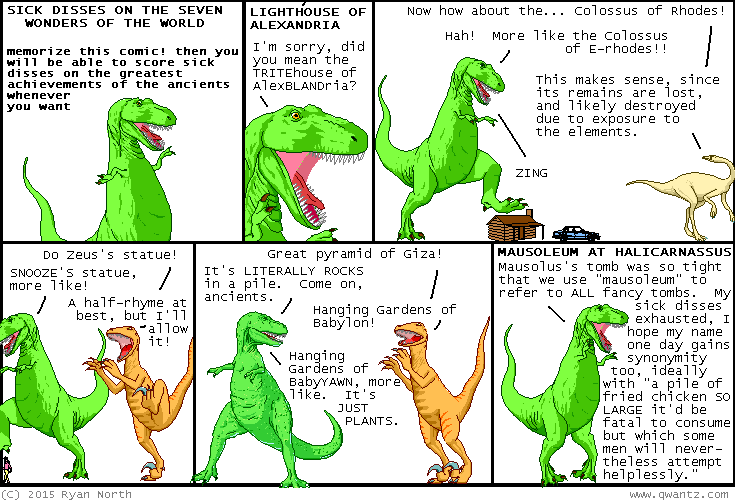
this is an EXCELLENT comic to print out and store in your wallet; you will always be prepared with the perfect mot juste burnsauce

archive - contact - sexy exciting merchandise - search - about
← previous December 23rd, 2015 next

December 23rd, 2015: I did a comic about the Temple of Artemis back in 2008, and if you read the alt text (THERE ARE SECRETS TO READ IF YOU HOVER YOUR MOUSE OVER THE COMIC :0 ) you can read about one of the greatest coincidences in my life.

– Ryan

24 Dec 14:09

Alex & Richard's Doctor Who 52: 05 Alien Bodies

by Millennium Dome

Previously…


The Doctor is the lonely god, the last highest authority in the universe, meting out justice to Weeping Angels and Prime Ministers. And there was a War…

Introducing…

The Time War.

It is hard to underestimate the importance of the books written in the Doctor's wilderness years between "Survival" and "Rose". Often dismissed as the rantings of angsty teenage fanboys – and there is a fair old bit of that – they were also a hothouse of ideas, taking on the Cartmel Era's impetus to try out new and daring directions. And the biggest idea was that the Doctor's homeworld Gallifrey was heading into a war that would see it destroyed.

The Virgin New Adventures saw the Doctor's seventh incarnation (the one who looked like Sylvester McCoy) taking on – and taking down – various gods and monsters from "the Dark Time" in Gallifrey's deep past. With the arrival of an official TV eighth Doctor (however short-lived that revival proved to be) BBC books took the franchise back in house and started their own line and wanted to go in a different direction. The first few books were… not a total success with a readership that had become used to Virgin's more mature angle. But then, almost by chance, Lawrence Miles delivered an idea that would shape the entire arc of the BBC books, and – to everyone's total amazement – the TV series itself.


Ten Reasons to Read "Alien Bodies" (warning: spoilers)


  1. The Time War – Actually, it's just referred to as "the war" by everyone involved. It's only referred to it as the "War in Heaven" with capital letters by the "ignorant locals" of the Planet Drornid (aka Dronid – Douglas Adams reference; not the only one: on page 134, the Doctor finds fairy cake in his ever-useful Zen-tailored pockets!). The Doctor accidentally-on-purpose crashes an auction that turns out to be between representatives of a bunch of time-travelling super-powers – including the Time Lords – from a period somewhere in his own personal future. Not wanting to transgress the laws of time (too much) the Doctor keeps shushing people every time they try to tell him about it, but it's still possible to pick up a lot of hints. E.g….

  2. The future of Time Lords – doesn't look too bright at this point. The war has been going on for five-hundred years from their point of view and everyone, including their own Celestial Intervention Agency, thinks they're losing.

    (That's retconned to just fifty years in "The Book of the War", but here Cousin Justine notes (p 256) that "half a millennium of warfare" has turned the Time Lords' preferred accommodation from opulence to military Spartan. But Five-hundred is more in keeping with a John Hurt War Doctor who ages from young Caligula-esque to his present distinguished craggles.)

    Their TARDISes have evolved into looking like, well, people (Time Lord Mr Homunculette's companion here is Marie, a Type 103, who chooses to look like a Brazilian supermodel to fit in with the locale, but defaults to the form of a 1960's policewoman. Ha ha.). But they've managed to lose all of their "big guns" in a pre-emptive strike by the enemy at the start of the war, hence their grubbing around in this unedifying auction to try and get hold of a (to begin with) unspecified weapon of great power.

  3. The enemy – are never named. But they're not the Daleks. "Alien Bodies" goes out of its way to suggest that the enemy are not the Daleks. Homunculette visits post-Dalek Invasion Earth (and not noticing that he's walking under the Thames like a Dalek!) and considers the humans lucky only to have been invaded by the Daleks. And there's the fact that the enemy and the Daleks both have invites to the auction. Except retrospectively, the enemy has to be the Daleks. And it still works.

  4. The Shadow of the Daleks – because we were, when "Alien Bodies" was published, well used to the idea of the Daleks as an enemy that remains unnamed. The usual complications with licencing from the Terry Nation estate (see "Dalek"), meant that the New Adventures had not been able to feature the deadly dustbins. Sometimes this meant coming up with faux-Daleks to fill the monster slot – e.g. flying armoured spheres, the Phractons (basically the Toclafane with an even sillier name). But mostly it meant very cleverly playing up the threat of the Daleks while keeping the metal menaces off-screen (as it were). Which also makes them seem vastly more powerful.

    Not to mention all those Episode One circumlocutions where the Space Marines/Thals/Doctor refer only to "them" (until it's time for the cliffhanger reveal that the anonymous adversaries in "Guess Who of the Daleks" are… oh, you guessed.)

  5. Except it's the Krotons – The BBC books "big thing" was supposed to be that they had the proper licence to use the Daleks. Indeed, they had just made their literary debut in the book immediately preceding "Alien Bodies": John Peel's truly execrable "War of the Daleks" (which will not be making the Doctor Who 52) the big event book with the fewest new ideas in it ever published, instantly overshadowed by the "ordinary" book that followed it. Lawrence Miles teases us at length that he might have sneakily brought them straight back without fanfare…

    And then he has them "peeled and eaten" by a notoriously rubbish monster from a silly, trippy story at the dog end of Patrick Troughton's reign as the Second Doctor. Somehow he manages to take one of the most notoriously botched attempts at creating "the new Daleks" (something the BBC tried every year or so, once they'd realised the full ramifications of Nation's contractual hold) and makes them into a credible, threatening Tellurium-based lifeform… who are still hilariously rubbish.


    Single-minded and monotone, Kroton representative E-Kobalt is not taken remotely seriously by the other representatives or the Doctor, even has he blunders about spraying deadly jets of acid. And when he decides to take out a whole cohort of Raston Robot Lap Dancers… Suffice to say, Mr Miles is very funny.

  6. Lawrence Miles – ah yes, Lawrence Miles. Bête noir of the fan-author scene, because of some crushing honesty about some of his fellow writers. And yet he deserves to be recognised alongside Whitaker, Dicks, Holmes, Davies and Moffat as one of the great creative contributors to Doctor Who. The writing here is as sharp and darkly funny as anything you'll read in the "tie-in" books range, with as many ideas to the page as Douglas Adams, but in a way – like a Robert Holmes story – amounts to a sketch of a much, much wider world. In fact, so much wider that it spawned its own spin-off.

  7. Faction Paradox – a self-titled Voodoo Cult who steal TARDIS technology from the Time Lords, use it to tie their precious laws of time in paradoxical knots, and dress it up in death fetishes just to piss off the immortals. What could be a better metaphor for fan-authors who file off the serial numbers of the Doctor Who universe write to guerrilla fiction in the undergrowth? You know that bit in "Before the Flood" where Toby Whithouse has the Doctor do a to-camera to explain the Ontological ("Bootstrap") Paradox? Well, Lawrence Miles does it first with the Grandfather Paradox, only better and as a gag. The members of the Faction "family" are titled "Little Brothers" or "Little Sisters", "Cousins" and "Mothers" and "Fathers". Because the head of the whole caboose is the Grandfather, Paradox.

  8. Sam Jones, proto Clara – blonde and perky, notionally created by Terrance Dicks in the execrable "The Eight Doctors" (yes, that's two execrables in six books – the early BBC Books had real problems, that "Alien Bodies" only began to turn around and Lawrence writes several responses to The Eight Doctors in particular here, including making it tie in with Paradox), Sam was written as "bland generic companion" because Uncle Terry didn't really have much of an idea what her character was supposed to be. Troublingly, neither did several of the subsequent authors either, although Kate Orman and Jon Blum's "Vampire Science" does put some flesh on her. But Lawrence Miles ingeniously turns this annoying goody-two-shoes-ness into a plot point. Sam is given a vision of an alternative timeline, perhaps her true timeline, in which she has dark hair, drugs troubles and never left Shoreditch and most immortally never met the Doctor. The suggestion arises that something, some enormously powerful space-time event (perhaps even the Doctor himself) has done something a bit Faction Paradox on her timeline and rewired her biodata to make her the perfect travelling companion.

    Orman and Blum will come back to this in "Business Unusual", with the explanation that the Doctor's regeneration (and near TARDIS implosion) on New Year's Eve 1999 (the TV movie in case you've purged that from your memory) left a scar on the fabric of the Universe and when Sam – the "real timeline" dark haired Sam – falls into this it turns her into this impossibly perfect girl. Just sayin'.


  9. Intelligent ideas – which of course the whole book is full of. But the particular one I draw your attention to is that of "conceptual entities". Meet Mr Shift (as in a shift in your perceptions) who lives in your perceptions and communicates by altering the way you read words in any text lying around. But he's merely the beginning.

    Other examples that we meet in passing are the "anarchitects", conceptual entities that live in architecture able to make floors vanish or turn corridors into Mobius loops.

    In the Eleventh Doctor story "The Time of Angels", it is revealed that the Angels are ideas that can think for themselves that inhabit statues. Just sayin'.

    But beyond them, there are the Celestis: god-memes that live in the fiction-hell of Mictlan. When the Celestial Intervention Agency saw which way the wind of the war was blowing, they erased themselves from history, jumping before they were retroactively putsched, but turning themselves into ideas. Because you cannot kill an idea. Obviously the whole process has driven them ferociously insane.

  10. Who the hell is Mr Quixotl? Qixotl is in charge of the auction. Or at least thinks he's charge as he sets it up and sends the invites before things spiral rapidly out of his control. "Quixotl", the Doctor tells us (p107), is the name of the god of ludicrous profit on Golobus, so probably not his real name. Time Lords aren't supposed to recognise one other after regenerating (p 81) but it happens just the same… not that the Doctor is sure Qixotl is another Time Lord. When Qixotl panics and cries out: "get me out of here" (p216), the Doctor recognises his expression of utter horror as one he's seen before on another face. He then punches Qixotl in the head, on account of what he did to him last time. And the time before. Of course, Mr Shift is mixing up everyone's perceptions at this point, so the Doctor might be remembering wrong.

    Fan theories tend to suggest that he is probably either Drax ("The Armageddon Factor", probably because of his underworld connections, not-quite-Time Lord status and generally spivvy nature), or Mortimus the Meddling Monk (which seems to me the more satisfying explanation, given how much Qixotl loves his own cleverness with technology and plans and that Drax only accidentally put the Doctor in harm's way, whereas the Monk has been betraying him with cheerful abandon ever since "The Daleks' Master Plan", and featured prominently in an early arc of the New Adventures too!)

    For that matter, though, who the hell is Captain Trask?


What Else Should I Tell You About "Alien Bodies"?

Well, it's a book not a television episode.

Doctor Who never stopped being made. It was merely that in 1989, rather like the Celestis turning themselves into Conceptual Entities, the Doctor changed from being a television character to one who existed in books.
The Eighth Doctor has appeared twice on our TV screens – once in 1996 in "Time Waits for No Man" aka "The Sensational TV Movie Starring Paul McGann" aka "Grace 1999"; and once in 2013 in "The Night of the Doctor". Suffice it to say that one of these is a work of quiet genius.

However, in between, he has had countless adventures in print as books and comics and on CD from Big Finish.

Arguably this give him three contradictory timelines (with the entirely-not-serious possibility that while the TV and audio Eighth Doctor regenerates into John Hurt, the books Eighth regenerated into Richard E Grant – see "Scream of the Shalka", foreshadowed in "The Gallifrey Chronicles" – and the comic strip Eighth regenerated into Rowan Atkinson – "Curse of the Fatal Death").

But, if you will accept a little hand-waving, and thanks to Doctor Eight's frequent bouts of amnesia, you can just about place them into some kind of an order: probably books first, Big Finish last.
(To make this difficult, in the books, the Doctor witnesses the destruction of Gallifrey. This leaves him with amnesia (again) and experiencing adventures in a Universe without Time Lords. But you can – just about – explain this as the Doctor getting trapped in his own future, thwarting Faction Paradox's attempt to overturn the events of "The Day of the Doctor", and doing something very clever to resolve the situation either in the stories "Time Zero", "Timeless" and "Sometime Never" or sometime after the last book, "The Gallifrey Chronicles", where he reveals he's worked out what's going on.)

If you need one, my score:

10/10.
This changed everything.


If You Like "Alien Bodies", Why Not Try…

"Cat's Cradle: Time's Crucible" – Just as "Alien Bodies" set the template for the BBC Books with a war in the future; Marc Platt, another genius author and the person who wrote "Ghost Light", sets the tone for the New Adventures with tales of Gallifrey's deep past.

"The Book of the War" – guidebook, short story collection, source material for a home-made universe, retirement home for Mr Shift? You can't really describe it; you have to experience it. The Book of the War takes all of the ideas expressed in "Alien Bodies" and adds a whole lot – including the City of the Saved at the end of the Universe more to give you a comprehensive starter in the Miles-Universe.

Next Time…

It's Christmas. What could be more spirit of the season than a proper religious retreat. With snowmen…?
24 Dec 13:47

How I Am Able to Forgive the Absolutely Appalling Science in the Most Recent (and Indeed Every) Star Wars Film

by John Scalzi

As explained by me to my wife as we drove home last night from The Force Awakens:

Me: See, the reason the bad science in Star Wars films doesn’t really bother me is because the movies tell you right up front that they’re based on legends, right? “A Long Time Ago In A Galaxy Far Far Away.” That’s the film saying “Hey, look, we know that some of what you’re seeing is totally unbelievable, but it’s myth. It’s an exaggerated version of what really happened so long ago that we can’t ever truly know what really happened.” Like, so, the Death Star probably wasn’t really the size of a small moon and Alderaan wasn’t really blown up, it’s was just probably heavily carpetbombed or something. So if you go in knowing it’s all meant to be exaggeration and myth, then all the parts like [SPOILER] and [SPOILER] in this film are totally excusable. Getting mad at Star Wars for getting the science wrong is like getting mad at Clash of the Titans for getting science wrong. You see what I’m saying.

Krissy: So does this mean you’re also willing to forgive “Red Matter” in Star Trek?

Me: OH HELL NO


24 Dec 13:35

An open letter to Daniel Holtzclaw, and those like him

by Kat Tanaka Okopnik

The whole world saw your face crumple as the verdict was read.

Did you think, up until that moment, that the Thin Blue Line would protect you? Not even thirty and your life is done. 

Back when the story started to come out, despite the media labeling you as “white”, I wondered, looking at your face, whether you had significant East Asian or Pacific Islander heritage. It’s not always apparent, but…you look like people I know. Was it rough, growing up hafu in Oklahoma in the ’90s? Did you learn to assimilate out of a desire to escape racism, or were you raised by parents who thought that Model Minority would be sufficient to protect you? Wikipedia says your father was also a cop. Maybe that was shield enough (and maybe I intend that pun).

Did you learn to be that sort of racist jerk naturally from your buddies, or did you learn to try to out racist all of them to show that you’re not one of “them”, to try to perform acts of racism as (maybe desperate) proof of your whiteness? Did you learn it playing football? Did you do it because you didn’t make the NFL draft the way you’d dreamed? (Pity, that. A bunch of Asian Americans would have been thrilled.) Did you learn it on the police force?

But you know, I don’t care. I don’t care why, because you played the role of The Man, devastating the lives of dozens of women that we know of. Targeted because they looked powerless to you. Easy to identify because of a racist environment where Black women can be presumed not to have the clout to speak up against police abuse. Maybe an “understandable” assumption in a time when we’ve seen so many Black and brown lives destroyed.

You made a choice. A stupid, evil choice. We all know why it was evil. I want to underline why it was stupid. (My children have been educated by their school and their peers to believe that stupid is one of the worst epithets ever, by the way. They are young. They’re Asian on their mom’s side, like you—but I hope that’s the only way they’re like you.)

The latest reports claim that you mouthed, “How could you do this?” to the all-white jury. I saw your face and I wonder if that was the moment you finally learned that there’s no way for you to assimilate enough to be Really White Enough. Maybe I was lucky—I learned that in my teens. I didn’t get The Talk that Black kids in white suburbia get, about how it’s stupid and dangerous to let your white friends talk you into doing questionable crap, because when it comes down to it, your white friends will get off with a slap on the wrist, but your brown ass will end up with the full measure. Maybe where you grew up your white cop dad was enough, for the kinds of things you did when you were growing up. Or maybe you thought once you had that badge and that gun that you’d made it.

I’m guessing that your mother is like mine. Raised in a land where the police are viewed as friendly helpers. Maybe she doesn’t quite understand how racism works. But again, I don’t care.

There’s a current myth, especially around where you grew up, that all cops are heroes. I’ve never thought that, but you could have been a hero by my definition. You had a chance to be the sort of cop everyone hopes for. The one that stands up to be the good guy. But you made a choice, to be abusive, over and over again.

…and you did it thinking you were invulnerable.

The problem with being part of the Model Minority, and not the profiled Other that is disproportionately incarcerated, is that there aren’t many like you behind bars, and it’s a place where all the stresses of our culture intensify under pressure. They say cops don’t do well in prison. They say people who don’t have a strong buddy system around them don’t survive. They say other things, too, but I’m not going to repeat those. I don’t believe in corrective rape for anyone.

But man. That was stupid on top of evil. Don’t make bargains with the Devil, especially ones that involve destroying other people’s lives. Especially when in the end, you smell like sacrificial meat, too. And now you’re an eventual Life Lesson for all the kids of mixed heritage I know, who think they’re white-passing. Don’t count on it. Especially when you’re doing things you shouldn’t be doing regardless.

Sigh.

22 Dec 19:56

Five Reasons to Read Doctor Who and the Auton Invasion – Doctor Who 52 Extra: D

by Alex Wilcock

Introducing Doctor Who and the Auton Invasion

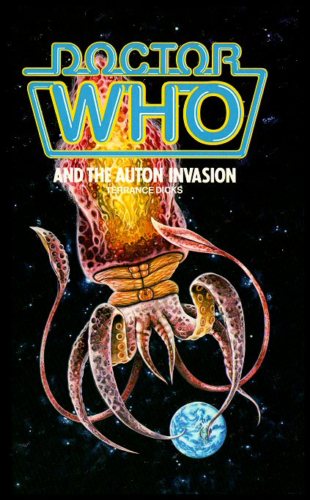
Shop window dummies that come to life, the Doctor given a new ‘family’ on Earth and a touch of bitchy soap opera… No wonder this was such an influence on Russell T Davies that he wrote the introduction for the new edition. Terrance Dicks’ first book novelises the thrilling TV story Spearhead From Space, making it more thrilling still from the title on through – one of the best Doctor Who novels ever written, and creating an irresistible monster that never quite made it to TV: “something between spider, crab and octopus…”

Robert Holmes’ 1970 adventure Spearhead From Space is one of the best-known Doctor Who stories – it introduced Jon Pertwee’s Doctor, the Autons and even colour to the series, was among the first to be released in video, DVD and book form, and with its mixture of action, horror, comedy and really aggressive department store sales windows, inspired Rose, 2005’s even more radical relaunch. It was first broadcast before I was born, so I grew up loving the Third Doctor’s adventures in their Target Books adaptations, and only caught up with the TV versions on VHS about two decades after transmission. The Pertwee books are arguably Target’s golden age; the TV originals rarely matched the pictures the novels had conjured in my head. I still think of this as the ‘Pertwee gap’ where this Doctor’s novelisations far outstripped his TV stories, and Spearhead From Space, too, gains a great deal by becoming The Auton Invasion… But in this case, it doesn’t mean that Spearhead From Space is a disappointment. It’s one of my favourite TV Doctor Who stories. The first two books Target commissioned were for me the two best Third Doctor stories, and they made them better still. The Pertwee gap here means that The Auton Invasion is simply fantastic.


Five Reasons To Read – or Listen To – Doctor Who and the Auton Invasion (warning: spoilers lower down the list)

1 – The Nightmarish Nestene. If you see this story on TV, you remember the Autons. If you read the book, you imagine the Nestene. You might say this is a spoiler to start with, save for it being on the cover and difficult to miss (and not just on Chris Achilleos’ original 1974 cover, either)…
“Standing towering over them was the most nightmarish creature Liz had ever seen. A huge, many-tentacled monster something between spider, crab and octopus. The nutrient fluids from the tank were still streaming down its sides. At the front of its glistening body a single huge eye glared at them, blazing with alien intelligence and hatred.”
Much of Terrance Dicks’ book description simplifies: the not-meteorite energy units are green spheres rather than complex polyhedrons; the factory receptionist expressionlessly doll-like; the walking dummy Autons much more blank. It’s effective. The repeated emphasis on Autons looking like half-finished waxworks, or having an enormous but peculiarly horrible hand – “It was completely smooth and white, and there were no fingernails” – that drops away to fire sizzling bolts of energy from the empty wrist instantly conjure mental images without complicated detail. The exception is deep within the factory that builds the Autons, where a body is growing to house the controlling majority of the Nestene Consciousness, the group mind animating all the living plastic for the invasion. The book teases this repeatedly to build anticipation, most effectively at the close of Chapter 6, where the Autons become more threatening yet and a series of short, understated sentences at the end give closure to an earlier attack. The audiobook version has much less in the way of music and sound effects than later Target CDs, but both steady narration by Caroline John (scientist Dr Liz Shaw on TV) and a strange alien glugging sound build up particularly eerily there too.

The book climaxes with the Doctor and Liz Shaw reaching the heart of the factory, where something enormous heaves, seethes and bubbles in a great tank (which the fascinated Doctor walks round “as if contemplating a swim in it”). On TV, a few limp tentacles emerge – then, in the sequel a year later, just a fuzzy video effect – without being entirely convincing. In the book, there’s no disappointment when the whole side of the tank shatters open and the “huge, many-tentacled monster something between spider, crab and octopus” rears unforgettably into our imaginations.

Where the cover paintings of most Doctor Who novelisations take pictures from the TV show as their model, Terrance Dicks’ Nestene created not just a nightmare but a challenge impossible for many artists to resist. Chris Achilleos paints one lurking on the cover, then gives it much more detail in a starring eruption as the finale to his internal illustrations, followed by other artists competing with further editions. The first sequel, Terror of the Autons, took similarly vivid descriptions from Terrance and let Peter Brookes’ imagination soar into a comic-book Cthulhoid horror that wraps its way around the front of the book, with Alan Willow having a go of his own inside the pages – then the second edition boasted Alun Hood’s horribly photo-realistic glaring eye, writhing tentacle and ickily teeth-like suckers. Even the back cover excitedly talks up
“a malignant, squid-like monster of cosmic proportions and indescribably hideous appearance.”
And yet Terrance’s description provides what’s still the most unforgettable mental image of all the Target books, inspiring artist after artist and proving that however powerful the design in front of your eyes, the most memorable horrors remain the ones you imagine.


2 – All Doctors Are Gits. The Doctor and the Autons both look human, but the book goes to even greater lengths than the TV version to emphasise that they aren’t – from the very first, poacher Sam Seeley sees both the ‘meteorites’ and the Doctor landing, and it’s the Doctor that frightens him more. But that’s not my favourite parallel for the Doctor here. The comatose Doctor is brought in to the local cottage hospital, and you can tell Terrance had written soap opera, on top of tea and bullying bosses as signatures of normality. The original script had plenty of hospital scenes, but the book expands them with full-on soap gossip, rivalries, and everybody on the make (just like Sam, a doomed businessman and even an army corporal later in the book).

A nurse gets the worst of it to start with, trembling at Dr Henderson’s sharp tongue when he shrieks with anger over the two hearts on the Doctor’s X-ray, then when Henderson’s “old enemy” Dr Lomax in Pathology rings to complain too, she “almost dropped the ’phone from pure terror”. In just a few pages, Terrance sketches in a history of bullying medical horrors, with Caroline John’s reading on CD making it all even more entertaining. But that’s nothing to when the hospital’s senior Surgical Consultant Mr Beavis shows up with his “high-handed, lordly manner” that terrifies even the doctors – not least our own favourite one, when he overhears that Beavis regards him as “some kind of interesting freak. Probably plans to open him up and sort out his innards for him.” Which rather reminds me of some of the more careless consultants when I was hospitalised last year, so it serves him right when the Doctor nicks his car to get away.

I always wonder, though – are we being lulled into liking the new Doctor because every other doctor in this is a total git or a complete monster? Or are we being warned by implication that this Doctor’s imprinted on them just after rebirth and thinks doctors ought to be arrogant workplace bullies?


3 – Terrance Dicks. One of Doctor Who’s most significant writers, Terrance Dicks wrote several TV stories and was the show’s script editor (similar to today’s lead writer) for five years, but it’s with Doctor Who and the Auton Invasion that his even greater role began: he went on to write nearly half the Target novelisations, amid hundreds of books altogether.

Terrance’s first novel is still for me his best. He puts in enormous creativity, and you can see immediately that he’s a natural prose as well as script writer – people often talk about his deceptively easy style, but I’ve read an awful lot of Doctor Who authors and few of the others manage Terrance’s ‘effortless’ flow even when they’re trying. His style’s all the more effective for having plenty of action and humour, but understating both. Crisp, dry and with deft touches of horror and sketched-in one-line character backgrounds to help us empathise (often immediately before they’re blasted down), he’s aware that he’s writing in part for children but is never patronising, though occasionally simplifying, such as calling the more advanced doppelgänger Autons “Replicas” rather than “facsimiles” (it would be another decade before the term facsimile would be in common use, but even then associated with sinisterly smooth businessmen who want to take over the world). He’s responsible for generations finding how exciting reading can be.

One of Terrance’s best-known devices is his use of simple, memorable descriptions – and reusing them. Chapter 6 contrasts a comedy car sequence and a very different action-based one, and here we get the first but not the last outing in one of Terrance’s books of a soldier emptying a full clip of bullets into a monster, plainly seeing a line of holes appearing across its chest – but there’s no blood, and the thing just keeps on coming (Terrance considerately also has the man recognise that it’s not human, to reassure us that the army don’t just fill you full of lead when spooked). The Doctor’s driving, by contrast, is already ridiculously accomplished and appalling for the passengers. But it’s not just set pieces like those that recur: fanatical alien villains are already “exultant”; doomed characters already stare “in horrified fascination” or react “with unbelieving horror”; multiple ‘Doctor who?’ puns even come with in-character laugh-tracks. All these will become very familiar, though he’s not yet settled into a pattern of short, punchy chapters each ending in their own mini-cliffhanger: compared to the rest, the final chapter is enormous and would make at least three in one of his later books. But his most famous description is here, when the TARDIS materialises right back in Chapter 1:
“…a strange wheezing and groaning filled the air.”


4 – The Auton Invasion. You can probably tell from the title where the book’s heading, and it’s a stunning tour-de-force. Like the similarly outstanding Remembrance of the Daleks novelisation, it makes even the series’ most thrilling action sequences seem broader, bigger-budget, and more compelling. Auton dummies coming to life behind high street windows is such a vivid image that it relaunched Doctor Who twice on TV – as well as being remade in multiple pop videos and even Pringles ads – but for me the one that still most enthralls me is on the page.

The Doctor and Liz have worked through the night on a device that could disrupt the Nestenes, but in the London dawn the city is coming to life in more than the ordinary way:
“Soon a normal, bustling London day would be in full swing. But this day, in London, and in cities all over the country, was to be like no other. This was the morning of the Auton invasion.
“In the shop windows and in the department stores the mannequins stood waiting. A policeman patrolling along Oxford Street cast a casual eye at the window display in one of the big stores. A group of window dummies, dressed in bright, casual sports clothes, sat under a beach umbrella in a cheerful seaside setting. The policeman thought longingly of his own holidays. Only another two weeks… As he passed on his way the mannequins posing round the table stirred and came to life. Jerkily at first, they rose from their beach chairs and rugs. The tallest raised its hand in a pointing gesture. The hand dropped away on its hinge to reveal a gun nozzle.”
One street and one copper draw us in, but the action telescopes swiftly out to the whole country. Autons blast people down in the streets of every major city; the police are overwhelmed by thousands of calls; it’s so serious that Terrance even mentions ITV as well as the BBC issuing urgent warnings to stay inside and barricade your home, before Autons destroy transmitters along with phone exchanges and fire stations. But the really effective part is when he widens the scope to full-on fifth columnist paranoia, with every response going wrong as ministers and senior officers give confusing or deliberately damaging orders – before their hands drop away to reveal Auton guns. It’s leavened by a few scattered examples of ‘hope in the ordinary people’s pluck and bravery’, but for the most part the invasion is pages of grim despair:
“Chaos… panic… confusion… Then, one by one, the outside ’phones went dead.”


5 – Where Do Autons Come From? …Actually, I wish you’d not told me.
“And Channing smiled a terrible smile.”
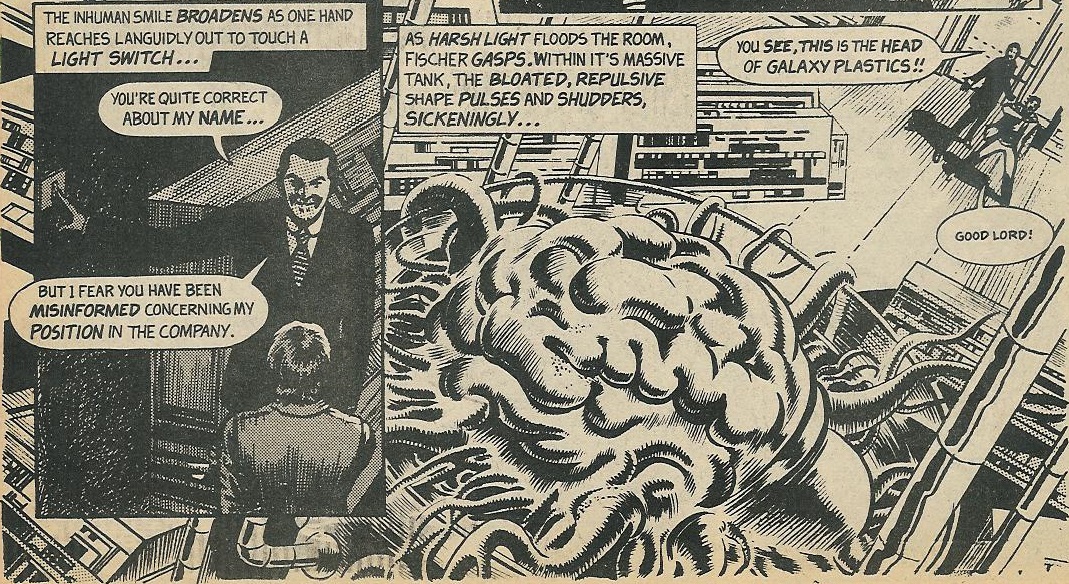
The book’s main villain is “Channing”, the new partner at a plastics factory. On TV the guest star makes him eerie and detached, perfectly alien. Here he’s an unnaturally smooth businessman, immaculately dressed, with regular, handsome features, utterly bland until he looks at you with those blazing eyes – as if he’s empty but for an animating will inside him. Like a waxwork come to life, the book suggests, or like Tony Blair with Margaret Thatcher’s eyes. He spends the novel dominating factory manager Hibbert with his alien will and revering the thing in the tank that is to come after him. And however terrific the Auton Invasion itself, for me the most gripping moment in the book is the revelation when Hibbert finally manages to free his mind enough to ask him a question…
“‘But what’s going to happen to us—to Man?’ The full horror of it suddenly came over Hibbert. ‘You’ll destroy us.’
“Channing’s voice was soothing. ‘Not you, Hibbert. You are our ally. You have helped us.’
Hibbert said dully: ‘And you… you’re not human.’
“‘I am part of the whole, Hibbert. Nestenes have no individual existence. This body is merely a container, Hibbert. You should know that. You made me.’
“And Channing smiled a terrible smile.”
That always gave me a thrill of horror when I was a boy – and others, too. Russell T Davies’ lovely Introduction to the 2011 edition not only talks about meeting his first fan through Target books (though his “doomed to never marry” shows how far we’ve come already since), confesses to childhood theft and praises Sir Terrance, as he should be, but picks that same line as the one that gave him chills and thrills. Can you spot the lines in Rose that came directly from this book, rather than the TV version? A young Alan Moore uses the same terror at the heart of his Auton tale Business As Usual (pairing him with Alan Davis before V For Vendetta). And the Terrance turns of phrase that I’m willing to bet stuck in a young JK Rowling’s head aren’t just stock descriptions like Professor Flitwick’s “shock of white hair”; at the climax of Harry Potter and the Goblet of Fire, Voldemort, too, smiles a terrible smile…


What Else Should I Tell You About Doctor Who and the Auton Invasion?

I’m still late, aren’t I? If I’m not careful it’ll soon be time to run screaming from the January sales. You can probably tell that I’d put this in my two or three favourite Target novels, and often still my favourite of the lot. But it isn’t entirely perfect. It can’t help missing something that the actors gave it on TV, and while Dr Liz Shaw comes out of it fairly well – lacking Caroline John’s sarky brilliance, but neatly emphasising her scientific ability and curiosity as the outsider finding her way into this weird set-up, the proof of the pudding being that I went to primary school with two Elizabeth Shaws, but I still thought this one was fantastic – Brigadier Lethbridge-Stewart’s characterisation is more confused.

On TV, this is possibly Nicholas Courtney’s best performance and probably his best part as the leader of the army UNIT tasked with investigating uncanny happenings – for the first half of the story, he’s the lead, and he’s an intelligent young officer, an urbane, incisive, highly efficient professional, briskly in charge and pedeconferencing decades before it was fashionable. Terrance Dicks wrote this four years later, by which time the Brig was more a comforting fixture and never threatening to steal the show from a domineering Doctor who’d often treat him as the comic relief (though with Nick always retaining some dignity). And in the novel the Brigadier keeps switching between these two poles. He’s never quite a buffoon, but we get internal monologues about what a cushy job he’d been expecting, or his moustache bristling with military fervour when he thinks he’ll get the chance to bomb something, and he loses his own sardonic jokes as he becomes the butt of the narrator’s instead. Crucially, you can see why ambitious, modern TV Brigadier would pick Liz as a scientific adviser, but not how fuddy-duddy stereotype book Brigadier would. But then his best television scene, surrounded by journalists, comes off nearly as well with a very different treatment here, while he has stone-cold serious moments silently spotting the villain or even calmly awaiting death after running out of the machine-gun bullets he’s been blazing away with to cut Autons in two. And for a character that Terrance instinctively thinks of as cosy, it’s noticeable that four chapters out of ten begin with him tearing a strip off his captain (no wonder that one doesn’t come back). The book has a similarly contradictory attitude to the army in general, even more than the script does: on the one hand they turn out to be the Doctor’s friends and shoot up Johnny Alien; on the other, a tired, jumpy sentry shoots up Doctor Alien, too, and they’re not just problematic by human frailty – an Auton Replica hijacking the chain of command implicitly suggests soldiers are brave but too easily misused by abrogating moral responsibility to the group.

Even the most establishment Doctor here gets several anti-establishment moments, starting with a Mr Benn joke, so despite Terrance Dicks overseeing most of the Doctor’s time as UNIT’s scientific adviser, you can credit him with still pointing out that it should never be an easy fit.

And, if you need one, my score:
10/10.


If You Like Doctor Who and the Auton Invasion, Why Not Try…

More Terrance Dicks, obviously. He’s gone down an astonishing long path with Doctor Who, with scripts from 1969’s The War Games to 1994’s Shakedown – Return of the Sontarans, probably the most successful of the straight-to-video while-it’s-off-the-air spin-offs. Mainly, though, it’s other books, his own ‘original’ novels – which usually have fun with elements from his own TV scripts, though World Game playfully rewrites the Prologue of The Auton Invasion – and the legion of Target adaptations. So I’m going to pick…

Doctor Who and the Terror of the Autons. Terrance’s 1975 Auton sequel novelisation established them as Big Monsters for a generation of readers who, like me, hadn’t been born when they were on TV. This too is from a script by Robert Holmes, who Terrance has often said inspired his best books because he was simply Doctor Who’s best writer, and has nastier jokes, the Master and a much greater improvement on the TV version. I’ve previously written about it in considerable detail (and with a picture of me as a little boy, as it was something like the second book I ever bought).

Doctor Who – Made of Steel. This one’s from 2007, with David Tennant’s Doctor and the Cybermen. It’s one of Terrance’s most recent books, and the best of his original novels in about the last twenty years. Short and crisp, this “Quick Read” is hugely entertaining: Terrance does a brilliant job writing a punchy new series adventure, with a London landmark in trouble, absolutely nailing Mr Tennant’s speech and persona, borrowing its opening from the first Doctor Who story I ever saw – by Terrance – and, if you read with the right eye, giving simple but elegant put-downs along the way to both Primeval and Torchwood.

Though also see if you can find Alan Moore and David Lloyd’s Business As Usual, a 1980 Doctor Who comic strip of the nastily ironic final ‘The End, dot dot dot question mark’ kind (think Saki, or Tharg’s Future Shocks), that does a very similar little Auton plot as some kind of macabre joke.


22 Dec 11:54

Ellery Queen, And on the Eighth Day

by Wesley

Years ago I read an Ellery Queen mystery (Ellery Queen being both the name of the detective and the pen name of the authors, Frederic Dannay and Manfred Lee). I don’t remember which one. It was one with a title following the “The [NATIONALITY] [THING] Mystery” template. Probably either The Dutch Shoe Mystery or The Roman Hat Mystery. I didn’t like it. I recall it as a straight puzzle without the sense of humor or shrewd observation of character that make the best mysteries worth reading. Also, Ellery himself was written as one of those piffle-spewing dilettantes who plagued golden age detective novels. The best of these–Albert Campion, say, or Peter Wimsey–quickly toned down the piffle and turned up the three-dimensional characterization. The ones who weren’t are no longer read. Ellery Queen seemed closer to the second group.

Since then I’d heard that a few Queen novels were ghostwritten by Theodore Sturgeon, Avram Davidson, and Jack Vance, from outlines by Dannay. And I recently discovered the Queen novels were available as ebooks, including And on the Eighth Day, secretly by Avram Davidson. It is, as you might expect from Davidson, a weird book. I’m going to have to take another look at the later Queen novels, because if the series could handle And on the Eighth Day it must have gotten a lot more interesting.

(To explain why, I’m going to spoil the whole book. If you want to read it I suggest you bail on the review halfway through.)

Cover of And on the Eighth Day

And on the Eighth Day was published in 1962 but is set in early 1944 and begins with Ellery taking off for Hollywood to write military propaganda films. After a spell of 12-hour days he breaks down and starts mechanically typing the same few words over and over like Jack Torrance, only instead of “All work and no play make Jack a dull boy” it’s his father’s name. (Ellery is unmarried and lives with his father, which until this scene I did not find weird.) So Ellery heads back east in his car, still addled, and gets lost somewhere in the Nevada desert. But that’s okay, because he wanders into Shangri La.

Ellery finds a green valley in the middle of the desert. In the valley is a town called Quenan founded 70 years earlier by one of those communist utopian communities that 19th century America bred like very earnest rabbits. Quenan is led by the Teacher, a very old man and the son of the colony’s founders. It’s completely isolated from the outside world, aside from the Teacher’s occasional visits to an equally isolated general store; the Quenanites have no idea there’s a war on, or what those flying things that keep passing over their village might be. They’re sure they’re expecting a messiah, though, and because “Ellery Queen” sounds kind of like the more Biblical and/or locally significant “Elroi Quenan” the Teacher thinks Ellery might be The One. Ellery goes along with this, mostly because he spends the whole novel loopy from exhaustion.

What follows resembles one of those science fiction novels like Looking Backward or Herland where an outsider is taken on a tour of the author’s fictional society… which is what And on the Eighth Day is: a utopian novel about a utopian community in the historical sense. It takes over a third of the novel for the actual mystery to show up. Basically, And on the Eighth Day is what you’d get if News From Nowhere starred Philo Vance.

Ellery learns how Quenan gets by in the desert, how it irrigates its crops, what animals it raises; the Teacher explains its government (it’s run by craftspeople) its marriage customs (everybody has to get married by a certain age, and the Teacher gets multiple wives, though he doesn’t seem to be sleeping with anybody) and its religion. Being so long isolated, Quenan has developed a language of its own; it’s governed by a “Crownsil” and worships “the Wor’d”[1] and has been looking for the lost “Book of Mk’h” which the Teacher is pretty sure he found at the general store a few years back. But not entirely sure, because no one in Quenan can read it.

Ellery and the narrative think of Quenan as a simple unspoiled paradise needing protection from the outside world, like a prime directive-insulated planet on Star Trek. (I’m not as convinced as Ellery that Quenan is idyllic: it once imposed the death penalty on a weaver who hoarded some extra cloth; public offices are said to be open to everybody regardless of gender but the Crownsil is in practice overwhelmingly male; and I have to question Ellery’s assumption that being a Teacher’s wife must be a sweet deal.)

Sadly for Quenan Ellery is one of those detectives. The ones who attract crime the way asbestos deposits attract lung disease clusters. The Teacher notices someone’s moved the keys[2] to the forbidden room containing Quenan’s stash of silver coins and the Book of M’Kh. Someone was too dazzled by Ellery’s fancy car and gold watch; for the first time in decades Quenan knows greed. Soon the thief is found with his skull bashed in. Apparently someone confronted the thief and killed him in self-defense. So Ellery gets his fingerprint kit out of the car[3] and sets to work.

Now the story is traveling further into standard detective novel territory, and yet this doesn’t stop it from getting even weirder. The mystery isn’t even very mysterious; both the red-herring suspect and the real killer are the only obvious choices for the roles. It’s like the detective plot took one look at Quenan, threw up its hands, and surrendered to the weirdness.

Ellery observes the crime scene, talks to witnesses, and, in a very long scene, explains to the Crownsil how fingerprints work. The evidence seems to point to the Teacher, and when Ellery presents his case to the Crownsil the old man doesn’t deny the crime. But Ellery isn’t satisfied, possibly because he’s noticed the novel still has a couple of chapters to run. Privately, the Teacher admits he framed himself: the real culprit is his young successor, who Quenan can’t afford to lose. So the next day everyone watches as the Teacher, like Socrates, very calmly drinks poison and lies down to die. Ellery stumbles out of town, dazed. But first he makes sure to steal and burn the Book of Mk’h, because it’s actually a copy of Mein Kampf. And then, as he leaves, a pilot bails out of his crashing plane right outside Quenan. A pilot who happens to look just like the teacher only fifty years younger, and whose name, Manuel Aquinas, sounds kind of like the more Biblical and/or locally significant “Emmanuel Quenan.” Ellery suggests Manuel check out the town.

So what we have here is a book that looks like a detective novel, published as just another entry in a long-running series of detective novels, but written by an eccentric fantasist and only perfunctorily performing the usual detective novel functions. Instead, it’s an allegory about a representative of justice who visits a community of innocents, bringing temptation with him; watches their leader, for the good of the community, sacrifice himself for another’s sin; and ferrets out and destroys the unsuspected evil lurking at the center of paradise, after which the Teacher symbolically rises again to rejoin his people.

The detective novel is, I will admit, a formulaic genre. Every one of them has the detective, the murder[4], the investigation, and the moment of revelation; readers have seen so many unimportant details revealed as vital clues that we unerringly sense they’re not actually unimportant. Sometimes, though, a formula is freeing. As long as all the elements of a formula–in this case, the detective, the crime, and the revelation–are present and correct, the audience has no reason to complain when the accompanying material is undisciplined or eccentric. The rest of the story can do anything else. Break the fourth wall and drop in the occasional M. R. James pastiche, reveal the entire cast to be undercover detectives… and then there are outliers like Thomas Hanshew’s Hamilton Cleek stories, which read like somebody’s fever dreams. It’s a freedom that not enough mysteries take advantage of, and even those that do usually do so too timidly.[5] But I keep looking, because there are always that few that recognize that a formula is a license to be eccentric, and let loose. Detective novels are like paintings that do their best work in the negative space; it’s not that the subject isn’t important, but it’s everything around it that keeps me coming back.


  1. The Quenanites love apostrophes almost as much as terrible epic fantasy writers.  ↩

  2. The Teacher keeps his belongings perfectly symmetrical. It’s too bad Ellery didn’t bring Hercule Poirot; he and the Teacher would have gotten along swell.  ↩

  3. Of course Ellery has a fingerprint kit in his car! He’s one of those detectives.  ↩

  4. It’s weird that it’s always a murder. It’s not like it would be hard to make an interesting story from a jewel theft or an embezzlement case.  ↩

  5. The Murder of Roger Ackroyd may have an unreliable narrator, but I have to admit it doesn’t have much else of interest.  ↩

22 Dec 11:31

Recommended Reading

by evanier

Jonathan Chait discusses how the arguments of the Climate Change deniers have had to change. It used to be they insisted the climate was not changing. Now, they kinda have to argue that it is changing but nothing human beings can do can stop it.

Here's my question: If nothing can be done to stop it, shouldn't we now be spending tons o' dough to relocate homes, build dams and levees, install new drain systems, etc.? Hurricane Katrina caused over $100 billion in damages. If you'd known it was coming, might it not have been prudent to prepare better for it?

The post Recommended Reading appeared first on News From ME.

22 Dec 11:29

The unaccountability of Nick Clegg

by Mark Thompson
Something that has been bubbling under for a while with me is a niggling feeling that Nick Clegg hasn't really been held to account for the utter devastation that the Lib Dems suffered back in May. Sure he resigned and is now just a lowly backbench MP. And indeed he is now in the somewhat excruciating position of not being able to step down as any subsequent by-election under current circumstances would probably lose the Lib Dems another seat that they can ill afford to squander.

So perhaps that combination is enough. And yet I feel that somehow it is not.

I was a Lib Dem from 2008 to 2013 and I still very much consider myself a fellow traveller at least with the membership if not the leadership in the latter years of the coalition. I was excited by the vibrancy of the party in the run up to 2010 and after the coalition was formed I was genuinely optimistic about the possibility of real political reform and a strong liberal flavour to the government that would play out over the following 5 years.

Sadly it was not really to be. At least not in any meaningful and sustainable way. Despite the promises the only political reform we got were fixed term parliaments which were only really instituted to protect the Lib Dems from their larger coalition partner and they were set at 5 years rather than the more accountable and liberal 4 years that most campaigners for this change wanted to see. Apart from that, electoral reform at Westminster, Lords reform and other measures people like me wanted to see fell by the wayside.

In addition to that a number of measures that most liberals would never have wanted to see on the statute books were rammed through in the teeth of party opposition. Secret courts were a resignation issue for some, most notably Jo Shaw who made the best political speech I have ever seen in person from the podium at the 2013 Lib Dem conference. I nearly left myself at that point but stayed on in hope only to drift away disillusioned later that same year. There were other things as well, tuition fees, 45p tax rate etc. etc. etc. I don't need to go through the list. Most people reading this will know them all by rote.

But politics is tough and it certainly wouldn't be fair to blame Clegg for all of those, although he was complicit.

There are some things though for which the blame squarely falls on his shoulders. I'll highlight just three here although there are more.

Firstly the complete lack of any attempt to change the way PMQs was practised at all. Clegg stood in for Cameron at PMQs many, many times. And instead of using the opportunity to do it differently, perhaps taking a more emollient tone and not constantly bashing anyone who criticised the government he did the exact opposite. He used the bully pulpit to attack the opposition over and over again. In many respects he was worse than Cameron. It made him look like Just Another Tory. Indeed after he resigned as leader he cited "sitting next to the Prime Minister" at PMQs as one of his biggest mistakes because of the "optics". He is right about that but it is much much worse than he states because of the way he himself carried out the same duties.

I asked Clegg about this very subject when I interviewed him in September 2012 and he claimed that he would have liked to change PMQs but when he had made slight attempts to move in this direction he had been branded as "ineffective and weak" and hence he had had no choice but to stick to the bearpit style. But this just simply is not good enough. What was the point of having a Lib Dem Deputy PM taking PMQs if when he deputised for the PM he made no difference to how it was practised and more importantly gave no inkling of how a liberal PM could do it? He had a responsibility to show how liberals in general and Lib Dems in particular were not happy with the current system and would change things. On this particular point he completely and totally failed.

Secondly cleaving far too closely to the Conservatives in the early years of the coalition. The "Rose Garden" press conference was clearly a misstep but it was indicative of a wider problem about how the party presented themselves. On the media and in parliament they went on and on and on about how there was a strong Lib Dem flavour to the government. They pounced on research that suggested 75% of their manifesto had ended up in government trumpeting this from the highest rooftops. But all this just made the Lib Dems look like they were crypto-Tories; when the cuts started kicking in, the tuition fees were raised, the NHS reforms were announced and all the other policies that were anathema to 2/3rds of the voters who backed Clegg in 2010 they "owned" the entire lot. There was no serious attempt to distance the party from these policies in government from the top level. Indeed Clegg seemed to revel in what he was doing, at one point light heartedly quoting Blair saying "It's worse than you think, I actually believe in the policies.". By the time the "differentiation" strategy kicked in in the last year or so of the parliament it was far, far too late.

The final one I want to focus on is how totally misguided Clegg's long term political strategy was. He seemed totally convinced that there were a huge swathe of liberal leaning voters out there who had previously gone for the Tories but now the Lib Dems had demonstrated they could do government they would come flocking to the yellow banner. And that these voters would replace all the lefties who had previously backed the party. Time and again at conference we members were all assured that the leadership knew exactly what it was doing and it would all come good. After the wipeouts in local elections and in 2014 losing all but one MEP (a devastating result for "The Party of Europe) the members were urged to keep the faith.

It was all wishful thinking. In May this year the electorate delivered their verdict. The Lib Dems lost 83% of their seats. They are now down to 8 MPs. There are some projections (that I take seriously) that suggest that in 2020 after the boundary changes they could be down to 4 MPs. They are a shadow of their former selves and are likely to be a political irrelevance for a generation or more.

I'm not saying there were any easy answers after the 2010 general election. There weren't. As I have argued many many times Clegg took the only option for stable government for 5 years and his party have paid in my view a disproportionate price for effectively putting the country before party.

But Clegg and his aides were complicit in a large number of tactical and strategic mistakes that made the ultimate result 5 years later even worse than it needed to be. They didn't listen to the many many voices from both inside and outside the party urging them to change tack. Clegg refused to stand down in June 2014 after the Euro elections when it was obvious to almost all political observers that he was a busted electoral flush.

I have no specific recipe for what sort of "punishment" Clegg should now undergo. Indeed it is unrealistic and probably even churlish to think there is one. But the party, its current and future leaderships and its members should think very carefully before pursuing the line that Clegg was very brave to do what he did and that the party in any way owes him a debt of gratitude. They should also all do their best to try and make sure he does not ultimately become a well respected and loved grandee of the party (like say Paddy Ashdown) who is listened to and has great influence in the future direction of the party.

He made some major errors that have cost both the party and ultimately the country in terms of much reduced liberal influence in parliament for many years to come.

At the very least he should be held accountable for that.

22 Dec 10:58

Tories show why skipping democratic reform was New Labour’s big mistake

by Nick

Today’s Observer has articles from Peter Hyman and Andrew Rawnsley that possess an interesting joint theme, even if one of them is unaware of it. Hyman’s critique of Corbyn’s Labour through defence of New Labour and Rawnsley’s warning about the Tory attempts to stictch up democracy help to expose where New Labour went wrong. By failing to reform the way our democracry works, New Labour missed the opportunity to lock in a permanent change to the system, leaving all its work open to removal by a Tory government.

Much of Hyman’s article is a long list of New Labour policy achievements under Tony Blair and an admonishment of the party for failing to continue that process. However, what he failed to acknowledge was these were all policy changes, and that New Labour did very little to change the way in which the political system works. New Labour came into office with a great zeal for reform, and those first two years in office did deliver some lasting changes: the Scottish and Welsh Parliaments, the Freedom of Information Act, removal of hereditary peers from the Lords, and the Human Rights Act amongst them. However, after that initial flurry, the drive for change came to a rapid halt. The Jenkins Commission on the electoral system reported and went nowhere, further Lords reform was allowed to fester in Parliament, local government reform stalled after mayors and cabinets were introduced, and regional devolution was being backed away from even before the North East referendum happened.

The problem was that the two landslide victories of 1997 and 2001 had convinced Blair and the heart of New Labour that there was no need for any widespread reform of Britain’s democratic system because it worked well enough to give them two convincing majorities. An anti-Tory majority in the country, willing to vote tactically between the Lib Dems and Labour to keep the Tories out, proved to some minds that our electoral system could be made to work. Failing to account for a time when Tory fortunes would rise and Labour’s fall, Blair brushed aside any idea that there should be more checks on the power of his Government, failing to take the long view and understand that there’d come a time when the Tories would come back to power.

This is where Rawnsley’s article is important as it explains how the Tories are doing what New Labour failed to do and using their current time in power to fix the system in their favour and ensure they keep everyone else out of power for as long as possible. They’re removing checks to executive power in the House of Lords, introducing boundary reviews that will drastically reduce the number of potential Labour seats, bringing in trade union reforms that will drastically cut Labour’s funding (on top of Osborne’s cuts to Short Money), and gradually squeezing the accountability from local government and making it dance to the Treasury’s tune. It’s a comprehensive effort to tilt the electoral playing field in their favour, while proposed reforms to the Human Rights Act and Freedom of Information Act will drastically shift power away from the individual and towards the already powerful.

Prioritising short-term policy victories over kong-term systemic reform wasn’t unique to New Labour, as it’s the same problem Nick Clegg had in the coalition, trumpeting tax credits and the Pupil Premium as major achievements while failing to deliver any deeper change to the democratic system. In both instances, it’s a case of a badly missed opportunity to deliver a fundamental change, and the Tories are now showing that while the centre and the left might miss those opportunities when they come up, they don’t.

22 Dec 10:49

Interview With Santa’s Reindeer Wrangler

by John Scalzi
Photo by bisongirl, used via Creative Commons. Click picture for original.


Q: Your name and occupation, please.

A: I’m Naseem Copely, and I’m the Reindeer Corps Manager for Santa Claus.

Q: What does that title mean?

A: Basically I’m responsible for recruiting, outfitting and caring for the reindeer who pull Santa’s sleigh on Christmas. If it has anything to do with the reindeer, I’m the one in charge of it.

Q: Why would you need to recruit? We already know who the reindeer are. Dasher and Dancer and Prancer and so on.

A: Well, that’s the first misconception. The canonical names of the reindeer aren’t of the reindeer themselves. The canonical names describe the role of the reindeer.

Q: I’m not sure I follow.

A: So, it’s like this: You have a football team, right? And a football team has a quarterback and full backs and half backs and centers and such. And in the role of quarterback, you could have Eli Manning or Andrew Luck or Aaron Rodgers or whomever.

Q: Okay.

A: So on a reindeer team, there’s a Dasher and a Dancer and a Prancer and so on. They’re roles. They’re positions. And the position of Dasher, as an example, is currently held by a reindeer named Buckletoe McGee. And before her, it was held by Tinselhart Flaherty, and before her, Ted Cruz.

Q: Ted Cruz.

A: Yes. No relation.

Q: All right. So the canonical names are the role of the reindeer, but this leaves open the question of why there are roles at all.

A: Because of varying the weather and various atmospheric conditions, basically. Depending on the weather, one or another of the team will be in lead position.

Q: So, for example –

A: So if the weather is clear, then Dasher is in the lead, because she’s fast and good with straight lines. If there’s a lot of turbulence in the upper atmosphere, then Dancer’s in front, because she’s good finding pockets of calm air for Santa to navigate into. “Donner” is the German word for “thunder,” so our Donner’s up when we have thunderstorms, and so on.

Q: Okay, but what about Cupid?

A: In the lead when we have to sweet-talk our way out of a moving violation citation.

Q: That really happens?

A: Lots of little towns have speed traps, man. They don’t care if it’s Santa. You see Santa, they see a wealthy traveler who won’t come back to town to contest a ticket.

Q: How does that even work? A reindeer mitigating traffic violations, I mean.

A: It’s technical. Very technical. I’d need graphs and a chart.

Q: And Vixen? What role does Vixen play?

A: Uh, that role’s currently in transition.

Q: What does that mean?

A: It means I’m ready for your next question.

Q: All right, what about the Rudolph position?

A: (Sighs) There is no Rudolph position. Never was. Never will be.

Q: You seem annoyed by this question.

A: None of us up here at the pole are big fans of the whole “Rudolph” thing.

Q: Why not?

A: Well, it makes us look like jerks, doesn’t it? A young reindeer is discriminated against up to and until he has marginal utility. I mean, really. Who looks good in that scenario? Not all of the other reindeer, who come across as bigots and bullies. And not Santa, who is implicitly tacit in reindeer bigotry.

Q: I have to admit I never really thought about it that hard.

A: You know, here at the pole we work hard to make sure that everyone feels welcome – it’s not just a legal requirement, it’s the whole ethos behind the Santa organization. And this one song craps on that for a reindeer who never even existed? Yeah, we’re not happy.

Q: You could sue for defamation.

A: No one comes out ahead when you do that. Anyway, Santa has his way of dealing with things like this.

Q: What do you mean?

A: Let’s just say a certain songwriter received lots of coal one year. In his car. The one with the white bucket seats.

Q: Okay. The next question: Why reindeer?

A: Why not reindeer?

Q: Generally speaking, they don’t actually fly.

A: Neither do sleighs, generally speaking, and yet here we are.

Q: We could talk about that. I mean, the general violation of physics that goes on around the whole Santa’s sleigh thing.

A: Look, I don’t pretend to know the science of the flying sleigh thing, okay? That’s not my job. You can ask Santa’s physicists about it if you want.

Q: Santa has physicists on staff?

A: Of course he does. He’s one of the largest recruiters of physicists outside of NASA. What, you thought all this happened because of magic?

Q: Well, now that you mention it, yes. Yes, I did.

A: See, that’s just silly. It’s not magic. It’s technology. Highly, highly advanced technology.

Q: So technology makes the reindeer fly.

A: No, that’s genetic.

Q: Oh, come on.

A: You’ll have to interview some of Santa’s biologists about that.

Q: Leaving aside the questionable physics and biology of flying reindeer, how do you recruit them? The reindeer, that is.

A: Craigslist.

Q: You’re telling me the reindeer can read.

A: Of course not. That’s just ridiculous.

Q: Unlike them flying.

A: It’s not the reindeer, it’s their owners. Laplanders and Canadians have access to the internet too.

Q: So the owners of the reindeer show up with their deer, and then what?

A: Well, the genes for flying in reindeer are recessive, so we have to test for ability.

Q: With a DNA test?

A: With a catapult.

Q: Wait, what?

A: We chuck ‘em into the air and see what happens.

Q: That’s… that’s horrible.

A: Why?

Q: What if they don’t have the flying gene!

A: Then they come down.

Q: And you don’t see a problem with that?

A: It’s just gravity.

Q: There’s that little part at the end! You know, when the reindeer who have been chucked into the air hit the ground at 32 feet per second per second.

A: What? No. We put up nets, dude.

Q: Nets?

A: Nets. To catch them. Jeez, what do you think we are, monsters?

Q: I didn’t know!

A: PETA would be all over us for that.

Q: Maybe you should have mentioned the nets earlier.

A: I would think they would be implied.

Q: Sorry.

A: Anyway.

Q: Okay, so you sorted the ones who can fly from the ones who can’t. What then?

A: Then we take the new reindeer and start training them, using various tests and exercises to see which role they would be best at.

Q: The fabled Reindeer Games.

A: Right. Once we know who is good at what, we slot them into the role.

Q: So how many reindeer are in each position?

A: Roughly a hundred.

Q: That’s… a lot of reindeer.

A: What did you expect?

Q: I don’t know, I thought maybe two or three for each position. Like a football team.

A: That was just an analogy.

Q: No, right, I get that, but even so.

A: Look, these are animals. They get tired. And the sleigh crosses the entire planet. You can’t have a single team of eight physical animals pull a heavy object that entire distance. That’s cruel. You got a swap ‘em out at regular intervals. So the couple of days before Christmas we truck them to various places around the world, and when Santa lands, we make the swap.

Q: Where do these swapouts usually happen?

A: Typically mall parking lots. They swap out and Santa can take a bathroom break. He’s drinking lots of milk that night and eating a metric ton of cookies. He’s gotta make space.

Q: And no one notices Santa landing and swapping out the team.

A: We’re quick about it.

Q: How quick?

A: Let me put it this way: NASCAR pit crews?

Q: Yes?

A: Slackers.

Q: Final question: the reindeer are on the job one night of the year.

A: Correct.

Q: What are they doing the rest of the year?

A: Leipäjuusto.

Q: Gesundheit.

A: I didn’t sneeze, you numbskull. It’s a traditional Scandinavian cheese originally made from reindeer milk.

Q: Santa’s a cheesemaker on the side, is what you’re saying.

A: And a damn fine one. His Leipäjuusto did very well at the International Cheese Awards this year.

Q: Did he say “Merry Curdmas” when he won?

A: No.

Q: Maybe he could make Holy Infant Cheddar, whose selling points would be that it’s tender and mild.

A: Stop.

Q: “Ho Ho Havarti!”

A: I’m going to have Vixen stab you with an antler now.


21 Dec 12:43

http://www.andrewrilstone.com/2015/12/on-monday-i-placed-two-apples-in-fruit.html

by Andrew Rilstone
On Monday, I placed two apples in the fruit bowl on my desk. 

On Tuesday, I placed two more apples in the same fruit bowl on my desk.

When I went back on Wednesday, I found that there were three apples there. 

“What ho!” I cried “Someone has been eating my apples!”

“Poor Andrew” said my Rational friend. “He thinks that two plus two equals three. And yet he still manages to hold down a job.” 


*

If I announce that no-one wearing a turban is allowed to join my club; and if the only people who wear turbans are Sikhs and the overwhelming majority of Sikhs are Punjabi and Punjabis have brown skin, then my “no turbans” rule amounts to a “no brown people” rule even though turbans are not a race. 

If the “no turbans” policy met with the widespread and enthusiastic support of people who don't think that foreigners ought to be allowed in the country to start with, and who aren't quite sure whether brown people should be allowed anywhere, my theory that the no-turbans policy is racist would be confirmed.


*

There is a catastrophically unfunny movie called "Life With Bells On” about an Englishman who travels to America to teach the locals to Morris Dance. The Californian dancers (rather offensively represented as gay) have replaced the wooden sticks used in English country dancing with special carbon fiber rods.

There is very good English folk-song called “My Son John” about a soldier who goes off to fight in the Napoleonic wars and comes back on crutches. (It’s known elsewhere as Mrs McGrath.) Martin Carthy updated the lyrics so that they refer to the Gulf War. The line about the crutches is changed to “up comes John, he’s got no legs, got carbon fiber blades instead.” 

The joke would have been different if the gay American Morris Dancers had been using plastic sticks; the song would have been different if the crippled soldier had had an aluminum prosthesis. A wooden leg would have made him sound like a pirate. Everyone knows that Abu Hamza had a hook, but no-one cares what kind of metal it was made of. So what's the deal about carbon fiber sticks and carbon fiber legs? That’s at least a bit interesting, isn’t it?


*

We’ve covered this before, but: 

Men, on the whole, care a good deal more about swords, guns, motorbikes and cars than women do; and often (in movies, say, or advertising posters) swords, guns, motorbikes and cars have symbolic value. A big shiny sports car shows that you are a Real Man. It shows other things as well: that you have got good taste, and that you are rich enough and important enough to be able to afford a big red car. But other things show that you are rich and important. A big house is a symbol of wealth, power and status (as well as being somewhere nice to live). So why aren't TV property shows fronted by loud, posturing, macho blokes?

If I remark, in this context, that a big red sports car is a “phallic symbol” or even a “phallus” some wiseguy will invariably say “ha-ha I hope yours isn’t shaped like that ha-ha”. Ten thousand spam e-mails testify that many men do in fact care about the size of their penis; and this seems mostly to be part of a competition with other men. Women don’t care all that much. So to say "the car is phallic" isn't to say "the car is shaped like a penis" so much as "cars and penises are both symbols of particular kind of aggressive, competitive masculinity. 

One of the most common euphemisms for “penis” is of course “manhood”. 

A lightsaber is not simply an old fashioned weapon; it’s a symbol, bound up with fathers and sons and the process of going from boy to man. If I say “when Darth Vader cuts Luke’s lightsaber hand off, it’s symbolic castration” I don’t mean that Lucas really wanted to to write a graphic scene of torture in which Vader physically cut off Luke’s genitalia. I mean that Star Wars is a growing up story and that Empire Strikes Back ends with Vader depriving Luke of the very thing that made him a man.

(There are at least two scenes where James Bond, the ultimate macho man, surrounded by guns, cars, planes and pretty women, is directly and literally threatened with having his penis and testicles destroyed.)

If I were to say that in Space Balls, Mel Brooks makes lightsabers “literally phallic” I think that you would understand what I meant: Dark Helmet and Lonestar position their swords at crotch level and then activate them; getting a childish, crude laugh from the audience when they "grow". I suppose I could have said “explicitly” or “directly” or “unambiguously.” But anyone who is that worried about small points of grammar English usage is literally a dickhead.


*

In 1963 the music critic of the Times famously described the Beatles song “This Boy” as being “harmonically intriguing, with its chains of pandiatonic clusters”. Paul McCartney, a self taught musician, claimed not to know what this meant. This has often been taken as a terribly funny joke at the critics' expense. The poor booby honestly imagined John and Paul sitting down and saying “Let’s put some pandiatonic clusters into this one, wack.” But it turned out they couldn’t have done so, so they aren’t there, so the critic was wrong, so the whole idea of music criticism and music theory is silly, ha-ha.

It is understandable that some writers and musicians should be cynical about critics: why should someone who can’t play an instrument himself get a say about whether my record is any good or not. (Actually, the question can be answered perfectly well on it’s own level: if I want to find the best fish restaurant in town, better ask Cecil, who can’t cook but eats out every night, than Brad, who spends every evening making perfect pastries in the back room of the Tart and Toad.) But the widespread suspicion of the humanities in general -- the doubts about whether literary criticism is a proper subject, the endless press sneering about Media Studies and Sociology are a little harder to account for. Nearly all of us listen to music and read books; and most of us can say which ones we think are good and which ones we think are bad. So it can look as if critics are using big words to tell us stuff we already know; or, worse, are spoiling our enjoyment of much loved classics. I don't know much about art, as the fellow said, but I know what I like. Sometimes, this may be perfectly true -- I have certainly come away from essays and said "you seem to have spent a very long time telling us that Tolkien's view of good and evil is basically the Catholic Church's view of good and evil, which was perfectly to obvious to anyone who has read the book." But very often, the man who says "I don't need an expert to tell me about books, I just want to read them" means "I don't want my preconceptions altered; I'd rather read Faust through 21st century eyes than hear someone telling me the kinds of things that could have been going through Marlowe's mind when he wrote it." 

Oliver Postgate says that when he was animator in residence at an Australian film school, he attended a lecture on the semiotics of film-making. The lecturer argued that film makers deliberately compose their shots in order to create particular atmospheres “impending danger, sexuality and other less definable moods, and infiltrate them subliminally into the unconscious of the viewer.” Postgate says that if any director really thought like that, they could never make anything worthwhile, because “it attempts to use the intellect to do something which is the business of the heart.” 

“I know how I choose the shot I take. I know how all the directors I have worked with choose their shots. They chose them because they looked right.”

He was, of course, absolutely right. He was an autodidact who worked out how to make cartoons from first principles and then discovered that what he was doing had been standard in the industry for decades. Of course he put shots into his cartoon because they looked right. And Paul McCartney, the most brilliant and intuitive song-writer of the last hundred years put notes into his music because they sounded right. The film studies lecturer and the music critic don’t claim to be able to make films or compose songs themselves: they don’t have that gift or that intuition. But they do claim, having looked at thousands of movies and heard tens of thousands of songs, to be able to explain why certain things “look right” and “sound right” and others don't. 

People who are skeptical about criticism never seem to say “Aha — that argument doesn’t work. You claim that in Episode 4 of Ivor the Engine, Oliver Postgate does this and it has that effect. Actually, he does that and the effect it has is more like this.” They always say “what business is it of yours to try to say what he was doing in the first place. What business is it of anyone’s to think seriously about cartoons, or pop songs, or the representation of sports personalities in the media”  

We have seen that Common Sense is the opposite of Political Correctness. Common Sense is whatever I think; the bundle of assumptions that I carry about in my head. Political Correctness is anything which challenges those assumptions. If Political Correctness can be defined as nonsensical then I need never question whatever happens to be going on in my head at the present moment. A sneering dismissal of all writing about the arts and culture has an equally useful effect.

(In fairness, Oliver Postgate was making quite a sophisticated point, much more interesting than Harold Wilson's reflex sneer about pandiatonic clusters. He felt that critical theory is a poor guide to the practice of film making; that film schools show students detailed critical analysis of great shots from classic movies and expect them to retrofit their own films to those ideas, and this doesn’t work. On the other hand, his claim that a director puts a shot into a film because it looks right and this can’t be further analyzed sounds a little bit like someone putting up a wall around his art: you’ve either got it, like me, or you haven’t got it, and if you haven’t got it, it can’t be taught.) 


*

Lots of women enjoy sport, participate in sport, watch sport. But it would be fair to say that many of the most popular sports — football, rugby, cricket and motor-racing — have a strong macho element to them. They are not merely about people competing to see who is the best at, say, tennis; they are about men competing with other men to see who is the biggest, strongest, gutsiest —  who is, in fact, the most male. The most successful sportsmen are represented as being more male than other males, whether we are talking about huge posters on the sides of buildings of David Beckham in his knickers, or George Best surrounded by beer and beautiful women wondering where it all went wrong. One of the "justifications" for the still prevalent hostility to homosexual footballers and homosexual basketball players is that it is an intrinsic part of the game for sportsmen to all get naked together after the match, and a gay man in the showers would alter the macho dynamic. In that kind of a culture, being unsuccessful or weak or merely studious makes you less male or, put another way, more female. It follows that a sportsman who, through injury or some other reason, stops being able to play his sport might be seen as feminized (in the sense we talked about above) castrated. The way in which people talked about Oscar Pistorius was therefore very interesting, because he was a sportsman who had been physically maimed, but who as a result of his prosthetic limbs, was able to compete at the very highest level. His disability made him less male, which is kind of like being castrated; his prosthetic limbs made him a man again, which is kind of like saying they are an artificial penis. In fact, because he became a world-beating athlete, it could be said that his false legs made him even more of a man than he would have been without them. It is therefore interesting that descriptions of his prosthesis always concentrated on what it was made of: they weren’t just false legs or prosthetic legs or metal legs, but always “carbon fiber legs”. One reason for this may be that “carbon fiber” is used to make racing cars, guns, bicycles — the classic “phallic” symbols of male power. 

It is interesting that one of the boys toys classically made of carbon fiber are racing cycles. You sit inside a plane or a car and hold a gun in your hand; but a cycle goes between your legs, making the phallic imagery explicit and unavoidable. Girl's bicycles used to be different from boy's bicycles for just that reason. It would probably be careless of me to say "bikes are literally phallic"; but you would know what I meant. 

*

I do not know if the culture of “safe spaces” in universities has gone too far. Maybe it has. I haven't been a student for years. Certainly, part of being a college student is, or ought to be, robust debate. Having your paper torn apart by your tutor or other students ought to be part of the process of learning, just as being thrown on the mat is part of the process of learning Judo. On the other hand, there is no excuse for personal or ad hominem attacks, in any debate, ever; and the border line between a strident and forceful argument and browbeating can be a fuzzy one. This is a particular problem when it's a man browbeating a woman. The distinction between "winning the argument by having a louder voice" and "bullying" may also be a bit woolly at times. 

If you are the kind of person who thinks that it is perfectly normal to accuse a fellow academic, completely outside your field, in a public forum, of being an intellectual fraud, and to follow it up with language like "pretentious bilge" and "pretentious bullshit" you are probably not the best person in the world to be advising colleges on their policies about acceptable behavior. 


*

Christians who believe in the literal truth of Christ's miracles —  not all do —  do not believe that this is how the universe works as a general rule. A person who believes that Jesus literally turned water into wine at Cana does not believe that this is, in general, how wine is made. Even if they did, it is hard to see why this would be a serious handicap in the overwhelming majority of vocations. I think that you could function very well as a plumber, a filing clerk, a computer programmer, a road sweeper, a window cleaner or Chancellor of the Exchequer while still believing that Threshers employs a Jewish man to lay his hands on bottles of water. It would, I grant you, be a drawback if you wanted to work as a vintner. 

I wouldn’t be particularly perturbed by having a doctor who believed that God healed sick people indirectly through the actions of the medical profession. Lots of doctors do believe precisely that. Nor would I be perturbed by one who believed that occasionally, patients who had no chance of getting better scientifically speaking nevertheless recovered miraculously; and that those "miraculous" events were literally acts of God. I certainly wouldn’t be worried about one who believed that two thousand years ago the Son of God cured people of diseases which were, so far as anyone could see, incurable. The only doctor I would be bothered by is the one who thinks that people are only healed through the miraculous actions of God, that prayer for a patient should come before any natural intervention, that medicine and surgery are blasphemous. Vanishingly few people — not even Christian Scientists, I understand — believe that. 

The idea that Christians told the story of the Virgin Birth because they didn’t understand where babies come from is obviously silly. They told the story because they did know exactly where babies came from. That’s what the word “miracle” means. 


*

The question is not whether or not you agree with me. I have written this very quickly and I may have made some remarks that I will not be able to defend tomorrow morning. 

The question is not even whether you are going to have a look at Hickey-Moody's essay and decide that I am being too generous about that; that it in fact post-modernism really is a load of tosh and I ought not to be coming up with defenses of obscurantism. The question is whether you think it is the kind of thing which is capable of being talked about. 

There is, in the end, very little difference between labeling anyone who disagrees with your as a Social Justice Warrior who Always Lies; and labeling anything outside your field as "theology", "philosophy" and "the humanities" and declaring that that is "not a subject", "not really knowledge", "pretentious bilge" "bullshit" and above all "nonsense". In both cases, you are building a wall around your own beliefs and making discussin of them impossible. You know in advance that anything the other side says is nonsense before they start speaking; you may actually find yourself saying thing like "I don't have to know anything about post-modernism to know that it is nonsense". We can't even discuss whether you are right that cultural studies is nonsense and Social Justice Warriors are liars, because anyone who defends them is lying and talking nonsense by definition... and so on through as many iterations as you please.

Turbans are not a race. Theology is not a subject. There is not possible value in studying culture or the media. My way of looking at things is the right way of looking at things. Your way of looking at things is pretentious bullshit. 


It is increasingly clear that what the New Atheists disbelieve in is not the God of church and religion. It's also feelings and cultural meanings and subjectivity and the humanities and just about anything which isn't cold A = B logic.
                   Me


If you find this kind of thing interesting then please consider promising to pay me 69p each time I write something. If you'd rather I just shut the hell up, don't bother. I was planning to write up the Star Wars Holiday Special but got distracted.
21 Dec 11:49

The 2017 Hugos and me

I'm hugely honoured to take on the role of Hugo administrator for Worldcon 75, to be held in Helsinki in 2017. The Hugos have been part of my fannish life since I was a teenager, and I've been commenting in depth on the fiction nominees every year this century. I love the institution and I'm really glad to be part of it.

2017 may be a bit different to previous years. Four amendments to the Hugo rules passed last August by Sasquan will, if ratified by MidAmeriCon II next year, come into effect for Worldcon 75 to administer. I'll be ready to implement any or all of them.

I will also be largely refraining from comment on the SF of 2016 until after the 2017 Hugo ceremony is over. That still leaves plenty else to talk about, of course...

More information about Worldcon 75, including how to join.
19 Dec 11:05

My Xmas Story

by evanier

encore02

This is the most popular thing I've ever posted on this weblog. In fact, it's so popular that proprietors of other sites have thought nothing of just copying the whole thing and posting it on their pages, often with no mention of me and the implication that they are the "I" in this tale. Please don't do that — to me or anyone. By all means, post a link to it but don't just appropriate it and especially don't let people think it's your work. This is the season for giving, not taking.

Yes, it's true…and I was very happy to learn from two of Mel Tormé's kids that their father had happily told them of the incident. Hearing that was my present…

I want to tell you a story…

The scene is Farmers Market — the famed tourist mecca of Los Angeles. It's located but yards from the facility they call, "CBS Television City in Hollywood"…which, of course, is not in Hollywood but at least is very close.

Farmers Market is a quaint collection of bungalow stores, produce stalls and little stands where one can buy darn near anything edible one wishes to devour. You buy your pizza slice or sandwich or Chinese food or whatever at one of umpteen counters, then carry it on a tray to an open-air table for consumption.

During the Summer or on weekends, the place is full of families and tourists and Japanese tour groups. But this was a winter weekday, not long before Christmas, and the crowd was mostly older folks, dawdling over coffee and danish. For most of them, it's a good place to get a donut or a taco, to sit and read the paper.

For me, it's a good place to get out of the house and grab something to eat. I arrived, headed for my favorite barbecue stand and, en route, noticed that Mel Tormé was seated at one of the tables.

Mel Tormé. My favorite singer. Just sitting there, sipping a cup of coffee, munching on an English Muffin, reading The New York Times. Mel Tormé.

I had never met Mel Tormé. Alas, I still haven't and now I never will. He looked like he was engrossed in the paper that day so I didn't stop and say, "Excuse me, I just wanted to tell you how much I've enjoyed all your records." I wish I had.

Instead, I continued over to the BBQ place, got myself a chicken sandwich and settled down at a table to consume it. I was about halfway through when four Christmas carolers strolled by, singing "Let It Snow," a cappella.

They were young adults with strong, fine voices and they were all clad in splendid Victorian garb. The Market had hired them (I assume) to stroll about and sing for the diners — a little touch of the holidays.

"Let It Snow" concluded not far from me to polite applause from all within earshot. I waved the leader of the chorale over and directed his attention to Mr. Tormé, seated about twenty yards from me.

"That's Mel Tormé down there. Do you know who he is?"

The singer was about 25 so it didn't horrify me that he said, "No."

I asked, "Do you know 'The Christmas Song?'"

Again, a "No."

I said, "That's the one that starts, 'Chestnuts roasting on an open fire…'"

"Oh, yes," the caroler chirped. "Is that what it's called? 'The Christmas Song?'"

"That's the name," I explained. "And that man wrote it." The singer thanked me, returned to his group for a brief huddle…and then they strolled down towards Mel Tormé. I ditched the rest of my sandwich and followed, a few steps behind. As they reached their quarry, they began singing, "Chestnuts roasting on an open fire…" directly to him.

A big smile formed on Mel Tormé's face — and it wasn't the only one around. Most of those sitting at nearby tables knew who he was and many seemed aware of the significance of singing that song to him. For those who didn't, there was a sudden flurry of whispers: "That's Mel Tormé…he wrote that…"

As the choir reached the last chorus or two of the song, Mel got to his feet and made a little gesture that meant, "Let me sing one chorus solo." The carolers — all still apparently unaware they were in the presence of one of the world's great singers — looked a bit uncomfortable. I'd bet at least a couple were thinking, "Oh, no…the little fat guy wants to sing."

But they stopped and the little fat guy started to sing…and, of course, out came this beautiful, melodic, perfectly-on-pitch voice. The look on the face of the singer I'd briefed was amazed at first…then properly impressed.

On Mr. Tormé's signal, they all joined in on the final lines: "Although it's been said, many times, many ways…Merry Christmas to you…" Big smiles all around.

And not just from them. I looked and at all the tables surrounding the impromptu performance, I saw huge grins of delight…which segued, as the song ended, into a huge burst of applause. The whole tune only lasted about two minutes but I doubt anyone who was there will ever forget it.

I have witnessed a number of thrilling "show business" moments — those incidents, far and few between, where all the little hairs on your epidermis snap to attention and tingle with joy. Usually, these occur on a screen or stage. I hadn't expected to experience one next to a falafel stand — but I did.

Tormé thanked the harmonizers for the serenade and one of the women said, "You really wrote that?"

He nodded. "A wonderful songwriter named Bob Wells and I wrote that…and, get this — we did it on the hottest day of the year in July. It was a way to cool down."

Then the gent I'd briefed said, "You know, you're not a bad singer." He actually said that to Mel Tormé.

Mel chuckled. He realized that these four young folks hadn't the velvet-foggiest notion who he was, above and beyond the fact that he'd worked on that classic carol. "Well," he said. "I've actually made a few records in my day…"

"Really?" the other man asked. "How many?"

Tormé smiled and said, "Ninety."

I probably own about half of them on vinyl and/or CD. For some reason, they sound better on vinyl. (My favorite was the album he made with Buddy Rich. Go ahead. Find me a better parlay of singer and drummer. I'll wait.)

Today, as I'm reading obits, I'm reminded of that moment. And I'm impressed to remember that Mel Tormé was also an accomplished author and actor. Mostly though, I'm recalling that pre-Christmas afternoon.

I love people who do something so well that you can't conceive of it being done better. Doesn't even have to be something important: Singing, dancing, plate-spinning, mooning your neighbor's cat, whatever. There is a certain beauty to doing almost anything to perfection.

No recording exists of that chorus that Mel Tormé sang for the other diners at Farmers Market but if you never believe another word I write, trust me on this. It was perfect. Absolutely perfect.

The post My Xmas Story appeared first on News From ME.

17 Dec 21:13

#1183; Santa’s Older Brother (Part 3)

by David Malki

He always says his boss is ''The children'' but I can't discount the notion that it's a few SPECIFIC children, perhaps standing on each other's shoulders, perhaps in a trench coat

17 Dec 20:51

The Top 20 Voice Actors: Mel Blanc

by evanier

top20voiceactors02

This is the final entry to Mark Evanier's list of the twenty top voice actors in American animated cartoons between 1928 and 1968. For more on this list, read this. To see all the listings posted to date, click here.

melblanc06

Mel Blanc

Most Famous Role: Bugs Bunny.

Other Notable Roles: Daffy Duck, Porky Pig, Yosemite Sam, Foghorn Leghorn, Tweety, Sylvester, Pepe LePew and hundreds of other characters in Warner Brothers cartoons; Woody Woodpecker (for a while), Barney Rubble, Mr. Spacely (on The Jetsons), Secret Squirrel, Captain Caveman and many, many more.

What He Did Besides Cartoon Voices: Mel was a superstar of comedy and variety radio shows.  In addition to regular appearances with Jack Benny and Abbott & Costello, he appeared on dozens of other shows and even had his own program for a time.  He followed Jack Benny into television and appeared on other comedies, plus there were hundreds of commercials and talk show appearances.

Why He's On This List: Does anyone need an explanation?  He was the first superstar of cartoon voicing and the guy everyone else who went into the business wanted to emulate, career-wise.  And it wasn't just a matter of him being able to do a lot of different voices.  It had more to do with him being a great comic actor — the kind who could hold his own in a sketch with great comedians like Benny.

Fun Fact: At one point in the fifties, Mel did one line voicing a cartoon pig in a TV commercial for Paper Mate pens. The commercial ran hundreds if not thousands of times and Mel, who was paid for each usage, collected more money for it than he'd been paid for all the Warner Brothers cartoons he'd done to date. For years, he held the record for the highest payment ever received by an actor for performing one line.

The post The Top 20 Voice Actors: Mel Blanc appeared first on News From ME.

17 Dec 15:23

Off With Their Comments

by John Scalzi

The Toronto Star newspaper has decided to nix comments on its Web site. The reason:

We have passionate, opinionated readers who are eager to get involved in conversations about politics, education, municipal issues, sports and more. You’re talking about the news on thestar.com, Facebook, Twitter, Instagram, Snapchat, Tumblr, LinkedIn and more — and we want to be able to capture all of these conversations.

With that goal, we have turned off commenting on thestar.com effective Wednesday and instead we’ll be promoting and showcasing the comments our readers share across social media and in their letters and emails to our editors.

This is a polite and deflect-y way of saying “Our comments are a raging cesspool filled with the worst that humanity has to offer and you all make us look bad by smearing your feculent mindpoops on our property, so do it somewhere else and we’ll pick the ones we like to highlight.”

And you know what? Good for the Star. At this late stage in the evolution of the Internet, it’s become widely apparent that, barring committed moderation, comment threads trend quickly toward awful and vile, and that their ostensible reasons for existing (“free exchange of ideas,” “building community,” “keeping eyeballs on the site” etc) are not just negated but very often undermined by their content. Very few online sites, news, social or otherwise, benefit commercially or reputationally from their comment threads. There’s a very real and obvious reason why “NEVER READ THE COMMENTS” is a phrase that has gained such currency in the online world.

So why not just ax them? This is apparently the question that the Toronto Star folks asked themselves, and equally apparently could not find a sufficient reason to keep them. Again: Good for them. The site will become marginally more readable, and the newspaper won’t have to task some poor sad staffer to moderate the flood of bigots and/or numbskulls and/or spammers who traditionally populate the comment threads of major news sites (and minor ones, and indeed, any site where they are given a chance to thrive). There’s no downside.

But what about the bigots and/or numbskulls and/or spammers? What of them? Where will they go? Won’t their special snowflake voices be silenced? Well, yes, on the Toronto Star site. But there is the whole rest of the Internet, and creating one’s own outpost to fill with one’s own thoughts — and one’s own thoughts on the news media — is trivially easy. Look! I’m filling my own site with my own thoughts right now! Now, the drawback to the bigots/numbskulls/spammers is that their thoughts won’t get the benefit of being a free rider on the traffic the sites they’ve attached themselves to; they will have to attract readers on their own in the marketplace of ideas.

But that’s not fair! Oh, well. That’s life. Also, it is in fact entirely fair. As I noted to someone elsewhere on this topic, no one is owed an audience. The audience I have, as an example, comes from a quarter century of writing, including seventeen years(!) on this very site. You want my audience? The answer is clear: get cracking, folks.

I mentioned on Twitter last night that the world would largely be a better place if all commenting ability were to be vaporized on the Internet, and someone asked me if I would include my own site in that. I said yes, for the general good of humanity, I would be willing to sacrifice my own site’s commenting ability (and also, that for the first five years of the site, it did not allow comments, and yet it did just fine). It would be hard, but I’m pretty sure most of the people who I like would keep in touch. Email would still exist.

This does not mean, I should note, that I plan to get rid of comments here. I do actually moderate my comments, and because I do — and because there is in fact a community of people here who care for the quality of the site, often as much as I do — this site is in my mind one of the exceptions to the general rule that comment threads suck. It also helps that this is a very idiosyncratic sort of site; if it was all politics (or all tech or all anything) all the time I suspect it would attract more people committed to trolling and being douchecanoes on particular subjects, and also garner more fly-by commenters. But the site is about whatever is going on in my brain, and my brain skips around a bit. Variety of topics is useful.

But I’ll also note that especially over the last few years my patience with comments runs thinner and how I approach them is different. There was a period of time not long ago where I began to dread writing about contentious topics here because I knew it would require me to babysit comment threads, and it would take a whole lot of my time and brain cycles — both of which I could better spend on writing — to plink out obnoxious comments and otherwise act as referee. It genuinely began to affect my overall happiness. I had to change the way I thought about commenting here because of it.

Now I do things like turn off comment threads when I go to sleep, which means I don’t wake up dreading coming to my own site to see what some shitty human has posted on it. If I write on a contentious topic but don’t feel like referring comments, I just plain leave the comments off (which, incidentally, has no measurable effect on how widely a piece is read, as far as I can see). And I’m quicker to mallet comments and punt people out of threads if I decide they’re out of line.

Basically, I changed seeing comments as something “of course” and more as “at my pleasure.” If I’m not going to be happy they’re there, then they won’t be.

Which is a point of view I think more people — and more sites — are beginning to take on: What does allowing comments get me? Does it make me happy or not? Will my site be better for them, or not? In the Toronto Star’s case, the answer apparently was that the site wasn’t better for them, so out they went.

Once more: Good call. I hope more people and sites ask themselves the same questions, and ditch the comments if they don’t measure up.


17 Dec 13:52

Reading List

by Sean Carroll
Andrew Hickey

Sharing because every book on this list that I've read is a great one that has affected my thinking, so I'm betting the others are too.

Now that The Big Picture is complete, I have more time for fun things like blogging, but I have a bunch of research to catch up on before I can return as normal. So in the meantime, here’s another teaser from the book: my list of “Further Reading” keyed to the different sections. You should have enough time to read all of these between now and publication day, May 10.

Part One, Cosmos:

  • Adams, F., & Laughlin, G. (1999). The Five Ages of the Universe: Inside the Physics of Eternity. Free Press.
  • Albert, D.Z. (2003). Time and Chance. Harvard University Press.
  • Carroll, S. (2010). From Eternity to Here: The Quest for the Ultimate Theory of Time. Dutton.
  • Feynman, R.P. (1967). The Character of Physical Law. M.I.T. Press.
  • Greene, B. (2004). The Fabric of the Cosmos: Space, Time, and the Texture of Reality. A.A. Knopf.
  • Guth, A. (1997). The Inflationary Universe: The Quest for a New Theory of Cosmic Origins. Addison-Wesley Pub.
  • Hawking, S.W. and Mlodinow, L. (2010). The Grand Design. Bantam.
  • Pearl, J. (2009). Causality: Models, Reasoning, and Inference. Cambridge University Press.
  • Penrose, R. (2005). The Road to Reality: A Complete Guide to the Laws of the Universe. A.A. Knopf.
  • Weinberg, S. (2015). To Explain the World: The Discovery of Modern Science. HarperCollins.

Part Two, Understanding:

  • Ariely, D. (2008). Predictably Irrational: The Hidden Forces that Shape Our Decisions. HarperCollins.
  • Dennett, D.C. (2014) Intuition Pumps and Other Tools for Thinking. W.W. Norton.
  • Gillett, C. and Lower, B., eds. (2001). Physicalism and Its Discontents. Cambridge University Press.
  • Kaplan, E. (2014). Does Santa Exist? A Philosophical Investigation. Dutton.
  • Rosenberg, A. (2011). The Atheist’s Guide to Reality: Enjoying Life Without Illusions. W.W. Norton.
  • Sagan, C. (1995). The Demon-Haunted World: Science as a Candle in the Dark. Random House.
  • Silver, N. (2012). The Signal and the Noise: Why So Many Predictions Fail — But Some Don’t. Penguin Press.
  • Tavris, C. and Aronson, E. (2006). Mistakes Were Made (but not by me): Why We Justify Foolish Beliefs, Bad Decisions, and Hurtful Acts. Houghton Mifflin Harcourt.

Part Three, Essence:

  • Aaronson, S. (2013). Quantum Computing Since Democritus. Cambridge University Press.
  • Carroll, S. (2012). The Particle at the End of the Universe: How the Hunt for the Higgs Boson Leads Us to the Edge of a New World. Dutton.
  • Deutsch, D. (1997). The Fabric of Reality: The Science of Parallel Universes and Its Implications. Viking Adult.
  • Gefter, A. (2014). Trespassing on Einstein’s Lawn: A Father, a Daughter, the Meaning of Nothing, and the Beginning of Everything. Bantam.
  • Holt, J. (2012) Why Does the World Exist? An Existential Detective Story. Liveright Publishing.
  • Musser, G. (2015). Spooky Action at a Distance: The Phenomenon That Reimagines Space and Time–and What It Means for Black Holes, the Big Bang, and Theories of Everything. Scientific American / Farrar, Straus and Giroux.
  • Randall, L. (2011). Knocking on Heaven’s Door: How Physics and Scientific Thinking Illuminate the Universe and the Modern World. Ecco.
  • Wallace, D. (2014). The Emergent Multiverse: Quantum Theory According to the Everett Interpretation. Oxford University Press.
  • Wilczek, F. (2015). A Beautiful Question: Finding Nature’s Deep Design. Penguin Press.

Part Four, Complexity:

  • Bak, P. (1996). How Nature Works: The Science of Self-Organized Criticality. Copernicus.
  • Cohen, E. (2012). Cells to Civilizations: The Principles of Change that Shape Life. Princeton University Press.
  • Coyne, J. (2009). Why Evolution is True. Viking.
  • Dawkins, R. (1986). The Blind Watchmaker: Why the Evidence of Evolution Reveals a Universe without Design. W.W. Norton.
  • Dennett, D.C. (1995). Darwin’s Dangerous Idea: Evolution and the Meanings of Life. Simon & Schuster.
  • Hidalgo, C. (2015). Why Information Grows: The Evolution of Order, from Atoms to Economies. Basic Books.
  • Hoffman, P. (2012). Life’s Ratchet: How Molecular Machines Extract Order from Chaos. Basic Books.
  • Krugman, P. (1996). The Self-Organizing Economy. Wiley-Blackwell.
  • Lane, N. (2015). The Vital Question: Energy, Evolution, and the Origins of Complex Life. W.W. Norton.
  • Mitchell, M. (2009). Complexity: A Guided Tour. Oxford University Press.
  • Pross, A. (2012). What Is Life? How Chemistry Becomes Biology. Oxford University Press.
  • Rutherford, A. (2013). Creation: How Science is Reinventing Life Itself. Current.
  • Shubin, N. (2008). Your Inner Fish: A Journey into the 3.5-Billion-Year History of the Human Body. Pantheon.

Part Five, Thinking:

  • Alter, T. and Howell, R.J. (2009). A Dialogue on Consciousness. Oxford University Press.
  • Chalmers, D.J. (1996). The Conscious Mind: In Search of a Fundamental Theory. Oxford University Press.
  • Churchland, P.S. (2013). Touching a Nerve: The Self as Brain. W.W. Norton.
  • Damasio, A. (2010). Self Comes to Mind: Constructing the Conscious Brain. Pantheon.
  • Dennett, D.C. (1991). Consciousness Explained. Little Brown & Co.
  • Eagleman, D. (2011). Incognito: The Secret Lives of the Brain. Pantheon.
  • Flanagan, O. (2003). The Problem of the Soul: Two Visions of Mind and How to Reconcile Them. Basic Books.
  • Gazzaniga, M.S. (2011). Who’s In Charge? Free Will and the Science of the Brain. Ecco.
  • Hankins, P. (2015). The Shadow of Consciousness.
  • Kahneman, D. (2011). Thinking, Fast and Slow. Farrah, Straus and Giroux.
  • Tononi, G. (2012). Phi: A Voyage from the Brain to the Soul. Pantheon.

Part Six, Caring:

  • de Waal, F. (2013). The Bonobo and the Atheist: In Search of Humanism Among the Primates. W.W. Norton.
  • Epstein, G.M. (2009). Good Without God: What a Billion Nonreligious People Do Believe. William Morrow.
  • Flanagan, O. (2007). The Really Hard Problem: Meaning in a Material World. The MIT Press.
  • Gottschall, J. (2012). The Storytelling Animal: How Stories Make Us Human. Houghton Mifflin Harcourt.
  • Greene, J. (2013). Moral Tribes: Emotion, Reason, and the Gap Between Us and Them. Penguin Press.
  • Johnson, C. (2014). A Better Life: 100 Atheists Speak Out on Joy & Meaning in a World Without God. Cosmic Teapot.
  • Kitcher, P. (2011). The Ethical Project. Harvard University Press.
  • Lehman, J. and Shemmer, Y. (2012). Constructivism in Practical Philosophy. Oxford University Press.
  • May, T. (2015). A Significant Life: Human Meaning in a Silent Universe. University of Chicago Press.
  • Ruti, M. (2014). The Call of Character: Living a Life Worth Living. Columbia University Press.
  • Wilson, E.O. (2014). The Meaning of Human Existence. Liveright.

CVUeQgqUAAAWuBv

17 Dec 11:56

Blue Milk

by Tim O'Neil


Back in 2005, I knew. It was obvious. Even if they said it was over, and there would never be any more, it was clearly a lie. Some day, there'd be more. No time soon. But eventually.

And sure enough, I was right. You didn't need to be a rocket scientist to figure that one out. Eventually, something had to give, and that "something" was George Lucas. Either he would give in to the temptation himself, or allow others to move on without him. The first, while improbable in hindsight, was always a possibility, even given the venomous fallout of the Prequels. Lucas heeds no counsel but his own. It was said in the wake of the Disney sale that one of the main factors that prompted the sale was that he didn't want to direct the sequel trilogy which he knew would eventually be made. So he chose the second option.

He did it in the most irrevocable way possible. He could never be content to hire another set of hands and merely supervise. He was too old to want to collaborate. It was best to walk away, and the best way to walk away would be to give it away. So he took the payday and gave his blessing. His notebooks and ideas were part of the deal, but they didn't want those. Just as well. Clean slate.

Star Wars started out as an idea George Lucas had that he developed with a tight-knit group of friends and partners. When Star Wars got big and stayed big, the friends and partners fell off, until Lucas was the last man standing. His name was on the company, after all. So what if something was lost? It had to change anyway.

How to criticize the Star Wars movies? They simply are. If you're with me, you're with me, and if you're not, you're shaking your head. They're just movies, after all. But even after everything else falls by the wayside, it's never quite so easy . . .

They're still special because they're so few. Cut away the ancillary products, and you've got six movies: three essential and three inessential. The latter three are beloved by many but also loathed in equal measure. Now that there's a new series of movies, designed specifically to turn back the clock and pretend the "bad" Star Wars never happened, those other movies can finally breath, be their own weird thing with their own fans and controversies in their own corner of the landscape, without the pressure of being the only other Star Wars, with all the high emotions such a status implies. Now there's new Star Wars to argue about.

But it won't be the same. As much grief as he got for it, Lucas never consented to give the fans what they said they wanted. He had his ideas and they weren't all great ideas but at the end of the day it was his vision - if you want to use such a degraded word. All the other people with a claim to have shepherded Star Wars at any point in its development were gone. Those later films, warts and all, were inarguably his, and that's what makes them so interesting and (for those of us who do love them, warts and all) compelling. It's OK not to like them. But even if you wind up preferring the new Star Wars movies to the last series (something that seems very likely as of this writing), it will be impossible to argue that they're somehow more legitimate just because they're more ingratiating. Regardless of whomever else was involved, the common denominator for all previous Star Wars was George Lucas. This new model might be good, but it'll never be the same.

Maybe that's it: I'd rather have something imperfect and weird from George Lucas than a streamlined and perfectly satisfying sequel product constructed by the Disney corporation to hit all the right nostalgia buttons. It's not my fault I just happened to be born at the right moment to have those films imprint on me like a baby bird. The relative scarcity of Star Wars material made the movies rare and special in a time before cultural ubiquity. This is why the brand is so valuable. There's still, after almost forty years, only those six movies. Everything else is ancillary. There are literally hundreds of hours of "official" Star Trek in canon, same with Dr. Who (although let's not mention "canon" and "Who" in the same sentence, I'm just talking about the broadcast TV show), but . . . still only the six Star Wars movies, the same six movies to watch and parse and argue over and build elaborate Expanded Universes and Wookieepedias around. But not after tonight, and never again. (The fact that The Clone Wars and Rebels are also considered inviolable canon problematizes this slightly, but a large majority of Star Wars fans get by just fine without ever having seen either.)

Disney is good at what they do, the well isn't going to run dry anytime soon. But it'll never go away again, and it'll never be special quite the same way. Marvel will never again be the slightly disreputable upstart with vague counter-culture cachet, either.

Back in the summer of 2005, I knew as I watched Revenge of the Sith that this was the last new Star Wars film I'd ever get to see - while at the same time somewhere else in the back of my brain I knew that was impossible. Somewhere in the future, like a beast in the jungle, there was more Star Wars waiting for me - but it was so far off as to be academic. Honestly, ten years is sooner than I anticipated. How odd to think it's actually happening.

That last scene with Obi-Wan handing off baby Luke to Owen and Beru, before walking off into the desert - I would have been content for that to be the last shot in Star Wars, ever. It's a beautiful shot, almost cheap because of the way it plays on the visual rhyme with the first film, but fair game in the context of a film series constructed on rhyming shots and sequences. That's why it works, and that's part and parcel of the franchise's appeal.

By the summer of 2005 my marriage was on its last legs, even if I didn't know it yet. My ex was a good sport about going to see Star Wars with me, even if she didn't really care. But she was miffed after that, I remember clearly. "You cry at the end of Star Wars but not for our marriage." I guess I knew Star Wars would last longer.


17 Dec 11:26

The call of the sad whelkfins: the continued relevance of How To Suppress Women's Writing.

The call of the sad whelkfins: the continued relevance of How To Suppress Women's Writing.
17 Dec 11:08

Why I Don't Cook

by evanier

The other day, I posted a link to a video of TV cooking expert Alton Brown lecturing us, as he tends to do, about the right way to run one's kitchen. As I said, he always convinces me I have no business even trying to prepare a meal. I suspect if I watched him on a more regular basis, I'd even feel unqualified to phone to have a pizza delivered. A few readers challenged that or want to know why I feel as I do.

I enjoy watching Mr. Brown. He's clever, he's informed and I'm sure he's generally right about the "right" way to do things. I'm also sure that I will never in my life have a kitchen as well-stocked as his or that I will have nine hours to spend making a blintz. He can have that kind of kitchen and devote that kind of time because he makes his living as a chef and cooking teacher.

He can say things like, "Add a spritz of Worcestershire sauce" because he has cooked so much, he knows how much a "spritz" is. He also has a bottle of Worcestershire sauce. If I wanted to attempt a recipe that required it, I'd have to go out and buy one and over the next few years, I'd probably use up about three spritzes from it and wind up throwing 95% of it away.

He complains that people clutter their kitchens with "unitaskers" (devices that do only one thing) but he presumes we have every known spice and ingredient available and that it's practical to have them there because we use them often. In my kitchen, a bottle of Worcestershire sauce would be a unitasker.

I want to make clear: I admire Mr. Brown's skill. But I don't watch him to learn how to make what he makes because I'll never be able to replicate any of that. I watch him the way I watch champion athletes do other stuff I can't accomplish. Seeing him make spaghetti sauce is like watching that guy from Italy who did the Boston Marathon in 2:24:37. I ain't about to attempt that, either.

Consider: I used to make one of the simplest things to make in this world…a grilled cheese sandwich. I melted some butter in a pan. I buttered both sides of two slices of whatever bread I had on hand. I inserted whatever kind of cheese I had around. I put it in the pan, flipped it now and then and within about five minutes, I had what I thought was a pretty decent grilled cheese sandwich.

It tasted great and I was proud I made it myself. Then I watched the Alton Brown video that told me I did it all wrong. In fact, let's watch it together and see what I should have done…

Sounding very much like a college prof who thinks his students are lunkheads, he starts by telling me my grilled cheese sandwich is not a grilled cheese sandwich.

Apparently, my stove is of no use in this process. I have to go out in my backyard and light charcoal in my barbecue which I don't have. Years ago when I did have one, that took a little while to do and I never thought to go to all that trouble just to make two grilled cheese sandwiches. Then again, I didn't have my own cooking show.

So let's say I buy a barbecue and charcoal and all the things you need to get a proper fire going like a chimney starter and mitts and tongs. I mean, I sure don't want to disappoint Alton or attract his scorn.

He doesn't approve of my bread so I'm going to have to buy a whole loaf of "a good, hearty country-style bread" which I probably won't use in full before it goes stale on me. I do have butter and olive oil, even if I don't have a sprayer for the oil. He doesn't approve of my cheese or even that I use but one kind. I need to buy two kinds that I probably also won't use all of, and I don't dare buy it already-grated so I either need to find my grater or buy one of them, too.

I need a teaspoon of dry mustard. I don't have any so I'll need to buy a jar of it and use one teaspoon full. I need half a teaspoon of smoked paprika. Again, I don't have any so I'll need to buy a jar of it and use even less of it. I do have black pepper and a grinder so at least there, I'm equipped.

But I don't have two grill spatulas so I'll need to buy them. Then I'll need to take foil (I have that) and shape it around the spatulas to make little shallow trays with just a little bit of lip and…well, I've taken this far enough. I've made my point. What I haven't made since I watched that video is a grilled or even a griddled cheese sandwich. I can't do it his way and now I'm ashamed to do it my way. I take slight consolation in the fact that my method might be better than his when it's raining.

Let me say one last time that I like Alton Brown. He actually gets out there and demonstrates the art of food preparation, whereas most cooking shows now seem to be contests where they get a bunch of chefs together, give each one a hamhock, a bay leaf, a jar of Maraschino cherries and a live squirrel and tell them they have six minutes to whip it all up into a souflé that the judges will love. That doesn't relate to anything I might ever do in my kitchen either.

From now on, I may try nothing in my kitchen more complicated than Campbell's Soups. I sure hope he doesn't do a show about the proper way to do that. I'll probably have to buy a backhoe to open the can, import the water from Zurich and let the whole thing simmer over a smoldering volcano. And he'll tell me it isn't even Bean with Bacon like I thought.

The post Why I Don't Cook appeared first on News From ME.

17 Dec 11:05

Doctor Who 52: 03 – Ten Reasons to Watch Rose

by Alex Wilcock

Introducing Doctor Who – Rose

The first new Doctor Who story starts with an ordinary person who follows someone extraordinary to a blue box that’s larger on the inside than the outside and travels in time and space. Again.

Fast, funny and fantastic, Billie Piper and Christopher Eccleston burst onto our screens and deadly dummies burst through shop windows in the perfect Doctor Who relaunch
, choosing strangeness over normality, running towards adventure and reinventing British television. And it all looks glorious. It’s nearly Christmas, but it was at Easter 2005 that Doctor Who – Rose.
“Right. Where d’you wanna start?”
The biggest question for me: how do I choose only ten reasons to watch this?

I’m celebrating Doctor Who’s fifty-second anniversary with one story every week for a year – and my husband Richard is joining in with his own eclectic choices if you want different recommendations. You can read more of what this Doctor Who 52 is all about here. But if I were you I’d just read on, then press Play on the DVD.


Ten Reasons To Watch Rose (warning: spoilers lower down the list)

1 – Rose. This episode is built on Rose Tyler, and Billie Piper is perfect. It’s Rose’s story, the story of a young woman who doesn’t know she’s looking for something better in her life until it runs into her – and who then goes after it. She’s completely normal – and smart, fresh and funny. She works in a shop. She knows nothing about the Doctor or walking dummies or miraculous travels. With the new audience, she comes in half-way through the story, tries to make sense of it all, and won’t let go when it’s horrifying, intriguing or joyous. The Doctor’s in a story of living plastic “Autons” animated by the alien Nestene Consciousness, but that’s just window-dressing. The story we’re watching follows Rose as she almost-unwillingly picks at the weird thread of the Doctor’s world intruding into hers, rather than us or her being given the whole lot in one big splat of culture shock or backstory. And she makes it an achievement – increasingly determined first to find out what’s going on and then to do something about it, even when her family tell her she shouldn’t bother and the Doctor won’t answer her questions. Her ‘hero moment’ comes when she swings in to save the Doctor with a great piss-take of a motivational speech:
“I’ve got no A-Levels. No job. No future. But I tell you what I have got – Jericho Street Junior School under-sevens gymnastics team. I got the bronze!”
But for me I was really sold on Rose, and Billie, in two moments where she shows she’s not just a foil to the Doctor but brings something more: when it seems her boyfriend Mickey is dead, Rose’s first thought is that she’ll have to tell his mother, grounding the series in consequences from the start; and her brilliant comic timing with just a nod and an eyebrow when she’s being smarter than the Doctor.

Above all, Rose is the symbol of the new audience who didn’t know they were looking for Doctor Who until they started watching, embodying the message that the series is for everybody – not least young women – so why don’t you demand something more interesting from your television set?


2 – The Doctor. Christopher Eccleston is, like William Hartnell before him, at first a mystery to the ordinary person who doesn’t know what to make of him, but also fantastic from his first moment. When Rose and we first meet him, he’s a baffling mixture of reassuring and alarming as only
“Nice to meet you Rose. Run for your life!”
while waving a bomb could be. Of course he has to be the Doctor when he starts with “Run!” Speaking to Rose, he’s upbeat and engaging, but when he turns away that all switches off – and when he talks to someone who knows of his world, he can’t hide his pain. And at the same time he can be as innocent as a new-born about our world, from his appealing faith in a not-totally-a-disguise to having to be reminded that death might upset people, that there are details as well as the big picture. Rose keeps trying to make the Doctor pay attention to what she thinks is serious, and when she tracks down someone else who’s been trying to find out about the Doctor he’s even more so, telling her that “The Doctor is a legend woven throughout history”… When back at her flat, the legend had been worrying about his ears, losing control of a card trick and dismissing the celebrity gossip with a glance:
“Hmm. That won’t last; he’s gay, and she’s an alien.”
But then, he doesn’t seem quite human, dismissing the whole of humanity as “boneheads” and “stupid apes” to our faces… Only to stick up for us as “capable of so much more”. Christopher Eccleston is brilliant casting to relaunch the Doctor, a very serious actor who you wouldn’t expect in the role but who’s utterly right for it, bringing dramatic credibility and all the range of the Ninth Doctor: lonely, angry, hurt, wrapped up in survivor’s guilt… Yet surprised and delighted by Rose – and very funny.


3 – That introduction to the TARDIS.
“Right. Where d’you wanna start?”
“Um – the inside’s bigger than the outside?”
“Yes.”
“It’s – it’s alien.”
“Yep.”
“Are you alien?”
“Yes. That all right?”
“Yeah.”
This is the heart of Rose – when she walks into the Doctor’s world, coming up to two-thirds of the way into the episode. It’s one of the most wonderful moments – or series of moments – in all of Doctor Who, and I could easily find ten reasons to watch this sequence alone. But I’ve not put it first, because there’s a reason the story doesn’t start here. You have to earn it, to discover the wonder and terror and sheer fun for yourself alongside Rose. And though it runs across several different settings, it’s also a big, long talky scene. In disguise.

Before Rose aired, I’d admitted to three big fears – beyond the unsayable, existential one that Doctor Who would come back, only to go away again. I’d worried that pop star Billie Piper wouldn’t be able to act. I’d worried that the Doctor wouldn’t be likeable, as I’d seen Christopher Eccleston in many things and he’d been many things – intense, mostly – but not fun. And I’d worried that they’d mess up the TARDIS and not introduce it properly (like the TV Movie, starting off inside it rather than letting us find out). This was the point where I knew without a doubt that I’d been deliriously wrong on all three.

Rose keeps teasing the TARDIS before revealing it as the Doctor’s impossible time and space machine: a blue hut glimpsed in the shadows as Rose runs from her exploding workplace; the Doctor striding off towards what looks like another wooden booth with a light on top on another street in the light of day, a wheezing, groaning sound, Rose turns, and it’s gone – a scene with a special magic for Richard and me; the same blue box standing by the bins behind the restaurant in which a plastic facsimile of her boyfriend is going berserk.

And then a place of safety can be weirder than the threat.


Rose has seen Auton Mickey smashing everything in sight. Obviously she wants the Doctor to undo the padlocked gates. So why is he strolling to a wooden box that can’t possibly protect them? He walks in. She follows… She has to come straight out again. She walks all the way round. Then she takes the plunge. A gloriously huge space, with a turquoise undersea glimmer, great coral arches and a control console and the Doctor at the centre, both packed with weirdness. It’s the best introduction to the TARDIS since An Unearthly Child, and even as the Doctor gently takes her through his and its strange origins, there’s a hint of more strangeness to come that he doesn’t even explain right now:
“The assembled hordes of Genghis Khan couldn’t get through that door. And believe me, they’ve tried.”
But it’s not just a surprise for Rose. The Doctor’s brought her world into his, too – not just in carrying an alien replica of her boyfriend’s head that he’s trying to trace a signal from. No, something much more alarming. He asks about her culture shock and gets instant culture shock whiplash back from her asking if this means her boyfriend’s dead. And he’s panicking and petulant at losing the signal, too, so he goes back outside. Where, obviously, it isn’t safe. Then Rose looks through the door. And they’re on the Thames Embankment without having moved.


The Doctor’s explanations are unspeakably joyous to watch. Sulky:
“We’ve moved. Does it fly?”
“Disappears there and reappears here. You wouldn’t understand.”
Angry:
“I’ll have to tell his mother. Oh… Mickey! I’ll have to tell his mother he’s dead, and you just went and forgot him, again! You were right – you are alien.”
“Look, if I did forget some kid called Mickey –”
“Yeah, he’s not a kid –”
“It’s because I’m busy trying to save the life of every stupid ape blundering about on top of this planet! All right?”
Hilarious pouty non-answer:
“If you are an alien, how comes you sound like you’re from the North?”
“Lots of planets have a north.”
And, best of all, so proud of his toy, so wide-eyed and so endearingly clueless:
“What’s a police public call box?”
“It’s a telephone box. From the 1950s. It’s a disguise.”
I can’t imagine more perfect dialogue and actors. Rose has stepped into the Doctor’s world and out the other side; now he’s telling her more about it, but in the way he does so telling her and us much more about himself, while Rose brings her ordinary life with her by being the adult, constantly taking a deep breath and moving on rather than reacting with a ‘What?’ or a ‘You’re joking’ or a ‘You unspeakable git’ to the countless ways in which he’s completely self-unaware.

And there’s one more thing, after the Doctor’s mini-1970s-Who-style lecture on ecology: the transmitter he’s come to track down. Something the alien Consciousness needs to boost its signal to control every single piece of plastic. How can you hide something that big? Which is where Rose shows just how useful she can be to the Doctor, and Billie Piper completely steals the show without saying a word. The Doctor’s on the Embankment, his head framed like a halo by the lights of the London Eye on the opposite bank, wittering on all night about how it must be round, and massive, like a dish, like a wheel, radial – “Must be completely invisible.” All the while, Rose is looking straight at him, and it, and raising her eyebrow, and giving little nods to point past him. And I was nearly crying with laughter. A perfect five minutes.

The TARDIS. Always the bridge between different worlds.


4 – The opening. A thrilling version of the Doctor Who Theme – electronic and orchestral, with new bits to surprise even old viewers and to entrance the new audience. A blue box slipping through a scintillating time tunnel from blue to red (and still to find out the reimagined significance of both).

A zoom-in from a view of the Earth in space right to Rose’s estate, Rose’s bedroom, Rose waking up, montage of her Mum who’s settled for nothing much, the bus, the big shop where she works and which she can’t wait to escape, modern London whizzing around her, her boyfriend making her laugh, all in a couple of minutes of energy energy energy and fast music that keeps skipping playfully in and out of diegetic (with fabulously massive bass in the new Blu-ray mix), establishing her life in two minutes flat. And, for long-term viewers, a visual nod to the openings of Spearhead From Space and The Ark In Space – both stories major influences at the start of Russell T Davies’ Doctor Who – for Rose On Earth.

Then the end of the working day and the end of Rose’s old life: she goes down to the basement to collect the lottery money but finds creepy walking dummies and a man telling her to run instead. And to cap it all, he blows up the store. All told, seven minutes to grab your attention at breakneck pace and with a more complete mini-adventure than a James Bond pre-credits or The Avengers – The Town of No Return. Though with its mix of drama, comedy, British iconography colliding with strangeness and a man who does this for a life a woman who does this for fun, the closest thing TV’s come to The Avengers for a while, too.


5 – A man screams first. A subtle reinforcement of ‘this is not the sneering stereotype people put the show down with’: the first person we see letting out a real cry of fear is a terrified man, who clutches the woman he’s with and screams his head off – just after fake Mickey’s head comes off. The real Mickey has been almost as useless a boyfriend, even before dissolving from laddish swagger into scared, helpless victim. Rose, meanwhile, hits the fire alarm to get everyone out to safety and saves the Doctor at the climax, too.


6 – Choosing strangeness over normality. Those fantastic trailers spoke the truth. The Doctor told us “It won’t be quiet, it won’t be safe, and it won’t be calm”; Rose told us, “I’ve got a choice” between home, Mum, boyfriend, job – or chucking it all for danger, monsters, life or death. “What do you think?” And that’s what Rose is all about – taking the risk. Because choosing safety and normality is the obvious choice, and this wants to show you the other side.

It’s not that normality doesn’t have its appeal. It’s comfortable. You don’t need to think. And it’s safe. That’s the word that keeps pounding at us, from Rose’s Mum, from Rose herself, and the Doctor simply says, no, it won’t be. This first episode of the new series is not quite yet, as Russell T Davies described the Doctor’s constant companion, “Death,” and Doctor Who, “steeped in death” – even as killer shop window dummies break through their shop windows and start shooting, we don’t yet see the impacts and the bodies, but we know they’re there, and if he’s a little hesitant to start with on the danger (even the Autons breaking windows lack punch), the director excels in showing us weirdness colliding with modern soap-style life.

TV, chips, department stores, beans on toast, Mum and boyfriend. Russell T Davies’ Doctor Who was grounded in ordinary life as never before, and many fan critics complained that it was “soap opera”. The point was that the mass audience saw what was different instead. That it showed both sides, or there wouldn’t be a choice – but that it made the choice to go with ‘different’. Rose cares about her ordinary life. We all care about ours. She reacts as a real person when her boyfriend or her Mum are in danger. But that doesn’t mean she has to be forced to settle for them as the only thing in life. Both are in their own ways the anti-Doctor: her Mum Jackie tells her not to better herself, not to get airs and graces (she thinks even the upmarket store her daughter worked in was too good for her), not to stand up or stand out, to be safe, “There’s no point in getting up, sweetheart”; her boyfriend Mickey is an easy relationship to pass the time, but he cares more about the pub than her and they don’t have anything to say to each other and no longer even listen to each other, absurdly highlighted when she doesn’t even notice he’s been replaced by a plastic impostor.

The point of Rose, of Doctor Who, is that there’s more to life than being the same. Not everyone will make Rose’s choice, but this programme will. You can just eat, sleep, work, never looking for anything different, never mixing with anyone different. From the start, Doctor Who was about opening your mind and life to the strange, the different, the alien. In 1963, that meant a mind-expanding TARDIS and allegories of fascism; by 1988 it was confronting racism head-on; in 2005, no-one mentions the new central character has a black boyfriend, but life’s got to reach higher than just the new normal. Mickey’s the one who bundles all the weirdness together, the good and the bad, when the Doctor asks Rose to come with him:
“Don’t. He’s an alien. He’s – he’s a thing.”
The show rejects xenophobia instead: not just about its alien hero, but even in his first reaction to the would-be invader:
“I’m not here to kill it. I’ve got to give it a chance.”
Rose could settle. But she makes the choice. Be outward-looking, go beyond the obvious, find out what her true potential might be – part of Russell’s optimistic, outgoing vision of humanity for the series. It’s completely at odds with so much of modern life and almost all of modern TV, but both Rose and Rose know the risks and take them anyway.


7 – Choosing strange TV over normal TV, and reinventing British television. 2005 doesn’t seem like that long in the past, but they did things differently there. Russell T Davies and the BBC took a massive risk. There was nothing like Doctor Who on then. Well, there isn’t anything else like Doctor Who, but the BBC and ITV had been stuck for many years making virtually nothing but conveyor-belt banality. Reality shows, cop shows or medical shows or medical-cop shows, and that was it until a very different doc show threw a bomb into British TV. If you wanted anything remotely different then you had to pick up a vintage TV DVD or a vintage TV channel. No Merlin, Primeval or Robin Hood. No The Sarah Jane Adventures, Wizards Vs Aliens or Wolfblood. No Hyde – not even Jekyll. No Life On Mars, Torchwood, Jonathan Strange & Mr Norrell or Being Human. Nothing interesting made for the TV wasteland in years, and everyone told by a complacent media that anything different would be crap even if anyone dared show it, so no-one should even try. No wonder every industry expert said Doctor Who would be a flop. But because it was so brilliantly conceived and made, it became one of the biggest hits on television, all over again, and suddenly people started making shows that might be interesting again. Thank goodness.

Can you imagine how soul-destroyingly boring all of British TV would still be without it?


8 – Looking back… Since Doctor Who finished its original TV run in 1989, stories had flourished in novels, CDs and other media, but the only attempt to bring it back to TV had flopped. The 1996 TV Movie gave the impression you had to know everything before you even started, and was crammed with indigestible torrents of backstory. Rose wasn’t. It introduced the viewers to the bare basics of the series and only slowly filled in more, taking Rose and the audience with it. But at the same time the series was marketed as new for a new audience, it was clearly carrying on from all that had come before if you looked and listened carefully. Russell T Davies’ instinct for appealing to the widest possible audience was underpinned by a deep and abiding love of a show that was worth getting people to love all over again.

So notice how even the opening moments echo two influential stories from the 1970s, one suggesting a more Earthbound Doctor and the other an alien Doctor who both admires and is frustrated by humanity, and see how both run through Rose and the 2005 series, with the walking dummies once again an ideal way to introduce new viewers to a weird-but-not-too-weird alien attacker. See how by starting with an ordinary person becoming intrigued by the steadily more extraordinary and discovering the Doctor for herself echoes the pattern of the very first story, An Unearthly Child, even down to the title having a similar focus with an inverted meaning (and a nod to the day before it was first shown)… Right through to the cat-flap mystery on a council estate evoking the very last TV story in 1989. And that’s before it becomes clear how much the underlying story owes to the novels from the years in between…


9 – Looking forward… You expect a new TV series to start with a bang. Whether it’s the most explosive spaceship battle or the most explicit sex scene, producers show us the biggest money shot they can afford up front to get people watching, get people talking and get people to come back – even though what follows will never deliver quite as much again. This might be their only chance with the viewers, and they’re desperate not to blow it. Russell T Davies knew all that: it’s how he’d launched Queer As Folk. But his renewed Doctor Who held back instead. Doctor Who isn’t like any other show. It can go anywhere in time and space, and in almost any style. How do you show that all at once? You don’t. Doctor Who is too broad and too deep for any one piece of television. You have to get people to tune in again and again. You could call it caution – starting slow, letting an audience fed on years of banality discover the Doctor’s world with Rose one step at a time rather than frightening them off with every weird thing all at once. You could call it confidence – that the show would be so appealing that people would want more, and it would deliver much more. I call it amazingly good judgement.

Like Robert Holmes – the most celebrated writer for Twentieth Century Doctor Who, name-checked in the credits here – Russell drops in hints of history way beyond the plot’s requirements. I love a writer who leaves tantalising threads of backstory dangling, ones which may or may not ever be picked up (and am always put off by those which, like the endless post-Frank Herberts of Dune, or Revenge of the Sith, beat the life out of these intriguing hints by telling us exactly and only what we already know in the most banally obvious way and with no dangling creativity whatever).

Rose looks like a simple alien invasion story, but is packed with other layers, promising more to come. What’s startlingly new about the way Russell does it is that he begins with the characters: much of what we see of the Doctor here only makes sense in a context we don’t know yet, but we can already see what he’s feeling. We don’t get introduced to the Last Great Time War with a space battle or a portentous voiceover hitting us in the face in the opening scene: that’s all about Rose, sketching in a life we recognise. It takes us longer to recognise that the jolly terrorist Doctor we first meet rattling off words as top-speed gags puts his survivor-guilt death wish right in the middle of them (and blowing up a London landmark won’t be a one-off, either). How do we know the War mattered, was so great and so terrible? The pain cracking the Doctor’s voice as he desperately pleads,
“I was there. I fought in the War. It wasn’t my fault. I couldn’t save your world – I couldn’t save any of them!”
This isn’t a history book. It’s still-raw personal anguish. And long before – or long after, according to taste – The Night of the Doctor, the Nestene Consciousness doesn’t recount but reacts to that backstory, too: it starts the invasion in panic, because it recognises a TARDIS. As my husband Richard puts it, “Terror of the Autons”, indeed. What did the Doctor, his people and their War do? Rose asks if the Doctor’s on his own; we don’t grasp the full implications of that yet, but the way the Doctor’s expressive face shuts down cold as he turns away from her tells us more. We get to feel it all before the second week gives us more of the story of just how he’s “a long way from home” – and a special effects extravaganza. In retrospect, reminders of weddings terrifying Jackie take on extra meaning, while even a shuffling wheelie bin looks like it’s foreshadowing a kid pretending to be a Dalek.

And there’s one more thing Rose promises us, right at the end, if it’s still not grabbed you…


10 – Running towards…
“By the way, did I mention – it also travels in time?”
The whole story runs towards the moment of choice. For Rose, and the viewer. It’s shown you so much already – and here’s the promise of more. “Is it always this dangerous?” asks Rose as her boyfriend literally holds her back. “Yeah,” says the Doctor, and suddenly she has too many everyday things to do, and he steps into the TARDIS, and we see the light flash, a wind rise, and it fades away.

And then Doctor Who comes back.

Rose has made the Doctor’s world so utterly compelling that it fills sixteen seconds away with the yearning of sixteen years, for Rose and for the audience together, old and new. Then we all feel the joy of an endless wait fulfilled when the TARDIS rematerialises and the Doctor steps back into our lives again. It travels in time? We’ve all just felt forever in sixteen seconds. The loss had already told Rose she’d made the wrong decision, and now there’s more even than she’d thought there would be. And when the first thing the Doctor said to her was “Run!” it wasn’t just a warning, but a promise of danger.

Rose runs towards the open door of the TARDIS with a massive smile on her face, slow motion prolonging the moment so we can delight in the sheer joy of it as the thrillingly deep musical sting of the Doctor Who Theme crashes in.

Of course we all want to go with her.


What Else Should I Tell You About Rose?

London-Eyed viewers will spot that this should have been published a couple of Saturdays ago. That means this is the late one, despite having managed to write 52s in advance so they’d publish while I was on a different continent. However, of all the complications in my life that have meant it’s taken me a while to write this, you should know that none of the delay was any lack of enthusiasm for Rose.

That may be why this has grown to about a million words to compensate, which is really rather too long for a ten-list, but it’s too late to curb this one. But back to 2005.

After all the wait, Rose was fantastic. It got ten million viewers – still one of the highest ratings for the Doctor in the Twenty-first Century. Within days, the BBC confirmed there would be another series, and a Christmas special. In retrospect, it looks like an inevitable rise. But at the time, when news also leaked that Christopher Eccleston was to leave the show after the trip of a surprisingly short time, it all felt terribly fragile. I was wrong there too. Just as I was about Jackie and Mickey only being comic relief characters, or the plots being perfunctory (Rose walks in half-way through the story of the Autons, but this is her story, not theirs, and you can tell that because her name’s the title and theirs are only in the credits), or the tone not being sinister, or the music not being grand or scary yet. All these things would develop. You can’t do all of Doctor Who in one episode. And this is still the best of all the season-openers this century.

One more thing about why Rose is special to me. Richard and I had friends near what on TV was about to become Rose’s estate. One day in July 2004, he went to the doctor – and saw the TARDIS. He rang us, and so that evening we saw Rose turn back and look into the sudden wind at something that wasn’t there, then run back, longing for it. We knew. We knew.

[I’ve still got that ancient phone because I can’t get the pictures off it.]

And, if you need one, my score:

Usually this is a simple mark out of ten, the crudest possible metric of how good I think it is. Some weeks there will be exceptions.

9/10 says my head
But the joy it always sparks in my heart is 10/10.


If You Like Rose, Why Not Try…

The 2005 season re-establishes where the series can go so perfectly that the same sort of pattern’s been followed almost annually to introduce new viewers, taking us to past, present and future in the first three stories. So it’s pretty much a perfect start to follow Rose with The End of the World and The Unquiet Dead. Or, for me, the whole Christopher Eccleston season, which whether you call it Series One or Season Twenty-seven is one of the few Doctor Who years where I can cheerfully enthuse about every single story without looking shifty. Or there’s the earlier season that most resembles this one, Tom Baker’s first, Season Twelve, from 1975 – or for a single story, Spearhead From Space introduces both Jon Pertwee’s Doctor and the Autons.

Not the Autons, but with a terrific monster that looks very like a modern take on an old-school Nestene, there’s Invasion of the Bane, another terrific launch episode in which Russell T Davies and Elisabeth Sladen spearhead Doctor Who spin-off series The Sarah Jane Adventures. Or from just the year after Rose, director Graeme Harper’s Rise of the Cybermen shows us an even more smashing entrance for a monster as the Cybermen break windows with stunning pace and energy.

But in particular I’m going to recommend The Christmas Invasion, seasonal and the final Doctor Who story of 2005. The series had returned and become a massive hit – but could it continue without its first Doctor? Once again, Rose is the crucial character in discovering and accepting not the Doctor’s world, but the new Doctor. It’s a terrific alien invasion story in its own right, but Rose carries it all the way until David Tennant’s ready to step up. And it may not be the Nestene Consciousness behind it this time, but there’s still something ordinary turning deadly to keep you on the edge of your seat – are you going to get killed by a Christmas Tree?


Meanwhile, On the Other Side…

Richard is watching… Dalek. The returning series started with an ordinary person discovering the Doctor and the TARDIS, and brilliantly re-established both. But there’s one more essential icon of the series to come, and if the new era started by only hinting at death, perhaps it was only building up to the mid-season big event…


Next Time…

From beginnings to an ending of sorts, a final evolutionary form…? Except, of course, there’s no such thing.


17 Dec 10:26

The Darkness on Diamondia

by Lawrence Burton

A.E. van Vogt The Darkness on Diamondia (1972)
The planet of Diamondia has been colonised by humans. The native population are tentacled beings called Irsk who apparently maintain some sort of physical and sentient existence after death - although I could have misinterpreted that detail. Some Irsk are friendly and are identified as such by green and white striped clothing, whilst other Irsk are less well disposed towards humanity. Additionally there is this problem with the darkness, a poorly defined phenomenon which seems to cause people's minds to swap bodies, or even to inhabit those of the Irsk. A.E. van Vogt's novels tend to be weird and confusing at the best of times, but this one is peculiar even by his standards.

The narrative dances around in such away as to suggest that van Vogt could have been trying to say something here, and that The Darkness on Diamondia is more than just a sequence of arrestingly puzzling scenarios; but as to what he could have been trying to say...

It's tempting to see the colonisation of the Irsk planet as analogous to the colonisation of America, with the darkness presumably representing some aspect of the natural world, something to which the less technologically developed Irsk were connected in a spiritual sense, even something which the arrival of humans has thrown out of balance:

The adyl was sullen. 'It's well known,' she replied, 'that we live about five-hundred Diamondian years.'

Morton had heard the figure. But he was stubborn about where he got his facts.

And puzzled now. 'That's a long life span,' he said. 'How would you explain such longevity?'

'We Irsk,' she said, 'had a perfect affinity with each other through the darkness. All that is endangered now. And something has to be done quickly. Recently Irsk have died as young as a hundred and thirty. Everybody is alarmed!'

'It could be the war,' said Morton. 'Maybe rebellion isn't good for people.'

'It's better than slavery,' she said acridly.

'History says the Irsk welcomed the first settlers and helped them.'

'It didn't occur to those pure minds,' the girl replied raspingly, 'that their planet was going to be taken over.'

Morton was a pragmatist. 'It's happened—by whatever fashion. Now everyone has to learn to live with it.'

The Irsk as native Americans seems too obvious and simplistic a comparison to me, and isn't really supported elsewhere in the text, at least not that I noticed. I think the key to the above passage may be in the last line, presenting as it does the possibility of there being no  correct answer to a situation. This, I would suggest, at least applies to analogies of the arrival of Europeans in America in that the best one can really say is that it happened, because practically there is no apology big enough, and no recompense which will ever set such wrongs as were committed to right.

Elsewhere in the novel van Vogt wrestles with a dichotomy he defines as finite logic set against infinite logic, and at least some of this argument would seem to apply to the above.

It was an either-or idea. 'Where Edward is, Mary isn't.' Most useful in the great switching systems of computers and such, they said. Those were the days when if a switch or a relay or a transistor didn't work, the engineer would say irritably, 'For God's sake, get us another R2B unit.'

At some deep level of his being, he believed (with 'modern' logic) that all R2B units belonged to a 'set' and they should work, damn it.

And that system kept things in operation, because the human brain sort of understood that sometimes Mary did try to occupy the same space as Edward. And the gap between the set theory and the certainties of the Venn diagrams on the one hand and, on the other, the reality that as the machines grew more complicated, engineers learned from sad experience to furnish back up equipment that could take over in the event of a failure. People even worked out sophisticated MTBF (Mean Time Before Failure) theories for innumerable components.

But there was a day in the twenty-first century when (so the news reports later stated) every machine everywhere stopped. Obviously that was never literally true. But that was the way it looked.

For a day or more science confronted the nightmare product of a logic system that was based upon a mathematics which stated that there is such a thing as a dozen eggs or a dozen duplicate transmitters—in short, a 'set' of eggs or of anything.
Not true.

On that day of total (?) stoppage, every egg on Earth stood up and said, in effect, 'I too am an individual.'

He seems to be scrambling for quantum uncertainty, or fuzzy logic, or something else I don't quite understand most likely related to his interest in Alfred Korzybski's general semantics, but at times it unfortunately resembles the testimony of the nutter at the bus station talking about what has been done to the radiation since Strictly Come Dancing came back on the telly. The fun is, I suppose, to be found somewhere between the suggestion of ideas and the grammar of crazy; but unfortunately, it's not easy to keep one's eye on the ontological ball with all the thrusting and groaning:

The arriving troops had found vast numbers of prostitutes available in all the cities where they were stationed. 'And as you know, Charles, there are no fleshpots anywhere else. Elsewhere the women's unions have such a tight control that life has become a hell for men. We may surmise that Diamondian men never did allow civilisation to make as many inroads on the women situation. And when the Irsk ceased doing all the labor, it forced an economic condition which overnight sent girls out into the street to make a living.'

I think he means well, but he definitely has a weird attitude to women - or prostitutes as they are known in this novel.

'Why are the Diamondian prostitutes angry?' he asked.

'It's a one up thing,' said Kirk. 'Just imagine, they get all the sex and all the men a girl could ever dream of having. And get paid for it. But they can blame the men for being the kind of beasts they are. It's a perfect setup for a girl—you'll agree?'

Well, who could possibly argue with that?

Being a van Vogt novel there's also a superweapon to be found, and Colonel Morton eventually becomes at one with the darkness and hence Godlike by some definition, but I still couldn't say for sure what any of it adds up to, and it becomes increasingly difficult to follow at somewhere around the halfway mark. On the other hand, providing you can overlook all the weird stuff about prostitutes, The Darkness on Diamondia starts well with some of van Vogt's most vividly bizarre and descriptive prose, and remains oddly fascinating even beyond the point at which we lose all track of what the hell is supposed to be happening. So good, I think.
17 Dec 08:44

The Beast Upon Your Shoulder, The Price Upon Your Head.

by Peter Watts

Imagine a place that looks pretty much like any other faux-English pub/sports bar on the planet: familiar, unremarkable, safe. It’s only when you eye the menu— “Deviled Lamb Kidneys on Dripping Toast”; “Stilton Cheese Ice Cream”; “Crusty Lard in Mason Jars”; “Jellied Stingray garnished with Nettles”— that you start to wonder if you’ve entered some kind of gustatory Twilight Zone. It’s like they’re daring you to eat this stuff by giving it the most revolting names possible.

Weird thing, though: the worse it sounds, the better it tastes. They once served up a one-off batch of— I kid you not— cinder ice cream. It tasted exactly like the bottom of a fireplace, and somehow it was delicious. It must have been five years ago now, and I still beg them to bring it back every time I climb those stairs.

We call this place “The Queeve” (short for “Queen and Beaver”, its actual name), and it’s a good place to hang out with fellow authors. (At the very least, horror writers can seek inspiration from the menu listings.) Dale Sproule for example, with whom I argued a few weeks back over a pint and a plate of kedgerie. The daily peeve was online privacy: I recited my usual outraged litany of violations committed by corporations and governments alike as they stalked us across the internet. It cut no ice with Dale: “You know, if CSIS is really all that interested in where I buy my underwear or what porn sites I visit, they’re welcome to it.”

Hardly the first time I’d heard that line— it’s one of the most common variants of the “nothing to hide = nothing to fear” fallacy— but it got me thinking. Dale’s no dummy. Neither is ecofantasist extraordinaire Alyx Dellamonica, who responded to an earlier iteration of the same tirade with “Your arguments all make sense, and I know I should care— but I don’t, really.”

That’s okay, guys. Nobody does. All these years post-Snowden, all these endless warnings and reports on slashdot and ars Technica and the EFF website— LG televisions listen to your pillow talk and report it to headquarters, CSIS routinely scrapes Canadians’ social media accounts just for the hell of it, Windows 10 logs your keystrokes— and for the most part, people yawn and shrug and get on with their lives. If LG really wants to know what I say to my boyfriend in front of the TV, they’re welcome to it.

Why is that?

Back at the Queeve, last week’s hang-out was with Karl Schroeder. We bitched about our publisher; we knocked around an actual adaptive function for consciousness (or at least, a potential function, if you tweak it just a hair to the left); and—

“— and Dale, he was just if CSIS is really all that interested they’re welcome to it. But you know, if every time he walked down the street some hulking guy was two steps back, taking notes on everything he did and muttering into a wrist mic, I’m pretty sure it’d creep him out. And people wouldn’t be so copacetic if every time they made a purchase a Man in Black grabbed their wallet and riffled through it to see how much was inside. Or if Sony sent some guy to follow you around in your house with a voice recorder.”

Karl nodded patiently.

“But that’s exactly what happens when you go online, when you boot up your smart TV. It’s the same damn thing but nobody cares because we’re not wired to feel threatened by electrons. You can’t even see electrons, so all you have is this intellectual knowledge. There’s no gut response to online threats. But if every one of those trackers manifested as some dark predatory shape, I bet Dale and Lexus wold be quite so blasé about—”

Blink.

I think it was Karl who suggested building an app at that point. At least, he’d evidently invented something similar in a story he wrote for the Hieroglyph anthology: a VR app called “Fountainview”, which— every time you made a financial transaction— showed where your money was going by drawing an luminous arc from you to whatever entity(s) had lightened your wallet. (I’ve just bought three tickets for The Force Awakens. Oh, my: there goes a bright stream arcing through the air from me to Disney, and another to Cineplex Odeon! Oh, and there’s there’s a little JJ Abrams icon, sipping from Disney’s run-off. See how it works?)

(The biggest stream of all, of course, goes to Engulf and Devour Inc, the company that sells cinema popcorn at $4.80 per kernel.)

Karl had envisioned a great user-friendly visual aid to show exactly who you were supporting with your hard-earned bucks, and how many skips it took to get back to the Koch Brothers. If someone isn’t building something like that in real life, they damn well should be.

Now imagine another app that manifests a dark, threatening figure at your shoulder every time twitter plants a tracking cookie on your laptop, or whenever Google mines your email for lucrative keywords. Imagine some raincoat-wearing perv with binoculars, popping onto your screen whenever the TV relays your living-room conversation upstream to parties unknown. Or a monstrous leech affixing itself to the glass, pulsing and sucking and grotesquely swollen with data, every time you fill out one of those facebook surveys to discover which Disney Princess you are.

The Apparent Online Experience.

The Apparent Online Experience.

The actual online experience, brought to you by Real Life (TM).

The actual online experience, brought to you by Real Life (TM).

Nothing that actually blocks the stream, mind you. Nothing that might disrupt functionality or fuck with any of those peeks and scrapes nobody seems to care about. Just something to show your online environment as it really is, in a way your Pleistocene brain can grasp. Write it first for cell phones, tablets, and laptops. Move on to the Oculus Rift and the HoloLens; have it ready for that imminent point, just a few years down the road, when our realities are all augmented. That’s when it will really hit its stride, gut-reaction wise.

Call it “Realview”. Better yet, call it Real Life. I’ve even got a tag line for you:

Real Life. When facts aren’t enough.

Coders, you have your mission. Get started. I know a couple of people who could really use this.

Just don’t count on ever being able to sell it in the Apple Store.