On February 21-25, I taught a weeklong mini-course at the Bellairs Research Institute in Barbados, where I tried to tell an integrated story about everything from quantum proof and advice complexity classes to quantum money to AdS/CFT and the firewall problem—all through the unifying lens of quantum circuit complexity. After a long effort—on the part of me, the scribes, the guest lecturers, and the organizers—the 111-page lecture notes are finally available, right here.
Here’s the summary:
This mini-course will introduce participants to an exciting frontier for quantum computing theory: namely, questions involving the computational complexity of preparing a certain quantum state or applying a certain unitary transformation. Traditionally, such questions were considered in the context of the Nonabelian Hidden Subgroup Problem and quantum interactive proof systems, but they are much broader than that. One important application is the problem of “public-key quantum money” – that is, quantum states that can be authenticated by anyone, but only created or copied by a central bank – as well as related problems such as copy-protected quantum software. A second, very recent application involves the black-hole information paradox, where physicists realized that for certain conceptual puzzles in quantum gravity, they needed to know whether certain states and operations had exponential quantum circuit complexity. These two applications (quantum money and quantum gravity) even turn out to have connections to each other! A recurring theme of the course will be the quest to relate these novel problems to more traditional computational problems, so that one can say, for example, “this quantum money is hard to counterfeit if that cryptosystem is secure,” or “this state is hard to prepare if PSPACE is not in PP/poly.” Numerous open problems and research directions will be suggested, many requiring only minimal quantum background. Some previous exposure to quantum computing and information will be assumed, but a brief review will be provided.
If you still haven’t decided whether to tackle this thing: it’s basically a quantum complexity theory textbook (well, a textbook for certain themes within quantum complexity theory) that I’ve written and put on the Internet for free. It has explanations of lots of published results both old and new, but also some results of mine (e.g., about private-key quantum money, firewalls, and AdS/CFT) that I shamefully haven’t yet written up as papers, and that therefore aren’t currently available anywhere else. If you’re interested in certain specific topics—for example, only quantum money, or only firewalls—you should be able to skip around in the notes without too much difficulty.
Thanks so much to Denis Therien for organizing the mini-course, Anil Ada for managing the scribe notes effort, my PhD students Adam Bouland and Luke Schaeffer for their special guest lecture (the last one), and finally, the course attendees for their constant questions and interruptions, and (of course) for scribing.
And in case you were wondering: yes, I’ll do absolutely anything for science, even if it means teaching a weeklong course in Barbados! Lest you consider this a pure island boondoggle, please know that I spent probably 12-14 hours per day either lecturing (in two 3-hour installments) or preparing for the lectures, with little sleep and just occasional dips in the ocean.
And now I’m headed to the Perimeter Institute for their It from Qubit summer school, not at all unrelated to my Barbados lectures. This time, though, it’s thankfully other people’s turns to lecture…
MidAmeriCon II members, this is your timely reminder that voting for the Hugo Awards this year ends on Sunday, July 31, 2016, 11:59 PM PDT, so you have just a few days left to vote in all the categories. There is a lot of excellent work on the ballot, and also some mischief from a few bad actors, and all of it deserves your attention and what votes you decide to offer, up or down. My tip to you: Vote for what you think deserves awarding, and you’ll be groovy.
One of America's all-time great cartoonists has left us at the age of 91. Jack Davis made his initial fame in EC Comics like Tales from the Crypt and MAD but went on to become one of the most visible (and imitated) creators of advertising, movie posters and record album covers ever. His ability to make anything funnier when he drew it and his keen eye for caricatures could be seen darn near everywhere in this country for well more than half a century.
Jack Davis was born in Atlanta, Georgia on December 2, 1924. His first drawing in print was a small sketch that ran in Tip Top Comics in the thirties. It was on a page that printed reader contributions and he was not the only soon-to-be-famous cartoonist who first saw a drawing of his published there. So did Mort (Beetle Bailey) Walker and Davis's soon-to-be collaborator/employer, Harvey Kurtzman.
Davis attended the University of Georgia and his work on the campus newspaper (and an independent humor publication) got him an intern job at the Atlanta Journal which in turn led to assistant work on the newspaper strip, Mark Trail and later on The Saint.
In 1950, he hooked up with EC Comics and became one of the firm's most popular artists on its popular line of horror, crime, war and humor comics. Davis could do any of those but it was the funny stuff he did for MAD that really set him apart from the pack. When MAD's first editor Harvey Kurtzman left, Davis followed him to other humor periodicals (all short-lived) but returned to MAD in the mid-sixties. By then, he also had a steady flow of work for movie posters, record album covers, magazine covers (including Time) and other commercial venues.
His poster for the 1963 movie It's a Mad, Mad, Mad, Mad World wasn't his first film job but it was the one that everyone noticed. Thereafter, a hefty percentage of folks marketing comedy films — especially those with large casts of well-known comedians — turned to Davis for their key art. Just as there are performers who have made good careers impersonating Elvis Presley or The Beatles, there are artists whose livelihoods have involved outputting commercial art more or less in the Jack Davis style.
I loved everything he drew but Jack was not fond of some of them. He was great at horror comics but uncomfortable with the subject matter. He turned up occasionally in Playboy, often assisting on his friend Harvey Kurtzman's "Little Annie Fanny," but didn't much like the magazine or its hedonist philosophy. He eventually stopped drawing for MAD partly because of his advanced age but partly because he didn't like its politics or a subtle trend he perceived towards raunchiness. He also just plain wanted to take it easy, drawing when and what he felt like drawing. (One job he was very glad to do was for the U.S. government in 1989: A postage stamp he drew to honor postal carriers.)
Photo by David Folkman
Mr. Davis won every award he could possibly win for cartooning and was widely-loved and respected among his peers. The photo above was taken at a 2006 dinner held in his honor in Los Angeles by the Comic Art Professional Society. That's Jack on the left, me in the middle and the guy at right is Jack's friend and fellow MAD artist, Sergio Aragonés. I always found Jack to be a delightful man — cheery and gentle with what is generally described as old-school Southern Manners. He loved talking about the Civil War and old monster movies and his fellow cartoonists, all of whom he loved. He was truly as adored as his cartooning was, and that's a lot of adoration.
There was something about his art that just plain made you smile, starting with the fact that there was no meanness whatsoever in his caricatures. He didn't like all the politicians he drew for magazine covers but you wouldn't know it from his renderings. He made every movie he drew look a little funnier and livelier. I have the original to one of his movie posters on a wall in my home and everyone who sees it — artists, writers, my plumber, my electrician, etc. — knows that style and grins when they see it. That's a great legacy to leave behind.
You can see a lot of Jack's work on this page and this page and this page and this page. See if there's one drawing there that doesn't make you smile.
Next spring, be sure to search your ponds and watercourses for faragespawn and rid them of it. Left undisturbed, it will metamorphose into full-grown farages. These froglike creatures hop about making a thorough nuisance of themselves in pubs and can frequently be heard expressing rude and reactionary opinions.
Why, only the other day one turned up in the European Parliament! It was last seen being chased down the street by a posse of angry Belgians armed with butterfly nets.
Lord Bonkers was Liberal MP for Rutland South West, 1906-10.
July 22nd, 2016: I'm at San Diego Comic Con today! If you wanna meet up and exchange ONLY THE HIGHEST OF FIVES, here's where and when we can make that happen!
Hey, my new (NEW YORK TIMES BESTSELLING, WHAT WHAT) book Romeo and/or Juliet is on super sale on Amazon! Less than $12! WHAT A STEAL, YOU SHOULD DEFINITELY BUY IT RIGHT AWAY
The new issue of Liberator contains this article by me on Iraq and the Chilcot Report. It was written in haste and owes an indecent amount to Peter Oborne and James Graham, but I wanted to have my say n an event that continues to haunt British politics.
Disgraced in the Desert
“We want you to get up the arse of the White House and stay there.” Tony Blair put it more elegantly when assuring George W. Bush that “I will be with you, whatever,” but this order, given to Christopher Meyer when he became Britain’s ambassador in Washington by Blair’s chief of staff Jonathan Powell, conveyed the essence of the relationship that led to disaster in Iraq.
It was entirely reasonable of Tony Blair to associate himself closely with President Clinton when he first became prime minister. Here was a popular and successful politician with views notably similar to Blair’s own.
But the Blair inner circle’s insistence that Meyer became so unhealthily close to the US had its roots in Labour’s long years in opposition to Margaret Thatcher and John Major. With the Thatcher years dominated by the Cold War and arguments over the British deterrent and the deployment of American weapon systems on British soil, Labour struggled not to be painted as unpatriotic.
Blair overturned all that, and it drove the Conservative Party mad. You can see this in their reaction to Charles Kennedy’s brave speech in the Commons before action in Iraq began. Their outrage was surely a mask for their anger that Labour had usurped their role as America’s staunchest ally. Somewhere there too was the jealously of a younger boy who fears he has lost the friendship of an older, cooler boy because the latter has allowed someone else into their gang.
Ill-suppressed excitement
Blair, the new boy in the gang, certainly saw it that way. In his book DC Confidential, Christopher Meyer records that the new prime minister “pulsed with ill-suppressed excitement” during his first official visit to the US. That excitement continued when George W. Bush was elected, no matter how crass his views and actions.
As Peter Oborne reminds us in his book Not the Chilcot Report, in January 2002 Bush startled his allies by naming Iraq, Iran and North Korea as "an axis of evil, arming to threaten the peace of the world":
Iraq, he claimed, had been plotting for more than a decade to develop anthrax, nerve gas and nuclear weapons. As a supporter of "terror", it might well provide these to terrorists.
In fact, there was no evidence to support this last claim: not only was Saddam Hussein ideologically opposed to al-Qaeda, but he wouldn’t allow it to operate in his territory.
Regardless, the United States now set about seeking allies for an attack on Iraq. Thus, Bush invited Blair and his family to visit him at his family ranch in Crawford, Texas that April – nearly a full year before the invasion.
Most unusually, there were no advisers present and no notes were taken.
Oborne goes on to piece together what he thinks was said at Crawford.
Bush, he argues, told Blair he was committed to regime change in Iraq. Blair expressed strong support for this, but said he would need to find cover under international law by seeking support from the United Nations. Well-placed observers, claims Oborne, also believe that he also made a private pledge to commit Britain to war.
The real Chilcot Report sets out the background to this meeting. On 12 March 2002, just weeks before the Crawford summit, Blair’s chief foreign policy adviser David Manning had a conversation with Condoleezza Rice, Bush’s national security adviser. The prime minister, Manning told her, “would not budge in [his] support for regime change”.
Five days later, Meyer met the US Deputy Secretary of Defense Paul Wolfowitz. Meyer told him that Britain "backed regime change, but the plan had to be clever and failure was not an option". And on 25 March, just before Blair’s meeting with Bush, the Foreign Secretary Jack Straw sent him a memo.
To provide legal cover and a plausible pretext for war, said Straw, Blair needed to present his objective as the elimination of Iraq’s weapons of mass destruction, rather than regime change. On this analysis, Hans Blix and his weapons inspectors were dispatched to Iraq in the hope that Saddam would deny them entry and provide a pretext for war.
Oborne concludes that Blair committed himself to regime change – and agreed to support US military action – during that secret meeting at Crompton.
Blair’s response to this widely made charge is strange. On the one hand he maintains that war in Iraq really was caused by fear of Saddam’s chemical and biological weapons, yet whenever he makes the moral case for that war, he does so entirely in terms of regime change. So the end he denies seeking before the war was fought is not the one he uses to justify it.
To listen to Blair now you would imagine that, in those febrile weeks before war began, he argued that we must take action in Iraq to overthrow Saddam’s dictatorship. I love to see tyrants overthrown, their statues torn down and their prisons broken open to public gaze. If you are not a pacifist, such action must sometimes be an option if the tyranny is extreme enough and the prospects of success are strong enough.
But that was not the case Blair made. The first bombs fell on Iraq on 20 March 2003, buy as late as 25 February he told the Commons:
"I detest his regime but even now he can save it by complying with the UN's demand. Even now we are prepared to go the extra step to achieve disarmament peacefully."
Blair frequently implies that there was no middle position between doing nothing about Saddam and invasion. The truth is there were many things we could and did do against Saddam before we went to war in 2003. There had been two separate no-fly zones in Iraq since the first war in 1992.
Tony Blair today cuts a tortured, Christ-like figure, albeit one with a peculiar orange hue and multi-million pound annual earnings . It is hard to resist the conclusion of the Guardian journalist Mike Carter:
A colleague just said to me: “if Blair hadn't toppled Saddam, he'd be doing his PR for him now.” Scary thing is, that's probably true
The war was a disaster for the people of Iraq, not least because the victors had no plans for running the country after it was over beyond disbanding the Iraqi army and civil service.
Imperialist nostalgia
Though British participation was buoyed by imperialist nostalgia – we flattered ourselves that we understood the Arab world in a way the Americans never could – we were not prepared even to count the number of Iraqis who died under our rule. As a result the independent website Iraq Body Count was set up. It now estimates there have been more than 250,000 deaths from the war and the violence that engulfed the country afterwards.
Besides the Iraqi people and Blair’s reputation, progressive politics in Britain have suffered because of the dishonest way the country was led into war in Iraq. Look at the disputes between the Corbynistas and the rest of the Labour Party today. The former use the cry of “Iraq”” as a means of silencing their opponents in the way that previous generations of far-leftists used “Fascist!” So it is that, because of her support for war in Iraq, a mainstream Labour figure like Angela Eagle is branded a “Tory”.
Nor have the Liberal Democrats escaped the baleful legacy of Iraq. Because the party lacks strong intellectual foundations, often seeming to be shored up by a combination of support for Guardian editorials, leaflet distribution and general benevolence, we find it hard to explain how it is that we differ from moderate Labourites. We have a tendency so seize upon policy questions where we are in the right, such as Iraq or identity cards, and elevate these into insurmountable peaks of principle.
You would never guess from all the praise for Charles Kennedy and his courage in the face of that heckling from the Conservative benches that he had originally been wary of opposing the war in Iraq and was rather bounced into opposition by the wider party.
Writing five years after the event, the Liberal Democrat blogger James Graham recalled the opposition from the party’s big-wigs after a motion he and Susan Kramer took to the Federal Executive, calling on the party to oppose the war and on members to join the Stop the War demonstration, was passed:
Senior figures in the party did everything they could to stop any aspect of this motion from being implemented. They point blank refused to put anything up on the party website … They wouldn’t link to my site.
Then: with less than a week to go before the demo itself, Kennedy was asked a direct question by David Frost on live television and, bottling it, turned volte face and said he would be “very happy” to go on [the demonstration].
Suddenly we got our link on the front page of the party website, publicity in Lib Dem News (which until that point had been relegated to the letters pages) and the full weight of the party’s campaigns and press departments behind us.
Yet even then Kennedy remained obsessed with having it both ways. Notoriously, his Hyde Park speech argued meekly that he was “not persuaded” of the case for war and demanding that Parliament be allowed a vote (it was; the troops went in).
In my experience those party big-wigs were never much interested in Liberal Democrat News, but that was how James saw it.
Our finest hour
Charles Kennedy’s opposition to war in Iraq is now established in the popular mind and the party’s own mind, as our finest hour. But we do need to be sure what lessons we draw from that.
We are not a pacifist party, so in what circumstances would we support military actions abroad? Must there be United Nations support for it. Must we be part of a wide international coalition? Must we be sure of success? We need to decide.
And those who oppose such action need to be clear why they do so. I did detect a conscious rerunning of the debate on Iraq by those Lib Dems who opposed what turned out to be near token action against ISIL forces in Syria.
It is too late for the people of Iraq or for Tony Blair’s reputation, but the rest of us need to learn from the wretched affair and be clear about which lessons we need to learn.
I got another wrong number call for a certain art gallery the other day and it reminded me I wanted to rerun this post. This is from 9/21/11…
There's an art gallery in L.A. that has a phone number that's one digit different from mine. I just got a call from someone looking for them who'd misdialed.
I get one of those every year or so and it's no big deal. But some time ago, shortly after I moved into this house and got this number, I was getting a lot of them — one day, more than twenty. Several of the callers insisted they had the right number and I was wrong. They had an ad that they'd received and they read the phone number (mine) right off it.
I called the manager of the gallery and informed him. He checked a copy of the ad and said, "Oh…so that's why it hasn't increased our business any." He was most apologetic and then he added, "I'm afraid it's going to get worse for you. The ad runs this Saturday in the L.A. Times and it's the same ad with the same typo in the phone number."
I asked, "Is there any way you can stop it?"
He said, "I'll check and call you back. Let me have your number."
I said, "You have my number. And all your customers have my number, too."
"Oh, that's right," the man said. "I'll call the Times and see if there's any way to pull or change that ad."
A few minutes later, he called back and said, "They said they'd rerun it next week with the corrected phone number for a reduced rate. They're very nice about this kind of thing."
I asked, "Does that mean it will run this weekend with my phone number?"
He said, "Well, they said that to get it pulled out now, we'd have to pay a large fee."
I said, "I think you should pay that fee."
He said, "Look, I'd really rather not. Do you think you could put up with these calls a little longer? I could maybe pay you a little something to make it up to you. You could tell callers the right number…"
I said, "I think you should pay the fee to get the ad pulled from this Saturday's edition. It's really to your advantage."
He said, "Well, I know we'll lose out on the business but if you could just give them the correct number…"
I said, "No, I mean it's to your advantage to get the ad pulled because from now on, every time someone calls me looking for your art gallery, I'm going to tell them to come in and see our current exhibition of pro-Nazi lithographs."
He said, "You wouldn't."
I said, "Yep. I'm going to tell each caller, 'We've selected the finest works from around the world emphasizing why we must exterminate the inferior races and pledge our souls to the memory of Der Fuhrer. Oh, but you'd better hurry. The exhibit is only up for two weeks and then we have our annual showing of Child Porn.'"
He said, "Look, we can work something out…"
Just then, I got a Call Waiting beep and I said, "Excuse me a second. I have another call" and I put him on hold. When I came back, I told him, "That was someone who wants to attend your exhibit. I informed him the gallery had just been shut down by the police for trafficking in heroin and selling fake Picassos."
He said, "Okay, you win. I'll pay the large fee on one condition. You're still going to get some calls for us for a while. Would you please not tell them that kind of thing? Would you please just give them the right number?"
I said, "You have a deal."
Fifteen minutes later, the phone rang again with someone looking for that gallery. I could tell by the caller's badly-disguised voice (and the Caller ID) that it was the gent from the gallery calling to see what I was telling people who thought they'd reached his place of business. I politely told him the correct number and then just before I hung up, I told him that if my number was in the L.A. Times this weekend, I was going to tell people that they'd reached his gallery and that we had a sale going: With every purchase, a free kick in the groin and a mandatory enema.
The ad was changed. Sometimes, wrong numbers can be such fun.
Original photo by Gage Skidmore, used under Creative Commons license. See original by clicking on image.
Some thoughts on Trump, and the GOP convention:
1. The convention, generally, was the worst-run major political convention in a generation, and that should scare you. How is Trump going to manage an entire country when he can’t even put on a four-day show? (The answer, as we found out this week, is that he has no intention of managing the country at all; he plans to foist the actual work onto his poor VP while he struts about as bloviating figurehead.) Trump lost control of his convention and his message twice, once with Melania Trump’s clumsy plagiarism of Michelle Obama, which ate up two days of news cycles before Trump’s people found someone to be their chump for it, and then second with Ted Cruz, that oleaginous lump of hungering self-interest, who rather breathtakingly took to the stage of a nominating convention in order not to endorse Trump, in the most public way possible. That bit of low-rent Machiavellianism ate up another day of news cycles.
In the end, all the GOP convention has coming out of it are two massive failures of message control and Trump’s cataclysmic nomination speech. With regard to that hot mess of a speech, Trump was always going to be Trump, and there was no way of avoiding that, but the other two mishaps were eminently avoidable — vet all your speeches for previously-used phrases (which is a thing that is commonly done in politics anyway), and don’t give your previous political opponent whose family you’ve insulted a primetime speaking slot when you know he’s not going to endorse your candidate, as Cruz never intended to, and which was a fact the Trump campaign knew. That’s the part that boggles my mind. Two unforced errors on the Trump campaign’s part, and they blew up his convention.
2. Not that there was much to blow up; the Trump GOP convention line-up was closer to that of a struggling MLM company sales rally hosted in Tulsa or Des Moines than that of a major political organization, and the messages offered to the faithful there were almost insultingly simple:
We’re all doomed by crime, immigrants and minorities;
It’s all Hillary Clinton’s fault, let’s jail and/or kill her;
Trump is great, Trump is the supreme leader, all hail Trump, details to come.
i.e., your basic fact-free racist appeal to authority, and at any point you might like to suggest a fact-based counter-argument (crime is near historical lows, immigrants are not major engines of crime, Hillary Clinton is largely not corrupt, as 30 years of intense scrutiny has shown, and Trump is mostly a scammy bungler who likes to screw over the people who go into business with him, etc), the rebuttal from the Trump folks is to just yell louder. YES HILLARY IS A CRIMINAL YES CRIME IS OUTSIDE MY DOOR RIGHT NOW YES THE IMMIGRANTS ARE COMING TO EAT OUR BABIES WITH CRUEL TINY SPOONS
Well, no —
CRUEL TINY SPOOOOOOOOOOOONS
And honestly there’s nothing much one can do to convince them otherwise.
Which means that even if Trump’s convention had gone off without a hitch (which is to say, to be clear, without the hitches that he and his people should have known better than to allow), it still would have been a factless embarrassment of bigotry and fear. The GOP convention this year was going to be a shitshow even without the unforced errors; the unforced errors just added farce to the tragedy.
3. So, let’s talk about that speech of Trump’s for a second, shall we. I didn’t watch it live (I decided instead to go see a Thursday night showing of Star Trek Beyond, which, trust me, from an entertainment point of view was the right call), but I caught it afterwards. I think if you were already in the tank for Trump, it was a fine piece of theater. If you weren’t already in the tank for Trump, though, it scanned as You’re going to die we’re all going to die you need me to save you you need me to save us all. And, well, no. I’m really not, and I really don’t. I don’t know that it will scan effectively for anyone else not in the tank, either. Things just aren’t that bad.
But that’s the Trump shtick: He doesn’t have policies or positions or plans (details to come!), but what he does have is the ability to yell and to confirm your opinion there’s something wrong. To paraphrase Aaron Sorkin (See! Look! Attribution! It’s not difficult!), whatever your particular problem is, Trump is not the least bit interested in solving it, he is interested in making you afraid of it and telling you who’s to blame for it. In this case that’s Clinton, who it’s evident that he doesn’t actually hate (or didn’t prior to this campaign), but when he pressed the “Hillary” button his voters spun up into an excited froth, so why not. It’s also immigrants, which I also suspect he doesn’t hate or care about either, except as a lever, and it works because there are a lot of racists, overt and latent, in his voting pool.
Trump knows what got him this far, and like the unimaginative businessman he is, he sees no need to “pivot” away from it, to try to bring in other people not already in the tank for him. I know this works, he says, why fuck with it? Which, actually, maybe isn’t a bad argument! His recent predecessors as the GOP candidate didn’t benefit from all from trying to pivot, did they? They didn’t win! Like the proverbial boy who keeps digging because there’s got to be a pony down there, Trump is betting there are even more white people he can scare into voting for him. He and the GOP are all in on the idea that there are still enough white people out there to win an election. All he has to do is scare ’em hard enough and make Hillary Clinton look crooked, which has been a GOP hobby for a quarter century running.
So, that was his speech: Scare the white folk.
4. Now, a brief interlude with the Trump voters, aka the scared and angry white people of America.
We’re not scared! Hillary’s crooked!
Guys, no. She might be good at getting out of scrapes, but no one’s that good, and not at the highest levels of scrutiny that she operates on, and has for decades.
Benghazi! E-Mail! Vince Foster! Whitewater!
Dudes. They spent millions and decades trying to pin something on her, and the best that they got out of it was that she was stupidly careless with her email. Which is not good! But it’s not a thing she should be jailed for. Or hanged from a tree for, which was a thing when spoken that Trump’s people only rather half-heartedly distanced themselves from. I could have told you she was stupidly careless with her email and wouldn’t have charged nearly as much, or taken that much time with it.
It’s conspiracy!
It’s really not.
Well, I just don’t trust her.
Of course you don’t. The GOP, as noted, has spent the better part of three decades trying to make her look crooked and evil; concurrently the GOP’s modus operandi, thanks to Newt Gingrich and his followers in Congress, has been to demonize and hate their political opponents. You can’t just disagree with anyone anymore — you have to despise them, and fear them, and scream for them at your political convention to be thrown in jail. You’ve had decades of indoctrination and now you think that’s normal, and that’s kind of fucked up.
Oh, so you can’t criticize Hillary! I see how it is, commie!
Sure you can criticize her, and disagree with her policies and positions and even dislike her as a person. Maybe try to do it without visualizing her as That Horrible Bitch Queen What Belongs in Jail, and while you’re at it, maybe stop visualizing Barack Obama as That Terrifying Kenyan Muslim Socialist Who is Coming For Our Guns, which is not accurate, either. Both of them, as it turns out, are pretty much bog-standard liberalish Democrats. You don’t like that? Okay, fine! You don’t need to go the extra step of demanding to salt the very earth upon which they walk, so nothing ever grows there again.
And while you’re at it, think about why it is that the GOP’s m.o. since Gingrich has been to hate and fear its political opponents, and how it’s come down to this election. Folks, as a candidate for President, Trump has no ruling principles other than hate and fear. He wants you to hate and fear minorities. He wants you to hate and fear immigrants. And most of all he wants you to hate and fear Hillary Clinton. Why? Because those are the buttons he can press to get to the presidency and that is all. If there were other buttons to be pressed, he’d press those. If it were Bernie Sanders in there instead of Clinton, he’d make you hate and fear him instead. It’s all he’s got, but then again, it’s all he’s needed.
5. Which is entirely on the GOP. Make no mistake about two things: One, Trump is where he is today precisely because the GOP has for decades worked on a principle of “demonize and obstruct” rather than working across the aisle to get things done, making it possible for someone with no recognizable Republican principles to bully his way to being the nominee; Two, no matter what happens with the 2016 election, the GOP is pretty much fucked. If Trump wins, there will be a dangerous occupant in the White House, one that has no guiding philosophy beyond his own narcissism and whose own personal inclinations lead him to admire autocrats, and if the GOP thinks they can manage that, I invite them to think on the primaries and the convention. The GOP doesn’t have managers in its ranks anymore; the last one, John Boehner, flipped Congress the bird and went home, and now there’s just hapless Paul Ryan, aka Hangdog Reardon, Ayn Rand’s saddest acolyte, minding the store. They’re not going to control Trump; they can’t even control themselves. They don’t see the value of it.
And if Trump loses? Then you can rely on the GOP to do what it did in 2008 and 2012: To figure the problem was that they weren’t “conservative” enough — “conservative” in these cases means “even whiter and older and scareder.” I mean, shit. The reason Ted Cruz did his Wednesday Night Knifework on Trump was to set himself up for 2020 when Trump loses, and let’s just think about that, shall we. First, Cruz is such a howling vortex of personal regard that he sees someone else’s party as the perfect place to launch his next campaign; second, Cruz — smug, grasping Ted Cruz — actually is likely to be where the GOP goes next. That should genuinely terrify any GOPer who still has sense, or who wants have a Republican in the White House this side of 2024.
6. Trump is still not likely to win — after everything, he’s still trailing Clinton, even if that margin is as slim as its ever been, and in the next few days we’ll see what, if any, convention bounce he gets — and now it’s Clinton’s turn at bat, with her VP pick and the Democratic convention. But let’s not pretend he can’t win, or that he might not be correct that there are still more white people to scare into voting for him. Ultimately it doesn’t matter to the GOP that their nominee is manifestly unfit to be in the White House, because Trump wins them a Supreme Court seat and (if they keep both houses) legislative repeals of all sorts of policies they hate. Whatever mischief Trump gets into as President, they figure he’s not going to veto anything they send his way. They’re probably right about that; all that is detail work, and Trump doesn’t care about that stuff. That’s the silver lining to the upcoming GOP disaster.
Now, I suppose we could try to appeal to true conservatives or GOP folks not to vote for Trump — look! Gary Johnson is there and has actual positions! — but let’s not bullshit about this. Trump wins if everyone else who is not an anguished conservative flirting with Johnson does not show up at the voting booth in November, and, bluntly, does not vote for Hillary Clinton for President. And yes, you few remaining diehard Sandernistas, that means getting the fuck over yourselves for once in your lives, realizing that this is not an ordinary election, and acknowledging you pretty much owe the entire world not to consign it to the flames over your entitled fit of pique.
(But I’m in a safely blue state! Can’t I vote for the Greens/Peace and Freedom Party/Wavy Gravy/etc? Ugh, fine, but only after you’ve extracted a promise from at least three swing state pals that they’ll vote for Clinton. It’s important, y’all.)
7.But not everyone who’ll vote for Trump is scared and/or angry and/or white, you say. Sure. Some people just won’t be able to countenance Clinton in the Oval Office for perfectly principled political reasons, and figure that Trump is the only one with a chance to stop her. I understand that. I am sorry for them, who I suspect are largely GOPers, that their choice against Clinton this year is Trump, and that the GOP right now is in a place where Trump was able to become the nominee, because most of the rest of the candidates for the 2016 GOP nomination were an appalling clown car of Dunning-Kruggerands. Whether or not that’s on them as party members, it’s still a tragedy for the country.
All I can say to them is what I have been saying: Look at Trump. Look how he got where he is. Look how he plans to get to the White House. It’s not through policy or positions. It’s through anger and blame and fear, and screaming that those who oppose you are going to pay. Look how he’s run his campaign. Look how his convention went down.
You can’t vote for that and say you didn’t know that was what you were voting for. And if he gets into the White House, you won’t be able to say you weren’t responsible for what happened next. You knew, and you will be.
On Monday (July 18) a Miami behavior therapist who in the course of his professional duties was attending to a 23 yo autistic resident of his group home while out in the community was shot by police, while laying on his back, with his hands in the air, announcing his credentials ("I AM A BEHAVIOR THERAPIST AT A GROUP HOME") and pleading for the safety of his patient ("ALL HE HAS IS A TOY TRUCK") and pleading with his charge to stay calm ("RINALDO, PLEASE BE STILL, RINALDO").
He was, of course, black.
Video at the link above, and an interview with the therapist who fortunately survived the shooting despite spending 20 minutes handcuffed on the ground, bleeding.
"When he hit me [with the shot], I'm like– I still got my hands in the air! I say, you know– I just got shot. [...] 'Sir! Why did you shoot me?!' and his words to me were, 'I don't know.'"
In other news, the Somerville Police Department's union has made an official request to the mayor that the #BlackLivesMatter banner on city hall be removed, and replaced with one saying "All Lives Matter".
The mayor has refused. I think he should have offered the compromise of replacing the banner with one that reads #CopsPleaseStopKillingBlackPeople, but I suppose that's why he's an elected official and I am not.
The spokesperson for the Miami-Dade’s Police Benevolent Association, John Rivera, has claimed that the officer was not aiming at the therapist, he was aiming at the autistic person.
Rivera claims the officer thought Kinsey's life was in danger from the man sitting next to him, crosslegged in the street, playing with a toy truck, and that's why he opened fire: to save Kinsey's life.
Rivera insists that officers couldn't hear Kinsey, and were responding to a call about a white man with a gun, and had no idea that he was autistic.
Why the officer – or some officer, there were several – then rolled the wounded Kinsey over, handcuffed him, and generally treated Kinsey as if he were the suspect, or, for that matter, why, if the officer felt deadly force was necessary to protect Kinsey from an assailant, he didn't proceed to then shoot the assailant or otherwise attempt to rescue Kinsey, Rivera didn't say.
Rivera seems to be arguing that the shooting was an honest mistake in a completely reasonable course of events in which shooting at someone because you were told by an anonymous caller that he had a gun and he is literally acting like he is mentally retarded is, really, what any police officer might do and nothing to get upset about.
A while back when I wrote about how China’s economic development might not have increased happiness there much, Scott Sumner wrote a really interesting response, Does Anything Matter?
He points out that it’s too easy to make this about exotic far-off Chinese. Much the same phenomenon occurs closer to home:
If nothing really matters in China, if even overcoming horrible problems doesn’t make the Chinese better off, then what’s the use of favoring or opposing any public policy? After all, America also shows no rise in average happiness since the 1950s, despite:
1. A big rise in real wages.
2. Environmental clean-up (including lead–does Flint matter?)
3. Civil rights for African Americans
4. Feminism, gay rights.
5. Dentists now use Novocain (My childhood cavities were filled without it)
6. 1000 channels in glorious widescreen HDTV
7. Blogs
I could go on and on. And yet, if the surveys are to be believed, we are no happier than before. And I think it’s very possible that we are in fact no happier than before, that there’s a sort of law of the conservation of happiness. As I walk down the street, grown-ups don’t seem any happier than the grown-ups I recall as a kid. Does that mean that all of those wonderful societal achievements since 1950 were absolutely worthless?
But there are exceptions. I recall reading that surveys showed a rise in European happiness in the decades after WWII, and Scott reports that happiness is currently very low in Iraq and Syria. So that suggests that current conditions do matter.
The following hypothesis will sound really ad hoc, but matches the way a lot of people I know talk about their lives. Suppose people’s happiness is normally calibrated around the sort of lifestyle that they view as “normal.” As America got richer after 1950, it all seemed very normal, so people didn’t report more happiness. Ditto for China during the boom years. Everyone around you was also doing better, so you started thinking about how you were doing relative to your neighbors. But Germans walking through the rubble of Berlin in 1948, or Syrians doing so today in Aleppo, do see their plight as abnormal. They remember a time before the war. So they report less happiness than during normal times.
The obvious retort is – modern Chinese grew up when China was very poor. Why didn’t they calibrate themselves to poverty, such that sudden wealth seems good? What’s the difference between a Chinese person going from poverty to wealth, versus a Syrian going from stability to chaos? Might it be a shorter time course? A sudden shock is noticeable, a gradual thirty-year improvement in living standards isn’t?
Probably not. There seem to be a lot of cases where happiness of large groups does change gradually in response to social trends less dramatic than a world war.
First, consider African-Americans. The New York Times calls the increase in black happiness over the past forty years “one of the most dramatic gains in the happiness data that you’ll see”. This is not just about poverty; in 1970, blacks who earned more than 75% of whites were only in the tenth percentile of white happiness. Today, those blacks would be in the fiftieth percentile; they’re still doing worse than would be expected based on income, but not nearly as much worse. This is a very sensible and predictable thing to find. Black people face a lot less racism and discrimination today than in 1970 [citation needed], so assuming that was really unpleasant we shouldn’t be surprised that they’re happier. But notice that this is a time course very similar to the rise of China! It doesn’t look like black people picked a happiness level to calibrate on and then never bothered to adjust. It looks like they adjusted exactly like we would expect them to, even over the course of a multi-decade change.
Second, consider women. In 1970, US women were generally happier than US men. Today, the reverse is true. There seems to be a general pattern around the world of women being happier than men in traditional societies and less happy than men in modern societies (though see Language Log for a contraryperspective). I don’t think of this as a weird paradox. It seems perfectly reasonable to me that having to work outside the home makes people less happy, getting to spend time with their family makes them more happy, and having to work outside the home but also being expected to take care of your family at the same time makes them least happy of all. In any case, the point is that the numbers are changing. Men and women aren’t just fixating on some level of happiness and staying there, they’re altering their happiness level based on real trends, just like African-Americans did (but apparently unlike Chinese).
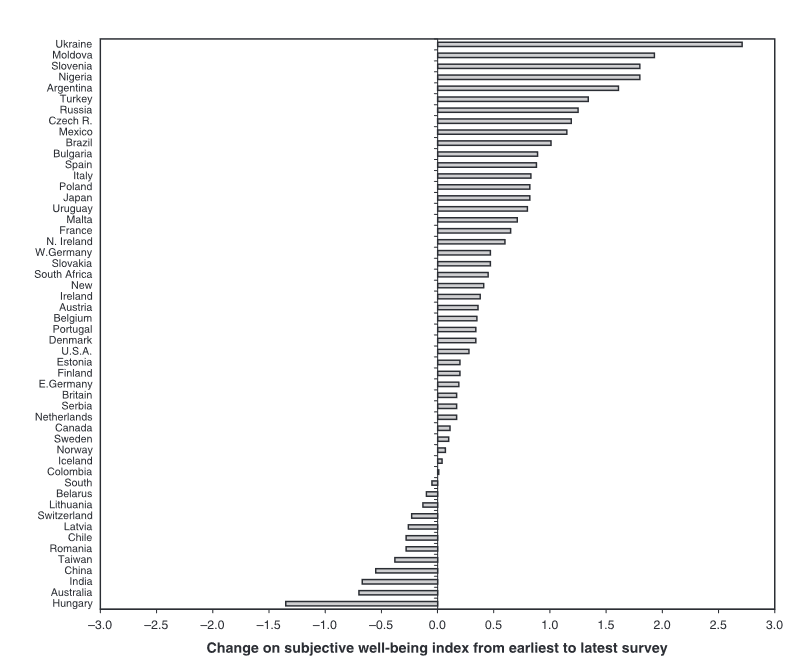
Third, I was finally able to find a paper that had really good data on change in happiness in different countries, and it supports the idea that happiness can change significantly on a countrywide level.
This is change in happiness in a bunch of countries between about 1990 and 2010 (the years were slightly different in each country). There are other graphs for related concepts like life satisfaction and subjective well-being that look about the same.
The most striking finding is that most countries got happier between those two years – sometimes a lot happier. In Mexico, the percent of people saying they were very happy increased by 25 percentage points!
Just eyeballing the graph, there’s not an obvious relationship between happiness and economic growth – China is still near the bottom like we talked about before, and France – a country that’s been First World since forever – is near the top. Even Japan, which is famous for its decades of stagnation, has done pretty well. But the authors tell us that after doing their statistical analyses, there is a strong relationship with economic growth. Okay, I guess.
They also say there’s a dramatic relationship with freedom and democracy. Mexico, the top country on the graph, went from a relatively closed to a relatively democratic government during this time. South Africa, number five, went from apartheid to no apartheid. Some of the ex-Communist countries like Poland and Ukraine also look pretty good here. On the other hand, other ex-Communist countries like Lithuania and Estonia are near the bottom. I wonder if this has to do with cutoff points – since every country started at a slightly different time, maybe they began sampling Poland during the worst parts of Soviet dictatorship and got Lithuania right in the first euphoria of independence? I don’t know. It all seems very noisy.
They also mention that the United States’ supposedly level happiness is kind of a misunderstanding. People say things like “Happiness in the US has been flat from 1950 to today”, but in fact it declined from 1950 to 1979 and increased from 1980 to today. They attribute this to the 1950s being unusually happy; then the 60s and 70s being unusually conflict-prone, and the Reagan Revolution and Clinton years were back to being optimistic. They don’t have data that stretches too long after that.
(This is pretty neat for Reagan and Clinton. When I die, I’ll consider my life a success if people attribute a spike on national happiness graphs to my influence.)
So apparently population happiness levels do change in response to relevant social changes, even on multi-decade timescales. Which brings us back to asking – what’s up with China?
The graph above shows India as doing okay – not great, but okay. But a similar graph on subjective well-being – which should be another way of looking at the same thing – shows India as doing pretty poorly, right down there with China – even though its GDP per capita quadrupled during the period of study.
I see a lot of conflicting perspectives about whether economic growth increases national happiness. It may, but the effect isn’t as big as you’d expect, and is usually overpowered by other factors. Maybe it isn’t even direct, but has something to do with development increasing democracy, liberalism, rule of law, and stability. China got the development, but its happiness genuinely didn’t increase because of country-specific factors that have something to do with how it developed (inequality? pollution? authoritarianism?).
This matches the race and gender data. Blacks saw a big happiness boost during a time when their feeling of freedom (but not their income) increased relative to whites. Women saw a small happiness drop during a time when their income (but not their feeling of freedom) increased relative to men.
So it looks like happiness can change. It just didn’t change in China over the past thirty years. The apparent paradox of improving economic situation and stable/decreasing happiness is genuinely paradoxical. Intangibles are probably just way more important than money, even amounts of money big enough to raise whole countries out of poverty.
I came across an article today by Warren Hatter that looks at the reasons the Remain campaign lost the referendum.
I'm not sure quite which body of theory or knowledge it draws on, but it certainly sounds convincing:
It’s not hard to make a case that the main flaw of the Remain campaign was in allowing the debate to be framed by the Leave camp. Framing isn’t a behavioural effect as such, but how something is framed provides the context for decision-making – and biases – to play.
Taking just one example, the Leave side managed to get ‘freedom of movement’ spoken about as though it’s a one-way street. And this is still true; listen to news pieces even today about the issue, and it’s all about EU citizens’ right to move to the UK, not about UK citizens being able to live in any of 28 countries, as a result of being EU citizens.
How could the campaign have been run to reframe this? I’ll offer just one example: loss aversion is good to tap into. For UK citizens like me and my family, the Leave campaign was about removing our right to live in 27 of those 28 countries. Expressing it more vividly, they want to take 95% of my/your passport away.
“It comes from a very ancient democracy, you see..."
"You mean, it comes from a world of lizards?"
"No," said Ford, who by this time was a little more rational and coherent than he had been, having finally had the coffee forced down him, "nothing so simple. Nothing anything like so straightforward. On its world, the people are people. The leaders are lizards. The people hate the lizards and the lizards rule the people."
"Odd," said Arthur, "I thought you said it was a democracy."
"I did," said Ford. "It is."
"So," said Arthur, hoping he wasn't sounding ridiculously obtuse, "why don't people get rid of the lizards?"
"It honestly doesn't occur to them," said Ford. "They've all got the vote, so they all pretty much assume that the government they've voted in more or less approximates to the government they want."
"You mean they actually vote for the lizards?"
"Oh yes," said Ford with a shrug, "of course."
"But," said Arthur, going for the big one again, "why?"
"Because if they didn't vote for a lizard," said Ford, "the wrong lizard might get in. Got any gin?"
The other day I was amused to find a quote from Einstein, in 1936, about how hard it would be to quantize gravity: “like an attempt to breathe in empty space.” Eight decades later, I think we can still agree that it’s hard.
So here is a possibility worth considering: rather than quantizing gravity, maybe we should try to gravitize quantum mechanics. Or, more accurately but less evocatively, “find gravity inside quantum mechanics.” Rather than starting with some essentially classical view of gravity and “quantizing” it, we might imagine starting with a quantum view of reality from the start, and find the ordinary three-dimensional space in which we live somehow emerging from quantum information. That’s the project that ChunJun (Charles) Cao, Spyridon (Spiros) Michalakis, and I take a few tentative steps toward in a new paper.
We human beings, even those who have been studying quantum mechanics for a long time, still think in terms of a classical concepts. Positions, momenta, particles, fields, space itself. Quantum mechanics tells a different story. The quantum state of the universe is not a collection of things distributed through space, but something called a wave function. The wave function gives us a way of calculating the outcomes of measurements: whenever we measure an observable quantity like the position or momentum or spin of a particle, the wave function has a value for every possible outcome, and the probability of obtaining that outcome is given by the wave function squared. Indeed, that’s typically how we construct wave functions in practice. Start with some classical-sounding notion like “the position of a particle” or “the amplitude of a field,” and to each possible value we attach a complex number. That complex number, squared, gives us the probability of observing the system with that observed value.
Mathematically, wave functions are elements of a mathematical structure called Hilbert space. That means they are vectors — we can add quantum states together (the origin of superpositions in quantum mechanics) and calculate the angle (“dot product”) between them. (We’re skipping over some technicalities here, especially regarding complex numbers — see e.g. The Theoretical Minimum for more.) The word “space” in “Hilbert space” doesn’t mean the good old three-dimensional space we walk through every day, or even the four-dimensional spacetime of relativity. It’s just math-speak for “a collection of things,” in this case “possible quantum states of the universe.”
Hilbert space is quite an abstract thing, which can seem at times pretty removed from the tangible phenomena of our everyday lives. This leads some people to wonder whether we need to supplement ordinary quantum mechanics by additional new variables, or alternatively to imagine that wave functions reflect our knowledge of the world, rather than being representations of reality. For purposes of this post I’ll take the straightforward view that quantum mechanics says that the real world is best described by a wave function, an element of Hilbert space, evolving through time. (Of course time could be emergent too … something for another day.)
Here’s the thing: we can construct a Hilbert space by starting with a classical idea like “all possible positions of a particle” and attaching a complex number to each value, obtaining a wave function. All the conceivable wave functions of that form constitute the Hilbert space we’re interested in. But we don’t have to do it that way. As Einstein might have said, God doesn’t do it that way. Once we make wave functions by quantizing some classical system, we have states that live in Hilbert space. At this point it essentially doesn’t matter where we came from; now we’re in Hilbert space and we’ve left our classical starting point behind. Indeed, it’s well-known that very different classical theories lead to the same theory when we quantize them, and likewise some quantum theories don’t have classical predecessors at all.
The real world simply is quantum-mechanical from the start; it’s not a quantization of some classical system. The universe is described by an element of Hilbert space. All of our usual classical notions should be derived from that, not the other way around. Even space itself. We think of the space through which we move as one of the most basic and irreducible constituents of the real world, but it might be better thought of as an approximate notion that emerges at large distances and low energies.
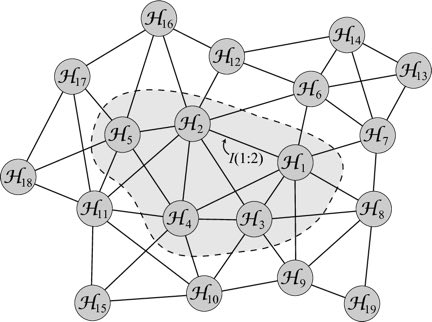
So here is the task we set for ourselves: start with a quantum state in Hilbert space. Not a random or generic state, admittedly; a particular kind of state. Divide Hilbert space up into pieces — technically, factors that we multiply together to make the whole space. Use quantum information — in particular, the amount of entanglement between different parts of the state, as measured by the mutual information — to define a “distance” between them. Parts that are highly entangled are considered to be nearby, while unentangled parts are far away. This gives us a graph, in which vertices are the different parts of Hilbert space, and the edges are weighted by the emergent distance between them.
We can then ask two questions:
When we zoom out, does the graph take on the geometry of a smooth, flat space with a fixed number of dimensions? (Answer: yes, when we put in the right kind of state to start with.)
If we perturb the state a little bit, how does the emergent geometry change? (Answer: space curves in response to emergent mass/energy, in a way reminiscent of Einstein’s equation in general relativity.)
It’s that last bit that is most exciting, but also most speculative. The claim, in its most dramatic-sounding form, is that gravity (spacetime curvature caused by energy/momentum) isn’t hard to obtain in quantum mechanics — it’s automatic! Or at least, the most natural thing to expect. If geometry is defined by entanglement and quantum information, then perturbing the state (e.g. by adding energy) naturally changes that geometry. And if the model matches onto an emergent field theory at large distances, the most natural relationship between energy and curvature is given by Einstein’s equation. The optimistic view is that gravity just pops out effortlessly in the classical limit of an appropriate quantum system. But the devil is in the details, and there’s a long way to go before we can declare victory.
We examine how to construct a spatial manifold and its geometry from the entanglement structure of an abstract quantum state in Hilbert space. Given a decomposition of Hilbert space H into a tensor product of factors, we consider a class of “redundancy-constrained states” in H that generalize the area-law behavior for entanglement entropy usually found in condensed-matter systems with gapped local Hamiltonians. Using mutual information to define a distance measure on the graph, we employ classical multidimensional scaling to extract the best-fit spatial dimensionality of the emergent geometry. We then show that entanglement perturbations on such emergent geometries naturally give rise to local modifications of spatial curvature which obey a (spatial) analog of Einstein’s equation. The Hilbert space corresponding to a region of flat space is finite-dimensional and scales as the volume, though the entropy (and the maximum change thereof) scales like the area of the boundary. A version of the ER=EPR conjecture is recovered, in that perturbations that entangle distant parts of the emergent geometry generate a configuration that may be considered as a highly quantum wormhole.
Like almost any physics paper, we’re building on ideas that have come before. The idea that spacetime geometry is related to entanglement has become increasingly popular, although it’s mostly been explored in the holographic context of the AdS/CFT correspondence; here we’re working directly in the “bulk” region of space, not appealing to a faraway boundary. A related notion is the ER=EPR conjecture of Maldacena and Susskind, relating entanglement to wormholes. In some sense, we’re making this proposal a bit more specific, by giving a formula for distance as a function of entanglement. The relationship of geometry to energy comes from something called the Entanglement First Law, articulated by Faulkner et al., and used by Ted Jacobson in a version of entropic gravity. But as far as we know we’re the first to start directly from Hilbert space, rather than assuming classical variables, a boundary, or a background spacetime. (There’s an enormous amount of work that has been done in closely related areas, obviously, so I’d love to hear about anything in particular that we should know about.)
We’re quick to admit that what we’ve done here is extremely preliminary and conjectural. We don’t have a full theory of anything, and even what we do have involves a great deal of speculating and not yet enough rigorous calculating.
Most importantly, we’ve assumed that parts of Hilbert space that are highly entangled are also “nearby,” but we haven’t actually derived that fact. It’s certainly what should happen, according to our current understanding of quantum field theory. It might seem like entangled particles can be as far apart as you like, but the contribution of particles to the overall entanglement is almost completely negligible — it’s the quantum vacuum itself that carries almost all of the entanglement, and that’s how we derive our geometry.
But it remains to be seen whether this notion really matches what we think of as “distance.” To do that, it’s not sufficient to talk about space, we also need to talk about time, and how states evolve. That’s an obvious next step, but one we’ve just begun to think about. It raises a variety of intimidating questions. What is the appropriate Hamiltonian that actually generates time evolution? Is time fundamental and continuous, or emergent and discrete? Can we derive an emergent theory that includes not only curved space and time, but other quantum fields? Will those fields satisfy the relativistic condition of being invariant under Lorentz transformations? Will gravity, in particular, have propagating degrees of freedom corresponding to spin-2 gravitons? (And only one kind of graviton, coupled universally to energy-momentum?) Full employment for the immediate future.
Perhaps the most interesting and provocative feature of what we’ve done is that we start from an assumption that the degrees of freedom corresponding to any particular region of space are described by a finite-dimensional Hilbert space. In some sense this is natural, as it follows from the Bekenstein bound (on the total entropy that can fit in a region) or the holographic principle (which limits degrees of freedom by the area of the boundary of their region). But on the other hand, it’s completely contrary to what we’re used to thinking about from quantum field theory, which generally assumes that the number of degrees of freedom in any region of space is infinitely big, corresponding to an infinite-dimensional Hilbert space. (By itself that’s not so worrisome; a single simple harmonic oscillator is described by an infinite-dimensional Hilbert space, just because its energy can be arbitrarily large.) People like Jacobson and Seth Lloyd have argued, on pretty general grounds, that any theory with gravity will locally be described by finite-dimensional Hilbert spaces.
That’s a big deal, if true, and I don’t think we physicists have really absorbed the consequences of the idea as yet. Field theory is embedded in how we think about the world; all of the notorious infinities of particle physics that we work so hard to renormalize away owe their existence to the fact that there are an infinite number of degrees of freedom. A finite-dimensional Hilbert space describes a very different world indeed. In many ways, it’s a much simpler world — one that should be easier to understand. We shall see.
Part of me thinks that a picture along these lines — geometry emerging from quantum information, obeying a version of Einstein’s equation in the classical limit — pretty much has to be true, if you believe (1) regions of space have a finite number of degrees of freedom, and (2) the world is described by a wave function in Hilbert space. Those are fairly reasonable postulates, all by themselves, but of course there could be any number of twists and turns to get where we want to go, if indeed it’s possible. Personally I think the prospects are exciting, and I’m eager to see where these ideas lead us.
Please don’t read this commentary if you’re having breakfast or drinking a latte.
I’ve joked about it many times, but I do find the entire idea of drinking cow milk horrifying. It’s just my weird mental thing, and should not be taken as an attack on milk drinkers.
For me, the idea of squeezing fluid out of a live animal is deeply unsettling to begin with. Then the fact that we’ve bred those animals so that the parts we squeeze are larger, and will produce more of the fluid, makes it worse. And then we developed suction-based machines made of stainless steel and rubber hoses to squeeze the animals more effectively.
I think the worst part is that I’ve been pretty close to more than one cow. I do not find them pleasant. Milk is white and clean-looking, yet it comes out of a cow. The cows I’ve been around have been dirty, have smelled awful, and have had glassy eyes and big gooey tongues like Jabba the Hut.
I’ve also been fairly close to more than one dairy farmer, and while most of them didn’t fit that description, more than one of them did.
I’ve had a weird couple of weeks. There was a lot of uncertainty, although that settled down towards the end of this week. There was the worst meltdown I’ve had in years. And now there’s a heatwave coming, which my hypersensitive anxious brain interprets in much the same way as “there’s a zombie apocalypse coming”. Tonight I’ve been thinking about a common thread running through the various different low points: needing more than ever to express things and seek help and reassurance, but not having the ability at the relevant time to do so verbally, or not doing so for fear it sounds ~weird~ or ~silly~ to others. So here’s a list, off the top of my head, of things I wish I could have said to the people around me about when I’m not coping so well.
Meltdowns are not just about the behaviour that you, a neurotypical observer, can see from the outside. For me, meltdowns feel different each time, depending on the circumstances. The main things I remember from this time is lots of crying, the mother of all headaches, and feeling sick whenever there was new input. This meant there was no way I could look at my phone screen, so there was no way of contacting friends even if I would have had the typing words to explain it all. It’s inescapable and at the time, it feels like nothing will be okay ever again.
If I’m going into meltdown and I walk away from the conversation, don’t follow me. And don’t pressure me to talk right now, because I can’t.
For you, this was upsetting, but probably just one of those weird blips that’s over now. For me, this was huge, and it won’t leave my thoughts so easily. For a while now, I’ll be operating in a sort of survival mode – the primary focus of decision-making is that I don’t want that to happen again. This probably means I’ll be more anxious than usual, too.
If I’m apologising more than usual or otherwise appear more anxious than usual, the correct response is something like “You seem a bit nervous, are you okay? What’s up?” The correct response is not “stop that!” as if I have a choice.
If I’m in meltdown, honestly there is no correct response; only time will calm me down. Having said that, “stop getting upset!” is an incorrect response.
Use some of that empathy and theory-of-mind that you claim to have – just because something isn’t scary or hard for you, doesn’t mean it isn’t scary or hard for me.
I am so so so super anxious right now. It would be nice if I could be open about that without feeling silly and pathetic. You probably don’t think I am, but some would, and that’s enough to put me off opening up. Hence all the apologising suddenly.
On balance, today has gone well; there have been wobbles, but I’ve taken an approach of lots and lots of distraction (for example, I’m actually blogging for once!) and it’s all under control. Again, it would be nice if I felt able to talk about this.
A lot of small talk right now is going to trigger that anxiety response. And I’m not sure there’s anything that anyone can do about it. Sorry.
I’m withdrawing a lot, I know. It doesn’t mean I’m angry with you or upset with you. It just means that I need space, that a lot of input right now is overwhelming. It will pass, I promise. At least, that’s what I’ve been telling myself.
Mainly, I want someone to tell me it’s okay and not shameful to feel like this. I feel like I’ve got a better grip on the rationalising side of things now – this will pass, and it’s not going to hurt me – but I do find reinforcement of those things helpful, even if it seems obvious and patronising. What I don’t need is your judgement.
Milo Yiannopoulos, aka Nero aka some real basic garbage in human form, got the boot from Twitter last night as a result of encouraging his racist and/or sexist and/or alt-right pals to go after actress Leslie Jones, who starred in the new Ghostbusters, aka the film sexist manboys wailed was ruining their childhood. Jones was subjected to more than a day of appalling abuse, Yannopoulos chortled about it like the troll he is and cheered his minions on, and Twitter finally decided he was a liability and permanently dumped his ass.
So, some thoughts on this:
1. Yiannopoulos and his party pals are now mewling about this being some horrible violation of free speech, so let’s recall that a) Twitter is not the US or any other government and b) is a private entity and c) essentially reserves the right to boot anyone from their service for whatever reason, so, really, waaaaaaaah, and also, no. Yiannopoulos still has a platform for his nonsense on Breitbart, aka where journalism goes to drill holes in its temple and then cover itself in its own poop, so anyone who wants him can go there (Please go there. Please stay there). He hasn’t been censored; he’s just been told to take a hike.
2. Yiannopoulos and his party pals will also want to claim this is about him being conservative, and again, no. There’s nothing inherent in holding to a conservative philosophy that requires one, in their interactions with others online, to be a raging shithole, or to encourage others to be the same. Millions of conservatives use Twitter every day without being raging shitholes. Conversely, there’s nothing about a liberal philosophy that means you can’t be a raging shithole; I just the other day muted a liberal turd over there because I didn’t want to be bothered with his smug dickery any further. Being an asshole is orthogonal to political philosophy. Yiannopoulos’ public persona is centered on being an asshole in order to serve a market of assholes. That’s pretty obvious.
3. When Yiannopoulos was booted off of Twitter, some folks wrenched their hands and said “But that’s what he wants! It’ll just serve his narrative of persecution!” Well, one, no, it’s not what he wanted. This is a fellow who, when given an opportunity to ask a question in the White House press room, querulously whined about losing his “verified” checkmark on Twitter. Being booted from the service is not an actual win for him. Two, of course he’ll spin it like a win anyway, because as with other dipshits of his sort, everything must always be spun as, not only a victory, but as a victory that is unfolding exactly to plan. Yiannopoulos could trip down a flight of stairs mouth first and he’d crawl himself up a wall at the landing, turn to you with a mouth full of broken teeth and try to convince you that he meant to do that. If you know that about him (and other dipshits like him), it becomes easy to ignore the “that’s what he wants” aspect and do what you need to do.
4. “But he’s gay!” Yes, Yiannopoulos is gay. He’s also an asshole who points other assholes at people to harass and terrorize them. He got booted off Twitter for the latter; the former doesn’t excuse it. Being an asshole is orthogonal to sexuality as well as political philosophy.
5. It’s good that Twitter punted Yiannopoulos, but let’s not pretend that it doesn’t look like Twitter did some celebrity calculus there. Yiannopoulos and pals had a nice long run pointing themselves at all other manner of people they didn’t like, for whatever reason, and essentially Twitter didn’t say “boo” about it. But then they harass a movie star with movie star friends, many of whom are Twitter users with large numbers of followers, and whose complaints about Twitter and the harassment of their friend get play in major news outlets, and Twitter finally boots the ringleader of that shitty little circus.
So the math there at least appears pretty obvious from the outside. You can punch down on Twitter and get away with it, but don’t punch up, and punch up enough to make Twitter look bad, or you’ll get in trouble (after more than a day). Is this actually the way it works? I’m not at Twitter so I can’t say. I can say I do know enough women of all sorts who have gotten all manner of shit by creeps on Twitter, but who weren’t in a movie and had movie star friends or got press play for their harassment. And they basically had to suck it up. So, yeah, from the outside it looks like Twitter made their decision on this based on optics rather than the general well-being of their users.
6. Which is a recurring theme with Twitter (and other social media services, but also, of Twitter): Not much gets done until the service looks bad, and then what gets done is cosmetic rather than useful. Don’t get me wrong, Twitter punting Yiannopoulos is a good thing; he deserved it and has done for a while. But Yiannopoulos didn’t get to the point where he needed the boot all by himself. He happily exploited the weaknesses of Twitter — weaknesses Twitter could have dealt with years ago — to become one of the service’s leading shitlords. And getting rid of the shitlord doesn’t mean the shitty little minions he gathered to himself still aren’t on the service and happy to continue their shitty ways. Which is fine if they keep to themselves; less so when they’re shitty to others, as they are likely to be.
Twitter can do more to make it easier for users to route around awful people and to get them off the service if they won’t let themselves be routed around. Twitter’s been promising for years that they’re going to make better strides in this department — and is promising more in the coming weeks — and yet here we are in 2016 and still it takes someone with a number two box office film to her name and all her famous friends to get the service to do something it should have done long ago. Yiannopoulos is giant turd of human, to be sure. But Twitter did its part in letting him get that way. Maybe they should do more to avoid let turd buildup happen from here on out.
They say they’re going to do it. Prove it, Twitter.
Garry Marshall was a great writer, producer, director and actor. (Actor, you say? Yeah. His scenes as the hapless casino host opposite Albert Brooks in Lost in America are about as perfect as comedy scenes get.) His credits in the other categories are equally impressive, starting with all the scripts he penned for sitcoms in the sixties with his longtime partner, Jerry Belson. Their scripts for The Dick Van Dyke Show alone were legendary.
Obits like this one will tell you what else he did but they don't all mention the long, long list of top writers, actors and directors (and other professions) who got their start — or a job when no one else would hire them — on a Garry Marshall production. I could list twenty-five just among my friends. And I may be missing one exception but as I'm sitting here writing this, I can't think of one who ever had an unkind word to say about the man himself. That is not true of very many people who hired that many people.
I never worked for Garry but I ran into him all the time. We had the same doctor, the same favorite restaurant for lunch in Burbank (this place) and a lot of mutual friends. Garry loved it when people knew all he'd done, not just Happy Days or Laverne & Shirley or Pretty Woman or any of his biggest or most recent hits. So I'd ask him, "Hey, are you one of the guys responsible for Hey, Landlord or Evil Roy Slade and he'd laugh and tell me something about it.
One time, I asked him about The Joey Bishop Show — the 1961-1965 sitcom, not the subsequent talk show. Garry had not enjoyed the experience and he told me a story. I don't know if it was an episode that he and his partner wrote but there was one where Joey played a dual role — a twin brother or cousin or something. Garry said Joey started complaining because the other character was getting all the good jokes. I laughed (of course) and he said, "You know, I hated that show but it was worth it just to get that anecdote." Spoken like a true comedy writer.
A pulling goal is when you want to achieve something, so you come up with a plan and a structure. For example, you want to cure cancer, so you become a biologist and set up a lab and do cancer research. Or you want to get rich, so you go to business school and send out your resume.
A pushing goal is when you have a plan and a structure, and you’re trying to figure out what to do with it. For example, you’re studying biology in college, your professor says you need to do a research project to graduate, and so you start looking for research to do. You already know the plan – you’re going to get books, maybe use a lab, do biology-ish things, and end up with a finished report which is twenty pages double-spaced. All you need to figure out is what you’re going to select as the nominal point of the activity. There’s something perversely backwards about this – most people would expect that the point of a research project is to research some topic in particular. But from your perspective the actual subject you’re researching is almost beside the point. The point is to have a twenty page double-spaced report on something.
School and business are obvious ways to end up with pushing goals, but not every pushing goal is about satisfying somebody else’s requirements. I remember in college some friends set up an Atheist Club. There was a Christian Club, and a Buddhist Club, so why shouldn’t the atheists get a club too? So they wrote the charter, they set a meeting time, and then we realized none of us knew what exactly the Atheist Club was supposed to do. The Christian Club prayed and did Bible study; the Buddhist club meditated, the atheist club…sat around and tried to brainstorm Atheist Club activities. Occasionally we came up with some, like watching movies relevant to atheism, or having speakers come in and talk about how creationism was really bad. But we weren’t doing this because we really wanted to watch movies relevant to atheism, or because we were interested in what speakers had to say about creationism. We were doing this because we’d started an Atheist Club and now we had to come up with a purpose for it.
Sometimes on Reddit’s /r/writing I see people asking “How do you come up with ideas for things to write about?” and I feel a sort of horror. So you want to write a novel, but…you don’t have anything to write about? And you just sit there thinking “Maybe it should be about romance…no, war…no, the ennui of the working classes…or maybe hobbits.” I can understand this in theory – you want to be A Writer – but it still weirds me out.
You may have noticed I don’t really like pushing goals. Part of it is an irrational intuition that they’re dishonest in some way that’s hard to explain. It usually ends up with me trying to figure out what to do my biology research project on, and I think “well, I can’t think of anything I really want to research, so maybe I should just do whatever is easiest”. But if I do whatever is easiest, I feel really bad, and worry maybe I have some kind of obligation to research something important that I care about. So I get my brain tangled up trying to figure out how much easiness I can get away with, then feeling bad for asking the question, then trying to come up with something important I honestly want to do, which doesn’t exist since I wasn’t doing a biology research project the month before my professor assigned it to me and so clearly I am only doing it to satisfy the requirement.
Another part of it is that it’s often a sign something has gone wrong somewhere. In the example of the Atheist Club, that thing might have been starting the club in the first place. But assuming that we genuinely want to start the club, then the presence of a pushing goal means we don’t understand why we wanted to start the club. If we wanted to start it because we wanted to hang out with other atheists, then that offers a blueprint for a solution to the problem – instead of planning all these movies and speakers, we should just hang out. If we did it because we thought it was important for atheism to be more visible on campus, then again, that offers a blueprint for a solution – spend our sessions trying to improve atheism’s campus visibility. If we just sit there saying “I guess we have an Atheist Club now, better think of something to do at meetings”, then it seems like something important hasn’t been fully examined.
The third part of it is that things done for push goals usually suck. Maybe this isn’t a human universal – my go-to example is Edgar Allen Poe deciding to write a creepy poem and coming up with The Ravenfrom first principles – but it’s true for me. If I have to write a report on a topic I don’t care about, then even if I’m really trying to do a good job, it’s not going to be as good as something I actually want to write about. Sometimes I try to solve this by making lists of things I want to pull, then using them when the appropriate pushing situation comes up. For example, when I knew I would be assigned research projects and writing assignments on a regular basis, whenever I thought of something I wanted to research or write, I wrote it down, then consulted the list when I needed it. I have a similar list of interesting things to work into stories. This is one reason I’m not interested in journalism – I worry that if I have to produce specific articles on specific things within a time frame, they’ll probably suck.
I've seen this argued a lot of places before. I may even have argued it myself, semi-seriously.
Couple of PSAs to start out with:
I’m going to be participating in tomorrow’s Future of Mind Symposium, put on by the Center for Transformative Media down in NYC. (I will, no big surprise, be participating via video-link to reduce the chances of getting killed and/or arrested en route.) The event is free, but you gotta register. Also they’ve already had to move to a bigger venue so I don’t know how available tickets might be.
Spacecat.
I’ve already participated in another interview with Jasun Horsley’s “Liminality” podcast. This time, like the last, we rambled on so long that it ended up being a two-parter. As of this writing only the first hour is up; according to the page summary we discoursed erratically on UFOs, Michael Persinger’s helmet, abduction narratives and sexual abuse, J. Allen Hynek and close encounters, MKULTRA, the parliament of voices, ritual abuse and False Memory Syndrome’s disinformation campaign, Whitley Strieber & the Nazi-US alliance, Elizabeth Loftus, using satanic elements as cover to invalidate memories of abuse, and organized pedophilia in the British aristocracy. To name but a few. I haven’t had a chance to listen to the whole thing, so I have no idea how coherent or incoherent it might be. Think of it as sitting across from us at a bar after I’ve had a few drinks.
Gotta love what Jasun does to my author photos, though. He swears that any resemblance of that upper-right yellow blob to a seventies-era Space Invader is purely accidental.
*
“Nothing is real.”
—John Lennon
So. The latest variant on the classic double-slit experiment continues to support what all other such experiments have supported in the past, namely that whether something behaves like a particle or a wave depends upon whether it’s being surveilled, which demonstrates in turn that (in the words of the study’s author) “reality does not exist if you are not looking at it”, which in yet another turn means that nothing makes any fucking sense whatever. I’ve always clung to the belief that it all does make sense, but — because stuff that happens on quantum scales has no relevance to the process of natural selection up here in the classical world— our brains simply aren’t wired in a way that lets us grok such things intuitively. But let’s put that aside for now, because I think I might have come up with an explanation for all this quantum dumbness that actually does make sense at classical scales:
Nick Bostrom is right. We’re all living in a simulation. More, these dual-slit experiments suggest that (and here’s my little contribution, which probably has its head up its ass because I don’t know anything about this stuff but bear with me) we’re living in a simulation with a really low budget.
We are somewhere below the line
Most of you already know Bostrom’s argument. For the rest of you, his reasoning boils down to 1) if it’s possible to create simulations with self-aware inhabitants, and 2) if some advanced species is inclined to actually build such sims, then 3) there are probably way more simulated universes (>>1) than real ones (=1). Which means, based purely on the odds, that we are far more likely to be living in one of a myriad simulations than we are in a singular baseline reality.
I’ve always liked this thought. It fits in nicely with the whole Digital Physics paradigm that seems to have taken root in the Physics community. It jibes with the way reality seems to kinda “stop” below a certain scale of resolution (Planck Length and Planck Time may be no more than pixel dimensions and clock cycles). And if enough studies like Bean et al come down the pike— and if they hold up— the Simulation Hypothesis might even find its way out of the it’s-untestable-so-it’s-not-science swamp that’s mired String Theory for so long.
So what do we know about our own baby steps into building simulated realities? We know that when you’re playing Fallout 4, the graphics engine doesn’t waste energy rendering the landscape behind you. We know that when you put on your Oculus Rifts, they don’t paint the vista at the back of your head. Why should they? Nobody’s looking there. Oh, they keep all the pointers and variables on hand, sure. They’re completely capable of rendering the world to your left the moment you turn your gaze in that direction. But they don’t actually solidify any part of the world until someone looks at it.
You see where I’m going with this, right?
Maybe not so Unreal an Engine after all…
First-person gaming is a pretty good metaphor for quantum indeterminacy; nothing is real until observed. Maybe it’s more than a metaphor. Maybe we’re living in a cut-rate Bostrom sim, one that can’t afford the computing power to render everything in hi-res detail all the time— so it cuts corners, saves cycles only for those parts of the model that are being observed.
Maybe there’s nothing insane or counterintuitive about quantum indeterminacy after all. Maybe it’s perfectly understandable— depressingly familiar, even— to anyone who’s lived on a grad-student budget.
On 10 July I blogged about the Conservative leadership:
For her sake and the sake of the country, Leadsom should now stand down from the contest.
The following day she did just that.
Sometimes it takes a little longer. On 7 July I wrote:
What would be welcome ... would be Nick Clegg taking on the Europe and foreign affairs for the Liberal Democrats,
His party needs him and his country does too.
This afternoon came news (so far only via Twitter) that Nick Clegg is going to take on the European portfolio for the Lib Dems.
To be honest, I have been calling for him to do that ever since the last election. But if people have finally started to take notice of me I shall call for more things in future.
Named Characters: J. Jonah Jameson, Aunt May, Betty Brant, Flash Thompson, Liz Allan + Curt Connors, Martha Connors, Billy Connors
Observations: Like the Hulk, the Lizard wears purple trousers after his transformation; although unlike the Hulk, this appears to be the sartorial choice of his human counterpart.
On the cover, the Lizard’s white lab coat is also purple — either due to an error, or because red/blue green/purple is a good combination in cheap four colour printing.
The Lizard appears to have no teeth.
Although he’s an iconic villain, this is the Lizard’s only appearance in the classic era. (Connors appears as a supporting character in #32.)
Connors’s son Billy definitely knows about his father's affliction; although when the Lizard returns in issues #44, he appears not to.
As a monster story, it’s kind of okay. As a Spider-Man story...
Amazing Spider-Man #4 (Sandman) seemed to have nailed the Spider-Man formula: it achieved a perfect equilibrium between The Writer (who wanted big fights between the Hero and a monthly Challenger) and The Artist (who wanted realistic stories of a guy saddled with weird powers). It interleaved the high-school story and the super-villain story and made the Fight Scene interesting by showing us the goodie and the baddie using their powers in a series of ingenious attacks, defenses and counter-attacks. But it appears that neither Lee nor Ditko quite realized they’d produced the definitive Spider-Man tale. Issue #5 and issue #6 represents a different conjectures about what a Spider-Man story ought to look like. Neither of them quite work.
A Florida swamp is being terrorized by a lizard, known as The Lizard. Near the swamp lives Dr Curtis Connors, an expert on lizards. To no-one’s great surprise, it turns out that The Lizard and Connors are one and the same. Connors is an amputee and thinks it is unfair that human beings can’t just grow new limbs when they need them. He uses Science to brew a Potion which gives him a new right arm, but unfortunately it has the side-effect of turning him into a giant lizard. For reason which are not explained it also makes him talk like Thor. ("Begone! This swamp is mine!")
Comic book Science is a form of sympathetic magic, so the idea that a Potion brewed from lizards gives you new arms and legs but also turns you into an actual lizard makes a good deal of comic book sense. Harder to swallow is the alchemy of "powers". It seems that individual species — and indeed whole taxonomic categories — have irreducible essences which can be transubstantiated to other individuals. So the radioactive spider-bite transferred the "powers" of the Spiders to Peter Parker; and the lizard potion transferred the "powers" of all cold blooded creatures on earth to Curtis Connors.
On page 16 we see Spider-Man using his wall-crawling ability to run up the side of an old Spanish fort, and The Lizard climbing after him. It looks to me as if The Lizard is just scaling the wall (picking out foot and hand holes in the brick work) but in fact, it’s all to do with his Platonic essence. “Hah! He forgets there are thousands of different kinds of lizards on the earth, and I have the powers of ALL of them! Has he never seen a gecko lizard slither up a wall”. Similarly, the Scorpion is able to cut through spider-webbing with his fingers because he has the “powers” of a scorpion and scorpions have claws; the Sub-Mariner is able to electrify his body because he has the “powers” of all fish and they serve eels in sea-food restaurants.
The whole logic of the story depends on there being something unnatural or uncanny about The Lizard. Peter Parker has little difficulty in accepting the existence of space aliens, flaming teenagers or giant green monsters, but he finds the story of an intelligent lizard in a swamp a little too far-fetched. Jameson says outright that The Lizard doesn’t exist despite Parker having taken photos of it. Connors den is decked out with retort stands and test tubes; and he himself (even in his monster form) wears a long white lab coat. Spider-Man (being at least half way through his chemistry A level) is able to decode his notes and brew up a new Potion which turns The Lizard back into a human being. But no-one regards Connors as anything other than a black magician. “I tampered with forces of nature which must not be tampered with!” he exclaims, before burning his books and breaking his staff. Well, burning his books, anyway. It's not that his experiment had an unexpected result, or that he stupidly didn't think through the consequences: the idea of using Science to restore lost limbs was against the natural order of things. Like picking apples in Eden or trying to steal fire from the gods. Frankenstein was a necromancer.
The bulk of the episode — pages 6 - 20 — takes Spider-Man out of New York altogether, sending him to Florida to fight The Lizard. It’s hard not to see this as a last-ditch attempt by Lee to force Ditko to turn in a superhero comic. Lee probably reasoned that Ditko couldn't very well fill the comic with characterization and human interest if Liz Allen, Aunt May, Flash Thompson Betty Brant and Spider-Man are a thousand miles apart.
J. Jonah Jameson, on the other hand, flies all the way to Florida with Peter Parker ("It’s such a big story that I’m going with you”), confirming our sense that Amazing Spider-Man has become the Peter and Jonah Show. This is the third consecutive episode which has begun with J.J.J bad-mouthing our hero. It's a potentially good set-up for a story: how many sit-com episodes have involved sending two characters who don’t like each other away on a field trip? But, as so often in these early issues, nothing really comes of it. We ought to have seen Parker and Jameson forced to make conversation in a hotel room during a power cut, or Spider-Man and J.J.J. forced to cooperate to escape from the Lizard. In fact, Jameson might just as well have stayed at home: Peter gives him the slip as soon as they arrive in Florida, and the remaining 12 pages is a monster story in which Spider-Man doesn't get out of costume once.
Ditko does manages to smuggle a bit of soap-opera in, a 4 page sequence in which Peter Parker goes to the museum to find out about lizards and finds Flash and Liz already there. (Museums are a sort of olden days version of Google.) Wouldn’t you know it, though: some thieves try to rob the museum and briefly take Liz hostage. Peter has to change to Spider-Man to rescue her. This sequence has no actual connection with the main plot, and it’s very hard not to think that Ditko dropped it in as a pretext for reminding us readers that the supporting cast still exist.
As we've seen, Stan Lee’s dialogue and captions sometimes get out of sync with Steve Ditko’s art. There is a minor example of that in the museum sequence: we see two hoods walking through the dinosaur exhibition; Peter Parker clocking them with his spider-sense; the crooks spotting that he’s spotted them and grabbing Liz at gunpoint; and Spider-Man knocking them both out with a single punch. (”Ugh! Oof!”). Nothing in the pictures indicates what they are doing in the museum: for that, we have to read the speech bubbles. The crooks say “No-one saw us take the idol’s ruby”; a few panels later Spider-Man says “It’s the guard! He’s chasing those two! He saw them steal something!” and the crooks say “Okay, so you saw us grab that ruby…”. It’s very odd that we don’t see the idol or the theft; and very odd that Ditko doesn’t show us the crooks trying to conceal a gem. It’s very odd indeed that Spider-Man says that he sees guardS chasing them, even though there is no guard in the picture. It is pretty clear that Stan Lee looked at the pictures, didn’t think it was clear what was going on (which, indeed, it isn’t) and made up the story about the jewel heist after the event.
But this is as nothing to the counter melody that Lee plays during Spider-Man's big fight with The Lizard.
The plot, as expressed in the pictures, is simple and satisfactory. The Lizard is terrorizing the Swamp. Spider-Man realizes that The Lizard and Curt Connors are the same person; and uses Science to make a potion that will turn him back to his human form. The challenge is how to get The Lizard to drink the potion, which Spider-Man ingeniously solves by grabbing The Lizard and forcing it down his throat. Spider-Man doesn’t hand Connors over to the authorities because he hasn’t broken any laws. Breaking the law is a big thing for Stan Lee. He keeps saying Doctor Doom isn’t really a baddie because there is no law against trying to conquer the universe. Surely the real point is that Spider-Man lets Connors go because he isn’t responsible for what he did when he was in his lizardy form?
This doesn’t seem to be exciting enough for Lee so he adds a sub plot. During the big fight, The Lizard is shown to be being followed around by three big alligators. I don't think that you or I, just looking at the picture, would have thought that needed much explanation: of course a big intelligent humanoid lizard would have alligators as minions. But Lee feels the need to explain that the Lizard Potion not only turned Connors into a Lizard; not only gave him the Powers of every kind of Lizard; but also gave him mental control over Lizards. Even better, he is going to spill his Potion into the swamp, which will turn every lizard in the world into a super-lizard under his mental command which will enable him to (Evil Laughter) RULE THE WORLD!
I suppose this follows on a bit from the “alchemical” idea that Connors' has transferred some kind of distilled essence of lizardyness to himself. I suppose that Stan Lee thinks that increasing the “hazard” automatically makes the story more exciting, so he upgrades “I have to defeat the monster and return the nice scientist to his right mind” to “I have to defeat the monster and return Connors to his right mind or else he will conquer the world.” I think it is unnecessary, and confuses a simple story. None of the pictures remotely suggest the conquer-the-world angle. Ditko shows us Spider-Man physically snapping photos with his camera; and clearly shows Spider-Man holding a flask with the antidote Potion in it. But at no point do we see The Lizard's conquer-the-world Potion. Surely if Ditko had known about it, there would have been a dramatic scene with the Lizard holding a flask over the swamp and Spider-Man grabbing it in the nick of time?
Once again, Spider-Man is not primarily motivated by a sense of duty or altruism. He goes to Florida because Jameson challenges him to fight the Lizard (as Spider-Man) and because he needs the money for the photo-assignment (as Peter Parker). Once again, he starts out acting from honest self-interest and only gradually becomes entwined in situation in which he has to a good thing.
Spider-Man initially thinks that The Lizard is “publicity mad”; where Jameson thinks that Spider-Man will not challenge him because he is more interested in “making a rep” for himself in New York. But when Peter Parker comes up with the pictures, Jameson (having traveled all the way to Florida to get them) declares that the whole thing is “some sort of publicity stunt” and refuses to pay for them. Once again, we appear to be talking about competing sports stars or TV personalities, not heroes and deadly menaces.
*
Summary of Peter Parker's Photo Career, So Far:
Issue #2 - Sells pictures of Vulture for tens of thousands of dollars
Issue #3 - Doesn’t bother to photograph Doc Ock
Issue #4 - Sells (fake) pictures of Sandman for an undisclosed amount
Issue #5 - Sells pictures of a fire in Doom’s base for an undisclosed amount
Issue #6 - Fails to sell pictures of Lizard.
Does Aunt May have an independent source of income? What, indeed, was Uncle Ben’s job? Did he have a pension? May has no savings, having to pawn her jewelry to pay the rent in issue #2. Having spent all the money from issue #2 on rent and kitchen equipment, are May and Peter wholly reliant on the Sandman pictures to pay general living expenses? If so, how can Parker even contemplate college?
*
On page 6, Parker nervously tells Betty Brant “I’ve been wanting to ASK you something.” We can guess what he wants to ask her: after all, only last issue he suddenly realized how he felt about her. On his return from Florida, he phones her up -- at some point in the last year, he has grown into the kind of guy who confidently asks girls to go out with him. But when he finds out she’s working late, he immediately asks Liz to go out with him instead. Which, if he’s honestly just realized that Betty is seriously interested in him and he’s seriously interested in her is a fairly caddish thing to do.
The Sandman story ended with Peter Parker carrying the weight of the world on his shoulders, declaiming to God about the curse of his powers. Issues #5 and #6 have lightened up considerably; with mildly ironic sit-com style endings. #5 ended with Flash Thompson having become a hero to the other school kids, despite having made a complete idiot of himself. This issue ends with Peter half-smiling when he finds out that Liz doesn’t want to go out with him...because she thinks Spider-Man is going to call her. (Spider-Man called her "blue eyes" when he rescued her in the museum.) Parker still thinks that it's not fair when everything doesn't go exactly his own way, but instead of God, he now blames a phenomenon he calls luck. “I’ve got nothing but luck, and it’s all bad”; “Only a guy with my nutty luck could end up being his own competition.”
Believing in “bad luck” is a way of reading malice into the ordinary process of stuff happening; it can also be a form of self-sabotage. Some pop psychology suggests that people who believe that they are lucky are the ones who are good at grasping opportunities when they come their way. People who believe in bad luck think they are helpless in the face of set-backs. But it isn't a very serious explanation. People mainly invoke luck when they are throwing dice or betting on horses. You could, perfectly reasonably, say that it was “bad luck” that meant that a crook who had once passed Parker in a corridor just happened to murder the person he loved most in the world; but it would be a trivial way of talking about a serious event. Amazing Fantasy #15 would have been a very different comic if it had ended with Parker winking into camera and saying “My luck’s running true to form…”
The grim tragedy of Stan Lee’s groundbreaking character has become a comic tick. You can almost hear the waa-waa-waa sound effect in the background. We have four or five months of happy endings to look forward to before everything turns depressing again.
This blog is supported by Patreon. Please consider agreeing to pay $1 each time I publish an essay
I'm still on vacation (with a side-order of signing tour) and won't be home until Thursday evening, at which point I'll be jet-lagged for a few days. Meanwhile, History is happening, and I wish it would stop, or at least slow down.
As Lenin allegedly put it, "sometimes decades pass that feel like weeks: and sometimes weeks pass that feel like decades." Assuming the quote's correct (I haven't been able to run down a citation for it), he was on the nail, and we're clearly living through it: at the rate History has been happening over the past month I am expecting the date for a new Scottish Independence referendum to be announced, China to land a Taikonaut on the Moon, Turkey to declare war on Pennsylvania, and Boris Johnson not to offend anyone all week. (For those who aren't in on the joke, here's The Economist's take on Boris as Foreign Secretary—key phrase: "like putting a baboon at the wheel of the Rolls Royce".)
Seriously. 2016 sucks. It probably doesn't suck as badly as 1933, or 1943 come to think of it, but it's still a shitty, horrible, no-good excuse for a year in history, and future generations of schoolkids will ask their baffled teachers, "but what were they thinking?"
So. In an attempt to cheer myself up ... what am I missing that is outside the prevailing media narrative but is still worthy of reportage?
 MidAmeriCon II members, this is your timely reminder that voting for the Hugo Awards this year ends on Sunday, July 31, 2016, 11:59 PM PDT, so you have just a few days left to vote in all the categories. There is a lot of excellent work on the ballot, and also some mischief from a few bad actors, and all of it deserves your attention and what votes you decide to offer, up or down. My tip to you: Vote for what you think deserves awarding, and you’ll be groovy.