Andrew Hickey
Shared posts
First responders usually shouldn’t mean ‘people with guns’
sherlock holmes, whose brother was more interesting and competent than him but we're stuck with sherlock so we all just have to deal, sighed. his brother was just so much more interesting and competent than him, but we all just had to deal.
| archive - contact - sexy exciting merchandise - search - about | |||
 |
|||
| ← previous | July 1st, 2016 | next | |
July 1st, 2016: HERE'S TO THE NEXT 3000 COMICS!! Also: Happy Canada Day! – Ryan | |||


Know-nothing Arrogance or Machiavellian machinations?
The problem with the "Brexit mean Brexit" discourse is that no one has yet determined precisely what Brexit does actually mean. Even now there is a clear difference between the ideas of an associate membership, an EFTA solution, and EEA solution or a complete exit from all EU-led structures. It is by no means clear what version carries with it the support of the Conservative Party. Increasingly there seems to be some traction that the "Brexit means Brexit" narrative actually means complete withdrawal. If so, then Mrs. May's "safe pair of hands" risks being the instrument of strangulation of the economic well being of our country and its political survival as a single unit.
While 51% were not clear about what version of Brexit they wanted, 48% - led by the young and the better educated- did not want to lose any of the features of the European Union. A complete exit is a very clear minority position. The appointment of Mr. Davis- who apparently does not understand that Germany and France will not do any trade agreements separate from the rest of the EU, because that is the whole point of the EU- is nearly as controversial as the appointment of Mr. Johnson, and potentially even riskier.
Mrs. May has squared the circles of her party, at the cost of irritating all the UK's international partners. The fact is that the ignorant who have wrapped themselves in self righteous tosh about British democracy fail to recognize the idealism that also lies at the heart of the European project. That cynical and lying journalists may have persuaded the old and the poor that the EU is all about bureaucracy does not remove the fact that the rest of Europe regards the Union as a noble project designed to support European prosperity as a whole. Lecturing those who believe in the European ideal in the way that many right-wing Conservatives have often tended to in the past will isolate Britain still further, and the divorce could become very bitter indeed.
As the new government takes its first baby-steps, Mrs. May must know that, despite the current implosion at the heart of Labour, it is the Conservatives who stand to be tarred with the contempt of history if a suitable and moderate path is not established soon.
Even Machiavelli ended up in exile.
A Target for Tommy

'Your people may be the masters of all time and space,' said the luchador in a voice rich with martial confidence, 'but when it comes to fighting as would a man, you seem lacking in certain departments, if you don't mind my saying so.'
The muffled response of a pained not at all sounded from beneath the huge wrestler's bottom, which had now made a seat of the Doctor's face.
A Short Review of Ghostbusters and A Longer Pummel of Manboys

What I thought of the new Ghostbusters: I liked it, and would happily rewatch it. It’s definitely the second-best Ghostbusters movie, and much closer to the original in terms of enjoyment than the willfully forgotten Ghostbusters 2. There are legitimate criticisms to make of it: the plot is rote to the point of being slapdash, the action scenes are merely adequate, and Paul Feig is no Ivan Reitman, in terms of creating comedic ambiance. But the film got the two big things right: It has a crackerjack cast that’s great individually and together, and it has all the one-liners you can eat. And now that the origin story of these particular Ghostbusters is out of the way, I’m ready for the sequel.
But what about the Ghostbusters being all women?!??!?? Yes they were, and it was good. If you can’t enjoy Melissa McCarthy, Kristen Wiig, Kate McKinnon and Leslie Jones snarking it up while zapping ghosts with proton streams, one, the problem is you, not them, and two, no really, what the fuck is wrong with you. The actors and the characters had chemistry with one another and I would have happily watched these Ghostbusters eat lunch, just to listen to them zap on one another. And in particular I want to be McKinnon’s Holtzmann when I grow up; Holtzmann is brilliant and spectrum-y and yet pretty much social anxiety-free and I honestly can’t see any sort of super-nerd not wanting to cosplay the shit out of her forever and ever, amen.
BUT THEY’VE RUINED MY CHILDHOOD BY BEING WOMEN, wails a certain, entitled subset of male nerd on the Internet. Well, good, you pathetic little shitballs. If your entire childhood can be irrevocably destroyed by four women with proton packs, your childhood clearly sucked and it needs to go up in hearty, crackling flames. Now you are free, boys, free! Enjoy the now. Honestly, I don’t think it’s entirely a coincidence that one of the weakest parts of this film is its villain, who (very minor spoiler) is literally a basement-dwelling man-boy just itchin’ to make the world pay for not making him its king, as he is so clearly meant to be. These feculent lads are annoying enough in the real world. It’s difficult to make them any more interesting on screen.
But this is just the latest chapter of man-boys whining about women in science fiction culture: Oh noes! Mad Max has womens in it! Yes, and Fury Road was stunning, arguably the best film of its franchise and of 2015, and was improbably but fittingly nominated for Best Picture at the Academy Awards. Oh noes! Star Wars has womens in it! Yes, and The Force Awakens was pretty damn good, the best Star Wars film since Empire, was the highest grossing film of 2015 and of all time in the domestic box office (not accounting for inflation. Accounting for inflation, it’s #11. #1 counting inflation? That super-manly epic, Gone With the Wind).
And now, Oh noes! Ghostbusters has womens in it! Yes, and it’s been well-reviewed and at $46 million, is the highest grossing opening for its director or any of its stars and perfectly in line with studio estimates for the weekend. Notably, all the surviving principals of the original film make cameos, suggesting they are fine with passing the torch (Harold Ramis is honored in the film too, which is a lovely touch), and Ivan Reitman and Dan Aykroyd are producers of the film. If your childhood has been ruined, boys, then your alleged heroes happily did some of the kicking.
I’m an 80s kid; my youth is not forever stained by a Ghostbusters remake, any more than it was stained by remakes of Robocop or Point Break or Poltergeist or Endless Love or The Karate Kid or Clash of the Titans or Footloose or Total Recall and on and on. I think most of these remakes were unnecessary, and I don’t think most of them were particularly good, or as good as their originals, and I question why film companies bother, aside from the “all the originals were made before the global movie market matured and there’s money on the table that can be exploited with these existing brands,” which is, of course, its own excuse.
But after a certain and hopefully relatively early point in your life, you realize remakes are just a thing the film industry does — the first Frankenstein film listed on imdb was made in 1910, and the most recent, 2015, and Universal (maker of the classic 1931 version) is planning yet another reboot in 2018 or 2019 — and maybe you get over yourself and your opinion that your childhood is culturally inviolate, especially from the entities that actually, you know, own the properties you’ve invested so much of your psyche into. It’s fine to roll your eyes when someone announces yet another remake, tweet “UGH WHYYYYYY” and then go about your life. But it causes you genuine emotional upheaval, maybe a reconfigure of your life is not out of the question.
(Not, mind you, that I think these shitboys are genuinely that invested in Ghostbusters, per se; they’re invested in manprivilege and, as noted above, would have wailed their anguished testeria onto Reddit and 4chan regardless of which cultural property had women “suddenly” show up in it. This is particularly ironic with anything regarding science fiction, which arguably got its successful start in Western culture through the graces of Mary Shelley. Women have always been in it, dudes. Deal.)
The happy news in this case is that, whether or not this Ghostbusters reboot was necessary, it’s pretty good, and fun to watch. That’s the best argument for it. I’m looking forward to more.


Amazing Spider-Man #5

You’ve struggled through one of the LONGEST INTRODUCTIONS you’ve ever read! But we think you’ll find it well worth it because now the fireworks begin in earnest!
Put another way: the narrator is only interested in the Spider-Man part of the tale; the story teller is interested in Peter Parker as well.
Put a third way: the narrator thinks it's a fantasy book about super-villains; the story teller thinks it's a realistic book about an ordinary guy coping with his weird powers.


The idea that a strong man has to be a saint because he has so much potential to harm people recalls Sir Lancelot in the Once and Future King; it's one of the central moral ideas in Marvel Comics, eventually daubed across the universe in the Dark Phoenix saga. ("I’d have to stay completely in control of myself every second of every day for the rest of my immortal life. Maybe I could do it. But if slipped, even for an instant, if I… failed… if even one more person died at my hands…")I can't think of any occasion when Spider-Man does cause harm by losing control: his sins are invariably sins of omission.

Page 21: “The next day, at the office of J. Jonah Jameson…” Peter admits that he didn’t get any pictures of Spider-Man fighting Doctor Doom. (Day 3) And “The next day…” he goes back to school to find that the other kids are treating Flash as a hero. (Day 4)

But the caption says:


But on the verge of exhaustion due to his herculean effort, Spider-Man cannot prevent his older, more experienced adversary from regaining his balance first and striking the initial blow!
Spider-Man twists suddenly so that he and Doom fall against the control panel.
Up to now, Spider-Man has beaten villains with Science; because Peter Parker has thought up devices to stop their arms or their wings working. But this time Spider-Man wins because he tries super hard and doesn't give up. (Maybe he's remembering the Human Torch's motivational talk!) He has super-strength; but he is operating at the very limit of that strength. So it doesn’t matter that the F.F turn up and Doom escapes, or even that Flash Thompson will take the credit for scaring Doom away. Spider-Man has won a moral victory by continuing to push when he was practically exhausted.

If you have enjoyed this essay, please support me on Patreon.
How Reg Varney ruined the British economy
The comedian Reg Varney was born 100 years ago today.
Normally one would celebrate such an anniversary, but I cannot forget an old post on Stumbling and Mumbling.
This demonstrated conclusively that Varney (who died in 2008) was single-handedly responsible for Britain's woes.
If you doubt me, read this:
His portrayal of Stan Butler did much to perpetuate the image of the 1970s worker as a bone-idle work-dodger; we forget today just how enormously popular On the Buses was. And this in turn might subconsciously have contributed to the popularity of Thatcherism. How many of those who, when asked by Tories in 1979 whether the working class had become too big for its boots, conjured up a picture of Stan Butler and so voted for Thatcher?And this:
Reg Varney was the first man in the world to use a cash point machine. In doing so, he might have kicked off two effects. One is a tolerance of inflation. One of the drawbacks of inflation is that it forces us to economize on holding cash, as inflation erodes its value. We therefore make more trips to the bank, incurring what economists call shoe-leather costs - costs which are more significant than you might think ... However, the invention of the ATM helped make it much easier to get cash out of the bank. This fall in shoe leather costs for technological reasons offset part of the normal cost of inflation, which helped make people less intolerant of it.
Is it really a coincidence that inflation began to rise as the cash point machine, as popularized by Mr Varney, became more widely used? I think not.And this:
Before Mr Varney used the cash point, impulse buying of good or sessions down the pub were constrained by the fact that cash was hard to obtain. After that fateful day, however, the constraint came down.

If you think of consumers as rational far-sighted maximizers the effect on spending should have been minimal. But if people lack self-control, the spread of the ATM would have raised spending.
Maybe, then, Mr Varney is partly to blame for the low savings ratio.Is it any wonder that some people did not care for him?
Boris Johnson and the collapse of British power
So Boris Johnson is the new foreign secretary.
Our relations with other countries are now in the hands of a man who, only a couple of weeks ago, destroyed his own chances of becoming the Conservatives' leader with one undiplomatic newspaper column.
And he has previous.
In 2004 Johnson was ordered by his leader Michael Howard to go to Liverpool and apologise to the people of the city after he marked the murder of Ken Bigley by running an article in the Spectator that said of them:
"They see themselves whenever possible as victims, and resent their victim status; yet at the same time they wallow in it."In 2006 he had to apologise to the people of Papua New Guinea after likening to his colleagues in the Tory party:
"For 10 years we in the Tory Party have become used to Papua New Guinea-style orgies of cannibalism and chief-killing."In 2007 he described Portsmouth as
"a place that is arguably too full of drugs, obesity, underachievement and Labour MPs."And in 2008 he apologised for a column he had written in 2002 that referred to black people as "piccaninnies" and talked about their "watermelon smiles". During that same mayoral campaign he was also embarrassed by some of the racist columns by Taki that he had published in the Spectator.
The appointment of Boris Johnson is a confirmation that Britain is no longer a world power.
What international relations are left to us will be handled by David Davis, who is a grown up, as we attempt to withdraw from the European Union.
Johnson will merely go around the world exuding what he imagines to be upper-class charm. He will go down well with the sort of people who enjoy Richard Curtis films.
When the foreign secretary gig falls through - and I would not put money on its lasting too long - he will probably turn to playing the English butler in a situation comedy on American television.
Sinking giggling into the sea: the ineffectiveness of anti-establishment satire.
Wednesday Morning
I saw a lot of posts yesterday from angry Bernie Sanders supporters, most of whom made a quick leap from thinking Bernie could do no wrong and was the one guy in the world who'd never sell out…to wailing that Bernie had sold them out. Ah, but for what? For getting a large portion of his agenda into the Democratic platform and for wanting Republicans to not keep the Senate and also win the presidency? There's a sleazy bribe if I ever heard one.
I dunno what else they expected him to do. Consider two of Bernie's main objectives: Universal health care and free college. Which of these two possible presidents — President H. Clinton or President D. Trump — is likelier to get us close to those? Which one's likelier to get tough with financiers, cracking down on unscrupulous business practices like, say, Donald Trump's? (If you think Hillary would be just as bad there…well, maybe. Or maybe Bernie, with an insider's perspective, thinks otherwise.)
Really though, it comes down to alternatives. I don't see where Senator Sanders had any. Some of those who'd backed him are saying, "There should be a third party," which is one of those things people say and then nothing ever happens. It's like when something transpires in government that you don't like and you vow to pass a Constitutional Amendment to overturn that. Nothing ever happens. You say it, you feel good and then you forget about it because it's too much work and it'll never happen anyway.
Any time you hear someone say "We'll start a third party" or "We'll pass a Constitutional Amendment," just imagine they're saying "We'll cover the entire planet in cream cheese!" Because the chances of the cream cheese happening are really about the same as the odds of the third party or the Constitutional Amendment.
The folks calling for a "third party" are also forgetting that we already have a third party…and a fourth party and a fifth and so on. Their impact on national elections is basically to act as "None of the Above." You and I will win as many states as Gary Johnson. It would be great if any of those were viable but it just doesn't work that way. You know why it's Johnson running on the Libertarian ticket and not Rand Paul? Because Rand Paul wants to stay in politics.
So does Bernie Sanders and I hope he does for as long as he can.
The post Wednesday Morning appeared first on News From ME.
The Mating Game
They're saying Donald Trump will pick or maybe has picked Indiana governor Mike Pence as his running mate. This comes as a surprise in the sense that some of us kinda expected Trump to pick a fictional character or maybe a small puddle of green liquid. The choice of Pence is rational…sort of.
He's a solid conservative who'll please a lot of Republicans who aren't sure Trump knows or cares what that means. It makes so much sense that I can't help but think that when the time comes, Trump will say, "Mike Pence? No, I said 'My Pants!' I'm nominating my trousers as my running mate because they're the greatest trousers in the entire world. Ask anyone. They're all saying it!"
And it makes sense for Pence, too. He was in a tough re-election battle in Indiana, one that a lot of people seemed to think he'd lose. This gets him out of that and into a contest where if/when the ticket goes down to defeat, he won't look too much like a loser.
One reason it makes sense for Pence to be Trump's running mate is that, as noted here, Pence has a negative approval rating. He may be the only vice-presidential nominee from a major party to have one when he joins the ticket. That's in keeping with the negative approval ratings of the two folks at the top of their tickets.
I'm thinking Hillary ought to keep the trend going and pick, say, Bill Cosby. Then Pence with his -6 approval rating would be the most popular guy in the race.
The post The Mating Game appeared first on News From ME.
Shooting Back.
For at least three years now— probably longer— I’ve been worrying at a perpetually-unfinished blog post that tries to take an economic approach to murders committed by cops. I’ve never posted it, for reasons that should be obvious when I outline its essentials. The basic argument is that conventional attempts to reform police behavior are doomed to fail for two reasons:
- the cost (to a cop) of gunning down the average black person in the street is low; and
- the cost of not covering for your buddy when he guns down someone in the street is high.
I don’t believe these are especially controversial claims. We all know how rare it is to see a cop indicted, even when there’s video evidence of him choking the life out of someone or shooting them in the back. The astonishingly high rate of “equipment failure” experienced by body cams on the beat is old news. When you’re used to that level of invulnerability, why not indulge in a little target practice if you’re so inclined?
Likewise, the Blue Wall of Silence is news to no one. It is very difficult to get a cop to turn in their fellows because their very lives may depend on their partner having their back at a critical moment. You get a rep as a rat, your backup may just look the other way for that critical half-second when a real threat draws down on you. (I once compared civilian-police interactions to dealing with snakes in the desert: 95% may be nonpoisonous, but it’s still a good idea to pack an antivenom kit when you head out. No, said the person I was talking with, the cops are worse: with snakes, at least the nonpoisonous 95% don’t go out of their way to protect the other five.)
So: cost of murder low. Cost of turning in murderer high. These are the economics of Homicide: Cops on the Street. Seems to me, the only way to change the current pattern is to change those economic costs. For example, what if you increased the cost of not turning in a bad cop? What if, every time you didn’t turn in a badged murderer, you yourself stood significantly higher odds of getting killed?
What if we started shooting back?
Not at the guilty cop, of course. He’d be too well protected, too on guard by the time the word got out. But what if, for every cop who gets away with murder, some other random cop within a certain radius— say, 200 miles— was shot in reprisal? It wouldn’t matter that they were innocent. In fact, their innocence would be central to the whole point: to make the nonvenomous 95% stop covering for those “few bad apples” we’re constantly being told is the heart of the problem. The point would be to raise the price of collusion enough make those 95-percenters think twice. Simple economics.

From Ross, 2015. Risk Ratio (of getting killed by police): Black-and-Unarmed to White-and-Unarmed.
Of course it’s not justice; you’d be killing an innocent person. But we’re way past the point at which justice should have any say in the matter. There doesn’t seem to be a whole lot of justice in the number of people who get gunned down by police on an ongoing basis. There’s little justice in the statistical finding that on average in the US, unarmed blacks are 3.5 times more likely to be gunned down by cops than unarmed whites (over 20 times as likely in some corners of that benighted country). Anyone who tells you that you must remain polite, respectful, and most of all nonviolent while your fellows are being mowed down like mayflies has either chosen a side (hint: it ain’t yours), or drunk about ten litres of Kool-Aid.
When it comes to game theory, tit-for-tat remains the most effective strategy.
*
I never published that blog post. Never even finished it. The solution seemed way too naive and simplistic, for one thing. In a world of rainbows and unicorns cops might do the math, realize that murdering unarmed black people endangered themselves, and change their evil ways— but if we lived in a world of rainbows and unicorns, cops wouldn’t be murdering with impunity in the first place. In this world, it seems a lot more likely that things would simply escalate, that police forces across the US— already militarized to the eyeballs— would go into siege mood, feel increasingly justified in shooting at every shadow (or at least the dark ones). They’d rather put the whole damn country under martial law than lose face by backing down.
It also didn’t help that I’ve known some very decent people who happen to be cops— one a 9-11 first responder, another who actually reads my books and writes his own— and while that wouldn’t change the logic of the argument one iota, random assassination is still a fate I wouldn’t wish on good people. Because when it comes right down to it this is wish-fulfillment, for all the economic and game-theory rationales I might invoke. It was born in my gut, not my neocortex. Every time I read about another Philando Castile or Alton Sterling, I want to start throwing bombs myself. (My greatest disappointment in Bruce Cockburn welled up when he back-pedaled on “If I Had a Rocket Launcher”.)
I want the fuckers to pay, and I know they won’t.
Oh, maybe this month’s killers have some rough times in store— the public documentation of those crimes was so incontrovertible that the politicians don’t really have the option of sweeping them under the rug. But viral videos of murder in progress didn’t send Eric Garner’s killers to jail. Nobody got indicted for the murder of Sandra Bland. The killer of Samuel DuBose is at least awaiting trial, but given the history of such proceedings dating back to Rodney King I’m not counting on any convictions. And those victims are the lucky ones, the ones “fortunate” enough to be gunned down on camera. What about the greater number whose deaths happen out of camera range, whose killers are free to make up any story that fits without fear of contradiction or scrutiny by a legal system which continues, unfathomably, to treat the word of a police officer as golden?
They keep getting killed. And we keep rending our garments and sending them our fucking thoughts and prayers, and the moment they block a road or stop a parade or express a fraction of the rage that is their due we back away and tell them that they won’t get anywhere with that kind of attitude. We trot out the same insipid MLK Jr. quotes about the virtues of nonviolence, about peace being the only way to achieve “dialog” or “brotherhood”— as if the people who have them in the crosshairs give a flying fuck about any of that. We tell them to have patience, to let the system work because we’ve got the evidence now, everyone saw it on YouTube, no way those fucking cops will walk away from it this time— and yet they do. Time and time again. The cops walk away from it.

Photo by Jonathan Bachman. According to the Atlantic article from which I cadged this photo, a number of readers sided with the police.
Why should the black community care about alienating us? Why should they give us another chance to express our shared anguish and deepest sympathies, only to have us wag our fingers at them the moment we’re inconvenienced? A quarter-century after Rodney King, why should they believe that the next time will be different, or the next, or the time after?
What’s left to try, except fighting fire with fire?
That is where my game-theory imaginings came from: not some rational step-by-step multivariate analysis, but vicarious rage. And while I might be able to construct such an analysis to yield the same result; no matter how rationally I might to put that argument; no matter how many of you I might even convince— all I’d have really done would be to craft a clever excuse to let my brain stem off the leash. I try to be better than that.
Which doesn’t make keeping it to myself all this time feel any less like a betrayal of some principle I can’t quite put my finger on.
*
Anyway, I never posted it. And now the scenario’s been realized anyway: five cops dead, six others critical. All innocent, so far as we know (although if they were black civilians, I’m sure Fox would already be pointing out that they were no angels…) All shot in direct retaliation for the murder of black people, for the sins of their brethren.
The only deviation from my own scenario is that the shooter didn’t get away alive. They blew him up, used a robot carrying a bomb on its arm like it was delivering a pizza.
The usual aftermath. People “coming together”. Pastors and politicians urging calm. The same old Kingisms and Ghandi-isms popping up like impetigo sores all over Facebook. Everyone expressing support for the members of the Dallas Police Force, chiefed by a black man who has, by all accounts, turned that department into a model of progressive policing and perhaps the worst target Micah Johnson could have chosen. (Although it bears mention that that same progressive chief, and those same progressive policies, are apparently quite unpopular with the DPF rank-and-file.) As usual, none of this seems to have had much impact on the tendency of certain cops to gun people down and lie about it afterward (I mean, Jesus— by now you’d think they’d dial back the shootings on account of the optics if nothing else). So far, nothing out of the ordinary.
Except now, here and there across the US, these other people have begun threatening reprisals against other cops. There’ve been some actual shootings. Copycat attacks, you might call them. Or perhaps “inspired reprisals” might be a better term.
Micah Johnson is becoming a role model.
So what now? Have we finally reached critical mass? Is this a smattering of isolated blips, or the start of a chain reaction? Have we finally reached a tipping point, will black lives matter enough to starting shooting back? Given the stats on the ground, who among you will blame them if they do?
For my part, I’m more glad than ever that I didn’t make that blog post. At least nobody can blame me for the events of the past few days. (Don’t laugh— following my post on Trump’s burning of America, I had at least one long-time fan renounce me completely for “throwing [him] under the bus”, as if my thoughts might have even an infinitesimal impact on the unfolding of US politics. Some people seriously overestimate my influence on the world stage.)
I have no idea what’s in store. I’m not sure I want to find out.
All I know is this: if we are, finally at long last, starting to reap the whirlwind— no one can say it hasn’t been a long time coming.
From the E-Mailbag…
Andrew HickeyThe number of commercials on US TV always amazes me. Three commercial breaks in half an hour would just make me turn off.
Got a question from a reader of this site asking, "So what exactly is a TV tag?" Guess I should have explained that.
When you produce a TV show for a network, there are specifications. The show is supposed to be delivered at a specific length and the opening titles and closing credits are to be a certain length. If there are commercials involved, producers are told how much time to leave for commercial breaks and approximately where in the show they are to fall.
If we're talking about a half-hour show as we were with M*A*S*H, the specs usually lead to the decision for a two-act structure. The show is to be told in two acts…once in a while, three. But these acts may be preceded by a very short scene at the top to try and hook the viewer…or it may be followed at the end by a very short scene that provides a feeling of "wrap-up" and if it's a comedy, ends on a joke. Once in a while, you do all of these.
If the scene at the top starts your show and precedes the opening titles, it's called a cold opening. If it comes after the opening titles, it's called a tease or teaser. The scene at the end is called a tag. These are not set-in-titanium terms. They're just what most people call them.
When I worked on Welcome Back, Kotter back in the ice age, this was the format: The first thing you saw was a cold opening in which Mr. Kotter told his wife a joke. This led into the opening titles, which led into Commercial Break #1. Then we had Act One, followed by Commercial Break #2, then Act Two, then Commercial Break #3. When we came back from Commercial Break #3, we had a tag in which Mr. Kotter told his wife or someone else a joke and this led into the closing credits.
Generally speaking, you want to make the tag expendable because when they start cutting the show for more commercial time in syndication, that's usually the first thing to go. Why have it in the first place? Because it may cause some viewers to sit through the last commercial break to see it instead of turning off the set, changing channels or heading for the bathroom. So advertisers like tags and so do networks. That last commercial break is where the network will probably put a promo for the show that's on next, the goal being to stop viewers from reaching for the remote. And that's about it.
The post From the E-Mailbag… appeared first on News From ME.
We'll all go together when we go
While I was at WesterCon last weekend I did a number of panel discussions. And one of the more interesting ones was on the topic of anthropogenic world-ending events.
So here are my post-convention thoughts, and a question.
News flash: nuclear weapons are not likely to cause human extinction. There's certainly no doubt that a large-scale nuclear war with the arsenals that existed on both sides at the peak of the cold war (say, circa 1988) would have been a thing of horror and disastrous for civilization on a global scale; even nations untouched by bombs, fallout, or climactic changes triggered by continent-sized fires would have suffered grievous damage from disrupted supply chains, loss of access to resources, and the total collapse of the global trade system. But it's hard to see a path leading to a total death toll in excess of 90% of the human population, or rendering it impossible to retain a 19th century engineering culture (steam traction, electricity production from hydropower or local fossil fuels, iron and steel production) at least in isolated locations after the event.
About the only path through which warfare could lead to total human extinction would have been through the use of modern biological warfare technology. For example, it's possible to modify poxviruses such as mousepox (or smallpox) by inserting the gene for IL-4 and turn them into a ferociously lethal airborn plague that triggers a cytokine storm in its victims, with close to 100% lethality. This was once, and recently, the domain of high-level vaccine research and biowarfare labs; but the tools that enabled the genomics revolution also permit the relatively easy development of such a "biobomb in the basement" weapon—the only thing going in our favour is that nobody would be crazy enough to deploy a species-extinction weapon on their own kind. Or would they?. (See also; apocalyptic eschatology may be one of those things we don't get to survive the 21st century and keep.)
But then we get to other doomsday scenarios. I'm going to take anthropogenic climate change as a given at this point and bring up the Green Sky hypothesis as a possible "oops, didn't mean to do that" scenario for the end of the world. It's a model for how the Cenomanian-turonian extinction happened, roughly 110 MYa ago. As temperatures rise, the deeper waters of the ocean become oxygen-depleted. Gradually the upper border of the anoxic level rises until it's close to the top; below it, anaerobic bacteria and archaea survive by switching to the sulfate reduction cycle. This is something that happens in stagnant ponds; but there's some evidence that entire oceans are overwhelmed by this sort of bacterial bloom when conditions are right, leading to catastrophic consequences for life. Sulfate-cycle metabolism releases hydrogen sulfide, H2S, rather than carbon dioxide, and H2S is rather more toxic than hydrogen cyanide; so as the atmosphere is depleted of its breathable oxygen by the shutdown of oceanic photosynthesis, the bacterial bloom produces poison in its place. For a while the stagnant bottom layers will be stable ... but eventually the H2S-saturated waters will begin to circulate, releasing the dissolved gas, in a disastrous outburst similar to the outgassing of Lake Nyos in Cameroon, where in 1986 the volcanic lake emitted a large burp of carbon dioxide, asphyxiating nearly 2000 people in villages nearby. (As with the anaerobic ocean hypothesis, Lake Nyos was gassified from the bottom up; like a bottle of soda water, it finally out-gassed and bubbled up when conditions became right for a limnic eruption.
The reason for focussing on the oceanic disaster is its scale. To get to it, we first need to produce a Canfield ocean—a stagnant one, where the Thermohaline circulation ceases and the bottom and upper reaches of the oceans are no longer mixing. In the past, this usually arose as a side-effect of continental drift. But we're currently seeing unprecedented discharges of melting water from the Greenland and Antarctic ice caps which, being extremely cold, have a significant impact on the existing deep oceanic currents—just as we're subjecting large chunks of the upper oceanic biosphere to unprecedented stress and over-fishing induced extinction is causing a large-scale repopulation event or two (for truly, right now the future seems to belong to the tentacled ones!).
Anyway. Forget nuclear weapons: they're nothing like destructive enough! And it's doubtful that a small group of fanatics wouldd be able to deflect a big enough asteroid to kill everyone, with any technology that's on the horizon—certainly not without providing enough lead time for national space agencies to intervene. (As most asteroids seem to be gravel piles rather than solid objects, and tend to explode at high altitude under the stress of entering the atmosphere, "dropping rocks" from orbit is a somewhat problematic doomsday weapon.)
Biological weapons like weaponized IL-4 augmented poxviruses are a possible doomsday scenario. And we could do it to ourselves accidentally, albeit over a thousand year time scale, if we fuck up the thermohaline circulation beyond all hope of remediation—or if someone utterly crazy figures out a shortcut to cause a sulfide bacteria bloom in the deep ocean.
Short of handing out lethal technological magic wands (and I include Drexler-level nanotech in this category: genetically engineered bacteria are quite bad enough!), what other paths to we-did-it-to-ourselves human extinction can you see that might be viable within the next century?
Brexit: a coup by one set of public schoolboys against another.
As politically pure as a bystander’s clean hands
Finally, a use for Liam Fox

Say ‘disgrace’ for the camera!
Now, you might wonder just what Liam Fox is doing there apart from reminding people that he’s a disgraced former minister who resigned in disgrace but for once in his career, he’s actually providing a useful service. He has effectively no chance of winning the leadership, and very little chance of not finishing fifth in the first round of MP voting. In the system the Tories use (MPs vote in successive ballots with the candidate with the least votes dropping out after each vote until only two remain, who then go to a ballot of the party membership) this means his leadership campaign will be finished shortly after 4pm this afternoon after providing us with an answer to the question ‘how many Tory MPs would want a disgraced former minister who resigned in disgrace to be Prime Minister?’ However, by being part of the contest he is providing a useful service in ensuring that none of the slightly more serious candidates (none of whom have yet resigned in disgrace from anything) get eliminated in the first round.
As I’ve written about before, the first stage of a Tory leadership election is a very complicated situation of tactical voting for all involved. As well as the contest for overall victories, there are other contests going on to show who is the strongest candidate for a particular faction. In 2005, David Cameron and David Davis weren’t just competing with each other but with Kenneth Clarke and (pre-disgrace) Liam Fox, respectively, to be seen as the lead candidate of their wing of the party. There’s a similar struggle going on this time, with May and Crabb pitching themselves for the Remain side of the party while Gove and Leadsom duel over who’s the most hardcore Leaver. The presence of a fifth candidate, almost certain to come last in the first round, means that this is purely the preliminary round of those contests, allowing the four non-disgraced candidates to see their initial levels of support, safe in the knowledge that they’ll all make it to the next ballot on Thursday.
When there were only four candidates in 2005 this preliminary phase of voting for the four key candidates didn’t happen. Ken Clarke was not only beaten by David Cameron in the contest for the modernisers’ vote, he came fourth overall, kicking him out of the contest and not giving him the chance to refine his pitch or negotiate with Cameron over the value of his voluntary withdrawal from the contest. Adding a fifth candidate into the mix allows for a momentary pause before the real contest begins with Thursday’s ballot.
So, despite his presence reminding people that a disgraced former minister who resigned in disgrace can still be taken seriously as a leadership contender in the modern Tory Party, Liam Fox is providing a useful service by standing. His defeat gives a little bit of space to the other candidates, and an opportunity for them all to try again on Thursday.


Noel Neill, R.I.P.

Sad to hear of the passing of actress Noel Neill. She was best known of course for playing Lois Lane first opposite Kirk Alyn's Superman in the serials and then later opposite George Reeves for many years on the first TV series. A lot of different actors and actresses have been identified with roles based on comic book characters but no one was ever more closely identified than Noel as Lois.
Which is not to say that's all she did. She was a frequent screen presence, appearing in dozens and dozens of movies before she ever got near her signature role. She was a lovely presence on screen and obviously a very reliable professional. One of the things that made the 50's Adventures of Superman show so successful was the talents of its three leading players — her, Reeves and Jack Larson. The scripts were often silly and the show was shot cheaply, quickly and often with scenes wildly outta order. You had to be real good to do it at all, let alone to make the material work as well as they did.
Noel was a darling on the comic convention circuit, thanks in large part to her close associate Larry Ward. Larry took great, loving care of her and serves to be acknowledged as her friend and protector. He has written a touching piece about Noel that will tell you more about her long, enviable career.
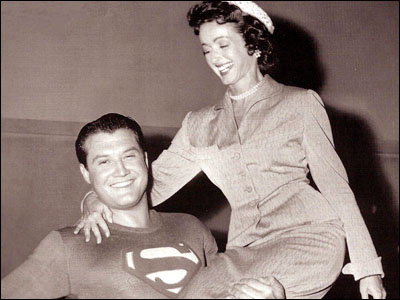
I had the honor of speaking with Noel on several occasions and interviewing her at one convention. She was delightful and very honest with the understandable restriction that she didn't want to speak ill of certain people. A lot of people came to that panel and others she did to "meet" the lady they'd loved so on television. I'm pretty sure no one was ever disappointed.
She died yesterday at her home in Tucson, Arizona at the age of 95. But as we all know, Noel Neill as Lois Lane will live on forever.
The post Noel Neill, R.I.P. appeared first on News From ME.
Open Politics
As both Labour and Tory politicians jockey for leadership in their prospective parties, it is becoming all too clear that a new political system is now struggling to be born. The traditional left-right split has for some time been overlaid with a different matrix. Partly one might call this a socially liberal vs socially conservative spectrum. David Cameron, by campaigning on issues such as gay marriage, laid claim to a socially liberal stance, and such issues were not always split on conventional party lines. More to the point there are now far wider signifiers- it case become a matter of an entire political culture.
In short the Brexit has revealed a totally different political spectrum: those who support globalization and the open society and those who oppose it. Broadly speaking, the metropolitan, young, educated remain voters are supporters, while the rural, older and less educated leave voters are not. This cultural split seems set to create still further upheaval.
The political system, as currently constituted, does not reflect this fundamental split. Jeremy Corbyn's reactionary Socialist dogma barely even recognizes the growing power of the open society, and to be honest, Theresa May is not exactly in touch with the open minded concerns of youth either.
Thus there is now an obvious opportunity to recast British politics in a more modern and responsive form. Though the Brexit crisis is only just beginning, the result may lead to some fundamental changes in the future. As Corbyn continue his stubborn resistance, it seems more and more likely that a Labour split might form the core of a new grouping- though not necessarily a particularly cohesive one.
The tedious managerialism that has been the bill of fare in the UK since the fall of Margaret Thatcher and the Berlin Wall has led nowhere.
The new politics will not rest on questions of administration but of philosophy. Those who believe in the open politics and the open society will still need to carry the unconvinced, but in the end the closed society can not deliver the prosperity that the open can.
I shall return to this debate, but the political sea change may throw up some big surprises in the coming months and years. Though Theresa May offers the comfort of a pause for breath today, by 2020 the pressure for real change may have out played her caution.
The Brexit campaign leaders- Farage, Gove, Johnson- have demonstrated both a cowardice and a dishonesty that will rightly blacken their name for the foreseeable future, Brexit may be their victory, but it is already a Pyrrhic one, and as their hollow promises are revealed for the lies they were, there will be little forgiveness for any of them.
The vindication of the Liberal Democrats has been far swifter than they hoped, albeit that it has come with such a price for the UK. However, the party can now lay claim to being in the vanguard of political change. The game's afoot.
Ex-LAB MP, Nick Palmer, looks at what the party might do

What will Labour do?
If recent weeks have taught us anything, it’s that forecasting is a mug’s game – there may be pundits here who have always been right, but I can’t think of any – certainly not me. So the wise thing for reputations is to keep your head down.
But a lot of the comments here misread how many Labour people think, which has implications for those who bet on Labour outcomes. So some thoughts, partly to complement Don’s piece a few days ago.
1) There is a fairly broad consensus within Labour on what we see as the factual position (some here won’t agree, but this is members I’m talking about).
a) It’s a mess, and we’re not exploiting Tory divisions effectively.b) Corbyn is a decent man pursuing a socialist agenda (on which more in a moment) not shared by most MPs. He’s putting up with intensive abuse with a polite equanimity that few of us would manage.c) The party is being seriously damaged by the standoff between Corbyn and the MPs. It needs to be resolved either by replacing the leader, by replacing the MPs or by reaching a broadly acceptable compromise.d) Labour’s support in these circumstances has a high floor (which is why Labour has over-performed in each by-election) and a low ceiling (which is why we’re not breaking through)
2) The serious left – of which Corbyn is a prime exponent – is about systemic change towards a society less dominated by big business and prioritising solidarity with people in difficulty. They are not interested in singling out personalities, or tactical advantage, or a comfortable life for themselves. It completely misreads Corbyn to think that making his life difficult or unpleasant will make him resign.
3) Most members are not reliably in one faction or another. To see the party as Progress vs Momentum overlooks a huge proportion of the membership who have a leaning one way or another but come to individual decisions. Factors:
a) Members want the party to stand for something they think attractive. Merely not being the Tories is insufficient if we need to be sort of Tory ourselves in order to achieve it.b) If a) is fulfilled, then members want to have the best chance of winning.c) Members intensely dislike disloyalty. YouGov showed 60-39 opposed to the mass Shadow Cabinet resignations.d) MPs are mostly respected and liked in their CLPs, but there are limits, and if the PLP is perceived as irredeemably disloyal, members will start to look at deselection (see here.) A new leadership election is seen as fair enough. Continued moaning to the Daily Mail if Corbyn is re-elected will not.
4) The majority of members will consider an alternative if it is put positively and meets the above criteria – something worth fighting for and a good chance of getting it. “Here are the five things we should aim to achieve and how I’ll lead us to doing them” will get serious attention. “Vote for me because I can get rid of Jeremy” will not.
Conclusions: Corbyn will probably not stand down, because he’s the left-winger with the best chance of winning. A challenger has a fair chance (59% wasn’t that huge a majority – it looked that way because the opposition was split 3 ways), but they need to win positively. We get that the PLP majority isn’t happy with Corbyn: there’s no need to go on about it further. But do they have someone who would be both seriously progressive and electorally appealing and who would be inclusive towards the left? If so, let’s hear from them. If not, then STFU.
Nick Palmer
Nick Palmer was MP for Broxtowe from 1997-2010
Open plan offices are basically terrible in every way.
I don't care to belong to any party that would accept me as a member
The discussion began when it turned out that my MP, who I had voted for, was one of those who had tabled a vote of no-confidence in Jeremy Corbyn, leader of the Labour Party. I said that I honestly wondered if people like me were welcome in the party. I have been quite open about have been one of the "three pound members" who registered as a supporter in order to support his leadership bid; and who became a full member of the party literally minutes after his election. An old friend, who has been an active member of the Party for many years, asked, not unreasonably: "Did you join a party, or join a person?"

[psych/anthro, Patreon] Girls Crossing the Threshold of Geekery
In my previous post, Where Geek Girls Come From, of my observation that female geek-identified people at least from my generation, had a marked tendency to have "geek origin stories" that followed the form "When I was a girl, there was a man", I allowed
Now perhaps this isn't about geekery at all. Maybe it's just that when you ask women about their pasts, they're more likely to mention influential people than are men, regardless of what the topic is. Maybe it's a female tendency – whether acquired or innate – to think in terms of people.But there's another hypothesis I'd like to explore.
In that post, I proposed that those characteristic geek girl origin stories were stories of initiation. What if that sort of initiation is more important, psychologically, developmentally, for geek girls than geek boys?
I explained: "an initiation is the inward crossing of a group's membership boundary: before you were not a member, now you are a member". What if what we're seeing has to do with crossing boundaries?
When women my age (+40/-20 yrs) were girls, our pursuing geek interests meant violating gender norms. What we did involved crossing a social boundary.
This suggests two hypotheses to me, both of which involve the issue of whether a boundary crossing is sanctioned.
Unsanctioned boundary crossings are, literally, transgressions. So maybe the function of the man in the "When I was a girl, there was a man" stories is to sanction the boundary crossing. By making the boundary crossing – a girl pursuing male-coded interests – licit, girls might be able to mentally move it from the problematic category "transgression" to "okay to do".
Consider this comment I found haunting, left by
 crinklebat, emphasis mine:
 I've always felt like a bit of a weirdo as an American-born woman in tech because I *don't* have this sort of origin story. I fell in love with computers at school and at friends' houses and begged my non-geeky parents for one until we got one. We got AOL when I was 9 and I was instantly smitten with the internet. No adult relative ever recommended I check something out; no teacher noticed me and took me under their wing. On the contrary; adults in tech almost uniformly were either indifferent to me or encouraged me to stick with poetry. My tech geekery was entirely self-taught and self-motivated until I was actually able to pursue formal computer science coursework late in high school, at which point people started throwing piles of cash at me to urge me to stick with it. I always feel when hearing or reading these sorts of stories that everyone else got an invitation to the club from someone who was already a member and I just walked in a side door and tried to look like I belonged there.So maybe this is the function of initiation, and why women geeks tell initiation stories: because when not initiated into geekdom as girls, girls feel like they don't belong.
ETA: There is a very strong urge in many of us, when confronted with a proposed gender difference, to begin speculating as to whether it is "innate" or "acquired". Let's not go there, here. I hereby declare it a derail for purposes of this post. Discussing proffered observations of how male and female humans might differ can – and indeed, for reasons of intellectual integrity, should – be discussed without diverting into the quite different topic of why such differences exist, when that very existence is still in question.
Perhaps what we are seeing, when we ask geek women about their origin stories, is the function of a suvivorship-bias filter: perhaps mostly only those geeky girls who had someone to initiate them stayed in geekery to grow into geeky women, while geekily-inclined girls who didn't get initiated generally left because they felt out-of-place, like they didn't belong.
crinklebat goes on to say later in her comment: So a less charitable reading of this phenomenon is that we tell these origin stories precisely because we still feel the need to establish that we were invited to this exclusive, male-dominated party by someone with the qualifications to discern whether we deserved the invitation.That's possible, but in my experience these stories are not told with defensiveness; these stories aren't offered unprovoked, they're generally only told if asked. It suggests to me that women don't tell these stories to establish in the present, to either themselves, their actual audience, or an imagined audience, that they do belong in geekdom out of a lingering anxiety that they don't, but rather they tell these stories to relate how they came to feel that they did belong in the first place, in the past. Further, initiation doesn't necessarily have anything to do with worthiness and judgment, nor even permission. It can be simple acknowledgement that one is a member.
So one hypothesis is that girls had a higher need for initiation into geekery than boys had – indeed boys might not need initiation at all – because there is (or was in our days) a social boundary between girls and geekery that didn't stand between boys and geekery: the social gender norms that said geekery was a male thing. Since initiation legitimizes boundary crossings and makes them non-transgressive, maybe geek women tell initiation stories because initiations helped girls cross a social boundary of gender norms that boys didn't need to cross.
Furthermore, there might be an interesting other survivorship bias. The girls of our generations who grew up to be geeky women might be those who required the least amounts of social legitimacy to emotionally tolerate the crossing of the gender norm boundary. Maybe there were other geekily-inclined girls, for whom mere initiation wasn't enough. We might be seeing the results of a filter for those women who as girls only needed one person to recognize their geekery to feel adequately comfortable to stay in male-dominated domains. It is easy to imagine there were a contrasting population of proto-geek-girls who said to themselves, "Well, even if my dad thinks I belong, everybody else in the math club at school is a guy, and I feel awkwardly different and out of place, so I just won't do that then", and noped out of geek things, even before accounting for being actively discouraged by encounters with sexism.
I know I am very unlike that, and I know that about myself because I spent a lot of my youth in all-but-for-me-male environments, and without qualm; in my day, if you need to not be the only girl in the computer lab to be in the computer lab, you weren't going to spend much time in the computer lab. I also know there weren't a lot of other girls who felt that way, because... I was the only girl in the computer lab.
The other hypothesis is that perhaps females find transgressing social norms more emotionally aversive than do males. Males certainly do more of the transgressing in our society than do females, by a very large degree, as evidenced by all the statistics ever from our criminal justice system. There's a whole range of hypotheses why that gender difference exists, proposed causes both acquired and innate. A hypothesis I'll throw out into the ring, that I've never seen discussed, is that females experience transgressing boundaries as more aversive, on average, than do males. That is, that being in violation of norms feels more bad to females, on average, than it does to men.
Thinking on
crinklebat's comment, I was suddenly reminded of a famous scene in the movie "Let the Right One In" (2008). I'm given to understand from some review I read somewhere that it was the first time someone tackled this particular detail of the vampire mythos. In this scene, the protagonist Oskar is visited by his little vampire playmate, Eli. Oskar opens the door for Eli, and stands aside to let Eli in and gestures with his head. Eli says, "You have to invite me in." Oskar replies, "What happens if I don't? What happens if you walk in anyway? Is there something in the way?" Eli doesn't answer. Oskar starts teasing Eli and beckoning Eli across the threshold. Finally Eli silently steps through the doorway and walks into the apartment. Eli stands there a moment, shuddering, and then begins to hemorrhage from the everything. "NO!" cries Oskar, aghast, "YOU CAN COME IN!"Maybe girls are like vampires? That is, maybe being in violation of gender norms – being a place or social milieu that "belongs to males", socially – is more uncomfortable, or down-right painful, and more aversive for girls than it is for boys, and girls bleed emotionally until they leave or they're told they can come in? Or maybe just more aversive than others think it should be for them? Others – whether males or adults – may be like Oskar, asking "What happens if you walk in anyway? Is there something in the way?", unwitting of the cost.
Now, I'm not saying that I think this is true; I'm saying it's an interesting hypothesis, with various circumstantial evidence to suggest it. There's also other circumstantial evidence that argues against it. It's an intriguing possibility, that is, unfortunately, all but impossible to test. This is about subjective facts, and is deep in Qualialand.
But if it is true, it raises some interesting issues and possibilities.
Most explanations for gender difference in participating voluntary activities fall into two camps. In one camp, there are arguments that attribute the difference to a proposed difference in how females relate to the activity, itself: arguments about differential ability to do the activity or differential interest in doing the activity. These arguments may be essentialist or cultural, feminist or misogynist; they cover the whole spectrum. In the other camp are arguments that attribute the difference to male opposition to female participation.
If the (or even a) cause of lower rates of female participation in an sphere of human activity traditionally male is simply that females need a rather trivial invitation to be able to enter without suffering, and they don't get it, that's an entirely new class of issue. It doesn't fall in either camp. It has nothing to do with women's aptitude or interests, or lack thereof; it has nothing to do with male opposition to women's participation. It has to do with an unmet need that happens to be gender-bound.
If, that is, this hypothesis is true, which it may not be.

This post brought to you by the 109 readers who funded my writing it – thank you all so much! You can see who they are at my Patreon page. If you're not one of them, and would be willing to chip in so I can write more things like this, please do so there.
Please leave comments on the Comment Catcher comment, instead of the main body of the post – unless you are commenting to get a copy of the post sent to you in email through the notification system, then go ahead and comment on it directly. Thanks!
Brexit: if you think Corbyn is the problem, you haven’t been paying attention
I don’t think I’ve ever been as appalled by UK politics as I am at this point. That the Leave campaign won the referendum on a pack of lies is a fact in this post-fact world that even its own leaders have implicitly acknowledged by their equivocations, downcast faces and vanishing acts. We are in the midst of undoubtedly the worst financial crisis since 2008, and the level of racist attacks appears to have skyrocketed, but the political and media class have locked themselves into Westminster to focus on their intrigues and petty rivalries. The journalists I follow on Twitter have never been more delighted by the Tory and Labour leadership crises, pigs in shit blithely ignoring the outside world as if it was an unwelcome distraction from the main event. Only Nicola Sturgeon and Tim Farron have shown a shred of political leadership since Friday. It has been gobsmacking to watch, and utterly repugnant.
While acknowledging that it is part of the problem, I don’t feel I have much to add in terms of analysis of the current state of the Conservative Party. A bunch of overgrown schoolboys have played around in politics as if it were nothing more than a game, and now appear to be waking up to the fact that the stakes were in fact very real. I don’t know how it will all play out for the simple fact that I have consistently underestimated Boris Johnson’s ability to survive from political crises of his own making. I don’t have any analysis of why this is; I’ve never understood his charms I’m willing to accept at this point that there are supernatural forces at play here and that only a beheading, stuffing the corpse with garlic and burying it at a crossroads has any chance of stopping him being elected and remaining Prime Minister for the next 50 years. I mean, he survived that Boris Bus debacle – how bad does it have to get?
On Labour, I have a little more to say. It has become painfully apparent over the referendum campaign that Jeremy Corbyn simply isn’t up to the job. He is incapable of commanding respect amongst the PLP, incapable of thinking strategically, incapable of making a good speech and incapable of seizing a political opportunity when it lands on his plate. The problem is, leaving aside the facts that a) there is no guarantee that they will end up with someone more capable, and b) the party has demonstrated it is incapable of any degree of unity for years now, I don’t think you can look at those results last Thursday and conclude that Corbyn is even Labour’s biggest problem. What we witnessed was a party that was incapable of reaching out to its own core communities outside of the major metropolitan areas scattered across England and Wales.
I’m grateful to John Harris’s reportage from around the country, showing the depth of alienation and utter contempt that people in the poorest and most deprived communities across the country have for Westminster politics. What we saw on Thursday, was those people flicking Westminster a massive V-sign. Yes, a minority have fallen for the Brexiteers’ lies and even turned to outright racism. But for the most part, it appears to have been as prosaic as the fact that if large swathes of the country aren’t seeing the (very real, very significant) economic benefits that the UK enjoys from immigration, free movement of people and its membership of EU, they are likely to see very little downside to voting to get rid of it all. They’re wrong, and I guarantee they will come to regret it as the economy tanks and Westminster opts to force them to bear the brunt, but I can understand the feeling all to well.
That it has come to this ought to be a wake up call. To his credit, it seems pretty clear to me that Jeremy Corbyn understands this, and understands that without a significant and meaningful redistribution of wealth the mood in those communities is only going to turn uglier. But it is equally clear that a significant number of Labour MPs don’t and see the solution lying purely in triangulation. It is plain to see that for an awful lot of Labour politicians, the solution lies now in adopting a string of anti-immigration and anti-free movement policies regardless of the bad economic case – just as long as they don’t look as punitive and nasty as UKIP. We’re in the scary situation right now where it is becoming apparent that the Tories are now busily building the case for a Norwegian-style relationship with the EU – where we accept free movement, the imposition of EU regulation and pay roughly the same as we do now but get none of the democratic rights we’ve taken for granted – while what noises we have coming from Labour is that free movement is unacceptable to them. With UKIP now a very real threat in their heartlands, the triangulators are prepared to make the Tories look like wishy-washy liberals when it comes to immigration – presumably in the full knowledge that this will only encourage UKIP and the Tories to push even further to the right.
Triangulation is not a new thing – when it comes to economic policy, it’s got us in a lot of the mess that we now find ourselves after all. But when it comes to immigration, it takes on an all new terrifying dynamic. We’ve already seen that a scary number of racist individuals and groups have seen the referendum result as a starting gun for a campaign of terror and intimidation (again, to be clear, I’m not saying all Leave voters are racist – just that all racists are Leave voters who now believe 52% of the country agrees with them). Imagine how bad that will get if we start seeing the sort of Dutch auction on immigration policy being proposed belligerently by the likes of John Mann and in more velvet tones by the likes of Tom Watson.
And of course, it almost goes without saying that it is simply not the case that this is an automatic vote winner. The SNP haven’t hoovered up Labour support in Scotland by adopting an anti-immigrant position – quite the opposite. Where people do see the economic benefits of immigration, anti-immigrant sentiment is way down. It wasn’t Jeremy Corbyn who persuaded Islington, one of the most deprived boroughs in the country, to support Remain by 75%; it was the daily experience of living in an area with high immigration.
If Jeremy Corbyn had spent the last two months going around the country calling for England’s more deprived communities to better reap the economic benefits of the EU and immigration than they do at present (which to be fair to him he did say, sotto voce), then there’s at least a chance he could have turned it around. But it wasn’t just him. It certainly wasn’t a position being championed by Labour In – dominated as it was by centrists in the party. And while Jeremy Corbyn voluntarily gave up his opportunity to share platforms with David Cameron and use it to press him on this matter, it was the position of all the candidates who stood in last year’s Labour leadership election to adopt the same self-defeating no-platform policy.
I’ve been talking about Labour, but to be frank, this is the Lib Dems’ failing as well. While they don’t have the same platform in deprived northern communities that Labour enjoys, they too should have made this case. And if Tim Farron’s welcome stance to stand in the next election on a position of remaining a member of the EU is to reach out beyond the party’s metropolitan base, he too needs to be making the case for redistribution of wealth. This policy will prove a mistake if it ultimately amounts to little more than a plea for business as usual; the City has to be made aware that there is a price that it needs to pay.
Where do we go now? I have no idea. The whole situation is a bloody mess and while I’m sceptical that the markets can wait as long as Labour and the Tories want to get their acts together, we at least have a period during which the rest of us can allow the referendum result to sink in. I don’t think the United Kingdom is going to survive this. I wouldn’t especially begrudge Scotland for leaving us, and the only thing stopping me from saying the same about Northern Ireland is the fear of what might happen if the unionist communities there feel they are being abandoned to their fate. My hope is that the political system of what country remains will be able to crawl out of the quagmire that it is in now, but I’m very scared that the situation is going to get much worse, and much more violent, before we finally turn a corner.
The post Brexit: if you think Corbyn is the problem, you haven’t been paying attention appeared first on Quaequam Blog!.
The Physics of Hope.
Okay, one more before I pack. Since it came out in NF a long time ago:
I never liked physics much.
I’m not just talking about the math. I don’t like what modern physics tells us: that time is an illusion, for one thing. That we live in a reality where everything that ever was, and ever will be, always is: static timelines embedded in a “block universe” like threads in amber. I may remember scratching my head before writing this sentence, but that’s just one frozen slice of me with a bunch of frozen memories. An instant further along is another slice at t+1, with memories incrementally more advanced, and because it remembers the past it believes that it is moving through time. But in reality— seen from some higher-dimensioned overhead perspective— we exist on a tabletop where nothing changes, nothing moves, nothing goes away.
I hate that vision. My gut rebels at the grim counterintuitive determinism of it. But I’m no physicist, and we all know how misleading gut feelings can be. I don’t like it, but what do I know? I know nothing.
You can’t say that about Lee Smolin. Eminent theoretical physicist, co-Founder of the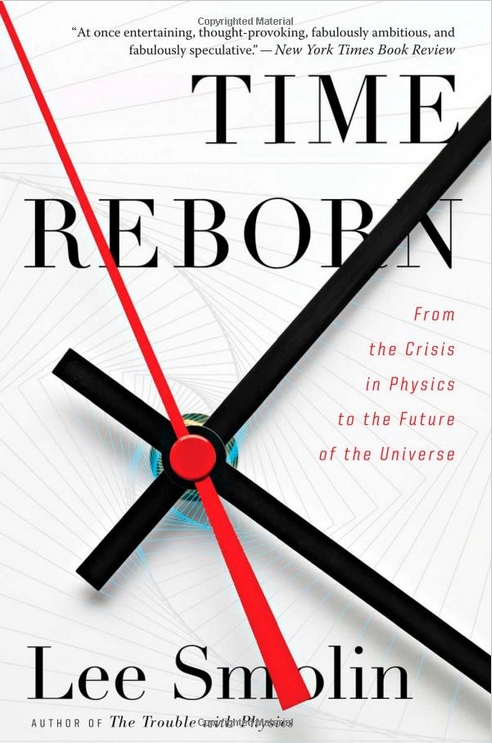 world-renowned Perimeter Institute, author of the 2013 book Time Reborn. I’ve just read it. It gives me hope. It says my gut was right all along. We do exist from one moment to the next. This flow we perceive is no illusion. Time is real.
It’s space that’s bullshit.
Imagine the universe as a lattice of nodes; the only way to get from one place to another is to hop along the nodes between, like stepping-stones in a stream. The more dimensions the lattice has, the shorter the number of hops required to get between two points: Smolin invokes the analogy of a cell-phone network, which puts you just one step away from billions of “nearest neighbors”.
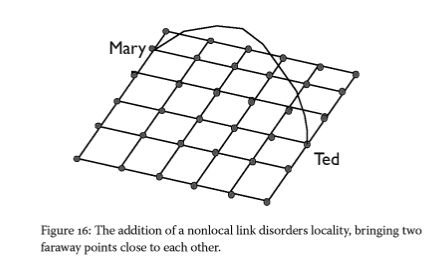
Well, sure, if this is how you represent a “higher dimension, then of course the cell phone collapses space…
It takes energy to keep those higher dimensions active, though. In the early, hot universe— right after the Big Bang— there was energy to spare; dimensions were abundant and everything was one cell-phone-hop away from everything else. “Space” didn’t really exist back then. As the universe cooled, those higher dimensions collapsed; the cell network shut down, flattening reality into a low-energy mode where only those few locations adjacent in three dimensions could be considered “nearest”. Now, to get anywhere else, you have to hop a myriad low-dimensional nodes. You have to cross “space”.
The point is, space is not a fundamental property of reality; it only emerged in the wake of that energy-starved collapse. This is the story Smolin is selling: There is no time-space continuum. There is only time.
Physics is wrong.
According to Time Reborn, physics went astray at two points. The first was when it started confusing maps with the territories they described. Most physics equations are time-symmetric; they work as well backwards as forwards. They are timeless, these rules that do such a good job of describing our observations of reality; so, physicists thought, maybe reality is timeless too. When we first started drawing graphs of motion and mass on paper— each moment a fixed point along some static axis— we were being lulled into a Block-Universe mindset.
Smolin describes the second wrong turn as “the Cosmological Fallacy”: an unwarranted extrapolation of the local to the universal. Physics studies systems in isolation; you’re not going to factor in the gravitational influences of the Virgo Supercluster when you’re calculating the trajectory of a bowling bowl, for example. You ignore trivial variables, you impose boundaries by necessity. You put physics in a box and leave certain universals— the laws of nature, for example— outside. Those laws reach into the box and work their magic, but you don’t have to explain them; they just are.
Physics works really well in boxes. The problem arises when you extrapolate those boxy insights to the whole universe. There is no “outside” when you’re talking about all of existence, no other realm from which the timeless laws of nature can reach in and do their thing. Suddenly you’ve got to explain all that stuff that could be taken as axiomatic before. So you start fiddling around with branes and superstrings; you invoke an infinite number of parallel universes to increase the statistical odds that some of them would turn out the way ours did. If Smolin’s right, a lot of modern physics is an attempt to reimpose an outside on a universe that doesn’t have one. And because we’re trying to apply locally-derived insights onto a totality where they don’t apply, our models break.
Smolin’s alternative sits so much easier in the gut— and, at the same time, seems even more radical. Everything affects everything else, he says; and that includes the laws of physics themselves. They are not timeless or immutable: they are affected by the rest of the universe, just as the universe is affected by them.
They evolve, he says, over time.
Everyone agrees that reality was in flux during the first moments after the Big Bang: universal laws and constants could have taken entirely different values than they did when the universe finally congealed into its present configuration. The strong and weak nuclear forces could have taken different values; the Gravitational Constant could have turned out negative instead of positive. Smolin suggests natural laws are still not set in stone, even now; rather, they result from a sort of ongoing plebiscite. How the universe reacts to X+Y comes down to a roll of the dice, weighted by past experience. Correlations, initially random, strengthen over time; if X+Y rolled mostly snake-eyes in the past it’ll be increasingly likely to do so in the future.
Now we’re 15 billion years into the game. Those precedents have grown so weighty, the correlations so strong, that we mistake them for laws; when we see X+Y, we never observe any result but snake-eyes. Different outcomes are possible, though—just very, very unlikely. (Think of the Infinite Improbability Drive from Hitchhiker’s Guide to the Galaxy, transmuting a missile into a sperm whale or a bowl of petunias.)
So much becomes possible, if this is true. Smolin’s concept of “Cosmological Natural Selection” for one, in which Darwinian processes apply to the universe at large— in which black holes, egg-like, spawn whole new realities, each governed by a different physics (those which maximize black-hole production outcompete those which don’t). Another mind-blowing implication is that if the universe were to encounter some combination of quantum events that had never happened before, it wouldn’t know what to do: it would have to roll the dice without any precedent weighting the outcome. (Something to keep in mind, now that we’re starting to play around with quantum computing in a big way.)
We may even find our way to ftl, if I’m reading this right. After all, the lightspeed limit only applies to our impoverished four-dimensional spacetime. If you pumped up the energy in a given volume enough to reactivate all those dormant cell-phone dimensions, wouldn’t space just collapse again? Wouldn’t every node suddenly get closer to every other?
Of course, all this hypothesizing leaves open the question of how the universe “remembers” what has gone before, and how it “guesses” what to do next. But is that any less absurd than a universe in which a cat is both dead and alive until something looks at it? A universe governed by timeless laws so astronomically unlikely that you have to invoke an infinite number of undetectable parallel universes just to boost the odds in your favor?
At least Smolin’s theory is testable, which makes it more scientific than this multiverse that everyone else seems so invested in. Smolin and his allies seek to do to Einstein what Einstein did to Newton: expose the current model as a local approximation, good enough for most purposes but not truly descriptive of the deeper reality.

…but this is how I envision going from 2D to 3, and I don’t see how that extra layer gets Mary and Ted any closer…
And yet I’m not entirely convinced. Even with my poor grasp of physics (or more likely, because of it), aspects of this new worldview seem a bit off to me. Smolin openly derides multiverse models— but then, where then do the black-hole-spawned “baby universes” of Cosmological Selection end up? And while I can easily imagine two points, three nodes apart, on a 2D lattice, I don’t see how adding a third dimension brings them any closer together (although it certainly opens up access to a whole bunch of new nodes). Also, if the laws of nature are affected by the objects and processes they affect in turn, wouldn’t that feedback follow certain rules? Wouldn’t those rules bring determinism back into play, albeit with a couple of extra complications thrown in?
These are most likely naive criticisms. Doubtless Smolin could answer them easily; I’m probably just pushing his metaphors beyond their load-bearing limits. But perhaps the most important reason that I’m not convinced is because I so very dearly want to be. Current physics leaves no room for free will, no room even for the passage of time. Every moment we experience, every decision we think we make, is a lie. It’s not just that nothing happens the way we perceive it; in the block universe nothing happens, period.
Who wouldn’t reject such a reality, given half a chance? Who wouldn’t prefer an uncertain future in which we make our own decisions and influence our own destinies? What I wouldn’t give to live in such a world. Smolin offers it up on a platter. And because it is so tempting, I must counter my desire with an extra dose of skepticism.
Then again, the most basic tenet of empiricism is that any of us could be wrong about anything. “No amount of experimentation can ever prove me right,” Einstein once said. “A single experiment can prove me wrong.”
Maybe, before too long, Smolin will get his single experiment.
Stay tuned.