
FCC Commissioner Mignon Clyburn (who's in charge of overseeing the proposed Comcast/Time Warner merger) is receiving an award, for which Comcast and Time Warner Cable are "presenting sponsors," paying $110K and $22K respectively.
Read the rest
Shared posts
13 Aug 23:29

Comcast, Time Warner make huge "donations" to party honoring their FCC overseer
by Cory Doctorow
08 Aug 14:25

elodieunderglass: gimmeagoodcoldbeer: ronin134: revengeofthemu...
This three-legged decorated war hero had one leg lost to surgery after taking four rounds from an AK-47.
Bad. Mother. Fucker.
Those eyes say “Pretend to throw the tennis ball. I dare you to only pretend.”I think those eyes say a lot more than that. He’s seen more than I ever will, done more than I’ll ever do, and his war will never be over.
He’s got Ranger scrolls on his collar. That dog is a god damn hero.I just noticed the Purple Heart and that Scroll.
Wow. Just wow.
The picture alone, in all it’s detail says a lot of things. god damn.I can’t not reblog this dog… his you
Eyes say so muchI’ve never seen a dog with such a face like that. Like an old man who went to war and if you ask him about he just stiffens up and face turns to stone.
Layka is a lady dog. Let’s remember that.
Now, it’s an understandable problem - our socialization instantly encourages us to see this rugged, sleek, military animal as a male. Three-legged hero dog with military decorations and stern-appearing eyes? TOTALLY A DUDE DOG, JUST LOOK AT HIM. It’s a programmed response, and nothing to be ashamed of - let’s just be accurate and note that Layka’s a female.
I’ve highlighted all the reblogs above where Layka is described as a hero, an old man, with male pronouns - rather than the fierce, charming heroine she is. It’s kind of a teachable moment: how does an image of an animal, displaying absolutely no secondary sex characteristics, instantly give us these fictional headcanons about its gender and gender performance? It’s an impressive demonstration of our ability to translate body language.
The photographer who took this compelling shot noted that Layka’s playful, bouncy energy made it nearly impossible for him to get a shot with her mouth closed! He ended up having to stop using the tennis ball he was using to get her attention, because it made her too excited and smiley. Based on the photos below, I think she’d have quite a sense of humor about the “where’s the tennis ball?” game!
Of course, the photographer did end up connecting with a fundamental aspect of Layka’s nature in the cover photo; her serious, soldier side. But that’s not all the animal is. Does the dog in the unused shots still resemble an “old man?” Is the dog in the unused shots male or female? Is it still a hero with its tongue out? Is it still admirable without a “face like stone?”
This is what I mean when I say that we have to examine the lenses of culture and society that we are always, always looking through when we talk about science biology.

07 Aug 19:05
T-Mobile Smartphones Outlast Competitors' Identical Models
by timothy
An anonymous reader writes Laptop Mag battery tested the leading phones on all four major U.S. carriers and found that the same models on T-Mobile typically last 1 to 3 hours longer on a charge. This trend is not new, but has continued for over 3 years of testing. The article says While we don’t know for certain why T-Mobile phones last longer on a charge, there are some strong possibilities. T-Mobile’s network could be more efficient at sending and receiving data because of the bands it uses, or maybe there are far fewer customers on its LTE network, easing the strain. Another possibility is that T-Mobile tends to pre-load less bloatware on its flagship devices relative to the other carriers. AT&T is firmly in second place in the battery life findings presented, with Verizon and Sprint jockeying for last of the four carriers measured. It woud be interesting to see a similar test battery for phones in marginal reception areas; searching for service seems to deplete my battery faster than talking does. 


Read more of this story at Slashdot.
Matt Skouras, firehose and one other like this
07 Aug 18:39
Anti-Vaxxers Couldn’t Stop This Student Documentary About Vaccination, but They Sure Tried - It's like a vaccine against ignorance.
by Dan Van Winkle

A group of students at Carlsbad High School in California wanted to make a documentary about the risks of under-vaccination and became a target for the anti-vaccination movement, who insisted they were being coerced into making propaganda. After years of work and pushback from opponents, the film has finally been released.
The controversy started in 2012, when a local paper ran a story about the 16 teens in the school’s award-winning chstvFILMS film and journalism program. Their film, The Invisible Threat, was not yet even finished, but anti-vaccination activists quickly became convinced that the students were going to portray the issue in an unduly lopsided fashion.
As we’ve discussed in the past, there’s nothing unduly lopsided about accurately portraying scientific consensus. Seriously. The real distortion would be making both sides seem equal. Still, the team behind the film did their homework, so to speak, and made a point to research both sides as they approached the issue.
According to the students themselves, the goal of the film was to really get to the bottom of the debate. They thought the original suggestion for the documentary from local Rotary Club volunteers, which was to simply detail how the immune system and vaccines work, was too boring. Instead, they made an effort to dig into arguments for and against vaccination, and what they found even changed some of their minds.
After reading studies, talking to experts, interviewing parents, and trying to give both sides a fair shake, they found that the controversy was manufactured from nothing. As student Allison DeGour told the LA Times, “It was all social controversy. There was no science controversy.”
Still, their project was almost shut down by their advisors. And protestors attended a screening, which caused another screening on-campus at the high school to be canceled. The students didn’t like feeling as though they were being pushed around, and they succeeded in keeping it alive. You can watch the trailer below, rent the documentary for $5 online, and make donations to keep the CHSTV program running.
The trailer looks really great, and the medical community seems as impressed as we are. Dr. Paul Offit, Chief of the Division of Infectious Diseases at the Children’s Hospital of Philadelphia, said simply: “One of the best films made on this subject. It’s wonderful!”
(via io9, image via The Invisible Threat)
Previously in disease research
- The CDC found smallpox that the FDA just left lying around
- Science was working on a meth vaccine that would make Heisenberg unhappy
- The Australian Health Council has some issues with homeopathy
Are you following The Mary Sue on Twitter, Facebook, Tumblr, Pinterest, & Google +?
05 Aug 18:50

Charting culture, showing birthplaces and deaths for over 120,000 people
The team used those data to create a movie that starts in 600 bc and ends in 2012. Each person's..(Read...)
01 Aug 14:42
There can be little doubt that VUPEN turned out these vulnerabilities to whatever intelligence/law enforcement agency would have them during the last three years. Informing Microsoft of this flaw at the point of discovery just isn't a great way to make money. IE users were left unprotected against anyone who wished to exploit the same hole the security contractor had slapped a price tag on.
VUPEN's spin on this bug hoard/$300,000 windfall conveniently leaves out the fact that it sat on these exploits for extended periods of time.
But that's not even the most disingenuous part of VUPEN's pitches. This is:

If you can't read the text, it says:
Permalink | Comments | Email This Story


French Company That Sells Exploits To The NSA Sat On An Internet Explorer Vulnerability For Three Years
by Tim Cushing
Thanks to Snowden's leaks and a host of other information proceeding those, it's become clear that intelligence agencies -- despite their constant and loud "worrying" about cyberattacks -- are more than happy to make computers and the Internet itself less safe by purchasing, discovering and hoarding vulnerabilities. These are exploited to their fullest before being reported to the entities that can patch the holes. In the meantime, the NSA and others make use of security holes and vulnerabilities, leaving millions of members of the public exposed.
It may just be arrogance. Maybe these intelligence agencies believe they're the only ones with this access and, because they're ostensibly the "good guys," any collateral damage caused by unpatched vulnerabilities is acceptable. The other option is worse: they just don't care. Their "higher calling" -- the fight against terrorists and hackers -- is more important than the security of computer users around the world.
VUPEN, a French company that sells exploits to the NSA (as well as intelligence and law enforcement agencies around the world) recently capitalized on an Internet Explorer vulnerability it's been sitting on for over three years.
Security outlet VUPEN has revealed it held onto a critical Internet Explorer vulnerability for three years before disclosing it at the March Pwn2Own hacker competition.For three years, VUPEN held onto this, allowing the exploit of four straight Internet Explorer versions. IE may be losing its grasp on home users, but governments around the world still tend to opt for Microsoft's browser (along with its suite of productivity products). VUPEN finally notified Microsoft of this vulnerability en route to collecting $300,000 for this and other exploits its been hoarding. (Additional products affected include other widely-used programs like Adobe Flash and Adobe Reader.)
The company wrote in a disclosure last week it discovered the vulnerability (CVE-2014-2777) on 12 February 2011 which was patched by Microsoft on 17 June (MS14-035).
The flaw affected Internet Explorer browsers eight through eleven and allowed remote attackers to bypass the protected mode sandbox.
There can be little doubt that VUPEN turned out these vulnerabilities to whatever intelligence/law enforcement agency would have them during the last three years. Informing Microsoft of this flaw at the point of discovery just isn't a great way to make money. IE users were left unprotected against anyone who wished to exploit the same hole the security contractor had slapped a price tag on.
VUPEN's spin on this bug hoard/$300,000 windfall conveniently leaves out the fact that it sat on these exploits for extended periods of time.
In March 2014, VUPEN has once again won the 1st place at the Pwn2Own 2014 security competition by creating and showing zero-day exploits for Google Chrome, Internet Explorer 11, Adobe Reader XI, Adobe Flash, and Mozilla Firefox. The exploits have fully bypassed all Windows 8.1 security protections and exploit mitigation in place, and all sandboxes. VUPEN has reported all the discovered zero-day vulnerabilities to the affected vendors to allow them fix the flaws and protect users from attacks.The word "creating" implies it discovered these holes during the conference and immediately turned them over to the vendors. While it's true that the vendors can now "fix the flaws," the latter half of that sentence ("protect users from attacks") is only true going forward. There's no telling how many attacks occurred over the past months and years while VUPEN hawked its vulnerability stash.
But that's not even the most disingenuous part of VUPEN's pitches. This is:
If you can't read the text, it says:
Do not wait 6 to 9 months for vendor patches to protect your infrastructures and assets from critical vulnerabilities.So, VUPEN will "protect" your private company from exploits it knows about but won't pass on to vendors until it's managed to sell enough protection plans. Your company wouldn't need to "wait 6 to 9 months" for vendors to patch products if VUPEN and others would turn these over to them sooner. But that's not part of the business plan. There's nothing wrong with a company trying to make money, but hoarding exploits and selling protection against them seems to run very close to extortion. It's like selling home security while running a gang of thieves on the side.
Permalink | Comments | Email This Story
22 May 14:49
Bill Would End Door-Slot Mail Delivery For 15 Million Addresses, Save USPS $2 Billion Annually
by Ashlee Kieler
A bill that would phase out door-to-door mail delivery over the next decade passed its first hurdle on the way to becoming a law.


The House Oversight and Government Reform Committee approved H.R. 4670 Wednesday. Supporters of the legislation say it could save the U.S. Postal Service nearly $2 billion annually by ending traditional mail delivery in favor of centralized delivery locations, the Associated Press reports.
While many new addresses already have centralized delivery, the proposal would require USPS to convert 15 million addresses from door-slot delivery to curbside cluster boxes over the next decade.
Rep. Darrell Issa, who sponsored the bill, said that less than 1% of all addresses would undergo the change annually and the new method would offer a safe, locked location for packages.
There would be exceptions to the new service, though. People with disabilities who have difficulty leaving their homes could get waivers to continue traditional delivery. And consumers who would rather continue delivery to their doors could pay for the service.
Still, the proposal lacks the support of many legislators who believe it would cause undo stress for consumers and wouldn’t work in all areas of the country, such as urban settings where there is little room on sidewalks for the large communal mailboxes.
Although the proposal could save billions of dollars for USPS, it likely wouldn’t be enough to solve all of the service’s financial problems. In the first three months of 2014 alone the postal service has reportedly lost $1.9 billion.
There have been several attempts to make over the postal service to be a more profitable venture. Earlier this year, Sen. Elizabeth Warren voiced her support for a proposal that would allow the USPS to use its infrastructure to extend basic banking needs, including debit cards and small-dollar loans, to consumes who are ignored by the banking industry.
A white paper issued by the Postal Service Office of the Inspector General suggested that USPS could make $9 billion annually by partnering with banks to offer the service.
Committee OKs end to door-slot mail for millions [Associated Press]
16 May 18:45

The Idaho governor's race is very entertaining
by Xeni Jardin
The race for governor in Idaho is full of highly entertaining characters. My favorite is Walt Bayes, aka Apocalypse Santa, who said in his opening statement during the recent debates that he has "77 descendants" and is running on a platform of Apocalypse Awareness and opposition to abortion.
Christian and -1 others like this
09 May 19:16
Appeals Court Doesn't Understand The Difference Between Software And An API; Declares APIs Copyrightable
by Mike Masnick
We sort of expected this to happen after the appeals court for the Federal Circuit (CAFC) held its oral arguments back in December, but CAFC has now spit at basic common sense and has declared that you can copyright an API. As we noted, back when Judge William Alsup (who learned to code Java to better understand the issues in the case) ruled that APIs were not subject to copyright protection, his ruling was somewhat unique in that it was clearly directed as much at an appeals court panel who would be hearing the appeal as it was at the parties. Alsup rightly suspected that the judges on the appeal wouldn't actually understand the issues as well as he did, and tried to break it down clearly for them. Unfortunately, the three judge CAFC panel did not pay attention. The ruling is so bad that legal scholars are suggesting that it may be as bad as the horrific ruling in the Garcia case.
It's tragic that this case ended up before the CAFC. It shouldn't be there. It should be before the 9th Circuit (who issued the Garcia ruling, so it's not like they're particularly good either...), but because this case started out as a patent lawsuit, even if the patent stuff went away early, the appeals went to CAFC. CAFC is already famous for its maximalist bent on patents, and so it's perhaps not too surprising that it takes a similar view towards copyright. Or, as law professor James Grimmelmann astutely notes: "Is there any body of IP law that the Federal Circuit hasn't done its best/worst to screw up?" The answer, James, may be publicity rights. But, give them a chance and we'll see what it can do there too...
As for the ruling itself... well... it's bad. The court seems to not understand what an API is, confusing it with software functionality. It also appears to misread Judge Alsup's ruling, thinking that he's mistakenly using a fair use analysis to determine whether or not something is copyrightable. But that was not the basis of Judge Alsup's ruling. He very specifically noted that the "command structure is a system or method of operation under Section 102(b) of the Copyright Act and, therefore, cannot be copyrighted." The CAFC panel doesn't seem to understand this at all. In case you're not readily up on your Section 102 knowledge, it covers what is copyrightable subject matter, and (b) is pretty explicit:
The original ruling pointed to the ruling in Lotus v. Borland, which found that pull down menus in an app weren't copyrightable. But here, the CAFC rejects this (in part) by saying that a big difference is that the "source code" wasn't copied. But in that case, the menu structure and names were copied -- which is basically the same thing that was copied from the Java API. But the CAFC judges don't even seem to realize that.
It seems fairly clear that the CAFC judges don't understand the difference between an API and software. And thus they make a decision that makes no sense. There is no distinction recognized when it comes to the functionality of an API and how it's entirely different than the purpose of the software itself. This is especially clear towards the end, in which the CAFC ruling misrepresents some discussions on whether certain functionality is best protected by patents or copyright. But the problem is that they misinterpret statements people are making about APIs, thinking that those statements were made about software as a whole. This is just a flat-out fundamental misunderstanding of what an API is, assuming that it's just software. Take the following example:
This is a disaster all around. Of course, it's not over yet. Google can (and likely will) seek a review of this ruling, either en banc or by petitioning the Supreme Court. And even if that doesn't happen, the CAFC ruling tosses it back down to the district court for an entirely new battle about whether or not -- if the API is covered by copyright -- Google's use was fair use. So, there are still a few more years (and many more millions) to be thrown at this before there's any real conclusion. In the meantime, CAFC has mucked up another form of intellectual property law through a basic (and near total) misunderstanding of technology.
Permalink | Comments | Email This Story


It's tragic that this case ended up before the CAFC. It shouldn't be there. It should be before the 9th Circuit (who issued the Garcia ruling, so it's not like they're particularly good either...), but because this case started out as a patent lawsuit, even if the patent stuff went away early, the appeals went to CAFC. CAFC is already famous for its maximalist bent on patents, and so it's perhaps not too surprising that it takes a similar view towards copyright. Or, as law professor James Grimmelmann astutely notes: "Is there any body of IP law that the Federal Circuit hasn't done its best/worst to screw up?" The answer, James, may be publicity rights. But, give them a chance and we'll see what it can do there too...
As for the ruling itself... well... it's bad. The court seems to not understand what an API is, confusing it with software functionality. It also appears to misread Judge Alsup's ruling, thinking that he's mistakenly using a fair use analysis to determine whether or not something is copyrightable. But that was not the basis of Judge Alsup's ruling. He very specifically noted that the "command structure is a system or method of operation under Section 102(b) of the Copyright Act and, therefore, cannot be copyrighted." The CAFC panel doesn't seem to understand this at all. In case you're not readily up on your Section 102 knowledge, it covers what is copyrightable subject matter, and (b) is pretty explicit:
In no case does copyright protection for an original work of authorship extend to any idea, procedure, process, system, method of operation, concept, principle, or discovery, regardless of the form in which it is described, explained, illustrated, or embodied in such work.Got that? Well, CAFC doesn't seem to get it. At all. They basically seem to think that because the API is "big" it must therefore be copyrightable as a "literary work" even though -- as Alsup rightly pointed out -- it's nothing more than a "system or method of operation" which 102(b) clearly states is uncopyrightable. And yet, CAFC spends many pages arguing how an API is not unlike a "literary work", ignoring its intent and purpose. CAFC argues that the various names that Sun/Oracle used for naming things in the API are subject to copyright because they're "creative." Yet, as Grimmelmann against notes, if that's the case, Brian Kernighan should sue Oracle for its "copying" of his creative choices in "int," "short," "long", "float", "double", and "char."
The original ruling pointed to the ruling in Lotus v. Borland, which found that pull down menus in an app weren't copyrightable. But here, the CAFC rejects this (in part) by saying that a big difference is that the "source code" wasn't copied. But in that case, the menu structure and names were copied -- which is basically the same thing that was copied from the Java API. But the CAFC judges don't even seem to realize that.
It seems fairly clear that the CAFC judges don't understand the difference between an API and software. And thus they make a decision that makes no sense. There is no distinction recognized when it comes to the functionality of an API and how it's entirely different than the purpose of the software itself. This is especially clear towards the end, in which the CAFC ruling misrepresents some discussions on whether certain functionality is best protected by patents or copyright. But the problem is that they misinterpret statements people are making about APIs, thinking that those statements were made about software as a whole. This is just a flat-out fundamental misunderstanding of what an API is, assuming that it's just software. Take the following example:
Many of Google's arguments, and those of some amici, appear premised on the belief that copyright is not the correct legal ground upon which to protect intellectual property rights to software programs; they opine that patent protection for such programs, with its insistence on non-obviousness, and shorter terms of protection, might be more applicable, and sufficient.But that's not true. No one is arguing that patents are more suitable overall for software. In fact, many in the software field have long argued the exact opposite. What they're saying is that copyright is inappropriate for APIs -- but the CAFC judges don't seem to be able to distinguish between APIs and software. In fact, they're so confused that they throw a bogus parenthetical "software" before "interfaces" in quoting Google:
Google argues that "[a]fter Sega, developers could no longer hope to protect [software] interfaces by copyright . . . Sega signaled that the only reliable means for protecting the functional requirements for achieving interoperability was by patenting them."Note that "[software]" thrown in before interfaces? Google is talking about whether APIs -- "application programming interfaces" -- are copyrightable. Not whether or not software is copyrightable. And yet the CAFC doesn't even seem to realize this. Ridiculously, CAFC then uses its own misunderstanding and misquote, and points to some of the (many) arguments where people argue that patents are inappropriate for software to dismiss Google's argument about APIs. It honestly doesn't realize that it's comparing two totally different things. What lots of people agree on: software shouldn't be patentable and APIs shouldn't be copyrightable, but software can be copyrightable and API functionality may be patentable. But by confusing APIs and software, CAFC totally misreads both arguments.
This is a disaster all around. Of course, it's not over yet. Google can (and likely will) seek a review of this ruling, either en banc or by petitioning the Supreme Court. And even if that doesn't happen, the CAFC ruling tosses it back down to the district court for an entirely new battle about whether or not -- if the API is covered by copyright -- Google's use was fair use. So, there are still a few more years (and many more millions) to be thrown at this before there's any real conclusion. In the meantime, CAFC has mucked up another form of intellectual property law through a basic (and near total) misunderstanding of technology.
Permalink | Comments | Email This Story
01 May 19:34

Permalink | Comments | Email This Story


The Supreme Court's Real Technology Problem: It Thinks Carrying 2 Phones Means You're A Drug Dealer
by Parker Higgins
I spent a lot of the last week shaking my head at the commentary on the Supreme Court and its (lack of) technical expertise. Much of the criticism came in response to the oral arguments in Aereo, and broke down in two areas: it either misunderstood the nature of Supreme Court oral arguments and their transcripts, or mistook familiarity with a handful of Silicon Valley products with actual tech savviness.
But in a series of cases this week about law enforcement searches of cell phones, we caught a glimpse of the Supreme Court’s real technology problem. Here's what it comes down to: it's not essential that the Court knows specifics about how technology itself works—and as Timothy Lee argues, that might even tempt them to make technology-based decisions that don't generalize well. However, it is essential that the Court understands how people use technology, especially in areas where they're trying to elaborate a standard of what expectations are "reasonable."
So when Chief Justice Roberts suggests that a person carrying two cell phones might reasonably be suspected of dealing drugs, that raises major red flags. Not because of any special facts about how cell phones work, but because (for example) at least half of the lawyers in the Supreme Court Bar brought two cell phones with them to the courthouse that day. Should those attorneys (along with the many, many other people who carry multiple devices) reasonably expect less privacy because the Chief Justice is out of touch with that fact?
Contrast that with Justice Kagan’s point about storage location in the same argument. Justice Kagan suggested, correctly, that people don’t always know what is stored on their device and what is stored “in the cloud.” The actual answer to that question should be immaterial; the point is that it’s absurd for a person’s privacy interest to hinge on which hard drive private data is stored on.1 Instead, the important fact here, which Justice Kagan recognizes, is that the distinction between local and cloud storage just doesn’t matter to many people, and so it can’t be the basis of a reasonable-expectation-of-privacy test.
If you’re feeling less generous, you might take Justice Kagan’s point as evidence that she herself doesn’t know where her files are stored. And in fact, that’s probably true—but it’s not important. You don’t actually need to know much about file systems and remote storage to know that it’s a bad idea for the law to treat it differently.
That’s not to say that technical implementation details are never relevant. Relevant details, though, should (and almost always do) get addressed in the briefs, long before the oral argument takes place. They don’t usually read like software manuals, either: they’re often rich with analogies to help explain not just how the tech works, but what body of law should apply.
What can’t really be explained in a brief, though, is a community’s relationship with a technology. You can get at parts of it, citing authorities like surveys and expert witnesses, but a real feeling for what people expect from their software and devices is something that has to be observed. If the nine justices on the Supreme Court can’t bring that knowledge to the arguments, the public suffers greatly. Again, Justice Kagan seems to recognize this fact when she says of cell phones:
They're computers. They have as much computing capacity as laptops did five years ago. And everybody under a certain age, let’s say under 40, has everything on them.
Justice Kagan is not under 40, and might not have everything stored on a phone (or on an online service accessible through her phone). But that quote shows me that she at least knows where other people’s expectations are different. Chief Justice Roberts’s questions show me exactly the opposite.
The justices live an unusual and sheltered life: they have no concerns about job security, and spend much of their time grappling with abstract questions that have profound effects on this country’s law. But if they fail to recognize where their assumptions about society and technology break from the norm—or indeed, where they are making assumptions in the first place—we’re all in trouble.
Reposted from ParkerHiggins.net.
- That speaks to a need to revisit the sort-of ridiculous third-party doctrine, which Justice Sotomayor has suggested, but one battle at a time.
Permalink | Comments | Email This Story
18 Apr 14:21


Common Replies From Programmers When Their Code Doesn’t Work
by David Ponce
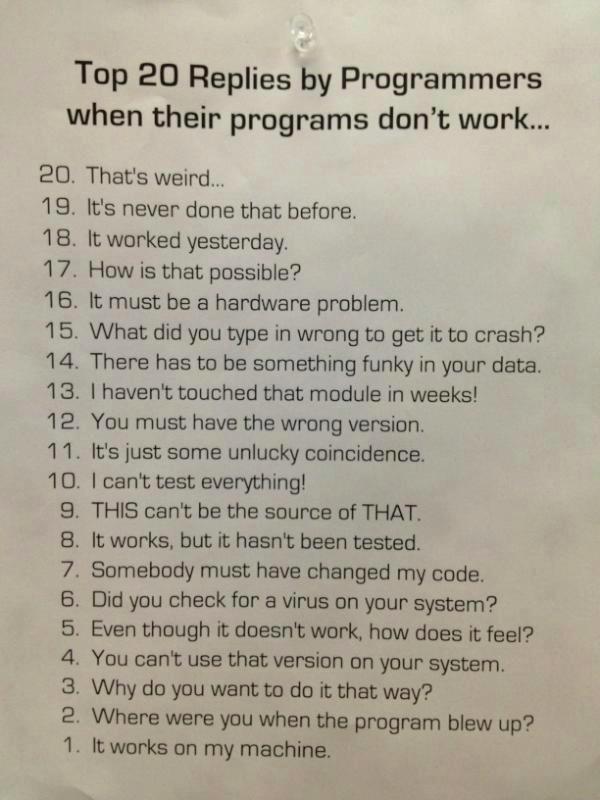
Programmers in the audience… how true is this?
VIA [ GeeksAreSexy ]
The post Common Replies From Programmers When Their Code Doesn’t Work appeared first on OhGizmo!.
11 Apr 15:40
As the bill points out, it was suggested by the Secretary of Commerce in 1999 that the NTIS would eventually outlive its usefulness. According to the GAO's 2012 findings, that sell-by date was reached more than a decade ago.
It's not often you get the chance to watch an extraneous government agency be put down and even rarer still under a snarky, incisive, short title. This is for the best. As we've seen all too frequently, time marches on, swiftly distancing itself from the glacial pace of government innovation.
Permalink | Comments | Email This Story


Sen. Coburn Offers To Put An Outdated Agency Out Of Its Misery With His 'Let Me Google That For You' Bill
by Tim Cushing
No entity highlights the ridiculous amount of bureaucratic inefficiency and ineptitude of government agencies better than the Government Accountability Office (GAO). Its reports are loaded with the sort of damning evidence that would lead those unfamiliar with how government actually works to assume that heads will be rolling. In reality, the agencies investigated by the GAO soldier on from scathing report to scathing report with little to no sign of improvement.
Tom Coburn, a long-time combatant of government waste and fraud who publishes a yearly report exposing the worst of worst in terms of senseless government spending (the "Wastebook") is now using the GAO's own words to craft a bill targeting the money pit that is the National Technical Information Service (NTIS).
Here's the leadup:
(3) NTIS is tasked with collecting and distributing government-funded scientific, technical, engineering, and business-related information and reports.And here's the punchline:
(4) GAO found that NTIS sold only 8 percent of the 2,500,000 reports in its collection between 1995 and 2000.
(5) A November 2012 GAO review of NTIS made the following conclusions:
(A) 'Of the reports added to NTIS's repository during fiscal years 1990 through 2011, GAO estimates that approximately 74 percent were readily available from other public sources.'
(B) 'These reports were often available either from the issuing organization's website, the Federal Internet portal (http://www.USA.gov) or from another source located through a web search.'
(C) 'The source that most often had the report [GAO] was searching for was another website located through http://www.Google.com.'
(D) '95 percent of the reports available from sources other than NTIS were available free of charge.'
(6) No Federal agency should use taxpayer dollars to purchase a report from the National Technical Information Service that is available through the Internet for free.
SECTION 1. SHORT TITLE.Someone had fun cranking out this "Short Title."
This Act may be cited as the 'Let Me Google That For You Act.'
As the bill points out, it was suggested by the Secretary of Commerce in 1999 that the NTIS would eventually outlive its usefulness. According to the GAO's 2012 findings, that sell-by date was reached more than a decade ago.
NTIS product expenditures exceeded revenues for 10 out of the past 11 fiscal years.The "Let Me Google That For You" Act calls for the repeal of the 1988 National Technical Information Act and the disbandment of the agency itself, with the redistribution of whichever of its duties are still deemed essential to the Commerce Department.
It's not often you get the chance to watch an extraneous government agency be put down and even rarer still under a snarky, incisive, short title. This is for the best. As we've seen all too frequently, time marches on, swiftly distancing itself from the glacial pace of government innovation.
Permalink | Comments | Email This Story
10 Apr 20:05
Shameful Security: StartCom Charges People To Revoke SSL Certs Vulnerable To Heartbleed
by Mike Masnick
Yesterday, we wrote about just how terrible the Heartbleed bug in OpenSSL is. It's been generating plenty of discussion, with folks like Bruce Schneier calling it "catastrophic" and saying that "on the scale of 1 to 10, this is an 11." It's a pretty big deal. So you'd think that everyone would be scrambling to help plug the vulnerability as painlessly as possible. And most companies have been doing that. But one -- StartCom -- apparently sees this as an opportunity to rake in cash and to screw over those most vulnerable.
StartCom is a free SSL Cert authority, and on the company's website, it claims it offers this service for free "because we believe in the right to protect and secure information between two entities without discrimination of race, origin and financial capabilities." Except, that's not quite how things are playing out in reality. As is being actively discussed over at HackerNews and via the StartSSL Twitter fee, the company is trying to charge people to revoke the vulnerable certs. Update: And, yes, they're even charging those who are on their premium paid service tiers as well -- and often charging exorbitant rates.
While the company has generally charged for revoking certs, many people pointed out that with a vulnerability of this magnitude, that's both ridiculous and dangerous. However, the company doesn't seem to care. Yes, this is part of StartCom's business model. Free certs, pay to revoke (Update: but that doesn't explain why they're doing this for paying customers too...). But this is clearly a case where that model should be suspended to keep the internet safe. The amount of ill-will this move is generating is pretty clear. Furthermore, it highlights what a bullshit claim it is that its goal is to better protect communications. If that were true, it would allow emergency revocations for an issue like Heartbleed.
Permalink | Comments | Email This Story


StartCom is a free SSL Cert authority, and on the company's website, it claims it offers this service for free "because we believe in the right to protect and secure information between two entities without discrimination of race, origin and financial capabilities." Except, that's not quite how things are playing out in reality. As is being actively discussed over at HackerNews and via the StartSSL Twitter fee, the company is trying to charge people to revoke the vulnerable certs. Update: And, yes, they're even charging those who are on their premium paid service tiers as well -- and often charging exorbitant rates.
While the company has generally charged for revoking certs, many people pointed out that with a vulnerability of this magnitude, that's both ridiculous and dangerous. However, the company doesn't seem to care.
It's upon the subscriber to take appropriate action since the certificate authority can't enforce which software to use. The terms of service and related fees will not change due to that.When it was pointed out to the company how serious a vulnerability issue the company started to get snotty with its own uses:
We do understand the situation very well, thanks.... This is not our fault as well. We do not see any reason to provide this paid service for free. We have enough other free services already if you didn't mentioned it.People began challenging the company on Twitter, and it's taken that same snotty "we don't give a fuck" attitude to them as well:
Yes, this is part of StartCom's business model. Free certs, pay to revoke (Update: but that doesn't explain why they're doing this for paying customers too...). But this is clearly a case where that model should be suspended to keep the internet safe. The amount of ill-will this move is generating is pretty clear. Furthermore, it highlights what a bullshit claim it is that its goal is to better protect communications. If that were true, it would allow emergency revocations for an issue like Heartbleed.Permalink | Comments | Email This Story
10 Apr 18:58
Dianne Feinstein: Emotions Didn't Motivate The CIA Torture Report; Michael Hayden's Coverup Did
by Mike Masnick
Senator Dianne Feinstein has finally responded to former CIA and NSA boss Michael Hayden's misogynistic and ridiculous claims that the Senate Intelligence Committee's 6,300 page, $40 million research report into the CIA torture program (run, in part, while Hayden was boss) was motivated by her "emotions" rather than by an objective position. Hayden has also called out the staffers working on the report as sissies (though he'll claim he was just saying the Senate Select Committee on Intelligence's acronym -- SSCI). She brushes off the whole "emotional" claim by noting quickly that's Hayden being "stereotypical" and "incorrect" and saying such a thing is "an old male fallback position."
However, as Marcy Wheeler points out, rather than spending her time addressing silly ad hominem attacks, Feinstein scores a lot more points in basically pointing out that the real motivation for the report was Hayden's own lies to Congress: What she notes is that the real inspiration for the report came after it was revealed to the Senate that a CIA staffer had ignored direct requests from Congress, the White House and others in the CIA and destroyed tapes showing the CIA torturing people. The destruction of the tapes was then hidden from Congress for some time as well. When it finally came to light, Hayden (then director of the CIA) told the Senate that it could review various cables and documents, which were "just as good" as the tapes. In looking into that claim from Hayden that the documents were just as useful as the deleted tapes, that the Senate decided to move forward on a full investigation. In other words, it wasn't emotions that motivated Feinstein, it was Hayden's lies to the Senate.
Permalink | Comments | Email This Story


However, as Marcy Wheeler points out, rather than spending her time addressing silly ad hominem attacks, Feinstein scores a lot more points in basically pointing out that the real motivation for the report was Hayden's own lies to Congress: What she notes is that the real inspiration for the report came after it was revealed to the Senate that a CIA staffer had ignored direct requests from Congress, the White House and others in the CIA and destroyed tapes showing the CIA torturing people. The destruction of the tapes was then hidden from Congress for some time as well. When it finally came to light, Hayden (then director of the CIA) told the Senate that it could review various cables and documents, which were "just as good" as the tapes. In looking into that claim from Hayden that the documents were just as useful as the deleted tapes, that the Senate decided to move forward on a full investigation. In other words, it wasn't emotions that motivated Feinstein, it was Hayden's lies to the Senate.
Let me give you how this began. It began in 12/6/07 when the NY Times reported that the CIA destroyed evidence -- namely videotapes. In December, the 11th, Director Hayden appeared before our Committee and said he would allow members and/or staff to review operational cables which he said were just as good. Jay Rockefeller was then the chairman of the Committee. He, on the 7th of February of '08, assigned staff. On February 27th, the staff presented an interim report to the Committee on the destruction of the tapes. The Committee agreed to do a full review of the tapes. On March 5, 2009, the Committee voted 14-1 to do a comprehensive review of the detention and interrogation [program].As Wheeler notes: Michael Hayden has only himself to blame for this report. If he hadn't lied and tried to downplay the destruction of evidence of the CIA's torture program, perhaps there would be no torture report at all. No wonder he's so "emotional" and attacking everyone about it.
Let's have the record crystal clear. I never gave any direction to the staff. I just said 'we want the facts -- and we want those facts footnoted.' The one place I did give some direction, was with respect to the CIA response to the report. I said, 'you will include their response, where appropriate, within the text of the report, and where not appropriate, you will note the response in a footnote to the report.' And that has been carried on.
.... I don't believe Director Hayden has seen the report. I don't believe most people talking about it have actually seen the report. But the genesis of the report was back with the videotapes and back under then Chairman Rockefeller, who assigned staff, staff studied the operational cables, came back, reported to us, we took a look at that and said -- both sides -- we should move ahead and do a full study.
Permalink | Comments | Email This Story
04 Apr 17:10
Everything Old Is Unavailable Again: How Copyright Has Ebooks Operating In The 1800s
by Timothy Geigner
Nothing sucks more than a great new technology with old-world thinking attached to it. Such has been the case with ebooks, unfortunately, with antiquated views on DRM, pricing, and storefront protectionism resulting in pissed off customers and libraries hollering from the nearest rooftop. What we're left with is a platform that could do much to spread knowledge and the practice of reading among entire populations being stifled by those that still think the world should operate based on analog philosophies.
Reader zip writes in about a nice write up detailing how cyclical this has made reading, with protectionist policies regarding ebooks cutting the benefit of the technology right out from underneath it.
But it gets more stupid. This doesn't simply apply to fictional entertainment, but to true knowledge platforms as well, and the willingness to be wasteful is astounding.
So, who's fault is it? The answer is the combination of governments unwilling to consider change and, of course, publishers. Most egregious are the academic publishers.
Permalink | Comments | Email This Story


Reader zip writes in about a nice write up detailing how cyclical this has made reading, with protectionist policies regarding ebooks cutting the benefit of the technology right out from underneath it.
Today, the situation has come full circle. If a student in Freiburg wants to read the hard-copy version of a book from the university library in Basel, he or she can simply order it via an interlibrary loan. But if only an electronic version is available, interlibrary loans are generally not an option. The student has no choice but to climb into a train and head to Switzerland to read the book on a university computer.If that doesn't strike you as absurd, you're likely missing some significant sections of your brain. The very benefit the entire digital experience has brought most other marketplaces and forms of communication and learning in the past thirty years is being blocked by a trumped-up policy born out of fear. Just think about that for a moment: the same book I can get on loan from a far-off library is unavailable to me in ebook format, even though the transfer of that ebook is easier, cheaper, and quicker. That, friends, is the dumbest thing I've ever heard.
It is a paradox: Books that traveled around the world via interlibrary loan in the 20th century paper era are safeguarded locally in the Internet age. Indeed, it is the sheer ease with which electronic publications can be sent around the world that is now resulting in their being locked up behind digital bars. The book doesn't go to the reader, the reader comes to the book -- just like in the 19th century.
But it gets more stupid. This doesn't simply apply to fictional entertainment, but to true knowledge platforms as well, and the willingness to be wasteful is astounding.
The issue is the core of the knowledge economy: essays, articles and books from researchers. "We have thousands of e-books that we could make available to our users via the Internet," says Harald Müller, head librarian at the Max Planck Institute for Comparative Public Law and International Law in Heidelberg. "Be we often aren't allowed to because licenses are so restrictive."In other words, everyone ends up in the exact same place they would if ebook lending was opened up, except it's slower, less efficient, costlier, and requires physical resources that nobody is actually interested in using. This is the epitome of inefficiency, and it's the answer to whether or not the originators of copyright law would support this kind of application: no they damn well wouldn't. Imagine Thomas Jefferson being showed how copyright was being used to limit knowledge and that imagining had better end with Jefferson punching everyone involved.
Copyright laws often lead to "delightful absurdities," says Müller. If, for example, he wants to read an essay from an American library via interlibrary loan, "they will print it out on paper and send it over by fax -- and I will then scan it into our computers here." Sending it as an email attachement is forbidden.
So, who's fault is it? The answer is the combination of governments unwilling to consider change and, of course, publishers. Most egregious are the academic publishers.
In many cases, it is the readers themselves who, through their taxes, pay the university authors whose studies they are then unable to access. It is also likely that many professors themselves cannot even afford a subscription to the journal in which their work is published. Subscription rates of up to €15,000 ($20,633) per year are hardly a rarity. The Journal of Comparative Neurology, for example, comes with a price tag of more than €20,000 annually. Authors who publish their works in such a journal usually don't see a single cent for their labors. Publishing companies such as Reed Elsevier, by contrast, regularly achieve pre-tax profit margins of over 25 percent.And the suppression of knowledge is the result of all this protectionist nonsense. When we've reached the point where the researchers aren't being paid and the public can't access their papers, things need to change.
"Publishers of scientific journals make so much money because they collect their product for free from taxpayers and then sell it back at inflated prices," says Günter M. Ziegler, a distinguished mathematician at Berlin's Free University.
Permalink | Comments | Email This Story
03 Apr 19:12

Gorgeous Macro Photographs of Butterfly and Moth Wings by Linden Gledhill
by Christopher Jobson


A biochemist by training, photographer Linden Gledhill is fascinated by the beauty of infinitesimally small aspects of nature and science, from capturing the flight of insects to exploring the beauty of magnetic ferrofluid. Among his most jaw-dropping images are macro photographs of butterfly wings that reveal complex patterns that look like perfectly organized flower petals. These tiny protrusions are actually scales, similar to what you would find on reptile, though extremely small and fragile. Gledhill’s photography recently inspired an episode of Smarter Every Day where Destin Sandlin learns how to shoot similar photos. (via awkwardsituationist.tumblr.com)
mtaczak likes this
03 Apr 17:14


Stop-and-frisk as the most visible element of deep, violent official American racism
by Cory Doctorow
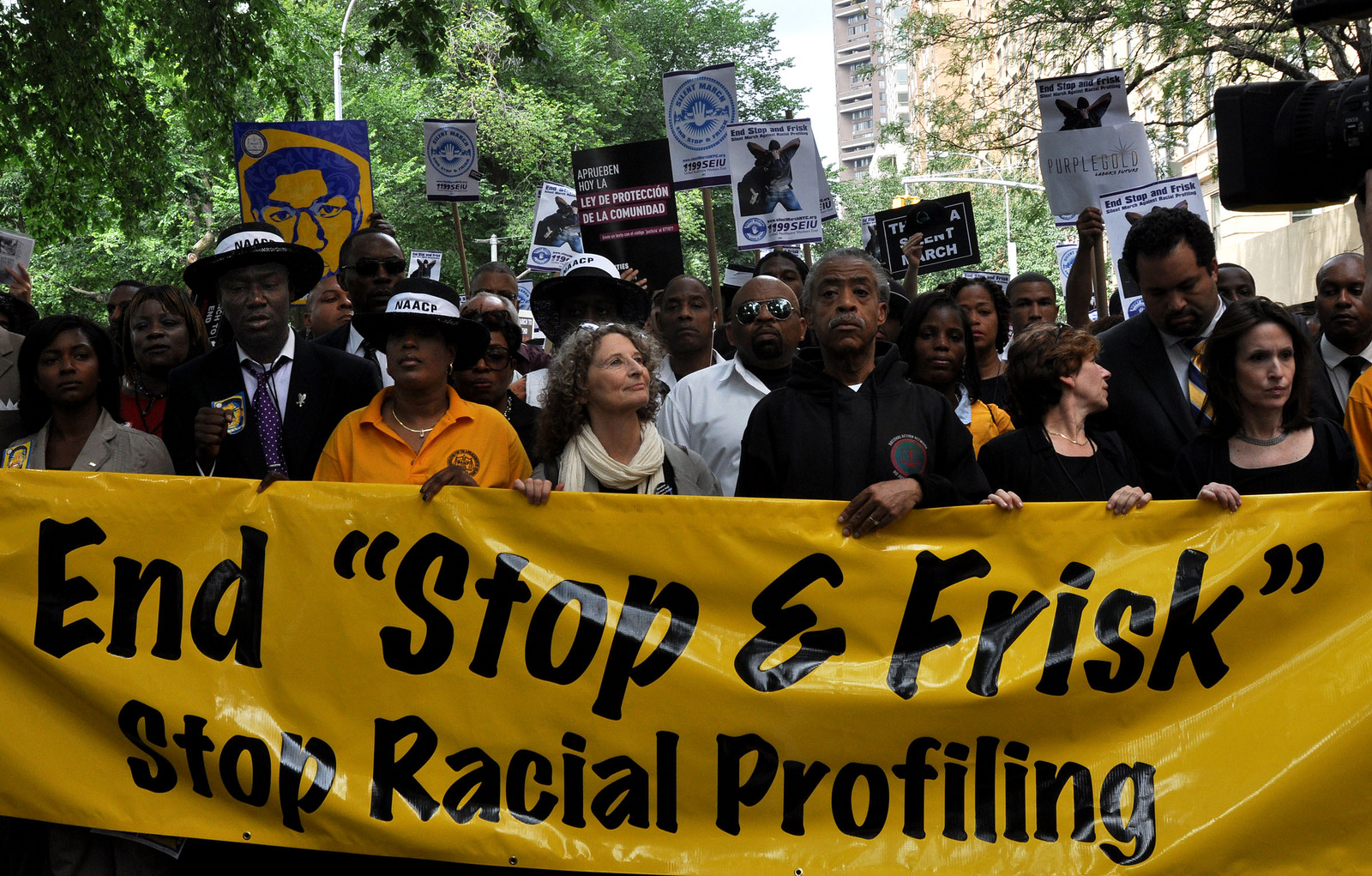
Christopher E Smith is the white father of a black, biracial son, and it is through his son's experience of being black in America that he has learned just how pervasive and humiliating and violent officialdom is to black Americans, a fact embodied perfectly through New York City's notorious, racist stop-and-frisk program. Smith describes how his son, interning on Wall Street, has been repeatedly stopped by police, once made to lie face down on the filthy sidewalk in his best suit while police went through his pockets (former NYC mayor Michael Bloomberg was a staunch supporter of this program). He describes the experience of his black in-laws, who are stopped by police-cars en route to family gatherings, who have guns aimed at their heads, and who are then released with a shrug and a nonsensical excuse. He describes how driving over the US/Canadian border with his son is totally different from driving on his own, and how the customs guards routinely stop the two of them, and make them wait out of sight of their car while it is searched.
As an aside, I've experienced this myself. I've driven across the US/Canadian border literally dozens of times and the only time I was stopped was when I gave Nalo Hopkinson and David Findlay -- who happen to be black -- a ride to a Clarion reunion at Michigan State University. At both border crossings, the car was searched from top to bottom, with officers taking out books and shaking the pages to look for contraband. It's never happened since. The only difference between that drive and all the others was that there were some brown-skinned people in evidence.
Smith proposes a thought experiment in which stop-and-frisk searches were mandatorily applied in keeping with overall demographics, so for every three black people that the NYPD pull over and humiliate without warrant or suspicion or probable cause, they would have to do the same to ten white people -- and suggests that this would end the program of stop-and-frisk in a heartbeat.
I think he's right.
Proponents of stop-and-frisk often suggest that the hardships suffered by young men of color might be tolerable if officers were trained to be polite rather than aggressive and authoritarian. We need to remember, however, that we are talking about imposing an additional burden on a demographic that already experiences a set of alienating “taxes” not shared by the rest of society.
I can tell myriad stories about the ways my son is treated with suspicion and negative presumptions in nearly every arena of his life. I can describe the terrorized look on his face when, as a 7-year-old trying to learn how to ride a bicycle on the sidewalk in front of our suburban house, he was followed at 2-miles-per-hour from a few feet away by a police patrol car—a car that sped away when I came out of the front door to see what was going on. I can tell stories of teachers, coaches, and employers who have forced my son to overcome a presumption that he will cause behavior problems or that he lacks intellectual capability. I can tell you about U.S. Customs officials inexplicably ordering both of us to exit our vehicle and enter a building at the Canadian border crossing so that a team of officers could search our car without our watching—an event that never occurs when I am driving back from Canada by myself.
If I hadn’t witnessed all this so closely, I never would have fully recognized the extent of the indignities African-American boys and men face. Moreover, as indicated by research recently published in the American Journal of Preventive Medicine, the cumulative physical toll this treatment takes on African-American men can accelerate the aging process and cause early death. Thus, no “special tax” on this population can be understood without recognizing that it does not exist as a small, isolated element in people’s lives.
What I Learned About Stop-and-Frisk From Watching My Black Son [Christopher E. Smith/The Atlantic]
(Image: stopfrisk_june17_DSC_1073, Michael Fleshman, CC-BY)
    
|
Luke.stirling, Benjaminsavage and -1 others like this
03 Apr 15:15

The Expert (Short Comedy Sketch)
"Funny business meeting illustrating how hard it is for an engineer to fit into the corporate..(Read...)
Pavel likes this
02 Apr 19:29
 It turns out that those rumors of Microsoft cutting Windows prices to spur adoption were true -- and then some. The company has announced that Windows will be free for hardware makers to use on phones, tablets with screens under nine inches and...
Windows will be free on phones, small tablets and the Internet of Things
by Jon Fingas
It turns out that those rumors of Microsoft cutting Windows prices to spur adoption were true -- and then some. The company has announced that Windows will be free for hardware makers to use on phones, tablets with screens under nine inches and...
Ross.campbell likes this
02 Apr 19:29
Federal Revenge Porn Bill Will Look To Criminalize Websites
by Mike Masnick
My own representative in Congress, Jackie Speier, has apparently decided to introduce a federal "revenge porn" bill, which is being drafted, in part, by Prof. Mary Anne Franks, who has flat out admitted that her goal is to undermine Section 230 protections for websites (protecting them from liability of actions by third parties) to make them liable for others' actions. Now, I've never written about Franks before, but the last time I linked to a story about her in a different post, she went ballistic on Twitter, attacking me in all sorts of misleading ways. So, let me just be very clear about this. Here's what she has said:
Now, her retort to all of this is likely that she's not seeking to undermine Section 230 in any way. Rather, she's attempting to do something of an end-run around it. Section 230 has never protected sites from liability of federal crimes -- just civil infractions and state crimes. So her goal is to make the amorphous concept of "revenge porn" a "federal crime" thereby suddenly making third-party websites liable. She will argue that does nothing to undermine Section 230. A more reasoned and thoughtful look at the issue, however, shows how this effort is fraught with dangerous consequences and potential First Amendment problems.
Taking a step back, though, let's be clear: revenge porn -- the practice of posting naked pictures of someone (who likely took those photos for an individual or themselves, rather than the public) along with that person's identifying information -- is odious. Those who are involved in the practice are morally repugnant individuals. And yet, what we've seen is that there do appear to be ways to deal with them. One of the most well-known creators of revenge porn, Hunter Moore, was recently arrested on charges that he conspired with another person to hack into email accounts to get more photos. Often, those engaged in revenge porn are also engaged in extortion over those images or other crimes on which they can be charged. Some revenge porn sites have been hit with lawsuits for copyright infringement -- though that creates a whole different set of problems.
Meanwhile, amazing folks like Adam Steinbaugh have been diligently tracking down and exposing the details of people who operate revenge porn sites, which can sometimes be an effective (if slightly ironic) way to get them to go away. But that's an example where more speech is often a better result than censoring speech by increasing liability.
Still, you can see why there's a temptation to create a new anti-revenge porn statute. The whole concept of revenge porn is itself repugnant, so it's tempting (especially as a lawmaker) to pull out that old hammer and create some regulations. But the dangers of regulating based on reacting to the odiousness of those sites may obscure the way such laws will inevitably -- as Prof. Franks herself admits -- impact companies that are clearly not engaged in revenge porn.
In the article about the legislation, EFF's Matt Zimmerman (who, actually, just left EFF) points out that using criminal law here is "dangerous" because it would likely lead lots of companies to reflexively delete all sorts of content, including plenty of perfectly legal and legitimate content, to avoid the sort of liability Franks describes. And that's the huge problem here. By spreading liability, you guarantee over-censorship. It's easy for people who are narrowly focused on a single issue to not recognize the wider impact that issue may have. Trying to accurately describe what "revenge porn" is for the sake of criminalizing its posting, will almost certainly have chilling effects on third parties and undermine the very intent of the CDA's Section 230.
People who don't think through the details seem to assume that it must be easy to define what is "revenge porn," but the deeper you go, the more difficult it becomes to define -- and the more risks there are of both over-criminalizing and creating serious First Amendment issues. For example, you could say that sites should be forced to take down photos of individuals where those individuals insist that the photos are problematic. But then you'd have to deal with situations, like with Ranaan Katz, where he went after a blogger and Google (using civil copyright law) for posting an "unflattering" photo. Do we really want to bring criminal law into that arena?
And the First Amendment issue is not easy to get around. At all. As lawyer Mark Bennett discussed in trying to create a First Amendment-compliant anti-revenge-porn statute, it's not an easy challenge:
Instead of following Franks down that dangerous road, it would be wise to focus on ways to use existing laws to go after those who are clearly engaged in related questionable behaviors. Changing the laws to put the burden on third parties is only going to create significant new problems. I'm disappointed that my own Representative in Congress, Jackie Speier, appears to not realize this, and I will be contacting her office to express my concerns about the bill.
Permalink | Comments | Email This Story


"The impact [of a federal law] for victims would be immediate," Franks said. "If it became a federal criminal law that you can't engage in this type of behavior, potentially Google, any website, Verizon, any of these entities might have to face liability for violations."That makes it clear her intent is to undermine Section 230 and make third parties -- like "Google, any website, Verizon... face liability."
Now, her retort to all of this is likely that she's not seeking to undermine Section 230 in any way. Rather, she's attempting to do something of an end-run around it. Section 230 has never protected sites from liability of federal crimes -- just civil infractions and state crimes. So her goal is to make the amorphous concept of "revenge porn" a "federal crime" thereby suddenly making third-party websites liable. She will argue that does nothing to undermine Section 230. A more reasoned and thoughtful look at the issue, however, shows how this effort is fraught with dangerous consequences and potential First Amendment problems.
Taking a step back, though, let's be clear: revenge porn -- the practice of posting naked pictures of someone (who likely took those photos for an individual or themselves, rather than the public) along with that person's identifying information -- is odious. Those who are involved in the practice are morally repugnant individuals. And yet, what we've seen is that there do appear to be ways to deal with them. One of the most well-known creators of revenge porn, Hunter Moore, was recently arrested on charges that he conspired with another person to hack into email accounts to get more photos. Often, those engaged in revenge porn are also engaged in extortion over those images or other crimes on which they can be charged. Some revenge porn sites have been hit with lawsuits for copyright infringement -- though that creates a whole different set of problems.
Meanwhile, amazing folks like Adam Steinbaugh have been diligently tracking down and exposing the details of people who operate revenge porn sites, which can sometimes be an effective (if slightly ironic) way to get them to go away. But that's an example where more speech is often a better result than censoring speech by increasing liability.
Still, you can see why there's a temptation to create a new anti-revenge porn statute. The whole concept of revenge porn is itself repugnant, so it's tempting (especially as a lawmaker) to pull out that old hammer and create some regulations. But the dangers of regulating based on reacting to the odiousness of those sites may obscure the way such laws will inevitably -- as Prof. Franks herself admits -- impact companies that are clearly not engaged in revenge porn.
In the article about the legislation, EFF's Matt Zimmerman (who, actually, just left EFF) points out that using criminal law here is "dangerous" because it would likely lead lots of companies to reflexively delete all sorts of content, including plenty of perfectly legal and legitimate content, to avoid the sort of liability Franks describes. And that's the huge problem here. By spreading liability, you guarantee over-censorship. It's easy for people who are narrowly focused on a single issue to not recognize the wider impact that issue may have. Trying to accurately describe what "revenge porn" is for the sake of criminalizing its posting, will almost certainly have chilling effects on third parties and undermine the very intent of the CDA's Section 230.
People who don't think through the details seem to assume that it must be easy to define what is "revenge porn," but the deeper you go, the more difficult it becomes to define -- and the more risks there are of both over-criminalizing and creating serious First Amendment issues. For example, you could say that sites should be forced to take down photos of individuals where those individuals insist that the photos are problematic. But then you'd have to deal with situations, like with Ranaan Katz, where he went after a blogger and Google (using civil copyright law) for posting an "unflattering" photo. Do we really want to bring criminal law into that arena?
And the First Amendment issue is not easy to get around. At all. As lawyer Mark Bennett discussed in trying to create a First Amendment-compliant anti-revenge-porn statute, it's not an easy challenge:
The First Amendment problem we face is that “posting nude or explicit images of former lovers online” is speech; a statute focused on such posting is a content-based regulation of speech; content-based regulations of speech are presumed to be invalid (that is, speech is presumed to be protected); and the Supreme Court in U.S. v. Stevens expressly rejected a balancing test for content-based criminal laws, instead applying a categorical test.At best, Bennett tries, as an exercise, to see if it would be possible to extend obscenity laws to cover "revenge porn," but that would massively expand obscenity laws, again in potentially dangerous ways. The problem here is that pretty much everyone agrees that revenge porn is a really horrible thing -- but any attempt to criminalize it will have serious implications way beyond the targeted issue.
Instead of following Franks down that dangerous road, it would be wise to focus on ways to use existing laws to go after those who are clearly engaged in related questionable behaviors. Changing the laws to put the burden on third parties is only going to create significant new problems. I'm disappointed that my own Representative in Congress, Jackie Speier, appears to not realize this, and I will be contacting her office to express my concerns about the bill.
Permalink | Comments | Email This Story
|
|
02 Apr 19:02
Hacked Prius powered by electric bus system's overhead lines
by David Pescovitz
UPDATE: Looks like this was probably an April Fools joke! Bummer, great idea anyway!


San Francisco's MUNI system operates electric buses that draw power from overhead wires. A fellow named Jon has brilliantly hacked his Prius with a trolley pole to sip power from the same overhead lines. Sierra Hartman has the story over at The Bold Italic. (Thanks, Marina Gorbis!)
|
|
01 Apr 16:28


Playground removes "safety" rules; fun, development and injuries ensue
by Cory Doctorow

The Swanson School in Auckland, NZ, quietly eliminated all the rules against "unsafe play," allowing kids to play swordfight with sticks, ride scooters, and climb trees. It started when the playground structures were torn down to make way for new ones, and the school principal, Bruce McLachlan, noticed that kids were building their own structures out of the construction rubble. The "unsafe" playground has resulted in some injuries, including at least one broken arm, but the parents are very supportive of the initiative. In particular, the parents of the kid with the broken arm made a point of visiting the principal to ask him not to change the playground just because their kid got hurt.
The article in the Canadian National Post notes that Kiwis are less litigious, by and large, than Americans, and that they enjoy an excellent national health service, and says that these two factors are a large contributor to the realpolitik that makes the playground possible. But this is still rather daring by Kiwi standards.
He didn’t start asking “why” until he became part of a playground and risk study by Auckland University researcher Grant Schofield and his research manager, Julia McPhee, three years ago. The researchers gave 16 schools a grant of $15,000 to build their vision of a playground that would reintroduce risk and help encourage physical activity in children.
“It hadn’t occurred to me that anyone would actually abandon all school rules,” Prof. Schofield said.
Mr. McLachlan built a few play structures, but they were dismantled as part of a larger building project (he claims they’ll be resurrected somehow once the project is done). As the debris sat cordoned off with caution tape in the middle of the schoolyard, he noticed students ducking underneath, grabbing chunks of wood and metal and building their own toys.
While the caretaker and some teachers worried, Mr. McLachlan was energized to see them building makeshift seasaws and dismantling them once they got bored.
About a year ago, Mr. McLachlan quietly informed his staff that they would all just stop saying “No” when they saw a child climbing a tree or a fence, or walking toward an area that used to be “out of bounds” and no longer was. There would be no big announcement, just a silent backing away.
When one New Zealand school tossed its playground rules and let students risk injury, the results were surprising [Sarah Boesveld/National Post]
(via Hacker News) 
|
|
25 Mar 17:58
 The U.S. Supreme Court is hearing arguments today in a case that could have a far-reaching impact on businesses whose owners’ religious beliefs may run counter to the medical needs of their employees, as craft store chain Hobby Lobby and a Pennsylvania cabinet-making business each challenge the Affordable Care Act’s mandate that employers provide health insurance that includes coverage for contraception.

Supreme Court Hearing Arguments On Hobby Lobby’s Challenge To Contraception Mandate
by Chris Morran

(afagen)
The law does provide exemptions for certain businesses owned by religious groups, but the personal religious beliefs of the owners of for-profit corporations are not a consideration, leading some owners to claim their statutory rights are being violated.
At the heart of the challengers’ argument is the 1993 Religious Freedom Restoration Act, which states that “Government shall not substantially burden a person’s exercise of religion even if the burden results from a rule of general applicability, except… if it demonstrates that application of the burden to the person is in furtherance of a compelling governmental interest; and is the least restrictive means of furthering that compelling governmental interest.”
According to the challengers in the case before the Supremes today, the Affordable Care Act requires them “to do precisely what their religion forbids them or face draconian consequences — including millions in fines, private lawsuits and government enforcement actions.”
However, the Obama administration counters that this legislation was meant to protect individuals and not the owners of corporations. Furthermore, contends the White House, the contraception mandate places no personal burden on business owners, as they are not the insurer and it is the employees’ choice as to whether they use that coverage. After all, just because one’s health insurance covers contraception, it does not require the insured to obtain or use contraception.
In the Hobby Lobby case, a federal appeals court agreed with the business owners, citing the Supreme Court’s controversial ruling in the Citizens United case, which found that corporations have the same political speech rights as individuals.
The second case, involving Pennsylvania-based Conestoga Wood Specialties, went the other way when it went before a federal appeals panel. In that case, the appeals court ruled that the business, owned by a Mennonite family, was obliged to obtain the coverage as set out in the Affordable Care Act. This appeals court also criticized the ruling in the Hobby Lobby case, saying that decision was made without any grounding in existing case law.
“Even if we were to disregard the lack of historical recognition of the right, we simply cannot understand how a for-profit, secular corporation — apart from its owners — can exercise religion,” wrote a judge in the Conestoga appeals court ruling.
The Supremes’ ruling on this matter will come later in the year.
At Supreme Court today: Health-law cases mix questions of religious freedom, worker rights [Washington Post]
14 Mar 18:39

Only A Third Of Bank ATMs Using Windows XP Have Upgraded Ahead Of April 8 Deadline
by Mary Beth Quirk

Banks all over the world have known since 2007 that Microsoft would stop support for ATMs running Windows XP on April 8 of this year, but with that deadline looming, only one-third of those 2.2 million machines have upgraded their outdated software.
That means banks will be shelling out a pretty penny to Microsoft for continued support after the deadline, reports Reuters, unless they want a slog of malware and other glitches to hit their machines.
Microsoft admits that many banks have enlisted the company to provide extended support until all the ATMs are upgraded, but won’t say how much that’ll cost banks in extra costs, which were avoidable, of course.
“There are certainly large enterprise customers who haven’t finished their migrations yet and are purchasing custom support,” a spokesman for Microsoft said, without being specific as to which customers or how much money Microsoft will make off their dilly-dallying.
“The cost will depend on both the specific needs of the customer and what support they already have in place, so it’s different for every customer.”
To get an idea of the cost: At least five of Britain’s biggest banks have said they’re either negotiating for or have extended support, which could cost them each about $100 million, a London-based head of financial services advisory at a technology firm told Reuters.
He said the reason banks have left things to this late hour is likely due to all the new regulatory demands put in place in the aftermath of the 2008 financial crisis.
“They were probably not very serious about the directive that came in from Microsoft. There’s a lot of change going on at these banks at this moment in time and they would have seen Windows XP as one more change,” he said.
About 440,000 of those Windows XP ATMs are in the U.S. and many of those will still be running the outdated software after the deadline, said the vice president for risk management policy at the American Bankers Association. But because so many banks are in line to upgrade, Microsoft can’t get to all of them at once.
“There is a little bit of a bottle-neck,” he explained.
Among them is JPMorgan, with its 19,200 ATMs. It’ll start converting machines to Windows 7 in July, but hasn’t said how much it’s paying Microsoft for extended XP coverage.
Citigroup and Bank of America are also asking Microsoft for extended coverage, and are in various stages of the conversion process.
You can follow MBQ on Twitter and rest assured she’s not running on any outdated programs: @marybethquirk
Banks to be hit with Microsoft costs for running outdated ATMs [Reuters]
13 Mar 18:09
wouldn't doesn't mind being able to hold onto metadata indefinitely. (Of course, the FISC court limits this metadata to these two specific cases where the plaintiffs have requested the data be held. There's a lot of plaintiffs in one of those cases [First Unitarian Church v. NSA], meaning a whole lot of records will be maintained.) There's always the concern that this evidence will need to be presented in court, but if the past is any indicator, the admission of these records will be fought vigorously by the agency. As for the data the DOJ requested to be held? It will simply vanish into the ether upon expiration, keeping it out of the public eye forever.
Permalink | Comments | Email This Story


NSA Decides It Wants To Hold Metadata Indefinitely, Asks FISA Court To Reverse Decision Telling It To Destroy Records
by Tim Cushing
A house set against itself cannot stand gets a win no matter who's dealing the cards. As was noted earlier, the NSA's metadata is currently integral to a series of lawsuits against the government. This fact prompted the DOJ to ask the FISA court to bend the minimization rules and extend the holding period from five years to "whenever."
This was shot down by FISC judge Reggie Walton, who pointed out that the government's argument was faulty on multiple levels. First of all, changing the stipulations of the minimization procedures put the entire metadata collection on shaky constitutional ground, seeing as it's almost entirely composed of data on American citizens not currently the subject of NSA investigations. Secondly, the DOJ cited evidence preservation statutes that applied solely to private corporations, something that clearly doesn't transfer directly to a government database composed of US citizens' "business records."
On March 10th, a contradictory decision was handed down by US District Court judge Jeffrey Wright, who declared the NSA was required to hold onto metadata relevant to ongoing lawsuits. This set up an interesting situation for the NSA, which would now have to decide whether it would rather have data with no expiration date or destroyed data that would never possibly appear in court.
The NSA has now shown its hand. In a motion filed Wednesday, the agency asked the FISA court to reverse its decision on destroying the held metadata. The filing refers to the temporary restraining order entered by Judge Jeffrey Wright which stipulates that the agency must hold onto the data until the cases are resolved. The NSA notes that it now is subject to two contradictory notices and is asking the FISA court to honor the other court's decision. I'm not exactly sure how the FISA court will respond to this. Walton made it pretty clear that he felt the government's arguments were weak and jeopardized the minimal privacy protections surrounding the bulk records collections. Not only that, but presumably the FISA court's authority supersedes a district court, considering it is the entity charged with directly supervising the collection and handling of the NSA's bulk collections.
Well, no sooner had the ink dried on this post than FISC judge Reggie Walton delivered an opinion agreeing with the District Court's order and will allow the NSA to retain the metadata associated with the two cases listed in Judge Jeffrey Wright's order. Walton's decision to reverse the FISC's opinion hinges on these two specific cases, Jewel v. NSA and First Unitarian Church v. NSA. As he notes, the DOJ's request to hold the data was based on common law rules normally applied to retention of corporate data in civil cases, something entirely unrelated to bulk surveillance metadata. Addiitonally, he points out that none of the plaintiffs in the cases the DOJ listed had requested the data be retained.
The Court concluded that any interests the civil plaintiffs might assert in preserving all of the BR metadata was "unsubstantiated" on that record. The Court further observed that no District Court or Circuit Court of Appeals has entered a preservation order applicable to the BR metadata in question in any of the civil matters cited in the motion. Further, there is no indication that any of the plaintiffs have sought discovery of this information or made any effort to have it preserved, despite it being a matter of public record that BR metadata is routinely destroyed after five years.Beyond the legal issues is the NSA itself, which probably
Permalink | Comments | Email This Story
|
|
13 Mar 14:43


How we read and share online
by Rob Beschizza
Please stare at this self-explanatory and rather sad graph for no less than 90 seconds, then share it on Facebook. Tony Haile:
If you’re an average reader, I’ve got your attention for 15 seconds, so here goes: We are getting a lot wrong about the web these days. We confuse what people have clicked on for what they’ve read. We mistake sharing for reading. We race towards new trends like native advertising without fixing what was wrong with the old ones and make the same mistakes all over again.[Time Magazine via Flowing Data]
|
|
Stephanie.hammell and -1 others like this
12 Mar 22:38
Crowdsourcing Confirms: Websites Inaccessible on Comcast
by timothy
Bennett Haselton writes with a bit of online detective work done with a little help from some (internet-distributed) friends: "A website that was temporarily inaccessible on my Comcast Internet connection (but accessible to my friends on other providers) led me to investigate further. Using a perl script, I found a sampling of websites that were inaccessible on Comcast (hostnames not resolving on DNS) but were working on other networks. Then I used Amazon Mechanical Turk to pay volunteers 25 cents apiece to check if they could access the website, and confirmed that (most) Comcast users were blocked from accessing it while users on other providers were not. The number of individual websites similarly inaccessible on Comcast could potentially be in the millions." Read on for the details. 


Read more of this story at Slashdot.
12 Mar 02:06
How The FBI Has Been Working Hard To Deport Friends Of Guy They Killed During Interview About Boston Bombing
by Mike Masnick
This week's This American Life is an entire hour devoted to investigating the FBI's killing of Ibragim Todashev along with a companion piece in Boston Magazine. You probably heard about the basics of the Todashev story. Todashev was a friend of Tamerlan Tsarnaev, the older of the two brothers implicated in the Boston Marathon bombings (and the one who was killed when law enforcement tried to capture them), who was being interviewed by the FBI and was then shot multiple times and killed -- with a whole variety of conflicting stories coming out soon after as to what he did to lead to his death. One of the key stories was that Todashev had just admitted to participating, with Tsarnaev, in a grisly triple homicide outside of Boston a year and half earlier, and then supposedly lunged at the FBI agents (there were a variety of different reports, each claiming he had some kind of weapon, but each time the report differed on what kind of weapon). But reporter Susan Zalkind, who had been friendly with one of the 3 men killed back in 2011, which Todashev supposedly confessed to taking part in, decided to explore the story more deeply, and found a variety of oddities at every turn, nearly all of which involve strange moves by the FBI.
It's also impossible to listen to this story, without connecting it to some of the recent Snowden revelations concerning how the NSA and FBI act. While the various chapters of the story are all interesting (including Todashev's girlfriend who agreed to be interviewed by Zalkind, and a month or so later was deported, almost certainly because of the interview), perhaps the most striking is the story of Ashurmamad Miraliev, profiled in Act 2 of This American Life and written up in more detail by Zalkind last fall.
Miraliev was someone who lived in Florida and had become an acquaintance, but not a close friend, of Todashev. Months after Todashev was killed, Miraliev was pulled over and arrested, supposedly for having an expired license (it had expired a week or so earlier). He was then interrogated for six hours by the FBI (without a lawyer) -- almost all about Todashev, asking specific questions about the triple homicide and Todashev's involvement (remember, this is supposedly well after the FBI claims Todashev confessed to those murders). Miraliev pointed out that he wasn't that close to Todashev, that he'd never been to Massachusetts, and that all of that happened well before he'd ever met Todashev. He then asked to be let go, and was told that he was being thrown in jail based on absolutely ridiculous trumped up charges that are way too convoluted to fully cover here, but the short version is that a year earlier, Miraliev had apparently gotten into a yelling altercation with a guy who Todashev had fought with, and the feds (a year later) had pressured the guy Todashev fought with to press charges, and then claimed that Miraliev was "witness tampering" for that screaming match. The charges were later dropped after a judge pointed out how ridiculous they were -- but the whole thing still got Miraliev put on a terrorist watch list, caused him to miss a court date for his student visa, and got him kicked out of the country:
The whole story highlights, yet again, why anyone who claims "if you've done nothing wrong, you have nothing to fear," are simply wrong. Miraliev did not appear to do anything "wrong" other than failing to reregister his driver's license on time. But, because the FBI wanted to pressure and then punish him, to give them information they didn't have supposedly to confirm a murder which the FBI itself claims they had already solved, suddenly he got kicked out of the country entirely, losing everything he had (he lost his home, his money and car, which were all left in the US when he got sent back to Tajikistan).
While Zalkind presents a plausible theory on what may have happened with the FBI and Todashev, the hiding of information, the coverup and the continued efforts to bully, threaten, harass and (eventually) deport a number of his friends is quite shocking. One former law enforcement official quoted in the show, notes that when your job is to stop terrorism, these kinds of actions seem perfectly reasonable. Even if you have no proof, you just want anyone who knew anyone to be gone, so they're not your problem. It's entirely possible that's what's going on, and no one seems to care about punishing perfectly innocent people.
But if you actually believed the crap that the NSA and FBI have been saying about only targeting real threats to national security, and not putting innocent people at risk, take a listen or read the writeup. It presents a very different picture than one of an FBI protecting the country. It suggests a bunch of thuggish bullies who went too far, and are now doing everything possible to cover their tracks.
Permalink | Comments | Email This Story


It's also impossible to listen to this story, without connecting it to some of the recent Snowden revelations concerning how the NSA and FBI act. While the various chapters of the story are all interesting (including Todashev's girlfriend who agreed to be interviewed by Zalkind, and a month or so later was deported, almost certainly because of the interview), perhaps the most striking is the story of Ashurmamad Miraliev, profiled in Act 2 of This American Life and written up in more detail by Zalkind last fall.
Miraliev was someone who lived in Florida and had become an acquaintance, but not a close friend, of Todashev. Months after Todashev was killed, Miraliev was pulled over and arrested, supposedly for having an expired license (it had expired a week or so earlier). He was then interrogated for six hours by the FBI (without a lawyer) -- almost all about Todashev, asking specific questions about the triple homicide and Todashev's involvement (remember, this is supposedly well after the FBI claims Todashev confessed to those murders). Miraliev pointed out that he wasn't that close to Todashev, that he'd never been to Massachusetts, and that all of that happened well before he'd ever met Todashev. He then asked to be let go, and was told that he was being thrown in jail based on absolutely ridiculous trumped up charges that are way too convoluted to fully cover here, but the short version is that a year earlier, Miraliev had apparently gotten into a yelling altercation with a guy who Todashev had fought with, and the feds (a year later) had pressured the guy Todashev fought with to press charges, and then claimed that Miraliev was "witness tampering" for that screaming match. The charges were later dropped after a judge pointed out how ridiculous they were -- but the whole thing still got Miraliev put on a terrorist watch list, caused him to miss a court date for his student visa, and got him kicked out of the country:
So the FBI had been matchmaking: They had helped the sheriff’s department go fishing on a long-closed case to find a victim and a charge with which they could pressure or detain first Ibragim, and later Ashurmamad. The witness-tampering charge the FBI brought against Ashurmamad was so flimsy that it was dropped in just a month.Hearing the original story, and reading through the details, I'm further reminded of the stories of how the NSA, FBI and others in the federal government use "parallel construction" to build questionable cases against individuals they want dealt with.
And yet it didn’t matter. Although he had never been to Boston and never met the Tsarnaevs, Ashurmamad was nonetheless flagged—according to a note on the booking sheet—“ON TERRORIST WATCH LIST/PLACED PROTECTIVE CUSTODY AND HIGH RISK. HOUSE ALONE.” Ashurmamad was taken from the Orlando Police Department to the Osceola County jail, where he was kept alone in an 8-by-10 room. To meet with his lawyers, he had to have his hands and wrists shackled and be chained to the ground. Ashurmamad told me there were no windows, the light was always on, and he was always cold. He was there for a month until the tampering case was dropped. But he wasn’t released. His student visa had expired, and he’d missed a court date while he was in jail. So he was moved directly to an immigration detention facility, and on November 4, he was ordered to be deported back to Tajikistan.
The whole story highlights, yet again, why anyone who claims "if you've done nothing wrong, you have nothing to fear," are simply wrong. Miraliev did not appear to do anything "wrong" other than failing to reregister his driver's license on time. But, because the FBI wanted to pressure and then punish him, to give them information they didn't have supposedly to confirm a murder which the FBI itself claims they had already solved, suddenly he got kicked out of the country entirely, losing everything he had (he lost his home, his money and car, which were all left in the US when he got sent back to Tajikistan).
While Zalkind presents a plausible theory on what may have happened with the FBI and Todashev, the hiding of information, the coverup and the continued efforts to bully, threaten, harass and (eventually) deport a number of his friends is quite shocking. One former law enforcement official quoted in the show, notes that when your job is to stop terrorism, these kinds of actions seem perfectly reasonable. Even if you have no proof, you just want anyone who knew anyone to be gone, so they're not your problem. It's entirely possible that's what's going on, and no one seems to care about punishing perfectly innocent people.
But if you actually believed the crap that the NSA and FBI have been saying about only targeting real threats to national security, and not putting innocent people at risk, take a listen or read the writeup. It presents a very different picture than one of an FBI protecting the country. It suggests a bunch of thuggish bullies who went too far, and are now doing everything possible to cover their tracks.
Permalink | Comments | Email This Story
|
|