Shared posts

28 Mar 03:34

The Art of the Steal… Democrats voting in GOP contests make a HUUGGEEE difference

by Vince

Back in 2008 Rush Limbaugh had a bit called “Operation Chaos” where he suggested Republicans in Ohio and elsewhere cross over and vote for Hillary Clinton in the Democrat primary. The goal was to keep Clinton in the race to blunt the lead of Barack Obama and cause more chaos on the Democrat side. Well, Operation Chaos was pretty much a failure as Obama steamrolled Clinton.

While Limbaugh is not calling for an “Operation Chaos” this year, something along those lines is definitely happening… but it doesn’t have anything to do with Hillary Clinton this time, but rather, Donald Trump.

The turnout for this year’s primary contests is surging with record numbers of voters participating on the GOP side. No doubt there are Republicans who sat out in 2012 and 2008 who are now participating. But that’s not the driver of the numbers. The driver is… Democrats. In Massachusetts as example, according to the Boston Herald 20,000 Democrats switched to the Republican Party before the primary. That works out to fully 5% of the GOP ballots cast. Interestingly, Trump’s 31% margin of victory in Massachusetts was the largest he’s has had.

In Pennsylvania the same thing is happening. According to CBS 46,000 Pennsylvania Democrats have already switched to the GOP to vote for Trump. If the participation in the Pennsylvania primary exhibits the same kind of increase Massachusetts did (up 12% over 2008, the last year with a lame duck president in office) then those 46,000 Democrats will make up 5% of the 900,000 GOP voters.

But of course that’s not the only way Democrats are influencing the GOP primary. In Massachusetts and Pennsylvania they switched because both are closed states in that registrants of party can’t vote in the primaries of another party. Massachusetts is officially open however as unaffiliated voters can vote in any party’s primary. That means that the only way Democrats in those two states can vote in the GOP primary is by changing parties.

But in a large number of states you don’t even have to do that. Those states have “Open” primaries or caucuses where voters can vote in either party’s primary, regardless of which party they are registered in. That makes a HUUGGGGEEEE difference. (And for course, Ohio is an “Open” primary.)  To give you an idea of how big, consider the following:

There have been a total of 14 open primaries and caucuses where Democrats are able to vote in the GOP contest. Donald Trump has won 12 of them. At the same time, there have been a total of 9 primaries and caucuses in closed states… and Ted Cruz has won 6 of them, while Donald Trump has won only 3 of them.

So in the states where only Republicans can vote in the Republican primaries and caucuses Ted Cruz has won 66% of the contests while Donald Trump has won 34%… and those are states where data shows that tens of thousands of Democrats are switching party affiliation for the specific purpose of voting for Trump in the GOP contest. At the same time however, in states where Democrats are free to vote in the GOP contest Donald Trump has won 85% of the time.

Conservatives like myself find ourselves growing horse explaining that Donald Trump is no conservative, that he loves big government and is no friend of liberty… all to no avail. The Trump train keeps rolling on. We wonder, how is it even remotely possible that someone so antithetical to the principals of limited government and individual freedom could be leading in the GOP race when a guy like Ted Cruz, who lives and breathes and bleeds those things is on the same ballot? Well, now we know. Republicans are not the ones making Donald Trump the front runner, Democrats are.

While you can make the argument that some of them may indeed be moving to the party to vote for Trump rather than playing out a reverse of Limbaugh’s “Operation Chaos”, you have to ask yourself how many Democrats who voted for Barack Obama are going to be pulling the lever for any Republican in the general election?

So it should be no surprise why poll after poll shows Donald Trump getting trounced in the general election by either Clinton or Sanders… It’s Clinton’s and Sanders’ voters who are picking the opponent for their candidate! Picking the players on your side and the players on the other side. That’s a pretty good position to be in, it almost sounds like something right out of the Art of the Deal. Hmmm, you don’t say…

28 Mar 03:25

Can the Blockchain Kill Uber? Free State Project Participant Launches "Arcade City"

by Brian Doherty

Christopher David was running afoul of local and state regulations regarding driving for hire using smartphone apps in New Hampshire, as I reported here.

He's decided to use Ethereum (Jim Epstein hipped you to that fascinating use of blockchain tech last year) to create a genuinely peer-to-peer means for drivers and passengers to find each other without a top-down company making rules and skimming huge percentages, which he's calling "Arcade City."

I reported on Arcade City's debut in the context of getting drunks home safe on New Year's Eve for a donation, something the city of Portsmouth, N.H., didn't love.

A detailed interview with David appears today at Cointelegraph. Excerpts and summation:

On "why use Ethereum"?

David: .....the vision of Ethereum aligns precisely with our own vision of peer-to-peer transportation and distributed logistics. Any problems that we'll need to solve to implement our decentralized business model -- like identity, reputation, payments, cryptoequity -- we know there will be brilliant minds working to solve the same issues....

....By beginning with a conventional ‘minimum viable product’ in the Android and Apple app stores earlier this month, we’ve been able to build a userbase willing to test new features and provide feedback. We are beginning immediately to build components of our ridesharing model in Ethereum, starting with identity and reputation systems. Our first goal is to deliver a working proof of concept of an Ethereum-based reputation system by the end of April. The many rules that govern reputation for rides will be encoded as smart contracts, editable by consensus. If in testing our drivers agree that too many driver reputation points are being lost after negative reviews by first-time riders, the relevant smart contract can be modified....

David believes that the things they learn and techniques they develop with Arcade City will have use beyond their own ride-share model.

What drivers should love about Arcade City vs. centralized Uber model:

David: Every day drivers for Uber and Lyft need to worry about decreased rates set centrally at headquarters in San Francisco, or the next enforcement action by a centralized government interjecting itself into peer-to-peer transactions. In that light, the appeal of decentralization is clear. If Ethereum remains the best way to decentralize power into the hands of the drivers and facilitate sustainable peer-to-peer transactions, then drivers will be happy to use it.

What are some of the more "real world" issues outside blockchain tech Arcade City has to cope with?

David: ....necessary capital needed to extend rideshare insurance coverage to our drivers: our primary obstacle to growth. Raising that capital would be relatively easy for a straightforward Uber clone that just happened to be friendlier to drivers, assuming that company planned to go down the standard VC track toward a sale or IPO. We don’t want to do that. We want to build an asset for the community, an open platform for distributed logistics that any driver, entrepreneur or startup can plug into and have immediate access to all that we’ve built. Eventually Arcade City won’t be managed by any company or our founding team; it will be essentially a public utility maintained by the community....

Compared to the problems and costs of driver acquisition that the big venture capital-funded Uber and Lyft face, David insists:

our cost per driver acquisition so far: $0. We’re turning people away because we can’t handle all the volume. How will Uber and Lyft sustain their revenue models when the lean and mean Arcade City swarm attracts away all their drivers?

Issues not addressed in the article very deeply: will this model pass legal muster in all the cities with all their regulations about for-hire driving? How will the decentralized "driver decides" payment system evade any such regs? And how well is it working so far?

A press release yesterday from Arcade City says:

Drivers have given more than 1,000 rides to customers in 100+ cities across 27 states, and Australia.....Arcade City quickly signed up more than 3,000 drivers, most of them current or former drivers for the 'big two' ride-sharers.

.....Approximately half of current drivers give rides on a 'pay what you think is fair' basis.

....Arcade City will use Ethereum to issue 'crypto-equity' to drivers, allowing them to own up to 100% of the company by 2020.

Arcade City drivers have so far given rides in 27 states and counting: Arizona, Arkansas, California, Colorado, Florida, Georgia, Illinois, Indiana, Kentucky, Louisiana, Maryland, Michigan, Minnesota, New Mexico, North Carolina, New Hampshire, New Jersey, Ohio, Oklahoma, Oregon, Pennsylvania, South Carolina, Texas, Virginia, Washington state, and Washington, D.C....

Before David was really trying to change the world, he tried running for Congress in California, which I interviewed him about. I met David while researching my book Ron Paul's Revolution back in 2011.

28 Mar 02:22

In the ‘warmest year ever’, U.S. tornado deaths were near lowest ever

by Anthony Watts
While pundits such as AP’s Seth Borenstein are trying to link some climate and weather connections in a new study, this sobering fact is worth noting. Since record keeping began in 1875, U.S Tornado deaths are near the lowest ever for 2015. And, this is the fourth year in a row that tornado deaths have been below…
28 Mar 01:52

Chart of the day

by Mark Perry
income

I’m busy for the next few days teaching MBA students in Michigan and don’t have time for much commentary on this, but thought I’d do a quick post with the chart above, which displays median US household income in 2014 for various minority and ethnic groups whose incomes exceed whites, based on Census Bureau data. I posted a similar chart a few days ago on Twitter and it generated a lot of interest and got re-Tweeted about 400 times. As much as we hear about how America is a country based on white privilege, and now that the term “America is the land of opportunity” is considered to be an offensive micro-aggression, I’m wondering if some of the Americans in the groups above might disagree, and might eve say that the American dream is alive and well (see below and see this related post)?

Update: Here’s an excerpt from a related 2014 NY Times article “What Drive Success“:

A seemingly un-American fact about America today is that for some groups, much more than others, upward mobility and the American dream are alive and well. It may be taboo to say it, but certain ethnic, religious and national-origin groups are doing strikingly better than Americans overall.

Indian-Americans earn almost double the national figure (roughly $90,000 per year in median household income versus $50,000). Iranian-, Lebanese- and Chinese-Americans are also top-earners. In the last 30 years, Mormons have become leaders of corporate America, holding top positions in many of America’s most recognizable companies. These facts don’t make some groups “better” than others, and material success cannot be equated with a well-lived life. But willful blindness to facts is never a good policy.

Today’s wealthy Mormon businessmen often started from humble origins. Although India and China send the most immigrants to the United States through employment-based channels, almost half of all Indian immigrants and over half of Chinese immigrants do not enter the country under those criteria. Many are poor and poorly educated. Comprehensive data published by the Russell Sage Foundation in 2013 showed that the children of Chinese, Korean and Vietnamese immigrants experienced exceptional upward mobility regardless of their parents’ socioeconomic or educational background.

There are some black and Hispanic groups in America that far outperform some white and Asian groups. Immigrants from many West Indian and African countries, such as Jamaica, Ghana, and Haiti, are climbing America’s higher education ladder, but perhaps the most prominent are Nigerians. Nigerians make up less than 1 percent of the black population in the United States, yet in 2013 nearly one-quarter of the black students at Harvard Business School were of Nigerian ancestry; over a fourth of Nigerian-Americans have a graduate or professional degree, as compared with only about 11 percent of whites.


The post Chart of the day appeared first on AEI.

28 Mar 00:41

Corporate worms starting to turn

by Bishop Hill

The corporate world has been misled by its public relations advisers for far too long. The softly, softly approach they have taken to attacks by environmentalists has not served them well, and in many areas business has ground to a halt. 

It's nice then to see a company that is willing to take a stand.

In 2013 [Canadian forestry business] Resolute sued Greenpeace for “defamation, malicious falsehood and intentional interference with economic relations” and sought $7 million Canadian in damages. The company has clearly been harmed by Greenpeace’s fact-challenged denunciations of logging in Canada’s vast boreal forest. As a result of the green media campaign, Resolute says it has lost U.S. customers including Best Buy. Greenpeace says in its court filings that its publications on Resolute “present fair comment based on true facts” and that the company is “engaged in destructive forest operations.”

As part of the court proceedings, Resolute is seeking Greenpeace correspondence, which should be lots of fun if it ever sees the light of day.

But Greenpeace may be forced to defend those comments. In January 2015 an Ontario court refused to consider an appeal of its motion to dismiss the lawsuit. Then last June Superior Court Justice F. B. Fitzpatrick rejected Greenpeace’s motion to strike part of the Resolute complaint that details the environmental group’s activities around the world.

27 Mar 22:32

Is Liechtenstein a Libertarian Utopia?

by ReasonTV

Liechtenstein isn’t just one of the world’s smallest countries, it’s one of the most prosperous.

Despite having just 37,000 citizens and covering just 61 square miles in central Europe, the microstate has a per capita income of about $100,000, a corporate flat tax of 12.5 percent, and an income tax of just 1.2 percent.

Now well-known as a banking and financial hub, the principality wasn’t always so flush. In fact, in 1967 the royal family had to sell a prized possession—Leonardo da Vinci’s first known portrait—just to keep the country afloat.

Reason's Nick Gillespie talked with the country’s leader, Prince Hans-Adams II, at the International Students for Liberty Conference in Washington, D.C. about how Liechtenstein turned itself around while becoming world famous for its banking privacy and openness to immigrants.

And he talked with Hans-Adams' about his new book, The State in the Third Millennium, which outlines the reforms he brought to Liechtenstein and argues that modern government should treat citizens as customers who have the option to live elsewhere.

About 8 minutes. Produced by Joshua Swain.

For links, downloadable versions, and more videos, go to http://reason.com/reasontv/2016/03/21/prince-of-liechtenstein
27 Mar 22:29

Pennsylvania House Votes 149-43 to Legalize Medical Marijuana; Foundation to Nullify Federal Prohibition

by Shane Trejo

HARRISBURG, Penn. (Mar. 21, 2016) – The Pennsylvania House has passed a bill to legalize medical marijuana in the state. If ultimately signed into law, it would take another step toward nullifying the unconstitutional federal prohibition on on cannabis in effect.

Introduced by State Sen. Michael Folmer (R-Lebanon), Senate Bill 3 (SB3) would set up a state regulatory regime that would allow medical marijuana to make its way into the hands of the sick. It passed the Senate on May 5, 2015 with a 40-7 vote, remained active this year, and passed the House on Mar. 16 with a 149-43 vote. Because the bill was amended, the Senate will have to approve it once more before it can move on to the Governor’s desk.

“We will look at the effects of all the passed amendments to ensure the bill that reaches the Governor’s desk and becomes law,” Sen. Folmer said in a Facebook comment about future developments for SB3 in the Senate.

SB3 would create a Medical Marijuana Advisory Board program that would allow the growing and dispensing of medical marijuana by licensed individuals for use by qualifying patients. Initially, the board would be able to license up to 25 medical marijuana processors and 50 dispensaries but the total may be increased at their discretion.

Qualifying conditions include cancer, epilepsy or seizures, glaucoma, amyotrophic lateral sclerosis, inflammatory bowel disease, Crohn’s disease, Parkinson’s disease, Huntington’s disease, spinal tissue damage, multiple sclerosis, posttraumatic stress disorder, autism, sickle cell anemia, and the neuropathies.

The bill contains penalties for unlicensed growers, including a civil penalty for each violation, while providing protections for patients against losing child custody, visitation rights, or being deprived of employment due to the use of medical marijuana.

Despite the federal prohibition on marijuana, measures such as SB3 remain perfectly constitutional, and there is little if anything the feds can do to stop them in practice.

EFFECT ON FEDERAL PROHIBITION

Passage of this bill would partially remove one layer of law prohibiting the possession and use of marijuana in Pennsylvania, but federal prohibition would remain in place.

Of course, the federal government lacks any constitutional authority to ban or regulate marijuana within the borders of a state, despite the opinion of the politically connected lawyers on the Supreme Court. If you doubt this, ask yourself why it took a constitutional amendment to institute federal alcohol prohibition.

While this Pennsylvania bill would not alter federal law, they would take a step toward nullifying in effect the federal ban. FBI statistics show that law enforcement makes approximately 99 of 100 marijuana arrests under state, not federal law. By easing the state laws, the Pennsylvania legislature would remove some of the basis for 99 percent of marijuana arrests.

Furthermore, figures indicate it would take 40 percent of the DEA’s yearly-budget just to investigate and raid all of the dispensaries in Los Angeles – a single city in a single state. That doesn’t include the cost of prosecution. The lesson? The feds lack the resources to enforce marijuana prohibition without state assistance.

If the Pennsylvania legislature passes this bill, the Keystone State would join a growing number of states simply ignoring federal prohibition. Colorado, Washington state and Alaska have all legalized both recreational and medical marijuana, and 23 states now allow cannabis for medical use. With nearly half the country legalizing marijuana, the feds find themselves in a position where they simply can’t enforce prohibition any more. The feds need state cooperation to fight the “drug war,” and that has rapidly evaporated in the last few years with state legalization, practically nullifying the ban.

“The lesson here is pretty straight forward. When enough people say, ‘No!’ to the federal government, and enough states pass laws backing those people up, there’s not much the feds can do to shove their so-called laws, regulations or mandates down our throats,” Tenth Amendment Center founder and executive director Michael Boldin said.

NEXT UP

SB3 will be considered again the Senate. It must be re-approved by the full Senate before it can be sent to the governor’s desk.

For Pennsylvania: Support this bill by following all the steps at THIS LINK.

For other states: Take action to support medical marijuana at this link.

27 Mar 22:24

To the Governor: Maine Passes Right to Try Act Rejecting Some FDA Restrictions on Terminally Ill Patients

by Mike Maharrey

AUGUSTA, Maine (March 23, 2016) – Today, the Maine Senate gave final approval to a bill that would set the foundation to nullify in practice some Food and Drug Administration (FDA) rules that deny access to experimental treatments by terminally ill patients. The legislation now moves on to the governor’s desk for his signature.

Rep. Thomas Longstaff (D-Waterville) introduced House Bill 180 (LD180) last year, and the bill was carried over to the 2016 session. The legislation would enable terminally ill patients to access to medications and treatments not yet given final approval for use by the FDA.

On Tuesday, the House gave final approval to the legislation 114-28. The Senate concurred the following day by a 20-11 margin. LD180 will now go to Gov. Paul LePage’s desk. He will have 10 days (excluding Sundays) from the day it’s transmitted to sign or veto the bill. If he fails to act, it will become law without his signature.

he Federal Food, Drug, and Cosmetic Act prohibits general access to experimental drugs. However, under the expanded access provision of the Federal Food, Drug, and Cosmetic Act, 21 U.S.C. 360bbb, patients with serious or immediately life-threatening diseases may access experimental drugs after receiving express FDA approval.

LD180 would create a process to bypass the FDA expanded access program and allow patients to obtain experimental drugs from manufacturers without first obtaining FDA approval. This procedure directly conflicts with the federal expanded access program and sets the stage to nullify it in practice.

Physicians who prescribe these drugs and procedures to patients, along with manufacturers are shielded from liability under the proposed law. The bill states that “this chapter does not create a private cause of action against a manufacturer of an investigational drug, biological product or device or against any other person or entity involved in the care of an eligible patient using the investigational drug, biological product or device for any harm done to the eligible patient resulting from the investigational drug, biological product or device if the manufacturer or other person or entity is complying in good faith with the provisions of this chapter and has exercised reasonable care.”

LD180 further stipulates that ”

“Americans shouldn’t have to ask the government for permission to try to save their own lives,” said Darcy Olsen, president of the Goldwater Institute. “They should be able to work with their doctors directly to decide what potentially life-saving treatments they are willing to try. This is exactly what Right To Try does.”

So far, 24 other states have passed similar legislation into law. Although Right to Try bills only address one small aspect of FDA regulation, they provide a clear model that demonstrates how to nullify federal statutes that violate the Constitution. The strategy narrows the influence of nullification to limited aspects of the law itself, which has proven to be very effective.

The Right to Try Act is a no-brainer. When someone is on their deathbed, the fact that FDA regulations would let them die rather than try, has got to be one of the most inhumane policies of the federal government. Every state should take action to nullify the FDA like this.

ACTION STEPS

Contact Gov. LePage’s office at 1-855-721-5203 and urge him to sign LD180 into law.

27 Mar 21:17

One-Third of AMS Members Don’t Agree with Climate Change Orthodoxy

by Roy W. Spencer, Ph. D.

A George Mason University survey of 4,092 members of the American Meteorological Society (AMS) on climate change attitudes in the meteorological community has just been released.

It shows fairly general acceptance of the view that climate change is happening, that it is at least partly due to humans, and that we can mitigate it somewhat by our energy policies.

Fully 37% of those surveyed (including me) consider themselves “expert” in climate science. It should be remembered that most of us old climate researchers were formally trained as meteorologists, with climatology being just a small part of our education.

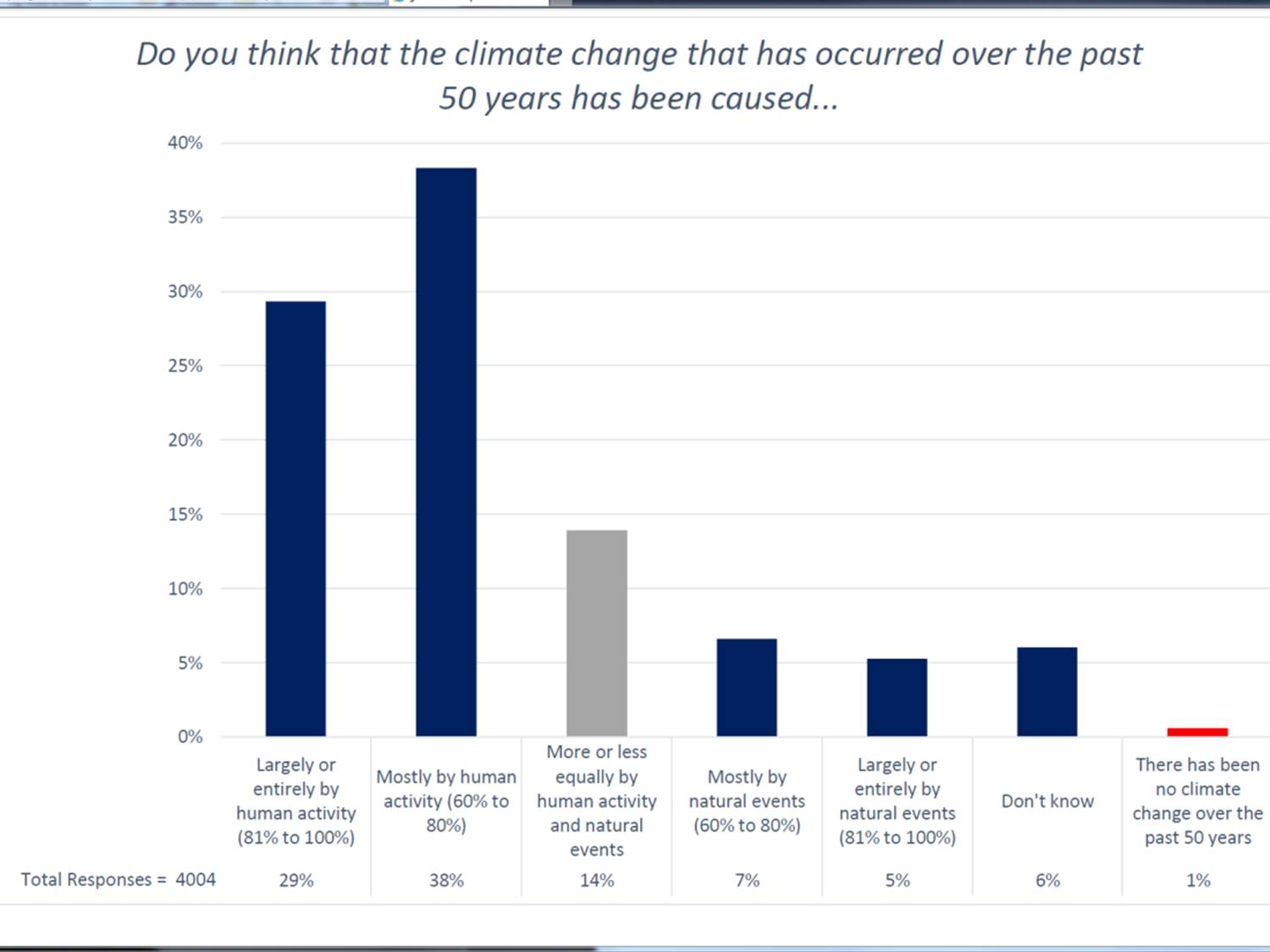
But what I find interesting is that the supposed 97% consensus on climate change (which we know is bogus anyway) turns into only 67% when we consider the number of people who believe climate change is mostly or entirely caused by humans, as indicated by this bar chart:

George Mason University survey results of 4,092 members of the American Meteorological Society.

George Mason University survey results of 4,092 members of the American Meteorological Society.

Fully 33% either believe climate change is not occurring, is mostly natural, or is at most half-natural and half-manmade (I tend toward that last category)…or simply think we “don’t know”.

For something that is supposed to be “settled science”, I find that rather remarkable.

27 Mar 15:39

科学家合成出简单生命形式

by AnkhMorpork
Craig Venter博士领导的团队在《科学》期刊上发表论文,报告他们合成出名为JCVI-syn3.0或Syn3.0的“最小化合成细菌细胞”。Syn3.0是Syn1.0的升级版。Syn1.0是首个从零合成出DNA的活细胞。研究人员希望,Syn3.0或其后续样品能提供一个平台,供合成生物学家加入有特定用途的基因,比如生产药品或生物燃料的基因,尽管Syn3.0更直接的目标是更好地理解生命的基本生化机理。研究团队通过逐个剔除再观察结果的办法,观察丝状支原体的901个基因中有哪些是必不可少的。丝状支原体是一种天然的细菌。不必要的基因被一个接一个地剔除,最终得到了473个复制和生长所必需的基因。编码组成这473个基因的DNA,共有约53.1万个碱基对。这些DNA随后在实验室中被合成出来,合成出的基因组被植入另一种细菌支原体M capricolum的壳中,该支原体自身的DNA已被移除。该合成基因组接管了宿主细胞的生物学运作。


09 Mar 07:59

Libertarian Lite

by John Stossel

In this year's Republican presidential primaries, Sen. Rand Paul got little traction. In 2012, his father failed. That year, the Libertarian Party candidate, former New Mexico Gov. Gary Johnson, got just 1 percent of the vote.We libertarians must be doing something wrong. Maybe our anti-government message is too radical, says Jerry Taylor. Maybe we should soften our approach.

"Libertarians need to be more realistic," Taylor told 500 young people at a taping of my TV show at last week's International Students for Liberty conference. In electoral politics, he said, finding libertarians is "like trying to find a daisy in Hiroshima" after the nuclear blast.

Taylor, a smart libertarian who runs a think tank called the Niskanen Center, says to become more popular, we libertarians ought to change our views. He criticized Rand Paul for saying that in 1964 he would've voted against the Civil Rights Act.

Actually, Rand didn't say that. He supported the act's ban on government racism, like Jim Crow laws. He objected only to the act's ban on private discrimination. Rand was right to object. If owners of a private business want to serve only gays, basketball players or bald men, that should be their right.

Market competition will punish bigots for their narrow-mindedness, because some people will avoid that store. There's no need for government force.

"Right," said Taylor, but "5 percent of the American public says yes to that, and 95 percent say no... They're not going to embrace a candidate who says, tough, people should just suffer under the teeth of bigotry because white people have that right."

I suppose Taylor is correct. Voters prefer simple answers ("Mexico will pay for a wall!"). They don't want constitutional lectures about property rights or free association.

Taylor is fine with welfare spending, too. He points out, "Even people like Milton Friedman and F.A. Hayek supported a safety net to help the indigent."

Taylor and some other libertarians sound like "reform Republicans" who want free-market advocates to embrace the welfare state. They think they're being practical, realistic.

But we free-market supporters know what really creates prosperity and opportunity: economic freedom! We saw it work in America when America was young. We see it now in Hong Kong, Singapore, New Zealand, Switzerland, Australia and other countries that today offer more economic freedom than the United States. Government that governs least governs best.

I said to Taylor, rudely, "Your plan for victory is to surrender?"

"No," replied Taylor. "I don't think it's surrender to say that the rights and freedoms of people in this country can be secured by government."

I don't either. But America's government has gone well past "securing rights and freedom." Today's welfare state provides much more than a safety net. It's become a giant hammock that encourages dependency. Government today takes half our money and micromanages the workplace.

But Taylor criticizes libertarians who complain about that and "reflexively" talk about "taxes and spending and regulation. Other things are important too, like war! War is the engine of the growth of the state. Hundreds of thousands of people die."

All true. We libertarians should probably talk less about taxes and more about what we'd do about ISIS and how to help poor people without using government force.

But I won't "soften" my arguments. I know they are right. After years watching liberal and conservative "solutions" fail, I know that limited government is the better way. We haven't convinced today's voters, but people aren't endlessly foolish. If we keep fighting, maybe they will see the truth.

To help us understand more about these ideas, the "Stossel" TV show will host a Libertarian presidential forum. Three leading Libertarian presidential candidates—"leading" because they placed top three in a poll done by the Libertarian Party—will debate. They are former New Mexico Gov. Gary Johnson, software entrepreneur John McAfee and Libertarian Republic founder Austin Petersen.

The forum will air, unfortunately, on April 1. But this is no April Fools' Day joke. Our future is a stake.

For free tickets to the "Stossel" Libertarian presidential forum, contact stosseltix@foxbusiness.com.

09 Mar 05:25

All Temperature Adjustments Monotonically Increase

by tonyheller

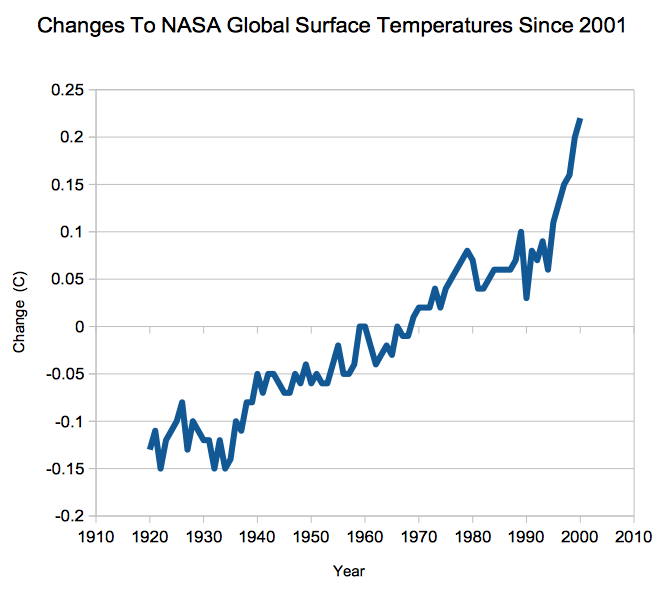
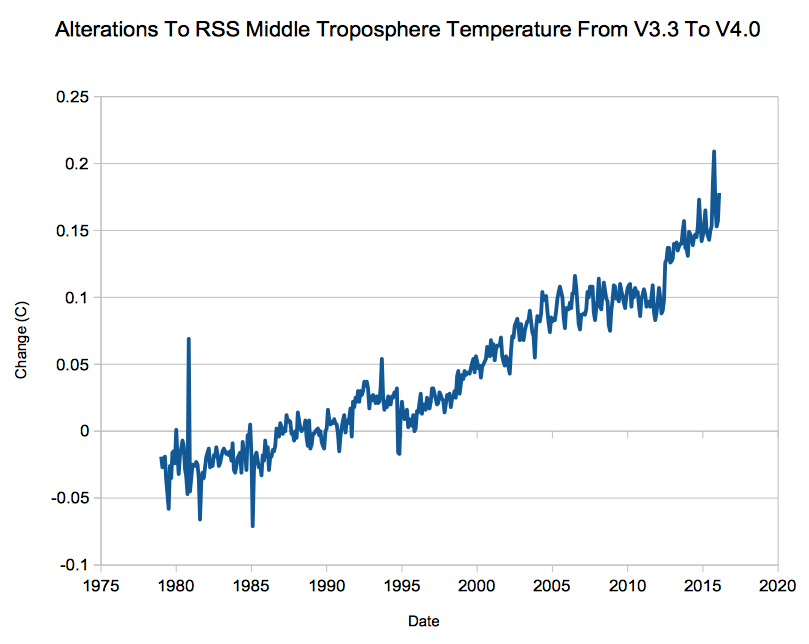
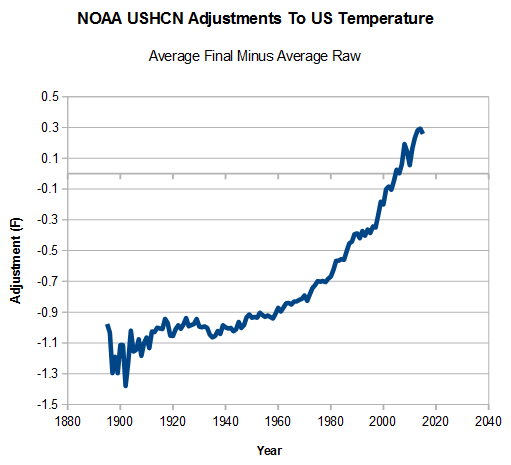
Nothing about climate science reeks more of confirmation bias, than the changes scientists make to their own data sets over time. They all show exactly the same pattern of monotonically cooling the past and warming the present, regardless of the instrumentation.

Screenshot 2016-03-08 at 08.53.41 AM

2001 version : FigA.txt       2016 version : Fig.A.txt

2016-03-07114423

2016 version : RATPAC-A-annual-levels.txt     2011 version : global.dat

Screenshot 2016-03-02 at 07.38.25 PM

RSS_Monthly_MSU_AMSU_Channel_TMT_Anomalies_Land_and_Ocean_v04_0.txt

RSS_Monthly_MSU_AMSU_Channel_TMT_Anomalies_Land_and_Ocean_v03_3.txt

2016-01-10-06-45-08.png

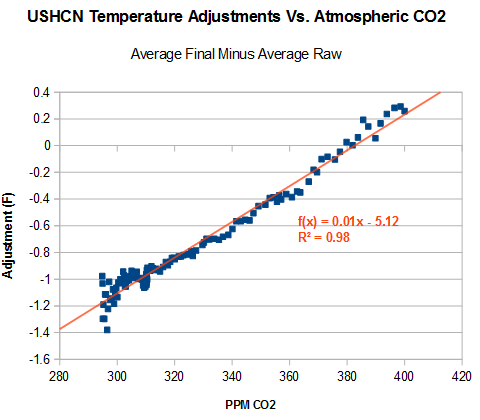
In the case of US temperature adjustments, they are made to exactly match the increase in CO2. Junk science doesn’t get any worse than that.

2016-01-14-04-18-24

08 Mar 11:58

Guns And States

by Scott Alexander

[Epistemic status: I think I probably wrung the right conclusions out of this evidence, but this isn’t the only line of evidence bearing on the broader gun control issue and all I can say is what it’s consistent with. Content warning for discussion of suicide, murder, and race]

I.

From a Vox article on America’s Gun Problem, Explained: “On Wednesday, it happened again: There was a mass shooting — this time, in San Bernardino, California. And once again on Sunday, President Barack Obama called for measures that make it harder for would-be shooters to buy deadly firearms.”

Then it goes on to say that “more guns mean more gun deaths, period. The research on this is overwhelmingly clear. No matter how you look at the data, more guns mean more gun deaths.” It cites the following chart:
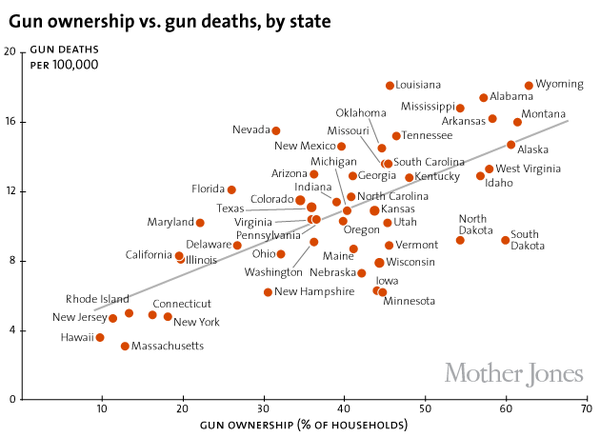
…then uses the graph as a lead in to talk about active shooter situations, gun-homicide relationships, and outrage over gun massacres.

Did you notice that the axis of this graph says “gun deaths”, and that this is a totally different thing from gun murders?

(this isn’t an isolated incident: Vox does the same thing here and here)

Gun deaths are a combined measure of gun homicides and gun suicides. Here is a graph of guns vs. gun homicides:
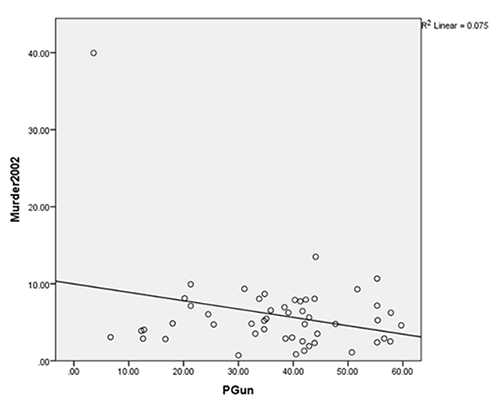
And here is a graph of guns vs. gun suicides:
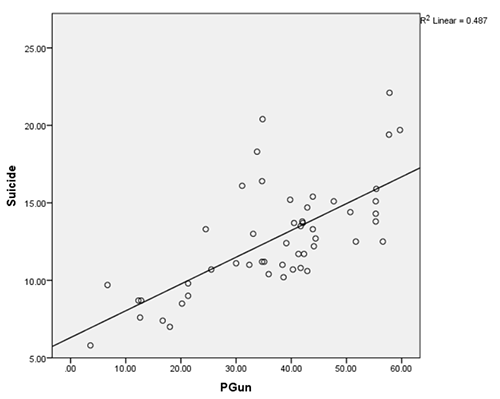
The relationship between gun ownership and homicide is weak (and appears negative), the relationship between gun ownership and suicide is strong and positive. The entire effect Vox highlights in their graph is due to gun suicides, but they are using it to imply conclusions about gun homicides. This is why you shouldn’t make a category combining two unlike things.

II.

I am not the first person to notice this. The Washington Examiner makes the same criticism of Vox’s statistics that I do. And Robert VerBruggen of National Review does the same analysis decomposing gun deaths into suicides and homicides, and like me finds no correlation with homicides.

German Lopez of Vox responds here. He argues that VerBruggen can’t just do a raw uncontrolled correlation of state gun ownership with state murder rates without adjusting for confounders. This is true, although given that Vox has done this time and time again for months on end and all VerBruggen is doing is correctly pointing out a flaw in their methods, it feels kind of like an isolated demand for rigor.

So let’s look at the more-carefully-controlled studies. Lopez suggests the ones at the Harvard Injury Control Research Center, which has done several statistical analyses of gun violence. They list two such analyses comparing gun ownership versus homicide rates across US states: Miller Azrael & Hemenway (2002), and Miller Azrael & Hemenway (2007).

(does it count as nominative determinism when someone named Azrael goes into homicide research?)

We start with MA&H 2002. This study does indeed conclude that higher gun ownership rates are correlated with higher murder rates after adjusting for confounders. But suspiciously, it in fact finds that higher gun ownership rates are correlated with higher murder rates even before adjusting for confounders, something that we already found wasn’t true! Furthermore, even after adjusting for confounders it finds in several age categories that higher gun ownership rates are correlated with higher non-gun homicide rates (eg the rates at which people are murdered by knives or crowbars or whatever) at p Behavioral Risk Factor Surveillance System Survey – and the FS/S measure fails. When I repeat all of their analyses with their own FS/S measure, I get all of their same positive correlations, including the ones with non-gun homicides. When I repeat it with the real gun ownership data, all of these positive correlations disappear. When I look at exactly why this happens, it’s because FS/S is much more biased towards Southern states than actual gun ownership is. Real gun ownership correlates very modestly – 0.25 – with 538’s ranking of the Southern-ness of states. FS/S correlates at a fantastically high 0.62. For some reason, suicidal Southerners are much more likely to kill themselves with guns than suicidal people from the rest of the States, even when you control for whether they have a gun or not. That means that MA&H 2002 thought it was measuring gun ownership, but was actually measuring Southern-ness. This is why they found higher homicide rates, including higher rates of non-gun homicide.

So we move on to MA&H 2007. This study was published after the CDC’s risk survey, so they have access to the same superior gun ownership numbers I used to pick apart their last study. They also have wised up to the fact that Southern-ness is important, and they include a dummy variable for it in their calculations. They also control for non-gun crime rate, Gini coefficient, income, and alcohol use. They do not control for urbanization level or race, but when I re-analyze their data including these factors doesn’t change anything, likely because they are already baked in to the crime rate.

They find that even after controlling for all of this stuff, there is still a significant correlation between gun ownership level and gun homicide rate. Further, this time they are using good statistics, and there is not a significant correlation between gun ownership and non-gun-homicide rate. Further, there is a correlation between gun ownership and total homicide rate, suggesting that the gun-gun-homicide correlation was not just an artifact of people switching from inferior weapons to guns while still committing the same number of murders. Further, this is robust to a lot of different decisions about what to control or not to control, and what to include or not to include.

I repeated all of their analyses using two different sources of gun ownership data, a couple different sources of homicide and crime rate data, and a bunch of different plausible and implausible confounders – thanks a lot to Tumblr user su3su2u1 for walking me through some of the harder analyses. I was able to replicate their results. Pro-gun researcher John Lott had many complaints about this study, including that it was insensitive to including DC and that it was based entirely on the questionable choice of controlling for robbery rate – but I was unable to replicate his concerns and found that the guns-homicide correlation remained even after DC was included and even when I chose a group of confounders not including robbery rate. I was unable to use their methodology to replicate the effect in places where it shouldn’t replicate (I tried to convince it to tell me tractors caused homicide, since I was suspicious that it was just picking up an urban/rural thing, but it very appropriately refused to fall for it). Overall I am about as sure of this study as I have ever been of any social science study, ie somewhat.

This study doesn’t prove causation; while one interpretation is that guns cause homicide, another is that homicide causes guns – for example, by making people feel unsafe so they buy guns to protect themselves. However, I doubt the reverse causation aspect in this case. The study controlled for robbery rate; ie it was looking at whether guns predicted homicides above and beyond those that could be expected given the level of non-homicide crime. My guess is that people feeling unsafe is based more on the general crime rate than on the homicide rate per se, which would make it hard for the homicide rate to cause increased gun ownership independently of the crime rate.

If guns are in fact correlated with more homicide, how come me and VerBruggen found the opposite in our simpler scatterplot analysis? This is complicated, but I think the biggest part of the answer is the urban/rural divide. Rural people have more guns. Murder rates are higher in urban areas. Race also plays a part: whites have more guns, but black areas have higher murder rates. Finally, the North and West seem to have more guns, but murder rates are highest in the South (which is what produced the bogus effect on the last study). All of these differences are large enough to cancel out the gun/no-gun difference and make the raw scatterplot look like nothing. This study didn’t address all those things directly, but its decision to control for non-gun crime rate and poverty took care of them nevertheless. As the old saying goes, guns don’t kill people; guns controlled for robbery rate, alcoholism, income, a dummy variable for Southernness, and a combined measure of social deprivation kill people.

If this is all true, how come I spent so much time yelling at that first study with worse data? Because I worry that if people only see the good studies, they’ll get complacent. Vox posted these two studies as proof that there was a state-level gun-murder correlation. The first one was deeply flawed, but the second one turned out to be okay. Do you think Vox realized this? Do you think they would have written that article any differently in a world where both studies were flawed? As long as you trust every scientific paper you see – let alone every scientific paper you see on your side in a highly politicized field – even when you’re right it will often just be by luck.

III.

Vox also voxsplains to us about America’s unusually high gun homicide rate.
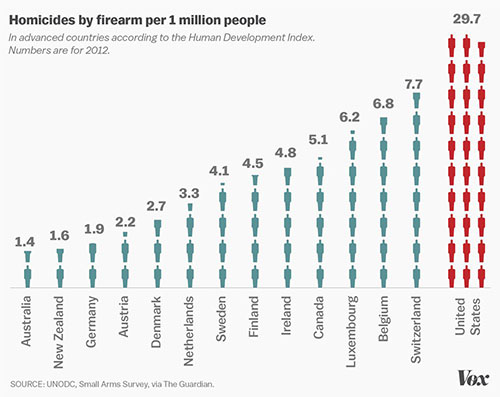
Having presented this graph, they say that “To understand why that is, there’s another important statistic: The US has by far the highest number of privately owned guns in the world.”

Even granting, as we saw above, that gun ownership does indeed increase homicide rates, this is not the most important factor in explaining America’s higher homicide rate, or even close to the most important factor. Let me give a few arguments for why this must be the case:

1. The United States’ homicide rate of 3.8 is clearly higher than that of eg France (1.0), Germany (0.8), Australia (1.1), or Canada (1.4). However, as per the FBI, only 11,208 of our 16,121 murders were committed with firearms, eg 69%. By my calculations, that means our nonfirearm murder rate is 1.2. In other words, our non-firearm homicide rate alone is higher than France, Germany, and Australia’s total homicide rate. Nor does this mean that if we banned all guns we would go down to 1.2 – there is likely a substitution effect where some murderers are intent on murdering and would prefer to use convenient firearms but will switch to other methods if they have to. 1.2 should be considered an absolute lower bound. And it is still higher than the countries we want to compare ourselves to.

2. There are many US states that combine very high firearm ownership with very low murder rates. The highest gun-ownership state in the nation is Wyoming, where 59.7% of households have a gun (really!). But Wyoming has a murder rate of only 1.4 – the same as right across the border in more gun-controlled Canada, and only about a third of that of the nation as a whole. It seems likely that the same factors giving Canada a low murder rate give Wyoming a low murder rate, and that the factors differentiating the rest of America from Wyoming are the same factors that differentiate the rest of America from Canada (and Germany, and France…). But this does not include lower gun ownership.

3. There are many US states that combine very low firearm ownership with very high murder rates. The highest murder rate in the country is that of Washington, DC, which has a murder rate of 21.8, more than twenty times that of most European countries. But DC also has the strictest gun bans and the lowest gun ownership rate in the country, with gun ownership numbers less than in many European states! It seems likely that the factors making DC so deadly are part of the story of why America as a whole is so deadly, but these cannot include high gun ownership.

If not gun ownership, what is the factor making America so much more deadly than Europe and other First World countries? The traditional answer I always heard to this question was that America had a “culture of violence”. I always hated this answer, because it seemed so vague and meaningless as to be untestable by design. If the NRA waves their hands and says “eh, culture of violence”, how are you going to tell them they’re wrong?

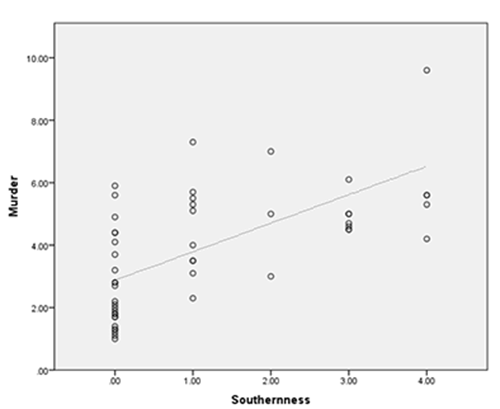
But we can work with this if we assume the culture of violence (or, if you want to be official about it, “honor culture”) is more common in some populations and areas than others. Some of the groups most frequently talked about during these lines are Southerners and various nonwhite minorities. This provides a testable theory: if we compare American non-Southern whites to European countries mostly made up of non-Southern whites, we’ll find similar murder rates. But first, some scatter plots:

This is murder rate by state, correlated with perceived Southernness of that state as per 538’s poll. I’ve removed DC as an outlier on all of the following.
And this is murder rate by state correlated with percent black population:
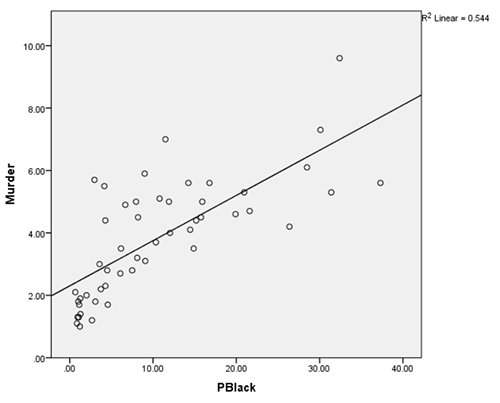
This would seem to support the “culture of violence” theory.

Can we adjust for this and see what the murder rate is for non-Southern whites? Sort of. The Economist gives a white-only murder rate of 2.5 (this is based on white victims, whereas we probably want white perpetrators, but the vast majority of murders are within-race so it doesn’t make much difference). And Audacious Epigone has put together a collection of white murder rates by state. I can’t find anything on non-Southern white murder rates per se, but one hack would be to take the white murder rate in non-Southern states and assume there aren’t any Southerners there.

Our main confounder will be urbanization. Western Europe is about 80% urban, so let’s look at states at a similar level. The four northern states that are closest to 80% urban are Colorado, Oregon, Washington, and Connecticut. I’m throwing out Colorado because it has a large Latino population who can’t be statistically differentiated from whites. That leaves, Washington (2.4), Connecticut (2.0), and Oregon (2.0). So possibly adjusting out Southerners brings us down from 2.5 (all whites) to 2.1 or so (non-Southern whites)? Again, compare to Germany at 0.8, Canada at 1.4, and America at 3.8.

There’s one more factor that needs to be considered:
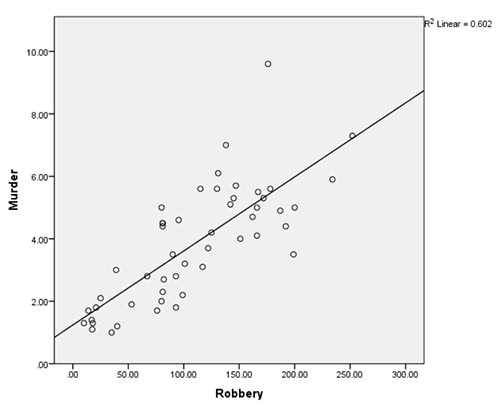
This is a plot of the gun death rate vs. the robbery rate. There’s a strong correlation (r = 0.78). Robbery is heavily correlated with percent black, percent Southern, and urbanization, so it’s probably coming from the same place. Nevertheless, it seems to correlate with murder better than any of them alone, maybe because it’s combining all three measures together. I was able to make a linear model using those three measures that correlated at r = 0.79 with murder, about the same amount that robbery does. I should also mention that robbery correlates negatively with gun ownership at r = – 0.52, but this disappeared when controlled for urbanization.

So my very tentative conclusion is that although the US murder rate is much higher than that of other First World countries, this is partly due to the existence of various cultural factors not present in those other nations. When we adjust those away, America’s murder rate falls from 3.8 to 2.1. Which is still higher than Germany’s 0.8 or Canada’s 1.4.

Is that extra due to guns?

IV.

According to MA&H 2007, each absolute percentage point in gun ownership was related to a 2.2 relative percentage point difference in homicide. This part of the study was beyond my ability to check, and I’m not sure why they switched from absolute to relative percents there, but suppose we take it seriously.

America has a gun ownership rate of 32%, so if we somehow decreased that to zero, we would naively expect about a 70% decrease in homicides. Unfortunately, only 67% of American homicides involve guns, so we’re back to pretending that eliminating guns will not only have zero substitution effect but also magically prevent non-gun homicides. This shows the dangers of extrapolating a figure determined by small local differences all the way to the edge of the graph (I’M TALKING TO YOU, RAY KURZWEIL).

Maybe we can be more modest? Canada has a gun ownership rate of aboot 26%, so…

…wait a second. I thought we’ve been told that the US has a gun ownership rate seven zillion times that of any other country in the world, and that is why we are so completely unique in our level of gun crime? And now they’re telling us that Canada has 26% compared to our 32%? What?

Don’t trust me too much here, because I’ve never seen anyone else analyze this and it seems like the sort of thing there should be loads of analyses of if it’s true, but I think the difference is between percent of households with guns vs. guns per capita. US and Canada don’t differ very much in percent of households with guns, but America has about four times as many guns per capita. Why? I have no idea, but the obvious implication is that Canadians mostly stop at one gun, whereas Americans with guns buy lots and lots of them. In retrospect this makes sense; I am looking at gun enthusiast bulletin boards, and they’re advising other gun enthusiasts that six guns is really the bare minimum it’s possible to get by with (see also “How many guns can you have before it’s okay to call your collection an ‘arsenal’?”, which I have to admit is not a question that I as a boring coastal liberal have ever considered). So if the guy asking that question decides he needs 100 guns before he gets his arsenal merit badge, that’s a lot more guns per capita without increasing percent household gun ownership. This should actually be another argument that guns are not a major factor in differentiating US vs. Canadian murder rates, since unless you’re going on a mass shooting (WHICH IS REALLY RARE) you wouldn’t expect more murders from any gun in a household beyond the first. That means that the small difference between US and Canadian household percent gun ownership rates (32% vs. 26%) would have to drive the large difference between US and Canadian murder rates (1.4 vs. 3.8), which just isn’t believable.

…okay, sorry, where were we? Canada has a gun ownership rate of about 26%, so if America were to get its gun ownership as low as Canada, that would be -6 absolute percentage points = a 13% relative decrease in murder rate = the murder rate going from 3.8 to 3.3 = a 0.5 point decrease in the murder rate. That’s pretty close to the difference between our 2.1 US-sans-culture-of-violence estimate and the 1.4 Canadian rate – so maybe beyond the cultures of violence, the rest of the US/Canada difference really is due to guns?

(I’m not sure whether I should be subtracting 13% from 2.1 rather than 3.8 here)

In Germany, 9% of households own firearms (wait, really? European gun control is less strict than I thought!) Using MA&H’s equation, we predict that if the US had the same gun ownership rate as Germany, its murder rate would drop 50%, eg from 3.8 to 1.9. Adjust out the culture of violence, and we’re actually pretty close to real Germany’s murder rate of 0.8.

How much would gun control actually cut US gun ownership? That obviously depends on the gun control, but a lot of people talk about Australia’s gun buyback program as a model to be emulated. These people say it decreased gun ownership from 7% of people to 5% of people (why is this number so much lower than Canada and Germany? I think because it’s people rather than households – if a gun owner is married to a non-gun-owner, they count as one gun-owner and one non-owner, as opposed to a single gun-owning household. The Australian household number seems to be 19% or so). So the gun buyback program in Australia decreased gun ownership by (relative) 30% or so. If a similar program decreased gun ownership in America by (relative) 30%, it would decrease it by (absolute) 10% and decrease the homicide rate by (absolute) 22%. Since there are about 13000 homicides in the US per year, that would save about 3000 lives – or avert about one 9/11 worth of deaths per year.

(note that our murder rate would still be 3.0, compared to Germany’s 0.8 and Canada’s 1.4. Seriously, I’m telling you, the murder rate difference is not primarily driven by guns!)

Is that worth it? That obviously depends on how much you like being able to have guns. But let me try to put this number into perspective in a couple of different ways:

Last time anyone checked, which was 1995, about 618,000 people died young (ie before age 65) in the US per year. Suppose that the vast majority of homicides are of people below 65. That means that instituting gun control would decrease the number of premature deaths to about 615,000 – in other words, by about half a percentage point. I’m having to borrow this data from the UK, but if it carries over, the average person my age (early 30s) has a 1/1850 chance of death each year. Gun control would decrease that to about 1/1860. I’m very very unsure about the exact numbers, but it seems like the magnitude is very low.

On the other hand, lives are very valuable. In fact, the statistical value of a human life in the First World – ie the value that groups use to decide whether various life-saving interventions are worth it or not – is $7.4 million. That means that gun control would “save” $22 billion dollars a year. Americans buy about 20 million guns per year (really)! If we were to tax guns to cover the “externality” of gun homicides preventable by Australia-level gun control, we would have to slap a $1000 tax on each gun sold. While I have no doubt that some people, probably including our arsenal collector above, would be willing to pay that, my guess is that most people would not. This suggests that most people probably do not enjoy guns enough to justify keeping them around despite their costs.

Or if all gun enthusiasts wanted to band together for some grand Coasian bargain to buy off the potential victims of gun violence, each would have to contribute $220/year to the group effort – not totally impossible, but also not something I can really see happening.

This is very, very, very, very very tentative, but based on this line of reasoning alone, without looking into the experimental studies or anything else, it appears that Australia-style gun control would probably be worth it, if it were possible.

(I didn’t price in the advantages of guns in terms of preventing state tyranny and protecing freedom, which might be worth subsidizing, but my guess is that if 32% gun ownership is enough to maintain freedom, 22% gun ownership is as well)

V.

In summary, with my personal confidence levels:

1. Scatterplots showing raw correlations between gun ownership and “gun deaths” are entirely driven by suicide, and therefore dishonest to use to prove that guns cause murder (~100% confidence)

2. But if you adjust for all relevant confounders, there is a positive correlation between gun ownership and homicide rates (~90% confidence). This relationship is likely causal (~66% confidence).

3. The majority of the difference between America’s murder rate and that of other First World countries is not because of easier access to guns in America (~90% confidence).

4. But some of it is due to easier access to guns. This is probably about 0.5 murders/100K/year.

5. An Australian-style gun control program that worked and had no side effects would probably prevent about 2,000 murders in the US. It would also prevent a much larger number of suicides. I am otherwise ignoring suicides in this piece because discussing them would make me too angry.

6. Probably the amount of lost gun-related enjoyment an Australian-style gun control program would cause do not outweigh the benefits.

7. This is not really enough analysis to make me have a strong opinion about gun control, since this just looks at the correlational evidence and doesn’t really investigate the experimental evidence. Contrary to what everyone always tells you, experimental evidence doesn’t always trump correlational – there are cases where each has its strengths – but it wouldn’t be responsible to have a real opinion on this until I look into that too. Nevertheless, these data are at least highly consistent with Australia-style gun control being a good idea for the US.

If you want to look into this more, here is a CSV version of all the relevant data.

08 Mar 11:30

Retailers Don't Need Another Regulatory Handout

by Veronique de Rugy

MoneyBenjamin Franklin said there are only two things certain in life: death and taxes. But I'd like to add a third: cronies coming back for more after Washington gives them a handout. Case in point, the merchants and retailers who got a juicy morsel from Dodd-Frank are now clamoring for more.

Sen. Dick Durbin, (D-Illinois), slipped into the monstrous 2010 Dodd-Frank financial regulation bill a favor long sought by big-box retailers, such as Wal-Mart. The Durbin amendment, as it is known, imposed price controls on interchange fees for debit cards. Interchange fees are what banks and card issuers charge retailers for processing payments. Many consumers prefer to use cards instead of cash, so it's advantageous for retailers to provide that as an option.

While retailers are all too happy to reap the benefits—which include cutting labor and security costs and retaining customers by accepting card payments—they don't much like paying the market price to do so, hence the intense lobbying to secure a Durbin amendment-type provision.

The price controls in the Durbin amendment only apply to debit cards. However, as George Mason University professor Todd Zywicki predicted in 2011, the unintended consequences of the regulation have cut enough into the financial windfall expected by retailers that they now want price controls for credit cards, too.

That would be crazy. Enough evidence has accumulated in the years since Dodd-Frank to give regulators pause. For instance, multiple studies have identified negative and unintended consequences from the Durbin amendment's price controls for debit card interchange fees. A large survey of merchants conducted by the Federal Reserve Bank of Richmond found that few have lowered consumers' prices despite a substantial reduction in their payments to debit card issuers.

At the same time merchants have reaped a windfall, customers have found that banks are quick to make up the losses elsewhere. Benefits such as rewards programs have been cut or eliminated, while numerous fees have been increased—including account maintenance charges, insufficient-funds fees and inactivity fees, to name a few—yielding a net negative for consumers. One estimate puts the total net loss to consumers between $22 billion and $25 billion.

This shouldn't come as a surprise. Government interventions rarely benefit the public at large. Usually, they just help the special interests that pushed for them. Unfortunately, Congress is more apt to respond to pressure from special interests than it is to watch out for our general welfare. Moreover, earlier this year, Europe imposed a cap on interchange fees for credit cards, as well as debit cards, making very similar arguments for consumer savings as those used to back the Durbin amendment. The move energized the call on this side of the Atlantic to do the same.

The Durbin amendment was slipped into a major regulatory bill by a Democratic majority in Congress. To be fair, some Republicans supported the rules, too. The question, then, is whether the current Republican-controlled Congress knows better today and will deny out of principle the calls for additional handouts for retailers. Unfortunately, its record on cronyism has been mixed at best.

Nevertheless, members of Congress have considerable evidence in front of them demonstrating the costly folly of setting price controls on payment processing—which they should heed, not only to justify rejecting calls for greater intervention but also as cause for undoing past mistakes.

COPYRIGHT 2016 CREATORS.COM

08 Mar 10:29

Youtube:谁是仇恨煽动者,你能分得清吗?

by AnkhMorpork
lam20102010 写道 "一个总部设在耶路撒冷的名叫“巴勒斯坦媒体观察”(Palestinian Media Watch)的以色列机构周日(3月6日)对媒体披露,他们在Youtube的频道账号于当天突然被Youtube以违反网站规程为名冻结了。该组织呼吁粉丝们能以电子邮件等方式呼吁Youtube解封。根据最新报道,Youtube已经在一天后,也就是3月7日恢复其账号。 事情起因是该频道在周四转发了一段巴勒斯坦民族权力机构官方电视台播出的“少儿访谈”节目。在这档节目中,一名巴勒斯坦小女孩面对电视镜头朗诵了一段诗歌,诗歌中有“战争将碾碎压迫者,摧毁犹太复国主义者的灵魂”(war that will smash the oppressor and destroy the Zionist’s soul)等仇以词句。这段视频被认为有煽动民族仇恨和暴力的嫌疑。 “巴勒斯坦媒体观察”机构辩解说,他们不是在煽动暴力和仇恨,而是在揭露那些煽动暴力和仇恨的言行。 该机构平时注意搜集巴勒斯坦媒体发布的各类仇以极端言论,并配上英语字幕,在Youtube上转载,目的在于告诉世界,巴勒斯坦方面至今仍在其管辖范围内制造和散播仇以舆论,助长了巴勒斯坦人对以色列的恐怖主义行为。 该机构在Youtube上发布的视频在国际上也引起了不少关注。上周五瑞典国会就巴勒斯坦民族权力机构是否参与了当前的恐怖主义活动展开了25分钟的辩论,这场辩论就是基于该机构在Youtube上发布的一段巴勒斯坦视频。 这不是该机构的账号第一次被Youtube冻结。2010年,该机构曾转发了一段巴勒斯坦民族权力机构高级宗教领袖穆夫提.穆罕默德.侯赛因(Mufti Muhammad Hussein)的讲话视频,在这段视频中,这位巴勒斯坦高级宗教官员宣称“诛杀犹太人是义所当为”( it is a religious imperative to murder Jews)。不久,youtube就给了该账号二个礼拜禁止内容更新的处罚。"


08 Mar 09:43

One funeral at a time?

by Stephen Hsu
A new scientific truth does not triumph by convincing its opponents and making them see the light, but rather because its opponents eventually die, and a new generation grows up that is familiar with it. -- Max Planck I'm at the annual AAU meeting of research Vice-Presidents, and the "reproducibility crisis" (in some fields) is one of the topics on the agenda. Today I heard a nice talk by
08 Mar 09:22

Reverse Voxsplaining: Prison and Mental Illness

by Scott Alexander

I.

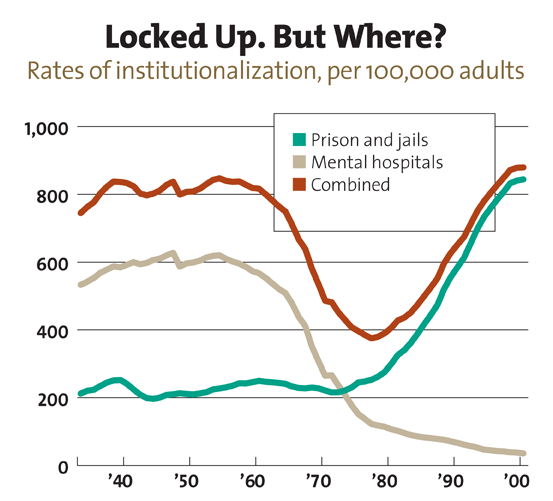
German Lopez of Vox writes that “America’s criminal justice system has in many ways become a substitute for the US’ largely gutted mental health system”.

He says that starting in the 1970s the US “began locking up a lot more people”, and “at the same time, the country pulled back and defunded its public mental health system”. He admits that “this wasn’t, at the time, totally malicious”, but then says it “left the criminal justice system as the only system that can respond to people with mental illness.”

He concludes that as a result, “the number of people with mental illness in prisons/jails outnumber those in state hospitals 10 to 1.” The apparent (though unstated) conclusion is that defunding the big state mental hospitals was a mistake and we need to bring them back so that the mentally ill in state hospitals once more outnumber those in prison.

Lopez seems to be working off a model where there is a population of mentally ill people who can’t make it in normal society, and so will inevitably end up either in a long-term mental hospital or a prison. Since mental hospitals are good places where people get treatment, and prisons are bad places where people get punishment, we should “catch” these mentally ill people before they end up in prison so that they can be in nice hospitals instead.

Needless to say I disagree with pretty much every part of this assessment.

II.

Between all of this talk of “the tragic collapse of America’s public mental health system” and “the US’s largely gutted mental health system” and “the country pulled back and defunded its mental health system” and so on, you might get the impression that less money is being spent on mental health. This is not really true. The share of GDP devoted to mental health is the same as it was in 1971, although this looks worse if you compare it to rising costs in other areas of health care. There hasn’t been a “gutting of the mental health system”, there’s been a shift from long-term state-run mental hospitals to community care. It hasn’t “left the criminal justice system as the only system that can respond to people with mental illness”, it helped create an alternate and less restrictive system of outpatient psychiatry. In my opinion, this was a positive development, and the share of mentally ill people in prison is not an argument against it. Let me explain.

“Mentally ill people in prison” conjures up this lurid image of psychos who snap and kill their families, followed by “well, what did you expect leaving a person like that on the street?” The reality is more mundane. There are lots of mentally ill people in prison because there are lots of mentally ill people everywhere. Remember, 20% of the population qualifies as mentally ill in one sense or another. If a depressed guy sells some marijuana and gets caught, he is now a “mentally ill person in prison”.

There are disproportionately many mentally ill people in prison partly because people’s illnesses lead them to commit crimes, but mostly because some of the factors correlated with mental illness are the same factors correlated with criminality. Poverty? Check. Neighborhood effects? Check. Genetic load? Check. Education? Check. IQ? Check. Broken families? Check. Drug abuse? Definitely check. The factors that gave that pot dealer depression might be the same factors that drove him to sell pot instead of becoming an astronaut. Treating the depression might help a little, but it’s not guaranteed to keep him on the good side of the law.

In my model, the overwhelming majority of mentally ill people can live okay lives outside of any institution, hopefully receiving community care if they want it. If they commit crimes they will go to prison just like anyone else; if not, we should hardly be clamoring to bring back the often-horrifying state-run mental hospitals and lock them up there.

So when we talk about the number of mentally ill people in prison, we should be trying to distinguish between Lopez’s model and mine. That means asking: exactly how mentally ill are we talking about here?

III.

Lopez’s source for the claim that “ten times more mentally ill people are in prisons than hospitals” is a report by the Treatment Advocacy Center – note the less-than-neutral name. Where Lopez uses the phrase “mental illness”, TAC uses the phrase “severe mental illness” and defines it in two ways. For people in state prisons, they define it as reporting at least one psychotic symptom, and say 15% of people met their criteria. For people in county jails, they define it as meeting criteria for a depressive, bipolar, or psychotic illness, and say 15% of people met their criteria (they later arbitrarily increase that number to 20% because they feel like the survey might have undercounted).

No no NO. First, “psychotic” is not the same thing as “severely mentally ill”. Some people are severe but not psychotic – for example, a suicidally depressed person. Others are psychotic but not severe – for example, someone who hears a voice whispering her name but shrugs it off. Describing a survey that shows 15% of people as admitting one symptom of psychosis as showing 15% of people are severely mentally ill is really sketchy.

The prison survey provides a perfect example. It looks like the prisoners were asked fixed questions about their symptoms, and I think the exact screening instrument was just this survey, which has four relevant questions: “Can anybody else control your brain or thoughts?”, “Do you ever hear voices other people don’t hear?”, “Do you ever see something that other people tell you isn’t real?” and “Do you ever think anyone (other than correctional staff) is spying on you or plotting against you?”

Unfortunately, these kinds of surveys are really weak. I’m doing a study about this now, so maybe later I can cite myself on this, but the gist is that a lot of short mental health screening questions get false positives from perfectly healthy people. For example, I can’t tell you how many patients I’ve asked “Do you ever feel like anyone is spying on you?”, they say “Yes”, I ask “Who?” and they say “The NSA on my Internet activity”. Well, good work keeping up with the news. But a survey with a checkbox and no followup questions diagnoses that person as psychotic (see also: Lizardman’s Constant). This prison questionnaire was smart enough to exclude prison guards, who are certainly spying on all the respondents, but even beyond that I feel like the criminal lifestyle really does involve being spied on and plotted against a lot. At the very least it gives you lots of opportunities to legitimately worry about it.

(also, the diagnostic criteria for psychotic disorder are very clear that paranoia experienced while taking drugs doesn’t count. 75% of prisoners admit to using marijuana, marijuana can totally make you paranoid, and as far as I can tell the survey did not specify that the paranoia had to be while sober.)

(also also, Scientific American says that about 5-15% of perfectly ordinary people hear voices. Meanwhile, 4-6% of prisoners in the survey admitted to it.)

When the survey says that X% of prisoners have felt plotted-against or heard voices in the last year, does that mean X% of them are psychotic? That X% of them are “severely mentally ill”? That the old state mental hospitals need to be re-opened so X% of them can be locked up there for being too crazy for society? I don’t think it means any of those things.

But this is the stricter of the two criteria that the survey uses! The other one counts depressed people, bipolar people, and psychotic people. I don’t want to trivialize non-psychotic illnesses like depression. But remember: about 10% of the ordinary non-prison population is depressed/bipolar/psychotic. Also, going to prison is depressing as heck in and of itself. When they say that 15% of people in county jails (rounded up to 20%) are severely psychiatrically ill, they’re talking about pretty normal people, who might be in prison for something unrelated to their mental illness and might not even have become mentally ill at all if they hadn’t been incarcerated.

So I don’t think this survey shows the majority of the mentally ill prison population is in need of institutionalization. When Vox complains that ten times more mentally ill people are in prison than in state mental hospitals, I will shoot right back at them that ten times more mentally ill people are in the Los Angeles metropolitan area than in state mental hospitals. You want more meaningless statistics? Ten times more mentally ill people are in the Southern Baptist Church than in state mental hospitals! Ten times more mentally ill people watched the last season of Game of Thrones than are in state mental hospitals! We can’t and shouldn’t aim to institutionalize all of them.

IV.

What about that graph? It’s very suggestive. You see a sudden drop in the number of people in state mental hospitals. Then you see a corresponding sudden rise in the number of people in prison. It looks like there’s some sort of Law Of Conservation Of Institutionalization. Coincidence?

Yes. Absolutely. It is 100% a coincidence. Studies show that the majority of people let out of institutions during the deinstitutionalization process were not violent and that the rate of violent crime committed by the mentally ill did not change with deinstitutionalization. Even if we take the “15% of inmates are severely mentally ill” factoid at face value, that would mean that the severely mentally ill could explain at most 15%-ish of the big jump in prison population in the 1980s. The big jump in prison population in the 1980s was caused by the drug war and by people Getting Tough On Crime. Stop dragging the mentally ill into this.

Lopez himself wrote a nice piece on how most mentally ill people are not violent, and another nice piece on how most people in prison are there for violent offenses. But put these together, and you get that most mentally ill people do not end up in prison. Most of the people who got out of the mental hospitals during deinstitutionalization are getting by. Some of them are homeless, and that’s bad. But if you want to solve homelessness among the mentally ill, build homeless shelters, not state-run long-term mental hospitals.

V.

In case you haven’t noticed, I really don’t like state-run long-term mental hospitals. There is a really amazingly great thing about prison, which is that you don’t go there unless you’re convicted of a crime. Mental hospitals do not have that advantage. The commitment process kind of sucks, and I am saying this as a person who makes commitment decisions myself. A lot of times it degenerates into a ritualized method of avoiding lawsuits without much concern for benevolence or patient autonomy. It helps me sleep at night to know that most commitments only last a couple of days or a week at most. Long-term state-run mental hospitals didn’t work that way. Remember that some of the perfectly sane people in the Rosenhan experiment were kept locked up for fifty days just for saying they heard a voice once but now they’re better.

I think long-term state-run mental hospitals are better than prison, but not by very much. The Rosenhan participants described it as:

…an overwhelming sense of dehumanization, severe invasion of privacy, and boredom while hospitalized. Their possessions were searched randomly, and they were sometimes observed while using the toilet. They reported that though the staff seemed to be well-meaning, they generally objectified and dehumanized the patients, often discussing patients at length in their presence as though they were not there, and avoiding direct interaction with patients except as strictly necessary to perform official duties. Some attendants were prone to verbal and physical abuse of patients when other staff were not present. A group of bored patients waiting outside the cafeteria for lunch early were said by a doctor to his students to be experiencing “oral-acquisitive” psychiatric symptoms. Contact with doctors averaged 6.8 minutes per day.

The idea of potentially saving a couple of people from prison by pre-emptively committing way more people to a mental hospital does not appeal to me at all, and I still think closing the institutions was the best thing Reagan ever did.

But prison and institutions aren’t the only two options! There’s a six month waiting period for psychiatrists in most parts of the country. The existing mental hospitals – which are different from and often nicer than the old state-run institutions – are constantly turning away people who want to be there because they don’t have enough beds for them. There are a bunch of patients who are having trouble affording their medications. There are special treatment options like day clinics, partial hospital programs, recreational therapy, occupational therapy, et cetera that do really great things but which most patients can’t afford. There are intensive health monitoring programs – think nurses who come to your house and make sure you take your medication on time – which are proven to improve outcomes but which never have enough staff for everybody who needs them. There are omnipresent underfunded community mental health systems. All of these things are doing great work right now. Indeed, the plan for closing the state-run long-term facilities was to gradually transition care to all of these other systems, and where that was supported it worked well, and insofar as it didn’t work well it was because it wasn’t supported.

If we support all that, will it keep all mentally ill people out of the prison system? No. First of all, no treatment is perfect and most are downright mediocre. Second of all, like I said, there are mentally ill people in prison because there are mentally ill people everywhere. There are disproportionately many mentally ill people in prison because the risk factors for mental illness are the same as the risk factors for crime, like poverty and drug abuse. Regardless of the level of care given, mentally ill people are likely to end up in prison at increased rates, unless you’re willing to either institutionalize all mentally ill people before they can commit any crimes, or excuse all crimes committed by mentally ill people.

But we shouldn’t be making our mental health decisions based on worries about criminality and prisons. Most people who are mentally ill will never end up on the wrong side of the law, and many (most?) mentally ill people who do end up in prison will do so for reasons not directly related to their illness. Make mental health decisions because it’s the right thing to do and there are people who really need help.

And if mentally ill people do end up in prison? There is a forensic health system dedicated to treating mentally ill prisoners. It’s not perfect, but with more funding and attention it could be better. There are forensic psychiatric hospitals that house mentally ill prisoners, and though again they are not perfect, they at least have that great advantage that you can’t be put in them unless you are found guilty of a crime.

So my argument is: fund and use the community mental health system more to help people in the community. Fund and use the forensic mental health system more to help people in prison. But stop acting like the two groups are fungible. And stop trying to institutionalize more people. That doesn’t help.

08 Mar 08:40

NOAA Radiosonde Data Shows No Warming For 58 Years

by tonyheller

In their “hottest year ever” press briefing, NOAA included this graph, which stated that they have a 58 year long radiosonde temperature record. But they only showed the last 37 years in the graph.

2016-03-07060741

NESDIS Strategic Communications

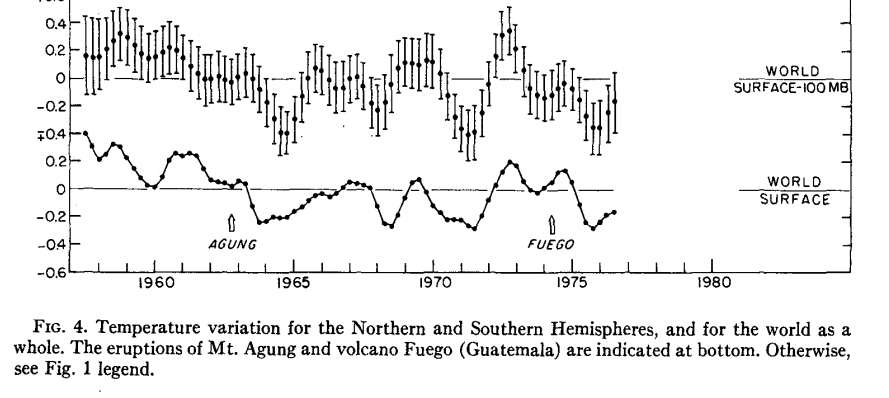
Here is why they are hiding the rest of the data. The earlier data showed as much pre-1979 cooling as the post-1979 warming.

 2016-03-07060842

2016-03-07060954

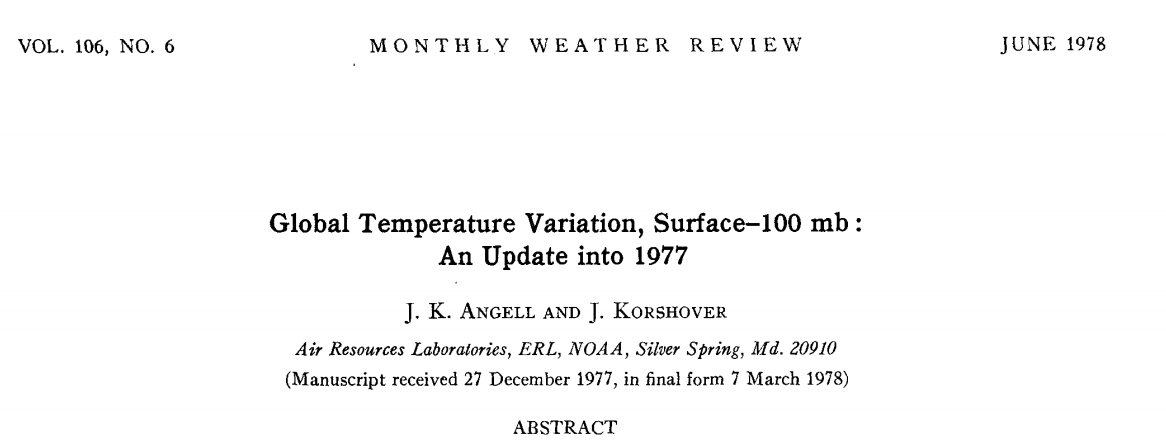
1520-0493(1978)106<0755:GTVSMA>2.0.CO;2

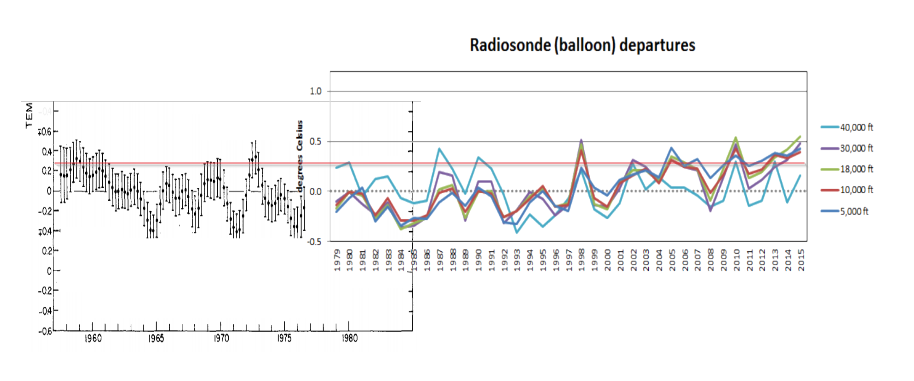
I combined the two graphs at the same scale below, and put a horizontal red reference line in, which shows that the earth’s atmosphere has not warmed at all since the late 1950’s

2016-03-07060229

The omission of this data from the NOAA report, is just their latest attempt to defraud the public. NOAA’s best data shows no warming for 60 years. But it gets worse. The graph in the NOAA report shows about 0.5C warming from 1979 to 2010, but their original published data shows little warming during that period.

2016-03-07153308

 cdiac.esd.ornl.gov/ftp/trends/temp/angell/global.dat

Due to Urban Heat Island Effects, the NOAA surface data shows nearly one degree warming from 1979 to 2010, but their original radiosonde data showed little warming during that time. Global warming theory is based on troposphere warming, which is why the radiosonde data should be used by modelers – instead of the UHI contaminated surface data.

2016-03-07152234

NOAA’s original published radiosonde data showed little net troposphere warming from 1958 to 2010, when the data set ended.

2016-03-07151312

The next graph shows how NOAA has altered their 850-300 mb temperature data since 2011. Another hockey stick of data tampering.

2016-03-07114423

2016 version : RATPAC-A-annual-levels.txt

2011 version : global.dat

08 Mar 06:38

Fresh evidence emerging of Iran’s deadly nuclear and terror ties to Argentina

by jgates

Last week, an Argentine intelligence official testified that Iran sought nuclear technology from that South American country and that a prosecutor investigating suspected Hezbollah bombings in Buenos Aires had been murdered for attempting to expose Tehran’s dangerous plot.

This fresh testimony supports reports I published in July 2011 regarding suspicious nuclear diplomacy in 2007 and a massive cash transfer in 2010 involving then Iranian and Argentine leaders, Mahmoud Ahmadinejad and Nestor Kirchner, respectively. Despite congressional inquiries and mounting evidence, the State Department has chosen to ignore this blind spot in strategy for containing Iran’s illicit nuclear program.

Federal judge Sandra Arroyo Salgado (C), ex-wife of late prosecutor Alberto Nismam, flanked by forensic experts. speaks during a news conference in Buenos Aires March 5, 2015, regarding a plot to cover up Iran's alleged role in a 1994 bombing. REUTERS/Enrique Marcarian.

Federal judge Sandra Arroyo Salgado (C), ex-wife of late prosecutor Alberto Nisman, flanked by forensic experts. speaks during a news conference in Buenos Aires March 5, 2015, regarding a plot to cover up Iran’s alleged role in a 1994 bombing. REUTERS/Enrique Marcarian.

According to the Argentine daily newspaper, Clarin, a former Argentine senior intelligence official, Antonio Stiuso, confirmed in two days of testimony before a judge that the former president of Venezuela, Hugo Chávez, interceded with Nestor Kirchner to resume nuclear cooperation with Iran, which had been suspended in 1991. Also, according to Stiuso’s testimony, Ahmadinejad was interested in using Argentina’s technology to produce plutonium bombs, which he characterized as more sophisticated than the ones Iran was trying to make with enriched uranium.

Stiuso noted that Venezuela did not possess the technical knowledge to make use of the nuclear technology sought by Chávez from Argentina. Instead, because Iran’s nuclear plans were designed by Argentines in the 1960s, Stiuso’s theory is that Tehran was the ultimate beneficiary of such nuclear cooperation.

Stiuso also testified that the former prosecutor, Alberto Nisman, was murdered for refusing an order from former president Cristina Kirchner to cease investigating Iran’s role in the 1992 and 1994 bombings and its corrupt dealings with Argentine officials. In a draft criminal complaint discovered after the prosecutor was found dead last year in an apparently staged suicide, Nisman accused Cristina Kirchner of covering up the involvement of five Iranians who have been charged with planning the 1994 terrorist attack against the Jewish Community Center in the heart of Argentina’s capital city.

In a separate development, last Thursday, Nisman’s family disclosed a written statement by a prosecutor from Argentina’s federal appeals court saying that scientific tests failed to find evidence that he fired the pistol found near his body. This is the first formal statement by a government official confirming suspicions that Nisman was the victim of a homicide.

From the US side, the Obama State Department has systematically neglected the dangerous liaisons among Venezuela, Argentina, and Iran. As dramatic evidence of Iran’s deadly provocations in our own neighborhood continues to come to light, it is fair to ask whether its cluelessness was by accident or design.

07 Mar 13:29

Against Liberal Triumphalism…

by bsixsmith

“Civilisation,” claims Nick Cohen, “Came from the battering that religion took from the Enlightenment.” For liberal triumphalists like Mr Cohen, culture and science sprang into existence around the time that Voltaire first poked fun at faith. Before this, Britain was no more than a primitive tyranny.

Never mind the fact that Shakespeare, Drake and Newton somehow flourished among all of this barbarianism. If Europe was so benighted, how did Hulme and Voltaire, let alone Rousseau, not only live but speak and publish? Muslim reformers are still being killed today.

Enlightenment supremacists often fail to acknowledge the extent to which liberalism depends on traditional institutions: all of the cultural and administrative apparatus that allows for prosperity, social trust, security and innovation. Overlooking this is like attributing all of one’s success to one’s own virtues without acknowledging the contributions of one’s parents.

How effective can liberalism be, anyway? Cohen is writing on Islamic extremism and its supposed enablers. As well as the evermore hypersensitive left he is attacking the supposed hypocrisy of traditionalists. Yet what does he offer to deal with the problem? Little except the vague, optimistic hope that supporting reformers and denouncing orthodoxies will prompt the liberalisation of Islam. This is a faith-based position. All previous examples of religious reform have been long and frustrating, and some have been brutal. I hope the idea will be found to have some truth to it but otherwise Europe depends on the unlovely work of traditional institutions: border controls, secret services and social taboos. This is not inspiring but it is the truth.


06 Mar 08:33

没有无线信号的神奇小镇

by 次次小姐
整个小镇都没有Wi-Fi,无线电话,手机信号,甚至微波炉。简单来说,能产生或者需要电磁波的工具,这里都不能用。
06 Mar 05:39

Can’t Stop Lecturing

by Robin Hanson
Whig Zhou

可不是嘛

Imagine a not-beloved grade school teacher who seemed emotionally weak to his students, and was fastidious about where exactly everything was on his desk and in his classroom. If the students moved things around when the teacher wasn’t looking, this teacher would seem disrupted and give long boring lectures against such behavior. This sort of reaction might well encourage students to move things, just to get a rise out of the teacher.

Imagine a daughter who felt overly controlled and under considered by clueless parents, and who was attracted to and tempted to get involved with a particular “bad boy.” Imagine that these parents seemed visibly disturbed by this, and went out of their way to lecture her often about why bad boys are a bad idea, though never actually telling her anything she didn’t think she already knew. In such a case, this daughter might well be more tempted to date this bad boy, just to bother her parents.

Today a big chunk of the U.S. electorate feels neglected by a political establishment that they don’t especially respect, and is tempted to favor political bad boy Donald Trump. The main response of our many establishments, especially over the last few weeks, has been to constantly lecture everyone about how bad an idea this would be. Most of this lecturing, however, doesn’t seem to tell Trump supporters anything they don’t think they already know, and little of it acknowledges reasonable complaints regarding establishment neglect and incompetence.

By analogy with these other cases, the obvious conclusion is that all this tone-deaf sanctimonious lecturing will not actually help reduce interest in Trump, and may instead increase it. But surely an awful lot of our establishments must be smart enough to have figured this out. Yet the tsunami of lectures continues. Why?

A simple interpretation in all of these cases is that people typically care more about making sure they are seen to take a particular moral stance than they care about the net effect of their lectures on behavior. The teacher with misbehaving students cares more about showing everyone he has a valid complaint than he does about reducing misbehavior. The parents of a daughter dating a bad boy care more about showing they took the correct moral stance than they do about whether she actually dates him. And members of the political establishment today care more about making it clear that they oppose Trump than they do about actually preventing him from becoming president.

05 Mar 14:31

A sure sign of warmism in decline: Yale closing down its ‘Climate and Energy Institute’

It's offical: peak warmism has passed.
04 Mar 15:47

Philip Zimbardo, the Stanford Prison Experiment Architect, Has Become an Anti-Porn Crusader

by Jesse Singal
Whig Zhou

津巴多果然不靠谱


Dr. Philip Zimbardo is best known as the architect of the Stanford Prison Experiment, in which a group of randomly assigned “guards” in a simulated prison quickly began treating their “prisoners” in a shockingly barbaric manner. The experiment, which was called off after only six days despite having a planned...More »

03 Mar 07:30

Male Student Had Drunken Sex with Female Non-Student. Her Dad Called It Rape. Expulsion Imminent.

by Robby Soave
Whig Zhou

女权与父权终于合流了~

DrunkThe University of Texas at Austin has recommended expulsion for a male student who was found responsible for sexual misconduct by the university's Title IX bureaucrats. But the woman he supposedly raped didn't formally accuse him—they remained friends and even flirted via text messages subsequent to the encounter. 

In fact, it was the woman's father who initiated the Title IX proceedings against the male student, "John Doe," who is suing UT-Austin to prevent the university from expelling him. 

The woman, "Jane Roe," is not a UT-Austin student, which raises an important question: Should a university really have a responsibility to meddle in students' private sex lives when parents of non-students file complaints? 

The Title IX bureaucracy at UT-Austin evidently believes so. 

The details of Doe's case are in many ways similar to dozens of other disputed rape cases, with one crucial difference: after some initial confusion, both parties eventually came to the conclusion that their sex was consensual, according to Doe's lawsuit. 

The College Fix reported on the circumstances of the encounter. On March 6, 2015, Doe met Roe and her friend, "Jennifer Smith," at a party near campus. They headed back to Roe's apartment: Smith and Roe went to sleep in the bedroom, while Doe took the couch. Roe was reportedly very drunk. Soon after, Smith invited Doe into the bedroom, where they had sex while Roe was passed out. 

Later, Roe woke up and initiated sexual contact with Doe. Smith noticed, and left the apartment to give them more privacy. They then engaged in sex. Both Smith and Doe believed Roe was fully conscious and capable of giving consent—she was awake, talking, and willing, according to the lawsuit. Doe left the apartment in the morning. 

Afterward, Roe couldn't remember what had happened, and sent a text to Smith berating her for leaving Roe alone with Doe. Smith responded, "I'm sorry, I thought you wanted to have sex with him though." 

Roe also contacted Doe, accusing him of taking advantage of her while she was unconscious. But Doe explained that she wasn't unconscious. Importantly, he explained that she had shared private information about herself—that she had appeared in pornographic films—during the encounter. This led Roe to concede that although she couldn't remember having sex with him, it "sounded passionate." She ceased accusing him, and even began exchanging flirtatious texts with him. On March 16 and 27, she even sent him sexy pictures of herself. They agreed to get together, though they never did. 

But on April 8, Roe's father called UT's police department and told them Doe had sexually assaulted his daughter. His complaint was forwarded to UT's dean of students, who initiated a Title IX investigation, "despite the fact that Ms. Roe was not a UT student and despite her not personally making any claim that she had been sexually assaulted at that point," according to the lawsuit. 

UT's Title IX investigators interviewed Doe, Roe, and Smith, and decided that Doe was guilty. On November 5, they recommended his expulsion. 

Doe has the right to appeal that determination, and was granted a hearing with a panel of university employees. But this hearing lacks even a semblance of fairness. He is not afforded a lawyer—he must argue his case himself. Most notably, he has no power to compel witnesses to appear at the hearing: in other words, he can only cross-examine Smith and Roe if they choose to attend. In fact, UT's rules bar him from questioning the "complainant" even if she does show up (it's not precisely clear to me who the complainant even is, since Roe's father initiated the proceedings). 

In summary: Doe has already been found guilty by a team of Title IX investigators. The responsibility now rests with him to prove he is innocent of sexually assaulting a non-student who never formally accused him of wrongdoing until her father initiated the complaint. Doe is equipped with no tools to achieve this task, since none of the relevant parties are members of campus—nor would they have any obligation to participate, even if they were. 

I've read the text messages and other documents relating to the case. They paint a clear portrait of a messy, drunken hookup that led to hurt feelings between Smith and Roe, and Roe and Doe. But drunken sex is not illegal, and hurting someone's feelings should not be grounds for expulsion. 

Doe's lawsuit alleges gender discrimination and abridgement of due process. I'll be watching this one closely. [Related: Students Had BDSM Sex. Male Says He Obeyed Safe Word. GMU Agreed, Expelled Him Anyway.

01 Mar 18:15

How Commerce, Not the Feds, Saved the Alligator

by Zach Weissmueller

Paynes Prairie Preserve State Park in Gainesville, FloridaIn July 2015, the Internet went on an outrage bender after a well-to-do American dentist killed a beloved Zimbabwean lion known as Cecil. The backlash was so strong that the offending dentist briefly went into hiding; when he returned to work months later, a troop of angry protesters camped outside his office, awaiting the opportunity to call him a cold-blooded killer to his face.

In the United States, hunting big beautiful animals is a cultural taboo. But does that prohibition do more harm than good? When governments legalize the trade of valuable animals, moving the practice out of the black market, it actually helps sustain their populations.

That's exactly what happened with one iconic North American predator: the American alligator. At one time, there was doubt about whether the species would survive. Today, gators in the Gulf Coast states number in the millions. While federal agencies and some conservation groups like to credit the 1973 Endangered Species Act for the animal's recovery from near-extinction, the state-level regulators who actually oversaw its comeback have a different explanation. Theirs is a story of hunting, harvesting, commerce, and conservation working together for the greater good.

One person who had a swamp-level view is Tommy Hines, who ran Florida's alligator management program in the 1960s and '70s. A key element of Hines' strategy was a willingness to work with hunters and traders.

Tommy Hines"The idea that the Endangered Species Act was responsible for the alligator's recovery is a myth," he says. "Those people who are most interested in the conservation of alligators in many cases are those who depend upon them for their livelihood."

Hines gives more credit to a 1969 amendment to the Lacey Act that required states to tag and track alligator hides. This opened up the alligator harvesting industry and created a strong incentive to ensure there would be a thriving population of the animals for years to come.

When the government focused its efforts on enabling a legitimate, flexible market, the results were stunning. Land owners suddenly had a strong motive to maintain alligator habitats. The creature's population stabilized and began to grow. A 1984 report from Louisiana's management program found that the number of alligator nests started to spike before the feds classified the species as endangered.

In fact, that step might have made the problem worse. By prohibiting states from setting reasonable hunting quotas, the law hampered the development of a well-regulated market for gator hides. Wildlife managers then had to battle to get the animal taken off the endangered list, which they did in 1977. "By that time," says Allan Woodward, another former head of the Florida Fish and Wildlife Conservation Commission, "we were having major problems with nuisance alligators."

Today alligator hunting is widely practiced and has even been the subject of reality TV shows, such as the History channel's Swamp People. And most of that harvesting activity—40 percent in Florida and close to 90 percent in Louisiana—happens on private land.

"The whole North American model of wildlife management is based on the idea that sustained harvest is not only possible, it's a positive," says Hines, "because it's generated a tremendous amount of funds to go back into conservation, to go back into wildlife research."

Sometimes you have to hunt an animal to save it.

01 Mar 14:06

What Cell Phones Reveal About the Failures of Government-Run Telecommunications

by Marian Tupy

A colleague of mine recently alerted me to the following quote from Charles Moore's book Margaret Thatcher: At Her Zenith. As Thatcher's official biographer remembered, "In 1981, the present author bought his first house. It had no telephone and he wished to install one, but was told by [British Telecom] that this would take six months because of a 'shortage of numbers.' The only way to speed this up was for his employer, the editor of The Daily Telegraph, to have a word with the chairman of the company, Sir George Jefferson. The device was installed in ten days. This was a classic example of how a nationalized industry would respond to string-pulling, but not to the ordinary customer's needs."

The British Telecommunications, as it was then known, was notorious for its slow and shabby service, and Lady Thatcher privatized it in 1984. At the time of privatization, Great Britain had 36 fixed telephone lines per 100 people. The United States had 47.

Of course, these are first world problems. Almost all African countries had state-owned and state-run telecommunications monopolies until recently. Some, including Kenya and Zambia, still retain a monopoly on the provision of landline services. No wonder, therefore, that the number of fixed telephone lines in Africa peaked in 2009 at 4 lines per 100 people. In Tanzania, there is just one landline per 100 people. The vast majority of Africans, in other words, never had reliable means of calling a doctor or a loved one.

The rise of the cell phone changed all that. In 2014, 84 percent of Africans had a cell phone. In addition to massively improved communications, cell phones enabled Africans to side-step another problem plaguing people in poor countries—limited banking opportunities (especially in the far-flung rural areas). Users of cell phone services, like Kenya's M-Pesa, can deposit, withdraw and transfer money, and pay for goods and services, without ever having to visit a bank or access a bank account on a computer.

The private sector has also been instrumental to mitigating the negative effects of African governments' failure to provide their people with adequate education and drinking water. For more data on communications and other indicators of human well-being, please visit www.humanprogress.org.

29 Feb 11:40

Connecticut's State-Backed Liquor Price Fixing Scheme

by Jacob Sullum

Last summer, when Pennsylvania's governor vetoed a bill that would have privatized liquor and wine sales in that state, he argued that inviting private businesses to compete for drinkers' dollars would raise prices. Last week, as Connecticut legislators considered a bill that would eliminate minimum legal prices for liquor and wine, opponents argued that consumers would end up paying more as a result.

Alcohol sure makes people say funny things. In Connecticut's case, the liquor merchants who benefit from a 35-year-old protectionist scheme that discourages price competition want legislators to believe that system is good for consumers. And even though Connecticut is the only state in the country that sets minimum prices for liquor and wine, supporters of that policy act as if the alternative—allowing the market to set prices—is unthinkable.

"The whole purpose here, the whole result would be to give business to the box store who is trying to take over everybody's business in Connecticut," Carroll Hughes, chief lobbyist for the Connecticut Package Store Association, told the Associated Press. The trade group warns that abolishing minimum prices will drive half of the state's 1,150 liquor stores out of business, eliminating 2,100 jobs. "If we had a 2,100-employee company going belly up in Connecticut," Hughes said, "we'd be falling all over ourselves trying to help them survive." 

Unlike Pennsylvania Gov. Tom Wolf, who parrots the self-interested talking points of privatization opponents, Connecticut Gov. Dannel Malloy is standing up for drinkers. "Why would government force residents to pay artificially high prices?" he asked in an interview with the Hartford Courant. "It's illogical and backwards. We need to be competitive with surrounding states, who have lower prices—and we need to let the market work instead of allowing backwards laws to remain on the books."

In 2012 Malloy, a Democrat, persuaded the state legislature, which is controlled by his party, to make Connecticut one of the 38 states that allow Sunday liquor sales. Last year he won approval of a law that allows stores to stay open an extra hour (until 10 p.m. on weekdays and 6 p.m. on Sundays). He sees scrapping minimum prices, which he says force consumers to pay $4 to $12 more per bottle than merchants in other states charge, as the next logical step.

Although all of these reforms give retailers more freedom, they mostly have resisted the changes. As long as no one was allowed to sell wine and liquor on Sundays or between 9 and 10 p.m. the rest of the week, merchants could work less without losing business. But once those options became legal, stores that stayed closed risked losing sales to stores that didn't. "While convenient to the public," the wine and spirit wholesaler Brescome Barton told legislators last week, "these changes have placed enormous pressure on many small 'mom and pop' package stores that need to contend with the consequences of more days and longer hours."

Liquor merchants, hundreds of whom showed up at the state Capitol last Tuesday to protest the bill backed by Malloy, support minimum prices for the same reason they supported restrictions on their hours: Both policies make their lives easier by limiting competition. But it is not the government's job to make people's lives easier by limiting competition.

"This whole scheme," observes Nelson Gonzalez, owner of The Grog Shop of Torrington, is "because of a few special interest parties." To give you a sense of how topsy-turvy debates about alcohol regulation can get, the "scheme" to which Gonzalez refers is not the price-fixing arrangement that the state has been enforcing since 1981; it is the attempt to overturn that anti-competitive system. Gonzalez argues that if the government stops forcing merchants like him to charge higher prices, it is effectively forcing them to charge lower prices. "Why isn't the governor demanding that all clothing retailers lower their prices?" he asks in a letter to state legislators. "I never see anyone pushing for lower gas prices, cigarette prices or other consumables that are of higher cost in this state."

The governor, of course, is not "demanding" that Gonzalez charge lower prices; he is simply saying that liquor retailers should be free to do so. The problem for Gonzalez is that some of his competitors are bound to take advantage of that freedom. 

Total Wine & More, which has three outlets in Connecticut and plans to open a fourth, is one of the few retailers that support pricing freedom. "The current protectionist policy you are contemplating eliminating today costs citizens of Connecticut millions of dollars a year and drives business to our surrounding states," Edward Cooper, the chain's vice president for public affairs, told legislators last week. "The artificially high prices package store retailers must charge inflate costs to consumers and place Connecticut package stores at a competitive disadvantage with stores in our neighboring states."

As a result of the price floors, Cooper says, a 1.75-liter bottle of liquor costs $5 to $8 more in Connecticut. The Distilled Spirits Council of the United States (DISCUS), which also opposes minimum prices, says "various surveys have shown that the total impact of the minimum bottle price requirement increases retail prices for spirits and wine 8-9% above surrounding states," while "some surveys have shown even higher prices, with as much as 24% difference between the per-bottle case price and the minimum mandated single bottle price."

Malloy hopes lower liquor prices will increase Connecticut sales, leading to more revenue from excise and sales taxes. He estimates that letting merchants charge less will generate $1.6 million to $2.1 million in additional tax revenue each year. DISCUS projects a bigger boost in annual tax revenue, between $5.2 million and $8.1 million. Hughes disputes those estimates, and none amounts to much as a share of the state's $38 billion budget. But the size of the government's cut is irrelevant to question of whether the state should forcibly transfer money from wine and liquor consumers to retailers, which is what it has been doing since 1981.

S.B. 14, the bill that would eliminate minimum prices (while still prohibiting retailers from selling below their "actual cost"), is sponsored by four Democrats and backed by a Democratic governor. By contrast, four of the five current and former legislators quoted as critics of the bill in a recentHartford Courant story are Republicans, who supposedly support free markets and oppose heavy-handed economic regulation. That's rather puzzling on the face of it, since, as Total Wine's Cooper dryly observes in an A.P. interview, "a government-mandated system" in which "the retailers are told what it is they should sell a product for" so as to "guarantee them a profit at a certain level" is "really not the free market."

John McKinney, former Republican leader in the state Senate, warns that "if more alcohol is consumed" there will be "more societal impacts." In other words, minimum prices are paternalistic as well as protectionist, so obviously they should be supported by critics of big government.

"If it's not broke, don't fix it," says Sen. John Kissel (R-Enfield). "Why should we open the door to these monsters who want to devour us?" This is the difference between being pro-business and being pro-market. Siding with small-business owners who fear competition from large retailers, Kissel sees nothing broken in a system that protects entrenched interests at the expense of consumers, and he sees monsters where consumers see friends.

This article originally appeared at Forbes.com.

29 Feb 06:19

Should we ban the $100 bill?

by Tyler Cowen
Whig Zhou

溢价这么高,震惊

Ashok Rao has an excellent post on this question, and it is not obvious that a ban is in order.  Here are a few parts of his multi-faceted argument:

  • There is an information tradeoff. Imagine if criminals transacted only in $10,000 notes. It would be reasonably easy for intelligence agencies to sneak a traceable note to probe criminal networks. This would be close to impossible with a $20 note (not the least because this is a high velocity note used by normal people).
  • Citing the high use of $100 among criminals doesn’t mean much. Of course criminals use the lightest / most compact / highest denomination currency at their disposal. Therefore suggestions along the lines of “n% of criminal activity is transacted in $100 bills” mean little because if we got rid of the $100 and managed to avoid the problems noted in point (1) it would be the case that “n% of criminal activity is transacted in $20 bills”.

I found this information on premia interesting, note the premia serve as an implicit tax for trading in $100 bills, though I wonder who exactly reaps that surplus?:

  • Screenshot 2016-02-27 18.02.18.png

Finally, Ashok tells us this:

Would we not be hurting innocent people in oppressive regimes? Aren’t there autocracies in Africa and Eastern Europe that use HDN [high denomination] dollars as a means of trade in otherwise embargoed necessities?

Recommended.

The post Should we ban the $100 bill? appeared first on Marginal REVOLUTION.

28 Feb 18:38

The saving grace

by James Thompson

I am a saver, but I do not know exactly why. For a rainy day perhaps, but rainy days are plentiful and cheap: I stay in and read something. Perhaps I save so that I can be gently fed when unable to do so in old age. More likely, perhaps I secretly wish to astound my neighbours by driving up in a red Ferrari, though rather than admiration this will more likely engender doubts about my mental state. Furthermore, I am told that only a very limited set of Ferraris hold their value. Moreover, after relaxing the rules regarding how pensions could be spent, a Government Minister agreed that pensioners “could blow the whole lot on a Lamborghini”. Decisions, decisions.

Savings have survival value. Food and resources get you through lean periods. It is prudent to fear the worst and provide a buffer against storm and starvation. Surely everyone realises that?

R.W. Hafer. Cross-country evidence on the link between IQ and financial development. Intelligence 55 (2016) 7-13.

Research finds that individuals with higher levels of intelligence are likely to save relatively more than others. Evidence from macro-level studies shows that countries with higher than average IQs also are characterized by greater levels of saving. These two outcomes suggest the testable hypothesis: Do countries with higher national average IQs, on average, have more developed financial markets to accommodate this increased savings activity? Using three popular measures of financial development and the Lynn-Vanhanen national IQ measure, I test that hypothesis for a large sample of countries. The evidence indicates that, all else the same, IQ is a signficant predictor of financial development.

The author takes 3 measures of national wealth and plots them against IQ. The bivariate correlation between IQ and Liquid Liabilities, Private Credit and Bank Assets is, respectively, 0.66, 0.76, and 0.66.  Private Credit is considered the most accurate measure of savings, so I have used that one, but all three are similar.

image


French legal systems are less conducive to wealth generation than those from other countries, such that the correlations between French legislation and wealth are negative. 

Hafer puts in other predictive variables, and finds they made a contribution, but not so much as to alter the conclusion that the main driver is human ability.

The evidence presented here indicates that countries with higher national IQ are more likely to experience greater financial development than countries with lower levels of IQ. Using three popular measures of financial development, the effect of IQ occurs independently of a country's legal origin, its initial level of real GDP per capita and its level of economic freedom. This finding is robust to a variety of tests, including the addition of alternative institutional measures, such as human development, health, and education, as well as more specific indexes of economic freedom.

Not only do individuals with higher IQs tend to be thriftier and save more, but countries comprised of such individuals apparently establish and develop financial institutions that promote such behavior.

In brief, when clever people save, and when countries are composed of clever people save, then financial institutions evolve to handle those savings, and to cater for deferred expenditures. Money transfers are the first step, financial instruments like mortgages and futures markets the second. Such markets facilitate the saving habit, reduce transaction costs, speed up the re-allocation of resources, and provide deep pools of wealth to get societies through times of trouble. That is the theory anyway. The study period started in 1980 and for painfully obvious reasons stopped in 2009. The deep pools were not deep enough. Have the advanced and clever nations been clever in carrying out Quantitative Easing? I don’t think so, but as Chou En Lai remarked of the French Revolution “It is too early to tell”. (Yes, I know he misheard the question, and thought that Kissinger was asking about the effects of the then recent French Student revolution of 1968).

Read the whole thing here:

https://drive.google.com/file/d/0B3c4TxciNeJZN3pEdTBTdFlQSHM/view?usp=sharing