×You need to sign in to continue.

Shared posts

25 Apr 06:51

Why are states taxing e-cigarettes?

by Adele Hunter

Cigarette taxes are one of the many sources of revenue that states have come to rely on. Taxing cigarettes makes sense based on the plentiful evidence that smoking imposes significant health care costs on society. As a bonus, cigarette taxes also bring in money for state governments. States face a fateful choice, though, as e-cigarettes emerge as an increasingly popular alternative to cigarettes. Will the states follow the health evidence or will they follow the money?

Two years ago, we warned states not to follow the lead of Minnesota, the first state to tax e-cigarettes, and described how e-cigarettes can help people quit smoking and improve health outcomes. Unfortunately, some states are moving to do just that, a new Tax Foundation report reveals. Kansas, Louisiana, North Carolina, and the District of Columbia have adopted e-cigarette taxes. Other states are considering e-cigarette taxes, and local taxes have been adopted in Chicago, Montgomery County in Maryland, and Cook County in Illinois.

E-cigarettes are sometimes made by the same companies that make cigarettes and, like cigarettes, satisfy users’ craving for nicotine. E-cigarettes may look like cigarettes, at least from afar, and they provide similar sensory stimulation. But, there’s one crucial difference – e-cigarettes don’t kill.

That’s because nicotine isn’t what kills smokers. The killers are the carcinogenic tars and gases, which are absent from e-cigarettes. With e-cigarettes, a heating element converts a liquid solution of nicotine into an aerosol that users inhale as a vapor. Although some ingredients in e-cigarettes may pose small health risks, they pale in comparison to the toll exacted by cigarettes. Many former smokers credit e-cigarettes with helping them to quit or reduce smoking.

Although taxing e-cigarettes doesn’t make sense, there are precautions the federal and state governments should take – for example, keeping e-cigarettes away from minors. Eight states recently enacted minimum-age restrictions, which now exist in all but three states.

Related reading:

So, why would states tax e-cigarettes, a product that saves lives? Maybe they’ve become too focused on revenue and have forgotten why cigarettes are taxed in the first place. Cigarettes damage smokers’ health and harm society by driving up the costs of government medical programs and through the harms of second-hand smoke. Cigarette taxes help cover some of these costs. If e-cigarettes cause smoking to decline, those costs go down and cigarette tax revenue goes down as well, as it should.

Broader fiscal issues may be in play. The National Association of State Budget Officers reports that states reduced personal income taxes in 2016 while raising corporate income taxes and sales and excise taxes (including cigarette and e-cigarette taxes). Some of the push for e-cigarette taxes may come from a desire to drive down unpopular income taxes. But, even if states need more revenue to cut income taxes, they should not tax nicotine users to finance services needed by the general population.

Looking ahead, this debate is likely to get a lot more complicated. The Food and Drug Administration (FDA) intends to subject e-cigarettes to the same regulatory authority that traditional tobacco products face, a move that is expected to cause widespread disruptions to the e-cigarette market. If the FDA loses sight of the difference between e-cigarettes and their truly harmful and deadly tobacco competitors, it’s all the more important that states not lose their way.

10 Apr 13:03

The 1%

by gcochran9

We don’t see people today with Neanderthal Y chromosomes or mtDNA. I keep hearing people argue that this means that mating between Neanderthal males and AMH females must have produced sterile males, or that matings between AMH men and Neanderthal women were all sterile, or whatever.

That is not necessarily the case. A slight disadvantage is all that would be required to totally eliminate Neanderthal Y-chromosomes or mtDNA.

Imagine that a Neanderthal Y-chromosome reduces the bearer’s fitness by 1%, and that the original frequency of Neanderthal Y chromosomes (after admixture) was 2%.

It’s been something like 1500 generations. The expected frequency is 5.67 x 10⁻⁹. In real life it would probably have fluctuated to zero, and of course stayed there.

Understand and remember.


08 Apr 06:41

Bibi Goes To Africa

by Michael Carter

The Israeli effort to court Africa diplomatically is picking up steam, as Bibi is setting up a diplomatic barnstorming tour of several African countries. While many Sub-Saharan African states have been traditionally hostile to Israel, this is changing, as the Times of Israel reports:

[E]conomic progress in many African countries has begun to change the dynamics, while the threat of Islamic extremism in parts of the continent has left governments in search of advanced defense technology.

Certain countries would be especially keen to benefit from Israeli agricultural and water technology, said Na’eem Jeenah, head of the South Africa-based Afro-Middle East Center research institute.“The manner in which Israel has presented itself to these governments is in terms of huge opportunities,” Jeenah said, adding that he believed “many countries” would be interested.Netanyahu’s planned trip, the first by an Israeli premier to Africa since Yitzhak Rabin visited Casablanca in 1994, is a culmination of years of rapprochement.

As the memory of colonialism fades in Africa, collaboration and cooperation with Western-aligned nations will become ever more attractive. In the 1960s, African countries aligned themselves with the Arab world against the Israelis, buying into the Arab line that Israel was essentially a settler colony of Europeans intruding into the Third World. Israeli ties with apartheid-era South Africa and the United States led anti-colonial (and anti-American) despots like Idi Amin and Robert Mugabe to offer material and rhetorical support to Palestinian terrorists.

However, now that African states are facing intensified religious and ethnic conflict, African countries are less likely to look down their noses at Israel’s long experience dealing with the Palestinians and more likely to take notes. Israel’s military and defense establishment have 60 years of relatively successful counterinsurgency experience and a level of technological sophistication that far outstrips most all African countries.The advanced technology Israel brings with it will be a welcome boost both for African conventional military capabilities and for African economies. In return, Israel hopes for a more pro-Israel African bloc at the United Nations. Sustained Israeli engagement in the region would be an encouraging sign. These developments, if they hold, are good for Israel, good for the United States, and good for Africa.
07 Apr 15:50

The Scientist vs. the SPLC

by Steve Sailer
by Steve Sailer
The dumbing down of the establishment left is amusingly illustrated by how the Southern Poverty Law Center, America’s most lucrative hate group, put the great scientist Henry Harpending (1944–2016) on their “Extremist Info” blacklist as a “White Nationalist” on the grounds...

Read the rest at Taki's Magazine

07 Apr 02:27

ISIS in the Balkans

by Gallagher

Bosnia has an ISIS problem. Der Spiegel reports:

Ibro Cufurovic, born in 1995, is one of 200 to 300 Islamist radicals who have left Bosnia-Herzegovina to join IS or al-Qaida in Syria or Iraq. Two of the most wanted terrorists in the world are among them: Bajro Ikanovic, for many years the commander of the largest IS training camp in northern Syria; and Nusret Imamovic, a leading member of the Nusra Front in Syria, a group tied to al-Qaida. Bosnia, says the American Balkan expert and former NSA employee John Schindler, “is considered something of a ‘safehouse’ for radicals,” and now harbors a stable terrorist infrastructure. It is one that is not strictly hierarchical and is thus considered “off-message” within IS, but it nonetheless represents an existential threat to the fragmented republic.

According to findings by the Bosnian Ministry of Security, not only were munitions from Bosnia used in the January 2015 attack on the satirical magazine Charlie Hebdo, but some of the weapons used in the November 13 Islamic State attack on Paris were also from former Yugoslav production.It increasingly looks as though a new sanctuary for IS fighters, planners and recruiters has been established right in the middle of Europe. In some remote villages, the black flag of IS is flown and, as a share of the population, more fighters from Bosnia-Herzegovina have joined IS than from any other country in Europe, except for Belgium. Around 30 Bosnians have lost their lives in the Middle Eastern battlefields, with some 50 having returned home.

Bosnia has a population of 3.8 million, and is about half Muslim. Only a small faction of these are radicalized or have radical sympathies—but that’s still a larger number, in absolute terms, than the EU would like to see in a country that shares a border with Croatia (which is due for consideration for admission to the—admittedly endangered—visa-free Schengen Zone). Furthermore, the legacy of war in the mid-1990s has left Bosnia internally divided and very difficult to police.

This is just another security worry for Europe, which has in the span of a few short years gone from thinking it was at the end of history to being at the center of Western security concerns. From Belgium to Bosnia, it’s past time for America to start worrying —and helping—our European partners.
07 Apr 01:50

People do some truly crazy stuff when they encounter Google's driverless cars

by Danielle Muoio

When people see Google's driverless cars, things get weird.

Google released its monthly report for March on how its driverless cars are faring — and it highlighted how many truly strange scenarios self-driving cars face everyday. Like, preparing for a massive group of leap froggers:

Google driverless car

"We can try to come up with lots of wacky situations for our cars to handle, but the real world can defy even our wildest imaginations," Google wrote in the report.

The scenarios highlight how the robot cars must be smart enough to handle situations that are so weird programmers wouldn't think to address them in a hypothetical sense in advance.

Chris Urmson, director of Google's self-driving car project, put into perspective just how crazy things can get at the "South by Southwest" music festival in Austin, Texas. Here are some examples:

Here we see a woman in an electric wheelchair chasing a duck with a broom in the middle of the road. You read that correctly.

RAW Embed

As you can see, that ridiculous scenario actually happened. Urmson said there is a team at Google whose main purpose is to dream up crazy scenarios like this one and program how the car should respond. They missed dreaming up a duck-chasing lady, though.


But when there is a scenario the car can't handle, like a group of leap froggers, something called anomaly detection kicks in.

RAW Embed

This is when Google cars generalize what they have seen, and come up with their own solution to address the problem. That typically means slowing down, letting whatever weird thing is happening play out, and then going once it's over. 


That can be difficult when what it's seeing defies all logic, like three cars in a row going the wrong way on an intersection.

RAW Embed


See the rest of the story at Business Insider
06 Apr 07:51

White House blames omission of ‘Islamist terrorism’ from Hollande remarks on a ‘technical issue.’ Please.

by Justin Lang
Whig Zhou

跟新华社学的

Last week, the White House posted a video of French President Francois Hollande’s remarks at a joint press event on terrorism with President Obama. But the translation suddenly went silent when Hollande mentioned the words “Islamist terrorism,” before picking up again a few moments later.

President Obama meets with French President Francois Hollande (R) at the Nuclear Security Summit in Washington March 31, 2016.  REUTERS/Kevin Lamarque.

President Obama meets with French President Francois Hollande (R) at the Nuclear Security Summit in Washington March 31, 2016. REUTERS/Kevin Lamarque.

According to the official transcript, Hollande declared:

We are also making sure that between Europe and the United States there can be a very high level coordination. But we’re also well aware that the roots of terrorism, Islamist terrorism, is in Syria and in Iraq. We therefore have to act both in Syria and in Iraq, and this is what we’re doing within the framework of the coalition. And we note that Daesh is losing ground thanks to the strikes we’ve been able to launch with the coalition.

But in the posted video, the translation went silent at the words “Islamist terrorism, is in Syria and in Iraq. We therefore have to act both in Syria and in Iraq, and this is what we’re doing within the framework of the coalition” – and then promptly picked up again.

When conservative critics pointed out the omission – charging that the White House has censored the French President – the White House immediately took down the video and then reposted it with the omitted words restored.  They issued a statement declaring:

A technical issue with the audio during the recording of President Hollande’s remarks led to a brief drop in the audio recording of the English interpretation. As soon as this was brought to our attention, we posted an updated video.

A “technical issue”? Sure it was.

For one thing, if there was a technical issue “during the recording of President Hollande’s remarks” (emphasis added), as the White House claims, how were they able to suddenly magically restore the missing translation?  If it happened “during the recording,” there would have been no audio to restore. The words would not have been recorded to begin with.

Second, we’re supposed to believe that a technical issue occurred — just by pure happenstance — at the exact moment Hollande uttered the verboten words “Islamist terrorism”?

Please.

I’m not sure which is more troubling: The fact that someone at the White House could not resist the Orwellian impulse to purge the phrase “Islamist terrorism” not only from President Obama’s lexicon speech but from the speech of a visiting head of state, or that we have sunk to the point that the French are more willing to call our enemy by its name than the president of the United States is.

You can watch the video with the omission here and judge for yourself if it was intentional or a “technical issue” as the White House claims.

06 Apr 03:05

This for-profit college startup has a 1.9% acceptance rate, making it tougher to get into than Harvard

by Abby Jackson

Minerva Project office

For-profit college startup Minerva Schools — whose students explore up to seven cities during four years of study — has received 16,000 applications for 306 available places this year, The Financial Times reported.

That acceptance rate for the unconventional college, at 1.9%, is far lower than at any schools in the Ivy League, as well as Stanford.

This year, Harvard University — the most competitive school in the Ivy League — accepted 2,037 students from 39,041 applicants, for an acceptance rate of 5.2%.

Stanford accepted an even lower 2,063 students out of a pool of 43,997 applicants — a 4.69% acceptance rate.

But while Minerva's acceptance rates seem to be an overt challenge to the Ivy League establishment, the startup, created in 2012, doesn't aim to be another elite private school. Instead, its model is vastly different from what four years of school in the prestigious Ivy League resemble.

For one thing, students don't stay in one place during their four-year education. They spend time in up to seven residence houses in San Francisco, Berlin, Buenos Aires, Seoul, Bangalore, Istanbul, and London.

"As you travel the world with a tight-knit cohort of classmates, you will establish weekly rituals and organize interest- and activity-based groups," the school's website reads. "By exploring each new place together, you form lasting friendships and a collective identity — one defined by shared values and a common sense of purpose." 

Seventy-eight percent of Minerva's students come from outside of the US. The Ivy League's percentages are roughly the inverse of that figure, with roughly 10%-15% international students.

The admissions process at Minerva also appears different from the Ivies. Minerva's website stresses that acceptance is "based purely on merit, so there is no favoritism or majority student group of any kind."

Ben NelsonTo that end, Minerva does not accept any standardized test scores, calling them an unfair and biased depiction of true potential. Instead, they have their own set of assessments.

"Since Minerva assessments are not something you can study for, you can take them on your own schedule, as you move through the admissions process," the admissions page reads.

One of the biggest draws to Minerva may be its annual tuition and charges, which it highlights is much lower than other elite schools. That's true; for the 2016-2017 school year, Harvard lists its total tuition, room and board, and additional fees at $66,900.

But while lower, attending Minerva still comes with a relatively hefty price tag. Its website lists annual tuition and other fees at $28,450.

Still, founder and former Snapfish President Ben Nelson believes schools like Minerva will start to create competition in the higher education arena. "Students are realizing that institutions can’t just sit on their brands that they’ve built over decades or centuries and deliver the same ineffective experience,” Nelson told the Financial Times.

“Much like in technology, the service industry, travel, entertainment, transportation, or any other field you can think of, when an undeniably better offering comes around, people flock to it.”

SEE ALSO: This essay got a high-school senior into 5 Ivy League schools and Stanford

Join the conversation about this story »

NOW WATCH: 'Batman v Superman' is a complete trainwreck, and director Zack Snyder is to blame

05 Apr 13:28

How did the dingo get to Australia?

New study hones in on chief suspects
05 Apr 03:08

There's a worldwide shortage of the board game Go after Google's computer beat the world champ

by Sam Shead

lee sedol & demis hassabis

Supplies of the ancient Chinese board game Go are running low after Google DeepMind shone a spotlight on the game in a five-game tournament that pitted man against machine.

Go Game Guru, a website dedicated to promoting and selling the game of Go, said there is a worldwide shortage of Go equipment after the recent match between DeepMind's AlphaGo AI and Go world champion Lee Sedol, which AlphaGo won 4-1

"This is ... a very intense time for us ... because we’re receiving many more orders for equipment and books than we usually do, as well as a high volume of questions about Go from new players," wrote David Ormerod, who edits the Go Game Guru website. "We’re replying to thousands of emails every week and shipping out hundreds of orders.

"We started out with a large amount of stock on hand at the beginning of March (at least by typical standards for the Go market), but a lot of it has been sold at this stage and some products have been removed from our catalog after completely selling out."

Go is a two-player, turn-based strategy game. Each player puts down either black or white stones in an attempt to outmaneuver and surround the other player. It's easy to pick up but takes years to master.

The game is simple but it has been notoriously difficult for computers to master because of the sheer number of potential moves. While AI programs began being able to beat humans at chess decades ago, the best Go players in the world have always been able to outsmart Go-playing software — until last month.

Ormerod said Go Game Guru has restocked some supplies already but he explained that the factories are struggling to keep up with demand. "The factories that make the equipment we sell are facing an even heavier surge in demand, because AlphaGo has caused an even larger ‘Go boom’ in Asia," he wrote. "Given that they are struggling to keep up with domestic demand, it’s extremely difficult for them to satisfy the export market."

Go

Ormerod, who stressed at the end of his post that it wasn't an April Fools' Day joke, warned that some products may not be available for the foreseeable future.

Google DeepMind CEO Demis Hassabis tweeted a link to Ormerod's article, saying it was "so cool to see the surge in the popularity of Go. Google CEO Sundar Pichai retweeted Hassabis.

Earlier this month Hassabis wrote on his Twitter profile that 280 million people watched AlphaGo vs. Sedol on YouTube. He also said 10 times as many Go boards had been sold off the back of the match.

Join the conversation about this story »

NOW WATCH: Tony Robbins reviews DJ Khaled's keys to success

04 Apr 13:12

Pennsylvania Resolution Affirms Principles of Kentucky and Virginia Resolutions of 1798

by Mike Maharrey

HARRISBURG, Pa. (April 3, 2016) – A resolution protesting and demanding an end to federal overreach based on the the Kentucky and Virginia Resolutions of 1798 was introduced in the Pennsylvania Senate last month.

Sen. Michael Folmer (R-Lebanon) and Sen. Mario Scavello (R-Tannersville) introduced Senate Resolution 293 (SR293) on March 7. The resolutions claims sovereignty for the citizens of Pennsylvania under the Ninth and Tenth Amendments, and demands that the federal government end unconstitutional actions.

RESOLVED, That this resolution serve as Notice and Demand to the Federal Government, as our agent, to cease and desist, effective immediately, mandates that are beyond the scope of its constitutionally delegated powers; and be it further

RESOLVED, That all compulsory Federal legislation which directs states to comply under threat of civil or criminal penalties or sanctions or requires states to pass legislation or lose Federal funding be prohibited or repealed.

SR293 builds its case on the Kentucky and Virginia Resolutions of 1798. Written by Thomas Jefferson and James Madison respectively, these resolutions were a response to the Alien and Sedition Acts. The Kentucky and Virginia Resolutions not only laid out the case for unconstitutionality of these laws, they also asserted that it was the right and duty of the states to resist such unconstitutional actions. The Kentucky and Virginia Resolutions of 1798 formally lay out the principles of state nullification and interposition.

SR293 stops short of advocating state action to stop federal overreach. Instead, the  Senate resolution characterizes the Kentucky and Virginia Resolutions as protests against unconstitutional federal action.

WHEREAS, The Kentucky Resolution was introduced in part to ensure a “solemn protest” against “alarming measures of the general government”; and

WHEREAS, The Virginia Resolution was introduced in part as a protest “against the palpable and alarming infractions of the Constitution” where Federal officials were exercising: a power no where delegated to the federal government…

SR293 represents a very small first step against federal overreach. It correctly acknowledges the sovereignty of Pennsylvania and the limits of the federal government. Passage would create a philosophical framework for further action in Pennsylvania. If the federal government fails to heed the state’s demands to cease and desist in its unconstitutional actions – and it surely will – Pennsylvania could move ahead and actually exercise the sovereignty affirmed in the resolutions and state steps to resist federal power. The resolution would lay the foundation to refuse cooperation with federal actions it describes and nullify them in practice.

While not legally binding, resolutions like SR293 serve as an important educational tool, and are often a prelude to more substantive action. In the future. Resolutions take an effective first step in states like Pennsylvania where legislators tend to resit the idea of confronting federal overreach. The strategy would be to pass SR293, and then follow up by taking more direct action as Madison called for in the Virginia Resolutions of 1798.

“That in case of a deliberate, palpable, and dangerous exercise of other powers, not granted by the said compact, the states who are parties thereto, have the right, and are in duty bound, to interpose for arresting the progress of the evil, and for maintaining within their respective limits, the authorities, rights and liberties appertaining to them. [Emphasis added]

This would involve following Madison’s blueprint in Federalist #46 – a refusal to cooperate with officers of the Union in order to create impediments and obstructions that stop federal overreach.

UP NEXT

SR293 was referred to the Intergovernmental Affairs Committee where it will need to pass by a majority vote before moving on to the full Senate for a vote.

03 Apr 00:45

Signed By the Governor: Maine Right to Try Act Rejects Some FDA Restrictions on Terminally-Ill

by Mike Maharrey

AUGUSTA, Maine (April 1, 2016) –  On Wednesday, Maine Gov. Paul LePage signed a bill into law that sets the foundation to nullify in practice some Food and Drug Administration (FDA) rules that deny access to experimental treatments by terminally ill patients.

Rep. Thomas Longstaff (D-Waterville) introduced House Bill 180 (LD180) last year, and the bill was carried over to the 2016 session. The legislation would enable terminally ill patients to access to medications and treatments not yet given final approval for use by the FDA.

The House gave final approval to the legislation 114-28. The Senate concurred the following day by a 20-11 margin. With LePage’s signature, LD180 will go into effect 90 days after the end of the current legislative session.

The Federal Food, Drug, and Cosmetic Act prohibits general access to experimental drugs. However, under the expanded access provision of the Federal Food, Drug, and Cosmetic Act, 21 U.S.C. 360bbb, patients with serious or immediately life-threatening diseases may access experimental drugs after receiving express FDA approval.

LD180 creates a process to bypass the FDA expanded access program and allow patients to obtain experimental drugs from manufacturers without first obtaining FDA approval. This procedure directly conflicts with the federal expanded access program and sets the stage to nullify it in practice.

Physicians who prescribe these drugs and procedures to patients, along with manufacturers are shielded from liability under the new law. The bill states “this chapter does not create a private cause of action against a manufacturer of an investigational drug, biological product or device or against any other person or entity involved in the care of an eligible patient using the investigational drug, biological product or device for any harm done to the eligible patient resulting from the investigational drug, biological product or device if the manufacturer or other person or entity is complying in good faith with the provisions of this chapter and has exercised reasonable care.”

LD180 further stipulates that a licensing board may not revoke, refuse to renew or suspend the license of or take any action against health care practitioners based on their recommendation of an experimental treatment.

“Americans shouldn’t have to ask the government for permission to try to save their own lives,” said Darcy Olsen, president of the Goldwater Institute. “They should be able to work with their doctors directly to decide what potentially life-saving treatments they are willing to try. This is exactly what Right To Try does.”

Maine becomes the 26th state to passed similar legislation into law. Although Right to Try bills only address one small aspect of FDA regulation, they provide a clear model that demonstrates how to nullify federal statutes that violate the Constitution. The strategy narrows the influence of nullification to limited aspects of the law itself, which has proven to be very effective.

The Right to Try Act is a no-brainer. When someone is on their deathbed, the fact that FDA regulations would let them die rather than try, has got to be one of the most inhumane policies of the federal government. Every state should take action to nullify the FDA like this.

02 Apr 23:23

Is Liechtenstein a Libertarian Utopia?

by Nick Gillespie

Liechtenstein isn’t just one of the world’s smallest countries, it’s one of the most prosperous.

Despite having only 37,000 citizens and covering just 61 square miles in central Europe, the microstate has a per capita income of about $100,000, a corporate flat tax of 12.5 percent, and an income tax of 1.2 percent.

Now well-known as a banking and financial hub, the principality wasn’t always so flush. In fact, in 1967 the royal family had to sell a prized possession—Leonardo da Vinci’s first known portrait—just to keep the country afloat.

Reason's Nick Gillespie talked with the country’s leader, Prince Hans-Adams II, at the International Students for Liberty Conference in Washington, D.C. about how Liechtenstein turned itself around while becoming world famous for its banking privacy and openness to immigrants. And he talked with Hans-Adams' about his new book, The State in the Third Millennium, which outlines the reforms he brought to Liechtenstein and argues that modern government should treat citizens as customers who have the option to live elsewhere.

About 8 minutes. Produced by Joshua Swain.

Scroll below for downloadable versions and subscribe to Reason's YouTube channel to receive automatic notifications when new videos go live.

Follow Reason on Twitter.

Like Reason on Facebook.

02 Apr 15:48

Home Ownership and Labor Mobility

by admin

Alex Tabarrok discusses some academic work that shows a declining inter-regional mobility in the United States which is causing local economic declines to last much longer than they used to last.

In a new paper, also cited by Leubsdorf, Danny Yagan at Berkeley suggests that reduced migration is only part of the problem. What has made the aftermath to the 2008-2009 recession so bad is that migration is low at the same time that it has become more necessary than ever. The 2008-2009 recession was especially localized, it hit some places harder than others and in a way that appears to be permanent. But migration has been too slow to solve the problem.

The usual story is that in-and-out migration equalizes wage, unemployment and employment rates across the nation. Some places may be harder hit than others but movement quickly makes the US into one labor market. In the aftermath of this recession, however, that isn’t happening for employment rates. Using a clever research design that looks at workers with similar education and skills doing the same jobs at the same large firms but in different locations, Yagan finds that location continues to matter years after the recession has ended. Workers who worked in the places hardest hit in the 2007-2009 recession have employment rates today that are 1% lower than similar workers in regions that were less hard hit.

It is probably unfair for me to comment on this because I have been highly mobile in  my life, having lived and worked in about 10 places as diverse as Houston, Dallas, Boston, Boulder, Seattle, Phoenix, St. Louis.  However, I will take  a shot at this.  Some of my hypotheses:

  1. Government programs to encourage home ownership have reduced mobility.  It is simply harder to move if one has a house to sell, and this was worse in the last recession, which was driven in large part by falling home prices, which made it even harder to move when one has an underwater home to sell.
  2. Political/Cultural redlining reduces mobility.  As an example, certain millennials want to be nowhere else but San Francisco, despite how absurdly hard it is to live there.  They will starve in poverty there before going to, say, Houston, which is an easy place to live when one is young but which many consider to be a evil redneck backwater.
  3. Use of Communication technology causes people to think they can reduce mobility when they perhaps can't.  I think a lot of folks with modern communication technology assume that location is irrelevant and that they should be able to do X work anywhere they want.   I think they are overestimating where many industries and companies are right now (though they may be correct in the future).  Just from tax compliance and regulatory perspectives, it is pure hell for a company in, say, Texas to have an employee in, say, California.  Plus I think there are still real networking and management reasons for employees to be concentrated in facilities.


02 Apr 15:21

Australia’s Gun 'Buyback' Created a Violent Firearms Black Market. Why Should the U.S. Do the Same?

by J.D. Tuccille

On the campaign trail and speaking to audiences fearful of firearms in the hands of their friends and neighbors, Hillary Clinton says "Australia is a good example" as she points to a model she wants to emulate in revising the country's gun laws. "The Australian government, as part of trying to clamp down on the availability of automatic weapons, offered a good price for buying hundreds of thousands of guns. Then, they basically clamped down, going forward."

The man Clinton wants to succeed, Barack Obama, noted, "Australia … imposed very severe, tough gun laws.  And they haven't had a mass shooting since."

The president invokes the country's restrictive laws so often that at the recent "Guns In America" town hall on CNN, host Anderson Cooper pointed out "You've praised their policies over and over."

"Over and over?" Maybe it's time to tell the president and his likely successor that the policies they so admire have been largely flouted, and that Australia remains a mostly peaceful country despite a foolish and intrusive legal tantrum that is fueling the growth of a large black market served by organized crime.

Clinton and Obama tout a 1996 "gun buyback" that was actually a compensated confiscation of self-loading rifles, self-loading shotguns, and pump-action shotguns in response to the Port Arthur mass shooting. The seizure took around 650,000 firearms out of civilian hands and tightened the rules on legal acquisition and ownership of weapons going forward.

As a result, concluded one academic assessment, "Suicide rates did not fall, though there was a shift toward less use of guns, continuing a very long-term decline. Homicides continued a modest decline; taking into account the one-time effect of the Port Arthur massacre itself, the share of murders committed with firearms declined sharply. Other violent crime, such as armed robbery, continued to increase, but again with fewer incidents that involved firearms."

A largely peaceful country remained peaceful, with alternative weapons sometimes adopted in place of guns by those who weren't so well-intentioned.

What the law couldn't do—what prohibitions can never accomplish—was eliminate demand for what was forbidden. And demand has an inescapable habit of generating sources of supply. If that demand can't be legally satisfied, it will be met through black market channels.

In Australia, part of the supply of banned firearms comes from defiance of the original prohibition. The Sporting Shooters' Association of Australia estimates compliance with the "buyback" at 19 percent.

Other researchers agree. In a white paper on the results of gun control efforts around the world, Franz Csaszar, a professor of criminology at the University of Vienna, Austria, gives examples of large-scale non-compliance with the ban. He points out, "In Australia it is estimated that only about 20% of all banned self-loading rifles have been given up to the authorities."

But that defiance was mostly on the part of peaceful civilians who just didn't want to bend their knees to politicians, and it was 20 years ago. What about the bad actors supposedly targeted for disarmament by the government?

Just days ago, Australia's Peter Dutton, Minister for Immigration and Border Protection, and Michael Keenan, Minister for Justice, held a joint press conference to announce "We don't tolerate gun smuggling in Australia and we know Outlaw Motorcycle Gangs are engaged in it. We have been keen to send the strongest possible message from Canberra that we're not going to tolerate people smuggling in guns or smuggling in gun parts. You'd appreciate that even one smuggled gun can do an enormous amount of damage."

When politicians announce that they don't tolerate something, it's a fair bet that the something is completely out of hand.

"Police admit they cannot eradicate a black market that is peddling illegal guns to criminals," the Adelaide Advertiser conceded a few years ago. "Motorcycle gang members and convicted criminals barred from buying guns in South Australia have no difficulty obtaining illegal firearms - including fully automatic weapons."

More recently, the country's The New Daily gained access to "previously unpublished data for firearms offences" and reported a surge in crime "including a massive 83 per cent increase in firearms offences in NSW between 2005/06 and 2014/15, and an even bigger jump in Victoria over the same period."

"Australians may be more at risk from gun crime than ever before with the country's underground market for firearms ballooning in the past decade," the report added. "[T]he national ban on semi-automatic weapons following the Port Arthur massacre had spawned criminal demand for handguns."

Much as the Mafia and other organized criminal outfits rose to power, wealth, and prominence by supplying illegal liquor during Prohibition in the United States, outlaw motorcycle gangs in Australia appear to be building international connections and making money by supplying guns to willing buyers.

It's as if Australian politicians looked at America's experience and said: what the land down under really needs is its own Al Capone—but Mad Max-style, with leather and a hog.

Once you enable organized crime, there are no boundaries. Australia's criminal gangs supply not just pistols, but weapons up to and including rocket launchers—some of which may have ended up in terrorist hands. "Police have only ever recovered one of the 10 rocket launchers," a report notes in the wake of an incident involving (you guessed it) a "bikie."

Obviously, items like rocket launchers come from specialized sources. "[T]hefts of guns from the Australian defence forces accounts for a steady stream of weapons falling into the hands of criminals," according to yet another news report. The military-sourced guns have been linked to crimes, including murder.

But like American bootleggers who supplemented smuggled booze with bathtub gin, Australia's organized criminal outfits have learned the joy of DIY production.  A South Australia man was arrested in 2012 for manufacturing guns, including submachine guns, for criminals. A year later, New South Wales jeweler was busted for cranking out "up to 100 of the perfectly constructed MAC 10 machine guns" for motorcycle gang members.

Maybe Australia already has its own biker Capone.

Those DIY efforts become easier every day. Surveying recent technological developments, the Australian Crime Commission foresees improved home-manufacturing abilities making "3D printing of firearms or firearm parts an increasingly viable option."

Make no mistake about it, Australia is a generally peaceful country with a 2014 murder rate of 1.0 victims per 100,000 persons and an overall homicide rate, including manslaughter, of 1.8. In 2000 the Australian Institute of Criminology reported "the homicide rate for Australia has stayed remarkably constant. The highest rate recorded over the last 11 years was 2 per 100,000 and the lowest rate was 1.7 per 100,000." So in the intervening years, they've basically seen a continuation of the "modest decline" referred to in the academic assessment cited above.

By contrast, without Australia's confiscation policy, the United States has seen its murder (including nonnegligent manslaughter) rate drop from 9.3 homicides per 100,000 U.S. residents in 1992 to 4.7 in 2011 and decline further, to 4.5 per 100,000 in 2014, the last year for which full data is available. During this time, the number of firearms in civilian hands increased by roughly 50 percent, to an estimated 300 million.

If Australia's gun policy has coincided with a continuing "modest decline" in its homicide rate, it has had more dramatic results elsewhere. The confiscation drove many of the country's peaceful gun owners underground. It also—and this is important if America's Prohibition-era experience is any guide—empowered a growing organized crime network that is enriched by the trade in guns, drugs, and other goods that people desire and that governments vainly tries to keep out of their hands. That crime network has developed international contacts, and grown wealthy and dangerous. Investigative journalists suggest the organized black market in firearms is fueling a surge in crime that has yet to appear in statistics.

Australia will have to live with the rise in organized crime for years to come. 

Hillary Clinton, Barack Obama, and their friends need to explain to us why we should risk America's current success at reducing violent crime with an Australian policy that has succeeded most obviously at fueling the rise of a down-under Mafia awaiting only the obvious rise of an armaments Al Capone. We already lived through Prohibition once. Australia may not have learned from our experience, but we don't have to emulate that country's mistake.

02 Apr 05:28

Not Yet

by gcochran9

Ron Unz has talked about how labile national IQ is, and how Mexican Americans are all going to be watching reruns of Don Adams and Barbara Feldon real soon now.

Here are the National Merit Semifinalists out of the Albuquerque Public School System for the past three years. FYI, the population of the school system is 67% Hispanic.

2015

from Albuquerque High: Joel Frazier, Nik Hildebrandt and Tobias Oliver;

From the Early College Academy: Masha Ford;

From Eldorado High: Andrew Johns, Jake Lesher, and Elizabeth Rivenbark;

From La Cueva High: Steven Aque, Naomi Brandt, Hyesun Choi, Deanna Garcia, Madison Hazard, Emily Hong, Priyanka Jain, Daniel Kavelman, Amy Lee, Insun Yoon, Randy Zhang, and Hanna Zumwalt;

From Manzano High: Karl Eickhoff;

From Volcano Vista:– Jacob Pankratz.

2014

Albuquerque High: Ivan Aidun, Francesca Jarrett, Sarah Mellin and Adam Wood;

From Del Norte High: Talon Cox;

From Eldorado High: Erica Holswade and Suzanne White;

From La Cueva High: Nicole Chapdelaine, Priyanka Chellappa, Eli Echt-Wilson, Serena Fang, Jonathan Haase, Julia Nakhleh, John O’Brien, Justin Porter, Sarah Salinger-Mullen, Samuel Zhu and Albert Zuo;

From Manzano High: James Donnelly;

From Sandia High: Paige Nielson, Amy Swahlan and Ryan Taylor;

From Valley High: Cole Burge.

2013

Del Norte High: Cochran, Roderick D.

Eldorado High: Anderson, Nicholas W.; Depoy, Jessica M.; Erikson, James W.; Hinojos, Jacob A.; Niver, Anastasia J.; Qaseem, Yaqoob; and Schmittle, Christopher A.

Homeschool: Hughes, Sage E.

La Cueva High: Anderson, Kelley K.; Anthony, Ashley N.; Dai, Shelley M.; Kelly, Maria; Lee, Christy T.; Pedersen, Ryan R.; and Yan, Phillip W.

Manzano High: Chael, Nathan S.


02 Apr 01:27

Honestly!

by James Thompson

Honesty is a core value, the ultimate test of deferred gratification. It has a quasi-religious quality to it, in that it requires a belief that someone will notice that you restrained yourself from the short-term convenience of lying: either an all-seeing deity or a body of right thinking honest persons into whose quiet precincts one gains admission. Honesty is not the favoured strategy of people in a hurry. At a larger level, honesty is measure of respect for society: although cheating provides personal advantage it debases the society in which the cheater lives: if he steals a bicycle then everyone must carry a bicycle lock thereafter. Understanding that particular cause and effect relationship requires a modicum of intellect, self-restraint and long-term thinking.

Simon Gächter & Jonathan F. Schulz. Intrinsic honesty and the prevalence of rule
violations across societies. Nature, Letter doi:10.1038/nature17160

https://drive.google.com/file/d/0B3c4TxciNeJZS0JfOGZQNnBhVkE/view?usp=sharing

Good institutions that limit cheating and rule violations, such as corruption, tax evasion and political fraud are crucial for prosperity and development. Yet, even very strong institutions cannot control all situations that may allow for cheating. Well-functioning societies also require the intrinsic honesty of citizens. Cultural characteristics, such as whether people see themselves as independent or part of a larger collective, that is, how individualist or collectivist a society is, might also influence the prevalence of rule violations due to differences in the perceived scope of moral responsibilities, which is larger in more individualist cultures.

If cheating is pervasive in society and goes often unpunished, then people might view dishonesty in certain everyday affairs as justifiable without jeopardising their self-concept of being honest. Experiencing frequent unfairness, an inevitable by-product of cheating, can also increase dishonesty. Economic systems, institutions and business cultures shape people’s ethical values, and can likewise impact individual honesty.

Unobserved in a cubicle, participants played a dice-rolling game for money. They were paid reasonable sums in their local currency according to how they said the dice fell, but had the opportunity to report better results than they actually obtained. Although the experimenters did not peer over their shoulders, the spirits of Pierre de Fermat, Blaise Pascal and Chevalier de Méré were watching, and honest persons were distinguishable after the event from those who cheated a bit (“justified dishonesty”) and those who cheated a lot (“full dishonesty”). For example, in this game throwing a six gained you nothing. How many in a national sample reported throwing a six?

Although individual dishonesty is not detectable, aggregate behaviour is informative. In an honest subject pool, all numbers occur with a probability of one-sixth and the average claim is 2.5 money units. We refer to this as the ‘full honesty’ benchmark. By contrast, in the ‘full dishonesty’ benchmark, subjects follow their material incentives and claim 5 money units.

Deviations from honesty

The authors ran their experiments from 2011 to 2015. Talk about dedication. Scrupulous sea-green incorruptible honesty would result in 2.5 money units. Even citizens of decent countries stray from rectitude and award themselves 3.17 money units,  a 0.67 tip for self-interest. Those from more corrupted polities claim 3.53 money units or 1.03 money units more than they should. They are 54% more self interested.

Our strategy was to conduct comparable experiments in 23 diverse countries with a distribution of PRV (prevalence of rule violations) that resembles the world distribution of PRV. In the countries of our sample, PRV in 2003 ranges from −3.1 to 2.0, with a mean of −0.7 (s.d. = 1.52). Thus, the distribution of PRV in our sample is approximately representative of the world distribution of PRV with a slight bias towards lower PRV countries. The countries of our sample also vary strongly according to frequently used cultural indicators such as individualism and value orientations.

So, all though not all the world was tested, this is likely to be a representative sample.

Our participants, all nationals of the respective country, were young people with comparable socio-demographic characteristics (students; mean age of 21.7 (s.d. = 3.3) years; 48% females; who, due to their youth, had limited chances of being involved in political fraud, tax evasion or corruption, but might have been exposed to (or socialized into) certain attitudes towards (dis-) respecting rules.

Where do the cheats live? The authors give 4 ways of calculating honesty, and I have picked the % of honest people in each country measure as the most explicable metric for everyday Bayesian interaction with foreigners.


Where the honest people are

Avoid Tanzania and Morocco and head for Germany and Slovakia (which many of the citizens of Tanzania and Morocco are seeking to do).

On a topical note, given the referendum on British membership of the European Union, it would probably be better for the European Union to consist of Germany, Slovakia, Austria, Sweden, Poland, UK and Lithuania; but not Italy, and possibly not Spain. A real pity France was not included in the experiment, but you cannot always have what you want.

After four years of labour the authors have come to some conclusions, and here they are:

Given that the experiment holds the rules and incentives constant for everyone, the large differences across subject pools are also consistent with a cultural transmission of norms of honesty and rule following through the generations and a co-evolution of norms and institutions. Societies with higher material security, as measured by
Government Effectiveness, tend to be more individualist, and more individualist societies tend to have less corruption. Consistent with this, we find that subject pools from individualist societies have lower claims than subject pools from more collectivist societies and also from
more traditional societies and societies with survival-related values. Further econometric analyses developed in economic literature on culture and institutions applied to PRV support the argument that both the quality of institutions, as well as culture (individualism) are highly significantly
(and likely causally) correlated with PRV.

Taken together, our results suggest that institutions and cultural values influence PRV, which, through various theoretically predicted and experimentally tested pathways, impact on people’s intrinsic honesty and rule following. Our experiments from around the globe also provide support for arguments that for many people lying is psychologically costly. More specifically, theories of honesty posit that many people are either honest, or (self-deceptively) bend rules or lie gradually to an extent that is compatible with maintaining an honest self-image. Evidence for lying aversion and honest self-concepts has been mostly confined to western societies with low PRV values. Our expanded scope of societies therefore provides important support and qualifications for the generalizability of these theories—people benchmark their justifiable dishonesty with the extent of dishonesty they see
in their societal environment.

This is a very good paper. The experiment is simple, the results compelling, the implications considerable. It bounces out of the experimental cubicle into socio-political and philosophical dilemmas. Will immigrants from corrupt countries adopt the values of the society they move to, or keep cheating? Will the current levels of rule-following in decent countries persist, or drift down to less honest global levels? Conversely, might growing affluence make honesty the next must-have consumer requirement across the world?

Consider the authors remark that the different rates of cheating “are consistent with a cultural transmission of norms of honesty and rule following through the generations and a co-evolution of norms and institutions”. The mention of “through the generations” is very welcome. Of course, they might have said “are consistent with cultural transmission of norms of honesty and rule following through the generations and a co-evolution of norms and institutions, and also consistent with a contribution through genetic transmission of a propensity to behave in a pro-social manner”.

The authors may have thought it outside the bounds of their work to consider why societies are “individualist” or “collective” or why some have developed reliable institutions and others haven’t. Cheating, they say, depends on institutions and cultural values but these are created and maintained by the people who live in the countries studied. What drives some to peoples to relative honesty, strong institutions, civil calm and material wealth and others to dishonesty, corruption, unrest and poverty?

I will be posting more about this topic, now that a distinguished colleague has spent some time crunching the relevant additional data. He has many of the answers. You know which way I am heading, but bear with me for a while.

02 Apr 00:49

Another Look at Science

by Donna Laframboise
Since the early 1980s, grave concerns have been raised about the process by which scientific evidence gets produced.
01 Apr 13:15

Federal Versus State Marijuana Law

by Jeffrey Miron

Marijuana is now legal under the laws of four states and the District of Columbia, but not under federal law. And this creates huge headaches for marijuana businesses: 

Two years after Colorado fully legalized the sale of marijuana, most banks here still don’t offer services to the businesses involved.

Financial institutions are caught between state law that has legalized marijuana and federal law that bans it. Banks’ federal regulators don’t fully recognize such businesses and impose onerous reporting requirements on banks that deal with them.

Without bank accounts, the state’s burgeoning pot sector—2,500 licensed businesses with revenue of $1 billion a year, paying $130 million in taxes—can’t accept credit or debit cards from customers, Colorado officials say.

Marijuana-related businesses instead use cash to pay their employees, purchase equipment or pay taxes to the state. Reports abound of business owners refurbishing retired armored bank trucks to transport money and hiring heavily armed security guards.

The best solution is repeal of federal prohibition. This is not on the policy table yet, but if more states legalize marijuana in November (at least five states are likely to vote on the issue), the pressure on federal policy might just hit the boiling point.

01 Apr 08:21

New BLS data show that for all ‘chief executives,’ the ‘average CEO-to-average worker pay ratio’ is less than 5-to-1

by Mark Perry
ceo

Every time CEO salaries are reported for S&P 500 companies, there’s always a lot of hand-wringing and criticism of “excessive CEO compensation,” along with the inevitable comparisons of rising CEO salaries to stagnant pay for average workers, and how that contributes to rising income inequality and an increasing concentration of wealth for the top 1%, etc. In about a month, we’ll hear the annual lamenting from the AFL-CIO about skyrocketing pay for a small group of the nation’s highest paid CEOs, America’s income inequality crisis resulting from corporate CEOs taking all of the wage increases while giving nothing to rank-and-file workers, and how the pay gap between CEOs in the S&P 500 and the typical American worker has widened to some ratio like 373-to-1 (as the AFL-CIO reported last year, see “CEO Pay Continues to Skyrocket”).

We can get a more accurate and complete picture of CEO compensation by looking at wage data for all CEOs, not just a small handful, just released by the Bureau of Labor Statistics in its annual report on Occupational Employment and Wages for 2015. The BLS report provides “employment and wage estimates by area and by industry for wage and salary workers in 22 major occupational groups,” including the category “chief executives.” In 2015, the BLS reports that the average pay for America’s 238,940 chief executives was only $185,850. Looking at a smaller group of “chief executives,” who according to the BLS manage “companies and enterprises” (a group that is more comparable to the S&P500 CEOs than all “chief executives”), the 20,620 CEOs in that category earned an average salary last year of $220,700 (data here). Whereas most comparisons of CEO pay to average worker pay only consider the CEOs of the S&P 500 companies (or 2.4% of the total reported by the BLS), this larger sample of more than 20,000 CEOs reported by the BLS gives us a much better understanding of “average CEO compensation.”

The chart above shows the annual ratio of average CEO pay for the more than 20,620 CEOs who head companies and enterprises to the average annual pay of full-time workers based on BLS data for all occupations. For 2015, the average CEO earned $220,700 and the average full-time worker earned $48,320 (data here), for an Average CEO-to-Average Worker Pay ratio of only 4.56-to-1 – the same as the previous three years, and actually slightly lower than the peak ratios of more than 4.6-to-1 in both 2010 and 2011.

For the sample of 20,620 CEOs reported by the BLS, their average pay increased only 2.1% in 2015, from $216,100 in 2014 to $220,700 in 2015. In contrast, BLS data show that the average pay of all full-time workers increased by the same 2.1% last year to $48,320 from $47,320 in 2014. Therefore, the average worker last year saw an increase in their pay that was exactly the same increase in pay for the average CEO. Over the last decade, the average annual increase in CEO pay of 3.3% is only slightly higher than the average annual increase of 2.5% for workers in all occupations.

In contrast to the more sensational reports we’ll hear about in May from the AFL-CIO, there’s no “skyrocketing of CEO pay” when we consider all CEOs, and the Average CEO-to-Average Worker Pay ratio is less than 5-to-1, nowhere near the 400-to-1 ratio the AFL-CIO is likely to report in a few months for a small, elite group of CEOs that excludes 97.6% of all CEOs in the US. The chart above shows that the pay gap between CEOs and the typical worker has remained remarkably stable and flat for the last decade, and shows no upward trend that could be described as “skyrocketing.”

Consider also that the average US orthodontist earned $221,390 last year, slightly more than the average CEO ($220,700), but you’ll never hear media reports about “overpaid orthodontists” or “excessive orthodontist compensation,” or about the fact that orthodontist pay increased by 10.1% in 2015, nearly 5 times the 2.1% increase in the average CEO’s pay last year. You also will never hear about America’s “overpaid anesthesiologists,” “overpaid surgeons” or “overpaid obstetricians” who at average annual salaries of $258,100, $247,520 and $222,400 in 2015 all out-earned the average CEO last year by $37,400 (and by 17%) for anesthesiologists, by $26,820 (and by 12.2%) for surgeons, and by $1,700 (and by 1%) for obstetricians. Other medical professionals like internists ($196,520), family practitioners ($192,120), and psychiatrists ($193,680), dentists ($177,130) and nurse anesthetists ($160,250) earned salaries last year that weren’t too far below the average CEO.

Bottom Line: The concerns about skyrocketing CEO pay and “CEO-to-worker pay ratios” are distorted by looking at only a small outlier group of about 500 CEOs of America’s largest multi-national companies, out of more than 20,000 chief executives nationwide. That elite group of CEOs represents only 2.4% (and fewer than 1 in 40) of all of America’s CEOs, and ignores almost 98% of the nation’s chief executives.

Of course, many young, risk-taking CEOs are running early stage startups and tech companies, and many are making even less than the average CEO as reported by the BLS. Further, these entrepreneurs are usually not in it for their salaries in the early days, they’re in it for the payoff if their startups are successful and they one day join S&P 500 CEOs like Mark Zuckerberg. If we reduce the size of the Big Payoff (S&P 500 CEO salaries), the number of aspiring entrepreneurs trying to get there will likely be reduced.

We should applaud the highest-paid 500 CEOs as a group of the most successful American business professionals, and not vilify them. And we should keep in mind that they are an outlier, elite group, and not representative of the average CEO in America, who earns about the same as the average psychiatrist. Further, the fact that there are more than 20,000 risk-taking ambitious CEOs who are running companies, while making less on average today than an orthodontist, but who are trying to someday be among the top 500 highest-paid CEOs in the US is a sign of a dynamic, wealth-generating economy. Those job-creating entrepreneurs should be applauded as well.

Update: To arrive at the 373-to-1 CEO-to-worker pay ratio last year, the AFL-CIO compared the average S&P 500 CEO total compensation of $13.43 million in 2014 to the annual income of $36,134 for the “average production and nonsupervisory worker.” However, that figure of $36,134 was apparently arrived at using an average hourly wage of $20.60 and and an average workweek of about 35 hours per week (that’s just barely full-time, and would like include a mix of some part-time employees working part-time (fewer than 35 hours) and some full-time employees working more than 35 hours per week). Using the BLS estimate of average annual income of $47,320 in 2014 for all full-time workers in all occupations, we would get a CEO-to-worker pay ratio of only 283-to-1, almost 100 less than the reported 373-to-1 ratio by the AFL-CIO. Then consider that fringe benefits are now about 46% of cash wages for the average worker, and the average compensation for the average worker would be about $69,000, bringing the CEO-to-worker pay ratio down to about 195-to-1 when we consider total compensation for both CEOs of S&P 500 companies and average workers. Therefore, just making adjustments to include: a) all full-time workers in all occupations and b) fringe benefits, the AFL-CIO’s ratio falls from 373-to-1 to 195-to-1.

The post New BLS data show that for all ‘chief executives,’ the ‘average CEO-to-average worker pay ratio’ is less than 5-to-1 appeared first on AEI.

01 Apr 08:14

The revolt of the public and the rise of Donald Trump

by thefifthwave

Donald Trump

The Political Apparition

Like the phantom at the feast, Donald Trump materialized at the head of the Republican presidential race without anyone quite knowing how he got there.  Once we overcame our embarrassment over his unexpected arrival, however, we haven’t been able to stop talking about the man.  He needs to be explained.  A veritable army of professional Trump explainers has thus been mustered into action.  He needs to be criticized.  A raging mob of Trump debunkers now howls by torchlight under the castle walls – comparing him, quite literally, to Frankenstein’s monster, but also, of course, to Hitler.

The extraordinary obsession with the higher meaning of Trump is as bewildering in its own way as his success.

It so happens that a number of people whose opinions I respect have brought up The Revolt of the Public in connection with the Trump phenomenon.  Virginia Postrel, Arnold Kling, and Tyler Cowen, among others, have suggested that Trump’s abrupt appearance on the threshold of power becomes less perplexing in the context of the sociopolitical conflict I described in the book.  Unhappily, I’m inclined to agree:  and that entails the responsibility to draw out the implications.

If, as I suspect, Trump is a blunt objet trouvé, an accidental instrument wielded by the public against the political institutions of the industrial age, then two additional propositions are likely to be true.  First, the public’s temper has moved much closer to nihilism than anyone not wholly deranged by conspiracy theories could have imagined.  Second, the disintegration of the institutions of American democracy has proceeded much faster than I, at least, would have thought possible.

The trouble with such assertions, of course, is that we’re dealing with a fast-evolving, vastly complex set of human relations, caught in the fever heat of political conflict, amid the muddle of events.  Analysis is hardly likely to be conclusive.  What follows, then, is not finished analysis, and is only indirectly another attempt to classify Trump as if he were an exotic new species of insect blown in from the rain forest.

My subject is the sickness of democracy in our country, which appears to have taken a dangerous turn for the worse since I wrote the last pages of The Revolt of the Public.

The Empty Vessel

A meticulous study of Donald Trump’s biography, statements, and policy “positions” will reveal no hint of political direction.  It’s not that Trump is contradictory or incoherent.  He’s ideologically formless.  His claim to business competence is nullified by inherited wealth and several bankruptcies.  His supposed nationalism consists of complaining about countries in which he has invested his own money (“I love China, but…”).  He’s going to make America great again – yet that’s a wish, not a program.  A run at the US presidency has been concocted out of a disorganized bundle of will and desire.

A candidate deprived of direction can only drift on the stream of public opinion.  Or to flip that around:  the dizzying rise of Trump can best be understood as the political assertion of a newly energized public.  Trump has been chosen by this public, for reasons I’ll have cause to examine, and he is the visible effect, not the cause, of this public’s surly and mutinous mood.  To make him into an American Hitler or a world-historical figure of any sort, let me suggest, would be to distort reality as on a funhouse mirror.

The right level of analysis on Trump isn’t Trump, but the public that endows him with a radical direction and temper, and the decadent institutions that have been too weak to stand in his way.

The American public, like the public everywhere, is engaged in a long migration away from the structures of representative democracy to more sectarian arrangements.  In Henri Rosanvallon’s term, the democratic nation has devolved into a “society of distrust.”  The reasons, Rosanvallon argues, are deep and structural, but we also have available a simple functional explanation:  the perception, not always unjustified, that democratic government has failed to deliver on its promises.

The public, I mean to say, cares a lot about outcomes and not so much about the legitimacy of the ballot box or the authority of elected officials.  And if the outcomes demanded are a tangle of contradictions that divide the public, the sense of being betrayed and abandoned by “protected classes” is shared across large majorities of mutually hostile persuasions.  The landscape in a society of distrust tilts steeply toward repudiation:  everyone, at all times, wants to stand against.

For this descent into reflexive negation, President Obama bears a measure of responsibility.  To the president, the democratic process is legitimate if, and only if, it promotes the advancement of progressive ideals.  Otherwise democracy is really manipulation.  In the heat of partisan battle, with the outcome in doubt, he has felt free to lash out at the system for being corrupt, racist, sexist, socially and economically unjust, and unworthy of his support.

By shrinking democracy to partisan dimensions, the president has extended an invitation to mayhem that far more radical characters than Barack Obama could hardly refuse.

Among them are the social justice warriors who have sought to budge the president leftward and now incline to Bernie Sanders.  The logic of the moment, however, more fiercely agitates Tea Partiers, evangelists, “alt conservatives,” and others on the right who find the status quo intolerable.  These groups tap into energy flowing away from the preferences and even the personality of the sitting president.  Repudiation, in their case, takes a special form that benefits Trump:  the search for the anti-Obama.

As for the specific issues under debate in the primaries – immigration, the economy, terrorism – their importance to the public is uncertain.  Exit polls have jumped all over the place.  Take Trump’s apparent signature wedge issue:  immigration.  There’s little evidence that it is an abiding obsession for Trump voters, and some evidence that it falls somewhat down the list of their concerns.  The same holds true for economic problems and terror.  These topics can hold the public’s attention, but don’t seem decisive to its voting choices.

My guess is that they are tokens of distance – of that sense of betrayal and abandonment by the institutions of government.  Ordinary people, for example, are not allowed to maintain that immigration might be connected to crime, or job loss, or terrorism.  Such opinions are condemned as racist and placed beyond the pale of political discussion.  If you happen to hold them, you are effectively silenced.  A majority of Trump supporters agree with the following statement:  “people like me don’t have any say in what the government does.”

Distance is decisive.  The transcendent aim of the revolt of the public, everywhere around the globe, has been to smash the elites and the institutions down from the protected heights, by whatever means necessary, regardless of the consequences.  So far, the US presidential elections of 2016 appear to be no exception.

The Lord of Attention

The attitudes just described are pervasive.  They cut across ideological and demographic boundaries.  Their relevance to the rise of Trump should be placed in perspective, however:  he has received slightly more than a third of the 20 million votes cast in Republican primaries so far.  He hasn’t yet been anointed maximum leader of the revolution.

But he is, politically, a stranger in a strange land, a man from nowhere who may soon become standard-bearer for the party of true world-historical figures like Ronald Reagan and Dwight Eisenhower – who may, conceivably, become president of the United States and so the most powerful person in the world.  Such fantastic improbabilities lead us to the obvious question.  Granted the zeitgeist of negation and repudiation, the failure of the institutions and the bad mood of the public:  why Donald Trump?

I’m not a fan of cosmic, single-cause explanations.  Let me offer instead a hypothesis about what I believe to be the most significant factor in the public’s reconstruction of Trump into a phantom of revolt.  The hypothesis comes in two parts:  one an indisputable fact, the other a lot more speculative.

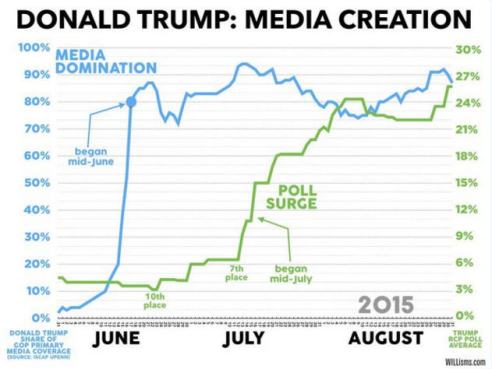
The fact is this:  since June 2015, when he announced his candidacy, Trump has received massive, probably unprecedented, levels of media attention.  Though he has spent less on media ads than his Republican opponents, he has benefited from coverage so vastly more intense that the other candidates, by comparison, have suffocated from lack of exposure.  When it comes to television coverage, for example, the primary election season at times has felt like a contest between Trump and silence.

trump media chart 2The same disproportion held true in digital media.

trump web chart edited

So the question we should pose is what the effects might be of such immoderate levels of attention.  Academic scholars, as it happens, have studied that question for decades.

According to media agenda-setting research, volume of discussion about a topic must climb above a specific awareness threshold before it can enter the consciousness of the public.  Below that level the topic simply doesn’t exist.  The charts show Ted Cruz and Marco Rubio, Trump’s chief opponents, drowning deep below the awareness threshold.  They and their messages were largely nonexistent to the public.

To the degree that volume of discussion rises above the awareness threshold, the topic discussed becomes increasingly important to the public.  A Palestinian victim of violence, for example, will appear more important than a Congolese victim, because media coverage will favor one and ignore the other.  If this principle is valid, and I believe it is, then in 2015 Donald Trump exploded into the consciousness of the American public as an event of cosmic significance:  a media Big Bang.  The political consequences were equally explosive and are not in doubt.
trump media chart 1

The media fixated on Trump for a pretty straightforward reason:  he represented high ratings and clickbait.  The news business is desperate for an audience and willing to trade whatever remains of its authority for that mess of potage.  The web is an eternal shouting match between sectarian war-bands hungry for attention:  the outrageous Trump, as object of digital frenzy, lifted their game to a whole new level.

Media people pumped the helium that elevated Donald Trump’s balloon, and they did so from naked self-interest.  This has been widely noted – by now, it’s the favorite Theory of Trump among the commentariat.  Although true so far as it goes, it begs a whole series of questions:  for example, just how did Trump become such a magnet for high ratings and clickbait?  Why the fascination?  What separates him so sharply from the other candidates, in the eyes of both the public and the media?

Here we come to the more speculative bit of my hypothesis.

In American politics, Trump is a peacock among dull buzzards.  That should be apparent to anyone with eyes to see.  The one discernible theme of his life has been the will to stand out:  to attract all eyes in the room by being the loudest, most colorful, most aggressively intrusive person there.  He has clearly succeeded.  The data above speaks to a world-class talent for self-promotion.  The media noticed, and just kept the cameras aimed at the extravagant performance – allowing Trump to represent himself to the public, a rare commodity for a politician.  And the public, in its mood of negation, its hostility to the established order, also noticed.  Trump lacked a political past.  He was glamorous and a winner – he looked different and acted different.

He also sounded different from other politicians.  The most significant factor separating Trump from the pack, I believe, is rhetorical.  Trump is a master of the nihilist style of the web.  His competitors speak in political jargon and soaring generalities.  He speaks in rant.  He attacks, insults, condemns, doubles down on misstatements, never takes a step back, never apologizes.  Everyone he dislikes is a liar, “a bimbo,” “bought and paid for.”  Without batting an eyelash, he will compare an opponent to a child molester.  Such rhetorical aggression is shocking in mainstream American politics but an everyday occurrence on the political web, where death threats and rape threats against a writer are a measure of the potency of the message.

The “angry voter” Trump supposedly has connected with is really an avatar of the mutinous public:  and this is its language.  It too speaks in rant, inchoate expression of a desire to remake the world by smashing at it, common parlance of the political war-bands that populate Tumblr, Gawker, reddit, and so many other online platforms.  By embracing Trump in significant numbers, the public has signaled that it is willing to impose the untrammeled relations of social media on the US electoral process.

I’m amazed by the rapidity with which this moment has arrived:  that we have come to it, however, will surprise no one who has been paying attention.

The Conquistador of Ruins

Trump has warned of “riots” if he is denied the nomination, but this seems unlikely.  The public that picked him up and now wields him like a sledgehammer against the status quo has never been deeply involved in his campaign.  There have been few spontaneous Trump events, websites, or online riffs – nothing equivalent to “Obama girl,” for example, or the social media activism that inspired protests in Spain, Israel, Venezuela, and elsewhere.  A Trump “occupation” sounds like a contradiction in terms.  Beyond the demographics of his supporters, Trump himself is the occupier:  he’s taken over all the available political space.  The news media aims its cameras at him, personally, because he’s the one who delivers the audience.  In social media, Trump has utilized his Twitter account, which had millions of followers before he became a candidate, to dominate digital buzz by the sheer outrageousness of his personal style.

The Trump uprising is less an eruption from below than an improvised performance, a demonstration of what is now possible for the public to accomplish.  Italy’s Five Star Movement, which became the second-largest political party behind a popular entertainer and blogger, Beppe Grillo, may serve as a reasonable parallel.

Put differently, the Trump candidacy is a test of democracy in America in 2016.  The public is agitated and willing to vote for this strange and formless man.  It is not directly engaged.  The structures of democracy, on the flip side, appear to be near collapse.  What should have been a brutal collision against unyielding institutions has turned into a strut over a landscape darkened by colossal ruins.  The news business is dying and desperate.  The primary elections are a crazy quilt of contradictory rules.  The Republican Party, by all appearances, is more of a historical memory than a living organization.

Donald Trump, anti-establishment wrecker, has been fortunate in his moment.  In 1960, 1980, even 2000, there would have been an establishment to oppose him.  In 2015, the putative establishment champion was Jeb Bush.  He had been away from elected office for nine years, “a longer downtime than any president elected since 1852 (and any candidate since 1924).”  The Republican worthies who endorsed and promoted him had been out of office for an average of 11 years.  If this once was the party’s establishment, it’s now a claque of political corpses.  The Bush candidacy, in brief, was a dance of the dead, and the Republican Party, at the national level at least, stands revealed as a ruinous graveyard over which nearly anyone, fitting any description, can lay claim.

The Revolt of the Public has been accused, with uncertain justice, of advancing a bleak vision of our political reality.  In that spirit, I want to conclude with a dismal observation.  At present, the leading candidates for the presidency are Trump and Hillary Clinton.  One is a reckless smasher of institutions.  The other is a fossilized specimen of the remote and protected elites.  Both are creatures of the society of distrust, divisive to an extreme degree.

So my observation is this:  regardless of who wins, the 2016 presidential election is shaping up to be just another episode in the grinding social conflict and disintegration of industrial forms that have defined our age.  Nothing much, I fear, will be decided.


31 Mar 00:03

Another Trump Triumph -- He Has The Left Defending the American Economic System

by admin

The American Left generally spends most of its time telling us how much better things are in Denmark or France.  I can't find a lot of reasons to like Trump, but he has apparently convinced the Left that they need to defend the American economic model against other countries.  This post by Kevin Drum at Mother Jones reasd more like what one might expect from Mark Perry at AEI.

"We're a poor country now." I wonder how many people believe that just because Donald Trump keeps saying it? In case anyone cares, the actual truth is in the chart on the right. There's not a single country in the world bigger than 10 million people that's as rich as the US.

I agree!   In fact, not only are American rich richer, but the American middle class is richer and the American poor are richer.  From an earlier post, here is the purchasing power of individuals across the income spectrum in the US vs. Denmark

click to enlarge

30 Mar 10:20

日本老年人犯罪率增加

by AnkhMorpork
步入老龄化社会的日本面临越来越多的老年人犯罪。犯罪数据显示,约35%的入店行窃罪行由60岁以上的人犯下。在这个年龄组内,40%的惯犯犯相同罪行的次数超过6次。一份报告认为,有充分理由怀疑,入店行窃犯罪案件高发,尤其代表了罪犯有意进入提供免费食物、住宿以及医疗服务的监狱。日本单身退休人员如果存款较少,其生活成本也比微薄的基本国家养老金(78万日元)高25%。而即使是偷窃一份200日元的三明治,就可以换取两年的有期徒刑,给国家带来840万日元的成本。


30 Mar 09:44

The Fourth Branch of Government is Out of Control

by A. Barton Hinkle

America has witnessed a massive shift in government authority, says George Washington University law professor Jonathan Turley—one that "has occurred without a national debate and certainly not a national vote." That shift has led to the de facto creation of a "fourth branch of government containing legislative, executive and judicial components but relatively little direct public influence."

Turley made those remarks in recent testimony before a House Judiciary subcommittee. His talk waded deeply into the weeds of legal history and precedent, but the upshot was this: By failing to rein in regulatory agencies when they overstep their bounds, the Supreme Court and Congress have allowed those agencies not merely to administer law, but to create it—and run roughshod over the public in the process.

It's hard to argue with the numbers: In one recent year alone, Congress passed 138 laws—while federal agencies finalized 2,926 rules. Federal judges conduct about 95,000 trials a year, but federal agencies conduct nearly 1 million. Put all that together and you have a situation in which one branch of government, the executive, is arrogating to itself the powers of the other two.

All of this has happened thanks largely to a 1984 Supreme Court case called Chevron. The Reagan administration chose to relax some air-quality regulations, and the Natural Resources Defense Council challenged the decision in court. The Supreme Court sided with the Environmental Protection Agency. It did so for commendable reasons: to avoid turning the courts themselves into policy-making bodies. Rather than decide whether the EPA was right or wrong, the high court deferred to the agency. This is judicial modesty.

But modesty can go too far. Federal law (the Administrative Procedure Act) requires courts to "hold unlawful" agency actions that are arbitrary or capricious, that violate the Constitution, or that exceed their authority. Turley and others contend Chevron has tilted the scales too far. He says it is "the administrative equivalent of Marbury v. Madison"—except that, unlike Marbury, it has made executive agencies rather than the courts the final arbiter of their own behavior.

The very day Turley was making that case, the Justice Department was taking steps to prove him right. It sent a "Dear Colleague" letter to state courts in all 50 states lecturing them about the harm done by the imposition of fines and fees on poor defendants, especially when those fines and fees become a source of revenue for local governments.

The letter laid out seven principles to guide the behavior of courts, and urged court officials "to review court rules and procedures within your jurisdiction to ensure that they comply with due process, equal protection, and sound public policy."

Let's stipulate right away that such practices are highly dubious and ripe for reform. That said, on what authority does an arm of the executive branch presume to dictate the activity of the judiciary—not only with regard to issues that are constitutional, such as due process and equal protection, but also with regard to those that aren't, such as public policy?

If you're sympathetic to the Justice Department's concerns—and all good people should be—it might be helpful to turn the circumstances around. Imagine for a moment that judges took it upon themselves to instruct the Justice Department about what sort of cases it ought to bring, based on the judges' opinions about "sound public policy." Whatever the merits of the argument, it's clear the judges would have no business making it.

Even more pernicious abuse has come from the Education Department, beginning with a 2011 "Dear Colleague" letter to colleges and universities that shifted the burden of proof in sexual harassment cases. Schools across the country promptly followed the directive, even though there have been serious questions about the legal basis for issuing the letter in the first place.

When pressed by Sen. Jim Lankford (R-Okla.) of Oklahoma, the Education Department offered a response that was so non-responsive Hans Bader, a former Office of Civil Rights attorney himself who has written extensively on the issue, concluded that it "simply repeated the same question-begging rationalization it gave (before)" and failed to "address the criticisms of its letter made by many lawyers and law professors."

Those law professors include 16 from the University of Pennsylvania. In an open letter last year, they criticized the Education Department not only for violating basic standards of due process, but also because "the federal government has sidestepped the usual procedures for making law."

One final example—unrelated to Chevron, but indicative of the broader problem: Earlier this month the U.S. military killed about 150 people at an al-Shabab training camp in Somalia. The Obama administration justified the attack by citing the 15-year-old Authorization for Use of Military Force—against those who were responsible for the attacks on 9/11. Al-Shabab emerged from the Somali Council of Islamic Courts that took over southern Somalia... in 2006. In 585 pages, the 9/11 Commission Report mentions al-Shabab not even once.

The Constitution gives to Congress the power to declare war—a point Virginia Sen. Tim Kaine (D) has pressed relentlessly—just as it gives to Congress the power to write the laws. These days the Executive Branch is doing both far more than the Founders intended—or the public knows. Those who do so are unelected, unaccountable, and unconstrained. For any democratic system, that is most unhealthy.

This column originally appeared in the Richmond Times-Dispatch.

30 Mar 08:01

Labor Market Rigidity and the Disaffection of European Muslim Youth

by Alex Tabarrok

In Belgium high unemployment and crime-ridden Muslim ghettos have fomented radicalism but as Jeff Jacoby writes:

Muslims in the United States…have had no problem acclimating to mainstream norms. In a detailed 2011 survey, the Pew Research Center found that Muslim Americans are “highly assimilated into American society and . . . largely content with their lives.” More than 80 percent of US Muslims expressed satisfaction with life in America, and 63 percent said they felt no conflict “between being a devout Muslim and living in a modern society.” The rates at which they participate in various everyday American activities — from following local sports teams to watching entertainment TV — are similar to those of the American public generally. Half of all Muslim immigrants display the US flag at home, in the office, or on their car.

Jacoby, however, doesn’t explain why these differences exist. One reason is the greater flexibility of American labor markets compared to those in Europe.

Institutions that make it more difficult to hire and fire workers or adjust wages can increase unemployment and reduce employment, especially among immigrant youth. Firms will be less willing to hire if it is very costly to fire. As Tyler and I put it in Modern Principles, How many people will want to go on a date if every date requires a marriage? The hiring hurdle is especially burdensome for immigrants given the additional real or perceived uncertainty from hiring immigrants. One of the few ways that immigrants can compete in these situations is by offering to work for lower wages. But if that route is blocked by minimum wages or requirements that every worker receive significant non-wage benefits then unemployment and non-employment among immigrants will be high generating disaffection, especially among the young.

Huber, for example, (see also Angrist and Kuglerfinds:

Countries with more centralized wage bargaining, stricter product market regulation and countries with a higher union density, have worse labour market outcomes for their immigrants relative to natives even after controlling for compositional effects.

The problem of labor market rigidity is especially acute in Belgium where the differences between native and immigrant unemployment, employment and wages are among the highest in the OECD. Language difficulties and skills are one reason but labor market rigidity is another, as this OECD report makes clear:

Belgian labour market settings are generally unfavourable to the employment outcomes of low-skilled workers. Reduced employment rates stem from high labour costs, which deter demand for low-productivity workers…Furthermore, labour market segmentation and rigidity weigh on the wages and progression prospects of outsiders. With immigrants over-represented among low-wage, vulnerable workers, labour market settings likely hurt the foreign-born disproportionately.

…Minimum wages can create a barrier to employment of low-skilled immigrants, especially for youth. As a proportion of the median wage, the Belgian statutory minimum wage is on the high side in international comparison and sectoral agreements generally provide for even higher minima. This helps to prevent in-work poverty…but risks pricing low-skilled workers out of the labour market (Neumark and Wascher, 2006). Groups with further real or perceived productivity handicaps, such as youth or immigrants, will be among the most affected.

In 2012, the overall unemployment rate in Belgium was 7.6% (15-64 age group), rising to 19.8% for those in the labour force aged under 25, and, among these, reaching 29.3% and 27.9% for immigrants and their native-born offspring, respectively.

Immigration can benefit both immigrants and natives but achieving those benefits requires the appropriate institutions especially open and flexible labor markets.

The post Labor Market Rigidity and the Disaffection of European Muslim Youth appeared first on Marginal REVOLUTION.

30 Mar 06:00

Adelanto: The Desert Town Turning From Prisons to Pot to Save Itself From Bankruptcy

by Zach Weissmueller

Adelanto, California, population 32,000, is a little city in the middle of the desert, the kind of place you pass by without even noticing on the drive from Los Angeles to Las Vegas.

Like many of the cities in sprawling San Bernardino county, it faces severe financial problems, teetering on the edge bankruptcy. For a time, there was even talk of dissolving Adelanto and absorbing it into its larger neighbor Victorville.

But then, along came Johnny “Bug” Woodard and his big idea: Save Adelanto by legalizing marijuana. Woodard, a self-described gun-toting Tea Party Republican, decided to run for city council on the promise of turning around the town's finances by allowing the mass cultivation of cannabis within city limits.

"I had already picked out some property in Arizona to move my family to Arizona, because I really didn't think I'd be elected," says Woodard. "I mentioned the 'M-word.' Mention the 'M-word': political suicide."

But something surprising happened: Woodard won his race, defeating an incumbent and entering the office with a mandate. Adelanto's voters had booted out most of the previous city council and the mayor after they had tried to patch the budget with a utility tax hike, a wildly unpopular move in a city with an unemployment rate above 10 percent. Woodard's outside-the-box proposal seemed to make sense for a desert town with lots of cheap land and giant warehouses that hold everything from windmill turbines to predator drones.

The victory at the polls was only the beginning of the political battle, though, as entrenched local interest groups (such as the local school district, the sheriff's department, and representatives from the three prisons that provide many of the jobs in Adelanto) all lined up against his proposal. City council meetings could stretch to midnight and beyond as Woodard's proposal underwent eight months of heated debate.

The other council members studied the issue and the new mayor visited Colorado to check out its legal pot situation. Then, slowly but surely, everyone came around and supported Woodard’s plan. The ordinance passed with a 4-1 vote, positioning Adelanto as the first Southern California city to legalize marijuana cultivation on a mass scale. And already, investors are flocking to buy up the land, generating a large spike in real estate prices.

"For years and years our city was treated as a bad stepchild by all these other cities, and now we have an opportunity, if we do this right, to be the ones they look to. It's going to be a role reversal," says Woodard.

For a glimpse at what's going on in Adelanto, watch the video above. Scroll down for downloadable versions. And subscribe to Reason TV's YouTube channel for daily content like this.

Approximately 6 minutes. Produced by Zach Weissmueller. Camera by Alex Manning and Weissmueller. Music by Josh Woodward, The Rope River Blues Band, and Silent Partner.

30 Mar 05:16

Who’d a-thunk it? Uber is way more efficient than traditional taxis?

by Mark Perry
Taxi2

I’ve written before about some obvious signs of widespread inefficiency in the traditional taxi market, as illustrated in the photo above that show the dozens of taxis that line up every day at The Mayflower Hotel in DC (and at every other major hotel in DC) and sit idly for very long periods of time waiting for passengers. In this post from last August “Why are a dozen taxis lined up every day at The Mayflower Hotel?” I wrote:

In a dynamic Uber world, the available drivers respond to demand, and are directed by Uber to areas where there are a lot of passengers. And when demand is really high, surge pricing goes into effect to attract even more drivers to areas of high demand. But when there are always a dozen taxis sitting around idly at The Mayflower (and most other DC hotels), that just seems like an outdated form of transportation inefficiency, an inefficient excess supply, a failure to balance supply and demand, and something that would never happen in a ride-sharing world of much greater transportation efficiency.

There’s now evidence of just how inefficient legacy taxis are compared to UberX when measured by two capacity utilization rates: a) the fraction of time taxi and UberX drivers have a fare-paying passenger in their cars and b) the percentage of total miles driven by taxi and UberX drivers with a passenger in their cars. The anecdotal evidence of taxi inefficiency I observe almost every day in DC is now confirmed more formally in a new NBER research paper by Judd Cramer and Alan B. Krueger titled “Disruptive Change in the Taxi Business: The Case of Uber,” here’s the abstract:

In most cities, the taxi industry is highly regulated and utilizes technology developed in the 1940s. Ride sharing services such as Uber and Lyft, which use modern internet-based mobile technology to connect passengers and drivers, have begun to compete with traditional taxis. This paper examines the efficiency of ride sharing services vis-à-vis taxis by comparing the capacity utilization rate of UberX drivers with that of traditional taxi drivers in five cities. The capacity utilization rate is measured by the fraction of time a driver has a fare-paying passenger in the car while he or she is working, and by the share of total miles that drivers log in which a passenger is in their car. The main conclusion is that, in most cities with data available, UberX drivers spend a significantly higher fraction of their time, and drive a substantially higher share of miles, with a passenger in their car than do taxi drivers. Four factors likely contribute to the higher capacity utilization rate of UberX drivers: 1) Uber’s more efficient driver-passenger matching technology; 2)the larger scale of Uber than taxi companies; 3) inefficient taxi regulations; and 4) Uber’s flexible labor supply model and surge pricing more closely match supply with demand throughout the day.

From the Findings section of the paper:

Figure 1 (reproduced above to the right of the photo) summarizes estimates of the mileage-based capacity utilization measure for Los Angeles and Seattle, the only two cities for which we have been able to obtain information on taxi drivers’ miles. In Los Angeles, taxi drivers have a passenger in the car for 40.7% of the miles they drive, while UberX drivers have a passenger in the car for 64.2% of their miles, resulting in a 58% higher capacity utilization rate for UberX drivers. In Seattle, UberX drivers achieve a 41% higher capacity utilization rate than taxis in terms of share of miles driven with a passenger in the car [39.1% for taxis vs. 55.2% for UberX].

And when capacity utilization is measured by time with a passenger:

Across the five cities (LA, NYC, Seattle, San Francisco and Boston), UberX drivers have a passenger in their car around half the time that they are working, whereas taxi drivers have a passenger in their car anywhere from 32% of the time in Boston to nearly half the time in New York City.
From the paper’s Conclusion:
There are several possible reasons why UberX drivers may achieve significantly higher capacity utilization rates than taxi drivers. First, Uber utilizes a more efficient driver-passenger matching technology based on mobile internet technology and smart phones than do taxis, which typically rely on a two-way radio dispatch system developed in the 1940s or sight-based street hailing. Second, in most cities Uber currently has more driver partners on the road than the largest taxi cab company. Apart from the technology, there are network efficiencies from scale, as pure chance would likely result in an Uber driver being closer to a potential customer than a taxi driver from any particular company given the larger scale of Uber. Third, inefficient taxi licensing regulations can prevent taxi drivers who drop off a customer in a jurisdiction outside of the one that granted their license from picking up another customer in that location. Fourth, Uber’s flexible labor supply model and surge pricing probably more closely matches supply with demand during peak demand hours and other hours of the day.

The concluding section of the paper also raises some important implications of Uber’s significantly higher capacity utilization rates compared to traditional taxis: a) Uber’s greater efficiency translates to lower fares (e.g. UberX drivers in LA could charge 37% less than taxis and generate the same revenue per hour) and b) greater operational efficiency translates to less traffic congestion and less wasteful fuel consumption in cities like LA, where for every mile driven by taxis with a passenger in the car, they travel 1.46 miles without a passenger; the comparable figure for UberX drivers is 0.56 miles.

Finally, the authors’ findings also have implications for occupational licensing laws, which are frequently impossible to repeal directly due to the entrenched power of politically connected, government-protected industry cartels like Big Taxi. However, new innovative technologies like Uber and Lyft as one example, are bringing about disruptive changes that are weakening (and could eventually eliminate) inefficient, unnecessary and counterproductive occupational licensing laws that for many, many generations were impervious to change.

Related: Beyond their much greater operational efficiency which lowers prices and reduces congestion, ride-sharing services are also providing other unintended side-benefits. For example, Uber and Lyft are being given credit for encouraging redevelopment of neighborhoods around downtown Nashville and helping to revitalize the city’s urban core, see story here,  here’s a quote: “What it’s doing for the neighborhoods near downtown Nashville is amazing. This is changing the game,” said developer Khira Turner.

30 Mar 01:10

The Plan to Create a Giant, Privately Funded Nature Reserve by Selling Beef

by ReasonTV

Many Americans trace the modern conservation movement back to President Theodore Roosevelt, known for his love of the outdoors and for creating the U.S. Forest Service and the national parks system.

But what if government isn’t the only, or the best, entity to protect America’s natural wonders?

The American Prairie Reserve is a nonprofit group that wants to establish the largest nature reserve in the lower 48 states and it aims to do so with private funding. So far, American Prairie Reserve owns or leases more than 300,000 acres with a goal of stitching together 3.5 million acres of private and federal land across to create a reserve 1.5 times the size of Yellowstone National Park. And they believe that their unique approach will reduce the tension with local ranchers and farmers that national parks often experience.

"Currently, wildlife has no economic value to ranchers and, as such, the ranchers don't want them around," says Pete Geddes, managing director of American Prairie Reserve.

But American Prairie Reserve aims to fix that problem with its Wild Sky Beef program. Wild Sky is a brand associated with a for-profit company, and the proceeds from its profits go towards funding incentives for ranchers to engage in wildlife-friendly practices such as creating gaps in their fences for herd animals to pass through, planting native grasses, and allowing prairie dogs to establish colonies on their property. The more benchmarks the ranchers meet, the bigger the payout.

"As we're successful and we gain more attention over time, you'll see other groups trying to put this together at a much larger scale," says Geddes.

Watch the video above to learn more about American Prairie Reserve and Wild Sky Beef. Visit http://reason.com/reasontv for downloadable versions. Subscribe to Reason TV's YouTube channel for daily content like this.

Approximately 5 minutes. Produced by Zach Weissmueller. Field produced by Alex Manning and Paul Detrick. Camera by Manning. Prairie and wildlife footage by Gib Myers. Music by Adam Selzer, Michael Howard, Waylon Thornton, and Kitaygorod.
29 Mar 15:12

How Hollywood Changes Movies to Appease Foreign Censors

To profit from China's huge movie market, Hollywood producers have to get past the country's censors. And the censors have some suggestions.
28 Mar 07:33

Honey, I Shrunk Chicago

by Aaron M. Renn
The Illinois Supreme Court refuses to let anyone fix the pension crisis, and people are leaving.