Shared posts

17 May 15:09

Why Ayn Rand is not, and ought not be, taken seriously

by Artir

EDIT: Read beyond the first paragraph! Also, read this to understand how to reject something without reading it.

I have never  read a piece of work from Ayn Rand, beyond some paragraphs and extracts here and there on the internet. I never gave Objectivism, her system of thought, much importance.

But there are people -Objectivists- who think she is one of the greatest, or the greatest, philosopher ever (along with Aristotle, they’ll add). Sometimes, Objectivists tell people who have not read Rand to read her, so that they can become rational, and abandon their “non-Objectivist, mystical beliefs”.

I haven’t read anything from Rand because I consider that the effort won’t be worth it, as every time I’ve read something from Objectivists, I have not been persuaded that there is much to be learned from Rand. And also, there exists a critique available on the net that demolishes Objectivism. I will give reasons later why I believe the critique succeeds.

Recently, I read the Stanford Encyclopedia of Philosophy’s entry on Rand. The entry is not written by Rand haters, mind you. Roderick T. Long and Neera K. Badwhar also have read Rand’s work, and in their own writings seem sympathetic to her. And yet, they admit:

Whereas Rand’s ideas and mode of presentation make Rand popular with many non-academics, they lead to the opposite outcome with academics. She developed some of her views in response to questions from her readers, but never took the time to defend them against possible objections or to reconcile them with the views expressed in her novels. Her philosophical essays lack the self-critical, detailed style of analytic philosophy, or any serious attempt to consider possible objections to her views. Her polemical style, often contemptuous tone, and the dogmatism and cult-like behavior of many of her fans also suggest that her work is not worth taking seriously.

 Further, understanding her views requires reading her fiction, but her fiction is not to everyone’s taste. It does not help that she often dismisses other philosophers’ views on the basis of cursory readings and conversations with a few philosophers and with her young philosophy student acolytes. Some contemporary philosophers return the compliment by dismissing her work contemptuously on the basis of hearsay. Some who do read her work point out that her arguments too often do not support her conclusions. This estimate is shared even by many who find her conclusions and her criticisms of contemporary culture, morality, and politics original and insightful. It is not surprising, then, that she is either mentioned in passing, or not mentioned at all, in the entries that discuss current philosophical thought about virtue ethics, egoism, rights, libertarianism, or markets.

See also this on why she is not taken seriously.

Here’s a general criticism of Ayn Rand’s Objectivism: Why I am not an Objectivist and Critique of The Objectivist Ethics. There are things that Objectivists say that are true, but that does not make the whole thing true. There is a huge difference between things like A=A, existence exists, or consciousness perceives reality, and that only serving our self-interest is good, and altruism is bad. The problem isn’t all of the conclusions, either: yes, reality is objective, and capitalism is great, and one should be rational. The problem is with some conclusions, and with the arguments for those.

The author of that critique is Michael Huemer, a philosopher who has read the key pieces of the randian opus, and rejected it. From his writings, it can be inferred that he has read the Introduction to Objectivist Epistemology, Objectivism, the Philosophy of Ayn Rand (Peikoff, 1991), The Virtue of Selfishness, and the Introduction to Objectivist Epistemology.

He has published not one, not two but six articles in the Journal of Ayn Rand studies (Huemer, 2004a, Huemer 2002, Huemer 2004b, Huemer 2005, Huemer 2007 ).

From these papers, it can be shown that he has read Atlas Shrugged, Capitalism: the Unknown Ideal, The Fountainhead, and The Ayn Rand Lexicon.

From this Cato Unbound issue, on Rand’s thought, we learn that he has also read Philosophy: Who Needs it.

He participated in a debate about Rand’s ethics (here), and the Objectivists themselves praised Huemer’s understanding of Objectivism:

Many of us may disagree with things he [Huemer] said, but he did far better than most other academics who try to analyze and critique Objectivism. Just open most any of the secondary literature on Rand written more than five years ago and you’ll see what I mean. I went up after the debate and extended him my thanks. I think others should do so, as well, perhaps by sending him emails thanking him for his participation.

Huemer did not misrepresent the Objectivist position once in the entire debate, and displayed a genuine understanding of its basic principles. That is rare and commendable. Huemer is in the unique position of being a professional philosopher who takes Objectivism seriously, even though he disagrees with it. … From what I’ve seen so far, we need more critics of Objectivism like Huemer.

Finally, as a philosopher, he has read works from Aristotle, Kant, and most philosophers you probably think are relevant for this discussion.

The fact that Huemer believes that, and that the rest of the philosophers believe that, and that there is a publicly available critique, is very strong evidence against Objectivism.

We then have Jason Brennan who points out a few particular mistakes of Rand: That she makes false claims due to not relying on empirical evidence when it is available, that she does not endorse what are logical conclusions of her own views, and that he misrepresents other thinkers, chiefly Immanuel Kant. Huemer expands on that in his previously linked critique:

Rand seriously misrepresents the history of ethics. Essentially, she leads the reader to believe that there have been only two alternative views in ethics: (a) that moral knowledge comes by mystical revelations from God, and (b) that moral principles are arbitrary conventions. Either way, ethics is regarded as “the province of the irrational.” One other position is mentioned: that of Aristotle, who allegedly based ethics on what noble and wise people choose to do but ignored the questions of why they chose to do it or why he thought they were noble and wise. Next to these alternatives, Rand’s theory looks almost reasonable by comparison.

However, the above is a gross caricature of the history of ethics, and Rand makes no effort to document her claims with any citations.

In short, Rand draws plausibility for her position by attacking straw men.

Now, perhaps the critiques linked above have been answered by Objectivists. Here there are some of the responses:

Since they do not convince me and some of them are actually pretty bad, I maintain that Huemer’s critique stands, and thus my belief that Rand should not be taken seriously remains, even when I haven’t read anything she has written.

This conclusion, however, has to be qualified. Should we reject views just because others with good qualifications say they ought to be rejected, and there are no critiques of their arguments for the rejections? Usually, yes. Such combination of factors is a very good reason to reject something without reading about it. This is how we generally go about in our life: rarely we go to the depths of Physics’ journals to believe or disbelieve claims that physicists make. If a lot of people who have studied a subject for a long time agree on something, that is evidence for that something. It is not ultimate evidence, but the burden of proof is on you is you want to go against the consensus.

So defenders of ideas that are out of the consensus of relevant experts should take the best critiques that have been made against them, and refute them. It would also be nice for them to provide a brief introduction to their ideas, to reduce the cost for others of acquiring information about those ideas.

My guess about the popularity of Objectivism is that it provides a unified body of thought that answers many philosophical questions. People like unified bodies of thought. There are other thinkers around who have built philosophical systems and who have lots of fans, and they have some similarities in their way of argument, which in some cases ends up in regurgitating almost pre-made sentences all the time.

But philosophy doesn’t work like that. Go to the Stanford Encyclopedia of Philosophy, and see how much debate and richness you have for every single concept. It’s hard to believe that a single person can come out of nowhere, and reject all of that without giving good arguments for the rejection, and then proceed to lay out a system of their own.

Objectivists: Publish a good rebuttal of Huemer’s critique, or stop being Objectivists.


04 May 05:35

The US Has The Best Rail System in the World, and Matt Yglesias Actually Pointed Out the Reason

by admin

Yglesias has a very good article on why passenger rail is not a bigger deal in the US.   In it, he says this (emphasis added):

Instead the issue is that the dismal failure of US passenger rail is in large part the flip side of the success of US freight rail. America's railroads ship a dramatically larger share of total goods than their European peers. And this is no coincidence. Outside of the Northeast Corridor, the railroad infrastructure is generally owned by freight companies — Amtrak is just piggybacking on the spare capacity.

It is a short article, so it does not go into more depth than this, but I have actually gone further than this and argued that the US freight-dominated rail system is actually far greener and more sensible than the European passenger system.  As I wrote years ago at Forbes:

The US rail system, unlike nearly every other system in the world, was built (mostly) by private individuals with private capital.  It is operated privately, and runs without taxpayer subsidies.    And, it is by far the greatest rail system in the world.  It has by far the cheapest rates in the world (1/2 of China’s, 1/8 of Germany’s).  But here is the real key:  it is almost all freight.

As a percentage, far more freight moves in the US by rail (vs. truck) than almost any other country in the world.  Europe and Japan are not even close.  Specifically, about 40% of US freight moves by rail, vs. just 10% or so in Europe and less than 5% in Japan.   As a result, far more of European and Japanese freight jams up the highways in trucks than in the United States.  For example, the percentage of freight that hits the roads in Japan is nearly double that of the US.

You see, passenger rail is sexy and pretty and visible.  You can build grand stations and entertain visiting dignitaries on your high-speed trains.  This is why statist governments have invested so much in passenger rail — not to be more efficient, but to awe their citizens and foreign observers.

But there is little efficiency improvement in moving passengers by rail vs. other modes.   Most of the energy consumed goes into hauling not the passengers themselves, but the weight of increasingly plush rail cars.  Trains have to be really, really full all the time to make for a net energy savings for high-speed rail vs. cars or even planes, and they seldom are full.  I had a lovely trip on the high speed rail last summer between London and Paris and back through the Chunnel — especially nice because my son and I had the rail car entirely to ourselves both ways.

The real rail efficiency comes from moving freight.  As compared to passenger rail, more of the total energy budget is used moving the actual freight rather than the cars themselves.  Freight is far more efficient to move by rail than by road, but only the US moves a substantial amount of its freight by rail.    One reason for this is that freight and high-speed passenger traffic have a variety of problems sharing the same rails, so systems that are optimized for one tend to struggle serving the other.

Freight is boring and un-sexy.  Its not a government function in the US.  So intellectuals tend to ignore it, even though it is the far more important, from and energy and environmental standpoint, portion of transport to put on the rails. ....

I would argue that the US has the world’s largest commitment to rail where it really matters.  But that is what private actors do, make investments that actually make sense rather than just gain one prestige (anyone know the most recent company Warren Buffet has bought?)  The greens should be demanding that the world emulate us, rather than the other way around.  But the lure of shiny bullet trains and grand passenger concourses will always cause some intellectuals to swoon.

Which would you rather pounding down the highway, more people on vacation or more big trucks moving freight?  Without having made an explicit top-down choice at all, the US has taken the better approach.

03 May 13:20

When Everyone Goes to College: a Lesson From South Korea

by Stephen Hsu
South Korea leads the world in college attendance rate, which is approaching 100%. This sounds great at first, until you consider that the majority of the population (in any country) lacks the cognitive ability to pursue a rigorous college education (or at least what used to be defined as a rigorous college education). Chronicle of Higher Education: ... Seongho Lee, a professor of education at
03 May 05:39

Why European women have few babies

by Matthias Doepke, Fabian Kindermann
Europe is in the midst of a major demographic crisis, with many countries facing ultra-low fertility rates. This column uses survey data from 19 European countries to show how low fertility can be traced to disagreement within couples about having babies. In low-fertility countries, it is usually the women who bear most of the burden of childbearing, and who veto having more babies. Fertility can be raised by policies that specifically lower cost to women of childcare, whereas general subsidies for childbearing are much less effective.
28 Apr 15:22

Genetics of racial differences in intelligence

by James Thompson


As far as I know, nobody is funding studies of the genetics of racial differences in intelligence. Although research is being carried out on the genetics of intelligence generally, and the genetics of different racial groups generally, for some reason nobody makes the link.

An exception is Davide Piffer, who as far back as 2014 suggested a possible approach: find any of the genetic variants associated with intelligence, however weak and inconsistent they may be, and then look up the published literature to see how frequent those variants are in any racial group. If there are many such positive variants in a group they will be bright, and if there are fewer such positive variants they will be less bright.

Here is the first account I gave of Piffer’s work in 2014:

http://drjamesthompson.blogspot.co.uk/2014/05/lci14-davide-piffer-human-polygenic.html

So far, this post has drawn no comments. However, it might turn out to be a significant step forwards.

The next account was in 2015 showing the pattern based on 9 GWAS hits:

http://drjamesthompson.blogspot.co.uk/2015/09/gwas-hits-and-country-iq.html

Now, in the wake of the most recent publication by Davies 2016 which I covered in my last post

http://drjamesthompson.blogspot.co.uk/2016/04/genetics-of-mental-ability-greater-power.html

Davide Piffer has taken the data from that very paper in order to extend his work on racial differences.

Recent polygenic selection for educational attainment

The genetic variants identified by two large GWAS of educational attainment were used to test a polygenic selection model.

Average frequencies of alleles with positive (Beta) effect on the phenotype (polygenic scores) were compared across populations and racial groups using data from 1000 Genomes and ALFRED. Strong correlations between polygenic scores and population IQ were found (r>0.8). Moreover, the polygenic score obtained from the two independent GWAS exhibited a strong correlation (r= 0.83), even after pruning for linkage disequilibrium.

Factor analysis revealed that most alleles loaded on a single factor, which in turn was strongly correlated to population IQ.

Polygenic and factor scores survived control for phylogenetic autocorrelation, although the latter’s net effect on population was stronger (Betas= 0.361 and 0.861, respectively).

Results obtained from ALFRED data were similar and revealed a peak in polygenic and factor scores among East Asians (60.8% and 1.06, respectively) and a nadir among Africans and Native Americans (44.1% and 0.493).

Geographic distance from Eastern Africa (assuming an origin of modern humans there) was only weakly predictive of factor and polygenic scores (r= 0.21-0.29).

The aim of this study is to replicate the studies by Piffer (2015, 2013) that educational attainment and cognition GWAS hits have different frequencies across populations and thus, were subject to different selection pressures. To this end, the hits from the latest GWAS on educational attainment (Davies et al., 2016) will be used in the analysis. This GWAS was carried out using the UK Biobank sample (N=100K+). Over a thousand SNPs reached genome-wide significance (P< 5 x 10⁻⁸), but after controlling for linkage disequilibrium (Genotypes were LD pruned using clumping to obtain SNPs in linkage equilibrium with an r2<0.25 within a 200 bp window), a few independent signals were identified (Davies et al., 2016).

https://figshare.com/articles/Polygenic_selection_on_educational_attainment/3175522/1

The boxplot below shows the major continental groups as derived from the 1000 genomes data.

  image


Population

Education attainmentP.S, I.S.(Davies et al., 2016). N=14

All_Ed_Att_2016. N=942

PS All Ind. (N=16)

Factor All Ind.

IQ

Afr.Car.Barbados

0.419

0.411

0.361

-1.385726617

83

US Blacks

0.447

0.428

0.387

-1.040795929

85

Bengali Bangladesh

0.516

0.566

0.461

-0.009509494

81

Chinese Dai

0.610

0.652

0.564

1.229103674


Utah Whites

0.493

0.467

0.461

0.385060759

99

Chinese, Bejing

0.671

0.682

0.636

1.614207102

105

Chinese, South

0.648

0.674

0.606

1.399490512

105

Colombian

0.500

0.512

0.462

0.155020855

83.5

Esan, Nigeria

0.416

0.417

0.362

-1.517446756

71

Finland

0.560

0.560

0.524

0.873423777

101

British, GB

0.526

0.494

0.499

0.568096086

100

Gujarati Indian, Tx

0.498

0.550

0.457

0.064904594


Gambian

0.438

0.398

0.381

-1.3799435

62

Iberian, Spain

0.512

0.488

0.481

0.4310518

97

Indian Telegu, UK

0.510

0.583

0.457

0.030182344


Japan

0.652

0.679

0.625

1.422186914

105

Vietnam

0.618

0.642

0.579

1.25233893

99.4

Luhya, Kenya

0.425

0.428

0.372

-1.438642624

74

Mende, Sierra Leone

0.416

0.421

0.364

-1.40422492

64

Mexican in L.A.

0.499

0.555

0.455

0.01771732

88

Peruvian, Lima

0.477

0.559

0.430

-0.00789958

85

Punjabi, Pakistan

0.511

0.564

0.475

-0.049972973

84

Puerto Rican

0.489

0.480

0.451

0.026710407

83.5

Sri Lankan, UK

0.506

0.564

0.454

0.070996352

79

Toscani, Italy

0.501

0.486

0.458

0.265676967

99

Yoruba, Nigeria

0.421

0.417

0.372

-1.572005998

71


The analysis of independent signals from two different GWAS revealed a significant overlap across two genomic datasets. Using ALFRED and 1000 Genomes, the Rietveld et al. (2013) and Davies et al. (2016) polygenic scores were strongly correlated (r= 0.62 and 0.83, respectively). Both sets of GWAS hits were strong predictors of population IQ. The polygenic score (N=14) computed from the new independent hits (Davies et al., 2016) had a strong correlation to population IQ (r= 0.82). Similar correlation was observed for the polygenic score created by combining all the independent hits (free of LD) from the two publications (N=16): r=0.843 with population IQ.

Factor analysis produced a factor that even more strongly correlated to population IQ (r= 0.89) and survived control for spatial autocorrelation. Indeed, the predictive value of this factor was not affected by partialling out Fst distances. The high Beta value (B=0.82) and the null effect of Fst distances (B= -0.16) are suggestive of polygenic selection on these SNPs, independent of noise due to migrations or drift.

Comparisons of mean frequencies across racial groups via one-way ANOVA produced either non significant or marginally significant results, but the addition of new GWAS hits is needed to provide a definitive picture.

A limitation of this study is the reliance on GWAS hits for a complex phenotype such as educational attainment, which shares the majority of additive genetic variation with general intelligence, but also other personality and health-related traits (Krapohl et al., 2014 and 2015).

Another more obvious limitation is the small number of (independent) SNPs used for this analysis. More GWAS of intelligence or educational attainment are needed to shed light on worldwide patterns of polygenic selection on cognitive abilities.

As the author says, this can only be considered a first step. However, the method has the merit of simplicity: if some variations in the genetic code are associated with intelligence, then groups that have more of those variations ought to be more intelligent. If they are not, then the link between these variants and intelligence can be called into question. Of course, it is possible that these are not the most important variants, and that they differ between racial groups for trivial reasons. If so, then the observed associations are an unusual coincidence. I think this is a method to watch. When even more genetic signals of intelligence are identified, however weak and tentative, this approach can be put to the test, and then improved or discarded.


28 Apr 02:55

After years of conjecture – Cash in the News

Our basic income trial continued to make headlines this week after our announcement in Slate two weeks ago. Cofounder Michael Faye spoke with Andrew Flowers of FiveThirtyEight, telling him, "To be honest, a full long-term universal basic income has never been tried, let alone rigorously evaluated." In Fast Company, Ben Schiller reports: "After years of conjecture about the possible merits and demerits of UBI, we could finally get some data to go on."


GIVEDIRECTLY IN THE NEWS AND BLOGS

1. What Would Happen If We Just Gave People Money?
FiveThirtyEight, Andrew Flowers, April 25, 2016
GiveDirectly, which is launching the basic income pilot in Kenya, has previously run RCTs to examine the effects of giving cash unconditionally; those experiments have shown that cash works wonders, and the peer-reviewed results have won over economists. The children of recipients are healthier and get more education; adults earn more income by using the cash to plan investments over a longer horizon; spending on alcohol and other vices — a worry some critics of cash grants raise — stays flat or even declines.

2. This charity is about to provide a basic income to people in Kenya, for 10 years
Global Citizen, Tom Murphy, April 25, 2016
Roughly 6,000 people in Kenya will get money for at least the next 10 years - no strings attached. The program is a new experiment launched by GiveDirectly, a charity that does what its name says, gives people money in Kenya and Uganda. There are no conditions on how the money is spent, people will get the income supplement and spend it as they see fit.
  
3. Charity To Amp Up Direct Aid Mission In Impoverished East Africa
NPR's Weekend Edition, Rachel Martin, April 24, 2016
The charity GiveDirectly announced plans to give 6000 people living in extreme poverty a guaranteed income for a decade. NPR's Rachel Martin speaks with co-founder Michael Faye about the project.
  
4. We'll Soon Have Hard Evidence About The Benefits Of A Universal Basic Income
Fast Company, Ben Schiller, April 20, 2016
GiveDirectly's cofounder Michael Faye says the advantages of experimenting in Africa start with costs. The nonprofit's $30 million pilot will cost about 30 times less than the equivalent study in the U.S. or Europe. Up to 15,000 people will be involved, with 6,000 getting the full basic income amount (probably about $1 a day) and the rest getting one of two variants: the same amount over a shorter period (two or five years, say) and a smaller amount.

5. To Test Basic Income, 6,000 People Will Get a Salary Just for Being Alive
Mic, Jack Smith IV, April 19, 2016
The concept of basic income is gathering steam. It's not too surprising that people would be excited about the idea of everybody getting a paycheck just for being alive. What's extraordinary is that some people are willing to pay those salaries. GiveDirectly, a charity that sends cash to people in Kenya and Uganda, is raising $30 million to fund a program that will give 6,000 Kenyans a basic living wage, no matter what, for 10 years, the Verge reported.

6. What If We Just Gave Poor People a Basic Income for Life?
AEA in the news, April 15, 2016
An article in Slate by the co-founders of GiveDirectly cited a study from this month’s issue of the American Economic Review. In "The Long-Run Impact of Cash Transfers to Poor Families," the authors study the effects of the Mothers’ Pension welfare program active in several U.S. states between 1911 and 1935. Using several decades’ worth of census and death records, they find that the male children of mothers who were accepted into the program ended up living a full year longer and obtaining a third of a year more schooling on average than male children of mothers who were rejected.


CASH IN INTERNATIONAL AID

7. ​When disaster relief brings anything but relief
CBS News, Scott Simon, April 24, 2016
"And cash donations enable relief organizations to purchase supplies locally, which ensures that they're fresh and familiar to survivors, purchased in just the right quantities, and delivered quickly. And those local purchases support the local merchants, which strengthens the local economy for the long run."

8. Cash transfers on the rise
The Fiji Times Online, Rasmus Schojoedt, April 21, 2016
Despite increasing evidence of their value, the use of cash transfers in emergencies is still limited. ODI's Paul Harvey estimated in a recent article in the Guardian, as well as a guest piece on Duncan Green's "From Poverty to Power" blog, that only 6 per cent of humanitarian aid is currently provided in the form of cash transfers. So far there seem to be more appetite for writing about cash transfers in emergencies than actually doing it.


BASIC INCOME

9. Why free money beats bullshit jobs
Fusion, Rutger Bregman, April 24, 2016
The universal basic income is an idea whose time has come. And, slowly but surely, it is converting members of the tech elite. It’s a radical idea: everyone should get an unconditional, monthly allowance, whether you’re rich or poor, old or young, overworked or out of work. An allowance that should be enough to live on, and how you spend it is up to you. The only condition, as such, is that you have a pulse.

10. All of the problems Universal Basic Income can solve that have nothing to do with unemployment
Quartz, Olivia Goldhill, April 24, 2016
Universal Basic Income isn’t just mankind’s answer to the threat of robots in the workplace. Those who support the transformative economic policy offer widely varying versions of exactly how it would operate, but all involve distributing a standard sum of money to citizens regardless of need. Many argue that this set-up could save the millions who are on track to lose their jobs to machines. But that’s not all.
27 Apr 02:41

Erdogan Goes After Geneva

by Gallagher

Two weeks after the Turkish government prevailed upon Germany to prosecute a comic for an insulting poem directed at Turkish President Recep Tayyip Erdogan, it’s now demanding that the Swiss remove a picture displayed at an art show that criticizes him. Foreign Policy reports:

The photo Erdogan took issue with shows a banner from a Turkish protest that features a photo of Berkin Elvan, a 15-year-old who died in Turkey after a police officer launched a tear gas canister that hit him in the head during protests in 2013. He spent 269 days in a coma before he died in 2014, and his family claims he was not participating in the protests in Istanbul but was en route to buy bread when he was attacked.

The banner featured in Sönmez’s photo is accompanied by the caption “My name is Berkin Elvan. The police killed me, on the order of Turkey’s prime minister.” Erdogan was prime minister at the time of the Gezi protests, and has been accused of ordering police to use force against peaceful protesters to discourage them from gathering publicly.Switzerland, like Germany, has a law that bans insulting foreign leaders. In this case it’s unclear whether the photographer would face charges or whether Turkey’s complaint would be filed with Swiss officials for approving the selection of that photo.

This latest piece of news is the third in a row. The German comic, whose prosecution for his offensive poem has made him a cause celebre, was himself reacting to the Turkish government protesting an inane little song called “Erdowie, Erdowo, Erdogan” (Erdo-how, Erdo-where, Erdogan) aired on a rival show. Sounds like a certain thin-skinned President is paying a lot of attention to European social commentary!

After Germany agreed to indict the comic, we wrote that, as with the mouse who’s given a cookie, Erdogan was likely to want more if given his way. And lo and behold, here we are.But how far can the Turkish government take this? For one thing, though President Erdogan seems unaware of it, he’s invoking the Streisand effect: each effort to squelch a criticism or insult gives it far more publicity than the original incident would have warranted. A few weeks ago, nobody would have thought to connect Recep Tayyip Erdogan to goats. Now foreign policy circles are busy adapting Welshman-and-the-sheep jokes at his expense.And as these ham-fisted attempts to tamp down debate abroad continue, there’s a chance the joking will spread to jurisdictions without the German-Swiss “insult” laws. In the U.S., for instance, everything written about Erdogan so far would have been protected under the First Amendment, and then some. It would really be a pity if The Daily Show or The Onion, not to mention some of our raunchier comedians, were to find out about the free publicity that the Turkish Embassy is willing to bring their work…
26 Apr 11:24

Racial differences in eye problems

by jewamongyou
There is no equality in nature. When I was a kid, leftist hippies used to stress the point that humans are “part of nature.” These days, the Establishment Left embraces an implicit human exceptionalism; a belief that the normal rules … Continue reading →
25 Apr 15:06

The Corrupt Bargain of 2016

by David Friedman
Whig Zhou

嗯嗯会算

I recently came across a clever article on how the Republicans could nominate Trump and then elect someone else. The plan is simple in principle, tricky in execution:

1. The Republicans nominate Trump, the Democrats nominate Hilary.

2. The anti-Trump Republicans run a pair of third party candidates, say Kasich and Cruz. They get on the ballot in Texas, Ohio, and perhaps a few other states where both major party candidates are sufficiently unpopular. They stay off the ballot in any state where their presence might help the stronger of the major party candidates, probably Clinton.

3. They get enough electoral votes so that neither Trump nor Clinton has a majority, which throws the election to Congress. The House chooses the President, the Senate the VP, from among the three leading candidates. Kasich is chosen as President, despite coming in third in both popular and electoral votes, and Cruz, or possibly Trump's running mate, becomes Vice President.

When I described the scenario to my history major son he informed me that it had already happened—almost two hundred years ago. In 1824, Andrew Jackson got forty-one percent of the popular vote, John Quincy Adams got thirty-one percent, with the rest of the votes going to Henry Clay and William Crawford, all four running as candidates of the Democratic-Republican Party. Jackson was looked down on by the more civilized elements of his party, viewed as a lowbrow populist and bully. 

Remind you of anyone?

Jackson had a plurality of both popular and electoral votes but no candidate had a majority of electoral votes, so the presidential election went to the House, which chose Adams. Critics claimed that Clay had thrown his support in Congress to Adams in exchange for being offered the position of Secretary of State, widely viewed as making Clay heir to the White House. They labeled it The Corrupt Bargain.

Having had the presidency stolen from him, as he and his supporters saw it, in 1825, Jackson ran again in the next election, this time as the candidate of the (new) Democratic Party. And won.

So maybe it's not such a clever idea after all.


25 Apr 10:11

The eerie wilds of Chernobyl

by Jackie Friedman

In the early morning hours of April 26, 1986, the Chernobyl nuclear plant in the Soviet Union exploded. Radiation fumes were released into the air traveling northwest, across the nearby town of Pripyat, up to the border with Belarus, and beyond.

A 1986 aerial view of the Chernobyl nuclear plant. | (AP Photo/Volodymyr Repik)

In the wake of the explosion in what is now Ukraine, the Soviet Union was painfully slow to react, calling the "radiation situation" merely an "accident." Residents in Chernobyl and Pripyat (which numbered more than 60,000 combined) weren't told to evacuate for 36 hours. It was only three days after the explosion, when radiation alarms were triggered at a nuclear plant in Sweden more than 600 miles away, that officials were forced to admit the severity of the disaster. Thirty-one people died as an immediate result of the explosion, but there are likely thousands of cases of cancer linked to the radiation exposure, though the precise number is impossible to calculate.

A few hundred people did return to their homes, despite the radiation exposure. And the plant continued to run until 2000 when it was finally shut down for good.

Today, 30 years after the Chernobyl disaster, while the rotting towns surrounding the nuclear site remain largely abandoned, Chernobyl has welcomed some new breeds of residents. The dense woodlands are now home to thriving populations of bison, wolves, boars, eagles, and other animals. Defying scientific expectations, these animals are reproducing. Indeed, there are more animals living there now than before the explosion. Scientists are studying the animals to see if people could eventually safely repopulate the site of the world's biggest nuclear disaster. Below, a look at the eerie beauty of the wild Chernobyl.

A white-tailed eagle sits on an abandoned school's roof just 19 miles from the exclusion zone in Tulgovichi, Belarus, on Jan. 29, 2016. The Chernobyl exclusion zone is an officially designated area that spreads out approximately 1,000 square miles from the nuclear site. | (REUTERS/Vasily Fedosenko)

Wild boars walk in the forest of the state radiation ecology reserve in the exclusion zone near the village of Babchin, Belarus, on Feb. 22, 2011. | (REUTERS/Vasily Fedosenko)

A white-tailed eagle lands on a wolf's carcass in the exclusion zone in the abandoned village of Dronki, Belarus, on Feb. 15, 2016. | (REUTERS/Vasily Fedosenko)

Elk peek through the brush near the abandoned village of Dronki, Belarus, on Jan. 28, 2016. | (REUTERS/Vasily Fedosenko)

Birds nests dot the trees in a park outside the village of Babchin, Belarus, on Jan. 26, 2016. | (REUTERS/Vasily Fedosenko)

Wolves walk in the exclusion zone in the abandoned village of Orevichi, Belarus, on Feb. 25, 2016. | (REUTERS/Vasily Fedosenko)

Bison meander in the exclusion zone near the abandoned village of Dronki, Belarus, on Jan. 28, 2016. | (REUTERS/Vasily Fedosenko)

A white-tailed eagle picks the carcass of a fox near the village of Babchin, Belarus, on Jan. 12, 2009. | (REUTERS/Vasily Fedosenko)

An elk runs in the exclusion zone near the village of Babchin, Belarus, on Jan. 27, 2016. | (REUTERS/Vasily Fedosenko)

25 Apr 06:01

One Threat To Freedom Of Opinion Down, In California. Many More To Go.

by Walter Olson

At Overlawyered, I’ve repeatedly covered California Attorney General Kamala Harris’s audacious demand for the donor lists of nonprofits that carry on activities in California, a step likely to lead to both private and public retaliation against individuals and groups revealed to have donated to unpopular or controversial causes. So this is good news: a federal district judge in California has ruled that her crusade violates the Constitutional rights of one such group, Americans for Prosperity Foundation.

As the WSJ notes in an editorial, U.S. District Judge Manuel Real “declared her disclosure requirement an unconstitutional burden on First Amendment rights,” finding that there was scant evidence the disclosures were necessary to prevent charitable fraud, and that, contrary to assurances, her office had “systematically failed to maintain the confidentiality” of nonprofits’ donor lists, some 1,400 of which Harris’s office had in fact published online. As for retaliation against donors, “although the Attorney General correctly points out that such abuses are not as violent or pervasive as those encountered in NAACP v. Alabama or other cases from [the civil rights] era,” he wrote, “this Court is not prepared to wait until an AFP opponent carries out one of the numerous death threats made against its members.”

An ally of the plaintiff’s bar and unions as well as a candidate for U.S. Senate, Harris recently surfaced as a key player in the alliance of state attorneys general intent on using criminal investigatory powers to probe so-called climate denial at non-profit research and advocacy groups as well as at energy companies like ExxonMobil. That makes at least two episodes in which Harris personally has signaled interest in novel, aggressive steps to pry open the internal workings of private advocacy organizations that take positions opposed to hers. 

It’s hard not to see an ongoing pattern here. Aside from the climate subpoenas, which are widely predicted to expand beyond the Competitive Enterprise Institute to other advocacy groups, powerful politicians have been demanding that the Securities and Exchange Commission use its regulatory powers to turn up pressure against advocacy by shareholder-held businesses, and in particular to investigate what they say on issues of regulation and policy – invariably, when they take the opposite side from the politicians’ own views. Earlier this month I covered such a ploy by Sen. Elizabeth Warren (D-Mass.), and New York City official Letitia James recently tried something similar with Sturm Ruger, demanding that the SEC punish the gunmaker for not being more cooperative with the demands of various gun control advocates. 

The pattern here is that the formidable power of law enforcement and regulatory discretion is being openly enlisted to identify, flush out, and punish what remains of dissenting opinion in the business community itself as well as among uncooperative nonprofits. Recall that in 2010 Health and Human Services Secretary Kathleen Sebelius vowed “zero tolerance” for health insurers spreading supposed “misinformation” about ObamaCare, in particular by blaming its provisions for rate increases, no small threat from an official wielding immense regulatory discretion over those insurers.

The WSJ’s Kim Strassel had a great column the other day asking why so few business leaders are willing to speak out against coercive and destructive economic measures. Given the amount of effort that goes into identifying and retaliating against dissenting pro-capitalism opinion these days, should we really be surprised?

[adapted and expanded from Overlawyered]

25 Apr 00:52

圣战者更可能主修科学而非伊斯兰法

by pigcanfly
宗教和地缘政治中心分析了过去三十年100位最著名的圣战领导人的生活背景和教育水平,发现虽然这些领导人自称唯一的兴趣是伊斯兰教法,但他们实际上很少经过伊斯兰教法的训练。这100人中,大约半数的人接受过大学教育,其中57%的人主修的科学相关专业(科学、技术、工程、数学和医学),只有28%的人学习的伊斯兰相关专业。以本拉登为例,他在大学里学的是经济学和商学。2009年试图炸毁飞机的Omar Farouk Abdulmutallab在大学主修的是机械工程。这一现象早已被人注意过,一种解释是学理科的人掌握了学文科的人所不具有的技能,因此能成为更好的恐怖分子,其根本原因不是因为他们学的是理科。研究发现,大部分人一开始是被非暴力伊斯兰组织招募的,之后逐渐变得激进,他们很多人都曾进入过监狱。
21 Apr 05:36

Sleep and Academic Performance

by Ken Opalo

Thanks to Jawbone, writers at the Jawbone Blog looked at data on sleep patterns for tens of thousands of students at over 100 universities across the United States (for a total of 1.4 million nights). One of the findings of from the data is show below. Screen Shot 2016-04-20 at 10.47.32 PMIt is important to note that:

The relationship between these rankings and amount of sleep, however, was weak (r2 < 0.1)

So basically what’s might be happening here is that night owls at highly ranked schools have huge chunks of quality time late in the night when they are not being distracted by everyday life

(Caution: these data show interesting patterns but cannot be used to make strong causal claims without further research).

It was interesting to learn that my students go to bed at 1:10 AM and sleep for 7 hours on average.

HT Ryan Briggs.


Filed under: africa Tagged: american colleges, jawbone
21 Apr 05:34

制造挪威血案的枪手赢得人权诉讼

by pigcanfly
2011年在挪威制造最严重血案杀死77人的枪手Anders Behring Breivik赢得了对政府的人权诉讼。Breivik过去五年一直被单独监禁。奥斯陆地方法院裁决他遭到了“不人道或有辱人格的待遇”,必须放松对他的监禁。法院认为,单独监禁违反了欧洲人权公约第三条。法庭还命令政府支付大约4.06万美元的法律费用。Breivik被判了21年徒刑,他一个人住在一间三人牢房内,可以玩游戏和看电视,以及锻炼。这一判决引发了对反人类暴力罪犯惩罚、法治和潜在的政府滥权的激烈讨论。
19 Apr 05:14

New York Times Caught Lying – Yet Again

by tonyheller

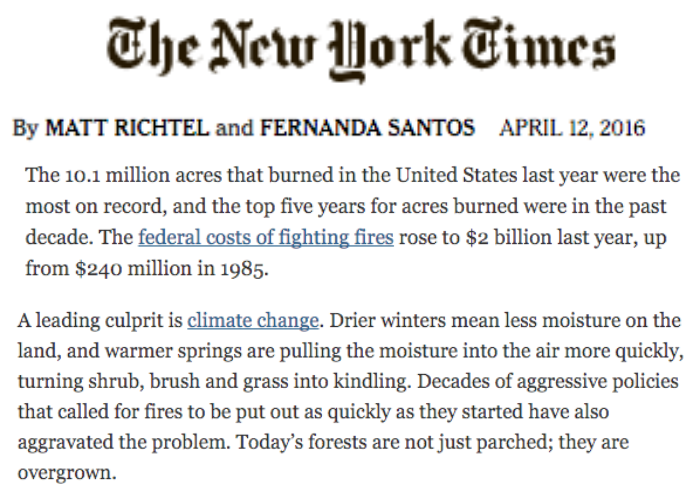
The New York Times is lying about climate yet again, claiming that last year was a record fire year at 10.1 million acres and it was due to climate.

Screen Shot 2016-04-18 at 11.17.07 AM-down

Wildfires, Once Confined to a Season, Burn Earlier and Longer – The New York Times

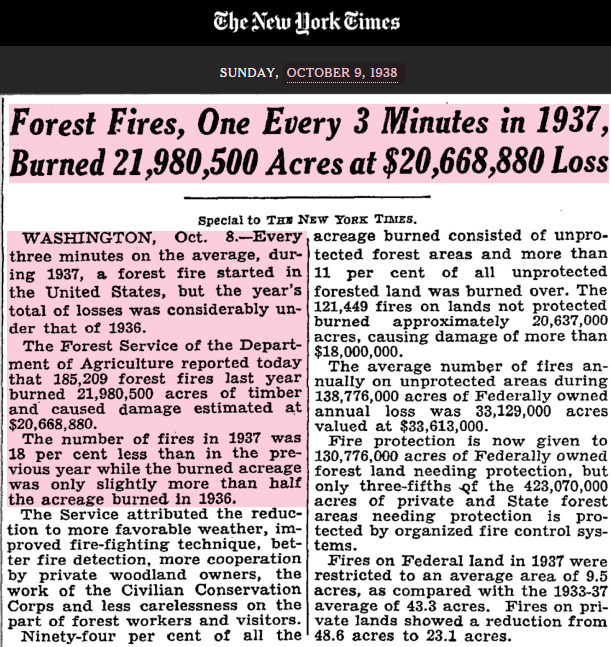
The level of fraud is off-scale. The New York Times reported in 1938 that more than twice that many acres burned in 1937. Why didn’t Matt Richtel and Fernanda Santos research their own paper?

2015-10-29-08-59-40

October 9, 1938 – NYTimes

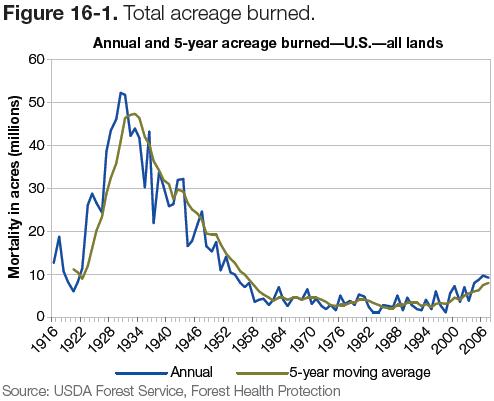
The US Forest Service reported that five times as many acres burned in the early 1930’s

figure16-1

Indicator 3.16: Area and percent of forest affected by abiotic agents

But their fraud gets much worse. When CO2 was at pre-industrial levels, forest burned almost fifteen times as much land in the US.

2016-01-08-13-35-22

2016-01-08-13-34-55

https://www.nifc.gov/PIO_bb/Policy/FederalWildlandFireManagementPolicy_2001.pdf

Outside of Alaska and California, last year was not a big fire year. The Rocky Mountains were very wet and had one of the quietest fire seasons on record. The constant climate fraud from the New York Times gives me something to write about almost every single day.

17 Apr 04:08

California's New Retirement Plan for Private Sector Workers Is a Stunning Display of Hypocrisy

by Ed Ring

Nest EggIn a move of breathtaking hypocrisy, California legislators on March 28 introduced a financially sustainable retirement security program for private workers, while keeping financially unsustainable pensions for public workers.

The move raises a question: If the new retirement security scheme—called Secure Choice—is so great, why aren't public employees going to adopt it too?

The answer is simple: Public employees already earn pensions—paid for by state taxpayers—that are far better than those you'd earn through Secure Choice.

To compare them, look at the official recommendations for Secure Choice. A table on page 53 shows "income replacement" based on years paying into the system at various contribution rates.

At a contribution rate of 10 percent, private-sector workers participating in the new system for 30 years can expect a pension of 27.6 percent. For example, if they earned $50,000 per year in their final year of work, they would get state pensions of $13,800 per year.

Teachers and government administrative workers pay a bit less than 10 percent, and public-safety workers pay a bit more. But after 30 years of employment, teachers and government administrators earn pensions equal to 75 percent of final salary. Public-safety workers earn an astonishing 90 percent of final salary.

There are two reasons for this gigantic disparity. First, public employees rarely pay more than 10 percent of their salary toward their pensions via withholding, but public pension funds like CalPERS collect far more than 10 percent for each employee. The employer—the taxpayer—kicks in up to 40 percent more.

Second, public pensions assume returns on the investment of those contributions will earn a "risk-free" return of 7 percent per year. How much will the Secure Choice plan assume? Refer again to the official recommendations, this time page 16:

Senate Bill 1234 will allow the Board to: Establish managed accounts that would be invested in U.S. Treasuries for the first three years of the program….

The 30-year Treasury Bill is currently paying 2.69 percent.

Let's recap: A "risk-free" annual return according to state pension systems is 7.5 percent. A "risk-free" annual return according to Secure Choice is 2.69 percent.

The attentive reader may wonder what will happen after three years—when the recommendations say "investment options" shall be "developed."

This brings us to the second monstrous hypocrisy: Secure Choice 401k funds will be managed by the same private-sector investment firms that defenders of public pension funds routinely demonize.

If 50 percent of California's 6.8 million eligible private-sector workers participate, using the U.S. Census Bureau's median income estimate for California's private sector workers of $45,000 per year, at a contribution rate of 5 percent, you're talking about $7.6 billion per year under management—not much compared to the $30 billion poured into California's state/local government pension systems each year, or the $45 billion per year that those systems actually require to remain solvent. But it's a huge chunk of change. And you can easily imagine the financial interests now gathering around the capitol.

The irony in all this is that Secure Choice has at least one virtue. It's more sustainable than public-sector pensions. With lower-risk investments, modest benefit formulas, and the built-in capacity to adjust benefits to ensure solvency, this system can be offered to all Californians without blowing up.

Concerned citizens may argue about whether the state should offer any sort of retirement security—Social Security, Secure Choice, or whatever. But if the state is going to create these programs, they should be offered to every worker according to the same set of rules and offer the same set of benefits. Government workers should not be getting deals far better than private workers.

So here's the deal, Sacramento:  Require every state and local government worker immediately to begin participating in Social Security and the Secure Choice program, and encourage them to supplement that with individual 401k retirement accounts. Mandate that all retirement benefits they earn from now on are limited to those three programs. Work out the bugs. Then—and only then—sign up the rest of us.

15 Apr 15:55

[美国] 富豪投资九千万美元做环保,大量买地恢复生态

by 桃子
这位赌徒出身的富豪在20年中买下5.3万英亩的土地。在患癌后他在自己挚爱的松木林里自杀身亡。
15 Apr 01:42

The wages of fear

by ssumner
Whig Zhou

哈哈

Not from the Onion:

LA unions call for exemption from $15 minimum wage they fought for

Los Angeles city council will hear a proposal on Tuesday to exempt union members from a $15 an hour minimum wage that the unions themselves have spent years fighting for.

The proposal for the exemption was first introduced last year, after the Los Angeles city council passed a bill that would see the city’s minimum wage increase to $15 by 2020. After drawing criticism last year, the proposed amendment was put on hold but is now up for consideration once again.

Union leaders argue the amendment would give businesses and unions the freedom to negotiate better agreements, which might include lower wages but could make up the difference in other benefits such as healthcare. They argue that such exemptions might make businesses more open to unionization.

Case closed?

HT:  Anand

14 Apr 10:25

What If Private Entrepreneurs Behaved Like Politicians, Pundits, and Professors?

by Don Boudreaux
Whig Zhou

呵呵

(Don Boudreaux)

Tweet

What if, for example, private entrepreneurs, upon noticing the widespread availability of a productive asset that they are certain is underpriced by at least 23 percent, proceeded to behave as do too many politicians, pundits, professors, PhD candidates, and preachers?  Rather than profitably bid units of that asset away from their current uses and, hence, cause the price of that asset to rise, these “entrepreneurs” would write op-eds proclaiming the reality of widespread underpricing.  They’d also lobby politicians to inform them about the widespread underpricing of the asset.  They’d fulminate and fume on television, radio, and in blog-posts about this widespread underpricing.  But never, ever would they take personal action to seize the profit opportunities that they insist exist.

The scene might play out as follows:

‘Entrepreneur’ A: “Look!  Pork bellies are way underpriced!”

‘Entrepreneur’ B: “My gosh, man!  You’re right!  Those pork bellies are indeed way underpriced – underpriced by about 23 percent!  And they’ve been underpriced for years!”

‘Entrepreneur’ A: “Wow.  That’s intolerable.  Pork-belly sellers are getting screwed by pork-belly buyers.  Those buyers, year in and year out, are making unjust fortunes by buying pork bellies at below-market prices.”

‘Entrepreneur’ B: “What can we do?”

‘Entrepreneur’ A: “Beats me.  [Pause]  Oh, wait.  I know!  Let’s tell the general public about this underpricing.  I’ll write an op-ed!!”

‘Entrepreneur’ B [smiling in wonder and with admiration at ‘entrepreneur’ A]: “You’re a true man of action!  A courageous hero!  I’ll join you by blogging on it!  And also, I’ll visit my member of congress to tell her about the underpricing of pork bellies.”

‘Entrepreneur’ A: “Fantastic!”  [Pause]  “But can you think of anything else to do?  Do you know of any other opportunities that these clearly underpriced pork bellies offer?”

‘Entrepreneur’ B: “Hmmmm……”  [Pause]  “Hmmmm……   No.  No, actually, I don’t.  I’ve thought about it and I can’t see any opportunities for action that these underpriced pork bellies offer to us, or to anyone else, beyond writing op-eds and telling politicians about it.”

‘Entrepreneur’ A: “Right you are!  When underpriced assets exist, the only possible solution is for government to force up the price.’

‘Entrepreneur’ B: “Yep!  Okay!  I’m off to blog on the underpriced pork bellies!  Good luck with your op-ed on this problem!”

‘Entrepreneur’ A: “Thanks!  Isn’t it fulfilling to know that we serve the public welfare?!”

….

In short, if everyone thought and acted like the typical politician, pundit, or professor, all of humankind would still be sleeping on dirt and routinely starving to death.

13 Apr 05:59

Big Insurer Flees Obamacare

by Jason Willick

America’s biggest health insurance company can no longer afford the Affordable Care Act. The Fiscal Times reports:

The Affordable Care Act suffered another jolt late last week with the news that UnitedHealth Group, the nation’s largest health insurer, was making good on its threat to pull out of Obamacare, beginning with its operations in Georgia and Arkansas.

UnitedHealth roiled the market last November when it revealed that it was considering exiting Obamacare after incurring hundreds of millions of dollars in losses related to ACA business.

As the FT notes, UnitedHealth’s decision does not come as a surprise (we wrote about the company’s ACA woes last year), and—unless other big insurers follow suit—it doesn’t herald the imminent collapse of the law. But the fact that even major insurers like UnitedHealth are hemorrhaging cash on the Obamacare exchanges highlights the fact that for all the ACA’s technocratic tinkering, it did not and will not fix the fundamental problem facing the U.S. healthcare system: That it’s too expensive, and that costs are growing too quickly.

The architects of the ACA took aim at access, rather than affordability, achieving a coverage expansion mostly by putting more Americans on the Medicaid rolls. They left the underlying issues plaguing the healthcare system in place (and in many cases exacerbated them), so middle class families are still seeing a growing share of their paychecks consumed by rising premiums and deductibles. And they failed to realize that in the long run, affordability is access, and that attacking the factors that inflate the cost of healthcare in the private market should be a higher priority than expanding subsidies. The departure of UnitedHealth from the exchanges is a devastating illustration of Obamacare’s failure to bring down costs, and clear evidence that, no matter what the White House says, the debate over health reform isn’t going away.
13 Apr 02:02

在ISIS前用激光扫描文物

by pigcanfly
当两位穿着防弹背心的德国测量员及警卫在伊拉克最著名的考古遗址——古巴比伦遗迹,费力地挪动激光设备时,只有浅浮雕公牛和蟒龙神在现场。他们是在2010年进行这项工作的,那时ISIS尚未开始在伊拉克和叙利亚无情地摧毁和掠夺古代遗迹,遭到举世唾弃。巴比伦遗迹得以保存,是因为它更靠东南,不像它那些不幸的古代邻居尼姆鲁德(Nimrud)、哈牡拉(Hatra)和巴尔米拉(Palmyra),它不在圣战者自称的伊斯兰教国的领域内。当时他们的扫描工作只是单纯的保护计划的一部分——虽然具有不同寻常的三维精确度——但是如今看来却很有先见之明,现在很多机构也竞相在冲突地带运用数字技术。


12 Apr 15:18

Ten Reasons to Defect From North Korea

by Marian Tupy

In Monday morning's news, National Public Radio reported that a colonel from the General Bureau of Reconnaissance, a North Korean spy agency, defected to South Korea. According to the newscaster, the reasons for the colonel's defection are, at present, "not known." Human Progress hates unresolved mysteries and humbly suggests 10 possible reasons for the colonel's defection. Here they are, in no particular order:

1. Life expectancy in the North is only 86 percent that of the South, 2013.


2. GDP per capita in the North is only 5 percent that of the South, 2008.

3. The infant mortality rate in the North is 679 percent that of the South, 2015.

4. Maternal mortality in the North is 322 percent that of the South, 2013.

5. Food consumption in the North was 63 percent that of the South, 2011. 

6. Democracy in the South is comparable to Belgium, but non-existent in the North, 2014.

7. Protection of the environment in the North lags behind that in the South, 2015.

8. Rule of law in the South is on par with Spain, in the North with Afghanistan, 2014.

9. Access to the internet in the North is…

10. Last, but not least, the colonel's chance of being murdered was almost six times higher in the North than in the South, including on the orders of this psychopath:

12 Apr 03:01

Congress, save e-cigarettes from the FDA

by Kelly Funderburk

On Wednesday, House appropriators will face a decision with major ramifications for efforts to combat smoking and protect public health. The Food and Drug Administration is poised to adopt rules that could cripple the e-cigarette industry, obstructing the availability of a safer alternative to cigarettes. The appropriators may be the last line of defense against wrong-headed action by the FDA.

E-cigarettes, and vaping products more generally, don’t burn tobacco, allowing them to deliver the nicotine that smokers crave without the cancer-causing tar that kills them. The nicotine solution contains flavoring and propylene glycol which, based on current evidence, is safe when inhaled over the short term – long term follow-up is needed to observe if any harmful effects show up later on. Smokers with asthma who have switched completely or partly to vaping products enjoy improved lung function and blood pressure.

Here’s the back story. In 2009, Congress gave the FDA power to regulate cigarettes and a few other tobacco products. Congress didn’t put e-cigarettes under FDA’s regulation, but it gave the FDA the option to extend its powers to cover e-cigarettes. In April 2014, FDA issued a proposal to do just that. FDA appears to be poised to finalize that proposal, putting e-cigarettes under the same rules as cigarettes.

Some of the FDA rules that apply to cigarettes should apply to e-cigarettes, like those that restrict access by minors. But, one part of the regulatory regime – the rules governing the introduction of new tobacco products – won’t work for e-cigarettes.

If a tobacco product wasn’t on the market on February 15, 2007, then the rules allow only two ways to introduce it. The manufacturer can show that the new product is substantially equivalent to something on the market on February 15, 2007. Or, the manufacturer can go through the costly and arduous process of filing a pre-market review application, which requires a large amount of scientific data.

Applying these rules to e-cigarettes would devastate the smaller vaping companies that account for much of the innovation in the industry. The problem is that there were almost no e-cigarettes on the market on February 15, 2007. So, almost no products would be grandfathered in and almost none of them could find a February 2007 product to which they’re substantially equivalent. In most cases, the only way to keep an e-cigarette product on the market would be to file a pre-market review application.

One part of the pre-market review process – the requirement that manufacturers demonstrate the safety of the devices and e-liquid – is welcome. But, two elements of the process are most worrisome. First, applicants must present research findings on the impact of the product on the population as a whole, including an examination of the likelihood of former smokers re-initiating tobacco use with the new product and the likelihood of smokers switching to the product instead of quitting completely or trying to quit with an FDA-approved medication. Second, applicants are required to demonstrate that the new product is beneficial to the public’s health by showing that it has a negligible (however that may be defined) impact on nonsmokers – especially youth – who might use the new product.

Performing the necessary investigations is extremely burdensome. The FDA estimates that it costs about $300,000 to prepare and file an application – some outside observers think the actual cost may top $2 million. In fact, the process is so arduous that cigarette companies have filed only a handful of pre-market review applications for new cigarette products since 2009. Now, multiply these demands by a factor of 10s to 100s, to account for an entirely new assessment for each device or e-liquid that a company makes.

Beyond the financial burden, though, the bigger problem is that some of the demands are completely unrealistic. As tobacco researcher Lynn Kozlowski and tobacco expert David Sweanor recently pointed out, some of FDA’s proposed rules pose a “near-impossible task, a barrier that no product has yet surmounted, and one not imposed on other FDA-regulated product categories.” Collecting data on long-term health effects is important, but it makes more sense to collect such data post-market rather than holding up approval for the years it can take to collect meaningful evidence.

For products like e-cigarettes, which pose many fewer risks than cigarettes, requiring pre-market review of public health impact probably doesn’t make sense at all. But, if it’s going to apply, then the February 15, 2007 date has to be changed.

FDA doesn’t want to change the date. And, even if it wanted to, it may not have the legal power to change it, so long as it regulates e-cigarettes at all. FDA has offered a grace period, giving sellers two years to file their pre-market review applications and allowing products to be sold while the applications are reviewed. But, that just postpones the day of reckoning.

It looks like only Congress can fix this problem. On Wednesday, the House Appropriations Committee’s agriculture subcommittee is set to consider the fiscal 2017 agriculture appropriations bill, which gives the FDA its spending authority. The subcommittee will consider a provision requiring FDA to change the February 15, 2007 date to the date on which the FDA’s final rule takes effect, probably later this year. Products on the market then, and new products substantially equivalent to them, wouldn’t have to file pre-market review applications.

The appropriators should ensure, though, that all e-cigarette products, regardless of the date they’re introduced, would be subject to labeling restrictions, prohibitions on distributions to minors, ingredient-listing rules, retailer-registration requirements, prohibitions on adulteration and misbranding, and other sensible regulations.

It was one thing for Congress to put heavy roadblocks in front of new cigarette products introduced after 2007. Our country already had a lot of cigarette products in 2007 and we don’t need many more brands and varieties of that deadly substance. But, it would be absurd to put the same barricade in front of virtually every e-cigarette product in the country, when e-cigarettes offer the potential to move people away from smoking.

Congress should stop the FDA from undermining e-cigarette innovation and availability.

12 Apr 02:43

Some thoughts on Equal Pay Day and the 23% gender pay gap myth

by Mark Perry

EqualPay
The American Association of University Women (AAUW), along with the National Committee on Pay Equity (NCPE), are major participants in the feminist propaganda machine that mobilizes its forces every April and engages in statistical misrepresentations to publicize the annual feminist holiday known as Equal Pay Day. Last April, AAUW executive director Linda D. Hallman sent a mass email that made this verifiably false statement (emphasis added):

Think about it: Women have to work almost four months longer than men do to earn the same amount of money for doing the same job. What’s more, we have to set aside a day each year just to call the nation’s attention to it.

Hallman’s statement is a statistical fairy tale because it’s based on the false assumption that women get paid 23% less than men for doing exactly the same work in the exact same occupations and careers, working side-by-side with men on the same job for the same organization, working the same number of hours per week, traveling the same amount of time for work obligations, with the same exact work experience and education, with exactly the same level of productivity, etc. In other words, the AAUW, NCPE, progressives, and gender activists falsely assume that employers all across America are using coupons like the one above to get a 23% wage discount for every woman they hire, and it’s that rampant, unjust and blatant gender discrimination that is the culprit behind the gender pay gap.

For example, Sen. Gary Peters (MI-D) said at this time last year that (emphasis mine): “Today, April 14th marks Equal Pay Day, the date by which women have made up for the wage discrimination they suffered during the previous year.” That’s complete statistical nonsense.

The reality is that you can only find a 23% gender pay gap by comparing raw, aggregate, unadjusted full-time median salaries, i.e. when you control for NOTHING that would help explain gender differences in salaries like:

  1. Hours Worked: The average man working full-time worked almost two more hours per week in 2014 compared to the average woman, see my analysis here.
  1. Type of Work: As I reported a few days ago, men represented 92.3% of workplace fatalities in 2014 (and the male share of job-related deaths has been consistently that high in every previous year) because men far outnumber women in the most dangerous, but higher-paying occupations like logging, mining and roofing that have the greatest probability of job-related injury or death. In contrast, women, more than men, show a demonstrated preference for lower risk occupations with greater workplace safety and comfort, and they are frequently willing to accept lower wages for the greater safety and reduced probability of work-related injury or death.
  1. Marriage and Motherhood: a) single women who have never married earned nearly 94% of male earnings in 2014; b) more women than men leave the labor force temporarily for child birth, child care and elder care, and c) women, especially working mothers, tend to value “family friendly” workplace policies more than men, according this Department of Labor study.

Most economic studies that control for all of those variables conclude that gender discrimination accounts for only a very small fraction of gender pay differences, and may not even be a statistically significant factor at all. For example, as Andrew Biggs and I pointed out in a 2014 WSJ op-ed:

In a comprehensive study that controlled for most of the relevant labor market variables simultaneously—such as that from economists June and Dave O’Neill for the American Enterprise Institute in 2012—nearly all of the 23% raw gender pay gap cited by the UUAW can be attributed to factors other than discrimination. The O’Neills conclude that, “labor market discrimination is unlikely to account for more than 5% but may not be present at all.”

On Equal Pay Day, when groups like the AAUW and NCPE point to a 23% unadjusted gender pay gap and demand that the pay gap be completely closed, what they are really saying is that they want women to:

  • Work longer hours on average like men do;
  • Work in riskier, less safe occupations like logging and commercial fishing like men do where the chances of getting injured or killed are much greater;
  • Work in more physically demanding occupations like farming, construction, roofing, logging and working on oil rigs, where they’d be working alongside men outside in 100 degree weather in the summer and below zero weather in the winter;
  • Accept fewer jobs in family-friendly workplace environments like teaching elementary school that coincide with their children’s schedules (with summers off, etc.), and accept more jobs in less family-friendly workplace environments like being an over-the-road truck driver or being an oil field worker.
  • Take less time off, or no time off, for child birth and child care to minimize their time away from the labor force that might affect their earnings.

Bottom Line: Those who publicize Equal Pay Day and demand that the unadjusted 23% pay gap be reduced to zero are unknowingly really advocating that men and women play completely interchangeable roles in the labor market and identical roles in their family responsibilities; and that’s an outcome I don’t think most women (or men) really want. As the Department of Labor concluded in 2009, “The differences in raw wages may be almost entirely the result of the individual choices being made by both male and female workers.” They also concluded that “the raw wage gap should not be used as the basis to justify corrective action.”

As I concluded on my recent related post, once we adjust for all of the factors that contribute to the raw difference in pay by gender, Equal Pay Day actually probably fell close to December 31 of last year. Or maybe the first week of January…. but NOT the second week of April. Women should be embarrassed by the economic myth that is annually perpetuated on their behalf by Equal Pay Day, which suggests that gender discrimination in the labor market burdens them with 14 additional weeks of work to earn the same income as their male counterparts earned the previous year – when that’s not even remotely true.

12 Apr 02:38

The Other Hydrocarbon Price Crash

by Jamie

Oil prices have tumbled from a June 2014 peak of $115 per barrel down into the low $40 range, but they’re not the only hydrocarbon that’s selling for a bargain these days. Spot prices for liquified natural gas (LNG) are dropping to all-time lows (though we should note that LNG spot pricing is still a relatively new development, making this low water mark perhaps a bit less impressive).

Japan is the world’s biggest importer of LNG, and spot prices there fell to $6.80 per million British thermal units (mmBtu) last month, and Asian prices were another $2 cheaper thanks to slowing demand. But while oil prices have rebounded slightly from a January nadir, LNG keeps falling, and that divergence is a major concern for producers. Bloomberg explains:

Oil and LNG prices have historically been linked because traditional long-term contracts priced the gas in relation to crude. That correlation held through 2014 and 2015, as prices for both fuels tanked amid a global glut.

The two are now heading in opposite directions. Spot LNG in Singapore slipped to $3.954 per million British thermal units the week of April 11, the lowest since Singapore Exchange Ltd. began assessing it in September 2014 and extending its decline into a fifth month. Brent, meanwhile, recovered from its early-year crash to post its best first quarter in four years. The global oil benchmark rose 1.6 percent to $42.62 a barrel by 10:23 a.m. New York time. […]“In oil, the big thing is the loss of production, as drilling activity around the world has dropped off and that’s balancing the market,” Sikorski said. “LNG is going to continue to throw gas at the world as major projects come on stream and need to recover their big costs. It’s a perfect storm of stuff to keep the spot market low.”

One of those new producers that will be intent on keeping the global market well- (and even over-) supplied is, of course, the United States, which just this year started exporting its glut of shale gas in liquified form, the first cargoes of which left Louisiana for Brazil in late February. The timing of this couldn’t be worse for those interested in making a profit on selling fracked gas abroad, but given the massive capital investments and long-term contracts already inked, some of America’s gas glut is still going to go global.

Just as is the case with the oil market, it’s a very bad time to be in the business of producing LNG, and a great time to be a buyer—Tokyo won’t be complaining.
11 Apr 12:07

对2000部电影的分析确认男性占支配地位

by pigcanfly
Whig Zhou

呵呵

好莱坞被白人男性统治着,对2000部电影台词的分析再次确认了男性的支配地位。以30部迪士尼电影为例,其中23部男性的台词占六成以上,即使在《花木兰》这部以女性为主角的动画片中,木须龙的台词比木兰还要多。在研究人员分析的电影库中,女演员台词最多的电影占22%,女演员最有可能占第二位,许多女性为主角的电影中女演员的台词总数也是次于男性,原因是有更多的男配角。此外对台词和年龄的相关分析发现,超过40岁的女演员的台词行数大幅减少,但这一现象在男性身上恰好相反,年龄较大的男演员有更多的台词。


10 Apr 12:50

The New Eco Tyranny

by Hans Bader
N.Y. Attorney General Eric Schneiderman speaks at a news conference in Manhattan with other state attorneys general to announce a states-based effort to combat climate change, March 29, 2016. REUTERS/Mike Segar

Last week, the attorneys general of 20 states met at a conference “dedicated to coming up with creative ways to enforce laws being flouted by the fossil fuel industry,” in the words of the conference’s host, New York Attorney General Eric Schneiderman. The environmental website Ecowatch called it “an unprecedented, multi-state effort to investigate and prosecute” oil companies that the AGs say “stymied attempts to combat global warming.”

This followed U.S. Attorney General Loretta Lynch’s disclosure early last month that the Justice Department had discussed pursuing civil action against so-called climate-change deniers, and she had “referred it to the FBI to consider whether or not it meets the criteria for” an investigation under the Racketeer Influenced and Corrupt Organizations (RICO) Act of 1970.

This attempt to punish opposition to climate-change regulations is shocking. The First Amendment protects such opposition, including corporate lobbying. Under the Supreme Court’s Noerr-Pennington doctrine, lobbying is protected even if it reflects a bad motive, or makes false claims.

The state AGs seek to hold ExxonMobil and other oil companies “accountable” for “fraud and suppression of key climate science.” They argue that Exxon somehow reached definitive conclusions about global warming before climate experts did, at a time when climate science was in its infancy, and then withheld this secret knowledge from the scientific community.

Exxon calls these claims preposterous and notes that the company openly shared its research findings in peer-reviewed publications and with the Intergovernmental Panel on Climate Change. The attorneys general also declare that Exxon was deceptive to claim for years that there was no definitive proof of man-caused climate change, even as its business plans took into account oil and gas resources that might be uncovered by melting polar ice caps, and how potential rises in the sea level could affect things like oil rigs. That accusation is a bit like saying a company knew a fire would occur, just because it purchased fire insurance.

Schneiderman began investigating Exxon last fall, subpoenaing documents from the company after learning that Exxon researchers were concerned about climate change decades ago even as Exxon publicly expressed uncertainties about it. (Philip Hamburger’s post on Law and Liberty about the original subpoena is here.) These researchers expected massive increases in temperature over the last 30 years that never came true, as Marlo Lewis and David Middleton have written. But Schneiderman believes Exxon committed fraud by not trumpeting their projections as fact. Following in Schneiderman’s illogical footsteps, his California counterpart Kamala Harris opened an investigation in January, and in March, so did their counterparts in Massachusetts and the U.S. Virgin Islands.

(In fact the Virgin Islands Attorney General, Claude E. Walker, on April 7 issued a subpoena to my employer, the Competitive Enterprise Institute, demanding CEI’s records concerning its work on climate-change policy.)

Even the New York Times seems to view this effort as constitutionally dubious. “Many legal experts have questioned whether the actions and statements by Exxon Mobil can be construed as criminal and outside the protections of the First Amendment,” wrote John Schwartz of the Times.

Schneiderman justified his investigation with the platitude that the First Amendment “does not give you the right to commit fraud.” But courts have struck down laws against “lies” in the political arena. As the Washington state supreme court noted in Rickert v. State Pub. Disclosure Commission (2007), our forefathers “did not trust any government to separate the true from the false for us” in the realm of politics.

A sobering aspect of the state AGs’ crusade is what is taking place outside of courtrooms: they are pressuring companies to cut off donations to nonprofit groups that employ “climate-change deniers.” Being one of those includes telling politically inconvenient truths about the costs of proposed climate-change legislation. It also includes projecting, as several mainstream climatologists have done, lower global temperature increases than liberal state attorneys general find politically convenient.

New York’s and California’s attorneys general have investigated Exxon for making donations to think tanks like the American Enterprise Institute and lobbying groups like the American Legislative Exchange Council. Schneiderman complains that these two specifically are “even more aggressive climate change deniers” than the run of the mill. (Ironically, while these large organizations include a few people labeled as “climate change deniers,” they focus mostly on issues having nothing to do with climate change.)

The First Amendment shields Americans engaged in corporate lobbying and making donations, and even groups that misinform the public about important issues are afforded this protection. In Pfizer v. Giles (1994), a federal appeals court ruled that the maker of an asbestos product could not be held liable for joining and financially supporting a trade association that represented makers of asbestos products, even though that association allegedly “disseminated misleading information about the danger of asbestos in schools directly to” the plaintiffs, where “at least some” of the association’s “activities were constitutionally protected.”

So even if being a “climate change denier” were a crime (rather than constitutionally protected speech, as it in fact is), a donation to a nonprofit that employs such a person would not be a crime.

Contrary to Schneiderman’s claims of fraud, Exxon did not engage in any deception about the health risks of its products when used by consumers (the way that asbestos makers were accused of doing), or in other forms of unprotected speech. Nor did it deny basic science. What angers Schneiderman most may be that Exxon pointed out that climate-change proposals have costs, and that these costs may hamper their political viability.

Schneiderman complains that Exxon noted that “switching over to renewables by the end of this century would raise energy costs” substantially, and that the company “essentially ruled out the possibility that governments would adopt climate policies stringent enough to force it to leave its reserves in the ground, saying that rising population and global energy demand would prevent that.” The smoking gun he points to is Exxon’s statement that “Meeting these needs will require all economic energy sources, especially oil and natural gas.”

Bloomberg News, like the Times, has shown a disinclination to join in this kind of reasoning. Not only that, Bloomberg’s editorial board questions the Schneiderman definition of a “climate denier”:

On the face of it, the company’s research on climate change and its previous public positions on climate policy not only fail to amount to fraud, they aren’t even necessarily at odds. You might accept the reality of man-made global warming and still argue against strict new rules on emissions—if, for example, you believe that such restrictions would do more harm than good. . . . that position isn’t indefensible, and certainly shouldn’t be illegal.

Ironically, it is Schneiderman whose claims about global warming are at odds with actual climate data over the last 30 years, not Exxon.

Investigations by state governments of a company’s donations and its positions on climate-change legislation are legally baseless, because any sanctions imposed on Exxon for them would obviously run afoul of the First Amendment (as newspapers like The Washington Post and USA Today have noted). As the Post’s Robert Samuelson noted, Exxon is being targeted for “expressing its opinions.”

A prolonged governmental investigation in response to someone’s speech—whether or not investigators nab their target in the end—can violate the First Amendment, courts have held. For example, a federal appeals court ruled in White v. Lee (2000) that lengthy, speech-chilling civil rights investigations by federal officials can violate the First Amendment even when they are eventually dropped. It found this principle so obvious that it denied officials qualified immunity for investigating citizens who spoke out against a minority housing project.

Similarly, the 1994 federal appeals court decision cited above (Pfizer v. Giles) found that the mere pendency of a lawsuit against a company for belonging to, and contributing to, a trade association contravened the First Amendment because the lawsuit chilled participation in and contributions to that association. Accordingly, it issued a writ of mandamus dismissing the suit.

These state investigations similarly discourage Exxon from contributing to groups like AEI or ALEC, as well as discouraging Exxon’s own speech about climate-related legislation and its costs. These groups themselves can sue an attorney general under the First Amendment, if the AGs’ pressure on an oil company like Exxon causes them to lose donations they would otherwise have received.

Government officials cannot pressure a private party to take adverse action against a speaker. For example, the federal appeals court in New York ruled that officials could not pressure a billboard company to stop displaying a church’s anti-gay billboard, or pressure a business group not to publish a businessman’s ad in its publication, even though the officials avoided using explicit threats. (See the 2003 case of Okwedy v. Molinari and the 1991 case of Rattner v. Netburn.) And a federal court allowed Google to sue a state attorney general over his speech-chilling investigation in Google v. Hood (2015).

The office of attorney general is a powerful one. What will the effects of these taxpayer-funded investigations be? It’s possible they may lead to skewed estimates of climate change, by intimidating researchers who raise legitimate questions about overly large predictions of warming. They are also a threat to oil companies’ ability to engage in prudent contingency planning that takes into account the maximum possible projections of global warming, without having to publicly tout those projections, which will likely turn out to be inaccurate years later.

The far-fetched nature of these investigations suggests that they are not really intended to uncover legal wrongdoing but to harass. The state of New York wants to subject Exxon to bad publicity and impose on it the costs of producing thousands of pages of documents in response to endless subpoenas. The process is the punishment. That violates the First Amendment.

The post The New Eco Tyranny appeared first on Online Library of Law & Liberty.

      
10 Apr 12:17

Speech Restriction Stories I Have Read in Just the Last 24 Hours

by admin

NY state attorney general (and others) pursuing potential criminal and civil charges against ExxonMobil for its climate change advocacy

US Virgin Islands AG (really) going after non-profit CEI for its climate change advocacy

Elizabeth Warren wants the SEC to ban companies from "saying whatever they want about Washington policy debates," a demand inspired by her frustration that financial firms are publicly disagreeing with her on the impact of her desired regulations

California AG Kamala Harris demanding non-profit donor lists, presumably so she can harass and intimidate the ones she does not like

California AG Kamala Harris has raided the home and seized video footage of an independent advocated/journalist  who did secret sting videos of Planned Parenthood, the exact same sort of advocacy journalism pursued legally (without legal harassment) by any number of Leftish groups in California and elsewhere  (I doubt Ms Harris plans to raid the home of PETA activists who trespass on farms to secretly film chicken and pig breeding).

It turns out there are strong speech protections in this country, except when you are a professional, and then there are none.

And of course, I still am fighting against a libel lawsuit meant to force me to remove this product review.

Update, add this one:  Tenured Marquette professor faces termination based on blog post with which University disagrees

When the student replied that he has a right to argue his opinion, Ms. Abbate responded that “you can have whatever opinions you want but I can tell you right now, in this class homophobic comments, racist comments and sexist comments will not be tolerated. If you don’t like that you are more than free to drop this class.” The student reported the exchange to Marquette professor John McAdams, who teaches political science. Mr. McAdams also writes a blog called the Marquette Warrior, which often criticizes the Milwaukee school for failing to act in accordance with its Catholic mission.

Mr. McAdams wrote on his blog that Ms. Abbate was “using a tactic typical among liberals now. Opinions with which they disagree are not merely wrong, and are not to be argued against on their merits, but are deemed ‘offensive’ and need to be shut up.” His blog went viral, and Ms. Abbate received vicious emails. She has since left Marquette.

But now Marquette is going after Mr. McAdams. In December 2014, the school sent him a letter suspending his teaching duties and banning him from campus while it reviewed his “conduct” related to the blog post. “You are to remain off campus during this time, and should you need to come to campus, you are to contact me in writing beforehand to explain the purpose of your visit, to obtain my consent and to make appropriate arrangements for that visit,” Dean Richard Holz wrote.

Lol, the university is going to prove he was wrong to write that universities avoid dialog in favor of saying "shut up" by telling him to  ...  shut up or be fired.

By the way, since nowadays it seems that supporting someone's free speech rights is treated the same as agreeing with that person, I will remind folks that having led a pro gay marriage ballot initiative briefly in Arizona, I am unlikely to agree with someone who thinks it should be banned.  But so what?  I would have absolutely no problem arguing with such a person in a rational way, something that faculty member Ms. Abbate seemed incapable of doing.  While I might disagree with him on any number of issues, Professor McAdams was totally right to call her out.  Besides, is the Left's goal really to take all opinion with which they disagree and drive it underground?  Force folks underground and you never know what will emerge some day.  Things like.... Trump supporters.

It is amazing to me that universities have become the least viable place in the US to raise and discuss controversial issues in the light of day.


10 Apr 12:09

Our Friends at CEI Face a Subpoena Over Climate Dissent

by Walter Olson

The campaign to attach legal consequences to supposed “climate denial” has now crossed a fateful line. Yesterday:

The Competitive Enterprise Institute (CEI) today denounced a subpoena from Attorney General Claude E. Walker of the U.S. Virgin Islands that attempts to unearth a decade of the organization’s materials and work on climate change policy. This is the latest effort in an intimidation campaign to criminalize speech and research on the climate debate, led by New York Attorney General Eric Schneiderman and former Vice President Al Gore….

The subpoena requests a decade’s worth of communications, emails, statements, drafts, and other documents regarding CEI’s work on climate change and energy policy, including private donor information. It demands that CEI produce these materials from 20 years ago, from 1997-2007, by April 30, 2016.

CEI General Counsel Sam Kazman said the group “will vigorously fight to quash this subpoena. It is an affront to our First Amendment rights of free speech and association.” More coverage of the subpoena at the Washington Times and Daily Caller.

A few observations:

  • If the forces behind this show-us-your-papers subpoena succeed in punishing (or simply inflicting prolonged legal harassment on) a group conducting supposedly wrongful advocacy, there’s every reason to think they will come after other advocacy groups later. That includes yours.
  • This article in the Observer details the current push to expand the probe of climate advocacy, which first enlisted New York AG Eric Schneiderman and then California’s Kamala Harris — into a broader coalition of AGs, with Massachusetts and the Virgin Islands just having signed on. More than a dozen others, such as Maryland Attorney General Brian Frosh, seem to be signaling support but have not formally jumped in. More: Peggy Little, Federalist Society.
  • CEI people, many of whom we count as longtime friends and allies in the pro-liberty policy community, have been active critics of the Schneiderman effort, with Hans Bader, a senior attorney there, highly critical just a week ago.
  • In these working groups of attorneys general, legal efforts are commonly parceled out among the states in a deliberate and strategic way, with particular tasks being assigned to AGs who have comparative advantage in some respect (such as an unusually favorable state law to work with, or superior staff expertise or media access). Why would one of the most politically sensitive tasks of all — opening up a legal attack against CEI, a long-established nonprofit well known in Washington and in libertarian and conservative ideological circles — be assigned to the AG from a tiny and remote jurisdiction? Is it that a subpoena coming from the Virgin Islands is logistically inconvenient to fight in some way, or that local counsel capable of standing up to this AG are scarce on the ground there, or that a politician in the Caribbean is less exposed to political backlash from CEI’s friends and fans than one in a major media center? Or what?
  • I recommend checking out the new Free Speech and Science Project, which intends to fight back against criminalization of advocacy by, among other things, organizing legal defense and seeking to hold officials accountable for misusing the law to attack advocacy.
  • This is happening at a time of multiple, vigorous, sustained legal attacks on what had been accepted freedoms of advocacy and association. As I noted yesterday in a piece in this space, Sen. Elizabeth Warren has just demanded that the Securities and Exchange Commission investigate several large corporations that have criticized her pet plan to impose fiduciary legal duties on retirement advisors, supposedly on the ground that it is a securities law violation for them to be conveying to investors a less alarmed view of the regulations’ effect than they do in making their case to the Labor Department. This is not particularly compelling as securities law, but it’s great as a way to chill speech by publicly held businesses.

[cross-posted, with slight changes, from Overlawyered]

10 Apr 06:20

A New Thought Crime

by Sheldon Richman
Whig Zhou

动手了

From the Competitive Enterprise Institute:
The Competitive Enterprise Institute (CEI) today denounced a subpoena from Attorney General Claude E. Walker of the U.S. Virgin Islands that attempts to unearth a decade of the organization’s materials and work on climate change policy. This is the latest effort in an intimidation campaign to criminalize speech and research on the climate debate, led by New York Attorney General Eric Schneiderman and former Vice President Al Gore.
“CEI will vigorously fight to quash this subpoena. It is an affront to our First Amendment rights of free speech and association for Attorney General Walker to bring such intimidating demands against a nonprofit group,” said CEI General Counsel Sam Kazman. “If Walker and his allies succeed, the real victims will be all Americans, whose access to affordable energy will be hit by one costly regulation after another, while scientific and policy debates are wiped out one subpoena at a time.” 
The subpoena requests a decade’s worth of communications, emails, statements, drafts, and other documents regarding CEI’s work on climate change and energy policy, including private donor information. It demands that CEI produce these materials from 20 years ago, from 1997-2007, by April 30, 2016.

On March 30, 2016, Attorney General Schneiderman, former Vice President Al Gore, and attorneys general from Massachusetts, Virginia, Connecticut, Maryland, Vermont, as well as Attorney General Walker, held a press conference in New York City to announce “an unprecedented coalition of top law enforcement officials committed to aggressively protecting and building upon the recent progress the United States has made in combating climate change.” Schneiderman said that the group, calling itself “AGs United for Clean Power,” will address climate change by threatening criminal investigations and charges against companies, policy organizations, scientists, and others who disagree with its members’ climate policy agenda. 
CEI has long been a champion of sound climate change policy, and opposed previous attempts to use McCarthy-style tactics by officials aiming to limit discussions between nonprofit policy groups and the private sector regarding federal policies. CEI is being represented in this matter by attorneys Andrew M. Grossman and David B. Rivkin, Jr., who recently founded the Free Speech in Science Project to defend First Amendment rights against government abuses.