Shared posts

29 Sep 20:59

How Scholars Lost the Culture War over Texas History

by Ty Cashion

When a land forgets its legends,
Sees but falsehoods in the past,
When a nation views its sires
In the light of fools and liars—
’Tis a sign of its decline,
And its glories cannot last.
Branches that but blight their roots
Yield no sap for lasting fruit.


During the spring of 2023, members of the Texas State Historical Association (TSHA) gathered in El Paso for their 127th annual meeting. When attendees opened their programs, they found the epigraphic poem above tattooed in the middle of the welcome letter composed by the organization’s executive director, J.P. Bryan—an unwavering traditionalist and the former CEO of the multimillion-dollar company Torch Energy Advisors. 

If the century-old poem appeared out of place for an event that celebrated intellectual inquiry, his statement of two seemingly contradictory goals was even more inexplicable. One expressed the hope “that the above statement of possibility does not become reality in the teaching of Texas history,” the other “that our organization is assured of its rightful calling as the finest state historical organization in this country.”  

The field, of course, cannot have it both ways. University-trained scholars concern themselves with the writing of history that, ideally, examines the past through historical methods designed to find meaning in it; the other side, the one Bryan is on, draws sustenance from the traditional narratives that instill Lone Star pride. 

The traditional chronicle of history that Bryan championed celebrated the process by which “true Texans” wrested the land from “the wilderness, the Indians, and the Mexicans,” as T.R. Fehrenbach articulated decades ago. The overarching idea, an instinctive metanarrative of “right by might,” formed the bedrock for a mostly 19th-century view of a martial past that average Texans seldom questioned. Its originators decided to pursue a narrative arc emphasizing the Texas Revolution and the state’s Western heritage, pushing the Civil War into the background.

As the rest of the former Confederate states continued wallowing in the ennobling aura of the Lost Cause, Texans freed themselves from such saturnine debilities on account of their triumphant role in the “winning of the West.” 

It was not until the last quarter of the 20th century that professional academic historians began bringing to bear the established methodologies of university training to their studies of the Texas past. The two sides were formally defined in 1990, when Texas A&M professors Robert Calvert and Walter Buenger published Texas History and the Move into the Twenty-First Century. Introducing new concepts that challenged the heavy-handed master narrative of the victors’ tale, these research historians effectively declared a rhetorical war on the conventionalcanon. 
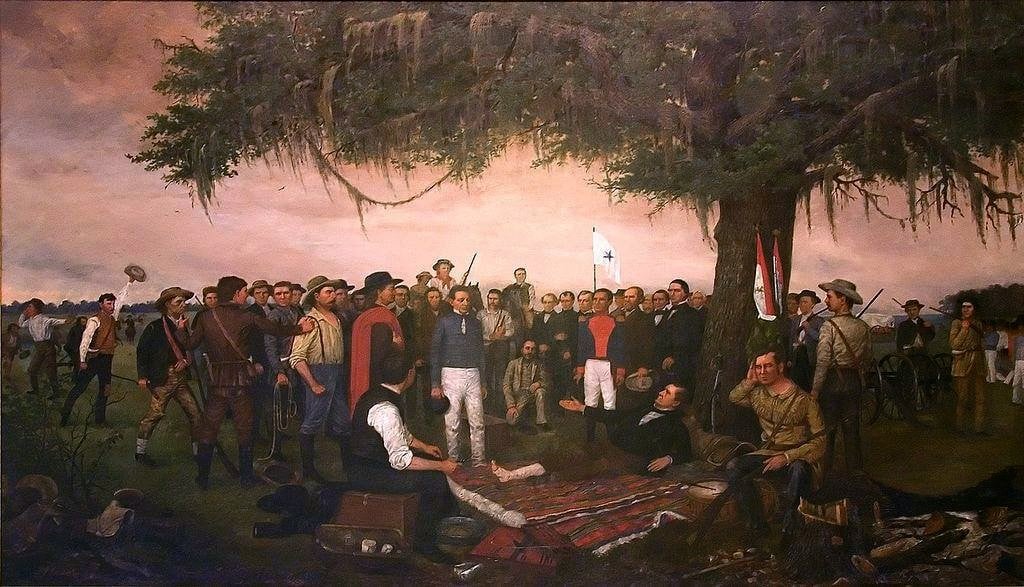
William Henry Huddle’s 19th-century painting “The Surrender of Santa Anna,” which is displayed at the Texas Capitol, depicts a key moment in the victors’ version of state history. (Wikipedia Commons)

The pioneering work by this new generation of social historians viewed society from the bottom up, focusing on the lives of ordinary Texans and their experiences. They made clear that the questions university-trained historians asked about the past, and the research required to provide the answers, contrasted in scope, focus, orientation, and conclusions with the public memories and myths held by traditionalists.

Given the impasse between the two sides, the field of Texas history looked precarious, yet everything appeared to be lining up exactly the way the writing of history is supposed to work. There was orthodoxy—the traditional history—butting heads with the antithesis, academic scholarship. Because of their willful detachment from traditional history, however, research historians never made an effort to execute the third step in what should have been a logical triad: creating a new orthodoxy. 

Scholars never invested the intellectual capital necessary to convince laypeople such as Bryan—at least in a way that penetrated the anger-armor of their insecurities—that a society becoming critical of its legends represents the first step toward rehabilitating a more complex story by taking on shades of gray that make their narratives real and more important. Rather than deconstruct it in a way that would educate its casual enthusiasts, scholars mostly ignored traditional history outside of revisionist and whiteness studies. The long game that research historians played depended on the impractical approach of waiting out the natural death of the traditional narrative, a creation story of frontier exceptionalism that was baked into the Texan identity. 


When traditionalists began openly attacking academic scholarship, research historians stayed the course of maintaining separate spheres, refusing even to try setting them straight. When the rhetorical war came, signaled by the poem Bryan introduced at the TSHA’s annual conference, traditionalists punctuated their attacks on academic history with open hostility built up during three decades of scholarship they did not understand. A heated exchange between Bryan and progressive-minded historians over his provocative ode to traditionalism revealed the intellectual distance that separated the two sides from any measure of understanding.

The immediate controversy that the vintage poem stirred up impelled Bryan to avow, “I don’t like their history, and I don’t believe their history.” He continued by insisting that in the version he embraces, westward Anglo expansion and the founding of Texas had the effect of “spreading freedoms for all.” The incendiary declaration was rebutted in an open letter, signed by 10 past TSHA presidents, who asked how Bryan, a proud descendant of Texan founding father Stephen F. Austin through a nephew, could “seriously contend that his pioneer great-great-grandfather settled on his Brazoria County plantation with thirty-eight slaves in order to secure ‘freedoms for all.’”

Actually, that is such an easy question to answer that it raises reservations about the interpretive clarity scholars brought to the table in this culture war. Given a traditionalist narrative that extolled the violent taking of the land, how else could their society be sustained than at the expense of everyone who was not Anglo and male?

An ad with the text: When Texas is at its worst, the Texas Observer must be at its best. We need your support to do it. A button reads: JOIN NOW
Advertisement

The tone of Bryan’s machinations found a kindred pairing with the creation of the Texas History Trust (THT), which began producing provocative videos condemning progressive scholarship. Michelle Haas, a TSHA member and editor of Copano Bay Press, narrated for THT the brief series “unMakers of Texas History.” Her combative style vilified the work of progressive scholars, even singling out some leading Texas historians for mocking derision.

For people such as Haas, Bryan, and their close supporters, this contest with progressive-leaning scholars was not about understanding the past; it was about power and keeping their soldiers on their side of the rhetorical battle lines. 

When Haas pilloried Buenger, then-  chief historian of the TSHA, Buenger responded in part by suggesting that “historians stay humble [and] avoid treating those who seem wrong-headed with disdain.” Rather than pushing back or waiting out the interregnum, scholars began dropping their memberships in the TSHA, effectively surrendering the institutional machinery of the state’s historical organization to traditionalists.

The defections had become so numerous by the fall of 2023 that Ben Johnson, a Loyola professor and former board member of the TSHA, polled like-minded Texas historians about the possibility of forming a counter-organization. The overwhelming response resulted in the creation of the Alliance for Texas History, which also attracted enthusiasts who would maintain memberships in both bodies. That next spring, on April 28, members of the Alliance gathered at Texas Christian University (TCU) in Fort Worth, where they held a one-day symposium at a small but sold-out auditorium. Gregg Cantrell, a highly regarded Texas historian who held an endowed chair at TCU, lent his prestige to the organization by becoming its interim president. The meeting’s success led to organizing a full conference that met this spring as well as a call for papers to be published in a new scholarly journal.


Even before traditionalists commandeered the state’s primary historical organization in 2023, two other groups had already launched endeavors to reshape the narrative of the state’s past. The first,the conservative Texas Public Policy Foundation (TPPF), initiated the so-called 1836 Project. The title signified a conservative response to the liberal 1619 Project, introduced in 2019 by journalists, historians, and artists who sought to reframe a new national narrative around slavery and its lingering influence. Hearkening to the year of Texas independence from Mexico, the stated purpose of the 1836 Project was to establish “an advisory committee to promote patriotic education and increase awareness of the Texas values that continue to stimulate boundless prosperity across this state.”  

The work of TPPF found consonance in another methodical undertaking, the Texas Center at Schreiner University in Kerrville, founded in 2020. Its mission proposed to foster “dialogue and understanding among Texans from all walks of life.” To guide the enterprise, the center selected Don Frazier, a “narrative historian” and TCU Ph.D. who had earlier organized and managed the McWhiney Foundation, which featured the State House Press, dedicated to publishing scholarly books with a traditionalist approach to history.

As TPPF and the Texas Center competed with real scholarship, the hard-right turn signaled by the 2024 elections turbocharged challenges to academic history in Texas. Soon, new state policies assailed programs that valued diversity, equity, and inclusion in the workplace. In May, Governor Greg Abbott signed into law Senate Bill 37, which shifts the power to make hiring and curriculum decisions away from faculty and toward state-appointed governing boards. Scholars are also contending with a more general, interpretive assault on their work embodied in President Donald Trump’s recent executive order “Restoring Truth and Sanity to American History.”

If these provocative actions caught scholars flat-footed, yet another challenge to the work of research historians is taking shape. Just as a committee of Texans during the 1930s anticipated their centennial by manufacturing an enduring master narrative, traditionalists today seem to be preparing for the 2036 bicentennial by retooling their grand thesis to fit present-day conditions. The dismissive contempt that university-trained scholars have expressed for the 1836 Project and the Texas Center seems to have left them unmindful of an interpretive sea change. Traditionalists have expanded the scope of their history, venturing beyond the state’s formative development and into the present age. Driving their conservative efforts is a sweeping but narrow reinterpretation of the Texas past: Sanitized—and deceptively less whitened—it proposes that “Texas history presents a record of opportunities and obstacles.”

Such a perspective maintains the equation of celebrating Texas history rather than seeking understanding. It can spotlight someone such as post-WWI-era pilot Bessie Coleman and imply that being Black and a woman were merely obstacles standing in the way of her achievements. This kind of approach recasts the oppressive depth of social, economic, and political inequities as surmountable barriers, minimizing the more injurious experiences for others subjugated by systemic institutional injustice. 

This anecdotal approach that views Texas history as “a record of opportunities and obstacles,” however, does little to help us truly understand who present-day Texans are becoming as a people. At a time of epochal transition, that can be done only by placing the history of Texans excised from the traditional history in the center of the narrative. These include Texans of color, women of every ethnicity, and even Anglo men whose ideas, values, or associations placed them at odds with the ruling order. Such a construction is a necessary part of the process to reach an even more expansive view of the past. And it is one that works against the interests of traditionalists and the power elite.
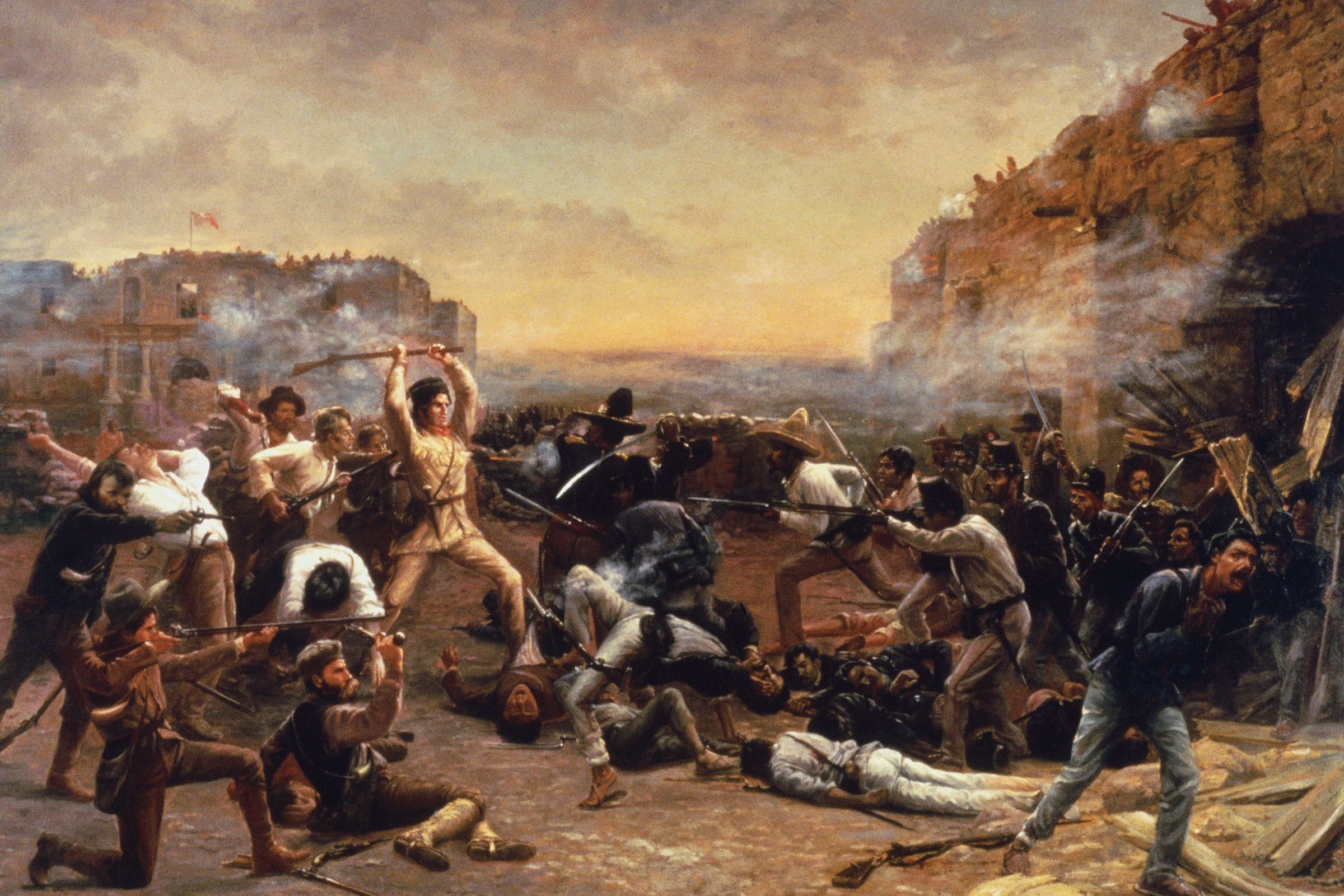
Robert J. Onderdonk’s 1903 “The Fall of the Alamo,” which is displayed in the governor’s mansion, depicts a heroic, rifle-wielding Davy Crockett in line with traditionalist Texas history. (Wikipedia)

So, what then is the outlook for the near future of Texas history? The progressive tide that swept American society circa 2020 has been beaten back; even so, the minute that progressive scholars today begin to acknowledge the impediments that allowed traditionalists to overtake them, the path ahead will open.

Seven years ago, I argued that “without piecing together grand narratives—which, although imperfect, at least include as a feature a broad understanding of how constructs of power and language are manufactured and at what costs their proponents maintain them—progressive scholars might as well retreat into those cavernous halls of academe, where they can write discourses for consumption by likeminded colleagues. Wider audiences … will never be the wiser.” What was intended as exaggerated anxiety ended up coming into view when so many academics dropped their memberships in the TSHA and created the Alliance for Texas History.

Their dramatic exodus has diminished the work of the TSHA, and—for better or worse—the intellectual well-being of the field itself now rides on the fate of the Alliance. Whether this ends up representing a strategic retreat for academics or an admission of failure will depend on the way thinking people in this contest respond to this moment in time. Will scholars learn from their past mistakes, and will open-minded workaday Texans listen if they do?

Those who would establish a new usable past that informs both sides must exercise a degree of intellectual humility that balances the popular needs and sensitivities of traditionalists who want to celebrate the historical journey and the demanding obligations of scholarship that looks critically for meaning along every step of the way. After 35 years of giving traditionalists scant attention, getting the general public to this balanced place will involve a steep learning curve. Such a difficult reckoning will not come soon. But there is no other suitable way forward.

The post How Scholars Lost the Culture War over Texas History appeared first on The Texas Observer.

29 Sep 20:52

Party Discipline

by Justin Miller

In response to last spring’s student protests against Israel’s war on Gaza that roiled college campuses across the country, including in Texas, the state’s Republican Legislature passed a law this spring placing certain conditions on “expressive activities” on campus. University governing boards were given more power to restrict when and how protests could occur, including a ban on amplified speech during class hours and demonstrations overnight. 

This was a notable about-face from the purported free-speech protections that Texas Republicans had enshrined into law just a few years earlier, in 2019, to curtail perceived campus crackdowns on conservative expression as colleges canceled events with controversial speakers like “alt-right” white nationalist Richard Spencer. 

So swings the political pendulum of First Amendment rights in the Lone Star State—and nationwide—as this foundational protection is treated as a prop to be bear-hugged in one moment and conveniently tossed aside when an opportunistic moment demands. 

After the September assassination of right-wing influencer and activist Charlie Kirk during a college campus event in Utah, the Trump administration and the MAGA movement have responded with a crackdown on free speech and expression, ranging from policing the masses for uncouth responses to Kirk’s killing to getting a critical late-night TV show host temporarily taken off the air. 

Perhaps nowhere has this been on more clear display than in Texas, and, more specifically, in the governor’s mansion. In the wake of Kirk’s death, Governor Greg Abbott publicly called for the expulsion of at least two students on state university campuses who were filmed mocking or otherwise making light of the assassination. In one case, he invoked “FAFO,” a very-online acronym he’s belatedly become fond of (short for “Fuck around and find out”), while posting the image of a Texas Tech student, a young Black woman, getting taken away in handcuffs after taunting Kirk supporters with an improvised song. “This is what happened to the person who was mocking Charlie Kirk’s assassination at Texas Tech,” Abbott wrote. “FAFO.” 

The governor expressed no concern as to whether the 18-year-old had committed any crime or had simply been arrested for her speech.

Abbott and his agency bureaucrats also set up a hotline to report instances of public school teachers in Texas posting anything deemed inappropriate about Kirk’s killing, pledging to revoke the state teaching certificates of anyone deemed guilty of such speech crimes.

While many conservatives in Texas have willingly joined this crackdown, some have shown some semblance of a spine. In response to U.S. Attorney General Pam Bondi pledging in the immediate aftermath of Kirk’s killing to prosecute “hate speech,” Senator Ted Cruz kindly reminded his podcast audience that this would be unconstitutional. The nation’s founding document “absolutely protects hate speech,” he said. “It protects vile speech. It protects horrible speech. What does that mean? It means you cannot be prosecuted for speech, even if it is evil and bigoted and wrong.” 

He also said that the Trump-appointed FCC chief had acted like a “mafioso” by threatening ABC execs over late-night show host Jimmy Kimmel’s (conveniently misinterpreted) commentary on Kirk’s death. Some other Texas Republicans publicly supported Cruz’s sentiment, including departing state Representative and ex-Speaker Dade Phelan, who chimed in: “Slippery slope indeed.” 

Meanwhile, the state’s top Republican leaders rushed to assemble what appears to be purely a show committee. Two days after Kirk’s murder, the Texas House speaker and lieutenant governor announced a select committee on Civil Discourse & Freedom of Speech in Higher Education, an Orwellian title for a body to ostensibly oversee the implementation of two recently enacted laws policing speech, governance, and curriculum on campus. 

This has all come alongside a rash of faculty firings in Texas sparked by the right’s efforts to purge universities of suspected leftist radicalism. A history professor at Texas State University was summarily tossed out of his tenured position for critical comments he made at a socialism conference about the violent American empire, which were surreptitiously recorded by a right-wing blogger. That professor, Thomas Alter, has since filed a lawsuit against the university for violating his First Amendment rights.

A lecturer at Texas A&M was also fired for apparently discussing a book that touched on gender identity in her children’s literature class. Texas A&M President Mark Welsh, a former four-star Air Force general, was caught on video initially resisting calls to fire the professor, though he ultimately did axe her in the face of cacophonous political pressure. But his initial hesitancy had his critics—including right-wing state Representative Brian Harrison and Lieutenant Governor Dan Patrick—saying he was insufficiently committed to carrying out the anti-left purges. 

“His ambivalence on the issue and his dismissal of the student’s concerns by immediately taking the side of the professor is unacceptable,” Patrick posted on social media. Welsh then resigned.

A&M, the more conservative sibling campus to UT-Austin, has been under growing scrutiny recently from right-wing attack dogs like Harrison, who’ve pounced on any sign of supposed DEI initiatives, gender and race coursework, and the like. Welsh himself was named university president to replace M. Katherine Banks, who resigned in the summer of 2023 amid a firestorm sparked by the university hiring longtime UT journalism professor Kathleen McElroy to head up A&M’s journalism program. That news whipped right-wingers into what McElroy, who is Black, described as a “DEI hysteria,” and the university board of regents rescinded her offer. (McElroy, who remains a UT professor, has since become a board member of the Texas Observer’s parent nonprofit.) 

While Welsh left without putting up much of a fight, his ouster has some similarities to perhaps the most infamous political breach of academic freedom in Texas history. In 1944, UT President Homer Rainey was summarily fired by the regents for his full-throated opposition to their firing of four economics professors with pro-labor New Deal politics and an English professor who’d assigned a controversial novel (which they also then banned). 

His ouster became a national story and prompted broad resistance on campus—including thousands of students who went on strike. The governor at the time, Coke Stevenson, did replace many of the sitting UT regents, but Rainey was never rehired. 

Nowadays, the independence of university leadership—to say nothing of faculty—has been greatly deteriorated by political dictates and targeted pressure campaigns. 

Abbott’s appointed regents are all big campaign donors who sit neatly in his back pocket. And the chancellorships of the big three university systems are now all about to be controlled by ex-Republican politicians: at UT, former state Representative John Zerwas; at A&M, recently departed Comptroller Glenn Hegar; and likely soon at Texas Tech, hardline conservative state Senator Brandon Creighton. 

All this portends a straitjacketed Texas campus culture, one fit for a Soviet Union in which Gorbachev had been succeeded by Pat Buchanan. In recent weeks, cancel crusades have been launched against individuals who merely quoted some of the late Kirk’s more repugnant views on civil rights or, sharpening the point, gun violence. To risk quoting Kirk himself here—espousing the rare view of his that was fit for a decent society: “There’s ugly speech. There’s gross speech. There’s evil speech,” he once opined. “And ALL of it is protected by the First Amendment.”

The post Party Discipline appeared first on The Texas Observer.

29 Sep 20:45

Ways the National Guard Can Actually Help “War-Ravaged” Portland

by Gracie Beaver-Kairis

“President Trump’s declaration on Saturday that he had authorized the use of federal forces to ‘protect war-ravaged’ Portland, Ore., prompted bewilderment and frustration—and more than a little sarcasm—in the city this weekend.”
New York Times

- - -

Help reshelve the books with pics of naked women in them that middle school boys have left strewn around Powell’s.

Put a stop to the ungodly ice-cream flavor combinations at Salt and Straw.

Institute a ban on wimps who use umbrellas.

Censor the outrageous cost for one, single penis-shaped Voodoo Doughnut.

Aggressive DOGE-style 20 percent reduction in the number of mediocre craft breweries.

Stop the radical liberal reeducation campaign to erase Oregon’s colonial history by allowing employees statewide to play The Oregon Trail during office hours.

Resurrect Shari’s Café and Pies, a tragic victim of cancel culture (not paying taxes).

Return the city’s historical monuments to their former, pre-woke glory (slap a new coat of paint on the Hawthorne Bridge).

Make Portland music legends Modest Mouse and The Decemberists form a supergroup.

Tend to victims’ war wounds (genital chafing) sustained during the annual Naked Bike Ride.

Police coffee shops that up-charge two dollars for alternative milk and then make your latte too weak and ruin the Stumptown beans they claim to use.

Have the NSA dig up some dirt on Damian Lillard to blackmail him into never leaving the Blazers again.

Mandate a new season of Portlandia and give the show the same budget as the Department of War.

Empower citizens to take the law into their own hands when they see someone throw a compostable plate into a landfill bin.

Instruct all HMOs to completely cover the costs of treating infected tattoos.

Eradicate the parasites living in Tryon Creek Park (ticks).

Subdue the real domestic terrorists—i.e., drivers who don’t know how to merge onto I-5.

Remove the scourge of unwanted immigrants flooding into Portland (crypto bros from California).

With full force, keep Portland weird.

29 Sep 20:02

Review: Nadia Al-Khalifah’s “Well, I’ll Be Damned” at Stinson House, Houston

by Ronnie Yates

Portraiture has a complex history, conveying status and power during the Renaissance, or taking up the interrogation of the gaze in the self-portraits of Cindy Sherman. But portraits also allow one to explore the intimacy and even frailty of the face, to, as the philosopher Emmanuel Levinas said, experience an ethical demand in response to the living face. Nadia Al-Khalifah’s current exhibition, curated by Nick Stinson and beautifully staged at the quietly remarkable Stinson House, uses portraiture and the heartbreaking delicacy of the carefully rendered face to examine personal relationships, the histories and registers of emotions of both the “interior world of deep friendships” as well as “strained family relations.”

A small color photograph of a man and woman standing next to each other. At the corner of a the photograph sits a small bouquet of flowers.

A photograph of Nadia Al-Khalifah’s parents on display in “Well, I’ll Be Damned” at Stinson House. Photo: Francisco Ramos

A striking diptych presides over the show, portraits of man and a woman, a couple painted from a photograph displayed nearby. The man is dressed in the traditional attire worn by men in Saudi Arabia. In the photograph, he stands next to a woman dressed elegantly in a patterned pair of wrap pants. They pose standing slightly apart. The man wears a thobe — a long, white robe, and a ghutrah — a plain white headscarf secured by the black, corded agal. The white robe is used for daily wear and suggests cultural identity and the (religious) principles of modesty, purity, respect, and simplicity, ideas that, in some ways, Al-Khalifah’s portraits throughout the show take up, turn, or flirt with, in what seems to be a sacred, profane, and very personal sense.

An installation image of mixed-media portraits of a man and a woman.

Nadia Al-Khalifah, “Half-Breed Bastard,” 2025, gouache, graphite color pencils, and chalk on panel, 10 x 8 x 1 5/8 inches (each). Photo: Francisco Ramos

The portraits here are of Al-Khalifah’s parents, who, according to her, had a tumultuous relationship that she struggles to make sense of, so that repeatedly painting them, she has said, has become “a searching, unresolved process.” The name of the diptych, Half-Breed Bastard (also the name of Al-Khalifah’s Instagram account), suggests an ambivalence about her history, but a “teasing” one, which Al-Khalifah says is a “hint” at the “tangle” of family history she has inherited and often tries to re-imagine. 

The portraits of Al-Khalifah’s parents are made with a layering technique that is a throughline of the show. Working without sketches, Al-Khalifah uses gouache, graphite, colored pencils, and chalks to build her portraits in real time with the “unexpected, even imperfect results” that she values. Out of these dreamy confluences of texture, color and line, carefully rendered details of eyes and mouths, the articulation of teeth in smiles, lips pursed in thought or anticipation, emerge as she paints her friends or intimates. 

There is a distance, however, in the diptych portraits: the unassuming, and small, tight, guarded smile of her father and mother are flattened into the remote gaze of monarchs, as if Al-Khalifah is playing with the idea of the portrait as an ornate and lavish rendering that elevates these subjects. Or, in a different way, as if the images become icons that occupy a sort of empty, or “unresolved,” as Al-Khalifah has noted, space, a meditative space that might be filled with awe or grief or longing.

An overhead view of a display coffee table featuring books, ephemera, and drawings.

An overhead view of an auxiliary coffee table display of books, ephemera, drawings, and tchotchkes on view in Nadia Al-Khalifah’s “Well, I’ll Be Damned” at Stinson House. Photo: Francisco Ramos

The relationship between the portraits of her parents and those in the rest of the show is nicely suggested by an assemblage made using a vintage, Ikea glass top display coffee table, borrowed from Al-Khalifah’s home (a suggestion made by Stinson). The table is divided into two display cases where the photograph of her parents, along with “ephemera, drawings, and tchotchkes,” are seen under the glass. Books from her collection are placed on top of the table, along with a vase of flowers. On one side of the display case, Al-Khalifah has gathered objects, sketches, and postcards that suggest uncanny details from her conscious or unconscious experience. These items are juxtaposed with the photograph of her parents, a spray of dried flowers resting poignantly near it, and another “diptych,” a sample of the portraits she obsessively paints based on this photograph. The images of her parents here occupy an isolated space around which the intimate, ordinary objects of her life, even psychologically, aesthetically charged objects (dolls, toy lambs, self-portraits, sketches of her partner), radiantly circulate. There is a certain stasis to the images of her parents in the display as they slip out of the details of her daily life into the strangeness of a complicated history.

On the wall near the display, the gallery-wrapped panel edges of the sumptuous Half-Breed Bastard portraits are painted with a bright, fluorescent red design, inspired by a tapestry with an “Arabian Nights” motif, which hung in Al-Khalifah’s childhood home and was, as Al-Khalifah says, “one of those rare objects that gave me small, fleeting glimpses of a heritage I never got to fully know.” The design embellishing the portraits elevates them again into the realm of the symbolic, or a longing for the symbolic. 

Al-Khalifah’s palette throughout the show is characterized by tranquil, dreamlike pastel hues, a softness that reflects and refracts a luminescence. When first seen in the antique, impeccable, light-flooded galleries of Stinson House, the row of portraits in the main room seem pure color, all light. But the use of light, the disposition of the luminescence, throughout the paintings is mobile and suggestive. In the diptych of her parents, the light doesn’t seem to emanate from some interior space, as it often does in the portraits of her friends, neither does it reflect some outward source of light, some vision outside the paintings, but rather seems to be a pure aesthetic gesture, a mask, or better, a masquerade of light, bestowing a certain aura on the figures. They appear distant, removed from the everyday, as if their true or dream or re-imagined selves are yet hidden from the painter, and she wishes to keep them safe somewhere behind these swaths of light.

A photograph of four mixed-media portraits by Nadia Al-Khalifah.

Works by Nadia Al-Khalifah on view in “Well, I’ll Be Damned” at Stinson House. Photo: Francisco Ramos

The portraits of friends, lovers, and intimates that make up most of the show operate similarly, but with different effect. Here the layering suggests a depth of history and feeling, shared worlds, depths of the mysteries of love and friendship, one which comes out of Al-Khalifah’s articulations of faces, lines like whispers, quirks and gleams of color, line and light, memories, stories, inside jokes, which the titles of the paintings suggest.

An installation view of works by Nadia Al-Khalifah on view in a house gallery.

An installation view of Nadia Al-Khalifah’s “Well, I’ll Be Damned” at Stinson House. Photo: Francisco Ramos

In the main gallery, with the small portraits of her friends lining the quiet cascade of space, a fireplace is situated at the far end. Stinson describes the hearth and firebox, painted a gleaming ebony, as a depth of negative space, which sets it apart by way of a threshold that viewers are hesitant to cross, one might say a sort of holy space, the space of an altar, or of familial intimacies. On the mantle of the fireplace sit three simply framed works: canvases saturated in single color fields, behind which photostrips from photobooths have been placed, some of the small photos visible through squares cut into the canvases. Here, we see images of Al-Khalifah as she strikes comedic poses, some with soft looks of amusement, or wry self-reflection, as if to, as Stinson says, ward off typical responses to beauty, protecting herself, or presenting the complexity of interiority manifested in a variety of larking moods, behind which a self-possession and vulnerability are yet expressed.

Three mixed-media works by Nadia Al-Khalifah featuring small photobooth photographs inserted into framed canvases.

Works by Nadia Al-Khalifah on view in “Well, I’ll Be Damned” at Stinson House. Photo: Francisco Ramos

Humor circulates liminally in the show, as in funny-haha as well as funny-strange, with hints at a sharper melancholy, but ultimately seems a source of love and wonder, an address to the recognitions and insights made possible as we inhabit the difficult, delightful histories of our lives and relationships. The name of the show, Well, I’ll Be Damned, came to Al-Khalifah before many of the portraits were made. “I love that the phrase lives in two worlds at once,” she says, “both heavy and fated, but also exasperated and funny.”

A mixed-media painting by Nadia Al-Khalifah of a woman with a bob haircut and an exaggerated long chin.

Nadia Al-Khalifah, “With Gloom (Aziam),” 2025, gouache, graphite, color pencils and chalk on panel, 10 x 8 x 1 5/8 inches. Photo: Francisco Ramos

The portraits of her friends sometimes employ surreal gestures — an elongated chin, or sharply rendered teeth. These playful gestures make the images of her friends her own, suggest and protect the ease and intimacy of her relationships, beautifully expressed in the sheer delicacy of the lines, the modeling. In the portrait With Gloom (Azizam), beneath a (rather beautifully) exaggerated chin, a bare, subtle shoulder extends — a shoulder to cry on, to lavish with tears or touches. In many of the portraits the eyes, the mouth, become fragile places to care for. In pure strokes of light caught up in the eyes, the painter, the subject and the viewer coalesce there in the gaze, the liquid light of love beheld. Voices seem to echo from the mouths, whether opened or closed, a kind of ventriloquism, at some depth of interiority, stories, laughter, private thoughts, tearful admissions. There is a tenseness, tautness, or deliciously teasing quality suggested in the physical renderings of the faces of Al-Khalifah’s intimates. 

A mixed-media portrait by Nadia Al-Khalifah.

Nadia Al-Khalifah, “That Nose… I Love That Nose (Austin),” gouache, graphite, color pencils, and chalk on panel, 10 x 8 x 1 5/8 inches. Photo: Francisco Ramos

In That Nose. . . I Love that Nose (Austin), a small, pastel orange circle appears on the man’s chin, the soft melancholy blue of his eyes accentuated by rings of blue light. In How’s Your Head? (Paulie), a portrait of Al-Khalifah’s partner, the face is touched here and there, brushed with scratches of red and fluorescent orange light. These marks or figures within the faces act as signs of the histories of conversations, experiences, love, laughter, and even griefs, given, shared, suffered through together; carefully, delicately, “heart-breakingly” rendered features that scintillate through the simple dreamscapes of color. Three Hour Coffee Date with Kitty, placed near the floor in a strange enticement to viewers to invert our expectations, presents a strongly modeled face, the brushstrokes of the eyebrows seem to come, without exaggeration, directly from the subject, her light filled eyes, mirthful grin, her nose ring and earrings, the flowers of her ears, her ghostly unfinished hair reflecting a fiery light down one length, suggest the frank beauty, poise and wit of this conversation partner.

Side-by-side photographs of a painting hanging in front of a window. One image shows the front, a portrait. The other image shows the back with text about friendship.

Front and back installation views of Nadia Al-Khalifah’s “You do look tired (to Junebug),” hanging in window at Stinson House. Photos: Francisco Ramos

One portrait, You do look tired (to Junebug), floats in a window, facing into the gallery, suggesting Al-Khalifah’s stylized realism, the way her images float out of the depth of and on the surface of the world. On the back, the artist has written a note to her friend, which can be read from outside through the window glass to which the painting is affixed. Here, the novel presentation suggests interiorities and views into and out of them, revealing how the hidden, the secret life, abides and is revealed. The note reads in part: “Thank you for this/aging friendship. . . all this baggage/in our past/under our eyes/we old Junebug/and I love it/seeing mama you/wed me.”

In Nadia Al-Khalifah’s portraits, we sense that seeing is a wedding, a face-to-face encounter expressed here with delicately rendered details of the faces of those we care for and even mourn, that tease meaning from light and line. Well, I’ll be Damned, with its mirthful and exasperated recognitions allowed us into Al-Khalifah’s intimate encounter with her friends and family, suggests an ambiguous, exquisite, and liberating operation that the artist works freely and joyfully within.


Well, I’ll be Damned is on view through October 3, 2025, at Stinson House in Houston.

The post Review: Nadia Al-Khalifah’s “Well, I’ll Be Damned” at Stinson House, Houston appeared first on Glasstire.

29 Sep 20:01

On Migration & Exchange: Mark Menjívar’s “A Space in Which People Are Free To Move and Birds To Fly” at Co-Lab Projects, Austin

by Isabel Servantez

A Space in Which People Are Free To Move and Birds To Fly is an encouragement to move, a reminder to mind life’s intricacies, and a push to embrace the practice of letting go. 

A photograph of people gathered near the opening of a concrete tunnel used to display artwork.

Co-Lab Projects

My movement began by coming upon the Co-Lab Projects structure for the first time just before sunset. In the center of a field, surrounded by trees, sits a large concrete tunnel-like structure made from five merged culverts (structures used to redirect rainwater under highways), its interior blacked out. The mixture of its non-reflective black center and imposing gray surface, against verdant grass, trees, and a darkening blue sky, was quite a phenomenon to experience. As I approached the structure, with its black center, it grew, menacingly, to subsume me. But there was respite at the nucleus of the monotone form; when gazing out from within the structure’s center, the black walls nicely framed the natural tones of grass, trees, sky, and sunlight at each end of the culverts.

A photograph from the inside of a concrete tunnel used to display art.

Co-Lab Projects, view looking through the culverts

An installation image of a large black cloth hanging inside a concrete tunnel, used to display art.

An installation image of “A Space in Which People Are Free To Move and Birds To Fly” on view at Co-Lab Projects

Walking inside the brutalist monolith I first faced a large black drop cloth accented with vibrant embroidered trails. Stepping past that, I met an impressive array of nondescript sound equipment, wires, a mass of small booklets, and a technicolor rainbowed array of eight-sided dice, in stark contrast to the surrounding dark surfaces. 

Mark Menjívar, at the center of the gray object, guided person after person through the details and intentions behind the physical elements of the exhibition. Menjívar patiently explained how participants affect the artwork’s output; each person rolls an eight-sided die (inspired by his dedication to the Chinese I Ching and his son’s dedication to the Dungeons and Dragons (D&D) role playing game) which corresponds to the volume of eight soundtracks being played in the field surrounding the gray structure.

A photograph of artist Mark Menjívar interacting talking with two people at a table that includes a sound mixer and a various eight-sided dice.

Mark Menjívar interacting with visitors to his exhibition “A Space in Which People Are Free To Move and Birds To Fly”

The importance of the dice grew as Menjívar gifted a used die to its roller as a memento of the experience, stating, “You’ll forget about this exhibition in a month, No, a week!, but maybe in a year you’ll find the dice rolling around and it will remind you of this exhibition.” 

A photograph of the cover of a Zine titled “A Space in Which People Are Free To Move and Birds To Fly,” by Mark Menjívar.

“A Space in Which People Are Free To Move and Birds To Fly” zine by Mark Menjívar

Gift giving continued as a part of A Space in Which People Are Free To Move and Birds To Fly with the free-for-the-taking zines on display. Menjívar explained that these “unprecious objects” were added to instill the show with a reflection on gift economy in art. Yes, these objects were inexpensive, but Menjívar and the curator of the exhibition, Leslie Moody Castro, imbued great importance into these small tokens. Could dice inspired by Menjívar’s spiritual commitment to the I Ching and his son’s passion for role playing, and a zine created with such care that it had blue and red binding and deeply significant stories to both Menjívar and Moody Castro, be anything less than precious?

This imbued preciousness continues with the large, draped textiles that bookend the main exhibition space. Menjívar explained that these black fabrics, simple drop cloths, held stitches from a sewing machine once belonging to his grandmother, and that each line of thread represents migration patterns of two different, and personally significant, species of birds.

The whole of these details are so deliberate when accounted for analytically, but the tight grip that the artist and curator have on the intricacies of the exhibition only goes so far, and that is  the point. 

A photograph of a field surrounded by trees.

Co-Lab Projects’ grounds

After I rolled and pocketed my die and zine, I exited the back of the culverts to a slightly different sky, and a slightly cooler air. Walking around the Co-Lab grounds, the artwork changed as I moved between the posted speakers and as other participants altered the intensity of each of the eight soundtracks. Taking time with the exhibition in that open space was almost as significant as  the time spent within the semi-enclosed center. It is important, because  unlike birds that have  freedom to glide over artificial borders, our movement is inhibited and bound by others. 

Perhaps what Menjívar and Moody Castro give us with A Space in Which People Are Free To Move and Birds To Fly is just enough room to remember that we could go freely through this world if we collectively allowed one another, and ourselves, to do so. With the experience of entering the overwhelming and confined space, taking on deeply spiritual, personal, and familial histories along with gifts noting small but significant connections and then exiting to unguided openness, we are given a glimpse of the unbound potential of Menjívar’s birds. Like peering through the darkened culvert at the radiant nature just beyond its concrete borders, with priceless keepsakes in hand, we have only to walk forward to embrace our freedom to move.


A Space in Which People Are Free To Move and Birds To Fly is on view through October 25, 2025, at Co-Lab Projects in Austin.

The post On Migration & Exchange: Mark Menjívar’s “A Space in Which People Are Free To Move and Birds To Fly” at Co-Lab Projects, Austin appeared first on Glasstire.

29 Sep 20:00

Trump: ‘Another Thing Epstein And I Never Did Is Play Nude Charades’

by The Onion Staff
29 Sep 20:00

Victor Wembanyama Reports To Training Camp Having Added 25 Pounds Of Hair

by The Onion Staff

SAN ANTONIO—Demonstrating his commitment to entering the season in peak physical form, Spurs center Victor Wembanyama reported to training camp Monday having packed on 25 pounds of dense, towering hair. “The coaching staff wanted me to bulk up over the offseason, and growing tons of hair was the best way to put on weight without affecting my agility,” said Wembanyama, flaunting the colossal, 3-foot-tall mass of hair, which functionally brings his height up to 10-foot-3 and greatly improves his vertical reach and defensive utility. “I have to use a lot of shampoo now, but I think this hair weight will really allow me to take my game to the next level. I can probably set a screen on an entire defense just by shaking my head around. I can block shots I’m not even looking at.” At press time, witnesses marveled as the all-star used his hair to tip a half-court lob directly into the basket.

The post Victor Wembanyama Reports To Training Camp Having Added 25 Pounds Of Hair appeared first on The Onion.

29 Sep 20:00

Highlights From Kamala Harris’ New Memoir

by The Onion Staff

Kamala Harris has released 107 Days, a new memoir detailing her 2024 run for president against Donald Trump. Here are highlights from the book.


Complete list of every American who did not vote for her in 2024


Story of how she selected Doug Emhoff as her husband after several rigorous rounds of romantic dates


Says Buttigieg was her first VP pick until she found out he’s gay


A dozen or so chapters devoted to whale anatomy


Revelation that despite mispronouncing “Kamala” in public, Trump spoke fluent Tamil in a private call


Pretty graphic Doug sex scene


Eighteen references to Biden as “that honky”


Real downer of an ending


A personal thank-you to Trump for not throwing her in jail yet

The post Highlights From Kamala Harris’ New Memoir appeared first on The Onion.

29 Sep 19:32

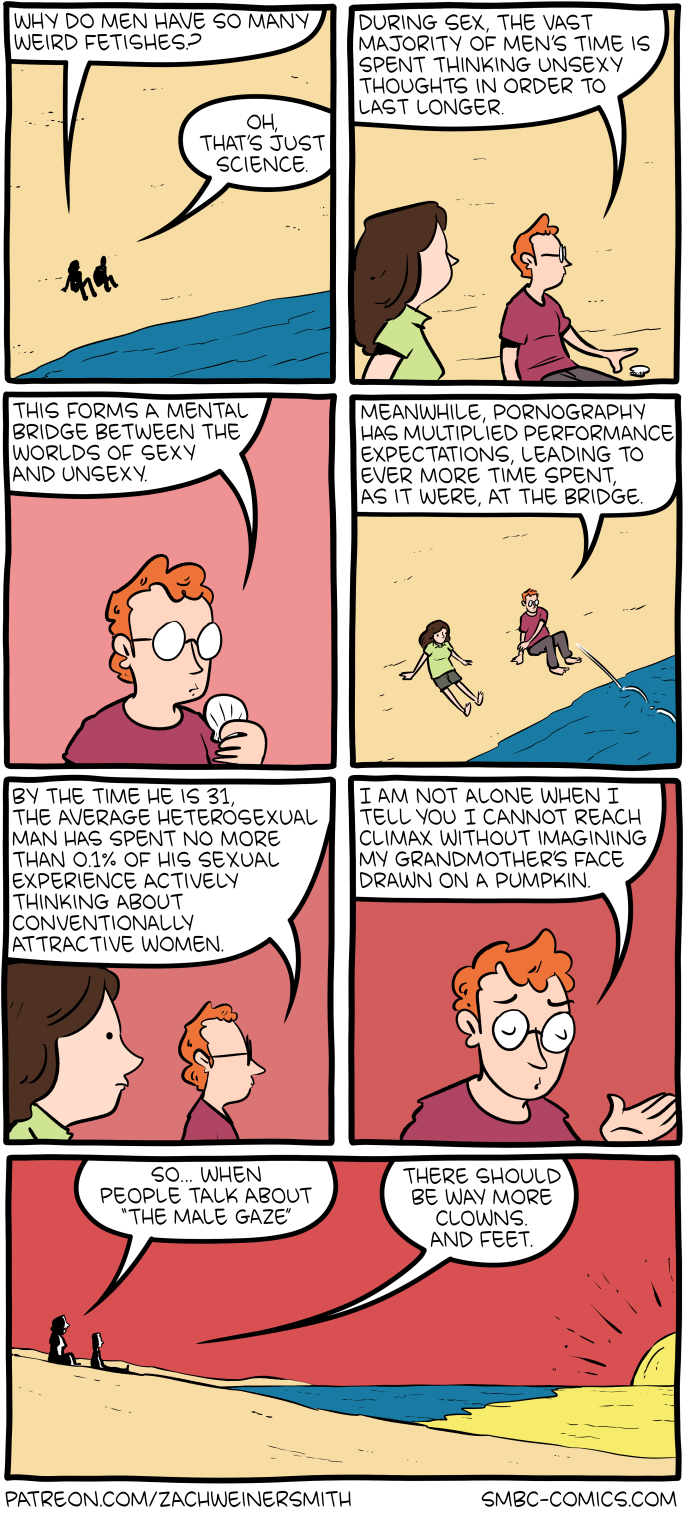
Saturday Morning Breakfast Cereal - Gaze

by Zach Weinersmith


Click here to go see the bonus panel!

Hovertext:
May I recommend the Look And Say Sequence, but don't complain to me if it starts getting weird.


Today's News:
29 Sep 18:36

Meet our next CEO: Sarah Adler Hartman

by By Trei Brundrett, Texas Tribune Board of Directors
Sarah is an Austin native who brings a rare combination of vision and leadership experience to the job.
29 Sep 18:36

#Rowen #RoninWarriors

29 Sep 18:36

I was offered a promotion to manager but with no raise

by Ask a Manager

A reader writes:

I work in the donor relations team at a major university.. This past year has been really tough for the university budget-wise, for various political funding reasons. There was a round of layoffs earlier this year where almost 20% of people let go were in our unit.

Another layer to consider is that our fundraising unit has gone through a massive reorg with a lot of roles being compressed with bigger portfolios.

Our team is really flat, with the associate director having too many direct reports. I’ve been approached to take on a role where I would oversee four of those people as a manager. This is a first time manager role for me but I have already demonstrated a lot of leadership and mentorship.

I was quite disappointed to hear that this new role would not come with a salary or job grade change. It was presented as a learning opportunity, but I sort of feel taken advantage of. I think I deserve a salary increase and if I don’t get one now, I won’t have as much leverage to negotiate if I wait to ask six months into the new role.

Yes, they’re taking advantage of you. Managing four people is a significant increase in responsibility and you should be paid accordingly for it.

I’m curious to know whether they’d be hiring for this position and advertising it to external candidates if you didn’t accept it. If they would be, they should absolutely pay you accordingly. But if they otherwise wouldn’t hire for it for budget reasons, it could become slightly less unreasonable; in that case, they might be seeing it as mutually beneficial. The idea would be that you get a management role that you might not be as competitive for if more experienced candidates were in the mix, and you can then parlay that into advancement and more money down the road (even if it not with them) … and in exchange, they get someone in that role. It’s still not fair — you deserve to be paid for a significant increase in work and responsibility — but I’d be slightly less irked by it, particularly given the context about the budget issues and layoffs.

Ultimately it comes down to how much you want to get management experience. If it’s not something you really care about, that’s a lot of work to take on for no raise just because they offered it. If you do want management experience, which can be frustratingly hard to get for people who want to move in that direction, it might be worth it to you to do.

If you do want to do the job, it’s reasonable to point out that it’s a significant increase in work and responsibility and ask to be paid fairly for that increase. They might not give you as much as they’d give a more experienced candidate, but you should get more than you’re getting now. If they really won’t budge, though, see if you can negotiate for a salary review (or outright raise) in six months. That’s not ideal, but it’s better than nothing.

The post I was offered a promotion to manager but with no raise appeared first on Ask a Manager.

29 Sep 18:13

Trump takes tariff war to the movies by announcing 100% tax on foreign-made films

by Wyatte Grantham-Philips, Associated Press
Claiming that movie production “has been stolen’’ from Hollywood and the U.S., Trump posted said he would be imposed the 100% tariff on “any and all movies” made outside of the U.S.
29 Sep 18:12

the government shutdown: an open thread for federal employees and contractors

by Ask a Manager

A reader writes:

Could we do an open thread for federal employees and federal contractors about the possible government shutdown? I wasn’t working in government for the last one and don’t really know what to expect.

Yes indeed. People impacted by the last shutdown, what advice do you have for people affected by this one? And people affected by this one, ask and share away.

The posts from the shutdowns in 2018 and 2019 might also be helpful, and here’s a piece from 2013 by a commenter about what not to say to friends who had been furloughed by the government shut-down then.

The post the government shutdown: an open thread for federal employees and contractors appeared first on Ask a Manager.

29 Sep 18:12

Can I be excused?

Can I be excused?

29 Sep 18:11

Trump’s Hollywood tariffs force Dune 3 to shoot in Mississippi

by Geoff Cork

Jackson, Arrakis – President Donald Trump’s proposed tariffs on movies filmed in other countries has forced Dune producers to relocate to Jackson, Mississippi. “It doesn’t quite match the desert fans have come to know,” mused Mary Parent, a head producer for the film. “But Jackson presents its own sort of danger to Paul and his […]

The post Trump’s Hollywood tariffs force Dune 3 to shoot in Mississippi appeared first on The Beaverton.

29 Sep 18:11

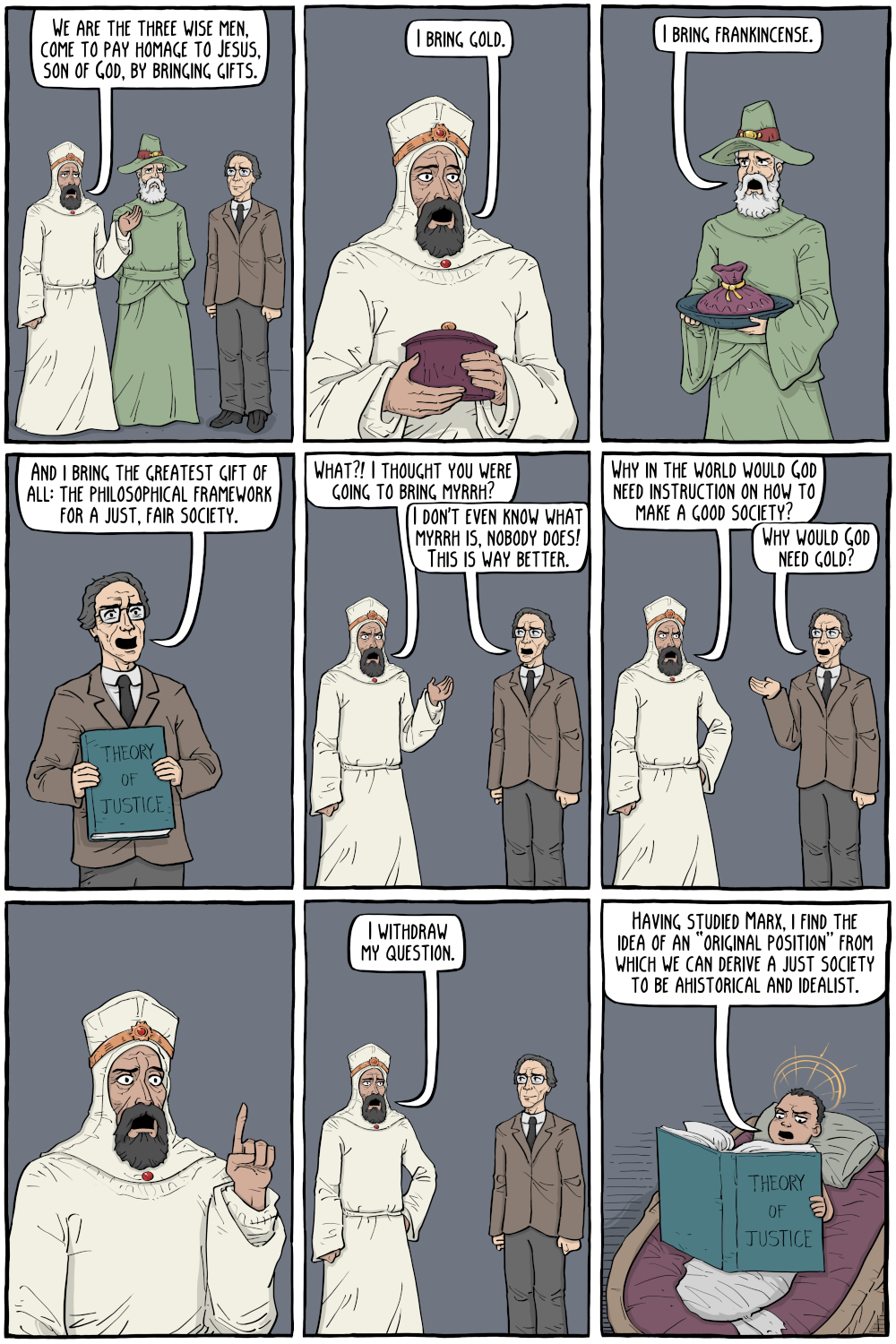
The Three Wise Men

by Corey Mohler
PERSON: "We are the three wise men, come to pay homage to Jesus, son of God, by bringing gifts. "

PERSON: "I bring frankincense."

PERSON: "I bring gold."

PERSON: "And i bring the greatest gift of all: the philosophical framework for a just, fair society."

PERSON: "Why in the world would God need instruction on how to make a good society?"

PERSON: "Why would God need gold?"

PERSON: "What?! I thought you were going to bring myrrh?"

PERSON: "I don't even know what myrrh is, nobody does! This is way better."

PERSON: "I withdraw my question."

PERSON: "Having studied Marx, i find the idea of an “original position” from which we can derive a just society to be ahistorical and idealist."
29 Sep 18:10

Ciddle

Guess the city based on its distance to other cities. Site is German, but the game is playable without language knowledge. Uses a city database so entering in another language should not be a problem.

Added by @fihu in Games › In-Browser Games.

29 Sep 15:18

ALT

A comic of two foxes, one of whom is blue, the other is green. In this one, Blue and Green observe with delight as Blue's breath turns into a puff of steam in the cold air.
Blue: Look! My breath is fogging up!
Green: It's finally getting cool enough to do things outside again!

Blue and Green look at each other, excited.
Blue: Are you thinking what I'm thinking?
Green: Yep!
Both, in unison: Dugout time!

The foxes get busy digging. The hole they've already achieved is deep enough that only their heads and Green's shovel poke out.
Blue: Next summer we'll have a nice, chilly underground bedroom away from the heat.
Green: Do you think we could fit a fridge in here, too?ALT
29 Sep 14:45

Amazon To Pay $2.5 Billion Settlement For Tricking Prime Customers

by The Onion Staff

In the largest civil penalty in Federal Trade Commission history, Amazon agreed to pay a $2.5 billion settlement to resolve claims that it misled customers into Prime enrollments and made cancellations difficult. What do you think?

“Amazon needs to stop mistreating their customers and focus on mistreating their workers.”

Adam Dokels, Unemployed

“Just think of how much you could buy on Amazon with that settlement money.”

Bruce Moises, Rice Purchaser

“I knew getting Prime would eventually pay off.”

Selena Alcantar, Batter Mixer

The post Amazon To Pay $2.5 Billion Settlement For Tricking Prime Customers appeared first on The Onion.

29 Sep 14:44

Taylor Swift Secures 5-Year Restraining Order Against Stalker

by The Onion Staff

Taylor Swift was granted a five-year restraining order against an alleged stalker who repeatedly appeared at her home and made delusional claims about having a child with her. What do you think?

“She should at least take a test to find out if the kid is hers.”

Ruby Elkins, Trouser Hemmer

“Not everyone has the money to follow her to actual concerts.”

Tom Olivier, Pelican Surgeon

“What a bitch.”

Danny Bartler, Border Embroiderer

The post Taylor Swift Secures 5-Year Restraining Order Against Stalker appeared first on The Onion.

29 Sep 14:44

ICE Confirms Agents Do Not Have Faces Beneath Masks

by The Onion Staff

WASHINGTON—In response to legislation that would ban officers from obscuring their identities during arrests and raids, U.S. Immigration and Customs Enforcement confirmed Thursday that beneath their masks, agents do not have faces.

Tom Homan, the U.S. border czar and chief enforcer of President Donald Trump’s immigration policy, warned that Democrats “may get more than they bargained for” with transparency initiatives like the Senate’s VISIBLE Act, because the agency’s more than 20,000 members wear neck gaiters, hats, and sunglasses to cover a terrifying void where their eyes, nose, and mouth should be.

“The truth is, just underneath their masks lies an infinite abyss of total and complete darkness,” said Homan, adding that ICE officers concealed themselves not only for their own benefit, but also to protect others from seeing the hideous, unknowable horror beneath. “Liberals can accuse this agency of constitutional violations all they want. But we both know that seeing a man in tactical gear is far better than seeing a man without a face, staring deep into that empty chasm, and instantly going mad.”

 “Mere mortals cannot survive what lies beyond the cloth,” Homan continued. “Whatever you do, don’t go towards the dark, don’t go towards the dark, don’t go towards the dark.”


Upon beholding the faceless, unmasked agents, border czar Tom Homan was driven to the edge of insanity.

According to Homan, anyone who went within even a few feet of an unmasked agent, including protesters, government officials, and lawyers, would experience debilitating full-body chills, hear sharp ringing sounds in their ears, and experience visions of death so intense they would immediately fall to the ground and claw out their own eyes.

In addition, the border czar warned that bystanders who attempted to take photos and videos of unmasked ICE agents at raids on workplaces, government buildings, or public parks would be sucked into a dimension of darkness, never to return, and nothing would be left behind but a charred, cracked camera and footage corrupted by static and ominous whispers.

Scoffing at what he called the naivete of Democrats, Homan told reporters the terror that lay behind agents’ masks was only the beginning, and that it was nothing compared to what could be found inside the agency’s unmarked vans and warehouses. He then looked off into the distance, unleashed a scream, and said, “They are coming for me, the men of the night, they are coming for me!”

In a post on Truth Social, the president argued that Americans should thank ICE agents for hiding their faces, contending that several months spent in a detention center was much safer than the prospect of accidentally catching a glimpse behind their masks and having one’s mind imprisoned for all eternity, floating forever between the valley of life and death.

“The BRAVE Patriotic Men and Women of ICE deserve to keep their masks and also when they remove them they are Very Scary,” Trump wrote in a late-night post defending his immigration policies. “They risk their lives arresting rapists and murderers. Also, when I stared into the void, I saw a baby version of myself being eaten by an adult version of myself while a faceless man watched. Then, my face was on his face, and he LAUGHED!”

“I don’t know what it means,” the president added, “but ICE and the faceless man who spoke in my mother’s voice will Make America Great Again!

At press time, Trump confirmed that he’d set a new goal to deport at least 65 million migrants to the shadow realm. 

The post ICE Confirms Agents Do Not Have Faces Beneath Masks appeared first on The Onion.

29 Sep 14:44

Spooky Tax Evasion House

by The Onion Staff

Live in the very house where a man failed to pay $200,000 in taxes over 10 years…if you dare!

Reference #29301

The post Spooky Tax Evasion House appeared first on The Onion.

29 Sep 14:43

Instructions for Your High-End Italian Espresso Machine

by Heidi Lux

Welcome to your new high-end Italian espresso machine. Or should we say buongiorno? Yes, we should. Your espresso machine only speaks Italian. To get the most out of the machine, you must learn the language.

We will wait.

Fourteen Months Later.

Remove the machine from the box. Carefully. You want to make a good first impression. Use a firm, yet gentle grip to establish trust. Too weak a grip, and your high-end Italian espresso machine will never respect you.

Important safeguard: Don’t film an unboxing video. Your espresso machine is wary about having a social media presence. Between you and me, it held some questionable beliefs during WWII and doesn’t want the public uncovering it.

Your Italian espresso machine is perfect for daily use; however, please keep in mind that the machine demands time off to rest, so daily use doesn’t really “work” for it.

To set your machine up, find the area of your house with the best lighting. We know the kitchen will be the most convenient, but this isn’t about you. This is about getting the best extraction, and your Italian espresso machine will feel self-conscious if it thinks the sunlight in your breakfast nook is hitting its metal in the wrong way. If you want your machine to function properly or even at all, get a professional photographer-grade light meter and wave it around your house like it’s a smudging stick.

Plug it in.

Now that your espresso machine is set up, check on its emotional well-being. Is it comfortable? How would it describe its feelings? Is the sunlight too direct? Ask if it feels as if it can produce today.

We’ll save you the trouble: It will say it cannot produce today. Try again tomorrow.

A Day Later.

Your high-end Italian espresso machine is now ready for use.

Fill the tank with water. Use bottled water. Never tap. Never filtered. Please refer to the “approved bottled water brands” list at the end of this instruction manual (see: Italian espresso machine rider). If you use a brand it doesn’t like, the machine will be able to detect it and will shut down.

Grind the espresso beans into the provided coffee filter basket.

Throw out the ground espresso beans. Reevaluate your coffee choices. Really take your time. Go on a journey. Come back when you’ve purchased beans that can live up to the high standards of your high-end Italian espresso machine.

Three Weeks Later.

If your high-end Italian espresso machine is on its phone when you try to use it, don’t be alarmed. It’s chatting with its cousin. Please wait for the machine to finish its call before you attempt to use it. You may be tempted to eavesdrop now that you are fluent in Italian, but this is a personal call, so please respect the machine’s privacy.

If you must know, they’re discussing where the cuff of a polo shirt should fall to best showcase a bicep.

Select one shot or two shots. Please know that your machine will dispense how much it feels like, regardless of your selection.

If your machine is reluctant to perform, play the Shia LaBeouf “you can do it” video for motivation. Your high-end Italian espresso machine hasn’t seen it yet, despite being a huge fan of Shia LaBeouf. Again, it makes excellent espresso—so we can forgive its support of problematic actors or former dictators.

Eventually, your high-end Italian espresso machine will produce espresso. It might be in five minutes. It might be at midnight. It might be never. But it will come. Unless it doesn’t.

Three Years Later.

Your high-end Italian espresso machine demands cleaning every two months. You have missed eighteen cleanings. Cleaning is simple, provided you’ve mastered the machine’s seventy-two-step process, seven of which have three steps in and of themselves.

Please note that these instructions may change at any time without warning. Your machine will not let you know, but if you screw up, it will turn off and never work again.

Enjoy.

29 Sep 13:03

Late summer weather to hold on this week: mid-90s possible for a few days in spots

by Eric Berger

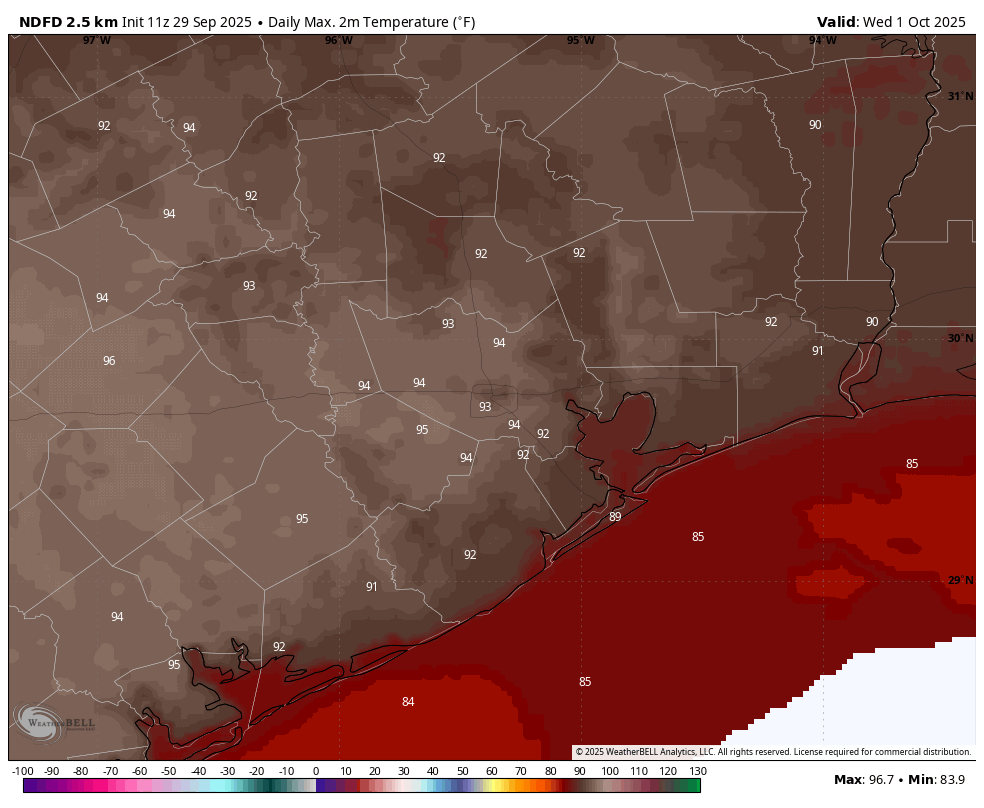
In brief: In today’s update we discuss the upcoming heat for this week, which may relent slightly by the weekend. We also remain in a bear market for cool fronts, with nothing in the cards until at least the middle of next week.

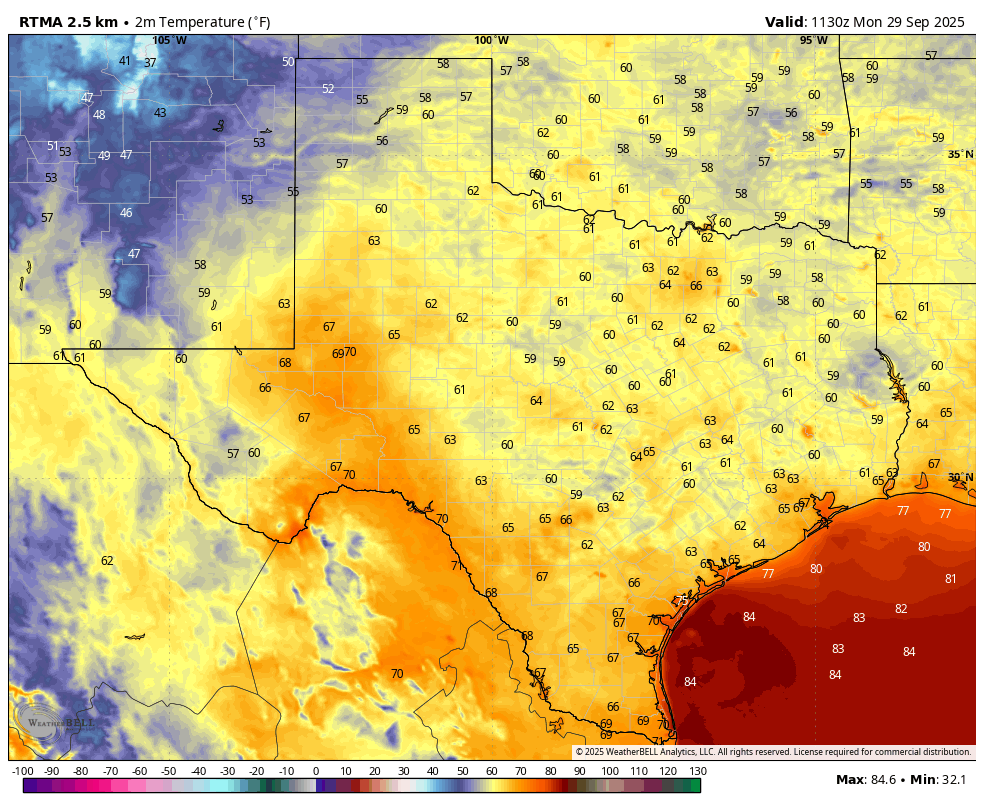
There is a pleasant chill across the northern half of Texas this morning. (Weather Bell)

Heat, with October on the horizon

We’ve had a pretty typical September, in which we still have some hot days, but also get some slightly cooler nights from time to time. This week the calendar turns to October, but the heat is continuing. Inland areas may reach the mid-90s for a couple of days (Wednesday and Thursday). How normal is this for this time of year?

Well, it’s not normal, but we also probably will not set any record highs. The highest temperature recorded in Houston on October 1 is 99 degrees (1900) and on October 2 it is 97 degrees (1938). So yes, our highs are likely to run several degrees above normal this week, but we should fall short of record heat. And this week’s soaring temperatures serve as a reminder that although fall is clearly on the horizon, we’re still dealing with the remnants of summer.

Monday

High temperatures today should remain in the lower 90s for most of the area, with a nice amount of drier air. Skies will be mostly sunny. Dewpoints should drop into the 50s this afternoon. However nighttime temperatures should be several degrees warmer, perhaps dropping only into the lower 70s, as some clouds build overhead due to a passing disturbance.

High temperature forecast for Wednesday. (Weather Bell)

Tuesday, Wednesday, and Thursday

A few clouds may linger into Tuesday morning, but for the most part these days will be sunny and hot. Central and southern parts of Houston may remain in the lower 90s, but some inland spots will probably hit the mid-90s with sunny skies and a fairly dry atmosphere allowing for efficient heating. Nighttime lows will be in the lower 70s. This probably isn’t the way most of us wanted to begin October, but here we are.

Friday, Saturday, and Sunday

A slightly more humid flow should moderate daily high temperatures a bit, to around 90 degrees this weekend. I still expect mostly sunny skies, but we could also see some isolated to scattered sea breeze showers each afternoon. Overall, chances each day are probably about 20 percent. If you’re participating in the 2025 Komen Houston Race for the Cure I expect conditions to be fine on Saturday morning, with any showers (however unlikely) holding off until the afternoon.

Next week

I expect this pattern to mostly hold for next week, with highs in the vicinity of 90 degrees. There is some whiff of a front in the models during the second half of next week, but nothing so concrete as to have any confidence at this point. We shall see.

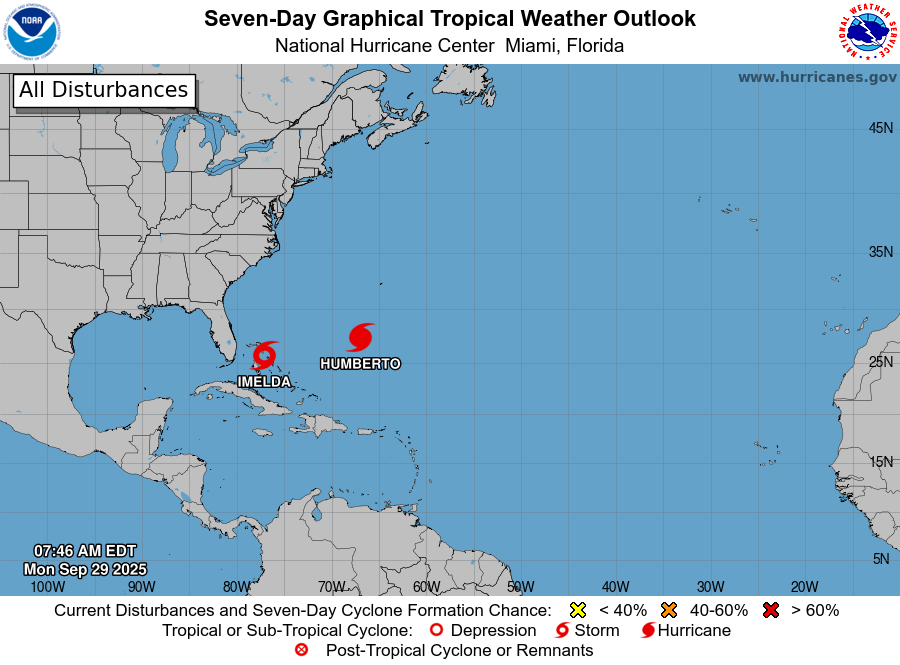
Tropical outlook for Monday morning. (National Hurricane Center)

Atlantic tropics

We have a busy scene in the Atlantic tropics, with Hurricane Humberto briefly ascending to Category 5 hurricane status on Sunday, but fortunately no direct threat to land. Tropical Storm Imelda also formed this weekend over the Bahamas, but due to interactions with Humberto it is likely to be pulled away from the southeastern United States, out to sea. And finally it is possible that a tropical disturbance develops in the southern Gulf at some point during the next week or so, but this seems unlikely to track north toward Texas and be a significant player in our weather.

29 Sep 13:01

azimuth

by Alvaro Montoro

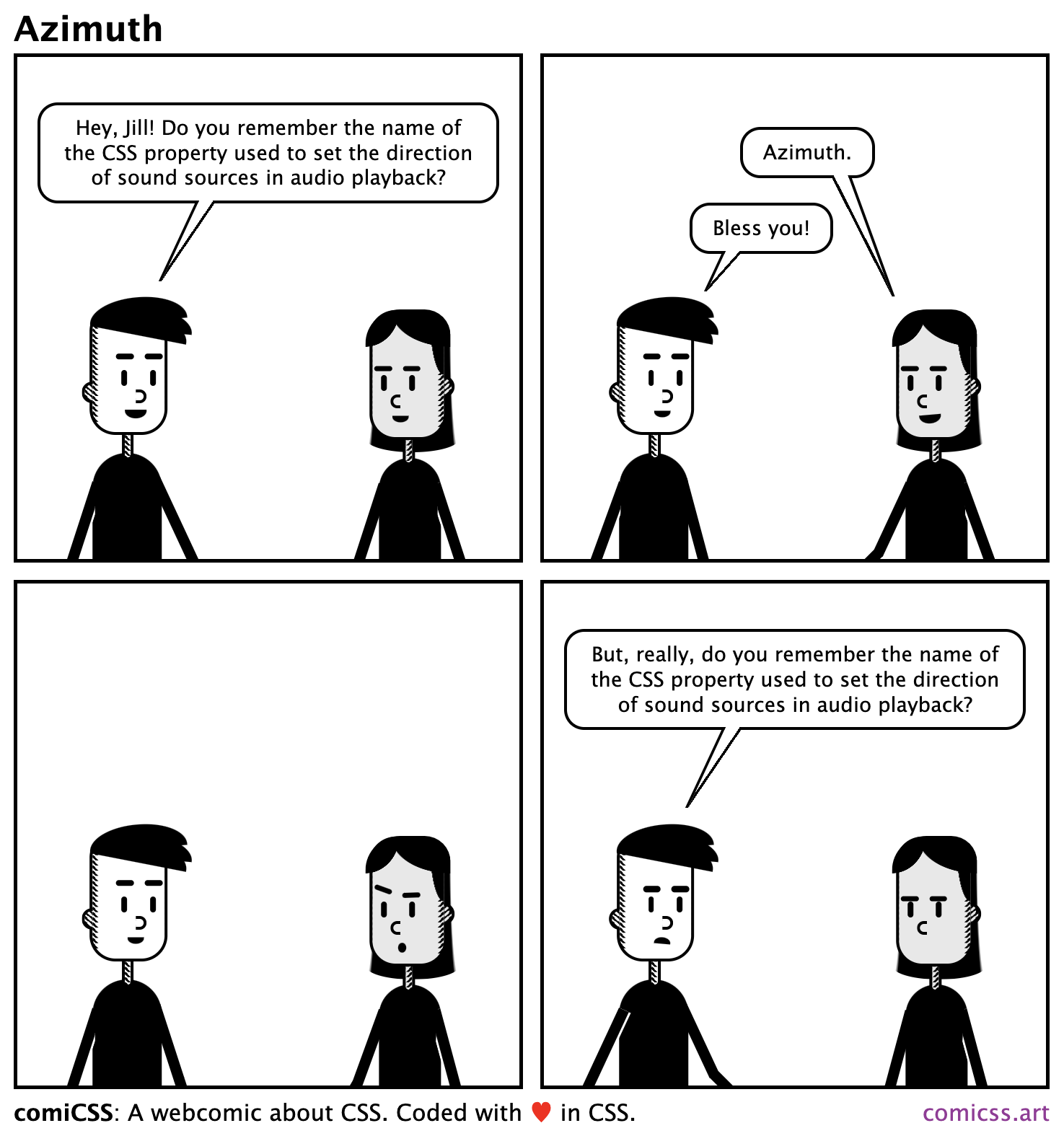
comic with 4 panels showing a man and a woman talking. He asks 'Hey, Jill! Do you remember the name of the CSS property used to set the direction of sound sources in audio playback?' She replies 'Azimuth', and he quickly answers 'Bless you!' There's an awkward silence, and to her despair, he says 'But, really, do you remember the name of the CSS property used to set the direction of sound sources in audio playback?'

29 Sep 11:18

my boss told me I had to be on camera while sick, telling an organization their volunteer is obnoxious, and more

by Ask a Manager

It’s five answers to five questions. Here we go…

1. My boss told me I had to be on camera while sick

My department hosts a monthly zoom meeting to a large audience. That week I was working from home with a terrible cold (coughing, sneezing, runny nose, the whole package). The day the meeting was scheduled to occur, I emailed my manager excusing myself for not having my camera on as I was sick.

She emailed me back with, “Please be camera ready for the meeting, all participants are expected to be on camera.” I was not presenting; I am just required to attend, and not having my camera on would not pose any disruption to the meeting. I didn’t have the energy to even reply back, so I complied with the ask.

All 100+ participants saw me constantly coughing, sneezing and cleaning my nose (I had my phone on mute). To be honest. I was embarrassed. I got a few “feel better” messages afterwards, which prompted me to realized some people did notice I was sick.

I would think a good manager would understand that the best approach is to have the sick person have their camera off to ensure no distractions. But now I’m wondering if I should’ve pushed back? Or is it the norm to be in camera even if you look like you have the plague? Should I say something now?

Your manager sucks. Even in meetings that are generally camera-on, it should be fine for people to go camera-off if they’re sick (or having connectivity issues, or pumping, or a whole variety of things).

Whether or not you should have pushed back depends on what you know about your manager. With some managers, it would be fine to say, “I’m really not in any condition to be on camera but if you’d prefer I skip the meeting instead, let me know.” With others, that would cause more problems than it would solve.

But you definitely don’t have anything to be embarrassed about! People clearly realized you were sick and probably just felt bad about it.

2. What’s the best way to tell an organization that their volunteer is obnoxious?

I just had a fairly wild interaction with a volunteer for an organization I professionally partner with (i.e., my NGO and their NGO have had joint projects in the past). This volunteer has stepped up to lead a major project and asked for a meeting to pitch that my NGO should endorse his project. Not only was his presentation fairly unimpressive, but I found him to be wildly condescending and aggressively sure that he is right in all details even when he is not. A real low point was the moment when he interrupted me to explain the details of my own work, that I’ve been leading, as the director of my org, for 5 years.

I’m not going to endorse his project. This partner NGO is very lightly staffed and relies heavily on volunteer work, but they do have a few paid positions. Should I reach out to the actual staff and tell them why they didn’t win my endorsement?

Frankly, I kind of want to chuck this whole encounter in the memory hole and move on, but maybe if I report my experience with the volunteer it will save some future human from having the same interaction I did. Any advice for wording I could use?

If you didn’t have contacts at the other org, I’d say to leave it alone … but since you’ve worked with them in the past, I’m assuming you have contacts there and, yes, it would be a professional courtesy to let them know that the volunteer they have leading a major project is alienating partners and coming across so badly.

I’d say it this way: “I thought I should let you know that I met with Malcolm Mulberry recently because he wanted our endorsement of the X project. The way he conducted himself in the meeting was so off-putting that there’s no way we can endorse the project (for example, aggressively confident about things I know him to be wrong about, and interrupting me to explain the details of my own work that I’ve been leading for the last five years). I don’t know if you’ve had the chance to work with him closely, but as someone who cares a lot about the work you do, I felt I should let you know what happened.”

3. Should I go after a job with a client — exactly what my boss feared would happen?

I received praise, with raises, for my performance at my firm, and was assigned to their largest, most profitable project. After a year, my manager asked me to spend time at the client site once a week. After six months of that, I discovered my manager had withheld from me that the client wanted to hire me directly. Though this was wrong of the client and I would have declined, this secret blew up because my manager had misled the client into thinking I knew, but my surprise contradicted this. This led to a very awkward moment in which I felt I had to defend my manager’s behavior to save the client relationship.

From that moment on, my manager became extremely paranoid, micromanaging everything I did and overriding decisions I made that resulted in rework because he was too far from the detail. This caused confusion for the team and extra costs for the client. He terminated my on-site presence, taking away tasks that I had once held, and then suddenly began attending meetings he rarely did before.

When he sensed my frustration, he dangled a new project with a new client, as a carrot. I took it, and our team’s success resulted in a second and third project from this client. However, my manager continued to micromanage me, and yet, when he inserted himself into every email, chat and meeting, he rarely read the project documentation first. As a result, when he took over meetings he asked the client questions and made suggestions that had long since been covered by me. It presented a poor team dynamic to the client, and I wasn’t sure if they might read this as my manager’s incompetence or his lack of confidence in me. Over the five months of this project, I had several meetings with my manager in which I brought up my concerns. He promised to change, blaming his behavior on worries that our most lucrative client had scaled back work, which made my project more important. However, he never changed, and I eventually gave notice when my frustration reached a boiling point.

I had a parting lunch with my manager’s manager and, when she asked about my decision, I explained all that I have explained here. She had no knowledge of any of it and, in her efforts to keep me at the firm, tried to minimize the issues by saying that my manager was the future of the company, and his reactions were normal as they had had an employee poached in the past. I left surprised and disappointed that my experience apparently meant nothing, but this did affirm my decision to leave.

People who know of this tell me that my allegiance to my old firm should no longer keep me from going to the client and seeking employment. I will not do this because it would affirm my ex-manager’s fears, but it does pose an ethical quandary, and I’m curious what you think.

If you’re interested in working for the client and you don’t have a written agreement with your old employer that prevents you from approaching clients within a certain amount of time after leaving, go for it. Who cares if it affirms your former manager’s fears? He treated you (and the client) poorly, and this is a natural consequence of his decisions. Don’t stop yourself from doing what you decide is best for you professionally just because of how he might feel about it!

He’s had enough influence in your life at this point; you don’t need to offer him more when you don’t even work for him anymore.

4. Do I have to attend our year-end party?

I work in higher education and my current position is part-time and grant-funded. It is coming to an end in December/January because of lack of interest in the community. Don’t worry, I’m well on the job hunt and have had some good fortune in the interviews and connections in the school. But my department likes to throw a lavish year-end party and I’m not really interested in going. I’m not feeling very excited about going since my contract is not being extended, and I feel a bit left out of some things in the division. Should I go? Should I sit this one out? If I sit this one out, what is a good excuse?

You don’t need to attend the party if you don’t want to; you can simply say you have a commitment scheduled at the same time that you can’t miss. But it’s worth considering whether there’s networking value in making yourself go for an hour anyway.

Related:
how to survive your office holiday party

5. Leaving graduation dates off your resume because you’re young

I’m in my late twenties, five years out of my bachelor’s degree, and starting to be eligible for some mid-level jobs (like 5+ years of experience required vs. entry-level). However, I’m feeling self-conscious about including my graduation date (2020) on my resume, especially when I can guess I’m at the younger end of candidates for a particular job. Maybe because of the weirdness of the pandemic, I think a lot of people have a subconscious feeling of “2020 was only a few years ago,” and they could dismiss me as inexperienced despite my work history.

There’s a lot of advice on when to leave graduation dates off to avoid age discrimination (generally 40s or so), but what about if you’re younger, have a fair amount of relevant experience, and want to be taken more seriously? Or would it lead to a “Streisand effect” and make it look like you’re hiding something?

It’s really common these days to leave your graduation year off your resume unless you’re right out of school. It used to be that candidates were advised to start leaving off around 40, but lots of people have started doing it way before that. An interviewer might ask when you graduated, but it won’t be weird to leave it off your resume (and definitely won’t create a Streisand effect!).

The post my boss told me I had to be on camera while sick, telling an organization their volunteer is obnoxious, and more appeared first on Ask a Manager.

29 Sep 11:10

Awkward Zombie - Transportsmanship

by tech@thehiveworks.com

New comic!

Today's News:

No, you don't understand. Yes, you could have received your mail weeks ago if I had brought it to you in my flying submarine, but that would be missing the point.

29 Sep 01:36

Tropical Storm Imelda Graphics

by nhcwebmaster@noaa.gov (NHC Webmaster)
Tropical Storm Imelda 5-Day Uncertainty Track Image
5-Day Uncertainty Track last updated Sun, 28 Sep 2025 23:56:37 GMT

Tropical Storm Imelda 34-Knot Wind Speed Probabilities
Wind Speed Probabilities last updated Sun, 28 Sep 2025 21:27:18 GMT
29 Sep 01:25

UFO lands in downtown, witnesses describe alien...

UFO lands in downtown, witnesses describe alien visitors: Although I really do pitty them, because they're in a hot costume HAHAHAHAHAHA! #CowboyWho