Folks familiar with the El Paso Museum of Art (EPMA) are used to being greeted by Gaspar Enriquez’s monumental portraits in the massive foyer. Now, upon entry, a bold and intriguing scene of the Reuben Salazar Apartments by El Paso artist Marianna Olague enlivens the space.
Olague’s mural sits across from Enriquez’s work — he is a friend of her father’s, a mentor figure, and the man who once painted her into one of his own paintings. “Even though we’re not related,” Olague says, “I feel part of the artistic legacy he helped build.”
For Olague, seeing her work on the walls of EPMA has been nothing short of “a dream come true.”
Olague has a stacked CV: an MFA from the Cranbrook Academy of Art, a recent residency at the Chinati Foundation in Marfa, work in the Smithsonian Museum’s National Portrait Gallery, and she was a finalist of the 2022 Outwin Boochever Portrait Competition.
She’s also got the chops: her larger-than-life, luscious oil paintings are some of the most masterful, intriguing portraits and vignettes around. Keep an eye on her juicy, incisive, relatable, humorous work.
Olague is familiar with Segundo Barrio, where she attended Hart Elementary and Guillen Middle Schools, in one of the historically poorest zip codes in the United States. Her father, himself an artist, studied under Enriquez and now teaches art at Bowie High School. That background infuses her work with an intimate sense of place.
A mural by Marianna Olague at the El Paso Museum of Art. Image courtesy of the El Paso Museum of Art
The Reuben Salazar Apartments inspire her mural; they are located in Olague’s childhood friends’ neighborhood. She rendered it in a bright Juárez-inspired yellow. Windows and porches fill with familiar characters: her nephew Sebastian, her sister Maya, her father under a truck, and even herself gossiping at a doorway.
“Even though we grew up in what was technically poverty, it was colorful and full of life,” she reflects.
The mural has already become a teaching tool. During EPMA’s summer camps, students added dialogue bubbles to the figures, imagining conversations and everyday moments. As EPMA Senior Curator Michael Reyes points out, “It creates empathy — kids and visitors see themselves, their families, reflected on the walls of a museum.”
“When I visited Olague’s studio,” Reyes remembers, “I immediately saw how resonant the work was for our community.”
This summer, Reyes displayed four of Olague’s works, and EPMA members voted to add Spare, Olague’s most recent painting and self-portrait, into the permanent collection. The four proposed works balance landscapes and portraits, with each subject closely tied to her family — her sister, and herself.
An installation image of four works by Marianna Olague at the El Paso Museum of Art. Image courtesy of David Davis
Olague’s distinctive color philosophy is central to her hyperrealist style. Rather than reproducing the muted earth tones of the desert or neighborhood streets, she pushes them into hyper-saturation. “I take the colors that are already there and elevate them to a level that immediately grabs attention,” Olague says. “It marks ordinary, fleeting moments as very important. That’s what art should do: make us pause and really see.”
Marianna Olague, “On Transmountain Drive”
For OnTransmountain Drive, Olague paints teal shadows darker than red skin tones, inverting light and shadow while preserving a believable realism. “It tricks you into seeing more light than there actually is,” she notes.
The colors in this work bring the heat, as does the expression of the portrait’s subject, Olague’s sister, who casually sits on the hood of a car with a near-scathing, transfixing gaze directed at the viewer.
Marianna Olague, “Customer Service Representative,” 2020, oil on canvas
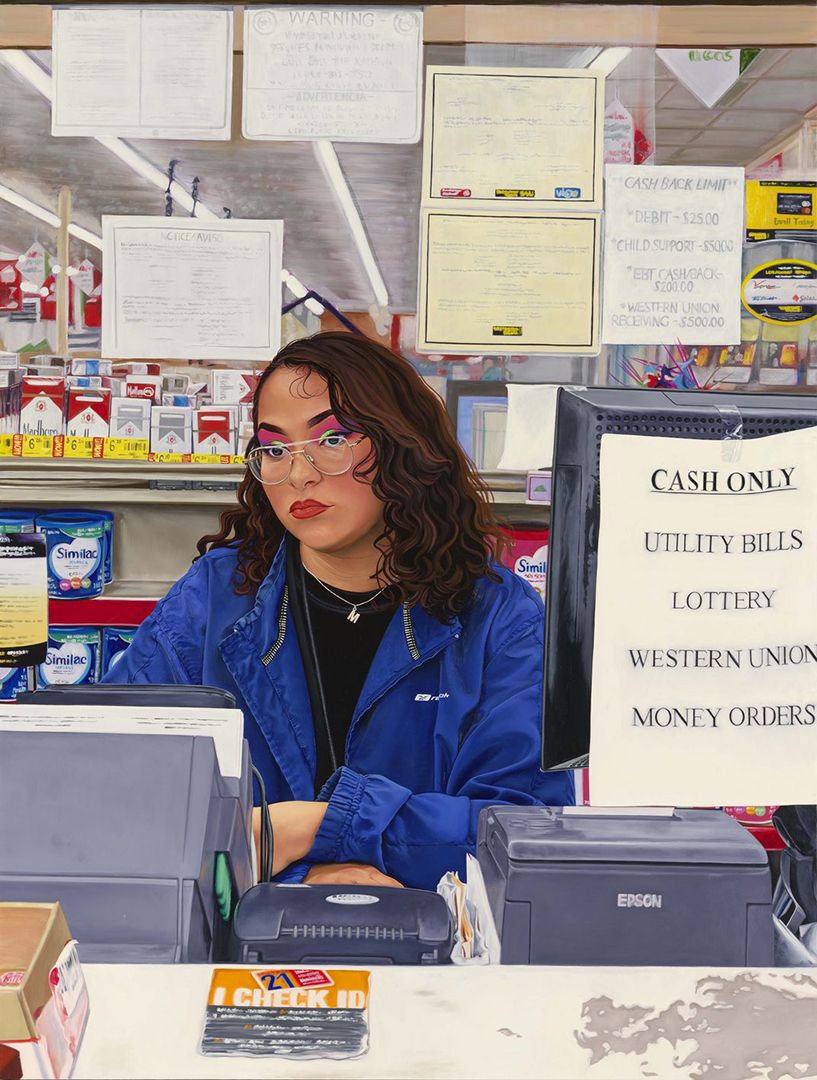
Customer Service Representative, a searingly realistic portrait of Olague’s sister Maya as an essential worker in a Food King grocery store during the pandemic, takes the opposite approach. Here, the supermarket’s drab, unavoidable palette dominates, with vibrancy appearing only in Maya’s jacket and makeup. Maya’s glazed-over gaze is fixed beyond the viewer.
“She would rather be anywhere else,” Olague laughs. “But that’s the point: she’s just a teenager carrying a responsibility far too heavy for her age.” That work, loaned by a local collector, is currently on view at EPMA.
Marianna Olague, “Spare”
In Olague’s addition to the EPMA’s permanent collection, Spare, she recreates a flat tire scene at a gas station, an homage to her father teaching her mechanical and household repair skills usually reserved for sons.
“I feel fortunate,” she explains. “My dad never taught us differently based on gender — whether it was fixing a tire, an AC, or a sink. That kind of scrappy independence is part of border culture. We learn early on how to take care of ourselves.”
In the painting, Olague hefts a spare tire — the idea of “spare” as self-portrait is wonderfully tongue-in-cheek. The gritty, heat-soaked palette radiates the discomfort of a dry triple-digit high desert day. This piece is Olague. And El Paso.
According to Reyes, Olague’s acquisition wasn’t a top-down decision, but one chosen by the community through the museum’s Members Choice Program, an annual acquisition initiative running since the mid-1990s with support from the Lipscomb Foundation. Recent acquisitions include Laura Turón in 2024, the De la Torre brothers in 2023, and Vanessa German in 2022.
“It’s truly democratic,” Reyes explains. “We send physical invites and artist information to members about a month in advance. Then at the summer event, around 150 members come together to vote. The turnout is beautifully diverse — steadfast museum supporters, emerging professionals, local artists — all with a voice in shaping the collection.”
The museum’s purchase of Olague’s work has drawn strong community attention. El Paso’s Mayor Pro Tem, Alejandra Chavez, attended the voting event and became a member; board members joined in selecting the works alongside area artists.
For Reyes, Olague’s addition to the collection fills a long-standing community request: “People wanted more voices from this region, and Marianna delivers that with authenticity and sheer talent. She’s already in multiple private collections and now in three museum collections, including ours. I see her having a lasting place in El Paso’s cultural history.”
The 2025 International Quilt Festival/Houston is coming to the George R. Brown Convention Center from Thursday, October 9 through Sunday, October 12.
The 50-year-old annual festival bills itself as the largest annual quilt show in the U.S., featuring 1,200 quilts and unique works of textile art on display in 700 booths, regularly attracting 40,000 visitors from more than 25 countries. The festival includes hundreds of classes and lectures for quilters at all levels of experience.
Ricky Tims, “The Visitation”
A slate of prizes have been awarded for quilts to be featured in the show. The $12,500 Best of Show award was given to Ricky Tims of Branson West, Missouri, for The Visitation, employing original hand-dyed fabrics for a moody raven-and-timepiece themed image. Master Awards of $5,000 were given to Yoshiyuki Ishizaki of Ashiya City in Hyogo, Japan, for Family, an ornate, brightly colored embroidered appliqué; Caryl Bryer Fallert-Gentry of Port Townsend, Washington for Tricuspid Biomorph #2, featuring dynamic gradations of color using hand-painted dye; and to Keiko Morihiro of Sanda-city, Hyogo-Ken, Japan, for Poco a Poco, in traditional style using 30,833 hexagonal pieces.
Master Awards for contemporary artistry and innovation were given to Karen Kay Buckley of Carlisle, Pennsylvania, and Melissa Sobotka of Richardson, for Painted Ponies on the Prairie, depicting an early 1900s image from the Sobotka family photo archive.
Melissa Sobotka, “Painted Ponies on the Prairie”
A list of other awards, including the First Place award given to Karen K. Stone of Dallas, and Second Place to Irene Roderick of Austin, can be found on the Quilts Inc. website.
Festival visitors will have the chance to vote on a $750 Viewers Choice award at the Special Exhibits Desk during the show, with the winner to be announced at 1 p.m. on Sunday, October 12.
For more information on tickets ranging from $16-$63, including for a special preview night on Wednesday, October 8, visit the festival ticketing web page.
Masks usually hide. Frisco Pete tunes. Mark Flood reaches for the hat and alias the way a sound engineer reaches for a fader: turning clickbait myth down, turning civic tone up, catching the frequency where public language begins to confess. The persona absorbs cliché — cowboy, saloon, hat-and-sunglasses bravado — so Flood can handle pacing, edit, and touch without preaching. The trick lands with meme-like clarity: give the crowd the silhouette it expects, then make the surface do the thinking.
Reeves Art and Design sets the tempo from the floor. Hay softens heel-strike and gallery echo; a dry sweetness folds into the air; dust rides the track lights and slows pupils to a humane pace. Not scenery — calibration. The room trims spectacle so small evidence steps forward: a knife-thin highlight along a brim, a ridge where tape steals a hairline of light, a brush-lift that leaves a whisper at the edge of a stroke. Flood routes billboard voice, storefront cheer, podium decorum through that slower regime until authority slides from slogan to surface.
Frisco Pete, “Watering Hole,” 2024, acrylic on canvas, 24 x 36 x 1.50 inches
The pictures meet the habits wired by feeds — thumbnail clarity, template repetition, captions waiting in the wings — then pry those habits open. Watering Hole (2024) greets the reflex: cowboy in front, horse behind, river an optimistic blue that reads in a blink. Then drag arrives. Scrapes hang in the sky and snag on tooth; a ridge along the hat slices a filament of glare; a coal-warm orange lingers at the ears. The image welcomes the scroll, then refuses it. Cliché loosens; attention reenters. Pete multiplies like an avatar gone viral; paint steals the tempo back.
Frisco Pete, “Dirt,” 2025
Where the show turns to streets and night, Flood treats public space as a stage that keeps its ledger open. Dirt (2025) leans a block-front toward the viewer; a figure holds the corner with a chewed cigarette; bodies thin along the margins where attention normally drops. Across the wall, FRISCO slants just off-plumb — loops that don’t quite meet, strokes that drag past their mark. Even without the canvas, the lesson stays clear: civic confidence often leans on finish and sameness; small lapses puncture that borrowed authority. Flood catches the moment a wall shifts from command to confession, a mask that mutters instead of shouting.
Frisco Pete, “Harbor Lights,” 2025, acrylic on canvas, 20 x 24 x 1.50 inches
Harbor Lights (2025) drifts the same audit into dark. A chalk-coin moon presses on water; two watchers anchor the near bank; a pale file slides the far shore. Brush passes cross the surface — wipe, drag, lift — each pass leaving a changed edge. Think of every night picture that flattens to postcard or phone-glow; this one refuses that comfort. Reflection trembles because labor refuses disappearance. What begins as mood settles into process; illumination starts to act like accountability.
Frisco Pete, “Bad Influence,” 2025
Portraits pull signage into faces and return faces to the public square. Bad Influence (2025) throws a head against hot red; the hat hovers like hardware; eyes sweep the room with union-hall stamina. Under the features, churned pigment reads as weather more than expression. Stand a breath longer and the red turns into a crowd — heat, breath, pressure — so the sitter toggles between witness and suspect, performer and backdrop. Flood stages “accident” with precision; volatility arrives as pose. Pete’s heat functions as flare rather than cover — cliché replayed until it singes. The White Hat (2025) collapses character to crown, brim, oval; a breath of undercoat peeks at the top the way primer peeks under virtue.
Frisco Pete, “Leo,” 2025, acrylic on canvas, 20 x 20 x 1.75 inches
Leo (2025) routes the scene back through mirrored lenses; a pinprick flare near the rim outs your position and folds your body into the optics. Neutrality drops because the surface includes you. Astrological aura brushes against civic self-branding; both drift toward costume. Flood tunes radiance into device — crown, sockets, glare working like a feedback rig — so the viewer completes the portrait rather than consuming it.
Frisco Pete, “Chep Hotel,” 2025
Architecture keeps its own dialect of public speech. Chep Hotel (2025) offers powdered-mauve poise and a woman who neither sells nor refuses; above her, CHEP drops a letter. A tiny municipal slip, and suddenly the promise reads human. Plaza (2025) stacks brims while fogged letters hover like neon that forgot its wattage — brand stepping ahead of place. River’s Edge (2025) plants a shovel beside a calm figure; faint survey marks ghost under chalkboard green the way policy haunts any sunny announcement.
Each canvas treats Western code not as heritage décor but as a toolkit for reading America’s persuasion machine: hat as logo discipline, horizon as promise graphic, rider as traveling avatar that campaigns without speech.
Frisco Pete, “Welcome to Frisco Pete,” 2025, ink on paper, 24.75 x 36.75 x 1.25 inches
Then the wall of oversized legal pads clears its throat — office yellow instead of linen, blue ruling instead of stretcher bars, torn edges that refuse tidy borders. Welcome to Frisco Pete stretches a suspension bridge across the ruled lines; trucks inch the humps; a row of Pete-profiles gossip on the bank. Those lines do triple duty — river, highway, ledger — format moonlighting as metaphor. A companion sheet marked Tourist Attraction adds chatter; another bridge variant scratches so many speed lines the span starts to hum. Wildlife pages — frog stacks, turtle, snake, scorpion, two spiky aloes — read like a boot-heel field guide; stray dollar signs drift toward the animals as if mascots and logos share payroll. Cowboy studies swing between blue and red; the autograph swells into billboard scale and doubles as brand. Blue tape tabs, price scribbles, SOLD dots remain inside the frame, so transaction joins composition instead of hiding backstage. Marker bleeds where the hand pressed too long; corners lift a millimeter and catch a sliver of light. Paperwork refuses to vanish; quick turns to true.
Flood threads format into rhetoric with Party (2025), a tondo that compresses the bar into coin theater. Chandelier doubles as badge and wheel; cards slide; hands confer; a bottle lifts like a rite. One slow orbit flips celebration to audit, back again without exit. Geometry enforces return; every gesture replays until spectacle drains into record. Pete wanders that loop like a house emcee with an accurate memory.
All these local proofs gather a wider claim. Flood engages the two frontiers that currently shape persuasion: the billboard frontier of promise and the feed frontier of template. The first lends gravity, the second lends speed. Frisco Pete — tuned mask, not disguise — absorbs the clichés those frontiers mint, so Flood can test how images recruit consent and how matter returns.
Counting matters: the rule of the pad, the measured gait of Rider you can feel elsewhere in the hang. In Welcome to Frisco Pete, the blue ruled lines do more than ground the drawing — they set a tempo. Trucks march the bridge one per stripe, the towers subdivide the span into even measures, and the row of Pete-profiles along the bank reads like a tally. Your eye ticks line by line, unit by unit, so attention holds and spectacle folds back into ordinary counting. Layering matters: milk over asphalt in Harbor Lights, red riding gray in Bad Influence. Collage matters: less cut-and-paste, more the braid of persona, signage, and scene. Swarm matters (bar tables, bridge traffic, frog colonies) because neighborliness often beats decree.
Houston flavors the reading — humidity tucked into grays, nightlife tucked into whites, a local patience under the wisecrack — yet the argument travels cleanly. First pass catches the icon. Second pass catches the pause. Third pass catches the smirk that kept the first two honest. Persona does its best work when it stops grandstanding and starts tuning. Flood understands that; Pete performs it.
Frisco Pete Was a Friend of Mine was on view September 13 – 27, 2025, at Reeves Art and Design in Houston.
A few weeks ago designer James Barnard made this TikTok video about what seemed to be a few mistakes in HBO’s logo. He got a bunch of crap from commenters arguing that they weren’t mistakes at all. Then he heard from the designer of the original version of the logo, from the 1970s.
Three times Nintendo released a product where you could write new games to existing media. The first was the Famicom Disk System, where users could bring in their disks to Disk Writer kiosks in stores and have new games rewritten to the floppy disks. This system began in 1986 and was modestly successful, newly written games were cheaper than buying either new cartridges or new disk games in boxes. The disk system's popularity waned by the 1990s, but Nintendo revived the concept with the Super Famicom Nintendo Power cartridge in 1997. A few years later they released the Game Boy Nintendo Power cartridge in 2000. They discontinued the service on February 28, 2007. In this article I will discuss how the service worked, how the flash cartridges worked, and how they can be flashed today.
In brief: Tropical Depression 9 remains a royal headache of a forecast. While the risk of an East Coast landfall seems to have diminished some since yesterday, the threat of heavy rain on the Carolina coast remains. But there are still many questions left to be answered. We try to explain what those are today.
Tropical Depression 9
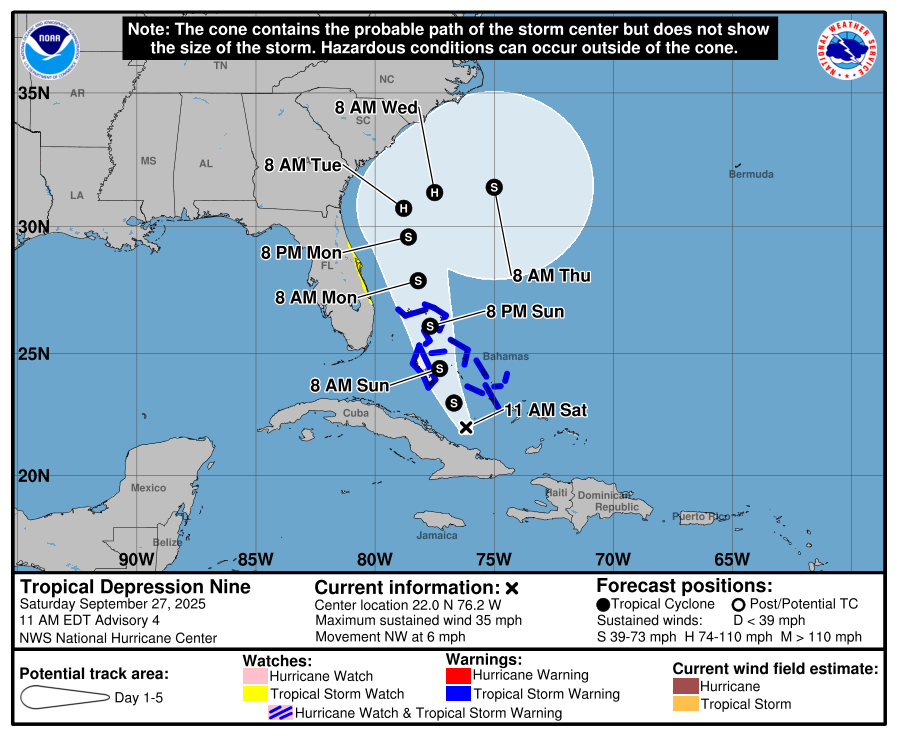
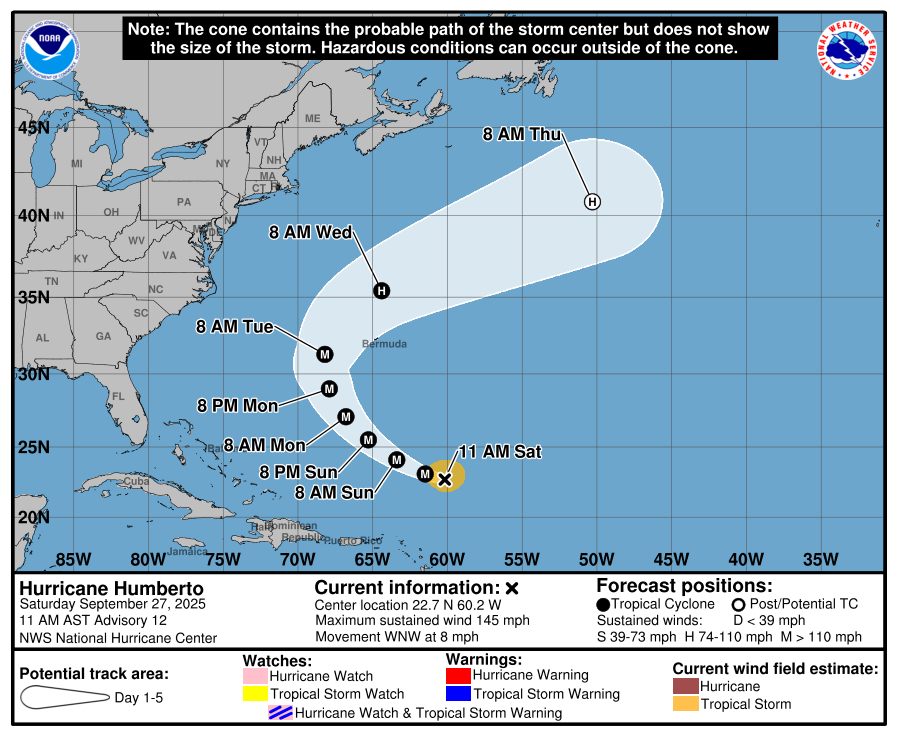
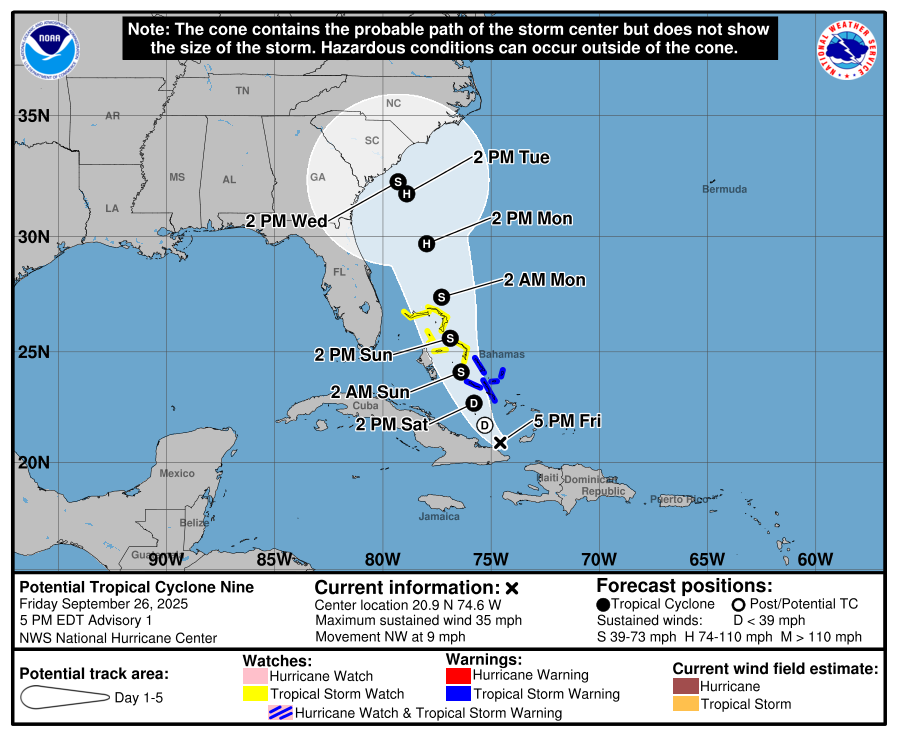
Forecast track from 11 AM ET Saturday. (NOAA/NHC)
Good morning! Tropical Depression 9 has formed off the north coast of Cuba this morning. It is no longer Potential Tropical Cyclone 9. We do expect the system to acquire a name as a tropical storm later today, which would be Imelda.
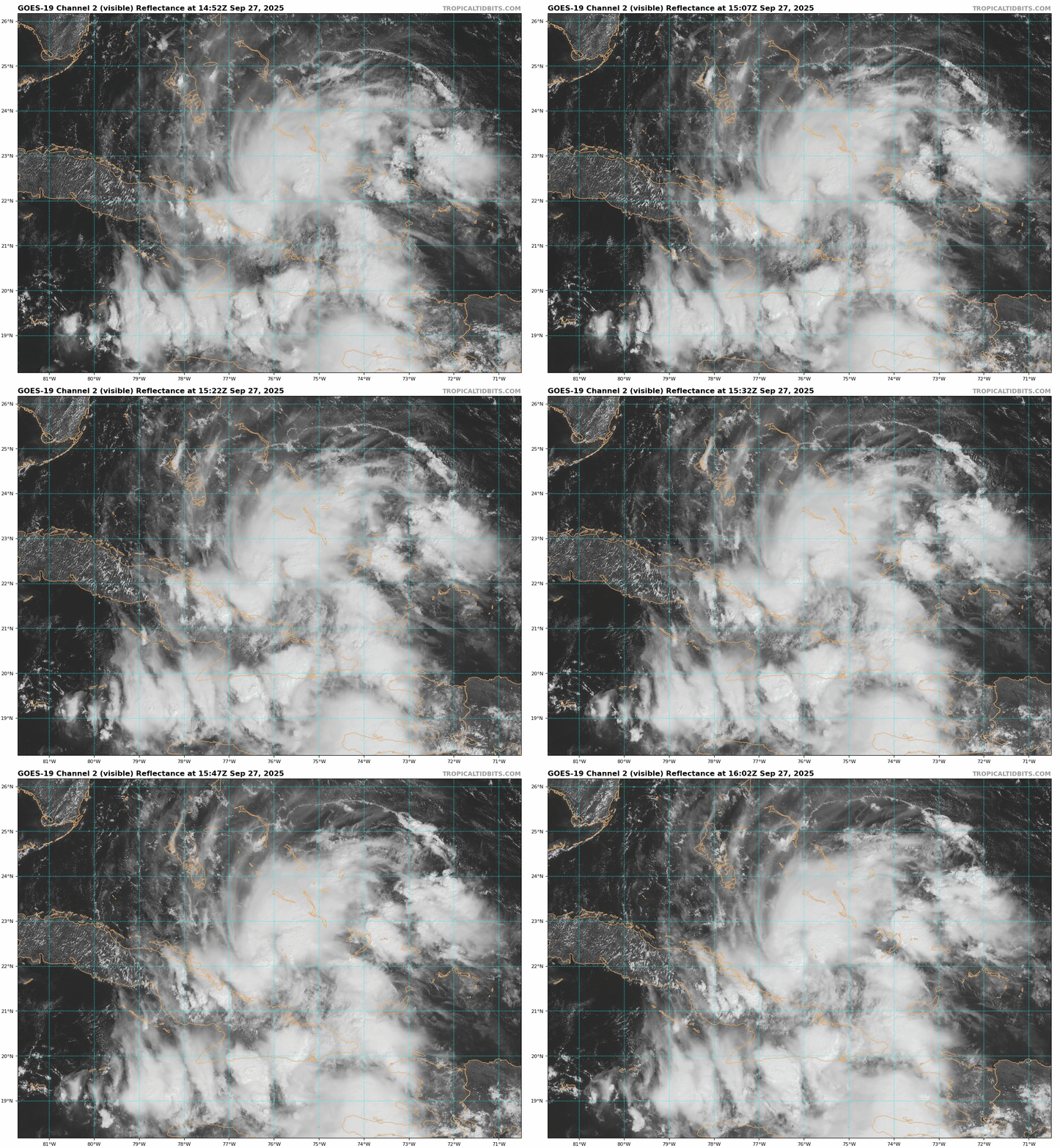
Tropical Depression 9 looking fairly healthy off the north coast of Cuba. (Tropical Tidbits)
TD 9 is unlikely to rapidly intensify in the near-term, though probabilities are around 2 to 3 times climatology (normal) for the extended timeframe (days 2-3). So watch for TD 9 to slowly organize today and tonight into tomorrow. Modeling has been pretty consistent on the intensity front. For as much uncertainty as this storm has had, we’ve pretty much known that this would probably slowly form into a tropical storm and eventually a hurricane. From the NHC discussion today, there is some hints that wind shear will impact TD 9 eventually, which means it probably won’t look as healthy on satellite as its compatriot to the east, Humberto.
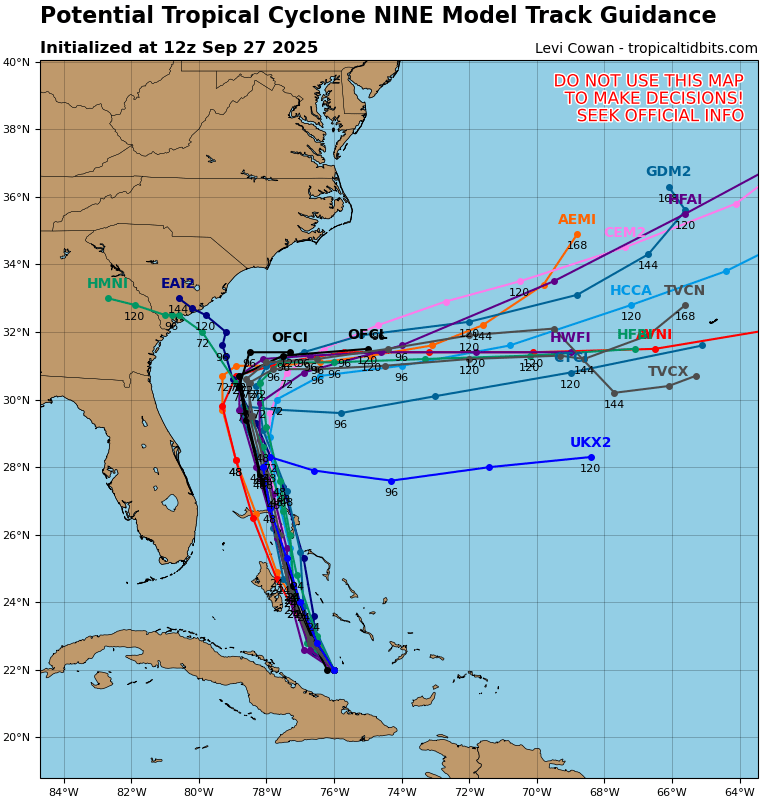
Let’s talk track. If storms had sponsors, TD 9’s would be Excedrin because it’s a headache inducer. The hurricane models are actually in pretty good agreement this morning, certainly the best we’ve seen in this system’s life cycle.
12z hurricane model guidance shows the majority keeping TD 9 offshore of the Carolinas. (Tropical Tidbits)
This is an improvement over last night. Recall, in yesterday evening’s post we discussed rainfall scenarios, and the one that hurt the most was the operational Euro which sat the storm right on the coast for a couple days. It appears that the Euro backed off significantly overnight, It keeps the system offshore and backpedals on rain totals by multiple inches. Good news.
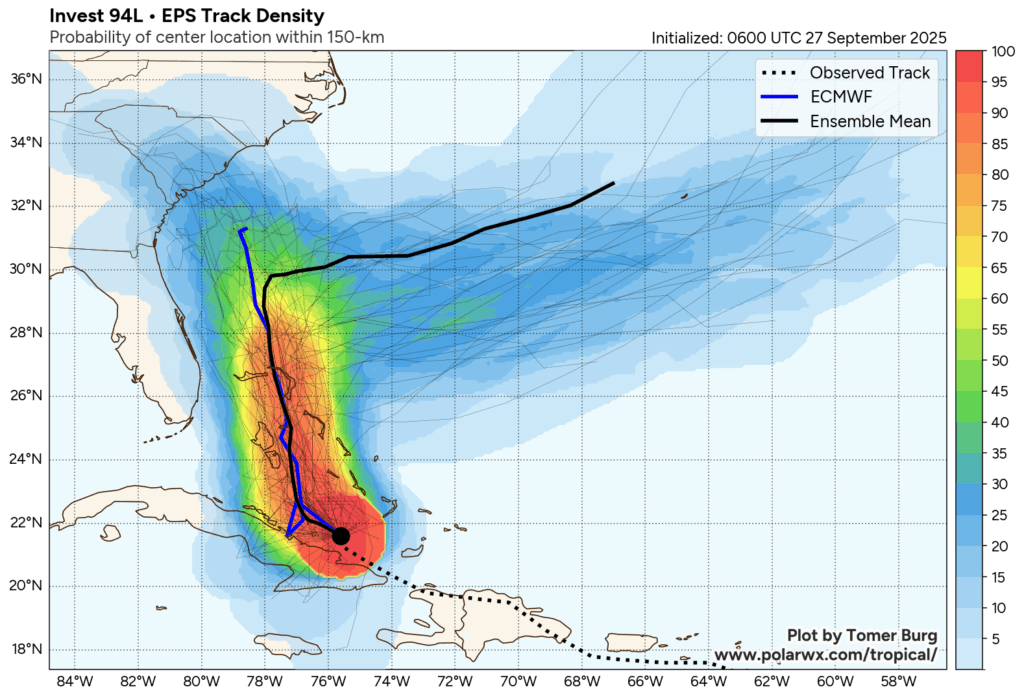
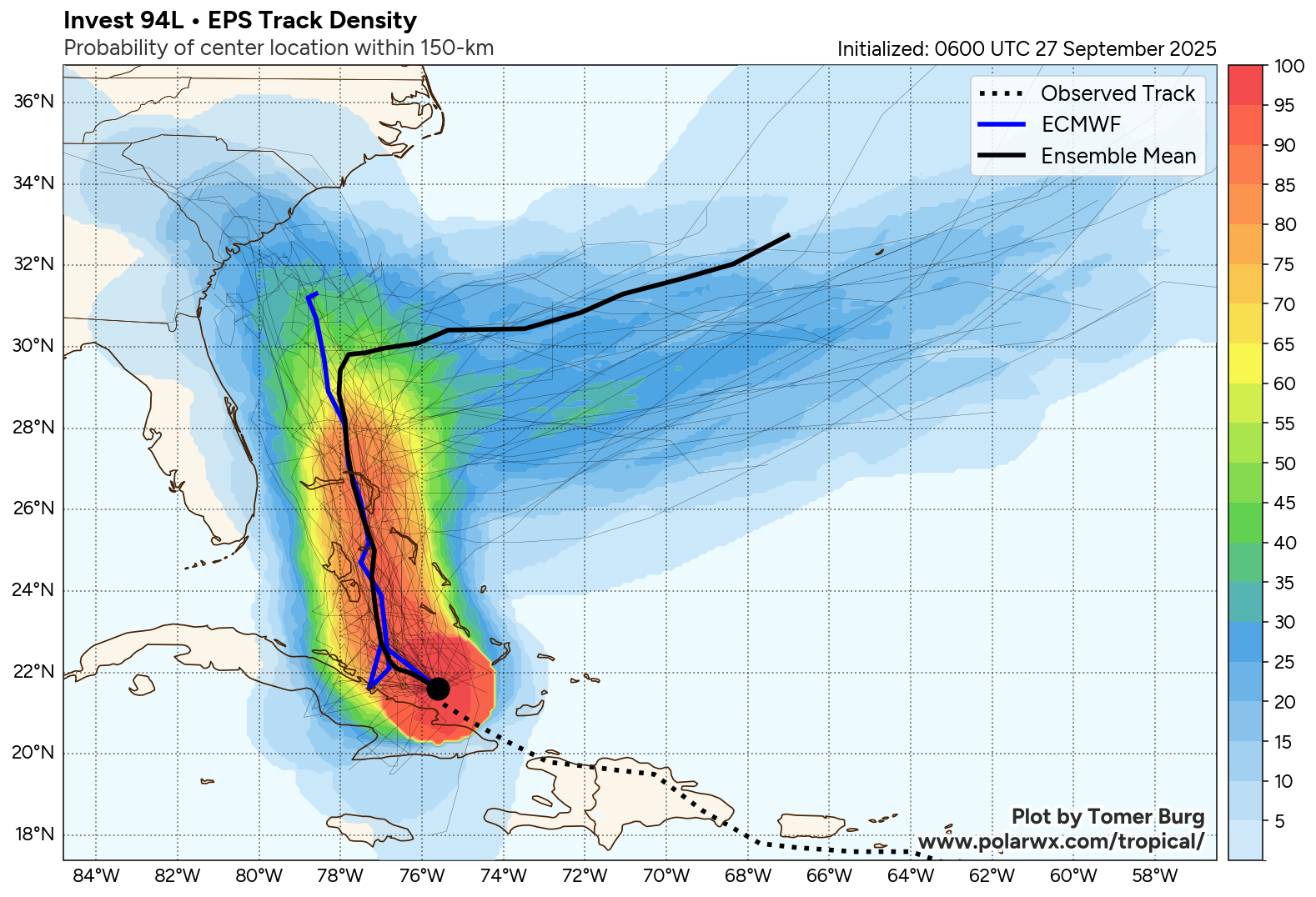
That said, the European ensemble’s spread of solutions is a bit less confident in what ultimately happens to TD 9.
Density forecast of the European model ensemble showing a rather bifurcated track, with several members going toward the coast but several out to sea. (Polarwx.com/Tomer Burg)
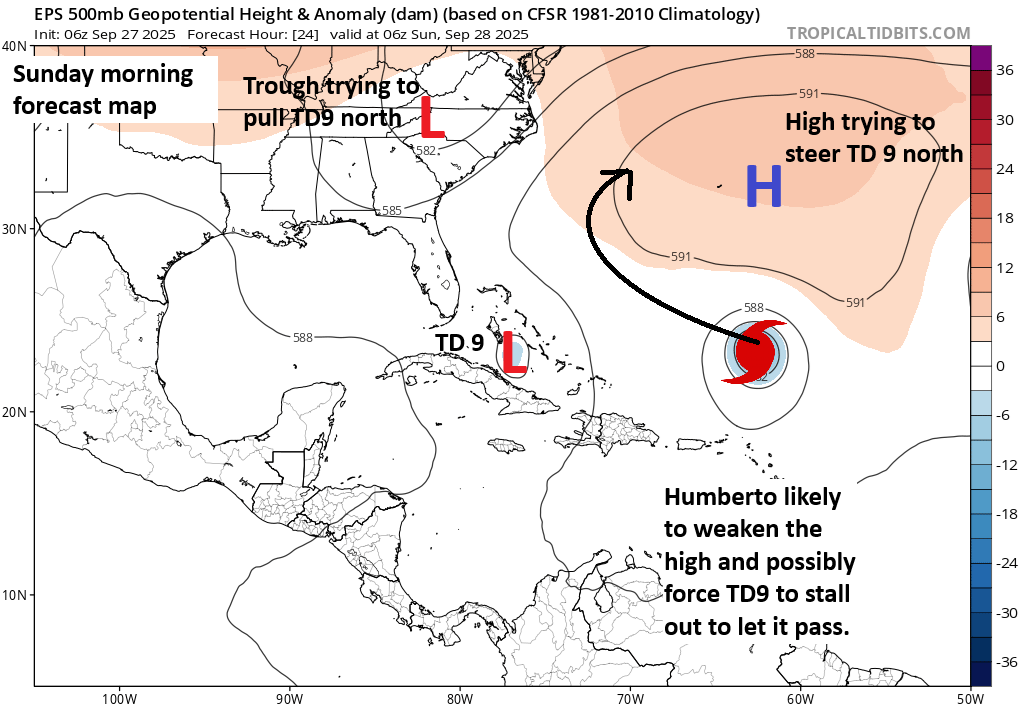
To understand how this will all play out, you almost need a football play diagram. There are four players on the field, including TD 9 itself. Here’s a forecast map for Sunday morning that shows how each feature will be trying to impact TD 9.
The trough over the Southeast is going to try and nudge it toward the coast, while the Bermuda high will impart a south to north motion on TD 9. Meanwhile, because Humberto has become a bit of a beast, it too will leverage influence on TD 9, probably canceling out the south to north motion as it passes to the east, as well as weakening or completely shelving any impact of the Bermuda high. Why? Since Humberto is a large storm, the wind around it is counterclockwise, as it passes TD 9 to the east, imparting north to south winds on the steering of TD 9. In that case, Humberto will be trying to push TD 9 back south. The end result of all this depends on the strength of each feature, but in general it likely means that TD 9 will meander or stall for a day or so as Humberto passes, which is expected to occur on Tuesday. Exactly where this stall or meander occurs will determine what impacts are experienced on the Carolina coast.
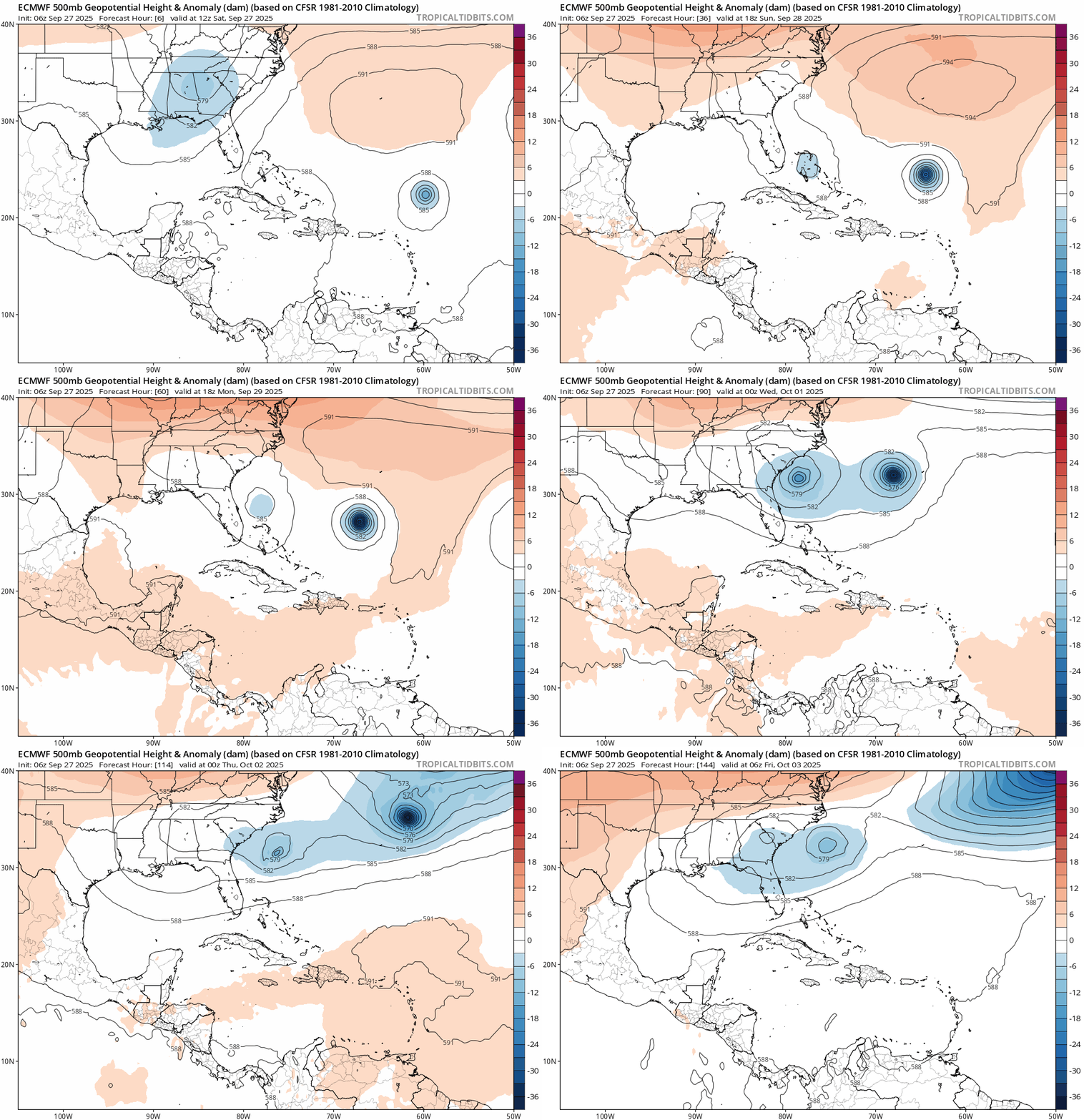
The question after that point becomes whether TD 9 or Imelda follows Humberto out to sea or if it gets left behind to meander in the western Atlantic. The tropical models tend to think it follows Humberto, and the NHC track follows that. But you can see how on last night’s 6z European model. TD 9/Imelda gets left behind as Humberto exits. You can also see how Humberto impacts TD 9 as it passes.
The complicated interplay of the various features that will impact TD 9 is making for a very, very difficult forecast. (Tropical Tidbits)
Let’s exhale for a moment. That’s a lot. It’s complicated meteorology. That’s the reality of tropical systems. They aren’t easy. We say at least once per hurricane season that “we can’t remember such a difficult forecast.” Well, welcome to tropical weather forecasting, kids. It’s not for the faint of heart.
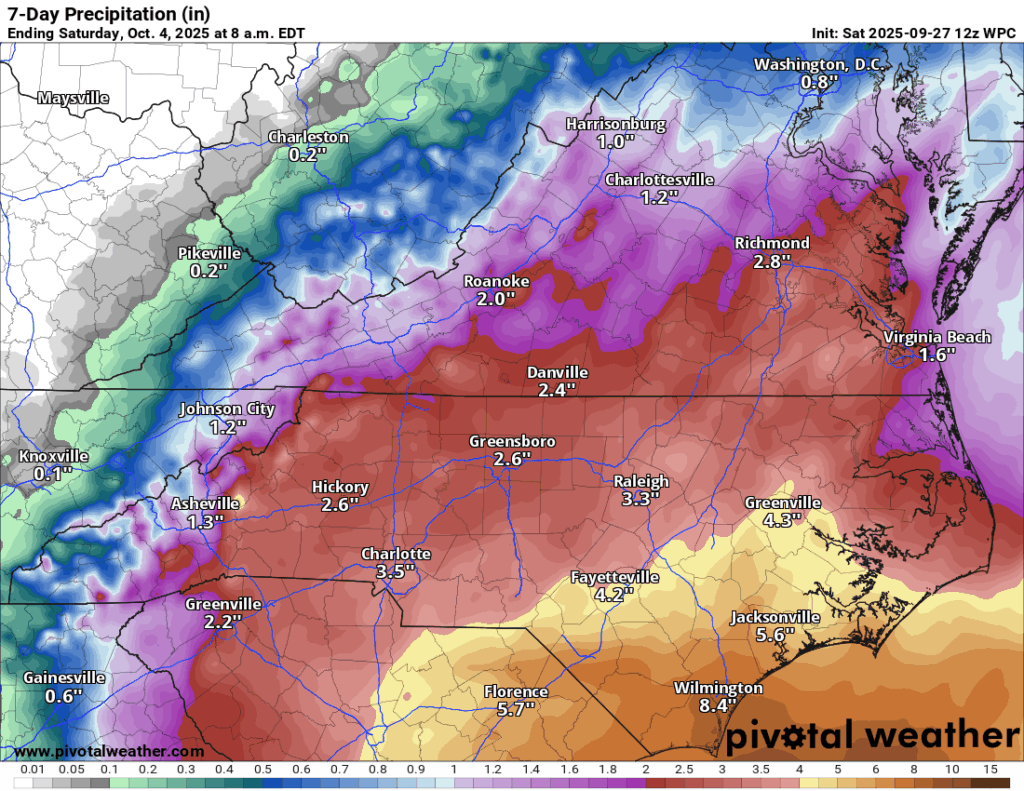
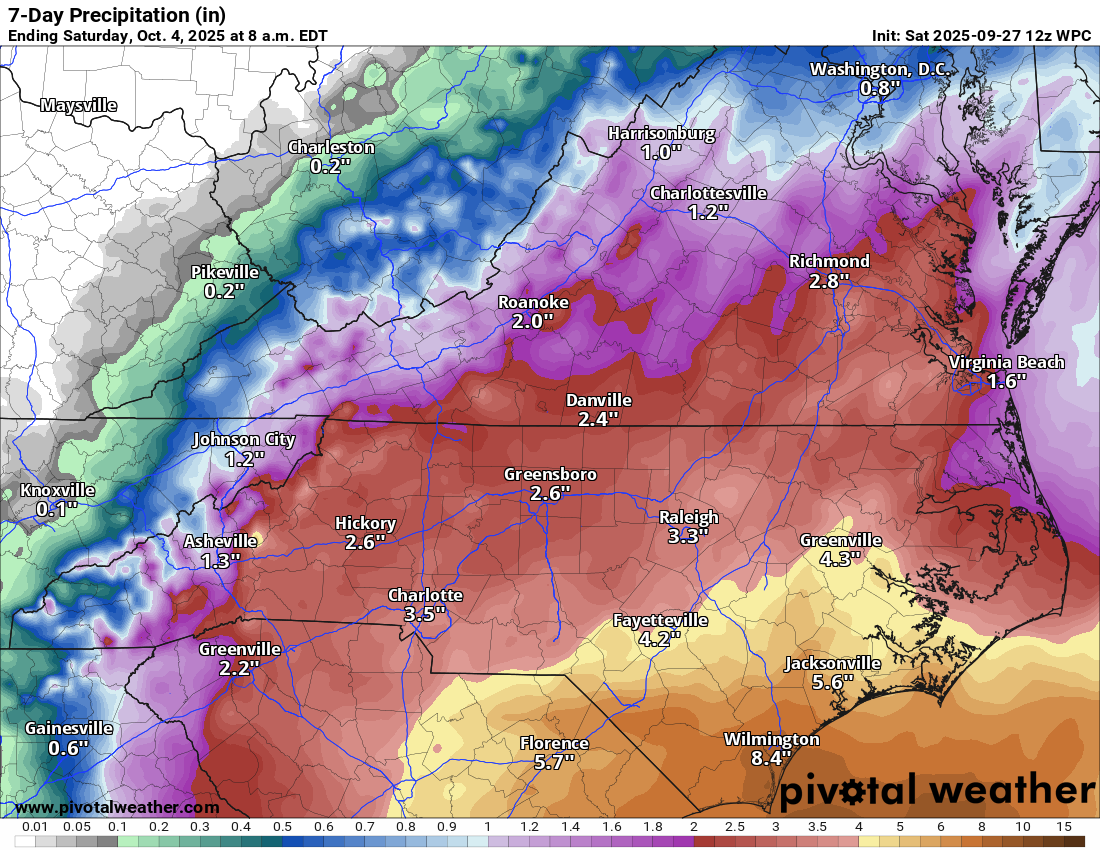
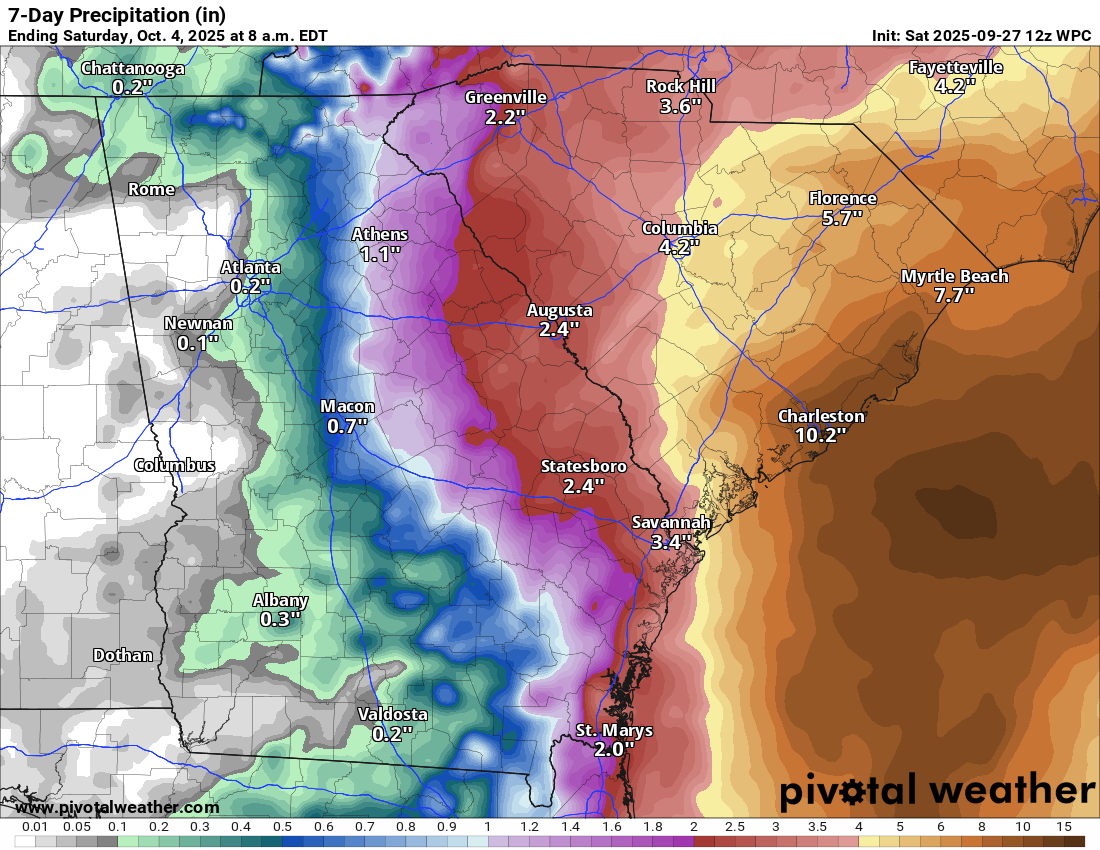
Alright, let’s look briefly at the rainfall situation. Obviously, this entirely depends on how close to the coast TD 9/Imelda gets. A storm closer to the coast will deliver more rain, while a storm that hangs offshore but not totally away from the coast will produce slightly less rain. Either scenario produces significant rainfall. It’s just that one is far worse than the other.
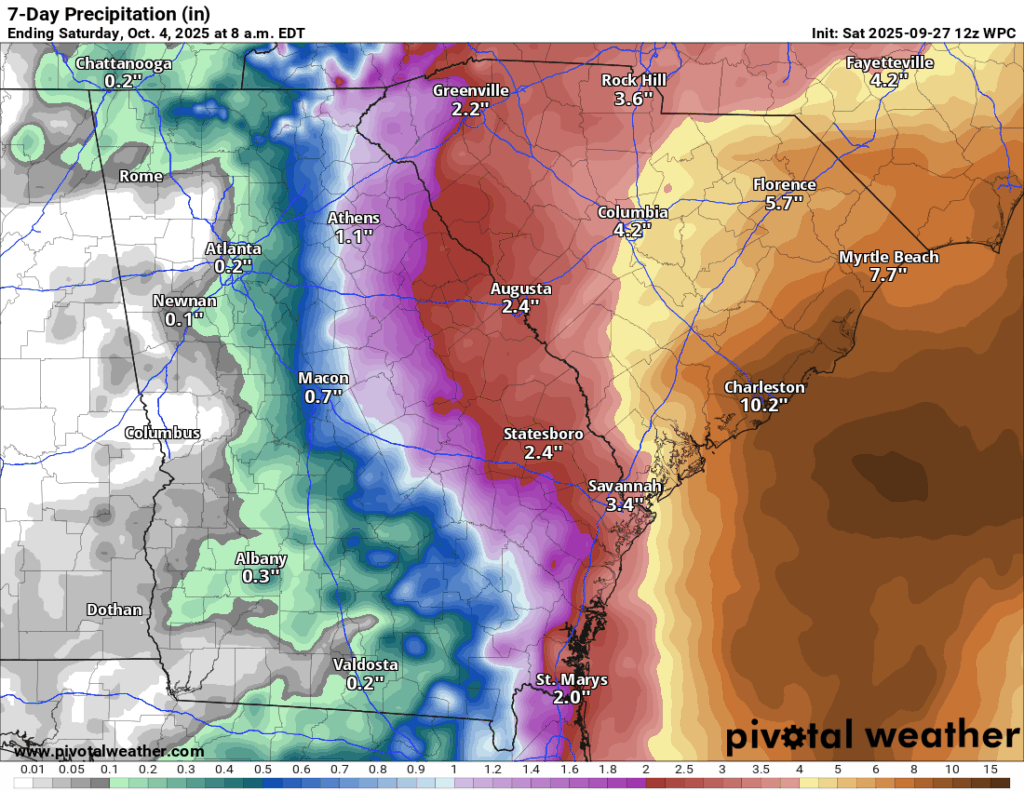
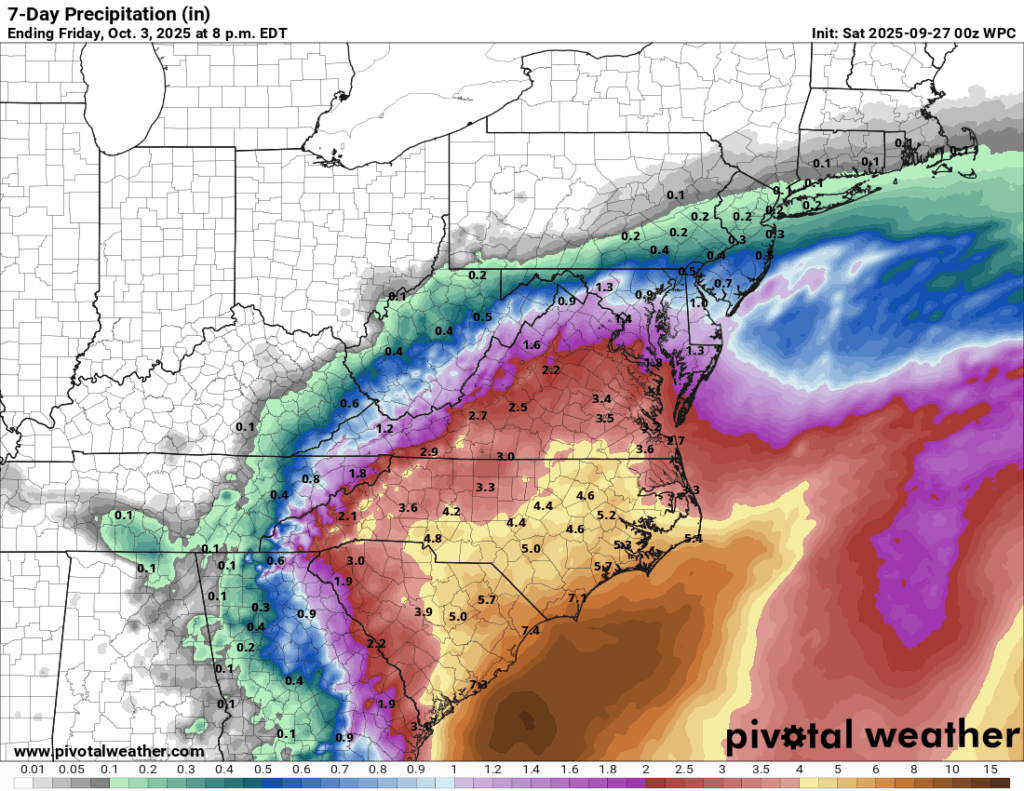
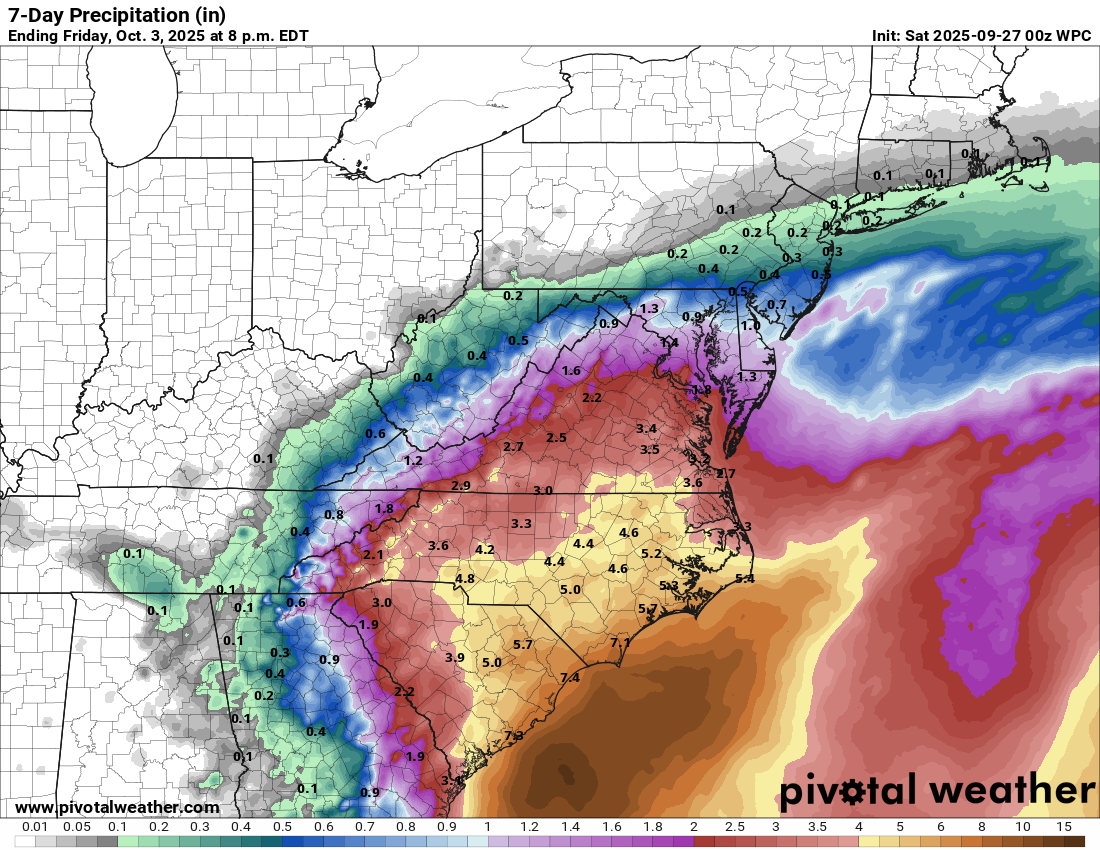
Rainfall forecasts for the next 7 days across the Carolinas and Mid-Atlantic. (Pivotal Weather)
For now, the WPC forecasts above represent the likely rainfall outcome based on the NHC forecast track at the top. Again, this will vary depending on where the stall occurs. It will also vary based on whether the system gets left behind as Humberto exits, which could potentially raise the stakes some. Questions we cannot yet answer.
In addition to the heavy rainfall and likely flooding risk in the coastal plain of the Carolinas, there will be rough surf, rip currents, beach erosion, and the potential for coastal flooding. Currently, tropical storm watches are posted from the Palm Beach/Martin County line to the Flagler/Volusia County line in Florida. Expect those to be expanded northward either later today or tomorrow. Please consult your local NWS office for more specific details for the coastal communities of interest.
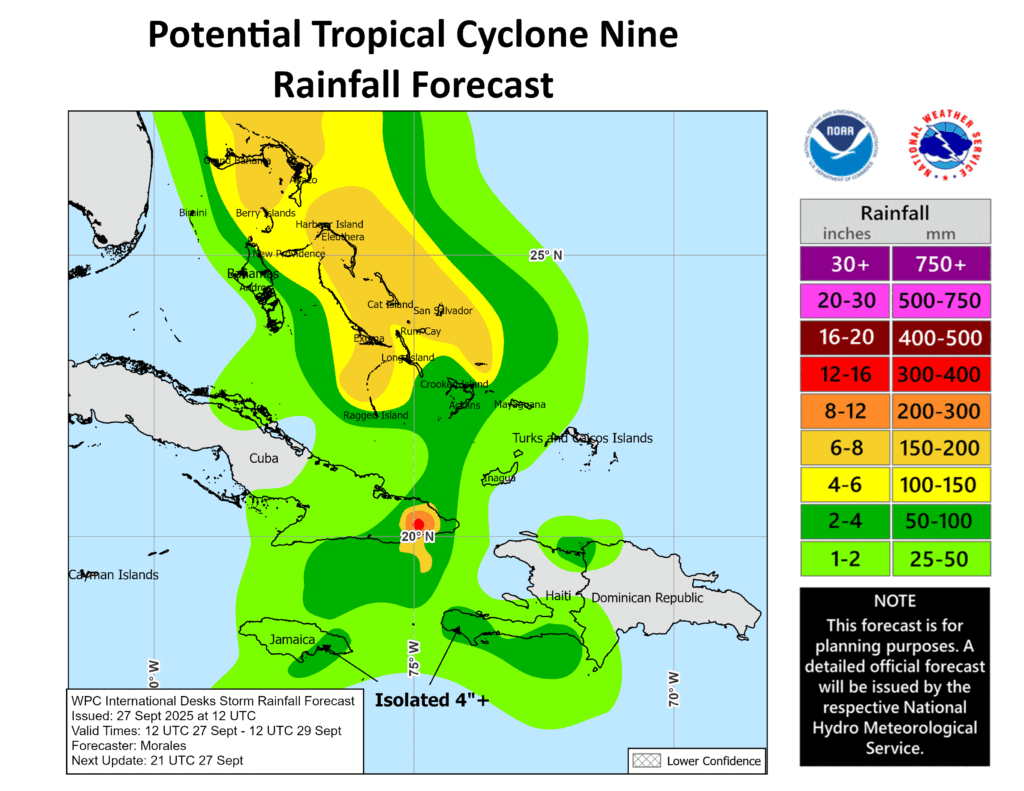
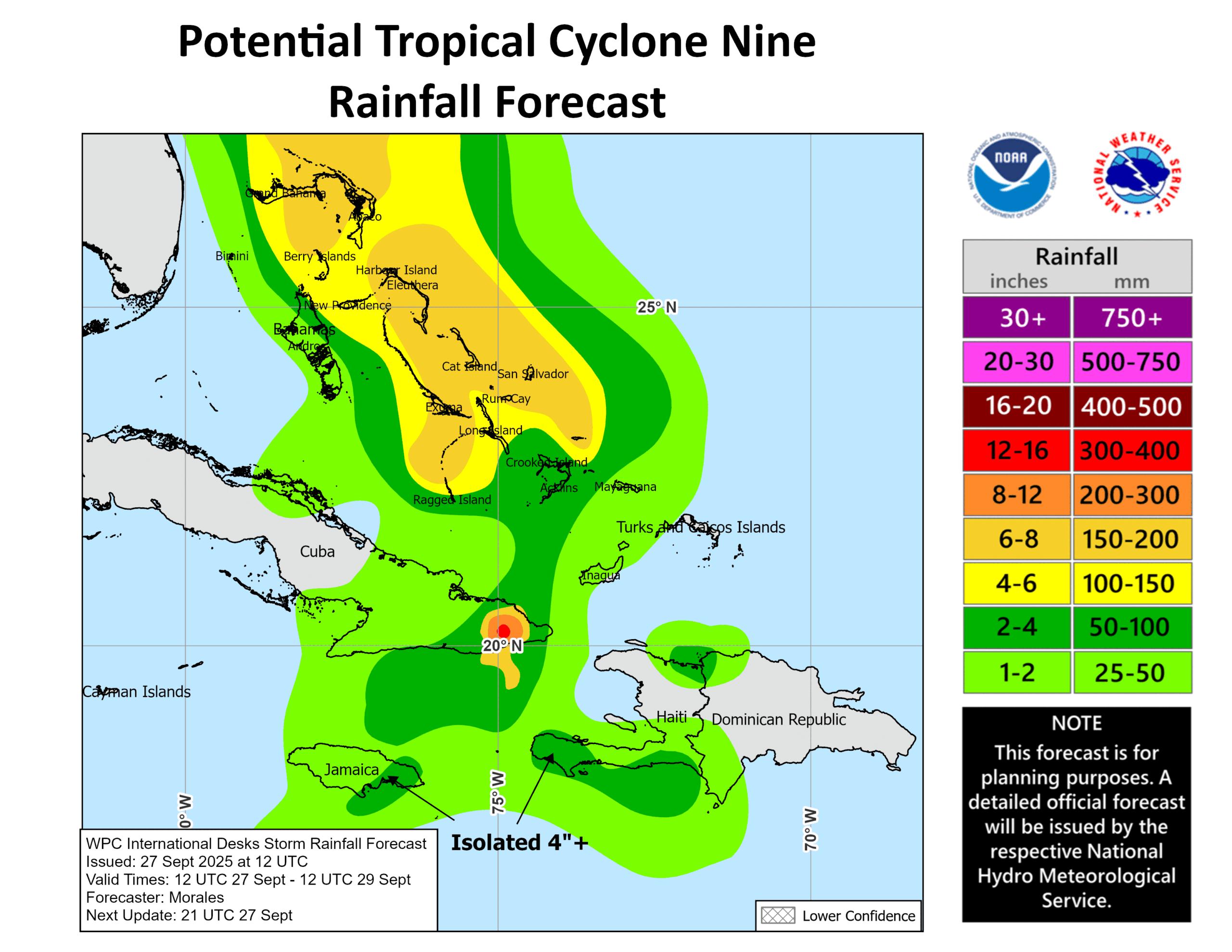
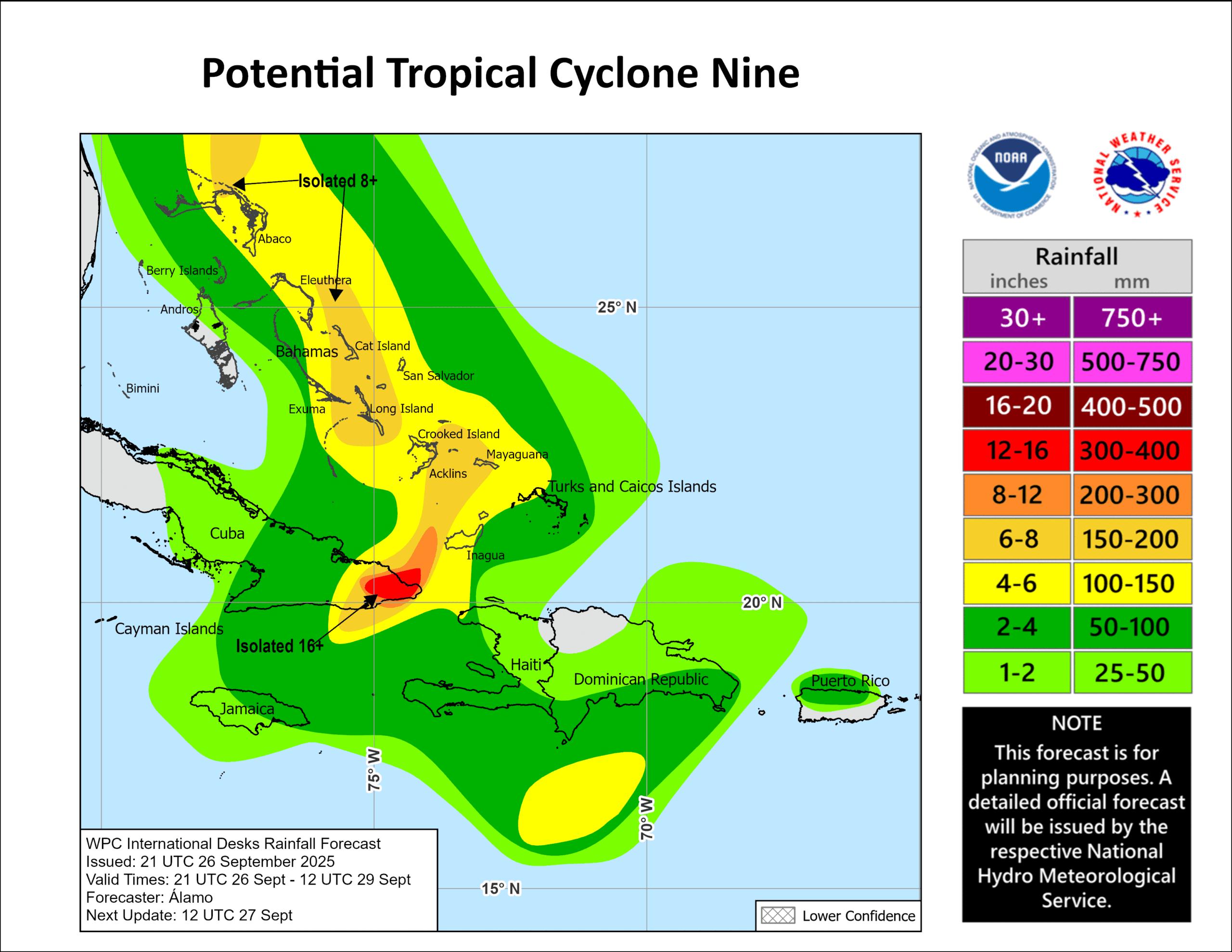
In addition to tropical storm conditions emerging in the Bahamas this weekend, rain totals of 4 to 8 inches are likely. (NOAA WPC)
In the Bahamas, heavy rainfall and tropical storm conditions are likely as the weekend continues.
We’ll continue to track TD 9 closely through the next few days.
Elsewhere
Hurricane Humberto? Big time. Humberto is a strong category 4 hurricane with 145 mph maximum sustained winds.
(NOAA/NHC)
Humberto is expected to pass west of Bermuda only grazing the island with fringe impacts. I wouldn’t be shocked to a watch or warning issued for tropical storm conditions by tomorrow, but for the most part, Humberto is not a huge deal for Bermuda. The combination of Humberto and TD 9 will kick up surf along the entire East Coast.
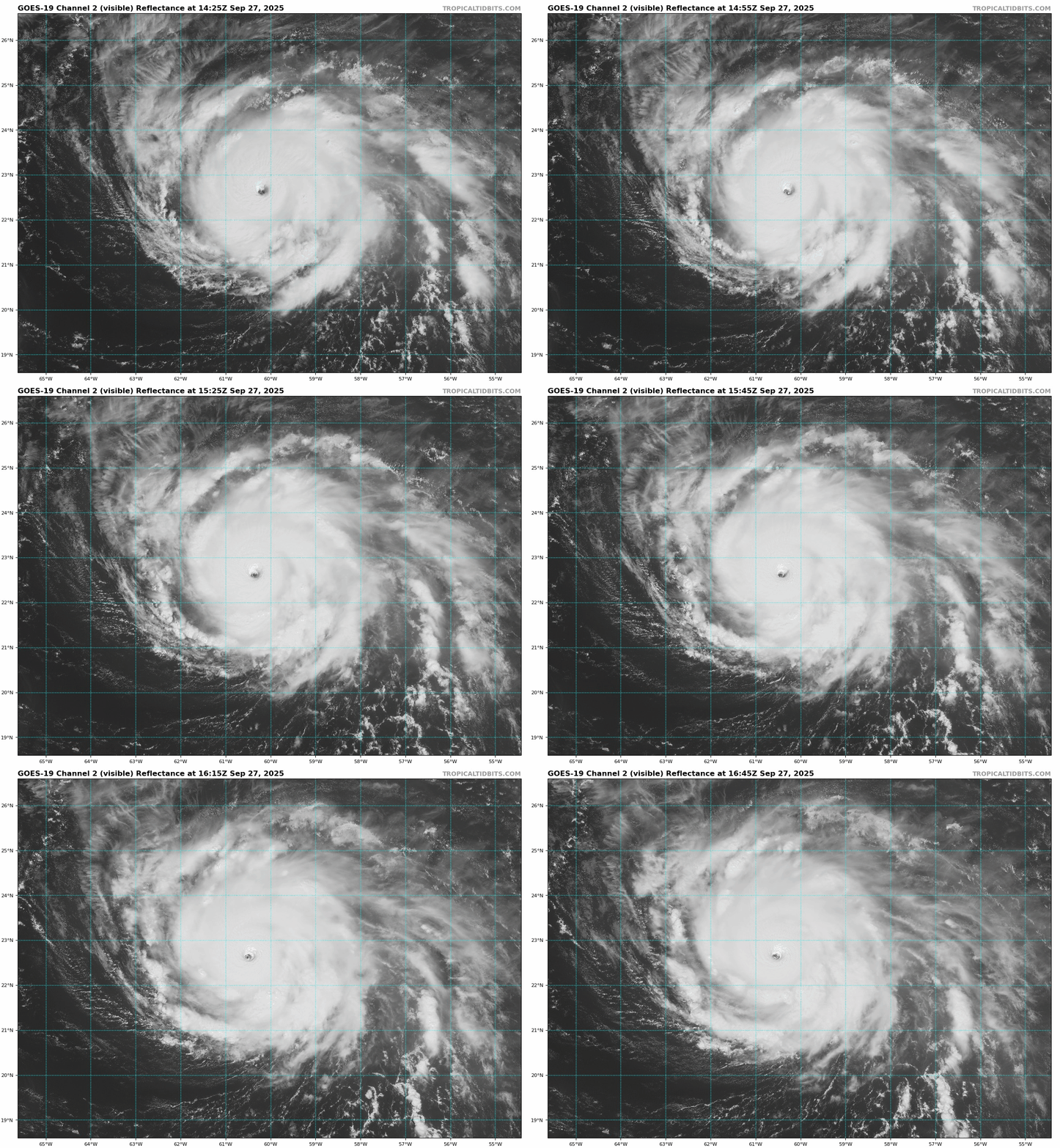
Humberto is quite a beautiful meteorological feature in the open Atlantic. (Tropical Tidbits)
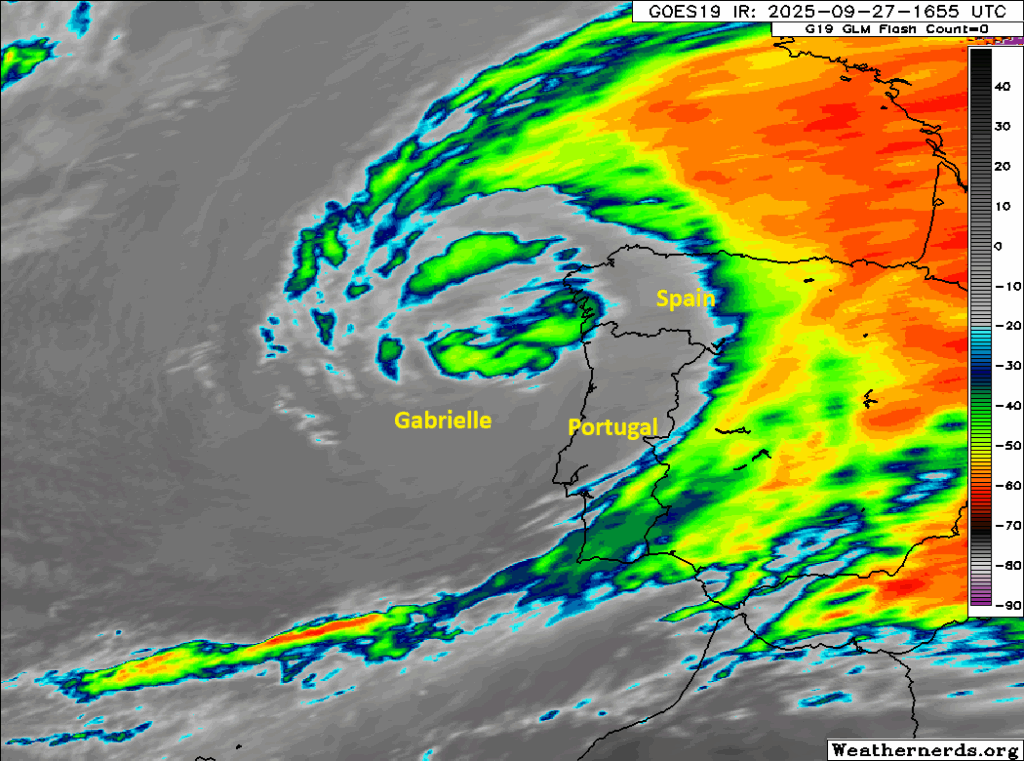
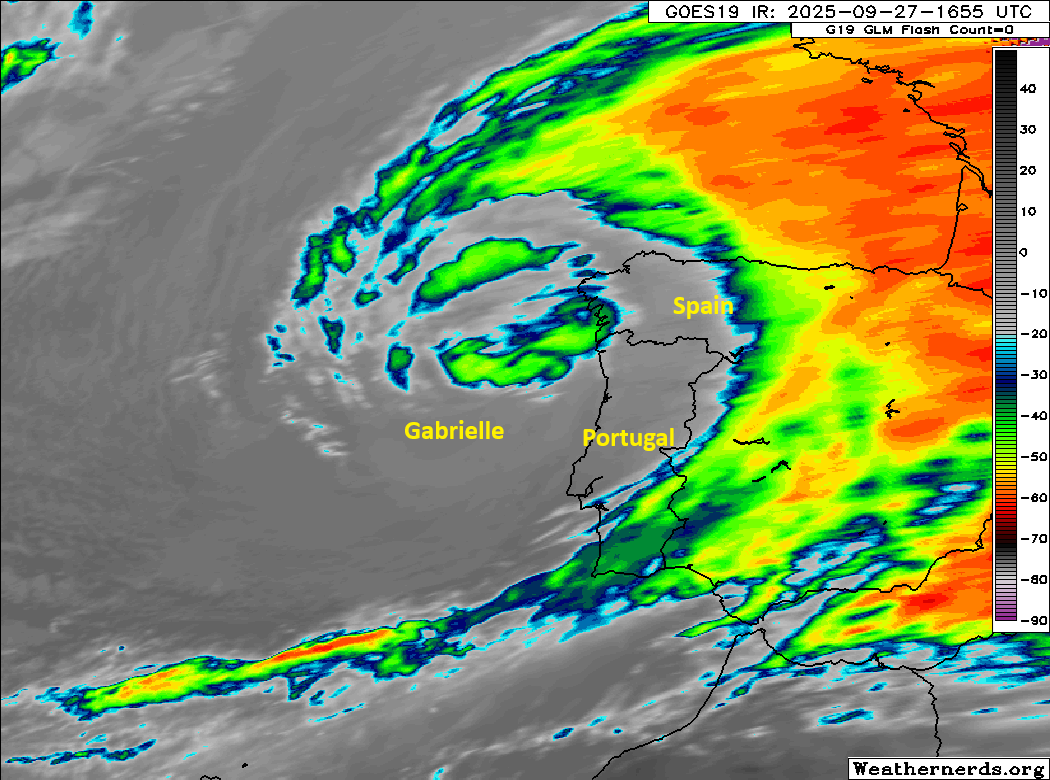
Also, off to the east, the remnants of Gabrielle are heading into Portugal. It is now expected to come ashore there later today, bringing locally heavy rain.
Gabrielle’s remnant low bearing down on Portugal and Spain. (Weathernerds.org)
TORONTO – Reporters have gathered at Toronto’s Yorkville Subway to witness the sandwich company’s latest breakthrough in the field of ladling a bunch of sauce onto some salty meat crammed in a tubular hunk of bread. “Thank you all for coming to see the Great North Chicken Lover, which oozes more liquid than three of […]
I noted some time ago that Windows 95 Setup was actually three programs running under three different operating systems. The first part was an MS-DOS program, which was used if you installed Windows 95 from MS-DOS. It installed a miniature version of Windows 3.1 and then used it for the next part. The second part was a 16-bit Windows program, which was the starting point if you installed Windows 95 from Windows 3.1 or Windows 95. This second part did most of the work. The third part was a 32-bit Windows program, which ran inside the inewly-installed Windows 95 to carry out some final steps that must be done inside the installed operating system.
Some people wondered if the MS-DOS and Windows 3.1 versions could install a miniature Windows 95 rather than a miniature Windows 3.1. That would allow the bulk of the work to be done in a fully 32-bit operating system and take advantage of new Windows 95 features.
I guess you could do that, but there are problems with that design, both from an engineering and a user experience standpoint.
From the engineering side, it would mean having to develop a miniature version of Windows 95 in the first place. Using the miniature Windows 3.1 didn’t incur any extra engineering cost because there was already a fully-debugged miniature Windows 3.1 that could be pulled off the shelf and pressed into service. The Windows 95 project was notoriously behind schedule, and adding a “Develop a variant of Windows 95 for the sole purpose of running Setup” would be a large work item that would instantly get pushback. “Can you find a quicker and less expensive way of doing this?” Especially since Windows 95 itself was still under development, so you would be chasing a moving target. Everybody working on a new feature would have to remember, “Oh wait, but what if we’re running in miniature mode?”
Even if you decide that creating a miniature version of Windows 95 is feasible within the desired timeframe, there is the user experience issue: That miniature version of Windows 95 is probably not going to fit on a single floppy disk. It appears that somebody managed to strip it down to around 7.5 MB, with a remark that 5 MB “might” be possible.
Now, the MINI.CAB that comes on the Windows 95 Setup Disk 1 is 441,905 bytes in size, and it expands out to 815,307 bytes, a compressed size of 54.2%. Let’s be nice and call it 50%.
This means that a miniature install of Windows 95 might fit into 2.5 MB, which is two floppies. That’s not so bad.
So now we have this:
MS-DOS
user
Windows 3.x
user
↓
↓
MS-DOS
file copy
Windows 3.x
file copy
Reboot
↓
Main setup
← Windows 95 user
↓
Reboot
↓
Final setup
One catch is that we have to write two versions of the code that copies the miniature Windows 95 to the system, depending on the starting point. That is a little bit of code duplication, and it’s a little more complex than the file copying code that Windows 95 actually uses for copying the miniature Windows 3.1 since there is a floppy swap involved.
Another catch is the need for a reboot into the miniature Windows 95, since the Windows 95 file system takes over operations from the MS-DOS file system that booted the system. In order to do that, they need to agree on the internal MS-DOS data structures the track the open files, and the MS-DOS side needs to provide the necessary hooks for the Windows 95 virtual machine manager to take over from it.
After the main setup is done, we do another reboot, this time into the real copy of Windows 95 (not the temporary one), and let the final setup delete the temporary copy and finish setting up the real copy.
Now, this design does impair the user experience.
The preferred workflow would be to get the user quickly to the point where they are answering questions about how they want Windows to be installed, and then go off and do the work and then finish in Windows 95 with a single reboot.
With this alternate design, the MS-DOS and Windows 3.x cases now do a lot more work before the user can start answering questions. This is frustrating because it means that the user can’t just start Setup, answer some questions, and then walk away and get some coffee. They have to babysit the Setup past the initial file copy (that includes a floppy swap) and sit through a reboot, wait for BIOS to POST, then wait for the miniature Windows 95 to boot itself up and get to the point where it can ask questions.
Furthermore, we now have two reboots, which breaks the “only one reboot” principle.
The staged version where the MS-DOS Setup program quickly installs and runs a miniature version of Windows 3.1 lets us get the user into the “asking questions” stage faster, and it also avoids the double-reboot.
¹ Another suggestion I saw was to install Windows 3.1 with Win32s so that the main setup program could be written as a 32-bit program. Unfortunately, there are a few problems with this proposal. One is that Win32s itself requires a reboot after installing, so you haven’t solved the double-reboot problem. Also, Win32s is itself 2 MB in size, so that adds to the amount of stuff the user has to wait for before they can start answering questions. And this extra 2 MB is used only by Setup; it isn’t going to be reused by the real Windows 95, so this adds to the number of floppies that need to be used.
Furthermore, Win32s requires Enhanced Mode Windows 3.1, so the miniature Windows 3.1 isn’t good enough, since that is just Standard Mode Windows. You now need to include a miniature Enhanced Mode Windows 3.1, but nobody has made one of those yet. The ready-made miniature Windows 3.1 is Standard Mode, not Enhanced Mode. And the Enhanced Mode Windows 3.1 will probably be a few more megabytes, adding to the amount of “dead weight” on the Windows 95 installation floppies.
At least five Starbucks stores in Houston are closing, according to information on the company's website. The three stores in the region with unionized employees appear to be staying open.
In brief: Invest 94L was reclassified as Potential Tropical Cyclone 9, meaning it is likely to become a tropical storm within the next 24 to 36 hours and produce tropical storm conditions in the Bahamas. We discuss the rain risks there and in Cuba. We also take a closer look at the current forecast goalposts of rainfall for coastal South and North Carolina.
We wanted to add a post this evening to highlight that Invest 94L has been designated as Potential Tropical Cyclone 9, meaning that the National Hurricane Center expects it to develop within the next 36 to 48 hours, requiring tropical storm watches and warnings. In this case, those warnings are presently limited to the Bahamas.
5PM ET Advisory for PTC 9, soon to be Imelda. (NOAA/NHC)
PTC 9 is expected to become a tropical depression tomorrow and a tropical storm tomorrow night as it moves into the Bahamas. Heavy rain is likely in the Bahamas, along with increasing winds and seas as the storm moves through.
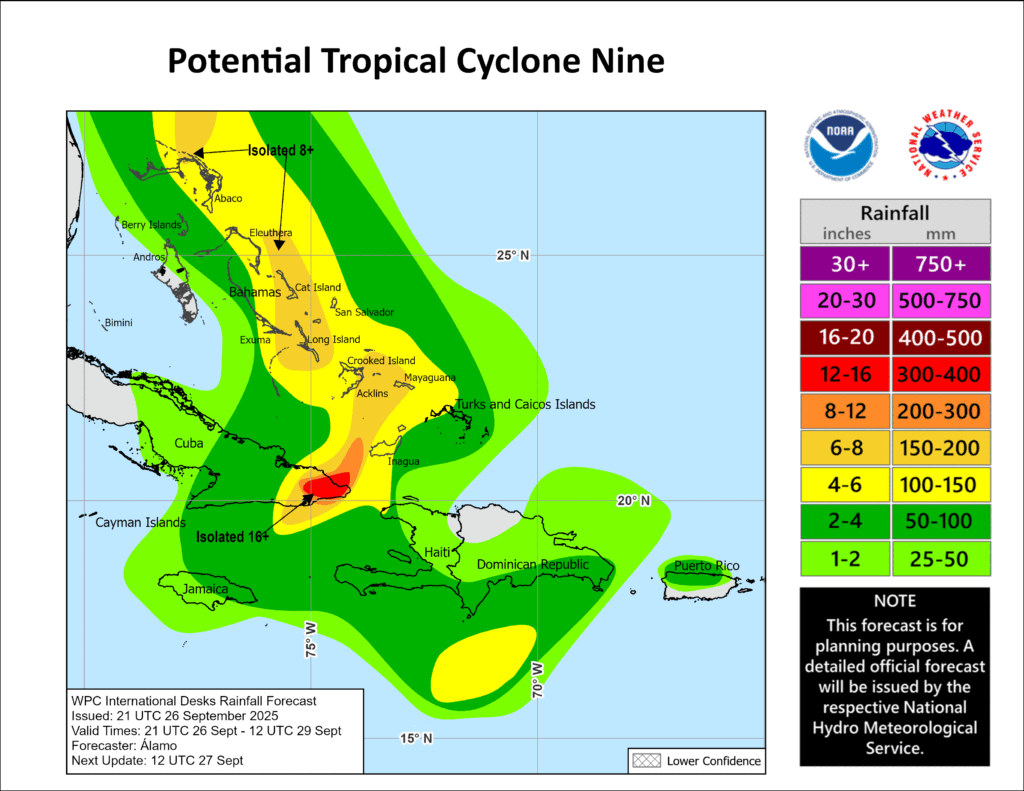
Total rainfall of 4 to 8 inches is expected across much of the Bahamas, with isolated much higher amounts over the eastern tip of Cuba. (NOAA WPC)
Some intense rain is likely over the eastern tip of Cuba as well. Rain totals may reach as high as 16″ or more in the higher terrain there leading to dangerous flooding and landslide risks.
From there, you can see the National Hurricane Center track above. It shows a hurricane and eventually a tropical storm approaching the coast of South Carolina by Tuesday night or Wednesday. There is a tremendous amount of uncertainty on exactly where this system will go, and if you look under the hood and read the NHC’s discussion, they make this clear as well. It’s possible that a landfalling hurricane or tropical storm hits the South Carolina or North Carolina coast early to mid-next week. It’s also possible that this thing just taps the brakes and meanders offshore for a few days. Both scenarios deliver impacts, including torrential rain to the Carolinas, particularly in the Coastal Plain between the Lowcountry, Pee Dee and southeastern North Carolina.
Rainfall scenarios
So let’s lay out a couple of the rainfall scenarios. First, here’s the current official forecast. Consider this the best estimate of how much rain may fall, on average, across the region over the next 7 days.
The official WPC forecast from NOAA for the next 7 days, showing anywhere from 4 to 8 inches of rain over a wide area of the coastal plains in the Carolinas, extending into the Piedmont and parts of Virginia as well. (Pivotal Weather/NOAA WPC)
So, officially at least, the current thought is 4 to 8 inches with isolated higher amounts at the coast.
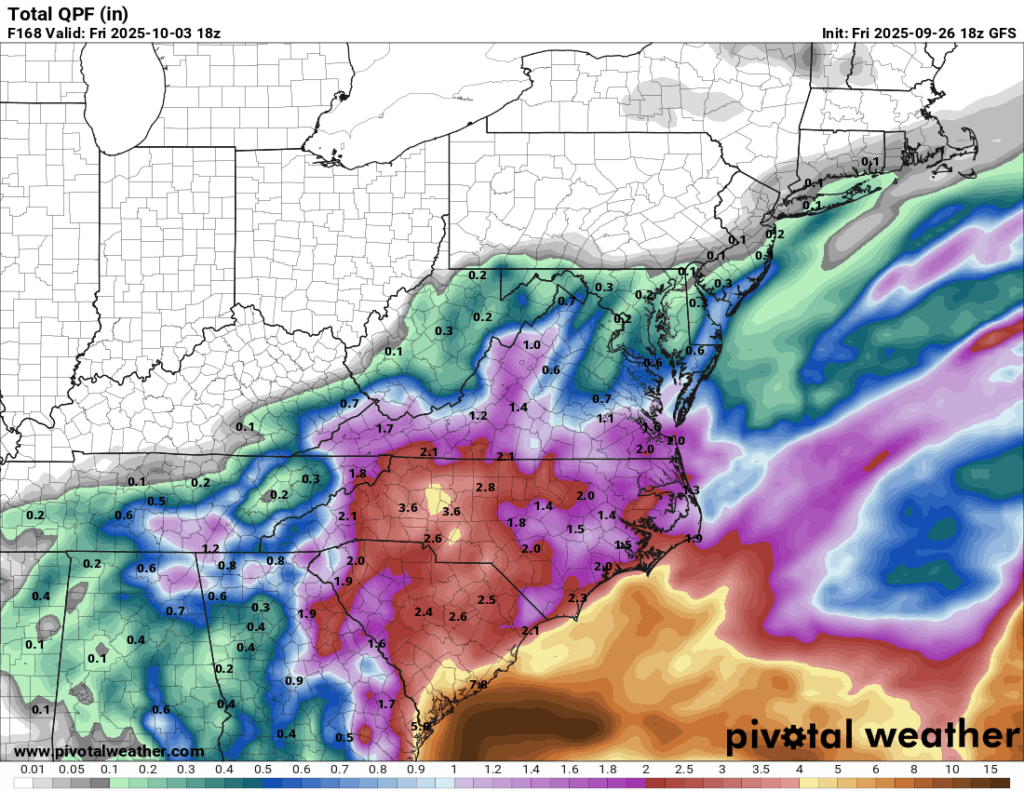
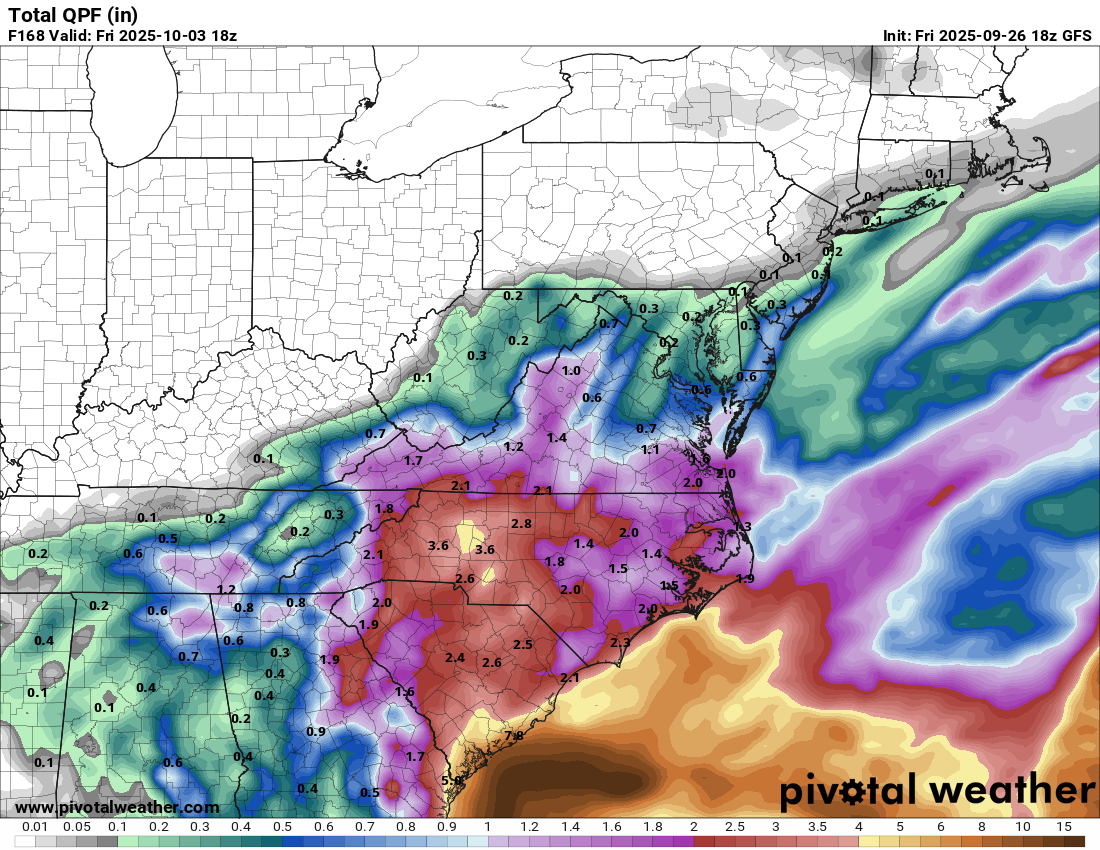
Let’s say the system never really makes landfall and approaches the coast but probably stays offshore and drifts eastward. The GFS model shows this fairly well today. Its rainfall totals are still impressive.
The GFS model from late this afternoon shows the heaviest rain primarily on the South Carolina coast, with 4 to 8 inches in the Charleston area and lesser amounts north of there. (Pivotal Weather)
But they’re also notably lower than the current official forecast. This feels like a nice “floor” for how much rain could occur. I would anticipate at least this much. There will obviously be ways this could change, but given the scenarios in play, that’s where we are right now.
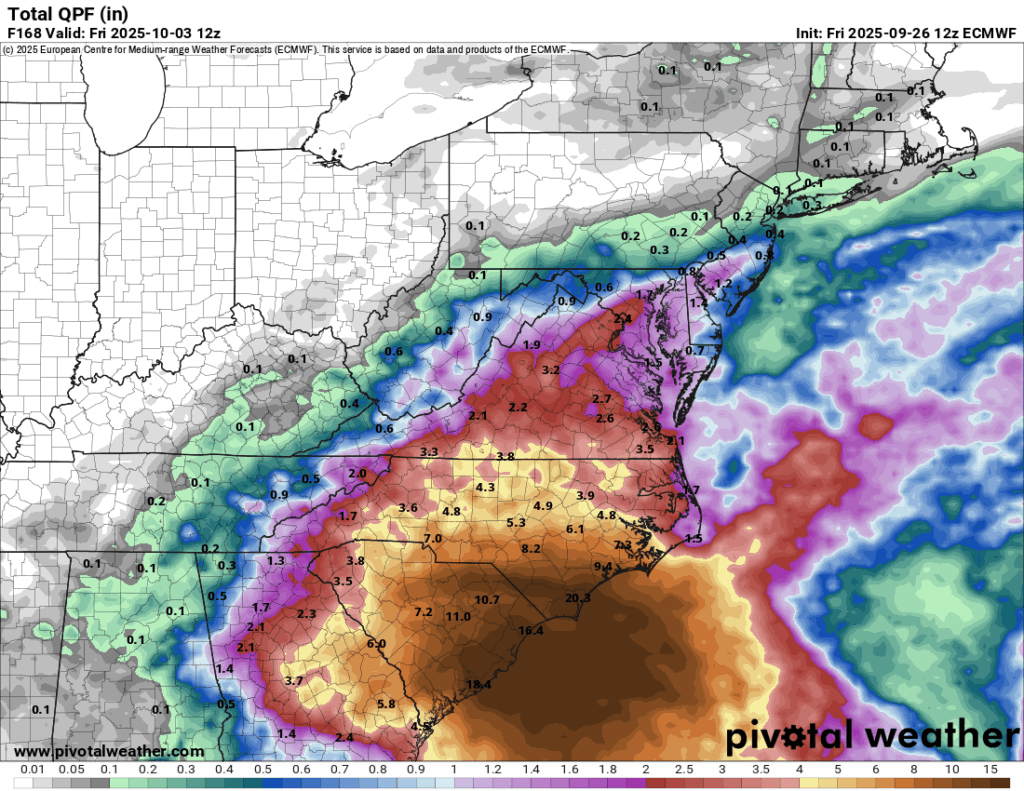
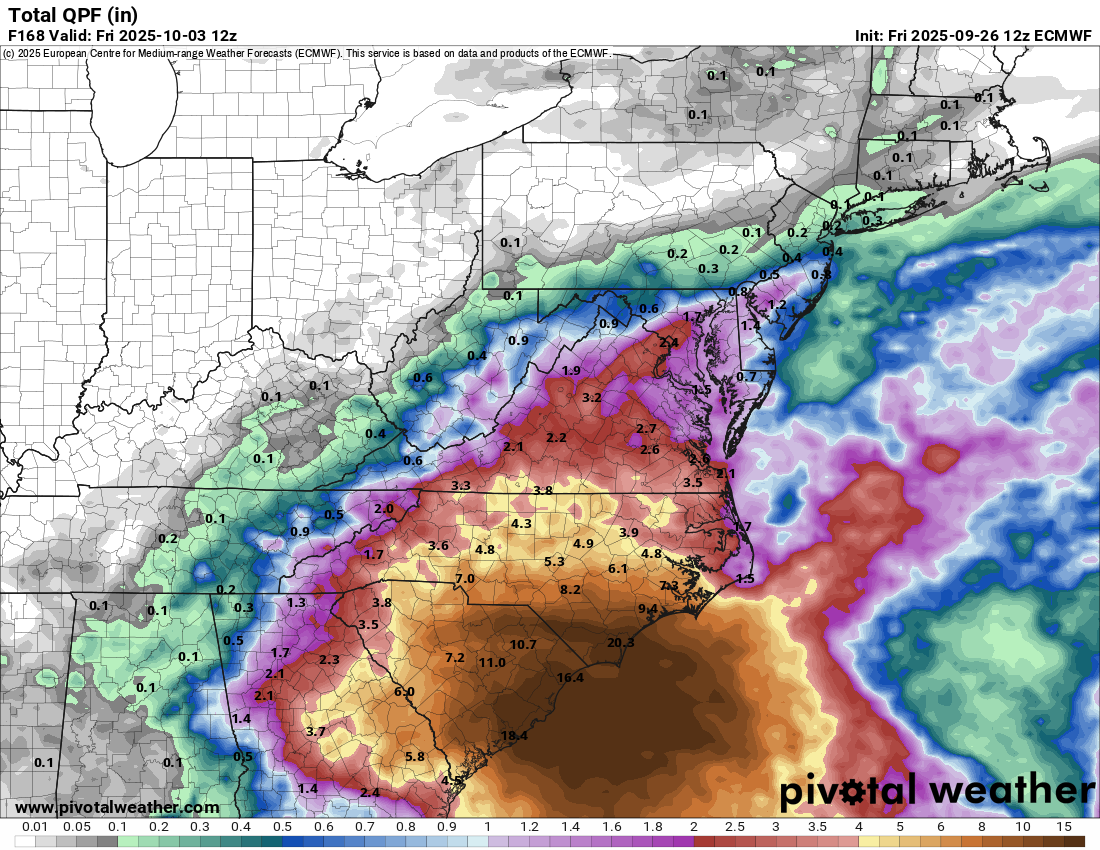
Now, let’s say the storm comes ashore or just hugs the immediate coast for a couple days. This is sort of what the European model showed this morning. How much rain falls in that scenario?
European model rainfall forecasts are much worse than the current outlook or the GFS forecast due to the storm sitting on the coast for a couple days. (Pivotal Weather)
Well, the Euro represents an extreme example at the moment but one that cannot be entirely ruled out. In this scenario, rain totals of 20 inches would be possible on the coast between Charleston and Wilmington with a wide area of 5 to 15 inches in the Pee Dee and southeastern North Carolina. This would bear some similarities to Matthew or Florence in that scenario in terms of the rainfall. Both of those storms were terrible flood producers in this region. To be clear, no one is forecasting a Matthew or Florence redux. But on the higher end of the spectrum of realistic possibilities, we can’t adequately rule the Euro model’s scenario out yet. Same goes for the less problematic GFS, of course.
But in addition to the “there’s a storm coming” mindset, we want folks on the coast and inland in the coastal plain to prepare for the potential for a long-duration rain event and the potential for flooding as well. There will be much to monitor this weekend, and we’ll be back in the morning with the latest.
NEW YORK – In a speech before the UN General Assembly, Israeli PM Benjamin Netanyahu declared that Canada officially recognizing Palestine as a state is worse than anything else he could imagine happening there. Canada, along with several other Western countries, recognized Palestine as a state as of Sep 21st, a move which Netanyahu described […]
The Supreme Court pulled off another shadow docket masterpiece this week, granting Trump’s request to keep FTC Commissioner Rebecca Kelly Slaughter fired while simultaneously pretending they haven’t already made up their minds about whether presidents can ignore 90-year-old Supreme Court precedent. What makes this particularly brazen is that the Court is allowing Trump to violate existing law while his challenge to that law is still pending—exactly the opposite of how preliminary relief is supposed to work. It’s a neat trick: use the emergency docket to give Trump exactly what he wants, then schedule oral arguments in December to maintain the fiction that this is all very serious legal deliberation.
As we covered earlier this month, the DC Circuit had the audacity to follow binding Supreme Court precedent when it reinstated Slaughter to her position. The court’s mistake was apparently believing that Humphrey’s Executor v. United States from 1935—where a unanimous Supreme Court told FDR he couldn’t fire FTC commissioners at will—remained good law until explicitly overturned.
Silly lower courts, thinking precedent means something.
The Supreme Court wasted no time correcting this error in judgment, issuing a stay Monday morning with zero explanation, effectively telling Rebecca Slaughter she’s out of a job until the Court gets around to formally trashing nearly a century of precedent sometime after December oral arguments.
Justice Elena Kagan, joined by Justices Sotomayor and Jackson, wasn’t having it. Her dissent cuts right to the heart of what makes this so legally absurd:
On top of granting certiorari before judgment in this case, the Court today issues a stay enabling the President to immediately discharge, without any cause, a member of the Federal Trade Commission (FTC). That stay, granted on our emergency docket, is just the latest in a series. Earlier this year, the same majority, by the same mechanism, permitted the President to fire without cause members of the National Labor Relations Board, the Merits Systems Protection Board, and the Consumer Product Safety Commission.
Kagan points out that Congress explicitly prohibited each of these removals. The FTC Act bars the President from firing commissioners “except for inefficiency, neglect of duty, or malfeasance in office.” Trump fired Slaughter because she’s a Democrat, not because of any of those reasons. Under current law, that’s illegal. Full stop.
But the majority doesn’t care about current law when Trump wants something:
Yet the majority, stay order by stay order, has handed full control of all those agencies to the President. He may now remove—so says the majority, though Congress said differently—any member he wishes, for any reason or no reason at all. And he may thereby extinguish the agencies’ bipartisanship and independence.
The legal principle at stake here is pretty basic: when you’re challenging existing law, you don’t get to ignore that law while your challenge is pending. That’s the whole point of courts being able to issue stays. You maintain the status quo until the court decides whether the law is constitutional.
But apparently that principle doesn’t apply when Donald Trump really, really wants to fire someone:
I dissented from the majority’s prior stay orders, and today do so again. Under existing law, what Congress said goes—as this Court unanimously decided nearly a century ago. In Humphrey’s Executor v. United States, 295 U.S. 602 (1935), we rejected a claim of presidential prerogative identical to the one made in this case. (Indeed, the suit emerged from a discharge at the very same agency.) Congress, we held, may restrict the President’s power to remove members of the FTC, as well as other agencies performing “quasi-legislative or quasi-judicial” functions, without violating the Constitution. Id., at 629. So the President cannot, as he concededly did here, fire an FTC Commissioner without any reason. To reach a different result requires reversing the rule stated in Humphrey’s: It entails overriding rather than accepting Congress’s judgment about agency design. The majority may be raring to take that action, as its grant of certiorari before judgment suggests. But until the deed is done, Humphrey’s controls, and prevents the majority from giving the President the unlimited removal power Congress denied him.
The only thing that’s different from when Humphrey’s Executor was decided is that this Supreme Court apparently thinks Trump should get whatever Trump wants.
The most damning part of Kagan’s dissent is how she calls out the majority for using the emergency docket to reshape constitutional law:
Our emergency docket should never be used, as it has been this year, to permit what our own precedent bars. Still more, it should not be used, as it also has been, to transfer government authority from Congress to the President, and thus to reshape the Nation’s separation of powers.
This gets to something we’ve been tracking all year: the Court’s systematic use of the shadow docket since the inauguration to hand Trump unprecedented power over the federal government. They’re not just breaking precedent—they’re breaking the normal process for breaking precedent.
Inmoreandmoredecisions, the Supreme Court is overruling judges who are literally just applying the law as it is written, and has long been interpreted; Justices Neil Gorsuch and Brett Kavanaugh are evenscoldingjudges for failing to anticipate which precedent the Court will stuff in the garbage next. The justices’ handling of Slaughter is again telling lower court judges not to do as the Court has said, but to do what everyone knows the Court wants to say. And increasingly, what the Court wants to say is, “Whatever Trump wants goes.”
Mark Joseph Stern at Slate captures the broader implications nicely:
It is bad enough that the court is clearly planning to let Trump construct the most submissive executive branch in history by purging his opponents from federal agencies. What’s worse, though, is that the supermajority has ushered in this new era of autocratic presidency over the shadow docket, offering almost no public explanation for its radical moves.
Here’s the thing that’s particularly galling: the Court could have easily said “we’re taking this case and we’ll decide it quickly, but in the meantime, existing law applies.” That would have meant Slaughter keeps her job until they rule (as both lower courts said, following the precedent). Instead, they chose to give Trump exactly what he wants while the case is pending, effectively deciding the case before they’ve heard arguments.
The stay also raises another troubling question. The Court asked the parties to brief whether federal courts can even “prevent a person’s removal from public office” at all. If they rule that courts lack this power entirely, then Trump could fire anyone from any agency and the judiciary would be powerless to stop him, even when the firing clearly violates federal law as per Congress.
As Stern writes, this would complete Trump’s takeover of the administrative state:
Should the supermajority strip courts of this authority, then the Fed’s independence will vanish completely: Even if Trump fires its members illegally, the judiciary will have no ability to put them back in office. It is increasingly difficult to avoid the conclusion that the Supreme Court is dismantling every guardrail that separates democracy from dictatorship.
The DC Circuit got this right in their ruling two weeks ago. They followed binding precedent and put Slaughter back in her job, while acknowledging that the Supreme Court would probably reverse them soon. They did their job—applying the law as it exists, not as they think it might exist after Trump’s Court gets done with it.
But apparently following binding Supreme Court precedent is now grounds for immediate reversal by… the Supreme Court.
The Court will hear arguments in December, and everyone knows how this ends. They’ll almost certainly overturn Humphrey’s Executor, give Trump the power to fire any federal official he wants, and pretend this was all a very serious exercise in constitutional interpretation rather than a predetermined outcome delivered through procedural gamesmanship.
Until then, Rebecca Slaughter remains illegally fired, and the Court’s emergency docket continues to serve as Trump’s personal fast-track to unlimited executive power.
Precedent was nice while it lasted.
The most disturbing part isn’t even that they’re planning to overturn Humphrey’s Executor—it’s that they’re so eager to help Trump that they can’t even wait for the formality of actually doing it.
In her telling, and in the minds of her supporters, she was pursued for crimes she didn't commit or that were justified. The FBI put Shakur on its list of “most wanted terrorists.”