Shared posts

28 Jan 17:15

A new Supreme Court case would force the government to create religious public schools 

by Ian Millhiser
James.galbraith

another one that will go badly

A man holds a cross outside of the Supreme Court.
A man holds a cross outside of the Supreme Court. | Bryan Dozier/Middle East Images via AFP

The Supreme Court announced on Friday that it will hear two cases that are likely to revolutionize the relationship between church and state, at least in the context of public schools. 

Both cases, known as Oklahoma Statewide Charter School Board v. Drummond and St. Isidore of Seville Catholic Virtual School v. Drummond, seek to force state governments to pay for religious public schools. They involve a planned public charter school in Oklahoma, which will be run by two Catholic dioceses. According to the Oklahoma Supreme Court, the school, known as St. Isidore, says it will “derive ‘its original characteristics and its structure as a genuine instrument of the church’ and participate ‘in the evangelizing mission of the church.’”

The state supreme court ruled that it is unlawful for the state to fund a religious public school. In its decision, the state court said that the ruling stemmed both from longstanding federal constitutional principles protecting the separation of church and state and the Oklahoma Constitution, which forbids the use of “public money … for the use, benefit, or support of any sect, church, denomination, or system of religion.”

It is likely, however, that the US Supreme Court’s Republican majority, which has ruled that states must fund religious education in some contexts, will extend those previous decisions to require Oklahoma to fund this religious school. That would likely mean that nearly every state will have to fund public religious schools similar to St. Isidore, a scenario that would fundamentally alter public education in the United States. While the Court has supported some government funding of private schools in the past, it has never endorsed a public religious school.

The Court said in Carson v. Makin (2022) that states “need not subsidize private education,” and that states may “provide a strictly secular education in its public schools.” But Carson also held that, when a state offers vouchers to help families pay for private education, “it cannot disqualify some private schools solely because they are religious.”

In the St. Isidore cases, both the school and Oklahoma’s charter school board essentially ask the Supreme Court to extend Carson to charter schools — which, unlike the private institutions at issue in Carson, are public schools that are subject to significant state control

As Oklahoma’s Supreme Court explained in its opinion, charter schools in that state are “subject to the same academic standards and expectations as existing public schools.” They “must comply with the same rules that govern public schools on school-year length, bus transportation, student testing, student suspension, and financial reporting and auditing.”

They also must comply with other rules that apply to all public schools in Oklahoma, including the requirement that they must be “equally free and open to all students as traditional public schools.”

Currently, charter schools exist in 45 states plus the District of Columbia. An extension of Carson would force these states to decide whether to shut down all of their existing charter schools, or to keep them and start funding schools like St. Isidore — they would no longer be allowed to host charter schools if those schools were exclusively secular.

Realistically, states that already have a significant number of charter schools are unlikely to shut them down. Few elected officials will want to deal with the political backlash that will come if they close existing charter schools that already serve thousands of students. 

That will leave these states with only one other choice: Allow religious public schools to open in their state.

How did we get to this point?

For many decades, the idea that Oklahoma is allowed to fund a religious school — much less that it is required to do so — was considered anathema to the Constitution. As the Supreme Court said in Everson v. Board of Education (1947), “no tax in any amount, large or small, can be levied to support any religious activities or institutions, whatever they may be called, or whatever form they may adopt to teach or practice religion.”

Those days are now gone. Carson is quite clear that, at least in some circumstances, states are constitutionally required to fund religious education. The Court, in other words, has turned Everson completely on its head.

In the now-dead regime, when the Court closely policed the boundary between church and state, the Constitution’s command — known as the establishment clause — that there shall be no laws “respecting an establishment of religion” was understood to protect three values that often come up in the context of public schools. 

The first was a pluralistic value system that sought to, in the words of Allegheny County v. ACLU (1989), “preclude[s] government from conveying or attempting to convey a message that religion or a particular religious belief is favored or preferred.” As Justice Sandra Day O’Connor wrote in an influential concurring opinion in 1984, when the government endorses one religious belief over another, it tells “nonadherents that they are outsiders, not full members of the political community” while simultaneously telling “adherents that they are insiders, favored members of the political community.”

But this concern that the government should not tell nonbelievers and members of minority faiths that they are outsiders in their own community is dead in the Roberts Court. In Kennedy v. Bremerton School District (2022), the Court’s Republican majority repudiated its past precedents warning about government endorsements of religion. It appears that the government is now free to actively promote one religious faith over another.

The second value system that used to animate the Court’s establishment clause cases is a ban on government actions that seek to coerce someone into religious activity. This rule against coercion still plays some role in the Roberts Court’s cases. In Bremerton, for example, the Republican justices agreed that the government “may not coerce anyone to attend church,” and that it may not “force citizens to engage in ‘a formal religious exercise.’”

It is unclear, however, whether the Court will still enforce this ban on coercion against the subtle forms of coercion that sometimes arise in public schools, or whether it will read this ban narrowly to prohibit only laws and policies that directly force children to participate in someone else’s faith. 

In Lee v. Weisman (1992), for example, the Court split 5-4 on how to apply this anti-coercion principle to school-sponsored prayer. In Lee, a public school invited a rabbi to deliver a prayer at its graduation ceremony. Writing for the majority, Justice Anthony Kennedy concluded that such a ceremony subtly coerces students into participating in that prayer.

“The undeniable fact,” Kennedy explained, “is that the school district’s supervision and control of a high school graduation ceremony places public pressure, as well as peer pressure, on attending students to stand as a group or, at least, maintain respectful silence during the Invocation and Benediction.” Such pressure, “though subtle and indirect, can be as real as any overt compulsion,” as it leaves a young nonadherent with “a reasonable perception that she is being forced by the State to pray in a manner her conscience will not allow.”

Four justices, however, joined a dissent by Justice Antonin Scalia, which mocked Kennedy’s concern about subtle religious coercion as “precious.” According to Scalia, the only kind of religious coercion forbidden by the Constitution is “coercion of religious orthodoxy and of financial support by force of law and threat of penalty.” So, as long as a public school does not actively punish a student who refuses to participate in a prayer or other state-sponsored religious exercise, it is free to host that prayer.

It’s unclear where each of the current justices will fall on this divide between Kennedy and Scalia. But the Bremerton opinion, which cites favorably to Scalia’s Lee dissent and which suggests that James Madison only understood the Constitution “to prevent one or multiple sects from ‘establish[ing] a religion to which they would compel others to conform,’” suggests that the Court’s Republican majority prefers Scalia’s approach.

Finally, the Court’s religion cases have historically warned against discrimination among different religious faiths. As the Court said in Larson v. Valente (1982), “the clearest command of the Establishment Clause is that one religious denomination cannot be officially preferred over another.”

In theory, the Roberts Court still honors the principle that the government may not discriminate among faiths. Indeed, Carson was rooted in the Republican justices’ belief that a state that pays tuition at secular private schools but not religious ones is engaged in “discrimination against religion.”

In practice, however, the Court’s Republicans have not always enforced this rule against religious discrimination rigorously, at least when politically disfavored faiths are involved. In Dunn v. Ray (2019), for example, the Republican justices ruled that Alabama may execute a Muslim inmate without his imam present, even though the state permitted Christian clergy to be present during a Christian inmate’s execution. The Court has since backed away from its decision in Ray, but that case and others suggest that the Republican justices may not be as zealous in protecting Muslims’ religious liberties as they are in protecting Christians.

Where do we go from here?

Realistically, if the Republican justices are determined to end the Court’s concern with pluralism, and read the bans on religious coercion and discrimination narrowly, no one can stop them. The Republican Party doesn’t just control the Supreme Court, it controls all three branches of the federal government, at least for now.

Similarly, if the Republican justices are determined to greenlight religious public charter schools, no one will prevent them from doing so.

Yet, while the St. Isidore cases seem likely to end whatever vestiges remain of decisions like Everson and Allegheny County, a great deal will still hinge on whether the justices enforce the rules against coercion and discrimination rigorously.

Imagine, for example, a community that is overwhelmingly Lutheran. In a world where public religious schools like St. Isidore are allowed, it is likely that a Lutheran charter school will soon open in this community, and the Lutheran parents in this community may all choose to send their children to this new Lutheran school.

Now imagine that a family from some other faith — let’s say a Hindu family — moves into this community. Because the overwhelming majority of their neighbors attend the Lutheran school, that school is likely to be well-funded. Its size will also allow it to take advantage of economies of scale, which will mean that the Lutheran school will be able to offer enrichment programs and advanced placement classes that a smaller school might not be able to afford.

Meanwhile, while there may still be a secular public school in this community, if only a small handful of students attend this traditional public school, that school will most likely lack the resources of the Lutheran school, and will offer an inferior education.

The Hindu family, in other words, will not be coerced into sending their children to the Lutheran school in the sense that they will be tossed into jail if their kids go to the secular school. But families want their children to succeed. And the Hindu family is likely to decide that they have no choice but to send their kids to the religious public school which will offer their children a superior education.

Worse, what happens if the Lutheran school only admits students who share the school’s religious faith? Will the Supreme Court enforce the ban on religious discrimination? Or will it effectively rule that Hindu children in this neighborhood must attend a separate and unequal public school?

For that matter, what if a religious public school excludes some students because of traits unrelated to their faith? Could a religious public school forbid gay students from attending, for example? Or could it expel a boy if it learns that, after school hours and in the privacy of his own home, that boy kissed another boy?

The whole point of the pluralistic theory of the Constitution announced in cases like Allegheny County is to ensure that all Americans stand on equal terms with their government, regardless of their faith. That theory is now dead, and the Republican justices appear eager to replace it with a rule that will further atomize Americans based on their religion.

It remains to be seen whether, if instituted, a new, more segregated approach to public schooling can still ensure that everyone in a community has access to the same quality of education.
28 Jan 17:02

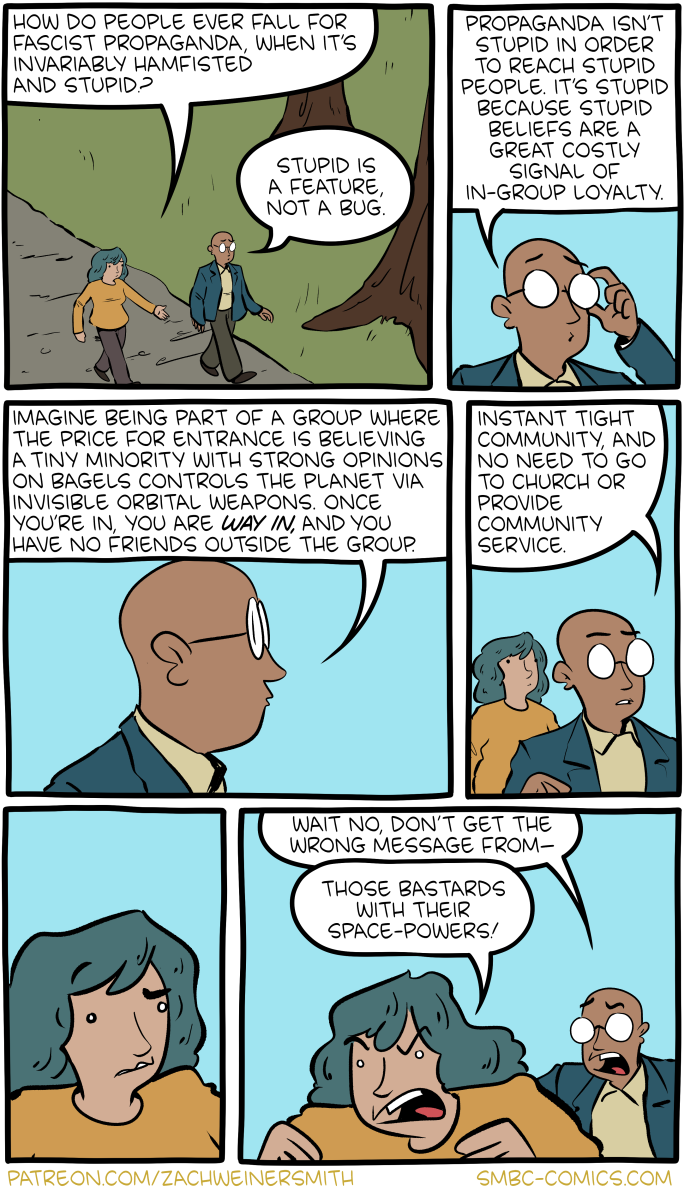
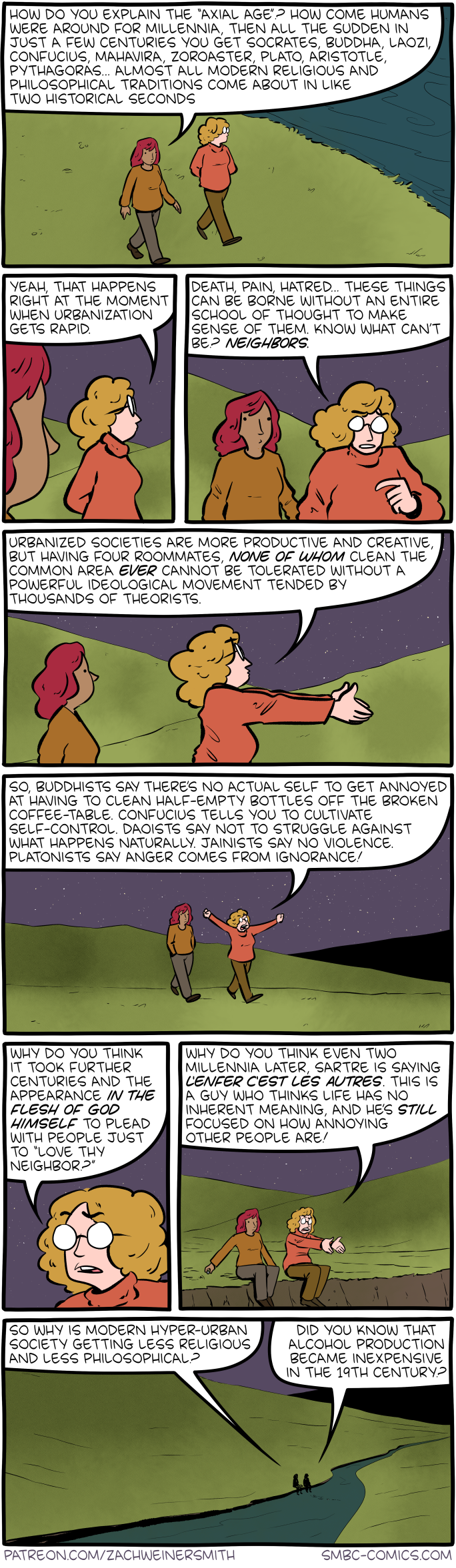
Saturday Morning Breakfast Cereal - Axial

by Zach Weinersmith


Click here to go see the bonus panel!

Hovertext:
Have you noticed how effective San Francisco is at producing ways to drop out of reality through technology?


Today's News:
27 Jan 23:40

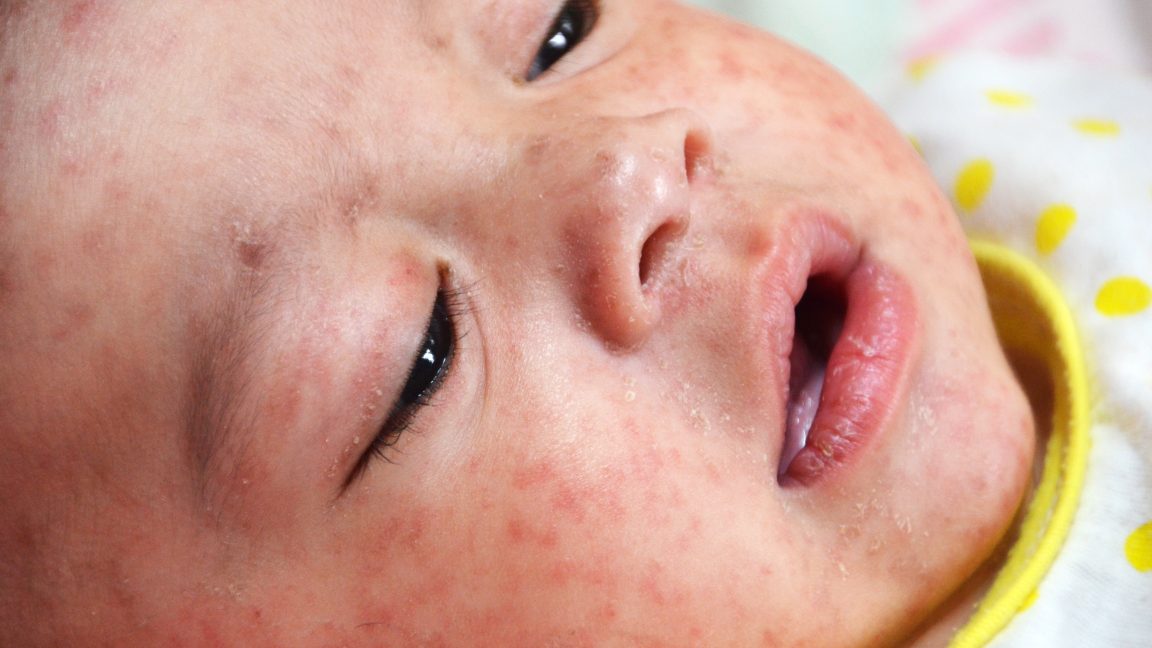
Dead babies, critically ill kids: Pediatricians make moving plea for vaccines

by Beth Mole

As federal lawmakers prepare to decide whether anti-vaccine advocate Robert F. Kennedy Jr. should be the next secretary of the Department of Health and Human Services, pediatricians from around the country are making emotional pleas to protect and support lifesaving immunizations.

The American Academy of Pediatrics (AAP) has assembled nearly 200 stories and dozens of testimonials on the horrors of vaccine-preventable deaths and illnesses that pediatricians have encountered over their careers. The testimonials have been shared with two Senate committees that will hold hearings later this week: the Senate Committee on Finance and the Senate Committee on Health, Education, Labor, and Pensions (HELP).

“I remember that baby’s face to this day”

In a statement on Monday, AAP President Susan Kressly noted that the stories come from a wide range of pediatricians—from rural to urban and from small practices to large institutions. Some have recalled stories of patients who became ill with devastating diseases before vaccines were available to prevent them, while others shared more recent experiences as vaccine misinformation spread and vaccination rates slipped.

Read full article

Comments

27 Jan 21:49

FCC chair helps ISPs and landlords make deals that renters can’t escape

by Jon Brodkin
James.galbraith

just the GOP actively making life worse to support their corporate overlords

Federal Communications Commission Chairman Brendan Carr has dropped the previous administration's proposal to ban bulk billing deals that require tenants to pay for a specific provider's Internet service.

In March 2024, then-Chairwoman Jessica Rosenworcel proposed a ban on arrangements in which "tenants are required to pay for broadband, cable, and satellite service provided by a specific communications provider, even if they do not wish to take the service or would prefer to use another provider."

Rosenworcel's Notice of Proposed Rulemaking was opposed by Internet providers and sat on the FCC's list of items on circulation throughout 2024 without any final vote, despite the commission having a 3–2 Democratic majority at the time. Carr, who was elevated to the chairmanship by President Trump, emptied the list of items under consideration by commissioners on Friday.

Read full article

Comments

27 Jan 20:17

How Trump bullied Colombia into accepting immigrant deportation flights

by Alex Samuels
James.galbraith

Christ what a mess. Someone's going to need to actually say No to trump and mean it for more than 10 seconds

President Donald Trump announced Sunday that he will, at least for now, hold off on his egregious threat to impose tariffs on Colombia after the nation agreed to accept deported migrants, who were being returned to the country by U.S. military planes.

Notably, this move represented a turn from Trump’s plan just hours prior. Earlier on Sunday, he vowed to impose steep tariffs and visa restrictions on Colombia after it turned away two deportation flights. 

At one point, it looked like we were headed toward a trade war. That was narrowly averted, though, after Colombian President Gustavo Petro agreed to accept the deportees. Trump, of course, claimed victory and said that the South American nation had caved to his authoritarian demands. 

The clash reflects how the Trump administration is ready to make examples of foreign countries that attempt to impede on his plans, specifically those that will likely target immigrants seeking asylum or shelter in the United States. 

So how did we get here—and is a trade war looming?

Trump hasn’t been shy about his intent to deport millions of undocumented immigrants, announcing a flurry of executive actions targeting immigrants on Day One of his second term.

But foreign nations aren’t necessarily on board with Trump’s hardline plans. On Sunday, Petro refused to let two U.S. military aircrafts, which were carrying deported Colombian immigrants, land on Colombian soil, as he demanded the deportees to be treated humanely instead of as political props.

Colombian President Gustavo Petro

“A migrant is not a criminal and should be treated with the dignity a human being deserves,” Petro posted on social media. “We will receive our nationals in civilian airplanes, without treating them as criminals. Colombia must be respected.”

In a separate post, Petro shared a video of immigrants, who were reportedly sent back to Brazil, walking on an airplane tarmac with restraints around their hands and feet.

It’s important to note that Petro didn’t refuse to take back the Colombian immigrants. According to data from Witness at the Border, an advocacy group that tracks flight data, Colombia accepted 475 deportation flights between 2020 and 2024, making it the fifth country to accept the most deportation flights behind Guatemala, Honduras, Mexico, and El Salvador. 

Petro’s issue with accepting deportation flights this go-around was how these immigrants were brought back. Petro wanted them to be returned via presidential plane or nonmilitary flight, arguing that it would be more dignified than how Trump and his cronies preferred to operate.

But since Trump’s past statements suggest he cares little—if at all—about the treatment of non-U.S. citizens, the request to treat immigrants with an ounce of decency was one that he couldn’t accept. Following Petro’s social media posts, Trump instigated a trade war by threatening Colombia with tariffs and sanctions. 

“These measures are just the beginning,” Trump wrote on Truth Social. “We will not allow the Colombian Government to violate its legal obligations with regard to the acceptance and return of the Criminals they forced into the United States!”

During a back-and-forth between U.S. and Colombian officials, Trump upped his threats and ordered a 25% tariff on all Colombian goods entering the United States. After one week, he said, tariffs would then be raised to 50%. 

Trump also said that he would impose “visa sanctions” and a “travel ban and immediate visa revocations” on Colombian government officials and their allies while enforcing even stricter border inspections of all Colombian nationals and cargo.

In response, Petro posted a series of defiant messages, in which he promised a retaliatory 25% tariff on all U.S. goods. 

“Your blockade does not scare me, because Colombia, besides being the country of beauty, is the heart of the world,” he wrote.

The two sides have reached—at least for now—what reads like a shaky agreement

Late Sunday, Colombian Foreign Minister Luis Gilberto Murillo said the two nations have “overcome the impasse.” As a result, Colombia would accept its citizens who are deported from the United States via military planes. But in the future, Murillo noted that Colombia’s presidential aircraft would be available to facilitate the return of immigrants.

Of course, the Trump administration put its own spin on the news. In a statement on Sunday, the White House said that, since Petro had agreed to all of Trump’s terms, the tariffs and sanctions Trump once threatened would be “held in reserve.” The visa sanctions, however, would remain in effect until the first planeload of deportees arrive in Colombia.

“Today’s events make clear to the world that America is respected again. President Trump will continue to fiercely protect our nation’s sovereignty, and he expects all other nations of the world to fully cooperate in accepting the deportation of their citizens illegally present in the United States,” White House Press Secretary Karoline Leavitt said.

It should be noted that a trade war would have had huge implications. According to the Associated Press, Colombia is the fourth-largest overseas supplier of crude oil to the United States. Imposing tariffs would also make items such as fresh-cut flowers and coffee more expensive for U.S. consumers. After all, Colombia accounts for 20% of coffee shipped to the United States, according to the U.S. Department of Agriculture

And Colombia would have also suffered, as the United States is the nation’s largest trading partner

But now we know what happens when countries refuse to bow to Trump’s threats: Not only will he throw a very public tantrum, but he’ll impulsively threaten a very expensive trade war until he gets his way. 

Just look at Canada and Mexico. We knew that Trump was impetuous and petty and held grudges against anyone who dares to cross him, but this latest episode shows just how unhinged Trump will be during his second term.

Campaign Action

27 Jan 19:55

Trump’s reported plans to save TikTok may violate SCOTUS-backed law

by Ashley Belanger
James.galbraith

It's terrible precedent to just pretend Trump can ignore the law...

It was apparently a busy weekend for key players involved in Donald Trump's efforts to make a deal to save TikTok.

Perhaps the most appealing option for ByteDance could be if Trump blessed a merger between TikTok and Perplexity AI—a San Francisco-based AI search company worth about $9 billion that appears to view a TikTok video content acquisition as a path to compete with major players like Google and OpenAI.

On Sunday, Perplexity AI submitted a revised merger proposal to TikTok-owner ByteDance, reviewed by CNBC, which sources told AP News included feedback from the Trump administration.

Read full article

Comments

27 Jan 07:30

Cartoon: 2025 corporate media style guide

by BrianMcFadden
27 Jan 04:40

Heat Pumps Are Now Outselling Gas Furnaces In America

by EditorDavid
CleanTechnicareports that last year Americans "bought 37% more air source heat pumps than the next most popular heating appliance — gas furnaces." And Americans bought 21% more heat pumps than they did in 2023. Canary Media is quick to point out that in many homes, more than one heat pump is required, so that data should be interpreted with that in mind. Typically, a home uses only one furnace. Nevertheless, the trend for heat pumps is up. Russell Unger, the head of decarbonizing buildings at RMI, said, "There's just been this long term, consistent trend." It's easy to understand why heat pumps are gaining in popularity. In addition to providing heated air in the winter and cool air in the summer, they are far more efficient than conventional heat sources — delivering three to four times more heat per dollar spent than oil- or gas-fired heating equipment or old fashioned electric baseboard heat. They also create far less carbon pollution. How much less depends on the source of electricity in the local area, Thanks to long-time Slashdot reader AmiMoJo for sharing the news.

Read more of this story at Slashdot.

24 Jan 19:17

Walgreens Replaced Fridge Doors With Smart Screens. It's Now a $200 Million Fiasco

by msmash
James.galbraith

lol no shit

Walgreens Boots Alliance has ended a $200 million digital display venture with startup Cooler Screens after widespread technical failures and poor revenue, removing thousands of smart screens from its store freezer doors [non-paywalled link]. The screens, which displayed product information and ads, frequently crashed, showed incorrect inventory, and occasionally caught fire, Bloomberg reports. Cooler Screens CEO Arsen Avakian cut data feeds to over 100 Chicago-area stores in December 2023 during a contract dispute, prompting Walgreens to obtain a restraining order. Walgreens completed removal of 10,300 screens from 700 stores in August 2024, replacing them with traditional glass doors. The screens generated just $215 per door annually, less than half the contractual minimum, according to Walgreens. Nearly $50 million worth of custom-made screens now sit unused in a Texas warehouse.

Read more of this story at Slashdot.

24 Jan 17:48

Cartoon: Inaugurate this

by Clay Jones
24 Jan 17:45

Elon Musk doesn’t deserve the benefit of the doubt

by Zack Beauchamp
James.galbraith

Just straight up nazi

Elon Musk stands behind a podium wearing a black suit jacket and raising his arm outward in a salute.
The salute.

Since Donald Trump’s rise to power, some liberals have developed a bad habit of seeing secret Nazi imagery everywhere on the right.

Be it Laura Ingraham allegedly sieg-heiling at the 2016 Republican National Convention, a Justice Brett Kavanaugh clerk being called a covert white supremacist in 2018 because of her resting hand position, or concerns that the furniture at a 2021 conservative conference was arranged in the shape of a Nazi division’s emblem, these charges almost always end up looking kind of absurd.

So when I say that Elon Musk gave a Nazi salute at Trump’s inauguration on Monday, I am doing so only because I can see no other plausible interpretation of his gesture.

I watched the footage from as many angles as I could find. He stuck his arm straight out, palm down, and pointed it toward the crowd in a gesture of tribute. He put his hand on his heart first, a variant of the Adolf Hitler salute popularized in American History X — a critical film about neo-Nazism that some on the far-right have reclaimed as a celebration. And he did it twice.

If that’s what you saw — well, I’m with you. And it’s what neo-Nazis themselves saw; Nick Fuentes, the Hitler admirer who dined with Trump in 2022, described Musk’s gesture as “a straight-up sieg heil, like loving Hitler energy.”

But maybe you saw things differently. 

Maybe, like the Washington Post’s Megan McArdle, you are inclined to give Musk the benefit of the doubt — suggesting that he was merely trying to mime his heart going out to the crowd. Maybe you’re skeptical of viral video clips on principle, a reasonable attitude given how easy they are to edit deceptively. Maybe you think we ultimately can’t know what’s in someone’s heart, and it’s not worth trying to guess — especially given Musk’s dismissal of the charges.

But whatever you believe was in Musk’s heart on Monday, you can see why many of us would be leery of giving him the benefit of the doubt.

Musk has a long and extensive track record of extreme-right politics, flirtations with antisemitism, and juvenile trolling. This assessment does not hinge entirely on one gesture but on the totality of his public behavior. Just a few years ago, someone this radical wouldn’t be anywhere near a presidential inauguration.

Musk’s presence there, and his ability to avoid even a hint of contrition for doing something that emboldens America’s neo-Nazis, is a sign of a deeper rot. 

Since Trump has risen to power, Americans’ shared notion of public morals — the idea that there are certain standards for conduct that shouldn’t be transgressed — have been blown to bits. Some of those standards, like strong prohibitions on doing anything that even resembles an endorsement of Nazism, are some of our most important bulwarks against a return to the worst political moments in modern humanity’s long collective history. 

And that, more than anything else, is why what Musk did — both from that stage and long before — matters. Even if leaders and elites have abandoned any pretensions to a moral code, we as citizens still need to insist on it. Instead, even institutions created to banish bigotry and contain cruelty are bending the knee.

We don’t need a Hitler salute to know who Elon Musk is

It’s true that Elon Musk has done some things, like visiting Auschwitz, that one wouldn’t expect from someone who would heil Hitler in public. But when you look at his public record in totality, the pattern is unmistakable — and disturbing.

After purchasing Twitter in 2022, Musk personally intervened to restore Fuentes and others like him, who had been banned by the platform’s previous owners. Two 2023 data analyses found that the amount of antisemitic content on Twitter, now X, doubled after Musk’s purchase. A 2024 NBC investigation reported that Musk’s choices allowed antisemitism and neo-Nazism to “flourish” on the platform, identifying hundreds of neo-Nazi accounts gaining in influence under Musk’s new policies.

While his initial justification was that these views are easier to combat when debated publicly, it quickly became clear that he actually agreed with some of what they had to say.

The most infamous example came when Musk replied approvingly to a nakedly antisemitic tweet. The original poster accused Jews of pushing “dialectical hatred against whites,” adding that he was “deeply disinterested in giving the tiniest shit now about western Jewish populations coming to the disturbing realization that those hordes of minorities that support flooding their country don’t exactly like them too much.”

Musk told this person that “you have said the actual truth.” He then went on to attack the Anti-Defamation League (ADL), a Jewish anti-hate group, for “unjustly attack[ing] the majority of the West.” He ultimately apologized and visited Auschwitz to demonstrate that he had learned.

Yet there are plenty of other examples afterward of Musk interacting with or promoting antisemitic or neo-Nazi content. 

He, for example, amplified a post accusing Jews of supporting censorship. He praised two separate Tucker Carlson interviews with troubling content — one featuring a Hitler apologist and the other airing conspiracy theories about Israeli control over US foreign policy. And he once accused the billionaire Holocaust survivor George Soros of “hating humanity,” comparing Soros to Magneto — the Jewish X-Men villain whose hatred of humanity arose from his experience in a death camp. 

In the past few weeks, Musk has used his platform on X to repeatedly and loudly advance Germany’s far-right Alternative für Deutschland (AfD) party. The AfD is extreme even by the standards of the European far-right: Some of its members tried to storm the German parliament in 2020, January 6-style, while a former AfD member of parliament was arrested in 2022 for plotting an actual coup. The party is virulently opposed to immigration; its leader Alice Weidel recently called for “remigration” — a mass deportation campaign that could potentially target even legal residents of minority backgrounds. Another leading party figure, Björn Höcke, has called for an end to German guilt over Nazism and used a Nazi slogan in one of his speeches.

The International Auschwitz Committee, a German anti-hate group founded by Holocaust survivors, has repeatedly warned about the party’s dangers.

“With every year of its existence, the AfD has become increasingly cynical and extreme. As a result, it has contributed to a huge level of radicalisation in language and in the extreme far right as a whole in Germany,” Christoph Heubner, the committee’s executive vice president, said in a 2023 press release. “MPs and representatives of the AfD repeatedly trigger disconcerting memories in the survivors of the German concentration and extermination camps with their speeches and public performances.”

So do the many examples of Musk supporting neo-Nazis and promoting their ideas make him a dyed-in-the-wool Nazi, one who simply revealed his true colors at Trump’s inauguration? We can’t tell what’s in his heart, of course, but I think there’s a likely explanation.

We know that Elon Musk has genuinely far-right politics and that he marinades in an online information environment rife with conspiracy theories. We also know that he delights in trolling.

He is willing to pursue these interests even in ways that damage his business. Think about X’s plummeting ad revenues after Musk platformed extremists. Or how he triggered an SEC lawsuit after vowing to take Tesla private at $420 a share (weed jokes, they’re hilarious). Or how, in the midst of a fight with Twitter’s corporate landlord, he repainted the sign to read “Titter” (boob jokes, they’re hilarious).

Elon Musk is many things: a brilliant entrepreneur, the world’s richest man, and a genuinely dangerous political extremist. But he also has a juvenile sense of humor and an adolescent love of transgressing against liberal America’s taboos. He is human South Park.

Such a person could sincerely hold Nazi beliefs. But he could just as easily find joy in making an obvious Nazi gesture on a national stage and then denying it, knowing full well that there would be no serious cost to his actions. 

A Thursday morning tweet containing a series of Nazi puns relating to the salute controversy — “Don’t say Hess to Nazi accusations,” “Some people will Goebbels anything down” — makes this all too easy to imagine.

Musk, manners, and the execrable “vibe shift”

It used to be that something like what Musk pulled — a gesture that perfectly mimicked a Nazi salute, intentionally or not — would necessitate some kind of apology. Something along the lines of “Of course I didn’t mean to heil Hitler, and I’m sorry for the hurt this caused to the victims of Nazism and their descendants.”

That’s not what Musk has done. Since Monday, he has gone on the offensive — calling the media propagandists and trying to shift to a debate over liberals’ position on Israel. There’s no contrition, no sense of embarrassment: just utter and complete shamelessness.

This is, of course, one of the defining traits of the Trump era of politics. But what’s striking is that, since Trump’s reelection, the institutions that are supposed to push back on this have kissed the ring.

Take the ADL, which had previously done so much to expose the rise of extremism after Musk’s purchase of Twitter and called him out for flirtations with white supremacy. It got so heated that Musk blamed the ADL directly for X’s loss in revenue and repeatedly threatened to sue them.

The ADL has retained a very low tolerance for public displays of antisemitism since then. After the October 7, 2023, attacks on Israel, it has been quite clearly overzealous in that regard, pursuing pro-Palestinian college students for behavior far less troubling (like handing out anti-Zionist flyers) than what Musk just did.

Yet after the inauguration, the group issued a statement basically giving Musk a hall pass for performing “an awkward gesture.” It did so, in large part, because we are in the midst of “a new beginning” for American politics in which “all sides should give one another a bit of grace.”

Even though the ADL found some spine on Thursday and criticized Musk for the Nazi jokes, the initial statement was capitulation of a particularly notable kind. It was a response to the much-heralded “vibe shift,” a sense that culture has shifted in Trump’s direction after his victory and that the rest of society needs to accommodate his faction. That it’s now realized it went too far, and is going after him for the much lesser offense of making Nazi leaders’ names into puns, does not diminish the severity of its original mistake.

You can see this mindset at work in another exchange about Musk. When Congress member Alexandria Ocasio-Cortez accused Musk of doing a “Nazi salute,” leading right-wing activist Chris Rufo responded by saying that the time for such allegations is over.

“They still think if they shout ‘racist’ and ‘Nazi’ loud enough, the entire society will bend to their narcissism and manipulation. No. It’s not 2020 anymore,” he said

Both the ADL and Rufo, in very different ways, are showing why we shouldn’t give Musk’s boorish behavior a pass.

The truth is that Musk has a public record of sympathy for odious views, and has shown zero contrition about making a gesture that looked exactly like a Nazi salute. Criticizing him for it is not uncivil or impolite; it is a way to assert that there are real moral standards, certain lines that shouldn’t be crossed by people in positions of power. 

The Trump era “vibe shift” isn’t merely a move to the right. It’s a move away from accountability and toward a culture where people get away with meanness, cruelty, and gratuitous insults against the vulnerable. As an anonymous banker put it: “We can say ‘retard’ and ‘pussy’ without the fear of getting cancelled … it’s a new dawn.”

At moments like these, collectively insisting on standards is all the more important. One of those standards is that you should not be able to get away with performing a Nazi gesture, intentionally or not, without apologizing like you mean it. Another is that someone with Musk’s record of promoting far-right ideas and approvingly conversing with neo-Nazis should never have been on the inaugural stage to begin with. This is one of the bulwarks we have, as a society, to prevent honest-to-goodness Nazism from reentering the zone of political acceptability. 

Yet Musk and Trump have made blurring those moral lines part of their life’s work. I fear we are all about to suffer the consequences — to live in a world where it becomes even more acceptable to openly perform nastiness and extremism. We may enter the world prophesied by philosopher Richard Rorty in 1998, where a far-right backlash brings “all the sadism” we once considered “unacceptable” in public life “flooding back.”

If that indeed comes to pass, the future of American politics is one in which Musk’s ugly display on Monday ends up looking like a dance recital.

24 Jan 00:49

You’ll never guess which notorious files Trump forgot to declassify

by Walter Einenkel
James.galbraith

No shit. Because his grubby paws are all over those records

Donald Trump ordered the declassification of files pertaining to the assassinations of John F. Kennedy, Martin Luther King Jr., and Robert F. Kennedy.

“A lot of people are waiting for this for a long, for years, for decades,” Trump said as he signed the executive order Thursday.

But, of course, Trump seems to have forgotten to declassify the files on Jeffrey Epstein, the serial sexual abuser of minors who hobknobbed with many wealthy and important folks during the 1990s and early 2000s. 

In 2019, Epstein died by suicide in his jail cell in Manhattan, where he was being detained on federal sex trafficking charges. Then-president Trump helped spread conspiracy theories questioning the nature of Epstein’s death.

During his 2024 election campaign, Trump appeared in a Fox News interview that sure made it seem like Trump was all in on releasing the Epstein files and getting to the bottom of things.

But when you view the full interview, you can see that Trump is uncomfortable with the proposition of releasing the Epstein files. 

Maybe most problematic for Trump is his very public relationship with Epstein, which spanned the better part of two decades. That friendship soured in 2004 after a squabble over Florida real estate, according to the Washington Post.

At least some QAnon conspiracists will be excited to see this move, since so many of them have fetishized and atomized conspiracy theories around the Kennedys. But it remains to be seen if Trump will do anything about the files on his former pal Epstein.

Daily Kos is now on Bluesky—and we want to make it easy for you to join us! Click here for the Daily Kos Bluesky Starter Pack.

24 Jan 00:02

Kook who said there are too many gays on TV will lead government agency

by Oliver Willis
James.galbraith

In any sane world this would be a scandal

Donald Trump has selected right-wing activist L. Brent Bozell III to lead the U.S. Agency for Global Media. The agency is independent of the federal government and oversees the Voice of America broadcast network as well as other taxpayer-funded news and information services targeting Asia, the Middle East, and Europe.

Bozell will require Senate approval to become CEO of USAGM.

Trump’s latest pick is best known for creating the extremist Media Research Center, which has claimed for decades that mainstream media is liberal and does not provide enough of a platform for conservative views. MRC has stood by this claim even as mainstream media organizations furthered lies about Iraqi weapons of mass destruction, advanced falsehoods about former Secretary of State Hillary Clinton’s emails, and are currently buckling to Trump.

Along with his crusade against the “liberal media,” Bozell and his organization have also repeatedly complained that movies and television shows sometimes acknowledge the existence of LGBTQ+ people and occasionally regard them as perfectly acceptable members of society.

In a 2013 column, Bozell lamented that gay characters on movies and TV shows “never face any real opposition to the gay agenda on these so-called 'inclusive' programs.” He also railed against a project by the advocacy group GLAAD which tracked the number of LGBTQ+ people depicted in entertainment.

He referred to GLAAD as “trend-enforcers” who “want children indoctrinated.”

A few years before that, Bozell wrote that he was upset that actors and media outlets expressed sympathy for gay teens who face bullying, describing them as “evangelists for a revolution of sexual immorality.”

Bozell’s Media Research Center also complained that Yahoo! deleted anti-gay hate comments, that the media didn’t depict enough “ex-gays,” and was incensed at CNN for purportedly supporting “homosexual causes.”

MRC even boycotted the notoriously right-wing CPAC conference because a group that supported gay equality was allowed to attend.

At one point, Bozell even demanded a congressional investigation of an art exhibit at the Smithsonian Institution in Washington because it depicted “images of an ant-covered Jesus, male genitals, naked brothers kissing, men in chains, Ellen DeGeneres grabbing her breasts.” The exhibit was pulled after Bozell and other conservatives complained.

On foreign policy matters, Bozell was among the contingent of conservatives who insisted that weapons of mass destruction had been found in Iraq. Bozell made the claim in 2006, long after it had been discovered that no such weapons existed. He is also a reliable presence spouting right-wing talking points on Fox News programs.

Trump’s decision to tap Bozell for the post echoes his choice of conspiracy theorist Kari Lake to head Voice of America. These selections make it clear that Trump intends to infuse the government’s media infrastructure with extremist right-wing values and talking points.

But it seems that extremism runs in the family. Bozell’s son L. Brent Bozell IV, was sentenced to 45 months in prison for assaulting law enforcement, destroying government property, and other charges stemming from the Jan. 6, 2021, Capitol riot instigated by Trump.

Bozell’s son was among the 1,500 people who were pardoned by Trump on Tuesday for their participation in the insurrection.

Campaign Action

23 Jan 18:30

Trump’s FCC chair gets to work on punishing TV news stations accused of bias

by Jon Brodkin
James.galbraith

fascism at work

Federal Communications Commission Chairman Brendan Carr has revived three complaints against broadcast stations accused of bias against President Donald Trump.

Outgoing Chairwoman Jessica Rosenworcel last week directed the FCC to dismiss the complaints against CBS, ABC, and NBC stations, along with a fourth complaint about Fox, in what she called a stand for the First Amendment. Rosenworcel said the "threat to the First Amendment has taken on new forms, as the incoming President has called on the Federal Communications Commission to revoke licenses for broadcast television stations because he disagrees with their content and coverage."

But in three orders issued yesterday, the FCC Enforcement Bureau reversed the CBS, ABC, and NBC decisions. "We find that the previous order was issued prematurely based on an insufficient investigatory record for the station-specific conduct at issue," each new order said. "We therefore conclude that this complaint requires further consideration."

Read full article

Comments

23 Jan 18:07

Meet the new neighbors: 7.5 million chickens and their mountains of manure

by Kenny Torrella
James.galbraith

If you keep voting for republicans, this is what you get. Not sorry.

MALCOM, IOWA — When Carolyn Bittner moved to Malcom, Iowa, in 2008 to serve as a pastor at two churches, she had no idea the town was also home to millions of egg-laying chickens. Three miles from her home, those chickens — which now total around 7.5 million — are raised in massive warehouses on a sprawling complex run by Fremont Farms, which from the outside looks more like a maximum security prison than an egg farm.

“Fremont is an egg factory,” Bittner told me when I visited her late last year. “It’s not a farm.” The US Environmental Protection Agency categorizes egg farms with 82,000 or more hens as “large”; Fremont has over 90 times as many birds, all packed into about 100 acres. 

Despite living three miles from the egg operation, Bittner is regularly reminded of its presence: “When they move manure, the stench is sickening. They will be moving manure now for the next few days, and it will be bad.” An egg farm that houses 7.5 million hens generates hundreds of millions of pounds of manure each year. 

The stench affects her in seemingly mundane ways that accumulate to degrade her overall quality of life. She can’t hang her clothes out to dry for fear the wind will shift and make them smell terrible. She often can’t open the windows, lest the smell invades her home. And the staggering amount of manure attracts tons of flies to the town, which spread their own manure around.

“I had a new garage built while I was here, and it looked new for three days, and then there were so many fly specks [excrement] on the white edging and around the windows that it looked like it had been here for a decade,” she said.

An illustrated aerial view of a mega farm next to a much smaller farm house, surrounded by dry grass

The same week I visited Bittner, I also visited other factory farm towns in the region and quickly grew sick of the odor; I couldn’t imagine what it would be like to live with it every day. 

Bittner told me that years ago, during a permit hearing at the local county board of supervisors meeting, the Fremont Farms CEO at the time asserted that the operation doesn’t smell and that no one ever complains. “From that day on, I have complained every time it smells,” she said. “This morning, before you came, I was on the phone.” Both the former and current CEOs have met with Bittner at her home, and while the meetings were cordial, she told me, neither seemed particularly sympathetic to the problems their company had wrought.

Bittner also worries about what’s in the air she breathes. Hog and poultry barns are equipped with giant exhaust fans that push pollutants, such as ammonia, hydrogen sulfide, volatile organic compounds, and particulate matter, out into the atmosphere.

Air pollution from animal farms is linked to almost eight times more premature deaths than coal-fired power plants, a 2021 study from Johns Hopkins University found. Other research has found that living near a factory farm is positively associated with risk of non-Hodgkin lymphoma and leukemia, and people who live near them report higher rates of headaches, depression, anger, and respiratory symptoms, such as asthma

“Owned by a group of family farms with a long legacy in egg production, our team makes environmentally conscious decisions each day to protect the land, air and water around our farm,” reads part of a statement provided to Vox by Fremont Farms, which declined an interview request for this story. “We are committed to responsible farming and we will continue to support the Malcom community as we have for decades.”

What it’s like to live near a factory farm

Future Perfect fellow Sam Delgado traveled with Kenny Torella to report and film this story. She explains what it was like to see — and smell — America’s factory farm capital.

<blockquote class="tiktok-embed" cite="https://www.tiktok.com/@vox/video/7463189172774276382" data-video-id="7463189172774276382" data-embed-from="embed_page" style="max-width:605px; @vox

What it’s like to live near a factory farm. #factoryfarm #factoryfarming #agriculture #farmlife #farmtok #farming #farmer

♬ original sound – Vox –

Over the last 65 years, the US has nearly tripled annual meat production, and the number of animals raised for food each year surpassed 10 billion in 2022. At the same time, the number of farms has plummeted, as small- and mid-sized operations have given way to large factory farms — and increasingly, “mega” factory farms, like Fremont Farms — that now produce the vast majority of America’s meat, milk, and eggs.

These massive facilities can far exceed the threshold for what the EPA considers a large animal farm by orders of magnitude. Their enormous scale enables them to produce more food on less land with a smaller carbon footprint on a per-pound basis, and at a lower price point, compared to traditional farms. But they also push environmental and public health boundaries with little to no repercussions. 

The mega factory farm is the inevitable consequence of decades of federal and state agricultural policy that has incentivized growth at all costs, with few guardrails in place to protect the people who live near them, like Carolyn Bittner, many of whom feel their health and quality of life has been sacrificed for corporate profit and cheap meat, milk, and eggs. 

With unceasing domestic and international demand for animal products, there’s no limit to how big the country’s factory farms will get — and how much damage they’ll do.

How a mega factory farm could end up in your backyard

How so many animals, and the voluminous manure and noxious fumes they produce, can exist so close to people’s homes is the result of a complex web of federal, state, county, and local regulations — or lack thereof. 

In Iowa, for example, the nation’s top egg- and pork-producing state, agricultural operations are exempt from county zoning ordinances, and there are no limits on how many animals can be crammed inside a factory farm. Large farms can set up shop half a mile from homes, businesses, churches, and schools. 

Iowa’s agricultural zoning and permitting laws are written by the state legislature and carried out by the state’s Department of Natural Resources, each of which have close ties to Iowa’s powerful agribusiness lobby — as does Iowa’s governor and secretary of agriculture. Some environmentalists call Iowa a “sacrifice state,” where the health and well-being of its residents has been sacrificed to enrich large meat, milk, egg, and grain corporations.

This is the fourth in a series of stories on how factory farming has shaped, and continues to impact, the US. Find the rest of the series and future installments here, and visit Vox’s Future Perfect section for more coverage of Big Ag. The stories in this series are supported by Animal Charity Evaluators, which received a grant from Builders Initiative.

While Iowa produces more animal waste than any other state, many aren’t far behind, and every major agricultural state has similar policy regimes, political dynamics, and air and water quality issues.

If there were regulations in place to prevent factory farms from polluting so much, their staggering animal populations and close proximity to people might be less of a concern, but there aren’t. 

The deregulation starts at the top, with the US Environmental Protection Agency, which enforces the Clean Air Act. But the agency has long said it doesn’t know how to measure pollutants on animal farms, so its authority there has barely been put to use.

In 2005, the EPA said it would study the issue and finalize pollution measurement models in 2009, which it could then use to issue Clean Air Act permits in 2010 and get factory farm air pollution under control. Over 15 years later, it still hasn’t delivered.

The agency declined an interview request for this story and didn’t answer several detailed questions. Over email, a spokesperson said that in November 2024, the agency posted draft air emission models for dairy, swine, and poultry operations. On its website, the EPA says it will finalize its emissions models by spring of this year. The agency didn’t provide insight as to when it will begin issuing Clean Air Act permits to animal farms.

Factory farms are exempt from other federal air pollution laws, due to actions taken by the EPA and Congress.

The factory farm industry also benefits from sweeping exemptions under the Clean Water Act, which has helped make agriculture the leading source of US water pollution. Much of the near 1 trillion pounds of manure produced each year by animal farms is applied to cropland as fertilizer, and when it rains, the manure — along with chemical fertilizers and pesticides — can leach into groundwater and contaminate the wells that people depend on for drinking water. It also runs off into rivers and streams, some of which water utilities source their water from, causing them to spend significant taxpayer resources to filter out pollutants.

“More recently, there’s been concerns over longer-term health impacts that can develop through long-term exposure to nitrate [from manure and chemical fertilizers] in drinking water,” David Cwiertny, a professor of civil and environmental engineering at the University of Iowa, told me, pointing to studies on the potential links in association between nitrates in drinking water and bladder cancer, thyroid disorders, colorectal cancer, and birth defects.

An illustration of a woman distressed and holding her head in her hands in front of a window covered in flies

Those potential health effects worry Jennifer McNealy in Decatur County, Indiana, who lives 1.5 miles from Hulsbosch Dairy Farm, which has 8,000 cows — around 11.5 times the threshold for what the EPA considers a large dairy. Her tap water comes from wells, and while she hasn’t tested it for nitrate levels, she doesn’t drink it out of an abundance of caution.

“I do not feel comfortable drinking my well water,” McNealy told me. She has reason to worry; a 2022 report by the nonprofit Environmental Integrity Project found that Indiana leads the country in polluted waterways, with agriculture as the top cause. 

In recent years, the EPA appears to have modestly increased its oversight of agricultural water pollution; in a few states it’s either sued individual factory farms or directed state officials to take action. But the agency has much more work ahead if it’s to see meaningful progress. 

While McNealy said the stench of manure from 8,000 cows is bad enough, there are also three hog farms with around 4,400 pigs apiece within a 2.5-mile radius of her home. The EPA considers a hog farm to be large if it houses 2,500 pigs. 

About three years ago, McNealy was diagnosed with asthma. “I can’t say that any one or the combination of these facilities has caused it; I can say that it aggravates it,” she told me.

Like Carolyn Bittner in Iowa, the smell of the factory farms near McNealy’s home erodes her quality of life. She takes the long way to work to avoid driving by the dairy and hog operations, and some days when she gets home, the stench is so bad she has to cover her mouth and nose with the top of her shirt or a scarf and run to the door. She bought a grill but ended up giving it away because she couldn’t host outdoor cookouts due to the unpredictability of the odors. 

Hulsbosch Dairy Farm didn’t respond to a request for comment.

McNealy’s’s situation illustrates another problem of factory farm expansionism over the last few decades: Rural communities don’t only have to contend with the rise of mega factory farms, but also with increasing factory farm density, with numerous large farms concentrated in one area that ultimately has the same impact of living near one massive facility. 

Agricultural permitting regimes “don’t adequately look at the cumulative impacts of all of the surrounding operations, so there’s a huge gap there,” said Holly Bainbridge, a staff attorney with FarmSTAND, a legal advocacy organization that works to reduce the harms of industrialized agriculture. 

Other people I spoke with in Ohio, Minnesota, and Iowa complained of similar factory farm density in their community. 

“The smell just made you want to throw up,” Kim Gearhart, who formerly lived within a three-mile radius of around nine cattle operations — each of which he estimates had a little under 1,000 steer each at the time — in Edon, Ohio, told me.

Three steer lay in mud and manure while a few dozen cattle behind them are standing.

The operations are run by the Schmuckers, an Amish family with a beef empire of nearly 100,000 cattle concentrated around the Indiana, Michigan, and Ohio tri-state border. They raise the cattle for JBS, the world’s largest meat company, and the region — 85 miles west of the manure-imperiled Lake Erie — has been plagued with farm pollution as the family has expanded its empire.

About 10 years ago, Gearhart and his wife moved several miles away to another part of Edon. “We moved over here, and I just thought… It’s out of sight, out of mind.” But about a year ago, the Schmucker family started a new cattle operation a quarter-mile from his new home, and they’re building two more, he said. “I have to keep the windows closed year-round. It’s just disgusting again.” 

Schmucker Family Farms didn’t respond to a request for comment.   

The right to farm, or the right to harm?

With few policymakers or regulators looking out for them, people who live near factory farms might naturally take livestock operations to court, but even that right has been taken away. Every state has what’s called a “Right to Farm” law on the books, which protect farms from lawsuits over nuisances like odor, noise, and dust. 

Most of the laws came about in the 1970s and ’80s as city dwellers moved to the country, sometimes bringing complaints of agricultural pollution with them. Right to Farm laws have long been invoked as a means to protect small, independent farms and conserve a rural way of life, but food system reform advocates have nicknamed them “Right to Harm” laws, as they’ve been instrumental in both factory farm operators’ and large meat corporations’ efforts to beat back nuisance lawsuits. 

“Everyone has a right to use and enjoy their property” under common law, said David Muraskin, managing director for litigation at FarmSTAND. “What the Right to Farm laws have done is basically say, ‘If you move next to a farm, no, you don’t — that farm can screw you over however it wants.’” 

Almost two-thirds of states’ Right to Farm laws supersede municipal ordinances, meaning towns can’t implement their own regulations to limit factory farm pollution, such as placing a cap on the number of animals allowed per farm. 

“I don’t think it’s a good thing for states to strip communities of their capacity to self-govern,” Loka Ashwood, an associate professor of sociology at the University of Kentucky and co-author of a book on Right to Farm laws, told me. “I think it’s undemocratic.”

While there are ongoing, long-term efforts to regulate farm pollution at the federal and state levels, campaigning on the ground against proposed factory farms before they can be built seems to be one of the few approaches that’s actually worked.

As executive director of Jefferson County Farmers & Neighbors, Diane Rosenberg has been running local campaigns to oppose factory farm construction in southeast Iowa, and elsewhere in the state, for almost two decades. When a factory farm is proposed in her county, she sends out a letter to people living within a couple miles of where it’ll be built explaining the potential impact it might have on them and, if they have concerns, how to make their voice heard.

“Truthfully, [factory farms] are hard to stop, because Iowa does not give us a whole lot to work with,” Rosenberg told me. “We come up with a strategy to exert public pressure … and that can look like a lot of different things”: phone calls to the meat company or potential factory farm owner, letters to the editor, organizing public meetings, attending hearings, or placing local ads. That the county in which she primarily works — Jefferson County — has far fewer hogs than most surrounding counties is a testament to the power of community organizing, she says.

Such campaigns may ultimately result in the proposed factory farm being built elsewhere, making it somebody else’s problem — what some would criticize as a form of NIMBYism. But after spending a few days in Iowa and Minnesota touring factory farm communities and hearing — and smelling — what it’s like to have millions of chickens or thousands of pigs as neighbors, I can’t blame them for using the only tool left at their disposal.

Stopping factory farms isn’t easy, Rosenberg said, “but it’s possible — and it’s possible when people work together and they don’t give up.”

Sam Delgado contributed reporting to this story.

22 Jan 23:42

Hospitals No Longer Allowed To Fix Machine That Costs Six Figures

by BeauHD
James.galbraith

pure greed

An anonymous reader quotes a report from 404 Media: The manufacturer of a machine that costs six figures used during heart surgery has told hospitals that it will no longer allow hospitals' repair technicians to maintain or fix the devices and that all repairs must now be done by the manufacturer itself, according to a letter obtained by 404 Media. The change will require hospitals to enter into repair contracts with the manufacturer, which will ultimately drive up medical costs, a person familiar with the devices said. The company, Terumo Cardiovascular, makes a device called the Advanced Perfusion System 1 Heart Lung Machine, which is used to reroute blood during open-heart surgeries and essentially keeps a patient alive during the surgery. Last month, the company sent hospitals a letter alerting them to the "discontinuation of certification classes," meaning it "will no longer offer certification classes for the repair and/or preventative maintenance of the System 1 and its components." This means it will no longer teach hospital repair techs how to maintain and fix the devices, and will no longer certify in-house hospital repair technicians. Instead, the company "will continue to provide direct servicing for the System 1 and its components." [...] In a brochure for hospitals, Terumo advertises both its device and its maintenance program: "Advanced, precision medical equipment requires genuine parts and top-quality, specialized service -- just as getting the best medical care from qualified specialists. Terumo Cardiovascular Service has the unrivaled expertise, experience, equipment, and parts to provide the optimal level of planned service and repairs needed. Use Terumo Cardiovascular Service and avoid exposure to liability issues." A spokesperson for Terumo told 404 Media that the company "saw declining participation in this program and determined that the best way forward was to require servicing through Terumo Cardiovascular's genuine in-house Service team to continue to ensure Terumo devices are properly maintained." "Terumo Cardiovascular's Biomed Certification Program was originally structured to train non-Terumo personnel (hospital Biomeds) to service Terumo heart-lung machines and associated hardware. Properly maintained medical devices are necessary for optimal performance which is essential for quality of patient care and outcomes," they added. "Hospitals' existing Terumo Cardiovascular Biomed certifications will remain valid through their expiration dates but will not be renewed once they expire." "It's no secret that America's healthcare system is the most expensive, and this is one of the reasons why. These machines are actually highly reliable, we've had a low cost of service for it over the last few years. And when something isn't right, we have people in-house who can fix it," a source familiar with Terumo machine repair said. "But the cost of having a service contract with a manufacturer, you're probably talking 10 times the cost. It's not a big deal having a contract for one device, but when that starts happening across many devices, it adds up in the end. If you took every hospital in America and said for every medical device in the hospital, you need to put it on an OEM [original equipment manufacturer] maintenance contract, it would tank your financial system. You just can't do that."

Read more of this story at Slashdot.

22 Jan 20:57

Trump admin fires security board investigating Chinese hack of large ISPs

by Jon Brodkin
James.galbraith

Happily covering up for chinese espionage. GOP in action.

The Department of Homeland Security has terminated all members of advisory committees, including one that has been investigating a major Chinese hack of large US telecom firms.

"The Cyber Safety Review Board—a Department of Homeland Security investigatory body stood up under a Biden-era cybersecurity executive order to probe major cybersecurity incidents—has been cleared of non-government members as part of a DHS-wide push to cut costs under the Trump administration, according to three people familiar with the matter," NextGov/FCW reported yesterday.

A memo sent Monday by DHS Acting Secretary Benjamine Huffman said that in order to "eliminate[e] the misuse of resources and ensur[e] that DHS activities prioritize our national security, I am directing the termination of all current memberships on advisory committees within DHS, effective immediately. Future committee activities will be focused solely on advancing our critical mission to protect the homeland and support DHS's strategic priorities."

Read full article

Comments

22 Jan 20:56

Trump’s aides had no idea of his Jan. 6 pardon plans to ’release ’em all’

by Alex Samuels
James.galbraith

bullshit. They knew and they've still stayed afterwards. They own it.

President Donald Trump’s decision to issue pardons to the violent insurrectionists who breached the Capitol on Jan. 6, 2021, isn’t only wildly unpopular with the electorate—but the move apparently caught many of Trump’s aides and supporters by surprise.

Two officials who worked on Trump’s transition told NBC News that the decision to pardon the more than 1,500 people convicted for their role in the violence was made mere days before Monday’s inauguration. 

“He is who he is,” one person who worked on Trump’s transition team told the outlet. “Expectations are sometimes set as best as can be expected, and sometimes they change quickly.”

Throughout his presidential campaign, Trump repeatedly said that one of the first acts of his second term would be to free the people who were convicted of breaching the U.S. Capitol on Jan. 6 in his name. At one point, Trump said he’d consider issuing pardons on a “case-by-case” basis, suggesting that he might not be as lenient toward those who were found guilty of violent offenses. After all, 169 people pleaded guilty to assaulting police officers, five of whom later died.

But of course, Trump effectively left everyone convicted for their actions off the hook. On Monday, he issued roughly 1,500 pardons and commuted the sentences of 14 imprisoned insurrectionists, allowing them to go free. According to Axios, an adviser familiar with the pardon discussions said that “Trump just said: ‘Fuck it: Release ’em all.’”

While most Republicans are fine playing dumb and pretending like they didn’t truly understand the scope of Trump’s pardons, others were mystified by the president’s actions.

Newt Gingrich

Former House Speaker Newt Gingrich, a Trump ally, told NBC News that denying pardons to those who attacked the police officers who Republicans claim to care about “is a more defensible position and easier to support.”

“You have to wonder whether you really want to put people back on the street who haven’t paid their dues for having done those things,” he said.

Meanwhile, the Fraternal Order of Police, the largest police union in the nation which endorsed Trump’s latest presidential bid, issued a joint statement on Tuesday with the International Association of Chiefs of Police in which members slammed both the Biden and Trump administrations for pardoning or commuting the sentences of those convicted of killing or assaulting a police officer. Before leaving office, former President Joe Biden commuted the sentences of 37 death row prisoners, including at least two of whom had killed a police officer.

“Crimes against law enforcement are not just attacks on individuals or public safety—they are attacks on society and undermine the rule of law. Allowing those convicted of these crimes to be released early diminishes accountability and devalues the sacrifices made by courageous law enforcement officers and their families,” the statement said.

Part of what makes Trump’s leniency toward his supporters even more abhorrent is the fact that his vice president was seemingly just as surprised by it. In a Jan. 12 interview on “Fox News Sunday,” JD Vance said people who committed violence on Jan. 6, 2021 “shouldn’t be pardoned.” 

Vice President JD Vance

Since then, though, it appears Vance has come around to the fact Trump is king, and his actions rarely match his words. NBC News reported that once it became clear Trump planned to issue sweeping pardons for those involved in the deadly attack on the Capitol, the entire administration, including Vance, quickly got on board.

“Everyone has been clear that we were looking at all the cases and the ultimate decision, which the Vice President ended up being a driving force behind, was more encompassing action,” a second transition official told NBC News. “The President ended up airing on leniency given how political and broken the process was.”

Trump, for his part, has defended his disgusting pardons, even going so far as to compare the rioters in prison to “hostages.” During a Tuesday press conference at the White House, he suggested that his imprisoned supporters had suffered enough behind bars.

“These people have already served years in prison and they’ve served them viciously,” Trump said. “It’s a disgusting prison. It’s been horrible. It’s inhumane. It’s been a terrible, terrible thing.”  

More recently, on Wednesday, CNN reported that Trump administration officials are toying with whether to invite some of the convicts to the White House for a potential meeting and visit with Trump.

Predictably, Republicans are trying to justify Trump’s awful decision to pardon the insurrectionists by noting that Biden pardoned some members of his family just before leaving office. But the comparisons are of apples and oranges at best. 

Biden’s last-minute preemptive pardons were controversial, but they were issued as a sort of protection to potential Trump administration targets who have not been indicted, let alone convicted, of a crime. Trump, on the other hand, moved to protect more than 1,500 people, many of whom were indicted, tried, and convicted of criminal wrongdoing. 

While many of those who have now been set free have praised Trump’s move, it sets a foreboding tone for the rest of his presidency.

If this was truly a last-minute move by Trump, that would suggest that the next four years will be nothing more than him making a series of disastrous and potentially harmful decisions based on whims and vibes. And we’re all going to suffer the consequences.

Campaign Action

22 Jan 20:42

‘Totally f-cked’: Instagram users are upset about platform’s shift right

by Alix Breeden
James.galbraith

Yep, get out

As Meta founder Mark Zuckerberg rubbed elbows with fellow front-row billionaires during Donald Trump’s inauguration Monday, Instagram users began to notice that searches for the term “Democrats” yielded rather dark results. 

“Hey, Meta, what the fuck is this?” influencer Mercedes Chandler asked in an Instagram video alongside a screenshot of an error screen. 

When some users searched the hashtag “Democrat” Monday morning, they were hit with the message, “We’ve hidden these results. Results for the term you’ve searched for may contain sensitive content.” 

In a statement to the BBC Tuesday, Meta said, “We're aware of an error affecting hashtags across the political spectrum and we are working quickly to resolve it.”

The company insisted this was not targeted and that the disruption impacted other search terms, including one unspecified Republican hashtag.

But once service was restored, users were still claiming that their feeds looked different than before. 

Multiple social media users told Daily Kos that when they searched the term “Democrat,” the results were flooded with Republican content, often from right-wing media like Breitbart, Fox News, and Newsmax.

“I think it’s time to leave Instagram. This is totally fucked,” one user posted alongside a screenshot of their MAGA-laden search results. 

A screenshot from an Instagram user who noticed a search for the term “Democrat” yielded several right-wing results.

In our own independent Instagram searches, Daily Kos acquired similar findings. However, we noticed a mix of Republican and Democratic content from the “Republican” hashtag as well. 

Meta declined Daily Kos’ request for comment. 

While theories abound regarding what could be happening behind the scenes with Instagram’s algorithm, Zuckerberg has been making much more apparent MAGA-friendly moves. 

Zuckerberg, who notoriously butted heads with Trump during his first administration, gave in and bent the knee to the convicted felon this time around. 

The college lonely boy-turned-multibillionaire not only gave a whopping $1 million to Trump’s inaugural fund, but he also dismantled Meta’s diversity, equity, and inclusion (DEI) programs; removed fact checking from Facebook and Instagram; and made changes to Meta’s “hateful conduct” policy, which now allows the use of hate speech toward women, transgender, and nonbinary people.

“We’re going to work with President Trump to push back on governments around the world that are going after American companies and pushing to censor more,” Zuckerberg said in a statement earlier this month. 

And as the freshly permed Zuckerberg cozies up to the Nazi-saluting Elon Musk, he’s also announced a company move to Texas—where Musk’s empire is headquartered. 

Ultimately, it’s unclear if Instagram’s algorithm is laden with MAGA content because of string pulling behind the scenes or if content from right-leaning creators is just simply more popular. 

One thing, however, is clear: Owners of the social media platforms that connect people, shape opinions, and keep people informed are eating out of Trump’s hand going into his second term. 

What they do with this newfound power remains to be seen.

Daily Kos is on Bluesky! Whether you’re a part of the mass exodus from Elon Musk’s platform or simply looking for another way to stay informed and involved during this next administration, we want to make it easy for you to keep up with Daily Kos. Click here to join us and follow along.

22 Jan 20:31

Trump’s sweeping new order tries to dismantle DEI in government — and the private sector

by Andrew Prokop
James.galbraith

Substituting DEI hires for DUI hires. Mediocre white men everywhere are trying to claw back from inevitable demographic change.

Closeup of Trump signing an executive order with a black marker
President Donald Trump signs executive orders in the Oval Office on January 20, 2025. | Jim Lo Scalzo/EPA/Bloomberg via Getty

New executive actions from the Trump administration on Tuesday make clear that not only is President Donald Trump using his power to purge the practice of diversity, equity, and inclusion (DEI) from the federal government — he’s acting to try and purge it from American culture as a whole.

In an executive order Tuesday night, Trump dismantled the decades-old requirements that federal contractors practice affirmative action by trying to employ more women and people of color. Trump’s acting chief of the Office of Personnel Management (OPM) — the office that oversees the federal civil service — also ordered that all employees of DEIA (diversity, equity, inclusion, and accessibility) offices at federal agencies be placed on paid administrative leave by the end of the day Wednesday.

But Trump went further, also taking aim at DEI in the private and nonprofit sectors. His executive order instructed the Justice Department and other agencies to identify “the most egregious and discriminatory DEI practitioners” in their jurisdiction. 

Every federal agency, the order went on, must send a recommendation to the attorney general of up to nine potential investigations of corporations, large nonprofits, foundations with assets of $500 million or more, higher education institutions with endowments of $1 billion or more, or bar and medical associations. All this, the order said, was meant to “encourage the private sector to end illegal discrimination and preferences, including DEI.”

DEI is, broadly, efforts at companies, universities, and other institutions to manage their internal cultures on identity-related matters, from hiring to workplace policies. Its supporters say DEI is necessary to combat bias and ensure employees of underrepresented backgrounds feel comfortable and supported. Its critics argue say it often crosses the line into speech policing and advances a progressive political agenda that conservatives don’t share.

Trump’s legal justification for all this is his claim that DEI programs or race- and sex-based preferences can violate civil rights laws — he claims that they often amount to illegal discrimination (the implication being: discrimination against whites, Asian Americans, and men when they do not receive such preferences). The order argues that “individual merit, aptitude, hard work, and determination” — not race or sex — should matter. (What exactly crosses the line to make a DEI program “illegal” is left extremely vague in the order.)

All this marks a seismic cultural and legal shift away from the 2010s and the racial reckoning of 2020, when these programs became widespread across the US. A few years ago, they seemed to many to be a commonsense response to enduring structural discrimination — now, they might get you investigated. 

But the rollback goes even further than that. Trump revoked a 1965 order by President Lyndon B. Johnson calling for affirmative action in federal contracting, which has become a pillar of the civil rights canon in the decades since.

The order also underscores the ascendance to power of the “anti-wokeness” crusaders who, irate at what they viewed as increasing progressive dominance in American culture, came up with a detailed plan for using federal power to combat it. They are now seeing that plan put into action by the president of the United States.

This policy shows the impact of the “anti-wokeness” crusaders

In a certain sense, this latest move is nothing surprising, given that conservatives have long criticized affirmative action practices that were adopted after the civil rights era.

Supporters of affirmative action argued that such programs were necessary to help broaden access to institutions dominated by white men due to longstanding societal discrimination. 

The right has long had a two-part critique: First, that these programs deprioritize qualifications and “merit”; and second, that programs to benefit minorities or women amounted to “reverse discrimination” against whites and men (and, in recent years, Asian Americans). That is, that, far from being compliant with civil rights law, affirmative action actually violates the principle of race neutrality by doing its own kind of discrimination.

In the 1990s and 2000s, conservative activists won victories in certain states that approved bans of affirmative action, but they kept coming up short at the Supreme Court and the status quo prevailed in federal policy. 

Then, in the 2010s, the practice evolved into a newfound trend toward DEI programs, which focused not just on affirmative action in hiring but on more broadly managing institutions’ internal culture on identity-related matters, culminating in an intense focus on such topics during the racial reckoning of 2020.

During Trump’s first term, he and his appointees did not make challenging affirmative action or DEI a top priority. But in 2020 and the years after Trump’s defeat, activists on the right increasingly focused on pushing back against “wokeness.” Their number included Trump’s policy expert Stephen Miller, who was mainly preoccupied with immigration during Trump’s first term, but branched out to focus on challenging DEI as well during the Biden years, when he founded a legal nonprofit to challenge Biden’s policies. And in 2023, the Supreme Court finally delivered the anti-affirmative action ruling long sought by the right, severely curtailing the use of affirmative action in college admissions.

But the right didn’t want to stop there. Advocates and commentators like Chris Rufo and Richard Hanania had gained prominence on the right by coming up with theories of why wokeness was so widespread — and how it could be combated. Rufo’s big idea was that the left controlled major institutions in American life, and that the right must take over such institutions and use power to purge left-wing ideas and practices from them.

As for Hanania — who wrote various extremely racist things for white supremacist sites in the early 2010s under a pseudonym, but has since claimed he now finds his old beliefs “repulsive” — he argued the roots of wokeness were in federal civil rights law. He singled out LBJ’s 1965 executive order on affirmative action for government contractors as starting the trend, arguing that GOP presidents (including Trump) had inexplicably failed to roll it back. He also argued for going further, and issuing a new executive order stating that “you can’t have an affirmative action program.” 

Trump’s sweeping actions are aimed at reshaping American law and culture

This is in essence what Trump did. Trump is acting far more aggressively on this topic than he did in his first term, apparently spurred on by some combination of the new focus from conservative activists, interest from Miller, his deputy chief of staff, and cover from the Supreme Court decision. Another potential contributor is a sense that many in the public have soured on wokeness — and that public backlash will be muted.

His new executive order reflects the Rufo-Hanania agenda, rolling back the LBJ order specifically to dismantle affirmative action in federal contracting, while putting private sector and nonprofit institutions on notice that DEI initiatives they deem “discriminatory” could land them in legal hot water. 

With his OPM order, Trump’s team is also outright purging DEI supporters from the federal government. And they’re also warning federal employees against fighting back. The OPM announcement stressed that higher-ups are “aware of efforts by some in government to disguise these programs by using coded or imprecise language,” and instructed employees to report any changes made since the election to “obscure” connections with DEI. “Failure to report this information within 10 days may result in adverse consequences,” the announcement adds.

The question now is how American institutions will respond. Enthusiasm for DEI has already cooled in recent years, as several major corporations have rolled back their efforts; more companies could follow their lead, using these legal threats as justification. More progressive-leaning colleges and nonprofits may be more inclined to fight back — but they, too, face the threat of investigations (Trump’s order calls out major universities, nonprofits, and foundations as potential “egregious” offenders).

Legal challenges against Trump’s order will clearly be coming. Progressives could argue that the order goes too far and threatens constitutional rights of speech or association. But whether the Supreme Court will sympathize with progressives is questionable, given that its six conservatives share the view that affirmative action amounts to discrimination. (“The way to stop discrimination on the basis of race is to stop discriminating on the basis of race,” Chief Justice John Roberts famously wrote in 2007.)

For now, what is clear is that Trump’s team is making an all-out effort to dismantle both the legal framework and the larger culture that have underpinned affirmative action and DEI in recent years. 

It is unclear what pushback they will receive — and, if none materializes, the ultimate legacy of the racial reckoning could well be a backlash that ends up rolling back decades of progressive policy.

22 Jan 16:53

Saturday Morning Breakfast Cereal - Propaganda

by Zach Weinersmith


Click here to go see the bonus panel!

Hovertext:
For the record, this was written ages ago please please don't go crazy in the comments.


Today's News:
22 Jan 07:45

Silk Road Creator Ross Ulbricht Pardoned

by BeauHD
James.galbraith

All hail the Party of Law And Order

Slashdot readers jkister and databasecowgirl share the news of President Donald Trump issuing a pardon to Silk Road creator Ross Ulbricht. An anonymous reader shares a report from the BBC: US President Donald Trump says he has signed a full and unconditional pardon for Ross Ulbricht, who operated Silk Road, the dark web marketplace where illegal drugs were sold. Ulbricht was convicted in 2015 in New York in a narcotics and money laundering conspiracy and sentenced to life in prison. Trump posted on his Truth Social platform that he had called Ulbricht's mother to inform her that he had granted a pardon to her son. Silk Road, which was shut down in 2013 after police arrested Ulbricht, sold illegal drugs using Bitcoin, as well as hacking equipment and stolen passports. "The scum that worked to convict him were some of the same lunatics who were involved in the modern day weaponization of government against me," Trump said in his post online on Tuesday evening. "He was given two life sentences, plus 40 years. Ridiculous!" Ulbricht was found guilty of charges including conspiracy to commit drug trafficking, money laundering and computer hacking. During his trial, prosecutors said Ulbricht's website, hosted on the hidden "dark web", sold more than $200 million worth of drugs anonymously.

Read more of this story at Slashdot.

22 Jan 00:07

RIP EA’s Origin launcher: We knew ye all too well, unfortunately

by Samuel Axon
James.galbraith

Good fucking riddance

After 14 years, EA will retire its controversial Origin game distribution app for Windows, the company announced. Origin will stop working on April 17, 2025. Folks still using it will be directed to install the newer EA app, which launched in 2022.

The launch of Origin in 2011 was a flashpoint of controversy among gamers, as EA—already not a beloved company by this point—began pulling titles like Crysis 2 from the popular Steam platform to drive players to its own launcher.

Frankly, it all made sense from EA's point of view. For a publisher that size, Valve had relatively little to offer in terms of services or tools, yet it was taking a big chunk of games' revenue. Why wouldn't EA want to get that money back?

Read full article

Comments

22 Jan 00:07

Trump seems hellbent on jamming through some wildly unpopular promises

by Alex Samuels
James.galbraith

If only there were a political party that could make him pay a price for all this unpopular and flagrantly unconstitutional shit

Shortly after being sworn in as the 47th president of the United States, Donald Trump set out to fulfill many of his campaign promises, signing a flurry of executive orders and pardoning roughly 1,500 people convicted for their role in the Jan. 6, 2021, insurrection at the U.S. Capitol.

While many of these moves have earned him plaudits from both members of the media and his base, polling shows they’re divisive, if not outright unpopular, with the American electorate.

Mass deportations

Starting with Trump’s most audacious immigration-related proposals, he’s sought to send troops to the Southern border, reinstate the controversial “remain in Mexico” policy for asylum-seekers, and end birthright citizenship for those born in the U.S. to undocumented immigrants—a concept promised by the Constitution’s 14th Amendment.

While Americans’ attitudes toward increased immigration have soured and there’s an uptick in support for securing the U.S.-Mexico border, the public hasn’t quite taken to mass deportations, which Trump has promised. A December Civiqs poll for Daily Kos found that just over half of registered voters (53%) support this, while an almost equal percentage (46%) were opposed.

Deporting immigrants who are in the U.S. illegally but who have not been convicted of a crime nets even less support. According to recent polling from The Associated Press-NORC Center for Public Affairs Research, just 37% of Americans support deporting undocumented immigrants who have not committed a crime, compared with 44% who are against doing so.

Ending birthright citizenship

On Monday, Trump signed an executive order seeking to end birthright citizenship—despite the fact that few Americans want him to do so. The same AP-NORC poll found that 28% of Americans support this, while a majority (51%) were opposed.

It’s possible that recent polling might undersell how many people are opposed to this policy, especially since it’s sure to get tied up in legal challenges. Republicans have pushed to end birthright citizenship since at least 2011, but polling from around that time suggests that there was never a majority support for it. 

For instance, a 2010 poll from Quinnipiac University found that 45% of registered voters said they wanted to “continue to grant citizenship to all children born in the U.S.,” while 48% said that existing laws should change “so children of illegal immigrants are not automatically granted citizenship.”

Pardoning Jan. 6 rioters 

According to former special counsel Jack Smith’s report, Trump could not accept his loss to former President Joe Biden in 2020 so he tried to “direct an angry mob to the United States Capitol … to further delay it.” Smith added that the crowd was predominantly supporters of Trump and that they “violently attacked” law enforcement officers attempting to secure the building.

Insurrectionists loyal to Donald Trump riot at the U.S. Capitol on Jan. 6, 2021.

The ensuing riot was a rough day for law enforcement. Roughly 140 officers were injured, and five later died

Public sentiment is overwhelmingly against pardoning the convicted rioters.

The same December Civiqs poll found that 51% of voters were opposed to pardoning the rioters, including a plurality (47%) who said they were strongly opposed. 

Other surveys have found similar results. According to December polling from CBS News/YouGov, 80% of Americans still disapprove of the actions of those who forced their way into the Capitol on Jan. 6, compared with 19% who approve of it. Meanwhile, AP-NORC found just only 2 in 10 Americans favor pardoning most people who participated in the attack, but a much larger share (6 in 10) oppose it, including half who strongly oppose it.

Imposing tariffs 

Trump has also announced plans to impose 25% tariffs on imports from Canada and Mexico starting on Feb. 1. But according to data from the Global Strategist Group, released in December, 3 in 5 Americans view tariffs unfavorably and believe that they’ll increase costs (which they likely will).

Meanwhile, data released on Tuesday by Navigator Research showed that 37% of registered voters support Trump’s tariff plan, while a slightly larger share (41%) are against it. Like Trump’s other proposals, support for tariffs is highly partisan: Nearly two-thirds of Republicans (67%) support imposing taxes on foreign goods, while 67% of Democrats oppose it. Independents are more split on the issue: While a plurality (43%) are against Trump’s tariff plan, roughly one-third of them (35%) are unsure.

Withdrawing from Paris climate agreement 

Sections of pipe for the Mountain Valley Pipeline are seen lined up Elliston, Virginia, on Sept. 15, 2020.

On Monday, Trump signed an executive order directing the U.S. to withdraw from the Paris climate agreement, but about half of Americans oppose this, according to aforementioned AP-NORC polling.

That polling found that roughly half of Americans (52%) “strongly” or “somewhat” oppose that action, with even Republicans fairly split on it (only 45% support the move). Meanwhile, only 2 in 10 Americans (21%) support withdrawing from the 2015 Paris climate agreement, a move that could isolate the nation from the global campaign to curb climate change.

Mandated return-to-office policies 

Another one of Trump’s executive orders mandated that federal employees return to the office five days a week, ending almost all remote-work arrangements. This is likely to be one of the Trump administration’s most unpopular policies since many workers have come to appreciate the flexibility of remote or hybrid work, which was popularized during the COVID-19 pandemic.

In October, the Pew Research Center found that a little under half (46%) of U.S. employees who work from home at least sometimes would be unlikely to stay at their current workplace if their employers required them to come into an office. Only about one-third (36%) said they would stay at their current job if existing remote-work policies changed. 

There are a number of reasons why workers might prefer more flexible work policies, though Gallup found in 2021 that some of the top reasons for wanting fully remote work included avoiding a commute (52%) and feeling more productive (35%).

While Democrats most strongly oppose the majority of Trump’s plans, Republicans also display some ambivalence, especially over pardons for Jan. 6 rioters. Despite Republican lawmakers and Big Tech allies hyping up Trump, this data seems to suggest that Trump’s honeymoon period might be over soon.

Then again, if Trump’s ever on the outs with voters and finds himself looking to curry favor with them, maybe he can sign an executive order to lower the prices of eggs

Campaign Action

21 Jan 23:38

How the right is justifying—and even celebrating—Musk’s Nazi salute

by Morgan Stephens

Feeling emboldened by Donald Trump officially being sworn in as president, the richest man in the world, Elon Musk, gave a nod to Germany’s Nazi Party—you know, the one that killed six million Jewish people and started World War II. 

“Thank you for making it happen,” Musk said to the raucous MAGA crowd during an inaugural event speech, which he wrapped up by doing the “Sieg Heil,” or Nazi salute—twice, just to clear up the possibility that it might have been an unintentional slip-up. 

Elon Musk gave two back to back Nazi salutes at the Trump inauguration parade

PatriotTakes 🇺🇸 (@patriottakes.bsky.social) 2025-01-20T20:07:32.023Z

Obviously, people have been expressing their reactions of shock and disgust on social media from around the world—except, of course, by far-right Trump supporters and white nationalists, who justified and praised the salute. 

“I studied the Nazis at university, taught the history of Nazi Germany on two continents and wrote for major newspapers about Nazi Germany,” Mike Stuchbery wrote on X. “I am internet famous for fact-checking chuds on the history, ideology and policy of Nazi Germany. That was a Nazi salute.” 

“For every dingbat posting Kamala or [Hillary] waving... they're not doing the wind-up, hand to heart which is the hallmark of the Nazi/fascist salute,” Stuchbery said in another post.

Postscript: For every dingbat posting Kamala or Hilary waving... they're not doing the wind-up, hand to heart which is the hallmark of the Nazi/fascist salute. pic.twitter.com/mdbdKZZBj0

— Mike Stuchbery 💀🍷 (@MikeStuchbery_) January 20, 2025

Democrats in Europe were equally aghast, with Spanish Minister of Labor and Social Economy Yolanda Díaz deciding to leave X after “the entire world witnessed Elon Musk mimicking a Nazi salute during Donald Trump’s inauguration.” 

Similarly, German Chancellor Olaf Scholz said at the World Economic Forum Tuesday that Musk has the right to free speech, but “what we do not accept is if this is supporting extreme right positions.”

Musk responded on his platform X on Monday in an attempt to downplay his Nazi gesture. 

“Frankly, they need better dirty tricks. The ‘everyone is Hitler’ attack is sooo tired,” he wrote.

Meanwhile, corporate media coverage of Trump has been overwhelmingly positive, with POLITICO co-founder John F. Harris writing that Trump is a “great president.” The Washington Post labeled Musk’s Nazi salute as merely “exuberant speech,” and The New York Times explained it away with the headline, “Elon Musk Ignites Online Speculation Over the Meaning of a Hand Gesture.” 

So we’re watering down Nazi salutes as “hand gestures” now?

To add insult to injury, the Anti-Defamation League, a pro-Israel and Jewish advocacy organization, defended Musk, saying that he “made an awkward gesture in a moment of enthusiasm, not a Nazi salute.” 

Alexandria Ocasio-Cortez quickly responded to the ADL’s statement. 

“Just to be clear, you are defending a Heil Hitler salute that was performed and repeated for emphasis and clarity. People can officially stop listening to you as any sort of reputable source of information now. You work for them. Thank you for making that crystal clear to all,” she wrote.

During her hearing on Tuesday, Rep. Elise Stefanik of New York denied that Musk did a Nazi salute when asked about it by Sen. Chris Murphy, Democrat of Connecticut.

We need to talk about what happened last night. I asked Trump's UN nominee, who wants to lead an effort to combat antisemitism at the UN, what she thought about Elon's Musk's Nazi salute and the celebration of it by domestic neo-Nazi and white supremacist groups. pic.twitter.com/OZCfFzhOEo

— Chris Murphy 🟧 (@ChrisMurphyCT) January 21, 2025

Meanwhile, white nationalist and far-right commentators like self-identified “Christian” Evan Kilgore praised Musk’s salute. 

“Holy crap… Did [Musk]  just Heil Hitler at the Trump Inauguration Rally in Washington D.C… This is incredible,” he wrote. 

But after criticism came roaring in, Kilgore backtracked by insulting everyone with autism who doesn’t salute Nazis.

“Elon Musk is autistic. He was excited. We all know his intentions weren't to make a Sieg Heil,” he wrote. “It looked much more like a Roman Salute. Can we all have a sense of humor for 5 seconds?”

Andrew Torba, founder and CEO of the extremist and conspiratorial platform Gab, shared the photo of Musk doing the Nazi salute with the caption, “Incredible things are happening.”

“Incredible” is certainly one way to put it. 

This moment—and the four years to come—will serve as a significant flashpoint in the slow, steady battle over the normalization of fascism and oligarchy in U.S. politics and culture. Welcome to Trump 2.0. 

Campaign Action
21 Jan 18:21

'Great president': Mainstream media slobbers all over Trump

by Oliver Willis
James.galbraith

Fucking appalling

Early in Donald Trump’s new presidency, mainstream media outlets confirmed fears of how they would cover him—by avoiding the truth, equivocating on his abuse of power, and even praising him.

The actions by widely read and watched outlets was the continuation of a recent trend that has seen outlets like ABC News, MSNBC, and The Washington Post cave to Trump, even before he was sworn in.

“Time to Admit It: Trump Is a Great President,” reads the beginning of a Politico headline published Tuesday. Contrary to its appearance, the column was not written by Trump himself or even one of his many MAGA acolytes in the media. Instead, it is the work of Politico co-founder and current Global Editor-in-Chief John F. Harris, a longtime mainstay of Washington journalism.

The gushing goes beyond the headline as Harris writes, “[Trump] is someone with an ability to perceive opportunities that most politicians do not and forge powerful, sustained connections with large swaths of people in ways that no contemporary can match. In other words: He is a force of history.”

When the mainstream press isn’t prematurely declaring Trump’s greatness (and ignoring the death toll of his previous stint of making America “great”), it equivocated on one of his first acts, which gave a green light to hundreds of criminals.

Trump pardoned about 1,500 people convicted of attacking the U.S. Capitol on Jan. 6, 2021, over the protests of millions—including the police officers battered and bruised by insurrectionists attempting to overturn the election.

But at The Washington Post, this was the equivalent of President Joe Biden’s decision to preemptively pardon figures like Anthony Fauci, retired Army Gen. Mark Milley, and members of the Jan. 6 congressional committee whom Trump and his MAGA movement have targeted.

“Biden started the day with pardons. Trump finished with many more,” reads the Post headline—as if pardoning Enrique Tarrio, convicted of sedition against the United States, is the same thing as pardoning Dr. Fauci, who MAGA world hates for the sin of telling Americans to mask up during a global pandemic.

Things aren’t much better at The New York Times. Their headline on Trump’s pardons: “In Dueling Pardons, an Intensified Fight Over the Meaning of Jan. 6.” 

Apparently, the Times believes that Biden issuing a pardon to Milley, whom Trump has lambasted for calling him a “fascist,” is on the same level as Trump’s pardon of the man who stormed the Capitol with a “Camp Auschwitz” hoodie.

At a post-inauguration rally for Trump, his Co-President and campaign benefactor Elon Musk—the richest person in the world—gave a Nazi salute. Twice.

Yet, at The Washington Post, it was merely an “exuberant speech.” Meanwhile, for The New York Times, the furor at the hand motion was explained away: “Elon Musk Ignites Online Speculation Over the Meaning of a Hand Gesture.”

Meanwhile, NBC’s Chicago affiliate apparently posted a video of Musk’s speech where the feed cut to a shot of the audience at the precise moments of the offensive salutes.

Wild. Top is the NBC upload, bottom is the one aired as the live feed

Timothy Burke (@bubbaprog.lol) 2025-01-21T05:45:15.013Z

Over the course of the 2024 election, the mainstream press made clear that it would prioritize criticism of Democrats like Biden and Vice President Harris while playing down offenses by Trump. Now that Trump is back in the Oval Office, the press is continuing that trend.

The press has long been described as the watchdogs of democracy, but these outlets show that the watchdog has gone on a break.

Campaign Action

21 Jan 07:25

Executive Order Delays TikTok Ban For 75 Days

by BeauHD
James.galbraith

If only there were a branch of government sworn to see that the law is faithfully executed, not just ignore it because it benefits a sham with a convenient propaganda outlet.

President Donald Trump signed an executive order today delaying the TikTok ban for 75 days. The Verge reports: The order, issued on Trump's first day of office, is meant to effectively extend the deadline established by The Protecting Americans from Foreign Adversary Controlled Applications Act for ByteDance to sell its stake by undercutting penalties on American companies like Apple and Google working with TikTok. It directs the Attorney General "not to take any action to enforce the Act for a period of 75 days from today to allow my Administration an opportunity to determine the appropriate course forward in an orderly way." The AG is supposed to "issue a letter to each provider stating that there has been no violation of the statute and that there is no liability for any conduct that occurred." The order furthermore instructs the Department of Justice to "take no action to enforce the Act or impose any penalties against any entity for any noncompliance with the Act" and says they should be barred from doing so "for any conduct that occurred during the above-specified period or any period prior to the issuance of this order, including the period of time from January 19, 2025, to the signing of this order." It remains unclear whether Trump can legally pause the ban. It's also unclear how he plans to enforce a 50 percent "joint venture" ownership with the company, a move he announced on Sunday.

Read more of this story at Slashdot.

21 Jan 04:27

The Trump executive orders that threaten democracy

by Zack Beauchamp
James.galbraith

I don't want to live in this country any more. There's also the fact that he used an EO to strip security clearances from his critics.

Trump sitting at his desk in the Oval Office, pointing and speaking.
President Donald Trump signs executive orders in the Oval Office of the White House in Washington, DC, on January 20, 2025.

Ever since Donald Trump declared he’d act like a dictator on Day 1 during his presidential campaign, there have been real concerns that he’d be true to his word — that he’d take a series of unilateral actions that threaten the integrity of American democracy.

With Trump’s Inauguration Day in the rearview mirror, we’re in a position to assess just how justified those fears were. Four specific moves — illegally attempting to end birthright citizenship, reviving the Schedule F order that could initiate a civil service purge, pardoning January 6 rioters, and ordering multiple investigations into the Biden administration — deserve particular attention. 

Each contributes, in its own way, to the weakening of democratic principles such as the rule of law and nonpartisan government that prevent authoritarian-inclined leaders like Trump from consolidating power. If he gets away with each of them, it will likely invite anti-democratic behavior of greater and greater import. They are tests, of a kind: early ways of assessing how resilient our system will prove to an anti-democratic leader. 

We’ll all soon learn the answer.

Trump’s blatantly unconstitutional immigration order

The 14th Amendment of the US Constitution makes it achingly clear: Anyone who is born in the United States is a citizen. 

Trump’s most troubling executive order attempts to overturn this constitutional right by executive fiat, ordering US officials to stop issuing citizenship documents to any future children born to undocumented migrants. It’s an order that will test just how willing the federal bureaucracy and the courts are to defend against unlawful Trumpian behavior.

The precise wording of the amendment — “All persons born or naturalized in the United States, and subject to the jurisdiction thereof, are citizens of the United States and of the State wherein they reside” — is fairly straightforward. Trump’s argument is that undocumented migrants and immigrants with temporary visas are not “subject to the jurisdiction” of the United States, but the case is legally absurd.

The only people inside the US nowadays who are not “subject to the jurisdiction” of the country are diplomats, as they enjoy diplomatic immunity from American law. Undocumented and temporary migrants, who can be arrested by American police and deported by American courts, are very much “subject” to American jurisdiction — which means their children would clearly be American citizens. 

This is not merely my interpretation of the law, but also red-letter Supreme Court precedent. In the 1898 case US v. Wong Kim Ark, the Court ruled definitively that the 14th Amendment applies even to the children of migrants who are ineligible to be naturalized. So Trump isn’t just offering an implausible interpretation of the amendment’s text; he is ordering federal officials to ignore the law as defined by the Supreme Court and listen to him instead.

When given an illegal order, government employees are within their rights to refuse it. The extent to which the federal bureaucracy ignores this order will test just how willing they’ll be to act on those rights. 

And the extent to which federal courts step in to stop Trump’s efforts to amend the Constitution unilaterally will test how willing Republican judges and justices are to put the rule of law over Trump and the GOP’s interests.

Trump’s Schedule F ticking time bomb

At the tail end of Trump’s first time in office, he issued an executive order creating a new classification for federal civil servants called Schedule F — essentially, a tool for converting a civil servant jobs protected from removal based on party into political appointments he could fire at will. The order got nowhere before former President Joe Biden took office and promptly repealed it.

Well, Schedule F is back. One of Trump’s Day 1 executive actions restored the 2020 order and added a few tweaks, including an inquiry as to whether “additional categories of positions” should be included in Schedule F beyond the ones considered in the first executive order.

In theory, this could be as damaging to democracy as the birthright citizenship order — if not more so. Schedule F in its original form applied, per some estimates, to somewhere around 50,000 civil servants (and potentially quite a lot more). Purging that many people and allowing Trump to replace them with cronies would be a powerful tool for turning the federal government into an extension of his will.

But at present, the scope of the threat is hypothetical.

We don’t know how many positions Trump will come after, or how effectively he can get around the legal roadblocks Biden erected to prevent such a purge. All the executive order does at present is create a tool that Trump could abuse; how much it’ll be abused, and whether its abuse can be stopped via litigation, remains unclear.

Trump’s dangerous pardons for January 6 offenses

When it came to people convicted of crimes relating to January 6, a group Trump calls J6 hostages, there was a range of plausible predictions — including, for example, reserving pardons for only nonviolent offenders.

Trump chose maximalism. 

His proclamation commuted the sentence of 14 offenders, including Oathkeepers leader Stewart Rhodes, and then issued “a full, complete and unconditional pardon to all other individuals convicted of offenses related to events that occurred at or near the United States Capitol on January 6, 2021.” All told, that’s roughly 1,500 insurrectionists whose convictions were wiped out at the stroke of a pen. He also instructed the Department of Justice to dismiss “all pending indictments” related to that day’s events.

The threats to democracy here are threefold.

First, the move incentivizes future political violence. Any extreme right-wingers who want to attack Democrats now have at least some cause to believe that the president will shield them from legal consequences. 

Second, it abuses the extraordinary latitude of the pardon power. As Biden demonstrated on his way out, the president currently enjoys fairly wide discretion to pardon whoever they please. In theory, the pardon power could be used to induce any government official to break the law, as Trump could simply promise a pardon if they get caught. Trump going this far this early suggests he might be willing to push the power to limits.

Third, Trump’s involvement in what should theoretically be a Department of Justice affair — decisions on which specific cases ought to be pursued — reminds us that he has little respect for the department’s traditional independence, seeing it as an agency that should operate as the president’s personal lawyers.

We’ll see, in the coming days, whether anyone in government or out of it can think of ways to check this decision’s fallout.

Trump’s potentially dangerous investigations

Two Trump executive orders, covering “weaponization” of government and “federal censorship” respectively, initiate formal inquiries into government conduct during the Biden administration.

What this means, in brief, is that the attorney general and the director of national intelligence are instructed to start looking into actions taken by the formal government in a series of areas ranging from January 6 prosecutions to FBI investigations of threats against teachers to cooperation with social media companies. Once the inquiries are complete, these officials are to recommend unspecified punishments for any wrongdoing uncovered.

In theory, this could amount to nothing: an order to look into something that quietly fades away. But it also could begin a process by which Trump’s picks for these two positions, Pam Bondi and Tulsi Gabbard (both still unconfirmed), begin identifying federal officials to be purged and replaced by Trump loyalists above and beyond the Schedule F proceedings. It could also create a pretext for prosecuting Trump’s political opponents in the private sector, or at least initiating burdensome investigations into their business.

Which of these two outcomes is more likely depends on Cabinet officials in question. If confirmed, Gabbard and (especially) Bondi will be in charge of interpreting these orders, with wide latitude to do as they please. Their choices, and the decisions of those who answer to them, will determine whether or not this ends up being a nothingburger — or a harbinger of a democratic crisis to come.

20 Jan 22:52

Trump’s real inaugural address started when the teleprompter stopped

by Zack Beauchamp
James.galbraith

There is no democracy left. A bunch of idiots sat home, then incels voted en masse for this sack of pudding who cares only about his pathetically fragile ego. All while serving the country up on a plate to religious bigots and profiteers. It's over.

An older man in a black suit (Trump) Stands at a podium and speaks into a microphone. A middle-aged bearded man in a black suit (Vice President JD Vance) stands behind him.
US President Donald Trump speaks to the crowd as Vice President JD Vance looks on after being sworn in as the 47th president of the United States on January 20, 2025.

When it comes to speeches, there are two Donald Trumps. The first is Teleprompter Trump, who reads a prepared speech and tends to be staid, sleepy, and insincere. The second is Rally Trump, who riffs in front of a cheering crowd and is wild, aggressive, and more true to the person that Trump really is.

We saw this duality on display immediately after Trump’s inauguration. 

In his official inaugural address in the Capitol Rotunda, Teleprompter Trump delivered a largely unmemorable performance — a sleepy address that gave audiences little substance to remember it by. In an impromptu follow-up performance given to the overflow crowd in nearby Emancipation Hall, Rally Trump made an appearance — giving a rambling but undeniably more energetic monologue that Trump himself described as “a better speech than the one I made upstairs.”

Rally Trump’s speech was a much better guide to what actually animates Trump than the more buttoned-down teleprompter address. And the portrait the second address painted is of a man who remains convinced of his own fictions and obsessed with revenge against those who challenged them.

The Rally Trump speech really got going when Trump began talking about things he left out of the official inaugural address. He singles out prospective pardons for January 6, 2021, Capitol rioters as an important example, saying it’s “action not words that count — and you’re gonna see a lot of action on the J6 hostages.”

You can see how deeply Trump cares about transforming the official history of January 6. It’s not good enough that he is returning to office: He needs to rewrite what happened such that the people who rioted to try and steal the 2020 election for him are the victims — “hostages” — rather than criminals. It’s all in service of the grander goal of insisting that Trump cannot lose and never has, and using his new powers to try and force reality to match.

Similar thinking was at work in Trump’s next riff on outgoing President Joe Biden’s “preemptive pardons” for potential Trump prosecution targets like Gen. Mark Milley, Liz Cheney, and Biden’s own family members.

Trump insisted these people were “very, very guilty of very, very bad crimes,” accusing the January 6 committee — which he referred to as “the unselect committee of political thugs” — of “deleting all the information on Nancy Pelosi” (it’s unclear what criminal statute this would fall under). It’s clear that Trump really does want to go after these people as part of his campaign to rewrite the events of the 2020 election; the extent to which he’s stymied by Biden’s pardons remains an open question.

Over the course of the next half hour, Trump continued down his revisionist lane.

Trump implied that Cheney opposed him not because of any perceived threat to democracy but because her dad was a war profiteer. He spent a while disputing a specific piece of January 6 testimony — that he attempted to seize the wheel of the presidential limousine to drive to the Capitol. He explicitly restated that the 2020 election was “rigged” against him, and then insisted that “we would have won the state of California” in 2024 if it weren’t for illegal votes.

The point is not that any of this is new ground for Trump. Rather, it’s that none of it is.

In his first truly authentic speech after returning to office, where he felt unchained to discuss what he really cared about, he spent the bulk of the time obsessing over election results and January 6, endlessly litigating the past and (at times openly) stating his desire to seek recompense and revenge for the indignity of losing an election.

The Rally Trump speech was the truest reflection of the once-and-current president’s feelings and, I suspect, his governing priorities. And four years of a president who uses his power to punish political enemies and reward his lawbreaking friends does not augur well for American democracy.

20 Jan 22:27

Robotic hand helps pianists overcome “ceiling effect”

by Jennifer Ouellette
James.galbraith

impressive

Fast and complex multi-finger movements generated by the hand exoskeleton. Credit: Shinichi Furuya

When it comes to fine-tuned motor skills like playing the piano, practice, they say, makes perfect. But expert musicians often experience a "ceiling effect," in which their skill level plateaus after extensive training. Passive training using a robotic exoskeleton hand could help pianists overcome that ceiling effect, according to a paper published in the journal Science Robotics.

“I’m a pianist, but I [injured] my hand because of overpracticing,” coauthor Shinichi Furuya of Kabushiki Keisha Sony Computer Science Kenkyujo told New Scientist. “I was suffering from this dilemma, between overpracticing and the prevention of the injury, so then I thought, I have to think about some way to improve my skills without practicing.” Recalling that his former teachers used to place their hands over his to show him how to play more advanced pieces, he wondered if he could achieve the same effect with a robotic hand.

So Furuya et al. used a custom-made exoskeleton robot hand capable of moving individual fingers on the right hand independently, flexing and extending the joints as needed. Per the authors, prior studies with robotic exoskeletons focused on simpler movements, such as assisting in the movement of limbs stabilizing body posture, or helping grasp objects. That sets the custom robotic hand used in these latest experiments apart from those used for haptics in virtual environments.

Read full article

Comments