James.galbraith
Shared posts
Why Madison Cawthorn’s hypocrisy should have Democrats celebrating
James.galbraithYep and point it out at every opportunity. "they didn't want you to have this, then claim credit" isn't bad as far as campaign platforms go
Ubiquiti breach puts countless cloud-based devices at risk of takeover
James.galbraithThis keeps looking worse and worse

Enlarge (credit: Getty Images)
Network devices maker Ubiquiti has been covering up the severity of a data breach that puts customers’ hardware at risk of unauthorized access, KrebsOnSecurity has reported, citing an unnamed whistleblower inside the company.
In January, the maker of routers, Internet-connected cameras, and other networked devices, disclosed what it said was “unauthorized access to certain of our information technology systems hosted by a third-party cloud provider.” The notice said that, while there was no evidence the intruders accessed user data, the company couldn’t rule out the possibility that they obtained users’ names, email addresses, cryptographically hashed passwords, addresses, and phone numbers. Ubiquiti recommended users change their passwords and enable two-factor authentication.
Device passwords stored in the cloud
Tuesday’s report from KrebsOnSecurity cited a security professional at Ubiquiti who helped the company respond to the two-month breach beginning in December 2020. The individual said the breach was much worse than Ubiquiti let on and that executives were minimizing the severity to protect the company’s stock price.
Read 7 remaining paragraphs | Comments
Saturday Morning Breakfast Cereal - Users
James.galbraithLOL
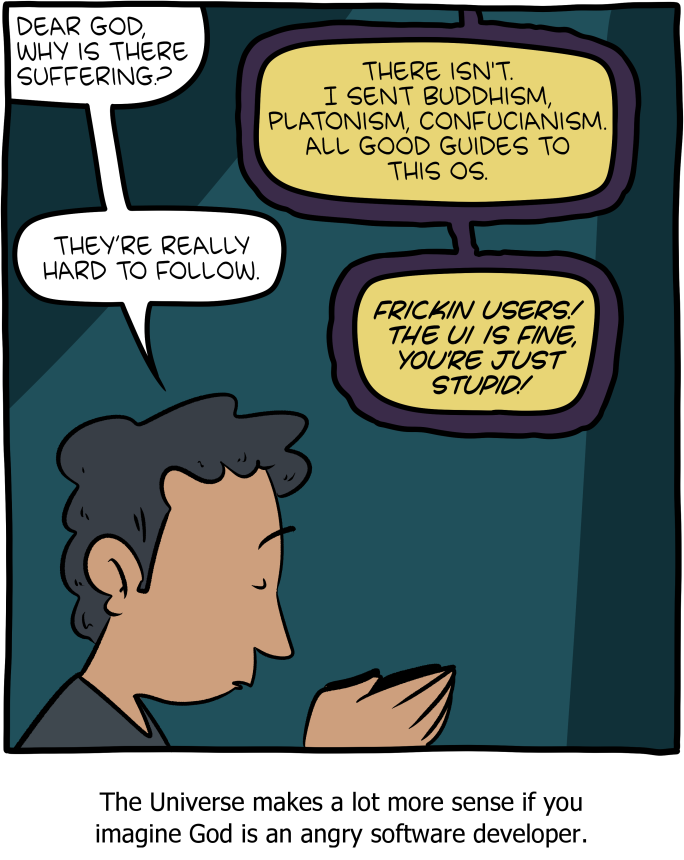
Click here to go see the bonus panel!
Hovertext:
God hasn't done miracles in a long time because he's grumpily playing WoW.
Today's News:
Matt Gaetz's legal predicament just keeps getting weirder, as Tucker Carlson found out the hard way
James.galbraithFlorida man does TV interview, implicates host in child trafficking
Let's face it, there's just a lot going on with Rep. Matt Gaetz of Florida these days. In the last 24 hours, bombshell news broke that Gaetz was under federal investigation for allegedly having sex with an underage girl—an inquiry that was initiated last year by Trump-appointed Attorney General William Barr. But there's also a series of subplots.
Just before news of the probe surfaced on Tuesday, Axios reported that Gaetz might not seek reelection in 2022 as he eyed a position with the right-wing site Newsmax, which has become a chief competitor of Fox News. After the news of the investigation hit, Gaetz told Axios the allegations were "false" and that he and his family were victims of a $25 million extortion scheme that they had been working with federal officials to expose—a claim the FBI is reportedly exploring. Gaetz further said his father has been "wearing a wire at the FBI’s direction." Oh, also, the Justice Department's investigation into Gaetz includes potential sex trafficking related to him paying for the 17-year-old girl with whom he was allegedly having a relationship to travel across state lines with him—an illegal act that is readily prosecuted.
So as anyone can see, that was a lot of ground to cover when Gaetz appeared Tuesday night on Fox News' Tucker Carlson Tonight to clear it all up. That went well.
In trying to explain away the allegation, Gaetz connected his own predicament to host Tucker Carlson personally—not once, but twice.
"I'm not the only person on screen right now who has been falsely accused of a terrible sex act," Gaetz said without going into detail.
When Carlson asked Gaetz to explain the allegation against him, Gaetz said he only knew what he had read in the news. Then he offered, “Actually, you and I went to dinner about two years ago, your wife was there, and I brought a friend of mine, you’ll remember her.” Gaetz further claimed the FBI tried to intimidate his friend into verifying his involvement in a "pay-for-play scheme."
Carlson quickly countered, “I don’t remember the woman you are speaking of or the context at all, honestly."
Gaetz later claimed, however, the woman in question was fictional. "The person doesn't exist, " he said, "I have not had a relationship with a 17-year-old."
Oh, but Gaetz also clarified, “Providing for flights and hotel rooms for people that you’re dating who are of legal age is not a crime.”
It’s fair to sum up the appearance by saying there were a lot of moving targets.
At the conclusion of the interview, Carlson told viewers, “That was one of the weirdest interviews I’ve ever conducted," adding that he didn't think it "clarified much."
Nope. Sure didn't.
Matt Gaetz vows to Tucker Carlson he didn't "travel" with a 17-year-old, but his denial seems pretty specific and carefully worded pic.twitter.com/emGePJeVfV
— Aaron Rupar (@atrupar) March 31, 2021
Gaetz again bizarrely implicates Tucker Carlson in his own personal peccadillo, then says, "providing for flights and hotel rooms for people that you're dating who are of legal age is not a crime" pic.twitter.com/wD0hUmwGGN
— Aaron Rupar (@atrupar) March 31, 2021

Biden plan eliminates billions in fossil fuel subsidies
James.galbraithgood

Enlarge (credit: Jose Luis Stephens | Getty Images)
Today, President Joe Biden will unveil a $2 trillion infrastructure plan that promises to overhaul the nation’s highways, airports, electrical grid, and more. It will be partly paid for by repealing subsidies for the fossil fuel industry.
Currently, the United States gives the $180 billion fossil fuel industry between $5 billion to $62 billion per year in direct subsidies, depending on the estimate. When accounting for indirect subsidies, including public health impacts and climate change, the handout could be as high as $649 billion. The Biden administration hasn’t specified which tax credits or subsidies it would eliminate, and certain subsidies probably will be subject to horse trading in Congress. That makes it difficult to get an accurate number at this point, but the number would certainly be in the range of billions of dollars.
If the Biden administration is successful, the US would be following through on a promise made at the 2009 G20 summit, which stated that signatories should “phase out and rationalize over the medium term inefficient fossil fuel subsidies.”
Read 6 remaining paragraphs | Comments
Matt Gaetz’s disastrous Tucker Carlson interview, explained
James.galbraith*popcorn*

Gaetz is under investigation for alleged sex trafficking. He went on Fox News and made it worse.
Hours after the New York Times broke the news that Rep. Matt Gaetz (R-FL) is under federal investigation for alleged sex trafficking, he was given a platform by Fox News host Tucker Carlson to tell his side of the story. But Gaetz ended up botching the softball interview so thoroughly that Carlson ended up telling his millions of viewers it was “one of the weirdest interviews I’ve ever conducted.”
At various points during the interview, Gaetz — who denies the allegations — volunteered the existence of criminal allegations against him that aren’t yet part of the public record, brought up sexual misconduct allegations against Carlson that most of his viewers probably weren’t aware of, and went out of his way to involve Carlson in stories about his personal life.
“I can say that actually you and I went to dinner about two years ago, your wife was there, and I brought a friend of mine — you’ll remember her — and she was actually threatened by the FBI, told that if she wouldn’t cop to the fact that somehow I was involved in some pay-for-play scheme, that could face trouble,” Gaetz said. “So I do believe there are people at the Department of Justice that are trying to smear me. Providing for flights and hotel rooms for people that you’re dating who are of legal age is not a crime.”
“I don’t remember the woman you’re speaking of or the context at all, honestly,” Carlson replied.
Gaetz again bizarrely implicates Tucker Carlson in his own personal peccadillo, then says, "providing for flights and hotel rooms for people that you're dating who are of legal age is not a crime" pic.twitter.com/wD0hUmwGGN
— Aaron Rupar (@atrupar) March 31, 2021
That exchange came shortly after Gaetz told Carlson that “I’m not the only person on screen right now who has been falsely accused of a terrible sex act. You were accused of something you did not do.”
“You just referred to a mentally ill viewer who accused me of a sex crime 20 years ago, and of course it was not true. I had never met the person,” Carlson replied. “But I do agree with you that being accused falsely is one of the worst things that can happen, and you do see it a lot.”
Carlson was falsely accused of molesting a woman about 20 years ago, but was also accused of sexually harassing a guest on his show in a lawsuit filed last year. (Fox News has denied the allegations against Carlson and other hosts contained in the lawsuit.)
Tucker Carlson responds to Matt Gaetz casually mentioning that someone accused him of a sex crime. Yikes. pic.twitter.com/GkcCP1yZnZ
— Aaron Rupar (@atrupar) March 31, 2021
Although Carlson didn’t challenge Gaetz during the interview, he was less than thrilled with how he handled the interview.
Following a commercial break, Carlson seemed to throw Gaetz under the bus, saying the interview was “one of the weirdest interviews I’ve ever conducted” and adding, “I don’t think that clarified much ... I don’t quite understand it.”
Wow. Back from commercial, Tucker Carlson proclaims that the interview he just conducted with Gaetz was "one of the weirdest interviews I've ever conducted." pic.twitter.com/85Fnyv4Km9
— Aaron Rupar (@atrupar) March 31, 2021
Citing “a person familiar with the matter,” CNN’s Oliver Darcy reported on Wednesday that Gaetz’s effort to involve Carlson in his problems “pissed [Carlson] off.”
But more importantly than the bizarreness of the interview is the fact that Gaetz didn’t do a very convincing job trying to refute the very serious criminal allegations underpinning the federal investigation. His defense basically amounts to claims that he’s the victim of a vast conspiracy.
Gaetz is implausibly alleging officials in Bill Barr’s Department of Justice conspired to take him down
According to the Times, Gaetz is under investigation “over whether he had a sexual relationship with a 17-year-old and paid for her to travel with him, according to three people briefed on the matter.” (It’s unclear whether the person that Gaetz said had dinner with Carlson and his wife is the person referenced in the Times story.)
The Times report adds that it is “not clear how Mr. Gaetz met the girl, believed to be 17 at the time of encounters about two years ago that investigators are scrutinizing.”
During the interview with Carlson, Gaetz denied improper conduct, but he did so in a very limited and specific way, using language that raised more questions than it answered.
“The New York Times is running a story that I have traveled with a 17-year-old woman, and that is verifiably false; people can look at my travel records and see that that is not the case,” Gaetz said — even though a 17-year-old is not a “woman,” the allegations go beyond mere “traveling,” and it’s unclear how “travel records” could disprove any of them.
Matt Gaetz vows to Tucker Carlson he didn't "travel" with a 17-year-old, but his denial seems pretty specific and carefully worded pic.twitter.com/emGePJeVfV
— Aaron Rupar (@atrupar) March 31, 2021
Gaetz went on to allege that word of the investigation was leaked as part of an extortion plot, saying “what is happening is an extortion of me and my family involving a former Department of Justice official” who demanded $25 million in exchange for making the sex trafficking allegations go away.
But during an MSNBC interview a short time later, one of the Times reporters bylined on the Gaetz story, Katie Benner, debunked one of Gaetz’s central claims, saying unequivocally that the former official Gaetz accused by name of being part of an extortion plot isn’t even involved in the investigation.
Katie Benner says the person named by Matt Gaetz is not involved in the investigation pic.twitter.com/ze13YFy9gp
— Acyn (@Acyn) March 31, 2021
That former DOJ official, David McGee, later told the Daily Beast that Gaetz’s claims are false and are “a blatant attempt to distract from the fact that Matt Gaetz is apparently about to be indicted for sex trafficking underage girls.”
Gaetz seems to be throwing defenses against the wall in hopes that something will stick. He concluded the interview with Carlson by suggesting the investigation is politically motivated, saying “I’m a well-known, outspoken conservative, and I guess that’s out of style in a lot of parts of the country right now.”
But the Times reports that the investigation “was opened in the final months of the Trump administration under Attorney General William P. Barr” — a chronology undercutting Gaetz’s suggestion that his political opponents are out to get him.
File this whole bizarre episode under “things defense attorneys wouldn’t advise”
Gaetz’s interview with Carlson came shortly after he initially responded to news of the investigation in a string of tweets, claiming he’s the victim of an extortion plot and that “my father has even been wearing a wire at the FBI’s direction to catch these criminals. The planted leak to the FBI tonight was intended to thwart that investigation.”
...and my father has even been wearing a wire at the FBI’s direction to catch these criminals. The planted leak to the FBI tonight was intended to thwart that investigation.
— Matt Gaetz (@mattgaetz) March 30, 2021
No part of the allegations against me are true, and the people pushing these lies are targets...
Gaetz has yet to provide any evidence to back up these claims, and instead posted retweets trying to discredit the New York Times and Department of Justice. But his story would be easier to buy if the Trump-loving Congress member hadn’t destroyed his credibility with false claims about antifa being responsible for the January 6 insurrection, by brazenly trying to intimidate a witness on Twitter and storming a secretive facility at the Capitol in an effort to disrupt Trump’s first impeachment trial; by inviting a notorious Holocaust denier to Trump’s 2018 State of the Union speech; and in general by behaving more like a MAGA dirty trickster than an elected official concerned with doing right by his constituents.
News of the federal investigation of Gaetz broke just hours after Axios reported that he’s “privately told confidants he’s seriously considering not seeking re-election and possibly leaving Congress early for a job at Newsmax,” a right-wing TV outlet that has distinguished itself by being even Trumpier than Fox News.
If what Gaetz told Carlson is any indication, the news surrounding the federal investigation into his conduct could get even worse for him.
“I really saw this as a deeply troubling challenge for my family on March 16, when people were talking about a minor, that there were pictures of me with child prostitutes — that’s obviously false, there will be no such pictures because no such thing happened,” Gaetz volunteered, even though the child pornography allegations were not publicly known before he brought it up.
Gaetz mentions that someone has alleged there's photos of him with child prostitutes. He claims such pictures don't exist. pic.twitter.com/GSCz9ea8T4
— Aaron Rupar (@atrupar) March 31, 2021
It’s unclear if Gaetz was trying to get ahead of yet another story. But what is clear is that no lawyer would recommend responding to news of a federal investigation by going on national TV and volunteering that sort of derogatory information.
During a Fox News interview on Wednesday morning, House Minority Leader Kevin McCarthy (R-CA) said he’ll remove Gaetz from committees if the allegations against him turn out to be true, and couldn’t explain why Gaetz was the only Republican to vote against an anti-human trafficking bill in 2017.
"I have no idea whatsoever why he would vote against that" -- McCarthy on Gaetz being only Republican to vote against an anti-sex trafficking bill in 2017 pic.twitter.com/h8gdou1kl4
— Aaron Rupar (@atrupar) March 31, 2021
“I have no idea whatsoever why he would vote against that,” McCarthy said.
Millennials are stuck in the world boomers built
James.galbraithLots to digest here, but yes it's going to take forever to unscrew the world after the boomers

The conservative case against the baby boomers.
I’m not a fan of baby boomers.
And no, it’s not really fair to paint an entire generation with the same brush, but I’m doing it anyway. If you’ve followed my work, you know I’ve been on this beat for a long time (here and here).
To my delight, another broadside against the boomers has appeared, this time from a somewhat different angle. It comes courtesy of fellow millennial Helen Andrews, a senior editor at the American Conservative, who has a new book called Boomers: The Men and Women Who Promised Freedom and Delivered Disaster.
As you might expect given her background, Andrews is making a specifically conservative argument, which distinguishes the book from some of the more recent additions to the anti-boomer oeuvre. And it’s especially interesting because it’s not a conventional narrative of boomer ineptitude, though there’s plenty of that in there. Instead, it’s a portrait of six prominent boomers, each of whom, in their own way, symbolizes what Andrews calls “an aspect of the Boomer tragedy.”
The people she profiles — Apple founder Steve Jobs, screenwriter/director Aaron Sorkin, economist Jeffrey Sachs, scholar Camille Paglia, civil rights activist Rev. Al Sharpton, and Supreme Court Justice Sonia Sotomayor — are all great Americans in many respects, or at least they’ve all achieved great things, but Andrews says they also represent the many contradictions of the boomer generation. The point, in other words, isn’t to condemn these people but to use them as a prism through which to explore the broader generational phenomenon.
For instance, Sharpton, she argues, symbolizes the boomer obsession with revolutionary politics but the reality of his career is much more “transactional.” Sotomayor, a hero to many liberals and a somewhat strange pick for this project, is portrayed by Andrews as representative of the tensions between boomer idealism and careerism. Sachs, meanwhile, started out as a promising anti-poverty economist but, according to Andrews, became a global celebrity whose hubris eventually made him a tool of the capitalist forces he initially opposed.
The book is modeled on the famous 1918 work Eminent Victorians, by Lytton Strachey, which mocked the triumphalism of the Victorian Era by profiling four of its “heroes.”
I spoke to Andrews about her beef, not just with boomers but also millennials, who she argues are too much like the boomers to clean up the mess they inherited. This is a winding exchange touching a ton of topics, including the role boomers played in the civil rights movement, if Steve Jobs is really a sell-out, why Aaron Sorkin’s work is uniquely annoying, and if she thinks millennials can ever escape the world boomers built for them.
A lightly edited transcript of our conversation follows.
Sean Illing
You say the baby boomers are responsible “for the most dramatic sundering of Western civilization since the Protestant Reformation.” I mean, really?
Helen Andrews
Yes, I do think the boomer revolution deserves to be compared to the Protestant Reformation. The way I justify that comparison is by looking at revolutions in media. The Protestant Reformation, which led to chaos and war across Europe, was a direct consequence of the printing press, and if you believe that the advent of television and the rise of visual media is a change in the human experience on par with the advent of print, then it’s not that much of a leap to say that the boomer revolutions are equally consequential.
Sean Illing
What was so destructive about TV?
Helen Andrews
It caused people who grew up in its wake to have their minds filled with pseudo-knowledge, rather than actual knowledge. And I think the main consequence of that was the destruction of both high culture and folk or local culture, and their replacement with mass culture and pop culture.
One thing I did in the research for this book was to go back and read all of the doomsayers at the time of the TV revolution who said that raising a generation glued to their screens was going to scramble their brains and make them stupid. These were people who were dismissed at the time as snobs and doomsayers, people who just were not hip to what the kids were thinking. And at the time, there was no way to check their predictions. The only thing these doomsayers could do was to say “Wait and see.”
Well, we’ve had several decades to wait and see the consequences of the rise of visual media and the decline of print and everything that flowed out of the TV revolution. And I think most of their dire predictions have been vindicated.
Sean Illing
The impact of TV deserves its own conversation, so I’ll turn back to the book and raise what’s probably my strongest objection.
I think there’s a nostalgic account of American life before the boomers that obscures some important realities. For instance, you write that boomers inherited “social cohesion” and an “uncomplicated patriotism,” but that cohesion was built on an exclusionary society and we paid a heavy price for it. Hell, Jim Crow didn’t end until 1965. So a lot of that “patriotism” was bound up with a way of life that had to be dismantled if the country was ever going to live up to its own ideals.
You can call this a lot of things, but no way I’d call it “uncomplicated.”
Helen Andrews
Much of what you say is true. But I would counter by saying that the uncomplicated patriotism I talk about has been replaced with uncomplicated narcissism, because most people who say America pre-1965 was actually awful and not even remotely living up to its ideals go on to say that America only became a decent country once the baby boomers showed up.
And I can understand how the boomers were able to sell themselves that line, but as a millennial I had to hear it over and over again during 12 years of public school history classes. What it sounded like to me, what it still sounds like to me, is the boomers replacing worship of America with worship of themselves.
So I don’t at all see how that shift is morally attractive in any way.
Sean Illing
The narcissism point is interesting. One of my pet fascinations is the failure of the so-called countercultural revolution in the 1960s. We have very different views of what that movement originally stood for and what it might have been, but we do seem to agree that it devolved into individualism and pop psychology.
How do you explain that failure?
Helen Andrews
The answer to that question lies in why the boomers were so idealistic in the first place. The baby boomers have the characteristics that they do mainly because of their demographic heft. There were so many of them and that meant that from the moment they hit the market, advertisers courted their dollars above everybody else’s. Politicians courted their votes because there were more boomers than anybody else.
So anybody trying to sell something or make something popular catered to the boomers’ every whim. That naturally led the baby boomers to be narcissistic and to think that they were the center of the universe. And unfortunately, this coincided with a period of uncharacteristic prosperity in the United States and the rest of the western world. And so the boomers also came to believe that wealth and stability were the natural order of things.
That’s what made the boomers so careless and also so lazy. They really thought that revolution could be a matter of saying the right words. They had no sense that no good thing comes without sacrifice. That’s what made them hippies in the first place, and that’s what made them such ineffective revolutionaries in the ultimate sense.
/cdn.vox-cdn.com/uploads/chorus_asset/file/22395140/BOOMERS_cover.jpg)
Sean Illing
The most striking thing to me about the boomers has always been the gap between their intentions and their ultimate impact, and no one represents this as much as Steve Jobs, the subject of your first profile. He’s the entire arc of boomerness, isn’t he? A former acid-dropping hippie marries his surface-level bohemianism with unprecedented corporate ambition and then sells his products as symbols of rebellion. I mean, come on ...
Helen Andrews
Actually, I wrote that chapter intending to refute exactly the position on Steve Jobs that you have just described. I came to believe, after researching him, that his bohemianism was not superficial at all. I mean, all of that stuff — the India pilgrimage, the vegan diet, the John Lennon glasses — I don’t think it was a put-on. It genuinely shaped how he ran his business.
You have to understand what the computer industry looked like when Steve Jobs came on the scene. It was dominated by IBM, which meant in your office there would be one gigantic computer, supervised by priest-like technicians whom you would petition for computer time. And even when IBM entered the PC market, you had to take weeks of training classes before you could even begin to operate their machines.
Steve Jobs thought one person, one computer was the model because he wanted to liberate the individual. And he succeeded. And shaping the computer industry to be more individual-focused was a huge accomplishment. Not everybody could have done that, and he did it for genuinely idealistic reasons.
Now I happen to think that the ultimate consequences of that revolution have been negative, especially for millennials who are complaining about the Uber-ization of the economy and the Tinder-ization of romance, but Jobs himself was legit in a way that very few other Boomers were.
Sean Illing
The feminist scholar Camille Paglia might be the least famous subject in the book, at least among millennials. Why is she part of this story?
Helen Andrews
She represents two worlds that are crucial to the boomers and their destructiveness. The first is pop culture. Camille Paglia has throughout her career stood for the idea that pop culture is as worthy of academic study as high culture, that Madonna’s sex book is as worthy of study as Milton.
And the second world is the academy. She was a great warrior in the first round of the PC wars in the 1990s. I think she was the best of them, better even than Allan Bloom. And it’s wonderful to see her slashing attacks on the old PC pieties, but the academy has continued to degenerate and become more PC, or as we would say now, “woke,” in spite of her wonderful slashing battles.
And more than that, it’s not just colleges that have become more left-wing, it’s that college itself has become more and more central. More and more people are going to college, which is bad for the country and for the people who enroll in college and then don’t finish, or the people who enroll in college, get their degrees, and then don’t get jobs that require college degrees. It’s just bad all around that college has become so central and the answer to everybody’s life course.
And that was something the boomers did. They were the generation that first decided everybody needs to go to college, and college is something not for a minority of the population, but for everybody.
Sean Illing
So you think it would be better if fewer Americans were able to attend college?
Helen Andrews
Yes, because it’s a massive waste of money that does not confer actual benefits to the people who pay for it. What a college degree represents today could be, and not so long ago was, taught in high schools, so we are wasting people’s time, valuable years of their lives, prolonging adolescence.
Sean Illing
Hard to leave that point about college dangling, but I don’t want to derail the conversation too much, so I’ll stay on the tracks. Why didn’t you choose a conservative boomer to profile? Why not Newt Gingrich or someone like Rush Limbaugh?
Helen Andrews
I did have some conservatives on my short list. But eventually I decided that while not every boomer is progressive, the boomer legacy is a progressive one. I ran into the same difficulty in trying to choose a faith leader, because religion is important to me and to people in general and society. So it would have been nice if I could have picked a boomer reverend or priest or religious notable, but every time I drafted a list of them I couldn’t find somebody who was important or influential enough, which is indicative in itself.
“You can’t understand the Democrats working in DC today if you don’t get that a lot of them are West Wing superfans”
Sean Illing
Why Aaron Sorkin?
Helen Andrews
I was attracted to the irony at the center of Aaron Sorkin’s career. Everybody loves his show about politics, The West Wing, even though politics is a subject Sorkin knows nothing about, by his own admission. As he told every interviewer when The West Wing was on the air, he was a musical theater major.
Politics is not his field. But when he tried making shows about the television industry, which is a subject he does know and care deeply about, everybody hated them. The idealism of Studio 60 was real. The idealism of The West Wing was fake. His boomer audience preferred the fake idealism. That’s tragic to me. It also suggests some of the ways that boomer idealism, more broadly, is often just a pose.
Also, you can’t understand the Democrats working in DC today if you don’t get that a lot of them are West Wing superfans.
Sean Illing
I guess after all that boomer hate, we have to say something about millennials. To be honest, I can’t tell if you have more sympathy or disdain for your generation —
Helen Andrews
Yeah, it’s the latter. There were early readers of this manuscript whose feedback was that for a book about how terrible the boomers are, you sure seem to spend a lot of time bashing millennials. And I guess my response to that is that millennials are the children of the boomers. We’re taught by the boomers. So it’s only natural that we should imitate them.
But it’s worse when we do it, not just because it’s unoriginal and repetitive and derivative, but because the boomers could get away with it and we can’t. We’re not going to graduate to that kind of prosperity, so we should stop trying to imitate them.
Sean Illing
To be fair, millennials inherited the mess boomers left behind. Given the blows they’ve endured — the forever wars, the Great Recession, a once-in-a-century plague — how much blame can we really place at their feet?
Helen Andrews
This isn’t a book about blame. Millennials are the way we are because of boomers, and the world we inherited is broken because of what the boomers did, but at a certain point you have to stop blaming your parents and also stop blaming yourself, and just say, where do we go from here? The boomers were dealt an easy hand, millennials were dealt a difficult hand. That’s not fair. Okay. Now what? An honest reckoning with the boomers’ legacy for me is about moving forward.
Sean Illing
So we agree that millennials are still largely stuck in the world boomers created — the same language, the same ideas (with slight modifications), the same paradigms, the same art. Do you see any potential for breaking out of this cultural morass?
Helen Andrews
If there’s hope, it lies with Gen X. They are the last people with any memory, any foot in the pre-boomer world. The boomers were not Gen X’s parents and they weren’t Gen X’s teachers, and that keeps them anchored and gives them some spark of life. The boomers, by clogging up the career pipeline, have refused to get off the stage and give Gen X its moment. So even though Gen X is aging now, we still have not yet seen all that they can do. We have not seen a world run by Gen X-ers.
Hopefully, the boomers will make a graceful exit and we can start seeing that soon, but if that doesn’t work, then we are monumentally screwed.
Joe Biden’s $2 trillion infrastructure and jobs plan, explained
James.galbraithIt's a great start

Biden’s new plan takes an expansive view of infrastructure.
President Joe Biden proposed his opening bid on Wednesday for a $2 trillion infrastructure package that pushes the US towards a clean energy economy.
The bulk of Biden’s plan deals with upgrading America’s roads, bridges, and public transit, but it also takes an expansive definition of the word “infrastructure,” expanding long-term care for the elderly through Medicaid, banning exclusionary zoning, and investing in community-based violence reduction programs, among many other things.
“The American Jobs Plan,” which he will formally introduce later today in Pittsburgh, Pennsylvania, will invest about $2 trillion over the next eight years, amounting to about 1 percent of America’s gross domestic product (GDP) per year over that time, an administration official estimated.
The plan includes $621 billion in infrastructure spending dedicated to rebuilding the nation’s roads, bridges, ports, and rail systems. It also contains $300 billion to bolster manufacturing, $213 billion for affordable housing, and a collective $380 billion for research and development, modernizing America’s electricity grid, and installing high-speed broadband around the country. The plan also contains $400 billion for home and community-based health and elder care.
The White House estimates the infrastructure plan will be paid for within the next 15 years, if Biden’s newly proposed “Made in America” tax plan is also passed. That tax plan would raise the corporate tax rate to 28 percent to pay for infrastructure, and close a number of loopholes to prevent corporations from stashing their money in offshore banks to evade taxes. It does not, however, raise the capital gains tax — an idea Biden initially floated during his presidential campaign.
Biden plans to argue that revitalizing American infrastructure will create millions of good-paying jobs, lower the country’s carbon emissions, and help the US compete on the world stage — especially with China.
“Part of the economic logic of this plan is that this is not just about infrastructure, but it’s about creating more jobs and more industrial strength in the United States,” a Biden administration official told reporters. “When you make these infrastructure investments and couple it with the president’s commitment to buy American, you’re pulling forward and creating demand that will help accelerate new industries in the US.”
Biden’s infrastructure package will be paired with a second piece of his jobs plan, focused on paid family and medical leave and expanded health insurance, that he’s expected to unveil in the coming weeks.
This wide-ranging list of priorities — with another package yet to come — shows just how much Biden and Congressional Democrats are hoping to pass in a relatively short amount of time. With the 2022 midterms on the horizon, Democrats are running against the clock with already razor-thin majorities in the House and Senate. And unless Democrats can convince the Senate parliamentarian otherwise, they have just one more chance to pass a bunch of priorities through budget reconciliation — which requires just 51 votes, rather than the filibuster-proof 60.
Biden’s jobs plan also shows an administration that is fundamentally re-thinking the role of government in America. Rather than the anti-government ethos that has permeated both Democratic and Republican administrations since Ronald Reagan, the Biden administration is embracing the big government mantle of historic Democratic presidents Franklin Delano Roosevelt and Lydon B. Johnson.
Multiple sources told Vox that while the White House plans to make bipartisan overtures to Congressional Republicans, they ultimately view budget reconciliation as a reliable fallback plan to get an ambitious package passed.
“I think that is the end game of all of this, most of this will be done through a reconciliation package,” a Democratic congressional aide told Vox. “That’s what the White House believes at the end of the day.”
Even so, the process will likely drag on much longer than the passage of Biden’s earlier $1.9 trillion Covid stimulus bill. Precisely because the Covid bill was passed so quickly, there is a lot of pent-up demand from lawmakers to get their state and district’s priorities included. Many members will be jockeying for their wish-lists to be included in the next budget package.
Infrastructure will dominate conversations on Capitol Hill for months to come. To start, here’s Biden’s next big economic proposal, broken down.
What’s in the American Jobs Act
The Biden administration’s first priority was always to get the Covid-19 pandemic under control. Now that vaccinations are ramping up and Biden’s $1.9 trillion Covid relief package is law, the president is turning to jobs.
The American Jobs Plan is designed to spur job growth in a number of sectors, including construction, clean energy, and long-term care. The plan envisions millions of housing units, school buildings, and veterans’ hospitals being built and retrofitted, lead pipes being eliminated from America’s water infrastructure, and 500,000 electrical vehicle charging stations being installed on the nation’s roadways.
Comparing the plan’s investment to the creation of the American highway system in the 1950s and the space race of the 1950s and 1960s, a Biden administration official said the goal of the plan is to “revitalize our national imagination and put millions of Americans right now in work that’s desperately needed for the nation.”
Here are the toplines of what’s in the American Jobs Plan.
- The $621 billion in infrastructure spending is the largest chunk of Biden’s plan, aiming to modernize 20,000 miles of highways, roads and main streets, fix the 10 most economically significant bridges in the US, and repair 10,000 smaller bridges. Biden’s plan calls for $85 billion to modernize public transit, and $80 billion to be put toward Amtrak for repairs and improving train corridors.
- Invests $174 billion into the electric vehicle market, building out a network of 500,000 EV chargers on the nation’s roads by 2030. The plan also calls for the electrification of 20 percent of the US school bus fleet, and using federal procurement to electrify the entire federal fleet, including the US Postal Service.
- Eliminates all lead pipes and service lines in US drinking water systems, and puts $56 billion in grants and flexible loans to states, Tribes and territories to upgrade drinking, wastewater, and stormwater systems.
- Invests $100 billion to build out the nation’s high-speed broadband infrastructure to 100 percent coverage, including to remote and rural areas. Biden’s plan also commits to working with Congress to reduce the price of broadband, but doesn’t specify exactly how.
- Invests $213 billion to build and retrofit over 2 million homes and commercial buildings, including community colleges, aging schools and child care facilities, veterans hospitals, and federal buildings. Biden’s plan specifically calls for a million affordable housing units to be produced or retrofitted, and over 500,000 homes for low- and middle-income homebuyers to be built or rehabilitated. His plan also calls for the elimination of exclusionary zoning.
- Puts $16 billion toward plugging old oil and gas wells, and abandoned coal and uranium mines, as well as funding environmental resiliency jobs including restoring forests, wetlands, and watersheds. The plan also calls for $10 billion in the creation of a Civilian Climate Corps to conserve public lands and waters, a campaign promise of Biden’s. Conservation advocates argued that environmental restoration and resilience jobs like these can put people to work even more quickly than clean energy jobs. “Some of the earliest job wins you’re going to see are going to be in the restoration space,” Collin O’Mara, president and CEO of the National Wildlife Federation, told Vox. “They don’t require materials or construction, new fabrication of different goods and materials. The only thing that’s needed is money.”
- Invests $100 billion to modernize the nation’s electrical grid, and extend and expand the production and investment tax credits to accelerate clean energy jobs and projects in wind, solar, and other forms of renewable energy.
The bill also includes some ideas that might stretch the traditional definition of infrastructure:
- Bolsters unions by calling on Congress to pass the pro-union Protecting the Right to Organize (PRO) Act. Biden’s plan similarly asks Congress to tie federal investments in clean energy and infrastructure to prevailing wage laws, and require that investments in transportation meet existing transit labor protections.
- Bans “exclusionary zoning” and harmful land use policies, including minimum lot sizes, mandatory parking requirements, and prohibitions on multifamily housing.
- Expands long-term care under Medicaid, increasing access to home and community-based services and giving more people the chance to receive care at home. The Biden administration’s plan aims to increase the quality of care-giving jobs and give home health workers more chances to unionize and increase their wages.
- As part of a plan to target workforce development in underserved communities, Biden’s plan would put $5 billion over eight years to support evidence-based community violence prevention programs, and invest in job training for formerly incarcerated individuals.
It’s worth repeating that this wide-ranging plan is Biden’s opening bid, not a final product. The next few months of negotiations with Congress will ultimately determine how many of these provisions will make it into a final bill, and it will take even more negotiations to get that bill passed.
Biden’s infrastructure plan is also a climate plan
Biden’s infrastructure plans contains one of his key campaign promises to tackle climate change: getting the nation’s economy to be powered by 100 percent clean electricity by 2035.
“This is something that is part of the president’s plan and that he intends to work with Congress on,” the Biden administration official said of the clean energy standard in the infrastructure plan.
Biden’s administration has been bullish on the potential of wind, solar, and other forms of renewable energy to become the primary source of power in the United States. Wind and solar are becoming attractive to utility companies simply because they’ve become much cheaper forms of power than that generated by fossil fuels. Renewables already produced 20 percent of US electricity in 2020, and could be poised to generate a greater share if Biden’s plan is passed by Congress.
Even with the weight of the federal government behind this goal, getting the country to 100 percent clean electricity will be easier said than done. Industry and utility representatives told Vox that getting the nation to 80 percent renewable electricity by 2035 is viewed as doable, but finishing the last 20 percent will be more challenging.
“It’s going to require everything we have from a policy and technology standpoint, and all of the tools we have in our toolbox,” Dr. Karen Wayland, policy adviser to electricity utility coalition group Gridwise Alliance, told Vox.
Congressional Democrats writ large — but especially progressives — view Biden’s infrastructure bill as their best hope to do something meaningful on climate change. Already, the effects of a warming planet are inescapable, with frequent strong storms and historic wildfires and droughts. As Biden releases his plan, progressives are already calling for something much bigger — $10 trillion in spending over the next decade on infrastructure and climate change.
“We think this is a once in a lifetime opportunity to really put forward what we know we need to tackle the climate crisis that we face,” Congressional Progressive Caucus Chair and Rep. Pramila Jayapal (D-WA) told Vox in a recent interview.
Progressives have been in constant communication with White House staff, including White House Chief of Staff Ron Klain, communicating their desire for the administration to go even bigger.
“While this plan represents some of the boldest thinking we’ve seen from the Democratic party in the last decade, the fact is it’s not bold enough to defeat the crises facing our country now,” Evan Weber, political director of youth climate organization Sunrise Movement, told Vox. “We’re definitely communicating with the administration how we’re feeling every step of the way.”
The next few months will be the real test for Democratic unity
With some Democratic lawmakers in the House already threatening to withhold their votes in order for a state and local tax deduction to be included in any tax policy changes to pay for infrastructure, lines are already being drawn within the Democratic caucus.
During Covid-19 relief bill negotiations, Biden was able to get the final product remarkably close to what he originally proposed. That could be much more difficult to replicate with an infrastructure package.
Whatever line the White House had to walk between pleasing moderate and progressive Democrats during the American Rescue Plan process will only be magnified in the coming months. Progressives will push the White House to be bolder, while moderates like Sen. Joe Manchin (D-WV) will push them to work with Republicans — who almost certainly would fight any attempt to raise taxes on corporations or the wealthy to pay for a massive bill.
“The question there is really what’s going to make it through the legislative process,” former Obama climate adviser John Podesta told Vox in a recent interview.
The process of drafting and passing an infrastructure bill and a pay-for structure that the White House, the Senate, and the House all agree on will likely be drawn out throughout the summer and into the fall. The House Transportation and Infrastructure Committee has laid out a September deadline to pass the approximately $500 billion five-year surface transportation reauthorization bill, and Senate committees are coming up with a topline number for their version of that bill. Still, negotiations over the surface transportation bill could be overshadowed by Biden’s larger infrastructure plan.
While there has been some talk on Capitol Hill about passing a bipartisan roads and bridges infrastructure bill (which is seen as having the most potential for bipartisan agreement) and then putting the more ambitious pieces of Biden’s infrastructure plan into a budget reconciliation bill, nothing is final yet.
“There’s going to be a lot of members leaving their print on the next piece,” a Democratic Congressional aide told Vox.
More And More Americans Say They’ll Get Vaccinated — But It’s Still Unclear Just How Many Will
James.galbraithJust wait til vaccination becomes required to participate in society again by travel, large gathering, etc
In the first months of 2021, COVID-19 vaccine distribution efforts have taken a rapid hold across the U.S. with Americans, on the whole, increasingly willing to get vaccinated.
Five different pollsters asked Americans how willing they are to get vaccinated in December, and again in March, while giving people some option to say they were undecided or in the middle. And the topline takeaway is that the share who’d gotten vaccinated or definitively intended to rose by an average of 23 percentage points.18

Meanwhile, the average share who expressed little intention of getting vaccinated dipped a relatively modest 5 points,19 while the undecided share fell an average of 18 points.20 If a politician or issue saw a similar rise over that period of time, it’d be reported — defensibly — as a shocking surge of support.
Watch: https://abcnews.go.com/fivethirtyeight/video/dr-anthony-fauci-country-back-normal-fivethirtyeight-74864826
The shift isn’t entirely unexpected, though. For most of last year, the question of getting vaccinated was wholly hypothetical, as vaccines were still under development and their eventual efficacy remained unknown. Many Americans also worried about a vaccine rushed out under political pressure. But in December, the Food and Drug Administration authorized the first COVID-19 vaccine for emergency use, marking the start of the nation’s vaccination campaign. Now, over one-quarter of Americans have received at least one dose of a vaccine and most know at least one person who’s been vaccinated, making the question of whether to get vaccinated increasingly tangible.
related: How To Get Vaccines To People Who Aren’t Going Out Of Their Way To Get Them Read more. »
It’s a mistake to think of the public as divided between a faction of enthusiastic vaccine advocates and a smaller bloc of equally adamant anti-vaccination crusaders. Polling last winter found many Americans who were undecided but potentially swayable, and in the months since, that group has increasingly made up their minds in favor of the vaccine, from an average of 40 percent to 58 percent, as the chart above shows. The share of vaccine refusers, meanwhile, has slightly decreased.
There’s a clear trend toward vaccine acceptance, although pollsters are finding somewhat less agreement on the absolute number of Americans who are likely to end up getting vaccinated — a question crucial for the prospect of reaching herd immunity.
One factor may be the slew of different frameworks pollsters have used to ask respondents to assess their behavior. This ranges from simple yes-or-no questions to questions that ask respondents to assess their likelihood of getting a shot or to consider the circumstances under which they might get vaccinated.
Whether pollsters give respondents an explicit option to say they’re uncertain also seemed to matter. Two polls that didn’t include any “maybe” or “not sure” options, Gallup and NPR/Marist, found initial vaccine acceptance higher than our average (in December, 65 percent and 61 percent, respectively, said they’d get the shot) and then relatively modest movement in the following months (74 percent and 70 percent, respectively, said this month that they’d gotten or intended to get the vaccine). Taken together, the results correctly suggested that a significant bloc of the public wasn’t yet fully sold on the vaccines in December — but that, if pushed to choose, those waverers were more likely to swing to a “yes” than a “no.”
Still, that group of vaccine-ambivalent people was hardly monolithic. Surveys last year found a number of groups that were less likely to say they wanted to get vaccinated. Two of the groups that received the most attention were Black Americans and Republicans. Their reasons for not wanting to get vaccinated, however, differed significantly. (So did the nature of their unwillingness, with the former more likely to express initial hesitation and the latter outright refusal.) Notably, the share of Black Americans who want to get vaccinated has steadily risen since last year while the share of Republicans who want to get vaccinated has moved significantly less. In Kaiser Family Foundation polling, for instance, the share of Black Americans who were vaccinated or said they’d get the shot as soon as possible rose 35 percentage points between December and March, while the change among Republicans was 18 points.
Watch: https://abcnews.go.com/Health/video/covid-19-vaccines-work-74654465
Partisanship has proved one of the strongest predictors of Americans’ reactions throughout the pandemic, and vaccination is shaping up to be no different.
In a mid-March CBS/YouGov poll, one-third of Republicans gave a definitive “no” to the question of whether they’d get vaccinated — still a minority, but higher than the share of refusers among any other racial, generational or gender-based demographic group. That survey also asked people who said they will not or might not get the shot to select their reasons for turning it down . The most commonly chosen reason, across partisan lines, was a feeling that the shot was “still too untested” — 58 percent of those who weren’t sure they’d get the vaccine, including 61 percent of Republicans, chose that as a rationale. Other factors were more uniquely partisan: Thirty-five percent of the Republicans who were unsure whether they’d get vaccinated said that they were “just not concerned about coronavirus,” reflecting larger polarization on the seriousness of the pandemic.
The vaccine rollout is about to hit another inflection point this spring, though, as states begin extending eligibility to the general public, leaving the question of whether the share of Americans who want to get the shot will continue to rise as well.
By far the most common reason people have cited for why they might not get vaccinated, a late February AP-NORC survey found, was concerns about possible side effects, which a 57 percent majority named among their top reasons (people taking the survey were allowed to select multiple options). That was followed by 48 percent who said they were waiting to see if it was safe, 45 percent who said they didn’t trust COVID-19 vaccines, 30 percent who weren’t sure the vaccine would work, 28 percent who worried about an allergic reaction and 27 percent who said they believed other people needed the shot more.
related: COVID-19 Reminded Us Of Just How Unequal America Is Read more. »
People aren’t always great at predicting what will or won’t cause them to change their minds. But a COVID-19 poll conducted by Langer Research Associates in March found the factors that best predicted whether people intended to get the vaccine included their trust in the vaccine’s safety and effectiveness; their concern about catching the virus; and their sense of social and moral norms (that is, believing that those around them want them to get vaccinated, and that being vaccinated is a community responsibility, respectively).
That suggests that many people who are still up in the air on whether to be vaccinated may still be reachable, but it’ll likely take further public health communications work. Even partisanship may not be an entirely immovable stumbling block — a CBS/YouGov polling experiment found some evidence that hearing about former President Donald Trump’s support for the vaccine could improve the willingness of at least some Republicans and Republican-leaning respondents who were hesitant, even if it did little to move those who said they are firmly against getting vaccinated. Changing the minds of those still flatly refusing the vaccine is likely a harder sell.
Sometimes, there’s not much basis to expect a dramatic change: certain traits, like partisanship, are known to stay relatively stable. But in situations where people are likely to encounter a lot of new information — whether it’s the rollout of a brand-new vaccine or the start of a primary election crammed with little-known candidates — it’s reasonable to expect opinions may evolve significantly.
It’s also hard for people to predict their own future hypothetical behavior — whether it’s how likely they are to get a vaccine that’s months away from appearing at their local drug store or an election that’s years away. And it’s equally difficult for them to predict what might potentially change their minds. When a lot of people are saying they’re still not totally sure, it’s good to take them at their word.
Watch: https://abcnews.go.com/fivethirtyeight/video/white-house-economists-thinking-covid-19-relief-fivethirtyeight-76157114
Watch: https://abcnews.go.com/fivethirtyeight/video/covid-19-vaccine-means-political-battles-74728009
All-white jury returns no convictions for officers who allegedly brutalized veteran Black detective
James.galbraithFucking ridiculous
There will be no convictions for St. Louis Metropolitan police officer Steven Korte and former St. Louis police officers Christopher Myers and Dustin Boone. The three men were charged with depriving 22-year veteran detective Luther Hall of his civil rights under the color of law, which carried a maximum sentence of 10 years. Korte also faced charges of lying to the FBI and Myers had an additional charge of destroying evidence, stemming from allegedly intentionally destroying Hall’s cellphone. The three men were on trial for the beating of a fellow police officer, who is Black, while he worked undercover during Black Lives Matter protests in Sept. 2017.
The all-white jury took two days to deliberate and clear Korte of all charges. The jury also acquitted Myers of the most serious charge of deprivation of Hall’s rights, but a mistrial was concluded over the destruction of property charge. The jury could not agree on the two charges against Boone, also resulting in a mistrial. This means that officer Korte is free and clear, while the other two men could be prosecuted for their mistrial charges if prosecutors decide to go ahead and retry them.
During Black Lives Matter protests on Sept. 17, 2017, Detective Hall was working undercover when he was attacked by St. Louis police officers, later identified through photography and witness accounts, as Bailey Colletta, Randy Hays, Christopher Myers, and Dustin Boone. Steven Korte was later identified by former officer Hays during an investigation as being someone who kicked Hall in the back of the head. The officers were indicted in 2018 on charges of deprivation of Detective Hall’s rights and obstruction.
St. Louis police beat a Black cop who was working undercover at a protest "like Rodney King" and not one officer was found guilty. If an undercover cop can't get justice, how will the rest of us who have been maced, shot, beaten, and brutalized ever get justice? https://t.co/ckn8qZoAz6
— Cori Bush (@CoriBush) March 29, 2021
Former officers Bailey Colletta and Randy Hays already plead guilty to lying to investigators and deprivation of Hall’s civil rights, respectively, agreeing to give testimony against the other officers in the hopes of receiving more lenient sentences. The defense teams for the three officers used the argument that the two guilty former officers’ testimony, specifically Hays’ testimony, were unreliable because they were bad cops. That along with the argument that these cops couldn’t have been attempting to obstruct justice because none of them thought they were doing anything wrong by beating up protesters is the perfect encapsulation of the double standard at work in our justice system for law enforcement and everyone else.
This of course is magnified when “everyone else” is a Black citizen, or in this case, a 22-year veteran police officer who happens to be Black. There are citizens in our country, frequently Black and brown, convicted off the testimony of guilty-pleading, equally unreliable witnesses. It’s the foundation of most prosecution strategies. The defense team was able to successfully manipulate the jury to exclude people of color, over the objections of prosecutors, and a judge who felt compelled to put at least one of the Black alternate jurors back in the pool—meaning that the jury remained all white, with two Black alternates. St. Louis, Missouri, is more than 45% Black.
The Ethical Society of Police that represents police officers of color in the St. Louis area released this statement on the verdict:
The Ethical Society of Police respects the decision of the jury, but we strongly disagree with the verdict,” it said in a statement. “There was clear evidence to convict former St. Louis City Police Officers Christopher Myers, Dustin Boone, and Steven Korte. The injuries Detective Luther Hall sustained were consistent with being beaten by multiple subjects.”
Police officers continue to escape the consequences of their actions. The criminal justice system continues to show African-American victims of police violence we do not receive the same level of justice when white police officers are accused of excessive force toward African Americans.
Luther Hall left the courtroom without talking to reporters but friends of his told St. Louis’s 5 On Your Side that Hall was “devastated.” St. Louis Police Chief John Hayden Jr. gave a statement saying that now that this trial was concluded, his department would move forward with an internal investigation into the events of Sept. 2017.
"Officer accountability is, and has been, a pillar of my administration. At the behest of the federal authorities and the United States Attorney’s Office, our Department has delayed any internal investigation into the assault of Officer Hall so as not to compromise the criminal investigation. Our Department has fully cooperated with the federal investigation and has been assured that the FBI will fully cooperate with our internal investigation.
"It is our hope to now obtain all relevant evidence from the FBI to conduct a complete and thorough internal investigation."
In Sept. 2019, Detective Hall filed a civil lawsuit against the officers, as well as St. Louis Mayor Lyda Krewson and Officer Joseph Marcantano—Marcantano admitted to not telling internal affairs what he knew of the event. Marcantano has since been promoted to sergeant in the St. Louis police force. Last week, Hall’s civil suit was settled with the St. Louis Police Department, Mayor Krewson and Sgt. Marcantano for $5 million. His case is still active against the other officers.

Rep. Matt Gaetz under federal investigation for possible sex trafficking
James.galbraithWell that's a lot of schadenfreude all at once
It's bombshell after bombshell in the Trump Republican era, but this one is a stunner. The New York Times reports that Florida Republican Rep. Matt Gaetz, a vitriolic Trump loyalist, is "being investigated by the Justice Department" over a possible sexual relationship with a 17-year-old that may have included paying "for her to travel with him." The investigation was reportedly opened late last year under Trump-appointed Attorney General William Barr, and "some" Trump-appointed officials had been informed of the investigation.
Gaetz is being investigated as part of a broader sex trafficking investigation of Florida politico Joel Greenberg, who has already been indicted for child sex trafficking and other charges.
Earlier today Gaetz had indicated that he might not run for reelection to his congressional seat, instead possibly taking a position at conspiracy outlet Newsmax. Newsmax and other conservative outlets have promoted "QAnon"-based conspiracy claims of a worldwide sex trafficking ring controlled by Donald Trump's personal enemies.

What Biden’s first list of judicial nominees tells us about his approach to the courts
James.galbraithStill, it's progress

Biden named a diverse group of 11 lawyers to the federal bench on Tuesday, including several former public defenders.
President Joe Biden announced his first slate of judicial nominees on Tuesday with a list of 11 lawyers and judges, including three nominees to powerful federal appeals courts.
During his presidency, Donald Trump reshaped the judiciary, appointing a third of the Supreme Court and about as many federal appellate judges in four years as President Barack Obama appointed in eight. Biden’s first slate of nominees hardly even begins to turn back that tide, but it does offer a window into how he is likely to approach the courts during his presidency. The 11 nominees are racially diverse and predominantly female, and quite a few are lawyers with backgrounds as public defenders.
Notably, all three of his appellate nominees are Black women. As a presidential candidate, Biden promised to appoint an African American woman to the Supreme Court. But Black women aren’t just unrepresented on the nation’s highest court — they’re also massively underrepresented on lower courts.
When Biden took office, only five of the nearly 300 sitting federal appellate judges were Black women, according to the Federal Judicial Center. If Biden’s three nominees are confirmed, he will have nearly doubled the number of Black women judges on the federal courts of appeal, also known as circuit courts.
In addition to these three circuit nominees, Biden named eight nominees to federal district courts, the lowest rank of federal judge with a lifetime appointment. They include Judge Zahid N. Quraishi, a magistrate judge in New Jersey and a former military prosecutor who will likely become the first Muslim American to serve as a federal district court judge.
Nine of Biden’s 11 nominees are women, and a majority are people of color. So Biden is clearly signaling that he intends to name judges who will add racial and gender diversity to the bench. His list would also add a different kind of diversity to a bench populated with former law firm partners and prosecutors, as almost half of the nominees worked as criminal defense lawyers for indigent clients.
Obama emphasized demographic diversity in his judicial selections, but he also came under fire from left-leaning activists for naming many judges who spent their previous career as either partners in corporate law firms or prosecutors.
A 2014 report by the liberal Alliance for Justice found that only 3.6 percent of Obama’s lower-court nominees worked for public interest groups. And while 43 percent of his district court nominees and 38 percent of his circuit court nominees had worked as prosecutors, only 15 percent and 7 percent of those nominees, respectively, worked as public defenders.
Biden’s first list of nominees suggests he was receptive to this criticism. Though the list does include both law partners and two lawyers with prosecutorial experience, it also includes five lawyers and judges who previously worked as public defenders or in some other role where they represented indigent defendants.
If this list is any sign of how Biden plans to pick judges in the future, an ambitious young lawyer with judicial aspirations is better off taking a job representing poor Americans during the most vulnerable moment of their lives than they are taking a job trying to lock up those Americans.
Biden is giving himself more options for a future Supreme Court vacancy
It’s worth taking note of just how underrepresented Black women currently are within the federal judiciary. The first Black woman to serve as a federal circuit judge, Amalya Kearse, was not appointed until 1979. Currently, there are less than a half dozen Black women serving as circuit judges, and the youngest of them on the federal appellate bench, Judge Johnnie B. Rawlinson of the US Court of Appeals for the Ninth Circuit, is 68.
Presidents typically prefer to name Supreme Court justices with a long career ahead of them — people who are, at the oldest, in their early- to mid-fifties. And, in the modern era, justices are normally chosen from the federal appellate bench. Of the nine current justices, only Justice Elena Kagan did not previously serve as a circuit judge.
That means that, if a vacancy were to open up on the Supreme Court today, Biden would need to either choose someone without the traditional credential normally associated with Supreme Court nominees, or name someone much older than usual, in order to fulfill his promise to name a Black woman.
The most notable name on Biden’s list of 11 nominees is Judge Ketanji Brown Jackson, a federal district judge in Washington, DC, and a former law clerk for Justice Stephen Breyer. Biden named Jackson to replace now-US Attorney General Merrick Garland, who gave up his seat on the US Court of Appeals for the District of Columbia Circuit to lead the Justice Department.
Jackson isn’t just a former public defender; she also served as vice chair of the United States Sentencing Commission from 2010 until 2014. during a period when the commission cut sentences significantly for many federal drug offenders.
Jackson, who is 50, was already considered a strong contender for the Supreme Court — after Justice Antonin Scalia’s death in 2016, President Obama interviewed her for the Supreme Court nomination that eventually went to Garland. Her promotion to a court that is widely considered to be the second-most powerful court in the country cements her status as a frontrunner for the Supreme Court (the other is Justice Leondra Kruger, a 44-year-old former law clerk to Justice John Paul Stevens, who currently sits on the California Supreme Court).
Biden also nominated Candace Jackson-Akiwumi, who is currently a law firm partner but also spent ten years as a public defender, to the Seventh Circuit — which oversees federal litigation in Illinois, Indiana, and Wisconsin. Though Jackson-Akiwumi hasn’t yet developed Jackson’s star power or judicial experience, she has many of the credentials traditionally associated with Supreme Court justices, including a Yale law degree and a prestigious clerkship for a federal circuit judge.
And Jackson-Akiwumi is quite young — she graduated from college in 2000. So even if she is not nominated to the next Supreme Court vacancy, she may be talked about as a potential nominee for a decade or more.
Biden’s third nominee to the federal appellate bench, Tiffany Cunningham, is also a fairly young Black woman. But Cunningham, who is currently a patent litigator at a large law firm, was nominated to the Federal Circuit — a highly specialized court that primarily deals with patent law. It’s unlikely a judge with such a narrow focus would be promoted to the Supreme Court.
Biden’s nominees appear less ideological than Trump’s
Though Biden’s preference for public defenders signals that he hopes to appoint judges who represented the vulnerable and not just the powerful, there is one glaring difference between Biden’s nominees and his predecessor’s.
Trump appointed many judges who appear to have spent their pre-judicial career trying to own the libs. For example, Judge Kyle Duncan, a Trump appointee to the Fifth Circuit, worked as general counsel to a leading Christian-right law firm, and he spent much of his legal career trying to restrict LGBTQ rights and diminish the right to vote. Justice Amy Coney Barrett was an outspoken opponent of abortion and LGBTQ rights before Trump named her to the Seventh Circuit and then to the Supreme Court. One Trump judicial nominee, Jeff Mateer, was hastily withdrawn by the Trump White House after news broke that he’d claimed that transgender children are part of “Satan’s plan.”
There’s no equivalent of a Duncan, a Barrett, or a Mateer among Biden’s first slate of nominees. While Biden did name several criminal defense lawyers, the GOP is now more open to criminal justice reform than it was a few decades ago. Trump, for example, signed a reform bill known as the First Step Act into law after that bill passed both houses of Congress by overwhelming margins.
Biden did not name a prominent voting rights attorney to the federal bench. Or a union lawyer. Or a lawyer for Planned Parenthood. Or some other lawyer who is likely to agitate Republicans in the same way that a judge like Barrett concerns Democrats.
That doesn’t mean that such nominations won’t be forthcoming. For the moment, however, Biden appears to be trying to diversify the bench without kicking any political hornets’ nests in the process.
America is now on track to vaccinate all adults by July 4
James.galbraithhallelujah

A new kind of Independence Day.
July 4 this year could also be America’s Independence Day from Covid-19.
At current rates, America is administering nearly 2.8 million Covid-19 vaccine doses a day — roughly enough to vaccinate every adult (18 and older) in the country by July 4.
That would mean 80 percent of the population would be able to get a vaccine. We don’t know for certain if that’s enough for herd immunity, when enough of the population is immune to the disease, through vaccines or natural infection, that the virus can no longer sustain its spread. But it’s in the range that experts typically mention.
Since a vaccine isn’t yet approved for children younger than 16, this is also close to the highest level of vaccination we can expect for the time being. (The estimates in this story don’t include 16- and 17-year-olds who are eligible for vaccines.)
As of Tuesday, March 30, about 96 million adults in the US have received at least one shot. More than 53 million, around 21 percent of adults, have been fully vaccinated, according to the Centers for Disease Control and Prevention.
At current rates, then, America could fully vaccinate up to 255 million people by July 4 — covering the entire adult population. (This is assuming about one-third of doses are the Johnson & Johnson vaccine, which, unlike the Moderna and Pfizer vaccines, requires one shot instead of two.)
The rollout is likely to speed up even more. In the coming weeks, drug companies are expected to deliver as many as 4 million doses a day to the federal government. If the companies deliver and states can turn those doses into shots in arms, it’d be enough to meet President Joe Biden’s goal to have enough vaccine supply for all adults by the end of May and, potentially, vaccinate all adults by June.
That would leave the rest of the summer to, hopefully, live life closer to the pre-pandemic normal, without worrying about the coronavirus.
None of this seemed very likely before Biden took office, when the US was administering fewer than 1 million shots a day. But local, state, and federal governments, along with the health care system, have worked around the clock since then to improve the rollout. We’re now seeing the results, with the rate of vaccinations improving steadily from day to day.
A lot can still go wrong. Maybe the drug companies won’t be able to deliver on the supply they’ve promised. Maybe cities, states, and the feds won’t clear all the logistical hurdles to get shots in arms. Maybe something else will break in a fairly complicated supply chain.
And as supply increases, it’s likely vaccine hesitancy will become a bigger issue as more adults simply refuse a vaccine. Overcoming that — to continue increasing the nationwide rate of vaccinations — will require creative education and awareness campaigns, focused on local pockets of resistance. That will pose its own logistical challenges.
The country is also seeing a recent increase in Covid-19 cases. If that marks the beginning of a fourth surge, it could lead to another wave of illness, hospitalizations, and deaths. It could also give the virus the room it needs, through millions more replications as it jumps from host to host, to mutate into another variant. So far, the current vaccines seem to work well against the variants, but that could change if the virus is allowed to mutate once again — and upend the US’s vaccination efforts.
At the very least, though, the country can see a likely finish line just a few months away. After more than a year of dealing with the coronavirus, America is so close to potentially breaking free.
Biden to scrap Trump's policy of ignoring global human rights abuses against women, LGBTQ people
James.galbraithGood. Fuck the GOP taliban
The Biden administration is set to turn back Donald Trump's attempts to promote religious conservative causes abroad at great cost to women and LGBTQ individuals, according to the Associated Press.
Secretary of State Antony Blinken is expected to "decisively" refute a report compiled by his predecessor, Mike Pompeo, that attempted to place limitations on the number of global human rights recognized and promoted abroad by the U.S. government. Human rights organizations had roundly criticized the 60-page report, issued last July, which prioritized property rights and religious freedom over international human rights agreements. The report was part of an overall effort by the Republican administration to place limits on what is considered to be a human right based on a conservative reading of the U.S. Constitution. In other words, fewer protections for fewer people— particularly those who are most vulnerable and in need of the protections. Pompeo had also nixed segments of the State Department's annual report on international human rights.
The Biden administration has already turned back several Trump administration initiatives, reestablishing itself with the United Nations Human Rights Commission, ending global opposition to abortion rights, and recommitting to promoting LGBTQ rights abroad as a matter of administration policy.
In a speech on Tuesday, Sec. Blinken will reportedly frame human rights as "universal and coequal," arguing there is “no hierarchy that makes some more important than others." He will also direct the department to prepare addendums to Pompeo's original report that outline maternal mortality rates and the hurdles women face to accessing sexual and reproductive health care.

Nike sues over “Satan Shoe,” disavowing all connection to soul soles
James.galbraithMarketing done right, and seems unlikely that Nike will prevail here.
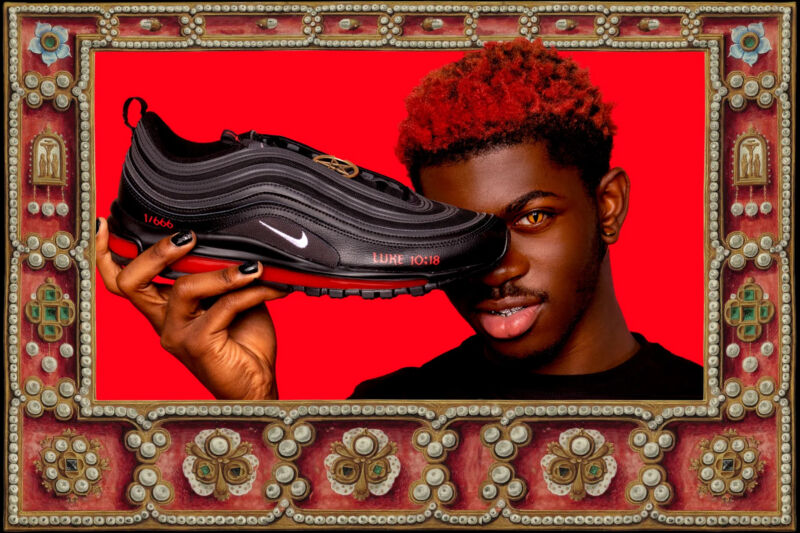
Enlarge / The shoes—and the marketing for them—are definitely committed to their aesthetic. (credit: MSCHF)
Nike is suing the company behind a viral, limited-edition custom shoe, arguing that the unauthorized custom work dilutes its brand and creates a false impression that Nike approves the controversial design.
The Satan Shoe, a collaboration between a company called MSCHF and rapper Lil Nas X, is a tie-in to the rapper's new single, "Montero (Call Me By Your Name)," released last Friday. The music video for the song (contains explicit language and extremely unambiguous sexual imagery; do not watch at work or around small children) tells a story "of sin, banishment, and redemption" that ends with Lil Nas X descending into Hell, giving Satan the lap dance of a lifetime, then deposing him and claiming the devil's horns for his own.
"Montero" proved to be an immediate viral sensation; in five days, it has racked up about 45 million YouTube views, and the song, the singer, and various related terms ("Satan," "mark of the beast," "devil," etc.) have been trending on Twitter and other platforms nonstop for days.
Read 13 remaining paragraphs | Comments
Amazon tweets trolling Congress were so bad that IT thought account was hacked
James.galbraithYeah not sure what they think they're doing
Enlarge / Amazon.com Inc. signage is displayed in front of a warehouse in Staten Island, New York, US, on Tuesday, March 31, 2020. (credit: Michael Nagle | Bloomberg | Getty Images)
As Amazon came under fire last week for working conditions in its warehouses and among its delivery drivers, the company went on the offensive on Twitter, aggressively replying to members of Congress.
Amazon’s tweets were so aggressive that one of the company’s own security engineers filed a support ticket—titled “Suspicious activity on @amazonnews Twitter account”—that aired concerns about whether the posts were evidence of the company’s Twitter account being hacked.
“These tweets are unnecessarily antagonistic (risking Amazon’s brand), and may be a result of unauthorized access by someone with access to the account’s credentials,” the ticket said. The engineer included links to eight tweets sent between March 23 and March 25.
Read 6 remaining paragraphs | Comments
Trump’s favorite new candidate exposes the true depths of GOP radicalization
James.galbraith"Slide"? You mean sprint.
Intel 11th-generation Rocket Lake-S gaming CPUs did not impress us
James.galbraithSurprise lol

Enlarge / Our test rig is a little more unlovely than usual, due to Asus' decision to entomb the CPU socket in surrounding high-rise heatsinks, with the system's RAM closing in just as tightly from the bottom. (credit: Jim Salter)
Today marks the start of retail availability for Intel's 2021 gaming CPU lineup, codenamed Rocket Lake-S. Rocket Lake-S is still stuck on Intel's venerable 14 nm process—we've long since lost count of how many pluses to tack onto the end—with features backported from newer 10 nm designs.
Clock speed on Rocket Lake-S remains high, but thread counts have decreased on the high end. Overall, most benchmarks show Rocket Lake-S underperforming last year's Comet Lake—let alone its real competition, coming from AMD Ryzen CPUs.
Our hands-on test results did not seem to match up with Intel's marketing claims of up to 19 percent gen-on-gen IPC (Instructions Per Clock cycle) improvement over its 10th-generation parts.
Read 29 remaining paragraphs | Comments
Immune Response
James.galbraithlol yes
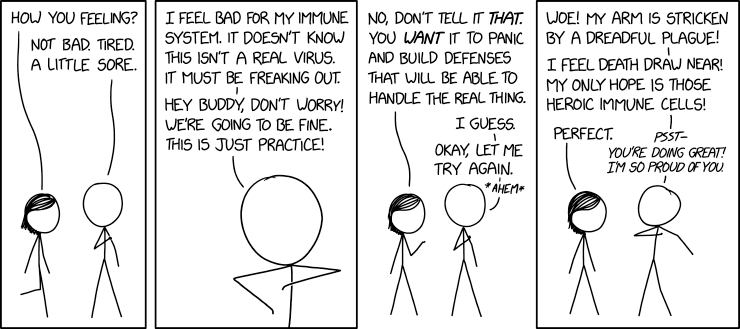
The COVID-19 'It wasn't my fault' tour begins in earnest
James.galbraithAnd cannot be allowed to succeed. 450k dead on their watch has to mean something
The “It wasn’t my fault” tour is in full swing. We heard from Robert Redfield, former director of the CDC and one of Trump’s prime stooges during the COVID-19 pandemic, venturing that if only China had been a little more forthcoming, the U.S. response under Trump would have been so, so drastically different.
Speaking Saturday to CNN, and rather than trying to justify his own abysmal performance during the worst public health crisis the country has experienced in over a century, he instead chose to repeat the discredited and debunked “lab myth.”
Without citing any evidence to back up his claim, Redfield also told Gupta he believes the pandemic originated in a lab in China that was already studying the virus, a controversial theory that the World Health Organization called "extremely unlikely" and for which there is no clear evidence.
Still, Redfield filled up the Internets with words, and maybe, just maybe, he will be able to salvage his career, working quietly cleaning bedpans in some nondescript medical hell-hole. Which would be far more than he deserves. But this is really, really just too much for any words:
Dr. Deborah Birx, who served as the White House coronavirus response coordinator under the Trump administration, reveals her chilling conclusion in a new CNN documentary that the number of coronavirus deaths could have been "decreased substantially" if cities and states across the country had aggressively applied the lessons of the first surge toward mitigation last spring, potentially preventing the surges that followed.
In other words, mistakes were made “last spring.” If some mysterious and unnamed “others” in those “cities and states” had just not been complicit in those mistakes, so many people would be alive right now!
"I look at it this way. The first time we have an excuse," Birx says. "There were about a hundred thousand deaths that came from that original surge. All of the rest of them, in my mind, could have been mitigated or decreased substantially."
In “her mind” the number of deaths could have been “mitigated or decreased substantially.”
Well, what exactly was in her “mind,” last spring? How hard would it have been for a 64-year-old physician and diplomat, with a career fully established, well ensconced and secure in her position, to speak out against what amounted to a politically motivated, contrived agenda that she knew full well would result in the deaths of hundreds of thousands of Americans?
I guess that prospect was just too daunting to contemplate at the time. As the New York Times reported, during that exact time—“over a critical period beginning in mid-April”—where she could have made any difference, Birx was little more than a cheerleader for Trump’s malfeasance:
For scientific affirmation, they turned to Dr. Deborah L. Birx, the sole public health professional in the Meadows group. A highly regarded infectious diseases expert, she was a constant source of upbeat news for the president and his aides, walking the halls with charts emphasizing that outbreaks were gradually easing. The country, she insisted, was likely to resemble Italy, where virus cases declined steadily from frightening heights.
“[F]ully embracing her role as a member of the president’s team,” as the Times reported back in July of last year, she positively reveled in her newfound status, even providing some useful buzzwords for Trump to try to explain away the virus’ mounting death toll, as he intentionally and deliberately discouraged the states—with her full knowledge, over and over—from doing anything to mitigate it:
Dr. Birx would roam the halls of the White House, talking to Mr. Kushner, Ms. Hicks and others, sometimes passing out diagrams to bolster her case. “We’ve hit our peak,” she would say, and that message would find its way back to Mr. Trump.
Dr. Birx began using versions of the phrase “putting out the embers,” wording that was later picked up by the press secretary, Kayleigh McEnany, and by Mr. Trump himself.
Perhaps most egregiously, in her public statements, Birx showered praise on Trump’s “attentiveness” to science during the very timeframe she now considers so critical:
“He’s been so attentive to the scientific literature and the details and the data,” Birx said. “I think his ability to analyze and integrate data that comes out of his long history in business has really been a real benefit during these discussions about medical issues.”
So during the time that she now says deaths from COVID-19 “could have been mitigated or reduced substantially,” Birx was providing support, cover and talking points for a policy she knew was failing. In fact, based on the reporting of record, she knowingly acquiesced in making the pandemic even more lethal.
Democratic Rep. Ted Lieu of California, comes to the same conclusion:
"The malicious incompetence that resulted in hundreds of thousands of unnecessary deaths starts at the top, with the former President and his enablers," the congressman tweeted. "And who was one of his enablers? Dr. Birx, who was afraid to challenge his unscientific rhetoric and wrongfully praised him."
There’s nothing more sickening than watching people desperately trying to redeem their reputations in the wake of a catastrophe they themselves helped to create. But, I suppose they can always say they were “just following orders.”

The evidence that Covid-19 vaccines are safe and effective in pregnancy is growing
James.galbraithHopefully mRNA will be useful for more things...sure looks like an amazing vector/tool

Covid-19 shots during pregnancy might also pass on protection against the virus to babies.
People who are pregnant are now eligible to get the coronavirus vaccine in more than 40 states — typically ahead of their lower-risk peers. And more than 60,000 of them have already rolled up their sleeves, according to the Centers for Disease Control and Prevention.
Although the Covid-19 vaccines authorized in the US were not studied in pregnancy, early data is now starting to emerge suggesting — as researchers expected — that the vaccines are likely safe during pregnancy and confer protection not only to the recipient but also, potentially, the baby.
“It’s all very positive,” says Stephanie Gaw, a maternal-fetal medicine specialist at the University of California San Francisco Medical Center, of the findings so far.
There have been many reasons to suspect the vaccines should be safe in pregnancy, including the lack of major adverse events reported so far, solid studies in animals, and a good understanding of how the vaccines work in the body (they don’t contain live virus, and they are quickly broken down). “The data that we’re collecting on it so far has no red flags,” Anthony Fauci, the top US infectious disease doctor, said in February.
Second, in the USA more than 44,000 pregnant people have so far received an mRNA vaccine. Passive surveillance of these people has revealed no safety signal, and the same is true for active surveillance of 1,815 pregnant people through V-safe. 4/https://t.co/LrItWY3VOC pic.twitter.com/2YqHLUtKm8
— Viki Male (@VikiLovesFACS) March 15, 2021
Meanwhile, new research, published March 25 in the American Journal of Obstetrics and Gynecology, found that the vaccines offer strong immune protection for people who are pregnant, just like their non-pregnant peers.
Preliminary research also suggests vaccines might provide some protection to newborns, who are unlikely to have their own approved Covid-19 vaccine anytime soon (and are also vulnerable to more severe illness). The new AJOG paper joins other early findings that antibodies to Covid-19 generated by pregnant mothers after receiving their vaccines were passed through the placenta to the fetus.
But Covid-19 vaccine rollout to the pregnant population has been inconsistent around the globe.
For months, the US and many national medical groups — including the American College of Obstetrics and Gynecology, the Society for Maternal-Fetal Medicine, and the Academy of Breastfeeding Medicine — say the vaccine should be offered to this group, in large part because there’s strong evidence that pregnancy elevates the risk for severe Covid-19 and death. (Given this data, the American Society for Reproductive Medicine goes so far as to say the vaccine is “recommended” for those who are pregnant or considering pregnancy.)
“If a pregnant patient gets infected during pregnancy, her risk of intensive care admission is around 5 percent,” says David Baud, chief of obstetrics at Le Centre hospitalier universitaire vaudois in Switzerland, where he studies infections during pregnancy. “I do not know of any disease that put a 30-year-old woman at such high risk to be admitted to the ICU.” Furthermore, if the infection happens late in pregnancy, it increases the risk of preterm birth and the baby needing intensive care.
Israel went as far as adding pregnant women to its vaccine priority list in January. But other countries, such as the UK and Germany, and the World Health Organization are still saying most people who are pregnant should wait.
Why the disagreement? The clinical trials of the new Covid-19 vaccines explicitly excluded pregnant people, and we don’t yet have enough follow-up data from individuals who have opted to get the shots to say for sure they are safe for everyone during pregnancy.
Second, in the USA more than 44,000 pregnant people have so far received an mRNA vaccine. Passive surveillance of these people has revealed no safety signal, and the same is true for active surveillance of 1,815 pregnant people through V-safe. 4/https://t.co/LrItWY3VOC pic.twitter.com/2YqHLUtKm8
— Viki Male (@VikiLovesFACS) March 15, 2021
Add to this muddled landscape the persistent misinformation swirling around the Covid-19 vaccines and pregnancy and fertility, and it is little wonder some people are still confused or worried. And most organizations still stop short of advising all pregnant people to definitely get the vaccine.
Thankfully, these information gaps are starting to fill in. Numerous studies are underway following the outcomes of pregnant and breastfeeding people and their offspring after immunization. And a handful of them are now starting to report early, reassuring results.
In the meantime, however, a growing number of people have had to come to their own decision, with the optional help of their care provider, with some uncertainty. And no one needs an extra thing to stress about during a pandemic pregnancy.
So more information about the coronavirus vaccines in pregnancy can’t come soon enough.
4 reasons the coronavirus vaccine should be okay to get while pregnant — but why not everyone is recommending it yet
One of the big reasons why, despite Covid-19’s known risks in pregnancy, not everyone has unequivocally recommended the vaccines that currently have emergency approval in the US for pregnant people is that the way they work is fairly new. But we do have some key pieces of information already:
1) These vaccines don’t contain live coronavirus. The only types of vaccines that are contraindicated in pregnancy contain live virus that has been weakened, such as the chickenpox vaccine. (Even fewer immunizations, such as the smallpox vaccine, are not recommended during lactation.) While these vaccines don’t pose a risk to most people, there is a small, theoretical chance they could cross the placenta and infect the fetus.
The Pfizer/BioNTech and Moderna vaccines, on the other hand, contain just a fragment of genetic material, called messenger RNA, that can tell human cells to build a tiny part of the virus’s outer shell, which the immune system learns to recognize and fight off. The Johnson & Johnson vaccine uses a different method, known as a viral vector (the same platform as the already-used Zika and Ebola vaccines), to get the body to build part of the virus’s shell.
In either case, there is no way the vaccine can cause a Covid-19 infection.
2) The main coronavirus vaccines are very fragile. Once the mRNA enters the body, it likely only reaches local arm muscle cells before the body breaks it down. This means it is unlikely to enter the bloodstream, and even less likely to make it as far as the placenta. Even if it does get that far, “one of the placenta’s main functions is to be an immune barrier to the fetus,” which adds another layer of protection, says Gaw. And although it contains genetic material, it doesn’t enter our cells’ nuclei, meaning that it can’t cause any mutations to our cells — or those of a developing fetus. This mRNA is so fragile, vaccine developers had to wrap it in nanolipids (which are also presumed to be safe for pregnancy) just to keep it intact long enough to reach muscle cells in the arm.
Experts also expect it is unlikely for the mRNA to make its way intact into breast milk. Preliminary research from Gaw and her team, which is in the process of being peer-reviewed, found no trace of the vaccine itself in breast milk samples from hours and days post-vaccination. And even if a small amount of it were to be transferred to a feeding baby, researchers say it (and any lipid nanoparticles) would get broken down by the baby’s stomach acids.
3) Animal studies look promising. Before any shots were given to pregnant humans, vaccine companies gathered safety data in other pregnant mammals. None of these developmental and reproductive toxicity (DART) studies from Pfizer/BioNTech, Moderna, or Johnson & Johnson suggest any safety concerns for use during pregnancy.
Rats, of course, are not humans, and DART study results do not always translate identically into humans. “Some results are similar to humans, and some are very different,“ Gaw says. Nevertheless, they are a good starting point — when combined with strong safety data in the clinical trials and public vaccinations so far.
4) We haven’t seen adverse events in pregnant people who have gotten it so far. For the Covid-19 vaccine trials, those of “childbearing potential” were screened for pregnancy before each shot, and those with positive tests were removed from the studies. However, a handful of people (12 who got the vaccine in Pfizer/BioNTech’s study and six who got the vaccine in Moderna’s study) ended up having been pregnant at the time of vaccination — and companies haven’t reported any negative outcomes from these individuals.
A newer and much larger data set is emerging from the Centers for Disease Control and Prevention, which is following pregnant people who sign up for its tracking platform V-safe after being vaccinated — and allowing them to sign up for a more targeted pregnancy-specific vaccine registry.
At the beginning of March, the CDC reported data from more than 1,800 pregnant people in the registry who had received Covid-19 vaccines. Among these individuals, there was not a statistically significant increase in adverse pregnancy or birth outcomes. Nor have they found any significant differences in side effects from the vaccine (such as fatigue or fever).
“From a scientific perspective, there’s no specific reason to think that pregnant individuals would have more adverse reactions to the vaccine or that there would be a risk to the fetus with the vaccine, while we know that there is risk with the Covid infection,” says Alisa Kachikis, an assistant professor of obstetrics and gynecology at the University of Washington.
A January study published in JAMA Internal Medicine, for example, analyzed the outcomes of more than 406,000 people who gave birth in hospitals between April and November 2020 and found that a significantly higher rate of those with Covid-19 had major complications. “The higher rates of preterm birth, preeclampsia, thrombotic [blood clotting] events, and death in women giving birth with Covid-19 highlight the need for strategies to minimize risk,” noted the authors.
So why are some, such as the WHO and the UK, still saying most pregnant people should not get the coronavirus vaccine yet? They are waiting for more data.
There are also, of course, other types of coronavirus vaccines in the works, such as protein-based vaccines (which is the basis for Novavax’s shots). This model of shot has been used for years — including for pertussis and hepatitis B — “and we are very comfortable with [their] safety profile,” Gaw says. Viral vector vaccines (which is how the Johnson & Johnson and AstraZeneca/Oxford shots work) have also been used safely in pregnancy, such as for the Ebola and Zika vaccines, although there is less historical data on these.
So, says Kachikis, if what’s hanging people up about getting a Covid-19 vaccine in pregnancy is mostly the novelty of the mRNA vaccines, having other types to choose from — as long as they’re just as effective — could be a good option.
What studies are happening, and what will they help us learn about the Covid-19 vaccine in pregnancy?
The CDC continues to monitor for any adverse outcomes and side effects through its V-safe program — and related pregnancy registry (which will check in with participants in each trimester, after delivery, and when the baby is 3 months old).
Pfizer/BioNTech started giving vaccine doses in their pregnancy-focused, placebo-controlled clinical trial this February. They are first running a smaller safety study of just 350 healthy pregnant participants before scaling up to give the vaccine to a total of about 4,000 people who are at between 24 and 34 weeks gestation. (This study design, however, will still leave some questions about the safety and efficacy of the vaccine, especially earlier in pregnancy.)
Moderna has created a registry that people can sign up for after receiving their vaccine while pregnant. For its part, Johnson & Johnson plans to conduct trials of its vaccine in pregnant participants later (likely after it studies the vaccine in children).
In the meantime, other researchers are racing to collect and study data from the natural experiment that started in December, when many pregnant people began electing to get vaccines as they became eligible because of their high-risk work in hospitals or long-term care centers.
At the University of Washington, Kachikis is leading a study to also follow vaccination in people who are pregnant. Thousands of people from around the US and the world who have received the vaccine while pregnant have already signed up for the registry, she says. (People who are pregnant or lactating but have not yet gotten vaccinated can also sign up, as can people who are considering becoming pregnant within the next two years.) This research will help them track any adverse outcomes, as well as gather additional data, such as whether any vaccinated individuals (or their newborns) later get Covid-19.
An additional large-scale clinical trial, which has not started enrolling participants, aims to track 5,000 women and their offspring over the course of 21 months. Other smaller studies are in the works as well, such as one at Duke University.
At UCSF, Gaw and her team are in the midst of separate observational studies. They will more closely follow a smaller group of participants — 100 or so of whom are pregnant and roughly 50 of whom are lactating — “to determine whether the Covid vaccines are equally effective in pregnant and lactating women, how long antibody responses last, and whether immunity is transferred to the baby,” Gaw explains.
Other vaccines are routinely given in pregnancy, such as pertussis, in large part to provide protective antibodies to the fetus and protect the newborn until they are old enough to get the vaccine themselves.
Covid-19 antibodies have been shown to transfer across the placenta in women who were positive for the virus at delivery. The new AJOG study found that even higher levels of antibodies were present in the umbilical cord after Covid-19 vaccination than after natural infection. “The research shows really promising results,” Kachikis says.
If these antibodies prove to be protective, it could be especially helpful, as newborns and infants will likely be among the last to have an authorized vaccine — and have the highest rates for complications and death from the virus among children. “There is still a lot of data that needs to be assessed, but for individuals who are thinking of ways that the vaccine may benefit their newborn, this is really encouraging,” Kachikis says.
More nuanced research might also eventually help advise on optimal timing for the Covid-19 vaccine during pregnancy. For example, Gaw notes, “there needs to be sufficient time for the mom to develop a robust antibody response, and then pass [this] to the baby.” After extensive research, the Tdap vaccine is recommended around 27 weeks of gestation so as to provide the best protection for the infant after birth. Without such information for the Covid-19 vaccine, many experts are recommending that those who decide to get the shot treat it like the flu shot — getting it as soon as it’s available to them, regardless of where they are in their pregnancy.
People who are lactating were also excluded from the vaccine trials. So researchers at a number of institutions are now working to study how the vaccine might impact breast milk contents and a nursing child. A study from October 2020 showed that most people who had recovered from Covid-19, as well as those suspected of being infected, passed on antibodies to the virus in their breast milk.
The recently released AJOG paper found a high level of antibodies in breast milk from women who had received the Covid-19 vaccine. Gaw’s team also has new findings, which are currently in peer review, that show a solid dose of Covid-19 antibodies in breast milk samples after vaccination. This, they hope, will provide some protection from the virus for babies.
“It’s all reassuring,” Gaw says. But “all the studies have been small...[so] we can’t 100 percent determine safety until a lot more people have been vaccinated and it’s been reported on.”
Wait, why weren’t pregnant people included in the early research to begin with?
Pregnancy has, for decades, been considered a “vulnerable” condition when it comes to researching new medical treatments and preventions, meaning people who are pregnant have been excluded from general trials in much the same way as have those who are unable to give informed consent, like children and those with severe mental disabilities.
Part of the reason for this might be due to the damaging legacy of thalidomide. This drug was given to pregnant women around the world starting in the 1950s as a way to ease nausea (although it was never approved specifically for use in pregnancy in the US). Soon, thousands of these babies were being born with devastating birth defects. This hammered home for scientists and the public that, when it comes to pregnant women and their fetuses, much more care ought to be taken in giving medications or vaccines.
But this conclusion, many are now saying, has it backward, as the oft-repeated phrase indicates: Protect pregnant people “through research, not from research.” If thalidomide had been carefully and systematically studied for pregnancy, it likely never would have been approved for use (or used unofficially) in this population, preventing the majority of these tragic outcomes.
“It can’t be emphasized enough that pregnant women should be included in vaccine trials from the get-go,” Kachikis says.
/cdn.vox-cdn.com/uploads/chorus_asset/file/22278905/1211125662.jpg) Johannes EiseleI/AFP via Getty Images
Johannes EiseleI/AFP via Getty Images
Gaw agrees: “We actually cause harm by not including [pregnant people] in early research, as they have to wait longer for good data to be published.”
So when will we have more data about the coronavirus vaccine in pregnancy and lactation?
One big challenge with researching anything to do with pregnancy is that it takes a long time: nine months, plus follow-up time to monitor infant outcomes. And subsequent study during lactation while you’re at it, and maybe preconception research, too.
Consider that it took vaccine makers just 10 months to develop the Covid-19 vaccines and ensure they were safe and effective in adults. But with formal studies in pregnant people just getting underway (and with many having not yet started, and others, like Pfizer’s, currently limited to late pregnancy), it could be late 2021 or beyond until we have comprehensive, robust safety data for all stages of pregnancy. And even later to assess long-term outcomes for babies.
Follow-up to the early work Gaw and colleagues are doing at UCSF will take “at least six to nine months, as we have to wait for a sufficient number of babies to deliver,” Gaw says.
Kachikis and her team at the University of Washington plan to follow the outcomes of people who sign up for their list for about a year, with hopes to continue more long-term follow-up. For example, they plan to test babies months after birth to see how long antibodies from vaccines given during gestation persist — and if these antibodies are equally as effective at fighting off the coronavirus as those found in the vaccinated adults.
But they aren’t waiting that long to start sharing what they learn. “The focus is on getting any data out,” Kachikis says. And “if multiple groups can get some data out, that will be better than having absolutely nothing,” which has been the situation, she notes.
For now, much of the official guidance in the US stresses the need for people to conduct their own analysis of the known increased risks of Covid-19 in pregnancy with the remaining unknowns of the vaccine. And this calculus is not the same for everyone.
I got my first shot of COVID-19 vaccine 2 days ago! I wanted to share my story in case another pregnant woman stumbles across this and can benefit from it. (oh yeah, for those who know me, we're expecting!) pic.twitter.com/x6zrSZtxkz
— Mieko Kikuchi-Conbere (@miekocakes) March 22, 2021
“As more evidence is coming out, it’s tilting to more benefit of getting the vaccine,” Gaw says. “But every individual has a different level of risk they’re willing to take” — as well as the amount of risk they might have of contracting the virus or getting extremely sick from it. The bottom line, based on the latest Covid-19 vaccine research in pregnancy, she says, is that “it’s looking more and more like it does work, it does pass antibodies to the baby (although we don’t know yet how protective they are), and there doesn’t look like there’s any harm at this moment.”
Additionally, even those who are reluctant to advocate the vaccine for all pregnant people just yet, such as the WHO, do suggest it should be available to those at high risk of exposure to the virus or underlying health conditions that increase their risk of severe Covid-19.
And some might elect to wait until there is more solid data. So to help move along the plodding process, people who are pregnant and have gotten the vaccine — or are considering it — can contribute to getting more and better guidance sooner by opting in to registries and studies.
Katherine Harmon Courage is a freelance science journalist and author of Cultured and and Octopus! Find her on Twitter at @KHCourage.
SpaceX loses another Starship prototype as landing sequence fails
James.galbraithoopsie
-

SN11 nears apogee on March 30, 2021 over SpaceX's South Texas launch site. [credit: Trevor Mahlmann ]
Despite a thickly fogged launch site in South Texas, SpaceX let its SN11 Starship prototype fly on Tuesday morning at 8 am local time.
An onboard camera showed the vehicle making a nominal ascent to about 10 km, shutting off its three Raptor rocket engines in turn. As the vehicle ascended, it cleared the low cloud deck into blue skies. Starship then hovered before beginning its return to Earth.
The camera attached to the Starship vehicle's exterior provided imagery during the descent, which appeared to be fairly smooth as the vehicle "flopped" over and oriented itself to come back through the thickening atmosphere. During three previous high-altitude flights, Starship prototypes have performed this graceful maneuver without much apparent difficulty.
Read 7 remaining paragraphs | Comments
Lil Nas X’s evil gay Satanic agenda, explained
James.galbraithIt is very fun to watch people lose their shit over things they created

Lil Nas X put human blood into 666 pairs of Nikes because being queer means embracing your villainy.
Not content to merely spur controversy and debate within the country music industry, Lil Nas X has jump-started the 21st century’s first foray into Satanic Panic by selling blood-infused Nikes.
Welcome!
It all started with the March 26 release of his latest music video, “Montero (Call Me By Your Name),” in which he cavorts erotically with various iterations of Satan, is stoned by a crowd throwing buttplugs, transforms a spear that’s been homoerotically aimed at him (a la St. Sebastian) into a stripper pole, and then slides all the way down the pole into Hell before giving Satan a lap dance as an excuse to seduce him, murder him, and steal the crown of Hell for himself in a win for bottoms everywhere.
Oh, and he does all of this while singing with a mix of joy and wryness about gay sex, the frustration of living a closeted life, the pain of loving someone who’s still in the closet — Lil Nas himself is openly gay — and the jealousy he feels toward straight people who get to live their lives without facing bigotry and oppression due to their sexuality. “You live in the dark, boy, I cannot pretend,” he sings. “I’m not fazed, only here to sin.” The song’s subtitle, “Call Me By Your Name,” also doubles as a refrain, in which he sings, “Call me by your name / tell me you love me in private” — another reference to the closet, as well as a reference to the acclaimed 2017 film about an illicit gay affair.
So you can see how the music video might be a little bit shocking — especially from the portion of the public that loves a good moral panic and believes queerness is a sin.
But Lil Nas X apparently wanted to ratchet up the potential for outrage just a bit further. So he partnered with a creative agency named MSCHF, a Brooklyn-based promoter with serious Zardulu energy that’s become known for a string of viral stunt promotions. In 2019, MSCHF released a viral pair of sneakers called “Jesus Shoes,” which claimed to contain a drop of holy water in every pair.
Together, Lil Nas X and MSCHF designed “Satan Shoes”: a limited edition of 666 pairs of custom Nike Airs in which the air bubble in the sole has been filled with a mixture of red ink and “one drop of human blood.” The shoes, which cost $1,018 per pair and went on sale at 11 am Monday, reportedly sold out in less than a minute (or should we say ... soul’d out?) — although Nike has reportedly moved to sue MSCHF and block sales of the shoes, citing infringement.
Outside of sneaker culture, you wouldn’t typically expect a limited number of shoes being sold at a very high price to set the world on fire. After all, how much trouble could a few hundred pairs of shoes possibly cause? Yet in the three days since they were announced, all hell has broken loose. According to many outraged conservatives, in fact, these boots were made for pied-piping children directly into the fiery pit of eternal damnation.
The “Montero” music video, with its decadent queer eroticism, spurred an initial homophobic backlash as conservative viewers chided Lil Nas X for corrupting children. But if the video drew a wave of backlash, the video together with the Satan shoes drew a veritable tsunami.
The resultant controversy has spawned a series of endlessly entertaining moments — cascading dominos of devilish diversion, starting with the enjoyably campy video that began all of this hysteria:
And beyond the initial hilarity, the shoes have also prompted a broader discussion about bigotry, homophobia, the historical roots of Satanic Panic in the US, and whether all that much has really changed since Satanic Panic began in the 1980s.
A fight for the soles of the nation
The world found out about the Satan shoes from this tweet on March 26, which immediately went viral:
MSCHF x Lil Nas X "Satan Shoes"
— SAINT (@saint) March 26, 2021
Nike Air Max '97
Contains 60cc ink and 1 drop of human blood
️666 Pairs, individually numbered
$1,018
️March 29th, 2021 pic.twitter.com/XUMA9TKGSX
The satan.shoes website that promoter MSCHF built features a photo of one of the blood-infused shoes rotating against a backdrop of orgiastic demons styled as ’90s collage-style website wallpaper, along with quotes from Paradise Lost and the Bible:
/cdn.vox-cdn.com/uploads/chorus_asset/file/22405322/Screen_Shot_2021_03_29_at_10.36.17_AM.png) MSCHF
MSCHF
The launch of the website led to this official description of the process by which the shoes — purchased by MSCHF and altered after the fact — were injected with the ink-and-blood mix, which MSCHF co-founder Daniel Greenberg provided to the New York Times, and which the New York Times, paper of record, subsequently quoted: “Uhhhhhh yeah hahah not medical professionals we did it ourselves lol.”
Nike, for its part, was quick to issue a statement to the Times emphasizing that the shoes were not sanctioned by Nike:
“We do not have a relationship with Little Nas X or MSCHF. Nike did not design or release these shoes, and we do not endorse them.”
In context, the terse dismissal carries the terrified tone of a jock shouting, “no homo” — an impression bolstered by Nike’s subsequent reported lawsuit against MSCHF.
For what it’s worth, the Church of Satan also distanced itself from the stunt — but not before the shoes prompted intense alarm among prominent Christians. Most visible was this tweet from South Dakota Gov. Kristi Noem, who took time out from presiding over the worst Covid-19 response in the US to cry that Christians are in “a fight for the soul of the nation,” implying literally that Lil Nas X’s shoes are a Satanic influence.
“Our kids are being told that this kind of product is, not only okay, it’s ‘exclusive.’” Noem wrote. “But do you know what’s more exclusive? Their God-given eternal soul.”
Our kids are being told that this kind of product is, not only okay, it's "exclusive." But do you know what's more exclusive? Their God-given eternal soul.
— Governor Kristi Noem (@govkristinoem) March 28, 2021
We are in a fight for the soul of our nation. We need to fight hard. And we need to fight smart. We have to win. https://t.co/m1k1YWFpuo
Noem’s response garnered a wide range of reactions, most notably from Lil Nas himself, who subsequently boggled that she was “a whole governor” who was “tweeting about some damn shoes” instead of doing her job.
But other conservatives also spoke out against the shoes, including popular Tennessee pastor Greg Locke, who called Lil Nas a “thug” and railed against the shoes as “a bunch of demonism, devilism, and psychotic wickedness.” Black right-wing activist Candace Owens called out Lil Nas and his Black fans for “promoting Satan shoes to wear on our feet.” Rapper Joyner Lucas complained that Lil Nas was corrupting his legions of young fans — to which Lil Nas quickly clapped back, as he did for most of the louder grievances:
i literally sing about lean & adultery in old town road. u decided to let your child listen. blame yourself. https://t.co/gYmTi49BqB
— nope (@LilNasX) March 29, 2021
(My personal favorite response born of all this social media chaos is this incredible “hole for Satan” tweet, made by a Christian comedian who seemed to think “hole for Satan” was a legitimately funny burn, which consequently makes it the funniest thing anyone has ever said.)
But concern over the shoes has predominantly been met with ridicule on social media, and trends like Satanic Panic and #SatanShoes have made the rounds as a result. Lil Nas X seems to be exulting in the controversy. He was quick to double down by posting a faux apology on YouTube that essentially functioned as a Rickroll for the music video’s aforementioned bump-and-grind moment with Satan:
Lil Nas X Apologizes for Satan Shoe https://t.co/bQ1hbmHQqh pic.twitter.com/hM5vsLRSAk
— nope (@LilNasX) March 28, 2021
He also continued courting attention and scorn in equal measure by promising to release a Christian-friendly version of the shoe, with a nod to the famously homophobic, if kinda reformed, Christian-founded fast-food chain Chick-fil-A:
we have decided to drop these to even the score. damn y’all happy now? pic.twitter.com/RGpCiiRbGb
— nope (@LilNasX) March 28, 2021
The artist also made it clear how fully he anticipated all of the outrage — and how happy he is to ride the waves of it to even greater success:
i had 9 months to plan this rollout. y’all are not gonna win bro.
— nope (@LilNasX) March 29, 2021
But while he’s clearly been having fun with the responses, he’s also been consistent about bluntly explaining the importance of the song and how it fits into his role as one of the few out gay entertainers in the music industry.
In fact, the whole topic has spawned ongoing conversations about everything from queer subtext in art to religious moral hypocrisy to (my personal favorite) the storied folkloric tradition of associating queerness with demon-fucking.
Be gay, do crimes, enjoy hell
Lil Nas X, as much a performance artist as any other Hollywood star, has made it clear that he intended for “Montero” to spawn exactly this level of outrage in precisely the way that said outrage has unfolded. In essence, it’s the entire package of “Montero” — the video, the shoes, and the social media backlash — that he’s presenting as art. All of it taken together creates a commentary about modern-day witch hunts, modern-day Christianity in general, and modern-day queer identity.
The video for “Montero” uses mostly classical imagery from a traditional version of Christianity to showcase how intertwined the languages of religiosity and homoeroticism have always been. In case it’s not clear from the sequence where Lil Nas X throws buttplugs at himself in the shape of stones, all of the titillating erotic elements in the video are intended as metaphors. He also plays all the characters in the video, and so essentially winds up self-flagellating — another bit of erotic play, this time on the theme of eroticized guilt and self-hate that also runs through Christian iconography.
The classical religious imagery in the video functions precisely the way religious imagery always has for many queer people — as a way of inserting queer subtext and overlaying figurative storytelling onto more socially acceptable biblical narratives. Remember, queer people have historically been denied access to salvation through legitimized readings of the Bible and stories like the fall of Adam and Eve — not to mention the constant reminders from most Christian churches that being gay is a sin. In response, they’ve inserted subtextual interpretations into biblical stories and readings of characters, and passed those subtextual readings down through the centuries.
The “Montero” video is in keeping with this tradition: It teems with traditionally homoerotic religious imagery, like the phallic spearing of St. Sebastian, the erotically charged Miltonian depiction of Satan as a ripped hot guy, and of course the bondage implications of tangling with a giant snake in the Garden of Eden. Lil Nas X showcases, calls out, and celebrates all of this long-established subtext, making it overtly sexual. In doing this, he not only creates an explicitly queer religious commentary, but he challenges Christianity to reckon with the hidden queer identities in its midst. And he does it all while he’s singing about loving a man who’s still trapped in the closet — a societal closet that Christianity helped create and still reinforces.
— nope (@LilNasX) March 26, 2021
Lil Nas X is deeply aware, as most queer people are, that the queer experience has always been defined by deviance, primarily because mainstream society has historically refused to legitimize any other kind of queer experience. Queerness has always been associated with the monstrous and diabolical, with queer influences being framed as corrupt and perverse, and queer people experiencing higher rates of imprisonment than straight people, all while being disallowed to marry, start families, and enjoy “normal” lives. Thus, queer people have learned to embrace and own their own social ostracism, turning deviance into something to celebrate.
They made us to be monsters
— Thembo of Light #BLM✊ ✊ ✊ (@DJxMatchax) March 28, 2021
Then gasped
As we grew fangs and wings.
The essence of being queer, in other words, is to “be gay, do crimes,” and to celebrate monstrosity.
Lil Nas anticipated the backlash to his stunt — and weaponized it to make a point about religious intolerance
These themes aren’t particularly deep — they’re a well-established part of queer theory, religious history, and media criticism. Most people probably wouldn’t even need to know much about them to understand the metaphors in “Montero.”
But there’s just one problem: Modern Christianity isn’t exactly keen on figurative interpretations, especially when it comes to demons and gay people.
Modern evangelical Christianity is largely influenced by the kind of epic Christian fantasy that emerged during the 1980s when writers like Frank Peretti turned the concept of “spiritual warfare” into, ironically, a kind of Dungeons-and-Dragons-like role play that saw good Christians quite literally fighting and defeating actual demons through prayer and spiritual badassery. Fueled by Satanic Panic, that version of Christianity spread like wildfire across the country during the rapid growth of evangelicalism throughout the 1980s and ’90s. And it never really went away — as Lil Nas X’s strategic baiting has made clear.
Lil Nas X is really exposing how many Christians think of Satan not in spiritual terms as a force of temptation and punishment for earthly wrongdoing, but in Diablo II terms as a second god who has magic powers and will take over as main God if he gathers enough Worship Points
— Cliff Jerrison (@pervocracy) March 29, 2021
Simultaneously, Christians’ justification of the persecution of queer people has historically been based upon very literal interpretations (and frequent misinterpretations) of biblical passages. These include verses in which sodomy is discussed and other same-sex subjects are hinted at broadly; this is also the approach that’s been used over the centuries to justify slavery and burning women alive for alleged witchcraft.
So a queer Black entertainer, singing about gay sex and flirting with the occult all in one fell swoop? That’s basically a bingo card of challenges to Christian literalism — and many Christians, at least on social media, seem to be failing the test.
satanic panic stuff is wild because you have one side being like "don't you understand symbolism and art, even a little bit, even conceptually?" and the other side responding "no, absolutely not even a little"
— Law Boy, Esq. (@The_Law_Boy) March 29, 2021
You might be asking: What’s the point of all this? Why would Lil Nas X bother to get people riled up and angry for no real reason?
There’s actually an excellent reason. It’s virtually unheard of to see an openly gay entertainer sing about being in love and having positive gay sexual experiences, let alone one as famous as Lil Nas X — who didn’t come out until after he was already famous. He is clearly determined to make his own outing into a positive, inspiring act, and making music about his queer identity is part of that.
But the flip side of that positivity is the joyous subversion that’s such a huge part of queer creation: acknowledging and celebrating your deviance. Lil Nas X has cut straight to the core of the queer experience with “Montero” and its accompanying diabolical shoes, framing queer people as fabulously demonic. In presenting that side of queer identity, he’s owning his queer Black heritage and anticipating the response to his daring performativity.
He’s also arguably inviting Christians to kick back and not start a new moral crisis over something so relatively trivial. But the nature of the stunt is that he’s already anticipated this predictable moral panic and framed it in advance as the kind of response that proves his point about the need for queer people to reject hate and choose to love themselves.
“i spent my entire teenage years hating myself because of the shit y’all preached would happen to me because i was gay,” Lil Nas X tweeted. “so i hope u are mad, stay mad, feel the same anger you teach us to have towards ourselves.”
It’s possible there will be more controversies yet to come around “Montero,” Christianity-adjacent or otherwise; many people have pointed out the video’s alleged plagiarism of the FKA Twigs video “Cellophane” (which also features a stripper pole to Hell), including the director of the latter. But the backlash to the music video — and to those 666 pairs of shoes with their 666 drops of human blood — reveals how skilled Lil Nas X is at owning a conversation and asserting his identity in an innovative way, all while making music that justifies the hype.
AT&T lobbies against nationwide fiber, says 10Mbps uploads are good enough
James.galbraithfuck off AT&T

Enlarge (credit: Getty Images | vexworldwide)
AT&T is lobbying against proposals to subsidize fiber-to-the-home deployment across the US, arguing that rural people don't need fiber and should be satisfied with Internet service that provides only 10Mbps upload speeds.
AT&T Executive VP Joan Marsh detailed the company's stance Friday in a blog post titled "Defining Broadband For the 21st Century." AT&T's preferred definition of 21st-century broadband could be met with wireless technology or AT&T's VDSL, a 14-year-old system that brings fiber to neighborhoods but uses copper telephone wires for the final connections into each home.
"[T]here would be significant additional cost to deploy fiber to virtually every home and small business in the country, when at present there is no compelling evidence that those expenditures are justified over the service quality of a 50/10 or 100/20Mbps product," AT&T wrote. (That would be 50Mbps download speeds with 10Mbps upload speeds or 100Mbps downloads with 20Mbps uploads.)
Read 20 remaining paragraphs | Comments
Here’s another GOP voting law that’s almost comically suspect
James.galbraithNo shit
Democrats, don’t fear what Republicans say about the infrastructure bill
James.galbraithThe GOP will lie about everything at the drop of a hat. Hopefully more people are realizing that
Cartoon: Rights
James.galbraithyup
Please consider supporting my work on Patreon or on Ko-Fi so I can continue creating it.
Also, please sign up for my free editorial cartooning newsletter.
Also, check out a quick time-lapse of me drawing this cartoon:

Internal CDC data shows virus regaining foothold as Biden urges states to pause reopening
James.galbraithNice to see an actual shift in strategy based on data. What a concept.

President Joe Biden and top health officials warned on Monday that coronavirus infections are once again beginning to climb — urging Americans, including elected officials, to double down on precautions to prevent a fourth surge.
"This is not a time to lessen our efforts," Biden said. "If we let our guard down now, we could see the virus getting worse, not better."
He pleaded with states to pause reopening efforts and reinstate mask mandates, his most direct call yet to governors. The president called mask wearing a "patriotic duty" and said that "reckless behavior" had sent cases rising "and the virus is spreading in too many places still."
The number of new cases jumped by 11 percent over the past week to a seven-day average of about 60,000 cases, according to an interagency memo dated March 29 and obtained by POLITICO. Nationally, the number of new Covid-19 hospital admissions and currently hospitalized patients both increased by 4 percent, said the memo, which is based on data from the Centers for Disease Control and Prevention.
By comparison, a memo dated March 11 reported that the country's seven-day average test positivity was at its lowest value since the beginning of the pandemic — 4.2 percent. And the seven-day daily average of confirmed Covid-19 hospital admissions had decreased by 13 percent from the week prior.
By March 24, the 7-day average number of new cases increased by 3 percent and hospital admissions dropped again by 4 percent.
Signs that the country has begun to lose ground against the virus prompted emotional remarks from CDC director Rochelle Walensky at a White House briefing on Monday morning. Walensky said she felt "a sense of impending doom" and told Americans, "Right now, I'm scared." The visibly shaken CDC director added: "I'm asking you to just hold on a little longer, to get vaccinated when you can."
Walensky and other top federal health officials said it is too early in the vaccination push to relax social distancing and safety guidelines.
"We have flattened out at a plateau. And in the press conference we were saying that we got to be careful because when you hit a plateau, it's often a forerunner of starting edge up. Now, we are at over 60,000 cases a day. That's a red flag," Biden's chief medical adviser, Anthony Fauci, told POLITICO.
"A lot of states and cities are pulling back on mask mandates. And what we're really trying to say is just hang on a bit longer," he added. "The more you hang on, and don't just throw caution to the wind, the better chance there is of preventing a surge of cases."
Their warnings came as Biden announced his administration would more than double the number of pharmacies administering coronavirus vaccines, to 40,000 nationwide.
The expansion could mean that 90 percent of Americans will have access to coronavirus vaccines in a matter of three weeks. Ninety percent of American adults will also be able to get their vaccines within five miles of where they live, the president said.
The promise could go a long way in removing hurdles for hard-to-reach and skeptical people to get vaccinated.
"It's a big country, and as fast as we are going, we still have a long way to go to finish this vaccination effort," the president said in a speech. "But being at 90-90 just three weeks from today should give hope to the country."
He added that a "new record" of 30 million coronavirus vaccine doses were allotted to states this week. By comparison, just over 23 million were available the week of Mar. 19.
The emphasis on pharmacies comes as their collective doses administered has far outpaced mass vaccination sites the administration has set up across the country, POLITICO reported Monday morning.
Nearly 40,000 pharmacies across the country will be on board to deliver vaccine doses compared to 17,000 earlier. There are 21 pharmacy chains in the government's vaccination program. The administration will also expand a network of 21 mass vaccination sites run by the Federal Emergency Management Agency, adding 12 new hubs.
The government has already shipped millions of doses to the FEMA-run mass vaccination sites. The sites administered 67,000 shots a day in recent weeks, according to a series of internal FEMA briefing documents and data sets obtained by POLITICO. But federal data shows that the retail pharmacy program rather than the mass sites strategy could reach many Americans faster, four people familiar said.
“A lot of pharmacies are sitting with waitlist of patients that they're now going to be able to fulfill," said Kurt Proctor, senior vice president of strategic initiatives at the National Community Pharmacists Association. "Some states have engaged pharmacies and then pulled back from that to mass events or hospitalized kinds of approaches. I hope that states recognize what the Biden administration is recognizing."
The White House said in a statement with Biden's announcement that the mass vaccination sites will be able to administer about 79,000 shots a day once they are at full capacity.
The president also announced Monday that the government will allot nearly $100 million towards helping at-risk adults and those with disabilities get the vaccine. The funds will expand the Health and Human Services Department's assistance and be ready in around two weeks.
That funding could be critical for helping homebound people and others without the means to get to a pharmacy, even one five miles away. Even a few miles can be an insurmountable distance for people without reliable transportation, or those who cannot take time off during pharmacy hours to get their shots.
Biden also acknowledged the need to focus on these populations as distribution continues, saying HHS funding would go towards transporting people to get their vaccines. "Neighbors helping neighbors: What a truly American effort."
David Lim contributed to this report.
Biden's pandemic, economic approval ratings are soaring
James.galbraithIt's like competence and doing popular things has positive outcomes. We'll see if it carries over to votes.
President Joe Biden's approval ratings are soaring on what remains the top issue for a plurality of Americans, according to a new ABC News/Ipsos poll. The survey found 72% of Americans approve of Biden's handling of the coronavirus pandemic, a 4-point improvement from earlier this month before Democrats passed the $1.9 trillion rescue plan. Just 28% of respondents said they disapproved of Biden's pandemic handling—an astoundingly low amount of opposition in these polarized times.
Biden also gets fully 75% approval on distribution of the COVID-19 vaccines. As ABC notes, about 35% of adults nationally have gotten at least one dose of the vaccine and, last week, Biden pledged to administer 200 million doses within his first 100 days, doubling his original goal at the outset of his presidency. Even a majority of Republicans, 53%, now approve of how Biden is handling vaccine distribution.
Biden's high marks on the pandemic also appear to be translating to high marks on the economic recovery as well, with 60% of respondents approving of it. Between the pandemic and the economic recovery, Biden is earning strong support among both Democrats and Independents. Here's the breakdown:
| 96% | 92% | 89% |
| 74% | 77% | 63% |
Where Biden is underwater at the moment is on his handling of gun violence (42% approve, 57% disapprove) and the surge of migrant children at the border (41% approve, 57% disapprove).
But in terms of the issues that remain most important for most Americans at present—the pandemic and the economy—President Biden is meeting the moment. Biden and his White House will now pivot to passing a massive infrastructure bill that could revolutionize the country’s economy for the 21st century.



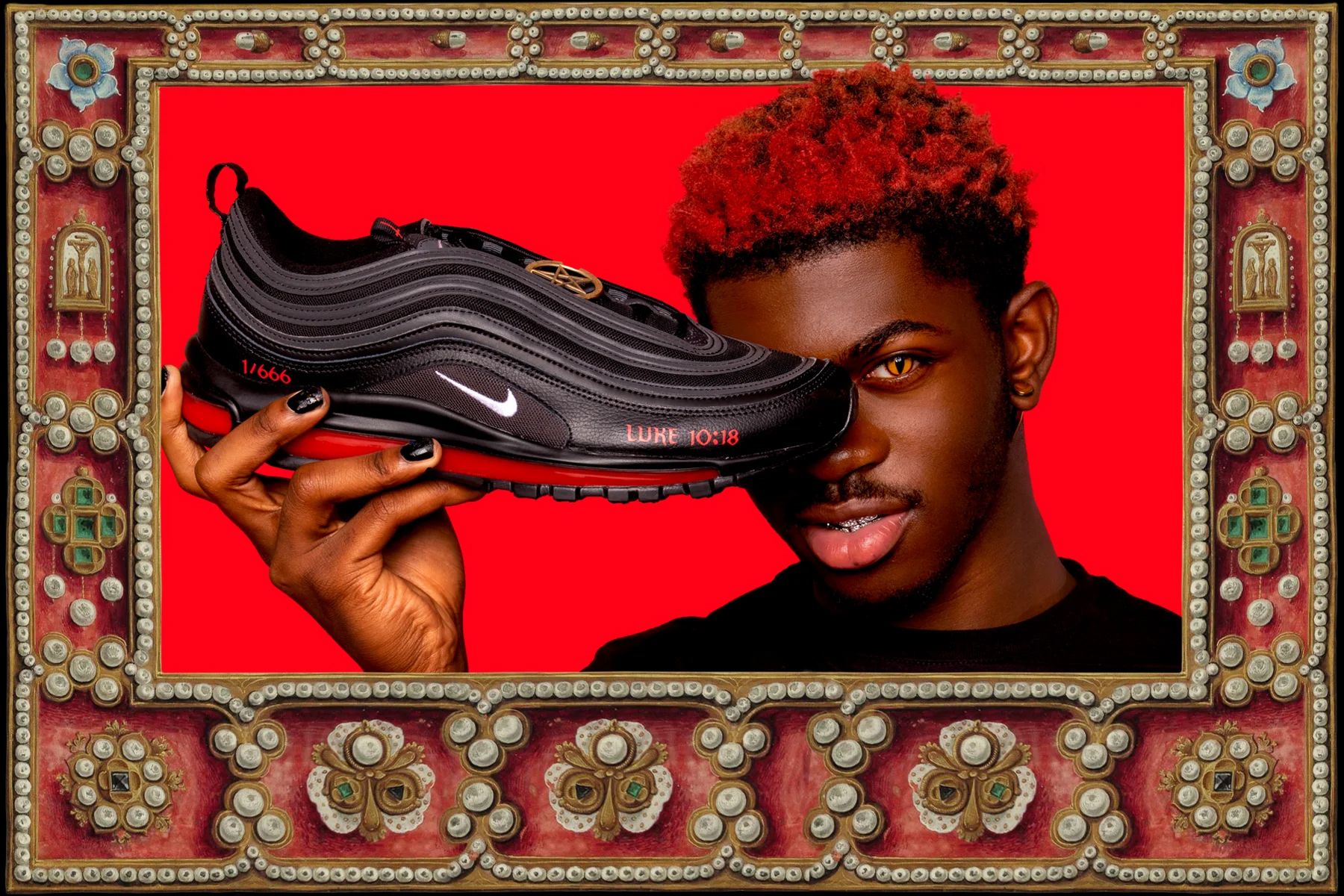


Saturday Morning Breakfast Cereal - Emotion
James.galbraithLOL phenomenal as always
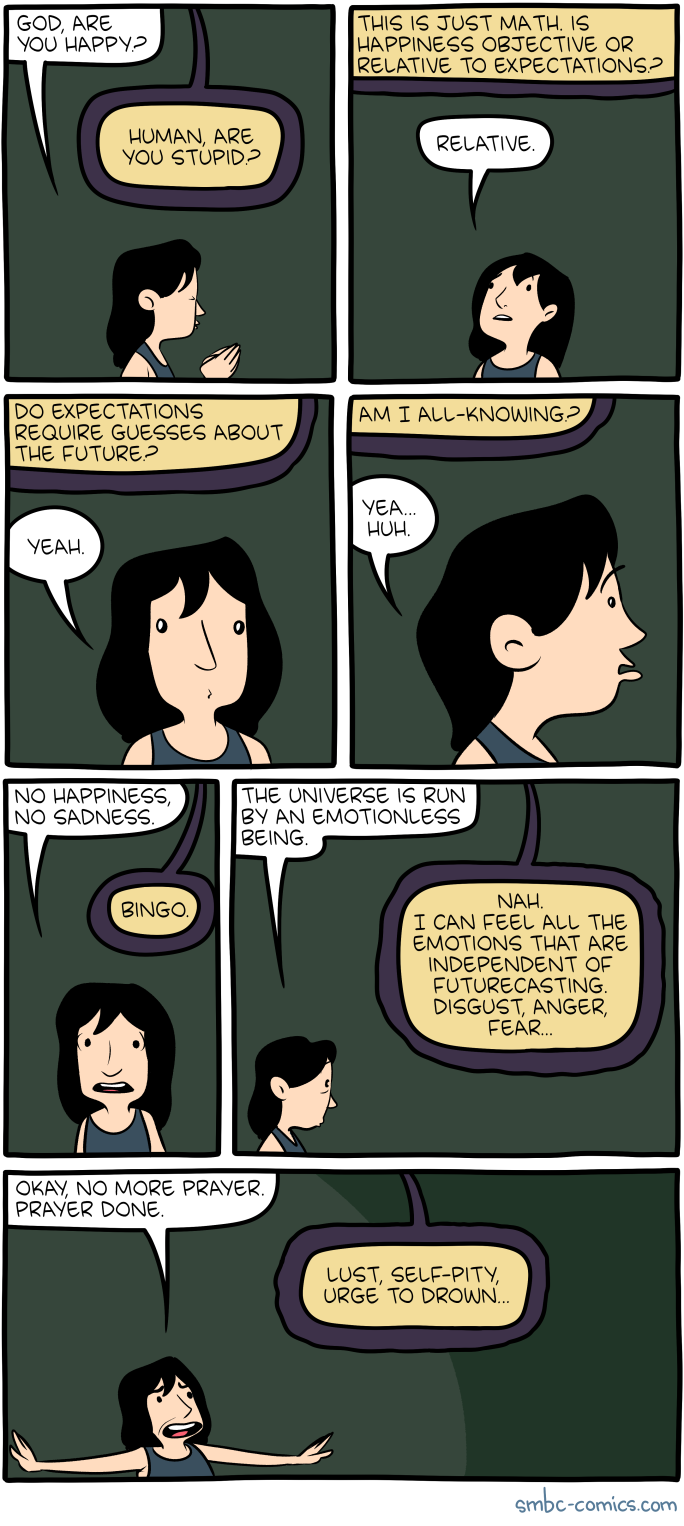
Click here to go see the bonus panel!
Hovertext:
I'm actually not sure any of those feelings work without time, so maybe the voice is just lying?
Today's News: