James.galbraith
Shared posts
Hungary slaps restrictions on LGBTQ+ books
James.galbraithThe future of the GOP
.jpg)
Legislators demand answers after report reveals 'blatant' racial profiling by Michigan border agents
James.galbraithjesus
The House Subcommittee on Civil Rights and Civil Liberties is calling on Department of Homeland Security (DHS) Sec. Alejandro Mayorkas to respond to a damning report by the American Civil Liberties Union (ACLU) of Michigan revealing widespread racial profiling of Latino residents in the state by Customs and Border Protection (CBP) officers.
“Most of the people apprehended by CBP were of Latin American origin, and nearly half—over 45%—were either U.S. citizens or had another kind of lawful status in the country,” chair Jamie Raskin and committee member Rashida Tlaib write. They say the report’s overall findings “suggest that CBP’s operations in Michigan are focused less on its lawful enforcement priorities than on harassing longtime residents of Michigan in a way that systematically and disproportionately target those of Latin American origin.”
Because of an obscure 100-mile zone law, border officials have believed they have the authority to carry out warrantless searches within the U.S. “CBP claims the entire state of Michigan falls within this 100-mile zone because it defines each of the Great Lakes as an international waterway,” the ACLU of Michigan said. And, border agents have used this supposed authority to engage in “blatant” racial profiling, the organization continues.
“Although people of Latin American origin comprise just 16.8% of the state’s foreign-born population, 85% of noncitizens apprehended by Border Patrol were from Latin America,” the report said. And, an overwhelming number of people being stopped by border agents have status. More than 33% are U.S. citizens. An additional 13% have some sort of lawful status. “Instead of following its mandate to patrol the Canadian border, Border Patrol is arresting people who, overwhelmingly, are established, long-term residents of Michigan.”
“The agency uses ‘complexion codes’ to describe people apprehended,” the report also noted. “Tellingly, more than 96% of those apprehended are recorded as being ‘Black,’ ‘Dark Brown,’ ‘Dark,’ ‘Light Brown,’ ‘Medium Brown,’ ‘Medium,’ or ‘Yellow.’” That last “complexion code” in particular seems very dated and offensive, by the way.
The ACLU’s report further noted how local and state law enforcement “play a key role in helping Border Patrol target people of color: Nearly half of Border Patrol apprehensions (48.6%) began with a state or local law enforcement agency initiating a traffic stop. Michigan State Police is, by far, responsible for initiating more contact with Border Patrol than any other police agency that results in people being detained and turned over to the federal agency’s custody.”
“More troublingly, the ACLU has identified at least 14 encounters where local law enforcement detained an individual absent a suspicion of wrongdoing and then handed them off to CBP agents,” Raskin and Tlaib tell Mayorkas. “Such prolonged stops are unconstitutional. In 2012, the Supreme Court warned that there are ‘constitutional concerns’ when state and local law enforcement ‘delay the release of detainees for no other reason than to verify their immigration status.’” Localities have in fact had to pay out millions in settlements to immigrants who were unjustly detained in this manner.
The report details one disturbing incident in particular, when U.S. resident Arnulfo Gomez and two passengers were pulled over by Michigan State Police, supposedly due to a loud exhaust pipe. For a moment it appeared they would be allowed to continue on, until an officer noted their accents and said that a colleague was nearby with a border agent. That agent then harassed Gomez’s wife, threatening her with arrest. The report said that Gomez watched the interaction in terror, fearful that their two U.S. citizen children would have their family torn apart.
Ultimately, they were allowed to leave. “There was no reason for him to pull us over,” Gomez said in the report. “As soon as he saw we are brown, he was after us. Then they called Border Patrol right away. Everything that happened to us was wrong. We were being targeted just because we are brown.” The ACLU of Michigan said in the report that “[u]nfortunately, this family’s experience is not unique.”
“We are deeply troubled by what appear to be discriminatory abuses of authority and misuse of taxpayer funds,” Raskin and Tlaib continue in their letter to Mayorkas. “DHS must provide a full explanation of exactly how it is addressing the problems laid bare by the ACLU.” The ACLU of Michigan thanked the committee for making the inquiry to Mayorkas, saying in a statement that “[w]e look forward to DHS’s response to the report and the reforms that come from this briefing.”

Edward Snowden and EFF Slam Apple's Plans To Scan Messages and iCloud Images
James.galbraithNo shit


Read more of this story at Slashdot.
Texas Republican who promoted mask burning dies of COVID-19
James.galbraithOh look, consequences.
On Aug. 4, the Galveston County Republican Party of Texas posted a sad tribute to H. Scott Apley, a Texas Republican Executive Committeeman who passed away after an acute case of COVID-19. “It is with an extremely heavy heart that we share the news of the death of H. Scott Apley, our friend, our Patriot in Arms, our State Republican Executive Committeeman, Precinct Chair, Dickinson City Council Member. A tragedy. Please pray for Melissa and Reid and their family. God remains in control although this is yet another tough one to swallow.”
Less than one week before this announcement, Apley himself posted an image of an anti-vaccination sentiment on his Facebook feed, mocking people for worrying about COVID-19. The post read: “In 6 months, we’ve gone from the vax ending the pandemic, to you can still get Covid even if vaxxed, to you can pass Covid onto others even if vaxxed, to you can still die of Covid even if vaxxed, to the unvaxxed are killing the vaxxed.” It was the last post he made. Two days later, H. Scott Apley was admitted to the hospital with “pneumonia-like symptoms,” and put on a ventilator.
According to a GoFundMe campaign set up for Apley and his family, H. Scott was admitted to a local hospital on Aug. 1, and was then quickly put on a ventilator. He died in the early hours of Aug. 4. According to KTRK, Apley’s wife Melissa and 5-month-old son Reid also tested positive for the virus. The surviving Apleys have not been hospitalized.

Apley’s political worldview seems to have been a typical Christian right-wing conservative one. Apley’s Twitter presence was made up of mostly Christian aphorisms and quotes from both Testaments, with some political posts scattered about. The general tenor of his politics had to do with keeping the federal government from what he perceived to be an infringement on citizens’ constitutional rights, extending to all of the standard conservative talking points, such as the need to lower taxes on corporations.
The Washington Post points out that Apley’s social media pages included not simply the anti-vaxx sentiments of the right, but also the anti-mask interpretation of freedom. In May, Apley posted an advertisement of a “Mask Burning” at a bar, writing “I wish I lived in the area!” He also posted a story about various ways in which Texas was trying to promote vaccinations by using incentives like tickets and giveaways, commenting that the efforts were “disgusting.”
Apley was an elected official on the Dickinson City Council and was also serving his first term on the Texas GOP’s State Republican Executive Committee.
H. Scott Apley was 45 years old. He leaves behind a wife and an infant son. This is tragic, in no small part because it was preventable.
Cartoon: Justice Breyer, the scrivener
James.galbraithYep it's gonna be a shitshow
Follow me on Twitter, Facebook, Instagram, or at my website.

Biden administration weighs compelling vaccinations by threatening to withhold federal funding
James.galbraithAbout fucking time
Vaccination is the only way out of the nation’s current COVID-19 surge. Immediate masking and other pandemic mitigation efforts are simply a bridge to the ultimate method for stopping the delta variant spread: widespread inoculation among U.S. residents.
But the Biden administration's largely effective vaccination program has run up against a red-state wall. In a sign of the frustration mounting within the West Wing, President Joe Biden on Wednesday told GOP governors who were thwarting local mitigation efforts to "get out of the way." Though Biden didn't name names or even parties, the comment was clearly directed at governors like Ron DeSantis in Florida, who only recently endorsed the vaccines but has tied the hands of local officials and school systems on issuing mask mandates.
According the White House, Florida and Texas alone have accounted for one-third of all new U.S. COVID-19 infections over the past week. Governors like DeSantis are literally telling Biden "do your job" on the pandemic while singlehandedly dooming him through their own gross mismanagement.
That has left Biden with the very real life-and-death predicament of how to reverse the current delta surge that has taken root in GOP-led states.
The administration is already requiring federal workers and contractors to either prove their vaccination status or be subject to mandatory mask-wearing and other pandemic mitigation efforts. The order covers some 4 million Americans nationwide, and the White House recently added teeth to the penalties for those who try to game the system.
Now the administration is reportedly weighing whether to withhold federal funding from certain institutions and entities as a way to potentially boost vaccination in regions where Biden lacks political sway. Roughly 90 million eligible Americans remain unvaccinated.
The Washington Post reports the move could affect entities ranging from long-term care facilities to cruise ships to universities. One possibility, for instance, is threatening to place restrictions on Medicare funding in order to push some nursing homes to enact vaccine mandates among their employees.
The president said his administration was exploring making such a policy move during a press event on Thursday. But time is of the essence. The mRNA vaccines like Pfizer and Moderna require at least a handful of weeks before the two-shot regimen provides full protection against infection. On Wednesday, the U.S. reported 100,000 new infections, numbers comparable to those in February, before the nationwide vaccination push had really ramped up.
Lawrence Gostin, director of Georgetown University’s O’Neill Institute for National and Global Health Law, has advocated for the White House to pull that lever. He told the Post it makes sense to push vaccinations in "high-risk settings with an absolute ethical obligation and legal obligation to keep your workers and your clients safe.”
But some public health experts want Biden to go even further, potentially mandating vaccinations nationwide. Last week, Biden said there was "still a question" whether he has the legal authority to issue such a blanket order.
Gostin is doubtful he does.
“The federal government can’t directly mandate a vaccine,” he said. “It can use its spending power to say to a state, ‘You mandate vaccinations. And if you don’t, we’ll withhold certain federal dollars.’ ” That's a lever that has been pulled in the past to compel states to raise their legal drinking age to 21 in order to get federal highway funding, for example.
Vaccine passports, which the White House had previously seemed to take off the table, are another possibility.
“If you established federal vaccine verification and then you required it for an increasing number of things, that would be helpful," offered Tom Frieden, Obama's former CDC director.
There's a model for taking such an action. French President Emmanuel Macron has effectively implemented a nationwide vaccine requirement for residents to participate in public life, spurring vehement resistance in some places but also pushing up vaccination rates. In the port city of Marseille, which is reportedly a hotbed of vaccine skepticism, appointments at one mass vaccination site have risen from under 1,500 a day to 2,500 a day more recently, according to Politico.
Any nationwide vaccination mandate Biden makes will likely draw legal challenges and surely draw political backlash.
But neither are a good reason for Biden to pull back from using every available tool that he reasonably determines could increase U.S. vaccination rates. No matter what happens, politically speaking, Biden needs to be able to argue that he exhausted every option he thought he could in order to save American lives.
Saturday Morning Breakfast Cereal - Revenge
James.galbraithheh
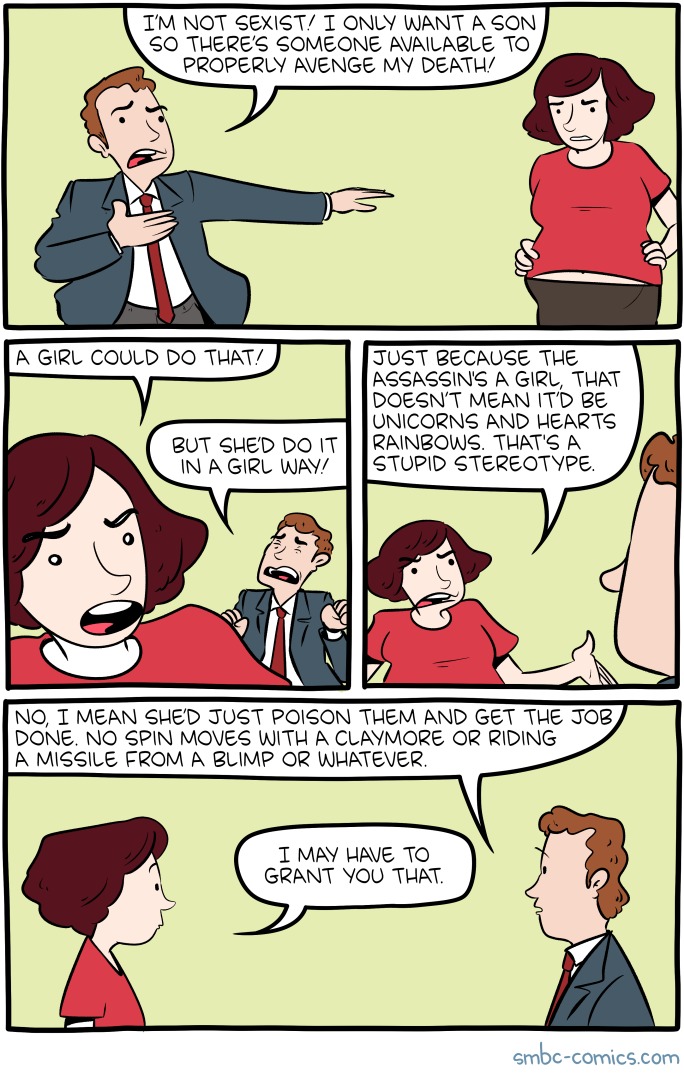
Click here to go see the bonus panel!
Hovertext:
For the record, missiles and blimps don't really work from a physics standpoint, but don't let that stop you being true to your bloodlust.
Today's News:
[Eugene Volokh] "Apple Plans to Scan US iPhones for Child Abuse Imagery"
James.galbraithYeah, no. There's no "hey we're scanning your phone for whatever we want and we'll report it to whoever we want" that's "designed with user privacy in mind".
They also omit the tools they now have to scan imessages in real time and provide helpful notifications for anything they think is naughty.
From Irish Times (Madhumita Murgia & Tim Bradshaw):
Apple intends to install software on American iPhones to scan for child abuse imagery, according to people briefed on its plans, raising alarm among security researchers who warn that it could open the door to surveillance of millions of people's personal devices….
The automated system would proactively alert a team of human reviewers if it believes illegal imagery is detected, who would then contact law enforcement if the material can be verified. The scheme will initially roll out only in the US….
The proposals are Apple's attempt to find a compromise between its own promise to protect customers' privacy and ongoing demands from governments, law enforcement agencies and child safety campaigners for more assistance in criminal investigations, including terrorism and child pornography….
"It is an absolutely appalling idea, because it is going to lead to distributed bulk surveillance of … our phones and laptops," said Ross Anderson, professor of security engineering at the University of Cambridge.
Although the system is currently trained to spot child sex abuse, it could be adapted to scan for any other targeted imagery and text, for instance, terror beheadings or anti-government signs at protests, say researchers. Apple's precedent could also increase pressure on other tech companies to use similar techniques….
It would be important to learn just how much government pressure Apple was under to implement such a feature, or even whether the government actively solicited this (even in the absence of coercive pressure). Some courts have concluded that the Fourth Amendment applies even to private searches if the police "instigated" or "encouraged" the search, and the private entity "engaged in the search with the intent of assisting the police"; see also, for instance, this decision and this nonprecedential decision. The Supreme Court's Skinner v. Railway Labor Executives' Ass'n points in that direction as well (though the program there had some special features, such as removal of legal barriers to the searches). Other courts, though, conclude that mere "governmental encouragement of private 'searches'" isn't enough, and that the private search becomes government action covered by the Fourth Amendment only if there is compulsion (perhaps including subtle compulsion).
Note, though, that there's also a twist here: The Court has held that police drug dog sniffs of luggage aren't "searches" for Fourth Amendment purposes because they "disclose only whether a space contains contraband" (setting aside the possibility of drug dog error), and thus don't invade any legitimate privacy interest. Could hash-value-based searches be treated the same way, so that even if Apple's search is treated as government action subject to the Fourth Amendment, it wouldn't be treated as a "search"? That's unsettled, see U.S. v. Miller (6th Cir. 2020):
Did the hash-value matching "invade" Miller's reasonable expectation of privacy? According to the Supreme Court, binary searches that disclose only whether a space contains contraband are not Fourth Amendment "searches." Illinois v. Caballes (2005). The Court has held, for example, that the government does not invade a reasonable expectation of privacy when a police dog sniffs luggage for drugs. United States v. Place (1983). Yet the Court has also held that a thermal-imaging device detecting the heat emanating from a house invades such an expectation because it can show more than illegal growing operations (such as the "hour each night the lady of the house takes her daily sauna and bath"). Kyllo v. U.S. (2001). Which category does hash-value matching fall within? Is it like a dog sniff? Or a thermal-imaging device? We also need not consider this question and will assume that hash-value searching counts as an invasion of a reasonable expectation of privacy. Cf. Richard P. Salgado, Fourth Amendment Search and the Power of the Hash, 119 Harv. L. Rev. F. 38 (2005).
If any of you know more about the governmental involvement in this decision, or for that matter the broader state action law related to such searches, please let me know. Thanks to Christopher Stacy for the pointer.
UPDATE: Here's Apple's announcement:
Another important concern is the spread of Child Sexual Abuse Material (CSAM) online. CSAM refers to content that depicts sexually explicit activities involving a child.
To help address this, new technology in iOS and iPadOS will allow Apple to detect known CSAM images stored in iCloud Photos. This will enable Apple to report these instances to the National Center for Missing and Exploited Children (NCMEC). NCMEC acts as a comprehensive reporting center for CSAM and works in collaboration with law enforcement agencies across the United States.
Apple's method of detecting known CSAM is designed with user privacy in mind. Instead of scanning images in the cloud, the system performs on-device matching using a database of known CSAM image hashes provided by NCMEC and other child safety organizations. Apple further transforms this database into an unreadable set of hashes that is securely stored on users' devices.
Before an image is stored in iCloud Photos, an on-device matching process is performed for that image against the known CSAM hashes. This matching process is powered by a cryptographic technology called private set intersection, which determines if there is a match without revealing the result. The device creates a cryptographic safety voucher that encodes the match result along with additional encrypted data about the image. This voucher is uploaded to iCloud Photos along with the image.
Using another technology called threshold secret sharing, the system ensures the contents of the safety vouchers cannot be interpreted by Apple unless the iCloud Photos account crosses a threshold of known CSAM content. The threshold is set to provide an extremely high level of accuracy and ensures less than a one in one trillion chance per year of incorrectly flagging a given account.
Only when the threshold is exceeded does the cryptographic technology allow Apple to interpret the contents of the safety vouchers associated with the matching CSAM images. Apple then manually reviews each report to confirm there is a match, disables the user's account, and sends a report to NCMEC. If a user feels their account has been mistakenly flagged they can file an appeal to have their account reinstated.
This innovative new technology allows Apple to provide valuable and actionable information to NCMEC and law enforcement regarding the proliferation of known CSAM. And it does so while providing significant privacy benefits over existing techniques since Apple only learns about users' photos if they have a collection of known CSAM in their iCloud Photos account. Even in these cases, Apple only learns about images that match known CSAM.
[Eugene Volokh] Police Recruiting Ad Lists "Qualified Immunity" as "Unique [Job] Benefit"
James.galbraithTime to remove qualified immunity entirely
A police department in New Hampshire is hiring! And it's delighted to offer such "unique benefits" as "qualified immunity." pic.twitter.com/4jilkjnMuB
— Isaac Scher (@isaacscher) August 3, 2021
You can see their retraction and apology here, together with public comments:
Qualified immunity is of course the (controversial) legal rule that government officials, such as police officers, generally aren't liable even for unconstitutional conduct unless "existing precedent" had made clear "beyond debate" that the conduct was unconstitutional.
New York legislature prepares for impeachment of increasingly isolated Gov. Andrew Cuomo
James.galbraithGet him out
Following Tuesday’s bombshell release of the New York attorney general's investigation report concluding that Democratic Gov. Andrew Cuomo sexually harassed 11 women, five district attorneys have confirmed that they’re investigating sexual harassment allegations against the governor, with two of them saying that they’ve already opened criminal investigations. Cuomo may have more immediate worries, though, as the Associated Press reports that 86 of the 150 members of the state Assembly say they support opening impeachment proceedings.
If a majority of the lower chamber votes to impeach him, Cuomo’s powers would be temporarily transferred to a fellow Democrat, Lt. Gov. Kathy Hochul; the governor would only regain his powers if he manages to avoid conviction in the Senate. It will likely be a little while, though, before impeachment can start. The Democratic-run Assembly has given Cuomo until Aug. 13 to submit evidence in his defense, and two members of the Judiciary Committee, Tom Abinanti and Phil Steck, tell the AP they expect the chamber’s investigation to end in “weeks or a month.”
The pair said that plenty of their colleagues want Cuomo impeached much faster following the release of Attorney General Tish James’ report. However, they argued that the Assembly needs time to build a strong argument for the Senate, which is also controlled by Democrats and would ultimately decide Cuomo’s fate.
Deputy Senate Majority Leader Mike Gianaris said that, should the Assembly vote to impeach, his chamber could begin Cuomo’s trial weeks later. As we’ve written before, members of New York’s highest court, known as the Court of Appeals, would also sit as jurors. Democratic Majority Leader Andrea Stewart-Cousins would not participate, however, because she is second in the line of succession after the lieutenant governor. As a result, the jury would consist of seven judges—all of whom are Cuomo appointees—and 62 senators, with a two-thirds majority, or 46 votes, needed to convict the governor and remove him from office.
Cuomo could avoid all this by resigning, but he’s continued to proclaim his innocence and refuse to quit. The governor was similarly defiant in March as more and more allegations surfaced about his behavior and other alleged abuses in office, but while he had enough allies back then to hang on, his situation has very much deteriorated following James’ Tuesday press conference. Several longtime Cuomo backers, including state party chair Jay Jacobs and the state’s influential unions, have turned against him, and the New York Times notes that he has very few prominent defenders left.
Indeed, Cuomo’s most high-profile advocate at this point may be disgraced Trump attorney Rudy Giuliani, who characteristically compared Cuomo’s situation to the multitude of allegations leveled at his old client. Giuliani’s son, former White House staffer Andrew Giuliani, announced earlier this year that he’d run against Cuomo.

Self-love
James.galbraithMatt in therapy is entertaining lol

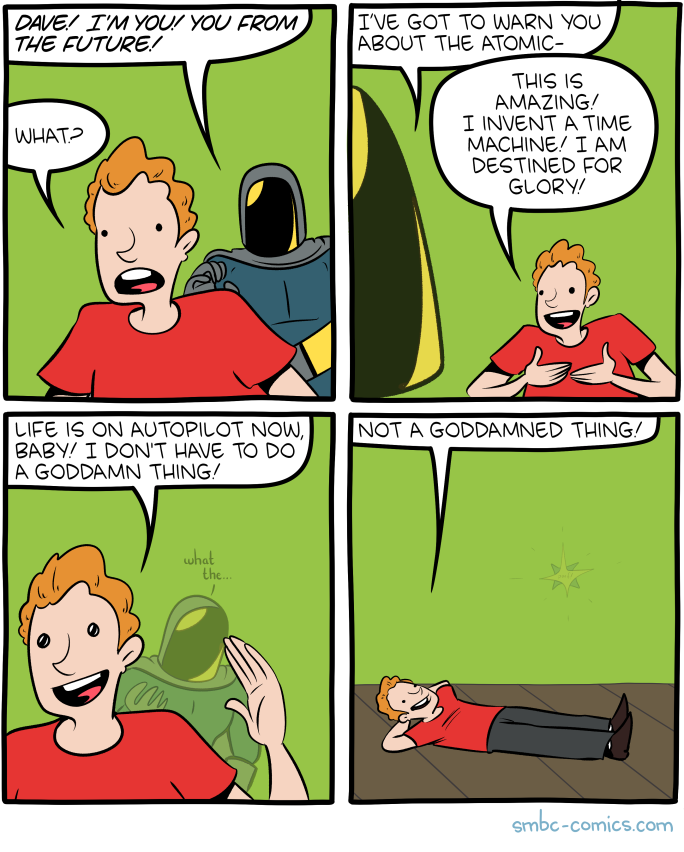
Saturday Morning Breakfast Cereal - Chess
James.galbraithLOL

Click here to go see the bonus panel!
Hovertext:
I think I can prove that all SMBC comics are good on a similar basis.
Today's News:
Blizzard's Dumpster Fire Keeps Getting Fuel Added
James.galbraithYup
Why it breaks your brain to take a compliment
James.galbraithLove this one

Up To Chance
James.galbraiththose are some Utah-level powers of self-delusion

what are the odds
Saturday Morning Breakfast Cereal - Future
James.galbraithlol
Why so many dead fish are washing up on Florida’s beaches
James.galbraithFlorida, surprise.

A toxic “red tide” is killing fish, displacing sharks, and going viral on TikTok. Is it getting worse?
This story is part of Down to Earth, a Vox reporting initiative on the science, politics, and economics of the biodiversity crisis.
The scenes from western Florida are hard to stomach: fish carcasses dotting beaches for miles, a backhoe lifting a 400-pound goliath grouper out of the water, hundreds of sharks swimming through neighborhoods, and hordes of maggots wriggling along the shore.
In the past three weeks, more than 1,700 tons of dead fish and other marine organisms and debris have washed ashore along beaches near Tampa Bay. They were killed by an overgrowth of toxic algae, known as red tide, that came inland earlier this summer.
While algal blooms are a natural phenomenon in southwest Florida — and across much of the world — they’re typically not this severe. The algae have not only killed untold thousands of fish and more than a dozen manatees but also sickened some beachgoers, who can experience respiratory issues when the toxins become airborne.
Now scientists are racing to determine what makes a year particularly bad for red tides — and whether they’re becoming more common. The last major red tide was just three years ago, when then-Gov. Rick Scott declared a state of emergency, as Vox’s Brian Resnick previously reported. The state’s current governor, Ron DeSantis, has rebuffed calls from environmental groups to declare a state of emergency for this year’s red tide.
Red tides in Florida result from a complicated set of variables, from ocean currents to weather patterns, researchers have learned. And while these events are not necessarily becoming more common, as you might expect, climate change is making them much harder to forecast — and Florida’s booming population is making them far more visible.
/cdn.vox-cdn.com/uploads/chorus_asset/file/22760508/GettyImages_1234097981.jpg) Octavio Jones/Getty Images
Octavio Jones/Getty Images
How a microscopic creature can kill so many fish
Dead fish, ruined vacations, and other consequences of Florida’s red tide can be tied to just one tiny species: Karenia brevis. It’s a type of marine algae, or phytoplankton, native to the Gulf of Mexico.
While they don’t always make national news, blooms of K. brevis typically occur every year. Starting in late summer, a deep-water current in the Gulf tends to move east toward Florida, causing an upwelling of nutrients like phosphorous and nitrogen that feed the algae and push them toward the coast, where they find other sources of nutrients.
/cdn.vox-cdn.com/uploads/chorus_asset/file/22760500/5807660623_328c28305c_o.png) Florida Fish and Wildlife Conservation Commission
Florida Fish and Wildlife Conservation Commission
Normally, the blooms — which can be a rusty red in hue — last for only a few months and impact a relatively small area. But on occasion, they grow uncontrollably and start wreaking havoc on marine ecosystems. That’s because K. brevis produces brevetoxin, an odorless neurotoxin that can be fatal to fish and other marine animals.
While scientists aren’t sure why the algae make toxins, one interesting theory is that it’s to kill fish by design. Rotting fish essentially fertilize the water, which in turn creates more algae. “The toxins have to have a purpose, and it might be killing fish to get the nutrients,” said Cynthia Heil, director of the Red Tide Institute at Florida’s Mote Marine Laboratory & Aquarium. “This little one-cell plant may actually be farming.”
In large numbers, these microscopic organisms also pose a threat to human health. Waves can break open the algae cells and release the toxin into the air. Inhaling it can cause respiratory issues and feel like “you’re starting to get a cold,” Heil said. Studies have linked severe red tides with a rise in hospital visits, especially among older adults.
/cdn.vox-cdn.com/uploads/chorus_asset/file/22759279/statewide_combo0730.png) Florida Fish and Wildlife Commission
Florida Fish and Wildlife Commission
/cdn.vox-cdn.com/uploads/chorus_asset/file/22760455/51328378513_dd53a93289_k.jpg) Florida Fish and Wildlife Conservation Commission
Florida Fish and Wildlife Conservation Commission
Why this year’s red tide has been so bad
Although K. brevis is well-studied, it’s still not clear why it explodes in some years. Each major red tide event seems to have its own unique equation, experts say.
This year, southerly winds helped keep the bloom close to shore, where it could feed off pollution spilling into the water. Meanwhile, months of drought ahead of Hurricane Elsa likely made estuaries around Tampa Bay saltier, allowing the marine algae to move farther inshore. Plus, more than 200 million gallons of wastewater from an abandoned phosphate mine known as Piney Point was pumped into Tampa Bay last spring.
“There was this huge pulse of nutrients into the bay,” Heil said. While it didn’t outright cause the bloom, it may have made it worse, she added. “It’s been a very odd year.”
Ultimately, the red tide killed more than 1,700 tons of sea life in Pinellas County, which hugs Tampa Bay, and that number could continue to grow. The bloom is also implicated in the death of 17 manatees in June and July, according to the Florida Fish and Wildlife Conservation Commission (FWC).
Floridians also reported seeing hundreds of live sharks evading the red tide by swimming into human-made canals and waterways in the Tampa region. “You literally could have walked across the canal on the backs of sharks — that’s how many there were,” Janelle Branower, a resident of Longboat Key, told Allyson Henning, a reporter with a local NBC news channel.
The toxic bloom is now beginning to dissipate, and hundreds of government workers have been working to clean up mountains of dead fish. (In Pinellas County, dead fish can be burned along with other trash to produce electricity, a county official told Vox.) But it’s only a matter of time before the next severe bloom strikes, experts say.
/cdn.vox-cdn.com/uploads/chorus_asset/file/22760461/51345153117_09152555f5_k.jpg) Florida Fish and Wildlife Conservation Commission
Florida Fish and Wildlife Conservation Commission
Red tides aren’t becoming more common in Florida
A cursory glance at state data showing the number of red tides over time suggests that these events are becoming more common in Florida. That’s in line with a handful of media reports that indicate climate change is fueling harmful algal blooms.
But that frightening conclusion isn’t quite right, experts say. “I don’t think we’re in a position to say with any certainty that the frequency of the events has been increasing,” said Thomas Frazer, a professor in the college of marine science at the University of South Florida. A recently published review of the evidence came to the same conclusion for Florida’s red tides: “no significant trend over time is evident,” the review reads.
So why do harmful blooms appear to be increasing?
For one, scientists have ramped up sampling efforts over time, Frazer said. The more you sample, the more likely you’ll be able to detect a toxic algae bloom. Florida has also seen a massive influx of residents in the past decade, so there are simply more people affected by red tides. “Each new bloom is undoubtedly the worst for many residents, regardless of trends,” Heil said. Plus, social media platforms like TikTok have brought a new level of attention to algal blooms. (Several top recent red tide videos on TikTok have tens of thousands of views.)
/cdn.vox-cdn.com/uploads/chorus_asset/file/22760468/GettyImages_1234099397.jpg) Octavio Jones/Getty Images
Octavio Jones/Getty Images
/cdn.vox-cdn.com/uploads/chorus_asset/file/22760443/GettyImages_1234098725.jpg) Octavio Jones/Getty Images
Octavio Jones/Getty Images
“You should not underestimate that there is a very strong human behavior factor involved,” said Gustaaf Hallegraeff, a professor emeritus at the University of Tasmania who’s been studying harmful algal blooms for decades. “The more people there are on the coast, the more blooms they see.”
Hallegraeff points out that records of red tides date back hundreds of years, and fish kills have been documented since at least the mid-1800s. The worst bloom in history — which spread from Sarasota down to the Florida Keys — was likely in 1947 and killed an estimated half a billion fish.
Climate change is making blooms unpredictable, but forecasts are improving
There’s some reassuring news in this history, Hallegraeff says. For one thing, “it’s not a new phenomenon. It’s always been there.” Other parts of the world are dealing with new outbreaks of harmful invasive species, he said, and this isn’t one of those.
Still, red tides could get more severe or longer-lasting, he said, as coastal houses and factories contribute to algae-fueling pollution. (There’s not great data showing whether the severity or duration of blooms is increasing, and it’s still a matter of debate among scientists.)
“Red tides are naturally occurring, but we have the capacity to make them worse,” Frazer said. “Increased nutrient delivery is a global problem and arguably the largest problem affecting water quality around the globe.” Nutrient-rich runoff is also fueling a massive “dead zone” farther east in the Gulf of Mexico, which is also caused by algal growth.
Climate change is certain to have some effect, experts say. Rising temperatures can alter ocean currents, raise sea levels, heat the water, and increase the frequency and intensity of droughts and hurricanes. Meanwhile, carbon dioxide affects the acidity of water and the growth rate of photosynthetic organisms like algae. All these variables will likely impact red tide. “Climate change makes algal blooms less predictable,” Hallegraeff said. “That’s the real impact.”
It’s a good thing, then, that researchers are getting better at forecasting blooms. The Florida Fish and Wildlife Conservation Commission can process hundreds of water samples a week, with the help of a sampling robot that measures levels of K. brevis and whether they’re growing.
“The more we know about the ecology of the organism, the better we are able to model it under different conditions,” said Kate Hubbard, director of the Center for Red Tide Research at FWC. Researchers are also experimenting with tools that can fight the blooms directly, from clay (which is used to fight blooms in China) to brewer’s spent grain (a common byproduct in making beer).
In the meantime, the National Centers for Coastal Ocean Science runs a respiratory forecast for red tide in beaches in western Florida, which is updated every three hours. “It’s really helpful to have these new forecasting tools and models that try to predict where it’s good to go, given that there’s an ongoing bloom,” Hubbard said. “It can change over the course of the day, or over the course of a few days — it’s a dynamic organism.”
The anti-American right
James.galbraithYep, the GOP has turned into a traitor party.

Rooting against Olympians, scoffing at Capitol police, broaching civil war — meet today’s conservative movement.
The Olympics are typically a boom time for jingoism: patriotic fervor heightening among Americans of all stripes with each gold medal for Team USA. But this year, we’ve seen an unlikely faction of Americans rooting against our athletes: conservatives.
During a late July rally, President Donald Trump claimed that “Americans were happy” about the women’s soccer team losing to Sweden — a loss that he blamed on “wokeism” turning the squad “demented.” Tomi Lahren called Team USA “the largest group of whiny social justice activists the Olympics has seen in decades,” accusing them in a Tuesday Fox News segment of engaging in “typical leftist so-called activism.” And after the men’s basketball team lost to France, Newsmax host Grant Stinchfield said he “took pleasure” in their defeat.
“The team is filled with anthem kneelers — and I find it ironic that they’re willing to put USA on their chest when, in the not so distant past, they would kneel for the anthem. Somebody ought to go up there and just rip USA off their chest,” said Stinchfield, who briefly went off the air earlier this year after insinuating that Jewish Americans are foreigners during a monologue.
These attacks on Team USA are not just culture war red meat; they are a reflection of a rising tendency in the conservative movement to reject America itself. In this thinking, the country is so corrupted that it is no longer a source of pride or even worthy of respect. In its most radical versions, you even see cheerleading for revolution or civil war.
Conservative anti-Americanism still pays lip service to love of country: Its proponents declare themselves the true patriots, describing their enemies as the nation’s betrayers. But when the cadre of traitors includes everyone from election administrators to Olympians to the Capitol Police, it becomes clear that the only America they love is the one that exists in their heads. When they contemplate the actual United States — real America, if you will — they are filled with scorn.
“They see no role or place for themselves in America now,” says Paul Elliott Johnson, a communications professor at the University of Pittsburgh who studies conservative rhetoric.
What’s striking about this strain of anti-American thought is how pervasive it is. Naturally, you frequently hear versions of it from rank-and-file conservatives and the carnival barkers of the right-wing echo chamber — but it doesn’t stop with them. Its most refined and troubling versions come from the highbrow thinkers of the Trumpist right; leading conservative politicians put their stamps on it.
While not entirely new — this has been bubbling up for years now, especially since Trump’s rise — the recent flare-up amid the Olympics and the January 6 hearings only underscores that influential elements of the American right seem past beyond the point of no return. These conservatives do not believe in sharing America with those who disagree with them. Forced to confront the country’s political diversity in the Biden era, they are choosing to turn on America rather than accommodate themselves to its reality.
How the right’s hyper-patriotism curdles into anti-Americanism
In the Jewish community, many of us have a suspicion of non-Jews who are a little too outspoken about how much they like Jews. These “philo-Semites” often end up being funhouse mirror anti-Semites, spreading stereotypes in the name of praising us. Trump’s infamous comment about Jewish accountants — “the only kind of people I want counting my money are short guys that wear yarmulkes” — is a perfect example.
Conservative anti-Americanism is a little like this. It’s a hyper-patriotism gone sour: a belief in a fictional ideal of a perfect right-wing America that’s constantly betrayed by reality, leading to disillusionment and even disgust with the country as it actually exists.
Trump’s 2016 address to the Republican National Convention, which promised “a straightforward assessment of the state of our nation,” painted a picture of a country on the verge of collapse. “The attacks on our police and the terrorism in our cities threaten our very way of life,” then-candidate Trump said. “Our roads and bridges are falling apart, our airports are in third-world condition, and 43 million Americans are on food stamps.”
This dark depiction of the state of the country has become a hallmark of the Trumpified GOP, and Democrats’ 2020 electoral victories only deepened the conservative sense of betrayal at the hands of their countrymen. In late July, Ohio Senate candidate J.D. Vance warned that “we have lost every single major cultural institution in this country” — and suggested that America “has built its entire civilization” around selfish, miserable people. Earlier that month, South Dakota Gov. Kristi Noem said “I look at Joe Biden’s America, and I don’t recognize the country that I grew up in.”
The Olympics have brought out this sense of alienation from America on the right. When conservatives see American athletes representing values at odds with their vision for the country, they don’t back Team USA in the name of patriotism — they turn on the icons of the nation itself.
Queer female soccer stars demanding equal pay, Black basketball players kneeling to protest police brutality, the world’s best gymnast prioritizing her mental health over upholding the traditional ideal of the “tough” athlete — this is all a manifestation of the ascendancy of liberal cultural values in public life. And an America where these values permeate national symbols, like the Olympic team, is an America where those symbols are worthy of scorn.
/cdn.vox-cdn.com/uploads/chorus_asset/file/22758654/1332161142.jpg) Jamie Squire/Getty Images
Jamie Squire/Getty Images
“So much of the self-perception of the American right is about losing the culture war. And that, specifically, is where some of this overt anti-Americanism — especially from the grassroots — is coming from,” says David Walsh, a post-doctoral fellow at the University of Virginia who studies the history of the right.
That disdain has also seeped into the right’s recent rhetoric toward an institution that conservatives have typically celebrated: law enforcement.
When Capitol police officers testified to the House about their experiences during the 1/6 attack, ostensibly pro-police conservatives vilified them. Fox’s Tucker Carlson laughed at Officer Michael Fanone’s claim to experience “psychological trauma” after the attack; fellow host Laura Ingraham gave out mock acting awards to the officers, implying their experiences were fake or ginned up.
The willingness to attack police officers who defended an attack on the seat of American government gets at the through-the-looking-glass ugliness of contemporary right-wing patriotism.
Over the weekend, the New York Times reported that leading elected Republicans have “concocted a version of events in which those accused of rioting were patriotic political prisoners and Speaker Nancy Pelosi was to blame for the violence.” Their base is listening: a recent poll from CBS-YouGov found that over half of Trump voters believe it’s appropriate to describe the events of January 6 as an act of “patriotism.”
The intellectual home of the anti-American right
This kind of anti-Americanism isn’t just the province of Fox News provocateurs and base voters. It’s also prevalent in the movement’s most intellectually rarefied corners.
The hub seems to be the Claremont Institute, a think tank based in Southern California, and affiliated institutions like Hillsdale College. Claremont is undoubtedly the most radically pro-Trump of any major right-wing intellectual institution, its thinkers most willing to defend both his presidency and his false claims of a stolen election. Claremont’s output in the past year has been astonishingly radical, all but openly calling for regime change and rebellion.
“Increasingly,” historian Joshua Tait writes in The Bulwark, “these [Claremont] patriots appear to actively hate America and their fellow citizens.”
In a May podcast, Hillsdale College lecturer and former Trump administration official Michael Anton chatted with entrepreneur Curtis Yarvin — a self-described monarchist who wants to appoint a Silicon Valley CEO king of America — about their shared desire to topple what Anton terms the American “regime.”
During the episode, Yarvin muses about how an American strongman — whom he alternatively calls “Caesar” and, more honestly, “Trump” — could seize authoritarian control of the US government by turning the National Guard and FBI into his personal stormtroopers. Critic Damon Linker identifies this politics, which meets with little pushback from Anton, as “broadly coterminous with fascism” — and it’s hard to see where he’s wrong. The pining for a strongman stems from disgust with an America Yarvin and Anton no longer recognize, a country they describe as a “theocratic oligarchy” controlled by a cadre of progressive “priests.”
In the American Mind, Claremont’s blog, writer Glenn Elmers declares that “most people living in the United States today — certainly more than half — are not Americans in any meaningful sense of the term.” If Trump voters and conservatives do not band together and wage “a sort of counter-revolution” against these “citizen-aliens,” then “the victory of progressive tyranny will be assured.”
Elmers intimates that violence will be a part of this struggle. “Learn some useful skills, stay healthy, and get strong,” he advises his fellow conservatives. “Strong people are harder to kill.”
/cdn.vox-cdn.com/uploads/chorus_asset/file/22758679/1230458461.jpg) Joseph Prezioso/AFP/Getty Images
Joseph Prezioso/AFP/Getty Images
And an essay in the Claremont Review of Books by scholar Angelo Codevilla describes a country whose government is clinging to “an illusion of legitimacy” after “a half-century of Progressive rule’s abuse” has demolished American society.
“The War on Poverty ended up enriching its managers while expanding the underclass that voted for them. The civil rights movement ended up entitling a class of diversity managers to promote their friends and ruin their opponents,” Codevilla writes. “There is no end to what the Left can do because there is so little that conservatives do to fight back.”
Over email, Tait tells me that Claremont has become the foremost center of anti-American right-wing thinking in large part because of its “sacralized view of American history as an ideal regime.”
Even among conservatives, generally a nostalgic bunch, Claremonters are particularly inclined toward veneration of the unique wisdom of the country’s founders and early America. This makes them particularly inclined towards a sense of political betrayal — and the same kind of hyper-patriotic anti-Americanism that motivates anti-Olympian, pro-Capitol riot punditry.
Abandoning America
A sense that the country has strayed because of liberalism has long been a core part of American conservatism. But this idea has become particularly dominant now due to the influence of both the Trump presidency and longer-term trends — most notably demographic change and defeats on culture war fronts like same-sex marriage.
Barack Obama’s 2008 election victory, powered by an expanding minority population and a left-ward tilt among the young, convinced many Republicans that they might well be consigned to permanent minority status. The left’s subsequent total victory in the central culture war topic of the 2000s, same-sex marriage, led many conservatives to believe that they had no power over a culture whose values were tilting inexorably leftward.
Combine all that with liberal dominance in mainstream American culture — Hollywood, media, academia, and even a growing share of corporate America — and you have a recipe for rising conservative alienation from the country they claim to love.
Part of Trump’s political genius was his ability to harness this sentiment among the conservative elite and rank-and-file and make a movement out of them.
There’s a reason that the most famous intellectual case for Trump is Anton’s “Flight 93” essay — a 2016 argument that a Trump victory was the only way to avoid national suicide. It revealed the sense of desperation that animates the modern right, a deep-seated fear of losing their country permanently.
During his initial campaign and presidency, Trump tapped into this sentiment by explicitly dividing the country into good Americans that supported him and his people and bad ones that did not. He found that there was a market in his party for a style of politics that eschewed unifying bromides and high-minded patriotism in favor of division and cruelty; he made it okay to say openly that you just hated the other side and didn’t want to share the country with them anymore.
Trump was all the permission that many in the conservative movement needed to finally express what it really felt about the American experiment. After his defeat, the sense of marginalization that animated his original campaign has come roaring back — a feeling of utter alienation manifesting in vicious attacks on the country’s symbols and government.
“For most parts of the right, there was this idea that you could still redeem the country — that you could reverse these long-term trends by political organizing, electing conservatives to political office, etc.,” Walsh, the UVA scholar, tells me. “Today, there is this move away from even the trappings of the American democratic tradition — and I think that is linked to the broader sense that this country can no longer be redeemed.”
One policy that could challenge a century of fossil fuel dominance
James.galbraithThis would be huge

A clean electricity standard could be “the biggest change in our energy policy since the lights went on.”
A time when the United States runs mostly on wind- and solar-powered electricity could be a reality in only a few years. It wouldn’t require any scientific breakthroughs or technological leaps for clean energy to overtake coal and natural gas, which still dominate 60 percent of the US power sector. What it would take to challenge a century of fossil-fuel dominance in record-breaking time is one sweeping, underappreciated policy: a clean electricity standard.
This policy could be “the biggest change in our energy policy since the lights went on,” Minnesota Sen. Tina Smith told Vox in a July interview. She called it the “centerpiece” of Democratic climate policy under President Joe Biden.
This potentially game-changing policy is now inching closer to becoming law. The US House of Representatives on Tuesday approved the outlines of a $3.5 trillion budget that includes at least $150 billion for a clean electricity standard. If the proposed budget survives negotiations in the coming weeks, it could solidify some of the Biden administration’s most ambitious climate goals — most of which were stripped out of the bipartisan infrastructure deal that the Senate passed on August 10.
One way to understand why this relatively arcane policy is now center stage is to consider what happens without it. Millions of consumers have electrified their cars and appliances, and many cities and states are electrifying public services such as public transportation — but these activities still draw most of their charge from dirty power plants. The electricity sector has slowly been cleaning up its act, and is now powered by around 20 percent solar and wind and around 20 percent nuclear.
But this summer of climate disasters is a vivid reminder that the transition can’t come soon enough. Yes, Americans have increasingly adopted solar panels to save money, while 30 states and more than 100 cities have adopted clean electricity targets — most ambitiously, Oregon’s recent passage of a goal of 80 percent reduction in power emissions by 2030. Still, these actions and uneven state progress don’t match the pace that’s needed to slow catastrophic warming across the planet.
The fate of a federal clean electricity standard is still very much undecided. The specifics of the reconciliation package could still change drastically in the weeks to come, and every Senate Democrat will now need to agree on the clean electricity standard if they want to push it through the process known as budget reconciliation.
A clean electricity standard is a bit of a misnomer because the actual policy being discussed is even more boring-sounding: a clean electricity payment program that pays utilities to clean up their act and fines them for missing deadlines. Still, this approach could effectively double the amount of wind and solar on the market, moving the nation toward roughly 80 percent renewable sources of electricity by 2030, and within reach of 100 percent clean electricity by 2035. It’s critical to getting the US halfway to Biden’s pledge under the Paris climate agreement.
The clean energy transition — which has perhaps prematurely been called a “revolution” — has made progress in “an incremental, disjointed way” until now, said Pam Kiely, a climate expert at the Environmental Defense Fund. She says Washington is finally recognizing the urgent need for “binding requirements that ensure you get the outcomes you want.”
The “multiplier effect” of a clean electricity standard
Do the math, climate experts say, and there’s no way to tackle the climate crisis without cleaning up the electricity sector.
Two of the biggest ways Americans contribute to climate change are their transportation and electricity usage. You might cut your carbon footprint by making your home more efficient, installing a solar panel, and even buying an electric car — and the power that flows from your outlet is a lot cleaner than it was a decade ago. But coal and natural gas, more often than not, are still the status quo. This reality limits the impact of well-meaning actions: A coal-fired power plant may be charging your Tesla, and gas might be powering your office’s air conditioning.
“If we’re electrifying cars so they don’t rely on oil, and electrifying buildings so they don’t leach gas, then what they rely on can’t be just as dirty as what’s been replaced,” said Sam Ricketts, a senior adviser for the climate group Evergreen Action.
If you live in one of the states that has adopted its own clean electricity standard, that power may be getting cleaner: 345 coal plants have retired in the past decade or will soon retire across the country, according to the Sierra Club. That still leaves 185 active coal plants operating in the country — and, worryingly, about 250 new gas plants planned for construction over the next 20 years. By making it economically impossible to keep coal plants up and running, a clean electricity standard could push coal to zero and slow the growth of natural gas.
“By cleaning up our power sector, we can have a dramatic impact on carbon emissions,” Smith said. “And when we combine that with other policies to electrify transportation, and to electrify building heating and cooling, it has a multiplier effect throughout the whole economy.”
In other words, to seriously slash pollution, the country needs to multitask. As the electric vehicle market booms and buildings upgrade to electric heating and cooling, their sources of electricity will also be modernizing in what could be a virtuous cycle: Electricity becomes a bigger share of US energy use, and clean electricity becomes a bigger share of electricity as a whole.
/cdn.vox-cdn.com/uploads/chorus_asset/file/22751358/Screen_Shot_2021_07_30_at_11.39.02_AM.png) EIA.gov
EIA.gov
The biggest short-term benefits aren’t even about climate change. Continuing to cut coal also slashes the country’s air pollution, like the ozone and particulates that damage people’s lungs and hearts. These gains would easily dwarf what the Environmental Protection Agency has accomplished under previous presidents because it would close more coal-powered plants than even President Barack Obama’s most effective environmental regulation, the mercury and air toxins rule.
And then there are the lives saved, according to research from Harvard University: By 2030, the policy would save 9,200 lives because of the sudden cut in air pollution. Over the next 30 years, that number grows to 317,500 lives saved.
For those who think about the benefits in dollars, a clean energy transition would create 500,000 to 1 million net new jobs over the course of the 2020s, according to a study from Princeton’s Andlinger Center for Energy and the Environment. “Job losses in extractive fossil industries are more than offset by an increase in construction and manufacturing in the clean energy sector,” the study found. Cutting air pollution also translates into the equivalent of $1.7 trillion in benefits from reduced health care costs, economic productivity, and lives saved, according to the climate think tank Energy Innovation.
There’s a narrow path for Democrats to pass a clean electricity standard
We know roughly what a clean energy standard would look like, based on a blueprint from Senate Majority Leader Chuck Schumer that was shared with reporters in July.
The vision environmentalists have pushed for, and Smith has supported, would reward utility companies for adopting clean energy — hence the roughly $150 billion price tag — and fine them for missing targets. It’s a carrot-and-stick approach to prioritize wind and solar over coal and gas, staying on schedule with rising targets every year. The aim is to reach 80 percent clean energy by 2030.
Biden initially wove many of his ambitious climate policies into a single large infrastructure proposal, which was then split into two parts — one bipartisan bill that needed 60 votes to avoid a filibuster, and one maneuver known as reconciliation that allows Democrats to pass a budget with a simple majority vote.
Some media outlets have called the new reconciliation agreement a “social spending plan,” but that label downplays the important climate policies it contains. On Wednesday, Schumer’s Senate office released its own analysis of how the trillion-dollar infrastructure package and $3.5 trillion reconciliation budget would cut climate pollution. The clean electricity standard, combined with a decade’s worth of clean energy tax credits, had the biggest impact by far, according to Schumer’s office.
Combined with other climate-friendly policies, like electric vehicle investments and a price on methane pollution, these pieces of legislation could spur a 45 percent reduction by 2030 (compared to 2005 pollution levels). Add in state action and Biden’s executive powers, and Schumer says “we will hit our 50 percent target by 2030” that the president has promised. Schumer’s office did not immediately respond to questions about its methodology.
/cdn.vox-cdn.com/uploads/chorus_asset/file/22804842/Screen_Shot_2021_08_25_at_11.43.37_AM.png)
That’s just a framework, though, and these numbers could change significantly. It’s still too early to know whether Republicans and moderate Democrats will fight the clean electricity standard, as they have with some of Biden’s other climate ambitions — arguing, for example, that the federal government shouldn’t pick winners and losers in the private sector, or that such policies are an inefficient use of taxpayer funds. Key Senate Democrats, critical to the final vote, have at times been skeptical of the reconciliation bill’s overall cost.
Ricketts, with Evergreen Action, dismissed concerns over the price tag. “We know there’s a cost to this energy transition,” he said. He argues that if the federal government doesn’t step up, those costs could instead end up in consumers’ energy bills.
“If we want to make the clean energy transition happen, we need to ensure investments reach every region and benefit every community,” Ricketts adds. He calls the clean energy proposal “a progressive, job-creating policy to drive an effective clean electricity transformation over the coming decade.”
Even among supportive congressional Democrats, there’s some debate over how to account for fossil fuel plants that promise to capture and store their pollution, and how to treat natural gas, which still contributes to climate change but accounts for less carbon pollution than coal. Many environmental groups have called carbon capture and natural gas “false solutions” to climate change.
Since the US rejoined the Paris climate agreement in the early days of Biden’s presidency, Democrats have had an added incentive to pass lasting climate policies. To prove that their agenda won’t unravel in a few years if the next president is a climate change denier, the United States could show up to the next major international climate change conference — held in Glasgow this fall — with a freshly minted budget that moves the country toward 100 percent clean energy. Or it could show up empty-handed, without a serious plan for getting to Biden’s target of a 50 percent cut in overall climate pollution by 2030.
Democratic leaders acknowledged as much in a press conference last month. “My great hope is that we go to Glasgow with a great climate bill that will demonstrate our commitment to our Paris objectives,” said California Rep. Mike Levin, one of 134 House representatives who signed on to a letter calling for 100 percent clean electricity by 2035.
Smith also sees this as a make-or-break moment: “I don’t see how you can reach our climate goals, nor how you can reach our goals for creating clean energy jobs and for creating a healthier, more equitable economy, without this kind of bold policy.”
Update, August 25: Updated to include the budget passing the House and new analysis from Majority Leader Schumer’s office.
The lapsed eviction moratorium is the Supreme Court’s fault
James.galbraithDems bad at politics, people are stupid. No shit.

Democrats are too busy infighting to place blame where it belongs.
On Sunday, a federal eviction moratorium, which was intended to prevent renters from losing their homes in the midst of a pandemic, expired.
At its height, this moratorium may have saved as many as 40 million Americans from eviction. But, in late June, the Supreme Court signaled that this moratorium must expire at the end of July, effectively leaving many renters without protection.
In theory, most of these renters — and their landlords — should have received federal housing assistance. Over the course of the pandemic, Congress allocated $45 billion in rent relief to help people struggling financially due to Covid-19. But the state and local governments charged with distributing these funds have struggled to disburse them quickly.
That means lots of people are behind on their rent and now at risk of eviction. And, because a closely divided Congress is barely able to function even under ideal circumstances, it also appears to mean that congressional leaders are eager to shift blame for a possible eviction crisis elsewhere.
On Sunday, House Speaker Nancy Pelosi and her Democratic leadership team put out a perplexing statement. Although the Supreme Court bears primary responsibility for the end of the eviction moratorium, the words “Supreme Court” do not appear anywhere in the House Democratic leaders’ statement about the now-expired moratorium. Instead, the statement insists that “action is needed,” and then it falsely claims that an effort to “extend the moratorium” must “come from the Administration.”
There is, in fairness, plenty of blame to go around for why the moratorium did not continue after the Court-imposed deadline of July 31.
After President Joe Biden called upon Congress to pass a new law extending the moratorium on Thursday, Pelosi attempted to find the votes to pass such a moratorium through the House — but ultimately came up short in a closely divided chamber where a handful of right-leaning Democrats can scuttle any bill.
Some House Democrats blamed Biden for not speaking out sooner about the need for a moratorium. And, of course, everyone can blame the Senate.
“It is clear that the Senate is not able to” extend the moratorium, the House leaders said in their Sunday statement, adding that “any legislation in the House, therefore, will not be sufficient to extend the moratorium.” In order to pass an extension through the Senate, Democrats would need to either secure 10 Republican votes to break a filibuster or unanimously agree to change the Senate’s rules to bypass the filibuster — something several conservative Democratic senators refuse to do.
But none of the figures implicitly implicated by the House leaders’ statement — Biden, Senate Republican Leader Mitch McConnell, or filibuster defenders like Sens. Joe Manchin (D-WV) and Kyrsten Sinema (D-AZ) — bear the lion’s share of the blame for the moratorium expiring.
That blame should rest with five Republican appointees on the Supreme Court.
The Supreme Court is dismantling much of the Biden administration’s ability to govern
Many federal laws give federal agencies the power to regulate businesses and individuals. The Clean Air Act and Clean Water Act, for example, give the Environmental Protection Agency a fair amount of authority to control pollution and reduce harmful emissions. The Affordable Care Act allows experts in the Department of Health and Human Services to require insurers to cover many medications and vaccines. The Department of Labor has some discretion to determine which workers are eligible for overtime pay.
In Gundy v. United States (2019), however, four justices signaled that they intend to place potentially drastic new limits on Congress’s ability to delegate this sort of authority to federal agencies. The specific legal rule articulated by the conservative justices in Gundy is vague and difficult to parse, but it would give the Court’s right flank tremendous power to strike down regulations they simply don’t like. Justice Brett Kavanaugh, who did not hear the Gundy case because he was not a member of the Court when it was argued, later signaled that he would provide the key fifth vote to slash federal agencies’ power.
The full implications of the approach laid out by the conservative justices in Gundy remain unclear, but it is likely that the Court is going to strip Congress of much of its power to delegate regulatory power to agencies — while stripping many agencies of their existing authority in the process. At the very least, the conservative Court is likely to claim a veto power over any regulatory action taken by a federal agency.
The Court’s June 29 decision in Alabama Association of Realtors v. HHS, the case that effectively ended the federal eviction moratorium, should be understood as part of this broader effort to disempower federal agencies.
In that case, a group of landlords and realtors asked the Supreme Court to halt a federal moratorium preventing many people who were experiencing financial hardship due to Covid-19 from being evicted. This moratorium was originally handed down by the Centers for Disease Control and Prevention (CDC) in September 2020 and has been extended multiple times since then — sometimes by Congress and sometimes by the CDC acting under its own authority.
Specifically, federal law permits the CDC to “make and enforce such regulations as in [its] judgment are necessary to prevent the introduction, transmission, or spread of communicable diseases.” In issuing this moratorium, the CDC determined that a temporary pause on many evictions was necessary to prevent the spread of Covid-19 because people who lose their home are likely to either move in with friends and family or wind up in shelters, where they could catch the coronavirus or spread it to others.
The plaintiffs in Alabama Association of Realtors argued that the federal law giving the CDC broad authority to prevent the spread of communicable diseases is too broad — so broad that it raises “serious constitutional concerns” similar to the concerns raised by conservatives in Gundy. They also argued that this broad statute must be read very narrowly to forbid an eviction moratorium.
And a majority of the Court agreed with them that the CDC should not have this power. Four justices — Clarence Thomas, Samuel Alito, Neil Gorsuch, and Amy Coney Barrett — voted to immediately suspend the eviction moratorium. Justice Brett Kavanaugh, meanwhile, voted to give renters a very temporary reprieve.
At the time that Alabama Association of Realtors was decided, the moratorium was set to expire on July 31. Kavanaugh wrote that he agrees with the plaintiffs that “the Centers for Disease Control and Prevention exceeded its existing statutory authority by issuing a nationwide eviction moratorium,” but he also decided to let the moratorium expire of its own accord at the end of July — rather than suspending it immediately.
Nevertheless, Kavanaugh was quite clear that the Biden administration could not extend it into August. “In my view,” Kavanaugh wrote, “clear and specific congressional authorization (via new legislation) would be necessary for the CDC to extend the moratorium past July 31.”
So that’s four votes to cut off the moratorium right away, plus a fifth vote to cut it off after July 31. Five votes is a majority on the Supreme Court, so, if the Biden administration had attempted to extend the moratorium without seeking new legislation from Congress, it would have lost in court.
All of which is a long way of saying that Congress bears some blame for the expiration of the moratorium. If a majority of lawmakers in the House and a filibuster-proof majority in the Senate had agreed the moratorium needed to be extended, it could have passed legislation doing so, and Kavanaugh’s opinion suggests that he would have upheld that legislation.
But the lion’s share of the blame belongs to the Supreme Court. The reason why the Biden administration cannot extend the moratorium by invoking CDC’s statutory authority is that the Court was quite clear that it would not permit such an extension.
Rank-and-file Democrats do not understand the threat posed by the Supreme Court
Given the Supreme Court’s role — and, particularly, the role of five Republican-appointed justices — in killing the eviction moratorium, Speaker Pelosi’s response to the moratorium’s demise is baffling. It’s also misleading.
The CDC has the power to extend the eviction moratorium. As they double down on masks, why wouldn't they extend the moratorium in light of delta variant?
— Nancy Pelosi (@SpeakerPelosi) August 1, 2021
Pelosi is simply wrong to claim that “the CDC has the power to extend the eviction moratorium.”
Yes, a federal statute does give the CDC broad power to control contagious diseases. And yes, this federal statute should be read to give the CDC authority to extend the moratorium. But five justices decided that the CDC does not have this power. So, unless the Biden administration is willing to openly defy the Supreme Court, it is out of options.
Moreover, Pelosi isn’t just wrong about what the CDC can do without Congress intervening, her political calculation also makes no sense. Why would a Democratic speaker blame a Democratic administration for creating a problem that was caused by five Republican appointees to the Supreme Court?
Nor were Pelosi and her fellow leaders the only Democratic lawmakers who seemed to shift blame away from the justices who caused a potential eviction crisis.
After CNN’s Jake Tapper asked Rep. Alexandria Ocasio-Cortez (D-NY), who often acts as a spokesperson for the party’s left flank, who was to blame for the moratorium expiring, she laid blame at the feet of “a handful of conservative Democrats” who didn’t want to vote for an extension. Ocasio-Cortez also singled out the White House for not asking Congress to move sooner and state governors for failing to distribute rent relief funds faster.
Other Democratic lawmakers echoed Pelosi’s misleading claim that the Biden administration should be blamed for not extending the moratorium on its own.
Meanwhile, while the White House’s statement explaining why the CDC would not extend the moratorium correctly noted that “the Supreme Court has made clear that this option is no longer available,” President Biden has thus far resisted the kinds of reforms that could rein in an excessively ideological judiciary. Although he appointed a commission to explore potential reforms to the Supreme Court, this commission is strikingly devoid of members who have actually advocated Supreme Court reform in the past.
Congressional Democrats’ instinct — to treat the Court as if it were an uncontrollable force of nature and not a panel of nine political actors whose decisions can be criticized in the same way that they might criticize, say, Mitch McConnell — could have severe political consequences for the Democratic Party.
In just this past term alone, the Supreme Court gutted the Voting Rights Act, targeted labor unions, and expanded wealthy donors’ ability to secretly spend money to influence American politics. All of these decisions benefit the Republican Party at the expense of Democrats, and they could be a middle phase of a much bigger judicial assault on democracy.
And yet, according to a recent Gallup poll, 51 percent of Democrats approve of how the Supreme Court is doing its job, and this number is trending upward.
/cdn.vox-cdn.com/uploads/chorus_asset/file/22756150/d5awbgcgsuocn3pp7p_o9a.png) Gallup
Gallup
Something has gone seriously wrong with the Democratic Party’s approach to the Supreme Court. If a majority of Democrats approve of a Court that is literally dismantling our nation’s safeguards against racist voter suppression, then Democratic leaders have utterly failed to communicate the potential threat posed by a Court dominated by right-wing justices.
Pelosi and her fellow House leaders, in other words, do their party — and their country — no favors by laying blame for the expired eviction moratorium where it does not belong. This is a problem created by the Supreme Court. And Democrats need to understand that.
Does Biden Understand Contemporary Politics?
James.galbraithNo, no he does not.
With rare exceptions, Joe Biden throughout his presidency has stressed his determination to cooperate with the GOP whenever possible and has minimized his personal confrontations with Republican leaders on both the national and state levels. That strategy has yielded the tangible benefit of the big bipartisan infrastructure bill now marching toward Senate approval, likely in the next few days. It has also allowed him to build strong working relationships with several Republican governors over combatting the coronavirus pandemic and distributing the vaccines.
But, until somewhat sharper comments on Tuesday, Biden’s approach has left him largely silent as other Republican governors in states from Florida and Georgia to Texas and Arizona bar cities, school districts, and higher-education institutions from mandating masking even while COVID-19 cases rapidly rise. And although Biden has been more publicly critical of the restrictive voter laws advancing in those same GOP-controlled states, he has similarly frustrated many civil-rights advocates by resisting a head-on confrontation with Senate Republicans over federal legislation to reverse those changes.
All of these dynamics make clear that one of Biden’s most consequential choices has been to pursue a generally conciliatory approach toward the Republican Party. It’s a distinctive strategy that has many Democrats asking the same questions: Is Biden artfully outmaneuvering the GOP? Or is he sentimentally refusing to acknowledge how far to the right the party has moved since his glory days in the Senate? In other words: In his dealings with Republicans, is Biden being shrewd—or naive?
On one side, the White House, and many party centrists, argue that his pleas for national consensus position him and Democrats for future success by reflecting the public’s desire for unity after the bruising and belligerent presidency of Donald Trump.
“President Biden ran on the message that we need to bring people together to meet the challenges facing our country,” White House senior adviser Mike Donilon wrote last week in a publicly released strategy memo. “And the American people embraced that message. While a lot of pundits have doubted bipartisanship was even possible, the American people have been very clear it is what they want.”
On the other side are Democrats who fear that Biden’s stress on bipartisan cooperation is normalizing the GOP even as the party is radicalizing on many fronts—from restricting voting and defending the January 6 rioters to opposing many public-health responses to the pandemic. These Democrats worry that Biden’s approach makes it easier even for voters who view Trump as unfit for office to back Republicans in upcoming down-ballot races.
Sawyer Hackett, the executive director of People First Future, the political organization founded by Julián Castro, expressed that view when he told me that in 2022 and 2024, “it is going to be tough [for Democrats] to run on a message that these people are too dangerous … to be in charge while simultaneously saying, ‘Hey, look what we’re getting done with the Republicans, Washington still works, look at this infrastructure deal we got done.’” He added: “We’re propping these things up as an example of a functioning Washington while the Republican Party is just moving to the right and becoming more extreme.”
The scale of Biden’s agenda has drawn justifiable comparisons to Franklin D. Roosevelt and Lyndon B. Johnson. But in his posture toward the opposite party, Biden’s model seems to be a very different former president: Dwight Eisenhower. Like Eisenhower, Biden is largely positioning himself as an elder statesman who has transcended the partisan fray. A promise to unify the country has been a central pillar of Biden’s messaging since he first announced his candidacy. And he’s rarely looked as happy as he did in late June when he stepped onto the White House driveway, surrounded by senators of both parties, to announce the tentative deal on infrastructure spending.
The Eisenhower analogy extends only so far: The former general, in a much-less-polarized era, received high approval ratings from voters in both parties, while Biden has faced overwhelming disapproval among partisan Republicans from the outset. Yet Biden, with his earnest and unpolished persona, hasn’t inspired the visceral backlash from his opponents that Trump, Barack Obama, or even George W. Bush and Bill Clinton did. While White House officials are closely watching for signs of backlash, they remain optimistic that this August recess won’t produce anything like the grassroots conservative uprising in August 2009 against the Affordable Care Act that crystallized the Tea Party movement.
For those Democrats comfortable with Biden’s approach, the benefits are clear. Sean McElwee, a leading pollster for progressive causes, says Biden has found an effective division of labor: By stressing unity and courting GOP officials, McElwee argues, Biden has made it more difficult for Republicans to mobilize their base. “Biden has made politics boring again,” he says admiringly, while other Democrats can call out the GOP’s turn toward extremism on issues from COVID-19 to voting. “I think it’s possible to walk and chew gum at the same time here,” he says.
To Democrats in this camp, the infrastructure deal “is proof of concept,” especially if Biden can pair it with an ambitious follow-on bill for human-capital investments passed solely with Democratic votes, says Jim Kessler, executive vice president for policy at the centrist Democratic group Third Way. If Biden can pass those two massive proposals, and contain the pandemic over the coming months, Kessler insists, he’ll be reelected. “And if he gets reelected, that could be the end of Trumpism,” Kessler says.
[Read: Biden’s strategy: treat Trump like a ‘crazy person’]
But critics of Biden’s approach toward the GOP, and even some supporters, acknowledge that it also comes with costs. Many Democratic strategists believe that one reason the party suffered disappointing results in congressional and state legislative races last November was because of Biden’s choice to portray Trump as an anomaly, rather than the culmination of broader GOP trends. That made it easier for voters to support Republicans in down-ballot contests. Hackett, like others, worries that even if Biden’s bipartisan posture helps him personally, his consistent praise of Republicans as reasonable negotiating partners could have the same effect on other races in 2022 and 2024.
Biden’s generally dovish approach to the GOP is also shaping his response to the coronavirus. After Trump feuded with Democratic governors during the pandemic (even publicly threatening to withhold aid from governors who criticized him), Biden prioritized building a close working relationship with leaders in both parties, particularly when it came to distributing the vaccines. Jeff Zients, the White House COVID-19 coordinator, holds a weekly call with governors (now chaired by the Republican governor of Arkansas, Asa Hutchinson) and talks to two or three more each day. “Our approach is to make this nonpolitical, to make this about public health, and to have strong partnerships with Democratic and Republican governors,” said one senior White House official, who asked for anonymity to discuss the administration’s interaction with governors. Republican, as well as Democratic, governors have praised the White House efforts.
But the emphasis on cooperation left the White House somewhat flat-footed when resistance to both vaccinations and public-health protections in multiple red states helped the Delta variant surge across the country. Caseloads have spiked most in Republican-controlled states—particularly Florida, Texas, and others across the Southeast—where vaccination rates remain relatively low and GOP governors, legislatures, or both, have shunned mask mandates and in some cases blocked businesses from requiring proof of vaccination from customers.
Many experts warn that so long as the virus rages in these red states it’s highly unlikely that Biden can fully control it even in the places that are imposing more stringent public-health measures, like restored indoor mask requirements.
“I can’t speak politically about what [Biden] is doing, but if there’s anything we have learned during this pandemic, it’s that no state is an island,” Leana Wen, the former Baltimore public-health commissioner, told me. “You can have great policies in some states, but if we have large portions of this country that are not even allowing mask mandates and are prohibiting businesses from protecting their workers, that is going to spill over into the rest of the country.” Given those dynamics, she added, for the Biden administration, “there is a public-health reason to apply a stronger hand when dealing with this crisis” in the red states.
Until this week, though, Biden almost entirely refrained from criticizing red-state governors who have blocked public-health measures, such as Florida’s Ron DeSantis and Texas’s Greg Abbott. In a White House speech Tuesday, Biden challenged them more directly than before, but still chose his words carefully. Citing Texas and Florida specifically, Biden declared, “I say to these governors, please help. If you’re not going to help, please get out of the way.” As tongue-lashings go, it was delivered more in a tone of sorrow than anger.
The front that will most pointedly test Biden’s restrained approach to red-state governors is the imminent reopening of the nation’s schools. On Monday, the federal Department of Education issued a “road map” for reopening schools that urged all districts to restore in-person learning this fall, but also to require mask wearing for all staff and students in K–12 classes.
That guidance arrived with a huge hole in it: At least nine states, all with Republican governors, have barred school districts from requiring masks on staff and students. Those states—Arkansas, Arizona, Florida, Iowa, Oklahoma, South Carolina, Texas, Utah, and Vermont—together enroll almost 12.8 million K–12 students, roughly one-fourth of the nation’s total, according to federal statistics. As long as the state-level prohibitions on masking stand, that means parents in cities as large as Miami, Orlando, Tampa, Houston, Dallas, Austin, and San Antonio, whatever their level of concern about the virus, must send their children to schools where they know that not everyone will be masked.
[Read: The threat of an unvaccinated South]
Peter Hotez, the dean of the National School of Tropical Medicine at Baylor College of Medicine in Houston, says that in Sun Belt states already seeing cases surge, that’s a formula for more disease and death. “There’s a forest fire raging across the southern United States right now,” he told me. “But in some ways, this is the warm-up act. Schools are opening now, and as schools open, they will start to accelerate things.”
Wen agreed. “Unvaccinated children could spread COVID-19 to other unvaccinated kids,” she said. “Some will become very ill and die; others, if they don’t become ill themselves, could be vectors for transmission and we could see large surges in those communities.”
The Biden administration doesn’t dispute those analyses, but it still believes its best chance of improving conditions in those red states is to emphasize carrots, not sticks. Biden offered sharper words this week, but beyond that, he’s not planning any actions aimed at the GOP local leaders blocking public-health measures. Even with the most recalcitrant GOP governors, the official said, the administration remains focused on providing inducements for cooperation rather than looking for policy mechanisms that might compel it, such as threats to withhold some streams of federal funding. Such direct pressure on red-state governors, the official said, is “not where we think the leverage is … The way we are approaching this is to get as many vaccinated as possible, make schools safe, [and] where there are surges provide resources to the states to deal with those surges.”
Is that enough? Khalilah Harris, the acting vice president for K–12 education policy at the Center for American Progress, a prominent liberal think tank, says Biden must be more forceful and creative in challenging the masking bans from Republican governors. “If we really intend to have students back in school buildings, then the Biden administration is going to have to be more aggressive,” she told me. One option, she said, could be to threaten to withhold education or broader recovery funding from states banning local schools from requiring masks; another could be to sue such states. “As a matter of public health and protecting the civil rights of children, particularly since we know there are disparities in which [minority] communities have higher rates of case positivity, there is a clear and convincing constitutional argument to be made here about equal protection under the law,” she argued.
Public-health experts and political analysts alike agree that governors such as DeSantis, Abbott, and Georgia’s Brian Kemp would welcome a confrontation with the Biden administration over masking in schools as a way to rally their electoral base. (DeSantis instantly demonstrated that by lashing back at Biden on Wednesday and then dashing off a fundraising letter about the criticism.) But the White House’s choice not to confront the GOP governors has consequences too: It means that parents in those states who want more protections are in effect abandoned to their governors’ political calculations. Hackett said that while he’s not sure “what the mechanism is” for Biden to most effectively pressure the GOP governors resisting public-health measures, “it seems to me if you are a citizen of any given state … your health and safety shouldn’t be determined by Republican governors who are trying to outflank each other to the right.”
The dynamic unfolding on voting rights is only slightly different. Compared with his relative reticence on state coronavirus actions, Biden has been more forthright in condemning the laws proliferating in red states since the 2020 election restricting access to the ballot: He’s called them “Jim Crow in the 21st century.” But while he has endorsed federal legislation that would overturn many of these restrictions and establish a new nationwide floor of voting rights, he has resolutely refused to endorse the one step that all advocates agree is indispensable to passing such a bill: creating a carve-out from the filibuster for it.
During a recent CNN town hall, Biden even said he believed Republicans eventually would support such federal voting standards. “I want to make sure we bring along not just all the Democrats; we bring along Republicans, who I know know better,” he insisted. “They know better than this.”
That answer infuriated voting-rights advocates who say there’s no evidence that any meaningful number of Senate Republicans—much less the 10 that would be needed to break a filibuster—will support new federal voting-rights legislation; even the handful of Republicans who have rejected Trump’s discredited claims of fraud, such as Georgia Secretary of State Brad Raffensperger and Representative Liz Cheney of Wyoming, have defended the restrictive state laws. Biden’s “comments did everything he could to avoid the reality of what we’re facing,” Fred Wertheimer, the president of Democracy 21 and veteran government-reform activist, told me immediately after the town hall. “This is incredibly dangerous for the rights of millions of Black, brown, Native American, other minorities, elderly, young voters to participate in federal elections in the future.”
[Read: The Democrats’ new voting-rights obstacle]
Wertheimer’s comments point to the much larger Democratic debate over Biden’s posture toward the Republican Party: Does he truly understand what he’s dealing with in the modern GOP? Kessler says yes; he believes Biden recognizes how many in the GOP have radicalized, but is strategically choosing to position himself as a less partisan figure to advance his goals. “I think Biden is playing a very sophisticated game, sometimes masked with his aw-shucks style,” Kessler says. With the states, for instance, Kessler says, “It seems to me that what Biden is doing is not embarrassing Republican governors who may be doing the wrong thing on masks so that there is space for them to do the right thing and say the right things on vaccinations, because that is the ballgame.”
Others in the party worry whether Biden accepts how much the GOP has changed since the long-ago era when he genially made deals with Senate Republican leaders such as Bob Dole and Howard Baker. When Biden announced the bipartisan infrastructure deal in the White House driveway earlier this summer, he seemed openly nostalgic for those years: “This reminds me of the days we used to get an awful lot done up at the United States Congress,” he exulted.
Yet, at best, the infrastructure deal looks like a onetime exception to a pattern of unstinting Senate Republican resistance that, absent changes in the filibuster, seems destined to doom every Biden legislative priority that can’t be shoehorned into the reconciliation process. The most consequential Democratic priority that could fall victim to Biden’s reluctance to fully confront Republicans is the federal voting-rights legislation meant to combat the red-state moves restricting voting access and providing GOP officials more opportunities to control election procedures.
“Will Joe Biden feel he’s in a good place for reelection when we don’t have the House and Senate, election rules have been transformed in state after state, and we have these [state] election-subversion bills?” asked Hackett, stating publicly what other Democrats are only muttering in private. “His argument about normalizing those relationships with Republicans may be null and void by the time 2024 comes around.”
Facing a statewide public health disaster, DeSantis joins the 'immigrants bring disease' trope train
James.galbraithAhh GOP racism, must be a day ending in Y
Republicans recently panicking over rising COVID-19 cases stemming from unvaccinated Americans and their own inept governance have found their common enemy to blame: immigrants. Now joining Texans Ted Cruz and Greg Abbott is Floridian Ron DeSantis, who is dumb enough to have no fucking clue how to put on a mask but apparently smart enough to figure out who’s to blame for this caseload: immigrants. He has no proof, but it’s immigrants, he insisted on Wednesday.
“Joe Biden is taken to himself to try to single out Florida over COVID,” the Orlando Sentinel reports DeSantis said. It was supposed to be a press conference about hurricane assistance, but DeSantis, as infamously thin-skinned as his Mar-a-Lago hero, instead launched into lies about immigrants. “He’s imported more virus from around the world by having a wide-open southern border, you have hundreds of thousands of people pouring across every month,” he claimed. “So he’s facilitating who knows what new variants are out there.”
Campaign ActionFirst, the facts: “Florida is heading towards a pandemic peak that may dwarf even this winter's numbers; 1 in 5 of all U.S. COVID-19 cases are now in DeSantis' jurisdiction; hospitals and other health resources are warning that they are facing crisis conditions; and the state continues to lag behind in vaccinations in large part because of DeSantis' own sneering political attacks on health officials,” my colleague Hunter wrote earlier today.
None of that is because of immigrants or the southern border; I mean, even the geography doesn’t square up. Yet that’s not stopping Ron and gang from spewing this racist “immigrants bring disease” trope. I feel like I’ve been repeating that last thing ad nauseam, but maybe it’s because Republicans have been racist ad nauseam. I mean, it’s also really no surprise that as soon as they start feeling the heat, they blame immigrants. It’s a tale as old as time.
“At this point, we could explain that the border is not, in reality, the problem,” MSNBC’s Steve Bennn writes. “We could also explain that Florida is one of the hemisphere's largest peninsulas—it's largely surrounded by water—and it shares a border with Georgia and Alabama, not Mexico. But there's ultimately no real point in even taking DeSantis' rhetoric seriously as a substantive argument, because it's not. The governor doesn't have a plan to deal with his state's intensifying public-health crisis; he opposes policies that might help for purely political reasons; and he's on the defensive after the president helped expose his indifference.”
Then there’s also DeSantis’ claim about a “wide-open southern border.” For Christ’s sake (forgive me, Mom, for taking the Lord’s name in vain), the Biden administration just this past Monday announced that it was keeping in place the Stephen Miller-pushed anti-asylum policy that has proved more effective in keeping out asylum-seekers than any stupid physical wall. The previous president’s unlawfully appointed acting Department of Homeland Security secretary, Chad Wolf, literally cheered the president’s decision to keep Title 42 in place.
Some folks have criticized immigrant rights advocates for calling for an end to this inhumane policy, arguing that it’ll give Republicans ammunition. But even with Title 42 continuing indefinitely, Republicans continue declaring “a wide-open southern border” anyway. Meanwhile, it’s asylum-seekers and families who are the ones left paying the price of this political gamesmanship.
“Ron Desantis and his incompetence led Florida to a place where the state accounts for 23% of hospitalizations nationwide and hospitals are suspending elective procedures,” tweeted Thomas Kennedy. The Florida advocate has been keeping DeSantis’ feet to the fire to the point that the thin-skinned Republican had Kennedy labeled a “known agitator” and barred from his press conferences. “To deflect, he scapegoats immigrants as usual,” Kennedy continued. “What an absolutely disgusting and cowardly thing to do.”

Workers shut down luxury butcher shop after investor demands removal of BLM and Pride signs
James.galbraithDefinitely time for some consequences.
We’ve all heard reports of restaurant and service industries struggling to find workers who are willing to come in amid a global pandemic. We’ve covered stories of workers taking a stand and quitting, too, like the Burger King workers who alleged unsafe conditions and went viral after putting up a banner announcing their resignation. Most recently, several dozen employees at a luxury butcher shop, Fleishers, participated in a walkout on July 23. This walkout led four store locations in the tri-state area to temporarily close. Why the walkout? The company’s leading investor directed the CEO to remove all signs supporting LGBTQ+ folks and Black Lives Matter from storefronts, as reported by Eater. And workers weren’t having it.
According to former workers, Robert Rosania, Fleishers’ top investor and a real estate developer based in San Francisco, California, called CEO John Adams and told him he had received a text from a friend who was offended by a Black Lives Matter sign hanging in the window of one of the store locations. These workers claim Adams personally removed two signs that same day after workers refused to take them down themselves, and removed the third sign at a different location the next day. Workers, many of whom are people of color or openly LGBTQ+, were horrified.
According to Patch New York, Adams returned the signs within 24 hours and sent workers photos to prove it, but the staff had already banded together.
There are Fleishers locations in both New York City and Connecticut. In New York, they are located in the Upper East Side and in Brooklyn, and in Connecticut, stores are located in Greenwich and Westport.
Divone Thompson, store manager at a Connecticut location of the shop, told Brooklyn Magazine that Adams told him in person that if he didn’t remove the signs, he wouldn’t get fired, but Rosania would be “upset.” Thompson told the magazine he experienced racism from customers while working at the shop and felt the signs served as a “shield” for himself and his colleagues. He said no one had complained about the signs during his time there, and that some customers even took pictures.
"I don't feel safe coming into work because you didn't do that,” Ajani Thompson (of no relation to Divone) explained to Forbes in an interview in reference to attempts from Adams, who has been CEO for just a few months, to gain employee trust. Thompson told the outlet he was the only Black employee at the Park Slope, Brooklyn, location of the shop.
“It’s messed up to think of someone as less-than and then want them to provide for you,” Thompson added to the outlet, noting he resigned right away when walking out of the job, but some employers are waiting to technically be fired.
Rosania sent an internal letter to workers on Aug. 2 with an apology for the removal of the signs. “I realize removing the signs that express support for the basic human rights of our black [sic] and LGBTQ [sic] employees, and customers was not in that spirit of supporting your feelings, along with a longer-term lapse in communications as we’ve gone through growing pains,” the letter reads in part.
According to Forbes, the store is still trying to rehire workers. But employers aren’t satisfied.
“We were doing what we loved,” a former employee who spoke to Brooklyn Magazine on conditions of anonymity explained. “But when you tell a significant part of your workforce that they basically don’t matter, we’re not going to put up with that. That’s not a company that we’re willing to fight for.”
As of the time of writing, the company’s website lists all store locations as “temporarily closed.” A sign at the Upper East Side location says the store won’t open again until the end of August at the earliest.
And if you’re curious what a luxury, high-end butcher shop is like, this brief video features the Greenwich location where an employee breaks down what sort of service they provide.
Working at a butcher shop is obviously a little obscure compared to, say, teaching or working in medicine, but one thing is for sure: workers have power, and when they band together, big changes can happen.

The military will definitely mandate COVID-19 vaccinations. The only remaining question is timing
James.galbraithGood
The New York Times reports that Defense Secretary Lloyd Austin will be deciding "in the next few days" whether to recommend mandatory COVID-19 vaccinations for active duty members of the military. Biden had asked the military to draw up plans for adding the vaccine to the list of required military vaccinations just last week, which suggests Austin is moving forward at an aggressive clip.
In practice, it's almost certain that the military will mandate universal COVID-19 vaccines within the next few months. The only remaining question is timing. The currently available vaccines have been authorized by the Food and Drug Administration (FDA) for use only on an emergency basis, but full FDA approval for some may happen in as early as one month. The decision being contemplated in the meantime is whether the pandemic represents enough of a threat to military forces to justify a vaccination mandate before full FDA approval is granted. That would require an order by President Biden himself; whether or not to recommend Biden do so is the decision Austin is mulling over right now.
The risk the pandemic poses to U.S. armed forces was made clear early on in the pandemic when the nuclear aircraft carrier USS Theodore Roosevelt was idled due to rampant onboard spread of the virus. But the ship's captain was relieved of duty after messages he wrote pleading to his superiors for help in quarantining his crew—messages that embarrassed a Trump White House that had been working aggressively to downplay the significance of the pandemic.
Embarrassing to the White House or not, the incident drove home how quickly the COVID-19 virus could disrupt military operations reliant on crews working in close quarters and for long periods of time.
Those dangers have not yet abated. The delta variant of the virus appears to be significantly more contagious than previous iterations, allowing it to spread even more quickly. It appears to have the ability to sometimes spread even among asymptomatic, vaccinated hosts, further increasing the risk to the unvaccinated.
With many millions of vaccinations now completed, there continues to be vanishingly few reported cases of serious side effects, and full approval of multiple COVID-19 vaccines now appears almost certain. The military, much like the other federal agencies grappling with the effects of the pandemic, must now decide whether the possibility that future side effects will be discovered outweighs the known serious risks of COVID-19 infection now.
But the two risks have this point have been well documented and aren't even comparable, so it's almost certain that the military will, indeed, issue orders for mandatory vaccinations on the speediest possible timeline. Losing soldiers to a pandemic is expensive, if nothing else. The military does not train top-notch experts in narrow but vital fields for those experts to be done in by an enemy smaller than a mote of dust. There's simply no plausible justification for not requiring the COVID-19 vaccine (and, likely, future boosters) to the list of already mandated vaccines that keep measles, chickenpox, and other potentially deadly superspreaders at bay. Austin's speed on this one suggests that the military is keen on getting this done as soon as possible.

Five Miami Beach officers charged after police swarm, attack suspect and bystander who recorded it
James.galbraithAnd the defense is "don't believe your eyes, this isn't us despite the fact it's a 5 officer dogpile"
Incidents of police brutality continue to surface online as bystanders have taken to sharing videos of police on social media. In one recent instance, multiple officers were caught brutally slamming a man into the ground. A bystander who was filming the incident became a target when the officers tackled and punched him repeatedly. What did the two men who were attached have in common? Both victims were Black.
While all five officers involved in the incident were suspended last week, the Miami-Dade County state attorney announced charges against the group, which included Sgt. Jose Perez and officers Kevin Perez, Robert Sabater, Steven Serrano, and David Rivas, on Monday. According to CBS News, all five officers turned themselves in on Monday and were given notice to appear in court after being charged with battery, a first-degree misdemeanor.
“Police officers face a variety of dangers on the job each and every day,” State Attorney Katherine Fernandez Rundle said at a press conference. “However, as I’ve previously said, excessive force can never, ever, ever, be an acceptable foundation for the policing of any community.”
The incident, which occurred on July 26, was not only captured by a bystander’s camera but on hotel surveillance footage and the police officers’ body cameras. During a press conference, Rundle played edited, pre-captioned, and highlighted portions of the incident, which totaled four minutes of content.
(Warning: The Twitter thread below contains violent video, photos, and language that may not be suitable for all readers.)
Despite being handcuffed and on the ground, Dalonta Crudup was kicked several times by two different officers, as seen on video. Five @MiamiBeachPD officers have been charged w/battery for rough arrests of Crudup and Khalid Vaughn last week at the Royal Palm Hotel. @wsvn pic.twitter.com/ABMC6kIiXW
— Sheldon Fox-7 News (@fox_sheldon) August 2, 2021
The video begins with an officer stopping 24-year-old Dalonta Crudup at gunpoint following a brief chase into a hotel. Crudup is seen putting both hands in the air and lying facedown on the floor before he is swarmed by more than a dozen officers. According to the state attorney, a total of 21 officers converged at the hotel before excessive force was used on Crudup, the Miami Herald reported.
According to police officials, the whole incident began when Crudup allegedly illegally parked his scooter. When confronted about it, he allegedly struck an officer with the scooter and then fled in the direction of the hotel. The struck officer was allegedly left with leg injuries that required hospitalization and crutches.
After being ordered to leave an elevator at gunpoint in the hotel, Rundle said Perez kicked Crudup in the head three times and Perez kicked him four times. The video depicts this violence, with the officers appearing to even lift Crudup from the ground before slamming his head on the floor.
“You see officer Kevin Perez kicking Mr. Crudup. You see him being kicked in the head. You see Kevin Perez kick him 4 times. Then you see officer Jose Perez, who is no relation to Kevin Perez, kick him three times,” Rundle said. Rundle noted that from the footage and audio evidence, Crudup seems to have already been handcuffed during this violence.
Excessive force was not only used on Crudup but also on the innocent bystander who attempted to use his cellphone to record the arrest. According to the state attorney, the bystander was identified as 28-year-old Khalif Vaughn.
“You see officer Robert Sabater run and tackle him,” she said. “You see a bunch of punches to his rib area and kidneys. Then you see Officer David Rivas punch Mr. Vaughn in his rib cage area. And you see Officer Steven Serrano repeatedly strike him,” she explained.
This is footage of Khalid Vaughn, who was taking video of the initial arrest. Here’s what happens once be is encountered by police. @wsvn pic.twitter.com/g6iekKmBAE
— Sheldon Fox-7 News (@fox_sheldon) August 2, 2021
Police had accused Vaughn of impeding their investigation and not maintaining a 20-foot distance. He was charged with resisting an arrest with violence and impeding a police investigation, while Crudup was charged with things that include aggravated battery of a law enforcement officer.
In response to the incident, Miami Beach Police Chief Robert Clements said: “I’m disappointed that this is out there, and it depicts our department in the manner that it does when I know we are much better than that.”
He added: “This in no measure reflects the men and women in the Miami Beach Police Department. Moving forward, I can tell you that my staff and I promise you, as individuals and as an agency, we will learn from this, and we will grow from this, and we will do better. This is not what you see from officers.”
After seeing the footage, Clements immediately suspended the officers. He also asked that charges against both victims be dropped. Investigations into the incident began when Clements contacted Rundle’s office and Internal Affairs.
In a Twitter post on Monday, Rundle thanked Clements for “swiftly recognizing the wrongs committed & bringing the matter to my attention.” According to CNN, the state attorney confirmed charges against Vaughn have been dropped, but the case against Crudup for allegedly hitting an officer with his scooter is under investigation.
"When we saw that kick to the head. And then we, and then we replayed it and we see all the other kicks that preceded it, it was just unfathomable, it was unspeakable, it is just inexcusable." Rundle said. "I'm not alone in that feeling. I watched the chief watch that video and his head just went right down on the desk. So we're all really horrified by it."
All five officers have been relieved of duty pending an investigation into the case, according to Clements.
In a statement, Miami Beach Mayor Dan Gelber thanked prosecutors and police for moving so quickly on the case, which is an uncommon occurrence, the Miami Herald reported.
“The video is not who we are, which is why our department took decisive actions within hours of the incident.”
In an interview with Local 10 News, Crudup said he believed the officers were after him for riding a scooter with headphones on. He denied hitting the officer who police say is now injured. Crudup said that he ran from the scene because he was scared of being chased by the officers.
“They trying to put a Black man in jail for no reason,” he said. “I ain’t do nothing wrong.”

Jordan waves off 'old news' about his Jan. 6 talk with Trump, as two more officers die by suicide
James.galbraithSubpoena time dipshit
Rep. Jim Jordan wants to know why people are talking about “old news” about the attack on the U.S. Capitol. The “old news” in question? The fact that Jordan spoke with Donald Trump at some point on Jan. 6, though he’s not saying exactly when during the day that happened. So that was certainly news at the point that it emerged. And as for the “old” part, Jordan only admitted to the conversation with Trump last week—and Monday brought news of the deaths by suicide of two more officers who responded to the attack.
At the time Jordan acknowledged the conversation, he was dodgy and evasive about exactly when on Jan. 6 he spoke with Trump. “I spoke with him that day, after?” Jordan said. “I think after. I don’t know if I spoke with him in the morning or not. I just don’t know … I don’t know when those conversations happened.”
Sure. Either there is about to be, or there is ongoing, or there has just been, a bloody attack on the U.S. Capitol while you, as a member of the House of Representatives, are there conducting congressional business, and you just can’t quite remember when you spoke to the leader of the party, the man who rules your world.
No, that’s something you remember.
Jordan’s admission might well lead him to get a subpoena to testify to the select committee investigating the insurrection. House Minority Leader Kevin McCarthy previously tried to put Jordan on the committee that may now call both of them as material witnesses because they talked to Trump on the day of the violent insurrection he incited. “If it's anybody that talked to the president that can provide that information—I want to know what the president was doing every moment of that day after he said, I'm going to walk with you to the Capitol,” said Rep. Adam Kinzinger, one of the two Republican members of the select committee.
“I’ve got nothing to hide,” Jordan claimed Monday. Except for, thus far, everything about when he talked to Trump and what was said. Jordan also claimed that Democrats “don’t want to answer the fundamental question, that’s why they didn’t allow Congressman Banks and I on the committee, the fundamental question being why wasn’t there better security posture that day.” To be sure, security failures are a key question. But why thousands of people marched from a speech by Trump to attack the Capitol is also an important question, and it’s one Jordan really, really doesn’t want answered.
Jordan’s dismissal of his conversation with Trump as “old news” came on the evening of a day when we’d been reminded that the events of Jan. 6 are still playing out, tragically. Washington, D.C.’s Metropolitan Police Department confirmed Monday that two more officers who responded to help defend the Capitol have died by suicide. Officer Gunther Hashida, an 18-year department veteran, was found dead at home on Thursday, while Officer Kyle DeFreytag, who had been with the department since 2016, died July 10. Their deaths follow two previous deaths by suicide among the officers who responded at the Capitol on Jan. 6.
The testimony of the four officers who appeared at the select committee’s first hearing last week offered a haunting picture of what the officers who have died faced on that day. “You will die on your knees,” the terrorists told Metropolitan Police Officer Daniel Hodges.
“I vividly heard officers screaming in agony, in pain, just an arm's length from me," Capitol Police Officer Aquilino Gonell said.
"I too was being crushed by the rioters," Gonell continued, "I could feel myself losing oxygen and recall thinking to myself, 'This is how I'm gonna die.'"
”What makes the struggle harder and more painful is to know so many of my fellow citizens, including so many of the people I put my life at risk to defend, are downplaying or outright denying what happened," said Metropolitan Police Officer Michael Fanone. "I feel like I went to hell and back to protect them and the people in this room, but too many are now telling me that hell doesn't exist or that hell actually wasn't that bad.”
Officers are still dying, and Jim Jordan wants us to believe it’s “old news” that on that day he talked to the person who incited the attack.

Like eager lemmings, GOP voters buy into Republican gaslighting about Jan. 6 insurrection
James.galbraithThey're idiots
In retrospect, Republican voters have come to two conclusions about the Jan. 6 assault on the U.S. Capitol: Donald Trump wasn't really at fault for inciting it, and arresting the perpetrators doesn't seem nearly as urgent as it did back in January.
According to a recently released Daily Kos/Civiqs poll, just 5% of GOP voters now hold "Donald Trump and other Republicans" responsible for the violent attack, while a 44% plurality say "individuals with their own agendas" were at fault, and another 41% place the blame on "Joe Biden and other Democrats." In other words, GOP voters would like to put the blame for the Capitol siege on almost anybody but Trump and Republicans.
Among Democratic voters, 92% hold Trump and Republicans accountable, as do a 46% plurality of independents.
Below is the partisan breakdown.
| 50% | 92% | 5% | 46% |
| 21% | 3% | 41% | 22% |
| 22% | 5% | 44% | 20% |
| 5% | 0% | 8% | 8% |
| 2% | 0% | 2% | 3% |
But Republicans voters aren't just letting Trump off the hook, they've also become much more likely over the last six months to go easy on the terrorists themselves. In Civiqs polling from January, 90% of GOP voters favored arresting certain perpetrators of the attack, but by July, just 55% favored arresting the attackers. Back in January, just 8% of GOP voters rejected making arrests of any kind; by July, 38% said no arrests should be made.
While nearly all Democratic voters still favor arresting the attackers (97% now versus 99% in January), support from independent voters has also trailed off some—from 91% in January to 69% now.
Here’s the back-to-back data from January versus July:
| 62% | 88% | 35% | 58% |
| 31% | 11% | 55% | 33% |
| 5% | 1% | 8% | 6% |
| 51% | 86% | 16% | 44% |
| 24% | 11% | 39% | 25% |
| 20% | 2% | 38% | 23% |
Donald Trump, along with many Republican lawmakers, has spent the last six months relentlessly gaslighting the country about what really happened on Jan. 6. Initially, some Republican lawmakers and GOP supporters sought to blame activists on the left for the assault, suggesting the mob was filled with members of antifa who were simply impersonating Trump supporters.
But ultimately Trump and his acolytes in Congress settled on a different narrative: It was a "loving crowd" that mostly enjoyed a casual day of tourist activities at the Capitol.
"There was a lot of love," Trump told journalists Carol Leonnig and Philip Rucker in a March interview for their book, I Alone Can Fix It. Trump also said he had a shared agenda with the crowd. "Personally, what I wanted is what they wanted," he said, while also falsely claiming the Capitol Police had greeted the rioters warmly.
“The Capitol Police were very friendly. They were hugging and kissing. You don’t see that," Trump claimed.
Nope, you sure don't because it never happened, as the four police officers who helped defend the Capitol that day made perfectly clear in congressional testimony last week.
As pitiful and repugnant as the excuses of Trump and GOP lawmakers have become, their voters—along with many conservative-leaning independents—have eagerly embraced the revisionist history.
The fact that 85% of Republican voters are eager to place blame for the assault on someone other than Trump and GOP lawmakers is nothing short of rank delusion. And at the same time that GOP voters are faulting anyone besides Trump, they've also grown considerably less interested in holding the perpetrators themselves accountable.
The bottom line is, the appetite of Republican voters to hold anyone accountable for the worst attack on the U.S. seat of government since 1812 has plummeted right alongside the GOP's disinformation campaign about the day's events.

Florida in revolt as COVID cases spike, DeSantis rejects health measures
James.galbraithThey voted for this shit, so buy your burial plots now. GOP freedom FTW
Enlarge / Florida man and Gov. Ron DeSantis speaks during a press conference held at the Assault Brigade 2506 Honorary Museum on August 05, 2021, in Hialeah, Florida. (credit: Getty | Joe Raedle)
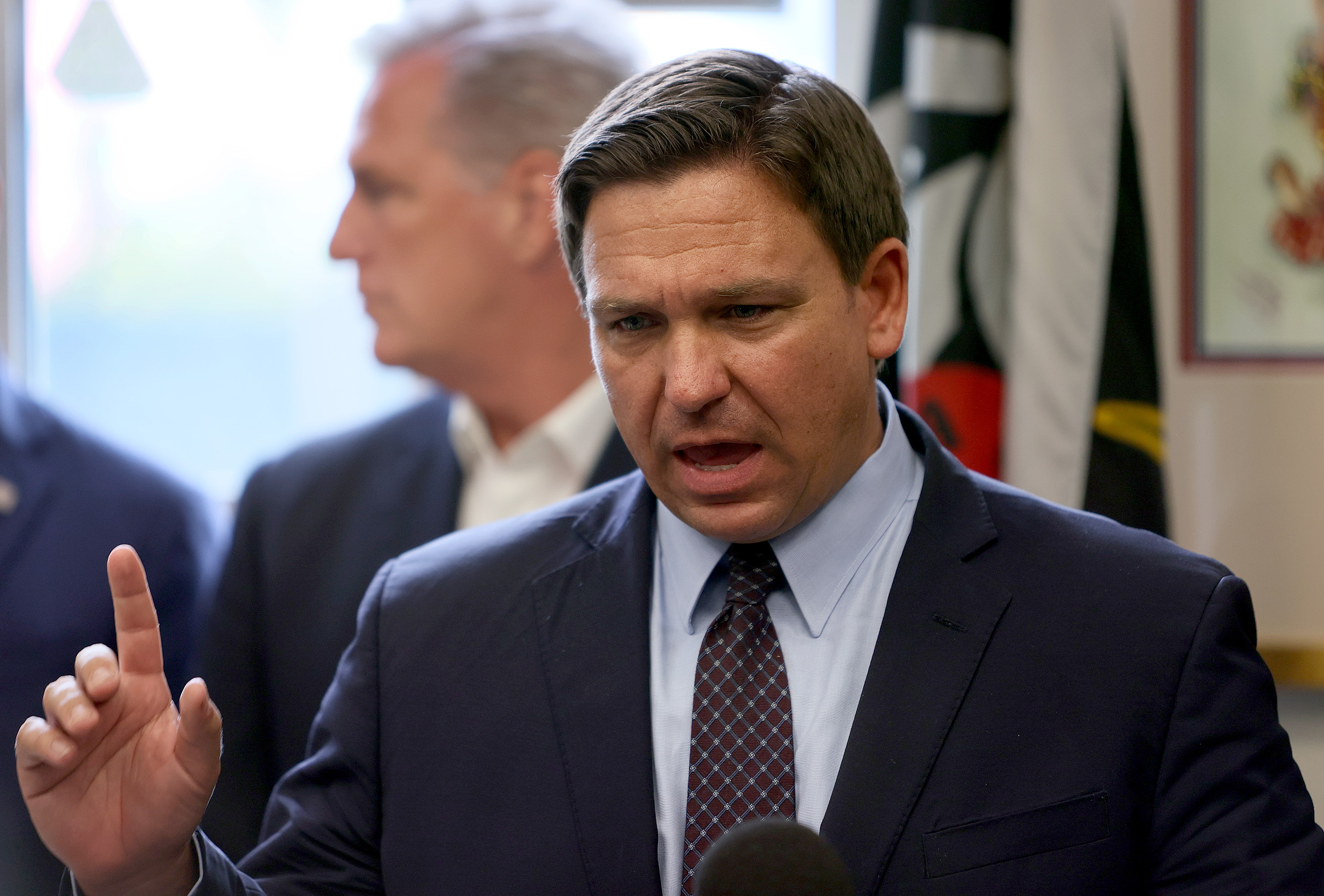
The dire COVID-19 situation in Florida continues to worsen as local and federal leaders push back against Republican Gov. Ron DeSantis and his efforts to thwart public health measures.
DeSantis has banned businesses, local governments, and schools in Florida from requiring proof of vaccination. Last Friday, DeSantis issued an executive order barring schools from requiring children to wear masks. In signing the executive order, the governor's office called federal recommendations for masks "unscientific" and claimed the order would "protect parents' freedom." The American Academy of Pediatrics has also recommended universal masking in schools, regardless of vaccination status.
Meanwhile, the delta coronavirus surge continues. On Wednesday, Florida recorded 20,133 new cases, its second-highest daily total of new cases in the entirety of the pandemic. The Sunshine State accounted for 22 percent of new cases detected in the US yesterday, despite making up just 6.5 percent of the country's population. Today, a record-high of 12,888 people were hospitalized with COVID-19 in the state. It is the fourth straight day of record-breaking hospitalizations.
Read 6 remaining paragraphs | Comments
Apple Plans To Scan US iPhones for Child Abuse Imagery
James.galbraithLike everything with security, "but the children" gets bleated to destroy security and introduce backdoors that will absolutely be exploited for other purposes.
Read more of this story at Slashdot.
Microsoft’s Windows 11 outreach efforts aren’t going very well
James.galbraithTaking today's award for most egregiously understated headline... lol
Microsoft Program Manager Aria Carley answers Microsoft Tech Community users' questions about Windows 11 upgrades once the new OS version reaches general availability.
In a July 21 livestream, Microsoft Program Manager Aria Carley answered Microsoft Tech Community users' questions about the final hardware requirements to upgrade to Windows 11. Although hardware requirements—including but not limited to TPM 2.0 support—aren't enforced for the Windows 11 alpha images available now, Carley confirmed that the "hardware floor" would be real for final versions.
"So we talk about this new hardware floor of what devices are eligible and which aren't," Carley said, adding, "We know that it sucks that some aren't going to be eligible for Windows 11." She went on to state that Microsoft is imposing the unpopular hardware floor "to keep devices more productive, have a better experience, and most importantly have better security than before so they can stay protected in this new workforce."
Despite acknowledging that the situation "sucks" for affected users, Carley doubled down on the inflexibility of the hardware floor in response to a later question, saying: "Group policy will not enable you to get around hardware enforcement for Windows 11. We're still going to block you from upgrading your device... to make sure your devices stay supported and secure."
Read 3 remaining paragraphs | Comments