Read more of this story at Slashdot.
James.galbraithThere's literally laws about this. Know Your Customer, etc.
Read more of this story at Slashdot.
James.galbraithNo shit
Erez Reuveni, a top lawyer who was kicked to the curb by the Department of Justice for not defending their agenda to deport men to El Salvador without due process, has officially blown the whistle.
The lawyer filed a 27-page report Tuesday, obtained by The New York Times, detailing the many ways in which Attorney General Pam Bondi and judicial nominee Emil Bove III have illegally dodged and intimidated others to get their way.

On one hand, this information feels less than shocking given how President Donald Trump and his team outright ignored orders to stop planes that were en route to detainment centers. However, this marks the first time someone who was on the inside has spoken out about it specifically.
In the filing, Reuveni recalls how Bove—whose nomination for circuit court judge is scheduled for Wednesday—blatantly ignored Judge James E. Boasberg’s orders to keep planeloads of immigrants on U.S. soil. Not only that, but Reuveni’s supervisor, Drew Ensign, allegedly lied to Boasberg’s face during a hearing when asked if he knew about any upcoming plans to fly immigrants to other detention centers in the next 24 to 48 hours.
According to the report, Ensign told Boasberg, “I don’t know the answer to that question.”
But if you ask Reuveni, the potential new circuit judge had informed him just the day before.
“Ensign had been present in the previous day’s meeting when Emil Bove stated clearly that one or more planes containing individuals subject to the [Alien Enemies Act] would be taking off over the weekend no matter what.”
Reuveni went on to detail how Bove and others withheld information for as long as possible from Boasberg to keep the deportation flights in the air.
And as the former top lawyer laid out example after example showing how the administration was brazenly defying the courts, he eventually recalled how he was faced with his own ultimatum.
In the case of Kilmar Abrego Garcia, the Maryland father who was wrongly abducted by ICE and deported to El Salvador’s terrorism confinement center, Reuveni was tasked with defending the U.S. government’s decision to keep Garcia locked up. However, as the facts unfolded, Reuveni could not. According to his filing, he was asked by another supervisor, August Flentje, to sign testimony stating that Garcia was a terrorist. Ultimately, he chose not to, which led to his firing.
While Garcia has returned back to the U.S. and Trump’s cronies lost the fight of labeling him as a dangerous MS-13 gang member, his legal battles are still ongoing. As of Monday, a judge ordered his release for an ongoing human smuggling case—the Trump administration’s latest claim.
However, the DOJ is threatening to deport Garcia the moment he steps outside of jail. Department of Homeland Security spokesperson Tricia McLaughlin said in a statement obtained by CBS Monday that Garcia "will never go free on American soil."
Then again, U.S. Magistrate Judge Barbara Holmes doesn’t see a reason for all of the hostility.
"Overall, the Court cannot find from the evidence presented that Abrego Garcia's release clearly and convincingly poses an irremediable danger to other persons or to the community," she wrote.
Related | Freeing Widmer: An aunt’s journey to El Salvador’s notorious CECOT prison
Garcia’s case is ongoing, but he may be one of the lucky men who has seen the outside of El Salvador’s CECOT. Of the over 250 immigrants deported, so far only Garcia has been granted any sort of due process for the crimes he is accused of committing.
Other men, such as 24-year-old Widmer Josneyder Agelviz-Sanguino, are still being held despite the only provided evidence for their imprisonment being the tattoos on their body.
Campaign ActionJames.galbraithThey keep voting Republican, so it doesn't hurt enough yet.

Summer has officially begun with a blast of scorching temperatures across much of the United States. The National Weather Service is warning of “extremely dangerous heat” baking 160 million people under a heat dome stretching from the Midwest to the East Coast the rest of this week. It’s already proven fatal.
But while this is the first real taste of extreme heat for Northeastern cities, parts of the country like Texas have been cooking since May. Alaska this month issued its first-ever heat advisory. Forecasters expect more above-average temperatures through the summer.
Summers are indeed getting hotter, a consequence of the warming planet. As the climate heats up, the frequency and intensity of heat waves is increasing and their timing is changing, arriving earlier in the season.
But the damage from extreme heat isn’t spread out evenly, and the more dangerous effects to people are not necessarily found in the hottest places. High temperatures often lead to more emergencies and hospital visits when they represent a big jump from a place’s average, which means ordinarily cooler regions tend to suffer the worst harm from heat. That includes places like Alaska and the Pacific Northwest, where temperatures rarely climb higher than 80 degrees Fahrenheit and most homes don’t have air conditioning.
Now researchers have found that rural areas may suffer more under extreme heat than previously thought. A report from Headwaters Economics and the Federation of American Scientists found that more than half of rural zip codes in the United States, which includes some 11.5 million Americans, have “high” heat vulnerability, a consequence not just of temperatures but unique risk factors that occur far outside of major cities.
The thermometers thus do not tell the whole story about who is likely to suffer from extreme heat — nor do the images, which tend to come from sweltering cities. But understanding the factors that worsen the harm of rising temperatures could help save lives.
The discussion around the geography of extreme heat tends to focus on the urban heat island effect. The concrete, asphalt, steel, and glass of dense urban areas act as a sponge for the sun’s rays. Air pollution from cars, trucks, furnaces, and factories helps trap warmer temperatures over cities, and that hotter air, in turn, accelerates the formation of pollutants like ozone. On a hot summer day, a city center can be 25 degrees Fahrenheit warmer than the surrounding regions. And with so many people squeezed into these metropolitan ovens, it adds up to a massive health burden from extreme heat.
But far outside of downtowns, where homes and buildings get farther and farther apart, rural regions face their own long-running challenges that exacerbate the dangers of extreme heat.
A major factor: the median age of the rural population is older than in cities. That matters, because on a physiological level, older adults struggle more to cope with heat than the young. People living in rural communities also have double the rates of chronic health conditions that enhance the damage from heat like high blood pressure and emphysema compared to people living in urban zip codes.
Rural infrastructure is another vulnerability. While there may be more forests and farms in the country that can cool the air, the buildings there are often older, with less adequate insulation and cooling systems for this new era of severe heat. Manufactured and mobile homes, more common in rural areas, are particularly sensitive to heat. In Arizona’s Maricopa County, home to Phoenix, mobile homes make up 5 percent of the housing stock but account for 30 percent of indoor heat deaths.
Even if rural residents have air conditioners and fans, they tend to have lower incomes and thus devote a higher share of their spending for electricity, up to 40 percent more than city dwellers, which makes it less affordable for them to stay cool. That’s if they can get electricity at all: Rural areas are more vulnerable to outages due to older infrastructure and the long distances that power lines have to be routed, creating greater chances of problems like tree branches falling on lines. According to the US Census Bureau, 35.4 percent of households in rural areas experienced an outage over the course of a year, compared to 22.8 percent of households in urban areas.
Sparsely populated communities also have fewer public spaces, such as shopping malls and libraries, where people can pass a hot summer day. Rural economies also depend more on outdoor labor, and there are still no federal workplace heat regulations. Farmworkers, construction crews, and delivery drivers are especially vulnerable to hot weather, and an average of 40 workers die each year from extreme heat.
The health infrastructure is lacking as well. “There is a longstanding healthcare crisis in rural areas,” said Grace Wickerson, senior manager for climate and health at the Federation of American Scientists. There aren’t always nearby clinics and hospitals that can quickly treat heat emergencies. “To really take care of someone when they’re actually in full-on heat stroke, they need to be cooled down in a matter of minutes,” Wickerson said.
The Phoenix Fire Department has now started using ice immersion for heat stroke victims when transporting patients to hospitals to buy precious time. But rural emergency responders are less likely to have tools like this in their ambulances. “In Montana, which has not traditionally seen a lot of extreme heat, you would not have those tools on your truck and not have that awareness to do that cooling. When you see someone who has to also then travel miles to get care, that’s going to worsen their health related outcomes,” Wickerson said.
Emergency response times are generally much longer in rural areas, sometimes extending more than 25 minutes. People also have lower incomes and lower rates of insurance far from cities. Hospitals in rural areas are closing down as well. So when severe heat sets in, rural healthcare systems can get overwhelmed easily.
Looking at data from the Centers for Disease Control and Prevention and the US Census Bureau, Wickerson and her collaborators mapped out how all these underlying factors are converging with extreme heat. They found that 59 percent of urban zip codes and 54 percent of rural zip codes are highly vulnerable to extreme heat as defined by the CDC’s Heat and Health Index, meaning they are much more likely to see health problems from extreme heat. So while rural areas may be cooler, the people living there face heat dangers comparable to those in much hotter cities, and geographically, they cover a much wider expanse of the country.

So while temperatures out in the sticks may not climb to the same peaks they do in downtowns, urban heat islands are surrounded by an ocean of rural heat vulnerabilities.
There are ways to reduce the dangers of scorching weather across vast swaths of the country, but they aren’t fast or cheap. They require big upgrades to infrastructure — more robust energy delivery, more shade and green spaces, better insulation, cool roofs, and more energy-efficient cooling.
Countering extreme heat also requires bigger structural investments to reverse the ongoing rural healthcare crisis where a doctor shortage, hospital closures, and longer emergency response times are converging. But the Republican budget proposal will do the opposite, cutting healthcare access for millions of Americans that would, in turn, lead to dozens of hospitals closing down, mainly in rural areas.
Protecting people from dangerous heat also demands policy changes. Most states don’t have any worker protections on the books for extreme heat. The Occupational Safety and Health Administration is in the process of creating the first federal heat safety standard for employers, requiring them to give employees breaks, water, and shade when it gets hot. But it’s not clear how strong the final regulation will be given that the Trump administration has been working to weaken rules across the board.
Cities and local governments could also impose rules that prevent utilities from shutting off power to customers during heat waves, similar to regulations that limit heat shutoffs during the winter.
But there are limits to how much people can adapt to hotter temperatures. Even places with a long history of managing heat are seeing more deaths and hospitalizations as relentless temperatures continue to mount. That means curbing the ongoing warming trend has to be part of the solution as well, reducing greenhouse gas emissions to slow climate change.
James.galbraithThis Supreme Court has destroyed any legitimacy it may have ever had. No decision, no reasoning, just "Trump can do whatever he wants"
A divided Supreme Court on Monday allowed the Trump administration to restart swift removals of migrants to countries other than their homelands, lifting for now a court order requiring they get a chance to challenge the deportations.
The high court majority did not detail its reasoning in the brief order, as is typical on its emergency docket. All three liberal justices dissented from the order.
It came after immigration officials put eight people on a plane to South Sudan in May. U.S. District Judge Brian E. Murphy in Boston found that violated his court order giving people a chance to argue they could be in danger of torture if sent away from their home countries.
Related | Which authoritarian country are we secretly deporting people to today?
The migrants from countries including Myanmar, Vietnam and Cuba had been convicted of serious crimes in the U.S. and immigration officials have said that they were unable to return them quickly to their home countries.
Authorities instead landed the plane at a U.S. naval base in Djibouti, where the migrants were housed in a converted shipping container and the officers guarding them faced rough conditions even as immigration attorneys waited for word from their clients.
The case comes amid a sweeping immigration crackdown by Republican President Donald Trump’s administration, which has pledged to deport millions of people who are living in the United States illegally.

Since some countries do not accept U.S. deportations, the administration has reached agreements with other countries, including Panama and Costa Rica, to house them. South Sudan, meanwhile, has endured repeated waves of violence since gaining independence in 2011.
Murphy’s order doesn’t prohibit deportations to third countries. But it says migrants must have a real chance to argue they could be in serious danger if sent to another country.
The justices have confronted a similar issue in Trump’s effort to send Venezuelans accused of being gang members to a notorious prison in El Salvador with little chance to challenge the deportations in court.
In that case, the court said migrants must get a “reasonable time” to file a court challenge before being removed, and the majority blocked the administration from resuming the deportations while lower courts worked out exactly how long they should get.
Related | Freeing Widmer: An aunt’s journey to El Salvador’s notorious CECOT prison
The conservative-majority court has sided with Trump in other immigration cases, however, clearing the way for his administration to end temporary legal protections affecting a total of nearly a million immigrants.
The third-country deportation case has been one of several legal flashpoints as the administration rails against judges whose rulings have slowed the president’s policies.
Another order from Murphy, who was appointed by President Joe Biden, resulted in the Trump administration returning a gay Guatemalan man who had been wrongly deported to Mexico, where he says he had been raped and extorted. The man, identified in court papers as O.C.G, was the first person known to have been returned to U.S. custody after deportation since the start of Trump’s second term.
Campaign ActionJames.galbraithThis Court is an abomination.

In a short, one-paragraph order, the Republican justices ruled on Monday evening that President Donald Trump may effectively nullify a federal law and an international treaty that is supposed to protect immigrants from torture. The Court’s order in Department of Homeland Security v. D.V.D. does not explain the GOP’s justices’ reasoning, although Justice Sonia Sotomayor responds to their silent decision in a 19-page dissent joined by her two Democratic colleagues.
The Court’s order is only temporary, and will permit Trump to send immigrants to countries where they may be tortured while the D.V.D. case is fully litigated. It is possible that one or more of the Court’s Republicans could reverse course at a later date. But it is hard to know what arguments might persuade them to do so because the justices in the majority did not explain why they decided this case the way they did.
Federal law requires that the United States shall not “expel, extradite, or otherwise effect the involuntary return of any person to a country in which there are substantial grounds for believing the person would be in danger of being subjected to torture.” This statute implements a treaty, known as the Convention Against Torture, which the United States ratified over three decades ago.
Trump’s lawyers, however, claim that they uncovered a loophole that permits the Trump administration to bypass these laws, at least with respect to some immigrants.
Typically, before a noncitizen may be removed from the United States, they are entitled to a hearing before an immigration judge. The immigration judge will inform the person facing deportation which countries they might be sent to, allowing the noncitizen to object to any countries where they fear they may be tortured. If the immigration judge determines that these objections are sufficiently serious to trigger the Convention Against Torture’s protections, the judge may still issue an order permitting the immigrant to be deported — but not to the nation or nations the immigrant raised objections about.
The D.V.D. case involves noncitizens who have already been through this process. In their case, an immigration judge determined that they may be deported, but not to specific countries. After the hearing process was complete, however, the Trump administration unexpectedly announced that it would deport the D.V.D. plaintiffs to other nations that were not previously under consideration.
That means that no immigration judge has determined whether these immigrants may be sent to those particular nations, and the immigrants have not been given a meaningful opportunity to object to the new countries where they are about to be deported. Using this loophole, the Trump administration seeks to deport them without a new hearing.
The Trump administration, moreover, appears to have intentionally selected countries where the noncitizens are likely to be unsafe. It wishes to deport many of these immigrants to South Sudan, for example, a country that was recently in a civil war, and where an uneasy peace appears to be collapsing. Others are slated for removal to Libya despite the fact that, according to Sotomayor’s dissent, they “would have landed in Tripoli in the midst of violence caused by opposition to their arrival.”
The Trump administration, in other words, appears to have created a deadly trap for immigrants who fear torture in their home nations. These noncitizens may object to being sent home under the Convention Against Torture, and an immigration judge may even rule in their favor. But the Trump administration may still send them somewhere else even more dangerous.
If you are interested in the specific legal arguments Trump’s lawyers raised to justify this trap, I summarized them here. But, again, it is not possible to determine which of these arguments persuaded a majority of the justices because those justices did not even bother to explain their decision.
James.galbraithlol seriously

Hovertext:
It'd be worth having this just for photos of the shamefaced users emerging from the experience machine door.
James.galbraithFuck the Court. They've abandoned any pretense of reasoning. It's just the GOP wish-granting fairy now.
We’re nearing the end of June, and you know what that means: It’s time for the Supreme Court to drop its most important decisions. And with a conservative supermajority, that means it’s just a bunch of punching down.
Justice Ketanji Brown Jackson’s dissent in Diamond Alternative v. EPA offers the best and most damning explanation of the Supreme Court’s current philosophy.

Factually, Diamond Alternative is about California’s ability to regulate automobile pollution in the state by requiring more stringent emission standards than those of the federal Clean Air Act. California began regulating emissions before the passage of the Clean Air Act, making it the only state that can set its own emissions standards—as long as the Environmental Protection Agency approves.
You’ve probably figured out that Diamond Alternative Energy is not a car company, so why are we here? The plaintiff is a fuel producer that’s not regulated by this law at all. But it came up with a genius theory: California’s requirement that 15% of the state’s automobiles must be electric hurts Diamond Alternative because, if fewer gas-powered cars are sold, demand for its fuel decreases.
This is an issue of standing, or who gets to bring a case. You can’t bring a lawsuit over something that doesn’t affect you, even if it makes you really sad. And you can’t claim something affects you by hypothesizing about it might someday trickle down and hurt you.
Fuel producers don’t have a dog in this fight, but they wanted to. And the conservatives on the Supreme Court—and Justice Elena Kagan, who should really know better—wanted them to as well.
Justice Jackson’s dissent calls this what it is: a giveaway to corporate fuel interests. When regular people come before the court, it isn’t nearly as eager to find a way to let them pursue a case. But apparently powerful petrochemical companies need their day in court, even if they can’t show any harm.
Things really aren’t any better in McLaughlin Chiropractic v. McKesson, in which a health care company sent unsolicited faxes to McLaughlin Chiropractic, who then sued under the Telephone Consumer Protection Act, which prohibits unsolicited intrusive telemarketing.
The Hobbs Act, gives the federal appellate courts exclusive jurisdiction to determine the validity of a challenged agency rule in what is known as pre-enforcement judicial review. There, a party asks the court of appeals to interpret the rule before the agency brings any enforcement actions against it. And if a party violates the rule, it’s not supposed to go to the federal district court to challenge it.
This is weedy, so let’s have Justice Kagan explain:
Imagine the Nuclear Regulatory Commission (NRC) issues a rule to ensure the safe handling of nuclear material—for example, by prohibiting the shipment of (radioactive) plutonium by air [...] And imagine, too, that a regulated party thinks the rule exceeds the NRC’s statutory authority. Must the party challenge the rule right away—before putting plutonium on a plane— by bringing its arguments to a court of appeals? Or can the party send plutonium through the skies without regard to the rule, and contest its validity only when (really, if ) the NRC initiates an enforcement action? Today, the Court picks the second option: ship first, litigate later.
That doesn’t sound safe, but is anyone surprised the court found another way to let companies ignore regulations without consequences?
How about a case where the majority ignores the plain text of the Americans with Disabilities Act?
Meet Stanley v. City of Sanford. During the time the plaintiff, Karyn Stanley, was employed as a firefighter in Sanford, Florida, the city changed its firefighter retirement benefits. When Stanley began working with the city, it paid for post-retirement health insurance until age 65 for firefighters with 25 years of service or who retired earlier due to a disability. In 2003, it changed the benefit for the latter group only, capping health insurance payments at 24 months.
Justice Jackson, again came in hot with a dissent, pointing out that the ADA is pretty clear that this is illegal. It prohibits disability discrimination not just in terms of employee pay, but also “other terms, conditions, and privileges of employment.”

But the Supreme Court majority invented a new interpretation that doesn’t protect a retiree who was once in the workforce. It’s a go-ahead for employers to slash benefits for disabled people as long as they do it post-retirement. Somehow, that doesn’t seem like what Congress intended.
Saving the worst for last, there’s the heartbreaking decision in United States v. Skremetti, where the majority upheld Tennessee’s ban on gender-affirming care—at least for trans kids.
Need puberty blockers because of gender dysphoria? Nope, not even if your parents agree. Want puberty blockers for any other reason, like early onset puberty? Well, that’s totally cool.
This is open and obvious discrimination on the basis of sex.
“Physicians in Tennessee can prescribe hormones and puberty blockers to help a male child, but not a female child, look more like a boy; and to help a female child, but not a male child, look more like a girl,” Justice Sonia Sotomayor wrote in her dissent.
The court’s conservatives twist themselves in knots trying to get around this, settling on an argument that the Tennessee law doesn’t ban gender-affirming care based on sex, but instead for certain medical uses regardless of sex. So it’s totally fine and cool and good to criminalize the same medical care for trans kids.
So last week’s winners? Fuel companies, scofflaw telemarketers, employers that discriminate against people with disabilities, and transphobic bigots. Last week’s losers? Everyone else. All of us.
Campaign ActionJames.galbraithLook who's angling for a Supreme Court "textualist" job lol

Hovertext:
Look, if those exegesis guys get to find whatever they want in the text, so do the rest of us.
James.galbraithwell that would be fantastic
Read more of this story at Slashdot.
James.galbraithThe GOP should be disbanded after the number of people their idiocy will have killed.
With ardent anti-vaccine activist Robert F. Kennedy Jr. in the country's top health position, use of a long-approved vaccine against measles, mumps, rubella, and varicella/chickenpox (MMRV) as well as flu shots that include the preservative thimerosal will now be reevaluated, putting their future availability and use in question. The development seemingly continues to vindicate health experts' worst fears that, as health secretary, Kennedy would attack and dismantle the federal government's scientifically rigorous, evidence-based vaccine recommendations.
Discussions of the two types of vaccines now appear on the agenda of a meeting for the Centers for Disease Control and Prevention's Advisory Committee for Immunization Practices (ACIP) scheduled for two days next week (June 25 and 26).
On June 9, Kennedy summarily fired all 17 members of ACIP, who were rigorously vetted—esteemed scientists and clinicians in the fields of immunology, epidemiology, pediatrics, obstetrics, internal and family medicine, geriatrics, infectious diseases, and public health. Two days later, Kennedy installed eight new members, many with dubious qualifications and several known to hold anti-vaccine views.
James.galbraithAs always, they'll use it as a vehicle to impose their theocracy, regardless of the actual facts of the case. It's just transparent hackery under the increasingly thin veneer of legal "reasoning".
At first glance, the United States Supreme Court’s decision to hear First Choice Women’s Resource Center v. Platkin doesn’t seem so bad. The question presented to the nation’s highest court is a narrow, technical one regarding whether an individual who receives a subpoena in a state investigation and alleges that the demand chills their free speech rights can challenge that subpoena in federal court.
Okay—so far, so boring, so what? Well, what if the case is actually about so-called crisis pregnancy centers, which are really just fake clinics designed to deceive people seeking abortion care? And what if the clinic is represented by Alliance Defending Freedom, the notorious conservative Christian law firm dedicated to eradicating reproductive rights, which also just happens to get the Court to take its cases again and again? And what if you know that Erin Hawley, wife of Missouri Sen. Josh Hawley and terrible person in her own right, will be arguing the case? And what if you know that the Supreme Court has shown a remarkable tenderness toward protecting the free speech rights of these fake clinics, including letting them spew medical disinformation? Suddenly, the case doesn’t look so harmless.
Related | Texas' latest attack on abortion will fascinate and horrify you
Let’s jump back to what kicked off this case. In 2023, New Jersey Attorney General Matthew Platkin began an investigation into First Choice, which runs five fake clinics in the state. Platkin’s concern is that First Choice may have “misled donors and potential clients” that they were “providing certain reproductive health care services.” As part of that investigation, Platkin subpoenaed First Choice, asking for advertisements and donor solicitations, the identification of medical personnel providing services at the clinics, and donor lists.
It’s no surprise that First Choice just refused to answer the subpoena, instead launching a years-long scheme to get the case to federal court. President Donald Trump isn’t able to appoint anti-choice hard-liners to state courts, but he stuffed the federal system full of them during his first term and is busy doing more of the same during his second term. And of course, almost any federal case involving abortion seems to inevitably land in front of the resolutely anti-choice conservatives on the Supreme Court.
Much of First Choice’s argument in the lawsuit is over New Jersey ostensibly targeting these fake clinics out of hostility, and how they can’t possibly reveal their donor names because of all the violence perpetuated against fake clinics. That’s nicely vague—and it has to be, because there is only one side of the abortion fight perpetually engaging in violence against abortion providers and supporters. From 1977 to 2022, there have been 11 murders, 42 bombings, 200 arsons, 531 assaults, 492 clinic invasions, and 375 burglaries, all carried out by anti-choice zealots. Following the Dobbs decision that overturned Roe v. Wade, violence against reproductive health clinics where abortion remained legal spiked sharply.
It’s honestly impossible to get any hard data on how many attacks there were on fake clinics. Numbers range from a claim of 40 from Sen. Chuck Grassley to over 100 from Fox News, and an amorphous statistic of attacks “in 24 states” from Christianity Today.

First Choice is also unhappy that anyone would say that their free speech is a bunch of lies, but there’s no question that fake clinics like these deceive clients. It’s their entire business model. They lead people to believe that they are medical clinics and their personnel have medical training. They disguise their intentions by offering “pregnancy help,” a vague term that definitely does not include abortion. They also refuse to refer people to abortion resources and lie about the dangers of sexual activity generally and abortion specifically. They target lower-income pregnant people and people of color who think they are at a real clinic that would provide abortion care. They tell people they are farther along in pregnancy than they really are, so they will believe it is too late to get an abortion. They spread long-debunked medical misinformation, such as saying it is possible to “reverse” a medication abortion.
It would seem self-evident that a state attorney general has every right and duty to look into organizations that routinely scam and lie to people, particularly given that the consequences of those lies prevent people from obtaining a perfectly legal medical procedure. But the conservatives on the Supreme Court have shielded fake clinics, ruling in 2018 that it violates their First Amendment rights even to have to post a notice that abortion is available elsewhere in the state. That, declared Justice Clarence Thomas, is government-controlled speech and therefore unconstitutional.
But what about medical professionals who do not want to offer state-mandated lies about abortion to their patients because doing so requires them to engage in actions and speech that they morally and medically oppose, such as being forced to describe ultrasounds to pregnant patients even when the patients don’t want to hear it? That’s not government-compelled speech for … reasons, and it’s just fine if a state makes doctors lie about medical services.
With all that in mind, the court taking up another fake clinic case, even under the fiction that it is just a dispute over which court should hear the case, is not great for abortion rights.
Related | The horrific way conservatives are trying to redefine who's a person
And there’s an additional reason it’s not great that the court agreed to hear this case, and it has nothing to do with abortion as such. First Choice’s argument relies heavily on a 2021 Supreme Court decision that said California could not ask charities operating in the state to report the identities of big donors. Anti-choice groups need to keep their donors secret not for the reasons First Choice alleges—that they will be subject to violence from rabid anti-choicers—but because the anti-abortion movement is filled with dark money, and any inquiry into funding would illuminate those corners very quickly. We can’t have that, obviously, because secretly manipulating elections with cash behind the scenes is now a hallmark of America’s disintegrating democracy.
You can count on the Supreme Court’s conservatives to protect the free speech rights of evangelical Christians and the identities of those people who fund them. Too bad none of the rest of us are graced with such tender solicitude for our rights.
Campaign ActionJames.galbraithAs expected. The Hacks in Black ignore precedent to rush to their theocratic goal, law and constitution be damned.

It was obvious, if you listened to the Supreme Court’s oral argument in United States v. Skrmetti last December, that the Court would vote — most likely along party lines — to uphold state laws banning many forms of transgender health care for minors. So nothing about Chief Justice John Roberts’s majority opinion in Skrmetti is really surprising. All six of the Court’s Republicans voted to uphold these laws, and all three of the Court’s Democrats dissented.
But, as a matter of judicial craftsmanship, Roberts’s opinion is disappointing even by the standards of the Roberts Court. It draws incoherent distinctions. It relies on old and widely criticized precedents to undermine legal principles that are well established by more recent cases. At times in his opinion, Roberts seems to misread statutory language that he just quoted a paragraph or two earlier.
It appears, in other words, that the six justices in the majority started with the outcome that they wanted — bans on transgender health care for minors must be upheld — and then contorted their legal reasoning to fit that result.
Even if you share that goal, the decision in this case was unnecessary. As Justice Elena Kagan points out in a brief dissenting opinion, the issue before the Court concerned a threshold question: whether the Tennessee law at issue in this case should receive a heightened level of scrutiny from the courts before it was either upheld or discarded. The ultimate question of whether to uphold Tennessee’s law was not before the justices.
The Court’s Republicans, in other words, could have applied existing law, sent the case back down to the lower courts to apply this “heightened scrutiny,” and then ruled on the bans in a future case. Instead, Roberts’s Skrmetti opinion went further to rule on the legality of the bans, and consists of about two dozen pages of excuses for why the Court’s previous anti-discrimination decisions somehow do not apply to Tennessee’s law.
One virtue of this approach is that it minimizes the broader implications of Skrmetti. At oral arguments, several justices suggested that, in order to uphold Tennessee’s law, they might make sweeping changes to the rules governing all sex-based discrimination by the government — Roberts, for example, floated giving the government broad authority to discriminate on the basis of sex in the medical context. Roberts’s actual opinion contains some language suggesting that the general rule against sex discrimination is weaker when the government regulates medical practice, but those sections of his opinion are so difficult to parse that they fall short of the broad changes he discussed at oral argument.
Ultimately, Roberts’s Skrmetti opinion largely reveals something that close observers of this Supreme Court already know. The Court’s Republican majority is impatient. They are often so eager to reach ideological or partisan results that they hand down poorly reasoned opinions and incomprehensible legal standards.
Because the Skrmetti opinion is so incoherent, it is difficult to predict its broader implications for US anti-discrimination law. One thing that is certain, however, is that this decision is a historic loss for transgender Americans.
To understand why the Skrmetti opinion is so difficult to reconcile with the Court’s previous decisions, it’s helpful to understand the precise legal questions before the Supreme Court.
The first of two questions is whether Tennessee’s ban on trans health care for minors classifies patients based on their sex assigned at birth. In United States v. Virginia (1996), the Supreme Court held that “‘all gender-based classifications today’ warrant ‘heightened scrutiny.’” “All” means that all laws that classify people based on their sex must receive additional scrutiny from the courts, not just some laws that do so.
About half of the states have laws targeting transgender health care, but the Tennessee law at issue in Skrmetti is among the strictest. It prohibits people under the age of 18 from receiving many medical treatments to treat gender dysphoria or other conditions related to their transgender status — including bans on puberty blockers and hormone therapy.
Significantly, Tennessee’s law is also quite explicit that the purpose of this law is to ensure that young people do not depart from their sex assigned at birth. The law declares that its purpose is to “encourag[e] minors to appreciate their sex” and to prevent young people from becoming “disdainful of their sex.” That is an explicit sex-based classification. Patients who Roberts refers to as “biological women” are allowed to fully embrace femininity in Tennessee. But a child who is assigned male at birth may not.
Under Virginia, in other words, Tennessee’s law — which relies on a sex-based classification — must be subject to heightened scrutiny.
To be clear, the mere fact that courts must give heightened review to Tennessee’s law does not mean that the law will necessarily be struck down. As the Court held in Craig v. Boren (1976), “to withstand constitutional challenge…classifications by gender must serve important governmental objectives and must be substantially related to achievement of those objectives.” Some laws do survive this level of scrutiny.
Roberts’s opinion raises several policy arguments for Tennessee’s law, claiming that the procedures targeted by Tennessee are “experimental,” that they “can lead to later regret,” and that they carry “risks.” A court applying heightened scrutiny could consider these arguments and whether they justify upholding the law.
But Roberts bypasses this inquiry altogether, instead denying that the Tennessee law engages in sex-based classifications at all. The law, Roberts claims, only “incorporates two classifications.” It “classifies on the basis of age” by banning certain treatments only for minors. And it “classifies on the basis of medical use” by prohibiting doctors from prescribing those treatments to address gender dysphoria or similar conditions affecting transgender people, while simultaneously permitting those treatments to address other conditions.
Roberts is correct that Tennessee’s law does draw lines based on these two classifications. But a law can do more than two things at once. And this law explicitly states that it exists to classify every child as either a boy or a girl, and then to lock them into that classification until their 18th birthday. Under Virginia, that classification demands heightened scrutiny.
The second legal question before the Court in Skrmetti was whether all laws that discriminate against transgender people are themselves subject to heightened scrutiny. Roberts, however, dodges this question by claiming that Tennessee’s law “does not classify on the basis of transgender status.” Instead, he argues, the law classifies people based on whether they have conditions such as “gender dysphoria, gender identity disorder, or gender incongruence.”
Gender dysphoria, gender identity disorder, or gender incongruence are among the defining traits that make someone transgender. Roberts might as well have argued that Jim Crow laws do not discriminate on the basis of race, but instead discriminate based on the color of a person’s skin.
To justify this distinction, Roberts points to the Court’s decision in Geduldig v. Aiello (1974), which held that discrimination against pregnant people is not a form of sex discrimination because not all women become pregnant. But, even if it is true that not all transgender people experience gender dysphoria or a similar condition, post-Geduldig decisions have long held that the government cannot evade a ban on discrimination by claiming that it is merely discriminating based on a trait that closely correlates with a particular identity.
As the Court said in Bray v. Alexandria Women’s Health Clinic (1993), “a tax on wearing yarmulkes is a tax on Jews” — even though many Jews do not wear yarmulkes.
That said, the Court’s decision not to rule on whether laws that classify on the basis of transgender status must receive heightened review is probably a blessing for transgender people, even if it is a small one. While Roberts’s reasoning on this question is muddled, his opinion leaves open the possibility that a future Court may resolve this question in favor of transgender people — although that is highly unlikely to happen unless the Court’s membership changes significantly.
Notably, Justice Amy Coney Barrett, who is close to the center of the current Court, wrote a separate concurring opinion arguing that discrimination against trans people does not trigger heightened scrutiny.
For the most part, Skrmetti is a disaster for transgender people, and especially for transgender youth. It twists the Constitution in knots to uphold Tennessee’s law. And the decision is likely to ensure that many parents of transgender children must move to blue states if they want their child to receive appropriate medical care.
James.galbraithAnd the supreme court can't wait to join in
The Trump administration is trying to make a change to federal regulations that would bar thousands of U.S. girls from school sports.
The change would be to a provision in Title IX, the 1972 landmark federal civil rights law, that bans sex discrimination in schools receiving federal funding and requires those schools to provide athletic opportunities for the “underrepresented sex.”
Currently, that means that in schools where there is only a boys’ team for certain sports, girls are allowed to try out for the team. For instance, according to the National Federation of State High School Associations, there were more than 4,000 U.S. girls who played on 11-person boys’ football teams during the 2023-2024 school year.
This attempted change is part of President Donald Trump’s multi-agency push to repeal civil rights advances and bar equal opportunities for transgender Americans. In this instance, not only would transgender children be barred from sports, but cisgender girls would also lose rights that they’ve had for more than five decades.
“To uphold the spirit and promise of Title IX, we urge for [the proposed change] to be withdrawn,” the Women’s Sports Foundation said in a statement to The Hill.

Similarly, Kel O’Hara, senior attorney for policy and education equity at Equal Rights Advocates, told HuffPost that this could be used to destroy even more civil rights down the road.
“The really concerning part from my perspective is that this could essentially provide a blueprint for dismantling civil rights protections across the board,” they said.
Bizarrely, the Trump administration is pursuing this change through the Department of Energy rather than the Department of Education, which traditionally handles matters like this. But the Education Department has been subject to layoffs triggered by the so-called Department of Government Efficiency, and Trump is trying to destroy the entire agency.
Trump and other Republicans, along with right-wing media outlets like Fox News, have consistently demonized transgender people over the last several years in an effort to motivate conservative voters to support the GOP while simultaneously encouraging violent bigots.
The attack on human rights can now count school sports as another casualty of the Trump regime.
Campaign ActionJames.galbraithICE cannot be saved. Burn it to the ground.
Immigration and Customs Enforcement agents on Tuesday arrested New York City Comptroller Brad Lander, who is also a Democratic mayoral candidate. Lander’s arrest is the latest in a string of Trump administration attacks on elected officials, but appears to be the first arrest carried out by ICE agents. Sure, ICE doesn’t have the authority to arrest U.S. citizens, but an administration that already illegally deployed troops in Los Angeles and is letting them illegally arrest people doesn’t care about such niceties.
Lander’s alleged offense appears to be accompanying an immigrant who was leaving immigration court and asking ICE agents to produce their judicial warrant. Doing so now allows ICE to spring into action and arrest Lander, a citizen, for obstructing their arrest of a migrant they say is subject to removal. But it isn’t at all evident that ICE agents have the authority to arrest citizens, even if they really, really want to.

ICE has broad authority to detain and arrest undocumented migrants who are subject to removal from the country. DHS and immigration judges can issue administrative warrants, which do not allow them to enter or search private spaces. Those warrants can serve as the basis to arrest an undocumented person if they are in public, however. But they aren’t the same as judicial warrants, which require compliance from everyone and allow the search of private locations.
But in order to hit the 3,000 arrests per day demanded by Donald Trump adviser and ghoul-in-chief Stephen Miller, Homeland Security Secretary Kristi Noem and ICE need some easy wins. With the help of immigration courts, the Department of Homeland Security developed a truly repugnant scheme to make this happen.
DHS attorneys are dismissing pending immigration cases against people who show up to court for a scheduled appearance as required. The immigration judge agrees to the dismissal, leaving the migrant believing they are free to go, but when they step outside the courtroom, they are arrested by ICE agents because they no longer have a pending immigration case and are therefore subject to removal.
The problem for ICE goons is that while this ruse allows them to detain an undocumented person, they have no authority to arrest U.S. citizens. In fact, when DHS partners with state and local police for immigration enforcement, even those officers are only allowed to detain and interrogate suspected noncitizens.
Which brings us back to Brad Lander, who was dragged away by masked ICE agents when he tried to walk out of the courthouse with an immigrant and requested that ICE produce a judicial warrant. ICE likely had an administrative warrant to detain the immigrant walking with Lander, because if they were a victim of the dismissal trick, they were now subject to removal. But that piece of paper holds no sway over Lander.
Department of Homeland Security flack Tricia McLaughlin announced that Lander was arrested for assaulting law enforcement and impeding a federal officer. She also took the opportunity to trot out the tired lie that the real victims here are ICE agents and that “if you lay a hand on a law enforcement officer, you will face consequences.”
Related | Republicans go full fascist because Democrats visited an ICE facility
McLaughlin’s statement isn’t just meant to spread the lie that Lander was arrested because he assaulted law enforcement personnel. It’s also meant to obscure who is allowed to do the arresting. McLaughlin doesn’t refer to ICE agents, but instead to “law enforcement” generally.
It’s not like ICE agents are clearly identifying themselves these days regardless. The people who arrested Lander included someone wearing a tactical vest labeled only with “federal agent,” people in plainclothes wearing surgical masks, and someone wearing a full face mask and tactical gear. These are not people who are even inclined to properly identify themselves and their agency, much less obey laws about who they can arrest.
Of course, by now, it’s clear that Lander is not an outlier and his arrest is not just a single moment of unwarranted escalation that won’t happen again. The Trump administration is now routinely figuring out ways to arrest elected officials for daring to oppose its immigration crackdown.
In April, the FBI arrested Judge Hannah Dugan, a sitting Wisconsin state judge, for allegedly helping an immigrant evade ICE while at the courthouse. At the time, that felt like the most outrageous thing that could happen, with FBI officers arresting her as she arrived for work at the courthouse. At least FBI officers really are allowed to arrest people.

Only two weeks later, Newark Mayor Ras Baraka was arrested for trespassing at an ICE facility, although arrested by whom is a bit murky, as DHS blurred the faces of everyone manhandling Baraka. When Democratic Reps. Bonnie Watson Coleman, LaMonica McIver, and Robert Menendez Jr. visited the facility in the wake of Baraka’s arrest as part of their required congressional oversight duties, DHS Secretary Noem accused them of committing felonies. Former Trump personal attorney and current underqualified Interim U.S. Attorney Alina Habba later indicted McIver for “assaulting, resisting, impeding, and interfering” with federal officers.
The administration’s ongoing assault on Los Angeles has also already resulted in DHS goons attacking Sen. Alex Padilla and dragging him away for daring to ask Noem a question she didn’t like. Border czar Tom Homan threatened to arrest Gov. Gavin Newsom and Los Angeles Mayor Karen Bass if he felt like they were hindering ICE.
So, to recap: ICE agents who refuse to officially identify as ICE agents are now apparently arresting U.S. politicians who are citizens. Active-duty troops are apparently performing law enforcement duties in Los Angeles in direct violation of the Posse Comitatus Act. Politicians are being arrested or threatened with arrest for any resistance to the administration, even just for asking a question. It isn’t even all that important which combination of thugs the administration deploys to do this, because it’s a wholesale assault on democracy no matter what.
Campaign ActionJames.galbraithThe Times is finished. Pack it in
The New York Times’ chief White House correspondent Peter Baker penned a “news analysis” on Monday that goes on at length about “The Age of Trump.” The cringe-worthy column, meant to coincide with the 10-year anniversary of Donald Trump first entering the Republican presidential race by maligning Mexican people as rapists, comes as the nation continues to deal with the fallout from his time in office—including rampant crime, countless deaths, and rising authoritarianism.
Baker sounds more like a fan gushing over a celebrity than a journalist discussing a conspiracy theorist bigot with dictatorial aspirations.

“Ten years of jaw-dropping, woke-busting, scandal-defying, status quo-smashing politics that have transformed America for good or ill in profoundly fundamental ways” is how this “journalist” describes the decade of hell that Americans have been forced to live through.
Yes, that is prose from a column in The New York Times, not a melodramatic monologue from Trump superfan Sean Hannity on Fox News. While Baker concedes that Trump is unpopular, he describes pro-MAGA voters as “the most consequential political force of modern times, rewriting all of the rules along the way.”
Here’s some context on Baker’s purple prose: Trump’s most significant political victory came in 2024 where he won the popular vote by 1.5% over former Vice President Kamala Harris. Trump lost the 2020 election by almost 5 points against former President Joe Biden and lost the popular vote in 2016 against former Secretary of State Hillary Clinton. Former President Barack Obama, the most recent two-term president before Trump, won by over 7 points in 2008 and nearly 4 points in 2012.
Even worse, Baker’s column comes after yet another bloody weekend during a Trump presidency, not to be confused with the steady succession of bloody weekends that occurred during his first term as COVID-19 ravaged the nation and he pushed quack medicine and anti-Chinese racism.
On Sunday, Minnesota House Speaker Emerita Melissa Hortman and her husband, Mark, were shot dead in an apparent political assassination. State Sen. John Hoffman and his wife Yvette were also shot at their home, but are expected to recover. Early reporting indicates the alleged shooter was a Trump fan who espoused similar views to him opposing abortion and LGBTQ+ rights. The shooting follows years of Trump endorsing and encouraging political violence—including the Jan. 6 attack on the Capitol that he incited.

On the same day the killings occurred, Trump was indulging in another fantasy of his, presiding over a military parade on the streets of Washington, D.C. While the president previously expressed envy at well-organized military parades in other nations, the D.C. event was a sparsely attended affair that didn’t even have the polish of a military parade held the same day at Disney World.
But millions of Americans turned out on the very same day to protest Trump and his lackeys like Vice President JD Vance, House Speaker Mike Johnson, and billionaire benefactor Elon Musk at “No King” protests across the nation. Unsurprisingly, the Times could only muster a print headline noting “thousands” had marched.
This is an ongoing pattern at the Times. The writers there have veered from a cringe-inducing review of Trump’s presidential portrait (they claimed he was “smizing,” Tyra Banks-style) to uncritically regurgitating his spin on taxes to presenting an obvious political operative as a simple man-on-the-street Black Trump supporter.
The past 10 years have seen the mainstream media trying over and over to normalize Trump despite all his obvious abnormalities, and the Times has led the charge. Trump is unpopular, which shows that the public doesn’t buy the lies—but the Times is too busy cheering on and normalizing his administration to notice.
Related | 10 years of trouble, terror, and tussling thanks to Trump
Campaign ActionJames.galbraithNo surprise there
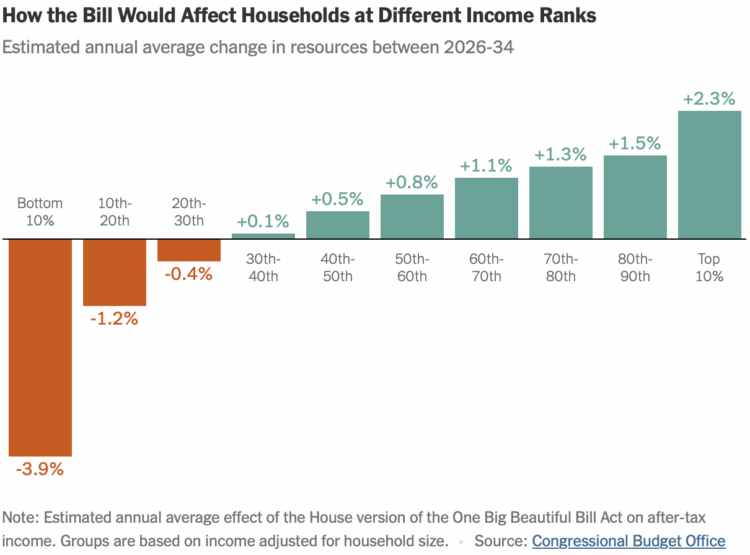
The bill proposed by the current administration affects incomes of the poor and the rich in an unusual way. To demonstrate, for NYT’s the Upshot, Emily Badger, Alicia Parlapiano, and Margot Sanger-Katz compare the bill against previous bills.
The bill as passed by the House in May would raise after-tax incomes for the highest-earning 10 percent of American households on average by 2.3 percent a year over the next decade, while lowering incomes for the poorest tenth by 3.9 percent, according to new estimates by the Congressional Budget Office.
The shape of that distribution is rare: Tax cut packages have seldom left the poor significantly worse off. And bills that cut the safety net usually haven’t also included benefits for the rich. By inverting those precedents, congressional Republicans have created a bill unlike anything Washington has produced since deficit fears began to loom large in the 1990s.
Tags: bill, government, taxes, Upshot
James.galbraithTrump has made it clear deportations aren't actually about immigration, they're just another tool to oppress and punish democrats.

President Donald Trump promised his supporters “the largest deportation program in American history” — but he’s nowhere close.
That distinction belongs to an early 20th-century program that likely saw 2 million people deported. When looking at more recent times, it’s President Barack Obama — once dubbed by immigrant advocates “the deporter in chief” — who holds the 21st-century deportation record. His administration kicked out 438,421 people in 2013. No president since has come close to equaling that record, including Trump during his first term.
The political atmosphere that made the mass deportations of the 1900s possible is long gone. Similarly, Trump is likely to find it all but impossible to approach his goal of deporting “millions and millions” by borrowing from Obama’s playbook.
In fact, actions taken by Obama are part of why Trump’s ambitions have been stymied. If Trump truly wants to set a new record, he’ll need to more than double the current pace of deportations. And that will take a strategy that radically departs from those that have come before.
Obama’s immigration enforcement strategy was two-pronged: increasing penalties for unauthorized crossings at the southern border and deputizing local law enforcement to target immigrants with criminal records inside the US. The former increased the number of people who faced official removal proceedings and deterred repeat border crossers. And the latter allowed ICE to have its ear to the ground in cities throughout the country.
Before Obama, unauthorized border crossers were typically allowed to voluntarily return to Mexico, without undergoing an official process or being subjected to any penalties. That meant that many attempted to recross the border, knowing that they would not face repercussions for doing so.
The Obama administration started subjecting a greater proportion of them to formal deportation proceedings, utilizing an expanded federal immigration enforcement workforce that had grown from 12,700 in 2003 to 22,000 in 2008 with an influx of congressional funding. That drove up the deportation numbers and also barred unauthorized crossers from reentering the US for another 10 years. If they tried to reenter anyway, they could be permanently barred.
Many proved unwilling to take that risk, with the share of unauthorized crossers making multiple attempts to cross the border coming down sharply, from 29 percent in fiscal year 2007 to 14 percent in fiscal year 2014.
Obama also utilized tools including agreements with local law enforcement agencies that allowed them to conduct immigration enforcement and a program known as “Secure Communities” to deport undocumented immigrants inside the US, prioritizing those with criminal records.
By the time Obama took office in 2009, about 70 of these 287(g) agreements had been signed. They allowed local law enforcement to receive training from US Immigration and Customs Enforcement and issue immigration detainers, effectively deputizing them.
Through Secure Communities, local law enforcement shared fingerprints of people booked into local jails with federal immigration authorities, which would determine whether they were deportable. ICE could then ask local law enforcement to hold that person for up to 48 hours; agents would pick them up and transfer them to immigration detention.
Initially effective at increasing deportations, the Secure Communities program was short-lived. It faced blowback from primarily liberal jurisdictions, driving a revival of the movement to offer sanctuary to undocumented immigrants in the 2010s.
The concern among progressives was that it would reduce trust in law enforcement among immigrant communities and make everyone less safe because fewer people would report crimes. It also led to the deportation of people who had only committed minor offenses or had no criminal convictions.
In 2014, Obama rescinded the program in response. He replaced it with another program that focused only on deporting immigrants who had committed serious offenses. As a result, the number of deportations fell to about 414,000 that year and never resurged to their 2013 peak.
Trump might struggle to ramp up deportations along the border, as Obama did, simply because significantly fewer people are coming. In March, border apprehensions fell to 7,181, a 95 percent decrease from March 2024.
Trump would also likely face great opposition to a revived Secure Communities program.
The opposition in liberal enclaves — where many undocumented immigrants reside — to cooperating with federal immigration authorities has only hardened since the Obama era. In response, Trump’s border czar Tom Homan has gone as far as threatening Democratic officials with arrest for shielding immigrants from deportation.
But for now, Democrats are holding their ground.
“I will stand in the way of Tom Homan going after people who don’t deserve to be frightened in their communities,” Illinois Gov. JB Pritzker said in a congressional hearing Thursday, in comments emblematic of the liberal position.
With these avenues cut off, Trump has attempted other tactics. He’s launched workplace immigration raids across California, spurring mass protests in Los Angeles. He’s mobilized federal resources from the National Guard to the IRS to identify and arrest undocumented immigrants. He’s urged half a million immigrants from Cuba, Haiti, Nicaragua, and Venezuela to self-deport.
None of that has been enough to match Obama’s pace of deportations so far, something that has reportedly frustrated Trump. However, deportations did increase to 17,200 in April, surpassing the number of deportations during the same period last year under the Biden administration.
It’s not clear whether Trump can maintain that momentum. For one, he suggested in a recent post on Truth Social that he’s now torn about deporting farmworkers and hotel workers after speaking with industry leaders who said that his policies were “taking very good, long time workers away from them, with those jobs being almost impossible to replace.” In the same post, he vowed that “changes are coming,” without elaborating on what they might look like.
At the same time, however, Trump is pushing for a spending bill now under consideration in the US Senate. It provides $155 billion in new immigration enforcement funding — more than five times the amount of current funding. While even some Republicans say that increase is too large, he may soon have considerably greater resources to carry out his vision for mass deportations if the bill passes.
James.galbraithThis entire administration is just an exercise in using federal power to enforce Trump's bigotries. It's fucking ridiculous
Injustice for All is a weekly series about how the Trump administration is trying to weaponize the justice system—and the people who are fighting back.
You may have noticed that Attorney General Pam Bondi is perfectly happy to let President Donald Trump treat the Department of Justice like his own personal law firm/attack dog. So now the DOJ is mobilizing to help Trump continue his baseless claims that the 2020 election was stolen.
The DOJ has demanded an enormous amount of voter data from Colorado, a request that could be read to include voter registration materials. They want all records from the 2024 election, and that any records remaining from 2020 be preserved as well. Terrific.

To the best of anyone’s knowledge, this has never happened. Not just never happened in Colorado. Like, never ever happened. The request for 2024 election data, versus only 2020, is unnerving, as it suggests that the administration is looking for additional ways to undermine election integrity, rather than being limited to trying to prove the lie that Trump won in 2020.
Colorado is a Trump fixation because of Tina Peters, the former Mesa County clerk and Big Lie believer. Last year, Peters was convicted in Mesa County state court after giving another weirdo conspiracy theorist access to county voting machines to find voter fraud in the 2020 election.
Although Peters was convicted in state court, Trump has called for the Department of Justice to attempt to free her anyway, which is about as big a violation of federalism as you can get. The federal government is not supposed to reach down into states and tell them what to do about their own state laws. Of course, they also aren’t supposed to be helping Trump pursue his personal vendettas, but that ship has long sailed.
A three-judge panel composed entirely of Trump appointees stayed the lower court deadline requiring the administration to explain what due process it will provide to the deportees in CECOT, the horrific El Salvador Terrorism Confinement Center prison. Judge James Boasberg issued the order on June 4, requiring the administration to provide an answer by June 11. Instead, the administration did nothing and went to the appellate court on June 10. Since the stay was granted, the administration doesn’t have to do anything while the appeal proceeds.
Boasberg’s order didn’t even require the government to return the deportees and extend them due process here. But according to the administration, even being required to provide due process is too much to ask. It’s an absolutely specious argument, but luckily, Trump drew a panel of judges extremely inclined to entertain his most dubious allegations.
Meanwhile, the immigrants sent to CECOT in violation of Boasberg’s March 15 order have been held in El Salvador for nearly three months with no relief in sight. They are victims not just of the executive branch that sent them there, but also the Trump appointees of the judicial branch.
Kirkland & Ellis is one of the Big Law firms that bent the knee to Trump before even being targeted with an executive order. In fact, they were so hyped for the deal that they agreed to bribe Trump with $125 million in free pro bono services instead of the customary $100 million.
But Kirkland isn’t going to stop there. They’ve got to make sure they stay in Trump’s good graces, and that’s a constant project. Last month, the firm’s chair joined Trump for his whirlwind griftathon through the Middle East.
This week, the firm slashed its DEI staff, which is bad enough, but then Kirkland insisted that, oh, no, it’s just a total coincidence that they cut the people doing the exact thing targeted by Trump, after doing a bunch of other things to please Trump. And, as Above the Law notes, Kirkland made $8.8 billion in gross revenue last year, so it isn’t like it’s credible to say this was a financial necessity.
A Big Law two-fer this week!
Robert Giuffra is one of Trump’s personal lawyers at Sullivan & Cromwell. That’s the firm representing Trump in his bid to move his New York state criminal conviction to federal court. In other words, Giuffra’s law firm is employed by Trump in his personal capacity, not as president.
Paul, Weiss, Rifkind, Wharton & Garrison LLP was the first Big Law firm to cut a deal with the administration after Trump targeted them with an executive order. When the terms of that deal were announced, it was a shell shock: $40 million in free pro bono labor, elimination of diversity policies, and an agreement to represent any client, regardless of political affiliation.
Related | Big Law bends the knee and DOGE plays stupid games
And making that agreement has hurt Paul Weiss. Last week, Damian Williams, the former U.S. attorney for the Southern District of New York, left the firm because of the Trump deal, and clients have been considering pulling their business.
It turns out that Trump, in his role as president, called Giuffra, his personal lawyer, to help negotiate the deal. Basically, Trump handed Giuffra an opportunity to harm an industry rival and do so under the auspices of government action. We’d say it’s an unprecedented level of corruption, but what isn’t these days.
The DOJ just sued a California coffee shop which allegedly sells coffee drinks that seem to reference Hamas and the Oct. 7, 2023 attack in a positive light. Fun fact: that is not illegal. Indeed, it’s the exact opposite, what with the whole First Amendment and all. The DOJ’s allegation is that the coffee shop discriminates against Jewish customers.
To be fair, there are some allegations in the complaint that would definitely rise to the level of discrimination, such as refusing to serve people wearing hats with a Star of David. But that’s lumped in with complaints about coffee drinks and an inverted red triangle symbol on the coffee shop’s exterior wall, assailing protected free speech by tucking it in with the discrimination allegations. Also, let’s be frank: there is no reason to extend a presumption of good faith to this administration and pretend that they’ve carefully assembled enough evidence to do this.
This is a shot across the bow, the DOJ flexing and showing that there’s nothing small enough to escape their notice, nothing to stop them from bringing the might of the government to bear.
Campaign ActionJames.galbraithMissing the fact that he was fired because of his partisan identity. Blatantly fucking illegal, and you'd better believe if a Republican were fired for the same reason, it'd be in every headline
Critics warn that the United States may soon be taking on more nuclear safety risks after Donald Trump fired one of five members of an independent commission that monitors the country's nuclear reactors.
In a statement Monday, Christopher Hanson confirmed that Trump fired him from the US Nuclear Regulatory Commission (NRC) on Friday. He alleged that the firing was "without cause" and "contrary to existing law and longstanding precedent regarding removal of independent agency appointees." According to NPR, he received an email that simply said his firing was "effective immediately."
Hanson had enjoyed bipartisan support for his work for years. Trump initially appointed Hanson to the NRC in 2020, then he was renominated by Joe Biden in 2024. In his statement, he said it was an "honor" to serve, citing accomplishments over his long stint as chair, which ended in January 2025.
James.galbraithlol

Hovertext:
Tragedy is when the apes fight until everyone is dead. Comedy is when the apes fight until everyone is married.
James.galbraithBut heaven forbid we actually regulate AI and the tools that are being used for massive fraud
Read more of this story at Slashdot.
James.galbraithActively gutting the 1st amendment
The Federal Trade Commission is reportedly pitching a merger condition that would forbid advertising agencies from boycotting platforms based on political content, in a move that could benefit Elon Musk's X social network and President Trump's own Truth Social platform.
As the FTC reviews a proposed merger between Omnicom Group and Interpublic Group, two large ad agencies, The New York Times reported yesterday that a "proposed consent decree would prevent the merged company from boycotting platforms because of their political content by refusing to place their clients' advertisements on them, according to two people briefed on the matter."
This is one of several moves the FTC has reportedly made to discourage ad boycotts that have riled conservatives. The FTC currently has only Republican commissioners because President Trump fired both Democrats, who allege in a lawsuit that the firings were illegal. Trump also declared sweeping executive power over the FTC and other agencies that were created to operate independently from the White House.
James.galbraithWell that's a problem
Read more of this story at Slashdot.
James.galbraithThey've just invented shittier cable
Amazon forced all Prime Video subscribers onto a new ad-based subscription tier in January 2024 unless users paid more for their subscription type. Now, the tech giant is reportedly showing twice as many ads to subscribers as it did when it started selling ad-based streaming subscriptions.
Currently, anyone who signs up for Amazon Prime (which is $15 per month or $139 per year) gets Prime Video with ads. If they don’t want to see commercials, they have to pay an extra $3 per month. One can also subscribe to Prime Video alone for $9 per month with ads or $12 per month without ads.
When Amazon originally announced the ad tier, it said it would deliver “meaningfully fewer ads than linear TV and other streaming TV providers." Based on “six ad buyers and documents” ad trade publication AdWeek reported viewing, Amazon has determined the average is four to six minutes of advertisements per hour.
James.galbraithSurprise: doctrines made up to shackle a Democratic administration will never apply to a Republican. This Court has made it abundantly clear that Trump gets infinite leeway and "Status quo" means "Whatever the GOP did last".

In late May, a federal court handed down an order pausing President Donald Trump’s plans to fire a simply astonishing amount of federal workers. As Judge Susan Illston explains in her opinion, the proposed cuts are so sweeping that they would effectively shut down multiple federal programs.
To give just a few examples, Santa Clara County, one of the plaintiffs in this suit, runs a preschool program for 1,200 children that is funded by a federal grant that expires at the end of June. But the county is unable to renew that grant because the federal employees who manage that grant “have now all been laid off and their San Francisco office closed.” The county argues that without the grant, it may need to lay off 100 early learning employees.
The National Institute for Occupational Safety and Health has 222 workers that research health hazards facing mine workers, but the Trump administration plans to fire 221 of them. Retirees are unable to reach the Social Security Administration due to layoffs, potentially making benefits inaccessible to many. According to Illston, “one individual got through to a representative only after eleven attempts to call, each involving hours on hold.”
And things will likely get much worse if the Trump administration can fully move forward with their planned firings as outlined in the case.
The plaintiffs in this case, now known as Trump v. American Federation of Government Employees, claim that the Department of Energy “proposed cuts of up to 50% of [the] agency’s workforce.” The Centers for Disease Control and Prevention, they claim, plans to eliminate its entire office that “monitors lead exposure in children.” The National Institute of Occupational Safety and Health, the plaintiffs claim, plans to cut 93 percent of its staff.
And this is just a small sampling of what is coming if Trump gets his way. The president’s budget called for more than 100,000 cuts — and many agencies’ plans for mass layoffs are not yet public.
Illston’s order is now before the Supreme Court. Trump’s lawyers asked the justices to block Illston’s decision earlier this month. Because the case arises on the Court’s “shadow docket,” a mix of emergency motions and other matters that get decided on an expedited basis, the Court could rule on Trump’s request at any time.
Many of Trump’s legal arguments will be familiar to anyone who has followed his second-term litigation strategy. When Trump loses a case in a lower federal court, his lawyers often argue that the court lacked jurisdiction to hear that case, and that the case must be shifted to a different forum — often a forum that cannot actually give the plaintiffs the relief that they seek.
And so Trump’s brief claims that many of the AFGE plaintiffs’ challenges to the proposed mass firings must be heard by the Merit Systems Protection Board (MSPB), an agency that is currently incapable of hearing these disputes because it lacks a quorum — two of the board’s three seats are vacant.
The Trump administration also points to a statute permitting the US Office of Personnel Management to “prescribe regulations for the release of competing employees in a reduction in force,” claiming that this law authorizes the sweeping mass firings contemplated by Trump.
The plaintiffs, meanwhile, primarily argue that Trump’s proposed firings are so widespread that they would fundamentally transform the federal government in ways the president cannot do on his own. “Whatever one’s view on the proper size and scale of government,” their brief argues, “that vision may not be imposed by unilateral executive order, without engaging in the dialogue and cooperation with Congress that the Constitution requires and that Presidents have historically pursued.”
This argument will be familiar to anyone who followed the many fights over executive power during the Obama and Biden administrations. In those fights, the Republican justices frequently ruled that, when the executive branch attempts to do something that is too ambitious, the courts must block it — even in some cases where the executive’s action was authorized by a broadly worded federal statute.
The Republican justices even invented a brand new legal doctrine, known as “major questions,” which provides that the executive may not make new policies of “vast ‘economic and political significance’” without an extraordinarily specific act of Congress authorizing that policy.
The stakes in the AFGE case, in other words, are even broader than the immediate dispute over whether Trump can fire so many government workers that entire federal programs cease to function. The case also will reveal whether the rules that the GOP justices invented to constrain Democratic presidents like Obama and Biden also apply to Republican presidents like Trump.
In 2014, President Barack Obama announced a bold new plan to allow as many as 4.3 million undocumented immigrants to live and work in the United States. The Obama administration justified this policy by stringing together a list of several different legal authorities.
The executive, for example, has “prosecutorial discretion” to decide which undocumented immigrants law enforcement should prioritize, and which immigrants it should leave alone — a principle that an 8-1 Supreme Court reaffirmed as recently as 2023. So the Obama administration argued it was merely instructing law enforcement not to prioritize the millions of immigrants that would benefit from its new program.
Meanwhile, federal regulations dating back to the Reagan administration permitted immigrants who are deprioritized in the way contemplated by Obama’s policy to seek authorization to work in the United States. A separate federal law permitted them to receive Social Security and Medicare benefits (assuming that they otherwise qualified for these programs).
The law, in other words, was fairly clear that the Obama administration could offer any individual undocumented immigrant a temporary right to live in the United States, to work here, and to receive certain benefits. All that Obama’s 2014 policy sought to do was make this same offer to millions of immigrants at a time.
The Supreme Court never formally struck down this program — when it reached the justices in a case known as United States v. Texas (2016), Republican Justice Antonin Scalia had recently died and the Court was split 4-4 between Democrats and Republicans. So the justices split down the middle in the Texas case, leaving a lower court order that blocked the program in effect.
But it was clear from the oral argument why the Republican justices found this program objectionable. Chief Justice John Roberts worried that, under the Obama administration’s legal argument, the president could “grant deferred removal to every…unlawfully present alien in the United States.” Justice Samuel Alito fretted that Obama could have simply announced that “we’re just not going to remove anybody.” Justice Anthony Kennedy suggested that there must be “limits” to the president’s “discretion,” and that when a program gets too big it becomes a “legislative, not an executive act.”
All of these concerns were rooted in a similar theory of the separation of powers. Even when federal law seemed to authorize the president to take a particular action, the Republican justices all seemed to believe that, at some point, that action becomes too ambitious for the president to do on his own. When this line is crossed, the president must persuade Congress to enact a new law which authorizes the president’s proposed policy.
The Court formalized this theory in its major questions doctrine cases, which established that the Court “expect[s] Congress to speak clearly if it wishes to assign to an agency decisions of vast ‘economic and political significance.’” Again, the idea was that, at some point, a policy proposed by the executive branch crosses a line where it becomes too ambitious for the president to implement on his own authority — and the president must seek Congress’s permission before moving forward.
Under President Joe Biden, the Republican justices applied this major questions doctrine quite rigidly. In Biden v. Nebraska (2023), for example, the Court struck down a Biden administration plan that would have forgiven hundreds of billions of dollars in federal loans. These justices did so, moreover, despite a federal law which gave the secretary of education sweeping authority to “waive or modify any statutory or regulatory provision applicable to the student financial assistance programs…as the Secretary deems necessary in connection with a war or other military operation or national emergency” such as the Covid-19 pandemic.
Thus, even though Congress had broadly authorized the secretary to forgive federal loans, the Republican justices balked at the Biden administration’s attempt to use this power on such a grand scale.
Trump’s mass firings should also fit within this framework. No one really questions that the federal government may fire some federal workers that it deems to be inefficient or unnecessary. But the sort of mass firings contemplated by Trump are at least as ambitious and transformative as the immigration program in Texas or the student loans program in Nebraska. And the firings would certainly have great political and economic significance.
The Trump administration has already attempted to dismantle entire federal agencies, such as the US Agency for International Development. And Trump’s executive order calling for mass firings explicitly contemplates eliminating entire agencies or their “subcomponents.”
The scope of many agencies’ proposed layoffs are not yet public, but, as both Illston’s opinion and the AFGE plaintiffs’ brief lays out, the information that is public suggests many agencies will be gutted. It should go without saying that the Department of Energy, for example, would have to cease much of its existing work if it fired half of its workers.
The ultimate question in AFGE, in other words, is whether the limits on executive power that the Supreme Court imposed on Democratic administrations in cases like Texas and Nebraska also apply to a Republican president like Donald Trump.
James.galbraithWell that's unfuckingacceptable
Read more of this story at Slashdot.
James.galbraithOf course
Apparently, Florida’s Department of Children and Families employs no one who understands the First Amendment. That’s the only logical explanation for the letter it sent to the Orlando Sentinel, telling the paper to cease and desist reporting on the shady charity spearheaded by Gov. Ron DeSantis’ wife, Casey.
The paper hasn’t published the story yet, but FDCF nonetheless accuses it of threatening foster families to make negative statements about the beleaguered Hope Florida Foundation.
This is an obvious case of prior restraint, which is where the government attempts to censor speech before it is published. It’s arguably the worst way the government can violate the First Amendment. The Supreme Court addressed this nearly 100 years ago in Near v. Minnesota, which invalidated a Minnesota law that allowed a judge to block any publication deemed obscene or scandalous, stating that it violated the First Amendment.
You don’t need to be a legal scholar to have learned about this fundamental constitutional protection. You have to be only moderately aware of American history. Then-President Richard Nixon famously tried to block publication of the Pentagon Papers, saying the publication of the history of U.S. involvement in Vietnam would jeopardize national security. The Supreme Court did not agree and ruled that The New York Times and other papers could publish the material.

DeSantis’ administration is scrambling to cover up Casey DeSantis’ involvement with the charity, particularly because the scandal might compromise her gubernatorial ambitions. Ron is term-limited, so there’s a genius plan to just have Casey take his place. If this sounds familiar, it’s because rabid segregationist Alabama Gov. George Wallace got around that state’s term limits by having his wife run for governor in 1966. Her election allowed Wallace to serve as a shadow governor.
The DeSantis family’s apparent plan to emulate Wallace has taken a hit, though, because of the investigation into the Hope Florida Foundation. This is sort of a mess, so buckle up.
First, the state established a charity known as the Hope Florida Foundation to receive private donations, which it would then distribute to churches and nonprofits. Casey made it her signature initiative, but it was remarkably bad at its core function of distributing money. In its first year, it gave away less than 5% of the donations it received. It also reportedly failed to perform required audits and to file taxes on time—until reporters came calling.
In September 2024, the DeSantis administration settled with a large health care company that had overbilled the state’s Medicaid program, requiring the company to pay Florida $67 million. The administration then diverted $10 million of that settlement to the Hope Florida Foundation despite the fact that it was money designed to make Florida citizens whole. The Hope Florida Foundation suddenly got good at giving away money, swiftly passing it on to DeSantis-affiliated PACs set up to block Florida’s ballot initiative to legalize recreational marijuana. Those PACs then turned around and sent millions to Florida’s state Republican Party.
This didn’t come to light because some left-wing rag was attacking Casey DeSantis. Instead, state Republican lawmakers kicked things off, and now prosecutors are investigating the charity as well.
This is small-fry corruption compared with the vast lawlessness of the Trump administration, but Ron has always been a bargain-basement Trump, so it makes sense he’d try to follow in those criminal footsteps. Republicans are fully committed to using the government to grift.
It isn’t just that Ron and Casey DeSantis are seemingly taking taxpayer dollars away from Florida citizens to support their own pet projects. Their actions show they don’t think Florida citizens deserve to know where their money goes, and they don’t deserve to read publications critical of DeSantis. That’s a profound and deep disdain for the people Ron DeSantis professes to serve.
Campaign ActionJames.galbraithThis is just the GOP using federal power and money to soften up 2028 presidential opponents. It's pretty fucking obvious
House Speaker Mike Johnson said on Tuesday that California Gov. Gavin Newsom should be “tarred and feathered” for opposing President Donald Trump’s Immigration and Customs Enforcement actions in Los Angeles, which have kicked off widespread protests.
Johnson was asked about Trump’s comment that “border czar” Tom Homan should arrest Newsom.
“That's not my lane,” Johnson, whose campaign website touts his years of constitutional law experience, told reporters during a press conference. “I'm not going to give you a legal analysis on whether Gavin Newsom should be arrested, but he ought to be tarred and feathered.”
On Sunday, Homan threatened to arrest Newsom for supposedly protecting undocumented migrants, but when Newsom egged him on, Homan backpedaled. However, Trump has endorsed the proposed arrest.
Protests against immigration raids in Los Angeles intensified over the weekend. Trump has labeled protesters "insurrectionists" and “professional agitators.” And to squash dissent to his brutal actions, he has deployed 2,000 National Guard troops and 700 Marines to the area, doing so without Newsom’s approval and despite protests from state officials.
Johnson’s violent rhetoric against Trump’s perceived enemies is just the latest example of the GOP’s support for an authoritarian shift in government.
Campaign ActionJames.galbraithlol

Hovertext:
You're saying, hey, the last panel has a nonsensical perspective. Well, perspective is part of the post-Eden fallen world.
James.galbraithAnd guess what, just watch the hacks hide behind procedure to rubber stamp torture.

Federal law states that the United States shall not “expel, extradite, or otherwise effect the involuntary return of any person to a country in which there are substantial grounds for believing the person would be in danger of being subjected to torture.” This law implements a treaty, known as the Convention Against Torture, which the United States ratified more than three decades ago.
Federal regulations, moreover, provide that even after an immigration judge has determined that a noncitizen may be deported to another country, that judge’s order “shall not be executed in circumstances that would violate Article 3 of the United Nations Convention Against Torture.” And those regulations also establish a process that immigrants can use to raise concerns with an immigration judge that they may be tortured if sent to a specific country.
The Trump administration, however, claims it has discovered a loophole that renders all of these legal protections worthless, and is now asking the Supreme Court to explicitly give it the authority to make use of that loophole in order to enact its immigration policies.
According to President Donald Trump’s lawyers, the administration can simply wait until after an immigration judge has conducted the proceeding that ordinarily would determine whether a particular noncitizen may be deported to a particular country, and then, if that noncitizen is allowed to be deported, announce that the immigrant will be deported to some previously unmentioned country — even if that immigrant reasonably fears they will be tortured in that nation.
Department of Homeland Security v. D.V.D., the case where the Trump administration asks the justices to neutralize the Convention Against Torture, is unlike some of the more high-profile deportation cases that reached the Supreme Court — such as the unlawful deportation of Kilmar Armando Abrego Garcia to El Salvador — in that no one really questions that the immigrants at the heart of this case may be deported somewhere.
D.V.D. involves immigrants who have gone through the ordinary process to determine whether they can be removed from the country. The Trump administration even claims that some of them were convicted of very serious crimes. According to the administration, “all were adjudicated removable.”
But the Convention Against Torture and the federal law implementing it forbid the government from deporting anyone to a country where there is good reason to believe they will be tortured. And federal immigration law and regulations lay out the process that should be used to determine if an immigrant may be deported to a particular country.
As the district judge who heard this case explained in his opinion ruling that Trump must comply with the Convention Against Torture, when the government wishes to deport a noncitizen, that individual is typically entitled to a hearing before an immigration judge. That hearing determines “not only whether an individual may be removed from the United States but also to where he may be removed.”
In these proceedings, the immigrant is given an opportunity to name where they want to be deported to, if the immigration judge determines that they should be removed. If the immigrant does not do so, or if the United States cannot deport them to their designated country, federal law lays out where they may be sent. The United States may deport someone to a country where they have no ties only as a last resort, and only if that nation’s government “will accept the alien into that country.”
The immigration judge will generally inform the noncitizen which nations they could potentially be sent to, giving that noncitizen an opportunity to raise any concerns that they may be tortured if sent to a particular country. The immigration judge will then decide whether those concerns are sufficiently serious to prohibit the United States from sending the immigrant to that particular country.
The D.V.D. case concerns noncitizens who have been through this process. In many cases, an immigration judge determined that they could not be deported to a particular country. According to the immigrants’ lawyers, for example, one of their clients is a Honduran woman. An immigration judge determined that she cannot be sent back to Honduras because her husband “severely beat her and the children after his release from prison” and she fears that he would find her and abuse her again.
And that brings us to the loophole that Trump’s lawyers claim he can exploit to bypass the Convention Against Torture.
Ordinarily, if the government wants to deport someone to a country that did not come up during their hearing before an immigration judge, it can reopen the process. The government will inform the immigrant where it wishes to deport them. The immigrant will again have the opportunity to object if they fear being tortured, and an immigration officer and, eventually, an immigration judge, will determine if this fear is credible.
But the Trump administration claims it can bypass this process. If a country “has provided diplomatic assurances that aliens removed from the United States will not be persecuted or tortured,” the Trump administration claims it can deport people to that country “without the need for further procedures.” In other cases, it claims that it can give the immigrant such a brief period of time to raise an objection that it would be exceedingly difficult for them to find legal counsel, much less compile enough evidence to show that their fears are justified.
Using this virtually nonexistent process, the Trump administration recently tried to deport several non-Sudanese immigrants to South Sudan, a nation that was recently in a civil war. The peace in South Sudan, moreover, appears to be collapsing.
So Trump’s lawyers claim that the government can wait until after a noncitizen has received a hearing before an immigration judge, and only then reveal where it intends to send that noncitizen — even if that country is one of the most dangerous locations on Earth. And the immigrant may receive no process whatsoever after they learn about this decision.
Recently, in A.A.R.P. v. Trump (2025), the Supreme Court ruled that a different group of immigrants that Trump hoped to deport without due process “must receive notice…that they are subject to removal…within a reasonable time and in such a manner as will allow them to actually seek” relief from a federal court. The district judge that heard the D.V.D. case determined that a similar rule should apply to noncitizens the Trump administration wants to deport to a surprise third country.
The Trump administration, however, primarily argues that three provisions of federal law governing which courts are allowed to hear immigration disputes mean that the district judge lacked jurisdiction to hear the D.V.D. case in the first place.
One of these provisions generally forbids federal courts from second-guessing the government’s decision to bring a removal proceeding against a particular immigrant. It also typically prohibits judges from intervening in the government’s decision to execute an existing removal order once that order has been handed down by an immigration judge. But, as the district judge explained, the D.V.D. plaintiffs do not challenge the government’s
“discretionary decisions to execute their removal orders.” Nor do they “challenge their removability.” They merely challenge the government’s decision to bypass the ordinary process it must use to obtain an order permitting an immigrant to be deported to a specific country.
The other two provisions, meanwhile, largely govern the appeals process that immigrants may use if they lose a case before an immigration judge. Such cases are typically appealed to the Board of Immigration Appeals, and then to a federal circuit court, not the district court that heard the D.V.D. case. But, again, the D.V.D. plaintiffs do not seek to appeal an immigration judge’s decision. They object to the Trump administration’s refusal to bring them before an immigration judge in the first place.
Trump’s lawyers, moreover, are quite candid about what it means if the Supreme Court accepts these jurisdictional arguments. “To the extent an action does not fit” within their proposed process, they argue, “the result is that judicial review is not available.” So, if Trump prevails, many of the immigrants he hopes to target will not have any recourse in any court.
Many immigrants, in other words, could be deported without any judge or other neutral adjudicator considering whether the immigrant will be tortured in the country the Trump administration wants to send them to — both circumventing the Convention Against Torture and giving the administration a cruel new weapon in its immigration crackdown.