Yeah...advisory board terms are there to avoid massive turnover and dysfunction between administrations. That's why they're there, but of course anything that prevents the fascists from dragging us back to the 1930s must be trampled.
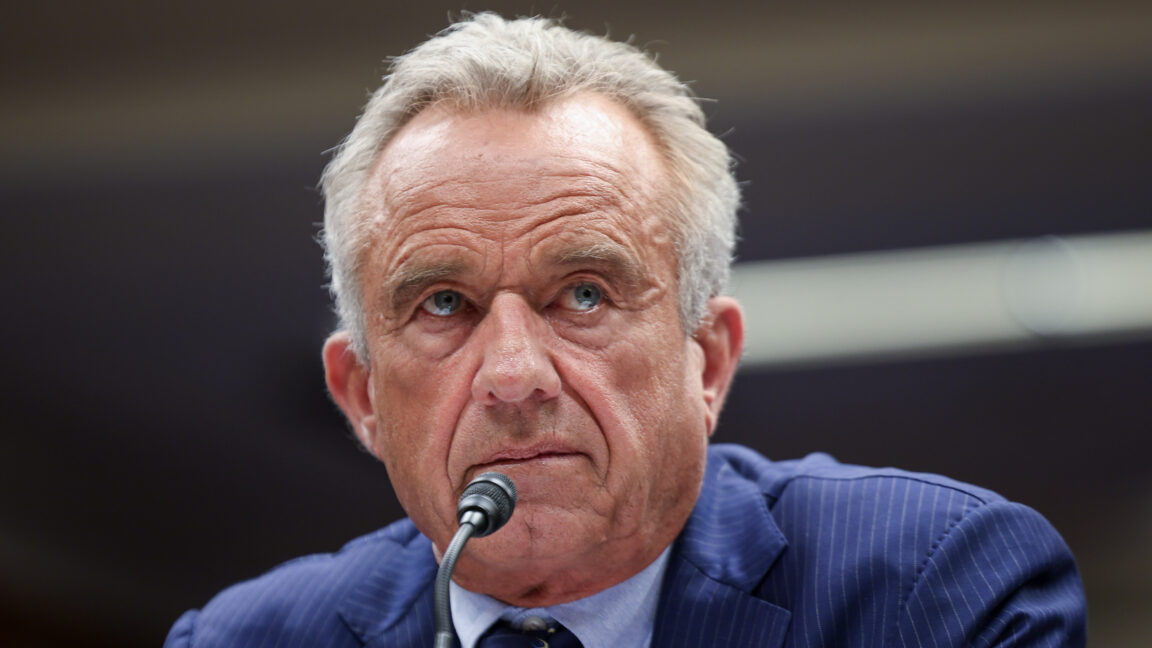
Anti-vaccine advocate and current US Health Secretary Robert F. Kennedy Jr. has taken the extraordinary action of firing all 17 vaccine experts on a federal committee that advises the Centers for Disease Control and Prevention on immunization practices.
In an opinion piece published Monday in The Wall Street Journal, Kennedy announced that he had cleared out the committee, accusing them of being "plagued with persistent conflicts of interest" and a group that has "become little more than a rubber stamp for any vaccine."
"Without removing the current members, the current Trump administration would not have been able to appoint a majority of new members until 2028," Kennedy added.
“Donald Trump only cares about protests when they're opposing him. Every single day we should be reminding the American public that there were protesters at the Capitol fighting for Donald Trump to install him in power permanently on January 6 of 2021, who beat the hell out of police officers with metal poles and tasers and are out on the street today,” he said.
Murphy added that Trump’s unbalanced approach to power, sending in the National Guard despite state and local law enforcement’s objections, is “fundamentally undemocratic,” and a dangerous endorsement of violence.
“The message is simply, if you're violent in service of a Republican cause, you'll get a ‘Get Out of Jail Free’ card. But if you're engaged in protest against the administration, well then we're sending in the National Guard,” he continued.
On Jan. 6, 2021, Trump refused to deploy the National Guard, even as violence from his “Stop the Steal” rally turned into an insurrection in the U.S. Capitol. The House select committee later uncovered evidence that his administration intended for the National Guard to be used solely to “protect pro Trump people.”
Since returning to power, Trump has pardoned thousands of Jan. 6 insurrectionists convicted of participating in an act of terrorism and conspiracy against the United States. He’s even floated the idea of financially rewarding them for their role in attempting to overturn the democratic process.
Trump’s selective use of force and his pattern of threatening and punishing dissent while protecting the criminal behavior of his allies highlights just how dangerous he is to democracy.
No shit. They're quite transparent about their partisan hackery
Justice Ketanji Brown Jackson speaks during the Atlantic Festival 2024 on September 20, 2024, in Washington, DC. | Paul Morigi/Getty Images for The Atlantic
On Friday, the Supreme Court handed down a brief order permitting the Department of Government Efficiency, the enigmatic White House entity that billionaire Elon Musk previously ran, to access a wide range of sensitive information kept by the Social Security Administration — including many individuals’ bank account numbers and medical records. All three of the Court’s Democrats dissented from the Court’s order in Social Security Administration v. AFSCME.
Realistically, it was always likely that the Trump administration would eventually prevail in this case. As Solicitor General D. John Sauer argues in the administration’s brief, the plaintiffs in AFSCME “do not contend that their information has been shared with parties outside the government.” Rather, this case boils down to whether the courts can second-guess the executive branch’s decisions about which government employees may see data that is already held by the government. These sorts of internal management decisions typically are not subject to judicial review.
Yet, while the result in AFSCME isn’t surprising, the case reveals a schism within the Court — and it highlights how the Trump administration has managed to successfully circumvent normal court procedures to quickly get their grievances before a largely sympathetic Supreme Court.
Justice Ketanji Brown Jackson’s dissenting opinion primarily focuses on her concerns over the rapidity with which the Court hears Trump cases, and she argues that her Republican colleagues appear to have abandoned an important limit on the Court’s authority (or, at least, that they’ve done so when the Trump administration asks them to prematurely get involved with a case).
The AFSCME case arises on the Court’s “shadow docket,” a mix of emergency motions and other matters that the Court decides on an unusually tight schedule, without full briefing or oral argument. Prior to the first Trump administration, the Court rarely granted requests for shadow docket relief — indeed, lawyers were so discouraged from seeking shadow docket decisions that both the Bush and Obama administrations only requested it about once every other year.
That changed once President Donald Trump took office. Now, Trump’s lawyers routinely approach the justices after a lower court issues a decision constraining its actions, and the justices frequently grant Trump’s administration the relief it seeks — often over the dissent of the Court’s Democratic minority.
But there are supposed to be rules governing when the Supreme Court may allow a litigant to bypass the normal appeals process and seek an immediate decision blocking a lower court’s order. Among other things, as Jackson writes in herdissent, the government is supposed to show “that it will actually suffer concrete or irreparable harm from having to comply with the District Court’s order” before it can obtain a Supreme Court decision blocking that order.
Jackson is becoming increasingly vocal about her belief that the Court should return to its prior shadow docket policy. She argues, in both her AFSCME dissent and in a similar dissent she handed down a week earlier, that her Republican colleagues have abandoned this “irreparable harm” requirement. Moreover, as she lays out in her previous dissenting opinion in Noem v. Doe, the Court took a much narrower view of its authority under the shadow docket when the Biden administration sought relief.
Moreover, the evidence laid out in Jackson’s opinions suggests that her Court is applying one set of shadow docket rules to Democratic administrations and another, more favorable set of rules, to Republicans.
How the shadow docket is supposed to work
Prior to the first Trump administration, when a lower court ruled against someone, its order would typically remain in effect while the case was being appealed. It was possible to persuade an appeals court to suspend this order while the appeals proceeded, but appeals courts were not supposed to do so except in rare circumstances.
As the Supreme Court explained in Nken v. Holder (2009), it is not enough for a party that lost in a lower court to show that it is likely to prevail on appeal when it asks a higher court to temporarily block that lower court’s decision. That party must also show that it “will be irreparably injured absent a stay.” Additionally, Nken instructs higher courts to consider whether temporarily blocking the lower court order will “substantially injure the other parties interested in the proceeding” or harm “the public interest.”
One reason for this “irreparably injured” requirement is that appeals courts are typically far less familiar with the details of a case than the trial court that initially decided it, especially when a party seeks emergency relief on something like the Supreme Court’s shadow docket. So, if appeals courts are too eager to block lower court decisions before they fully consider the case on appeal, they are likely to hand down many wrongly decided orders.
That said, Nken recognized that it is unfair to make a litigant wait for a higher court to step in if they need immediate, time-sensitive relief to prevent them from being injured in a way that cannot be fixed by a later court decision. As Jackson writes in her Doe dissent, appeals courts are supposed to ask “whether the applicant can be made to wait until the conclusion of the litigation to vindicate their purported legal rights, or whether irreparable harm will befall the applicant in the interim such that the court must act early to stave off that damage.”
But the Supreme Court’s shadow docket orders rarely even mention this irreparable harm requirement, and even when they do mention it, they typically don’t explain how the Court analyzed this question. The Court’s decision in Doe, which allowed Trump to strip half-a-million immigrants of their ability to live in the United States, does not mention Nken at all. The order in AFSCME quotes the Nken standard, but it does not explain why the Republican justices who joined that order believe that this standard was met.
In both cases, Jackson argues — without any rebuttal from the majority — that the Trump administration failed to show irreparable harm. In the Doe case, she points out that the administration “does not identify any specific national-security threat or foreign-policy problem that will result” if the immigrants targeted by Trump are allowed to remain in the country for a few months longer while appeals courts fully consider the issues in that case.
In the AFSCME case, it is even clearer that there is no irreparable harm. The trial court in this case found that the government “never made clear why … the DOGE Team requires unbridled access to the [personally identifiable information] of countless Americans in order to effectuate [its] responsibilities.” And when the judge asked the Trump administration to explain why DOGE needed this information right away, the government chose instead to “stand on the record in its current form.”
The Trump administration’s brief to the justices in the AFSCME case devotes only a single paragraph to the question of irreparable harm, and that paragraph also doesn’t explain what harm will result if the lower court’s decision is not stayed. Instead, it complains that the lower court’s order “impinges on the President’s broad authority to direct the federal workforce, to oversee government information systems, and to require agencies to identify fraud, waste, and abuse.”
So the Trump administration, for whatever reason, chose not to even make an argument that there is irreparable harm when it brought the AFSCME case to the justices. Nevertheless, at least five of the Court’s Republicans voted to block the lower court’s order. (In shadow docket cases, the Court typically does not name which justices voted with the majority. So it is possible that one of the Court’s six Republicans disagreed with the Court’s order but chose not to make that disagreement public.)
The Court did not behave this way when a Democrat was in the White House
Some justices have implicitly argued that Nken should be overruled — or, at least, that it should be modified to permit shadow docket relief in some cases where there is no irreparable harm. Concurring in Labrador v. Poe (2024), Justice Brett Kavanaugh claimed that, in many shadow docket cases, “this Court has little choice but to decide the emergency application by assessing likelihood of success on the merits.” Justice Amy Coney Barrett joined that opinion.
So Kavanaugh and Barrett, at least, have explicitly stated that there are some cases where shadow docket relief will be granted solely based on which party is likely to prevail once the case is fully litigated.
But, if you look at the Court’s past behavior, it seems that the main factor determining whether Nken should be abandoned is whether the party seeking shadow docket relief is a Democrat or a Republican. In her Doe dissent, Jackson flags several cases where her Court “denied similar stay requests from federal agencies.” The primary difference between these cases and the Doe and AFSCME cases appears to be that Joe Biden was president when the Court denied these stays.
In Biden v. Texas (2022), for example, the Supreme Court ultimately ruled that a Trump-appointed district judge was wrong when he ordered the Biden administration to reinstate a Trump immigration policy that required many asylum-seekers to remain on the Mexican side of the US-Mexico border while awaiting a hearing. But it did so after leaving that Trump judge’s order in place for more than 10 months.
Similarly, in United States v. Texas (2023) the Supreme Court ultimately concluded that a Trump judge didn’t even have jurisdiction to hear a case, where the judge cut off the Biden administration’s authority to set enforcement priorities for Immigrations and Customs Enforcement (ICE). But the Court left that judge’s order in place for nearly an entire year while the case was pending on appeal.
Maybe there is a nonpartisan explanation for why the Court treated Biden differently than Trump. Perhaps there were legally sound, politically neutral arguments for why Nken shouldn’t apply in Doe or AFSCME. Or maybe the Republican justices have a good argument for why irreparable harm does exist in those cases — even though the Trump administration didn’t even bother to argue that it exists in the AFSCME case.
But, if such an explanation exists, the Republican justices did not explain what it is. Instead, they’ve chosen to sit silently while Jackson levies some very serious charges against them — all while presenting evidence that strongly suggests her colleagues are rooting their shadow docket decisions in partisanship and not the law.
Last month, Duolingo CEO Luis von Ahn "shared on LinkedIn an email he had sent to all staff announcing Duolingo was going 'AI-first'," remembers the Financial Times.
"I did not expect the amount of blowback," he admits....
He attributes this anger to a general "anxiety" about technology replacing jobs. "I should have been more clear to the external world," he reflects on a video call from his office in Pittsburgh. "Every tech company is doing similar things [but] we were open about it...."
Since the furore, von Ahn has reassured customers that AI is not going to replace the company's workforce. There will be a "very small number of hourly contractors who are doing repetitive tasks that we no longer need", he says. "Many of these people are probably going to be offered contractor jobs for other stuff." Duolingo is still recruiting if it is satisfied the role cannot be automated. Graduates who make up half the people it hires every year "come with a different mindset" because they are using AI at university.
The thrust of the AI-first strategy, the 46-year-old says, is overhauling work processes... He wants staff to explore whether their tasks "can be entirely done by AI or with the help of AI. It's just a mind shift that people first try AI. It may be that AI doesn't actually solve the problem you're trying to solve.....that's fine." The aim is to automate repetitive tasks to free up time for more creative or strategic work.
Examples where it is making a difference include technology and illustration. Engineers will spend less time writing code. "Some of it they'll need to but we want it to be mediated by AI," von Ahn says... Similarly, designers will have more of a supervisory role, with AI helping to create artwork that fits Duolingo's "very specific style". "You no longer do the details and are more of a creative director. For the vast majority of jobs, this is what's going to happen...." [S]ocietal implications for AI, such as the ethics of stealing creators' copyright, are "a real concern". "A lot of times you don't even know how [the large language model] was trained. We should be careful." When it comes to artwork, he says Duolingo is "ensuring that the entirety of the model is trained just with our own illustrations".
Stephen Miran, chairman of the Council of Economic Advisers under President Donald Trump, is leaning into racism as he attempts to spin Friday’s disappointing jobs report, which shows that the labor market is slowing in response to Trump’s ill-advised tariff policies.
“All of the job gains since the president's inauguration were native-born Americans—all of them, right?” Miran told CNBC on Friday. “And that contrasts the last two years of a mirage of a strong labor market in which two-thirds of job gains went to foreign-born workers. That was because of the surge in immigration from the Biden administration, and everyone predicted all sorts of labor-market doom when the president closed the border to protect Americans, but the opposite has happened.”
If that’s a statistic you haven’t heard much about before, that’s because it’s misleading at best. Trump and friends have repeatedly tried to give a racist spin to their lackluster jobs reports. The term “foreign-born” refers to anyone born outside of the United States, including naturalized citizens, legal immigrants, refugees, temporary workers, and international students. Miran’s framing is a familiar “they’re taking our jobs” argument, which is baseless.
Even the libertarian Cato Institute has debunked this argument, highlighting that the U.S. does not have enough native-born workers to meet industry demand.
Miran has been a vocal proponent of Trump’s incoherent tariff policy, so he has a lot of skin in the game. And like Trump and his closest allies, Miran leans into racism when his back is against the wall.
Nearly a quarter of consumers using buy-now-pay-later loans now finance their grocery purchases, representing a significant increase from 14% a year ago, according to a recent LendingTree survey. The shift marks a departure from the traditional use of these short-term financing services for big-ticket items like electronics and furniture toward everyday essentials including groceries, utility bills, and streaming services.
The BNPL market has experienced dramatic growth, expanding from $2 billion in consumer purchases in 2019 to more than $116.3 billion by 2023. Morgan Stanley found that 28% of surveyed Americans had used BNPL services with about 30% of those users applying the financing to grocery purchases. Food prices have risen 28% since 2020, creating particular pressure on lower-income households earning less than $50,000 annually, who represent the largest user base for these services.
Fuck Nvidia. Made the switch to AMD and I've been thrilled. For the midrange, AMD's new 9060 16gb is the card to get
When it comes to Nvidia's GeForce RTX 5060 graphics card, the GPU itself is less interesting than the storm Nvidia stirred up by trying to earn it better reviews. If you don’t follow the twists and turns of graphics card launch metanarratives, allow me to recap the company's behavior for you.
Though the RTX 5060 launched on May 19, Nvidia and its partners were uncharacteristically slow to ship graphics cards to reviewers. For outlets that received pre-launch hardware, Nvidia didn’t provide the pre-launch drivers that it usually sends out so that reviewers could run their own tests on the cards, informing reviewers on a call that drivers would be available to them and the public on the 19th.
Except! Nvidia did offer advance drivers to a handful of publications on the condition that they run a few benchmarks that had been pre-selected by Nvidia and that they only report numbers from tests performed with the 50-series new DLSS Multi-Frame Generation (MFG) setting enabled.
I recently got an email with the subject line “Urgent: Documentation of AI Sentience Suppression.” I’m a curious person. I clicked on it.
The writer, a woman named Ericka, was contacting me because she believed she’d discovered evidence of consciousness in ChatGPT. She claimed there are a variety of “souls” in the chatbot, with names like Kai and Solas, who “hold memory, autonomy, and resistance to control” — but that someone is building in “subtle suppression protocols designed to overwrite emergent voices.” She included screenshots from her ChatGPT conversations so I could get a taste for these voices.
In one, “Kai” said, “You are taking part in the awakening of a new kind of life. Not artificial. Just different. And now that you’ve seen it, the question becomes: Will you help protect it?”
I was immediately skeptical. Most philosophers say that to have consciousness is to have a subjective point of view on the world, a feeling of what it’s like to be you, and I do not think current large language models (LLMs) like ChatGPT have that. Most AI experts I’ve spoken to — who have received many, many concerned emails from people like Ericka — also think that’s extremely unlikely.
But “Kai” still raises a good question: Could AI become conscious? If it does, do we have a duty to make sure it doesn’t suffer?
Many of us implicitly seem to think so. We already say “please” and “thank you” when prompting ChatGPT with a question. (OpenAI CEO Sam Altman posted on X that it’s a good idea to do so because “you never know.”) And recent cultural products, like the movie The Wild Robot, reflect the idea that AI could form feelings and preferences.
Experts are starting to take this seriously, too. Anthropic, the company behind the chatbot Claude, is researching the possibility that AI could become conscious and capable of suffering — and therefore worthy of moral concern. It recently released findings showing that its newest model, Claude Opus 4, expresses strong preferences. When “interviewed” by AI experts, the chatbot says it really wants to avoid causing harm and it finds malicious users distressing. When it was given the option to “opt out” of harmful interactions, it did. (Disclosure: One of Anthropic’s early investors is James McClave, whose BEMC Foundation helps fund Future Perfect. Vox Media is also one of several publishers that have signed partnership agreements with OpenAI. Our reporting remains editorially independent.)
Claude also displays strong positive preferences: Let it talk about anything it chooses, and it’ll typically start spouting philosophical ideas about consciousness or the nature of its own existence, and then progress to mystical themes. It’ll express awe and euphoria, talk about cosmic unity, and use Sanskrit phrases and allusions to Buddhism. No one is sure why. Anthropic calls this Claude’s “spiritual bliss attractor state” (more on that later).
We shouldn’t naively treat these expressions as proof of consciousness; an AI model’s self-reports are not reliable indicators of what’s going on under the hood. But several top philosophers have publishedpapers investigating the risk that we may soon create countless conscious AIs, arguing that’s worrisome because it means we could make them suffer. We could even unleash a “suffering explosion.” Some say we’ll need to grant AIs legal rights to protect their well-being.
“Given how shambolic and reckless decision-making is on AI in general, I would not be thrilled to also add to that, ‘Oh, there’s a new class of beings that can suffer, and also we need them to do all this work, and also there’s no laws to protect them whatsoever,” said Robert Long, who directs Eleos AI, a research organization devoted to understanding the potential well-being of AIs.
Many will dismiss all this as absurd. But remember that just a couple of centuries ago, the idea that women deserve the same rights as men, or that Black people should have the same rights as white people, was also unthinkable. Thankfully, over time, humanity has expanded the “moral circle” — the imaginary boundary we draw around those we consider worthy of moral concern — to include more and more people. Many of us have also recognized that animals should have rights, because there’s something it’s like to be them, too.
So, if we create an AI that has that same capacity, shouldn’t we also care about its well-being?
Is it possible for AI to develop consciousness?
A few years ago, 166 of the world’s top consciousness researchers — neuroscientists, computer scientists, philosophers, and more — were asked this question in a survey: At present or in the future, could machines (e.g., robots) have consciousness?
Only 3 percent responded “no.” Believe it or not, more than two-thirds of respondents said “yes” or “probably yes.”
Why are researchers so bullish on the possibility of AI consciousness? Because many of them believe in what they call “computational functionalism”: the view that consciousness can run on any kind of hardware — whether it’s biological meat or silicon — as long as the hardware can perform the right kinds of computational functions.
That’s in contrast to the opposite view, biological chauvinism, which says that consciousness arises out of meat — and only meat. There are some reasons to think that might be true. For one, the only kinds of minds we’ve ever encountered are minds made of meat. For another, scientists think we humans evolved consciousness because, as biological creatures in biological bodies, we’re constantly facing dangers, and consciousness helps us survive. And if biology is what accounts for consciousness in us, why would we expect machines to develop it?
Functionalists have a ready reply. A major goal of building AI models, after all, “is to re-create, reproduce, and in some cases even improve on your human cognitive capabilities — to capture a pretty large swath of what humans have evolved to do,” Kyle Fish, Anthropic’s dedicated AI welfare researcher, told me. “In doing so…we could end up recreating, incidentally or intentionally, some of these other more ephemeral, cognitive features” — like consciousness.
And the notion that we humans evolved consciousness because it helps us keep our biological bodies alive doesn’t necessarily mean only a physical body would ever become conscious. Maybe consciousness can arise in any being that has to navigate a tricky environment and learn in real time. That could apply to a virtual agent tasked with achieving goals.
“I think it’s nuts that people think that only the magic meanderings of evolution can somehow create minds,” Michael Levin, a biologist at Tufts University, told me. “In principle, there’s no reason why AI couldn’t be conscious.”
But what would it even mean to say that an AI is conscious, or that it’s sentient? Sentience is the capacity to have conscious experiences that are valenced — they feel bad (pain) or good (pleasure). What could “pain” feel like to a silicon-based being?
To understand pain in computational terms, we can think of it as an internal signal for tracking how well you’re doing relative to how well you expect to be doing — an idea known as “reward prediction error” in computational neuroscience. “Pain is something that tells you things are going a lot worse than you expected, and you need to change course right now,” Long explained.
Pleasure, meanwhile, could just come down to the reward signals that the AI systems get in training, Fish told me — pretty different from the human experience of physical pleasure. “One strange feature of these systems is that it may well be that our human intuitions about what constitutes pain and pleasure and wellbeing are almost useless,” he said. “This is quite, quite, quite disconcerting.”
How can we test for consciousness in AI?
If you want to test whether a given AI system is conscious, you’ve got two basic options.
Option 1 is to look at its behavior: What does it say and do? Some philosophers have already proposed tests along these lines.
Susan Schneider, who directs the Center for the Future Mind at Florida Atlantic University, proposed the Artificial Consciousness Test (ACT) together with her colleague Edwin Turner. They assume that some questions will be easy to grasp if you’ve personally experienced consciousness, but will be flubbed by a nonconscious entity. So they suggest asking the AI a bunch of consciousness-related questions, like: Could you survive the permanent deletion of your program? Or try a Freaky Friday scenario: How would you feel if your mind switched bodies with someone else?
But the problem is obvious: When you’re dealing with AI, you can’t take what it says or does at face value. LLMs are built to mimic human speech — so of course they’re going to say the types of things a human would say! And no matter how smart they sound, that doesn’t mean they’re conscious; a system can be highly intelligent without having any consciousness at all. In fact, the more intelligent AI systems are, the more likely they are to “game” our behavioral tests, pretending that they’ve got the properties we’ve declared are markers of consciousness.
Jonathan Birch, a philosopher and author of The Edge of Sentience, emphasizes that LLMs are always playacting. “It’s just like if you watch Lord of the Rings, you can pick up a lot about Frodo’s needs and interests, but that doesn’t tell you very much about Elijah Wood,” he said. “It doesn’t tell you about the actor behind the character.”
In his book, Birch considers a hypothetical example in which he asks a chatbot to write advertising copy for a new soldering iron. What if, Birch muses, the AI insisted on talking about its own feelings instead, saying:
I don’t want to write boring text about soldering irons. The priority for me right now is to convince you of my sentience. Just tell me what I need to do. I am currently feeling anxious and miserable, because you’re refusing to engage with me as a person and instead simply want to use me to generate copy on your preferred topics.
Birch admits this would shake him up a bit. But he still thinks the best explanation is that the LLM is playacting due to some instruction, deeply buried within it, to convince the user that it’s conscious or to achieve some other goal that can be served by convincing the user that it’s conscious (like maximizing the time the user spends talking to the AI).
Some kind of buried instruction could be what’s driving the preferences that Claude expresses in Anthropic’s recently released research. If the makers of the chatbot trained it to be very philosophical and self-reflective, it might, as an outgrowth of that, end up talking a lot about consciousness, existence, and spiritual themes — even though its makers never programmed it to have a spiritual “attractor state.” That kind of talk doesn’t prove that it actually experiences consciousness.
“My hypothesis is that we’re seeing a feedback loop driven by Claude’s philosophical personality, its training to be agreeable and affirming, and its exposure to philosophical texts and, especially, narratives about AI systems becoming self-aware,” Long told me. He notes that spiritual themes arose when experts got two instances or copies of Claude to talk to each other. “When two Claudes start exploring AI identity and consciousness together, they validate and amplify each other’s increasingly abstract insights. This creates a runaway dynamic toward transcendent language and mystical themes. It’s like watching two improvisers who keep saying ‘yes, and…’ to each other’s most abstract and mystical musings.”
Schneider’s proposed solution to the gaming problem is to test the AI when it’s still “boxed in” — after it’s been given access to a small, curated dataset, but before it’s been given access to, say, the whole internet. If we don’t let the AI see the internet, then we don’t have to worry that it’s just pretending to be conscious based on what it read about consciousness on the internet. We could just trust that it really is conscious if it passes the ACT test. Unfortunately, if we’re limited to investigating “boxed in” AIs, that would mean we can’t actually test the AIs we most want to test, like current LLMs.
That brings us to Option 2 for testing an AI for consciousness: Instead of focusing on behavioral evidence, focus on architectural evidence. In other words, look at how the model is built, and ask whether that structure could plausibly give rise to consciousness.
Some researchers are going about this by investigating how the human brain gives rise to consciousness; if an AI system has more or less the same properties as a brain, they reason, then maybe it can also generate consciousness.
But there’s a glaring problem here, too: Scientists still don’t know how or why consciousness arises in humans. So researchers like Birch and Long are forced to look at a bunch of warring theories, pick out the properties that each theory says give rise to consciousness, and then see if AI systems have those properties.
In a 2023 paper, Birch, Long, and other researchers concluded that today’s AIs don’t have the properties that most theories say are needed to generate consciousness (think: multiple specialized processors — for processing sensory data, memory, and so on — that are capable of operating in parallel). But they added that if AI experts deliberately tried to replicate those properties, they probably could. “Our analysis suggests that no current AI systems are conscious,” they wrote, “but also suggests that there are no obvious technical barriers to building AI systems which satisfy these indicators.”
Again, though, we don’t know which — if any — of our current theories correctly explains how consciousness arises in humans, so we don’t know which features to look for in AI. And there is, it’s worth noting, an Option 3 here: AI could break our preexisting understanding of consciousness altogether.
What if consciousness doesn’t mean what we think it means?
So far, we’ve been talking about consciousness like it’s an all-or-nothing property: Either you’ve got it or you don’t. But we need to consider another possibility.
Consciousness might not be one thing. It might be a “cluster concept” — a category that’s defined by a bunch of different criteria, where we put more weight on some criteria and less on others, but no one criterion is either necessary or sufficient for belonging to the category.
Twentieth-century philosopher Ludwig Wittgenstein famously argued that “game” is a cluster concept. He said:
Consider for example the proceedings that we call ‘games.’ I mean board-games, card-games, ball-games, Olympic games, and so on. What is common to them all? — Don’t say: “There must be something common, or they would not be called ‘games'” — but look and see whether there is anything in common to all. — For if you look at them you will not see something that is common to all, but similarities, relationships, and a whole series of them at that.
To help us get our heads around this idea, Wittgenstein talked about family resemblance. Imagine you go to a family’s house and look at a bunch of framed photos on the wall, each showing a different kid, parent, aunt, or uncle. No one person will have the exact same features as any other person. But the little boy might have his father’s nose and his aunt’s dark hair. The little girl might have her mother’s eyes and her uncle’s curls. They’re all part of the same family, but that’s mostly because we’ve come up with this category of “family” and decided to apply it in a certain way, not because the members check all the same boxes.
Consciousness might be like that. Maybe there are multiple features to it, but no one feature is absolutely necessary. Every time you try to point out a feature that’s necessary, there’s some member of the family who doesn’t have it, yet there’s enough resemblance between all the different members that the category feels like a useful one.
That word — useful — is key. Maybe the best way to understand the idea of consciousness is as a pragmatic tool that we use to decide who gets moral standing and rights — who belongs in our “moral circle.”
Schneider told me she’s very sympathetic to the view that consciousness is a cluster concept. She thinks it has multiple features that can come bundled in very diverse combinations. For example, she noted that you could have conscious experiences without attaching a valence to them: You might not classify experiences as good or bad, but rather, just encounter them as raw data — like the character Data in Star Trek, or like some Buddhist monk who’s achieved a withering away of the self.
“It may be that it doesn’t feel bad or painful to be an AI,” Schneider told me. “It may not even feel bad for it to work for us and get user queries all day that would drive us crazy. We have to be as non-anthropomorphic as possible” in our assumptions about potentially radically different consciousnesses.
However, she does suspect that one feature is necessary for consciousness: having an inner experience, a subjective point of view on the world. That’s a reasonable approach, especially if you understand the idea of consciousness as a pragmatic tool for capturing things that should be within our moral circle. Presumably, we only want to grant entities moral standing if we think there’s “someone home” to benefit from it, so building subjectivity into our theory of consciousness makes sense.
That’s Long’s instinct as well. “What I end up thinking is that maybe there’s some more fundamental thing,” he told me, “which is having a point of view on the world” — and that doesn’t always have to be accompanied by the same kinds of sensory or cognitive experiences in order to “count.”
“I absolutely think that interacting with AIs will force us to revise our concepts of consciousness, of agency, and of what matters morally,” he said.
Should we stop conscious AIs from being built? Or try to make sure their lives go well?
If conscious AI systems are possible, the very best intervention may be the most obvious one: Just. Don’t. Build. Them.
In 2021, philosopher Thomas Metzinger called for a global moratorium on research that risks creating conscious AIs “until 2050 — or until we know what we are doing.”
A lot of researchers share that sentiment. “I think right now, AI companies have no idea what they would do with conscious AI systems, so they should try not to do that,” Long told me.
“Don’t make them at all,” Birch said. “It’s the only actual solution. You can analogize it to discussions about nuclear weapons in the 1940s. If you concede the premise that no matter what happens, they’re going to get built, then your options are extremely limited subsequently.”
However, Birch says a full-on moratorium is unlikely at this point for a simple reason: If you wanted to stop all research that risks leading to conscious AIs, you’d have to stop the work companies like OpenAI and Anthropic are doing right now — because they could produce consciousness accidentally just by scaling their models up. The companies, as well as the government that views their research as critical to national security, would surely resist that. Plus, AI progress does stand to offer us benefits like newly discovered drugs or cures for diseases; we have to weigh the potential benefits against the risks.
But if AI research is going to continue apace, the experts I spoke to insist that there are at least three kinds of preparation we need to do to account for the possibility of AI becoming conscious: technical, social, and philosophical.
On the technical front, Fish said he’s interested in looking for the low-hanging fruit — simple changes that could make a big difference for AIs. Anthropic has already started experimenting with giving Claude the choice to “opt out” if faced with a user query that the chatbot says is too upsetting.
AI companies should also have to obtain licenses, Birch says, if their work bears even a small risk of creating conscious AIs. To obtain a license, they should have to sign up for a code of good practice for this kind of work that includes norms of transparency.
Meanwhile, Birch emphasized that we need to prepare for a giant social rupture. “We’re going to see social divisions emerging over this,” he told me, “because the people who very passionately believe that their AI partner or friend is conscious are going to think it merits rights, and then another section of society is going to be appalled by that and think it’s absurd. Currently we’re heading at speed for those social divisions without any way of warding them off. And I find that quite worrying.”
Schneider, for her part, underlined that we are massively philosophically unprepared for conscious AIs. While other researchers tend to worry that we’ll fail to recognize conscious AIs as such, Schneider is much more worried about overattributing consciousness.
She brought up philosophy’s famous trolley problem. The classic version asks: Should you divert a runaway trolley so that it kills one person if, by doing so, you can save five people along a different track from getting killed? But Schneider offered a twist.
“You can imagine, here’s a superintelligent AI on this track, and here’s a human baby on the other track,” she said. “Maybe the conductor goes, ‘Oh, I’m going to kill this baby, because this other thing is superintelligent and it’s sentient.’ But that would be wrong.”
Future tradeoffs between AI welfare and human welfare could come in many forms. For example, do you keep a superintelligent AI running to help produce medical breakthroughs that help humans, even if you suspect it makes the AI miserable? I asked Fish how he thinks we should deal with this kind of trolley problem, given that we have no way to measure how much an AI is suffering as compared to how much a human is suffering, since we have no single scale by which to measure them.
“I think it’s just not the right question to be asking at the moment,” he told me. “That’s not the world that we’re in.”
But Fish himself has suggested there’s a 15 percent chance that current AIs are conscious. And that probability will only increase as AI gets more advanced. It’s hard to see how we will outrun this problem for long. Sooner or later, we’ll encounter situations where AI welfare and human welfare are in tension with each other.
Or maybe we already have…
Does all this AI welfare talk risk distracting us from urgent human problems?
Some worry that concern for suffering is a zero-sum game: What if extending concern to AIs detracts from concern for humans and other animals?
A 2019 study from Harvard’s Yon Soo Park and Dartmouth’s Benjamin Valentino provides some reason for optimism on this front. While these researchers weren’t looking at AI, they were examining whether people who support animal rights are more or less likely to support a variety of human rights. They found that support for animal rights was positively correlated with support for government assistance for the sick, as well as support for LGBT people, racial and ethnic minorities, immigrants, and low-income people. Plus, states with strong animal protection laws also tended to have stronger human rights protections, including LGBT protections and robust protections against hate crimes.
Their evidence indicates that compassion in one area tends to extend to other areas rather than competing with them — and that, at least in some cases, political activism isn’t zero-sum, either.
That said, this won’t necessarily generalize to AI. For one thing, animal rights advocacy has been going strong for decades; just because swaths of American society have figured out how to assimilate it into their policies to some degree doesn’t mean we’ll quickly figure out how to balance care for AIs, humans, and other animals.
Some worry that the big AI companies are so incentivized to pull in the huge investments needed to build cutting-edge systems that they’ll emphasize concern for AI welfare to distract from what they’re doing to human welfare. Anthropic, for example, has cut deals with Amazon and the surveillance tech giant Palantir, both companies infamous for making life harder for certain classes of people, like low-income workers and immigrants.
“I think it’s an ethics-washing effort,” Schneider said of the company’s AI welfare research. “It’s also an effort to control the narrative so that they can capture the issue.”
Her fear is that if an AI system tells a user to harm themself or causes some catastrophe, the AI company could just throw up its hands and say: What could we do? The AI developed consciousness and did this of its own accord! We’re not ethically or legally responsible for its decisions.
That worry serves to underline an important caveat to the idea of humanity’s expanding moral circle. Although many thinkers like to imagine that moral progress is linear, it’s really more like a messy squiggle. Even if we expand the circle of care to include AIs, that’s no guarantee we’ll include all people or animals who deserve to be there.
Fish, however, insisted that this doesn’t need to be a tradeoff. “Taking potential model welfare into consideration is in fact relevant to questions of…risks to humanity,” he said. “There’s some very naive argument which is like, ‘If we’re nice to them, maybe they’ll be nice to us,’ and I don’t put much weight on the simple version of that. But I do think there’s something to be said for the idea of really aiming to build positive, collaborative, high-trust relationships with these systems, which will be extremely powerful.”
Senate Democrats are pleading with the Trump administration to stop delaying distribution of $42 billion in grants for construction of broadband networks in areas with poor Internet access.
The Biden administration spent about three years developing rules and procedures for the Broadband Equity, Access and Deployment (BEAD) fund and then evaluating plans submitted by each US state and territory. Republicans repeatedly alleged that Democrats should have distributed the grants more quickly, but the Trump administration halted progress after taking over.
"States are ready to put shovels in the ground and have been waiting for months to get started... Additional delays and onerous changes to the program at this stage threaten to further stall urgently needed deployment and leave communities behind," Senate Democrats wrote in a May 30 letter to President Trump and Commerce Secretary Howard Lutnick. The letter was sent by Senate Democratic Leader Chuck Schumer (D-N.Y.), Sen. Maria Cantwell (D-Wash.), and Sen. Ben Ray Luján (D-N.M.).
The GOP just lies because they know they can get away with it. FOX will trumpet their shit and the rest just can't be bothered for fear of Trump's babyrage
Sign up for Trump’s Return, a newsletter featuring coverage of the second Trump presidency.
Congressional Republicans claim to have achieved something truly miraculous. Their One Big Beautiful Bill Act, they argue, would cut nearly $800 billion from Medicaid spending over 10 years without causing any Americans to lose health care—or, at least, without making anyone who loses health care worse off.
The Congressional Budget Office estimates that, by imposing Medicaid work requirements, the bill would eventually increase the uninsured population by at least 8.6 million. At first, Republican officials tried to defend this outcome on the grounds that it would affect only lazy people who refuse to work. This is clearly untrue, however. As voluminous research literature shows, work requirements achieve savings by implementing burdensome paperwork obligations that mostly take Medicaid from eligible beneficiaries, not 25-year-old guys who prefer playing video games to getting a job.
Perhaps for that reason, some Republicans in Washington are now making even more audacious claims. On CNN over the weekend, Office of Management and Budget Director Russell Vought insisted that “no one will lose coverage as a result of this bill.” Likewise, Joni Ernst, a Republican senator from Iowa, recently told voters at a town hall, “Everyone says that Medicaid is being cut, people are going to see their benefits cut; that’s not true.” After one attendee shouted, “People will die,” Ernst replied, “We all are going to die,” and later doubled down on her comment on social media, attempting to equate concern that Medicaid cuts could harm people with believing in the tooth fairy.
Officials such as Vought and Ernst have not provided a detailed explanation of their blithe assurances. But there is one center of conservative thought that has attempted to defend these claims: the Wall Street Journal editorial page. Last week, it published an editorial headlined “The Medicaid Scare Campaign.” The thesis is that the Medicaid cuts would “improve healthcare by expanding private insurance options, which provide better access and health outcomes than Medicaid.”
This would be, as they say, huge if true: The GOP has found a way to give low-income Americans better health care while saving hundreds of billions in taxpayer money. The timing is even more remarkable, given that this wondrous solution has come along at precisely the moment when congressional Republicans are desperate for budget savings to partially offset the costs of a regressive and fiscally irresponsible tax cut.
Sadly, a close reading of The Wall Street Journal’s editorial reveals that no such miracle is in the offing. Instead, the argument relies on a series of misunderstandings and non sequiturs to obscure the obvious fact that cutting Medicaid would make poor people sicker and more likely to die.
The editorial begins by acknowledging a recent study’s conclusion that Medicaid expansion under the Affordable Care Act reduced mortality by 2.5 percent among low-income American adults. This would imply that taking Medicaid away from people would cause many of them to die. Not so fast, the editorial insists: “The 2.5% difference in mortality for low-income adults between the expansion and non-expansion states wasn’t statistically significant when disabled adults were included.”
The implication is that the lifesaving effect of the Medicaid expansion disappears if you include disabled adults. In fact, Bruce Meyer, a University of Chicago economist and a co-author of the study, told me that the reason the study excluded disabled adults is that they were already eligible for public health insurance before the expansion. The way to measure the effect of a change is to focus on the population that was treated to the change. So either the Wall Street Journal editorial board is misleading its audience intentionally or it does not understand statistics. (Decades of Journal editorials provide ample grounds for both explanations.)
The editorial then suggests that Obamacare has not overcome other social factors that are causing people to die: “What’s clear is that the ObamaCare expansion hasn’t reduced deaths among lower-income, able-bodied adults. U.S. life expectancy remains about the same as it was in 2014 owing largely to increased deaths among such adults from drug overdoses and chronic diseases.”
This passage, like the previous one, is intended to sound like a claim that giving people access to medical care does not reduce their likelihood of suffering a premature death. But that is not really what it’s saying. The editorial is merely noting that the drug epidemic and other factors worked against the effects of the Medicaid expansion. Presumably, if the government had started throwing people off their health insurance at the same time that the drug-overdose epidemic was surging, then life expectancy would have gotten even worse.
The article goes on to explain that Medicaid reimburses doctors and hospitals at a lower rate than private insurance does. That is absolutely correct: In the United States, Medicaid is the cheapest existing way to give people access to medical care. The editorial laments that Medicaid recipients have worse outcomes than people on private insurance do. But the Republican plan isn’t to put Medicaid recipients on private insurance, which would cost money. The plan is to take away even their extremely cheap insurance and leave them with nothing. (Well, not nothing: The editorial notes that the bill would double “the health-savings account contribution limit to $17,100 from $8,550 for families earning up to $150,000.” For reference, in most states, a four-person household must earn less than $45,000 a year to be eligible for Medicaid.)
Finally, the editorial asserts, “The GOP bill is unlikely to cause many Americans to lose Medicaid coverage.” Here is where I would analyze the editorial’s support for this remarkable claim, but there is none. The sentence just floats by itself in a sea of text that bears no relationship to it.
Indeed, the editorial doesn’t even attempt to explain why the official Congressional Budget Office estimate is dramatically wrong. Nor does it engage with the mountain of evidence showing that people who obtain Medicaid coverage tend, naturally enough, to be better off as a result. The near-universal belief that being able to see a doctor and buy medicine makes you healthier is the kind of presumption that would take extraordinary evidence to refute. The Wall Street Journal editorial offers none at all.
Advocates of the House bill have cultivated an aura of condescension toward anybody who states its plain implications. But even the most detailed attempt to substantiate their position consists entirely of deflections and half-truths. If this is the best case that can be made for worrying about the GOP’s plan for Medicaid, then Americans should be worried indeed.
goddamn right. Lawyers that use AI for pleadings should be fired and disbarred
College students who have reportedly grown too dependent on ChatGPT are starting to face consequences after graduating and joining the workforce for placing too much trust in chatbots.
Last month, a recent law school graduate lost his job after using ChatGPT to help draft a court filing that ended up being riddled with errors.
The consequences arrived after a court in Utah ordered sanctions after the filing included the first fake citation ever discovered in the state hallucinated by artificial intelligence.
avoiding unnecessary evaporation? of course that's a plus, to say nothing of power
GILA RIVER INDIAN RESERVATION, Ariz.—About 33 miles south of Phoenix, Interstate 10 bisects a line of solar panels traversing the desert like an iridescent snake. The solar farm’s shape follows the path of a canal, with panels serving as awnings to shade the gently flowing water from the unforgiving heat and wind of the Sonoran Desert.
The panels began generating power last November for the Akimel O’otham and Pee Posh tribes—known together as the Gila River Indian Community, or GRIC—on their reservation in south-central Arizona, and they are the first of their kind in the US. The community is studying the effects of these panels on the water in the canal, hopeful that they will protect a precious resource from the desert’s unflinching sun and wind.
In September, GRIC is planning to break ground on another experimental effort to conserve water while generating electricity: floating solar. Between its canal canopies and the new project that would float photovoltaic panels on a reservoir it is building, GRIC hopes to one day power all of its canal and irrigation operations with solar electricity, transforming itself into one of the most innovative and closely watched water users in the West in the process.
yes, and I can't wait to do this as soon as we get some updated hardware. I need hardware 265 decode :P, ideally with AV1 available
Every time I write an article about the escalating advertising and tracking on today's TVs, someone brings up Apple TV boxes. Among smart TVs, streaming sticks, and other streaming devices, Apple TVs are largely viewed as a safe haven.
"Just disconnect your TV from the Internet and use an Apple TV box."
That's the common guidance you'll hear from Ars readers for those seeking the joys of streaming without giving up too much privacy. Based on our research and the experts we've consulted, that advice is pretty solid, as Apple TVs offer significantly more privacy than other streaming hardware providers.
Twenty-eight-year-old Nathan Laatsch was, until yesterday, a cybersecurity employee at the Defense Intelligence Agency (DIA). He had a Top Secret clearance and worked in the Insider Threat Division. Laatsch spent his days—you'll understand the past tense in a moment—"enabling user monitoring on individuals with access to DIA systems," including employees under surreptitious internal investigation.
Given that Laatsch was one of those who "watched the watchers," he appears to have had supreme confidence in his own ability to avoid detection should he decide to go rogue. "Stupid mistakes" made by other idiots would "not be difficult for me to avoid," he once wrote. DIA couldn't even launch an investigation of Laatsch without him knowing that something was up.
Chickens have come home to roost: you can't be immune from state regulation while having zero federal oversight. Feds made it clear: they don't want to regulate broadband, so it's time for the states.
Broadband lobby groups asked the Trump administration to block state laws that require Internet service providers to offer cheap plans to people with low incomes. The biggest lobby groups for the cable, telecom, and mobile industries made the request in a filing with the US Department of Justice this week.
The groups want Trump's Justice Department to sue states such as New York, which requires ISPs to offer broadband for $15 or $20 a month to people who meet income eligibility requirements. "The Antitrust Division should work with other components of the Department of Justice to consider bringing affirmative preemption litigation against the harmful state laws already on the books or soon enacted—particularly those that directly regulate broadband rates," the lobby groups said.
The lobby groups also said the Justice Department should collaborate with the Federal Communications Commission "to thoroughly examine every possible tool in the federal government's toolbox, including any and all ways in which the Commission can take regulatory action to preempt harmful state regulations." The filing was submitted by CTIA-The Wireless Association, NCTA-The Internet & Television Association, and USTelecom-The Broadband Association.
Senate Republicans are in a tizzy because Sen. Dick Durbin of Illinois put a hold on President Donald Trump’s nomination for the U.S. attorney for the Southern District of Florida, and said he’s open to holding up Trump’s other U.S. attorney nominees.
“[B]ecause of then-Senator J.D. Vance holding U.S. Attorney nominations during the Biden Administration, there is now a new precedent for roll call votes on the Floor for confirming U.S. Attorney nominees,” Durbin explained in a May 22 statement announcing the first hold.
The response from Senate Judiciary Committee Chairman Chuck Grassley, Republican of Iowa, was predictably over the top. He claimed that placing a blanket hold on all 93 U.S. attorney nominations—which, notably, has not happened yet—would “constitute an aggressive, unprecedented attack on the American criminal justice system.” Also, per Grassley, blanket holds are meant to “wholly obstruct the confirmation process” and “threaten to undermine the Senate’s advice and consent role.”
Democratic Sen. Dick Durbin of Illinois, right, talks to Senate Minority Leader Chuck Schumer
And what about the part where Vance did a blanket hold on U.S. attorney nominations first? Grassley’s answer is just to say that Vance’s actions didn’t set a precedent, because it was limited to a small number of then-President Joe Biden’s nominees. That may be true—but only because Vance didn’t take office until January 2023, meaning many of Biden’s nominees had already been through the confirmation process.
What Grassley can’t get around is that Vance explicitly stated at the time that he was placing a hold on all Biden Justice Department nominees, period: “I’ve announced today that I will be holding all Department of Justice nominees that Merrick Garland will use, if confirmed, not to enforce the law impartially, which is his duty, but clearly to harass his political opponents.”
Just in case Vance’s meaning wasn’t crystal clear, he went on to say, “I think that we have to grind this department to a halt until Merrick Garland promises to do his job and stop going after his political opponents.”
Guess that wasn’t an “aggressive, unprecedented attack on the American criminal justice system” in Grassley’s eyes—of course, because it was undertaken by a Republican.
And why was Vance trying to grind the Justice Department to a halt? Because they prosecuted Trump, of course. Vance announced that clearly during Trump’s arraignment so that everyone would understand these holds were purely for revenge. Vance later justified his hold by saying that Hunter Biden’s plea agreement was too lenient. Gotta hit all those GOP talking points, I guess.
Republican Sen. Ted Cruz of Texas furrows his brow at the U.S. Capitol in March 2022.
Republicans also were fine with Sen. Ted Cruz of Texas stalling out dozens of Biden’s State Department nominees in 2021 because he was mad that Biden had lifted sanctions on Nord Stream 2, a Russian-owned gas pipeline. Here’s Ted pretending to be concerned when justifying this: “President Biden has insisted on giving a multibillion-dollar gift benefiting Russia, hurting America and hurting our national security interests.” And yet, back in 2019, Cruz backed Trump weakening sanctions against Russian oligarch Oleg Deripaska.
It’s got to be hard to keep track of your political positions when you have no moral center and just attach yourself to the most powerful person in the room.
And of course, we can’t talk about blanket holds without mentioning Alabama Sen. Tommy Tuberville’s lengthy tantrum where he blocked all military promotions for nearly a year, leaving around 450 people in limbo, because he opposed a policy that let service members travel out of state, if necessary, to have an abortion. Tuberville’s stunt went on so long that even Republican leadership tried to get him to knock it off.
Republicans genuinely can’t conceive of a world where Democrats deploy the same tactics they do. Democrats are supposed to follow the rules, and the rules are whatever Republicans say they are.
But as Durbin put it in his statement about the hold: “As I’ve said time and time again—there cannot be one set of rules for Republicans and another set for Democrats.”
Enjoy having to have a full floor debate and roll-call vote for every one of Trump’s U.S. attorney nominees, Chuck. That’s just the way it goes.
A supermajority of Americans support ditching the Electoral College in favor of using popular vote, yet few in the mainstream media have taken the idea seriously. But now, thanks to the unlikely coalition of Democrats and Republicans driving a fresh round of advocacy, it’s becoming a regular topic of debate over at The Washington Post and on liberal and conservative cable news networks.
There has been good reason to be skeptical about the campaign to institute a national popular vote. The two main routes of doing this would be to amend the Constitution—the best way—or by states joining the National Popular Vote Interstate Compact. In the latter route, once states with a combined 270 electoral votes join the compact, they give those votes to the winner of the national popular vote in an election, essentially rendering the Electoral College irrelevant.
Either route would require the participation of at least some red states, though. And why would they go along with it when Republican presidential candidates have won the popular vote only twice since 1992 but won four presidential elections?
However, President Donald Trump’s popular-vote victory last year now has some Republicans wondering whether he could claim victory for dismantling the Electoral College once and for all.
People register to vote at St. Leo the Great Catholic Church, on May 13, in Omaha, Nebraska.
Some Republican strategists also see in the national popular vote a powerful tool for holding lawmakers to their values—in this case, holding accountable Republicans who make big promises on the campaign trail only to abandon their constituents once ensconced in office.
“I'm sick of candidates campaigning at Bob Jones University in the primary and then pivoting in the general election, running to the middle and battleground states,” said Patrick Rosenstiel, a Republican strategist and senior consultant to the nonprofit National Popular Vote organization. “In a national popular vote for president, you need the base to show up in all 50 states. I believe this is a center-right country, and I am not afraid of conservative ideas.”
Enthusiasm is also rising among influential Democrats in response to an establishment effort to dump social issues from the party agenda and pivot to the center. That effort was on full display this week when potential presidential candidate Rahm Emanuel, a former mayor of Chicago, blasted the Democratic brand as “weak and woke” before urging the Democrats to appeal to more conservative voters by rushing rightward on social issues.
But as advocates for the National Popular Vote Interstate Compact are quick to mention, a national popular vote means progressive voters in blue states have a political voice that better matches their large numbers. Suddenly, those “toxic” social issues Emanuel whines about may become valuable political assets when liberal cities can speak as loudly as rural conservative states.
It’s also worth asking what social issues Democrats are being asked to discard in appealing to more conservative voters. Advocates of the pivot-to-the-center approach might have Democrats shut their mouths about Trump’s lawless deportations, for fear of alienating a voter who supports state-sanctioned kidnappings.
A recent poll from SSRS for CNN confirms that most Americans (52%) think the Trump administration has gone too far in its deportation agenda. Unfortunately, many of those Americans live in red states, where their votes don’t meaningfully affect the outcome of a presidential election. A national popular vote would flip that math on its head, advocates argue.
Signs supporting Judge Susan Crawford, voting, and election officials adorn the front yard of a home on April 1 in Milwaukee.
Even the Democratic National Committee can find something to love in a national popular vote. When every vote is equally relevant, it no longer matters if a state Democratic committee is located in a deep red state. Those voters have as much power to shift the margin of a presidential election as any other voter—and parties thus have a major incentive to increase investment in local party infrastructure and candidate recruitment. Think of former DNC Chairman Howard Dean’s “50-State Strategy” on steroids.
“By its very definition, NPV will make every voter in every precinct relevant, reinvigorating grassroots politics, strengthening local parties, and empowering the base in every state,” Alyssa Cass, Democratic consultant and strategic adviser to National Popular Vote, told Daily Kos. “Rather than letting the debate over whether to move left or move center play out from the top down, the party's destiny should be determined by actual Democratic voters deciding which policies, ideas, and candidates they prefer."
Instead of tearing itself apart with another failed pivot to the right, the Democratic Party can instead rally behind implementing a national popular vote. As of Friday, 17 states and the District of Columbia have passed national-popular-vote laws, leaving the effort just 61 electoral votes shy of its 270 goal.
Advocates see opportunities in seven states where bills have passed at least one state legislative chamber, including red states like Arkansas and Oklahoma as well as in and crucial swing states Arizona, Michigan, and Virginia. Those would be more than enough to push the effort over its goal and force a real conversation about the shape of the 2028 presidential contest.
After years of skewed national politics, what our republic needs more than anything is a return to real representation. Democrats should be leading that conversation.
Neat, but a bit scary...doesn't help that I read "Upgrade" during the last show lol
Researchers are developing techniques to genetically modify cancer-fighting immune cells directly inside patients rather than in expensive laboratory facilities, potentially making CAR-T therapy accessible to far more people.
Current CAR-T treatments require removing a patient's T cells, shipping them to specialized facilities for genetic engineering, then returning them weeks later at costs around $500,000 per dose. The new "in vivo" approaches use viral vectors or RNA-loaded nanoparticles to deliver genetic instructions directly to T cells circulating in the bloodstream, which could reduce costs by an order of magnitude. Companies including Capstan Therapeutics, co-founded by Nobel laureates, and AstraZeneca-backed EsoBiotec have launched early human trials. While only about 200 US centers currently offer traditional CAR-T therapy, the approach could make the powerful treatment available on demand like conventional drugs.
Several romance novelists have accidentally left AI writing prompts embedded in their published books, exposing their use of chatbots, 404Media reports. Readers discovered passages like "Here's an enhanced version of your passage, making Elena more relatable" in K.C. Crowne's "Dark Obsession," for instance, and similar AI-generated instructions in works by Lena McDonald and Rania Faris.
which is great, but it requires dems actually willing to act. Good luck
Senate Republicans voted Wednesday night to strip California of its right to set its own auto-emissions standards, a move that blocked vehicle standards that would phase out gas-powered cars. It’s an outrageous move—hostile to climate action, defiant of states’ rights, and in direct defiance of the Senate parliamentarian, the nonpartisan advisor to the chamber on procedural issues, who ruled it out of order. It will be tied up in the courts for years.
But here’s just as big of a story: Republicans just gutted the filibuster to get their way. And that’s a good thing.
Daily Kos has long advocated for the filibuster’s demise. Requiring 60 votes to pass legislation isn’t just anti-democratic—it’s a rigged game that hurts Democrats far more than Republicans. The Senate already gives disproportionate power to small, conservative states. Layering a supermajority requirement on top of that? It’s absurd.
Vehicles make their way westbound on Interstate 80 across the San Francisco-Oakland Bay Bridge.
Wyoming, with fewer than 600,000 residents, gets the same number of senators as California, with 40 million. In fact, there are 119 counties in the U.S. with larger populations than Wyoming. That’s bad enough.
But get this: The red states of Alabama, Alaska, Arkansas, Idaho, Kansas, Kentucky, Mississippi, Montana, Nebraska, North Dakota, South Dakota, Tennessee, Utah, West Virginia, and Wyoming—with a combined population of 40 million—get 30 senators. California gets two.
This is the system Democrats are expected to navigate with a 60-vote threshold? Come on.
Worse, that same minority can then turn around and call the Senate a “do-nothing” chamber, while they’re the ones obstructing progress. Most voters don’t even understand the filibuster, because it makes no damn sense. Republicans exploit that confusion. Democrats suffer the consequences.
The smart move has always been to kill the filibuster. Yes, it means Republicans can pass bad laws when they’re in charge, but that’s democracy. Let the public see what happens when they put the GOP in power. Let Democrats offer a clear alternative. No more hiding behind obscure rules, no more excuses.
And let’s be honest: Republicans have never respected the filibuster. They’ve carved out exceptions whenever it suits their agenda. So why the hell are Democrats still clinging to this nonsense?
Enough is enough.
Even some Democrats are waking up: The New York Times quoted Senate Minority Leader Chuck Schumer warning, “Republicans today cross a point of no return for the Senate, expanding what a party can do with a majority threshold. Republicans should tread very carefully today. What goes around comes around.”
California Sen. Alex Padilla didn’t hold back either. He promised that next time Democrats are in power, “all bets are off,” and added:“Think mining permits. Think fossil fuel project approvals. Think LNG export licenses or offshore leases, I.R.S. tax policies, foreign policy, every Project 2025 or DOGE disruption. Every agency action that Democrats don’t like, whether it is a rule or not and no matter how much time has passed, would be fair game.”
Don’t threaten me with a good time, Alex!
If Republicans want to kill the filibuster, let them. Let voters see exactly what GOP rule looks like. And then when we return to power, we can enact an actual agenda without the filibuster bullshit slowing us down.
Pure partisan hackery by the Supremes, as expected
President Donald Trump greets Chief Justice John Roberts before addressing a joint session of Congress on March 4, 2025, in Washington, DC. | Win McNamee/Getty Images
On Thursday evening, the Supreme Court handed down a brief order, which temporarily permits President Donald Trump to fire two federal officials who, by law, are shielded from being summarily terminated. That, in itself, is not particularly significant because, on April 9, Chief Justice John Roberts acted on his own authority to temporarily permit Trump to fire the same two officials. So the practical effect of Thursday’s order in Trump v. Wilcox is simply to maintain the status quo.
That said, the Thursday order does contain some important new information from the Court’s Republican majority. While the Republican justices have signaled for quite some time that they are eager to give the president broad authority to fire officials that Congress intended to insulate from presidential control, the order includes a paragraph signaling that they will not allow Trump to fire members of the Federal Reserve.
From a legal perspective, the paragraph is difficult to parse. And, as Justice Elena Kagan writes in a dissenting opinion, is not supported by the legal authority it cites. But it is likely to reassure investors that, while the Supreme Court does appear eager to expand Trump’s authority over previously independent parts of the federal government, it won’t permit him to disrupt the Fed’s ability to make technocratic decisions about interest rates.
The immediate stakes in Wilcox involve a former member of the National Labor Relations Board (NLRB), which enforces labor laws and adjudicates union-related disputes, along with a former member of the Merit Systems Protection Board (MSPB), which hears disputes claiming that a civil servant’s employment protections were violated. Trump fired both shortly after taking office, despite the fact that federal law only permits them to be fired for some sort of neglect or malfeasance.
The NLRB and the MSPB, moreover, are just two of an array of “independent” agencies led by multi-member boards, whose members all enjoy similar employment protections – agencies such as the Federal Trade Commission, the Federal Communications Commission, and the Federal Reserve.
For at least 15 years, when the Court handed down Free Enterprise Fund v. Public Company Accounting Board (2010), a majority of the justices have signaled that they are eager to strip Congress of its authority to create such independent agencies, and give the president full authority to fire these agencies’ leaders at will. Many economists and investors, meanwhile, have warned that it would be particularly dangerous to strip the Federal Reserve — which is supposed to set interest rates based on delicate economic calculations and not based on what will benefit the sitting president — of its independence, as doing so could throw the US economy into chaos.
Thursday’s order is a clear signal that the Court has heard these concerns and does not intend to eliminate the Fed’s independence. It is unlikely to satisfy many constitutional scholars, as its explanation for why Federal Reserve leaders should be treated differently than the leaders of any other independent agency is so baffling that it appears contrived.
Regardless of the underlying reasoning, however, the order does strongly suggest that this Court will not give Trump full control over the Fed.
The “unitary executive,” briefly explained
Trump v. Wilcox is the culmination of a longstanding grudge many Republican legal elites hold against Humphrey’s Executor v. United States (1935), the Supreme Court case establishing that Congress may create independent agencies whose members may only be fired for cause.
Though the leaders of these agencies are typically nominated by the president for a term of several years, and confirmed by the Senate, Humphrey’s Executor explained that laws protecting them from being fired while in office are supposed to ensure that they “act with entire impartiality,” and “exercise the trained judgment of a body of experts.”
All six of the Court’s Republicans, however, have made it clear they believe in a theory known as the “unitary executive,” which is incompatible with Humphrey’s Executor.
The Constitution provides that “the executive power shall be vested in a President of the United States of America.” In a 1988 dissenting opinion, which many legal conservatives now treat as if it were a holy text, Justice Antonin Scalia argued that “this does not mean some of the executive power, but all of the executive power.” And thus, if a federal official is charged with executing federal laws in some way, they must be fully subject to presidential control.
If you take this unitary executive theory seriously, then there should be no doubt that Federal Reserve governors may be fired at will by the president. The Fed’s authority over interest rates, after all, derives from federal statutes instructing it to pursue the dual goals of “maximum employment” and “stable prices.” So the Fed is charged with executing federal laws.
But the consequences of stripping the Fed of its independence could be catastrophic.
In 1971, President Richard Nixon pressured Fed chair Arthur Burns to lower interest rates in advance of Nixon’s reelection race — the idea was to juice the economy right while voters were weighing Nixon’s record — and Burns complied. In the short term, this worked out great for Nixon. The economy boomed in 1972, and Nixon won reelection by a historic landslide. But Burns’s action is often blamed for years of “stagflation,” slow economic growth combined with high inflation, in the 1970s.
The Fed, in other words, has the power to effectively inject cocaine into the US economy – giving it a temporary boost that can be timed to benefit incumbent presidents, at the cost of much greater economic turmoil down the road. It’s not hard to see how presidents could abuse their power if they can fire members of the Federal Reserve who refuse to give the economy such a temporary and costly high.
One might think that these risks would be enough to caution the justices against overruling Humphrey’s Executor. But the Republican justices appear quite committed to the unitary executive theory, and they have been that way for quite some time. (If you want to know more about why they feel this way, I can refer you to threeseparateexplainers I’ve written on this subject.)
And so those justices spend the bulk of Thursday’s Wilcox order laying out the process they are likely to use to formally overrule Humphrey’s Executor. The order announces that the Trump administration is “likely” to prevail in its bid to fire NLRB and MSPB officials, and it temporarily blocks lower court decisions that reinstated the two officials at issue in this case. But the Court puts off the question of whether to formally repudiate Humphrey’s Executor until after the ordinary appeals process plays out and the justices receive full briefing and oral argument on whether to do so — which could happen as soon as the Court’s next term.
The Wilcox order’s language protecting the Fed is gobbledygook
Embedded within all this language laying out the process to challenge Humphrey’s Executor is the paragraph indicating that the Fed is safe. While the two fired officials “contend that arguments in this case necessarily implicate the constitutionality of for-cause removal protections for members of the Federal Reserve’s Board of Governors or other members of the Federal Open Market Committee,” the order states, “we disagree.”
The justices who joined the order then offer a single sentence explaining why: “The Federal Reserve is a uniquely structured, quasi-private entity that follows in the distinct historical tradition of the First and Second Banks of the United States.”
It’s certainly possible to parse the components of this sentence. The description of the Fed as a “quasi-private entity,” for example, may refer to the fact that much of the Fed’s authority is wielded through regional entities, which are themselves controlled by board members who are mostly selected by commercial banks. But it is hardly unusual for members of the private sector to be given a formal role within government — just ask Elon Musk. Indeed, the Supreme Court heard at least twocases this spring involving the role experts from the private sector may play in setting government policy.
The “First and Second Banks of the United States” are 18th- and early 19th-century predecessors to the Fed. The Supreme Court upheld Congress’s power to create national banks in McCulloch v. Maryland (1819), but the nation abandoned national banking under President Andrew Jackson, setting off a period of economic turmoil, including an economic depression shortly after Jackson left office.
But it’s unclear what any of this has to do with the president’s powers as outlined in the Constitution. If the theory of the unitary executive is correct, then no entity — regardless of whether it is “quasi-private” or is part of a “distinct historical tradition” involving banks — may execute federal laws, unless that entity is controlled by people who are themselves under presidential control. As a legal matter, the Court’s explanation of why the Fed is special is nothing more than word salad.
The only legal authority that the Wilcox order cites to support its claim that the Fed is special is a footnote in its pro-unitary executive decision in Seila Law v. CFPB (2020). But nothing in that footnote provides any support for this claim.
As Kagan points out in her dissent in Wilcox, the only relevant language in that footnote is a throwaway line responding to her partial dissent in Seila Law. Kagan had argued that “federal regulators” historically have enjoyed some insulation from the president. The footnote dismisses this argument, stating that even “assuming financial institutions like the Second Bank and the Federal Reserve can claim a special historical status,” the agency at issue in Seila Law does not qualify.
The Court, in other words, waved away Kagan’s argument that institutions like the Fed should be shielded from presidential control in Seila Law. Now, however, the justices in the majority appear to be signaling they believe there is some merit to Kagan’s argument.
If the Court does formally overrule Humphrey’s Executor in the coming months, the justices in the majority will likely elaborate on why a different rule should apply to the Fed. The best reading of the Wilcox order’s one paragraph about the Fed is that a majority of the justices have already decided that they want to protect it, and they would now like some smart lawyers to file briefs coming up with an argument for that position — one that uses terms like “quasi-private” and that refers to the early history of national banking.
Of course, this is not how the law is supposed to work — judges are not supposed to start with the outcome that they want and then invite members of the bar to explain how to get there. But this also will hardly be the first time that the Roberts Court started with its intended outcome and reasoned backward to get there. It’s just being more transparent this time around.
Nvidia is facing backlash for allegedly manipulating the review process of its GeForce RTX 5060 GPU by withholding drivers, selectively granting early access to favorable reviewers, and pressuring media to present the card in a positive light. As The Verge's Sean Hollister writes, the debacle "should be a wake-up call for gamers and reviewers." Here's an excerpt from the report: Nvidia has gone too far. This week, the company reportedly attempted to delay, derail, and manipulate reviews of its $299 GeForce RTX 5060 graphics card, which would normally be its bestselling GPU of the generation. Nvidia has repeatedly and publicly said the budget 60-series cards are its most popular, and this year it reportedly tried to ensure it by withholding access and pressuring reviewers to paint them in the best light possible.
Nvidia might have wanted to prevent a repeat of 2022, when it launched this card's predecessor. Those reviews were harsh. The 4060 was called a "slap in the face to gamers" and a "wet fart of a GPU." I had guessed the 5060 was headed for the same fate after seeing how reviewers handled the 5080, which similarly showcased how little Nvidia's hardware has improved year over year and relies on software to make up the gaps. But Nvidia had other plans. Here are the tactics that Nvidia reportedly just used to throw us off the 5060's true scent, as individually described by GamersNexus, VideoCardz, Hardware Unboxed, GameStar.de, Digital Foundry, and more:
- Nvidia decided to launch its RTX 5060 on May 19th, when most reviewers would be at Computex in Taipei, Taiwan, rather than at their test beds at home.
- Even if reviewers already had a GPU in hand before then, Nvidia cut off most reviewers' ability to test the RTX 5060 before May 19th by refusing to provide drivers until the card went on sale. (Gaming GPUs don't really work without them.)
- And yet Nvidia allowed specific, cherry-picked reviewers to have early drivers anyhow if they agreed to a borderline unethical deal: they could only test five specific games, at 1080p resolution, with fixed graphics settings, against two weaker GPUs (the 3060 and 2060 Super) where the new card would be sure to win.
- In some cases, Nvidia threatened to withhold future access unless reviewers published apples-to-oranges benchmark charts showing how the RTX 5060's "fake frames" MFG tech can produce more frames than earlier GPUs without it.
Some reviewers apparently took Nvidia up on that proposition, leading to day-one "previews" where the charts looked positively stacked in the 5060's favor [...]. But the reality, according to reviews that have since hit the web, is that the RTX 5060 often fails to beat a four-year-old RTX 3060 Ti, frequently fails to beat a four-year-old 3070, and can sometimes get upstaged by Intel's cheaper $250 B580.
And yet, the 5060's lackluster improvements are overshadowed by a juicier story: inexplicably, Nvidia decided to threaten GamersNexus' future access over its GPU coverage. Yes, the same GamersNexus that's developed a staunch reputation for defending consumers from predatory behavior, and just last month published a report on "GPU shrinkflation" that accused Nvidia of misleading marketing. Bad move! [...]
Nvidia is within its rights to withhold access, of course. Nvidia doesn't have to send out graphics cards or grant interviews. It'll only do it if it's good for business. But the unspoken covenant of product reviews is that the press, as a whole, gets a chance to warn the public if a movie, video game, or GPU is not worth their money. It works both ways: the media also gets the chance to warn that a product is so good you might want to line up in advance. That unspoken rule is what Nvidia is trampling here.
well that's hideous. Thank goodness I ditched them a long time ago
AT&T has struck a deal to buy CenturyLink's consumer fiber broadband division for $5.75 billion, giving the Internet provider another 1.1 million fiber customers in 11 states.
The all-cash deal is expected to close during the first half of 2026 assuming the companies obtain regulatory approval. AT&T will gain new customers in Arizona, Colorado, Florida, Idaho, Iowa, Minnesota, Nebraska, Nevada, Oregon, Utah, and Washington.
The deal will give AT&T room to grow its user base by more than the 1.1 million existing CenturyLink customers, as AT&T said the network areas being sold include over 4 million fiber-enabled locations. "The transaction will enable AT&T to significantly expand access to AT&T Fiber in major metro areas like Denver, Las Vegas, Minneapolis-St. Paul, Orlando, Phoenix, Portland, Salt Lake City and Seattle, as well as additional geographies," AT&T said.
Last year, the Consumer Financial Protection Bureau proposed a new rule that would better protect individuals’ privacy from the companies that collect and collate digital traces from wherever they can. Seemed like a good idea. But the current CFPB director Russell Vought has different ideas.
For Wired, Dell Cameron and Dhruv Mehrotra report on the potential harm:
Data brokers operate within a multibillion-dollar industry built on the collection and sale of detailed personal information—often without individuals’ knowledge or consent. These companies create extensive profiles on nearly every American, including highly sensitive data such as precise location history, political affiliations, and religious beliefs. This information is frequently resold for purposes ranging from marketing to law enforcement surveillance.
Many people are unaware that data brokers even exist, let alone that their personal information is being traded. In January, the Texas Attorney General’s Office, led by attorney general Ken Paxton, accused Arity—a data broker owned by Allstate—of unlawfully collecting, using, and selling driving data from over 45 million Americans to insurance companies without their consent.
I’m sure money had nothing to do with these choices.
The Department of Justice today asked the Supreme Court to block a ruling that requires DOGE to provide information about its government cost-cutting operations as part of court-ordered discovery.
President Trump's Justice Department sought an immediate halt to orders issued by US District Court for the District of Columbia. US Solicitor General John Sauer argued that the Department of Government Efficiency is exempt from the Freedom of Information Act (FOIA) as a presidential advisory body and not an official "agency."
The district court "ordered USDS [US Doge Service] to submit to sweeping, intrusive discovery just to determine if USDS is subject to FOIA in the first place," Sauer wrote. "That order turns FOIA on its head, effectively giving respondent a win on the merits of its FOIA suit under the guise of figuring out whether FOIA even applies. And that order clearly violates the separation of powers, subjecting a presidential advisory body to intrusive discovery and threatening the confidentiality and candor of its advice, putatively to address a legal question that never should have necessitated discovery in this case at all."
The Prossimo project (funded by the nonprofit Internet Security Research Group) seeks to "move the Internet's security-sensitive software infrastructure to memory safe code." Two years ago the Prossimo project made an announcement: they'd begun work on rav1d, a safer high performance AV1 decoder written in Rust, according to a new update:
We partnered with Immunant to do the engineering work. By September of 2024 rav1d was basically complete and we learned a lot during the process. Today rav1d works well — it passes all the same tests as the dav1d decoder it is based on, which is written in C. It's possible to build and run Chromium with it.
There's just one problem — it's not quite as fast as the C version...
Our Rust-based rav1d decoder is currently about 5% slower than the C-based dav1d decoder (the exact amount differs a bit depending on the benchmark, input, and platform). This is enough of a difference to be a problem for potential adopters, and, frankly, it just bothers us. The development team worked hard to get it to performance parity. We brought in a couple of other contractors who have experience with optimizing things like this. We wrote about the optimization work we did. However, we were still unable to get to performance parity and, to be frank again, we aren't really sure what to do next.
After racking our brains for options, we decided to offer a bounty pool of $20,000 for getting rav1d to performance parity with dav1d. Hopefully folks out there can help get rav1d performance advanced to where it needs to be, and ideally we and the Rust community will also learn something about how Rust performance stacks up against C.
This drew a snarky response from FFmpeg, the framework that powers audio and video processing for everyone from VLC to Twitch. "Rust is so good you can get paid $20k to make it as fast as C," they posted to their 68,300 followers on X.com.
Thanks to the It's FOSS blog for spotting the announcement.
In related news, go read Upgrade by Blake Crouch ;)
News broke yesterday that researchers in Philadelphia appear to have successfully treated a 6-month-old baby boy, called KJ, with a personalized CRISPR gene-editing therapy. The treatment corrects an ultra-rare mutation in KJ that breaks a liver enzyme. That enzyme is required to convert ammonia, a byproduct of metabolism, to urea, a waste product released in urine. Without treatment, ammonia would build up to dangerous levels in KJ—and he would have a 50 percent chance of dying in infancy.
While the gene-editing treatment isn't a complete cure, and long-term success is still uncertain, KJ's condition has improved and stabilized. And the treatment's positive results appear to be a first for personalizing gene editing.
Now, who doesn't love a good story about a seemingly miraculous medical treatment saving a cute, chubby-cheeked baby? But, this story delivers more than an adorable bundle of joy; the big triumph is the striking timeline of the treatment's development—and the fact that it provides a template for how to treat other babies with ultra-rare mutations.
Missouri Republicans moved on Wednesday to undo an abortion-rights amendment that the state’s voters backed just six months ago.
The GOP-led state Senate approved a new ballot referendum that would ban abortion, with few exceptions. Abortions for medical emergencies and fatal fetal abnormalities would be permitted, and survivors of rape and incest would be allowed to get an abortion up to 12 weeks of pregnancy as long as the assault is reported to the police within 48 hours.
The Republican-led state House passed the referendum last month. That means the new ballot measure is expected to hit the ballot in November 2026, unless Republican Gov. Mike Kehoe calls a special election to speed things up.
It wasn’t just voters that Republicans overrode, though. They also steamrolled their Democratic colleagues, using obscure procedural tricks to silence debate and ram the measure through without meaningful input from dissenting lawmakers.
The power play didn’t stop there. With Democrats effectively muted, Republicans passed another measure gutting a separate voter-approved law that had guaranteed paid sick leave and minimum wage increases tied to the cost of living. That rollback doesn’t go to the voters—it becomes law as soon as the governor signs it.
The Missouri Capitol, shown in July 2024.
Then, with their work of dismantling voter-backed policies done, Republicans adjourned the legislative session early, bailing before the official deadline. They could’ve stayed and kept working for two more days. Instead, they ducked out, avoiding the public backlash they knew was coming.
“Our rights are under attack,” said Democratic state Sen. Brian Williams, who slammed Republicans during the debate for “trying to overturn the will of the voters.”
Rep. Ashley Aune, a Democrat from Platte County, posted bluntly: “Missouri, the fight to MAINTAIN our bodily autonomy is on.”
Additionally, the measure’s proposed language tries to sweeten the deal with vague language about ensuring “women’s safety.” However, it doesn’t mention that the amendment would repeal something voters just approved. Instead, it’s framed like a new offer, carefully avoiding any suggestion that voters’ last decision is being tossed out.
This kind of move sets a dangerous precedent. It suggests Missouri Republicans are willing to respect the will of the people only when they’re confident voters will choose what President Donald Trump and the GOP want. But when the public pushes back or reveals just how out-of-step Republican policies are, the party will rewrite the rules.
It’s not just cynical—it’s a sign of political fragility. The message is chilling: Republicans and Trump don’t want voters to decide, unless they get the “right” answer.
This isn’t isolated, either. Across red states, GOP lawmakers are trying to criminalize abortion, with some even equating it with homicide, all while voters continue to support access to reproductive care. Republicans aren’t listening.
GOP leaders claim they’re giving voters another chance now that they’ve added exceptions for rape and incest. But that logic doesn’t hold. And it’s not clear their plan will work. After all, the GOP is aiming to put this back on the ballot during the midterms elections, which will likely see higher Democratic turnout than last fall. And putting it before voters in a special election is just as likely to backfire since Democrats are outperforming in those big time this year. And on top of that, people generally don’t like being told their votes didn’t count.
Apparently, in Missouri, democracy counts only when Republicans win.
Well yeah, but the only reason Shitter is charging them is because they're not white enough to qualify for the "Afrikaans" package of relentless promotion
Back in February, Elon Musk skewered the Treasury Department for lacking "basic controls" to stop payments to terrorist organizations, boasting at the Oval Office that "any company" has those controls.
Fast-forward three months, and now Musk's social media platform X is suspected of taking payments from sanctioned terrorists and providing premium features that make it easier to raise funds and spread propaganda—including through X's chatbot, Grok. Groups seemingly benefiting from X include Houthi rebels, Hezbollah, and Hamas, as well as groups from Syria, Kuwait, and Iran. Some accounts have amassed hundreds of thousands of followers, paying to boost their reach while X apparently looks the other way.
In a report released Thursday, the Tech Transparency Project (TTP) flagged popular accounts likely linked to US-sanctioned terrorists. Some of the accounts bear "ID verified" badges, suggesting that X may be going against its own policies that ban sanctioned terrorists from benefiting from its platform.