
Yuval Pinter
Shared posts


31 Jan 20:38

למה הצעקות "פשיזם" גורמות יותר נזק מתועלת
by גדי טאוב
Yuval Pinterאיפה הילד שלי, גדי?
אני יודע שכתבתי כמה פוסטים מלגלגים על אלה שצועקים פשיזם. זה לא אומר שאני לוקח את זה בקלות. בכלל לא. אני חושב שצריך לעמוד נגד הצעקות האלה ברצינות רבה, והומור זה אחד הכלים, לא המטרה. כי לצעוק פשיזם-פשיזם זה לא רק לא מועיל. זה מזיק, וזה מסוכן.
.
לא הייתי מטריד אתכם עוד פעם בעניין הזה אם הייתי חושב שזה רק מגוחך. מופע האימים הזה הוא עדות לאובדן דרך ואוריינטציה, אה-פוליטיות, נרקיסיזם, ותבוסתנות. ולמי שהוויכוח המייגע הזה עוד מעניין אותו אני מוכן להסביר בפירוט למה זה גם חסר שחר, וגם מזיק.
.
נתחיל בחסר שחר.
.
יש בישראל בכלל ותחת הממשלה הזאת בפרט מגמות אנטי-דמוקרטיות מדאיגות. אבל לדמוקרטיה הישראלית שלום. לא הצהרותיה של מירי רגב (שאת רובן אין לה דרך לממש), לא הקמפיין נמוך המצח של 'אם תרצו', וגם לא ספר האזרחות של נפתלי בנט, מתקרבים לליגה של 'משטרים אפלים'. משטר מאד לא אפל באמריקה הלך הרבה יותר רחוק בשנות הארבעים, מחוקי נאמנות שעל בסיסם פיטרו עובדים, עד רדיפות של FBI, ורשימות שחורות בתעשיית המדיה, עד ועדות של הקונגרס שלא נתנו לנחקריהן זכות להתגונן. שלא לדבר על מאסר של מאות אלפי אזרחים (כן, מאות אלפי) רק על סמך מוצאם ותו לא. ואפילו זה לא היה פשיזם.
.
אצלנו, להבדיל, אקדמאים ועיתונאים יכולים להיות אנטי-ישראלים קיצונים כמה שהם רוצים, ואף אחד לא דופק להם בדלת. אז מספיק להביא את עזרא נאווי בתור דוגמא. גם חשדו בו בפשעים חמורים מאד, הוא גם התרברב בזה שהוא שולח אנשים לעינויים ומוות, וגם בסופו של דבר שיחררו אותו בהוראת בית משפט. לא שמעתי שגדעון לוי צריך לבקש מקלט מדיני, בינתיים. וטוב שכך. פרופ' ניב גורדון קורא לאקדמאים בחו"ל להחרים אוניברסיטאות ישראליות, והוא מקבל משכורת מאוניברסיטה ישראלית, וטוב שגם כך. לבריאות. זו רק עדות לחוסננו. ובתנאים האלה זה ממש מגוחך בעיני שכל מצביע מר"צ ימנה את עצמו לחבר ברסיסטנס ויחמיא לעצמו על אומץ ליבו כאילו הגסטפו ממש בדלת. להיות היסטרי זה לא אותו דבר כמו להיות אמיץ.
.
אולי חשוב עוד יותר, ישראל היא מקום מאד מורכב. ובצד תופעות חשוכות ודוחות – יש הרבה יותר דוחות מאלה שמחוללות שערוריות היסטריות בשמאל – יש לה גם מאפיינים יוצאי דופן של סובלנות וחוסן דמוקרטי. בהרבה מובנים היא יותר דמוקרטית מרוב הדמוקרטיות. מדינת ישראל ממנת מערכות חינוך (הן במגזר הערבי והן בזה החרדי) שהכחשת זכותה להתקיים פורחת בהן. זה לא היה עולה על הדעת בצרפת, באנגליה, או בארצות הברית. ישראל אינה פוסלת רשימות פוליטיות גם כשהן מתנגדות לזכותו של העם היהודי להגדרה עצמית, או תומכות באוייב בזמן מלחמה, למרות שהחוק אוסר את זה. אני לא מכיר עוד מקום שמאפשר דבר כזה. ישראל מאפשרת לחברת הכנסת חנין זועבי, בוגרת המשט התורכי, להסביר לבוחריה איך אפשר לעודד את אינתיפדת הסכינים, והיא עדיין יושבת בכנסת שלנו. לעומת זאת ישראל הוציאה מחוץ לחוק את מפלגת 'כך' של מאיר כהנא, כשם שרק לאחרונה, בבחירות, היא לא נתנה מספיק קולות למפלגתו הלאומנית הקיצונית של אלי ישי אפילו כדי לעבור את אחוז החסימה. וזאת אותה ישראל שרק עכשיו עשתה רפורמה מקיפה בחלוקת המשאבים שלה כדי לתקן קיפוח רב שנים של המגזר הערבי. בישראל יש מערכת משפט שעוצמתה היחסית לענפי השלטון האחרים היא ללא אח ורע בעולם הדמוקרטי, והיא מקפידה על ערכים ליברליים עד כדי כך, שלפעמים אני חושש שהיא מסכנת את הדמוקרטיה מהצד השני של הקשת, רחוק ככל שאפשר להיות מפשיזם. אם אחרי כל זה הניסיון של מירי רגב להתערב בחלוקה של תקציבי תרבות דומה בעיניכם לטיהור התרבות הגרמנית מאלמנטים יהודיים – כמו באיזה פוסט אידיוטי שמסתובב עכשיו ברשת, עם ציטוטים מהיטלר – אז אל תצפו שמישהו מחוץ למחנה שלכם ייקח אותכם ברצינות. כל מי שעדיין רוצה לצעוק שאנחנו פשיסטים ונאצים למרות הכל, שיזכור מה הוא חשב כשהימין טען על השמאל שהוא נאצי. יצחק רבין במדי אס אס. זוכרים? שזה כבר פולש לתחום שאלת המזיק.
.
אז עכשיו למזיק.
.
אלה שצועקים זאב זאב חושבים אולי שהם נלחמים במגמות אנטי-דמוקרטיות, אבל הם משבשים לחלוטין את הדבר החשוב שמבקרים חברתיים ופוליטיים צריכים לעשות. אם יורשה לי לצטט את עמוס עוז, שלקרוא לו "שתול" זה מעשה נבלה מטופש, תפקידם של אינטלקטואלים ומבקרים להבדיל בין דרגות של רוע. ואם הם לא יודעים להבדיל בין 'אם תרצו' לבין הנאצים, אז הם לא עושים את תפקידם, ואיש לא יאמין להם כשהם יתקלו ברוע חמור הרבה יותר. לצעוק פשיזם על כל דבר זה מרפה ידיים ומקהה רגישות, זה מציע ייאוש מיופייף במקום אקטיביזם פוליטי.
.
שנית, זה שכל עדות לכך שישראל היא דמוקרטית נתקלת בבוז ואפילו בזעם, זה סימן רע מאד בעיני. היו לי כמה חוויות כאלה. כתבתי לא מזמן מאמר על הרפורמה בתקציבים לטובת המגזר הערבי, ונדהמתי מהמרץ (תסלחו לי על התרתי משמע) שבו התגייסו כל מיני דוברי שמאל להכחיש את ההישג החשוב הזה, בתנאים לא פשוטים של סכסוך דמים בין עמים. זה כאילו הם ממש שמחו, ממש היתה להם הקלה, כשהם מצאו סיבה לומר שהרפורמה לא תמומש (והם גם טועים). על מה זה מעיד? שחלקים של השמאל התחילו לבסס את זהותם, לא רק את עמדתם, על בוז לישראל, על ביזוי של ישראל, על תחרות אידיוטית מי ישמיץ אותה יותר. אין לי שם אחר לזה חוץ משמחה לאיד. אנשים כאלה לא רוצים לשנות, הם רוצים להתבדל. הם רוצים לבסס את הזהות של עצמם על זה שהם נגעלים מכולנו. אין לי שום כבוד לזה. אבל תעזבו כבוד. זאת עדות עמוקה לזה שהם לא חושבים, אפילו הייתי אומר לא רוצים, להחליף את השלטון. אין שום סיכוי למכור לבוחרים במדינה דמוקרטית את הבוז למדינה שלהם, ולחשוב שככה תגיע לשלטון. זאת אחת הסיבות המרכזיות להתכווצות השמאל.
.
שלישית, לצעוק פשיזם מעל כל במה, זה לא משחק פנים-ישראלי בלבד. מי שחושב שכך הוא מעודד לחץ בין לאומי שיוביל ליציאה מהשטחים חולם בהקיץ. מה שזה עושה זה עוזר ל BDS, תנועה שמתנגדת לזכות קיומה של ישראל, תומכת בהחזרת הפליטים, ושכמעט כל דובריה הם בעד פתרון המדינה האחת, כלומר מתכחשים לזכותם של היהודים להגדרה עצמית. אין דבר החביב על אלה יותר מלצטט דוברים ישראלים שתחת חסות המונח "אפרטהייד" מטשטשים במתכוון את הגבול בין ביקורת על התננחלות לבין התכחשות לזכות קיומה של ישראל. ככה הופכות תמונות של מחסומים בשטחים ל"הוכחה" שמדינה יהודית לא יכולה להיות דמוקרטית. ככה מוכרים לצרכני חדשות בפורטוגל שמדינה יהודית פירושה שרק ליהודים יש זכויות. ככה מזמינים את סוג הלחץ על ישראל שכל מה שהוא יעשה הוא נהירה של מצביעים לפרנויה של הימין, שלפיו כל העולם נגדנו. ככה הצעקות פשיזם מחזקות את אותה מירי רגב שהן לכאורה קוראות להחליש.
.
בקיצור, מי שרוצה להילחם בתופעות שמכרסמות בדמקורטיה הישראלית, צריך להתחיל מלהירגע, ולהעריך את הכוחות במאבק הזה באופן ריאלי. לנפנף במצפונו הנקי מרבב על ידי צווחות חסרות פרופורציה זאת לא ממש הדרך לעשות טוב בעולם הממשי.
.
ומי שהגיע עד כאן בפוסט המייגע הזה, סחה עליו. ובבניין ציון ננוחם.
.
שבוע טוב לכם.
(פורסם לראשונה בעמוד הפייסבוק שלי, אתמול, וקצת נדהמתי מזה שטקסט ארוך כל כך קיבל כל כך הרבה תשומת לב ושיתופים, אז הנה עותק פה, בשביל הפרוטוקול)
Yuval Pinter likes this
29 Jan 16:52
Waste bin misnegation
by Geoffrey K. Pullum
Yuval Pinterוואו. לא קלטתי מה הבעיה עד לב ההסבר
I saw a sticker on the lid of a pedal-operated hospital waste bin that said this:
| THIS SACK HOLDER IS SPECIFICALLY DESIGNED TO BE FOOT OPERATED ONLY. THE LID MUST NOT BE HAND OPERATED AND PUSHED PAST THE POINT WHERE IT WILL NOT AUTOMATICALLY RETURN TO THE CLOSED POSITION. |
Everyone who uses the bin sees this notice; maybe some even read it and try to respect it; but perhaps only Language Log readers will notice that it contains a misnegation — another sign that the number of negations within a sentence that our poor monkey brains can successfully handle averages out at little more than 1.
Lifting the lid by hand and pushing it back all the way beyond the vertical is apparently likely to either break it or lock it in a position where the automatic quiet-closing action will fail. So what the sticker should have said is that you shouldn't push it past the point where the automatic closing mechanism will still work. In other words, you shouldn't push it to the point where the automatic closing mechanism will not work. (This still isn't helpful, since the user will not know where that point is, which means this is a case of nerdview; but at least it has the right semantics.)
I might be the first person in human history to notice that this sign doesn't say what it was meant to say, and you might be the second. But we belong to a small minority. When ordinary people read signs at all (and mostly they don't, as an examination of the contents of almost any recycling bin will show) they typically just grab a quick sense of what it probably means. They don't parse with care, and they don't analyse much.
Even in speech, this is a perfectly normal way of responding to language. If you remark "That's not necessarily not untrue" at some point in a conversation with someone who isn't a linguist or a logician, your interlocutor is likely to take you to mean "That's probably true" if that's plausible in the context or "That's probably false" otherwise.
The people who work in factories writing the text for warning labels on products are very much like the rest of the hairless bipedal primates roaming the planet. They can handle a negation on a fair day if the wind is in the right direction. They can seldom handle a second or a third within a single sentence.
[UPDATE: I should add that a number of people have written to me to defend the wording of the sticker, or to suggest alternative interpretations. I'll spare you the details, and just say this: I have a PhD in English syntax and six decades of experience reading the language, and read the sticker with the best will in the world, and couldn't make it coherent. Possibly the deep and complex interaction of English grammar, semantics, and pragmatics allow it to be interpreted as saying something sensible. But couldn't someone have written it in a way that allowed me, and people with far less experience of reading complex material, to understand it? Wouldn't it have sufficed to say "DON'T PULL THIS LID UP. IT'LL BREAK. USE THE PEDAL."? Of course it would. All that stuff about sack-holding (it's just a bin!) and hand-operation and automatic return and the point past which the automatic-return mechanism will no longer function is, as I mentioned above, pure nerdview. People are just hopeless at writing signs to warn the general public about things. That's my secondary point, and should perhaps have been my primary one. —GKP]
28 Jan 07:18
Comic for 2016.01.28
Yuval Pinterבערך ברף התחתון של השיתוף. תחשבו אם שווה לכם את ה-2:28 דקות.
New Cyanide and Happiness Comic
27 Jan 22:59

הסיפור המוזר על תביעת הדיבה של דומפה נגד הבלוג הזה
by גדי טאוב
או. אז תשמעו סיפור.
.
אלדד יניב ושמוליק הספרי כתבו פעם מניפסט בשם "השמאל הלאומי", שבו תמכתי. אהרון דומב, לשעבר ראש מועצת יש"ע הגיש נגדם תביעת דיבה כי הם כתבו שם שהמתנחלים הם לא חלוצים, שהם לא נטעו עץ ולא בנו בית, אלא שפועלים פלסטינים עשו את זה בשבילם. והיו שם עוד דברים יותר בוטים. אלא שהמניפסט של הספרי ויניב לא דיבר רק על המתנחלים באופן כללי, אלא גם הביא את אהרון דומב ופנחס ולרשטיין בתור דוגמאות גנריות למתנחלים. מאחר שהוזכר בשמו סבר דומב, או שמא עורך דינו אביעד ויסולי שכנע אותו, שהוא יכול לטעון שהוציאו כאן את דיבתו רעה באופן אישי.
.
מה זה קשור אלי? ובכן, זה לא קשור לזה שתמכתי במניפסט של יניב והספרי בפומבי ובכתב, אלא לכך שהקטע המעליב צוטט בבלוג שלי על ידי אחד המגיבים. אתם מבינים? תגובה בבלוג שלי, היא שמוציאה את דיבתו של דומב רעה ופוגעת בשמו הטוב. מעניין שאת אתר ynet שפירסם את אותו קטע דומב לא תבע, אולי בגלל שynet הוא אחרי הכל פורום שולי וקטן ביחס לבלוג האימתני שלי. אז קיבלתי מכתב מעורך דינו של דומב שאיים עלי שאם אני לא אמחוק את התגובה מהבלוג זה יעלה לי ביוקר (38 אלף, הוא טען באותו מכתב, נדמה לי). אמרתי לו שהוא יכול לקפוץ לי. זאת תביעת השתקה וניסיון להלך אימים. שיתבע.
.
תבע. ועכשיו העלילה מסתבכת, אגב ימי דיונים ארוכים בבית המשפט עם החבר דומב. כי דומב ועורך דינו מצאו פטנט: הם הגישו את התביעה לבית המשפט המנהלי בקריית ארבע, ואולי עלה בדעתם הרעיון שהשופטת המנהלית בקריית ארבע, כבוד השופטת מלכה אביב, מפאת היותה בעצמה תושבת התנחלות, תהיה אוהדת יותר לעניינם. ואולי, רק אולי – מי חכם ויידע? – היו להם סיבות אחרות להניח אהדה כזאת.
.
בית משפט מנהלי לא יכול לשפוט בעניין כזה, אבל השופטת אביב העבירה את התיק לעצמה בבית המשפט השלום בירושלים, מה שאינו לפי הנהלים, אם לנקוט לשון זהירה במיוחד. מי שמחלק תיקים לשופטים היא מזכירות בית המשפט, כדי ששופטים לא יכולו לבחור תיקים לעצמם ובכך ליצור חשש לשיקולים זרים או דעות קדומות. אבל כנראה שנוהל מטריד זה נשתכח מליבה של השופטת אביב, משום שהיא הורתה להעביר את התיק אליה.
.
ואכן, הפלא ופלא – ראו ראו איזה צירוף מקרים ביש מזל! – המשפט התנהל באופן בולט שלא לטובתנו. משום מה היתה לנו הרגשה שאנחנו שוחים נגד הזרם, אף על פי שמנקודת ראותנו (שאמנם אינה אובייקטיבית) היה צריך לדחות את התביעה הזאת על הסף. מפני שכל קורא סביר מבין שיניב והספרי לא כתבו משהו אישי על דומב אלא השתמשו בו בתור דוגמה למחנה המתנחלים, שהוא נושא דיונם האמיתי, וכהבעת דעה פוליטית הדברים אמורים לחסות בנוחות רבה תחת המיטריה – שבישראל היא רחבה מאד – של חופש הביטוי. אז באנו בטוחים בעצמנו עד שהבנו שלא כך נראים הדברים מנקודת מבטה של השופטת אביב. קוממה אותנו גם העובדה שבקשות לסדר שלנו מקבלות יחס צונן ואילו לדומב מותר להציע, לחזור בו, ולשוב ולהציע, ואוזנה של השופטת כרויה וקשובה לרחשי ליבו ולמכאובי לבטיו. עד כדי כך הרגשנו לא בנוח באקלים הזה שהגשנו בקשה לעליון להורות לשופטת אביב לפסול את עצמה. בקשתנו נדחתה.
.
או אז פנינו לעורך הדין התותח מיכאל ספרד, ומיכאל והצוות שלו, עו"ד אנו לוסקי, עו"ד כרמל פומרנץ, ועו"ד ישי שנידור, תותחים בפני עצמם, החלו לנבור במסמכי בית המשפט. ואז הם גילו איך בידיוק עובד הפטנט הזה, שהשופטת אביב מעבירה לעצמה תיקים, ועלה בדעתם שמא יש לשאול האם מה מה שהולך כאן הוא פחות מלגמרי תקין. מסמך ארוך שהגישו ספרד ושותפיו לשופטת אביב העלה תהיות כאלה. בתשובה התבשרנו שהשופטת אביב בדיוק יוצאת לחופשת פרישה ולא תוכל להמשיך לדון בתיק. שוד ושבר! כזה צירוף מקרים ביש מזל! אחרי כל ההתחקות המפורטת אחרי העברת התיקים העצמית, ובדיוק עכשיו חופשה! כך נשארנו עם חצי תאוותנו בידנו בתחום הסקרנות, אבל מרוצים למדי מבחינה משפטית. ובצדק, כפי שהתברר במהרה.
.
כי אחרי תלאות שונות ומשונות הגענו בסוף לבית המשפט המחוזי שפסק לא רק שאין עילה לתביעה, אלא גם פסק לדומב הוצאות משפט נכבדות על שהטריח אותנו לחינם וגם בתור שיעור בדמוקרטיה. מתברר שבית המשפט המחוזי בירושלים לא אוהב שמשתמשים במערכת הצדק כדי להלך אימים על בעלי דעות ומושכים בעט, להשתיקם.
.
מערכה אחרונה: דומב סירב לשלם. במקום זה הוא עתר לבג"ץ. ועכשיו בג"צ העיף אותו מכל המדרגות, וגם השאיר את ההוצאות על כנן. וכך שוב נצחה הדמוקרטיהח את כוחות הראקציה. אז מה העיקר פה בסיפור? העיקר הוא לא לפחד כלל.
27 Jan 13:47

רגע לפני שמפחידים אתכם לגבי ביטוח הבריאות
by שאול א.
בתוך שבוע תיכנס לתוקף רפורמה מקיפה שתשנה את פני ביטוחי הבריאות הפרטיים שהציבור קונה מחברות הביטוח. סוכני וחברות הביטוח כבר נמצאים בחודשים האחרונים בעיצומם של מבצעי שיווק לציבור – ״קנו את הביטוחים הקיימים לפני שהאוצר מחליף אותם לביטוחים פחות טובים״. רגע לפני שהרפורמה הזו נכנסת לתוקף, הנה כמה דברים שכדאי לדעת.
חלק א – שלושה דברים שצריך לדעת על הביטוחים החדשים
1. לב הביטוח
הדבר הבסיסי ביותר שצפוי להשתנות החל מפברואר הוא שביטוח הבריאות הבסיסי שתקנו – כזה שנותן לכם את האפשרות לבחור רופא מנתח באופן פרטי – לא יהיה יותר ביטוח לכל החיים, אלא ביטוח לתקופה קצרה בלבד – שנתיים. כלומר, שבכל שנתיים תוכלו להחליט אם לחדש את הביטוח או לא, או אם לעבור לחברה אחרת, בדומה לביטוח הרכב. בנוסף, לא יהיה הבדל בין חברה לחברה במה שהביטוח הזה נון, משום שזו תהיה פוליסה אחידה שקבע משרד האוצר, כמו בביטוח רכב חובה. המטרה היא שחברות הביטוח יתחרו ביניהן אך ורק על המחיר, ועל השירות, ולא על כיסויים מיותרים בתוך הביטוח שרק נראים טוב אבל אף אחד לא באמת צריך אותם.
2. הביטוחים האחרים
מלבד הביטוח לניתוחים פרטיים, את יתר ביטוחי הבריאות תוכלו לקנות בנפרד. עד היום יכולתם לקנות את הכל בחבילה אחת, גם אם לא הייתם צריכים את החלקים האחרים של הביטוח. מעכשיו, תוכלו לקנות כל רכיב בנפרד, כמו ערוצים בטלוויזיה. למשל, אם תרצו רק ביטוח להשתלות בחו״ל לא תצטרכו לקנות אותו בחבילה אחת עם טיפולים רפואיים אחרים בחו״ל או עם ביטוח תרופות או כל חבילה מורחבת אחרת שחברות הביטוח מציעות.
בכל מקרה, אם יש לכם כבר היום ביטוח בריאות ואתם רוצים את הסוג החדש, תהיו חייבים להתקשר לסוכן הביטוח שלכם ולבקש להחליף. זה לא יקרה אוטומטית.
שני השינויים האלה לא יהיו תקפים למי שכבר יש להם היום ביטוח בריאות פרטי, למעט אנשים שקנו ביטוח פרטי קבוצתי דרך מקום העבודה. אלה ביטוחים שתקפים לכמה שנים (למשל, שלוש או חמש). כשהם יגיעו למועד הסיום שלהם, מי שירצה לחדש אותם יחויב לעשות זאת על פי הכללים של הביטוחים החדשים.
3. המחירים
המטרה בשני הצעדים האלה היא להוזיל דרמטית את מחירי הביטוח, לפחות בטווח הקצר. הסיכון שתהיו חולים בתוך שנתיים קטן משמעותית אם אתם צעירים ובריאים לעומת ביטוח לכל החיים, ולכן לפחות באופן תיאורטי חברות הביטוח יוכלו להוזיל את המחיר. גם הרכישה של כל חלק בביטוח בנפרד אמורה להוזיל את המחיר, אם כי לא בהכרח.
מה שכן, בכל שנתיים, אם תחליטו לחדש את הביטוח, הכל ייפתח מחדש, גם המחיר. כאן נמצאת נקודת התורפה הגדולה ביותר של הרפורמה הזו, משתי סיבות. ראשית, משרד האוצר נתן לחברות הביטוח את הרשות להעלות את המחיר בכל שנתיים ב-20% (ואפילו יותר מזה, באישור פרטני של האוצר). במשרד האוצר טוענים כי בשוק הזה יש תחרות, ולכן חברות הביטוח לא ימהרו להעלות את המחירים מחשש לעזיבה של לקוחות לחברה המתחרה. בפועל, הטיעון הזה די עלוב. השוק הזה אינו תחרותי, והחברה הגדולה – הראל – מחזיקה נתח שוק של יותר משליש לבדה. כשהיא תעלה מחירים, המתחרות הקטנות שלה פשוט יעלו את המחירים אחריה.
חשש נוסף לגבי המחירים בעתיד הוא מאחר שככל שאתם מתבגרים הסיכון שלכם להפוך לחולים גדל, הרי שבגיל מסוים המחיר יהיה גבוה מדי, ואנשים יפסיקו את הביטוח כשהסיכון שלהם לעבור ניתוח דווקא יגדל. אבל האמת היא שהחשש הזה קיים גם היום, ואמנם אנשים רבים נוטשים את הביטוח שלהם בגיל מבוגר, כשהוא כבר יקר מאוד.
חלק ב׳- מה אתם צריכים לעשות אם סוכן הביטוח/חברות ביטוח אומרים לכם ש…
על רקע כניסת הרפורמה לתוקף, סוכני וחברות הביטוח מנסים בחודשים האחרונים לשכנע כל מי שרק אפשר שלא כדאי להמתין ועדיף לקנות כבר עכשיו את הביטוחים הישנים, רגע לפני שייעלמו. זאת משום שביטוח הוא חוזה, ואחרי שקניתם אותו, גם אם הרגולטור ישנה את הכללים באמצע, מה שקניתם לפני שינוי הכללים ימשיך להיות בתוקף כל עוד לא תבטלו אותו.
לכן, סוכני הביטוח מנסים לשכנע אתכם שכדאי לקנות ביטוח בריאות מהסוג שקיים כיום, אפילו אם הוא יקר יותר, משום שהוא לכאורה טוב יותר. באגף הפיקוח על הביטוח במשרד האוצר, שיזם את הרפורמה, דוחים את הטיעון הזה.
״הפווליסה האחידה תחזק את כוחו של הצרכן מול חברות הביטוח, תגביר את התחרות בשוק ותוזיל עלויות״, אומרים באגף הפיקוח על הביטוח בתגובה לטענות של הסוכנים, ״היא תאפשר כיסוי רחב ואופטימלי וכוללת את כל העלויות הצפויות בגין ניתוח פרטי. אנו קוראים לציבור לשקול היטב לפני רכישת ביטוח בריאות טרם כניסתה לפועל. אפשר ורכישת פוליסה ישנה לא תועיל למבוטחים אלא לבעלי אינטרס בשוק״.
הקריאה הזו של משרד האוצר – לא לרכוש את הביטוחים הקיימים ולחכות שהרפורמה תיכנס לתוקף – נכונה גם ליום שאחרי. כלומר, גם אחרי שהרפורמה תיכנס לתוקף, סוכני וחברות הביטוח ינסו לשכנע אתכם בכל דרך שלא להחליף את הביטוח הקיים שלכם לביטוח מהסוג החדש.
מאחורי תעשיית ההפחדה הזו של הסוכנים והחברות מסתתר גם אינטרס כלכלי שלהם. סוכני הביטוח לוקחים עד 35% מביטוחי הבריאות שהם מוכרים (כלומר שעל כל 150 שקל שאתם משלמים על ביטוח הבריאות, כ-50 הולכים לכיסו של סוכן הביטוח), ועבור חברות הביטוח עצמן מדובר במנוע רווח משמעותי. שיעור ההחזרים של החברות בביטוחי הבריאות נמוך – על כל שקל שאתם משלמים, תראו חזרה פחות מ-40 אגורות בממוצע. לכן, מוטב להם למכור לכם ביטוחים יקרים יותר. ולכן, כשסוכן הביטוח אומר לכם שאסור לכם בשום פנים ואופן להחליף לסוג החדש של הביטוחים, לפחות תשאלו אותו כמה הוא מקבל מהביטוח הזה שקניתם.
חלק ג׳ – מה יקרה בעוד כמה שנים?
בהקשר הזה של סוכני הביטוח הרפורמה הזו היתה יכולה להיות מוצלחת יותר ולהוריד את המחירים עוד יותר, ובעיקר לשמור שהם יישארו יחסית נמוכים. איך? כמו בעולם ביטוח הרכב חובה, ברגע שהביטוח עצמו נהיה אחיד והתחרות היא בעיקר על המחיר והשירות, מי שהיה יכול להוות תחרות אמיתית לחברות הביטוח הן החברות הישירות – ביטוח ישיר ו-AIG. כמו שהן נכנסו לביטוחי הרכב ותפסו את נתח השוק המשמעותי, כך הן היו יכולות לעשות גם בשוק ביטוחי הבריאות, ולהוזיל את המחיר.
רק שמשרד האוצר לא ממש מקל על החברות האלה להיכנס לענף. למה? בדיוק בגלל המנגנון שתואר קודם. אם ביטוח ישיר ייכנסו לענף וינסו לשכנע אתכם להמיר את הביטוח הקיים שלכם בביטוח מהסוג החדש, אתם תחששו. יותר מזה, סוכן הביטוח שלכם יפחיד אתכם בטירוף, וסביר להניח שתכנעו לפחדים האלה. בשוק כזה, לחברות הביטוח הישיר יהיה קשה מאוד להתחרות, ולכן לא בטוח שייכנסו בכלל לענף.
כניסה של החברות הישירות לשוק הזה היתה יכולה לפחות לתת תקווה שהמחיר לא יוזל רק בטווח הקצר, אלא שהתחרות ורמת המחירים הנמוכה יותר תישמר גם לאורך זמן. כל עוד משרד האוצר לא נותן לחברות הישירות דרך להיכנס לשוק הזה, האפשרות שלו לשמור על מחירים נמוכים לאורך זמן תהיה רק על ידי התערבות של ממש במחיר, דבר שמשרד האוצר לפחות מצהיר שהוא לא מעוניין לעשות.
26 Jan 14:23

הפריים האחרון הוא הסיבה שאנחנו נקבל מימון ועמיר שיבי לא.
Yuval Pinterאמנות ואומנות זה לא אותו דבר
הפריים האחרון הוא הסיבה שאנחנו נקבל מימון ועמיר שיבי לא.
25 Jan 18:38
Comic for 2016.01.25
Yuval Pinterאיתמרק, במיוחד בשבילך
New Cyanide and Happiness Comic
Gubetti likes this
25 Jan 06:41
New comic!
Today's News:
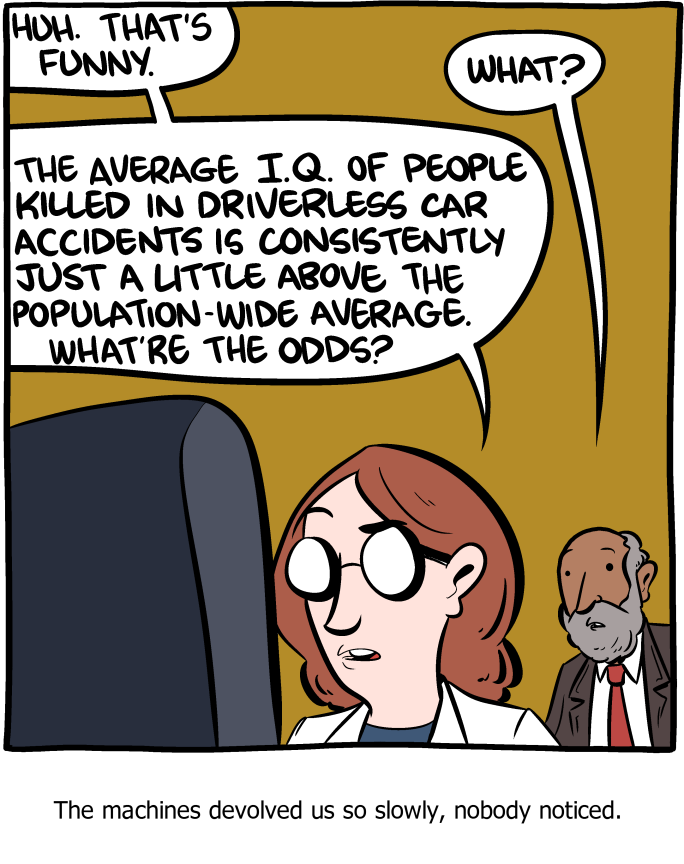
Saturday Morning Breakfast Cereal - That's funny...
by admin@smbc-comics.com
Yuval Pinterסוף סוף אפטר-קומיק ששווה כניסה לאתר
Hovertext: Also, happiness just keeps going up and up.
New comic!
Today's News:
Thank you Britain, Imperial College, and especially Lloyd. What a BAHFest it was.
24 Jan 07:45
Doug Larson
"Home computers are being called upon to perform many new functions, including the consumption of homework formerly eaten by the dog."
mkvande, Adam Victor Brandizzi and 2 others like this
24 Jan 07:45
Accents
by Mark Liberman
The entertainment potential of regional varieties of American English has apparently hit the late-night TV zeitgeist. Here's a brilliant trailer, for the imaginary movie Boston Accent (posted on YouTube 1/21/2016):
And a new kind of competition, the Accent-Off (also posted on 1/21/2016):
The formation accent-off is on the pattern of play-off, run-off (in elections or tournaments, not rainstorms), cook-off, bake-off, grill-off, … I can't think of any common X-off examples where X is a noun, though there are other occasional semi-serious coinages like "guac-off" and "chili-off" — but the meaning is plain.
23 Jan 06:48
Comic for January 23, 2016
Dilbert readers - Please visit Dilbert.com to read this feature. Due to changes with our feeds, we are now making this RSS feed a link to Dilbert.com.
22 Jan 16:24
another entry in the "one day Batman" series, a series which will HAVE NO END and THAT IS A GOOD THING
Yuval Pinterטוב, אז ריאן נורת׳ קורא תגובות בסטרונג לאנגוואג׳.
| archive - contact - sexy exciting merchandise - search - about | |||
 |
|||
| ← previous | January 18th, 2016 | next | |
|
January 18th, 2016: I spend a lot of time thinking about Batman!! I have this many regrets: NONE. – Ryan | |||
22 Jan 16:19
באלף עיניים
by כתב "העין השביעית"
Yuval Pinterבמיוחד בשבילך רועי.
יודע מה? מוכן שתראה את הסגמנט של אסנהיים במקום את התחקיר.
תיק תקשורת: עמרי אסנהיים וחגי מטר על תחקיר "עובדה" • לי-אור אברבך, מתן חודורוב ונתי דינר על אורך מהדורות החדשות בטלוויזיה
22 Jan 06:22
Comic for 2016.01.22
New Cyanide and Happiness Comic
Lani Evitts, Binaryjesus and one other like this
21 Jan 08:28
צופה לא מרוצה
by איתמר ב"ז
אדם מעורער בנפשו הועמד לדין אחרי שאיים על ליאור שליין כי ירצח אותו אם לא יפסיק את שידור תוכנית הטלוויזיה "גב האומה"

18 Jan 07:51
Three words
by Mark Liberman
 As I write this, I'm sitting in the middle of intend.agree.aware. Or alternatively, cèdre.permettre.lune.
Or, if you prefer, ambara.özüne.konuyu, or эпос.стукнуть.напрасный, or geflogen.aufhält.vollkommen, or mdogo.sokoni.yapenda, or …
What is this? and maybe more important, why?
Basically, it's a URL for the surface of the earth.
According to Fréderic Filloux, "Addressing 4 billion People in Three Words", Monday Note 11/30/2015:
Last week in New York, at the Next Billion conference organized by Quartz, Chris Sheldrick, the CEO of What3Words, captured his audience with strong arguments: 75% of the earth population, i.e. four billion people, “don’t exist” because they have no physical address. This cohort of “unaddressed” can’t open a bank account, can’t deal properly with an hospital or an administration, let alone get a delivery. This is a major impediment to global development. […]
In his previous job, Chris Sheldrick (now 33) had his epiphany when organizing large musical events around the world. Tons of material had to be shipped at a specific location and date/time. After several mishaps, he too tried using GPS coordinates to make dozens of flight cases converge at the right time and place. But people got confused with lat/long, sometimes mixing ones and sevens, etc. After a dramatic mistake that almost ruined a large wedding party in the Italian countryside, he vented his frustration to a mathematician friend who then suggested the following: why not replacing GPS coordinates with actual words that anyone can understand and memorize? Sheldrick’s mathematician pal came up with a simple idea: a combination of three words, in any language, could specify every 3 meters by 3 meters square in the world. More than enough to designate a hut in Siberia or a building doorway in Tokyo. Altogether, 40,000 words combined in triplets label 57 trillion squares.
Checking the math: The total surface area of the earth is 4*pi*6371^2 = 510064472 square kilometers, or about 5.101e+14 square meters. So we need about 5.101e+14/9 = 5.67e+13 labels for squares three meters on a side covering the earth's surface. The number of 3-tuples formed from 40,000 words is 40000^3 = 6.4e+13, which is about 7 trillion more than we need.
Rather than use a conventional approach to error detection, which would use a much larger space of possible word combinations, most of which would be invalid, they do this:
The what3words algorithm actively shuffles similar-sounding 3 word combinations around the world to enable both human and automated intelligent error-checking (e.g. table.chair.lamp & table.chair.lamps are on different continents).
If you enter a 3 word address slightly incorrectly and the result is still a valid what3words result, the location will be so far away from your intended area that it will be immediately obvious to the person searching or an intelligent automated error-detection system.
For more, see David Post, "Mapping the world, three words at a time", WaPo 1/12/2016, or the documentation at http://what3words.com/about/. A "Technical Appraisal" by Robert Barr is here.
So far, no one has noticed the possibilities for a new form of geo-aleatoric poetry.
Update — Gile Rhys Jones points out that I'm wrong — many people have noticed the poetry possibilities. There's the official what3words poetry competition, a tumblr page, a blog post by Darren Wiens, …
18 Jan 07:48
Why they heck is humanity so obsessed with classifying everything? Is it innate, historically influenced, or coincidental?
Language, Literature and Writing; Eastern Michigan University
16 Jan 11:04
The Finn-donesian of "The Force Awakens"
by Ben Zimmer
Yuval Pinterגבולי, רק אם משעמם
 For my language column in the Wall Street Journal this week, I describe how some alien-speak in "Star Wars: The Force Awakens" ended up being created by a young Finnish YouTube sensation, tailor-made for Indonesian actors. We could call it "Finn-donesian," though the character Finn doesn't actually speak it. Rather, the dialogue was designed for the Kanjiklub gang, who briefly face off against Han Solo and Chewbacca on a space freighter packed with slithery Rathtars.
The linguistic landscape of "Star Wars" has always been a bit of a mess. We're supposed to think of the English that most characters speak as a proxy for the in-universe lingua franca – Galactic Basic Standard, to those in the know. But some characters jabber away in other exotic tongues without much rhyme or reason. Chewbacca speaks in Wookiee, presumably because his vocal tract isn't equipped to speak Basic. As a protocol droid, C-3PO is of course "fluent in over six million forms of communication," but astromech droids R2-D2 and BB-8 can only bleep away in Binary because… well, who knows, really? They just do.
I had puzzled over these questions growing up with the original "Star Wars" trilogy, and with the release of "The Force Awakens" I started thinking about them again. I eagerly followed a sprawling Twitter conversation a couple of weeks ago, initiated by Gretchen McCulloch, which began with attempts to make sense of BB-8's droidspeak and then spun out into various other linguistic conundrums.
Why, for instance, did J.J. Abrams not take advantage of the community of "conlangers" to make alien languages for "The Force Awakens"? Abrams had, after all, directed two "Star Trek" movies with dialogue from that most famous of invented languages, Klingon. And other big science-fiction releases have featured the efforts of conlangers, like the Na'vi of James Cameron's "Avatar." But as I noted in the New York Times Magazine when "Avatar" was released, alien-speak in the "Star Wars" movies has, by contrast, "never amounted to more than a sonic pastiche" – a pastiche largely assembled by sound designer Ben Burtt using bits of exotic-sounding human languages.
As the tweets flew back and forth, Laura Seaberg pointed out a recently revealed tidbit about "The Force Awakens." Rather than approaching a conlanger, Abrams had instead enlisted Sara Maria Forsberg, a Finnish 19-year-old who found YouTube fame in 2014 with her video, "What Languages Sound Like to Foreigners" (more than 16 million views and counting). In the video, Forsberg proved herself to be an adept mimic of twenty different languages, earning her international attention and an appearance on "The Ellen Show" as "The Multilingual Gibberish Girl." After her bravura performance, Lucasfilm contacted her with a hush-hush offer to work on a scene in "The Force Awakens."
While Variety broke the story of Forsberg's involvement in the film right before the film was released last month, the details were sketchy – the article didn't even specify the scene or characters for which she was asked to make "additional alien dialect," as the film credits put it. Forsberg was quoted as saying that she listened to clips of Asian languages for inspiration, so that made the scene with the Kanjiklub gang, portrayed by Indonesian action stars, the most likely candidate out of the few moments in "The Force Awakens" where alien-speak is given English subtitles.
I tracked down Forsberg, who at 21 is now in Los Angeles pursuing a pop-music career as Saara, and she confirmed that she was asked to make the dialogue for the Kanjiklubbers. (The smattering of other alien dialogue in the film may have come directly from the screenwriters. [Or from supervising sound editor Matthew Wood – see the comment below.]) Abrams had cast the Indonesian actors – Yayan Ruhian, Iko Uwais, and Cecep Arif Rahman – after seeing them in the balls-to-the-wall action movie "The Raid," directed by Gareth Evans. The dazzling fight scenes in "The Raid" employ the Indonesian martial arts style known as pencak silat.
Forsberg hails from a Swedish-speaking town in Finland known as Pietarsaari in Finnish and Jakobstad in Swedish. Along with Finnish and Swedish, she grew up speaking English (her family briefly lived in Fort Worth, Texas), and she became fascinated by the sounds of immigrant languages that she encountered working as a supermarket cashier. For the Kanjiklub gang, she was encouraged by the filmmakers to make the lines sound a bit like Indonesian, a.k.a. bahasa Indonesia, the Malay-based national language of Indonesia. She also listened to clips of Sundanese, from the actors' home region of western Java. (Sundanese Indonesians, like Swedish-speaking Finns, grow up bilingual as a matter of course.)
This was an exciting discovery for me, because my graduate research in linguistic anthropology focused on – you guessed it – Indonesian and Sundanese. I dusted off my skills in both languages when I got in touch with Yayan Ruhian, who plays Tasu Leech, the leader of the Kanjiklub gang who "refuses to speak Basic, dismissing it as a 'soft language for soft people,'" according to the Star Wars Databank. Yayan, who delivers most of the lines created by Forsberg, told me he appreciated the Indonesian sound of the made-up words, though he also detected Indian and Thai traces as well. (In the Indonesian press, he has had to tamp down rumors that he's actually speaking a dialect of Sundanese in the film.)
Only a handful of lines in Forsberg's Finn-donesian actually made it into the film, and the subtitles are no help in figuring them out. Tasu Leech is subtitled saying to Han Solo, "Wrong again, Solo. It's over for you," "Twice," and "Nowhere left to hide." But the spoken bits matching "It's over for you" and "Twice" sound very similar (Yayan transcribes it as sicikadiga madiam). Then one henchman says to the other, "Search the freighter," according to the subtitles, but we hear them exchanging a single word that sounds like kadiam.
(In the clip, you can also hear Han trying to bargain with Bala-Tik, the leader of the Guavian Death Gang, who, for reasons unknown, speaks in a Scottish accent. Not sure how that maps onto the dialects of Galactic Basic.)
For "Star Wars," this neglect of linguistic plausibility is nothing new. In the introduction to his new book The Art of Language Invention, David J. Peterson, who created Dothraki and Valyrian for HBO's "Game of Thrones," recounts being a teenager watching "Return of the Jedi." When Princess Leia is undercover posing as an Ubese bounty hunter at Jabba the Hutt's palace, she uses the same word, yotó, in several lines, even though the subtitles say different things. Is this the sort of thing only conlangers and their ilk care much about? Perhaps, but given the fascinatingly multilingual origins of Finn-donesian, it's a shame that more care wasn't taken with the final product.
RC likes this
16 Jan 06:50
Comic for 2016.01.16
Yuval PinterI just adore their subtlety
New Cyanide and Happiness Comic
personal responsibility and -1 others like this
11 Jan 16:48
אכלו לי שתו לי
by עוזי בנזימן
Yuval Pinterבנזימן הנער גבעות הזה
על הקשר בין אתרוג שרון בהתנתקות לאתרוג תעאיוש היום • בעקבות תחקיר "עובדה" על עזרא נאווי והמחלוקת שעורר בשמאל
10 Jan 20:15
Some NAACL 2013 statistics on author response, review quality, etc.
by hal
Yuval Pinterלמיטיבי לכת
NAACL 2015 has just passed, NAACL 2013 is long in the past.
One bonus of being a program chair is that you get to have fun with data. In this post I'd like to review two pieces of data, one related to author response and one related to review quality assessment.
tldr: Generally, I think author response is useless, except insofar as it can be cathartic to authors and thereby provide some small psychological benefit. And in general people don't seem that dissatisfied with their papers' reviews, and this is largely independent of the outcome of the paper (conditioned on selection bias of those who responded).
On Author Response
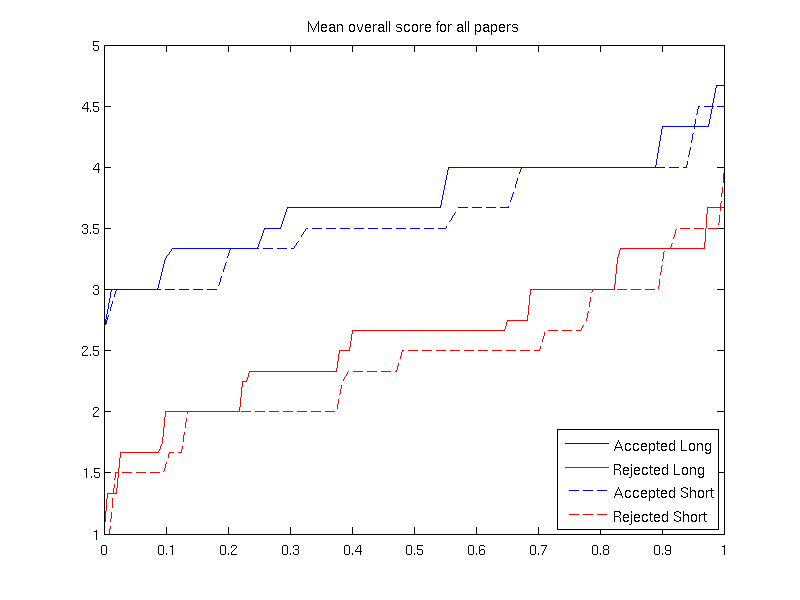
NAACL and other conferences have for some time allowed authors to respond to their reviewers, ostensibly to correct errors, but more often just to argue their position. Most people I've talked to who are in favor of author response say that it made the difference for one paper between it being rejected (pre-response) and accepted (post-response). Of course this is unknowable because decisions aren't made pre-response, so what these authors are reporting is their guess as to accept/reject before response versus actual accept after response. My own internal guesses of accept/reject are often off the mark, so you can imagine I don't find this argument particularly strong. To give a sense as to how hard this prediction is, here is a plot showing whether your paper got accepted or not as a function of the mean overall score.
 Here, the x-axis is the cumulative distribution of papers (there were more rejects than accepts, so the length of these is normalized to percentage) and the y-axis is the mean overall score for the paper.
Focusing just on the solid lines (long papers), you can see that there were one or two papers with average scores of 3.6 that got rejected, and several papers with average scores of 3.0 that got accepted. If instead you look at "probability of accept" given mean overall score, basically what you see is papers with a score of 2.8 or lower are almost certainly rejected; with 3.9 or higher are almost certainly accepted, and around 3.2 it's an absolute toss-up.
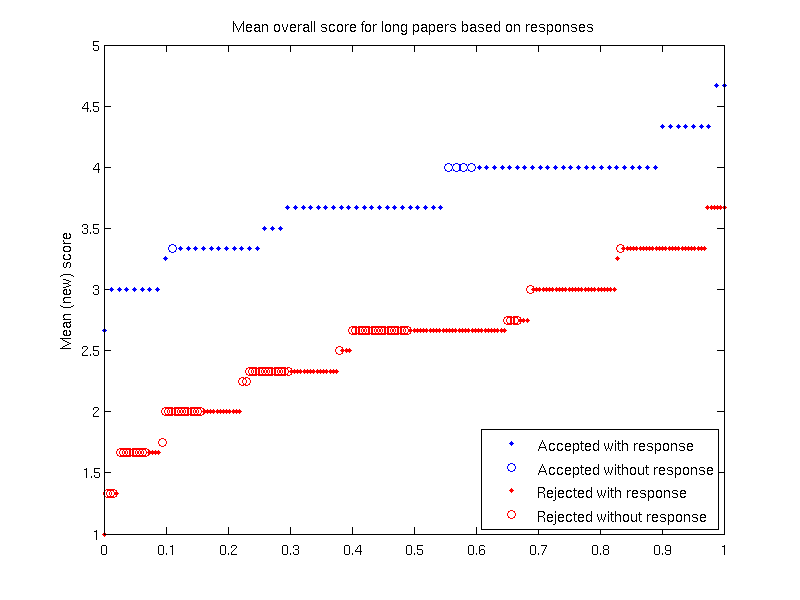
Now, you might ask: who chose to respond? Perhaps people with clear outcomes elected not to respond at all. Here are the numbers for that:
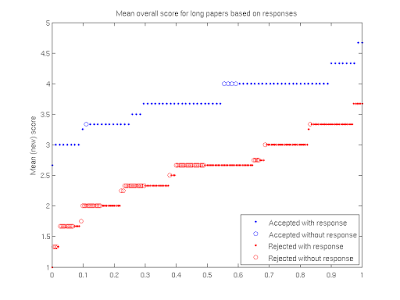 This is only for long papers (it looks the same for short). Each dot is a paper and red are rejects, blue are accepts; open circles means no response. Definitely people with scores less than 3 responded less frequently than those with scores above 3, but even the top scoring papers all included some response. There were some "hopeful" papers with scores less than 2.0 that responded, even though it was certainly not useful.
But wait, you might say: perhaps those papers with average score or 1.33 gave a response and their final scores went up to 4.5? Ok first of all, these are final scores plotted above, not pre-response scores. But we certainly can look at how scores changed between the initial reviews and the final reviews. (Note this conflates two things: author response and reviewer discussion. We'll get back to that later.)
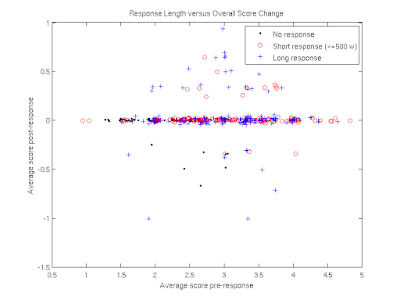 Here, we again have one dot per paper (these are randomly perturbed with small variance so they're all visible). Along the x-axis is the original score of this paper; along the y-axis is how much this score changed between the initial review and the final review. Overall the average absolute change across all papers is 0.1. The vast majority (87%) didn't change at all.
And note: scores were just about as likely to go down as up. (Several scores went down with no response, which I find troublesome, except in cases where reviewers specifically said "I'm giving benefit of the doubt, but need a clarification here.")
You could also say: well, maybe the scores didn't change much, but the review text did. Again, it's pretty rare. Out of 430 reviews (long papers only), 3 reviews decreased in length (~50 words), 46 increased by at most 100 words, and 49 increased by over 100 words (wow, awesome!). But for 80% the review didn't change at all.
Now, getting back to the question of "was this due to AR or to reviewer discussion", this is of course impossible to de-conflate, but we can look at a similar plot as a function of discussion rather than AR:
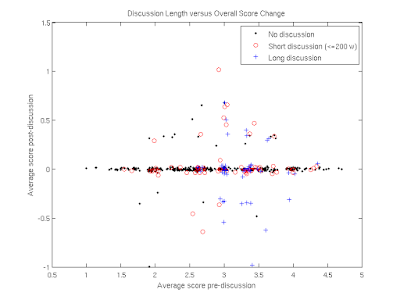 Here, a few results stand out. First, there are slightly more score changes as a function of discussion than AR. Most of those worrying dots below y=0 that didn't have a response seem to have gone down due to discussions. Moreover, a few scores that went up (on the low-scoring, almost-certainly-rejected papers) did so with no discussion, suggesting that AR did change those scores. But around the x=3.2 position (the true borderlines), almost all of these with score changes had discussion, though plenty had discussion and no score change. As opposed to the x=3.2 position in AR in which they all have responses, and still the majority of scores don't change.
An obvious response at this point is that we still don't know whether the final decision really changed as a function of response. This is a causality question we cannot perform the counterfactual for, so we're not going to get a solid answer. However, we can look at the following:
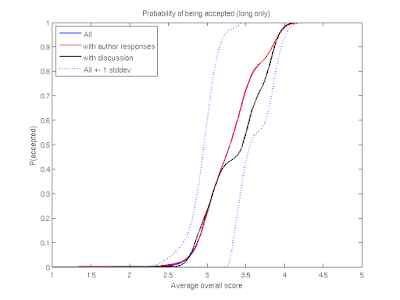 On the x-axis we have the final score of the paper, and on the y-axis we have (a smoothed version of) the probability that this paper is accepted.
The two nearly identical curves (red and blue) correspond to blue=all long papers and red=all long papers for which the authors submitted any response. In this setting, there really is almost no difference.
The slightly different curve (the black one) corresponds only to papers in which the reviewers engaged in a discussion. Around the critical point (score in the 3-3.5 range), discussion uniformly decreased odds of acceptance, which is of course not surprising for anyone who has ever participated in discussions.
You should take all this with a grain of salt, because all three of these curves are within one standard deviation of the blue curve (dotted lines).
Finally, there's of course the chance that response and discussion are highly correlated: that is, response should perhaps spur discussion. This is probably false (by the above plot), but just to drive the point home, here is the data:
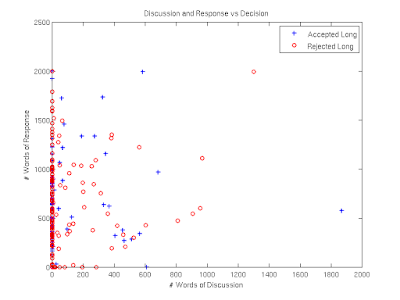 The x-axis is the amount of discussion and the y-axis is the length of the response. See all those dots along x=0? Those are the ones for which the authors responded (in one case with a 2000 word essay!) and for which there was absolutely no discussion. And most of them are rejected papers.
On Review Usefulness
Some of you may recall that we did a post-conference survey of how much you liked the reviews you got. We truly did this at a later point in time because we didn't get our acts together earlier, but now I'll claim we did it at a later point in time so that authors were no longer emotionally distraught by their reviews.
We presented each corresponding author with their old reviews, but hid the scores from them (I doubt any/many went back to look). They were then asked, for each review in turn, how informative it was and how helpful it was. They could choose 0=not, 1=sort of, or 2=very.
The first hypothesis one might have (certainly I had it!) is that people "liked" reviews that were nice to them and "disliked" reviews that were not. (I've heard this called the craigslist effect: if the transaction is successful, everyone's happy; else, everyone's unhappy.) This actually appears not really to be true. Here are the results:
Basically authors of accepted papers didn't particularly find their reviews much more informative (+0.14) or helpful (+0.02) than those of rejected papers.
[Note: the sample size is 110 rejects and 86 accepts, so there was a higher response rate on accepts since the acceptance rate is about 25%.]
You might suspect, however, that how much an author likes a review is correlated with that reviewer's score rather than the overall decision. We can look at that too (recall authors didn't see the scores when completing this survey):
Just to feel good about ourselves, authors do, in general, seem not-too-unhappy with their reviews.
Here's a histogram of informativeness for rejected papers:
(And in case you're wondering, it's basically the same for "helpfulness." As pointed out by a friend, the inability to separate different aspects of the same object is typical when people are asked for intuitive judgements that don't involve reasoning. 70% of responses gave the same score for helpfulness and informativeness and another 29% gave scores within 1. Only 0.8% said inf=2 help=0 and 0.6% said inf=0 and help=2.)
Overall
I think of complaining about review(s|ers) as a staple hallway discussion, sort of an attractor state if you run out of other things to talk about. And we all remember the worst reviews we have had and often forget about the good ones that really do help our work get better. As Lillian Lee said at NAACL this year, it's usually our own fault when reviewers don't understand our papers. And keep in mind that all these numbers have huge randomness associated with them, for instance related to the NIPS experiment.
Despite this, it actually seems that we aren't too dissatisfied with our reviews. Only 11% of reviews were considered uninformative and, while I think we should strive to get this number down, I don't think it's that horrible. Especially when I consider the fact that 19% of papers have an average score of 2.0 or less, which basically means they were submitted not standing a chance (for a wide variety of reasons).
In general I don't think author response has an effect on the outcome that makes it worth the time and energy it takes. It might make authors feel better, but this is temporary when their paper almost certainly enjoys the same fate after response as before. I do think discussion is useful, and I'd rather see us use more time for discussion but cutting out response. Perhaps by reducing the number of papers any given area chair has to deal with. We should realize, though, that discussion almost always serves to lessen the likelihood of acceptance, probably because it's easier to argue against a paper than for, and reviewers don't really have any incentive to stand up for a paper they like, leading to a veto-effect.
One bonus of being a program chair is that you get to have fun with data. In this post I'd like to review two pieces of data, one related to author response and one related to review quality assessment.
tldr: Generally, I think author response is useless, except insofar as it can be cathartic to authors and thereby provide some small psychological benefit. And in general people don't seem that dissatisfied with their papers' reviews, and this is largely independent of the outcome of the paper (conditioned on selection bias of those who responded).
On Author Response
NAACL and other conferences have for some time allowed authors to respond to their reviewers, ostensibly to correct errors, but more often just to argue their position. Most people I've talked to who are in favor of author response say that it made the difference for one paper between it being rejected (pre-response) and accepted (post-response). Of course this is unknowable because decisions aren't made pre-response, so what these authors are reporting is their guess as to accept/reject before response versus actual accept after response. My own internal guesses of accept/reject are often off the mark, so you can imagine I don't find this argument particularly strong. To give a sense as to how hard this prediction is, here is a plot showing whether your paper got accepted or not as a function of the mean overall score.
Focusing just on the solid lines (long papers), you can see that there were one or two papers with average scores of 3.6 that got rejected, and several papers with average scores of 3.0 that got accepted. If instead you look at "probability of accept" given mean overall score, basically what you see is papers with a score of 2.8 or lower are almost certainly rejected; with 3.9 or higher are almost certainly accepted, and around 3.2 it's an absolute toss-up.
Now, you might ask: who chose to respond? Perhaps people with clear outcomes elected not to respond at all. Here are the numbers for that:
But wait, you might say: perhaps those papers with average score or 1.33 gave a response and their final scores went up to 4.5? Ok first of all, these are final scores plotted above, not pre-response scores. But we certainly can look at how scores changed between the initial reviews and the final reviews. (Note this conflates two things: author response and reviewer discussion. We'll get back to that later.)
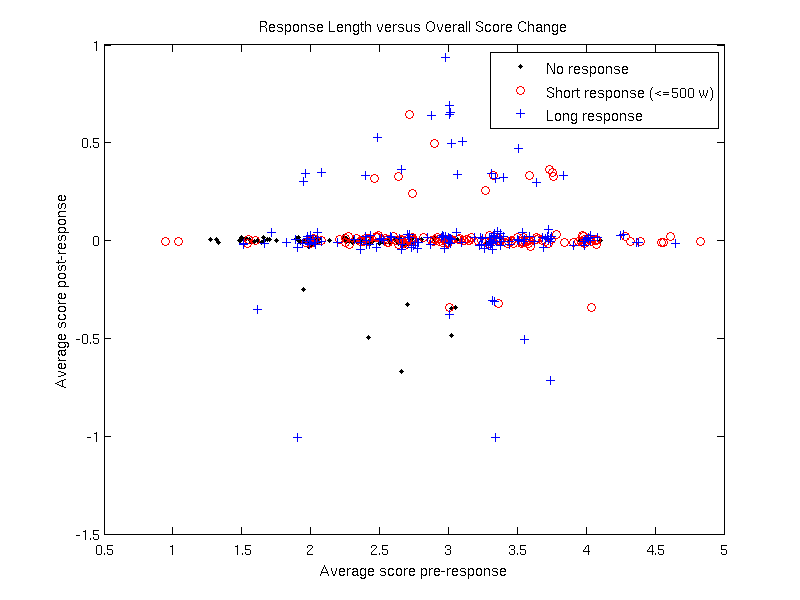
And note: scores were just about as likely to go down as up. (Several scores went down with no response, which I find troublesome, except in cases where reviewers specifically said "I'm giving benefit of the doubt, but need a clarification here.")
You could also say: well, maybe the scores didn't change much, but the review text did. Again, it's pretty rare. Out of 430 reviews (long papers only), 3 reviews decreased in length (~50 words), 46 increased by at most 100 words, and 49 increased by over 100 words (wow, awesome!). But for 80% the review didn't change at all.
Now, getting back to the question of "was this due to AR or to reviewer discussion", this is of course impossible to de-conflate, but we can look at a similar plot as a function of discussion rather than AR:
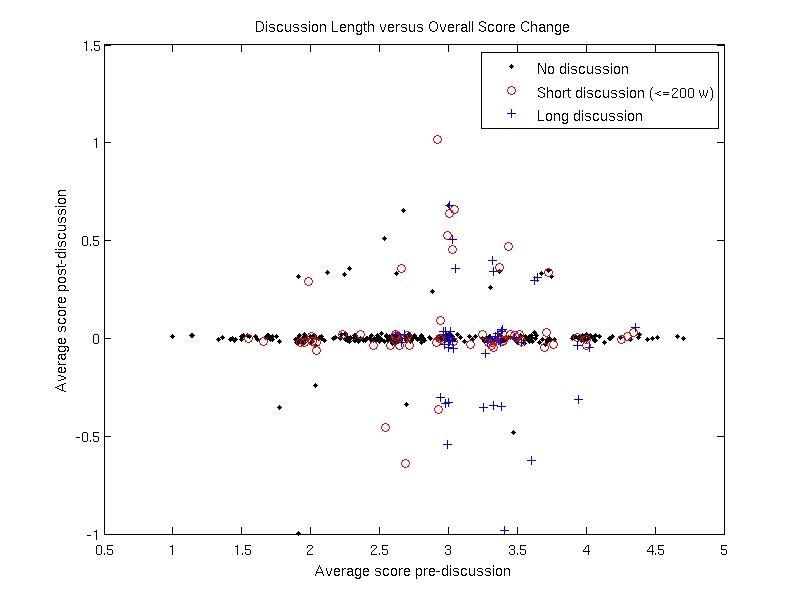
An obvious response at this point is that we still don't know whether the final decision really changed as a function of response. This is a causality question we cannot perform the counterfactual for, so we're not going to get a solid answer. However, we can look at the following:
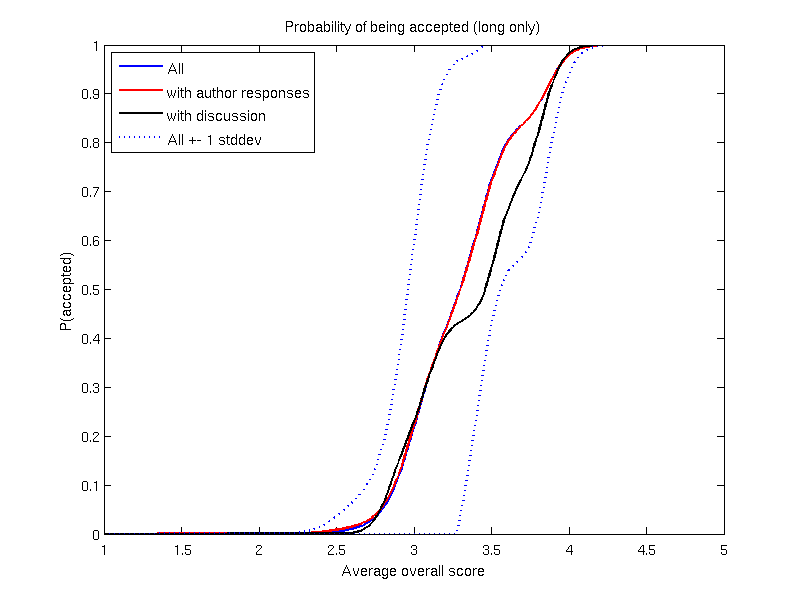
The two nearly identical curves (red and blue) correspond to blue=all long papers and red=all long papers for which the authors submitted any response. In this setting, there really is almost no difference.
The slightly different curve (the black one) corresponds only to papers in which the reviewers engaged in a discussion. Around the critical point (score in the 3-3.5 range), discussion uniformly decreased odds of acceptance, which is of course not surprising for anyone who has ever participated in discussions.
You should take all this with a grain of salt, because all three of these curves are within one standard deviation of the blue curve (dotted lines).
Finally, there's of course the chance that response and discussion are highly correlated: that is, response should perhaps spur discussion. This is probably false (by the above plot), but just to drive the point home, here is the data:

On Review Usefulness
Some of you may recall that we did a post-conference survey of how much you liked the reviews you got. We truly did this at a later point in time because we didn't get our acts together earlier, but now I'll claim we did it at a later point in time so that authors were no longer emotionally distraught by their reviews.
We presented each corresponding author with their old reviews, but hid the scores from them (I doubt any/many went back to look). They were then asked, for each review in turn, how informative it was and how helpful it was. They could choose 0=not, 1=sort of, or 2=very.
The first hypothesis one might have (certainly I had it!) is that people "liked" reviews that were nice to them and "disliked" reviews that were not. (I've heard this called the craigslist effect: if the transaction is successful, everyone's happy; else, everyone's unhappy.) This actually appears not really to be true. Here are the results:
informativeness helpfulness(+- is one standard deviation)
rejects 1.24 +-0.57 1.25 +-0.72
accepts 1.38 +-0.48 1.27 +-0.70
Basically authors of accepted papers didn't particularly find their reviews much more informative (+0.14) or helpful (+0.02) than those of rejected papers.
[Note: the sample size is 110 rejects and 86 accepts, so there was a higher response rate on accepts since the acceptance rate is about 25%.]
You might suspect, however, that how much an author likes a review is correlated with that reviewer's score rather than the overall decision. We can look at that too (recall authors didn't see the scores when completing this survey):
rating avg(informativeness) avg(helpfulness)Here, the first column (rating) is how the author scored the review. The second column is the average overall score that a reviewer gave an author who gave them a score of zero. For example, for reviews that were rated informative=2, the average score for those reviews was 3.21. Again, basically there's no effect.
0 3.04 +- 0.89 3.23 +- 0.87
1 3.22 +- 0.91 3.15 +- 0.93
2 3.21 +- 0.97 3.22 +- 0.96
Just to feel good about ourselves, authors do, in general, seem not-too-unhappy with their reviews.
Here's a histogram of informativeness for rejected papers:
Here's the same histogram for accepted papers:0: ############## (15%)
1: ############################################ (44%)
2: ######################################## (41%)
The only real difference is that rejected papers did have twice as large a frequency of "informative=0", but the rest was pretty close.0: ######## ( 8%)
1: ############################################## (46%)
2: ############################################## (46%)
(And in case you're wondering, it's basically the same for "helpfulness." As pointed out by a friend, the inability to separate different aspects of the same object is typical when people are asked for intuitive judgements that don't involve reasoning. 70% of responses gave the same score for helpfulness and informativeness and another 29% gave scores within 1. Only 0.8% said inf=2 help=0 and 0.6% said inf=0 and help=2.)
Overall
I think of complaining about review(s|ers) as a staple hallway discussion, sort of an attractor state if you run out of other things to talk about. And we all remember the worst reviews we have had and often forget about the good ones that really do help our work get better. As Lillian Lee said at NAACL this year, it's usually our own fault when reviewers don't understand our papers. And keep in mind that all these numbers have huge randomness associated with them, for instance related to the NIPS experiment.
Despite this, it actually seems that we aren't too dissatisfied with our reviews. Only 11% of reviews were considered uninformative and, while I think we should strive to get this number down, I don't think it's that horrible. Especially when I consider the fact that 19% of papers have an average score of 2.0 or less, which basically means they were submitted not standing a chance (for a wide variety of reasons).
In general I don't think author response has an effect on the outcome that makes it worth the time and energy it takes. It might make authors feel better, but this is temporary when their paper almost certainly enjoys the same fate after response as before. I do think discussion is useful, and I'd rather see us use more time for discussion but cutting out response. Perhaps by reducing the number of papers any given area chair has to deal with. We should realize, though, that discussion almost always serves to lessen the likelihood of acceptance, probably because it's easier to argue against a paper than for, and reviewers don't really have any incentive to stand up for a paper they like, leading to a veto-effect.
09 Jan 15:13
ADS Word of the Year is singular "they"
by Ben Zimmer
Yuval Pinterאני מרוצה
At the American Dialect Society annual meeting in Washington, D.C. (held in conjunction with the Linguistic Society of America), the 2015 Word of the Year selection has been made. The winner is they used as a gender-neutral singular pronoun. They was recognized by the society particularly for its emerging use as a pronoun to refer to a known person, often as a conscious choice by someone rejecting the traditional gender binary of he and she.
Check out the press release here and my full writeup for Vocabulary.com here. The WOTY vote also has received coverage from Time, the Washington Post, and Business Insider, among others.
08 Jan 14:35
Obama and Cuba: Ideology Over National Security
by Elliott Abrams
In previous posts I’ve argued that President Obama’s “opening to Cuba” gave the Castro brothers everything they wanted and got nothing for the United States–or for Cubans struggling peacefully for human rights and democracy.
But I didn’t know the half of it. Today The Wall Street Journal reports as follows:
An inert U.S. Hellfire missile sent to Europe for training purposes was wrongly shipped from there to Cuba in 2014….
For more than a year, amid a historic thawing of relations between the U.S. and Cuba, American authorities have tried to get the Cuban government to return the missile….
Hellfires are air-to-ground missiles, often fired from helicopters. They were first designed as antitank weapons decades ago, but have been modernized to become an important part of the U.S. government’s antiterrorism arsenal, often fired from Predator drones to carry out lethal attacks on targets in countries including Yemen and Pakistan….
U.S. officials worry that Cuba could share the sensors and targeting technology inside it with nations like China, North Korea or Russia….
So let’s review the bidding.
A Hellfire missile that could be of great value to Russia, China, North Korea gets to Cuba. We ask for it back. The Cuban regime says, in effect, drop dead. All the while we are negotiating with Cuba over an end to the embargo, much increased travel and investment and trade, and an opening of diplomatic relations. Do we say “hold on, we are ready to go but will not take those steps until we get the missile back?”
Of course not. Not in the Obama years, when the ideological goal of warming up to the Communist regime in Cuba takes precedence. This is a legacy item, after all, like the Iran nuclear deal. So now Fidel and Raul have the trade and the investment and the tourists and the U.S. embassy–and the missile.
One can only imagine the conversations inside the Cuban regime, when some fools argued that to get the Obama deal done they would have to give back the missile. Raul and Fidel knew better: nothing would stop Obama from going forward if only the American prisoner, Alan Gross, were freed.
And so it was.
And what are the chances that the Castros have not shared the Hellfire with Moscow? Zero.
08 Jan 07:30
גרפיטי תל אביב 16′
by עידו קינן
Yuval Pinterכמו כן, אסף וול לא שמע על צילום מסך
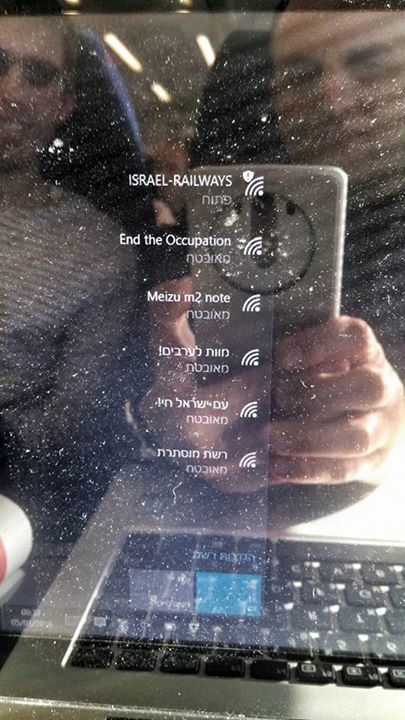
אסף וול איתר מאבק פוליטי עז בשמות הרשתות האלחוטיות במהלך נסיעה ברכבת ישראל – “End the Occupation” (“סיימו את הכיבוש”), “מוות לערבים!” ו”עם ישראל חי!”.
07 Jan 06:43
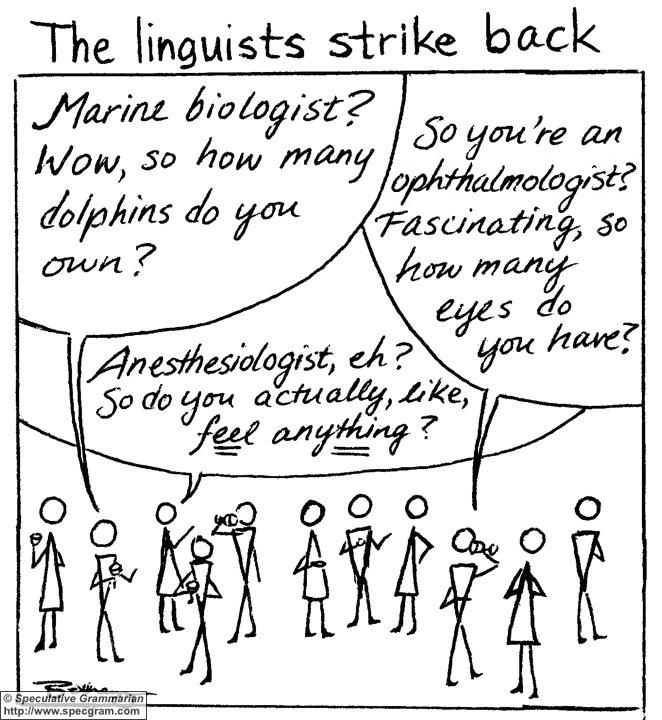
Linguists strike back…
by Mark Liberman
From the Speculative Grammarian:
Eve Liquide, mkvande and 2 others like this