Shared posts

21 Mar 20:48

NASA Asserts Starlink Doubts Are Not Meant For FCC License Rejection

by Ramish Zafar

SpaceX Crew Dragon ISS Docked

The National Aeronautics and Space Administration (NASA) has clarified its position in regards to an application filed by Space Exploration Technologies, LLC with the Federal Communications Commission (FCC) for the latter's Starlink satellite internet constellation. Starlink is currently in the midst of a heated battle surrounding its attempt to convince the Commission to grant it approval to launch the satellites with SpaceX's Starship next-generation launch vehicle systems. Its competitors have shared a myriad of concerns with the FCC, and NASA itself highlighted the need for additional analysis for the thousands of satellites that Starlink plans to place in and in the vicinity of low Earth orbit (LEO).

In a new letter submitted earlier this month, NASA briefly mentions Starlink's response to its earlier claims and clarifies that any comments by the space agency are not meant to dissuade the FCC from issuing a license.

NASA Shares Need To Understand Large Scale Satellite Constellations Such As Starlink In Fresh Letter To FCC

The letter was filed by the National Telecommunications and Information Administration (NTIA) on NASA's behalf, and when compared to the space agency's earlier correspondence, it was briefly worded. In its first submission, NASA had outlined that it was unsavory for Starlink to assume that there was a "zero" risk of collision and other accidents in its constellation simply due to the sheer number of satellites that are planned to be placed in orbit.

It had added that while Starlink could ensure a safe environment within its constellation, the risks will grow as other companies bring their satellite constellations into orbit. As a result, the space agency had stressed the need for a risk assessment and requested that SpaceX share its results with NASA.

Starlink's response to this came on two fronts. The first was indirect and it came in the form of a release on the SpaceX website. This highlighted the variety of safety mechanisms that are built in the Starlink satellites and applied to the entire constellation.

NASA Starlink FCC Letter
NASA's latest letter to the FCC highlights that it only seeks to better understand the dynamically changing space environment. Image: FCC SAT-AMD-20210818-00105

The second came in the form of an FCC submission, which stressed that the company had worked with NASA to ensure that the latter's operations are not at risk, it had used NASA's software to calculate collision probabilities, that it had worked with NASA to share information for enhancing space safety and that it will continue to work with the space agency to further improve its services.

Following Starlink's FCC response, NASA's latest letter clarifies the agency's position on the debate surrounding the second generation Starlink satellites. It reaffirms that the agency will continue working with SpaceX to improve space safety. Additionally, and more importantly, it asserts that its comments are not filed in opposition to the Starlink modification application for the new spacecraft. Instead, they simply seek to ensure that NASA assets will be protected and that the space community can safely continue its operations.

As the agency states:

NASA’s technical comments are not intended to dissuade license request permission from the FCC but are intended to ensure protection of Agency on-orbit mission assets by highlighting the risks associated with large constellations concepts. NASA’s recommendations for additional analysis are intended to help the space community identify and mitigate negative effects to the space environment, protect all parties’ assets, and enable commercial space activities.

The second generation satellite modification application is currently seeing Starlink battle several rivals, each of which has its own concerns with the spacecraft. Some believe that the elevation angles proposed are dishonest, while others believe that the scope of the constellation will preclude competitors from launching economically feasible satellite internet services.

The post NASA Asserts Starlink Doubts Are Not Meant For FCC License Rejection by Ramish Zafar appeared first on Wccftech.

21 Mar 20:48

Do These Two Things Every Time You Rent a Car

by Meghan Moravcik Walbert

Many of us are desperate to hit the road and see something—anything—other than the inside of our home this spring. Pair that desperation with a nationwide rental car shortage, and you may be so relieved to actually score a vehicle that you jump in the driver’s seat and go, before someone else snags what is rightfully…

Read more...

21 Mar 20:47

How Nosferatu Director F.W. Murnau Queered The Cinematic Vampire Forever

by BJ Colangelo

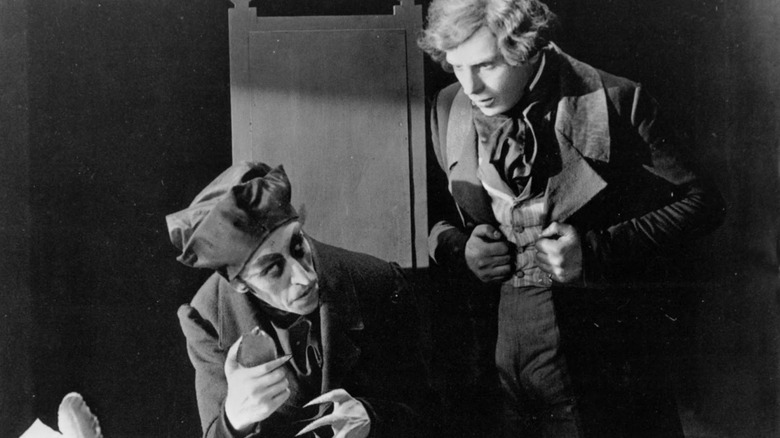
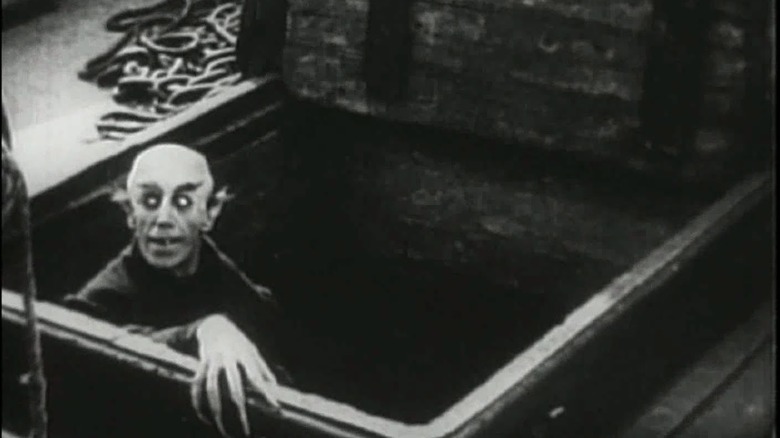
Celebrating its 100th birthday this year, F.W. Murnau's "Nosferatu" is the first widely-known vampire film. The unauthorized retelling of Bram Stoker's 1896 novel "Dracula," Murnau's "Nosferatu" is one of the most celebrated works of German expressionist cinema. While "Dracula" took inspiration from the lesbian vampire novella "Carmilla" and Bram Stoker was rumored to be a closeted homosexual, it was Murnau's deviation from "Dracula" that allowed him to use "Nosferatu" as a vehicle to explore the social and sexual anxieties during 1920s Germany, thereby queering the cinematic vampire forever.

Following Germany's loss in World War One, Germany saw a massive social change during the Weimar Republic -- the democratic transition between the monarchy and National Socialism. This change brought new political and social attitudes, especially in regard to the autonomy of women. During the war, women were permitted to the public work space, and in the years that followed, homosexuality and gay subcultures became publicly known

As with any large cultural change, there were plenty that clung tightly to their traditional values, and a wave of anxiety permeated throughout society. Murnau tapped into these anxieties, and used expressionist film techniques to bring these fears to the forefront. Utilizing the creature of the vampire, Murnau used "Nosferatu" as an allegory for the male fears of women's liberation, the blatant expression of queerness, and the growing xenophobia surrounding Eastern immigrants and the Jewish people.

The Plot Of Nosferatu

Newlyweds Hutter (Gustav von Wangenheim) and Ellen (Greta Schröder) are enjoying their perfect life in the country when Hutter is tasked with visiting Transylvania to sell a house to Graf Orlok a.k.a. Nosferatu (Max Schreck). Upon arrival, there is noticeable tension between the two. While it'd be easy to dismiss it as nothing more than a bloodthirsty vampire craving his next meal, it's clearly coded as a homoerotic desire. 

Hutter is eventually bitten, but has no memory of the ordeal. When Orlock sees a photo of Ellen in a locket, he expresses his desire for her and decides to travel to Germany by coffin on a boat. Rats carrying the plague on the ship kill all aboard, except for Orlock, and Hutter does his best to travel back to town by horseback in an attempt to stop him before he gets to Ellen.

As soon as Nosferatu arrives, the town begins to die of the plague. Ellen, having read a book about vampires given to her husband by the Romanian people, chooses to distract him until the sun comes up and he is destroyed. Ellen welcomes Count Orlok into her bedroom, allows him to feast upon her, and saves the town by exposing him to the sunlight and putting an end to the plague.

Horror From The Inside Out

With "Nosferatu" being an expressionist film, albeit a grounded one compared to something like "The Cabinet of Dr. Caligari," Murnau's fearful moments were crafted not by external factors, but the psychological fears from within. Queer desire, female desire, and the presence of eastern European/Jewish "intrusion" were prominent societal anxieties, and by using chiaroscuro lighting techniques, he was able to dissect the character's psyches and uneasiness with their own sexual repression. 

Murnau was allegedly gay himself, and despite the public knowledge of homosexuality in Germany at this time, it was still considered a criminal (and pathological) act. There was no way for Murnau to explicitly dissect these themes, so instead they are hidden in the subtext of "Nosferatu"

Nosferatu is presented as the double of Hutter, representative of the gay desire that Hutter desperately tries to repress. Nosferatu is not subtle with his desires, frequently staring at Hutter for long periods of time, the black around his eyes darkened to emphasize his gaze. At one point Hutter cuts himself, and Nosferatu grabs his finger to suck on it. Was he craving blood, or something more? 

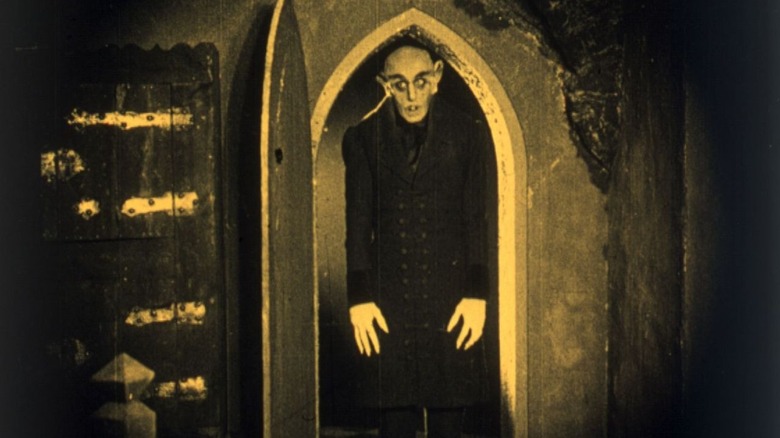
The closer Nosferatu gets to Hutter, the weaker his memory gets, and the smaller the film camera's iris gets: a clear act of repressing his desire. While much has been said regarding Max Schreck's blatantly antisemitic appearance as Nosferatu, what is frequently left analyzed is how phallic he appears in just about every frame. He's long, sleek, and rounded on top, frequently inserting himself into dark, thin doorways that only emphasize how much he looks like, well, you know.

It All Sources Back To Nosferatu

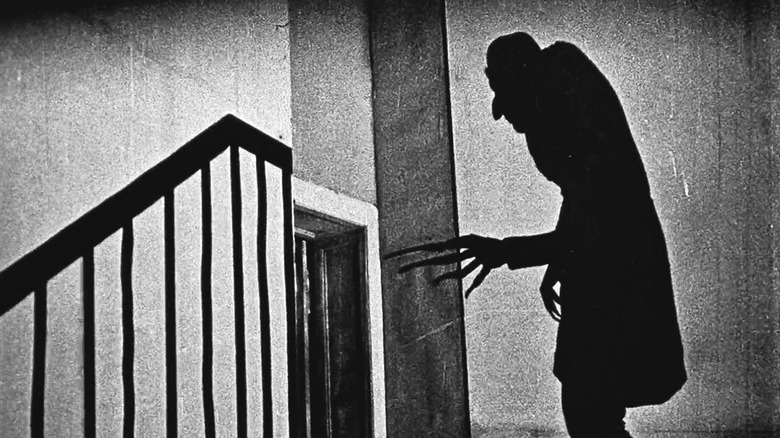
While "Nosferatu" is certainly not the first depiction of a vampire, it is the mainstream film that formed the roots that every vampire movie since has branched out from. Whether it be using sexuality as a means to lure in new prey, or the shadow cast on the wall, personifying the shadows of shame that follow us all, "Nosferatu" is there. 

The Universal monster movies, the lesbian vampire films of the 1970s, the flamboyant films of the 1980s, even the aggressively masculine vampire films of the late '90s and early '00s, all owe at least something to "Nosferatu" whether in direct inspiration or intentional opposition. With queerness embedded in our first mainstream cinematic vampire, all vampire films have queer elements embedded within their DNA. There's a running gag that "all vampires are gay" or "there's no such thing as a heterosexual vampire," and with "Nosferatu" acting as the great-great-granddaddy of all vampire films, there's no denying it. F.W. Murnau queered vampires forever. 

Read this next: The Horror Movies We Can't Wait To See In 2022

The post How Nosferatu Director F.W. Murnau Queered the Cinematic Vampire Forever appeared first on /Film.

21 Mar 20:24

ELEX II - Review @ Wccftech

Wccftech reviewed the open-world RPG ELEX II: Elex II Review – With a Rebel Yell I've tried writing the opening to this review of Elex II about eight different times, each time going back over it and having to rethink it. I'm not even sure why because reviews are, by definition, opinion pieces....
21 Mar 20:24

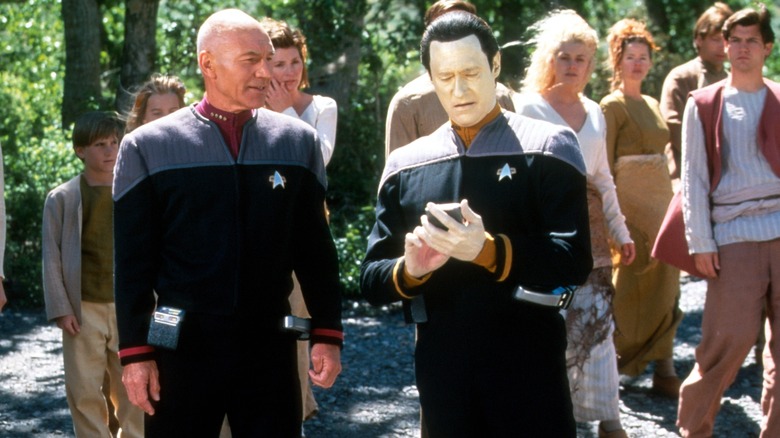
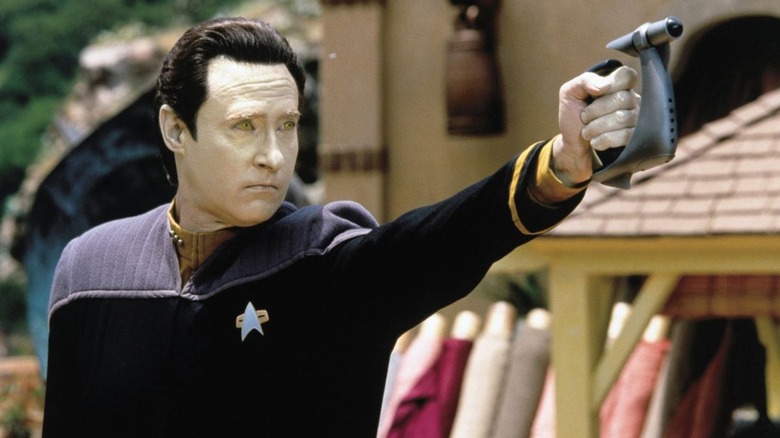
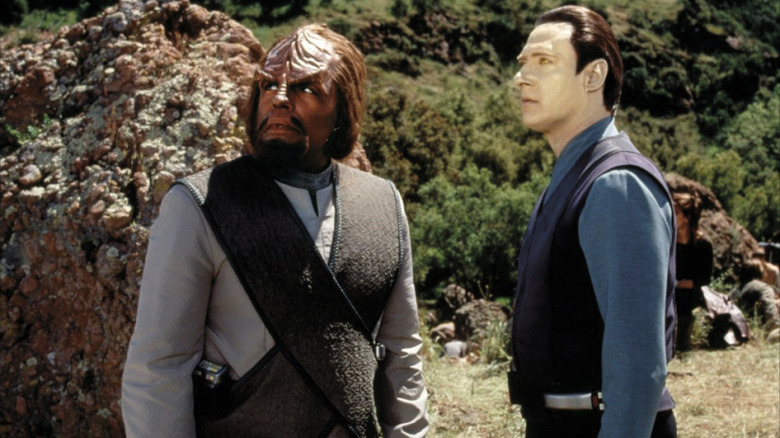
Brent Spiner Desperately Wanted Data To Die In Star Trek: Insurrection

by Witney Seibold

Actor Brent Spiner is on record with his ambivalence about playing the android Data on "Star Trek: The Next Generation." On the one hand, Spiner appreciates the boost in visibility the role provided, while on the other, he was all too cognizant of the way "Star Trek" pigeonholes an actor. When "NextGen" was wrapping, Spiner mused that no matter what impressive acting he may do for the rest of his career, Data would be listed first in his obituary. This must be a career irony of any actor associated with a beloved cult film or TV show: They will forever be simultaneously visible and un-hirable. To break the cycle, a Trek actor must find a role equally iconic (William Shatner on "Boston Legal," Patrick Stewart in the "X-Men" films, Kate Mulgrew on "Orange is the New Black"), or remain in the public eye in a wide variety of roles, such as how Robert Pattinson and Kristen Stewart have since severed their once-usual pop association with the "Twilight" films). 

Brent Spiner was more or less done with Data when "NextGen" ended its run in May of 1994. According to the book "The Fifty-Year Mission: The Next 25 Years: From The Next Generation to J.J. Abrams: The Complete, Uncensored, and Unauthorized Oral History of Star Trek" by Mark A. Altman and Edward Gross, Spiner didn't even want to star in the 1994 film "Star Trek: Generations." Furthermore, he hoped Data would be killed off in "Star Trek: Insurrection."

Consider Killing Data

When Spiner was asked to star in "Generations," he initially turned the part down. It took some negotiating to get him back. In his words, the studio needed to create "an attractive enough reason for me to do the first [movie]." Whether this refers to a higher salary or more interesting character work, we can only speculate, but "Generations" did introduce the story conceit of Data's emotion chip, a widget that allowed the unemotional android Data to experience feelings. 

Spiner goes on to say that the 1996 film "Star Trek: First Contact" was an easy "yes" for him, as he liked the script. In "First Contact," Data is kidnapped by the Borg Queen, an evil, seductive cyborg who grafts organic skin to Data's body and attempts to seduce him. The interplay between Data and the Borg Queen is icky, intense fun. "As soon as it was presented to me," says Spiner, "I thought it was a great idea." 

When it came time to make a third "Star Trek" feature film, Spiner had more or less run out of steam on Data. "Star Trek: Insurrection" entered pre-production in 1997, right when Spiner was in the middle of a nine-month run playing John Adams in a high-profile Broadway revival of "1776," and he would have been forced to leave that production to work on a movie he really didn't want to do. 

This time, it wasn't the script that turned him off, as Spiner hadn't seen one yet. It was merely the idea of leaving "1776" to go back to Data. "It was the idea of doing it again in that moment," Spiner said. "I would have had to leave the show and come back to L.A. to do another 'Star Trek' movie." He called executive producer Rick Berman from New York to make a daring suggestion: "When you write the script, consider killing Data at the end of this film." 

When Berman asked why, Spiner had several good reasons: 

A: It will create a really interesting scene in the movie; we can count on that. B: The studio won't have to negotiate with me again, which is never a pleasant thing. And C: When you do the next movie, you won't get caught off guard with whether or not I'm going to do it. You'll already know I'm not going to do it, because I'm gone and everybody will be let off the hook in a really gentle way.

Berman had to talk to some people to make it happen. 

Why He Did It After All

Spiner says that Berman went to the producers with the suggestion to kill Data, but he knew his idea had been rejected when the script for "Insurrection" arrived two weeks later with a Post-It note reading, "Sorry. Kill you next time!" written on it. 

But Spiner was ultimately convinced to star in "Insurrection" after his girlfriend made some good points. Plus, he came to the realization that playing Data was, at the end of the day, a fun, well-paying job that he gets to do with friends: 

A really good point was made to me by my girlfriend, which was: "You're going to hate it when it gets to be time to shoot this film and all your friends are there doing this movie and you're not going to be there." And I thought, you know, it's really true. Also, the fact that "Star Trek" is different from other films I do, because they asked me to do them. I don't have to win a contest in order to get the part. They call, they offer me a part, they offer me a handsome salary to do the part, and it's a good part. And I get to hang out with my friends and play for three months. It's an attractive proposition, always.

"Star Trek: Insurrection" ended up being, sadly, one of the lower-rated "Star Trek" movies, unloved by critics and clearly shot with a much lower budget than its immediate predecessors (much of "Insurrection" takes place on an alien planet that looks astonishingly similar to certain locations around California). To this day, it is considered one of the lesser "Trek" movies. 

The Death And Resurrection Of Data

Spiner would eventually get his wish with "Star Trek: Nemesis," a film wherein Spiner played Data and a character named B-4, a prototype of Data. The finale of "Nemesis" is clearly a repeat of the action in "Star Trek II: The Wrath of Khan" with two ships facing off in a nebula, one of them captained by a vengeance-driven villain. The bad guy is bested when Data sacrifices his life to blow up his ship. Finally, Data was killed off during the finale of a "Star Trek" film. Spiner, however, left the door open to returning to play B-4. 

B-4 would not return in "Star Trek," but Spiner would, and repeatedly. After the disappointing opening of "Nemesis" (which remains the lowest-grossing of all the "Star Trek" feature films) Spiner would return to "Trek" to play an ancestor of Data's creator in a multi-part episode of "Star Trek: Enterprise." Spiner would also play Data again in dream sequences on "Star Trek: Picard" over a decade later, as well as a descendant of Data's creator. On "Picard," particles of Data's obliterated android body had somehow been salvaged, and then used to (*sigh*) grow a series of new android bodies from scratch somehow. Additionally, Data's consciousness was reconstituted, and for reasons never fully explained, stored on a hard drive. 

By the end of "Picard's" first season, Data is politely requesting that Picard euthanize him. One can't help but assume that Data's request was Spiner's sentiment.

Read this next: The 25 Best Movie Robots Of All Time

The post Brent Spiner Desperately Wanted Data to Die In Star Trek: Insurrection appeared first on /Film.

21 Mar 20:21

The Harrison Ford Classic That Inspired Janeway's Star Trek Return

by Collier Jennings

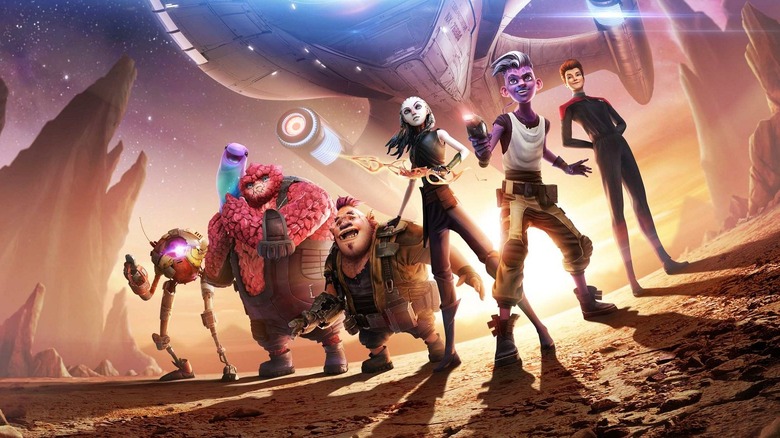
"Star Trek: Prodigy" has fast become one of my favorite weekly series on the streaming circuit. Not only does it boast some sleek animation, but it's also a great "Star Trek" story that appeals to both the younger audience it was designed for and longtime Trekkies — including yours truly. And it looks like the back half of the first season of "Prodigy" will present a new adversary for the young crew of the U.S.S. Protostar — an adversary who just so happens to be a classic "Star Trek" character.

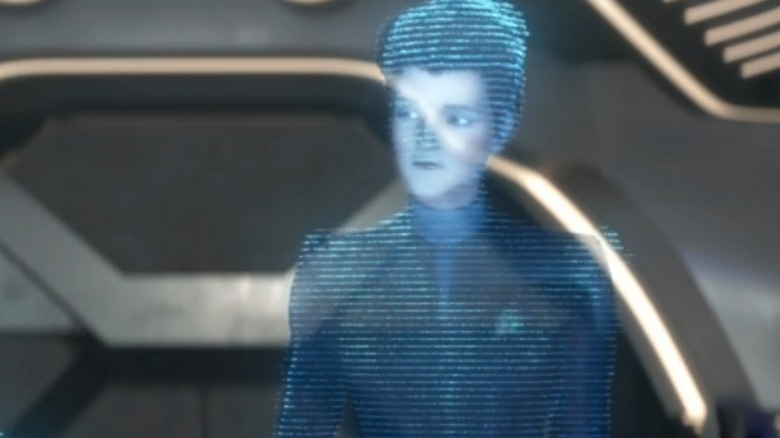
Series creators/showrunners Dan and Kevin Hageman recently held an interview with SyFy Wire where they discussed the events of the "Prodigy" midseason finale "A Moral Star." The closing moments reveal that Admiral Kathryn Janeway (Kate Mulgrew) is currently in pursuit of the Protostar, and that the next batch of episodes will draw from a classic action thriller — one that also happens to feature "Star Wars" alum Harrison Ford in a leading role.

Starship Run

Janeway had appeared on "Prodigy" before, albeit in holographic form as a training program that offered assistance to the crew of the Protostar. Now that the real deal is on the hunt for the Protostar, Kevin Hageman revealed how "The Fugitive" will shape the next batch of "Prodigy" episodes:

"We love the movie The Fugitive. And when you look at that movie, you love Harrison Ford. He's unjustifiably screwed over and he's on the run. And you want him to clear his name. And then you love Tommy Lee Jones, who is just trying to do his job, right? He's not a bad guy, you love seeing both stories and the characters and what's going to happen when their stories catch up to each other. And so we wanted that dynamic with Janeway and our kids."

"The Fugitive" is perhaps one of the greatest action movies ever filmed, and a large part of that is due to the game of cat and mouse between Dr. Richard Kimble (Ford) and U.S. Marshal Samuel Gerard (Tommy Lee Jones). Kimble manages to say one step ahead of Gerard, jumping off the edge of a dam and infiltrating a hospital to do so. If the Hagemans are using "The Fugitive" as a basis, then "Star Trek" fans should be in for an equally thrilling game of cat and mouse. Hopefully it won't end up like the Quibi reboot (remember when Quibi was a thing?). 

Voyage, Voyage

Dan Hageman also revealed that Janeway's return was baked into the original pitch for "Prodigy" and that she would also be searching for her missing friend — fellow 'Star Trek: Voyager' member Chakotay (Robert Beltran), who was in command of the Protostar before it was boarded by the cast of "Prodigy".

"They cannot get caught, so then it becomes a question and tension of: How do you escape Starfleet?"

But there's also another wrinkle: the malevolent Diviner, who held possession over the Protostar, also put a code into the ship's computers that will disable any Starfleet vessel it comes into contact with. And at the end of "A Moral Star," the ship is headed right for Federation space.

Not only do our heroes have to stay one step ahead of Janeway, but they are also unwittingly bringing doom upon Starfleet. Say what you will about Richard Kimble, but all he had to do was outrun Tommy Lee Jones. 

Read this next: The 14 Best Sci-Fi Shows On Amazon Prime

The post The Harrison Ford Classic That Inspired Janeway's Star Trek Return appeared first on /Film.

21 Mar 20:21

Dateline: Beijing. China to send $1.57 million in humanitarian aid to Ukraine. I repeat $1.57 million [Fail]

21 Mar 20:21

Ti West Teases What To Expect From A Potential Sequel To X

by Jenna Busch

Ti West's latest film "X" is a hit with critics and fans alike since it premiered at the SXSW festival. At the time of this writing, it's at 95 percent with critics and 77 percent with fans on Rotten Tomatoes. If you've seen it and loved it, you've probably heard that a prequel entitled "Pearl" was written by West during quarantine, and shot in secret. "X" is the first film for West in almost a decade, so this is pretty fantastic. When the film premiered at SXSW, there was a surprise teaser for "Pearl," according to an IndieWire interview with West.

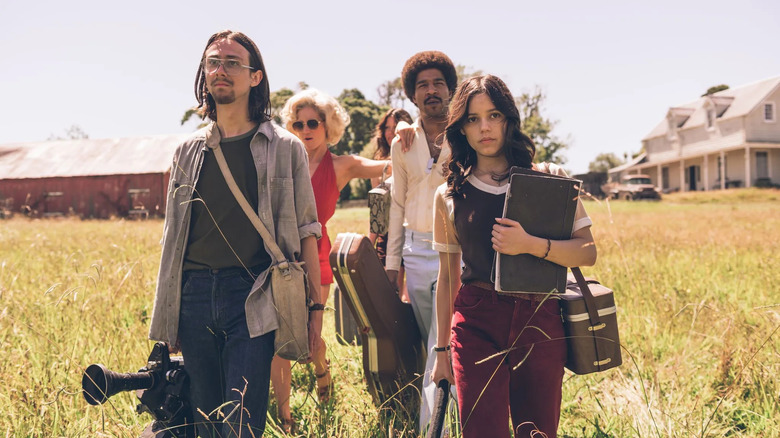
But wait, as they say in infomercials, that's not all. West also told the site that there is a possible third movie happening, which will be a sequel. "X" is about a group of filmmakers, actors, and crew making an independent porn movie at a secluded cabin in Texas, and Mia Goth plays both the lead actress in the porn flick. Without giving you spoilers, the prequel also stars Mia Goth. West told the site that they shot the prequel right after the original film because they were in New Zealand, which wasn't the worst place to be during quarantine. So, what about that sequel?

Here's What The Potential Sequel Will Explore

West told the site that he's currently writing the sequel to the A24 film. He said: 

"If people wonder what the backstory to 'X' is, well, I know all of it. That one will be about how home video has affected people. I'm very proud of these. They're super different and very out-of-nowhere. You won't need to see one to see the other but they do complement each other."

He also said the sequel will explore another filmmaking era, as "X" explores the late '70s with its indie filmmaking. "Pearl" will reportedly take place during the time the couple's cabin from "X" was a boarding house in WWII. Though I haven't seen this one yet, and I'm not always a huge horror person, it's intriguing. I have yet to hear a negative thing about it from people who have seen it. It's hard to argue with that!

"X" stars Mia Goth, Martin Henderson, Brittany Snow, Jenny Ortega, Scott Mescudi, Owen Campbell, and Stephen Ure. The film is currently in theaters.

Read this next: The 20 Best '80s Horror Movies Ranked

The post Ti West Teases What to Expect from a Potential Sequel to X appeared first on /Film.

21 Mar 20:20

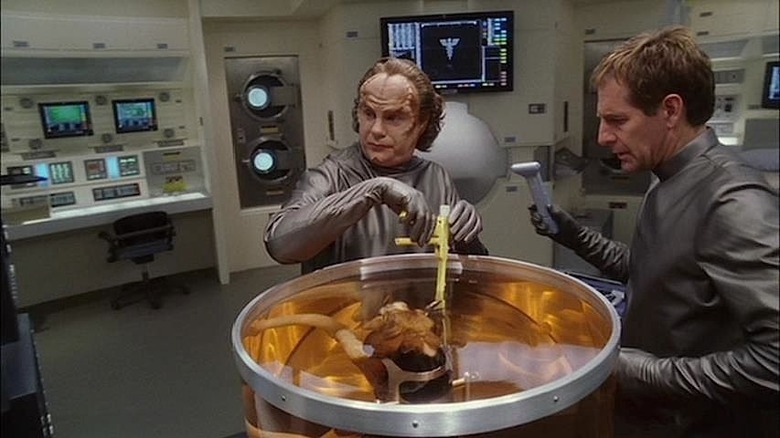
John Billingsley's Dream Star Trek Episode Sounds Absolutely Wild

by Witney Seibold

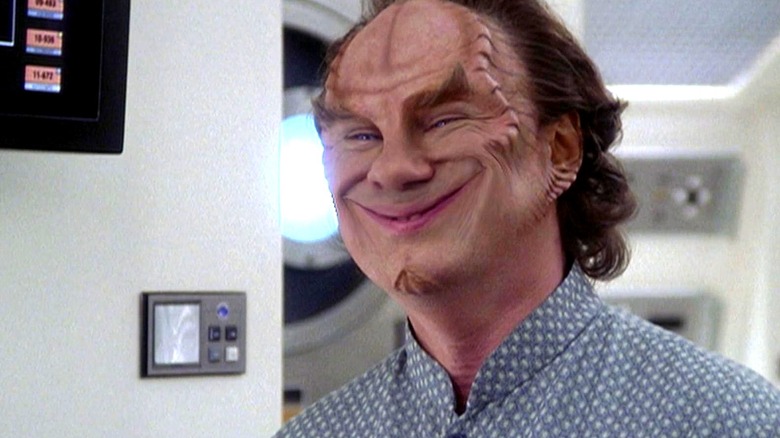
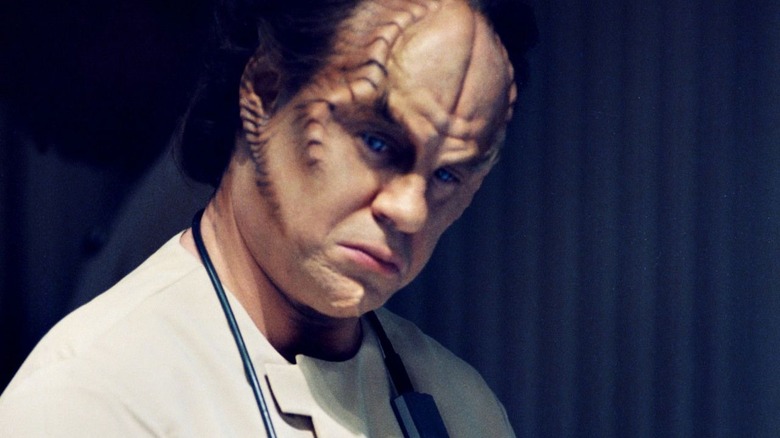
The best character on "Star Trek: Enterprise" was easily Dr. Phlox, played by John Billingsley. Phlox, the first Denobulan to have appeared on "Star Trek," was genial, approachable, peculiar, and intelligent beyond measure. He seemed excited to be serving on a ship full of humans, a species he found to be unusually optimistic and amusingly prudish (Denobulans marry into large, complicated polycules, for instance, shocking the more traditionally heteronormative Trip Tucker who refuses to sleep with one of Phlox's wives). Phlox also kept a sizable menagerie of unusual animals on the ship, each one capable of producing an oblique medical secretion. Additionally, Phlox possessed multiple medical degrees, capable of serving as the ship's therapist as well as primary physician.

Denobulans are, in Billingsley's words, "f***ing merry and just exuberant"; in an interview with TrekToday, Billingsley talked about how much he enjoyed playing Phlox -- a character he described as buoyant and balanced -- compared to the number of "creeps and crumb-bums" he's played in his career. Phlox's merriness provided a welcome contrast to the cast of straight-laced astronauts and stuffy Vulcans more commonly seen on "Enterprise." In the interview, he talks about how often the writers of "Enterprise" really seemed to understand the character in a way that felt consistent to him -- "A Night in Sickbay" remains a standout -- as well as the times Phlox was perhaps mishandled; why, Billingsley wonders, did Phlox and T'Pol not simply fornicate when she was going through premature pon farr in the episode "Bounty?"

Billingsley wasn't the kind of actor to pitch ideas to the production staff of "Enterprise," content to play the part as it was given him, but he did have one idea that he wishes he had pitched: A story of dozens of Denobulans who are taken onto the ship and have, essentially, a weeks-long orgy.

Sex All Over The Ship

Billingsley describes his dream "Star Trek: Enterprise" episode in his interview with TrekToday. Billingsley's idea -- and a rather amusing one at that -- seems to have been a way to challenge the uptight formality commonly associated with "Star Trek," and was based on the idea that Denobulans are, to his eye, wild, sex-crazed hedonists. 

I never really pitched ideas, but one of the ones I kinda wanted to pitch was this: we pick up a Denobulan ship in distress and take in the crew; hundreds of 'em, like Tribbles. They eat all the food. They're messy as s***. They sing and skip and dance... They're hyper-curious and ask tons of questions and they're pleasure-seeking (i.e. you can hear them having sex all over the ship, at all hours, sometimes in public locations). They are inadvertently insulting in their hyper-amused contempt for human modesty and human dopiness, and they basically make the entire crew so incredibly embarrassed, and irritated, that Archer can't wait to shift 'em off onto the nearest inhabitable planet (only there ain't one nearby). [It's] like "The Man Who Came To Dinner," for those of you who know that old chestnut of a play, only Monty Woolley's character is every single Denobulan that comes aboard.

The characters on "Enterprise" were, for the most part, wide-eyed adventuresome archetypes. Capt. Archer could be read as the hero of a boy's adventure novel, T'Pol is a stern schoolmarm, and the rest all possessed an element of naïveté -- fitting, as they were aboard the first Starfleet vessel to explore space. As such, the awkwardness of a spontaneous orgy erupting on the Enterprise would have been a fantastic counterpoint to the characters' color-within-the-lines approach to command.

Roddenberry's Free Love

Wild sex-crazed hedonism is a "Trek" tradition, going back to Gene Roddenberry's own lusty views of free love (if you need a clear view on Roddenberry's views on open sexuality, watch the 1971 feature film he wrote, "Pretty Maids All in a Row" -- or any of the "Star Trek" episodes that center on an alien society comprising scantily-dressed, low-tech "children of the universe"). One of Roddenberry's more pervasive utopian ideas was that free love would eventually rule and that multi-person relationships should be the norm. He himself wanted to be part of a polycule that included Majel Barrett and Nichelle Nichols (this is no idle gossip; this comes from Nichols' own autobiography), and would eventually have an open relationship with Barrett and his longtime girlfriend Susan Sackett (described in her book, "Inside Trek: My Secret Life with Star Trek Creator Gene Roddenberry").

So Billingsley's ideas of Denobulan hedonism fits the Roddenberrian spirit of "Trek," and his idea of a ship full of sexually-charged Denobulans wouldn't have been out-of-place in the original series (at least thematically). One can easily picture McCoy walking in on nude aliens in the sickbay and politely averting his eyes while trying to get them to dress once again, or Kirk and Spock having to tell a Denobulan captain -- using very, very guarded language -- that sex in the ship's corridors isn't appropriate on a Starfleet vessel. 

Hilarity would have, no doubt, ensued.

Read this next: 12 Awesome Sci-Fi Movies That Never Got Sequels

The post John Billingsley's Dream Star Trek Episode Sounds Absolutely Wild appeared first on /Film.

21 Mar 20:18

Brittany Snow Credits Her X Performance To The Internet's Favorite Country Star

by Valerie Ettenhofer

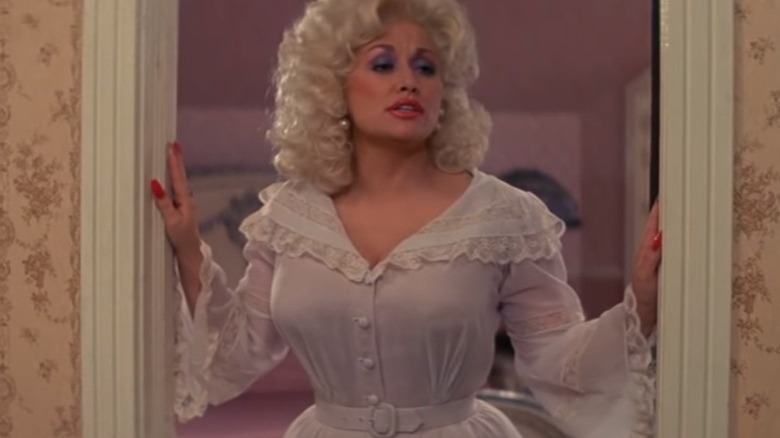
The queen of country music is getting a lot of unexpected recognition lately. First, Dolly Parton showed up on the ballot for induction into the Rock & Roll Hall of Fame, a race she attempted to humbly bow out of. Now, she's crossing genres even more as the unexpected influence behind one of the best horror movie performances of the year so far.

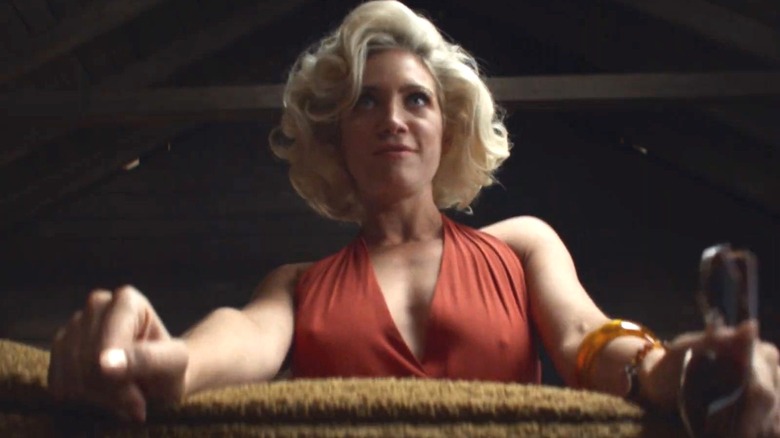
In an interview with The AV Club, actress Brittany Snow cited Parton as an inspiration for her performance as Bobby-Lynne in Ti West's new film "X." Bobby-Lynne is a firecracker, a confident, Marilyn Monroe-styled Southern woman who teams up with porn producer Wayne (Martin Henderson) and her sometimes-boyfriend Jackson (Scott Mescudi) to make a low-budget adult film in rural Texas. She's a great character: bold but never mean, unapologetic about her beauty and desires, and able to maintain a perfectly coiffed hairdo even as their film shoot turns into an unexpected gore-fest.

Never Underestimate The 'Blonde Bombshell'

She's also, apparently, inspired in part by Dolly Parton. When asked about any real-life influences for her character, Snow says she and writer-director West spoke at length about Parton's unique charm and intellect when making the film. Here are some of her thoughts on the rhinestone cowgirl:

"She's smart enough to know how to read a room and utilize her intelligence and her body for her benefit. And she also knew that she was smarter than what people thought she was, and her superpower in a way was that people were going to underestimate her and she was going to overdeliver."

The actress goes on to say that as a fellow "blonde bombshell type," Bobby-Lynne could be easily pigeonholed, but that she maintains control over her own narrative just like Parton has across her enduring career. While Parton's singing career and Bobby-Lynne's acting career have some major differences, it's easy to see what she means. The character is the type of stylish, sexual woman that horror films of decades past have loved to misunderstand and punish, as if her confidence and overt femininity are transgressions that can only be remedied by violence.

"X," though, comments on the sometimes-contradictory relationship horror and porn both have with women without ever giving into either genre's more reductive impulses. Bobby-Lynne's time on the Texas farmland the film crew ends up at isn't a cakewalk, but the film doesn't link her pursuit by its slasher villain to any particular trait. Instead, the film's villain targets youthful sexuality as a whole, cutting down the members of the film crew as nearly identical symbols of flaunted vitality.

If you're still on the fence about whether or not the Parton comparison is a compliment (it is!), look no further than West's comments during a recent interview with /Film. He explained that he intended for the entire ensemble to be "charming" and "endearing," so that when the blood started flowing, viewers would be truly shocked. "Slasher movies often have uninteresting, unlikable characters who are just there for you to see their demise," West said, "and I wanted to put together an ensemble of people that you felt like were really friends and that you liked." And who's a better friend than country music queen Dolly Parton?

"X" is in theaters now.

Read this next: The 15 Best '70s Horror Movies Ranked

The post Brittany Snow Credits Her X Performance to the Internet's Favorite Country Star appeared first on /Film.

21 Mar 20:12

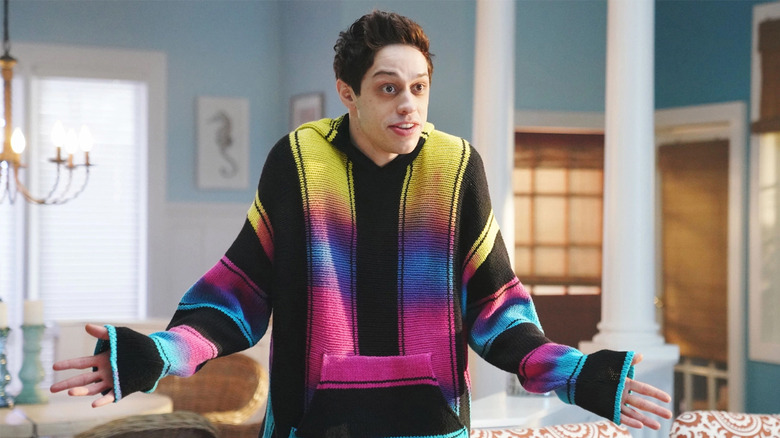
Why Has Pete Davidson Garnered Such A Huge Following At SNL?

by Michael Boyle

Pete Davidson opened up his 2020 Netflix stand-up special his set by mentioning how he felt after the finale of his first season on "Saturday Night Live." The comedian said, "So it's 2014 or '15, and it's the finale of SNL, and I was so shocked and happy that I didn't get fired, and this is a feeling that I get to relive every week... It's really awesome. I still can't believe it. It's very funny."

This is a running joke to those familiar with Davidson's comedy both on and off of "SNL." He's constantly marveling at how they're still paying him to be on the show, an apparent reaction to the fact that there's plenty of regular "SNL" viewers who feel the same way. After all, he only has one major recurring character (Chad, which doesn't require a ton of acting skill), and he's not a particularly memorable impressionist. Where actors like Kate McKinnon and Kenan Thompson are all over the show, it's easy to forget at times that Davidson's even there unless he makes one of his reliable appearances at the Weekend Update desk.

As a result, Davidson's popularity throughout these last eight years has befuddled critics and audiences alike. "Why is this guy getting so much attention?" people ask, and not just because every famous woman in Hollywood seemingly wants to date him. Compared to past "SNL" cast members, Davidson's tenure has been unique not only in the seemingly disproportionate amount of attention he's gotten, but the fact that he's still even on the show at all. 

Years Of Inconsistency

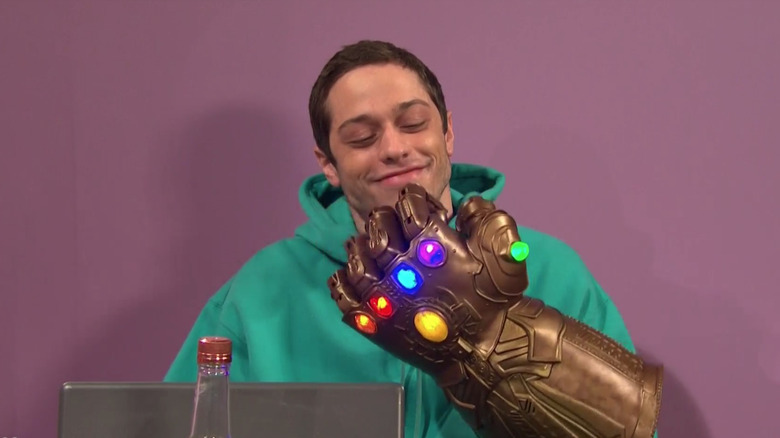
Those who frequent the Live From New York subreddit will remember a lot of anger and frustration aimed towards Davidson, fueled by the knowledge that past cast members couldn't have gotten away with so many absences. This was lightly remarked upon in Scarlett Johansson's monologue during the 2019 Christmas episode, where they did a fun little spoof of "Avengers: Infinity War," in which half the cast starts disappearing. At one point Heidi Gardner goes up to Cecily Strong and says "I think Thanos took Pete!" and Cecily responds calmly, "Oh, no, I think it's just one of those weeks where Davidson doesn't show up." 

It's funny because it's true: Pete Davidson was barely on the show in 2019, missing the first few weeks of the season 45 premiere to film "The Suicide Squad" and taking multiple episodes off after that. Taran Killam, who had a much stronger presence on the show throughout his six-year tenure, left because he was directing a movie that would've at most interfered with filming for the first two months of the next season. Before COVID-19 mixed up a bunch of cast members' schedules, if a project meant you were missing out on weeks of SNL, that typically meant it was time to leave the show. However, this is something that Lorne Michaels has become increasingly lenient about in recent years, with cast members like Kate McKinnon, Aidy Bryant, and Cecily Strong getting substantial time away from the show for other projects. 

On top of that, there's been a general perception that Davidson wasn't taking "SNL" seriously. Not only was he barely in any sketches, but when he was in one, he was breaking constantly, almost reaching Jimmy Fallon levels of unprofessional disruptions. Things got worse in early 2020 where he gave an interview with Charlamagne Tha God where he stated his intentions to leave the show soon, saying, "I have a weird feeling in that building where I don't know whose team they're playing for really ... if I'm the joke or I'm in on the joke." Although he wasn't quite as bitter in the interview as the quotes that circulated from it made him sound, all it did was further cement the anger towards him. If he was barely on the show — and he didn't appear to want to be on the show, why shouldn't he just leave?

His Sudden Improvement

The heat got taken off of Pete Davidson at the start of the pandemic in 2020, when "SNL" was forced to stick to at-home episodes for the remainder of the season. While those three at-home, entirely pre-recorded episodes serve as a nice little time capsule into what life was like back at the height of COVID-19 lockdowns, it just wasn't the same as the live show, and nobody could really blame them for it. 

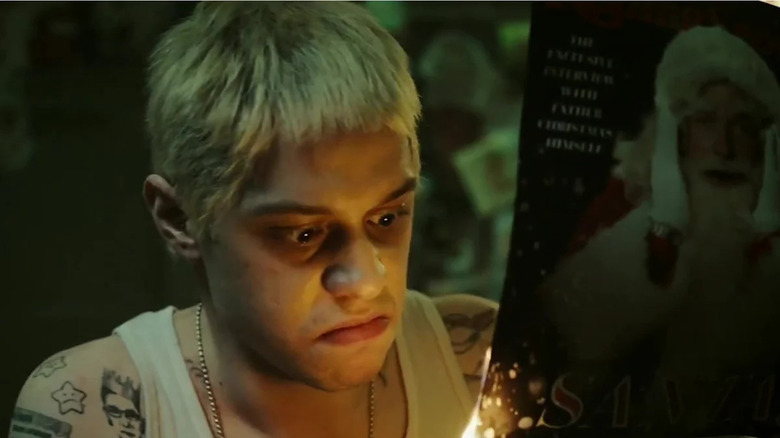
But by the time the show properly returned to its live format in the fall of 2020, Davidson felt like a whole new performer. He was showing up in multiple sketches per episodes, no longer breaking nearly as often, and seemed to find his calling doing music videos for the show, giving him a sort of hip-hop Adam Sandler kind of vibe. Although he'd done pre-recorded music video sketches before, he reached new heights with the Eminem-themed Christmas sketch "Stu," which was not only well-rapped but simply an impressive impersonation of Devon Sawa as Stan from the original music video. Whereas Davidson used to only be good for his Weekend Update stand-up segments, season 46 saw him come into his own as a sketch performer. When the season ended he discussed the change:

"I was at a really different place a year or two ago. I'm not exactly proud of how I handled or was handling things a few years ago. Looking back on it, you're like, "Ahh, come on, dude." Luckily a pandemic happened and I got kicked in the balls and had to sit with all of my immature irrational decisions. I was so happy when they said that SNL was going to come back because I was literally sitting with my own thoughts and I was feeling really bad. I was really excited just to work and see people and I had a different outlook for this season and moving forward."

Despite the yearly predictions that Davidson would be let go after each season, he's still going strong and doesn't show signs of leaving any time soon (though he has been gone a little while in this second half of the season to shoot another movie). However, that still doesn't fully explain the years of inconsistency beforehand. Throughout the nearly 50-year history of "SNL," it's rare for cast members to stick around for more than seven seasons, let alone to only hit their stride seven seasons into their run. With all the controversy Davidson's garnered over the years, from the outrage over his birth control joke about former fling Ariana Grande, to the right-wing outrage over his joke about Dan Crenshaw's eyepatch, to the mental health problems that made him such an unreliable member in the cast in the first place, it's worth wondering why Davidson was given so many second chance while other "SNL" performers were let go for stirring up far less trouble.

Lorne Michaels' Favorite

Showing up on "Late Night with Jimmy Fallon" in 2019, Davidson played a game of "True Confessions" with Fallon and former "SNL" writer and reliable host John Mulaney. The premise was that each of them had to read a statement and the other two had to figure out if it was true or not. Davidson's statement was so absurd the others assumed it had to be a lie: "Lorne Michaels and I went to Jamaica together for New Year's." 

Fallon and Mulaney — both "SNL" alums — couldn't believe that the famously stoic "SNL" showrunner would want to go on vacation with Pete Davidson, a 20-year-old who had only been in eight episodes of the show by that point. But it's true. Michaels and Davidson have always been on surprisingly close terms, with Davidson thinking of Michaels as a father figure and Lorne repeatedly having his back through all the controversies. With the behind-the-scenes culture of "SNL" notoriously leading to so many stories of actors self-destructing due to drug use, it makes sense that someone like Lorne, who's witnessed it all, would be looking out for the show's resident young person. As Davidson put it in an interview with Gold Derby in 2021:

"That guy never looked at me differently, never treated me differently, was always very understanding, never made me feel like my job was in jeopardy or that he was mad ... I definitely think he was concerned. There was a lot of concerning moments and a lot of serious conversations that needed to be had, but it was always from a loving place."

Watching the show live over the years, it feels like everyone at "SNL" has been looking after him, slipping in signs of support whenever they had the chance. One particularly memorable moment came in Jonah Hill's Five-Timer monologue, where Candace Bergen asks a bartender for a drink called a "Pete Davidson," explaining, "All I know is it's got a lot going on, but it gets the job done." At a time where Davidson was reeling from his highly public break-up with Ariana Grande and dealing with suicidal ideation, this felt like a sweet declaration from the writers that even if Davidson couldn't be as present on the show as you'd expect from a cast member, they still considered him a valuable member of the team.

Pete The Underdog

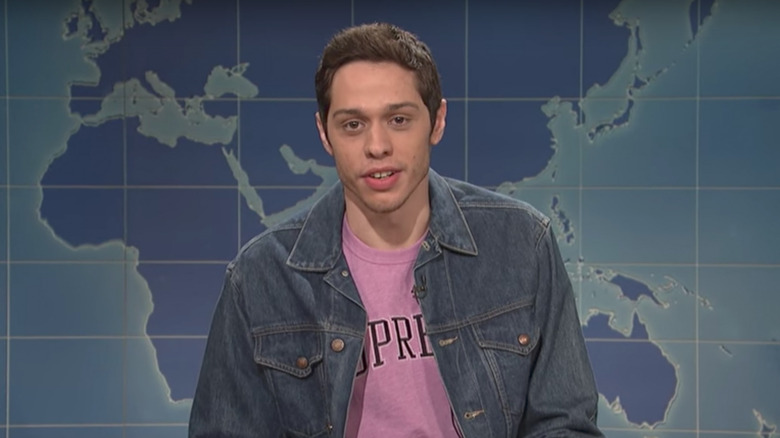
In 2017, Pete Davidson was formally diagnosed with borderline personality disorder and depression, and shortly after, he went on Weekend Update to talk about it. What starts as a serious bit about how people suffering from mental illness can find help quickly transitions into Davidson using it as an excuse for the show to put him in more sketches. Colin Jost suggests that if he wants to be on the air more, "maybe you should write more sketches for yourself," and Davidson jokes back, "That won't work. My sketches suck because they're all written by a depressed person."

This stand-up style bit was widely praised for its honesty and for the destigmatizing way Davidson treated mental illness, talking about depression with the same lack of shame most people talk about a standard physical injury. The type of comedy Davidson displayed here wasn't unique to that one episode. Much of his stand-up bits on Weekend Update were inspired by seemingly embarrassing bits from his life — the stuff most people would simply not want to admit on live TV — where Davidson turned it into something funny. He jokes about his rehab stints, his still living with his mom, his questionable choice in tattoos, it's all fair game, and it shows his great skill for personal comedy. 

Plenty of stand-up comedians' material feels like you're listening to a lecture, where the comedian in questions seems to think they're noble truth-tellers providing an invaluable service for humanity, carrying about a sense of self-importance that can make them nearly unbearable to listen to. Pete Davidson has none of those pretensions: he portrays himself as an idiot and he invites you all to laugh at his expense. There's no hint of arrogance in his material, and he clearly does not think he's better than you. He's honest about his life on a level that nobody else on Weekend Update is, and it makes viewers connect with him far more than they would with the other "SNL" stars who get way more screen time. Everyone else is playing a character, but he's often playing himself, and it feels like we've spent the past eight years truly getting to know him.

Read this next: The 13 Best Comedy Shows On Amazon Prime Right Now

The post Why Has Pete Davidson Garnered Such a Huge Following at SNL? appeared first on /Film.

21 Mar 20:02

Stop Storing These Items in Your Junk Drawer

by Sarah Showfety

Even the most pristinely organized and Marie Kondo’d among us still have a junk drawer—that place where tangled headphones, scrapbooking tape, Costa Rican coins, and one random golf ball coexist simply because we lead busy lives and don’t have time to put everything back in its proper place. But, while a junk drawer…

Read more...

21 Mar 01:43

Avoid These Bad Cleaning Habits That Make Your Home Even Dirtier

by Elizabeth Yuko

Cleaning, for most people, isn’t their idea of a good time. It’s a chore: Something we do because we have to. And in our quest to cross cleaning off our to-do list as quickly as possible, we’ve probably developed some strategies to help cut down on the amount of time and energy we have to expend on these tasks each…

Read more...

21 Mar 01:11

in which i discover analog horror

by wil@wilwheaton.net (Wil Wheaton)

When I was a kid, I was obsessed with the paranormal and the occult. I did not believe any of it was real, but I still loved it. I loved how the show In Search Of put this very respectable, credible sort of mask on, and winked at the audience, like, “Listen, we all know this isn’t real. But … what if it was? What if we all agreed to pretend that it was?”

Jack Palance was so intense on Ripley’s Believe It Or Not, it was like he dared you to not believe it. It was so great, that stuff. I just loved it. The Time Life Books series you already know I’m talking about before you even look at the link if you’re my generation was also a favorite. In the early days of the Internet, I just about died when I found all the regional urban legends on usenet that never made it to my little part of Los Angeles County.

I saw Blair Witch in the theater. I lurked on unfiction for what feels like ages back before the server blew up like Ricky’s mom. I watched so many found footage movies when they were just this low budget way to make indies, there was nothing left to surprise me when they went mainstream (though I was thrilled for the creators and the genre). I loved Marble Hornets so much, I tracked down like a 200 page PDF all about the Slenderman mythos that existed at the time, and I printed it out so I could make my own notes in it.

And until recently, it’s all just sort of fallen off my radar. I blame … *gestures broadly at everyfuckingthing*.

But when I came across Night Mind recently, it all came back. All the fun of pretending it’s real, with other people who are also pretending it’s real, while we all agree not to talk about how it isn’t real … oh man it just scratches this very specific itch that I didn’t even realize I had until I was scratching it. The SCP and EAS videos are just fantastic.

For the last minute or so, I’ve been channel surfing around Night Mind, Nexpo, and a few of those “people who watched this also watched” channels.

It’s one of those channels that surprised me and legit scared the evershittingfuck out of me last night.

Last night, I spent the evening watching analog horror videos on YouTube. I love the familiar, nostalgic, VHS feeling. I love remembering, from the safety of 49, how I felt every single time I heard the Emergency Broadcast System when I was 9 and a Cold War Kid. I don’t know what the modern day equivalent of walking into a room lit only by the static from a TV with no signal that you are positive you turned off an hour ago is, but if you know in your guts what I just described, that’s how these videos make me feel. It’s fantastic.

This is where I reveal that, until about 36 hours ago, I had not heard of “analog horror“. I hope you still respect me.

So, the story these videos and their creators are telling is genuinely frightening. Some real bad shit is happening with the moon and the television and even though I haven’t paused it to look, I just know there’s all sorts of creepy shit in the static. The way they are telling their story is impressive to me for a million reasons, technical and creative.

I think I watched three of them from this channel (they’re all very short, just a couple minutes each). Then they get to this video that slowly begins to feel familiar as I watch it. By the end of the first minute, that familiar feeling has become a memory. I have absolutely seen this before. But that’s impossible, because I didn’t know this video, this channel, or even this genre existed until breakfast yesterday morning!

I make this agreement with myself when I watch these channels, that’s essentially the same agreement we make when we play an ARG or engage with unfiction in any way: I know it isn’t real, but I’m going to pretend it’s real, and we aren’t going to talk about how it isn’t real. So my head is in a VERY PARTICULARLY RECEPTIVE AND VULNERABLE PLACE as this video WHICH I HAVE NEVER SEEN BUT TOTALLY REMEMBER plays out in front of me.

The video is tense and unnerving and unsettling on its own. But this unreal, impossible, yet undeinably real memory of seeing it before makes it feel like I am now inside one of these creepypasta shorts I’ve been watching. Somehow this specific video has also come out of my head and jumped into the computer in front of me and now this memory that I can not possibly have is clearly existing in my head and also on this video and I gotta tell you, bob, it isn’t great.

There’s a flash on the screen and I am already looking at exactly the right place to see the entity I know will be there. There has been nothing in this video so far that would lead anyone who hasn’t seen it to expect an entity. WHAT THE FUCK HOW DO I KNOW ANY OF THIS WHAT THE FUCK IS GOING ON.

The video plays for about another thirty seconds and then it ends.

I say, out loud, in my empty game room, “What the fuck.” And then the credits roll.

Oh. Okay. This all make sense, now, and I can breathe again. It’s made by Kris Straub, who I’ve known for years. I am a huge fan of Kris’s Candle Cove and Ichor Falls. Then I see that the video is from an idea by Mikey Neumann, who I have done many outstanding creative projects with over the years and love like family.

Mikey and Kris made this video forever ago, and sent it to me before it was uploaded anywhere. In all of the *gestures broadly at everyfuckingthing* of the last few years, I had completely forgotten about it. Like, the part of my brain where it lived was not reformatted, but absolutely marked as “available for storage” in my mental fstab.

I did that loud, nervous, I’m-so-glad-I-didn’t-die-I-really-thought-I-was-going-to-die laugh that we’re all familiar with for reasons none of us want to remember. Then I was like, “Okay. Okay. Well done, Mysterious Person Who Is Writing My Life. You just gave me the first good scare I’ve had in a long, long time.”

The series is called Local 58, and so is the channel, which is what I had been watching when I saw the video that made me metaphorically shit my pants. I am so glad I found it, and all the other channels like it that it either inspired, or was inspired by. This is fun, this stuff. This storytelling is doing the exact same thing for me in 2022 that the original analog horror did for me in 1982. I have just started Gemini Home Entertainment, (I know it’s not precisely the same but this Omega Mart training video is great,) and I haven’t even done the Night Mind Deep Dive into Local 58, which I know will open new doors for me to peek through.

As I am someone who is habitually late to every party, I’m sure there’s a ton of good stuff out there in this genre for me to discover. If there’s an analog horror series or creator you love who I haven’t linked to here, link them in a comment, if you want. I’m so interested to see what’s out there.

20 Mar 23:48

What Happened After Starlink's Satellite Internet Service Arrived in Ukraine?

by EditorDavid
The Washington Post looks at what happened after Starlink activated its satellite-based internet service to help Ukraine: Ukraine has already received thousands of antennas from Musk's companies and European allies, which has proved "very effective," Ukraine's minister of digital transformation, Mykhailo Fedorov said in an interview with The Washington Post Friday. "The quality of the link is excellent," Fedorov said through a translator, using a Starlink connection from an undisclosed location. "We are using thousands, in the area of thousands, of terminals with new shipments arriving every other day...." A person familiar with Starlink's effort in Ukraine, speaking on the condition of anonymity to discuss sensitive matters, said there are more than 5,000 terminals in the country.... Internet flows deteriorated on the first day of Russia's invasion of Ukraine on Feb. 24 and have not fully recovered, according to data-monitoring services. But since that initial dip, connectivity has remained fairly stable, with mainly temporary, isolated outages even during heavy Russian shelling. "Every day there are outages, but generally service comes back," said Doug Madory, director of Internet analysis for Kentik, which monitors global data flows. Even before Fedorov tweeted at Musk for help, SpaceX was working on a way to get Starlink to Ukraine. President and COO Gwynne Shotwell said in a talk at California Institute of Technology this month that the company had been working for several weeks to get regulatory approval to allow the satellites to communicate in Ukraine. In addition, the Washington Post reports, this week on Twitter Elon Musk also "challenged Putin to a fight and followed up by pledging he would use just one hand if Putin was scared. And he told Putin he could bring a bear." Reached for comment by the Post's reporters, Elon Musk responded by telling The Post to give his regards "to your puppet master Besos," following it with two emojis. But the Post's article also argues Starlink's technology "could have widespread implications for the future of war. Internet has become an essential tool for communication, staying informed and even powering weapons." And The Telegraph reports that Starlink "is helping Ukrainian forces win the drone war as they use the technology in their effort to track and kill invading Russians." In the vanguard of Ukraine's astonishingly effective military effort against Vladimir Putin's forces is a unit called Aerorozvidka (Aerial Reconnaissance) which is using surveillance and attack drones to target Russian tanks and positions. Amid internet and power outages, which are expected to get worse, Ukraine is turning to the newly available Starlink system for some of its communications. Drone teams in the field, sometimes in badly connected rural areas, are able to use Starlink to connect them to targeters and intelligence on their battlefield database. They can direct the drones to drop anti-tank munitions, sometimes flying up silently to Russian forces at night as they sleep in their vehicles... Should Ukraine's internet largely collapse, the "drone warriors" of Aerorozvidka would still be able to communicate with their bases by sending signals from mobile Starlink terminals, and using ground stations in neighbouring countries including Poland.... As Ukraine's internet is inevitably degraded, Starlink will be an alternative. General James Dickinson, commander of US Space Command, told the Senate armed services committee: "What we're seeing with Elon Musk and the Starlink capabilities is really showing us what a megaconstellation, or a proliferated architecture, can provide in terms of redundancy and capability." It's not all Starlink. The Telegraph points out that "The Ukrainian system benefitted from equipment given by Western countries, including radio communications which superceded Soviet-era technology, and the US has also poured in millions of dollars to protect against Russian hacking, jamming of signals and attempts to 'spoof' GPS technology." And meanwhile, weakness in Russia's own communications infrastructure may have played a role in the killing of five senior Russian generals in the last three weeks, according to a recent CNN interview with retired U.S. army general and former CIA director David Petraeus: "The bottom line is that [Russia's] command-and-control has broken down. Their communications have been jammed by the Ukranians. Their secure comms didn't work. They had to go single-channel. That's jammable, and that's exactly what the Ukranians have been doing to that. They used cellphones. The Ukranians blocked the prefix for Russia, so that didn't work. Then they took down 3G. [The Russians] are literally stealing cellphones from Ukranian civilians to communicate among each other. So what happens? The column gets stopped. An impatient general is sitting back there in his armored or whatever vehicle. He goes forward to find out what's going on... And the Ukranians have very, very good snipers, and they've just been picking them off left and right. Thanks to long-time Slashdot reader schwit1 for submitting the story.

Read more of this story at Slashdot.

20 Mar 23:44

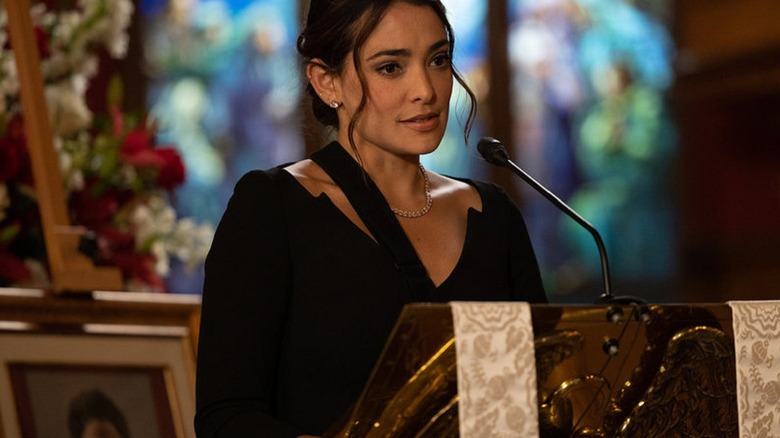
Natalie Martinez Has Joined The Cast Of Bad Monkey From Ted Lasso Co-Creator Bill Lawrence

by Danielle Ryan

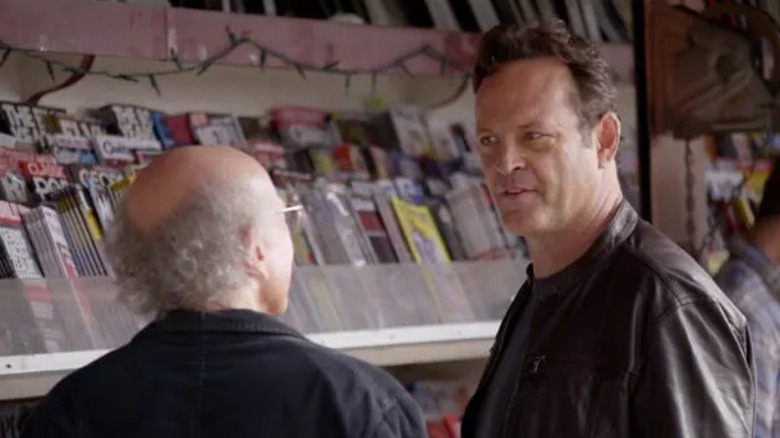
The next project from "Ted Lasso" showrunner Bill Lawrence is rounding out its cast with actress Natalie Martinez. Per Deadline, the actress will play opposite Vince Vaughn in the series "Bad Monkey," based on the darkly funny Carl Hiaasen novel of the same name.

Martinez rounds out a talented and intriguing cast that already includes Michelle Monaghan ("True Detective"), Jodie Turner-Smith ("Queen & Slim"), Meredith Hagner ("Search Party"), Rob Delaney ("Catastrophe"), and Arturo Luis Soria ("Insatiable"), with "Saturday Night Live" cast member Alex Moffat in a guest role.

The Plot Reads Like A Florida Headline

Fresh off the cancellation of her most recent project, NBC's "Ordinary Joe," Martinez is joining the cast of the upcoming Apple TV+ series. She will be playing a medical examiner who teams up with Vaughn's detective-turned-health inspector Andrew Yancy when he decides to investigate a mysterious severed arm caught by a fisherman in the Florida Keys. Like most of Hiaasen's stories, the 2013 book on which the series will be based captures the kookiness of Florida through a cast of peculiar and sometimes villainous characters, including, in this case, the titular bad monkey.

Deadline reports that Martinez's role is actually a recast, having originally been given to Broadway star and "New Amsterdam" actress Ana Villafañe. The outlet reports that the role may have been written for an actress a bit older than Villafañe, so Martinez may be more of a match for the role. Rosa is a love interest of Andrew's in the book, and the recast narrows the age gap between co-stars from 19 years to 14 years.

Morbidly funny "Bad Monkey" seems like a tonal shift for Lawrence after the gentleness of "Ted Lasso," but it also sounds perfectly in the wheelhouse for the man who brought us the increasingly zany Florida-set series "Cougar Town." In fact, Lawrence has been delivering pitch-perfect comedy shows–like "Scrubs" and "Spin City" — long before "Ted Lasso" made waves. But the success of the Emmy-winning Apple TV+ series has certainly made fans extra intrigued to see what he does next.

Lawrence signed a reported nine-figure deal with Warner Bros. Television just last month, and is also developing a show called "Shrinking." "Bad Monkey," though, may be the series we see first, as it's reportedly already entered production. Lawrence will executive produce the series alongside Matt Tarses, Jeff Ingold, Liza Katzer, and Marcos Siega. Siega, who recently helmed episodes of "Dexter: New Blood," will also direct the first episode of "Bad Monkey."

"Bad Monkey" will air on Apple TV+ but has no announced release date at this time.

Read this next: 13 Shows Like Manifest You Can Binge Watch Right Now

The post Natalie Martinez Has Joined The Cast of Bad Monkey From Ted Lasso Co-Creator Bill Lawrence appeared first on /Film.

20 Mar 23:43

Okay, What's The Deal With The Snails In Deep Water?

by Danielle Ryan

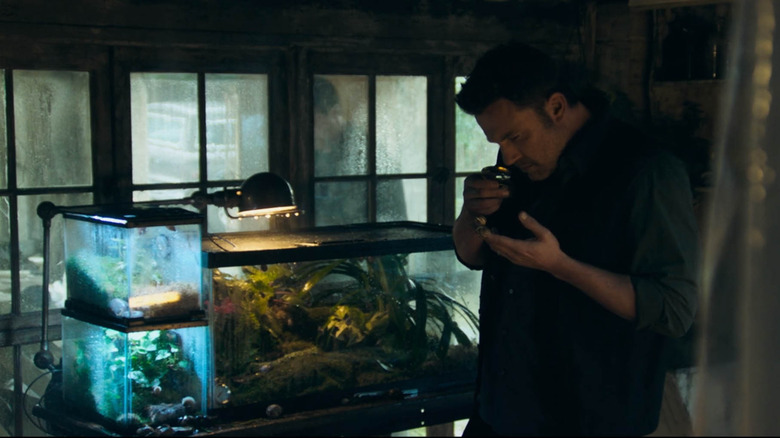
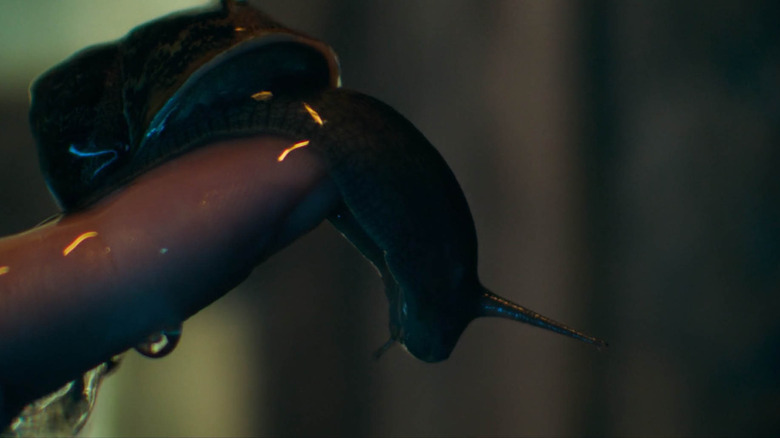
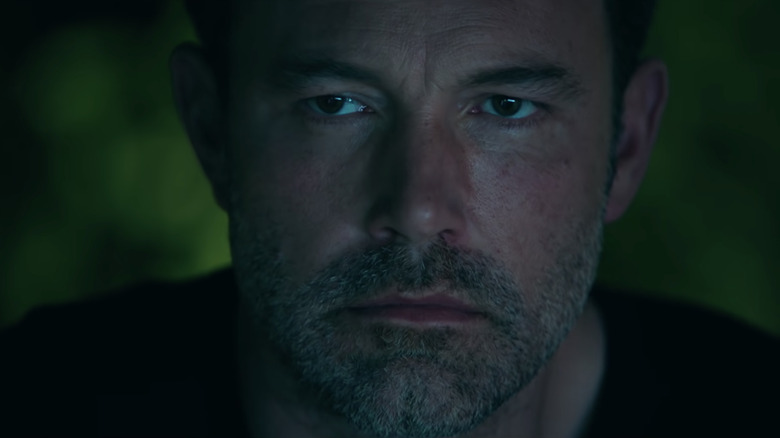
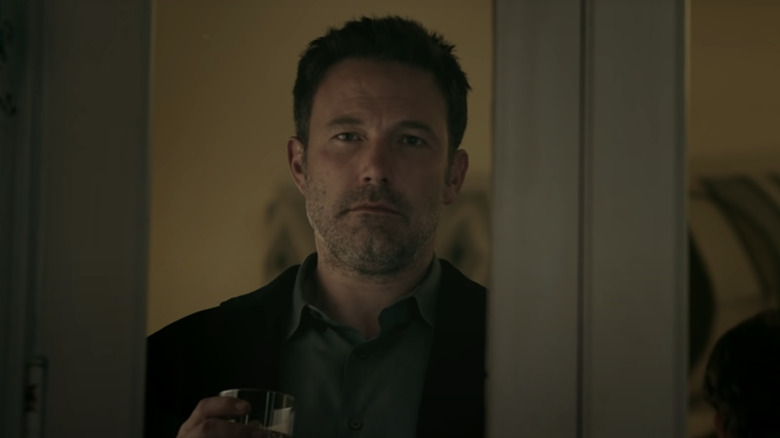
Guess what, gastropod enthusiasts? Ben Affleck's character in "Deep Water" likes snails as much as you do. In fact, Vic Van Allen (Affleck) seems to like hanging out with his pet snails even more than he enjoys watching other men have sex with his wife Melinda (Ana de Armas). In "Deep Water," the latest film from Adrian Lyne (best known for erotic thrillers like "Fatal Attraction" and "Indecent Proposal"), there are several scenes with Vic handling, washing, and ogling his little mollusk buddies. Reactions to the film itself have been mixed, but apparently, everyone is a fan of the snails, with critics praising the weirdness of their inclusion in their reviews. 

So, uh, what's with the snails?

Sweet Slimy Snails

"Deep Water" is an erotic thriller that follows the Van Allens as they try to keep their marriage together through a precarious arrangement where Melinda can have sex with whoever she wants, as long as they keep up appearances and stay together for their daughter. There's a lot to dig into, especially Vic's cuckolding and jealousy spiral, but there's just something fascinating about the snails. Plenty of eccentric rich guys keep giant tropical fish tanks in order to show off their wealth and have something to take care of, but snail farming is a fairly unusual hobby. The snails seem like they're going to have some kind of plot payoff, but they're really just a metaphor of some kind for Vic's languid existence that allow he filmmakers a great excuse for some slimy, surreal sexually-charged close-ups. 

There are a few pets that would make more sense for Vic's extracurricular paramour-killing activities, if I'm being honest. If he kept a shed full of prized pigs, like Mason Verger in "Hannibal," I could understand his reasoning. (Pigs are great at getting rid of bodies.) Piranhas would be equally practical, and their tanks can't possibly require more space and temperature control than all of those snails. Snails are omnivorous and can eat a decaying corpse, but Vic would need a lot more of them than he has in his shed. 

According to Oli Welsh's review for Polygon, the snails were almost cut from the film, which would have been a tragedy:

"[Vic] only comes fully to life when talking to Trixie or when gazing in humid adoration at his snails, scenes which Lyne and cinematographer Eigil Bryld shoot with an alien glow. (The snails are a wonderfully weird and unsettling touch of Highsmith's; Lyne has said that the studio was eager to cut them, but he rightly insisted on keeping them in.)"

If you want to check out Affleck, de Armas, and these sweet slimy little snails, then escargot to Hulu in the U.S. and Prime Video internationally and check out "Deep Water." 

Read this next: The 15 Best Final Girls In Horror Movies Ranked

The post Okay, What's the Deal with the Snails in Deep Water? appeared first on /Film.

20 Mar 23:43

Taylor Sheridan's Lioness Adds Laysla De Oliveira To The Cast

by Valerie Ettenhofer

Taylor Sheridan is continuing his quiet TV takeover with "Lioness," an upcoming Paramount Plus series starring Zoe Saldaña. Now, Variety reports Saldaña will be joined by "Locke & Key" actress Laysla De Oliveira.

"Lioness" is one of many Paramount-related series the prolific actor-turned-filmmaker is set to helm. His series "Yellowstone" is the network's flagship show, doing massive viewership numbers in comparison to other cable series. The show inspired a prequel series, the Tim McGraw and Faith Hill led "1883," last fall. Sheridan's status as the crown prince of cable has only been solidified since then, as more projects–including other period dramas like "1932" and podcast-inspired "Land Man" have been announced at a continual pace.

Sheridan Revisits The CIA

The project Saldaña and De Oliveira will headline is inspired by an apparent real-life CIA program that used women operatives, including in Iraq. De Oliveira plays the lead, Cruz Manuelos, a marine recruit who works under Saldaña's station chief Joe. Cruz will join the CIA's Lioness Engagement Team in hopes of helping to "bring down a terrorist organization from within," according to Variety.

This isn't the first time Sheridan has explored the far reach of the CIA. In 2015, he penned the Denis Villeneuve-directed film "Sicario," a potent thriller about a team working to take down a dangerous cartel. Although "Sicario" received widespread acclaim, its sequel was lambasted by some critics for perpetuating racial stereotypes. Another Sheridan film, "Wind River," also received criticism for its depictions of issues impacting Indigenous women. Sheridan can clearly craft a Western like nobody's business, but with "Lioness," he re-enters touchy cross-cultural territory that requires plenty of thoughtful nuance.

Sheridan won't be the sole authorial voice for "Lioness," though. He created the show and will executive produce, as will star Saldaña, Nicole Kidman, David C. Glasser, Ron Burkle, Bob Yari, David Hutkin, Geyer Kosinski, Jill Wagner, and showrunner Tom Brady. No, not that Tom Brady. Yes, that Nicole Kidman. In a statement to TV Insider, Brady responded to earlier news about the show with enthusiasm:

"I am a huge fan of Taylor Sheridan's work and am honored to help him tell his next amazing story with 'Lioness.' Taylor has created an epic, gripping, global spy thriller centered on a group of complex, strong women, and I can't imagine anyone better to help bring these characters to life than fellow executive producers Nicole Kidman and Zoe Saldaña."

"Lioness" will premiere on Paramount Plus, but release date information has not yet been announced.

Read this next: The 15 Best Anthology TV Series Ranked

The post Taylor Sheridan's Lioness Adds Laysla De Oliveira To The Cast appeared first on /Film.

20 Mar 14:08

Your Uber driver is (a) a grad student trying to make ends meet, (b) a musician doing a side gig, or (c) the former finance minister of Afghanistan [Murica]

20 Mar 11:58

Elex II Review – With a Rebel Yell

by Chris Wray

ELEX II

I've tried writing the opening to this review of Elex II about eight different times, each time going back over it and having to rethink it. I'm not even sure why because reviews are, by definition, opinion pieces. They are always subjective, with the reviewer simply having to explain why they think what they think about a title. Elex II is a game that I like against all odds and logical reasoning. As I look at my bullet-pointed notes and rummage around the ever chaotic thing I call a brain, I wonder why.

Honestly, I think I know why; Piranha Bytes. If you looked up "eurojank" in the gaming dictionary (is this a real thing?), it would understandably tell you to play any game by the developer. I've played every single one of them. I would say that issues people likely had with the Gothic titles continued, even if polished, in the Risen trilogy and have continued in Elex. It's not that I don't think Piranha Bytes have learned anything in the previous twenty years. They have; I don't think they care.

That's a good thing. Piranha Bytes is a small studio that cares about the games and worlds they create, and they do things that they find fun and interesting. They've been doing open worlds long before it became mandated by the industry for all new titles, which means their worlds often feel a little more lived-in than the latest That Ubisoft Game. The lived-in feeling is usually in the form of notes, exploring what happened to the nearby skeletal remains and giving you hints on where you could find something new, or it will simply be visible as you explore.

Sticking with random, why is Mr. William Idol Esq here in Magalan? I couldn't shake off the feeling that Magalan is now somewhere in the real world, much like how Horizon Zero Dawn takes place in a post-apocalyptic Colorado. Does Elex and now Elex II take place alternate-reality Konstanz? Also, as much as Whisky and Pills is a decent enough track, I expected William Broad to belt out Rebel Yell, which would also be thematic for certain factions. Was there a reason? God no, but it made me wonder if Billy is - much like The Sweet - bigger in Germany than he is here in the UK.

How does any of this help make the case that you should be playing Elex II? Honestly, I don't know. Still, any game that has me considering the nationality-based variance of rock music fan bases is fine by me. I'd also say Germany has better taste in music than the US and UK, whose people listen to space music and whatever else they are listening to enduring these days. Still, I suppose I should talk more about the game beyond the world being quite rich.

  • elex-ii-review-03-screenshot-1
  • elex-ii-review-03-screenshot-2
  • elex-ii-review-03-screenshot-3
  • elex-ii-review-03-screenshot-4
  • elex-ii-review-03-screenshot-5

Before I do, I should explain that a fair amount of the world you can explore is brought forward - with adjustments - from the first title. Lands to the west are no longer explorable, but the east has been introduced, bringing a new faction and areas to explore. The areas brought forward have been dramatically changed, with deserts have been terraformed into lush areas, snow has overtaken the old volcano, lava, and ash fields surrounding it.

But what can you do? The story has you facing a horde of alien invaders. It just so happens that the aliens have decided to drop a massive tower on the top of the hut of Jax, the protagonist from the first title. Never the most brilliant move, evidently the aliens in Elex II didn't play the original title and haven't realised that Jax, despite now being as brittle as a Jacob's Cream Cracker, is still a dangerous person to make your enemy. Only they've infected Jax with an alien disease, though the game forgot to show this in a cutscene that quite literally did not occur in the part of the map where I was.

Once you get over that perplexing issue, you find a few others. Sometimes the audio won't match the text; sometimes, it simply won't play; other times, I've had the text skip. Fortunately, you can read the dialogue of any current quest so that you won't lose out. Still, Elex II is a bit too buggy. As strange as it seems, these bugs sometimes help the charm of a game like this. Think of it as the Bethesda effect; they've always been buggy and baffling but don't have the excuse of "eurojank".

Wait, back to what you do in Elex II. As Jax, you will travel around Magalan interacting with each of the factions, having either the option to join them or win them around some other way. The aim is to stop the petty factionalism and unite the tribes in a great fight against the alien invaders. I have to appreciate the variety of missions, the interactions you have with different characters - even the smaller and stranger ones - and even that you have a far-too-binary moral choice aspect.

  • elex-ii-review-04-screenshot-1
  • elex-ii-review-04-screenshot-2
  • elex-ii-review-04-screenshot-3
  • elex-ii-review-04-screenshot-4
  • elex-ii-review-04-screenshot-5

As you may expect from a game where you're fighting alien invaders and multiple factions, there's a lot of fighting. If you've played the first Elex, you'll be aware of the janky combat. Not only is it janky, but it's also incredibly unforgiving. I've already mentioned how weak Jax is, but that's not doing it justice. Jax is so soft at the start of Elex II that I wouldn't fancy him in a fight against a moth. Not one of the SpindlyStabMoths flying around this world, just a regular one. Mainly thanks to the lack of a lock-on, that your swings (I like melee weapons) can easily miss your opponent and that the moth can fly.

What doesn't help matters is the plodding pace and progression. The reality is you need to do a lot of fighting (read above for issues) to gain experience to level up. Questing alone will not make you strong enough to get the experience, attribute, and learning points to face even the regular monsters roaming around the more challenging areas of the map. Want to fight a troll? Good luck with that if you're early in the game, don't have enough attributes to carry a stronger sword or gun, and are mortal.

Could Elex II have gone a bit quicker at the start? Yes, it could. You get the jetpack very early, and until you've upgraded it a fair amount, it's not much more than a hearty fart. Sure, it'll give you a bit of a lift, but it won't take you to the top of the nearby radio tower where somebody on the Steam forums said there's a special weapon that you won't be able to use for another few lifetimes. Once you get it going, though, the freedom is fantastic, and I think they should be mandatory in almost every open-world game. I want to fly.

That's the impression I get from Elex II and most Piranha Bytes games. The studio wants to fly, and it puts a lot into making games with almost all the correct elements, often just held back by that magical component. Could the studio be a little bigger to spread the workload and improve the polish? I would say so. No matter the issues, and I've said more than I have positives, I can't help but say I like Elex II. For anybody who hasn't played Eurojank titles, or the buggier of Fallout releases, risk it on a discount. If you have and like those games but could put up with pacing that's a little more glacial, you'll love this.

PC version reviewed. Copy provided by the publisher.

The post Elex II Review – With a Rebel Yell by Chris Wray appeared first on Wccftech.

20 Mar 11:57

Rebel FM Episode 533 - 03/18/2022

This week we've got some new stuff to talk about (and some stuff we've talked about already) with Tunic, The Captain, Orbital Bullet and more (yes Elden Ring) before closing with some letters! This week's music:  Hole - Violet
19 Mar 22:30

Elden Ring Review

by ValH

Introduction

Elden Ring is the latest action-RPG developed by FromSoftware, the Japanese studio behind the Dark Souls series, as well as a number of other Dark Souls-adjacent titles.

For years now, this particular type of action-RPG has been getting more and more popular, going from the humble cult classic of Demon's Souls that established a lot of the sub-genre's conventions, to Elden Ring that without exaggeration can be considered one of the biggest releases of the year.

To FromSoftware's credit, their previous successes didn't make them complacent. Instead of resting on their laurels and counting on Elden Ring to sell like hotcakes either way, they went all out here, creating an absolute behemoth of a game. As such, it took us a while to get through the game, but now that we have, you can find your thoughts on this particular title below.

The Old and the New

To start things off, let's consider what even is a Souls game. And Elden Ring is most definitely one of those.

Essentially, it's a third-person action-RPG designed in a way that punishes absent-minded button mashing. You spend stamina to both attack and avoid getting hit, be it by blocking, dodging, or running away, and as such, coming up with an actual strategy for how to approach encounters without running out of stamina and just standing there unable to do anything becomes an integral part of the whole experience.

On the most basic level, you have to study your enemy's attack patterns and use whatever openings they give you to counter-attack. That's the action part. Then comes the RPG part, where you have a great many ways to build your character.

You have an impressive list of primary and secondary attributes that you can increase by leveling up. These determine which gear you'll be able to equip, how strong you're going to hit, and how much health and resistance you'll have when you inevitably let an enemy hit you.

In order to level up in Elden Ring, you'll be using Runes that act as both the game's experience points and currency. You get Runes by defeating enemies, trading, and using special items. You also lose whatever unused Runes you have on you upon dying.

People oftentimes point to this fact when trying to paint these games as exceedingly difficult. What they don't tell you is that Souls, Runes, or whatever they're called in any particular title, don't really matter. You can always get more, and it's relatively easy to do.

You even get a chance to get your lost Runes back. Here's how this works - when you die, you get sent back to the nearest Site of Grace or a Stake of Marika. The former act as checkpoints where you can level up, manage your spells, set up your healing items, and so on, while the latter simply let you respawn near some dangerous spot.

But even if there's no Stake nearby, the thing that a lot of newer Souls players don't realize is that they can simply run past most of the game's enemies without any issues, which removes all of the annoyance you would think goes hand in hand with a game where enemies respawn whenever you rest at a Site of Grace.

And here's the kicker. Your character's attributes, while certainly important, and even more so in Elden Ring due to how the game is structured, are not what actually defines your playstyle. Your gear and personal preferences play a much bigger part there.

Depending on what you like and feel comfortable with, these games let you become a walking tank laughing from behind an impenetrable shield as enemies get staggered simply by hitting you, a nimble warrior dodging through every attack and responding with a flurry of blows, a wizard, a spellblade, a cleric, a pyromancer, or a mix of any of the above. The game's systems support pretty much all of it. In fact, playing as a naked guy wielding a tree trunk is a very much viable playstyle here.

This level of freedom is a big part of what attracts me to these games, and why I didn't enjoy Bloodborne and Sekiro: Shadows Die Twice, the series' more actiony spin-offs, that much. As opposed to those two games, Elden Ring really leans into this idea of letting you play however you want.


I would go so far as to call Elden Ring the Texas of Dark Souls. Everything's bigger in Elden Ring. When you're just starting your journey and get your first map piece, you think to yourself, "Wow, this place is quite large." But then you keep playing and at some point, realize that what you thought was the game's world is actually just one of its many regions. And once you think you know how large the map is, you discover that there's another subterranean layer to it with its own regions and secrets.

Usually, I'm not too fond of open worlds, but Elden Ring doesn't really follow the standard AAA formula, and instead gives you a large map and plenty of freedom. If you don't want to follow the main path straight away, you can just pick a direction and go.

The world is positively packed with minor dungeons along the lines of mines, caves, and catacombs. These usually have some theme to them, a few valuable items, and a boss. But even on the overworld itself, you'll find plenty of enemies to fight, chests to open, and bosses to face. In fact, the game has a day-night cycle, and some of the bosses appear only at night in specific spots, making you wonder what other kinds of hidden events the game has. Aside from that, you can discover plenty of assorted points of interest that range from giant-driven caravans to walking mausoleums and various environmental puzzles.

And every once in a while, you'll navigate yourself into one of the so-called Legacy Dungeons that put you into some castle that serves as a master class in level design and features multiple ways to advance, secret passages, architecture that loops around on itself, and all the other awe-inspiring stuff you're used to seeing in FromSoftware's games.

There's this sense of wonder that permeates your entire journey. FromSoftware's games are known for their impressive visual design, and Elden Ring takes that to a new level. Wherever you go, you can stumble onto some breathtaking vista.

Beyond just that, while, in the usual Dark Souls style, Elden Ring is set in a dying, or rather undying, world, things aren't quite as dire here as they were in Lordran. You get plenty of meadows and neat little groves where harmless critters skitter around, birds overlook things from their perches, and even turtles make an occasional appearance. And all the while, the ground is littered with skulls, mad undying warriors are still hanging around their ruined outposts and Nazgul-looking riders patrol the roads at night.

This combination of life and death really makes the world feel unique and makes you want to explore it.

And this brings us to the original question - what kind of game is Elden Ring? It's what you want it to be, really. Some people treat these games as an opportunity to fight some tough bosses and see everything else as a mere distraction. Some play them as rhythm games, boiling the gameplay down to pressing the dodge button at the right time and counter-attacking afterward, progression systems be damned.

Personally, I view these games as vehicles for exploration. You scour the world for cool-looking locations and bits of lore, in the process discovering plenty of gear and upgrade materials. You combine those with your understanding of the game's systems, and all of a sudden, even the toughest encounters become merely a test of sorts - were you able to put together a character capable of defeating this tough enemy without much effort? If the answer is yes, you get to advance. And if it's a no, especially in Elden Ring, you can always go explore some more, or just look for some hidden sequence-breaking path allowing you to bypass your current roadblock, explore the next area, and then return much stronger and wipe the floor with the previously tough opposition.

Speaking of upgrade materials. You can upgrade your weapons in Elden Ring all the way to +25 for the regular weapons and +10 for the more unique special weapons. This is a bit of a double-edged sword because once you know where to find the smithing stones you need to upgrade your stuff, you can make your weapons really strong really early. On the other hand, this creates a scenario where upgrading your weapons is more important than ever because the difference between an upgraded weapon and a basic one is staggering.

If there's anything negative to say about Elden Ring's world, it's that it is perhaps a little bit too large, which resulted in a number of compromises that don't exactly improve the overall experience. Multiple bosses in the game are just iterations of the same boss. On top of that, the game even borrows some enemies from its predecessors.


Imagine you're fighting this big tree spirit with a big hammer, but it's not actually a tree spirit, it's essentially Asylum Demon. And there are quite a few of those in the game. Everyone's favorite Capra Demon also makes a few appearances in a new form. At some point, you just get bored of fighting the same bosses, but now with extra poison, and start running past them. Thankfully, they tend to be entirely optional. And at the very least, very few of the game's boss fights are jokes or gimmicks where you need to solve some puzzle before you can damage a boss. Off the top of my head, I can only name one fight like that, and that's a very welcome improvement from some of the earlier Souls games.

Regular enemies can also be a bit suspect, however. While there's no level scaling of any sort in this game, there's enemy scaling. So for example the humble rat that harmlessly bites your ankles in the early game, when encountered in a late-game area, would generally be able to withstand a couple of hits from a decently-upgraded weapon and do enough damage to kill an under-leveled character in a single bite. Though admittedly, the game's enemy variety is pretty good and most areas have unique foes for you to tackle.

In general, the game's later areas, especially the optional ones, seem a bit overtuned. Just about anything there tends to kill you in one or two hits regardless of how much health you have. Enemies like to swarm you, and terrain seems to be designed with the express purpose of getting you stuck on some rock to make the monsters' job easier for them.

It honestly feels like those late-game areas were designed by the Dark Souls II team. Thankfully, Elden Ring never devolves into the nonsense that was Dark Souls II, because it gives you all the tools you need to overcome these "unfair" challenges.

First of all, you can summon and ride Torrent, a spectral steed that makes you hit harder and allows you to just not be there when monsters try to hit you back. Challenging areas also allow you to summon spirits. These range from mildly useful to extremely overpowered and can help turn the tide of many a battle. Defeating enemy groups or tough enemies in the world also restores your healing supplies, of which you usually get a limited number per rest. If all else fails, certain spots allow you to summon other players to help you out. And it's only up to you which of these options you deem too cheesy.

The one area where it legitimately feels the developers just gave up is the Dragonbarrow. It's essentially tuned like an optional end-game area, but you can visit it in the early game, and have to explore in mid-game to advance. Well, you don't have to, as there are ways to progress without going there, but they feel sequence-breaking, and chances are you won't find them on your first playthrough anyway.

So basically, you have to find a key in this area where enemies all have ridiculously bloated attributes. Some parts of it are just filled with copy-pasted dragons Lost Izalith-style, and right around where the item you need is located sits a giant dragon that does absolutely nothing but has obscene amounts of health. But if you have access to an attack that does percentage-based damage, you can kill that dragon in no time and get a ridiculous number of Runes for that point in the game, completely trivializing the next few areas. Basically, if you want to have a good time in Elden Ring, avoid the Dragonbarrow. Get in there, get the key, and get out immediately. That place is no good.

Another tool you have at your disposal in Elden Ring is the new crafting system. Basically, finding or buying recipes and gathering enough materials allows you to craft various stat-boosting items, throwable pots, arrows, and so on. Much like every other game with a crafting system, Elden Ring would've been a better game without a crafting system.

Here, it's not just that I don't like crafting in general, which I don't, it's that having crafting in the game means that crafting materials now pollute the item pool. Until you've played the game, you can't imagine the disappointment of going off the beaten path, engaging in some precise platforming, or maybe fighting some tough enemy, and on the other end of it, you get some flower or three mushrooms you'll never use.


On the other end of this, the combat system is a joy to behold. While on the surface, it's the same old Souls combat, there are enough meaningful changes here to make things more exciting. First, you now have a dedicated jump button, and a slightly different control scheme because of that. Jumping isn't just useful to get around some obstacles in the world, it's also a combat tool that allows you to perform jump attacks unique to each weapon type and also avoid a variety of ground-based attacks, which can serve as an alternative to the dodge roll.

If you prefer using a shield, you can now weather an attack and then perform a guard counter move that can be very useful. You also have these so-called Ashes of War that are essentially active skills you can add to your weapons. Not only do they allow you to make your sword be unlike any other sword in the game, they also let you adjust its attribute scaling, making it so you can use certain weapons with a build that otherwise wouldn't support them.

What I also like is that no combat style seems to be the ultimate answer now. Sure, you may have a shield that blocks just about anything, but certain weapons can go around it, while some special attacks ignore it completely. Also, while you can parry a lot of the game's bosses, you need to parry some of them several times in a row before you can go for a riposte. Even dodging is not a complete invulnerability button, with certain attacks being best avoided by jumping over them.

The game's enemies also got an upgrade. Gone are the times when you were mostly fighting skeletons clearly telegraphing their attacks. Elden Ring's enemies oftentimes delay their attacks to catch you off-guard, they press their advantage when they see you retreating, or they launch some devastating attack when you lock yourself into a healing animation. All of this makes the game's combat significantly more fun and engaging.

And even though the game is positively overflowing with mechanics, it's easily the most approachable FromSoftware title to date. For starters, the tutorial is pretty good now at actually explaining what's going on and how things work. Sure, it might not cover the advanced stuff, like what partial parries are, how generous backstab windows can be, or that you can actually slide down ladders instead of going one rung at a time, but it goes over enough of the basics to prepare a newer player for what's ahead.

You also, for the first time in a game of this type, now have a map. Not only can you leave markers on it, it also points you in the general direction of your main quest, which is a huge improvement over some giggling guy who mumbles something about some bells at you.

Finally, to end this section, I'd like to mention a couple of changes in how the game works compared to its predecessors.

When it comes to attributes, for the most part, everything works the same, but Attunement is gone completely. Instead, you now have memory slots for your spells. You gain them by finding special items in the game's world. Rings are now called talismans, and while you initially can only equip one, beating certain bosses will grant you more talisman slots.

Poise still exists as a secondary attribute, but much like in Dark Souls 3, it doesn't really work. In fact, it doesn't work even more than it didn't in Dark Souls 3. Basically, Poise is the attribute that allows you to continue attacking while taking damage, which is really useful when you have a slow heavy weapon.

In Elden Ring, while wearing heavy armor (one tier below the heaviest) and wielding a big sword, just about anything will still stagger you, making charged attacks more or less unusable. Pretty much the only thing granting you any noticeable amount of Poise, from my experience, is the Wild Strikes skill that allows you to withstand a hit or two before you get staggered.

The Elden Lord of the Rings

With the game's structure and mechanics out of the way, let's take a look at what it can offer in the story department.

The first thing to mention here is that while Elden Ring was developed in Japan, it's very much not a JRPG. And while true, some of the armor designs and cutscenes here are closer to that kind of game than ever before in a Souls title, this is still a very much Western-flavored project and your character runs upright instead of at a 45-degree angle.


Besides, the game's world was created in collaboration with George R.R. Martin, the author of A Song of Ice and Fire series of fantasy novels. And while his contributions were apparently limited to the big picture lore, you can clearly feel his influence on the game's story where most of the important characters are connected on some personal or familial level.

That is of course if you bother looking into that stuff. In the true FromSoftware fashion, Elden Ring's lore is primarily delivered through cryptic conversations and item descriptions, and it's up to you to piece everything together. Alternatively, you can just ignore all that stuff and hit skeletons with a big club. Your experience won't be diminished by that approach.

But should you choose to at least try and figure out what's going on in Elden Ring, you'll be dropped into what is perhaps the most complex FromSoftware world to date.

On the most basic level, you'll be tasked with restoring the Elden Ring, a divine artifact that was shattered at some point in the past, plunging the Lands Between into a purgatory state where no one can die for good, and all the nobles who got a hold of the ring's shards were gradually transformed into oversized monstrosities. Collecting those shards will make you the Elden Lord and supposedly restore order in the Lands Between.

Of course, nothing can ever be so straightforward in a FromSoftware game. During your journey, you'll meet plenty of factions and individuals who think they know of a better way to steer the Lands Between into a bright or not so bright future, and even the seemingly good guys don't necessarily have your best interest in mind.

The game's story continues the trend of everything being bigger in Elden Ring. While I can't say with any degree of certainty that I know exactly what's going on in the game after beating it just once, from what I've seen, it combines just about every possible inspiration and reference you'd expect from a collaboration between George R.R. Martin and Hidetaka Miyazaki.

You have plenty of Lovecraftian elements bubbling under the surface, with most of the game's factions being influenced by some Outer God or other. Magic, in the true Miyazaki fashion, once again has something to do with crystals, but this time around they're crystals from outer space. Ancient civilizations are stacked on top of one another like a layer cake. And there's a distant possibility that just about everyone in the world is a mimic thinking it's people.

What was a bit surprising, though, is how much Elden Ring clearly borrows from The Lord of the Rings. The ring part is obvious of course. But then you have these big divine light-giving trees. A race of demigods called the Numen. And one of the main bad guys goes by Morgott. I'm sure there are other less obvious things, but this is surface-level stuff, and there's plenty of it in the game.

What's also impressive is the game's commitment to its mystery. If you just play Elden Ring without looking anything up, there's a good chance you'll miss huge chunks of it. Entire large areas here are hidden behind secrets upon secrets. In fact, to fight one of the major bosses showcased in the intro cinematic, you'll need to join the game's "bad guys" acting as Elden Ring's Darkwraiths. Alternatively, you can die in a very specific way in a very specific spot, and then engage in some platforming upon being magically transported to a new area. But that's Elden Ring for you. There's almost always another way.

On the negative side, due to the game's scope, its side quests are now way too convoluted. Without reading any guides or just getting insanely lucky, I don't think it's possible to follow any of the game's side quests to their logical conclusion. It almost feels random where you need to go and what you need to do to advance most of those quests. Thankfully, they're a relatively minor part of the overall Elden Ring Experience.

Technical Information

Ever since the game launched, there have been reports of it being a bad PC port. And while I can't guarantee that you'll be able to run Elden Ring without a hitch, I personally didn't encounter any stuttering or major frame drops during my playthrough. The game crashed on me twice, and that's pretty much it as far as major issues are concerned.


This being an open-world game, it does suffer from numerous minor issues, like the very real danger of getting stuck on some terrain, or the AI not being able to handle elevation. But as far as open-world games are concerned, it's not even close to the worst thing ever.

As opposed to clear bugs, the biggest victim of the game's scope is the attention to detail FromSoftware is usually known for. Certain things in the game, like some of its quests, feel downright unfinished. The covenant system feels like it's supposed to be in the game but isn't. There's a whole system that lets you modify your armor, but all it does is let you remove capes from certain armor pieces. And don't even get me started on how the game's upgrade materials are now separated into sterile numbered tiers, as opposed to being chunks and slabs.

On the technical side, the game's visuals are a marked improvement over its predecessors. But honestly, visual fidelity is not really an integral part of most Souls games. It's all about their art direction. And as usual, it's top-notch in Elden Ring. Music, on the other hand… Well, music has never been FromSoftware's strong suit, in my opinion. Unless you're someone who can get excited by endless variations of somber melancholic plinking, chances are you won't be jumping with joy for Elden Ring's soundtrack.

Much like the earlier Souls titles, Elden Ring constantly saves your progress as you play, while also allowing you to manually save on quitting the game.

Another Souls game staple is the fact that the game really should be played with a controller. You certainly can use a mouse and keyboard for it, but it won't feel right. The game's control scheme is fairly unique and really needs a controller to shine.

The game also comes with multiplayer functionality. The main meat there are the messages you can leave on the ground and have other players see them in their game. This whole system is fascinating. Simply by working with a set of pre-made phrases, the game's community now has its own unique language for communicating things, its in-jokes, and clashing groups of people who want you to jump off of cliffs and those who want to prevent you from doing it.

You can also engage in some PvP, but unlike the previous Souls games, it doesn't look like people can just invade you at will now. Instead, they can only do so when you've already summoned other players to help you beat the game, or when you invite them in.

Finally, one last thing I want to mention is the game's length. Prior to its release, its length was estimated at around 30 hours. That was an understatement of the year. While missing plenty of optional dungeons, it took me around 100 hours to beat the game, and that's without getting stuck on any of its bosses for too long.

And while this number is comparable to some other major CRPGs, you have to keep in mind that Elden Ring doesn't have that much dialogue or cutscenes. These 100 hours were almost all pure gameplay, and as such, the game feels even larger than it already is. And that's not even mentioning the New Game+ mode that's a staple of Souls games by this point.

Conclusion

As you can see, Elden Ring is not a perfect game. It has plenty of flaws. But even with those flaws, I consider it the best FromSoftware game to date. It's an adventure. It's an experience. And I can't recommend it enough to anyone who already likes Souls games, but also those who'd like to give them a shot and see what they're all about.

This is the kind of game that makes you want to discuss it with other people. It's also the kind of game that, despite its considerable size, makes you want to start a second playthrough straight away. And we don't get a lot of games like that these days.

19 Mar 16:23

How Elden Ring got me through literally dying twice

by Minna Hong
How Elden Ring got me through literally dying twice

Content warning: this article contains references to medical emergencies, cardiac arrests, and near-death experiences.

As a big Dark Souls fan, I expect to die again and again while playing FromSoft games, but I never thought it would happen to me in real life. In early September of 2021, it did. Twice.

I didn't know it at the time, but I had walking pneumonia. At three in the morning on September 3, 2021, I was having difficulty breathing. I managed to call 911 before collapsing in my front hallway. The cops had to bag me with oxygen until EMTs arrived on the scene. I had a cardiac arrest and the EMTs performed CPR on me. They got me into an ambulance, where I had another cardiac arrest. They shocked my heart again and for one of the cardiac arrests, they jabbed me with an epinephrine injection as well. Oh, and I had a stroke at some point, too. That’s always an afterthought: the stroke, overshadowed by the two cardiac arrests.

RELATED LINKS: Best Elden Ring settings, Elden Ring bosses guide, The best Elden Ring classes
19 Mar 00:49

[Steam](Game) Lost Island

by /u/EinHaDe
18 Mar 23:54

Kids In The Hall: Comedy Punks Review: A Celebration Of Canada's Finest Alternative Sketch Comedians [SXSW]

by Ethan Anderton

"Saturday Night Live" is commonly viewed as the pinnacle of sketch comedy on television, even if fans of "Monty Python's Flying Circus" might have something to say about that. Created by Lorne Michaels, the live, late-night sketch series has endured for nearly 50 years since premiering in 1975, with the "Not Ready for Prime Time Players" ushering in a new era of comedy. But Lorne Michaels also made waves with another band of comic misfits imported from Canada, and they stepped into the comedy gaps that "SNL" left unfulfilled. They're called The Kids in the Hall, and while "SNL" caught the eyes of mainstream audiences on network television, they became an alternative comedy sensation that gave a rising swell of underrepresented audiences and comedians the voice they needed to hear.

"Kids in the Hall: Comedy Punks," a new documentary from director Reg Harkema, chronicles the rise of this groundbreaking sketch comedy troupe, from their formation in the Canadian city of Toronto, through their beloved TV series in the 1990s, and right up to their upcoming reunion series coming from Prime Video. It's the kind of documentary that serves as a compelling introduction for anyone who might not be familiar with the legacy of The Kids in the Hall, but for the hardcore fans who have been following them for over 30 years, the journey in between sheds new light on the comedians' camaraderie and evolution over the years.

The Kids in the Hall came together in 1984 when Mark McKinney and Bruce McCulloch, then performing in a group known as The Audience, met Dave Foley and Kevin McDonald, who were performing under the Kids in the Hall name. The name was inspired by a recurring joke from Sid Caesar's sketch series, where he would attribute a joke that didn't land very well to the up-and-coming comics in the backstage hall who would write jokes for Caesar before he took the stage. Despite McDonald instantly thinking that there was no way McKinney was funny, the two duos hit it off. Once they brought in Scott Thompson as their fifth member, The Kids in the Hall as we know them today had officially been formed, and they began performing regularly at the Rivoli, a bar, restaurant, and performance space in Toronto where the group slowly built up an impressive fanbase. 

But The Kids in the Hall were nearly finished as soon as they began when they caught the eyes of Lorne Michaels, who was always looking for fresh comedic talent to join the ranks of the cast and writers at "SNL." After a private audition featuring the troupe's best material, Mark McKinney and Bruce McCulloch were invited to become writers at "SNL" in 1986, taking them from Toronto to New York City, and making it hard to regularly perform with their partners in comedy. However, the two simply weren't happy in the highly competitive, fast-paced environment of "SNL," and Michaels could see that they simply weren't the same without the rest of The Kids in the Hall. Thankfully, CBC was looking to collaborate with Lorne Michaels on some kind of project, and "The Kids in the Hall" sketch comedy series was born, cementing their chapter in comedy history.

"Kids in the Hall: Comedy Punks" benefits from having a subject that rose to fame at a time when camcorders and VCRs meant comedians everywhere were recording their antics both on and off stage. There's a wealth of never-before-seen footage, from early sketches by The Kids in the Hall at the Rivoli to zany behind-the-scenes fun between these friendly and hilarious personalities. Plenty of clips from beloved sketches are featured, though I found myself thinking the documentary was maybe moving too quickly through the troupe's history. Each season could have easily received much more screentime. Thankfully, the film still more than adequately shows how "The Kids in the Hall" stood out from "SNL," choosing to lampoon the trials and tribulations of everyday life rather than riffing on timely headlines and trending pop culture. But it also came with plenty of surreal and zany comedy too, especially as the series became more cinematic and experimental in the later seasons.

'The Comic Arm Of The Grunge Movement'

On top of a satisfying retrospective, the talking heads featuring each of the five members of the troupe are full of honest, intimate reflections, especially when it comes to the more unsavory and tense details during more troublesome times. You might never have known of the animosity that grew between the gang as their show went into the fifth and final season. The production of their movie "Brain Candy" saw even more tension and bitterness envelope the group, just as it would any rock band who's been together for years. I only wish that the film had more footage of McKinney, McCulloch, McDonald, Foley, and Thompson together in the same room, which is only utilized every now and then. Thankfully, there are still a handful of amusing moments that come from the cast members addressing each other through the camera in their own individual interviews, with the film's editing making them go off without a hitch. You may also find yourself wiping some tears away when Thompson recalls his fight and eventual triumph after a cancer diagnosis. 

Aside from the insights provided by The Kids in the Hall themselves, there's also an outstanding assembly of commentary, context, and compliments from a variety of comedy greats. Mike Myers, the fellow Canadian comedian who found fame on "SNL," pays them the ultimate compliment by saying that he always wished he could be one of The Kids in the Hall (he kinda got his wish by performing with them several times at the Rivoli in the earlier years). Other famous faces such as Fred Armisen, Janeane Garofalo, Lewis Black, Matt Walsh, and Reggie Watts have nothing but kind things to say too. But it's the likes of Eddie Izzard, Julie Klausner, and Mae Martin who offer up the most important praise, and it's also what makes The Kids in the Hall stand out from all other sketch comedy shows, and, as one talking head called them, "the comic arm of the grunge movement."

Despite the fact that The Kids in the Hall are led by five white guys, they also brought with them a refreshing perspective and representation of both female and gay characters. All five of the male cast members frequently appeared in drag, but their sketches never tried to insultingly mock women in a lazy, superficial, or chauvinistic way. They featured hilarious, prominent female characters who just so happened to be played by men, giving the troupe an almost Shakespearean quality. On top of that, the presence of the openly gay Scott Thompson allowed them to effectively and hysterically tackle many homosexual topics, which weren't often being broached in comedy in the 1990s. With that came a queer-positive portrayal of gay characters and effeminate energy that you simply couldn't find in other sketch comedy shows. As Izzard astutely observes, "The Kids in the Hall were and are the successors to Monty Python." It's hard to imagine better praise than that.

"Kids in the Hall: Comedy Punks" is an insightful, celebratory, uplifting, and uproarious documentary that celebrates some of the best and brightest comedic talents. My only wish is that we got more time to spend with The Kids in the Hall to allow for even more of a deep dive into their sketches, both in their TV series and their on-stage revival over the past decade. But at the very least, it's good to see this documentary cap things off with the promise of the forthcoming "Kids in the Hall" series reboot. Since the troupe is looking at this more like a sixth season of the show, it'll be like the kids have been waiting in the hall this whole time to hand us some more jokes. I can't wait for more.

/Film Rating: 9 out of 10

"Kids in the Hall: Comedy Punks" will arrive on Prime Video sometime this year.

Read this next: The 35 Best Documentaries You Can Watch On Netflix Right Now (March 2022)

The post Kids in the Hall: Comedy Punks Review: A Celebration of Canada's Finest Alternative Sketch Comedians [SXSW] appeared first on /Film.

18 Mar 23:54

Great Scott! Christopher Lloyd Has Joined The Mandalorian Season 3

by Valerie Ettenhofer

Space Western "The Mandalorian" has just added another impressive guest star to its roster. Christopher Lloyd will reportedly be joining the show's third season, according to The Hollywood Reporter.

The actor is no stranger to sci-fi, having famously starred as Dr. Emmett L. "Doc" Brown in the beloved "Back To The Future" franchise from the '80s. He's also kept plenty busy since then, most recently appearing as a hilarious, badass geriatric assassin in the Bob Odenkirk-led action film "Nobody." As is customary for the acclaimed "Star Wars" spin-off series, his role is currently being kept under wraps, though I, for one, hope he'll be able to have fun under some creative alien makeup.

Mando Has A Great Track Record With Guest Stars

The first of several Disney+ shows expanding the "Star Wars" universe, "The Mandalorian" has earned a reputation for bringing excellent guest stars and recurring actors on board. "Justified" and "Deadwood" star Timothy Olyphant's Cobb Vanth has been a standout, but the show has a wide and rotating cast of characters that makes it a delight even for non-"Star Wars" fans. Comedian Amy Sedaris and "Breaking Bad" alum Giancarlo Esposito have both appeared as recurring characters, while the show's space-crossing shenanigans have included everyone from Werner Herzog and Taika Waititi to Richard Ayoade–and even Nick Nolte.

The series is set to return for its third season later this year, and thankfully, Baby Yoda fans shouldn't have to wait longer for Grogu's return. Other characters like Bo-Katan (Katee Sackhoff), Greef Karga (Carl Weathers), Esposito's Moff Gideon, and of course, The Mandalorian himself (Pedro Pascal) all seem set to return for the third season, though no teasers or footage has been released. Production for the season officially began in October.

The "Star Wars" timeline has been further complicated by additional spin-off shows arriving on Disney+. Most recently, "The Book of Boba Fett" continued the story of Fennec Shand (Ming Na-Wen) and gave us a look under the helmet of one of the franchise's most inexplicably popular characters, the titular Boba Fett (Temuera Morrison). Next up, Disney+ will debut "Obi-Wan," an Ewan McGregor-led series set to debut the same week as fans' annual "Star Wars" Celebration in May. Finally, Diego Luna will take center stage in the "Rogue One" spin-off, "Andor," later in the year.

"The Mandalorian" is set to return in 2022.

Read this next: Single-Season '80s Sci-Fi And Fantasy Shows That Deserve A Second Shot

The post Great Scott! Christopher Lloyd Has Joined The Mandalorian Season 3 appeared first on /Film.

18 Mar 23:54

Proposed Law In Minnesota Would Ban Algorithms To Protect the Children

by BeauHD
An anonymous reader quotes a report from Ars Technica: Minnesota state lawmakers are trying to prohibit social media platforms from using algorithms to recommend content to anyone under age 18. The bill was approved Tuesday by the House Commerce Finance and Policy Committee in a 15-1 vote. The potential state law goes next to the House Judiciary Finance and Civil Law Committee, which has put it on the docket for a hearing on March 22. The algorithm ban applies to platforms with at least 1 million account holders and says those companies would be "prohibited from using a social media algorithm to target user-created content at an account holder under the age of 18." There are exemptions for content created by federal, state, or local governments and by public or private schools. "This bill prohibits a social media platform like Facebook, Instagram, YouTube, WhatsApp, TikTok, and others, from using algorithms to target children with specific types of content," the bill summary says (PDF). "The bill would require anyone operating a social media platform with more than one million users to require that algorithm functions be turned off for accounts owned by anyone under the age of 18." Social media companies would be "liable for damages and a civil penalty of $1,000 for each violation." Tech-industry lobbyists say the bill would violate the First Amendment, prevent companies from recommending useful content, and require them to collect more data on the ages and locations of users. TechDirt's Mike Masnick slammed the bill in an article titled, "Minnesota pushing bill that says websites can no longer be useful for teenagers." "I get that for computer illiterate people the word 'algorithm' is scary," Masnick wrote. "And that there's some ridiculous belief among people who don't know any better that recommendation algorithms are like mind control, but the point of an algorithm is... to recommend content. That is, to make a social media (or other kind of service) useful. Without it, you just get an undifferentiated mass of content, and that's not very useful."

Read more of this story at Slashdot.

18 Mar 16:14

Deep Water Ending Explained: Keeping Up With The Van Allens

by Mike Shutt

After 20 years, Adrian Lyne has finally made his return to filmmaking, and he makes that return with a genre that is his bread and butter: the erotic thriller. "Deep Water," starring Ben Affleck and Ana de Armas, was sadly dumped on Hulu, avoiding a theatrical release altogether, but that says more about the sorry state of theatrical moviegoing than it does the film. While not up there with Lyne's best work, "Deep Water" offers plenty of salacious fun and features a wickedly wonderful Ben Affleck performance. One might think "Deep Water" being made 20 years after Lyne's previous film "Unfaithful" might find the filmmaker a little creaky, but he is still as engaged as a director as ever, even if some of the grander visual panache of his early work is missing here. Lyne's concerns as a storyteller remain firmly intact, though, and "Deep Water" fits right alongside the rest of his work perfectly.

In fact, this marks the third film an unofficial trilogy for the British filmmaker all concerning men who do not know how to handle themselves when their wives cheat on them. First was "Indecent Proposal," where Robert Redford's billionaire character offers the happily married (but financially struggling) couple of Demi Moore and Woody Harrelson $1 million for a night with Moore. Then there is "Unfaithful," in which Diane Lane cheats on her husband (Richard Gere) with a hunky bookseller. Harrelson and Gere in those two films play basically normal, everyday guys who just do not know how to compute the fact that their partners could have had sex with another person. Their jealousies consume them, with Harrelson lashing out in anger and Gere killing his wife's lover. Both films do offer a glimmer of hope that these relationships could continue after the tumult.

"Deep Water" takes the idea of the cuckolded husband and complicates him much more than the previous two films. While the jilted, jealous man with rage is certainly to be found in Affleck's Vic Van Allen, there are whole other facets to him that simultaneously make him more and less sympathetic to the audience than these other men. They also muddy up the central marriage with de Armas' Melinda even more, leaving you unsure if these two people should never see each other again or they were perfectly made for one another.

To Be Horny Or Not To Be Horny

Woody Harrelson and Richard Gere's characters are driven by complete sexual insecurity. Harrelson, in particular, keeps screaming at Demi Moore about whether or not she thought Redford was good in bed. This is a pretty common trope for the jilted husband. A lot of men love to think that their cocksmanship could topple regimes and cure world hunger, and if someone comes to challenge that, they must be defeated. It makes these men sick to think that they may not be the best lover, the only one this woman could ever want.

Ben Affleck's rage at the men that Ana de Armas sleeps with over the course of the film does not seem built on penis envy. Not really. Sure, it's a small part, but the real threat he feels concerned about is love. The Van Allens have this unspoken agreement of sorts where they will not get a divorce if de Armas' Melinda can sleep with basically whoever she wants. Vic knows this is part of the game. It is when these men get too close that his violent side comes out. Melinda decides to get bold and starts bringing her lovers to social parties or family dinners, with one even discussing the possibility of her moving out of the country with him. This level of connection Affleck's Vic cannot stand, and that is what drives him to murder all of these guys.
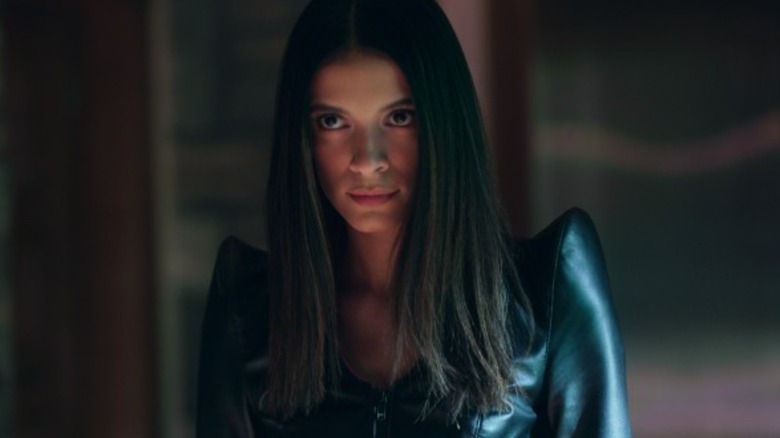
Where the major divergence occurs with Vic and the other two Adrian Lyne men is Vic actually loves that his wife cheats on him. And by "loves," I mean is incredibly turned on by it. Again, they have essentially agreed for him to be a cuckold, and he cannot help himself spying in on his wife and whatever guy she's with in intimate moments. He knows exactly what is happening anyway, yet he has to do some peeking. The scene explicitly calling out his horniness for the whole thing is when her piano player boyfriend plays a tune at a party, and she grinds herself on Vic's crotch as they watch him play. Disregard the violent love jealousy part, the sexual component of their marriage may be unusual for a fairly mainstream movie, but it is an agreement so many couples have made with one another in real life. If everyone is on board, cuckolding and voyeurism are perfectly fine kinks to utilize in your sex life. That's why Vic can be completely turned on by his wife sleeping with other guys, but overstepping the boundary to where it is more than sex is when the trouble starts.
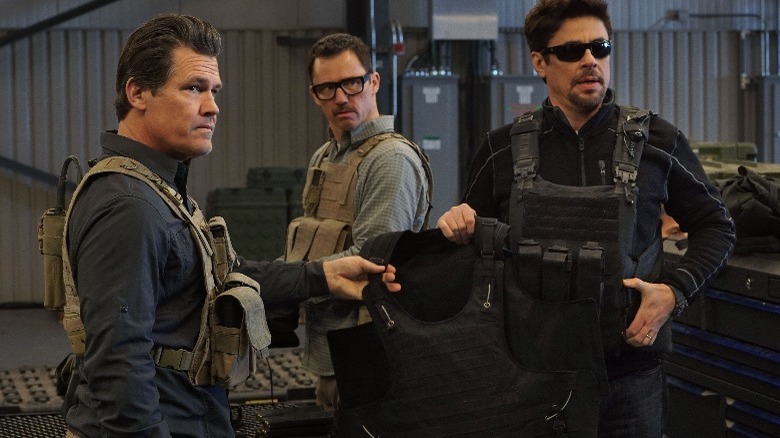
A Sinister Arrangement

While de Armas' Melinda is certainly suspicious that Vic has been the one making her boyfriends disappear, whether that be just by intimidating them to leave town or killing them, it is not until she finds the wallet of one of them in his snail shack (he likes snails) that she finally knows the truth. Her initial belief that he is a murderer certainly freaks her out, but once she has concrete evidence of his crimes, it turns out she isn't as opposed to the notion as she once thought. The film ends with Melinda burning the wallet of the dead lover, presumably to go on living her life as she had been with Vic.

Now, not only is there the tacit agreement between the two about her sleeping with other men, but they have a second unspoken agreement on top of that where he gets to murder the other men after they get too close. She sees the killing as the ultimate expression of love, how he is willing to take another person's life just so he can be the only one to love her. In the twisted realm of the erotic thriller, this is a marital compromise. Similar to how Daniel Day-Lewis' Reynolds Woodcock and Vicky Krieps' Alma Elson in "Phantom Thread" end that film on a pact where sometimes she is just going to poison him to take him down a peg, an extreme relationship needs an extreme accommodation. So, for Vic and Melina Van Allen, they can still have a great marriage, just as long as the f***ing and the killing can continue.

Other filmmakers may play this to the hilt, but Lyne trusts the faces of Ben Affleck and Ana de Armas to convey all of this complicated, twisted logic, which they beautifully achieve. "Deep Water" may not operate at a sensationalist level, but the murky morality that Adrian Lyne plays with here is as thrilling as any outrageous sex sequence he would have put in one of his earlier films. By making Vic a sociopathic horn dog who loves his wife and Melinda a woman who learns she is as jumbled up as her husband, "Deep Water" takes a step beyond so many other erotic thrillers, which feel the need to deliver black and white justice to its characters for their actions. Here, the Van Allens can be the f***ed up couple they are, which is the only way "Deep Water" could have ended.

Read this next: The Best Movies Of 2021

The post Deep Water Ending Explained: Keeping Up with the Van Allens appeared first on /Film.

18 Mar 16:13

Steam Cuts Off Developer/Publisher Payments to Russia, Belarus, and Ukraine

by Ule Lopez

Steam Ukraine Russia Belarus

Steam has recently cut off the developer and publisher payment options to Russia, Belarus, and even Ukraine. The company has not stated a reason behind this development but has sent a message to certain users, citing "the current environment" as the reason behind their cut down on developer and publisher payments.

Here's the full statement as cataloged by YellowAfterlife on Twitter:

Now, it might seem strange for Valve to suddenly just pull the rug on Ukraine as well as Russia and Belarus. But, once you consider factors outside of the current political one, it can begin to make sense. Valve's decision seems to be based on bank information. In other words, this could very well be a problem of the company no longer being able to keep up with the economic shift in all three of those areas.

Earlier this month, as the Russian invasion began, Steam developers from the region were reporting that their sales income was being halted due to their using state-owned banks. However, Russian developers could still earn an income should they switch to other, unsanctioned alternatives.

With this in mind, it's easier to assume that Steam's payment lock is more related to the other sanctions that Russia has been facing such as the SWIFT sanction that essentially froze banks within the country. Considering how volatile the current Russian and Ukranian financial systems have become during the war, it's going to be easier to hold off on payments until the financial situation in all three of the involved countries begins to stabilize.

Other companies that have renounced their sales to Russia after the conflict began are Ubisoft, Epic Games, Activision Blizzard, Nintendo, Sony, Intel, AMD, Electronic Arts, Microsoft, and NVIDIA.  Amazon's localization of New World for Russia has also been reportedly halted. There are many other companies that have been cutting their ties with Russia. But soon, it'll be a matter of asking if the cuts were made in solidarity or as a response to the current economical landscape.

The post Steam Cuts Off Developer/Publisher Payments to Russia, Belarus, and Ukraine by Ule Lopez appeared first on Wccftech.

18 Mar 16:12

American is one of those killed waiting in breadline. He was still there taking care of his partner who was in hospital with MS. Your Friday, March 18 Ukraine thread [News]