

Read more of this story at Slashdot.
Read more of this story at Slashdot.

Earlier this month, Microsoft publically released the DirectStorage API, designed to overcome the existing Input/Output (IO) bottlenecks the Win32 API has with the latest games.
At GDC 2022, Microsoft Software Engineer Cooper Partin talked about optimizing IO performance with DirectStorage on Windows. He said this is no direct port of the DirectStorage API available for Xbox Series S|X; this version has been tailored to the unique needs of the PC system.
The most exciting part is where Partin says the API can deliver 20-40% CPU savings as it is, provided you're running it on Windows 11 with an NVMe SSD. Game developers could then use those CPU cycles to do something else.
The DirectStorage run time provides game developers the ability to reduce that CPU usage as well as the load times in their title. This tech will work well with NVMe drives in combination with streaming architectures.
Now, reducing the CPU overhead. This is a key benefit that I really want to stress, and you're going to hear me say it multiple times in this talk. The more CPU cycles that are freed up for a title, they can be leveraged elsewhere in that title, improved background processing. AI workloads or anything, additional experiences, for example.
Let's talk about that CPU reduction that I referred to there. DirectStorage is designed for modern gaming systems. It handles smaller reads really efficiently, and you can batch things together to get more work done. When fully integrated with your title, DirectStorage with an NVMe SSD on Windows 11 reduces the CPU overhead in a game by 20 to 40 percent. This is attributed to the advancements made in the file IO stack on Windows 11 and the improvements on that platform in general.
DirectStorage also supports Windows 10 (19H1+), but on the older OS, it is a fallback implementation that uses an optimized file IO layer built on top of the Win32 API. While it will leverage patterns like async IO and completion ports to maximize throughput on Windows 10, the performance won't be quite the same as on Windows 11.
As mentioned in the Forspoken GDC 2022 talk, the Microsoft engineer confirmed that the current API release still relies on CPU decompression. GPU decompression is on the way, though, promising further improvements to both loading times and CPU overhead.
Our first DirectStorage release introduces CPU decompression, and that's what you're using now, but we're not going to stop there. We're going to continue to free up a lot more CPU cycles by finding more creative ways to offload decompression to other parts of the system.
For example, the GPU. In the future release, you'll be able to use DirectStorage to decompress assets using that GPU and this is more CPU savings for you where you can do more additional work in your title.
NVIDIA has been silent on the RTX IO technology for quite a while, but that should change whenever Microsoft implements support for GPU decompression in the API.
So far, the only game to support DirectStorage is Forspoken by Luminous Productions. Of course, we'll keep you up to date on any new announcements. Stay tuned!
The post DirectStorage Brings 20-40% CPU Savings to Begin With, Says Microsoft by Alessio Palumbo appeared first on Wccftech.
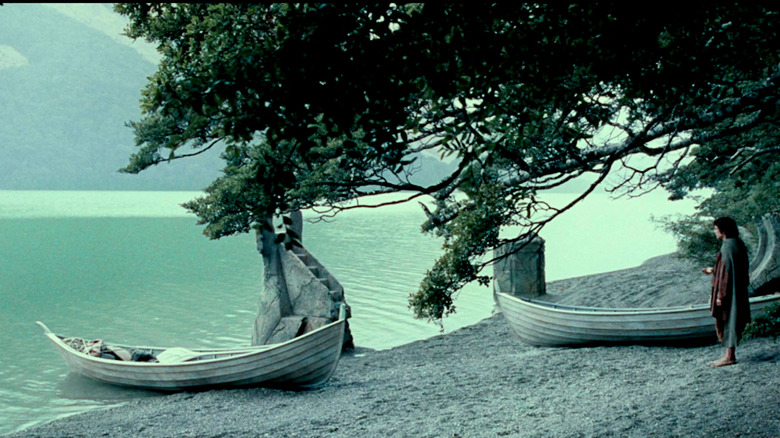
Widely considered to be one of the greatest fantasy stories ever adapted for film, Peter Jackson's "The Lord of the Rings" trilogy is quite the series to behold. With a massive (and massively talented) cast, "The Fellowship of the Ring" kicks off the trilogy to end all trilogies by introducing us to the hobbit Frodo Baggins and his friends who must help him on his long journey to Mordor where he must destroy the One Ring, forged by the evil Sauron in the fires of Mount Doom. If he fails, Middle-earth and the lives of all who live there will become slaves to evil and darkness at the hands of Sauron. It is a heavy burden to bear (both literally and figuratively), but Frodo shoulders the burden honorably.
Unlike the other two films in the trilogy, "The Two Towers" and "Return of the King," there is something light and hopeful about "The Fellowship of the Ring" that feels missing from the other two films. Of course, a lot of this has to do simply with the fact that the series, written by the masterful J.R.R. Tolkien, only gets darker the further you go, but even so, "Fellowship" still feels special in contrast to the other two films. It is, by far, my favorite of the three (though I do thoroughly enjoy them all for different reasons), and I think the reason for that largely has to do with the film's ending.
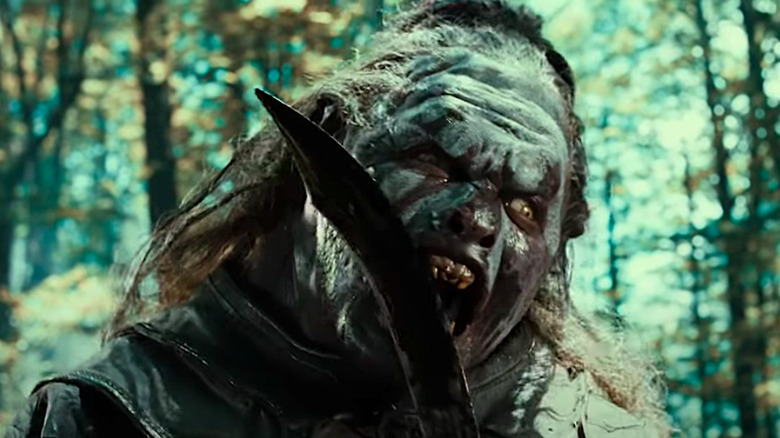
By the end of "The Fellowship of the Ring," Frodo and his company have been through a lot. Frodo has been stabbed by a Morgul blade, Gandalf has been lost to the mines of Moria, and the fellowship is welcomed by the Elf-queen Galadriel into Lothlórien where she delivers solemn news to Frodo — he alone must take the ring to Mordor, but along the way, one of his companions will betray him and try to take the ring for themselves.
The fellowship are then ambushed by an army of ruthless Uruk-hai, but Frodo, having wandered off alone, encounters Boromir who has followed him. Boromir tries to take the ring for himself, fulfilling Galadriel's prophecy, but Frodo resists and escapes, shaken by the experience. He now knows he must leave everyone behind and finish the journey by himself. While the fellowship fights, Frodo slips into a boat and begins to take off only to be met with a frantic Samwise who wades into the water, tenderly declaring that he made a promise to Gandalf not to leave his side ("Don't you leave him, Samwise Gamgee!") and so therefore, he must go with him to Mordor. (Insert me sobbing for all eternity.)
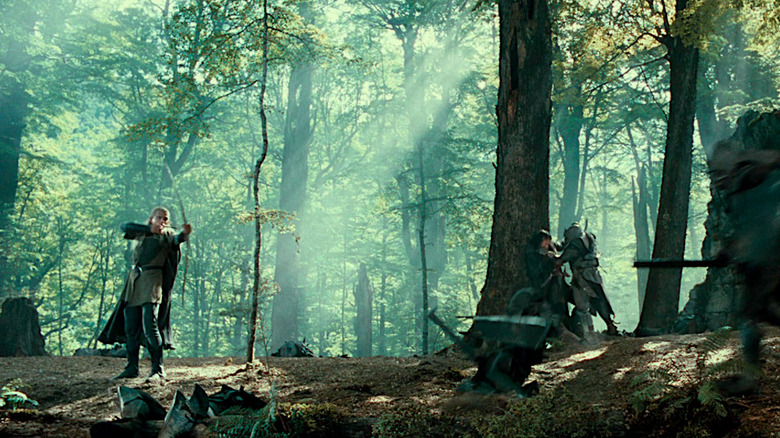
The two escape by boat, leaving the rest of the fellowship behind. Boromir, recognizing he has made a terrible mistake, returns to help the fellowship fight, but is killed by the ruthless onslaught of arrows fired by the Orc, Lurtz, who Aragorn kills in a fight that can only be described as "badass" (the licking of that blade, my god!). Merry and Pippin have been taken captive by the rest of the Uruk-hai, and Legolas, Gimli, and Aragorn vow to "hunt some Orc" in an effort to rescue the two hobbits before it's too late. The film ends with Frodo and Samwise looking out over Middle-earth wondering if they will ever see the fellowship again. "We may yet, Mister Frodo." More sobbing from me, and scene.
Like many first entries in a trilogy, there is a lot of setup going on here in "Fellowship." Somehow, though, Jackson manages to make it flow effortlessly, never once making it seem like explanatory fluff. Even in the film's ending where so many different things happen within a very short span of time, Jackson manages to give each thread enough space to breathe so that we are left with a very clear picture of what's to come.
Of course, the obvious surface level interpretation of the ending of "Fellowship" is that Frodo decides he must continue his journey alone (technically with Sam), and the rest of the fellowship is either captured (sorry, M. and P.!) or on the hunt. Each group clearly has their own distinct part to play in the battle for Middle-earth, and we know at the end of "Fellowship" just where each individual stands (or doesn't; R.I.P. Boromir).
But the true beauty of the ending of "Fellowship" comes in the form of its visuals. This is the only time (with the exception of the third film, but I'll get to that) where the scenery at the end appears green and lush. Despite the Orc ambush, the landscape is relatively pleasing to look at, even though so much is changing. The trees provide a sense of serenity that allows the viewer to feel hopeful when the fellowship disbands rather than fearful. There is still hope for Middle-earth and, unless you're a fan of Boromir (blow those horns of Gondor, Bormoir fans!), our heroes are still alive.
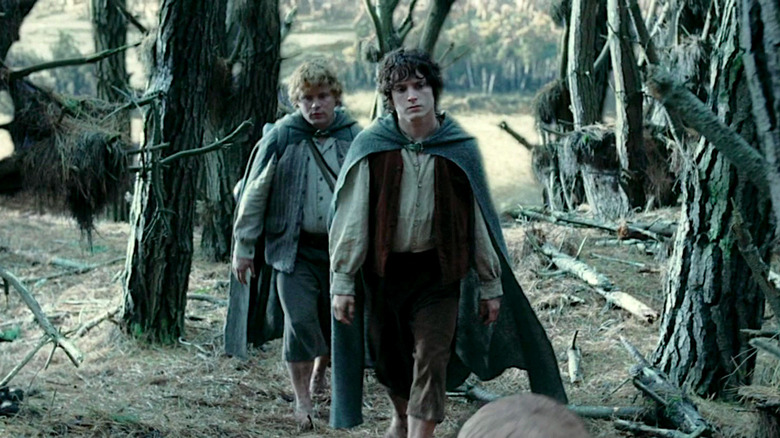
At its core, "Fellowship" is representative of the age of innocence. Frodo (perhaps foolishly) believes he only has to get the ring to Rivendell, only to realize he has a much bigger part to play. And even in the film's final moments, despite all the trauma the fellowship has been through, everyone is still largely hopeful. When Sam and Frodo look out over Middle-earth, the sun is shining down on the mountains and the scenery is fairly peaceful. They know their journey is hard, but they won't realize how hard until much later. They are merely at the start of what is to become a very long journey, and their minds and their energy are still relatively intact.
This is why I love the ending of "Fellowship." When I think back on it, even though tragic things happen within those final moments, I always see nothing but green forest. Even the score is uplifting, with the trilogy's main theme playing triumphantly as we watch each hero choose their new path. It is a decidedly different ending from "Two Towers," which ends on a desolated mountain side, Sméagol planning to lead Sam and Frodo to Shelob. There is a complete lack of color in that scene, signifying that we are now deep into this story. The relaxing days spent in the Shire have been replaced by the very real possibility that our heroes may not make it out alive.
And while it is true that "Return of the King" ends with Sam returning to the lush green landscape of the Shire, he returns a changed man. He has seen the world and then some, and the comforts of home, while appreciated, will never be enough anymore. There is a sadness to Sam as we watch him greet his wife and children, and we understand that the world has changed for all of them. Even though our heroes have won, they will never return to their innocence.
Read this next: 13 Fantasy Films That Never Got Sequels
The post The Lord of the Rings: The Fellowship of the Ring Ending Explained appeared first on /Film.

Police in Littlemore, England found a mountain of allegedly stolen bicycles in a man's backyard. The pile of two-wheelers was so large it was visible in a Google Earth satellite image. From Oddity Central :
— Read the rest"A large number of bicycles, believed to be stolen, have been recovered from the property.
To their credit, the Academy sort of understands why people tune into the Oscars: this isn't the kind of show you watch in full the next day, it's something you wanna live through in the moment. And so every year, they try to draw people in by manufacturing a few viral, can't-miss-moments through performances and -- shudder -- comedy bits. Sometimes that moment comes when everyone least expects it, but more often than not, the best of the night happens when Hollywood's best and brightest take to the stage to remind us what we knew all along: it's the speeches. It's always the speeches,
Nothing brings meaning back to this silly awards show like seeing someone celebrate a pivotal moment in their career. We can say what we must about the Academy Awards — i.e. make fun of this show until the end of time — but if the past few hours on the internet have taught us anything, it's that this show has a place at the center of cultural conversation. Winning one of those little gold men isn't nothing and for many, being accepted and lifted up by their peers for the fruits of their labors is galvanizing. From those wins, we get the moments most worth revisiting. However much the numbers dwindle, the speeches go on to be immortalized, whether by the internet, the celebs in the room, or a single viewer, who sees someone like them take home a trophy and comes to understand the glittering appeal of Hollywood.
Last night's show included a fair number of historic wins, and even though the Academy opted to cut some short, this meant many speeches that hit close to heart. In case you missed them or find yourself with few takeaways from the otherwise, ahem, smooth-sailing ceremony, here are a few key speeches worth revisiting.
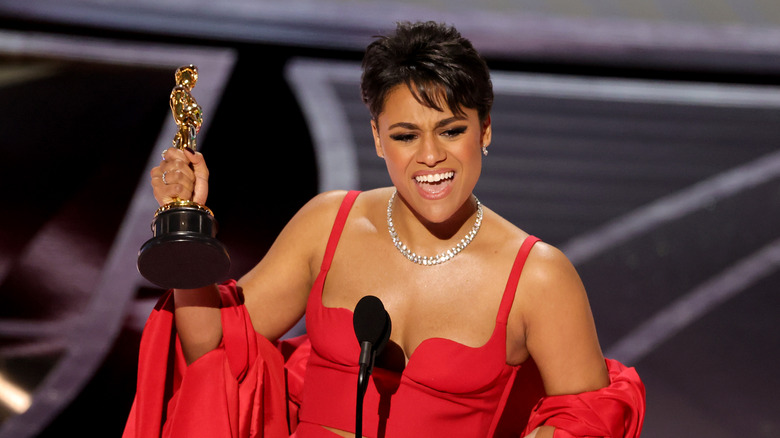
Ariana DeBose took home the first award of the night and helped us all forget the horrors of the opening monologue by speaking from the heart. In true theater kid fashion, DeBose made herself a very difficult act to follow by opening the night with the very best of what an acceptance speech can be -- a love letter to the power of art:
"Imagine this little girl in the back seat of a white Ford Focus, look into her eyes. You see an openly queer woman of color, an Afro-Latina, who found her strength in life through art. And that is, I think, what we're here to celebrate."
Wearing her heart on her sleeve the whole time, she thanked everyone from Steven Spielberg to her mother, even carving out a moment to speak directly to Rita Moreno, who originated the very role she just won for. This has been a long and arduous awards season during which many of us have endured the lead-up to this show with immense pessimism, so it was heartening to begin with DeBose brining us back to a place of joy. At the end, she dedicated her win "to anybody who has ever questioned your identity" or "living in the gray spaces," and added "I promise you this — there is indeed a place for us."
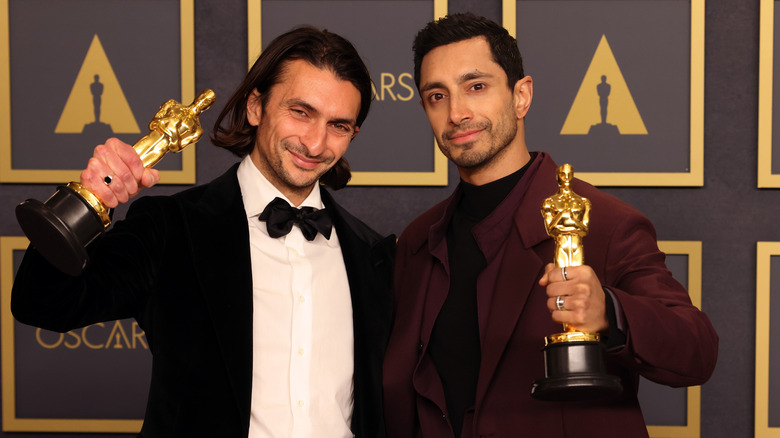
Among the many awards that the Academy deemed less important than Amy Schumer's Spider-Man bit was Best Live Action short, which marked the first win for Riz Ahmed. This win was among the eight Academy awards that were unceremoniously announced via Twitter, then sprinkled into the broadcast throughout —saving time at the expense of cutting short their much deserved victories. Ahmed's speech was injected into the show in one of those blink-and-you-miss-it moments, but even so, it was one of the more memorable wins of the night. The beloved "Sound of Metal" actor became the first Muslim to win an Oscar in Live Action Short category and made the most of his stage time with a heartfelt speech, saying:
"This is for everyone who feels like they don't belong. Everyone who feels like they're stuck in No Man's Land. You're not alone. We'll meet you there."
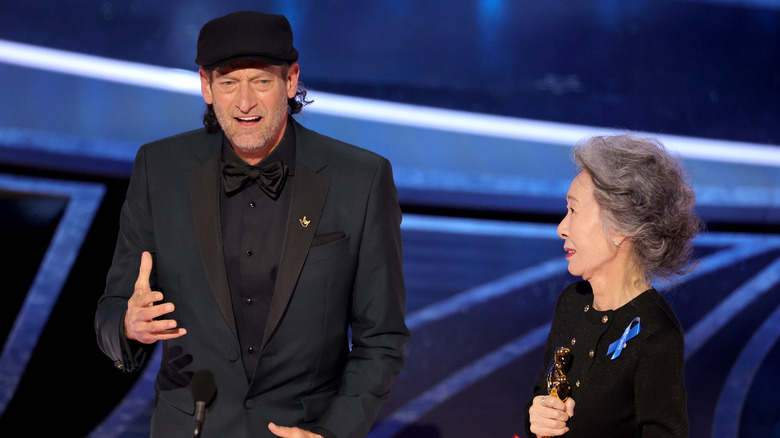
Good luck watching this speech through your tears! Troy Kotsur mixes the best of both worlds as he accepts Best Supporting Actor, jumping between hilarious and emotional (which is pretty fitting, given his role in "CODA" was the foul-mouthed bu loving father, Frank Rossi). Kotsur's win was among the many that this awards season was leading up to the whole time, but it marked a very welcome non-surprise and made history as he became the second deaf actor win an Oscar. The first was his co-star and onscreen wife Marlee Matlin.
A few difference aspects came together to make this moment an absolute delight: one special touch came from "Minari" actress Youn Yuh-jung, who made a point to sign Kotsur's name before announcing the win aloud. In the background, the audience signed their applause and Youn held the trophy at his side, to leave his hands free for signing. But naturally, the best part of all is the speech itself. Kotsur began with a heartfelt dedication to his co-star Matlin, telling a story about their visit to the White House where he hoped to teach the President dirty sign language. He also shines a light on "CODA" director Sian Heder, paraphrasing Steven Spielberg when he says "the definition of the best director is a skilled communicator." Kotsur dubs Heder that skilled communicator because she "brought the deaf world and hearing world together." Then emotions swelled as Kotsur paid loving tribute to his father, saying:
"My dad, he was the best signer in our family, but he was in a car accident and he became paralyzed from the neck down and he no longer was able to sign. Dad, I learned so much from you. I'll always love you. You are my hero."
By this point, even Kotsur's interpreter was tearful, so the actor capped it all off by dedicating his award to "the deaf community, the disabled community, the 'CODA' community." Finally taking the statue to hold it up himself, he closes out by offering a simple and sweet, "look at me now. I did it"
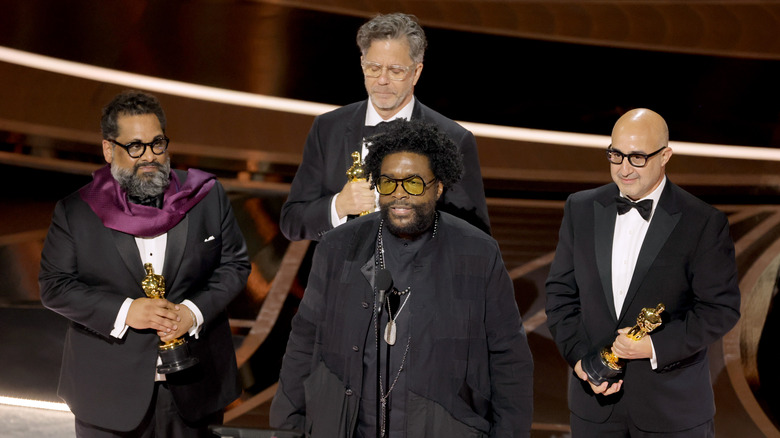
After a very, uh, memorable moment injected some chaos into the night, Ahmir "Questlove" Thompson took to the stage to accept his win for "Summer of Soul (...Or, When The Revolution Could Not Be Televised)." And quite fittingly, the first-time-director took special care to center his speech around healing. "Summer of Soul" was a source of healing for many, providing some much-needed Black joy in a worldwide period of pain. The film preserves and gives new life to the long-forgotten 1969 Harlem Cultural Festival, a celebration of Black history, culture, music and fashion. As touching as it may be to win the award for his directorial debut, Questlove directed attention back to the film's large meaning:
"It's not lost on me that the story of the Harlem Cultural festival should've been something that my beautiful mother and my dad should've taken me to when I was 5 years old... This is such a stunning moment for me. But this is not about me. This is about marginalized people in Harlem that needed to heal from pain."
Noticeably flustered and tearful about the win, Questlove promised to pull himself together afterwards and properly thanks everyone who made the film possible. But his words had already made their mark: this moment is another prime example of how emotion transcends all.
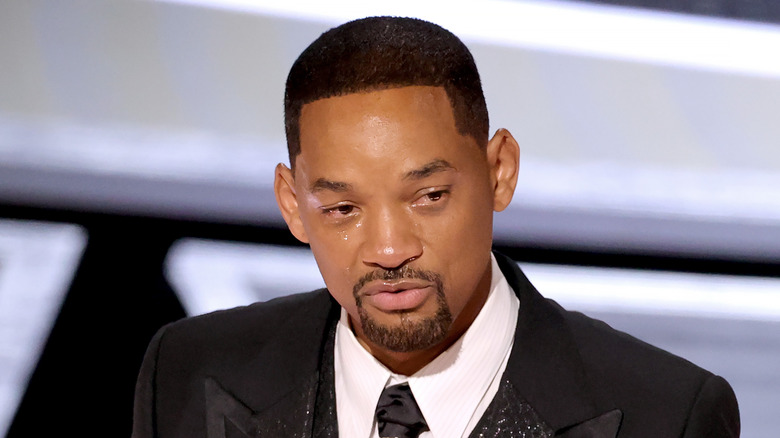
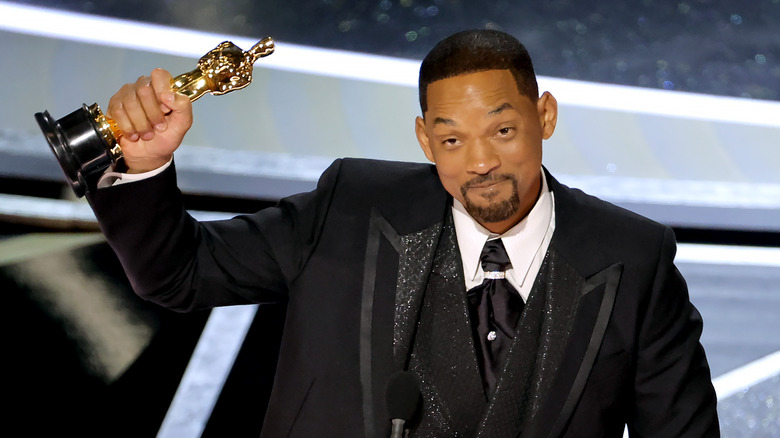
An emotionally-charged speech from Will Smith opened with a loaded acknowledgement: "Richard Williams was a fierce defender of his family."
This is not an uncomplicated acceptance speech, but certainly one that can't be left off the list. Many of the awards given out last night felt locked for months leading up to the show — Will Smith's most of all, and yet the energy surrounding this moment was utterly unpredictable. The drama that preceded will likely overshadow this momentous win, but it's worth noting that Smith has been chasing this Oscar for years and winning last night made him the fifth Black man to win a lead actor Oscar in the ceremony's 94 year long history. In more than one way, this win has been a long time coming. Given we all knew it was coming, there's no telling what kind of eloquent speech Smith has planned, but instead he took care to address the wildest moment of the night by apologizing and honoring all those who helped bring "King Richard" to screen:
"In this time in my life, in this moment, I am overwhelmed by what God is calling on me to do and be in this world. Making this film, I got to protect Aunjanue Ellis, who is one of the most strongest, most delicate people I've ever met. I got to protect Saniyya [Sidney] and Demi [Singleton], the two actresses that play Venus and Serena. I'm being called on in my life to love people. And to protect people and to be a river to my people."
He also took a moment to thank Denzel Washington, who huddled with him minutes before the win and offered a piece of advice that the actor clearly took to heart:
"Denzel [Washington] said to me a few minutes ago, 'At your highest moment, be careful, that's when the devil comes for you.' I want to be a vessel for love... That's what I want to do. I want to be an ambassador of that kind of love and care and concern. I want to apologize to the Academy, I want to apologize to all my fellow nominees."
There are plenty of reasons that this speech will be forever remembered, though I'd like to think it won't just be the allure of discourse and commentary. What the very best Oscars speeches share is their penchant for directing attention back to the greater meaning of art and the great work it can do. Even bogged down by the weight of a controversial moment, Smith takes a moment to acknowledge this about his win: "It's not about winning an award for me; it's about being able to shine a light on all the people"
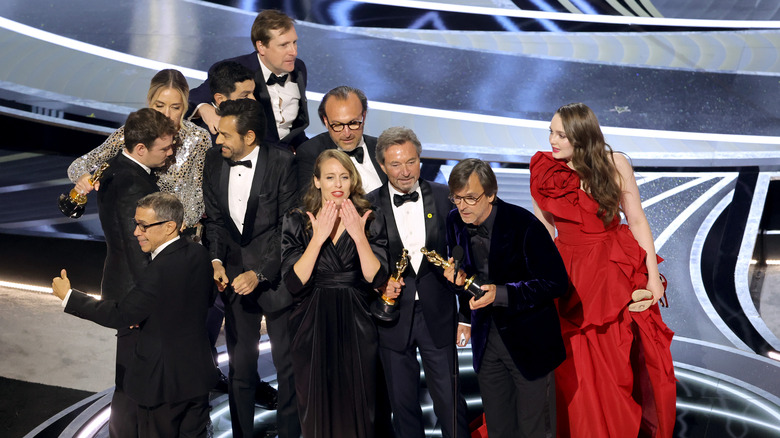
The Best Picture speech went a bit long, but in defense of this squad, they just won Best Picture. The night's biggest award went to the cast and crew of "CODA," the little movie that paved a path straight from Sundance to the Oscars by being kind, optimistic, and full of love. Watching the team take to the stage was a genuinely heartwarming moment, with everyone in the room looking equally thrilled by the announcement. No one could've guessed this win was coming when the movie first arrived to Apple TV+ so many months ago, but in the past few weeks, the energy behind this movie has shifted considerably and this is the ultimate proof. This marked the film's third award of the night, accepted by producers Philippe Rousselet, Fabrice Gianfermi, and Patrick Wachsberger, who shouted out director Sian Heder for making the film possible and the loving family created by the cast members:
"You guys have made such a wonderful and loving family on screen, but also offscreen. And everybody wants to be a part of it."
Read this next: The Best Movies Of 2021
The post The 6 Best Speeches from the 2022 Oscars appeared first on /Film.

After Will Smith slapped Chris Rock during the Oscars awards show last night, The Academy of Motion Pictures tweeted "The Academy does not condone violence of any form." But by allowing Smith to return to his seat and enjoy the rest of the show after committing the act of violence, its statement rings hollow. — Read the rest
Threat hunters at Checkmarx on Monday raised an alarm after discovering a threat actor fully automating the creation and delivery of "hundreds of malicious packages" into the NPM ecosystem.
The US Cybersecurity and Infrastructure Security Agency (CISA) has added 66 vulnerabilities to its list of known exploited security holes.
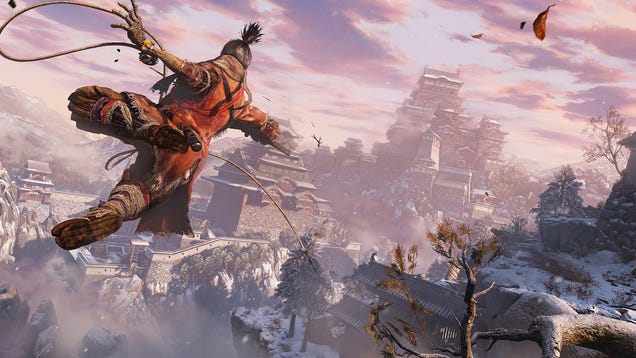
Cheat codes were once an ubiquitous video game feature, but these days they’re rarely included—and if they are, it’s usually as little more than a nostalgic wink to classic games. However, there’s a way to add helpful effects like invincibility mode to some games using Cheat Engine.

Space Exploration Technologies Corporation's (SpaceX) Starlink satellite internet constellation is continuing to exhibit wildly fluctuating download speeds. After having opened its service for pre-orders in February last year, Starlink has grown its user base from 10,000 at the time to a staggering 250,000 by March 2022, indicating rapidly growing popularity for satellite-based internet in the United States and globally.
At the same time, the internet service has delivered impressive results, as it continues to vastly surpass rivals in the three key metrics of internet performance - download and upload speeds, and latency, which is the time taken for an information packet to travel to and from a user's device. However, while the download speeds have been impressive, a key concern surrounding them is the performance range or the difference between the highest and lowest results.
The issue of widely varying download speeds for Starlink is not a new one, and it is likely occurring due to the constellation being in the early stages of its development. At full capacity, Starlink plans to have thousands of satellites in low Earth orbit, and to date, it has placed a mere fraction of those, as it struggles with the capacity of SpaceX's Falcon 9 medium-lift rocket and satellite manufacturing.
The issue has been consistently identified by Speedtest in quarterly analyses of Starlink median download speeds for the third and fourth quarters of last year. According to the testing service, the range between highest and lowest download speeds across the United States stood at 100 Mbps during Q3 2021 and grew to 130 Mbps in the next quarter.
Today's tests however show the download speed ranges from a handful of users, instead of the disparity presence across a geographic location. They cover the U.S.the U.K. and Canada, with the bulk coming from the North American countries and all having been shared on the social media platform Reddit.

The first set of results shared by a British Starlink user shows wildly varying performance for SpaceX's internet service. They reveal that in more than 80 tests, the highest download speed reached crossed 300 Mbps while the lowest was below 50 Mbps. Data compiled by PCMag in October 2020 had revealed that Starlink's rivals in the satellite internet industry - Viasat and HughesNet - had ~25 Mbps and ~20 Mbps in download speeds.
The British user's results were similar to the ones achieved by an American residing in Central Maine. Posting in response to the tests, elt0p0 shared that:
That graph looks about right. My speeds are all over the place, anywhere from 25 to 300 down and 5 to 30 up. Lately, speeds have been more consistent, around 200 down and 20 up. Central Maine.
Another user from rural West Oregon shared a far more striking discrepancy but admitted that their dish was facing obstructions. According to isidria:
I wanted to wait before posting anything about our Starlink. I got oue kit late December 2021, second generation dish showed up without incident. Our speeds and availability vary quite a bit, to be honest I wouldn't call it stable. I decided to keep our DSL line and have fail over setup on a Ubiqity Edge router 4. Our Starlink bis definitely faster than the DSL most of the time, but not stable enough for voice, video calls or gaming. Our speeds go from 220/20 down to 4/1 and everything in-between daily. Seems completely random. We do have a slight obstruction here in rural west coast Oregon, I'll attach the obstruction screen shot from my phone. We basically just redesigned our home and shop network to use Starlink for all the streaming and DSL for anything important, works well for us. I hope for better stability as more satellite's get launched.

Another Starlink user, this time from Nova Scotia, Canada, also shared his test results, which followed a similar pattern to the earlier ones. They revealed that the highest download speed that Starlink achieved was 286 Mbps while the lowest stood at 29.6 Mbps, with the average being 121 Mbps over roughly two weeks.

The results from both the users were mirrored by the ones shared by a Starlink user in Grass Valley, California. Reddit user NelsonMinar's speed test results that were run every 15 minutes for a seven day period showed that when it came to Grass Valley, Starlink's download speed averaged 137 Mbps. Additionally, it achieved a peak level of 299 Mbps alongside a low of 1.23 Mbps.
Overall, Starlink's performance in a region is affected by a number of factors. Since each 'cell' or location is serviced by a fixed number of satellites, the number of users in it determines peak and average performance particularly since the constellation itself is in its early buildout stages. Furthermore, the choice of orbits for the satellites works in the favor of certain regions as well.
While Starlink continues to improve performance in the U.S., its results in other countries have managed to beat broadband internet, in a crucial victory for a service that SpaceX plans to use to fund its ambitious interplanetary exploration missions.
For more on Starlink, take a look at:
The post Starlink Download Speeds Fluctuate Wildly From 300 Mbps To 10 Mbps In 100+ Tests by Ramish Zafar appeared first on Wccftech.
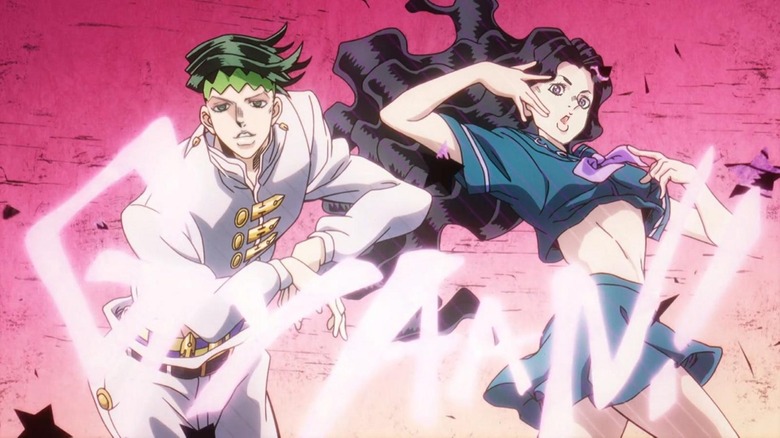
Shounen Jump is the most popular manga magazine in the world. "Naruto," "Demon Slayer" and "Dragon Ball" are all Shounen Jump comics, and that's just the tip of the iceberg. But there's a science to the magazine's success. In his alternative history of bizarre '80s cult manga, "Manga Zombie," the critic Takeo Udagawa describes Shounen Jump's "Great Two" system. The first step is to bind writers and artists to the magazine via tight contracts, preventing them from taking their work elsewhere. The second step is reader polls, which determine the fate of Shounen Jump's output. Manga that makes a bad first impression is either reworked or axed. This strategy has led to massive success, but it has real drawbacks as well. Readership is fickle, and risks are heavily penalized. It's no wonder that Udagawa, whose heart lies with the weird, personal and excessive, despises Shounen Jump, whose editors work tirelessly to weed out those qualities from their stable of artists.
"Jojo's Bizarre Adventure" is one of the longest running series in the history of Shounen Jump. It has many of the characteristics associated with the magazine -- close-knit male friendships, exciting battle scenes, cliffhangers and long sequences where the characters explain things to the audience. But it also has a quality rare among its fellows: originality. The characters wear outrageous outfits and are named after rock bands. There are scenes of gross-out violence closer to the work of horror artists like Junji Ito than the Shounen Jump norm. The battles become increasingly abstract, their resolutions achieved through puzzle-solving and confidence games rather than endless training. Yet the single most bizarre thing about "Jojo's Bizarre Adventure" is that there isn't just one adventure. There's eight of them, each featuring a descendant of the Joestar family at a different time in history.

In an interview with Italy's Kappa Magazine, "Jojo" creator Hirohiko Araki confesses that his editors "weren't keen on the idea of switching protagonists, especially for a popular series. If readers took the news badly, it could've ended in a total disaster." Their concerns are understandable. Shounen Jump was a magazine built around reader polls. If readers responded positively to the adventures of Jonathan Joestar and his ongoing conflict with the vampire Dio, the clear next step was to draw his further adventures. The idea that Araki would instead kill Jonathan and replace him with his son Joseph, introducing a mostly new cast of heroes and villains in the process, was ludicrous. But that's exactly what Araki did.
Araki justified his decision in two ways. The first is that he disliked having to draw the same characters over and over. Changing up the series with successive generations would allow for more flexibility in terms of designs, and present opportunities to grow as an artist. "Jojo's Bizarre Adventure" bears this out over the course of its run, transforming from world tour to David Lynch-style uncanny suburbia to a Florida prison based on the needs of each story. The second is that Araki saw "time" as one of the key themes of early "Jojo." While this is represented in the main characters and their powers, the passing of time is also reflected as the series evolves. When we first see Joseph Joestar, he's a wisecracking youth fighting supernatural evil in New York during 1938. The next time he appears, he's an older man fighting alongside his grandson Jotaro. Finally, we see him as a 90 year old whose dementia frustrates his illegitimate son Josuke. Joseph isn't an especially deep character, but "Jojo" uses its chronology to depict different stages of his life. It's just one way in which the series is unique among Shounen Jump comics.
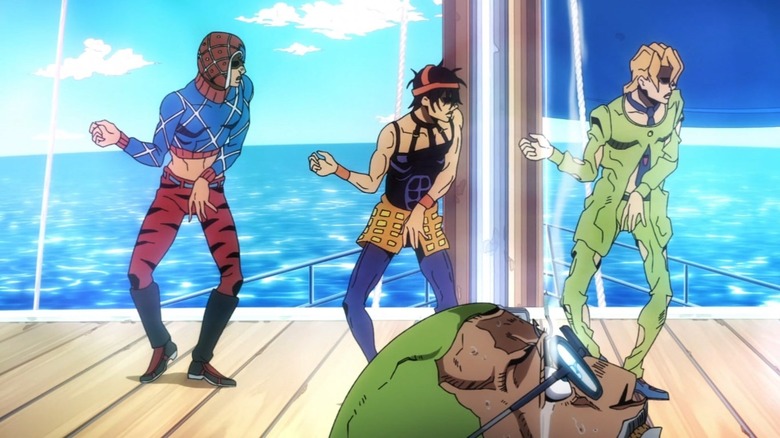
While Araki's editors doubted him at the time, I believe that Araki was correct when he made the decision to split "Jojo" into parts. The most successful Shounen Jump stories run for dozens and dozens of volumes. Compared to Marvel or DC comics, series like "Naruto" or "Dragon Ball" are drawn by the same creators and tell a linear story from beginning to end. Which raises the question: how do you tell a satisfying narrative that lasts for thousands of pages? Sooner or later, the scale of the story becomes unmanageable, the cast becomes far too large for the author to use properly, and the reader is bored to tears. The most successful Shounen Jump comics take inspiration from Araki's example to break themselves into manageable chunks.
One such title is "Hunter x Hunter," a series that wears its "Jojo" influence proudly. It swings wildly between martial arts tournament, gritty mafia thriller, and war epic depending on what the author is interested in that week. These different elements are unified by a carefully thought out system of powers that dictates the cast's capabilities, leading to the same variety of combat set pieces that made "Jojo" such a success. "Hunter x Hunter" has now been on hiatus for several years, but has attracted a loyal following precisely because few other comics in the magazine have been as unpredictable for so long. In this way it has managed to maintain its identity and its readership within the competitive environment of Shounen Jump.
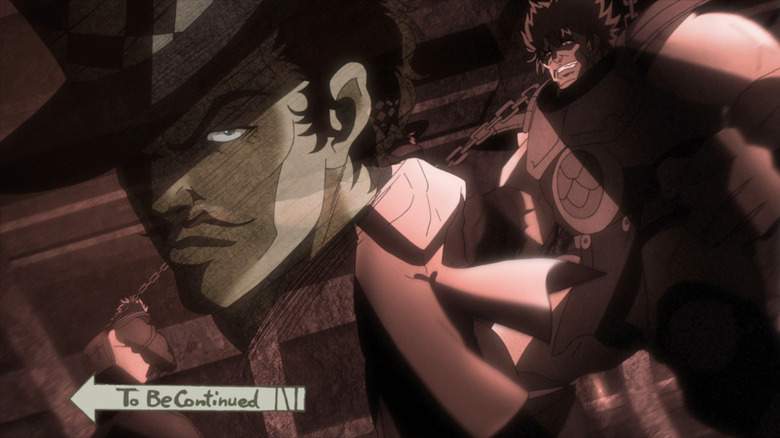
Even "One Piece," the most successful comic ever to run in "Shounen Jump," is built in such a way as to prove Araki's point. "One Piece" is heavily arc-based, introducing new characters and situations in each new story. New readers can jump into the series at the beginning of a new chapter and get a sense for the characters and their dynamic, even though there's plenty of context they may be missing. What makes "One Piece" an even wilder example of serial comics construction, though, is a careful attention to continuity that far outstrips comics like "Jojo." The series constantly pays off events set up dozens of volumes ago, or introduces characters first mentioned in an aside hundreds of pages before. Like Araki, Oda thought carefully about how to tell his colossal story within the limits imposed by the magazine, structured that story accordingly, and took the risk that his readership would be able to follow along. That risk continues to pay off to this day.
These days, "Jojo" is seralized in Ultra Jump, a Jump comic brand for adult readers. It has gradually transformed from a core title like "Jujutsu Kaisen" or "My Hero Academia" to a boutique series. But while Araki's work has only become more idiosyncratic over time, the series remains popular and has even made inroads in the United States since the release of its anime adaptation. "Jojo" has lasted for 35 years in the most mercenary comics magazine published in Japan, and it has done so because of the author's excesses rather than in spite of them. If the rumors are true, and Hirohiko Araki really is a vampire, I hope to see another 35.
Read this next: 14 Anime Shows To Watch If You Love My Hero Academia
The post Hirohiko Araki Took a Major Risk With JoJo's Bizarre Adventure appeared first on /Film.
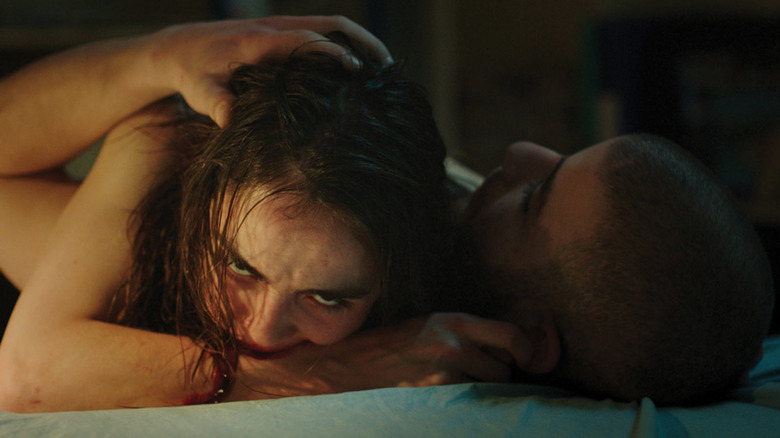
From the bold filmmaker behind the provocative "Titane," Julia Ducournau's feature debut "Raw" uses visceral horror to examine adolescent yearning. The lurid film follows a young vegetarian named Justine (Garance Marillier) who attends veterinary school where she tastes meat for the first time and develops a craving for flesh — including human. After Justine is forced to eat raw rabbit kidneys as part of a hazing ritual to welcome new students, her newfound hunger becomes overpowering, and she finds herself making emergency trips to the gas station for meat and sneaking raw chicken in the early hours of the morning.
But animal meat is not enough to satisfy her bloody appetite. After a scuffle with her older sister Alexia, as part of an attempt to give her a bikini wax, Alexia ends up cutting off her own finger and fainting. Justine picks up the finger, tastes the blood, and greedily nibbles it. Alexia's blood smears across Justine's face while she's under her ravenous spell. Alexia later reveals that she shares the same cravings as her sister when she deliberately causes a car crash and feasts on the bloody, exposed brains of one of the passengers.
Justine's violent urges coalesce with her erotic ones. During a wild paint party, she is forced to makeout with someone; in the throes of passion, she bites off and consumes a piece of his bottom lip. When having sex with her crush Adrien, Justine furiously thrashes while trying to bite him in-between her fervent kisses, but she ends up chewing her own arm until it bleeds while having an orgasm. Adrien is later killed by Alexia; he is stabbed in the back and a gruesome shot shows the bone sticking out of the bitten, torn flesh of his right leg.
In the disturbing final shot, Justine's father opens his shirt to reveal scars and chunks of missing chest on his body, indicating that their mother had the same cravings and her aberrant nature is hereditary. Ducournau's unflinching depiction of this gory cannibalism was too much for some audiences to handle.
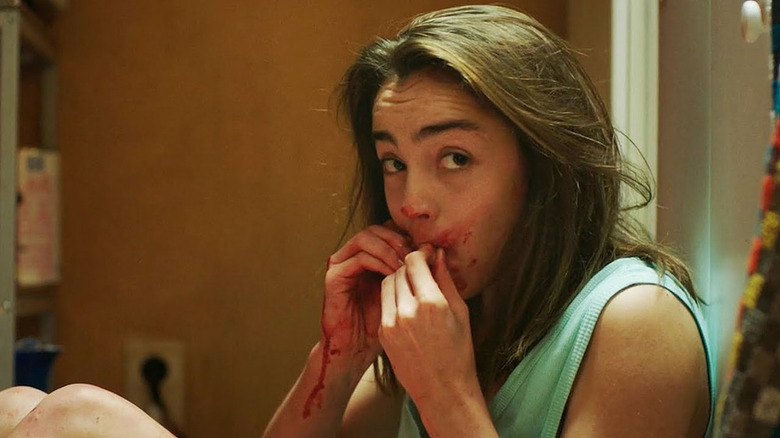
"Raw" is just one of many horror movies that made audiences physically sick. Since the shots of cannibalistic gobbling are quite candid, critics such as Variety warned viewers they might need to "reach for the barf bag." During a Midnight Madness screening at the Toronto International Film Festival in 2016, two audience members fainted from the stomach-churning visuals. Ryan Werner, a marketer for the film, confirmed that an "ambulance had to be called to the scene as the film became too much for a couple patrons." Several other viewers walked out.
It's the kind of controversy that every PR person dreams of for their new horror film, one that generates exciting buzz and makes it a must-see. Variety explains why "Raw" evoked such a strong reaction:
"Often so realistic that they are hard to look at, scenes that viewers of a sensitive nature may find disturbing see lacerated extremities, bite marks and gaping wounds perfectly walk the line between the visceral fun of practical effects and overt attention-grabbing. The effects are simply here to be believed."
"Raw" explores the animalistic impulses — sexual or otherwise — that course through our bodies, especially during youth. Justine's transformation from timid virgin to vamp by way of cannibalism is portrayed with a primal confidence that is unsettling and difficult to look away from — even if it makes you queasy.
Read this next: The 20 Best Zombie Movies Of All Time
The post The Raw Controversy Explained appeared first on /Film.
There is much ballyhoo surrounding the way actors prepare for their roles. Known as method acting, or simply "the Method," this popular process requires actors to draw on similar experiences to better relate to the character they are playing. It is an exhaustive process that can take a toll. Kate Winslet said it took her months to recover from playing a Nazi in "The Reader." Christian Bale lost so much weight for "The Machinist" the studio had to intervene. Rachel Lefevre even pretended to be a cat for "Twilight."
But actors aren't the only ones going to great lengths to prepare for a film. What about directors? The auteur theory states that the director is the sole author of a film, responsible for a movie's look, performance, and meaning. And while filmmaking is a collaborative effort, much of a film's success (or failure) is most often attached to the director. While the method might last weeks or even months for actors, directors might spend much longer in preparation for a film. In the case of the 1995 film "Heat," director Michael Mann spent years preparing for the production.
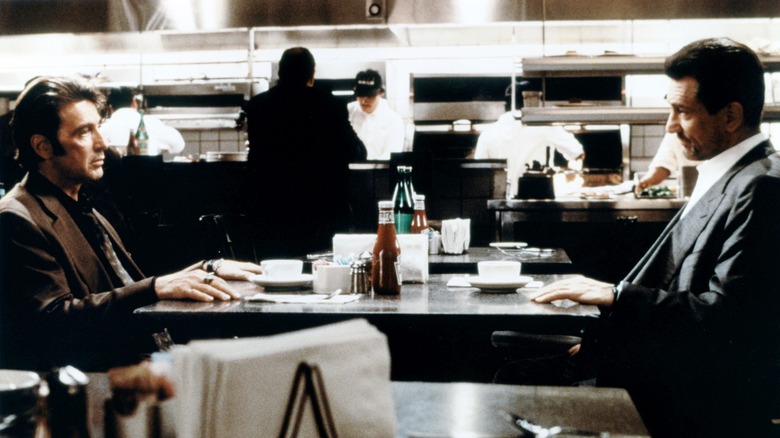
The crime thriller starring Robert De Niro and Al Pacino was written and directed by Mann. The movie is a sprawling narrative, clocking in at 170 minutes, chronicling the relationship between a Los Angeles detective Vincent Hanna (Pacino) and a career criminal Neil McCauley (De Niro). "Heat" is loosely based on an actual 1960 case and Chicago detective Chuck Adamson's relationship with McCauley.
It is Adamson that gave Mann the idea for the film. He worked with Mann as an advisor and told him about his implausible relationship with the real-life criminal Neil McCauley. Mann was so enamored by the complex relationship between the two, he began developing the concept for the film.
According to Esquire, Mann spent years preparing for "Heat," including putting himself in harm's way. Every Friday and Saturday for nine months he would do ride-alongs with an LAPD officer, answering calls from 9 p.m. to 2 a.m. Mann was friends with Adamson, but what about McCauley, who was killed in a shootout with Adamson's team years earlier? To get a sense of Neil McCauley, Mann visited Folsom State Prison to speak to inmates that were close to McCauley. He also worked to prepare his actors. He arranged for Ashely Judd, who played the wife of one of McCauley's crew, to meet women who turned to prostitution while their husbands were in prison. The preparation paid off. In describing the cast performance, Mann said:
"There's no performance. We were all so into character. You were the movie as well as the individual character."
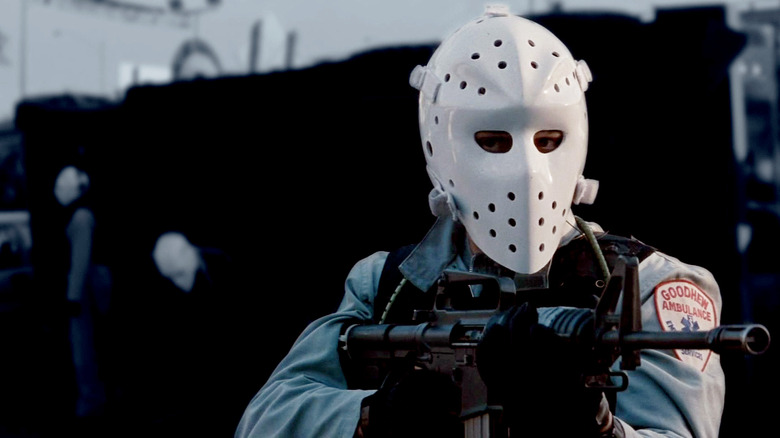
In what could only be described as "method directing," Mann took things to the next level to maximize the realism of a bank heist scene in the movie. Mann joined De Niro, Val Kilmer, and Tom Sizemore in casing an actual bank for a robbery. Mann claims they entered the bank with unloaded weapons (only the security guards knew) and secretly plotted a heist that would never actually happen.
The results of Mann's method would set a new standard for crime dramas.
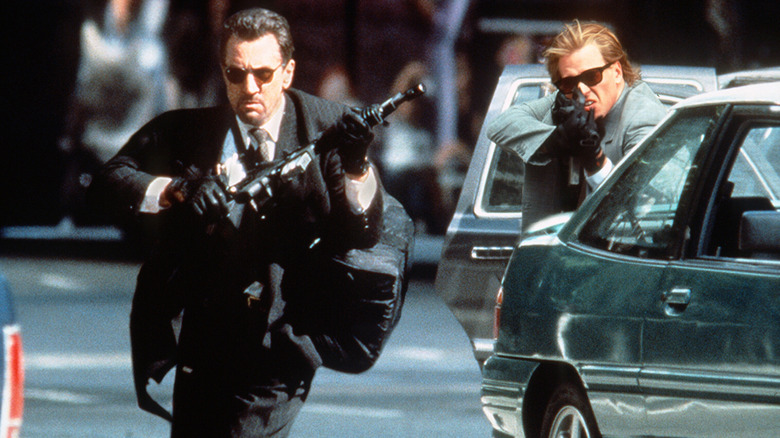
While "Heat" failed to win any Academy Awards, it remains a revered film to this day. Its influence is widely felt throughout modern cinema. Mann never wavered in his efforts to tell the unlikely story of the cop and criminal; two obsessive men hell-bent on outwitting one another while finding a mutual respect.
It was Mann's own obsession that saw the project all the way to become a Hollywood production. Before it was a film, "Heat" was a failed television pilot. It makes sense as Mann got his start in television, working on shows such as "Starsky & Hutch" and "Crime Story" before becoming an executive producer on "Miami Vice." He had the opportunity to produce a pilot for NBC and reworked the "Heat" script for television. NBC passed on the series but aired the episodes as a TV movie, "L.A. Takedown." The movie would turn out to be a dry run for "Heat."
After the success of Mann's 1992 film "The Last of the Mohicans," the door was finally open to produce "Heat" as a feature film. After a decade of honing his skills through popular crime series on television and years of intense research, Mann directed a profound and influential neo-noir. "Heat" is a stylistic study of human nature and relationships, an authentic examination of obsession, loneliness, and begrudging respect between foes. The aberrant real-life relationship and meeting between Adamson and McCauley led to one of cinema's most memorable scenes.
Noted critic Roger Ebert called the film "The single greatest Los Angeles crime epic of all time." It took a while for Mann to make "Heat" but it was certainly worth the wait.
Read this next: 14 Sequels That Truly Didn't Need To Happen
The post Michael Mann Went to Some Exhaustive Lengths While Doing Research For Heat appeared first on /Film.
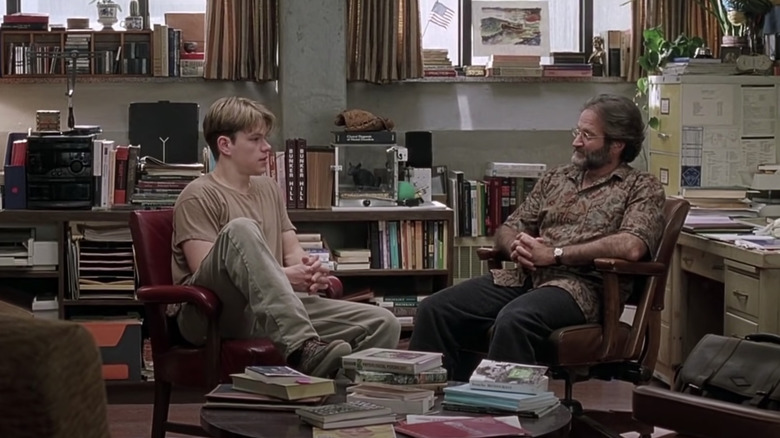
"Good Will Hunting" is one of the greatest movies of the late '90s, and that means something coming from me because I'm a complete nostalgic sucker for the movies of that decade. If you're weary about trusting a stranger's opinion on the internet, and I can't blame you, the Academy agreed with me and gave the movie nine Oscar nominations. Not bad for a small film that was competing with "Titanic."
So much about the film is good. The gritty way the characters talk to each other, the complex relationship between Will (Matt Damon) and his best friend Chuckie (Ben Affleck), and the bumpy ride we take with Will from a scared, closed-off kid to a man willing to forget his abusive past and embrace a loving future. Who doesn't love watching the brooding bad boy blossom?
In an interview with Boston Magazine, Damon reveals he began working on the script in 1992, during his last year at Harvard. He would later recruit his friend, struggling actor Ben Affleck, to help him flesh it out. The script went through many revisions and the two unknown actors' insistence that they play the lead roles didn't help sell it. Although the writing was praised by producers and agents, it hung in limbo. Producer Chris Moore told Boston Magazine that superstar actor Robin Williams agreeing to do the film "was the linchpin for the movie getting made."
Although most often associated with comedy, Williams already had a few serious roles under his belt before joining "Good Will Hunting," like "Awakenings" and "Dead Poets Society," and his portrayal of Sean would add another formidable weapon to the already well-stocked arsenal of the film.
And it was this casting that would lead to Matt Damon crying on the first day of filming.
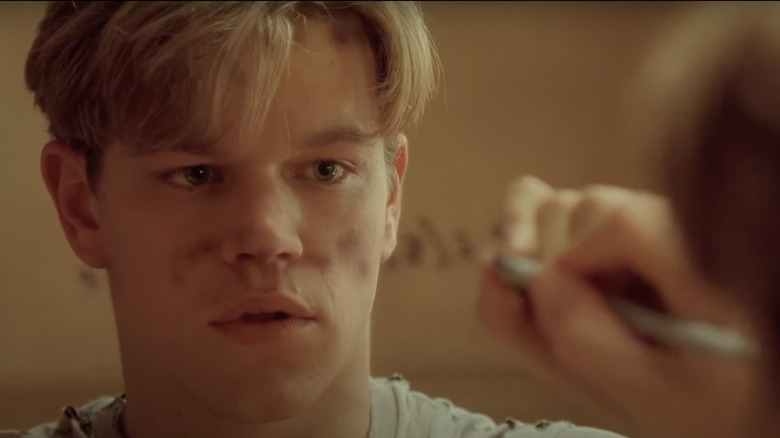
Damon and Affleck worked on the script for years before they felt it was ready. Eventually, Castle Rock Entertainment bought it for $600,000, but wanted the original script rewritten. In that same interview, Damon recalls Rob Reiner explaining that the script actually included "two movies...and [they were] fighting each other."
Along with the character-driven film, "Good Will Hunting" was blended with an "Enemy of the State"-type arc that had this genius kid hunted by the government for his smarts. Reiner told the guys they had to "pick one" of these stories. Luckily, Damon and Affleck had the good sense to drop that whole "government hunts boy genius thing" and focus on Will as a character.
When they were in the process of rewrites, the next obstacle was finding a director. Being young and ambitious, Damon and Affleck threw their inexperienced hats in the ring, and were met with blank stares from the studio executives. You can't blame them for trying, after all -- they were no name struggling actors who randomly decided to write a script and actually managed to sell it. I'm sure they were feeling pretty good about themselves at the time, but the studio wasn't about to turn the project over to them completely.
Damon and Affleck grew tired of the constant rewrites and creative roadblocks at Castle Rock, so they began to look for other production companies. They reached out to Kevin Smith, director of "Clerks" and "Chasing Amy," who passed the script on to Harvey Weinstein at Miramax. It floated in purgatory for a while. Mel Gibson even had the script for a couple months and considered directing it, but that wouldn't lead anywhere, either. Eventually, Williams joined the cast and Damon proved himself leading man material in "The Rainmaker." Once Weinstein felt like the project could actually succeed and earn some money, he hired Gus Van Sant, known for "My Own Private Idaho," to direct the project.
In 1997, Five years after Damon started writing the film, shooting finally began on "Good Will Hunting."
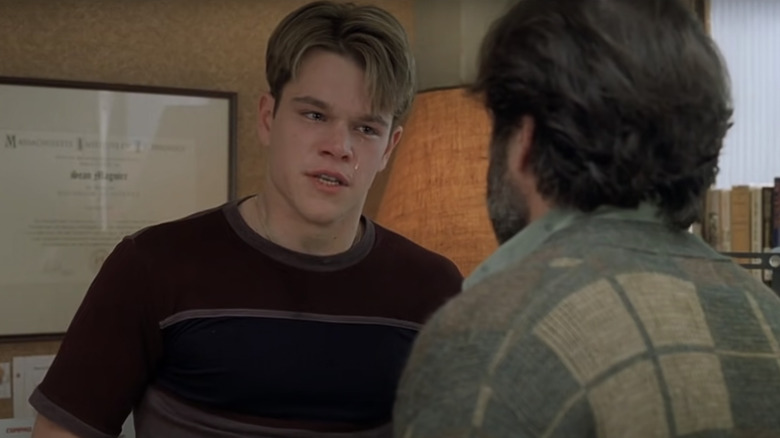
After years of rewriting and practicing scenes in their apartments, Damon and Affleck were finally going to see the world they built come to life. Understandably, the first day of shooting was an emotional one for them:
"...I remember we started crying, because it was a scene between Robin and Stellan [Skarsgård.] And when Gus called action and we watched these guys — I mean accomplished actors — do our scene verbatim, we had waited so long for this to happen. I remember just sitting next to Ben and I had tears rolling down my cheeks because I was just so happy and relieved that it was really happening."
Affleck tells Boston Magazine he remembers the day a little differently, saying, "We tear[ed] up a little bit," or maybe he's just not as quick to admit he cried like a baby. Either way, the initial day of shooting was a big deal for both young men and having a legend like Robin Williams embody one of your characters must be a huge moment by itself.
Williams wasn't shy about praising Damon and Affleck's work. In an interview with Charlie Rose, he called the script "extraordinary" and a "gift." He also questioned why such an amazing story took five years to get made. The actor loved the script so much he took a massive pay cut when he accepted the role. In the late '90's, Williams easily pulled $20 million for every movie he did, but he agreed to only $5 million for "Good Will Hunting." When asked about this huge pay cut, Williams simply said:
"I had to...they would have made this movie without me...it's too good not to be made."
If a Hollywood star like Williams takes a huge salary cut because he is that much in love with your script, you know you've made it.
Although they obviously spent a large amount of time perfecting the script and the story, Damon and Affleck understood the power of Williams' ability to enrich their world with his own humor and intelligence.
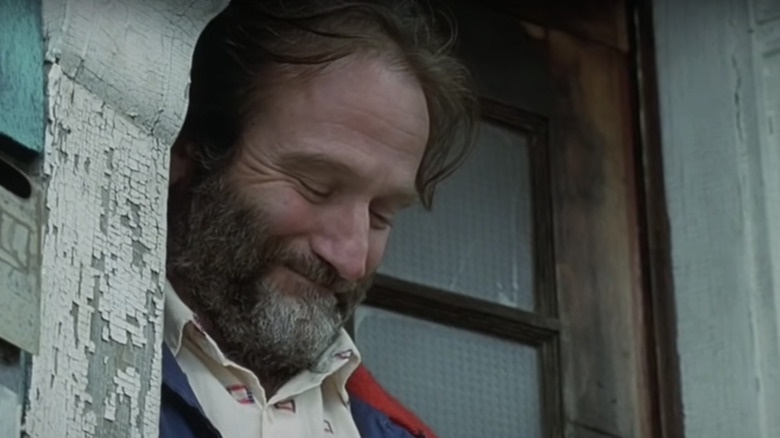
"Good Will Hunting" has a lot of great lines -- "How about them apples" and "My boy is wicked smart" are two of my personal favorites -- but William's portrayal of Sean is a goldmine of great lines. Most of them were written by Damon and Affleck, but the comedian added his own flair to two scenes in the movie.
During one of his court-mandated therapy sessions, Sean tells Will about his deceased wife's nasty little habit of farting in her sleep. The whole thing was ad-libbed by Williams on the spot and it's hilarious, earning wheezing laughs from Damon. At one point, you can even see some shaking of the image because the camera operator couldn't contain his own amusement. Williams suavely transitions from sharing authentic laughter with Damon to a heartfelt moment where he explains the imperfections of those we love are what make them real, calling them "the good stuff."
Williams also added a little something to the ending. Earlier in the movie, Sean recounts a time when he left his friends hanging to pursue the woman who would eventually become his wife. He remembers telling them, "Sorry, fellas, I got to go see about a girl." At the end of the film, Will has finally decided that he deserves happiness, which leads him away from South Boston for the first time in his life to pursue the woman he loves in California. He leaves Sean a note explaining he's going "to go see about a girl." Williams looks up with a proud smile and says, "Son of a b****. He stole my line."
Damon remembers doing several takes of the scene, the comedian saying something different every time. When Williams came up with the line that is in the movie, the actor remembers "...[grabbing] Gus. It was like a bolt, it was just one of those holy-s*** moments where, like, that's it."
And he was right. It was the line that would make the final cut.
Robin Williams was also right. "Good Will Hunting" probably would have been made with or without him, but it wouldn't have been the same movie. I can't imagine the film without fart jokes, sarcastic one-liners, and camera shakes. Like Sean explains about his wife, "these little idiosyncrasies" make William's portrayal of Sean "the good stuff."
Read this next: The 14 Best Film Acting Debuts Of All Time
The post Robin Williams Had Matt Damon In Tears On the First Day of Filming Good Will Hunting appeared first on /Film.
Read more of this story at Slashdot.

Republican Madison Cawthorn just couldn't help himself, tattling on Washington colleagues that he's "looked up to" for enjoying themselves with cocaine and a good ol' fashioned orgy now and then.
When asked how TV's "House of Cards" compared to real life, he said it's all true. — Read the rest
Read more of this story at Slashdot.
Researchers claim to have discovered evidence of the oldest known acts of cannibalism. The creatures eating each other were trilobites, roughly 500 million years ago.
The paper documents damage caused by trilobites whacking and chewing on each other from different directions, then digesting the gnawed off bits.
Evidence for cannibalistic violence:
A total of 38 injured specimens exhibiting various healed cephalic and thoracic injuries are documented, in addition to the mangled remains of two individuals that probably resulted from the activities of a durophagous predator or scavenger. Specimens of both species show that most injuries are located on the posterior portion of the thorax, indicating that predators preferentially attacked from behind and/or prey individuals presented the posterior of the trunk towards the predator when threatened or fleeing. The larger sample of injured R. takooensis shows that while unilateral injuries are more common than bilateral ones, there is no evidence for a left- or right-side bias, contrasting with previous suggestions that Cambrian trilobites exhibit right-sided injury stereotypy.
Nature: Gothic from the very start.
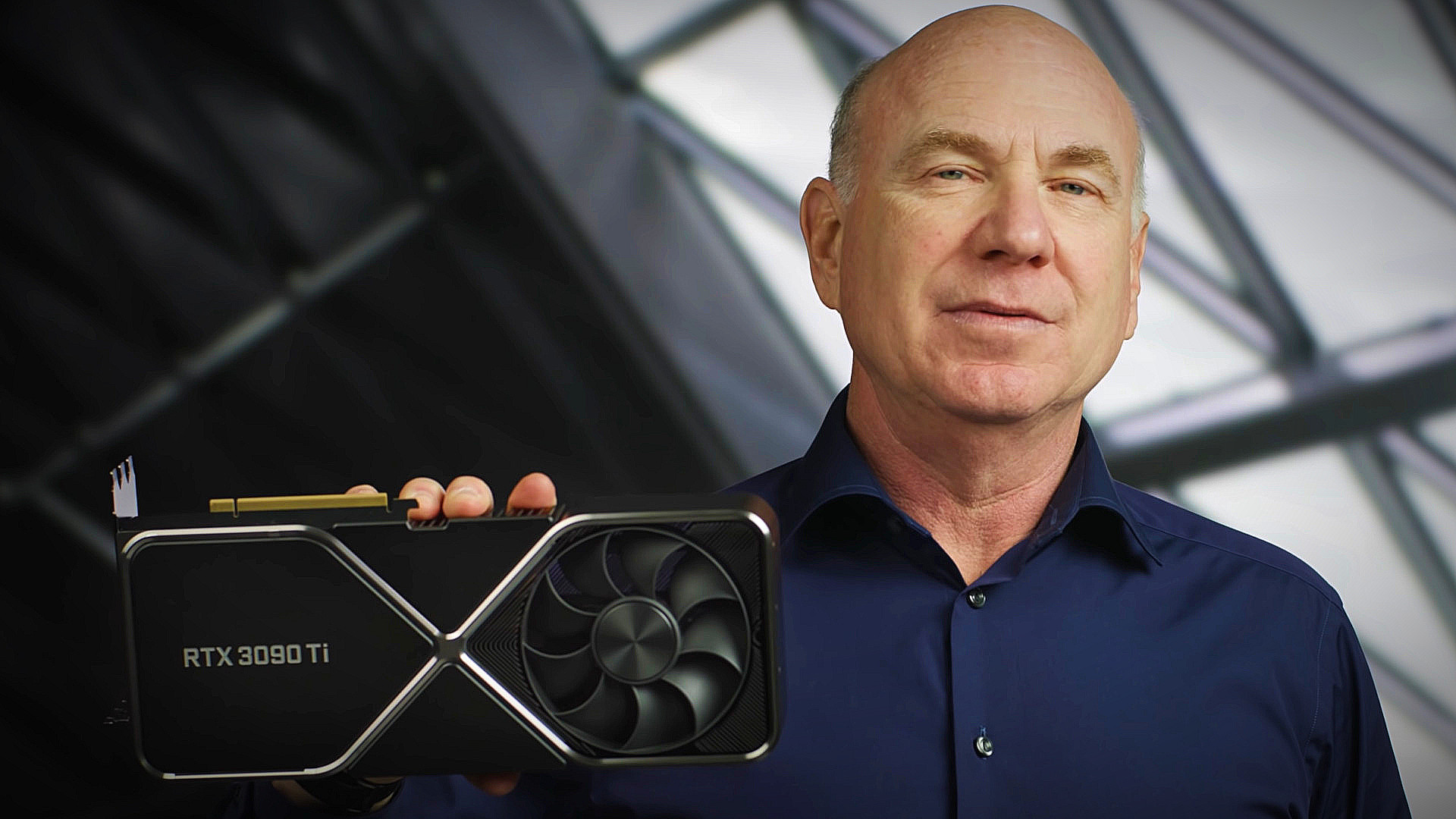
The Nvidia GeForce RTX 3090 Ti will undoubtedly rank among the best graphics cards you can slot into your gaming PC, but its performance may not be a huge upgrade over the current GPU king. In fact, rumours suggest that the new flagship’s fps improvements just about manage to hit double digit figures.
According to data captured by analysis tool CapFrameX (via Videocardz), the RTX 3090 Ti is only around “10% faster at 4K” than its predecessor, despite its higher 450W TDP compared to the 350W on the RTX 3090. While more performance is certainly nothing to be snuffed at, we still don’t yet know one very important thing about Nvidia’s new card: cost.
Retailers previously listed RTX 3090 Ti graphics cards for over $4,000 USD, but we could see Founders Edition models sell for much cheaper. In fact, Zed_Wang believes that Nvidia plans to set the GPU’s MSRP at $1,499, matching the existing price for the RTX 3090.
RELATED LINKS: RTX 4000 - everything we know, GeForce Now RTX 3080 review, Best graphics card
If you have been watching Taika Waititi's (What We Do in the Shadows, Jojo Rabbit, Thor: Ragnarok) goofball pirate comedy, Our Flag Means Death, you've likely heard that the main character, Stede Bonnet, is based on an actual 18th century pirate. — Read the rest
Read more of this story at Slashdot.

In a Twitter post made moments back. electric vehicle billionaire Elon Musk announced that he has caught the coronavirus for the second time. Musk's tweet marks the second time he has caught the virus, after the executive revealed in November 2020 that he had developed symptoms for a disease that has ravaged the global economy and disrupted daily lives. Musk complained about the different mutations of the virus alongside sharing that he is sick once again and wondered when it will stop resembling its original form that caused irreparable damage during late 2019 and early 2020.
According to the brief statements made by one of the richest men in the world earlier today, his second bout with the coronavirus appears to be milder than the first one. The first time Musk caught the virus was in late 2020, during the peak of the pandemic induced lockdowns and economic disruption. Back then, Musk had also made the announcement on Twitter, where he had revealed that:
"Am getting wildly different results from different labs, but most likely I have a moderate case of covid. My symptoms are that of a minor cold, which is no surprise, since a coronavirus is a type of cold,"
The executive has been confirmed to have received vaccination for the virus, even as his beliefs regarding the freedom of individuals to get vaccinated have landed him into controversy - a region where Musk is often found. While he believes that vaccinations are beneficial, he also believes that those who do not wish to get vaccinated have the right to do so.
Additionally, Musk came into the spotlight after his electric vehicle company Tesla's manufacturing facilities in California were shut down due to restrictions. In response, the executive took a hard stance and called the restrictions as anticompetitive. He then upped things a notch by announcing that not only will the electric vehicle company resume production, but that he will join his workers on the manufacturing lines and that if anyone was to be arrested, it should be him.

His latest announcement revealing that he does have the coronavirus was made early morning Eastern Time today and came as follows:
Covid-19 is the virus of Theseus.
How many gene changes before it’s not Covid-19 anymore?
I supposedly have it again (sigh), but almost no symptoms.
For those wondering, Theseus is an ancient Greek mythical king who had to face several daunting tasks before setting up what would be later known as Athens.
Musk's reveal comes on the day before his aerospace company, Space Exploration Technologies Corporation (SpaceX) might secure environmental approval from the Federal Aviation Administration (FAA) for the launch and testing site of its Starship next-generation launch vehicle system. The FAA is currently conducting an environmental assessment of SpaceX's facilities in Boca Chica, Texas, and should the company receive the approval, then it will be able to apply for a launch license and the ability to conduct a highly anticipated Starship orbital test.
Starship is crucial for SpaceX's future plans and it rose in importance last week when the National Aeronautics and Space Administration (NASA) decided to add another lunar landing mission for a variant of the rocket's upper stage that will be designed specifically for NASA needs. This extension is aimed at making the lunar Starship's design more robust and sustainable, allowing NASA to expand the scope of its lunar operations.
The post Elon Musk Is Sick With The Coronavirus Once Again – Compares It To Mythical King by Ramish Zafar appeared first on Wccftech.
Read more of this story at Slashdot.
Surprisingly, early retirement is not that hard.
Hitting the lottery or inheriting a windfall from ol' Aunt Myrtle isn't required.
Similarly, you don't have to become a brilliant investor or possess any unusual skill to retire early.
The strategies that work are repeatable and predictable science—not random luck.
In fact, the science supporting early retirement is so simple, literally anyone can do it.
However, almost nobody is willing to do it…and therein lies the rub.
Let's start by proving the theory with mathematics, talk a bit about why so few people succeed, and then explore the steps you must take to ensure the strategy can work for you.
Let's play with some simple equations to illustrate the point.
We'll assume $48,000 per year earned income to keep the taxes low and the math easy. Alternatively, you could just assume $48K after taxes and eliminate the tax complication from the equation. That works out to $4K per month spendable.
(By the way — the actual income level is irrelevant to the calculation, as you will see below, so use whatever income works for you. The key is the percentage of income that is dedicated to savings.)
Using one of my handy retirement calculators, we'll determine how long it takes to save your way to financial independence applying industry standard numbers like 8% for investment return, and 3% spendable retirement income to support living expenses. Another invaluable tool is the retirement planner available with a free Personal Capital account; when you link your existing investment accounts and enter assumptions about how much you'll spend and save, Personal Capital can show you exactly how soon you'll be able to retire based upon projections of your specific investments. Learn more about Personal Capital in our review.
If you saved 70% of your income, or $2,800 per month, at 8% return, you would have $515,000 at the end of 10 years.
Related: Why you need a wealth plan, not a financial plan.
Yes, I know that leaves you with only $14,400 per year to live on (I'll address this issue later), but the fact is, you'll be financially independent in 10 years because 3% of $515K is $15,450 in spendable income. This would be $1,000 per year greater than what you had been living on.
(If that math went by a little too fast and you want more detail, read this book: How Much Money Do I Need To Retire. It explains everything in step-by-step detail… plus a whole lot more.)
If you're really in a hurry to tell your boss what he can do with your job, and don't mind extreme frugality, then try saving 80%. You could be financially independent in less than 7 years, because $3,200 per month at 8% results in a $361,000 savings balance, providing $10,830 of annual spendable income at 3%. This is greater than the $9,600 ($800 per month) you would be living on for this scenario.
The first and most obvious comment nearly every reader will have to these two examples is something like, “Cute idea, Todd, but I can't even get by on 100% of my income. The idea of living on 20-30% is a pathetic joke! Your article is complete rubbish!”
(Come on… own up to it. The little voice in your head was saying something like that. Right?)
Here's the rub. That's only true for the people making those lifestyle choices. It's not “the truth”.
There are many people who have committed to extreme frugality as a lifestyle choice because they don't want to spend any more of their life than absolutely necessary working for money. They would sooner live without the luxuries that others have claimed are necessities than pay the price of working to have all that stuff.
It's an expression of personal values.
There are people who choose to live in motorhomes, use public transportation or their bicycle, shop only at thrift stores, grow their own food, and so on to keep expenses to a bare minimum.
It can be done. It's possible if that's your choice.
Alternatively, living on 20-30% of your income doesn't have to equate to extreme frugality. Try running the same numbers with $250K or $300K in income.
It leaves plenty of spending money for lifestyle today. Sure, it's far less than you could afford at that income level, but again, it's a choice.
In fact, I initially built my wealth following this exact formula. It totally works.
I just raised my income to a very high level, paid my house off, and never got frivolous, but never suffered. I chose my spending consciously based on my values (personal growth, reading, research, outdoor sports, adventure, and recreation), and never needed to spend much of the fat income.
The bulk went to savings with little effort or discipline. Presto! Instant financial freedom.
So anyway, it does work, and it's do-able. People do it every day.
Others might attack the 3% spending rule or the 8% return on investment. My answer is save your breath.
3% spending is easy to support in perpetuity because a portfolio of quality dividend stocks would pay that (and likely more) while growing to adjust for inflation, and without ever touching principal. It's easily do-able.
Similarly, 8% growth during the 10 years in this example is supportable using investment strategies designed to safely support growth that I teach my coaching clients and students in my courses, including Expectancy Wealth Planning.
Related: 5 Financial Planning Mistakes That Cost You Big-Time (and what to do instead!) Explained in 5 Free Video Lessons
However, even if you disagree with me on this point, the argument is moot because the compound return represents very little of the asset accumulation over this short time period. The math is dependent on the percentage savings rate – not the growth rate. It helps, but it isn't critical.
The time is just too short to make a big difference. Don't waste your energy arguing details – it all boils down to the savings rate.
Also, notice that I didn't include Social Security, pensions, or anything else. This is simple, stripped down math to make a minimalist point that is unarguably clear.
Anyone can retire early and live with financial independence (but not freedom) in 10 years or less. It's absolutely, 100% do-able.
I've done it, lots of other people have done it, and there are many entire web communities of people trying to walk the talk like the one run by Jacob at EarlyRetirementExtreme.com.
If you're a naysayer, then just be honest with yourself and realize your negativity is all about a lifestyle choice – not the viability of the strategy.
With that said, the reality is very few people will ever succeed with this approach. Let's look at why.
You probably already guessed why so few people are able to follow this plan…
It takes the self-discipline of a celibate monk living in a brothel to survive on 20-30% of what most people earn in our current culture. I did it easily because my income was substantial while living the simple life as a single male.
It would have been much harder if I was married with kids on an average income.
Does that mean you can discount this article and throw the idea away? No!
The math is the math. I'm teaching you how saving your way to financial independence works.
Related: How to be a pro at growing your wealth
This is one of three paths to financial independence. (The other two are real estate and owning your own business). The rules are inviolable. They are scripture in stone.
You can't argue with them. It's just math.
You can reduce the savings rate and lengthen the time, but you can't change the math.
There are a couple of key principles you want to understand with this strategy…
Frankly, I question if early retirement is even a worthwhile goal as stated in this post here.
All of this begs the question, “Is your goal financial freedom or financial independence?”
Surprisingly, they aren't the same thing.
You can be financially independent on $15,000 per year in 10 years or less with the above example, but you'll have to give up some freedom to achieve it.
Living low on the economic scale limits what you can buy and do with your life. These limitations are antithetical to freedom and cause what I call a “poverty mentality.”
Every corner must be cut, every dime squeezed for maximum blood. It creates an obsession with spending and money that doesn't equate to happiness for most people.
Unless your values are inherently extremely frugal, you'll constantly make concessions to save money as decisions are based on the right side of the menu of life (prices). Rather than work for money, you'll spend a comparable amount of life energy working to save money through all the frugality strategies required to make ends meet.
This is not a right/wrong question – it's just reality. It takes effort to figure out how to spend less and survive on less.
Money buys convenience, but that convenience comes at a price because you have to give your life energy in the form of work to earn it in the first place. Everything is a trade-off. There's no perfect answer.
For example, extreme frugality would limit my ability to take my family to France for a month (like I did last year), which honors my values for adventure and life experience. I wouldn't be able to honor my values on education by paying for quality, private schools for my kids.
I wouldn't be able to honor my health values by paying for professional services like sports training, physical therapy, or expensive organic food. All these things would be luxuries in a world dominated by frugality thinking.
These would all be limitations to my freedom and would dishonor my values. In my personal experience, that's antithetical to true wealth and personal freedom. Others would disagree, but that doesn't make them wrong.
It's all a question of values.
Extreme frugality is not everyone's cup of tea. It works fabulously for some people, and it's a recipe for misery for others.
The key is to integrate your plan for financial freedom with your values. The two must be congruent because the goal isn't just financial independence – the goal is true wealth and personal freedom.
For example, the spending level that honors my values as a 50 year-old, middle class, head-household, family of four, is much higher than when I was a single male straight out of college. It's probably higher than it will be 10 years from now when my kids are grown.
You must design a financial plan to reflect whatever reality is true for you. That's always the starting point when I begin working with coaching clients.
We co-design a wealth plan for financial freedom that integrates every aspect of their life: values, spending, life habits, skills, resources, interests and abilities.
Related: Here’s a scientific system to build your wealth now
We define their leverage points and competitive advantage into a plan specific to their needs.
Some clients save their way to wealth using the formulas discussed here. Others choose real estate and/or building a business to better leverage their passions and interests (this employs entirely different equations beyond the scope of this article).
Most use some combination of these three paths to wealth (I usually encourage two of the three paths).
One size does not fit all. Your wealth plan must fit you like a favorite pair of jeans in order for you to succeed with it. It must comfortably wrap every curve and unique attribute of your being, or it won't feel right and you won't stick with it long enough to succeed.
Getting your plan right is the first step to financial freedom on which all subsequent decisions and actions are built.
In summary, the purpose of this article was to illustrate how the rules of frugality and saving your way to wealth can be applied within your wealth plan to help you retire early. It's one of four potential paths to wealth.
To do this, traditional savings strategies are usually the primary choice (coupled with real estate) for W2 employees who lack entrepreneurial dreams. Entrepreneurs will typically build wealth through their business, and park that wealth in paper assets or real estate.
Let me reiterate: There is no such thing as one-size-fits-all when it comes to wealth planning. It's a very personal choice.
How fast you want to achieve your wealth goals through savings (7 years? 40 years?) is purely a lifestyle choice and a statement of your personal values and priorities. The paths you choose to realize your financial dreams should reflect your life situation.
The thing to note about paper asset savings plans is they're governed by specific mathematical rules and limitations. If you want to break out of those mathematical rules and get more creative, then you must include the other two asset categories—real estate and business.
…which is why they will be subjects of future articles, so stay tuned.
Finally, if you have any questions about what it takes to retire early, everything is explained in great detail and made fully actionable in this step-by-step course showing you how to design your life to create financial independence.
Let me know how I can help.
Anybody can learn to build a secure retirement -- and you don't need a financial advisor.
My course, Expectancy Wealth Planning, has been called "the best financial education on the internet" and provides all the knowledge you'll ever need to build the life -- and retirement -- of your dreams.


