Shared posts

01 Feb 16:41

Why Ted Cruz’s Dishonest Mailing May Not Have Even Worked Anyway

by Jesse Singal
Presidential Candidate Ted Cruz Holds Iowa Campaign Stops

Over the weekend, news spread that Republican presidential candidate Ted Cruz, seeking to drum up support during Monday’s Iowa caucus, had done something pretty sleazy: His camp had sent out official-looking mailers to Iowa voters with “VOTING VIOLATION” stamped ominously in red on them.

As you can see, the mailers “graded”...More »

29 Jan 13:27

Cops Getting Free License Plate Readers In Exchange For 25% Of The 'Take' And All The Driver Data Vigilant Can Slurp

by Tim Cushing

What happens when you lower the barriers to entry? More participants join the market. It works everywhere, even when the market is "law enforcement" and the "customers" are everyone else.

Vigilant Solutions, one of the country’s largest brokers of vehicle surveillance technology, is offering a hell of a deal to law enforcement agencies in Texas: a whole suite of automated license plate reader (ALPR) equipment and access to the company’s massive databases and analytical tools—and it won’t cost the agency a dime.

[...]

Vigilant is leveraging H.B. 121, a new Texas law passed in 2015 that allows officers to install credit and debit card readers in their patrol vehicles to take payment on the spot for unpaid court fines, also known as capias warrants. When the law passed, Texas legislators argued that not only would it help local government with their budgets, it would also benefit the public and police.
Well, we can see how this will benefit law enforcement and others on the government food chain, but it's unclear how this will benefit the public. The bill's sponsor said the law would "relieve the burden" of having their vehicles impounded or being jailed for unpaid fines. But beyond those vague perks, the benefits seem to flow mostly in one direction.

The EFF quotes legal blogger Scott Henson of Grits for Breakfast, who speculated the combination of license plate readers and credit card readers would push cops towards chasing down unpaid fines rather than enforcing traffic laws or performing more routine patrol duties. If so -- and it appears to be the case -- this is exactly the outcome Vigilant was expecting. It didn't hand out its tech for free. There may be no price tag on the plate readers at the point of purchase, but that's only because Vigilant has points on the back end.
The “warrant redemption” program works like this. The agency gets no-cost license plate readers as well as free access to LEARN-NVLS, the ALPR data system Vigilant says contains more than 2.8-billion plate scans and is growing by more than 70 million scans a month. This also includes a wide variety of analytical and predictive software tools.

The government agency in turn gives Vigilant access to information about all its outstanding court fees, which the company then turns into a hot list to feed into the free ALPR systems. As police cars patrol the city, they ping on license plates associated with the fees. The officer then pulls the driver over and offers them a devil’s bargain: go to jail, or pay the original fine with an extra 25% processing fee tacked on, all of which goes to Vigilant.
To make this relationship even more explicit, officers who issue tickets to parked vehicles rather than drivers leave a note instructing them to visit Vigilant's website to pay the fine. On top of the 25% fee, Vigilant also gets to collect massive amounts of sweet, sweet driver data, which it can then sell to other law enforcement agencies (database access licenses) and private firms (insurance companies, repo men, etc.). And, if the locals seem understaffed, Vigilant is more than happy to pick up the slack.
In early December 2015, Vigilant issued a press release bragging that Guadalupe County had used the systems to collect on more than 4,500 warrants between April and December 2015. In January 2016, the City of Kyle signed an identical deal with Vigilant. Soon after, Guadalupe County upgraded the contract to allow Vigilant to dispatch its own contractors to collect on capias warrants.
As the EFF points out, this freemium service benefits Vigilant and law enforcement, but does very little for the general public… including protect them from Vigilant's inability to perform its job competently.
During the second week of December, as part of its Warrant Redemption Program, Vigilant Solutions sent several warrant notices – on behalf of our law enforcement partners – in error to citizens across the state of Texas. A technical error caused us to send warrant notices to the wrong recipients.

These types of mistakes are not acceptable and we deeply apologize to those who received the warrant correspondence in error and to our law enforcement customers.
Apologies are nice, if of limited utility, but…
[T]he company has not disclosed the extent of the error, how many people were affected, how much money was collected that shouldn’t have been, and what it’s doing to inform and make it up to the people affected.
As has been discussed here before, turning law enforcement agencies into revenue-focused entities is a bad idea. Case in point: asset forfeiture. Further case in point: speed trap towns. Improper incentives lead to improper behavior. Agencies may like the idea of a "free" license plate reader, but the price still has to be paid by someone -- and that "someone" is going to be the general public.

As priorities shift towards ensuring ongoing use of the "free" ALPRs, other criminal activity is likely to receive less law enforcement attention. Unpaid fines and fees are in law enforcement's wheelhouse, but should never become its raison d'etre. Once it does, the whole community suffers. Anything that could be implemented to lower crime rates would also serve to lower revenue, making it far less likely to be implemented. Fewer infractions mean fewer opportunities to collect court fees. And while the legislators pushing the new law Vigilant is leveraging talked a good game about sending fewer people to overcrowded jails, the governments overseeing these agencies still have budgets to meet and law enforcement to lean on to ensure this happens. Actually achieving the bill's stated aims would mean a steady reduction in court fees, which would lead to the loss of "free" plate readers. And no one wants that, at least not on the government side of things.

Permalink | Comments | Email This Story


29 Jan 13:23

Istanbul Inception: Warped Turkish Cityscapes by Aydin Büyüktas

by Christopher Jobson

Yeni_Cami

Turkish photographer and digital artist Aydın Büyüktaş turns the streets of Istanbul upside down in these warped cityscapes that appear to curve infinitely upward and outward toward the skies. While it’s tempting to draw parallels with stunning visuals from the 2010 movie Inception, the artist says his true inspiration is taken from the 1884 satirical novella Flatland that depicts a two-dimensional world occupied by geometric figures. In this series, also titled Flatland, Büyüktaş photographed canals, bazaars, skate parks, and bridges with the aid of a drone and then digitally stitched them together as dramatically inverted spaces without a visible horizon. You can see more of his gravity-defying work on Instagram. All images courtesy the artist. (via Designboom)

Buyuktas-Aydin_Grand-Bazaar

Basibuyuk

Buyuktas-Aydin_Bus-Station

demirciler

Fenerbahce_stadium

Galata_Bridge

kaykaypist

Kurbagli_dere

maltepe_stadi

Sali_Pazari

SultanAhmet

29 Jan 13:20

How Electric Concrete Could Make Shoveling Snow a Thing of the Past

by Linda Poon
Image AP Photo/Craig Ruttle
Snow is cleared along a street in the Upper West Side neighborhood of New York City. (AP Photo/Craig Ruttle)

As much as 42 inches of snow covered the ground last week after a historic blizzard slammed the East Coast. Days later, cities are still working to clear roadways and sidewalks.

Chris Tuan, a civil engineer at the University of Nebraska, Lincoln, thinks there’s a better way to manage this huge task. With funding from the Federal Aviation Administration, he’s come up with a formula for making conductive concrete, which can carry enough electrical current to melt snow in even the worst storms.

The mixture contains basic concrete ingredients—including cement, sand, and water—but Tuan has replaced 20 percent of the components with steel shavings and a fine powder called “coke breeze,” both of which are industrial waste products. When the finished slabs are connected to a power source via steel rods inserted inside the concrete, they can generate heat that will spread to the concrete’s surface.

Tuan currently has a 200-square-foot test slab connected to a 120-volt AC power source outside his office that shows how the concrete works:

If testing is successful, the FAA will use the concrete on airport tarmacs to minimize delays during winter storms. But his research could also be used in cities.

In 2003, Tuan and his colleague, electrical engineer Lim Nguyen, tested a version of the conductive concrete by installing 52 slabs onto the 150-foot Roca spur bridge, just 15 miles south of Lincoln. “We know a lot of accidents can happen on bridge decks because they’re always icy since they’re exposed to the elements both on the top and bottom,” says Tuan. The results of the five-year-long experiment, published in the Journal of Cold Regions Engineering, were promising; the bridge successfully de-iced itself, and powering the concrete during a three-day storm cost about $250—far less that the cost of deploying snow plows and salt.


Related Story

The Sidewalk of the Future Is Not So Concrete

Cities are experimenting with different materials — from heated panels to flexible rubber — but the best replacement has yet to emerge.


Since then, Tuan has been working to make the concrete more affordable and therefore, scalable. By replacing the recipe’s highly conductive synthetic carbon power with industrial waste, he cut down the cost from over $600 per cubic yard to just $300.

Still, it’s a hefty price compared to regular concrete, which costs roughly $120 per cubic yard. In fact, Tuan advises against constructing entire roadways out of conductive concrete. Rather, he says, they should be used on specific areas with higher rates of collisions during storms, like intersections, exit ramps, and uphill roads.

The key is to turn on the power a day before a huge snowstorm hits to “preheat” the concrete. “When the snow hits, it melts instantly so you don't have any accumulations,” he tells CityLab, adding that it would remain safe to the touch. Depending on the size of the area covered, it can take as little as 48 volts to power the concrete.

Over time, the benefits add up. Tuan says current experiments show that the operating cost is only two cents per square foot, and the maintenance cost is virtually zero since there are no harsh de-icing chemicals involved. Tuan expects to get approval from the FAA after testing ends later this year, and he says he’s confident: “After I did the Roca Spur bridge project, which ended in 2008, I was very confident the technology is mature enough.”

29 Jan 13:16

This Artist Turned Chicago Into a Maze

by Natalie Delgadillo
Image Matthew Haussler
Matthew Haussler

If you like adult coloring books, prepare to lose many hours of your life to this even more intricate, throwback hobby: finding your way around hand-drawn mazes that loop through the Chicago cityscape.

Through a recently-launched Kickstarter campaign, artist Matthew Haussler is raising money for his second set of maze booklets, each page of which depicts a Chicago park, skyline, or neighborhood in an artful black and white sketch. Every image is a separate maze—like the ones you can find on the back of a children’s menu in a restaurant, except these are complex enough to drive kids insane and keep grown-up puzzle-solvers occupied for hours.

Haussler raised money for his first round of booklets last year, and held an art exhibition that featured several blown-up versions of the mazes in a Chicago Intelligentsia coffeehouse over the summer.

Matthew Haussler

In 2009, when he was working as a bank teller, Haussler doodled mazes on his break as a way of unwinding. About two years later, he had the golden idea: “I’ve done these things called negative space drawings, which is where you draw the area around an object instead of drawing the object,” Haussler says. “And I thought, ‘Hey, I can do those, and mix the mazes into it.”

Before he knew it, he was making mazes out of everything—buildings, fish, people. In 2013, he quit his bank job, made a full-time go at maze-making, and the Chicago mazes were born.

Haussler in the process of drawing his (almost) record-breaking maze.

In January of last year, he unveiled his most extensive work to date at Block 37, a shopping center in downtown Chicago: a 74-foot-long hand-drawn maze that took him eight months to complete. It’s so large and detailed that it’s proven impossible for him to upload on a computer as one image. Until someone solves it, the official Guinness World Record for longest maze remains out of his grasp—but for Haussler, the accomplishment is in the art itself.

Matthew Haussler
Matthew Haussler
Matthew Haussler

Haussler’s eventual goal is to make a maze book for every major city in the world. For now, the new maze booklet will contain images of Wrigley Field, the U.S. Cellular Field (where the White Sox play), the Chicago Water Tower, and several areas around the Loop.

Booklet, from $10 at Kickstarter.

29 Jan 13:15

NYPD Tells Public Record Requester It Will Cost $36,000 To Process A 'Sampling' Of Body Camera Footage

by Tim Cushing

The NYPD is once again in the middle of a transparency/accountability controversy. The law enforcement agency has achieved the dubious distinction of being more difficult to obtain public records from than federal three-letter agencies like the CIA and NSA. The latest news does nothing to improve its reputation.

Some of this is due to its in-house classification system, which allows it to arbitrarily declare potentially-responsive documents "secret" -- something it does quite often with no apparent oversight. Some of it is due to the department's general antagonism towards transparency and openness, which keeps documents not marked secret out of the public's hands just because. Its steadfast belief that the only entity truly entitled to information is the NYPD has seen this attitude carried over to discovery requests in civil lawsuits and criminal cases, much to the general disgruntlement of presiding judges.

With the NYPD's court-ordered body camera program going into effect, the recorded footage is the latest target of FOIL (Freedom of Information Law) requests. TV station NY1 asked for a "sampling" of body-worn camera footage from five weeks of recording. In return, the NYPD has given it nothing but delays… and a high-dollar estimate.

When the NYPD first rolled out its body camera pilot program, the idea was increased transparency and accountability. But last spring when NY1 requested five weeks worth of footage under the state’s Freedom of Information Law, known as FOIL, the NYPD said it would cost NY1 $36,000 so that an officer could first review and edit the video, to address privacy and other concerns.
After a couple rounds of appeals, the TV station has taken the next step. It sued the NYPD, citing a number of FOIL violations.
The NYPD denied NY1's request for unedited footage without specifying what material it plans to redact, how much material will be excluded from disclosure, or how the redaction will be performed. Instead, Respondents suggested that they may provide with edited footage, but only on the condition that remit $36,000.00, the alleged cost to the NYPD of performing its unidentified redactions.

FOIL does not permit public records to be withheld absent a full explanation of the materials that are exempt from disclosure. FOIL also does not permit agencies to levy any charge for review and redaction of records (let alone a $36,000.00 charge). As a result, the response to NY1's request violates FOIL.

Indeed, the response to NY1's request for footage runs counter to both the public policy of openness underlying FOIL, as well as the purported transparency supposedly fostered by the BWC program itself.
Redacting footage isn't necessarily inexpensive, but the NYPD has provided no justification for the $36,000 fee. The FOIL request doesn't ask for anything more than a "sampling" of the recorded footage. The NYPD responses don't specify whether the agency considers this to be every minute of footage recorded during those time periods, or something considerably more limited.

It is true that the footage will have to be redacted, at least in part. But without further information, the "reasonableness" of the NYPD's fee demand can't be assessed. This FOIL paywall runs contrary to the law's purpose, as well as the presumption of disclosure stressed in comments made by NYC Mayor Bill de Blasio, who lauded the new body-worn camera program as a step forward in transparency and accountability. If the footage remains solely in the possession of the NYPD, there will be no additional transparency or accountability.

On the other hand, NYPD Commissioner Bill Bratton seems to feel the state's public record law only applies to other government agencies. The NYPD currently ranks at the bottom of the list for city agency FOIL responsiveness. That seems unlikely to change if this is how the department responds to requests for footage.
"We have never released 911 calls, and video recorded by these officers, I think, would be under the same protection of not being released, even to FOIL requests," said Police Commissioner William Bratton.
Unfortunately, this response from the NYPD -- despite effectively pricing NY1 out of the market for these public records -- directly contradicts the commissioner's beliefs. Obviously, the NYPD FOIL team feels these documents are responsive to public records requests. However, it's more than willing to do whatever it takes to ensure this responsiveness remains in the realm of the theoretical.

Permalink | Comments | Email This Story


27 Jan 14:19

A Beautiful Bike Helmet That's Also Biodegradable

by Eillie Anzilotti
Image Rasmus Malbert/Cellutech
Rasmus Malbert/Cellutech

Cyclists, ready yourselves for yet more proof that you are saving the planet.

As a part of Swedish Forest Industries Federation´s Ekoportal2035 concept house, Stockholm-based startup Cellutech teamed up with designer Rasmus Malbert to launch a prototype bike helmet made entirely of forest-based products.

The outer layer is veneer wood, the straps are formed of extra-strong paper, and the shock-absorbing foam is made not with petroleum-based Styrofoam, but with a completely biodegradable, wood-based material.

Rasmus Malbert/Cellutech

This material, trademarked Cellufoam, was developed by three Swedish researchers at the Wallenberg Wood Science Center tasked with creating products sourced entirely from Swedish forests.

In a press release, Lars Wagberg, a fiber technology professor at KTH Royal Institute of Technology and one of the researchers on the project, says that the new helmet lining offers protective properties on par with Styrofoam, “but even better, it is from a totally renewable resource—something we can produce in the forest.”

Rasmus Malbert/Cellutech

The KTH press release points out that because Swedish forests are planted and harvested continuously like other cash crops, researchers are confident that it will be possible to take Cellufoam “to market on a cost-effective scale in a not-too-distant future.”

This bike helmet falls in line with a burgeoning trend of wood-based developments, notably in the Netherlands: the city of Emmen recently launched a plan for a bike path made out of recycled trees, and following a successful Kickstarter, the Amsterdam-based retailer reWrap is producing a fully biodegradable designer accessory aptly called the “Tree Bag.”

For now, a Cellufoam bicycle helmet is another score for cycling and sustainability—and also, it looks really good.

27 Jan 14:18

Nest Thermostat Goes From 'Internet Of Things' Darling To Cautionary Tale

by Karl Bode
Back when the Nest thermostat was announced in 2011, it was met with waves of gushing adoration from an utterly uncritical technology press. Much of that gushing was certainly warranted; Nest was founded by Tony Fadell and Matt Rogers, both former Apple engineers, who indisputably designed an absolutely gorgeous device after decades of treating the thermostat as an afterthought. But the company also leaned heavily on the same media acupressure techniques Apple historically relies on to generate a sound wall of hype potentially untethered from real life.

Courtesy of marketing and design, Nest slowly but surely became the poster child for the connected home. Over the last year or so however things have changed, and while now Alphabet-owned Nest remains an internet of things darling, the unintended timbre of the message being sent is decidedly different. For example, Nick Bilton recently wrote a piece in the New York Times noting how a glitch in the second generation of the supposedly "smart" product drained the device battery, resulting in numerous customers being unable to heat their homes just as a cold snap hit the country:
"The Nest Learning Thermostat is dead to me, literally. Last week, my once-beloved “smart” thermostat suffered from a mysterious software bug that drained its battery and sent our home into a chill in the middle of the night. Although I had set the thermostat to 70 degrees overnight, my wife and I were woken by a crying baby at 4 a.m. The thermometer in his room read 64 degrees, and the Nest was off."
Again, that's the poster child of the so-called "smart" device revolution failing utterly to complete a task thermostats have been successfully accomplishing for a generation. Other tech reporters like Stacey Higginbotham reported the exact opposite. As in, her Nest device began trying to cook her family in the middle of the night, something Nest first tried to blame on her smart garage door opener, then tried to blame on her Jawbone fitness tracker (Nest never did seem to pinpoint the cause). Her report suggests that an overall culture of "arrogance" at Nest shockingly isn't helping pinpoint and resolve bugs:
"One Nest partner, who declined to be named to preserve his business relationship with the company, said that Nest being quick with the blame didn’t surprise him, citing a culture of arrogance at the company. When something went wrong during integration testing between his device and Nest’s, problems were first blamed on his servers and team."
And fast-forward to last week, when researchers putting various internet of thing devices through tests found that the Nest thermostat was one of many IOT devices happily leaking subscriber location data in cleartext (with Nest, it's only the zip code, something the company quickly fixed in a patch). Granted Nest's not alone in being an inadvertent advertisement for a product's "dumb" alternatives. In 2016, smart tea kettles, refrigerators, televisions and automobiles are all busy leaking your private information and exposing you to malicious intrusion (or worse).

It's a fascinating, in-progress lesson about how our lust for the sexy ideal of the connected home appears to be taking a brief pit stop in reality, where sexy doesn't matter if the underlying product, person or device remains inherently dysfunctional. As a result, dumb and ugly technology is poised to make a dramatic comeback.

Permalink | Comments | Email This Story


24 Jan 00:38

Nature Reclaims D.C.'s Snow-Covered Streets

by Kriston Capps
Image Laurie Trayers
Laurie Trayers

Panic has set in. The city is lost. For more than 24 hours, the sky has fallen on Washington, D.C., once considered the most powerful city in the world. Still it falls, in the form of tiny jagged ice crystals, which rain down in sheets on the capital of the free world. District delenda est.

The city is lost. Since yesterday afternoon, nature has reasserted its hold over the world of man. In a neighborhood called Cleveland Park—for that is something that human civilization once did; we claimed lands and gave them titles, we called these lands home, we called these lands ours—the fauna have returned. You and I, friend? We were only ever renters, temporary occupants, living on borrowed time.

These deer, prancing across streets on which engines once motored, where business was conducted, where civilization was performed, these frolicking fairies are the sign, the signal: The city is lost.

See how they prance! See how they delight in the fall of mankind! The honor guard announcing the change of regime, the forward troupe of the parade at empire’s end. These deer are dancing in the streets.  

What might we say to them? We mistook you: for symbols of innocence, paladins of peace. We were wrong. We were so wrong.

Elsewhere, the rearguard formations take notice of the deer-scouts’ forward progress. Word spreads: The blizzard has undone the world of people. Huzzah! Witness the delight of one who has heard the good word:

Still we practice our sacred rites. Even now, the last remnants of human civilization rally against the dying of the age, embracing drink and sport with bacchanalian enthusiasm. The people of the District flee from the storm by throwing their bodies down Capitol Hill.

As the blizzard mounts, a vision of the future comes into view: the Capitol building, its dome barely surfacing over an uninterrupted plane of ice, deer dancing all over the place. Said Shelley:

Nothing beside remains. Round the decay
Of that colossal wreck, boundless and bare
The lone and level sands stretch far away.

The city is lost. May it meet a merry end.

23 Jan 15:53

Imagining an Ultra-Futuristic Library for Houston

by Kriston Capps
Image MA2
MA2

Here’s a library that Houston didn’t know it needed.

Michael Arellanes II, the architect and principal at the firm MA2, is exploring a series of grand design concepts for downtown Houston. No one in Houston has asked him to do this work, mind you. This is architectural spitballing.

In a post on the firm’s site, Arellanes II imagines a high-concept library and exhibition center for a parcel just north of downtown. The building is a star cluster of interlocking leaves, each of which provides programming space for what appears to be a truly massive library.

“By having a series of harmonic manifolds of book collection space and the mixing of programmatic function for exhibition”—[deep breath]—“it generates a dynamical system of flowing conditions which manifests with moments of extrapolation within the tectonic massing and circulation,” Arellanes II writes.

(MA2)
MA2, a firm with offices in Houston and Hong Kong, is “more about concepts rather than built projects for the moment,” according to Phaidon. Daydreaming is consistent with a perfectly respectable tradition of theoretical architecture.

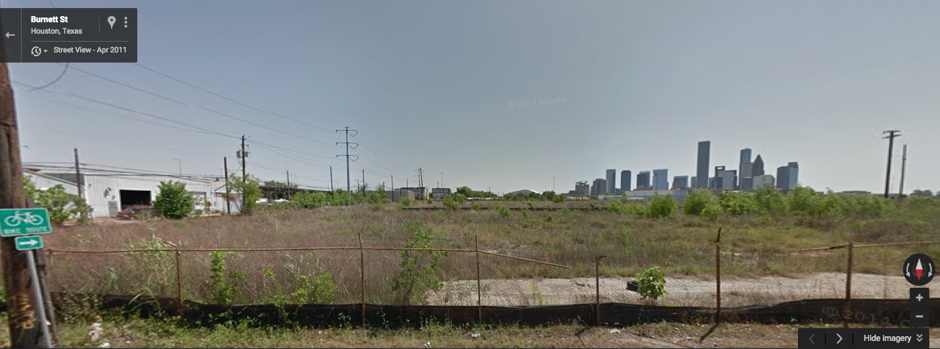
After all, it’s hard not to look at the site, which falls between Houston’s Downtown and its Northside neighborhood, and not picture something better. Here’s what the parcel looks like today.

Bound by train tracks to the south and a series of University of Houston parking lots to the west, and framed by highways I-10 and I-45, it’s not exactly the most desirable land in the city. But it’s prime for some kind of development: The lot is adjacent to the Burnett Transit Center/Casa de Amigos light rail station, and the White Oak Bayou Greenway Trail runs nearby. The nearby industrial sector is home to the Saint Arnold Brewing Company, a celebrated Texas brewery. To the north is residential Northside.

Houston has one of the best cultural districts in the U.S. in Montrose, but that neighborhood is a fair distance away from the spot on MA2’s radar. There’s no reason that a major cultural center couldn’t be located somewhere else, of course. Something that responded to its neighbors’ needs (programmatically, if not architecturally) would be an asset to the Northside.

Now, the planning set might argue that this design creates a few problems. The walks from just about anywhere to the library appears to be long. Discounting the nearby University of Houston parking lots, there’s no evident parking area for library patrons. A good thing, potentially, though this neighborhood isn’t one of Houston’s most walkable. That plaza, which looks to be about the size of the National Mall, could wind up empty and foreboding.

(MA2)

Of course, it’s only a sketch—and again, an unsolicited one—so there’s only so much sense in judging its viability as a civic scheme. And it’s part of a larger series, the point of which is to reimagine Houston spaces that aren’t being given a lot of thought. Arellanes II even offers up a post rethinking downtown Houston altogether.

The chances of any of these concepts being realized may be slim, but that misses the point. Any city should be so lucky as to have a designer willing to throw big ideas at the wall to see what sticks.

An iconic visualization for Houston’s downtown. (MA2)

23 Jan 15:36

Why Copenhagen Is Building Parks That Can Turn Into Ponds

by Athlyn Cathcart-Keays
Image COWI, TREDJE NATUR and Platant
Copenhagen's new Enghaveparken will have spaces that can host sporting events during dry weather and fill with water during heavy rains. (COWI, TREDJE NATUR and Platant)

COPENHAGEN, Denmark—At first glance, the square known as Tåsinge Plads doesn’t look much different from other parks in Copenhagen. A young couple lounges on a small hill surrounded by newly planted trees and wildflowers. Children laugh and play. Old women sit chatting on benches under the shade of tall sculptures shaped like upside-down umbrellas.


More From

Citiscope

But there are hidden features that make Tåsinge Plads part of this seaside city’s plan to survive the effects of climate change.

During heavy rains, the flowerbeds fill with water and wait to drain until the storm runoff subsides. The upside-down umbrellas collect water to be used later to nourish the plantings. And clever landscaping directs stormwater down into large underground water storage tanks. Above those tanks are bouncy floor panels that children love to jump on—when they do, the energy from their feet pumps water through the pipes below.

Just a few years ago, this square was paved with asphalt and dominated by parked cars—a small grassy area was used more as a toilet for dogs than as a park. Now, it’s the cornerstone of a plan to make the surrounding area of Saint Kjelds into what planners here are calling the world’s first “climate-resilient neighborhood.”

The tarmac has been torn up and the greenery reduces the urban-heat island effect. More parks like it are being built to purposefully turn into small ponds during heavy rains, allowing them to capture and retain water on site until the drainage system has capacity to handle it. During the worst deluges, certain streets with raised sidewalks will become “cloudburst boulevards,” creating a Venice-like cityscape of water channeled safely through the city until it can empty into the harbor.

Eventually, Saint Kjelds will be able to withstand—and even welcome—heavy rainfall and flooding. The plan is based on a vision drawn up by Copenhagen-based landscape architects Tredje Natur. Flemming Rafn Thomsen, a founding partner at the firm, says it’s an example of how the job of adapting to climate change can be turned from a seemingly negative thing into a positive one.

“Water is used as a resource to improve urban life,” Rafn Thomsen says. “We look at Copenhagen as a hybrid city where you can fuse nature, urban biology and human beings in a more appropriate balance.”

Handling higher volumes

Copenhagen isn’t alone in re-thinking its relationship with water. Two years ago, Rotterdam unveiled Benthemplein Square, an urban space with three concrete basins that intentionally fill up to store large amounts of water during storms. In the United States, Philadelphia has embarked on a $2.5 billion, 25-year effort to install thousands of rain gardens and permeable surfaces to allow rainwater to seep into the ground rather than run off into sewers and streams.

Copenhagen is advancing on a similarly massive scale. The city has recently been hit by two so-called “100-year flood” events, first in 2011 and then again in 2014. The Intergovernmental Panel on Climate Change predicts that this sort of extreme weather will become increasingly frequent in Denmark, with heavier downpours (as well as more periods of drought). Sea-level rise is a separate but related threat—according to research from the Niels Bohr Institute, the waters around Copenhagen could rise by up to 1.6 meters (more than 5 feet) in the next 100 years.

The flowerbeds of Tåsinge Plads fill with water during heavy rains, while sculptures collect water to nourish plantings. (David Buchmann)

Planning for this future, Copenhagen had to make a choice between two very different paths.

The first option was to expand the city’s existing subterranean sewer and drainage system—its “gray” infrastructure.” This would mean doubling down on the 20th-century notion that the city could handle higher volumes of rainwater as it falls by burying more and larger pipes to handle the runoff.

The second option was more of a “green and blue” system. Rather than funneling all stormwater at once through underground pipes, this option envisioned dealing with water at street level through a network of parks, cloudburst boulevards and retention zones.

Copenhagen opted for a Climate Adaptation Plan that relies mostly on the latter approach. In November, the council unanimously approved plans for 300 surface-based solutions like those in Tåsinge Plads to be implemented over the next 20 years. “The ambition of the Climate Adaptation Plan is to get technical solutions above ground,” says René Sommer Lindsay, manager for project in the neighborhood around Tåsinge Plads.  “So when it’s not raining, there is still value in the space.”

One of the highest profile of these projects is the Enghaveparken, a large urban park built in the 1920s. It is to be remade with water at the heart of the design. The park boundary will be marked by a dike that will filter water around the grounds and into 100 small community gardens. More water storage will be provided by excavating below-grade zones where sports such as football and hockey can be played when the park is dry but where water can fill up into retention ponds when it rains. An underground reservoir beneath the park will harvest more rainwater.

Cost considerations

For Copenhagen, the “green and blue” approach was also the most affordable option. It is expected to cost US$1.3 billion—about half the price of more conventional “gray” upgrades. Doing nothing was also an option, but that would only lead to more flood damage, which the city estimated at $2.3 billion over a 100-year period. As Esben Alslund-Lanthén, an analyst at the Danish think tank Sustainia, puts it: “It is both a financially sound investment and one that increases quality of life.”

The upgrades are to be paid for in two primary ways. Any technical adaptations such as below-ground water harvesting or pipe-based infrastructure will be financed through utilities charges. For an average apartment in Copenhagen with a typical amount of water consumption, bills will rise by around 715 kroner (US$100) per year. Meanwhile, elements of these projects related to the urban realm will be backed by the municipal budget. These costs are expected to add up to about US$145 million over 20 years.

While water plays a central role in every one of the improvement projects, community engagement is just as important. When the Tåsinge Plads project began in 2012, more than 10,000 people took part in 170 citizen-led initiatives in the area. By building community gardens and art projects in the previously forlorn space, the community began to shape the square’s future by bringing some meaning to it.

Community engagement is also central to the plans for Enghaveparken, where users are involved in every step of the redevelopment process. For example, locals who enjoy skipping stones across the surface of ponds (there’s a club) helped design a water feature with this activity in mind.

What Copenhagen shows us is that a holistic approach placing citizens at the heart of future-proofing their own city has remarkable payback for society as a whole. These adaptation projects will create 13,000 jobs, while inspiring local ownership of public space, improving quality of life and protecting urban dwellers from the unstoppable forces of climate change. That’s a lot more than you get from burying big new water pipes underground.

“Instead of just having a big concrete hole, we made it into something that has real recreational value,” René Sommer Lindsay says of Tåsinge Plads. “Water isn’t something we need to shield ourselves from.”

This story originally appeared on Citiscope, an Atlantic partner site.

23 Jan 15:34

Singer Sues Google For Not Asking Her Permission To Use A Licensed Song In Its Cell Phone Commercial

by Tim Cushing

Darlene Love, the voice on the Phil Spector-produced hit "He's A Rebel," is suing Google and its ad producer, 72 & Sunny, for violating her publicity rights by using a song she recorded in one of its ads without her permission.

The lawsuit seems to revolve around California's much-maligned "right of publicity" law, which allows plaintiffs to sue entities for using pretty much anything about them, rather than just for bog standard copyright infringement.

That's going to be key because it seems clear Google cleared the rights to use a song of hers in its Nexus ads. That would just leave the extra "permission" Love feels she's been screwed out of: the "right" to block Google from using a legally-licensed track.

A voice does not end up in a commercial advertisement by accident. Rather, a number of people are involved in the creation of commercials. The voice of a famous performer, singing a famous song is selected for the express purpose of trading on the performer’s goodwill. Defendants consciously and deliberately selected Love’s vocal performance of It’s a Marshmallow World for their commercials.

However, Defendants refused to take any steps to obtain Love’s consent and had no reason to believe she had or would consent to such use. Instead, Defendants took deliberate measures to evade contacting her or obtaining her permission.
Love's voice was used, as it was part of the licensed track. Her goodwill remained where it always was -- loaded like a spring trap, apparently. She accuses Google of deliberately using a non-union ad producer to ensure her union-granted "rights" (whatever they are…) were routed around.
An honest company, doing business in good faith, would not attempt to deprive Love of the benefits of the union protection and would have engaged a SAG-AFTRA affiliated advertising agency so that the performer (and the background singers) would receive at minimum, the union-mandated benefits.
So… medical coverage? Prevailing wages? This part isn't explicitly spelled out, but Eriq Gardner points out that union members may be eligible for separate payments. But Love's lawsuit never claims Google refused to pay her. She only alleges it did not seek her permission to use her "goodwill."
Defendants actions were despicable and in conscious disregard of Love’s rights. They turned her into an involuntary pitchman for products of dubious quality. They created a commercial that falsely implied to the public that Love had endorsed Google’s products.
That's a stretch. It's obvious Google chose the song for its lyrics (advertising a new phone containing its "Marshmallow" version of the Android operating system), rather than for Darlene Love's $75,000-worth of "goodwill."

Love gets her shots in at the nationally-acclaimed ad agency as well, claiming it colluded with Google to screw her out of something the lawsuit fails to specifically name. (But apparently worth $75,000+)
Google engages in anti-labor advertising practices and in an effort to harm Love, hired Sunny, a scab shop that utilizes recordings of artists created under the protection of collective bargaining agreements, without themselves becoming signatories and complying with the union-mandated obligations for the reuse of phonograph records in commercials.

[...]

Google’s conduct was so loathsome that it intentionally hired a disreputable non-union affiliated advertising company and the two of them deprived Love of her union protections, all to enrich themselves at her expense.
As you can see, some parts of the lawsuit read like someone's emotional blog post and -- I can't state this enough -- there are no accusations in the filing that Love did not receive compensation for the licensed use of her work. The agreement she cites as the basis for her beef with Google and its "scab" ad agency says nothing about seeking an artist's permission. It only notes they may be entitled to an additional, separate royalty. Nowhere in the suit does Love claim she did not receive the royalties she was entitled to. Instead, she's trying to use a bad law to extract $75,000 from Google simply because if they'd asked if she would like to be in its ad, she would have said no.

Can she win this? Anything's possible. The unauthorized use of someone's likeness -- which includes their voice -- can be considered a violation of the right of publicity under the local law. There's a good reason why she's brought this lawsuit in California, rather than New York, where she lives and Google has an office. In California, her suit isn't pre-empted by federal law, which means she can use the friendlier local law to pursue damages.

But she'll have to make a stronger case that Google intentionally traded her goodwill for thousands of dollars -- rather than simply licensed a song with "marshmallow" in the lyrics. It really seems like her beef should be with her union for not ensuring her the chance to reject the use, rather than Google, which apparently paid the licensing fees and handled everything correctly on its end of the deal.

Permalink | Comments | Email This Story


23 Jan 15:24

Profess Your City Love With These Skyline Rings

by Eillie Anzilotti
Image Ola Shekhtman
Ola Shekhtman

If you like it, you should put a ring on it. Or so the logic goes. Goldsmith Ola Shekhtman is upping the ante with her love of cities: she’s making them into rings.

The Siberian-born jewelry designer reimagined 12 major metropolises—including London, New York, Paris, Stockholm, and Hong Kong—as intricate accessories you can wear around your finger (perhaps to match your skyline bracelet).

London, in ring form (Ola Shekhtman)

While studying to be a goldsmith in St. Petersburg just four years ago, Shekhtman came up with the idea of creating a ring featuring a cozy house for herself. At the time, she was making everything by hand—“melting metal, rolling, sawing, soldering, polishing,” she writes on Etsy. She eventually crafted the house ring—and started to aim a little bigger.

Hong Kong (Ola Shekhtman)
Washington, D.C. (Ola Shekhtman)

Shekhtman and her husband moved to New York in 2013, and she enrolled in 3-D modeling courses. From there, her dream of creating cityscape rings got a lot more realistic.

Paris to go. (Ola Shekhtman)

Paris was her test case. When her design—complete with a mini Eiffel Tower, Moulin Rouge, and Arc de Triomphe—caused a sensation on her Etsy shop, Shekhtwoman, she expanded across the globe, and has no plans of stopping. She tells Huffington Post that this year, she has a list of more than 50 cities she hopes to “build.”

22 Jan 18:27

An Infrastructure Startup for All Those Crumbling Roads

by Eric Jaffe
Image AP Photo/Robert F. Bukaty
AP Photo/Robert F. Bukaty

Some students struggle to stay awake in their college civil engineering course. Coady Cameron was starting a business.

In 2012, during his fourth year, Cameron was learning how cities collect information about their street infrastructure. Turns out many road departments hire high-priced consulting firms to parachute into town and drive around in a van that tracks roughness by sending a laser into the pavement. “I was like, I can collect this data with what’s in my back pocket right now,” recalls Cameron. “Why are they using these big expensive pieces of equipment?”


CityFixer

CityFixer image

Solutions for an Urbanizing World


In time that insight grew into a company co-founded with brother Drew called TotalPave. The Canadian startup, based in the New Brunswick capital of Fredericton, has figured out a way to make reliable road-quality assessments using just a smartphone. Ultimately Cameron believes TotalPave can help thousands of small and midsized cities gather all the data they need to keep local streets in great shape at a fraction of the cost charged by big firms.

“The problem is not that municipal engineers don’t know how to maintain the roads and streets in their network,” he said during the 2016 TRB Six Minute Pitch competition, an annual contest for transportation startups, which TotalPave won. “It’s that they simply cannot afford the services that provide objective road-condition data that allows them to make the important paving decisions.”

More than just potholes

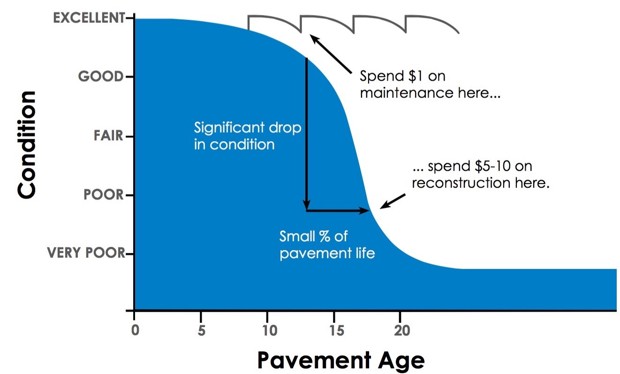
Timing matters when it comes to pavement. Roads don’t wear down at a perfectly gradual rate; after a certain point, says Cameron, there’s a steep drop-off in condition. Fixing a road before that cliff can be the difference between low-cost minor maintenance and pricy major reconstruction. Part of the reason the U.S. and (to a lesser extent) Canada face such costly infrastructure crises today is that officials have deferred so much street repair.

Big cities can shell out hundreds of thousands of dollars for their own road-quality vans or pay high consulting fees, but smaller ones can only afford to bring in the professionals every few years. As a result they might rely on less-objective data to fill the gaps and run the risk of missing those critical maintenance windows. But Cameron estimates that TotalPave provides a similar service at 15-to-20 times less than a typical one-time road assessment.

The reason is simple: the TotalPave package requires little more than a smartphone.

Right now the company offers two services. One is called TotalPave IRI, short for International Roughness Index. Local road managers can load the program onto a phone, mount it to any “road-worthy vehicle,” press the big green button, and start cruising around town. The IRI program logs accelerometer data from the phone’s micro-movements and pairs it with GPS data and any prior road conditions input into the system to spit out a single value of infrastructure quality.

“A rougher road is going to cause the vehicle to vibrate more,” says Cameron. “We’re looking for really, really small undulations. We’re not looking for potholes and huge dips and what-not. It’s a lot finer detail.”

The other product is TotalPave PCI, short for Pavement Condition Index. A street surveyor in the field can punch in standard road distresses—anything from a longitudinal transverse crack to a one-foot-deep pothole—and automatically get a PCI value in return. Anyone can be trained to use the program in half an hour, says Cameron, meaning cities can have an intern do the task rather than spending money on an outside consultant or taking up time from a salaried staff engineer.

A sample screenshot from a TotalPave web portal. (TotalPave)

Together the IRI and PCI tools can help local planners craft a street repair program that’s right for the city. “You can do as simple as exporting an Excel sheet and saying: ok, these ones here are about to fall off the cliff, so let’s see if we can do some minor maintenance on it,” says Cameron. “Or you can get all the way up to optimization models.”

Data for small-city planners

After that fateful day in fourth-year, Cameron studied smartphone-based road assessment for a masters thesis at the University of New Brunswick. The method proved a bit less accurate and more variable than high-tech consulting firm vans but “well within the range that you need to perform this kind of analysis,” he says. The idea subsequently earned him a seed round of $100,000 in an innovation competition, he says, and TotalPave officially launched in 2013.

In 2015 the company ran an early adopter’s program with four paid clients in Canada. One was the City of Fredericton, where Cameron previously worked as a summer student, which tested out the PCI program.

Mike Walker, the manager of roads and streets for the town of 50,000, and Jody Boone, a project engineer with the city, tell CityLab they would typically assess PCI by driving around town and conducting a visual inspection. That eye test, coupled with their knowledge of a street’s age, led to judgment calls about what needed to be resurfaced or treated. There was nothing wrong with that system, but using TotalPave made things “a little bit more objective,” says Boone.

“The visual inspection—that’s a little based on our own personal thoughts,” he says. “The different distresses that are actually happening out on the road, now they’re all recorded. You can categorize them based on a proper replacement year instead of an approximate age.”

Where the system might really come in handy for Fredericton is long-term planning. Knowing exactly when a pothole has been patched helps “project the life of the road out,” says Boone. Since the TotalPave system works off GIS maps of a city, it’s possible to combine road indexes with information on curbs, sidewalks, and other surface infrastructure—a convergence that can help coordinate repair jobs. Plus a map of streets colored by quality is just a strong visual for funding presentations.

“When we discuss things with our mayor and council,” says Walker, “we’ll have that data to back some information up.”

There’s still room for improvement. During his TRB pitch, Cameron acknowledged to Gabe Klein, the former Chicago and D.C. transportation chief who served as a contest judge, that the TotalPave system had not received a third-party validation. Cameron says his thesis revealed no statistically significant IRI differences with an existing street profile—so long as the smartphone was securely mounted in a vehicle—but the company continues to refine the program.

Imperfections aside, there’s a clear value in providing small and midsized cities with a reasonably priced alternative to the same types of infrastructure tools that large metros take for granted. Cameron says TotalPave is raising a round of venture capital at the moment and hopes to be in 38 municipalities within the first year of operations. Longer-term the company has targeted 13,500 cities in the U.S. and Canada that seem primed to benefit from such a service.

“We think these will be the municipalities that don’t currently collect the data or are fairly new to it,” he says. “Going from not collecting data at all to collecting any kind of data is a huge jump.”

21 Jan 23:43

The Dutch (Obviously) Are Building a Bike Lane Out of Wood

by Feargus O'Sullivan
Image Flickr/Fabio Bruna
Flickr/Fabio Bruna

A city in the Netherlands is trying out what might be the most Dutch plan yet conceived: a bike path made of recycled wood. The first of its kind in the world, the proposed path near the city of Emmen would be surfaced not with the usual asphalt or tarmac but with paving slabs formed from wood chips packed together with organic resin. To give the path an even daintier carbon footprint, it will be lit with eco-dynamic LED lighting made with bio-composite that lights brightly only when passing riders trigger sensors.

The idea behind the path is to cut the use of conventional, less eco-friendly materials such as concrete and aluminum, which require fossil fuels in the production and are far less easy to recycle. Not only will the wood chips and sawdust used for the new surface be carbon neutral, their creation will require no direct felling of trees; the company leading the experiment, Grontmij, plans to use waste product from sawmills.

The idea of creating permanent infrastructure from a substance that is celebrated for its biodegradability might seem ludicrous. But the path’s engineers insist that the wood and resin surfacing will be very durable, with a working life at least as long as concrete or asphalt. Rudi van Hedel, project manager of bio-based economy at the consultancy Grontmij, explained to Dutch magazine Cobouw that the light weight of the proposed material also makes them far easier to move and re-use:

“The bio-composite materials [we use] are less damaging to the environment to produce. They’re green resources so they contribute to a bio-based economy. Additionally bio-composite materials versatile and removable allowing you to customize a bike path easily to increasingly diverse users.”

The plan sounds promising, but it’s starting small. The first stretch will be just 200 meters (656 feet), a try-out space designed to test the material’s durability and construction over a period of several years. As a micro-project it’s going to cost a little more, the project’s leaders admit. But if it’s successful, it could be rolled out for the same or less as for conventional materials, van Hedel tells CityLab:

“At present, the material costs of the Eco-Dynamic Cycle track are higher than of traditional paths made of asphalt or concrete, but the construction costs are comparable or perhaps slightly cheaper. We expect that as production capacity increases the costs will go down. In the future we hope to use cheaper bio-fibers than the wood fibers we’re currently experimenting with, and ultimately we expect that bio-composite materials will be able to compete with asphalt and concrete.”

On top of this, the path should look great. Its LED lighting will be designed to change intensity and color depending on the time of day, blending more harmoniously into the landscape.

The path will break new ground, but it will be far from the first innovative cycle track the Netherlands has seen over the past few years. In 2014, the country created a path paved with solar panels, as well as this shimmering, luminescent cycle way inspired by van Gogh’s Starry Night. Holland’s bicycle network may be perilously close to full capacity, but at least the country is managing to make a name for itself for a highly unusual national obsession—creating the world’s prettiest, most innovative bike infrastructure.


19 Jan 20:41

How You Will Die

by Nathan Yau

How You Will Die

So far we've seen when you will die and how other people tend to die. Now let's put the two together to see how and when you will die, given your sex, race, and age. Read More

19 Jan 02:00

Photo


16 Jan 00:06

Facebook Busted Trying To Fake Support For Its Net Neutrality Positions In India

by Karl Bode
For much of the last year now, Facebook has been under fire in India for its "Free Basics" zero rating campaign, which exempts Facebook-approved content from carrier usage caps, purportedly to the benefit of the nation's poor. Critics however have argued that Facebook's just trying to corner developing ad markets under the banner of altruism, and giving one company so much control over what's effectively a walled garden sets a horrible precedent for a truly open Internet. Indian regulator TRAI has agreed so far, arguing that what Facebook is doing is effectively glorified collusion, and it's demanding that Facebook shut the program down until a public conversation about net neutrality can be had.

Like any good giant international company, Facebook's response to this call for open and honest dialogue has been to launch a mammoth media and lobbying blitz across India. The campaign has included buying entire newspaper spreads in which Mark Zuckerberg professes to be super worried about the country's farmers, to some subtle, local advertising:But as we noted a few weeks ago, Facebook also engaged in some pretty shifty behavior to try and trick people into spamming Indian regulators in favor of Facebook's Free Basics plan. Numerous people complained that the Facebook app tricked them into signing and sending a complaint to TRAI, after the regulator issued a call for public feedback on the country's nascent net neutrality rules:

Got conned into signing the #FreeBasics petition on FB. DON'T "SCROLL DOWN TO LEARN MORE"! Signs you up immediately! pic.twitter.com/XqpyQSdUlN

— Accidenteshwari (@accidenteshwari) December 18, 2015
Facebook subsequently admitted it also "accidentally" sent the message to U.S and UK users as well, resulting in a flood of "feedback" from people who don't live in India and may not even know what Free Basics is. Amusingly, TRAI appears to have noticed the spam attempt and called Facebook's bluff. In a public notice (pdf), TRAI notes that it received 2.4 million responses in total, with about 1.9 million of them associated with Facebook's media campaign domains.

Being Facebook-generated form letters, TRAI points out that none of these responses appear to answer any of the questions the regulators put forth in its original call for feedback. Facebook's response, attached to the filing, is to claim that the company actually helped generate 11 million supporters of Free Basics, yet it mysteriously has no idea where these missing 9.1 million responses disappeared to. In other words, Facebook not only tried to trick its users into spamming the government, but it appears it may have lied about the overall volume of support Free Basics had.

Combined with Zuckerberg's claims that opponents of Free Basics are extremists that hate the poor, Facebook's making an excellent case for its critics who say that creating a walled garden version of the Internet in which Facebook is king is a very bad idea. A better idea? As numerous folks have suggested, how about putting all of this money being spent on Free basics, lobbying, spamming and marketing into actually updating India's lagging broadband infrastructure?

Permalink | Comments | Email This Story


14 Jan 01:23

What Do Drivers Really Think About Cyclists?

by Eric Jaffe
Image AP Photo/Molly Riley
AP Photo/Molly Riley

Drivers and cyclists don’t always get along, nor do they shy from critiquing one another’s road behavior in words unfit for print. But it’s nice to think that maybe somewhere, deep down, they hold a grudging respect for the fact that the other group is just trying to get around, day to day, on frustrating city streets.

Nice, but evidently wrong. For a new survey, presented this week during a transportation conference, researcher Tara Goddard and colleagues at Portland State University asked drivers and cyclists to rate how well both mode groups are able to “follow the rules of the road” or to be “predictable” on the street. While neither group scored great in the exercise, cyclists scored way worse—especially in the eyes of drivers who never ride a bike.

The survey included nearly 2,300 people in five major U.S. metros: Austin, Chicago, Portland, San Francisco, and Washington, D.C. The slight majority (52 percent) were classified primarily as “drivers,” meaning they took “some” or “most” of their trips by car. (If this share feels low, it’s probably because the respondents tended to live in or near the downtown cores.) The rest were considered “non-drivers,” even if they did occasionally get behind the wheel.

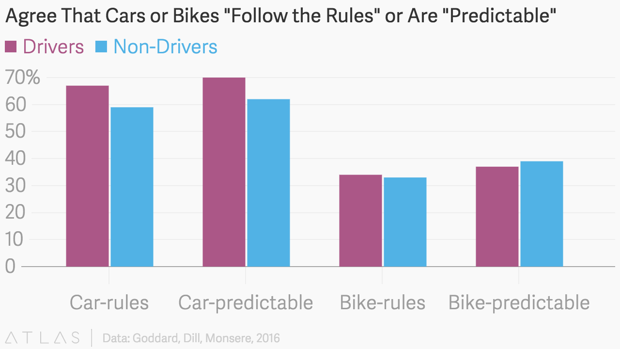
Initial results show that drivers themselves recognized that a lot of their kind don’t always do right by the road. Only 67 percent of drivers agreed that other drivers follow the rules, and 70 percent agreed they’re predictable; non-drivers were significantly less inclined to agree—59 and 62 percent, respectively—though the majority were still fine with driver behavior.

But when it came to cyclists, neither drivers nor non-drivers thought people on bikes followed the rules or rode predictably, with only about a third agreeing that was the case. So in these five cities—among those generally considered progressive when it comes to street life—bicyclists have a universal perception problem. It’s not just that drivers don’t think much of how people ride bikes; no one really does.

CityLab

In an accompanying paper, Goddard and company try to explain this perceived gap in how well drivers and cyclists behave on the road. The negative attitude toward cyclists could be plain wrong, and indeed some work shows people on bikes to be highly compliant with traffic rules. It might also be true that some cyclists do act unpredictably—often understandably, since they’re operating in a street environment designed for another travel mode—and that drivers latch on to these selective cases as confirmation bias.

Here’s more:

The highly positive evaluations of drivers as predictable likely reflects the success of traffic engineering in creating a system in which most users understand the expected behaviors, and (mostly) abide by them. This attitude may also be explained by familiarity—drivers understand what other drivers are doing on the roadway.

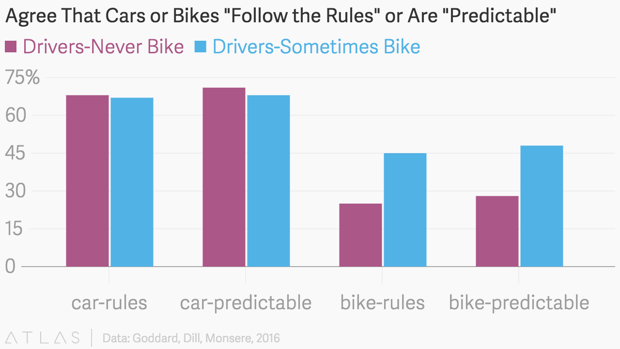
That sense of familiarity does seem to matter. The survey also found that drivers who occasionally get on a bike themselves do show some sympathy for the cyclist.

Once again, about two-thirds of drivers—both those who never bike and those who occasionally do—agreed that people in cars abide the rules. But drivers who never bike think considerably less of cyclist behavior than those who do sometimes ride. About 25 and 28 percent of never-bike drivers agreed that cyclists follow the rules or are predictable, respectively, whereas 45 and 48 percent of sometimes-bike drivers felt the same.

CityLab

The results took a disturbing turn when Goddard and company asked respondents about their support for building more protected bike lanes. The same people who disagreed that cyclists follow the rules of the road or who disagreed that their riding behavior is predictable—in short, drivers—were significantly opposed to the idea of expanding bike infrastructure. So too were respondents who didn’t ride at all.

That’s a striking finding when you consider that protected bike lanes would seem to grant drivers precisely what they desire: some separation from cyclists. In that light, this attitude can be interpreted in a couple ways. Perhaps drivers, who already perceive cyclists to be reckless, doubt that people on bikes will actually stay in their designated lane, making the infrastructure a waste of money. Or perhaps they’re just being spiteful toward a group of people they don’t like.

Whatever the reason, such a stance could have an outsized impact on a city’s ability to rally support for bike lanes, and thus to make its streets safer for all. The good news, write Goddard and company, is that “getting people on bicycles can improve how they view bicyclists.” That small success, in turn, might reduce overall opposition to bike initiatives; the researchers conclude:

Events and programs that result in even moderate increases in people’s bike use may have wide-reaching effects on their attitudes toward bicyclists and their willingness to support bicycle infrastructure in their communities. 


13 Jan 00:16

The Floating Sky Walk Plan That Could Change the Face of Stockholm

by Feargus O'Sullivan
Image Anders Berensson Architects
Anders Berensson Architects

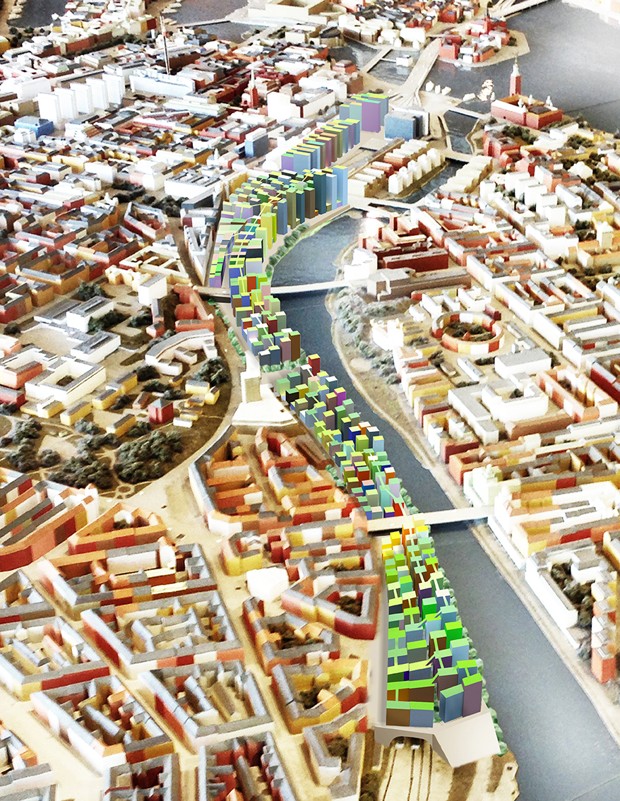
Could roof-straddling “sky walks” soon be coming to Stockholm? A new plan proposed for the Swedish capital would see a large slice of its city center built over with densely packed towers, joined at their peaks by a dramatic zigzag of tree-lined, open air gangways. Commissioned by Sweden’s opposition Center Party, the plan might seem a little fanciful. But it nonetheless answers some key questions that Stockholm is currently being forced to ask itself. Sweden’s capital is one of the fastest growing cities in Europe, with a population due to swell by 17 percent in just nine years. If it isn’t going to sprawl unmanageably or become overcrowded, it’s going to have to find somewhere to put everyone. One key solution could be to densify, as the proposal suggests, by rooting out and building on every scrap of currently un-built inner city land.

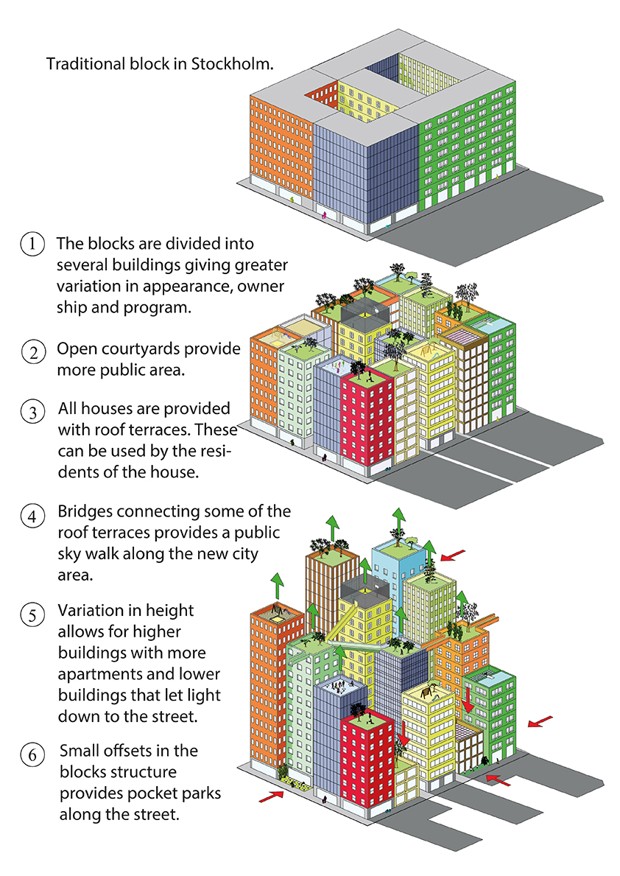
Called Klarastaden, or “clear city”, the plan comes from Anders Berensson Architects. While the group’s utopian bent might be clear from previous designs that include such oddities as folding saunas and luxury nests for swallows, Klarastaden does identify a useful site: a knot of railway tracks that could be built over behind Stockholm’s Central Station. As renderings show, this site could be transformed into a snaking tail of high-rises—necessarily dense so that profits can cover the high cost of burying the railway tracks within a tunnel. Towers of different widths and heights would be combined to prevent any building from feeling too hemmed-in or dingy, with every second building rising no more than four floors. Strung together, this would make the development’s overall silhouette resemble a badly broken comb. In a fashionable nod to look-at-me urbanism, these towers would be capped by a high-rise park, connected by pathways strung like tightropes across the chasms between the towers.

(Anders Berensson Architects)

Whether the skywalk feature itself is a good one is a matter of reasonable debate. New York’s High Line may have made half the world’s cities crave a tourist-friendly panoramic walkway, but such isolated high-level pathways have also given many modernist housing projects a reputation for poor security. Given that Center Party commissioners aren’t actually in power in Stockholm, the plan’s tree-capped, snaggle-jawed layout isn’t exactly slated for immediate construction. Perhaps acknowledging this, the architects have also created a diagram showing how its approach of mixed heights and sky walks could be adapted as a way of densifying other already built up sites.

(Anders Berensson Architects)

The proposal addresses issues that many European cities faced with rising land values and limited space are currently considering. London is bristling anew almost every day with towers. Controversially, these are moving away from the financial district to traditionally residential areas, as is the case with this planned Renzo Piano cylinder. Paris is letting the odd skyscraper creep onto its fringes, while Berlin has just green-lighted a residential tower that critics have called an “architectural crime.” Plans to build an entirely new section of central Stockholm are nonetheless likely to face more than average resistance. The city, you see, has already tried it before: In the 1950s, it demolished large parts of the city center to build wider streets and taller, more modern buildings. As Klarastaden’s architect Andreas Berensson tells CityLab:

As capital of a neutral country, Stockholm escaped any destruction in World War II. The city still demolished and rebuilt large areas in the 1950s and ‘60s—we’re the only city in Europe to have actually bombed ourselves. This has made Stockholmers especially skeptical about modern architecture.

Winning locals over to accepting a comet’s trail of new towers capped with a kooky adult playground in their city’s heart might be quite a reach. Strip the skyway embellishments away from the Klarastaden plan, however, and you’re still arguably looking at what in many European cities could be the shape of things to come.


12 Jan 14:43

Fucking Chad, Man

10 Jan 16:57

Alexander Colders

by Bill Amend

ft160110alexandercolders

09 Jan 16:54

Try to win the lottery

by Nathan Yau

Lottery simulator

The Powerball Lottery is big news in the United States right now. The jackpot sits at $800 million, they draw the numbers on Saturday, and it's likely someone is going to suddenly be rich soon.

This naturally comes not long after the Gaming Commission changed the rules last October, which increases the odds of winning something but decreases the odds of winning the jackpot.

In case you're not familiar with the rules of the game: Players choose five numbers and one “Powerball” number. The first five numbers used to range from 1 to 59 but since October, they range from 1 to 69. Conversely, the Powerball number used to range from 1 to 35, but now they're 1 to 26. That shifts the odds of winning the jackpot from about 1 in 175 million to 1 in 292 million.

So something very unlikely, became much more unlikely. Hence the current big jackpot.

Screw the odds though. That's a lot of money and will buy you enough tacos to make your head spin. Jon Schleuss for the Los Angeles Times provides a simulator to try your hand.

Lose your paycheck for pretend here.

Tags: lottery, simulation

07 Jan 20:32

T-Mobile Doubles Down On Its Blatant Lies, Says Claims It's Throttling Are 'Bullshit' And That I'm A 'Jerk'

by Mike Masnick
On Monday we wrote about T-Mobile flat out lying about the nature of its BingeOn mobile video service -- and after a couple of days of silence, the company has come out swinging -- by lying some more and weirdly attacking the people who have accurately portrayed the problems of the service. As a quick reminder, the company launched this service a few months ago, where the company claimed two things (though didn't make it entirely clear how separate these two things were): (1) that the company would not count data for streaming video for certain "partner" companies and (2) that it would be "optimizing" video for all users (though through a convoluted process, you could opt-out).

There were a bunch of problems with this, starting with the fact that favoring some partner traffic over others to exempt it from a cap (i.e., zero rating) is a sketchy way to backdoor in net neutrality violations. But, the bigger issue was that almost everything about T-Mobile's announcement implied that it was only "partner" video that was being "optimized" while the reality was that they were doing it for any video they could find (even downloaded, not streamed). The biggest problem of all, however, was that the video was not being "optimized" but throttled by slowing down video.

Once the throttling was called out, T-Mobile went on a weird PR campaign, flat out lying, and saying that what they were doing was "optimizing" not throttling and that it would make videos stream faster and save users data. However, as we pointed out, that's blatantly false. Videos from YouTube, for example, were encrypted, meaning that T-Mobile had no way to "optimize" it, and tests from EFF proved pretty conclusively that the only thing T-Mobile was doing was slowing connection speeds down to 1.5 Mbps when it sensed video downloads of any kind (so not even streaming), and that actually meant that the full amount of data was going through in many cases, rather than an "optimized" file. EFF even got T-Mobile to admit that this was all they were doing.

So that makes the response of T-Mobile execs yesterday and today totally baffling because rather than actually respond to the charges, they've doubled down on the blatant lying, suggesting that either it's executives have no idea what the company is actually doing, or that they are purposely lying to their users, which isn't exactly the "uncarrier" way that the company likes to promote.

We'll start with the big cheese himself, CEO John Legere, whose claim to fame is how "edgy" he is as a big company CEO. He's now released a statement and a video that are in typical Legere outspoken fashion -- but it's full of blatant lies. The video and the typed statement are fairly similar, but Legere adds some extra color in the video version.

Let's parse some of the statements. I'll mostly be using the ones from the written statement as they're easier to cut and paste, rather than transcribe, but a few from the video are worth calling out directly.
I’ve seen and heard enough comments and headlines this week about our Binge On video service that it’s time to set the record straight. There are groups out there confusing consumers and questioning the choices that we fight so hard to give our customers. Clearly we have very different views of how customers get to make their choices -- or even if they’re allowed to have choices at all! It’s bewildering …so I want to talk about this.
Of course, this is a nice, but misleading attempt to frame the conversation. No one is complaining about "giving choices to consumers." They're complaining about (1) misleading consumers and (2) providing a worse overall experience by throttling which (3) directly violates the the FCC's prohibition on throttling. The next part I'm taking from the video itself, rather than the printed statement, because Legere goes much further in the video, including the curses, which magically don't show up in the printed version:
There are people out there saying we’re “throttling.” That's a game of semantics and it's bullshit! That's not what we're doing. Really! What throttling is is slowing down data and removing customer control. Let me be clear. BingeOn is neither of those things.
This is flat out wrong and suggests Legere doesn't even know the details of his own service. As the EFF's tests proved (and the fact that YouTube videos are encrypted should make clear) T-Mobile is absolutely slowing down data. In fact, EFF got T-Mobile to confirm this, so Legere claiming it's "bullshit" is... well... bullshit!

But he's playing some tricky word games here, claiming that throttling is not just slowing down data, but also removing customer control. That's (1) not true and (2) also misleading. For all of Legere and T-Mobile's talk about "giving more options to consumers" or whatever, they're totally leaving out the fact that they automatically turned this on for all users without a clear explanation as to what was happening, leading to multiple consumer complaints about how their streaming videos were no longer functioning properly -- even for users on unlimited data plans.

Customer choice? Sure they could "opt-out" after through a convoluted process that many did not understand. But T-Mobile made the choice for all its users, rather than providing a choice for its customers to make.
Mobile customers don’t always want or need giant heavy data files. So we built technology to optimize for mobile screens and stream at a bitrate designed to stretch your mobile data consumption. You get the same quality of video as watching a DVD, but use only 1/3 as much data (or, of course, NO data used when it’s a Binge On content provider!). That's not throttling. That's a huge benefit.
Again, this is both wrong and misleading. There is no optimization. Legere is lying. They are 100% slowing down the throughput on video when they sense it. The EFF's tests prove as much. Yes, for some video providers when they sense lower bandwidth, they will downgrade the resolution, but that's the video provider optimizing, not T-Mobile. T-Mobile is 100% throttling, and hoping that the video provider downgrades the video.

But in cases where that doesn't happen then it doesn't save any data at all (the EFF test confirmed that the full video file still comes through, just slower).

Also, note the play on words "You get the same quality of video as watching a DVD." At first you think he's saying that you get the same video quality overall, but he's not. He's saying as a DVD, at 480p, which is lower than the 1080p that many HD videos are offered at. And that's what many people are complaining about -- that they'd like to watch videos at the full 1080p, but T-Mobile made the choice that they can't do that unless they go through a convoluted process to turn this off.

Rather than respond to any of this, Legere then claims that "special interest groups" and Google are doing this.... "to get headlines."
So why are special interest groups -- and even Google! -- offended by this? Why are they trying to characterize this as a bad thing? I think they may be using Net Neutrality as a platform to get into the news.
Wait, what? Google -- the same Google that absolutely refused to say anything publicly at all about net neutrality for years during the debate suddenly wants to get into the news by jumping on the net neutrality bandwagon? Does Legere have any idea how ridiculous that sounds? And it's not like Google has a problem getting into the news. And what about EFF and others? Does he really think they need to get extra news coverage?

But note the facts here: at no point does Legere respond to the actual charges leveled against the company. He then concludes by yelling at everyone for daring to complain about this:
At T-Mobile we're giving you more video. More choice. And a powerful new choice in how you want your video delivered. What's not to love? We give customers more choices and these jerks are complaining, who the hell do they think they are? What gives them the right to dictate what my customers, or any wireless consumer can choose for themselves?
Nice. I'm part of the contingent complaining about this and I'm also a T-Mobile customer... and the CEO just called me a jerk while telling me he's fighting for his customers? Really now?

And again this whole statement is blatantly misleading. The "choice" was made by T-Mobile for all users, and getting out of it involves a convoluted process that most don't understand and where none of this was made clear to end users. Beyond violating the FCC's "no throttling" rule, I wonder if it also violates the FCC's transparency rules as well, in which they are required to be much more upfront about how the data is being treated.

Also, the statement above is from the video where we're described as "jerks," but in the written version it leaves out the "jerks" claim, but also includes the following bit mocking YouTube for letting users choose to change the resolution on videos:
YouTube complained about Binge On, yet at the same time they claim they provide choice to customers on the resolution of their video. So it's ok for THEM to give customers choice but not for US to give our customers a choice? Hmmm. I seriously don't get it.
But that's bullshit also. YouTube's choice option there is a clear pulldown on every video shown, so that a user just needs to click on the video their watching and set the resolution. T-Mobile's is a process that's not clear at all, with some users reporting they had to call in and get T-Mobile customer service to turn BingeOn off for their account. To compare the two situations is completely bonkers.

As far as I can tell, Legere either doesn't understand what his own company is doing technically, or knows and is purposely misrepresenting it. Neither of those look good and go against the entire "uncarrier" concept they keep pitching. I'd expect better as a T-Mobile customer than being told that I'm a "jerk" for pointing this out.

And it appears he's not the only one among senior execs at T-Mobile who still don't realize what their own company is doing. On Wednesday at a Citigroup conference, T-Mobile's Chief Operating Officer Mike Sievert spewed some more nonsense suggesting he, too, has no idea what his own company is doing:
At a Citigroup investor conference Wednesday, T-Mobile executives shot back, saying YouTube’s stance is “absurd.” YouTube is owned by Alphabet Inc. “We are kind of dumbfounded, that a company like YouTube would think that adding this choice would somehow be a bad thing,” said T-Mobile Chief Operating Officer Mike Sievert. He said YouTube hasn’t “done the work yet to become part of the free service.”
Taken at face value, that comment makes no sense. If YouTube hasn't done the work yet to become a part of the free service than why the fuck is T-Mobile slowing down its videos? YouTube wasn't complaining about "adding this choice." YouTube was complaining about direct throttling of video content by T-Mobile, in clear violation of the FCC's prohibition on throttling.

Sievert and Legere both don't seem to understand (1) what YouTube and users are complaining about or (2) what his own company is doing. That's... troubling, given that these are the CEO and COO of the company. It really seems like T-Mobile execs might want to spend some time talking to its tech team to understand the fact that the only thing T-Mobile is doing to video is throttling it down to 1.5 Mbps, rather than any actual "optimization" before spewing more nonsense and calling their own customers "jerks." And, they might want to realize that their claim that this is all "bullshit" is actually complete bullshit. And that their bullshit may very well violate the FCC's rules.

Permalink | Comments | Email This Story


07 Jan 20:31

The Airplane of the Future Could Be Much More Accessible for Passengers With Disabilities

by Aarian Marshall
Image REUTERS/Jason Redmond
REUTERS/Jason Redmond

For airline passengers with disabilities, logistical headaches exist at every turn. Imagine navigating a security line without being able to hear the capricious and ever-changing instructions of TSA agents; sitting through a long-haul flight without the take-it-for-granted option of in-flight entertainment; trying to navigate a wheelchair to a tiny lavatory through thin airplane aisles.

But in early December, the Department of Transportation announced it’s exploring the possibility of new regulations that could force airlines to make additional accommodations for travelers with disabilities. DOT is gathering feedback on creating new in-flight entertainment options for people with visual or hearing impairments, fitting accessible bathrooms on new single-aisle aircraft, and producing firm and fast rules about service animals.

Airlines are not subject to the American Disabilities Act, but companies with foreign and domestic flights terminating in the U.S. come under the Air Carriers Access Act. This law requires air carriers to provide “reasonable accommodations” to those with disabilities, up until those accommodations pose risks to other passengers or cause the airlines “undue burdens.” What that term means is clearly up for debate.   

Why is this an issue now? More and more airlines are using small planes on very long flights, DOT notes. Those flights tend to have limited bathroom space. Eric Lipp is the director of the Open Doors Organization, which advocates for those with disabilities within the travel industry. He is partially paralyzed and uses an electric scooter to travel, but it’s simply too big for an airplane cabin and has to travel with the luggage. On flights, Lipp told the Chicago Tribune last month, he has to contact a flight attendant, be transferred to an on-board, folding wheelchair, and wheeled to a bathroom.

Current federal regulations only require airlines to place these wheelchairs on small planes with no accessible lavatory—the ones used increasingly often on long flights—if a passenger has given 48 hours’ notice.

And then when he actually gets to the restroom, Lipp faces the prospect of navigating around a mini airplane lavatory. It’s an ordeal, he said.

Of course, requiring companies to “take a few seats out and put [an accessible bathroom] in,” as Lipp suggests, has a serious downside for the airlines: Fewer seats to sell.

Try speeding your wheelchair down this Delta narrow body jet. (Wikimedia Commons/Cweyer)

But the Open Doors Organization suggests there’s an economic case for accessible airplanes, too. According to the group’s 2015 survey, 11 million travelers with disabilities took 23 million trips over the past two years, spending $9 billion on their flights in the process. But 72 percent of those who traveled by air said “they encountered major obstacles with airlines,” indicating there’s a lot of room for improvement.

An addendum: Those numbers may not include older people, many of whom face similar types of challenges, like trouble walking, hearing, seeing, or communicating. They could use more accessible bathrooms, too.

There has been improvement on the issue of restrooms, specifically. More and more airlines have voluntarily purchased planes with restrooms like Airbus’s Super-Flex, which puts a moveable wall between two lavatories that can be rolled away by the crew to create one big, wheelchair-accessible throne. Airbus tells CityLab that 57 aircrafts equipped with the Super-Flex concept have been shipped, with more on the way.

A wheelchair accessible bathroom on board an Air Canada Boeing 787 Dreamliner. (REUTERS/Aaron Harris)

The DOT regulation process now moves to the comment stage, when anyone—even you!—can offer input via web or mail. This ends January 21. If all goes according to plan, the process then moves to a “negotiated rule making” phase, which is a deliberation between the government and interest groups: airlines, aircraft manufacturers, disability advocates, the people who make content for in-flight entertainment, and the people who make wheelchairs, to name a few. Which is all to say: Buckle up. This could take some time.


07 Jan 20:27

FBI Turns 18-Year-Old With An IQ Of 51 Into A Terrorist; Dumps Case Into Laps Of Local Prosecutors

by Tim Cushing

Another would-be terrorist is in the hands of law enforcement, thanks to a joint effort by the FBI and the St. Clair (Alabama) Sheriff's Department. (h/t The Free Thought Project)

An Alabama prosecutor says an 18-year-old has been charged with soliciting or providing support for an act of terrorism, though details of the case aren't being released.

St. Clair County District Attorney Richard Minor said Tuesday that 18-year-old Peyton Pruitt of St. Clair County was arrested and charged Friday.
County Judge Alan Furr set Pruitt's bail at $1 million and refused to lower it, despite evidence surfacing that the young man is developmentally-disabled (IQ estimated at 52-58, last tested at 51) and the total amount of "support" was "less than $1,000" -- a Class C felony, which normally results in much lower bail amounts. (The guidelines in the state's criminal procedure rules suggest a $5,000-$15,000 range, although judges are free to depart from this recommendation.)

Judge Alan Furr must not like alleged terrorist sympathizers. Two accused murderers and a teacher charged with sexual misconduct involving a student who previously faced Judge Furr combined for less than half the amount set for Pruitt ($450,000).

This is the dangerous terrorist now behind bars.
Witnesses, friends and family members uniformly described Pruitt as a "child" - a teenager with an IQ of 51 who cannot tie his own shoes, soils his clothes, has little verbal skills and lacks the ability to distinguish reality from fantasy.
The FBI, which has never shown any reluctance to trumpet its ability to push mentally-challenged people towards acts of terrorism, doesn't have much to say about this particular bust. It seems content to let local law enforcement run with this one, bringing state charges rather than federal. But it's still behind the elevation of Pruitt from a guy who needs assistance using the restroom to a guy who provides assistance to enemies of the United States.
Chief Investigator Tommy Dixon testified, reading from an FBI transcript of a four-hour interview on Nov. 13 with Pruitt, that the teenager expressed sympathy with Islam and shared information on how to construct bombs that he obtained from Inspire, an online magazine linked to al-Qaeda in the Arabian Peninsula. To access the information, Pruitt referred them to a Wicr [sic] account, an encrypted instant messaging application.

Dixon said Pruitt had told the FBI "he would be happy" if acts of terrorism were carried out. "He felt it would be understandable," he said. He also suggested targets for terrorism, including the CIA headquarters, police stations and "big events" such as football games, Dixon said.
Beyond quoting from FBI interview transcripts, local prosecutors and law enforcement have said nothing about the case. They claim they can't jeopardize an ongoing information. But it appears they may not actually be in possession of much more than what the FBI has handed them, which may not be everything it has.
Under repeated questions from Pruitt's attorney Gibson Holladay, Dixon said his testimony came from the FBI transcript and not any first hand evidence. Holladay also questioned the logic of charging Pruitt with soliciting material support for a terrorist act by reading the statute and asking if Pruitt had provided a safe house, or false documents, or money, or transportation to terrorists. Dixon said he had no knowledge of whether he had or hadn't. Prosecutors objected to the questions.

"All you've got is Peyton's statement, right?" Holladay said. "You couldn't tell me if Peyton contacted Santa Claus or a terrorist, can you? Was it a bomb or a recipe for banana pudding? You don't know, do you?"
It certainly looks like the FBI realized it has a potential PR nightmare on its hands and somehow persuaded the locals to take the case. The agency is refusing to answer any questions, referring all queries to the St. Clair County District Attorney's office.

The few things local prosecutors have actually said -- that aren't direct quotes from FBI paperwork -- have been completely ridiculous.
Dixon said in his testimony that the FBI is still reviewing Pruitt's computer. But several of Minor's questions suggested other evidence. During Waldrop's testimony, Minor asked if she would be surprised to learn Pruitt had used an encrypted website, she said yes.

Reading statements, he asked, "Would it surprise you that he can quote the Koran?" She said yes.
Both perfectly legal acts. I use an "encrypted website." (This apparently refers to Wickr, suggesting prosecutors really have no idea what they're actually dealing with.) I use Wickr and can quote from religious texts (even the unpopular ones). So what? Even combined, these two things add up to nothing. But these prosecutors are trying desperately to make both acts sound ominous and supportive of their assertions that an 18-year-old incapable of tying his own shoelaces posed a legitimate threat to those around him and, indeed, the security of the nation.

Thanks to the same judge who refused to lower Pruitt's bail, prosecutors won't have to face any tough questions in the immediate future.
A St. Clair County judge sent the case of a teenager accused of soliciting support for a terrorist act onto a grand jury as part of a two-hour preliminary hearing in Pell City today.
This is the normal chain of events for serious felonies in Alabama, but one that will allow the prosecutors to present the FBI's evidence without being challenged by incredulous defense attorneys or distracted by the sight of the defendant silently "rocking back and forth" while the next 1-10 years of his life are discussed.

From here, it looks as though the FBI has finally developed a sense of shame and has chosen to ditch this turdball with local prosecutors. Unfortunately, its sense of shame hasn't compelled it to drop the case or otherwise dissuade far-too-enthusiastic prosecutors from pursuing this further. Both ISIS and the FBI have a fondness for "useful idiots," but neither should actually find anything useful in a person who's mentally unable to handle their own bodily functions, much less contribute to a terrorist group in any meaningful way.

Permalink | Comments | Email This Story


07 Jan 04:01

Photo


07 Jan 03:58

Told Me

by Reza

told-me

07 Jan 03:50

UK Legislators Want To Toss Tech Company Officials In Jail If They Inform Users About Government Surveillance Efforts

by Tim Cushing

Default mode at tech companies these days is to inform users of government surveillance. Unless explicitly forbidden to do so, multiple companies have stated they will inform users of requests for data or suspected state-sponsored hacking attempts.

The mechanisms inherent in US law usually prevent notification. Requests made by foreign governments, however, operate in a much grayer area. UK legislators are trying to close perceived loopholes with new legislation that would make it illegal to notify users of UK agencies' requests for data. (via Boing Boing)

Bosses at Twitter and other communications companies face up to two years in prison if they tip off customers that spies or the police are monitoring them under a proposed new law.

Ministers want to make it a criminal offence to notify the subject of a surveillance operation that requests of their data have been made, unless expressly allowed.

The move follows concerns some communications and social media firms will alert users if MI5, MI6, GCHQ or the police have asked for their records.
Even if this dubious proposal becomes law, it's unclear exactly how the UK plans to enforce this. Does it send cops to arrest the top exec at the offending company? Or would it go after a lower-level representative -- one that hopefully resides in UK to better avoid the diplomatic awkwardness of extradition proceedings? In all likelihood, if this proposal survives, the jail term will be replaced with a suitably large fine.

This stipulation has been added to the draft version of the Investigatory Powers Bill -- another attempt to broaden the UK's surveillance powers while codifying the quasi-legal spy efforts GCHQ and others already engage in.

This addition would close the "loophole" tech companies are using by shifting the legal burden. Tech companies say they'll notify users unless "expressly forbidden" to do so. The draft bill addition says companies can only notify users if they're "expressly permitted" to do so. With everything hanging on the government's permission, agencies will rarely have to provide justification for secrecy. Instead, the onus will be on tech companies to remain tight-lipped unless the UK government gives them the nod -- something that will undoubtedly be a rarity.

On the plus side, it's not just tech companies being targeted by additions to the draft bill. Similar consequences await those who abuse their surveillance powers.
The bill also proposes a new offence of knowingly or recklessly obtaining communications data without lawful authority.

The measure is aimed at ensuring those officials, officers and spies who access the personal data do so legitimately and appropriately.

Those who break the law will also face up to two years in prison.
Of course, enforcement of this proposed addition sounds just as unlikely as UK police officers handcuffing Google execs for informing a surveillance target of the UK government's interest in them.

I'd say we'll just have to wait and see, but the draft bill is becoming a dumping ground for every wild-eyed legislator's idea on how to better "secure" the UK against the threat of terrorism. There are certainly more, equally-terrible ideas on the way. The only hope is that most of these will be discarded as the bill moves forward. It's a given that far too many bad ideas will still survive, but with any luck, the worst suggestions won't make it into the final version.

Permalink | Comments | Email This Story


07 Jan 03:43

Britain Is Going Crazy for This Puddle of Water in Newcastle

by Feargus O'Sullivan
Image Screenshot via PressAssocation
Screenshot via PressAssocation

Today in Britain, a new Internet sensation was born. The new star is not a skateboarding cat, a swearing baby, a blooping newscaster, or a drunk person breaking a hip. It’s a puddle of water.

Yes, that’s right. Thousands of people have tuned in to watch a live feed of people trying to navigate their way across a pool that’s collected on a rain-flooded pathway in Newcastle, Northern England. As I write, the hashtag #drummondpuddlewatch is the number one trend on U.K. Twitter, and the puddle has even reached news bulletins. In a country that’s utterly in love with the banal—our top TV show features people baking cakes—people seem to have fallen for the sight of ordinary people making a modest effort to avoid getting their feet damp.

The Twitter commentary is coming fast and thick. Arguably bored silly on their first week back at work after the New Year, people are reveling in the puddle’s small-scale drama:

Best water-based drama since Jaws. #DrummondPuddleWatch https://t.co/kAdOxT1l60

— Kat Brown (@katbrown) January 6, 2016

COME ON ORANGE BAG LADY #DrummondPuddleWatch

— lisa johanna (@NotTheRehearsal) January 6, 2016

Others are marveling at the subtle underlying harmony present in the scene (in reference to this other recent U.K. meme):

Amazing. Like a Renaissance painting. #DrummondPuddleWatch pic.twitter.com/rhzg7sViNA

— Peter Gasston (@stopsatgreen) January 6, 2016

Predictably, the Drummond Puddle Cam has also spawned this odd meme:

Live puddle Cam #DrummondPuddleWatch pic.twitter.com/O8RlfJefn8

— yung content liker (@alexdaish) January 6, 2016

As news of the puddle has spread, things have gotten a bit meta. Some have pondered whether notoriety will go to the puddle’s head:

how long until the puddle becomes self-aware #DrummondPuddleWatch https://t.co/XzO1GL6GLk pic.twitter.com/Uqem1nm6nT

— Lisa Fleisher (@lisafleisher) January 6, 2016

These fears seem well-founded. As the puddle’s renown has grown, people have indeed exploited it for their own 15 seconds of fame:

About to go in the #DrummondPuddleWatch pic.twitter.com/MVwEtGEJiZ

— Anthony Kane (@anthonykane) January 6, 2016

Thousands are watching a livestream of a Newcastle puddle. Here's the now-famous pool up close #DrummondPuddleWatch https://t.co/O1hbujTl18

— Press Association (@PA) January 6, 2016

And some genius is now offering a 600ml bottle of Drummond Water for sale on eBay. It’s currently going for over £40,000 ($59,000). (Call us cynical but we’re wondering if the price might just possibly be a case of false bidding.)

There’s actually a serious story behind the puddle live stream. Following heavy rains, much of Northern England entered the New Year under water. The flood victims have complained that the lack of weather defenses is due to government cuts—reflecting a habitual neglect of England’s north by power elites in London and the South. For now, the Drummond puddle offers a light-hearted take on the post-flood cleanup, even though as dusk falls in the U.K., its place in the spotlight is likely to be all too fleeting.