I have to give the state of Florida credit. There’s something weirdly brilliant in this.
The state of Florida is planning to increase dramatically the percentage of students who are ready for college level courses by ... wait for it ... calling them ready!
I had not thought of that.
Starting in 2014, any student who entered the ninth grade in Florida after 2003-4, and who has a standard Florida high school diploma, will be automatically exempted from remedial classes. The exemption also applies to all active-duty members of the military.
As I read the story, students won’t be banned from remedial classes; they just won’t have to take them. Students who want to, apparently could. (How that would work with financial aid is left unclear.) I don’t imagine that many would, but they’d have the option.
I’m glad that Massachusetts isn’t doing this, but I’m also glad somebody is. Between Connecticut’s “one and done” remediation model and Florida’s massive exemptions, we’re seeing a couple of potentially revealing natural experiments. If nothing else, these should both provide valuable lessons for other states, whether positive or negative.
In a perfect world, of course, Florida’s law would be redundant. High school graduates would have the skills they need to be college-ready right out of the gate. This law would be as unnecessary as the NBA passing a rule that the average height of players on any given team must exceed six feet.
But this isn’t that world.
Even in the Florida case, they’ll have adult students who missed the window, high school grads who moved in from other states after the start of ninth grade, out-of-state students, and people with GED’s. So the exemption isn’t total. But it’s certainly sweeping.
The research I’ve seen over the last few years strongly suggests that much remedial coursework accomplishes little or nothing in terms of graduation rates; if anything, by increasing time to degree, it makes it likelier that life will get in the way. (I’ve also been less than impressed with the lack of predictive validity among placement tests.) To the extent that remediation is either ineffective or counterproductive, there’s certainly a strong argument for retiring it.
I’m still wary of such blunt-force interventions, though. Were it up to me, I’d prefer to see a combination of accelerated “boot camp” models, embedded as-needed help, and beefed-up tutoring centers. (My psychic powers tell me that this rule change won’t come with more money for tutoring. Call me cynical.) But ultimately, whether my preference would be more effective, or whether we should just rip off the band-aid and be done with it, can be settled empirically. After a few years, we should get a pretty good idea of the effects of Florida’s change (and Connecticut’s, for that matter).
Thanks, Florida, for volunteering to do something audacious, hamhanded, and possibly stupid. One way or another, the rest of us will learn from your example.
Leettaschmidt
Shared posts
Weirdly Brilliant
Go On And Call Me Fat; It's True
LeettaschmidtThis lady is always awesome.

Neuer Cartoon online - VERGESSEN vom 31.05.2013
|


Hairstyle archeologist proves crazy Roman 'dos were possible

    
|
Snow White and Rose Red illustrated by Gustaf Tenggren (1955)
LeettaschmidtI love this illustrator


Snow White and Rose Red illustrated by Gustaf Tenggren (1955)
George Takei responds to "traditional" marriage fans

Star Trek star and noted homosexual George Takei responds to bigots who believe in restricting the right to love to straight people only: an image gallery on Imgur. Oh, snap, oh glorious snap.
|
|
Hardwood Escher tesselated interlocking lizard tiles
LeettaschmidtI want this floor.

 The Spanish firm Arbore offered these custom Escher-inspired floor tiles back in 2011; from the looks of things, they're still available. It's a very well-executed conceit, done in hardwood.
Diseño geometrico inspiración Escher (via Geekologie) 
|
|
Research Notes, Day 5
When I pulled up the mermaids’ bios online, Frenchy saw the page from across the room and said, What do you have there, the Playboy Channel? Attraction is built into the myth, of course, starting with the Sirens, the Selkies, and the Finfolk, all those forbidden attractions, two separate worlds, the danger of drowning in love. I’ve long been interested in the idea of Weeki Wachee Springs, that “City of Live Mermaids.” It’s one of those “lost America” attractions that used to be in the middle of nowhere, back when having a car, time, and disposable income was a relatively big deal, and family trips—without electronics—was an (often miserable) adventure to see something you’d only seen in books, at best. There was also, I thought, a diver connection:
“In 1946, Newton Perry, a former U.S. Navy man who trained SEALS to swim underwater in World War II…experimented with underwater breathing hoses and invented a method of breathing underwater from a free-flowing air hose supplying oxygen from an air compressor, rather than from a tank strapped onto the back. With the air hose, humans could give the appearance of thriving twenty feet underwater with no breathing apparatus."
Some of that is a little problematic, since SEALs weren’t an organizational unit yet, and you don’t breath oxygen but air on those hoses. None of the other websites I saw mention his Navy service, and, saddest to me, no one at the park’s guest services, admission gate, or gift shop knew who Newton Perry was, even though the Mermaid Theater is named for him; apparently there is no history room at the park, which is state-run now. I’ll be buying books, looks like.
In any case, these are real live mermaids performing underwater in the spring’s limestone basin, which is about a hundred feet across, and the water crystal clear. We catch the afternoon show, “The Little Mermaid,” which the announcer on the speakers before and after the show stresses is Hans Christian Andersen’s “The Little Mermaid.” Disney is 83 miles up the road.
The young women are fit and attractive, and wear bikini tops and fabric tails (sometimes silicone, velour, or other materials, and they aren’t ballasted, one tells me) with a built-in flipper. The audience sits behind a glass wall, below surface level, and several mermaids, a sea witch, a sea turtle, and a prince act things out, dance in the Esther Williams mode, and lip-synch to a recorded soundtrack of dialog and song. The characters turn somersaults and swim in and out of sight and through a trap door. The current from the underwater spring outlet is said by the park to be five miles an hour. Frenchy says military diver guidelines indicate that a current of more than about a knot (1.15 mph) is unswimmable for any length of time. The mermaid tells me they have no trouble swimming in the tails, which zip open from waist to fin, and they use breath volume to control buoyancy.
The springs are turning out to be enormous. Cave divers from Karst Underwater Research have made a couple of extended descents of thousands of linear feet and nearly 250 feet of depth, in the last half-a-dozen years, into two underwater cave systems, which may be connected.
These days, of course, Weeki Wachee, far away exotic underwater world, where beauties breathe as magically as astronauts in an alien environment, is no longer in the middle of nowhere, and even my seven-year old has seen it all, at least on a screen. The park is still a long drive from the interstate, now because the area is so built up—little towns, bigger towns, stripmalls, highway construction. There are subdivisions nearly to the front gate. That you wonder which backyard they’ve put it in now. But seeing things in person matters, at least until they upgrade the hardware. And the sirens sing:
We’re not like other women,
We don’t have to clean an oven
And we never will grow old,
We’ve got the world by the tail!
We run down the coast to Clearwater, a beautiful powdery white-sand beach three miles long. It’s built up too, something awful, but at least they had the sense to keep the buildings off the beach itself, unlike Panama City. Dinner at Frenchy’s Original Café on the beach; the Frenchy I was with was delighted with the name. A walk on the long pier lined with vendors selling jewelry and artwork. The wondrous, adoring face of the woman stroking the back of the Captain Jack Sparrow imitator, who was getting impatient, love, because her friend’s camera went dead in mid-pose, and he relies on tips.
Photo courtesy of Florida State Archives.
Controversy-Scarred Florida Atlantic President Says She'll Resign
 Florida Atlantic University has had more than its share of controversies in the last several months, over the naming of its football stadium for a private prison company owned by an alumnus and a professor's in-class exercise in which he invited students to step on a piece of paper with "Jesus" written on it, among others. (The university took heat from many in the public for the professor's actions, and from many faculty members for failing to defend his academic freedom to their satisfaction.)
President Mary Jane Saunders staunchly defended the university's actions throughout both of those situations, but late Tuesday Florida Atlantic's board accepted her resignation, which she attributed to the controversies. “There is no doubt the recent controversies have been significant and distracting to all members of the University community," she wrote in a letter to the board. "The issues and the fiercely negative media coverage have forced me to reassess my position as the President of FAU. I must make choices that are the best for the University, me and my family.”
116. CAITLIN MORAN: We’re all dying

Caitlin Moran (1975-) is a British author, TV presenter, music critic, journalist and outspoken advocate for women’s rights. She currently writes a variety of columns (most of which are hilarious) for The Times UK.
Moran was something of a child prodigy. After being home-schooled (she left school after a few weeks when she was 11) she had her first book published at 15, had columns running in the Observer and Guardian at 17 and got her gig at The Times when she was 18.
This quote is taken from her best-selling memoir How to be a Woman. Her new book, Moranthology, has just been released.
Unlike Moran, I went to Catholic School for 12 years where my head was filled with all kinds of fanciful stories that I blindly accepted. Only when I left high-school and starting reading more books about science and evolution (mainly by Carl Sagan) did I begin to re-evaluate what I had been taught for all those years.
RELATED COMIC: Make the most of this life.
- Caitlin Moran’s official website.
- Thanks to Barclay for submitting this quote.
Mozilla Fights Back Against Surveillance Malware Sold to Governments, As New Report Shows It's Spreading
Last week, Mozilla took an important step in the fight against the proliferation of pervasive surveillance technologies by sending a cease and desist letter to Gamma International, demanding Gamma stop using Mozilla’s trademark. Gamma makes the notorious Finspy and Finfisher malware that has ended up in the hands of authoritarian regimes. Citizen Lab’s Morgan Marquis-Boire has spearheaded research showing that Finspy tries to trick users by using the Mozilla Firefox name to masquerade as legitimate software.
As Marquis-Boire detailed last year, once FinFisher is on a user’s computer, the attacker can see everything the user can, log every key stroke and access every file on the device. FinFisher products can even remotely turn on the user’s webcam or microphone in a cell phone without the user’s knowledge.
Mozilla wrote in a blog post, “We’ve sent Gamma a cease and desist letter today demanding that these illegal practices stop immediately.”
Trademark owners often abuse the law to stifle free speech and put competitors at a disadvantage. Gamma’s actions here, however, are exactly what trademark laws are designed to address: consumer deception, and especially the kind of deception that can cause serious harm. Given that Firefox is a leading producer of privacy enhancing technologies, they wrote they “cannot abide a software company using our name to disguise online surveillance tools that can be – and in several cases actually have been – used by Gamma’s customers to violate citizens’ human rights and online privacy.”
Gamma and FinFisher first made headlines in 2011 after the fall of Hosni Mubarak in Egypt. Documents found in an abandoned state security building showed that Gamma provided Mubarak with a five-month trial of their sophisticated spying technology, most notably FinSpy, which can wiretap encrypted Skype phone calls and instant messages.
Last year, the New York Times reported that Bahraini democracy activists found FinFisher spyware on their mobile devices. FinFisher denied they had sold to Bahrain, saying the Trojan was a stolen demo copy.
Two of the same researchers who analyzed the Bahraini spyware, Marquis-Boire and Bill Marczak, teamed up with Claudio Guarnieri and John Scott-Railton to publish a report for Citizen Lab last week on these very same surveillance technologies. Their report focused on FinFisher’s reach around the globe, noting, “Our findings highlight the increasing dissonance between [United Kingdom-based Gamma International's] public claims that FinSpy is used exclusively to track ‘bad guys’ and the growing body of evidence suggesting that the tool has and continues to be used against opposition groups and human rights activists.”
Unfortunately, Gamma is far from the only company that sells or produces this type of surveillance malware, as the Citizen Lab report makes clear. And in the United States, the FBI has been attempting to use similar hacking techniques to gather information about suspects under criminal investigation. Two weeks ago, a judge described the capabilities of FBI’s malware in detail:
Once installed, the software has the capacity to search the computer’s hard drive, random access memory, and other storage media; to activate the computer’s built-in camera; to generate latitude and longitude coordinates for the computer’s location; and to transmit the extracted data to FBI agents within this district.
The judge denied the FBI’s request, ruling that the FBI didn’t explain how it would locate and target the suspect’s computer and how it would avoid sending the malware to anyone else.
One thing is for certain, this problem is not going away. Luckily groups like Citizen Lab and Privacy International are out there fighting every day.
We Beat Them to Lima: Opening a New Front Against Secret IP Treaties
An expanded edition of EFFector, EFF's almost-weekly newsletter.
I’m Danny O’Brien, EFF’s new International Director. Five years ago, I worked on the EFF team that identified the threat of ACTA, a secret global intellectual property treaty we discovered was being used to smuggle Internet control provisions into the laws of over thirty countries. Together with an amazing worldwide coalition of activists from Europe to South Korea, we beat back that threat.
I’m writing to you today to explain what's happening with the new ACTA: the Trans-Pacific Partnership (TPP). TPP has been around since the Bush administration, but recently the pace has picked up, with governments saying they want to get the agreement signed and done by the end of this year.
Global activism can stop TPP, but preventing the endless merry-go-round of new IP treaties means tackling the problem at its roots. I'd like to describe what we're doing on both those fronts, and how you can help. But first, I'd like you to meet this gentleman:
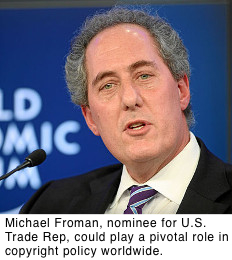
Meet Michael Froman: The Most Important Man in Global Copyright
This is Michael Froman, and barring a scandal, he's about to be the new United States Trade Representative (USTR). The U.S. Trade Representative negotiates international trade agreements on behalf of the United States. Congress has one opportunity to ask him questions at his nomination hearing.
They should take full advantage of it. Right now, the only reason the public knows anything about what the USTR is doing on IP is that whistleblowers participating in the treaty process have leaked what they can. (Congressman Darrell Issa re-published the leaks on his own office site, over the USTR's objections).
Those documents show that the American proposals for the Trans-Pacific Partnership would export the worst of modern U.S. copyright law, and thwart other countries' ability to create laws that best meet their domestic needs:
- The proposed rules could prevent individuals from circumventing DRM—the technical barriers put in place to make copying, accessing, and sharing copyrighted content more difficult. This would hinder technical fixes necessary to make content accessible for the blind or to unlock your phone.
- It contains provisions that would, by default, regulate "temporary" reproductions of copyrighted files, thereby restricting all kinds of intrinsic functions of your computer.
- It increases copyright terms well beyond international standards, adding some 20 years to copyright terms worldwide, potentially robbing the public domain of decades of cultural works.
- In many countries, an allegation of infringement is not enough to get material taken offline. TPP’s proposals, by contrast, put in place a system (similar to the one we have in the U.S.) that encourages ISPs to take down content based on nothing but a notice. We’ve seen how that can be abused here—do we really want to export it wholesale?
Treaties like this also help to fossilize existing U.S. law and force other countries to sign up for American missteps. Momentum in D.C. for rolling back copyright terms and DRM law is growing, but opponents of those changes have argued that lawmakers can't undo their own mistakes—because, they say, we've already signed onto IP trade agreements that we supposedly can't undo.
What We're Doing
We're asking U.S. senators to use the nomination process to grill Froman about the USTR’s IP plans, and we’re petitioning him directly to adopt meaningful transparency and stop using trade agreements to push aggressive IP programs worldwide.
Could Froman really reform U.S. trade agreement strategies? Yes, but only if he and the Administration face coordinated pressure from American politicians and citizens plus resistance from other countries pushing back against American demands.
Which brings us to why EFF's Maira Sutton and Katitza Rodriguez are remotely working right now—from Lima, the capital of Peru.
Yara TPP!
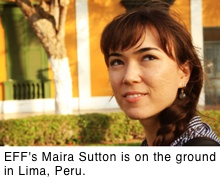
Starting today, the U.S. Trade Rep and negotiators from 10 other countries are meeting in Lima to take part in the latest round of negotiations for TPP.
We beat them there. Kat is our International Rights Director. She's also Peruvian. She's spent the last month in Lima working with fellow Peruvian technologists, makers and artists, highlighting how TPP will affect them. She has been working with the other groups fighting TPP on the ground, including Hiperderecho, Peru's own digital rights activism group.
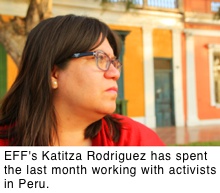
The result? An explosion in information and public debate in Peru about TPP. Kat has written Spanish language editorials, met with Peruvian politicians, journalists, students, free software advocates and filmmakers. Lima's hackerspace, Escuelab, hosted a two-day hackathon that produced memes and microsites that explain TPP to fellow Peruvians and the world. There's even the inevitable Peruvian TPP Downfall video. Other hackerspaces took part around the world, producing sites with titles like http://whytheheckshouldicareaboutthetpp.com/.
The slogan and hashtag of Peruvians' digital rights activists is "#yaratpp", a slang term which means (roughly) "Warning! TPP!". Peruvians have joined the fight at Nonegociable.pe, asking their President to set clear non-negotiable lines to ensure that Peruvians' fundamental freedoms are respected in the TPP negotiations.
Help Us Stop the TPP – and the IP Treaty Tarpit
The TPP negotiators are on deadline in Lima. They've already said TPP's IP chapter is one of the "more challenging issues that remain." It's more challenging still when the host country is demanding to know why this trade agreement would undermine local entrepreneurs and artists. Meanwhile, politicians back in the U.S. are demanding a closer look at their head negotiator's IP stance.
Like battling ACTA, stopping the TPP and its descendants is going to be a long-term fight that will take a worldwide effort. But you can help us today by taking advantage of the Froman nomination to speak truth to power.
Sign our petition demanding that Froman usher in a new age of transparency as the next US Trade Representative:
If you’re in the U.S., please also send a message to your representative to demand an end to these secret backdoor negotiations:
Don’t Let Them Trade Away Our Internet Freedoms
And if you're in Peru, join Hiperderecho and tell the Peruvian president that our rights over the Internet are non-negotiable:
Pidamos juntos límites no negociables
Stay tuned to the Deeplinks blog for more updates on the fight for sensible global copyright policy.
From Para-Professional to Director: A Librarian’s Tale
LeettaschmidtMr. Beman-Cavallaro, I used to know him when...
By A.D. Beman-Cavallaro, MLS
Over my academic and professional career, I attended Florida State University, (attaining my B.S. in Geography in ‘05) and University of South Florida, (to receive my MLS in ‘08). My time at USF, (as a Master’s Student: ’05-’08 and para-professional Library Employee: ’05-’10), prepared me for a position of Reference/Instruction Librarian at the Bartow Public Library in Polk County, FL, (’10-’12). I then returned to the academic world as Associate Library Director for Pasco-Hernando Community College’s (PHCC) Spring Hill Campus, (’12-present). The variations in roles and differences in assigned duties amongst the positions I have held have given a broad perspective on access, instruction and engagement. One element has remained constant however: the desire to provide unbiased access of information to a population.
As a new graduate student in MLS I wanted to gain library experience as soon as possible. My school offered Graduate assistantships, but I chose not to become a GA. Graduate assistants were at the mercy of the Library Science department; some GAs were placed in the library, others were assigned to a Library Science professor. In both cases, GAs worked 20 hours/week outside of their classes. The immediate advantage was the tuition waiver; tuition would be waived so long as the GA took one class per semester.
Several factors influenced my decision not to become a GA. First, I wanted to be able to take credit for getting my own employment. Second, I felt overwhelmed after taking my first full-time graduate semester; after my first semester, I usually only took one class per semester. Third, I did not want to risk being paired with a Professor; if I was paired with a professor, I would not be able to work in a library. Fourth, when GAs graduate they lose their jobs with the University and frequently remain unemployed for a time. Fifth, there is no chance for full-time employment or insurance while being a GA. None of these options sounded appealing to me so I simply stayed away from them.
I applied for a position in my school’s library as a part-time Student Assistant in the Government Documents section. I hoped my B.S. in Geography would give me an advantage over other applicants. When the position went to another individual, one with more library experience, I realized that experience is necessary before applying to even your first paid job in the profession. I then decided to volunteer.
Hoping that no one would turn down free work, I tried to find the appropriate person to set up an interview. I hoped to work in Reference, but I accepted that I would start wherever I was able. Thinking that the top-down method would work best, I contacted the heads of the Reference and Media Resources (MR) departments and established interview times for a volunteer position with each. The MR interview occurred one day, and the Reference interview the next. At the end of the MR interview I was surprised when the department head simply went to get the paperwork for me to sign to begin working. I then canceled my interview with the Reference department, though I didn’t know then that I would one day volunteer for that department years later.
Within MR (the collection of all non-book/non-periodical items in the library), my volunteer duties included small stints at the service desk and circulation of materials, but primarily the completion of long-overdue projects. For weeks I searched through projection slides to find damaged items (little did I know the entire slide collection would be thrown out a few years later). After three months of volunteering, a part-time supervisor position became available once the Library Science school stopped sending Graduate Assistants to the MR department. The department needed someone to work nights and weekends. My big break! I was hired. I supervised Student Assistants, ran the routine tasks of the face-to-face Patron interactions of the department and experienced the oddest hours and days off my new career could offer. I was with MR when the entire collection transferred floors from the 6th to 1st, thus sharing a mutual desk space with the Library’s Circulation Department. This big move opened the door for my first full-time position with the University.
Soon after the move, a Circulation Department employee left, creating a vacancy for a Library Assistant on the front desk. I applied. Now armed with library experience, over a year in the Library Science Program and even supervisory knowledge, I was hired. My new position offered a pay raise, insurance and a tuition waver for 6 credit hours per semester. The last rendered the remainder of my Master’s degree gratis!
My time in Circulation was relatively brief, lasting only a year. During this year I gained the bulk of my patron service skills. The sheer volume of students needing assistance, especially during the final weeks of a semester, was quite huge and often involved handling a large number of impatient and irate individuals in need of books they did not know how to locate and laptops or study rooms which always seemed to be in use. The experience overall however allowed me to gain confidence in handling stressful situations.
After my job in Circulation I was hired as an Assistant Stacks Supervisor, a position in which I become co-responsible for the checking-in, sorting, shelving and locating of all print material within the Library. I managed the veritable army of part-time Student Assistants, and I was also responsible for hiring, training, scheduling, project management, quality assurance and Patron assistance. Learning quickly became very important; whereas my previous position in MR allowed me to supervise two or three individuals, I was now responsible for dozens of employees. It was at this point that I learned one of the most important, unbreakable rules of supervisory work: make sure the people whose timesheets you handle always get paid on time! I remained in the position for two years. While holding this position I also volunteered at the Reference desk during lunch hours, and eventually had Reference work incorporated into my paid daily tasks.
These years working at the USF Tampa Library, combined with my freshly printed MLS, gave me the experience necessary to attain my first professional position.
I became the Reference/Instruction Librarian at the Bartow Public Library in June of ’10. The shift from large University to small town Public Library was indeed a big change. Rather than considering myself an individual who merely granted access to those who came searching for academic knowledge, I became an active educator responsible for teaching those who had no technological background how to access and utilize different forms of information, from the recreational to the life-critical. Instead of searching for answers to Ph.D. questions, I was now teaching basic computer classes; navigating unemployment benefits pages; searching government resources so convoluted it seemed as though they were intentionally designed to be nearly impossible for the average person to find; helping divorcees find their online paperwork; assisting single laid-off Moms find food stamps so their children could eat; getting disabled Vets in touch with places to live; teaching released convicts how to create resumes; and searching for the latest Debbie Macomber novel for the retired lady from the age-restricted community across the street. I came to view the library Library as a service, not merely a place; as an outreach organization to the community, not a stationary set of employees; as a hub of radical positive change, not a stereotyped outdated institution; and as an overall place of instruction in person in groups, in one-on-one tutorials and online through modern mobile technology. These views have become ingrained, and will stick with me for the rest of my life.
For two-and-a-half years this mission was my existence and it has changed very little even though in September of ’12 I applied for and in December accepted the position of Associate Library Director of PHCC’s Spring Hill Campus which I began in January of ’13. Though the position is new for me, the drive which I share everyday with my Staff and Patrons is not, and I am certain that the work I continue with my (once again!) academic colleagues will be as satisfying as that which I have been fortunate enough to be involved with in the past. Fortunately my staff is small and excellent in their work ethic and quality allowing us the ability to collaborate with others to form an environment for access, instruction, engagement, information literacy and support. My own personal hope is that the people with whom I work on a constant basis can themselves be as fortunate as I.
US State Department orders removal of Defense Distributed's printable gun designs
The US State Department has ordered Defense Distributed to take down the designs for a working 3D printed gun, citing export control rules set out in the International Traffic in Arms Regulations. Defense Distributed's Cody Wilson is appealing, and says that ITAR does not apply to "non-profit public domain releases of technical files designed to create a safe harbor for research and other public interest activities" -- though this carve out is for works stored in a library. Wilson's appeal may turn, then, on whether the Internet is a library for the purposes of this regulation. In the meantime, the designs are still up on The Pirate Bay, and are for sale in printed form in an Austin bookseller. More than 100,000 copies of the designs were downloaded from Defense Distributed's servers in the brief time that they were online.
“Until the Department provides Defense Distributed with final [commodity jurisdiction] determinations, Defense Distributed should treat the above technical data as ITAR-controlled,” reads the letter, referring to a list of ten CAD files hosted on Defcad that include the 3D-printable gun, silencers, sights and other pieces. “This means that all data should be removed from public acces immediately. Defense Distributed should review the remainder of the data made public on its website to determine whether any other data may be similarly controlled and proceed according to ITAR requirements.”
Wilson, a law student at the University of Texas in Austin, says that Defense Distributed will in fact take down its files until the State Department has completed its review. “We have to comply,” he says. “All such data should be removed from public access, the letter says. That might be an impossible standard. But we’ll do our part to remove it from our servers.”
Wilson's project is raising some important legal questions, such as whether design files can be considered expressive speech under the First Amendment, and whether the Internet is a library. The question of code-as-speech was famously considered in the Bernstein case, where strong crypto was legalized. However, as we discovered in the 2600 case, judges are less charitably inclined to code-as-speech arguments when they're advanced by non-academics, especially those with counter-culture stances.
Impact litigation -- where good precedents overturn bad rules -- is greatly assisted by good facts and good defendants. I would much rather the Internet-as-library question be ruled on in a less emotionally overheated realm than DIY guns.
State Department Demands Takedown Of 3D-Printable Gun Files For Possible Export Control Violations [Andy Greenberg/Forbes]
(Thanks to everyone who sent this in!) 
|
|
How Anonymous got involved in fighting for justice for rape victims

Mother Jones's Josh Harkinson has an excellent piece on the history of KnightSec, an Anonymous offshoot that publicized the Steubenville and Halifax rape cases, galvanizing both the public and police responses to both. The piece includes an interview with Michelle McKee, who is credited with swaying a critical mass of Anons to participation in KnightSec. The whole story is pretty incredible, especially where it spills over into the real world:
The video went viral, and the next Occupy Steubenville rally drew 2,000 people to the courthouse steps. Because MC brought the sound system, he ended up serving as the de facto master of ceremonies (which is how he ended up with his Twitter handle). As he played excerpts of the Nodianos video over the loudspeakers, he told me, people in the crowd grew so angry that he started to worry that they would riot.
When the Steubenville sheriff showed up, MC invited him up and grilled him about the case. In the end, he diffused the tension by giving the cop a hug. "I'm going to take this negative energy and turn it into a positive thing," he remembers thinking. "You've got to let the crowd vent."
And vent they did. For four hours, there was a catharsis of personal pain and grief that nobody in the small town could have imagined. Women who had been raped stood in front of the crowd, clad in Guy Fawkes masks, to share their stories. Some of them unmasked at the end of their testimonies as they burst into tears. Rapes at parties, date rapes, rapes by friends and relatives—their pent-up secrets came pouring out. "It turned into this women's liberation movement, in a way," MC recalls. "And it just changed everything. There was nothing anybody could do against us at that point because it was so real and so true."
Exclusive: Meet the Woman Who Kicked off Anonymous' Anti-Rape Operations 
|
|
The happiest little plankton in the world

Artist Hiné Mizushima makes these super adorable models of microscopic crustaceans called Daphnia out of felt. Scientists like to get the real-world versions of these creatures drunk, and use them to study how alcohol affects the nervous system. I suspect that Daphnia are cute drunks.
Via David Ng

|
|
1983's wonderful "Introduction to Machine Code for Beginners"

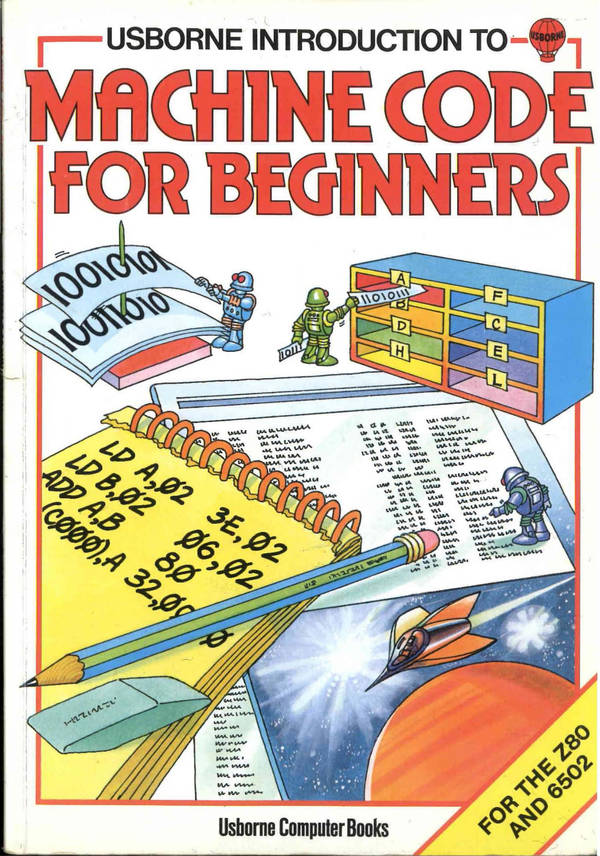 Usborne's 1983 classic Introduction to Machine Code for Beginners is an astounding book, written, designed and illustrated by Naomi Reed, Graham Round and Lynne Norman. It uses beautiful infographics and clear writing to provide an introduction to 6502 and Z80 assembler, and it's no wonder that used copies go for as much as $600. I was reminded of it this morning when @amanicdroid tweeted me with a link to a PDF of the book's interior. I'd love to see this book updated for modern computers and reprinted.
@doctorow Have you read "Introduction to Machine Code for Beginners"(1983)? gomsx.net/hansotten/msxd…Illustrations excellent, ages 10(?)-up
— Dr. Chronobiologist (@amanicdroid) May 16, 2013

|
|
National Geographic Traveler Magazine: 2013 Photo Contest


|
|
Crowdfunding a CC-licensed translation of classic Yiddish book Poylishe Velder (In The Forests of Poland)
LeettaschmidtI get way too excited when something gets a long overdue translation! And I look forward th reading it when it is done. From the author of Born to Kvetch, which is a fabulous work.
Eric sez,
Best selling author and native Yiddish speaker Michael Wex has launched an indiegogo campaign to translate what he is calling the most important work of world literature that you've probably never heard of. The book, written by Joseph Opatoshu in 1921 when he was a young Polish immigrant living in New York City is an historical novel about 19th century Jewish Eastern Europe:
A vast panorama of Jewish life in Poland during the 1850s, Opatoshu's novel concentrates on backwoods Jews who live among gentile peasants rather than in Jewish communities in cities or shtetlekh. Touching as it does on hasidism, heresy, pre-Christian Polish folk customs, wife-swapping, messianism, and Polish nationalism, this book will change the way you think about Jewish life in Poland.
When he completes the work in about a year the translated novel will be released under a Creative Commons license. Wex hopes that a new translation will bring Opatoshu's 1921 novel to a broader audience. "It'll change everybody's views of Jewish life in Poland,' Wex writes. 'If this campaign works, it'll also help other translators find a way to fund their own projects and establish a whole library of world literature that hasn't been translated into English before or has never been translated properly. Raising the money in advance means that the translators can work full time; since the finished product doesn't cost anything, they don't have to worry about a book's commercial potential. It's like a grassroots Guggenheim."
Wex wrote the wonderful book Born to Kvetch, which I reviewed in 2009.
New Authorized Translation of a Classic Yiddish Novel into English 
|
|
Samurai Pizza Cats series box set gets date and price
LeettaschmidtI used to watch this every morning before school.
We noted a couple months ago that Discotek Media was planning on releasing the entire Samurai Pizza Cats series on DVD. As one of my favorite cartoons as a kid, I've been watching this news very carefully, and we now have a date and price for the set. According to their Facebook posting, 52 episodes spanning eight DVDs will go on sale July 30, 2013 for $79.99.
I guess I'll finally be able to throw out the VHS tapes that I meticulously recorded and cataloged by episode back in the day. Any other fans of the Pizza Cats out there excited that this is finally happening?
Now, if somebody could finally get around to re-releasing Mighty Max, the early-morning cartoons of my childhood will all be within grasp...

Dyslexia Typeface
I stumbled upon this typeface nearly eight months ago, and thought that I had written about it, but after recommending it for the 3rd or 4th time, I realized that I had failed to actually create the post.
OpenDyslexic is a typeface that is specifically designed to be more usable for readers with, you guessed it, dyslexia. The characters are weighted (the lines are made thicker) on the lower portion of the letter, reducing the tendency by the dyslectic reader to mentally rotate the letter.
OpenDyslexic is not the first font designed this way, but it is the first open source, free typeface developed developed for dyslexia. It didn’t start out this way, and the story of how the murky legal landscape surrounding fonts and typefaces makes for an interesting read.
Here is a sample of the typeface:

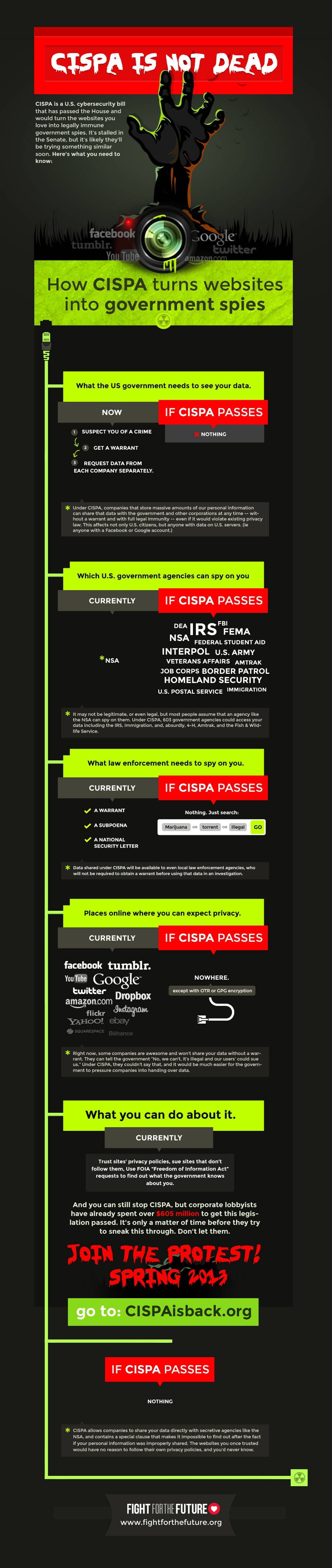
CISPA is not dead! It's coming back -- get ready!

Evan from Fight for the Future sez, "All of your phone calls, emails, petition signatures, and tweets are working. The privacy-killing back-from-the-dead zombie bill CISPA is a bit stalled in the Senate, with over $605 million in lobbying spent on it already, it's bound to be back to haunt us in some form soon. So we made an infographic to get everyone up to speed. This Spring, we'll be organizing the largest online privacy protest in history, to send this bill back where it belongs. Join us?"

|
|


duckhymn: The Dark one and His Lady. Thank you all once again...

The Dark one and His Lady. Thank you all once again for all the lovely comments and re-blogs/faves!
NZ parliament erupts in song after passing marriage equality bill
LeettaschmidtBeautiful. I wish this happened all over.
On Wednesday's, New Zealand's parliament passed its Marriage (Definition of Marriage) Amendment Bill in a 77-44 vote, expanding the country's 2005 civil union regime into full-blown marriage equality. Observers in the gallery and MPs on the floor burst into song, a stirring rendition of "Pokarekare Ana," an NZ lovesong that dates back to WWI. What a lovely, lovely moment.
New Zealand House of Reps bursts into song after legalizing same-sex marriage (via Making Light) 
|
|
More Post-It Monsters


I picked up John Kenn Mortensen's More Post-It Monsters at a comic-show in London and it's terrific. Mortensen draws beautiful and grotesque line-art monsters on yellow sticky notes, and, as with the first collection of these, Sticky Monsters, More Post-It Monsters reproduces them with a minimum of text (apart from a brief and charming intro from China Mieville) and other distractions. It's just about 80 pages' worth of Gorey-esque illustrations that'll excite and reward your brain's monster-center.
John Kenn Mortensen: More Post-It Monsters


|
|
Caddis fly larvae coaxed into building cocoons out of precious metals and gems

This 2007 profile of Hubert Duprat's work with caddis fly larvae is a tiny, entomological miracle. The larvae build their cocoons with whatever material is at hand; Duprat forces them to build with gold and precious gems, making spectacular bio-organic jewelry.
Duprat, who was born in 1957, began working with caddis fly larvae in the early 1980s. An avid naturalist since childhood, he was aware of the caddis fly in its role as a favored bait for trout fishermen, but his idea for the project depicted here began, he has said, after observing prospectors panning for gold in the Ariège river in southwestern France. After collecting the larvae from their normal environments, he relocates them to his studio where he gently removes their own natural cases and then places them in aquaria that he fills with alternative materials from which they can begin to recreate their protective sheaths. He began with only gold spangles but has since also added the kinds of semi-precious and precious stones (including turquoise, opals, lapis lazuli and coral, as well as pearls, rubies, sapphires, and diamonds) seen here. The insects do not always incorporate all the available materials into their case designs, and certain larvae, Duprat notes, seem to have better facility with some materials than with others. Additionally, cases built by one insect and then discarded when it evolves into its fly state are sometimes recovered by other larvae, who may repurpose it by adding to or altering its size and form.
Artist Project / Trichopterae (via Neil Gaiman)
(Photos: Jean-Luc Fournier) 
|
|
Goldie Blox and The Spinning Machine
LeettaschmidtI really want to give this to a kid now. Maybe during Christmas toy donations or something!

 Goldie Blox and The Spinning Machine is a game designed to encourage young girls to get into engineering. I gave my 6-year-old daughter a set for her birthday and she loves it!
Kids join Goldie via a series of short stories. They build, along side Goldie and her pals, the same machines she does! The machines largely spin characters around pirouette-style, and the designs are never complex! Its really engaging!
Building with Goldie's Blox is easy. There is a stable board where axles and posts slot in cleanly. Children wrap ribbon around them and use cranks to wind, tension and spin things. The stories are well written and very simply walk kids through the basics. The designs are easy to follow. I was really pleased with how well designed the whole game is. Engineers, go figure!
Finding engaging toys and games that expose my daughter to mechanical engineering, science and just how the world works is difficult. The first time she played with Goldie, my daughter built machines for 3 hours. I'd say this game does a good
I'm a big fan of Goldie Blox and The Spinning Machine.

|
|
What I learned getting published by Taylor & Francis.
It was a rather embarrassing moment. I was in a meeting with other copyright specialists from academic libraries when I received the email telling me that my article with Taylor & Francis had been published. Before I could stop myself, I expressed my surprise out loud, then had to explain to my colleagues that I had just had an article published in a library science journal published by Taylor & Francis, and that I was not expecting it. Two sources of embarrassment here. First, especially following the resignation of the entire editorial board of a different library-related T&F journal due to their archaic authors’ rights policies, this is not a publisher with whom I would have chosen to do business or encouraged authors who consulted me to use. Second, the fact that I was surprised by this news showed that I had been much more lax in my own decisions about publishing than I advise other academic authors to be. It is always awkward to be caught in a “do as I say and not as I do” situation, and especially so when you have to explain it to a respected set of colleagues.
So let me explain how this happened and what lessons can be gleaned from my experience.
The story began when I gave a talk at the 2012 conference of NASIG, the North American Serials Interest Group. Let me say at the start that no one at or representing NASIG did anything wrong in this encounter and that whatever misunderstanding or lack of information existed was entirely my fault. NASIG provided me with an interesting and engaged audience of librarians, which was all I could ask. In any case, I signed an agreement, as a “Vision” speaker (kind of ironic), allowing my talk to be mechanically recorded and also agreeing that a human “recorder” would write up what I said for an article for The Serials Librarian. In due time, that reporter sent me a copy of the article and I agreed that it was a good representation of the talk I had given, ready to be published. Not until the article was published did I realize that The Serials Librarian was a Taylor & Francis journal, and to the best of my recollection I never signed a copyright transfer agreement with T & F. At least, I can find in my saved e-mail the agreement to publish in The Serials Librarian but not a CTA.
Again, neither NASIG nor the article author did anything wrong; they sought and obtained all the necessary authorizations from me. It may well also be the case that the recorder who wrote up the article signed a CTA with Taylor & Francis, which she would have been entirely entitled to do. But as I say, to the best of my knowledge I did not, and the lessons I take from this incident are premised on that recollection.
So the first lesson is obvious — be careful what you sign. More careful than I was. I should have determined who the publisher was and made an intentional decision before I signed that agreement about what would be done with the article that resulted from my talk. It is quite likely that I would have agreed even after that small bit of research, since the article was actually written by someone else (as, I suppose, a derivative work from my original talk), and I had no further plans to use it in any way. What I often tell authors is to consider the agreement they are presented with in light of their own plans and hopes for their work, and transfer or license rights in a way consistent with those plans. If the agreements allow one to meet those goals, well and good; if they do not, negotiation is called for. The decision should rest with the author. In the experience I had, I did not make that decision in an informed way, and that, rather than the ultimate result, was the problem.
The second lesson from this experience is that authors choose journals, not publishers. When I read over the agreement with NASIG, The Serials Librarian seemed like a proper venue for the article resulting from my talk, and I failed to inquire further. Although I should have done, I did not look into the publisher’s identity because for me at that moment, as for many academic authors, it simply didn’t matter. The first step in getting academic authors to pay attention to the rights they transfer or retain is helping them realize that not all publishers are alike in this matter, and that they do need some awareness of who is who.
Next, my little story provides an opportunity to remind readers about the issue of joint authorship. Joint authors are very common, of course, in academia. Once mostly found in the STM fields, digital humanities projects are now making joint authors out of folks from many different departments. Joint authorship arises, of course, whenever two or more people each contribute original expression with the intent of creating a unified work. In the case of my talk, my original expression was fixed in the PowerPoint slides and notes that I had made. Recorder Susan Davis then created a derivative work from that original, adding a great deal of her own original expression. Once I had indicated my assent to that process, she and I became joint authors. Like all joint authors, we each hold an equal and undivided share in the copyright, and are each entitled to exercise the exclusive rights granted by copyright, subject only to a duty to account to each other for any profits (which I don’t expect, in this case). Because of this situation, if Susan signed a copyright transfer agreement for publication of the article, she was perfectly entitled to do so. And because of the potential that fact has to create misunderstandings and surprises for other joint authors, it illustrates how important it is in general that joint authors agree in advance, whenever possible, about how their shared work will be used, licensed and made public.
Finally there is this point — if I am correct that I never signed a copyright transfer, and assuming, for the sake of illustration, that Susan did, then Taylor and Francis and I are now joint holders of the copyright in this article. One thing that means is that I can continue to exercise all the rights as a copyright owner — I could post the article to the web if I wanted to, for example — without consent from T & F. So when publishers tell us that they need to be the exclusive holder of copyright in every item that they publish, it is important to realize that that may be an aspiration, but it is not a necessity. In fact, my experience is only one of a large number of scenarios under which publishers routinely publish articles for which they are not the exclusive rights holders. As we seek to reform the scholarly publishing system, partly by encouraging academic authors to pay better attention than I did in regard to this article, this fact is an important piece of information to remember.
U.S. House of Representatives Shamefully Passes CISPA; Internet Freedom Advocates Prepare for a Battle in the Senate
Today, Internet freedom advocates everywhere turned their eyes to the U.S. House of Representatives as that legislative body considered the Cyber Intelligence Sharing and Protection Act.
For the second year in a row, the House voted to approve CISPA, a bill that would allow companies to bypass all existing privacy law to spy on communications and pass sensitive user data to the government. EFF condemns the vote in the House and vows to continue the fight in the Senate.
"CISPA is a poorly drafted bill that would provide a gaping exception to bedrock privacy law,” EFF Senior Staff Attorney Kurt Opsahl said. “While we all agree that our nation needs to address pressing Internet security issues, this bill sacrifices online privacy while failing to take common-sense steps to improve security."
The legislation passed 288-127, despite a veto threat from Pres. Barack Obama, who expressed serious concerns about the danger CISPA poses to civil liberties.
"This bill undermines the privacy of millions of Internet users,” said Rainey Reitman, EFF Activism Director. “Hundreds of thousands of Internet users opposed this bill, joining the White House and Internet security experts in voicing concerns about the civil liberties ramifications of CISPA. We’re committed to taking this fight to the Senate and fighting to ensure no law which would be so detrimental to online privacy is passed on our watch.”
EFF extends its deep gratitude to the many organization that have worked with us on this campaign and the tens of thousand of EFF members who helped us by contacting Congress to oppose CISPA. We look forward to continuing to fight by your side in defense of civil liberties as CISPA moves to the Senate.
Related Issues: Cyber Security LegislationShare this:


 || Join EFF