Shared posts

17 Apr 19:06

News is bad for you – and giving up reading it will make you happier

by Mark Frauenfelder
Rolf Dobelli, author of the forthcoming book, The Art of Thinking Clearly, has an essay in the Guardian that explains the many reasons why you shouldn't read, listen to, or watch news. I don't agree with everything he says, but I found it thought-provoking.

News is toxic to your body. It constantly triggers the limbic system. Panicky stories spur the release of cascades of glucocorticoid (cortisol). This deregulates your immune system and inhibits the release of growth hormones. In other words, your body finds itself in a state of chronic stress. High glucocorticoid levels cause impaired digestion, lack of growth (cell, hair, bone), nervousness and susceptibility to infections. The other potential side-effects include fear, aggression, tunnel-vision and desensitization.

News makes us passive. News stories are overwhelmingly about things you cannot influence. The daily repetition of news about things we can't act upon makes us passive. It grinds us down until we adopt a worldview that is pessimistic, desensitised, sarcastic and fatalistic. The scientific term is "learned helplessness". It's a bit of a stretch, but I would not be surprised if news consumption, at least partially contributes to the widespread disease of depression.

News is bad for you – and giving up reading it will make you happier


17 Apr 13:08

VIDEO: Unstoppable crawl of giant land snail

Leettaschmidt

Oh boy! another fun and crazy creature in Florida.

One of the world's largest species of snail, which feeds on more than 500 types of plant, has descended on Florida.
16 Apr 19:10

vasengard: Theseus and the Minotaur. by Annie Wu. on Flickr.

by sarahcross
12 Apr 14:30

What Are Those Stickers on Japanese Cars?

by Hashi

When the Tofugu team was in Japan earlier this year, we were very lucky to have the Gakuranman drive us around to places that might be hard to get to otherwise. We rented a car, and I was a little confused by a big, green and yellow sticker on the front and back of the car.

I asked the Gakuranman what it meant and he explained that the sticker was for beginner drivers. I would soon find out that the Gakuranman had more than earned this sticker, and later found out that it was just one sticker of many.

It shouldn’t be surprising that Japan offers a whole array of colorful symbols for the road, but you might not know what all of them mean. Here’s the breakdown of the four stickers you might see in Japan:

Beginners 🔰

In the US, if you take a driving class before you get your license, you usually get the honor of driving around in a car with a giant, yellow “STUDENT DRIVER” sign so everybody on the road is at least aware of your incompetence.

But once you get your license, there’s no indication that you’re a new driver. You’re free to terrorize the roads without anybody knowing that you’ve only been driving for two weeks.

student-driver

Photo by Ildar Sagdejev

Not so in Japan. For one year after you get your driver’s license in Japan, you have to put the green and yellow “beginner” sticker on the front and back of your car. It lets other drivers on the road that they should maybe give you a little more room and patience than your ordinary driver.

The official name of this sticker in Japanese is 初心運転者標識, but you might know it as the “wakaba mark” 若葉マーク, or the “green leaf mark.” I guess that the implication is that, as a driver, you’re like a fresh leaf, right out of the bud.

copen-wakaba

Photo by Haruka Iwao

What’s really interesting about the wakaba mark is how far it’s spread. Even though it was created for new drivers, people from virtually every walk of life have embraced the symbol.

Car enthusiasts from around the world slap the wakaba mark on their cars, even if they’re not even remotely beginners. Games will use the symbol to indicate the “easy” or “beginner” difficulties. I’ve seen pictures of wakaba stickers slapped onto computer cases. There’s a wakaba emoji. Hell, I even found this picture of a horse with the wakaba mark on it. New rider, I guess?

wakaba-horse

Photo by Miyaoka Hitchcock

It’s cool to me that the wakaba mark has spread so far beyond its intended purpose and is so widely understood. Could the wakaba mark one day become the universal symbol for beginners? Time will tell.

Elderly People

At the beginning and end of people’s driving careers, they tend to not drive as well. In the beginning, it’s because of inexperience; towards the end, it’s because judgement and reaction time aren’t what they used to be.

The way that the Japanese tackle the issue of elderly drivers is, you guessed it, with another sticker. It’s called the 高齢運転者標識, or the “koreisha mark” (“koreisha” meaning “elderly”) for short.

koreisha-cars

Photo by David A. LaSpina

Drivers aged 70 and older have to display the koreisha sticker on their car. It can let other drivers on the road know to have a little more patience with a driver with this particular sticker on their car. Plus, you get other perks like reserved parking spaces.

koreisha-parking

Photo by Nemo’s great uncle

Koreisha means “elderly,” but people have given the mark other, less flattering names. Instead of the green leaf mark of beginner drivers, people will sometimes call it the autumn leaf, dried leaf, or even fallen leaf mark.

As you might imagine, the image of a withered, dried up, fallen leaf is kind of an offensive way to describe the elderly. Because of this branding problem, in 2011 the koreisha mark changed from the orange and yellow teardrop shaped sticker to a bright, colorful clover symbol.

new-koreisha-mark

The change to the new symbol wasn’t that long ago, so you still might see the former koreisha symbol around on cars in Japan.

Handicapped People

Like the US, Japan also has a catch-all handicapped permit for cars. Unlike the US, Japan has doesn’t always use the International Symbol of Access, the universally recognizable symbol of a person in a wheelchair on a blue background.

yotsuba-mark

Instead, Japan also uses a weird, four-leaf clover umbrella symbol called the 身体障害者標識. It’s supposed to be encompass more disabilities than the obvious physical disabilities represented by the International Symbol of Access.

Plus, it fits in with the rest of the other, nature-themed stickers, and disabled otaku can go nuts over having a sticker nicknamed the “yotsuba mark.”

Hearing-Impaired People

Aside from the general handicapped sticker, Japan also has one just for hearing-impaired people. The symbol (called 聴覚障害者標識 in Japanese) is yellow and green, and supposed to represent two ears arranged as a butterfly.

hearing-impaired-sticker

I get that it’s supposed to fit in with the nature theme, but an ear butterfly sounds like something you would find in a serial killer’s house.


So if you’re ever driving in Japan and see one of these stickers, give those drivers a little more room, consideration, and patience. Who knows? The Gakuranman might even be behind the wheel.

09 Apr 11:34

The Pile print is NOW AVAILABLE.

by Scott Campbell

PILE OF PEE WEES print is now available!

Get them at Poster Cabaret!

They are very limited in number, so get them sooner rather than later!

05 Apr 12:43

Court rules digital resales are a no-no

by The Beat
Tweet

person confused by computer
Can you sell “used” digital copies of books and music? You used to be able to via services such as ReDigi which allowed you to upload a digital file while removing it from your computer. However a court has ruled that this resale does not come under the first sale doctrine, since it isn’t a physical copy. Under first sale doctrine, once you purchase a copyrighted work like a book, dvd or CD you can resell it. The court ruled digital copies were not the same. Brigid Alverson unpacks the decision a bit here:

The digitally curious might want to read the entire ruling (linked above), because it goes into some detail about this concept. But the bottom line is this judge sees the first sale doctrine as applicable only to physical media — so if you want to sell your iPad or Kindle loaded with digital comics, that would be fine, but you couldn’t sell the comics one by one as digital files.

What does it mean to sell a used digital file, anyway? And why would you bother? It might seem like a strange idea, but both Amazon and Apple are working on it. Part of this may have to do with cost: There is a persistent perception that digital comics and e-books are worth less than their hard-copy counterparts, in part because they can’t be passed along to a friend or resold. On the other hand, a used digital file is indistinguishable from a new one, except for price, so publishers have a strong incentive to fight resales.


James Grimmelman has further analysis in terms we can all understand:

ReDigi said yes: the copy that emerges from its tramsporter is the same copy that goes in. It is, after all, bit-for-bit identical.Judge Sullivan, however, said no, because the new Kirk-copy is a different “material object” than the old one, made up of different atoms, stored on a different hard drive. Indeed, to borrow an idea from Parfit, consider what would happen if the transporter malfunctioned and instead functioned just like the Internet—that it is, as a “transporticator.” Old Kirk is still standing on the Enterprise; new Kirk is standing on the planet.ReDigi's solution is worthy of Evil Spock: set phasers on kill, execute the old Kirk, and toss him out the airlock.


While used digital comics sales haven’t been a huge story yet, this ruling makes it less likely that they ever will be.

04 Apr 17:32

Mining Books To Map Emotions Through A Century

by Bibliofuture
Leettaschmidt

what I wonder is, are authors now a-days using more abstract metaphor to describe emotion instead of regular vocabulary...

Were people happier in the 1950s than they are today? Or were they more frustrated, repressed and sad?

To find out, you'd have to compare the emotions of one generation to another. British anthropologists think they may have found the answer — embedded in literature.

Full piece: http://www.npr.org/blogs/health/2013/04/01/175584297/mining-books-to-map-emotions-through-a-century

26 Mar 19:47

19 year old develops plan to clean up ocean trash vortexes

by Jason Weisberger
Leettaschmidt

Right now in this world, no one is cooler than Boyan Slat.

Inhabitat shares the story of Boyan Slat, a 19 year old who seems hell-bent on cleaning up 7.25M tons of trash from our oceans. He started with a research paper in school, which won several awards. Next Slat developed a floating array of booms and garbage processing plants which he presented at TedxDelft last year, and now he's created a foundation to produce these technologies!

From Inhabitat:

Slat went on to found The Ocean Cleanup Foundation, a non-profit organization which is responsible for the development of his proposed technologies. His ingenious solution could potentially save hundreds of thousands of aquatic animals annually, and reduce pollutants (including PCB and DDT) from building up in the food chain. It could also save millions per year, both in clean-up costs, lost tourism and damage to marine vessels.
26 Mar 14:04

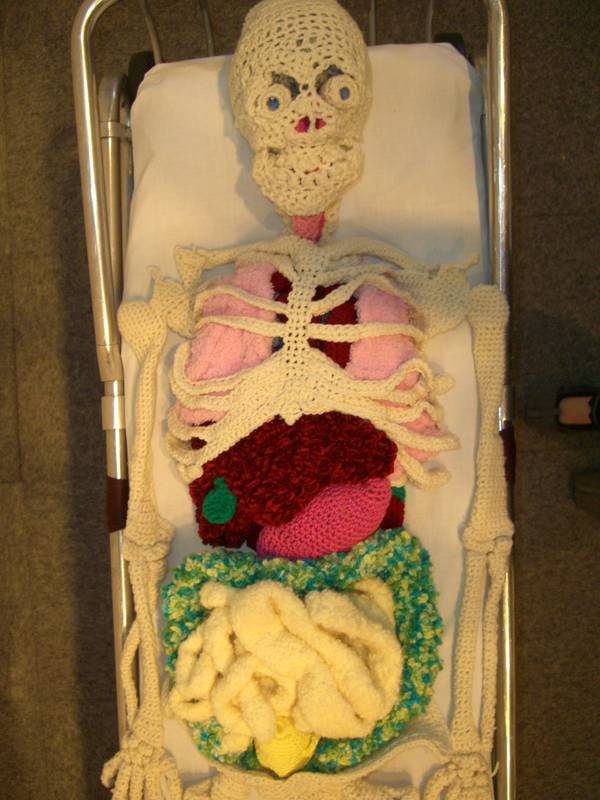
Crocheted skeleton with organs

by Cory Doctorow
Leettaschmidt

Love love crochet sculpture.

Artist Shanell Papp has a project called "Bawdy," which is about bodies and textiles. The centerpiece is "Lab," a yarn skeleton with a complete set of organs.

Lab (skeleton) (via Making Light)